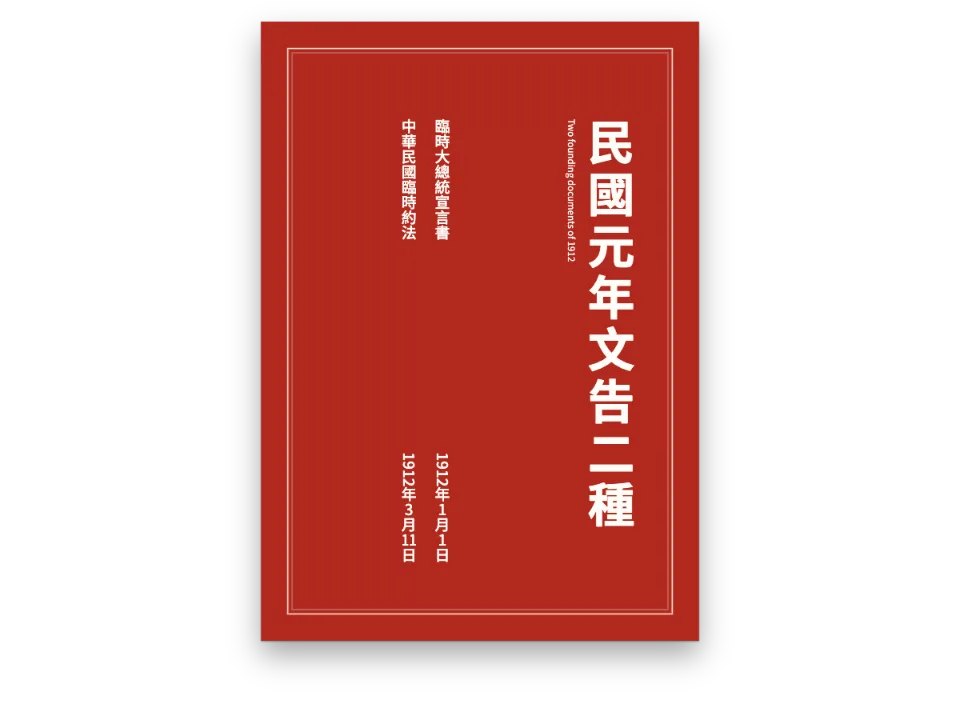
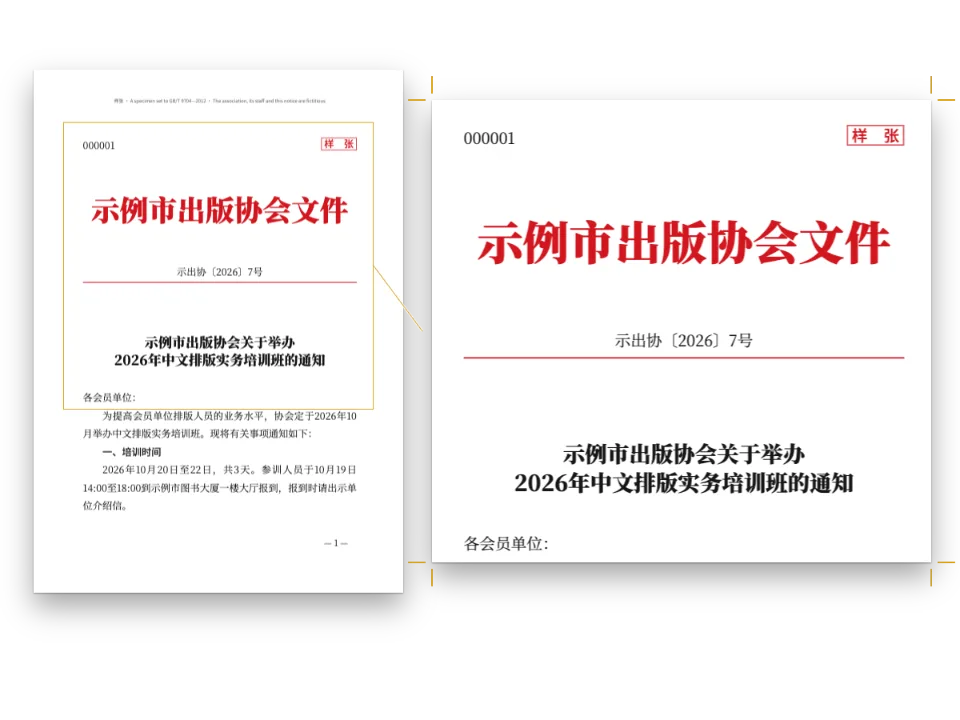
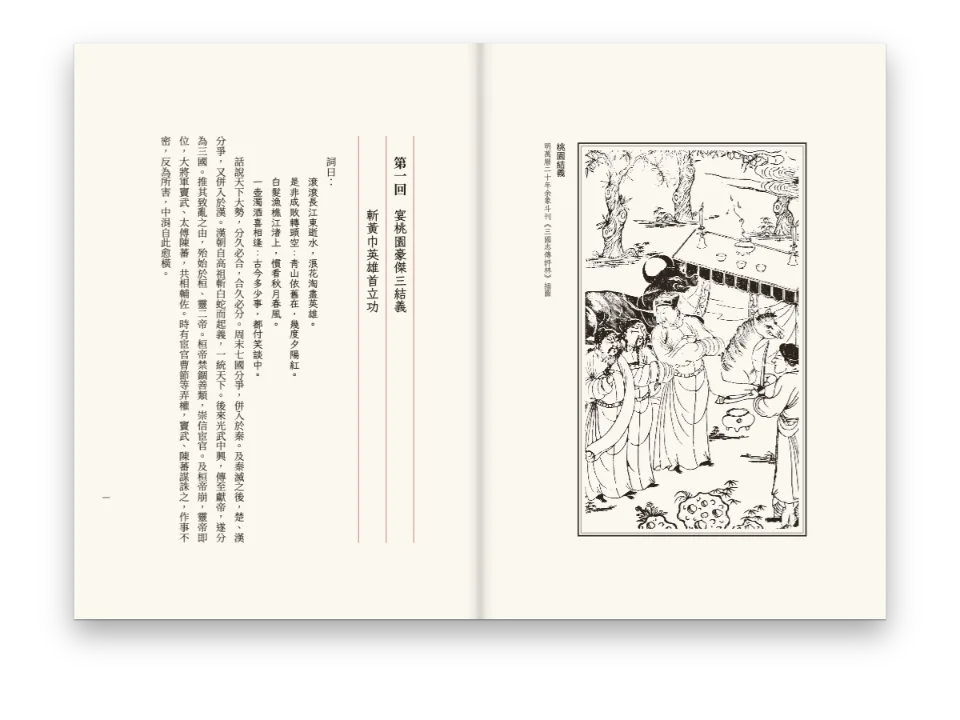
Em poucas palavras
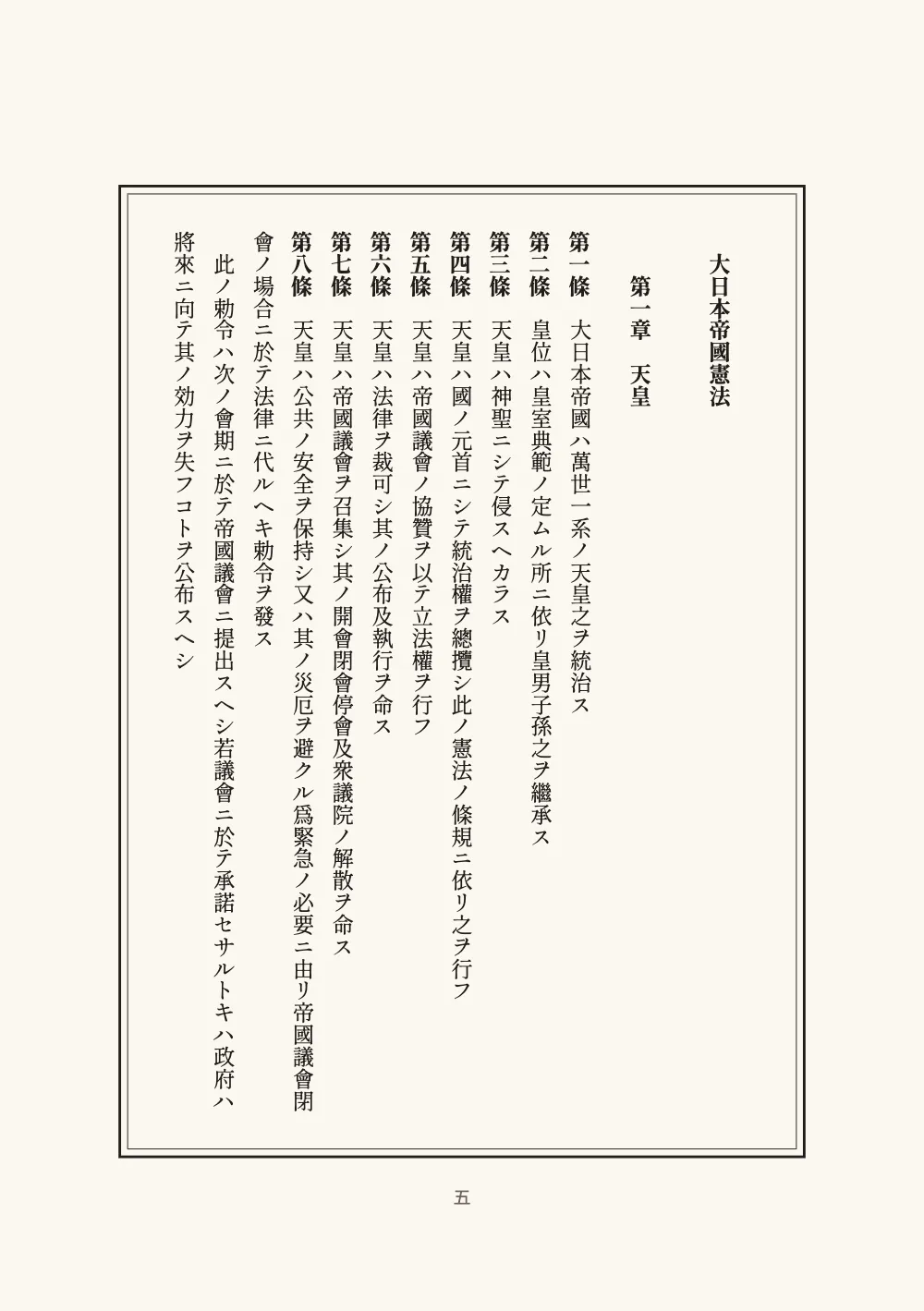
A constituição japonesa de 1889, escrita em kanji e katakana e impressa em linhas de cima para baixo como o diário oficial a imprimiu, com os artigos numerados em kanji.
O que você vai compor
Uma reimpressão de oito páginas da Constituição Meiji como o Diário Oficial (官報) a publicou em 11 de fevereiro de 1889: o édito imperial, as referendas dos ministros e os dois primeiros capítulos, trinta e dois artigos. O texto é 漢字カタカナ交じり文 (kanji-katakana majiri-bun), a língua escrita das leis Meiji: os kanji levam as palavras, os katakana levam as terminações, e não há marcas de sonorização, nem kana pequeno, nem pontuação alguma. As páginas são A5, verticais e encadernadas pela direita, com uma grade de 40 × 15 caracteres dentro de um fio grosso e um fino. Os artigos são numerados por um contador de lista em kanji, de 第一條 a 第三十二條, e o selo e as referendas ficam onde o Diário os pôs.
Esta receita responde a
- Como componho um texto Meiji em kanji e katakana, com suas formas antigas, e numero seus artigos 第一條?
- Como numero capítulos 第一章 com numerais kanji, ou itens de lista あ い う e イ ロ ハ?
- Quais fontes compõem japonês, com os kanji nas formas japonesas, na tela e no PDF?
A resposta curta
const layout = { layoutType: 'single', writingMode: 'vertical-rl' }; // bound on the right
const cjk = { grid: { enabled: true, charsPerLine: CHARS, linesPerPage: LINES } };
// Each article is an item of an ordered list: the counter is japanese-informal (十八, not
// 一十八), the prefix 第 and the separator 條 wrap it, and the turnover lines go back to
// the head of the line, as in the Gazette. Chapter two starts its list at 18.
const orderedLists = {
  numberFormat: 'japanese-informal', prefix: '第', separator: '條', gap: em(1),
  indent: em(0), hangingIndent: false, fontFamily: MINCHO, fontWeight: 800,
  color: col('ink'), marginTop: pt(0), marginBottom: pt(0), itemSpacing: pt(0),
};
// The chapters: 第{2:一}章 counts them in the same style, two characters down (字下げ).
const chapter = { level: 2, numberingTemplate: '第{2:一}章', numberSeparator: ' ',
  fontSize: pt(BODY), fontWeight: 800, indent: em(2), lineSpan: 2, // 二行取り
  breakBefore: { enabled: false } };
Ingredientes
- Funcionalidades
- Kana, kanji e rōmajiNumerais japoneses e contadores em kanaTexto verticalLivros encadernados pela direitaGrade de caracteresFontes chinesas, japonesas e coreanasQuebra de linha em japonês (kinsoku)Títulos sobre linhas do texto (gyōdori)Listas numeradasListas com marcadores e de verificaçãoAberturas desenhadasEstilos de títuloAtributos de títuloEstilos de parágrafoTextos, fios e caixas nos designs de páginaCabeços e fóliosCor do papelPaleta de cores semânticaExportação para PDFFontes incorporadas ao PDF
- Também usa
- Quebra de linha em chinêsTítulos numeradosCabeços por tipo de páginaElementos pré-textuais em romanosCapítulos sem número
- Tipografia
- Shippori Mincho B1, Noto Sans JP (SIL OFL 1.1)
- Materiais
- Nenhum: todas as imagens são desenhadas em código
Preparo
#1 · Deixe um contador de lista escrever 第十八條
O código é a resposta curta logo acima. Cada artigo é um item de uma lista numerada do Markdown, e orderedLists dá ao número a forma do Diário: numberFormat: 'japanese-informal' escreve 十八, e não 一十八, prefix: '第' e separator: '條' o envolvem, e gap: em(1) deixa o espaço de largura inteira do original. Com hangingIndent: false, as linhas seguintes voltam ao início da linha em vez de ficarem penduradas sob o texto, como no Diário. O capítulo dois começa a sua lista em 18., então o contador continua de um capítulo para o outro, e os próprios capítulos são numerados 第一章 e 第二章 pelo modelo de título 第{2:一}章, no mesmo estilo de contador (listas numeradas).
#2 · Deixe os katakana como o Diário os escreveu
locale: 'ja' aplica as regras japonesas, e nenhuma delas reescreve o texto. 侵スヘカラス fica sem as marcas de sonorização (lê-se okasu bekarazu), 行フ mantém o seu kana histórico e 奪ハルヽ a sua marca de repetição em katakana. Sem kana pequeno nem pontuação no texto, as quebras de linha caem entre dois caracteres quaisquer; as regras de kinsoku continuam impedindo que ヽ e 々 abram uma linha. As notas do editor, em japonês moderno com hiragana, ficam ao lado do édito na página 2, e assim os dois jeitos de escrever japonês podem ser comparados numa mesma página.
#3 · Desenhe a moldura em todas as páginas
// Header elements are placed on the sheet, not in the flow, so the frame is drawn in
// plain page millimetres: GAP outside the type area, then 1.4 mm to the thin rule.
const GAP = 6;
const rule = (id, out, thickness) => ({ kind: 'box', id, pages: 'all',
  style: { borderColor: col('ink'), borderWidth: pt(thickness) },
  placement: { anchor: { to: 'page', edge: 'top-left' },
    offset: { x: mm(SIDE - out), y: mm(HEAD - out) },
    size: { width: mm(AREA.across + 2 * out), height: mm(AREA.down + 2 * out) } } });
const header = { elements: [
  rule('outer', GAP + 1.4, 1.2), rule('inner', GAP, 0.4),
  // The folio in kanji, under the frame, in the middle of the page.
  { kind: 'text', id: 'folio', content: '{pageNumber}', pages: 'body', fontFamily: GOTHIC,
    fontSize: pt(8), color: col('muted'), align: 'center',
    placement: { anchor: { to: 'page', edge: 'top-left' },
      offset: { x: mm(0), y: mm(HEAD + AREA.down + GAP + 6) }, size: { width: mm(TRIM.w) } } },
] };
O encaixe do cabeçalho desenha em milímetros da página, e não no fluxo vertical, então a moldura são duas caixas postas com os mesmos números que posicionam a mancha: HEAD a partir do alto, SIDE a partir de cada borda. As margens são calculadas a partir da grade em vez de deixadas por conta dela, e a mancha fica exatamente 6 mm para dentro do fio fino. O fólio, em kanji por pageNumbering.format: 'japanese-informal', fica sob a moldura.
#4 · Componha a folha de rosto sobre o eixo
// In the flow frame of a vertical page x runs down the column, y leftward across it.
const at = (down, across) => ({ anchor: { to: 'container', edge: 'top-left' },
  offset: { x: mm(down), y: mm(across) } });
const MID = AREA.across / 2; // mm: the axis of the page, from the right of the type area
const cover = {
  id: 'cover', numbered: false, toc: false, span: 'page', runningChapter: false,
  breakBefore: { enabled: true, parity: 'any' },
  advancedDesign: { enabled: true, slot: { elements: [
    { kind: 'text', id: 'title', content: '{titleText}', fontFamily: MINCHO, fontWeight: 800,
      fontSize: pt(34), lineHeight: 1, letterSpacing: pt(10), color: col('ink'),
      placement: at((AREA.down - (7 * 34 + 6 * 10) * PT) / 2, MID - 34 * PT / 2) }, // centred
    { kind: 'text', id: 'date', content: '{attr.date}', fontFamily: MINCHO, fontSize: pt(11),
      lineHeight: 1, letterSpacing: pt(2), color: col('seal'), placement: at(30, MID + 18) },
    { kind: 'text', id: 'source', content: '{attr.source}', fontFamily: MINCHO,
      fontSize: pt(11), lineHeight: 1, letterSpacing: pt(4), color: col('ink'),
      placement: at(30, MID - 18 - 11 * PT) },
    // The edition's language, turned with the line, at the foot of the type area.
    { kind: 'text', id: 'latin', content: '{attr.latin}', fontFamily: GOTHIC, fontSize: pt(7.5),
      lineHeight: 1.5, color: col('muted'), overflow: 'wrap', align: 'right',
      placement: { ...at(0, AREA.across - 9), size: { width: mm(AREA.down), height: mm(9) } } },
  ] } },
};
Num fluxo vertical, x desce pela folha e y avança para a esquerda, então a coluna do título é posicionada pela distância até a borda direita da mancha. A data, na cor de destaque, e o nome do Diário ficam dos dois lados do título, a 18 mm do eixo.
#5 · Carregue cada fonte com o texto que ela compõe
const notes = (markdown.match(/^- .*$/gm) ?? []).join('');
const gothicText = `${notes}凡例上諭一二三四五六七八九十${markdown.match(/latin="([^"]*)"/)[1]}`;
A Shippori Mincho B1, uma Mincho com as formas antigas 國, 條 e 權, carrega os arquivos do texto e dos títulos; a Noto Sans JP carrega só as notas do editor, os fólios e a linha em inglês. Uma fonte que recebe menos do que compõe faz a captura falhar (C12).
A receita completa
// ═══ Postext Cookbook · Nº 128 · A Meiji proclamation in kanji and katakana ═════════ // https://postext.dev/en/cookbook/katakana-majiri-proclamation // Code: MIT · Text: Kanpō 1889, ja.wikisource (CC BY-SA 4.0); notes (CC BY 4.0) // Fonts: Shippori Mincho B1, Noto Sans JP (SIL OFL 1.1) · Needs postext ≥ 1.16.1 // The Meiji Constitution as the Official Gazette printed it: kanji and katakana, vertical. import { buildDocument, renderPageToCanvas, clearMeasurementCache, loadVerticalAlternates, } from 'https://esm.sh/postext'; import { renderToPdf, decompressWoff2 } from 'https://esm.sh/postext-pdf'; const LANG = 'en'; // @lang: the language of the frame; the text is Japanese in both editions const RECIPE = 'katakana-majiri-proclamation'; // ─── 1 · Design ───────────────────────────────────────────────────────────── // #region palette: gazette black, one vermilion for the seal, toned paper const palette = { ink: '#211d1a', // the text and the frame seal: '#a8321f', // 御名御璽 and the cover's date: the one accent (5.5:1 on the paper) muted: '#6b6259', // the editor's notes, the folio, the colophon paper: '#fbf8f0', }; const col = (id) => ({ hex: palette[id], model: 'hex', paletteId: id }); const colorPalette = [ ...Object.entries(palette).map(([id, hex]) => ({ id, name: id, value: { hex, model: 'hex' } })), { id: 'main-color', name: 'seal (defaults)', value: { hex: palette.seal, model: 'hex' } }, ]; // #endregion const MINCHO = 'Shippori Mincho B1'; // 明朝 with Meiji type in its bones, old forms 國 條 權 const GOTHIC = 'Noto Sans JP'; // the editor's voice: notes, folios, colophon const [BODY, LEAD] = [10, 18]; // pt: line pitch 1.8 em const [CHARS, LINES] = [40, 15]; // the type area: 40 characters down, 15 lines across const PT = 25.4 / 72; // mm in a point const TRIM = { w: 148, h: 210 }; // mm, A5 const AREA = { down: CHARS * BODY * PT, across: LINES * LEAD * PT }; // 141.1 × 95.3 mm const HEAD = 37; // mm from the top edge to the head of the type area: 天 deeper than 地 const SIDE = (TRIM.w - AREA.across) / 2; // the same margin on both sides of the frame // #region answer: kanji with katakana, vertical, and articles numbered 第一條 in kanji const layout = { layoutType: 'single', writingMode: 'vertical-rl' }; // bound on the right const cjk = { grid: { enabled: true, charsPerLine: CHARS, linesPerPage: LINES } }; // Each article is an item of an ordered list: the counter is japanese-informal (十八, not // 一十八), the prefix 第 and the separator 條 wrap it, and the turnover lines go back to // the head of the line, as in the Gazette. Chapter two starts its list at 18. const orderedLists = { numberFormat: 'japanese-informal', prefix: '第', separator: '條', gap: em(1), indent: em(0), hangingIndent: false, fontFamily: MINCHO, fontWeight: 800, color: col('ink'), marginTop: pt(0), marginBottom: pt(0), itemSpacing: pt(0), }; // The chapters: 第{2:一}章 counts them in the same style, two characters down (字下げ). const chapter = { level: 2, numberingTemplate: '第{2:一}章', numberSeparator: ' ', fontSize: pt(BODY), fontWeight: 800, indent: em(2), lineSpan: 2, // 二行取り breakBefore: { enabled: false } }; // #endregion // #region frame: a thick and a thin rule round the type area, on every page // Header elements are placed on the sheet, not in the flow, so the frame is drawn in // plain page millimetres: GAP outside the type area, then 1.4 mm to the thin rule. const GAP = 6; const rule = (id, out, thickness) => ({ kind: 'box', id, pages: 'all', style: { borderColor: col('ink'), borderWidth: pt(thickness) }, placement: { anchor: { to: 'page', edge: 'top-left' }, offset: { x: mm(SIDE - out), y: mm(HEAD - out) }, size: { width: mm(AREA.across + 2 * out), height: mm(AREA.down + 2 * out) } } }); const header = { elements: [ rule('outer', GAP + 1.4, 1.2), rule('inner', GAP, 0.4), // The folio in kanji, under the frame, in the middle of the page. { kind: 'text', id: 'folio', content: '{pageNumber}', pages: 'body', fontFamily: GOTHIC, fontSize: pt(8), color: col('muted'), align: 'center', placement: { anchor: { to: 'page', edge: 'top-left' }, offset: { x: mm(0), y: mm(HEAD + AREA.down + GAP + 6) }, size: { width: mm(TRIM.w) } } }, ] }; // #endregion // #region cover: the title down the middle, the date and the source to its left // In the flow frame of a vertical page x runs down the column, y leftward across it. const at = (down, across) => ({ anchor: { to: 'container', edge: 'top-left' }, offset: { x: mm(down), y: mm(across) } }); const MID = AREA.across / 2; // mm: the axis of the page, from the right of the type area const cover = { id: 'cover', numbered: false, toc: false, span: 'page', runningChapter: false, breakBefore: { enabled: true, parity: 'any' }, advancedDesign: { enabled: true, slot: { elements: [ { kind: 'text', id: 'title', content: '{titleText}', fontFamily: MINCHO, fontWeight: 800, fontSize: pt(34), lineHeight: 1, letterSpacing: pt(10), color: col('ink'), placement: at((AREA.down - (7 * 34 + 6 * 10) * PT) / 2, MID - 34 * PT / 2) }, // centred { kind: 'text', id: 'date', content: '{attr.date}', fontFamily: MINCHO, fontSize: pt(11), lineHeight: 1, letterSpacing: pt(2), color: col('seal'), placement: at(30, MID + 18) }, { kind: 'text', id: 'source', content: '{attr.source}', fontFamily: MINCHO, fontSize: pt(11), lineHeight: 1, letterSpacing: pt(4), color: col('ink'), placement: at(30, MID - 18 - 11 * PT) }, // The edition's language, turned with the line, at the foot of the type area. { kind: 'text', id: 'latin', content: '{attr.latin}', fontFamily: GOTHIC, fontSize: pt(7.5), lineHeight: 1.5, color: col('muted'), overflow: 'wrap', align: 'right', placement: { ...at(0, AREA.across - 9), size: { width: mm(AREA.down), height: mm(9) } } }, ] } }, }; // #endregion const config = () => ({ // a factory: the engine caches resolved configs per object locale: 'ja', // written out, never LANG (gotcha: ja-locale-tag) colorPalette, page: { sizePreset: 'custom', width: mm(TRIM.w), height: mm(TRIM.h), dpi: 150, backgroundColor: col('paper'), margins: { top: mm(HEAD), bottom: mm(TRIM.h - HEAD - AREA.down), left: mm(SIDE), right: mm(SIDE), mirror: true }, pageNumbering: { format: 'japanese-informal' }, // 一, 二, 三… }, layout, cjk, bodyText: { fontFamily: MINCHO, fontSize: pt(BODY), lineHeight: pt(LEAD), color: col('ink'), boldColor: col('ink'), italicColor: col('ink'), referenceColor: col('ink'), // A new clause of an article (項) starts one character down; the edict's paragraphs // start flush, as the Gazette sets them. textAlign: 'justify', firstLineIndent: em(1), indentAfterHeading: true, }, headings: { fontFamily: MINCHO, color: col('ink'), fontWeight: 800, levels: [ // Restated: any headings object drops the H1 break (gotcha: headings-drop-h1-break). { level: 1, breakBefore: { enabled: true, parity: 'any' } }, chapter, ], }, headingStyles: [ cover, // 凡例 and 上諭: in the editor's gothic, one line, not counted as chapters. { id: 'notes', numbered: false, fontFamily: GOTHIC, fontWeight: 700, fontSize: pt(9), color: col('muted'), lineSpan: 1, indent: em(1) }, { id: 'edict', numbered: false, fontFamily: GOTHIC, fontWeight: 700, fontSize: pt(9), color: col('muted'), lineSpan: 2, indent: em(1) }, { id: 'law', numbered: false, indent: em(1), lineSpan: 2 }, ], unorderedLists: { bulletChar: '一', gap: em(1), indent: em(1), fontFamily: GOTHIC, color: col('muted'), marginTop: pt(0), marginBottom: pt(0), itemSpacing: pt(0) }, orderedLists, paragraphStyles: [ { id: 'flush', firstLineIndent: em(0) }, // 御名 御璽, larger, three characters down: where the Emperor signed and sealed. { id: 'seal', fontSize: pt(15), lineHeight: pt(2 * LEAD), color: col('seal'), indent: em(2), marginTop: pt(LEAD) }, // The ministers' countersignatures end at the foot of the line (地付き). { id: 'countersign', textAlign: 'end', marginTop: pt(LEAD) }, { id: 'colophon', fontFamily: GOTHIC, fontSize: pt(7), lineHeight: pt(LEAD), color: col('muted'), textAlign: 'left', marginTop: pt(2 * LEAD) }, ], header, footer: { elements: [] }, }); // ─── 2 · Content ──────────────────────────────────────────────────────────── const markdown = String.raw`---Amostra em Markdown · 140 linhas · content.en.md
title: "大日本帝國憲法" author: "明治二十二年二月十一日發布" --- # 大日本帝國憲法 {style="cover" date="明治二十二年二月十一日" source="官報號外" latin="The Constitution of the Empire of Japan · Official Gazette, 11 February 1889"} ## 凡例 {style="notes"} - 本書には、明治二十二年二月十一日の官報號外に載った大日本帝國憲法のうち、上諭と第一章、第二章を収めた。 - 本文は官報のとおり漢字カタカナ交じり文で組み、旧字体と歴史的仮名遣いを改めていない。原文には濁点も句読点もない。「侵スヘカラス」は「おかすべからず」、「行フ」は「おこなう」と読む。 - 官報は送り仮名のカタカナを漢字より小さく組んでいるが、本書では本文と同じ大きさにそろえた。 - 大臣の副署は、官報では官職名を均等に割り付けているが、本書では行末をそろえるだけにとどめた。 ## 上諭 {style="edict"} :::paragraphs{style="flush"} 朕祖宗ノ遺烈ヲ承ケ萬世一系ノ帝位ヲ踐ミ朕カ親愛スル所ノ臣民ハ即チ朕カ祖宗ノ惠撫慈養シタマヒシ所ノ臣民ナルヲ念ヒ其ノ康福ヲ増進シ其ノ懿徳良能ヲ發達セシメムコトヲ願ヒ又其ノ翼贊ニ依リ與ニ倶ニ國家ノ進運ヲ扶持セムコトヲ望ミ乃チ明治十四年十月十二日ノ詔命ヲ履踐シ茲ニ大憲ヲ制定シ朕カ率由スル所ヲ示シ朕カ後嗣及臣民及臣民ノ子孫タル者ヲシテ永遠ニ循行スル所ヲ知ラシム 國家統治ノ大權ハ朕カ之ヲ祖宗ニ承ケテ之ヲ子孫ニ傳フル所ナリ朕及朕カ子孫ハ將來此ノ憲法ノ條章ニ循ヒ之ヲ行フコトヲ愆ラサルヘシ 朕ハ我カ臣民ノ權利及財産ノ安全ヲ貴重シ及之ヲ保護シ此ノ憲法及法律ノ範圍内ニ於テ其ノ享有ヲ完全ナラシムヘキコトヲ宣言ス 帝國議會ハ明治二十三年ヲ以テ之ヲ召集シ議會開會ノ時ヲ以テ此ノ憲法ヲシテ有効ナラシムルノ期トスヘシ 將來若此ノ憲法ノ或ル條章ヲ改定スルノ必要ナル時宜ヲ見ルニ至ラハ朕及朕カ繼統ノ子孫ハ發議ノ權ヲ執リ之ヲ議會ニ付シ議會ハ此ノ憲法ニ定メタル要件ニ依リ之ヲ議決スルノ外朕カ子孫及臣民ハ敢テ之カ紛更ヲ試ミルコトヲ得サルヘシ 朕カ在廷ノ大臣ハ朕カ爲ニ此ノ憲法ヲ施行スルノ責ニ任スヘク朕カ現在及將來ノ臣民ハ此ノ憲法ニ對シ永遠ニ從順ノ義務ヲ負フヘシ ::: :::paragraphs{style="seal"} 御名 御璽 ::: :::paragraphs{indent=6} 明治二十二年二月十一日 ::: :::paragraphs{style="countersign"} 内閣總理大臣 伯爵 黒田清隆 樞密院議長 伯爵 伊藤博文 外務大臣 伯爵 大隈重信 海軍大臣 伯爵 西郷從道 農商務大臣 伯爵 井上 馨 司法大臣 伯爵 山田顯義 大藏大臣兼内務大臣 伯爵 松方正義 陸軍大臣 伯爵 大山 巖 文部大臣 子爵 森 有禮 遞信大臣 子爵 榎本武揚 ::: ## 大日本帝國憲法 {style="law"} ## 天皇 1. 大日本帝國ハ萬世一系ノ天皇之ヲ統治ス 2. 皇位ハ皇室典範ノ定ムル所ニ依リ皇男子孫之ヲ繼承ス 3. 天皇ハ神聖ニシテ侵スヘカラス 4. 天皇ハ國ノ元首ニシテ統治權ヲ總攬シ此ノ憲法ノ條規ニ依リ之ヲ行フ 5. 天皇ハ帝國議會ノ協贊ヲ以テ立法權ヲ行フ 6. 天皇ハ法律ヲ裁可シ其ノ公布及執行ヲ命ス 7. 天皇ハ帝國議會ヲ召集シ其ノ開會閉會停會及衆議院ノ解散ヲ命ス 8. 天皇ハ公共ノ安全ヲ保持シ又ハ其ノ災厄ヲ避クル爲緊急ノ必要ニ由リ帝國議會閉會ノ場合ニ於テ法律ニ代ルヘキ勅令ヲ發ス 此ノ勅令ハ次ノ會期ニ於テ帝國議會ニ提出スヘシ若議會ニ於テ承諾セサルトキハ政府ハ將來ニ向テ其ノ効力ヲ失フコトヲ公布スヘシ 9. 天皇ハ法律ヲ執行スル爲ニ又ハ公共ノ安寧秩序ヲ保持シ及臣民ノ幸福ヲ増進スル爲ニ必要ナル命令ヲ發シ又ハ發セシム但シ命令ヲ以テ法律ヲ變更スルコトヲ得ス 10. 天皇ハ行政各部ノ官制及文武官ノ俸給ヲ定メ及文武官ヲ任免ス但シ此ノ憲法又ハ他ノ法律ニ特例ヲ掲ケタルモノハ各々其ノ條項ニ依ル 11. 天皇ハ陸海軍ヲ統帥ス 12. 天皇ハ陸海軍ノ編制及常備兵額ヲ定ム 13. 天皇ハ戰ヲ宣シ和ヲ講シ及諸般ノ條約ヲ締結ス 14. 天皇ハ戒嚴ヲ宣告ス 戒嚴ノ要件及効力ハ法律ヲ以テ之ヲ定ム 15. 天皇ハ爵位勳章及其ノ他ノ榮典ヲ授與ス 16. 天皇ハ大赦特赦減刑及復權ヲ命ス 17. 攝政ヲ置クハ皇室典範ノ定ムル所ニ依ル 攝政ハ天皇ノ名ニ於テ大權ヲ行フ ## 臣民權利義務 18. 日本臣民タルノ要件ハ法律ノ定ムル所ニ依ル 19. 日本臣民ハ法律命令ノ定ムル所ノ資格ニ應シ均ク文武官ニ任セラレ及其ノ他ノ公務ニ就クコトヲ得 20. 日本臣民ハ法律ノ定ムル所ニ從ヒ兵役ノ義務ヲ有ス 21. 日本臣民ハ法律ノ定ムル所ニ從ヒ納税ノ義務ヲ有ス 22. 日本臣民ハ法律ノ範圍内ニ於テ居住及移轉ノ自由ヲ有ス 23. 日本臣民ハ法律ニ依ルニ非スシテ逮捕監禁審問處罰ヲ受クルコトナシ 24. 日本臣民ハ法律ニ定メタル裁判官ノ裁判ヲ受クルノ權ヲ奪ハルヽコトナシ 25. 日本臣民ハ法律ニ定メタル場合ヲ除ク外其ノ許諾ナクシテ住所ニ侵入セラレ及搜索セラルヽコトナシ 26. 日本臣民ハ法律ニ定メタル場合ヲ除ク外信書ノ祕密ヲ侵サルヽコトナシ 27. 日本臣民ハ其ノ所有權ヲ侵サルヽコトナシ 公益ノ爲必要ナル處分ハ法律ノ定ムル所ニ依ル 28. 日本臣民ハ安寧秩序ヲ妨ケス及臣民タルノ義務ニ背カサル限ニ於テ信教ノ自由ヲ有ス 29. 日本臣民ハ法律ノ範圍内ニ於テ言論著作印行集會及結社ノ自由ヲ有ス 30. 日本臣民ハ相當ノ敬禮ヲ守リ別ニ定ムル所ノ規程ニ從ヒ請願ヲ爲スコトヲ得 31. 本章ニ掲ケタル條規ハ戰時又ハ國家事變ノ場合ニ於テ天皇大權ノ施行ヲ妨クルコトナシ 32. 本章ニ掲ケタル條規ハ陸海軍ノ法令又ハ紀律ニ牴觸セサルモノニ限リ軍人ニ準行ス :::paragraphs{style="colophon"} Set in Shippori Mincho B1 and Noto Sans JP (SIL OFL) · Text: Official Gazette (官報) extra of 11 February 1889, from the Japanese Wikisource transcription (revision 244180, CC BY-SA 4.0) · Editorial notes: CC BY 4.0 :::`; // content.<lang>.md: the same Japanese text in both // ─── 3 · Fonts ────────────────────────────────────────────────────────────── const FONTS = { 'Shippori Mincho B1': ['400', '800'], 'Noto Sans JP': ['400', '700'] }; // #region voices: each face loads the files of the characters it sets const notes = (markdown.match(/^- .*$/gm) ?? []).join(''); const gothicText = `${notes}凡例上諭一二三四五六七八九十${markdown.match(/latin="([^"]*)"/)[1]}`; // #endregion // ─── 4 · Build & show ─────────────────────────────────────────────────────── await loadFonts(FONTS, markdown); await loadCjkFonts({ [MINCHO]: FONTS[MINCHO] }, markdown.replace(/^- .*$/gm, ''), { vertical: true }); await loadCjkFonts({ [GOTHIC]: FONTS[GOTHIC] }, gothicText, { vertical: true }); const doc = await buildWithFonts(() => buildDocument({ markdown }, config()), markdown); showBook(doc, { title: t({ en: 'The Meiji Constitution, 1889', es: 'La Constitución Meiji, 1889' }) }); offerPdf(() => renderToPdf(doc, { fontProvider: cjkPdfProvider }), `${RECIPE}.pdf`);Kit · core, fonts, viewer, pdf, cjk: igual em todas as receitas · 459 linhas
// ─── Kit ── helpers shared by every Cookbook recipe · postext.dev/cookbook ───── // ─── Kit · core v1 ── the same in every recipe · postext.dev/cookbook function mm(value) { return { value, unit: 'mm' }; } function pt(value) { return { value, unit: 'pt' }; } function em(value) { return { value, unit: 'em' }; } /** The sample language's string: t({ en: 'Figure', es: 'Figura' }). */ function t(strings) { return strings[LANG] ?? Object.values(strings)[0]; } /** A file in this recipe's assets folder, served from the Postext repo by jsDelivr. */ function asset(file) { return `https://cdn.jsdelivr.net/gh/drnachio/postext@main/cookbook/${RECIPE}/assets/${file}`; } // ─── Kit · fonts v2 ── the same in every recipe · postext.dev/cookbook // Postext measures with the loaded faces and caches the widths: load every face // before the first build, from Fontsource, the files the PDF embeds too. /** faces = { 'Family Name': ['400', '400i', '700'] }. `text` is the sample: * č ł † α χ also load latin-ext and greek files (kitSubsetsFor). With * `optional`, a face Fontsource does not ship is skipped instead of failing. * Resolves to the number of faces added. */ async function loadFonts(faces, text = '', { optional = false } = {}) { kitStatus('Loading fonts…'); const ranges = { latin: 'U+0000-00FF,U+0131,U+0152-0153,U+02BB-02BC,U+02C6,U+02DA,U+02DC,U+0304,U+0308,U+0329,' + 'U+2000-206F,U+20AC,U+2122,U+2191,U+2193,U+2212,U+2215,U+FEFF,U+FFFD', 'latin-ext': 'U+0100-02BA,U+02BD-02C5,U+02C7-02CC,U+02CE-02D7,U+02DD-02FF,U+0304,U+0308,U+0329,' + 'U+1D00-1DBF,U+1E00-1E9F,U+1EF2-1EFF,U+2020,U+20A0-20AB,U+20AD-20C0,U+2113,U+2C60-2C7F,U+A720-A7FF', greek: 'U+0370-03FF', }; const jobs = []; let added = 0; for (const [family, specs] of Object.entries(faces)) { const id = fontsourceId(family); const todo = [...new Set(specs)].map((spec) => [parseInt(spec, 10), spec.endsWith('i') ? 'italic' : 'normal']) .filter(([weight, style]) => !hasFace(family, weight, style)); // before any await const meta = optional || /[^\0-ÿ]/u.test(text) ? await fontsourceMeta(family) : null; const subsets = ['latin', ...kitSubsetsFor(text, meta)]; for (const [weight, style] of todo) { if (optional && !(meta?.weights.includes(weight) && meta.styles.includes(style))) continue; for (const subset of subsets) { const url = `https://cdn.jsdelivr.net/npm/@fontsource/${id}@5/files/${id}-${subset}-${weight}-${style}.woff2`; const face = new FontFace(family, `url(${url}) format('woff2')`, { weight: String(weight), style, unicodeRange: ranges[subset] }); jobs.push(face.load().then((ready) => { document.fonts.add(ready); added++; }, () => { if (subset === 'latin' && !optional) throw new Error(`Fontsource has no ${family} ${weight} ${style}`); })); } } } await Promise.all(jobs).catch((error) => { kitFail(error); throw error; }); return added; } /** Runs `build` and loads any face the pages use that FONTS missed (a regular * one with a warning), then clears the measurement cache and builds again. */ async function buildWithFonts(build, text = '') { const tried = new Set(); for (let round = 0; round < 3; round++) { kitStatus('Laying out…'); await new Promise(requestAnimationFrame); // let the status paint first const result = await Promise.resolve().then(build).catch((error) => { kitFail(error); throw error; }); const wanted = { base: {}, variants: {} }; for (const { font, base } of [result].flat().flatMap(fontStringsOf)) { const { family, weight, style } = parseFont(font); const key = `${family}|${weight}|${style}`; if (tried.has(key) || hasFace(family, weight, style)) continue; tried.add(key); (wanted[base ? 'base' : 'variants'][family] ??= []).push(`${weight}${style === 'italic' ? 'i' : ''}`); } if (Object.keys(wanted.base).length) { console.warn(`[cookbook] FONTS does not list ${JSON.stringify(wanted.base)}: loading them.`); } const added = await loadFonts(wanted.base, text) + await loadFonts(wanted.variants, text, { optional: true }); if (added === 0) return result; clearMeasurementCache(); } throw new Error('The fonts did not settle after three builds.'); } /** Every font string of the layout; `base` marks a block's own face. */ function fontStringsOf(doc) { const found = new Map(); const walk = (node) => { if (!node || typeof node !== 'object') return; if (Array.isArray(node)) { node.forEach(walk); return; } for (const [key, value] of Object.entries(node)) { if (typeof value === 'string' && /fontString$/i.test(key)) { found.set(value, found.get(value) || key === 'fontString'); } else if (value && typeof value === 'object') walk(value); } }; walk(doc.pages); walk(doc.blocks); return [...found].map(([font, base]) => ({ font, base })); } /** '700 37.5px Open Sans' / 'italic 400 13px "Source Serif 4"' → { family, weight, style }. * A string with no weight ('95.8px Young Serif', from a design text) is 400. */ function parseFont(font) { const m = /^(?:(italic|oblique)\s+)?(?:small-caps\s+)?(?:(\d+|bold|normal)\s+)?[\d.]+px\s+(.+)$/.exec(font.trim()); if (!m) throw new Error(`Unexpected font string: ${font}`); const weight = m[2] === 'bold' ? 700 : !m[2] || m[2] === 'normal' ? 400 : Number(m[2]); return { family: m[3].replace(/^["']|["']$/g, ''), weight, style: m[1] ? 'italic' : 'normal' }; } /** A loaded FontFace covers this family, weight and style (fonts.check() would * also say yes for families nobody declared). */ function hasFace(family, weight, style) { for (const face of document.fonts) { if (face.status !== 'loaded' || face.style !== style) continue; if (face.family.replace(/^["']|["']$/g, '') !== family) continue; const [low, high = low] = face.weight.split(' ').map(Number); if (weight >= low && weight <= high) return true; } return false; } /** The files beyond latin `text` needs that `meta`'s family ships. */ function kitSubsetsFor(text, meta) { return [[/[Ā-˿ᴀ-ᶿḀ-ỿ†ℓⱠ-Ɀ꜠-ꟿ]/u, 'latin-ext'], [/[Ͱ-Ͽ]/u, 'greek']] .filter(([re, x]) => re.test(text) && meta?.subsets?.includes(x)).map(([, x]) => x); } /** Fontsource's id for a family: 'Source Serif 4' → 'source-serif-4'. */ function fontsourceId(family) { return family.toLowerCase().replace(/\s+/g, '-'); } /** The family's Fontsource metadata (weights, styles, subsets), or null. */ function fontsourceMeta(family) { fontsourceMeta.cache ??= new Map(); const id = fontsourceId(family); if (!fontsourceMeta.cache.has(id)) { fontsourceMeta.cache.set(id, fetch(`https://api.fontsource.org/v1/fonts/${id}`) .then((res) => (res.ok ? res.json() : null), () => null)); } return fontsourceMeta.cache.get(id); } // ─── Kit · viewer v1 ── the same in every recipe · postext.dev/cookbook /** The pages as spreads on a dark desk, page 1 alone, then verso | recto, * each painted when it scrolls near. */ function showPages(docs, { title, width = 460 } = {}) { const root = viewer(title); const pages = [docs].flat().flatMap((doc) => doc.pages.map((page) => ({ doc, page, n: (doc.pageIndexOffset ?? 0) + page.index }))); const spreads = []; let verso = null; for (const p of pages) { if (p.n % 2 === 1) { if (verso) spreads.push([verso, null]); verso = p; } else { spreads.push([verso, p]); verso = null; } } if (verso) spreads.push([verso, null]); const density = Math.min(window.devicePixelRatio || 1, 2); showPages.painter?.disconnect(); const painter = new IntersectionObserver((entries) => { for (const { isIntersecting, target } of entries) { if (!isIntersecting) continue; painter.unobserve(target); const { doc, page } = target.postext; renderPageToCanvas(page, doc, target, { scale: (width * density) / page.width }); } }, { rootMargin: '800px' }); showPages.painter = painter; root.replaceChildren(...spreads.map((pair) => { const spread = document.createElement('div'); spread.className = 'pt-spread'; for (const p of pair) { const figure = document.createElement('figure'); if (p) { const label = p.page.pageLabel || String(p.n + 1); const canvas = document.createElement('canvas'); canvas.postext = p; canvas.style.aspectRatio = `${p.page.width} / ${p.page.height}`; canvas.setAttribute('role', 'img'); canvas.setAttribute('aria-label', `Page ${label}`); const folio = document.createElement('figcaption'); folio.textContent = label; figure.append(canvas, folio); painter.observe(canvas); } else figure.className = 'pt-blank'; spread.append(figure); } return spread; })); kitStatus(`${pages.length} ${pages.length === 1 ? 'page' : 'pages'}`); document.documentElement.dataset.postext = 'ready'; return pages.length; } /** The desk, the bar and the error reporting, created once. */ function viewer(title) { if (!document.getElementById('pt-kit')) { document.head.insertAdjacentHTML('beforeend', `<style id="pt-kit"> :root { color-scheme: dark; } body { margin: 0; background: #0e1014; color: #b9bcc4; font: 13px/1.45 system-ui, sans-serif; } #pt-bar { position: sticky; top: 0; z-index: 1; display: flex; flex-wrap: wrap; align-items: center; gap: 6px 16px; padding: 10px 16px; background: rgb(14 16 20 / .92); backdrop-filter: blur(6px); border-bottom: 1px solid #23262d; } #pt-bar strong { color: #f4f1ea; font-weight: 600; } #pt-actions { display: flex; gap: 12px; margin-left: auto; } #pt-actions a, #pt-actions button { color: #d8a21a; font: inherit; background: none; border: 0; padding: 0; cursor: pointer; } #pages { display: grid; justify-items: center; gap: 48px; padding: 32px 16px 72px; } .pt-spread { display: flex; } .pt-spread figure { margin: 0; width: min(460px, 44vw); } .pt-spread canvas { display: block; width: 100%; background: #fff; box-shadow: 0 1px 2px rgb(0 0 0 / .5), 0 22px 44px -16px rgb(0 0 0 / .8); } .pt-spread figure:first-child canvas { box-shadow: inset -14px 0 14px -14px rgb(0 0 0 / .18), 0 1px 2px rgb(0 0 0 / .5), 0 22px 44px -16px rgb(0 0 0 / .8); } .pt-spread figcaption { margin-top: 10px; text-align: center; font: 600 10px/1 system-ui, sans-serif; letter-spacing: .18em; text-transform: uppercase; color: #6c7079; } .pt-blank { visibility: hidden; } @media (max-width: 760px) { .pt-spread { flex-direction: column; gap: 32px; } .pt-spread figure { width: min(460px, 92vw); } .pt-blank { display: none; } } </style>`); document.body.insertAdjacentHTML('afterbegin', '<header id="pt-bar"><strong id="pt-title"></strong><span id="pt-status" role="status"></span><span id="pt-actions"></span></header>'); document.getElementById('pt-title').textContent = document.title || 'Postext'; addEventListener('error', (event) => kitFail(event.error ?? event.message)); addEventListener('unhandledrejection', (event) => kitFail(event.reason)); } if (title) document.getElementById('pt-title').textContent = title; return document.getElementById('pages') ?? document.body.appendChild(Object.assign(document.createElement('main'), { id: 'pages' })); } function kitStatus(text) { viewer(); document.getElementById('pt-status').textContent = text; } function kitFail(error) { document.documentElement.dataset.postext = 'error'; kitStatus(`Error: ${error?.message ?? error}`); } // ─── Kit · pdf v2 ── the same in every recipe that exports a PDF /** The Fontsource files the screen used, as TrueType: the nearest weight the * family ships, upright if it has no italic; latin, then what the face's * letters need (kitSubsetsFor). */ async function fontsourceProvider(family, weight, style, request) { const id = fontsourceId(family); const meta = await fontsourceMeta(family); const weights = meta?.weights?.length ? meta.weights : [400, 700]; const w = weights.reduce((a, b) => (Math.abs(b - weight) < Math.abs(a - weight) ? b : a)); const s = style === 'italic' && meta && !meta.styles.includes('italic') ? 'normal' : style; const text = String.fromCodePoint(...(request?.codePoints ?? [])); const more = kitSubsetsFor(text, meta); const files = await Promise.all(['latin', ...more].map(async (subset) => { const res = await fetch(`https://cdn.jsdelivr.net/npm/@fontsource/${id}@5/files/${id}-${subset}-${w}-${s}.woff2`); if (!res.ok) throw new Error(`Fontsource has no ${family} ${w} ${s} ${subset}`); return decompressWoff2(new Uint8Array(await res.arrayBuffer())); })); return files.length === 1 ? files[0] : files; } /** A "Build the PDF" button; then "Open the PDF" (a new tab: CodePen's frame * shows no PDFs) and a download link. */ function offerPdf(makePdf, filename) { viewer(); const button = Object.assign(document.createElement('button'), { type: 'button', textContent: 'Build the PDF' }); button.dataset.postextPdf = filename; button.addEventListener('click', async () => { button.disabled = true; button.textContent = 'Building the PDF…'; try { const bytes = await makePdf(); const url = URL.createObjectURL(new Blob([bytes], { type: 'application/pdf' })); const size = `${Math.max(1, Math.round(bytes.length / 1024))} KB`; button.replaceWith( Object.assign(document.createElement('a'), { href: url, target: '_blank', rel: 'noopener', textContent: 'Open the PDF ↗' }), Object.assign(document.createElement('a'), { href: url, download: filename, textContent: `Download ${filename} · ${size}` })); } catch (error) { button.disabled = false; button.textContent = 'Build the PDF'; kitFail(error); } }); document.getElementById('pt-actions').append(button); } // ─── Kit · cjk v1 ── Chinese, Japanese and Korean books · postext.dev/cookbook // Fontsource ships a CJK family as about a hundred files per weight, each // declared in its stylesheet with the unicode-range it covers. The screen // loads the files the sample touches; the PDF gets the same files for the // characters its pages set in each face, and embeds each as a subset. // A book bound on the right (vertical text) is shown with its spreads // mirrored: page 1 alone on the left of the spine, then [3 | 2]. /** The files of a Fontsource face, read from its stylesheet: { url, range, * ranges }, the last declared first (the order the browser tries them in). */ function cjkSlices(family, weight, style) { cjkSlices.cache ??= new Map(); const id = fontsourceId(family); const css = `https://cdn.jsdelivr.net/npm/@fontsource/${id}@5/${weight}${style === 'italic' ? '-italic' : ''}.css`; if (!cjkSlices.cache.has(css)) { cjkSlices.cache.set(css, fetch(css) .then((res) => { if (!res.ok) throw new Error(`Fontsource has no ${family} ${weight} ${style} (${res.status})`); return res.text(); }) .then((text) => [...text.matchAll(/@font-face\s*{([^}]*)}/g)].map(([, rule]) => { const range = /unicode-range:\s*([^;]+);/.exec(rule)?.[1].trim() ?? 'U+0-10FFFF'; const ranges = range.split(',').map((part) => { const [lo, hi = lo] = part.trim().slice(2).split('-'); return [parseInt(lo, 16), parseInt(hi, 16)]; }); return { url: new URL(/url\(([^)]+?\.woff2)\)/.exec(rule)[1], css).href, range, ranges }; }).reverse())); } return cjkSlices.cache.get(css); } /** The file of `slices` that holds code point `cp`, if any. */ function cjkSliceFor(slices, cp) { return slices.find((slice) => slice.ranges.some(([lo, hi]) => cp >= lo && cp <= hi)); } /** Whether Fontsource serves `family` as a Chinese, Japanese or Korean * family (its subsets name the script). Fails when the API does not * answer: a CJK face taken for a Latin one would paint in a system face. */ async function isCjkFamily(family) { const meta = await fontsourceMeta(family); if (!meta) throw new Error(`api.fontsource.org did not describe ${family}: reload to try again`); return !!meta.subsets?.some((subset) => /^(chinese|japanese|korean)/.test(subset)); } /** faces = { 'Noto Serif TC': ['400', '700'] }, as for loadFonts: the * whole FONTS object may be passed, its other families are left to * loadFonts. Adds one FontFace per file of each CJK face with its * unicodeRange, then loads the files `text` touches. `text` is what the * faces set: the sample for the text face; a book in several voices calls * it once per voice (loadCjkFonts({ 'LXGW WenKai TC': ['400'] }, quotes)), * so the heading and quotation faces fetch and check only their own * characters. Fails when a character of `text` is in no file of a face. * List every weight the pages use: a weight left to buildWithFonts gets * the latin file only. With { vertical: true } it also loads each * family's vertical forms (brackets, quotes, pause marks) for the canvas, * which needs loadVerticalAlternates imported from postext. Resolves to * the number of files loaded. */ async function loadCjkFonts(faces, text, { vertical = false } = {}) { kitStatus('Loading fonts…'); let loaded = 0; try { if (vertical && typeof loadVerticalAlternates !== 'function') { throw new Error('loadCjkFonts(…, { vertical: true }) needs loadVerticalAlternates imported from postext'); } for (const [family, specs] of Object.entries(faces)) { if (!(await isCjkFamily(family))) continue; const twin = []; for (const spec of new Set(specs)) { const weight = parseInt(spec, 10); const style = spec.endsWith('i') ? 'italic' : 'normal'; const slices = await cjkSlices(family, weight, style); const missing = [...new Set(text)].filter((ch) => /\S/.test(ch) && !cjkSliceFor(slices, ch.codePointAt(0))); if (missing.length) { throw new Error(`${family} ${spec} has no file for ${missing.slice(0, 12).join(' ')}: ` + `give each face the text it sets (loadCjkFonts({ '${family}': ['${spec}'] }, text))`); } for (const slice of slices) { document.fonts.add(new FontFace(family, `url(${slice.url}) format('woff2')`, { weight: String(weight), style, unicodeRange: slice.range })); twin.push({ source: slice.url, weight: String(weight), style, unicodeRange: slice.range }); } const font = `${style === 'italic' ? 'italic ' : ''}${weight} 16px "${family}"`; loaded += (await document.fonts.load(font, text)).length; if (!document.fonts.check(font, text)) throw new Error(`${family} ${spec} did not load for the sample`); } // The same files under a twin name with the `vert` feature on: the // canvas paints the punctuation of vertical lines with it. if (vertical && twin.length) await loadVerticalAlternates(family, twin); } } catch (error) { kitFail(error); throw error; } return loaded; } /** The PDF font provider for recipes with CJK faces: a family whose * Fontsource subsets are Chinese, Japanese or Korean gets the files that * hold the characters its pages set (`request.codePoints`); any other * family gets the latin file fontsourceProvider fetches (the "pdf" block) * and, when the face sets letters only latin-ext has, that file too. */ async function cjkPdfProvider(family, weight, style, request) { if (!(await isCjkFamily(family))) return cjkLatinPdfFiles(family, weight, style, request); const meta = await fontsourceMeta(family); const weights = meta.weights?.length ? meta.weights : [400, 700]; const w = weights.reduce((a, b) => (Math.abs(b - weight) < Math.abs(a - weight) ? b : a)); const s = style === 'italic' && !meta.styles.includes('italic') ? 'normal' : style; const slices = await cjkSlices(family, w, s); const picked = new Set(); for (const cp of request?.codePoints ?? []) { const slice = cjkSliceFor(slices, cp); if (slice) picked.add(slice); } if (!picked.size) picked.add(slices[0]); return Promise.all(slices.filter((slice) => picked.has(slice)).map(async (slice) => { const res = await fetch(slice.url); if (!res.ok) throw new Error(`Fontsource file ${slice.url} (${res.status})`); return decompressWoff2(new Uint8Array(await res.arrayBuffer())); })); } /** A Latin family set next to the CJK faces: its latin file, then its * latin-ext file when the face sets letters only latin-ext has (ō ū in * Hepburn rōmaji, ǎ in pinyin), the file loadFonts adds on screen for * them. Latin comes first: postext-pdf draws a character from the first * file that has it, as the browser takes a character both files hold from * latin. A face Fontsource ships without latin-ext, or whose file does * not come, gets latin alone, and the PDF names the letters it lacks. */ async function cjkLatinPdfFiles(family, weight, style, request) { const meta = await fontsourceMeta(family); const beyond = [...(request?.codePoints ?? [])].some(cjkLatinExtOnly); if (!beyond || !meta?.subsets?.includes('latin-ext')) return fontsourceProvider(family, weight, style); const weights = meta.weights?.length ? meta.weights : [400, 700]; const w = weights.reduce((a, b) => (Math.abs(b - weight) < Math.abs(a - weight) ? b : a)); const s = style === 'italic' && !meta.styles.includes('italic') ? 'normal' : style; const id = fontsourceId(family); const url = `https://cdn.jsdelivr.net/npm/@fontsource/${id}@5/files/${id}-latin-ext-${w}-${s}.woff2`; const [latin, ext] = await Promise.all([fontsourceProvider(family, weight, style), fetch(url) .then(async (res) => (res.ok ? decompressWoff2(new Uint8Array(await res.arrayBuffer())) : null), () => null)]); return ext ? [latin, ext] : latin; } /** Whether code point `cp` is in Fontsource's latin-ext file and not in * its latin file: Latin Extended-A and -B, IPA, the spacing modifiers and * Latin Extended Additional (loadFonts's test for latin-ext), less the * few latin holds too (ı Œ œ ʻ ʼ ˆ ˚ ˜). */ function cjkLatinExtOnly(cp) { if (!((cp >= 0x100 && cp <= 0x2ff) || (cp >= 0x1e00 && cp <= 0x1eff))) return false; return ![0x131, 0x152, 0x153, 0x2bb, 0x2bc, 0x2c6, 0x2da, 0x2dc].includes(cp); } /** showPages for a book bound on either edge. A right-bound book (the * document says so: doc.binding is 'right' for page.binding 'right' and * for vertical text) lies on the desk as it opens: page 1 alone on the * left of the spine, then [3 | 2], the spine shade on each page's inner * edge. `binding` ('left' | 'right') overrides the document's. */ function showBook(docs, { binding, ...options } = {}) { const count = showPages(docs, options); const right = (binding ?? [docs].flat()[0]?.binding) === 'right'; if (!document.getElementById('pt-kit-cjk')) { // The pages keep direction ltr: a canvas draws text in the direction its // element inherits, and under rtl each run would end where the engine // starts it, its brackets mirrored. document.head.insertAdjacentHTML('beforeend', `<style id="pt-kit-cjk"> .pt-spread[dir="rtl"] canvas { direction: ltr; } .pt-spread[dir="rtl"] figure:first-child canvas { box-shadow: inset 14px 0 14px -14px rgb(0 0 0 / .18), 0 1px 2px rgb(0 0 0 / .5), 0 22px 44px -16px rgb(0 0 0 / .8); } </style>`); } // Each pair stays [verso, recto] in the page; right to left, the verso // sits on the right. Phones stack the pages in reading order either way. for (const spread of document.querySelectorAll('#pages > .pt-spread')) spread.dir = right ? 'rtl' : 'ltr'; document.getElementById('pages').dataset.binding = right ? 'right' : 'left'; return count; } // ─── /Kit ───────────────────────────────────────────────────────────────────────
O script.js montado funciona como está: cole-o como script de módulo em qualquer página ou abra a receita no CodePen. Pasta da receita no GitHub ↗ (abre em uma nova aba)
Variações
#Pendure as linhas seguintes sob o texto
Os livros de leis de hoje alinham a segunda linha de um artigo com o seu primeiro caractere de texto, e não com 第.
-  indent: em(0), hangingIndent: false, fontFamily: MINCHO, fontWeight: 800,
+ indent: em(0), hangingIndent: true, fontFamily: MINCHO, fontWeight: 800,#Numere os artigos em daiji
Alguns textos jurídicos e financeiros escrevem 壱, 弐, 参: o token 壱 ou o estilo japanese-formal dão 第壱條, 第弐條.
-  numberFormat: 'japanese-informal', prefix: '第', separator: '條', gap: em(1),
+ numberFormat: 'japanese-formal', prefix: '第', separator: '條', gap: em(1),Erros comuns
Erro comum
Marque um texto japonês como 'ja', nunca com zh-Hans nem LANG
As edições de uma receita são en e es, mas uma amostra japonesa é japonesa nas duas: `locale: LANG` a marcaria como inglês ou espanhol, e uma marcação chinesa a comporia pelas regras chinesas (pontuação Kaiming, kana pequeno livre para começar linha, 图 no lugar de 図, formas chinesas dos glifos no PDF). Escreva 'ja': isso escolhe a região do Japão (quebra de linha e pontuação da JLReq, pontos de ênfase em gergelim, espaçamento dos furigana, rótulos 図 e 表) e desativa a hifenização. O lint reprova um texto com kana sob uma marcação zh ou ko. Quebra de linha em japonês (kinsoku) →
Erro comum
Componha o japonês com uma fonte japonesa
A Noto Serif SC e a TC têm kana, mas desenham os kanji com formas chinesas (直, 骨 e 角 mudam) e o kana com desenho chinês. Componha o texto em Noto Serif JP ou Shippori Mincho B1 e os títulos em Noto Sans JP, carregadas com loadCjkFonts. Os arquivos japoneses do Fontsource não têm hentaigana nem outros kana históricos (U+1B000–1B16F): loadCjkFonts falha com eles e o PDF imprime caixas, então escreva o kana moderno ou inclua nos recursos da receita uma fonte que os tenha. A Shippori Mincho também não tem as vogais com mácron ō e ū: componha o rōmaji com uma fonte latina. Kana, kanji e rōmaji →
Erro comum
Fontes chinesas são carregadas em fatias, pelo bloco cjk
O Fontsource serve uma família chinesa, japonesa ou coreana em cerca de cem arquivos por peso, cada um com um intervalo de caracteres. loadFonts baixa só o arquivo latin, então na tela os caracteres chineses vêm de uma fonte do sistema e são medidos errado, e o fontsourceProvider entrega ao PDF esse arquivo latin, que os imprime como caixas vazias. Inclua o bloco cjk do kit, chame loadCjkFonts(FONTS, markdown) depois de loadFonts (uma vez por voz, com o texto que ela compõe, quando o livro usa várias fontes CJK) e passe a renderToPdf fontProvider: cjkPdfProvider: os dois pegam os arquivos que contêm os caracteres do texto. Fontes chinesas, japonesas e coreanas →
Erro comum
Qualquer objeto headings desativa a quebra de página do H1
Por padrão, um H1 salta para uma página ímpar (always-odd), mas passar qualquer objeto headings redefine esse padrão, então os capítulos ficam emendados e span: 'page' não faz nada. Declare de novo headings.levels[0].breakBefore: { enabled: true, parity } em toda configuração. Capítulos que abrem em página ímpar →
Erro comum
A configuração fica em cache pela identidade: crie um objeto novo
O motor guarda em cache as configurações resolvidas pela identidade do objeto, então alterar uma configuração no próprio objeto e compor de novo reaproveita o resultado antigo. Crie um objeto novo a cada composição; por isso a configuração de uma receita é uma função, config(). Páginas em um canvas →
Erro comum
Carregue todas as fontes antes do layout
O motor de layout mede o texto com as fontes que o navegador carregou e guarda as larguras em cache, então uma fonte que chega depois da primeira composição deixa quebras de linha erradas e um PDF que não corresponde mais à tela. Carregue antes todos os pesos e estilos e chame clearMeasurementCache() antes de recompor quando alguma chegar atrasada. Fontes antes da diagramação →
- O Diário compõe os katakana das terminações menores que os kanji e espaça os cargos dos ministros por igual até uma mesma largura (字取り). O Postext compõe todos os caracteres no corpo do texto, e o seu espaçamento uniforme,
jidori, vale só para títulos, por isso as referendas aqui só estão alinhadas no pé da linha. - Japonês e chinês divergem neste contador: num documento
ja, o token一e{2:一}significamjapanese-informal(百一, 十八); num chinês, significam o estilo chinês (一百零一, 十八). O livro chinês Datas e siglas em pé no texto vertical digita os seus 第一條 à mão.
Créditos
- Receita
- Ignacio Ferro
- Texto
- The Constitution of the Empire of Japan, 11 February 1889: the imperial preamble (上諭) with its countersignatures, chapters 1 and 2, as printed in the Kanpō (Official Gazette) extra of that day · Government of Japan; transcription by Japanese Wikisource editors · CC BY-SA 4.0
- The editor's notes (凡例), written in Japanese for this recipe · Postext Cookbook · CC BY 4.0
- Fontes
- Shippori Mincho B1 (SIL OFL 1.1) · Noto Sans JP (SIL OFL 1.1)
- Código
- MIT, como o Postext
Editar este texto ↗ (abre em uma nova aba)Pasta da receita no GitHub ↗ (abre em uma nova aba)