Em poucas palavras
Um pequeno guia impresso de cinco quadros. Onde o texto cita uma página web, um número pequeno leva ao pé da página, onde um código quadrado abre essa página no celular.
O que você vai compor
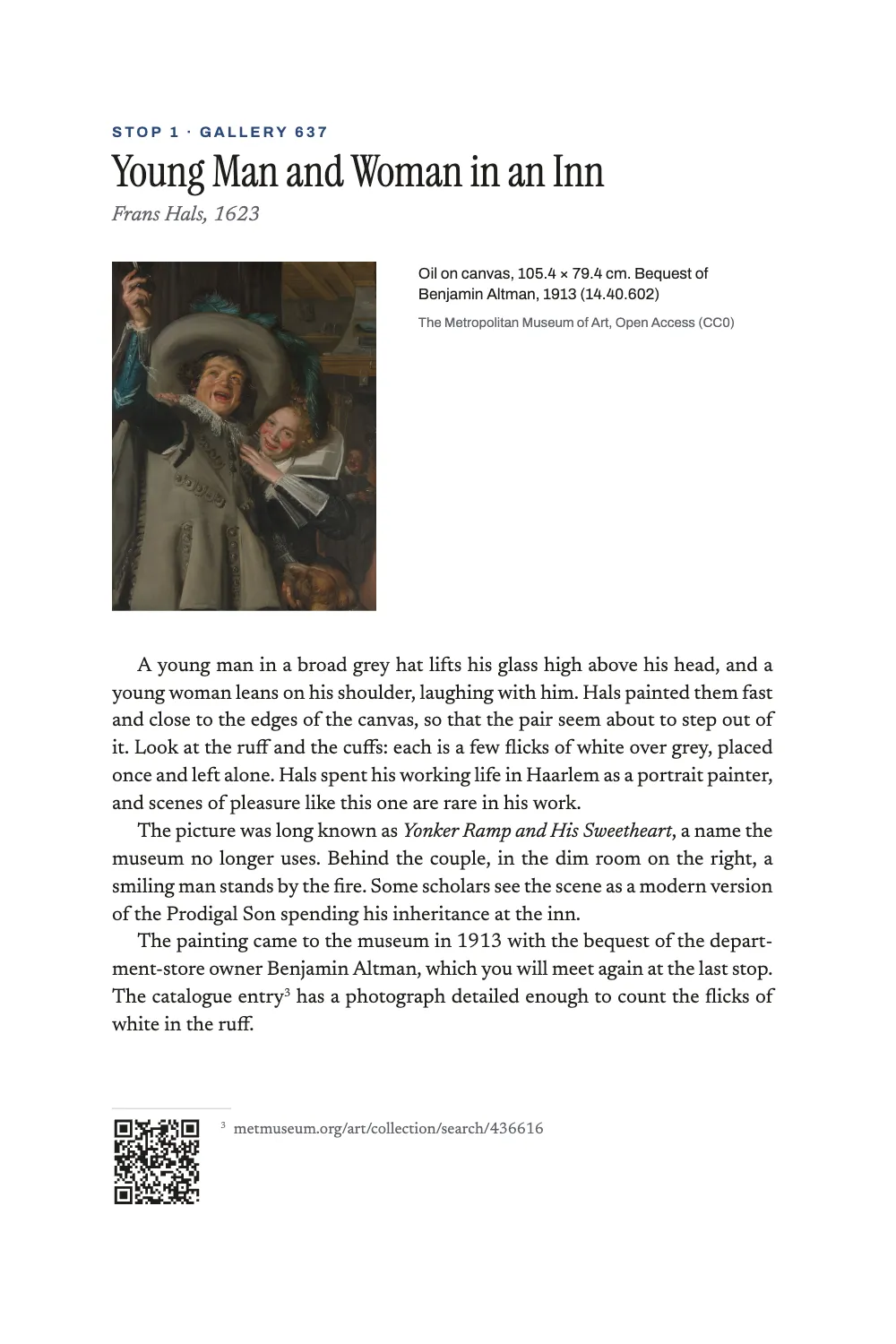
Um guia de bolso das salas holandesas do Metropolitan Museum of Art: cinco quadros, uma hora a pé, um quadro por página. A capa é a jovem de Vermeer junto à janela, cortada pela borda superior. Cada parada abre com o número da sala, o título e o pintor, depois o quadro com a etiqueta ao lado e depois três parágrafos curtos. O texto aponta para o catálogo do museu como qualquer página web faria. No papel, cada link vira um número pequeno, e no pé da página a nota traz o endereço curto e um código QR que o visitante aponta com o celular diante do quadro.
Esta receita responde a
- Como imprimo os endereços web dos links de um livro, como notas numeradas ou códigos QR que o leitor possa escanear?
A resposta curta
const links = {
  print: 'notes', // a note marker after the link text, the address in a note at the foot
  show: 'both', // the short address for reading, the code for the phone
  urlDisplay: 'short', // metmuseum.org/art/collection/search/436616: no https://, no www.
  repeat: 'first', // an address noted once is cited again by its number, never noted twice
  qr: { size: mm(16), side: 'start', gap: em(1.2), color: col('ink') },
};
// Link notes are footnotes: they take the note style and the numbering below. 'document'
// numbers them through the walk, so the five stops print notes 3 to 7, not five notes 1.
const footnotes = { placement: 'column', numbering: 'document', fontSize: pt(8),
  lineHeight: pt(10.5), color: col('muted'), spaceAbove: pt(LEAD), spaceBetween: pt(5),
  separator: { enabled: true, width: 0.18, lineWidth: pt(0.5), color: col('rule') } };
Ingredientes
- Funcionalidades
- Endereços dos links no papelNotas de rodapéAberturas desenhadasAtributos de títuloImagens nos designs de páginaPalavras-guia no cabeçoCabeços e fóliosCabeços por tipo de páginaFiguras exatamente aquiLegendas lateraisTipos de recurso personalizadosLinhas de fonte e créditoPaleta de cores semânticaExportação para PDF
- Também usa
- Faixa de capítulo em largura totalEstilos de parágrafoFontes incorporadas ao PDFFiguras e tabelas como recursos
- Tipografia
- Newsreader, Instrument Serif, Archivo (SIL OFL 1.1)
- Materiais
hals-1200.jpgrembrandt-1200.jpgruisdael-1400.jpgsteen-1200.jpgvermeer-1600.jpgvermeer-cover-1800.jpg- Johannes Vermeer, Young Woman with a Water Pitcher, about 1662 (the cover, cropped) (The Metropolitan Museum of Art, CC0 1.0)
- Frans Hals, Young Man and Woman in an Inn, 1623 (stop 1) (The Metropolitan Museum of Art, CC0 1.0)
- Jan Steen, Merry Company on a Terrace, about 1670 (stop 2) (The Metropolitan Museum of Art, CC0 1.0)
- Rembrandt, Aristotle with a Bust of Homer, 1653 (stop 3) (The Metropolitan Museum of Art, CC0 1.0)
- Johannes Vermeer, Young Woman with a Water Pitcher, about 1662 (stop 4) (The Metropolitan Museum of Art, CC0 1.0)
- Jacob van Ruisdael, Wheat Fields, about 1670 (stop 5) (The Metropolitan Museum of Art, CC0 1.0)
Preparo
#1 · Escreva links, imprima notas
O código é a resposta curta acima. O Markdown mantém links comuns, [A ficha do catálogo](https://www.metmuseum.org/…/436616), e links.print: 'notes' transforma cada um numa nota numerada com o endereço e o código (links na edição impressa). As notas são notas de rodapé: numbering: 'document' as conta ao longo do passeio, então o leitor encontra de 1 a 7, e repeat: 'first' deixa a última parada citar o Hals pela nota 3 em vez de imprimir o mesmo código duas vezes. No PDF o código é desenhado em vetores e é ele mesmo um link.
#2 · Uma parada por página
const stop = { enabled: true, minHeight: pt(4 * LEAD), slot: { elements: [
    { kind: 'text', id: 'stop', content: '{attr.stop}', ...caps(7.5), color: col('delft'),
      align: 'left', placement: at('container', 'top-left', 0, 0) },
    { kind: 'text', id: 'title', content: '{titleText}', fontFamily: DISPLAY, fontSize: pt(22),
      lineHeight: 1.05, color: col('ink'), align: 'left', placement: at('#stop', 'below', 0, 1.6) },
    { kind: 'text', id: 'artist', content: '{attr.artist}', fontFamily: TEXT, italic: true,
      fontSize: pt(10.5), color: col('muted'), align: 'left',
      placement: at('#title', 'below', 0, 0.8) },
  ] } };
Cada parada é um título de segundo nível cujo breakBefore abre uma página, par ou ímpar, e assim o visitante vira uma folha por quadro. O número da sala e o pintor são atributos do título; o design os põe acima e abaixo do título, e minHeight deixa o quadro na mesma altura em todas as páginas.
#3 · A etiqueta ao lado do quadro
// Paintings are not numbered: their own type, with no caption prefix and no number.
const paintingType = { id: 'painting', name: t({ en: 'Painting', es: 'Cuadro' }),
  shortLabel: t({ en: 'painting', es: 'cuadro' }), captionPrefix: '', numberingTemplate: '',
  resetOn: 'never', counterFormat: 'decimal' };
// Set where the ::resource line stands, under the stop's heading; caption and note beside it.
const HERE = { position: 'here', captionSide: 'inside' };
const cm = (n) => (LANG === 'es' ? String(n).replace('.', ',') : String(n)); // decimal comma
// The wall label: medium, size in cm (no-break spaces) and the museum's credit line.
const painting = (id, w, h, [cmH, cmW], credit, alt, width = 0.5) => ({
  id, typeId: 'painting', kind: 'bitmap', createdAt: 0, updatedAt: 0, placement: { ...HERE, width },
  bitmap: { fileId: `${id}-${Math.max(w, h)}.jpg`, format: 'jpeg', width: w, height: h },
  caption: `${OIL}, ${cm(cmH)}\u00a0×\u00a0${cm(cmW)}\u00a0cm. ${credit}`, altText: alt,
  note: 'The Metropolitan Museum of Art, Open Access (CC0)' });
const OIL = t({ en: 'Oil on canvas', es: 'Óleo sobre lienzo' });
const ALTMAN = t({ en: 'Bequest of Benjamin Altman, 1913', es: 'Legado de Benjamin Altman, 1913' });
const resources = [
  painting('hals', 908, 1200, [105.4, 79.4], `${ALTMAN} (14.40.602)`, t({
    en: 'A laughing young man raises a glass; a young woman leans on his shoulder.',
    es: 'Un joven ríe y alza una copa; una joven se apoya en su hombro.' }), 0.4), // portrait
  painting('steen', 1115, 1200, [141, 131.4], 'Fletcher Fund, 1958 (58.89)', t({
    en: 'A crowded party under a vine, with a lute player, a child and a dog.',
    es: 'Una fiesta concurrida bajo una parra, con un laudista, un niño y un perro.' })),
  painting('rembrandt', 1139, 1200, [143.5, 136.5], t({
    en: 'Purchase, special contributions and funds given or bequeathed by friends of the Museum',
    es: 'Compra con aportaciones y fondos donados o legados por amigos del Museo' })
    + ', 1961 (61.198)', t({ en: 'A bearded man in a black hat rests his hand on a marble bust.',
    es: 'Un hombre barbado con sombrero negro apoya la mano en un busto de mármol.' })),
  painting('vermeer', 1422, 1600, [45.7, 40.6], t({ en: 'Marquand Collection, gift of',
    es: 'Colección Marquand, donación de' }) + ' Henry G. Marquand, 1889 (89.15.21)', t({
    en: 'A young woman at an open window holds a gilt pitcher over a basin.',
    es: 'Una joven junto a una ventana abierta sujeta una jarra dorada sobre una jofaina.' })),
  painting('ruisdael', 1400, 1084, [100, 130.2], `${ALTMAN} (14.40.623)`, t({
    en: 'A sandy road between wheat fields under a tall bank of cloud.',
    es: 'Un camino de arena entre campos de trigo bajo un alto banco de nubes.' }), 0.6),
  // The cover: the Vermeer cut to the box's 4 : 3 (160 × 120 mm), since the opener fits a
  // picture inside its box. Drawn by the cover design, never cited.
  { ...painting('vermeer-cover', 1800, 1350, [], '', t({
    en: 'Detail of Vermeer’s young woman at the window, in blue and white.',
    es: 'Detalle de la joven de Vermeer junto a la ventana, en azul y blanco.' })),
  caption: '', note: '' },
];
captionSide: 'inside' põe a legenda e a nota de crédito ao lado do quadro, como um museu pendura a etiqueta, e width dá a cada quadro sua parte da medida: menos ao Hals, que é alto, mais ao Ruisdael, que é horizontal, para que as cinco páginas tenham uma altura de texto parecida. A etiqueta junta a técnica, as medidas em centímetros com espaços inseparáveis e a linha de crédito do museu, com vírgula decimal na edição espanhola.
#4 · A parada no cabeçalho
const head = (id, content, parity, edge, x, extra = {}) => ({
  kind: 'text', id, content, parity, pages: 'body', ...caps(7, 600), color: col('muted'),
  placement: at('page', edge, x, 13), ...extra,
});
const folio = { ...caps(8, 700), color: col('ink') };
const header = { elements: [
  head('verso-folio', '{pageNumber}', 'even', 'top-left', OUTER, folio),
  head('verso-title', '{title}', 'even', 'top-left', OUTER + 9),
  head('recto-stop', '{firstMark.h2}', 'odd', 'top-right', -(OUTER + 9)),
  head('recto-folio', '{pageNumber}', 'odd', 'top-right', -OUTER, folio),
] };
{firstMark.h2} imprime o título da parada que começa na página: a página ímpar nomeia o quadro, a par, o guia. Nenhum cabeçalho chega à capa, uma página com papel de abertura.
A receita completa
// ═══ Postext Cookbook · Nº 175 · A museum walk whose links print as QR notes ═════
// https://postext.dev/en/cookbook/museum-guide-qr-link-notes
// Code: MIT · Text: original (CC BY 4.0) · Paintings: The Metropolitan Museum of Art (CC0)
// Fonts: Newsreader, Instrument Serif, Archivo (SIL OFL 1.1) · Needs postext ≥ 1.65.0
// A pocket gallery guide: five paintings, one to a page. The Markdown writes the museum's
// catalogue pages as ordinary links; the print edition turns each one into a numbered note at
// the foot of the page, with the short address and a code a phone can scan.
import {
  buildDocumentWithFonts, renderPageToCanvas, registerResourceImage,
} from 'https://esm.sh/postext';
import { renderToPdf, decompressWoff2 } from 'https://esm.sh/postext-pdf';

const LANG = 'en'; // @lang: the language of the sample document ('en' | 'es')
const RECIPE = 'museum-guide-qr-link-notes';

// ─── 1 · Design ─────────────────────────────────────────────────────────────
// #region palette: Delft blue on warm paper, every colour linked by id
const palette = {
  ink: '#1f1d1a', // text: a warm near-black
  delft: '#2b4a7a', // the one accent: kickers, stop numbers, rules (8.6:1 on paper)
  rule: '#c6c9cf', // hairlines
  muted: '#5f6168', // running heads, notes, credits (6.1:1 on paper)
  paper: '#ffffff',
};
const col = (id) => ({ hex: palette[id], model: 'hex', paletteId: id });
const colorPalette = [
  ...Object.entries(palette).map(([id, hex]) => ({ id, name: id, value: { hex, model: 'hex' } })),
  // The engine's defaults link to main-color: point it at the accent, so nothing prints blue.
  { id: 'main-color', name: 'delft (defaults)', value: { hex: palette.delft, model: 'hex' } },
];
// #endregion
const TRIM = { w: 160, h: 240 }; // a large pocket guide, in mm
const TOP = 22; // top margin in mm: the cover's container starts here
const OUTER = 22; // outer margin in mm: folios and running heads align to it
const LEAD = 14; // body leading in pt: the baseline grid
const [TEXT, DISPLAY, LABEL] = ['Newsreader', 'Instrument Serif', 'Archivo']; // three voices

// #region answer: every web link of the guide prints as a numbered note with a code to scan
const links = {
  print: 'notes', // a note marker after the link text, the address in a note at the foot
  show: 'both', // the short address for reading, the code for the phone
  urlDisplay: 'short', // metmuseum.org/art/collection/search/436616: no https://, no www.
  repeat: 'first', // an address noted once is cited again by its number, never noted twice
  qr: { size: mm(16), side: 'start', gap: em(1.2), color: col('ink') },
};
// Link notes are footnotes: they take the note style and the numbering below. 'document'
// numbers them through the walk, so the five stops print notes 3 to 7, not five notes 1.
const footnotes = { placement: 'column', numbering: 'document', fontSize: pt(8),
O script.js montado funciona como está: cole-o como script de módulo em qualquer página ou abra a receita no CodePen. Pasta da receita no GitHub ↗ (abre em uma nova aba)
Variações
#Imprima o endereço na linha
Para um guia lido em casa, 'inline' acrescenta o endereço entre parênteses depois do texto do link, sem nota nem código.
-  print: 'notes', // a note marker after the link text, the address in a note at the foot
-  show: 'both', // the short address for reading, the code for the phone
+ print: 'inline', // (metmuseum.org/…) after the link text#Códigos sem endereço
show: 'qr' imprime só o código ao lado do número da nota, para um cartaz ou uma etiqueta em que o endereço só ocuparia espaço.
-  show: 'both', // the short address for reading, the code for the phone
+ show: 'qr', // the code aloneErros comuns
Uma nota com código tem pelo menos a altura do código. Quando a linha que leva o link não tem espaço embaixo para a nota na página, a linha passa para a seguinte com a nota; deixe os links fora das últimas linhas de uma página que precisa terminar onde termina, como o primeiro parágrafo da capa deste guia.
Créditos
- Receita
- Ignacio Ferro
- Texto
- Texto original, CC BY 4.0
- Imagens
- Johannes Vermeer, Young Woman with a Water Pitcher, about 1662 (the cover, cropped) · The Metropolitan Museum of Art · CC0 1.0
- Frans Hals, Young Man and Woman in an Inn, 1623 (stop 1) · The Metropolitan Museum of Art · CC0 1.0
- Jan Steen, Merry Company on a Terrace, about 1670 (stop 2) · The Metropolitan Museum of Art · CC0 1.0
- Rembrandt, Aristotle with a Bust of Homer, 1653 (stop 3) · The Metropolitan Museum of Art · CC0 1.0
- Johannes Vermeer, Young Woman with a Water Pitcher, about 1662 (stop 4) · The Metropolitan Museum of Art · CC0 1.0
- Jacob van Ruisdael, Wheat Fields, about 1670 (stop 5) · The Metropolitan Museum of Art · CC0 1.0
- Fontes
- Newsreader (SIL OFL 1.1) · Instrument Serif (SIL OFL 1.1) · Archivo (SIL OFL 1.1)
- Código
- MIT, como o Postext
Editar este texto ↗ (abre em uma nova aba)Pasta da receita no GitHub ↗ (abre em uma nova aba)