简单来说
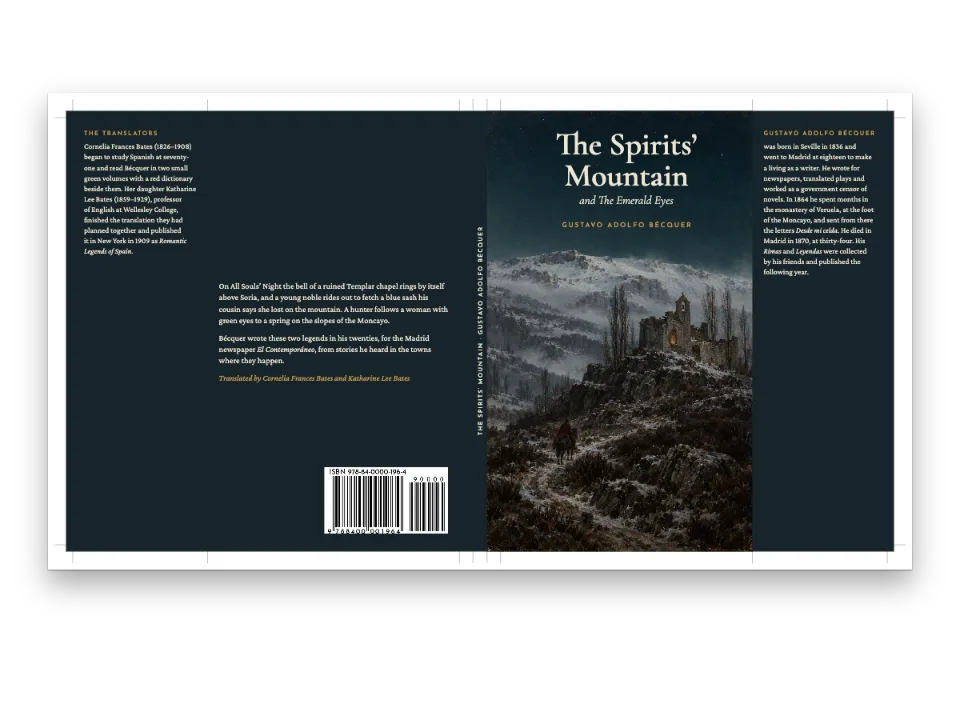
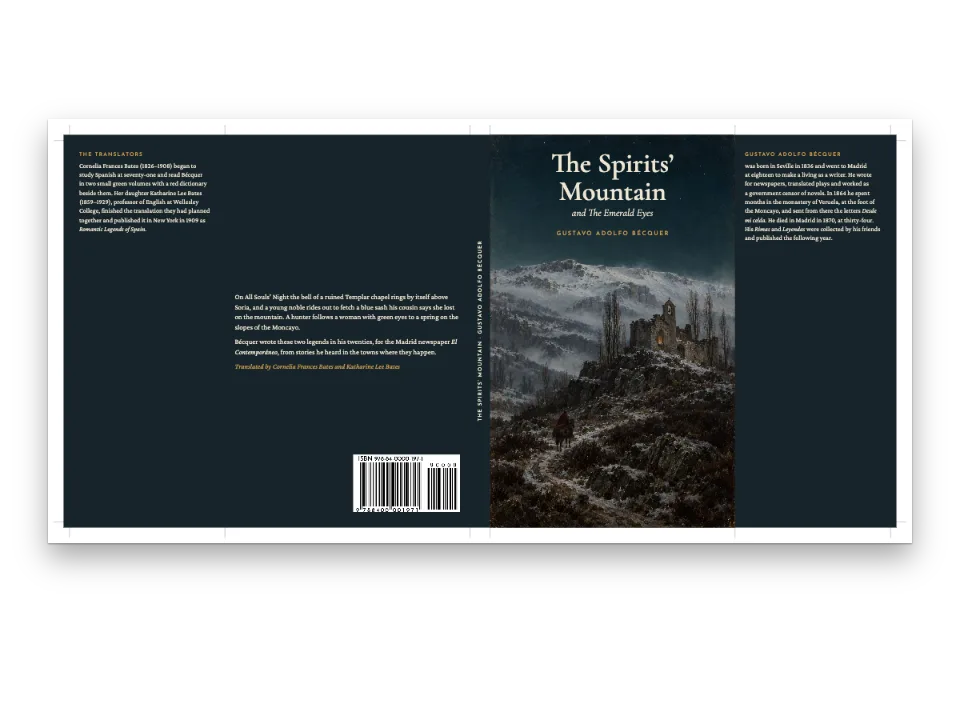
一本薄薄的古典诗集,以及它的封面印张。封面印好以后还有几道工序:画面上一层亮光,书名外框烫金,有些图形从纸板上压凸出来。页面上画出了每道工序落在哪里。
成品一览
豪尔赫·曼里克为父亲之死写的《悼亡父诗》(Coplas),英文版用朗费罗的译本,西班牙文版排原文,排成125 × 200毫米的平装书,另外还有封面印张:四色印完以后,它要送去做表面工艺。印张上有三道工艺。书名框上下两段画面做局部亮光上光。书名框的双层边框烫金,框里的底板起凸,书名就落在凸起的面上。封底有一枚素压的菱形:不上墨,只把纸板压凸。书的下方,示例把印张画了四遍:印出来的样子、上光版和烫金版的假色图、侧光下的样子,以及刻版师据以做压凸模的起凸版。PDF是PDF/X-4,每道工艺一块印版。
这道食谱解答
- 怎样给封面加局部光油、烫印和起凸的书名,交给印厂和装订厂?
简短回答
// A slim paperback: PUR perfect binding, the spine from the pages on 120 g/m² wove. The
// spine is under the 6 mm a spine is lettered from by default, so this version letters it
// from 4.5 mm.
const production = {
  bindings: [{ id: 'pur', name: 'PUR perfect binding', style: 'perfect', signature: 16,
    measures: { bleed: 3, spineAllowance: 0.5 } }],
  versions: [{ id: 'paperback', name: t({ en: 'Paperback', es: 'Rústica' }), binding: 'pur',
    isbn: '978-84-0000-199-5', spineText: { minSpine: 4.5 } }],
};
const folio = { paper: { type: 'bookWove', grammage: 120, bulk: 2.2, shade: '#f7f1e3' } };
const cover = {
  background: col('ground'),
  elements: [
    { id: 'art', kind: 'image', zone: 'front', x: 0, y: -3, width: 128, height: 206,
      resourceId: 'river', fit: 'cover' },
    // The title's panel, a shade darker than the ground, and the frame round it. The frame
    // prints nothing in four colours (it has the panel's colour): the foil plate carries it.
    { id: 'panel', kind: 'shape', zone: 'front', x: 14, y: 77, width: CW, height: CH,
      color: col('panel'), path: [{ closed: true, nodes: contour(0, 6) }] },
    { id: 'cartouche', kind: 'shape', zone: 'front', x: 14, y: 77, width: CW, height: CH,
      color: col('panel'), path: cartouche },
  ],
  finishes: [
    // A spot gloss over the painting above and below the panel, 4 mm clear of it, so the
    // varnish never lies on the foil. The back and the spine stay matt.
    ...[[-3, 76], [127, 76]].map(([y, height], i) => ({ id: `gloss-${i + 1}`, process: 'varnish',
      ink: col('varnish'), shape: { box: { zone: 'front', x: 0, y, width: 128, height } } })),
    // Gold foil on the frame, and the whole panel embossed: the title prints on a raised
    // field, the foil stamped round its edge.
    { id: 'gold', process: 'foil', ink: col('foil'), shape: { element: 'cartouche' } },
    { id: 'relief', process: 'emboss', shape: { element: 'panel' } },
    // A blind emboss: no ink and no foil, only the paper raised.
    { id: 'emblem', process: 'emboss', shape: { outline: emblem,
      box: { zone: 'back', x: 52.5, y: 30, width: 20, height: 20 } } },
  ],
  verticalAlign: { front: 'middle', back: 'middle' },
};
// The press file: PDF/X-4. The varnish and the foil are spot inks with a finish, each on
// its plate; the emboss goes on a plate named Emboss, beside the die line.
const print = { standard: 'pdfx4', outputProfile: 'fogra51', convertImages: false };
用料
- 功能
- 封面工艺与技术印版封面印张特种油墨印刷版本、ISBN与书脊封面、扉页和版权页标题样式设计过的章首页页面设计中的文字、线条和框文档元数据段落样式逐行排诗书眉与页码作为资源的图和表语义调色板导出PDFCMYK与灰度PDF在Canvas上绘制页面
- 类型
- Alegreya, Alegreya SC, Alegreya Sans SC(SIL OFL 1.1)
- 素材
river-1100.jpg- The cover painting: a river at sunset running to the sea below a ruined castle, in oils (Generated With Diffusion Models, 原创)
做法
#1 · 每道工艺都跟着设计里的一个图形
代码就是上面的简短回答。一道工艺写明工艺类型、要印的油墨(如果有)和一个形状:封面上的一个元素({ element: 'cartouche' })、某个区域里的一个方框,或者方框里的一条轮廓。上光和烫金是调色板里带finish的专色,所以在PDF里各有一块印版,印前检查会把它们列出来。起凸什么都不印。它放在一块技术版上,印刷文件把它叫作Emboss,是刻版师用的那块,页面上不画它。
上光是两个方框,一个在书名框上面,一个在下面,都离书名框4毫米,免得上光压到烫金。封底和书脊保持哑光。全书27页,用120 g/m²、松厚度2.2的书纸,按16页一帖装订后是32页,书脊4.7毫米。默认书脊不足6毫米不印字,所以版本里把spineText.minSpine设为4.5。这个ISBN是示例号码,不属于任何一本书。
#2 · 书名框是设计里的路径,不是图片
// Fractions of its box, so the frame stretches with it. Two rings, each an outer contour and
// an inner one run the other way round: the hole between them stays empty, and the foil and
// the emboss take exactly this outline.
const [CW, CH] = [97, 46]; // the cartouche's box, mm
const K = 0.5523; // a quarter circle as a cubic
function contour(inset, notch) {
  const [tx, ty, rx, ry] = [inset / CW, inset / CH, (notch + inset) / CW, (notch + inset) / CH];
  // Each corner: the point on the edge before it and on the edge after it, a hollow arc
  // between them whose handles leave each edge square.
  const corners = [
    [[1 - rx, ty], [1 - tx, ry], 'h'], [[1 - tx, 1 - ry], [1 - rx, 1 - ty], 'v'],
    [[rx, 1 - ty], [tx, 1 - ry], 'h'], [[tx, ry], [rx, ty], 'v']];
  return corners.flatMap(([[ax, ay], [bx, by], edge]) => [
    { x: ax, y: ay, out: edge === 'h' ? { x: ax, y: ay + K * (by - ay) }
      : { x: ax + K * (bx - ax), y: ay } },
    { x: bx, y: by, in: edge === 'h' ? { x: bx - K * (bx - ax), y: by }
      : { x: bx, y: by - K * (by - ay) } }]);
}
const reversed = (nodes) => nodes.slice().reverse()
  .map(({ x, y, in: i, out: o }) => ({ x, y, ...(o && { in: o }), ...(i && { out: i }) }));
const ring = (outer, inner, notch) => [{ closed: true, nodes: contour(outer, notch) },
  { closed: true, nodes: reversed(contour(inner, notch)) }];
const cartouche = [...ring(0, 1.3, 6), ...ring(2.3, 2.75, 6)];
// The emblem on the back: a lozenge with a lozenge cut out of it, as a saved outline.
const lozenge = (d) => [[0.5, d], [1 - d, 0.5], [0.5, 1 - d], [d, 0.5]].map(([x, y]) => ({ x, y }));
const emblem = [lozenge(0), lozenge(0.24).reverse()];
烫金和起凸严格沿着所指元素的轮廓走,所以边框必须是一个引擎知道路径的图形。封面路径是一组闭合轮廓,节点用元素方框的比例表示,曲线带进出控制柄。每个角是向内凹的四分之一圆,用三次曲线画。一个环由外轮廓和反方向走的内轮廓组成:按nonzero规则,两者之间是空的。两个环就是双层边框。边框和底板同色,四色印刷时什么也不印,全靠烫金版。封底的徽记是存好的一条轮廓:两个菱形,小的那个反向。
#3 · 封面的样式
const style = (id, fontFamily, size, lead, color, extra) => ({ id, fontFamily, fontSize: pt(size),
  lineHeight: pt(lead), color, italicColor: color, firstLineIndent: mm(0), textAlign: 'left',
  hyphenation: false, ...extra });
const caps = (tracking) => ({ fontWeight: 700, letterSpacing: pt(tracking) });
const mid = { textAlign: 'center' };
const coverStyles = [
  style('cover-title', 'Alegreya SC', 40, 40, col('cream'), { ...mid, fontWeight: 500 }),
  style('cover-subtitle', 'Alegreya', 13, 17, col('cream'), { ...mid, italic: true }),
  style('cover-author', 'Alegreya Sans SC', 9, 12, col('ochre'), { ...mid, ...caps(1.6),
    marginTop: pt(9) }),
  style('cover-spine', 'Alegreya Sans SC', 7, 8, col('cream'), { ...mid, ...caps(1.1) }),
  style('cover-quote', 'Alegreya', 13, 17, col('ochre'), { ...mid, italic: true,
    marginBottom: pt(16) }),
  style('cover-blurb', 'Alegreya', 10.5, 14.5, col('cream'), { marginBottom: pt(7) }),
  style('cover-note', 'Alegreya Sans SC', 8, 11, col('ochre'), { ...caps(1.2),
    marginTop: pt(4) }),
];
cover-title、cover-subtitle、cover-author和cover-spine是buildCover给它放置的元数据起的名字;cover-quote、cover-blurb和cover-note写在封面的Markdown里。封面在高度上居中(verticalAlign),书名不管字号多大都落在书名框里。
#4 · 书芯
const [W, H, TOP, FOOT, INNER, OUTER, LEAD] = [125, 200, 22, 24, 19, 17, 15]; // mm, pt
const at = (to, edge, x, y, size) => ({ anchor: { to, edge }, offset: { x: mm(x), y: mm(y) },
  ...(size && { size }) });
const text = (id, content, look, place) => ({ kind: 'text', id, content, align: 'center',
  overflow: 'wrap', placement: place, ...look });
const face = (fontFamily, size, color, x) => ({ fontFamily, fontSize: pt(size), color, ...x });
const label = (size, color = col('muted')) => face('Alegreya Sans SC', size, color, caps(size / 6));
const sc = (size, extra) => face('Alegreya SC', size, col('ink'), { fontWeight: 500, ...extra });
const none = { header: { elements: [] }, footer: { elements: [] }, numbered: false, toc: false };
const design = (minHeight, elements) => ({ enabled: true, minHeight: mm(minHeight),
  slot: { elements } });
const page = (parity) => ({ breakBefore: { enabled: true, parity } });
const rule = (id, y, to = 'page') => ({ kind: 'rule', id, direction: 'horizontal',
  thickness: pt(0.6), color: col('accent'), placement: at(to, 'top', 0, y, { width: mm(12) }) });
const headingStyles = [
  { ...none, id: 'half-title', advancedDesign: design(60, [
    text('t', '{title}', sc(18), at('page', 'top', 0, 64))]) },
  { ...none, ...page('odd'), id: 'title-page', advancedDesign: design(H - TOP - FOOT, [
    text('t', '{title}', sc(34), at('page', 'top', 0, 50)),
    text('s', '{subtitle}', face('Alegreya', 13, col('ink'), { italic: true }),
      at('page', 'top', 0, 66)),
    rule('r', 76),
    text('a', '{author}', label(8.5, col('accent')), at('page', 'top', 0, 81)),
    text('c', '{attr.credit}', face('Alegreya', 9.5, col('muted'), { italic: true }),
      at('page', 'top', 0, 120, { width: mm(76) })),
    text('i', '{attr.imprint}', label(7.5), at('page', 'bottom', 0, -28)),
  ]) },
  { ...none, ...page('even'), id: 'rights',
    advancedDesign: design(92, [rule('r', 86, 'container')]) },
  // The poem opens on a recto, sunk 46 mm, its title in small capitals over a short rule.
  { ...page('odd'), id: 'poem', toc: false, header: { elements: [] }, advancedDesign: design(46, [
    text('t', '{titleText}', sc(19), at('container', 'top', 0, 18)),
    text('n', '{attr.note}', face('Alegreya', 10.5, col('muted'), { italic: true }),
      at('container', 'top', 0, 28, { width: mm(80) })),
    rule('r', 38, 'container')]) },
  { ...none, ...page('odd'), id: 'colophon', advancedDesign: design(64, [
    rule('r', 56, 'container')]) },
];
const head = (id, content, parity) => text(id, content, { ...label(6.8), parity, pages: 'body' },
  at('page', 'top', 0, 11));
半书名页、书名页、版权页,然后诗从一个右页开始,往下沉46毫米,按诗行排,不把一节拆到两页上。书眉左页是作者,右页是书名。版本记录放在最后一个右页上收尾。
#5 · 印张由排好的内页生成
const built = buildCover({ config, version: 'paperback', pages: book.pages, markdown: coverText,
  metadata: book.metadata, resources });
if (!('config' in built)) throw new Error(built.issues.map((i) => i.kind).join(', '));
// The barcode's digits name OCR-B, which no font server has: the label face sets them.
for (const [id, bytes] of Object.entries(built.files)) {
  await loadSvg(id, new TextDecoder().decode(bytes)
    .replace(/font-family="[^"]*"/g, 'font-family="Alegreya Sans SC"'));
}
const sheet = await buildDocumentWithFonts(built.content, built.config, kitFonts(FONTS));
buildCover接收页面、元数据和封面的Markdown,返回一份交给buildDocumentWithFonts的文档,外加SVG格式的条码。条码数字要用OCR-B,没有哪个字体服务器提供,所以示例改用已经加载的Alegreya Sans SC。
#6 · 每块印版覆盖哪里
// 'flat' paints the inks: the foil in its colour, the varnish and the emboss not at all.
// 'map' marks the special plates in false colour over a faded sheet, 'sheen' rakes a light
// across it. The emboss plate is drawn from the page's technical plates, the outlines the
// PDF fills on its Emboss separation.
const leaf = sheet.pages[0];
const scale = 1100 / leaf.width;
const outline = (ctx, paths) => {
  ctx.beginPath();
  for (const c of paths.flat()) {
    if (c.op === 'M') ctx.moveTo(c.x, c.y);
    else if (c.op === 'L') ctx.lineTo(c.x, c.y);
    else if (c.op === 'C') ctx.bezierCurveTo(c.x1, c.y1, c.x2, c.y2, c.x, c.y);
    else if (c.op === 'Q') ctx.quadraticCurveTo(c.x1, c.y1, c.x, c.y);
    else ctx.closePath();
  }
  ctx.fill('nonzero');
};
const VIEWS = [
  ['flat', t({ en: 'As it prints', es: 'Como se imprime' })],
  ['map', t({ en: 'The varnish and foil plates', es: 'Las planchas de barniz y oro' })],
  ['sheen', t({ en: 'Under a raking light', es: 'Con luz rasante' })],
  ['emboss', t({ en: 'The Emboss plate', es: 'La plancha de gofrado' })],
];
const views = document.createElement('section');
views.id = 'finish-views';
views.style.cssText = 'display: grid; grid-template-columns: repeat(2, minmax(0, 560px)); '
  + 'gap: 18px; justify-content: center; padding: 24px max(16px, calc(50% - 520px)); color: #ddd; '
  + 'font: 14px sans-serif';
for (const [mode, name] of VIEWS) {
  const [figure, canvas, caption] = ['figure', 'canvas', 'figcaption']
    .map((tag) => document.createElement(tag));
  figure.style.margin = '0';
  canvas.style.cssText = 'display: block; width: 100%';
  canvas.setAttribute('role', 'img');
  canvas.setAttribute('aria-label', `${t({ en: 'The cover sheet', es: 'El pliego' })}: ${name}`);
  renderPageToCanvas(leaf, sheet, canvas, { scale, finishes: mode === 'emboss' ? 'flat' : mode });
  if (mode === 'emboss') {
    // The die-maker's film: the plate in black on white, the sheet faded under it.
    const ctx = canvas.getContext('2d');
    ctx.setTransform(1, 0, 0, 1, 0, 0);
    ctx.fillStyle = 'rgba(255, 255, 255, 0.86)';
    ctx.fillRect(0, 0, canvas.width, canvas.height);
    ctx.setTransform(scale, 0, 0, scale, 0, 0);
    ctx.fillStyle = '#111';
    outline(ctx, (leaf.plates ?? []).flatMap((p) => p.paths));
  }
  caption.textContent = name;
  figure.append(canvas, caption);
  views.append(figure);
}
// What the preflight reads from the sheet: its spot plates and the reliefs it checks.
const spots = preflightDocument(sheet).find((i) => i.kind === 'spotInks');
const list = document.createElement('p');
list.style.cssText = 'grid-column: 1 / -1; margin: 0; text-align: center';
list.textContent = `${t({ en: 'Plates beside CMYK', es: 'Planchas además de CMYK' })}: `
  + [...(spots?.inks ?? []), ...new Set((leaf.plates ?? [])
    .map((p) => `${p.process[0].toUpperCase()}${p.process.slice(1)}`))].join(' · ');
views.append(list);
document.getElementById('pages').before(views);
renderPageToCanvas有三种画工艺的方式。flat按印刷机落墨的样子画:烫金画成它的颜色,上光不画。map把印张调淡,用假色标出每块专色版。sheen让一道侧光扫过印张,上光和烫金会反光。起凸三种都不出现,因为它不印东西;第四幅图在调淡的印张上用黑色画出页面的技术版(page.plates),也就是PDF在Emboss分色上填充的轮廓。下面那一行从preflightDocument读出专色,从技术版读出工艺。
完整食谱
// ═══ Postext Cookbook · Nº 199 · A cover in foil, spot varnish and emboss ═══════════════
// https://postext.dev/en/cookbook/cover-foil-varnish-emboss
// Code: MIT · Text: Manrique, tr. H. W. Longfellow (public domain) · Art: diffusion models
// Fonts: Alegreya, Alegreya SC, Alegreya Sans SC (SIL OFL 1.1) · Needs postext ≥ 1.92.0
//
// Manrique's Coplas as a slim paperback whose cover goes to the finisher after the press: a
// spot gloss over the painting, a gold-foil cartouche stamped over an emboss of the same
// shape, and a blind emboss on the back. Each finish is a shape of the cover's design; the
// varnish and the foil get spot plates of their own, the emboss a plate that prints nothing.
import { buildDocumentWithFonts, renderPageToCanvas, registerResourceImage, inlineSvgFonts,
  preflightDocument } from 'https://esm.sh/postext';
import { buildCover } from 'https://esm.sh/postext/production';
import { renderToPdf, decompressWoff2 } from 'https://esm.sh/postext-pdf';

const LANG = 'en'; // @lang: the language of the sample document ('en' | 'es')
const RECIPE = 'cover-foil-varnish-emboss';

// ─── 1 · Design ─────────────────────────────────────────────────────────────
// The pages' four colours, then the cover's: a bottle-green ground and its darker panel.
const palette = { ink: '#262320', accent: '#8a3b2a', muted: '#6d655b', paper: '#fbf7ef',
  ground: '#1d2b27', panel: '#15201d', cream: '#efe5cf', ochre: '#c8a15a' };
// The two inks the finisher is asked for: spot colours that each make a plate of their own.
const spot = (hex, name, cmyk, kind) => ({ hex, model: 'spot',
  spot: { name, cmyk, finish: { kind, sheen: 'gloss' } } });
const inks = { foil: spot('#b8963e', 'Gold foil', { c: 0, m: 20, y: 60, k: 25 }, 'foil'),
  varnish: spot('#eef0e6', 'Gloss varnish', { c: 0, m: 0, y: 0, k: 0 }, 'varnish') };
const col = (id) => (inks[id] ? { ...inks[id], paletteId: id }
  : { hex: palette[id], model: 'hex', paletteId: id });
const colorPalette = [
  ...Object.entries(palette).map(([id, hex]) => ({ id, name: id, value: { hex, model: 'hex' } })),
  ...Object.entries(inks).map(([id, value]) => ({ id, name: value.spot.name, value })),
  { id: 'main-color', name: 'accent (defaults)', value: { hex: palette.accent, model: 'hex' } },
];

// #region art: the cartouche, a frame with hollow corners, drawn as a shape of the design
// Fractions of its box, so the frame stretches with it. Two rings, each an outer contour and
// an inner one run the other way round: the hole between them stays empty, and the foil and
// the emboss take exactly this outline.
const [CW, CH] = [97, 46]; // the cartouche's box, mm
const K = 0.5523; // a quarter circle as a cubic
function contour(inset, notch) {
  const [tx, ty, rx, ry] = [inset / CW, inset / CH, (notch + inset) / CW, (notch + inset) / CH];
  // Each corner: the point on the edge before it and on the edge after it, a hollow arc
  // between them whose handles leave each edge square.
  const corners = [
    [[1 - rx, ty], [1 - tx, ry], 'h'], [[1 - tx, 1 - ry], [1 - rx, 1 - ty], 'v'],
    [[rx, 1 - ty], [tx, 1 - ry], 'h'], [[tx, ry], [rx, ty], 'v']];
  return corners.flatMap(([[ax, ay], [bx, by], edge]) => [
组合好的script.js可以直接运行:把它粘贴到任何页面的模块脚本中,或在CodePen上打开这道食谱。 GitHub上的食谱文件夹 ↗ (在新标签页中打开)
变化
#把徽记改成压凹
压凹把图形压进纸板,而不是顶起来,放在单独的Deboss版上。
-    { id: 'emblem', process: 'emboss', shape: { outline: emblem,
+ { id: 'emblem', process: 'deboss', shape: { outline: emblem,#整幅画上光
画面元素上的一道工艺代替两个方框。这样上光也会盖过书名框和书名。
-    ...[[-3, 76], [127, 76]].map(([y, height], i) => ({ id: `gloss-${i + 1}`, process: 'varnish',
-      ink: col('varnish'), shape: { box: { zone: 'front', x: 0, y, width: 128, height } } })),
+ { id: 'gloss', process: 'varnish', ink: col('varnish'), shape: { element: 'art' } },常见问题
- 起凸或压凹离裁切线或折线不到3毫米,印前检查会报出来(
reliefTrim、reliefFold):纸板在那里会裂。让凹凸远离书脊的折线。 - 起凸在屏幕上从来不画。到PDF的Emboss分色里去看,或者像示例这样画出
page.plates。 - 工艺盖在文字框上,会遮住文字,视图里和印刷文件里都一样。留一部分文字在烫金之外,就像这里的书名放在书名框中间的空处。
致谢
- 文本
- Coplas de Manrique, translated by Henry Wadsworth Longfellow (1833), from The Complete Poetical Works of Henry Wadsworth Longfellow (Household Edition, 1902), Project Gutenberg eBook #1365 · Jorge Manrique · 公有领域
- Coplas por la muerte de su padre, from the first critical edition by R. Foulché-Delbosc (1902), Project Gutenberg eBook #49333, spelling and punctuation modernised · Jorge Manrique · 公有领域
- 图片
- The cover painting: a river at sunset running to the sea below a ruined castle, in oils · Generated With Diffusion Models · 原创
- 字体
- Alegreya (SIL OFL 1.1) · Alegreya SC (SIL OFL 1.1) · Alegreya Sans SC (SIL OFL 1.1)