成品一览
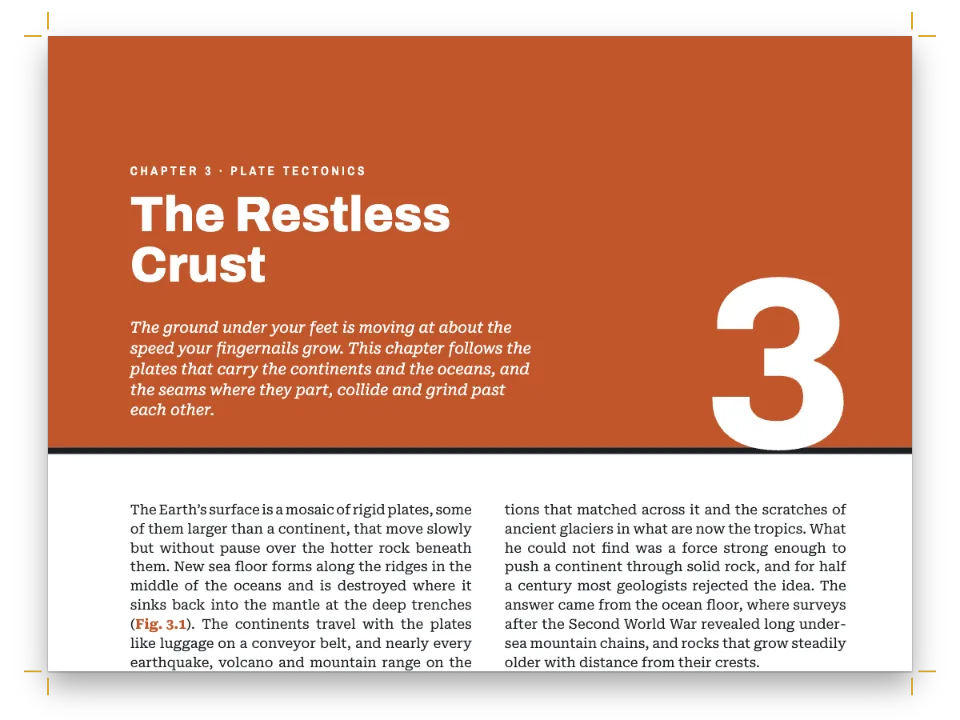
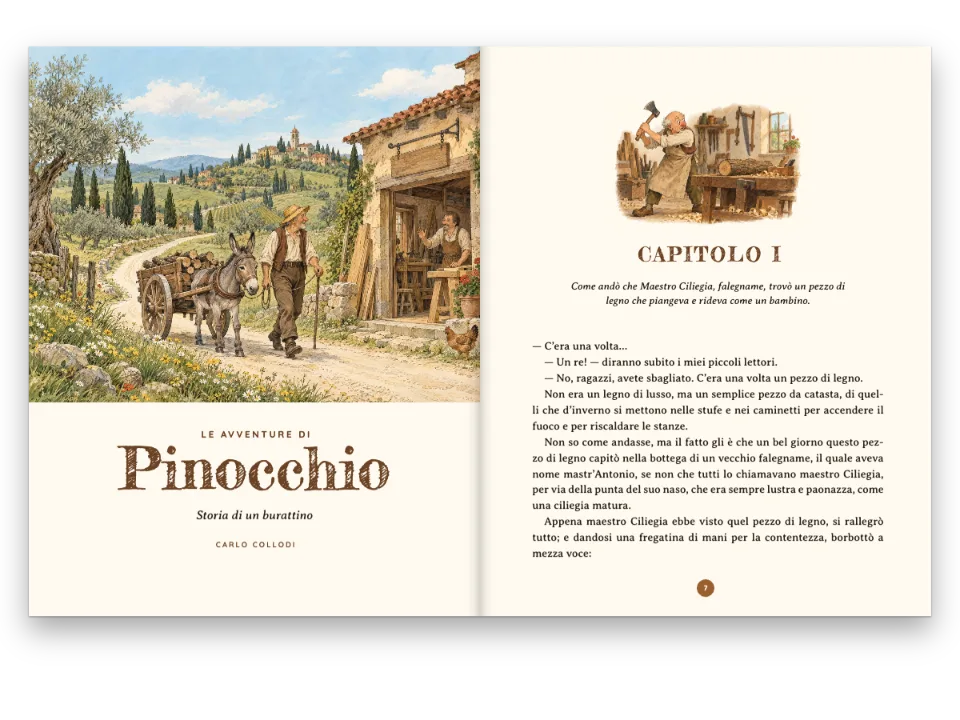
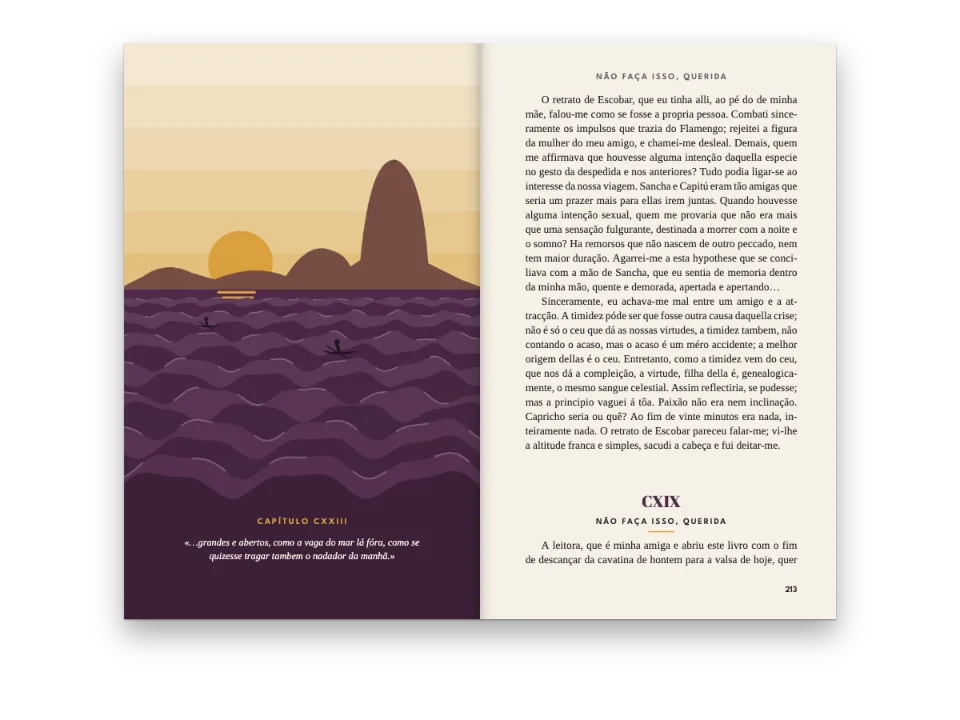
Five Ways to Begin是一本讲章首页的七页小书,180 × 240 mm,每一章都用它所讲的那种章首页排。第一章是小说式的:加宽字距的眉题、细斜体标题和五行高的红色首字母,后续页面带书眉。第二章把标题和一个花饰放在奶油色花框里,框由两条蓝线画成。第三章把标题以白色Fraunces Black堆叠在出血的品红色底上,下面是反白在方框里的等宽首字母。第四章是手册:等宽字体书眉、标题旁的橙色编号徽标,以及两栏Geist正文。尾声把标题排在空白页的中部,下面是一个上升首字母。第一章使用一级标题自己的章首页,其余四章在标题行上点名一种标题样式。
这道食谱解答
- 怎样给每章不同的照片、颜色或章首页样式?
- 怎样给章首页加作者行、提要或带首字下沉的导语?
- 怎样让章标题横跨页面,下面的正文分两栏排?
- 怎样在标题旁做一个编号徽标,让它在编号变长时(9 → 10)自动变宽?
简短回答
// A heading line picks a style by id, and its attributes feed the opener's {attr.…} texts:
//   # The Frame {style="framed" kicker="Chapter the Second" lead="Long before there…"}
// A style overrides the level fields it names (here the opener) and, until the next level-1
// heading, the section fields it names; what it leaves out comes from the level and document.
const level1 = () => ({ level: 1,
  // span 'page' opens each chapter at the head of a new page and runs its opener across
  // every column (chapter four has two). Any headings object drops the default break to a
  // recto (gotcha: headings-drop-h1-break): restate the side, 'any' for short chapters.
  span: 'page',
  breakBefore: { enabled: true, parity: 'any' },
  marginBottom: pt(LEAD), // one line of air between the opener and the text
  advancedDesign: literary }); // chapter one, unstyled: the book's own opener
const headingStyles = () => [ // factories, called by config() once every design exists
  // Each style brings its opener and swaps 'accent' for a colour of its own, on its pages.
  { id: 'framed', advancedDesign: framed, palette: { accent: palette.lapis },
    margins: { left: mm(EVEN), right: mm(EVEN) } }, // a centred text block
  { id: 'stacked', advancedDesign: stacked, palette: { accent: palette.magenta } },
  { id: 'spec', advancedDesign: spec, palette: { accent: palette.signal },
    marginBottom: pt(0), // the hairline under the title is the separator
    margins: { left: mm(SPEC), right: mm(SPEC) }, // a 144 mm text block
    layout: { layoutType: 'double', gutterWidth: mm(7) },
    bodyStyle: { fontFamily: 'Geist', fontSize: pt(9.8), textAlign: 'left' }, // on the grid
    header: { elements: [...specHead('even'), ...specHead('odd')] },
    footer: { elements: [] } }, // no folio at the foot: the head gives the page
  { id: 'quiet', numbered: false, // a coda: it advances no chapter counter
    advancedDesign: quiet, palette: { accent: palette.graphite }, footer: tinyFolio,
    margins: { left: mm(QUIET.inner), right: mm(QUIET.outer) }, // a 106 mm measure
    bodyStyle: { fontSize: pt(QUIET.size), lineHeight: pt(QUIET.lead), textAlign: 'left' } },
]; // hook-up in config(): headings: { levels: [level1(), …] }, headingStyles()
用料
做法
#1 · 在标题级别上设定本书的章首页
// The opening paragraph comes from lead="…" on the heading line: drop caps exist only in
// design text, so the lead is part of the opener (gap: body-drop-cap).
const lead = (placement, dropCap, extra = {}) => text('lead', '{attr.lead}', 'Lora',
  LEADIN.size, placement, { lineHeight: LEADIN.lead / LEADIN.size, dropCap, ...extra });
const CAPS = 0.7; // the height of a capital in Lora and in Fraunces, em
// A drop cap's foot stands on the last baseline it spans. Its default size makes the capital
// as tall as all those line boxes, so it rises above the first line (2.2 mm for five lines
// here); this size puts its top on the first line's capitals instead.
const dropSize = (lines) => pt(((lines - 1) * LEADIN.lead + CAPS * LEADIN.size) / CAPS);
const literary = design([
  text('kicker', '{attr.kicker}', 'Geist', 8, centred(22), { ...caps(1.7), align: 'center' }),
  text('title', '{titleText}', 'Fraunces', 32, at('#kicker', 'below', 0, 4, 'fill'),
    { fontWeight: 300, italic: true, lineHeight: 1.05, align: 'center' }),
  { kind: 'rule', id: 'rule', direction: 'horizontal', thickness: pt(0.8), color: col('accent'),
    placement: at('#title', 'below', (MEASURE - 18) / 2, 6, 18) }, // an 18 mm rule, centred
  lead(at('#title', 'below', 0, 17, 'fill'), {
    lines: 5, fontSize: dropSize(5), fontFamily: 'Fraunces', fontWeight: 400,
    color: col('accent'), gap: mm(2.5) }),
]);
第一章没有样式,所以采用一级标题自己的设计,所有样式都以它为起点(简短回答列出了这一级别和各样式)。首字下沉只存在于设计文本里,所以本章的第一段来自标题行上的lead="…",由lead()排进章首页;正文在下面接排。引擎让这个字母立在第五条基线上,但按默认字号,大写字母的高度等于五个行框的总高,会比首行大写字母高出2.2 mm。dropSize()根据Lora和Fraunces的大写字母高度(0.7 em)计算字号,让M的顶端与它们对齐。
#2 · 用两个方框给标题加框
const FRAME = 62; // mm: the outer box's height
const INSET = 3; // mm: the hairline box runs this far inside it
const FLEURON = 44; // mm: the ornament's width, centred under the title
const framed = design([ // array order is paint order: the boxes first, the type on top
  { kind: 'box', id: 'frame', placement: { ...at('container', 'top-left', 0, 0),
    size: { width: 'fill', height: mm(FRAME) } },
  style: { backgroundColor: col('tint'), borderColor: col('accent'), borderWidth: pt(1.6) } },
  { kind: 'box', id: 'hairline', placement: { ...at('#frame', 'align-top', INSET, INSET),
    size: { width: mm(MEASURE - 2 * INSET), height: mm(FRAME - 2 * INSET) } },
  style: { borderColor: col('accent'), borderWidth: pt(0.5) } },
  text('kicker', '{attr.kicker}', 'Geist', 7.5, centred(14), { ...caps(1.6), align: 'center' }),
  text('title', '{titleText}', 'Fraunces', 34, at('#kicker', 'below', 0, 3.5, 'fill'),
    { fontWeight: 600, lineHeight: 1.05, align: 'center' }),
  // An image element draws a registered resource, never numbered or captioned. Its resourceId
  // may be '{attr.photo}' (postext ≥ 1.8): then each heading names its own photo.
  { kind: 'image', id: 'fleuron', resourceId: 'fleuron',
    placement: at('#title', 'below', (MEASURE - FLEURON) / 2, 4.5, FLEURON) },
  // The section's palette does not reach dropCap.color: name the blue (gotcha: drop-cap-palette).
  lead(at('container', 'top-left', 0, FRAME + 9, 'fill'), { lines: 3, fontSize: dropSize(3),
    fontFamily: 'Fraunces', fontWeight: 600, color: col('lapis'), gap: mm(2) }),
]);
数组顺序就是绘制顺序,所以方框在前,文字在上;花饰是一个图像元素,绘制一个已注册的SVG资源,这个资源不编号也不被引用。每一章要有自己的照片,也是靠图像元素:从postext 1.8起,它的resourceId接受占位符,于是用resourceId: '{attr.photo}',一种样式就能绘制每个标题点名的照片,例如# The Frame {style="framed" photo="lake"},菜谱卡片里的菜品就是这样做的(图像元素)。简短回答里的framed样式设置了palette,把本章各页的accent变成蓝色,于是线条、眉题和底部页码都印成蓝色;它的margins让文字块在花框下居中。在1.4.1中,首字下沉的color不理会分节调色板,所以首字母用col('lapis')直接指定蓝色。
#3 · 堆叠标题,给首字母加框
const FIELD = 130; // mm from the trim: the foot of the colour field
const S_BEARING = 1.2; // mm: the white left of the title's S (0.0365 em at 94 pt)
// The boxed initial: the engine sets the letter, a drop cap on the third baseline; the box
// behind it is fitted by hand, in pt from the top of the lead's first line box.
const BASE = 0.8; // 1.4.1 sets a design text's baseline 0.8 down its line box; no option
// Geist Mono, em: cap height, the advance every capital shares, the white either side of an M
const MONO = { caps: 0.71, advance: 0.6, side: 0.044 };
const BOXED = 3; // lines the initial spans
const capsTop = BASE * LEADIN.lead - CAPS * LEADIN.size; // the first line's capitals: box top
const foot = (BOXED - 1 + BASE) * LEADIN.lead; // the third baseline: the letter's foot
// The M's top sits as far under the box's top as its sides sit in, and the box runs as far
// under its foot, so the colour is as wide on all four sides.
const letter = (foot - capsTop) / (MONO.caps + MONO.side), pad = MONO.side * letter;
const stacked = design([
  { kind: 'box', id: 'field', style: { backgroundColor: col('accent') },
    placement: { anchor: { to: 'bleed', edge: 'top-left' }, size: { height: mm(FIELD) } } },
  text('kicker', '{attr.kicker}', 'Geist', 8, at('container', 'top-left', 0, 4),
    { ...caps(1.8), color: col('paper') }),
  // {titleText} keeps the \\ breaks from the Markdown, so each line ends at the writer's \\.
  // Moved left by the S's side bearing, so its curve meets the text edge.
  text('title', '{titleText}', 'Fraunces', 94,
    at('container', 'top-left', -S_BEARING, 15, 'fill'),
    { fontWeight: 900, lineHeight: 0.84, color: col('paper') }),
  { kind: 'box', id: 'initial', style: { backgroundColor: col('accent') }, // behind the lead
    placement: { anchor: { to: '#lead', edge: 'align-top' }, offset: { y: pt(capsTop) },
      size: { width: pt(MONO.advance * letter), height: pt(foot + pad - capsTop) } } },
  // The lead: 8 mm under the field (FIELD is from the trim). Its drop cap's line box
  // counts in the opener's height, 3.5 mm under the lead: FIELD is set so it costs no line.
  lead(at('container', 'top-left', 0, FIELD - TOP + 8, 'fill'), { lines: BOXED,
    fontSize: pt(letter), fontFamily: 'Geist Mono', fontWeight: 700, color: col('paper'),
    gap: mm(2.2) }),
]);
堆叠写在Markdown里:# Say it \\ out \\ loud.在每个\\处给{titleText}换行,而书眉和PDF书签把标题读作一行(标题中的换行)。色底从出血的顶端垂下,通宽,高130 mm,引语从它下方8 mm开始。加框的首字母由两个元素组成。引语的首字下沉把M排成三行高,先画的品红色方框则按引语的行框和Geist Mono的字体度量确定尺寸,让M上下露出的颜色与它的左右侧边距一样宽。
#4 · 给手册加上徽标、两栏和自己的书眉
const SPEC = 18; // mm: both side margins, for a 144 mm text block in two columns
const PAD = 1.6; // mm of colour over the badge's figures
const spec = design([
  { kind: 'rule', id: 'top-rule', direction: 'horizontal', thickness: pt(2.4), color: col('ink'),
    placement: at('container', 'top-left', 0, 0, 'fill') },
  text('kicker', '{attr.kicker}', 'Geist Mono', 7.5, at('container', 'top-left', 0, 3.2),
    { ...caps(1.2, 500), color: col('graphite') }),
  // The badge's width follows its text, with padding on both sides, so 9 → 10 widens it. Its
  // line box holds 1 mm more under the figures than over them, so the foot pads 1 mm less.
  text('badge', '{chapterNumber}', 'Geist Mono', 26, at('container', 'top-left', 0, 12),
    { fontWeight: 700, lineHeight: 1, box: { backgroundColor: col('accent'), padding: {
      top: mm(PAD), right: mm(2.4), bottom: mm(PAD - 1), left: mm(2.4) } } }),
  // Same size and line height as the badge, dropped by its top padding, so the baselines meet.
  text('title', '{titleText}', 'Geist', 26, at('#badge', 'right-of', 4, PAD),
    { fontWeight: 700, lineHeight: 1 }),
  { kind: 'rule', id: 'hairline', direction: 'horizontal', thickness: pt(0.5), color: col('ink'),
    placement: at('container', 'top-left', 0, 31, 'fill') }, // room for a one-line title
]);
const specHead = (parity) => { // mono labels over the opener's rule, on every page of the section
  const [edge, s] = parity === 'even' ? ['top-left', 1] : ['top-right', -1];
  const mono = { ...caps(1.1, 500), color: col('graphite'), parity, pages: 'all' };
  return [
    text(`sp-page-${parity}`, '{pageNumber} / {totalPages}', 'Geist Mono', 7,
      at('container', edge, 0, HEAD_Y), mono),
    text(`sp-chap-${parity}`, '§ {chapterNumber} · {chapterTitle}', 'Geist Mono', 7,
      at('container', edge, s * 16, HEAD_Y), mono),
  ];
};
徽标是一个带填充和内边距、但没有宽度的文字元素,所以宽度跟随{chapterNumber};标题用right-of放在它右侧:到第10章,徽标多一位数字,加宽5.5 mm,标题也随之移动。它的下内边距比上内边距少1 mm,因为行框在数字下方多留了这么多空间,这样4才居中。在spec样式里,layout把这一节排成两栏,而这一级别的span: 'page'让章首页横跨两栏。它的margins把文字块加宽到144 mm,bodyStyle在本书14.5 pt的网格上排齐左的Geist,header替换本书的书眉,空的footer去掉页码。
#5 · 给尾声留出空间
const quiet = design([ // the kicker is in the accent, which this style turns graphite
  text('kicker', '{attr.kicker}', 'Geist', 7.5, at('container', 'top-left', 0, 92),
    caps(1.6, 500)),
  text('title', '{titleText}', 'Fraunces', 26, at('#kicker', 'below', 0, 3),
    { fontWeight: 300, lineHeight: 1.1 }),
  // One line: the letter stands on the first baseline and rises into the white above it.
  lead(at('#title', 'below', 0, 16, 'fill'), { lines: 1, fontFamily: 'Fraunces',
    fontWeight: 300, fontSize: pt(46), color: col('graphite'), gap: mm(1.2) },
  { fontSize: pt(QUIET.size), lineHeight: QUIET.lead / QUIET.size }),
]);
const tiny = (parity, edge) => text(`tiny-${parity}`, '{pageNumber}', 'Geist', 6.5,
  at('container', edge, 0, -12), { fontWeight: 500, color: col('muted'), parity });
const tinyFolio = { elements: [tiny('even', 'bottom-left'), tiny('odd', 'bottom-right')] };
眉题挂在文字块顶端以下92 mm处,上升首字母是一个一行高的首字下沉:它的底部立在第一条基线上,字号46 pt,所以向上伸进空白,而不是沉入段落。在quiet样式里,margins把行长收窄到106 mm,bodyStyle把正文排成12.5/17.5 pt的齐左,footer把底部页码换成外侧角上的小页码,palette把眉题变成灰色。这一页上没有印章号,所以numbered: false只会在尾声之后新增的章里显出效果,那一章仍会是第五章。
完整食谱
// ═══ Postext Cookbook · Nº 017 · Five chapter openers in one book ═════════════════ // https://postext.dev/en/cookbook/five-chapter-openers // Code: MIT · Text: original (CC BY 4.0) · Ornament: generated in code (CC BY 4.0) // Fonts: Lora, Fraunces, Geist, Geist Mono (SIL OFL 1.1) · Needs postext ≥ 1.4.1 // A small book about openers, each chapter set in the one it describes. Every heading style // brings its opener and palette; three move the margins, two bring their own type and folios. import { buildDocument, renderPageToCanvas, clearMeasurementCache, registerResourceImage, } from 'https://esm.sh/postext'; const LANG = 'en'; // @lang: the language of the sample document ('en' | 'es') const RECIPE = 'five-chapter-openers'; // ─── 1 · Design ───────────────────────────────────────────────────────────── // #region answer: one opener per chapter: the level's own, then heading styles by name // A heading line picks a style by id, and its attributes feed the opener's {attr.…} texts: // # The Frame {style="framed" kicker="Chapter the Second" lead="Long before there…"} // A style overrides the level fields it names (here the opener) and, until the next level-1 // heading, the section fields it names; what it leaves out comes from the level and document. const level1 = () => ({ level: 1, // span 'page' opens each chapter at the head of a new page and runs its opener across // every column (chapter four has two). Any headings object drops the default break to a // recto (gotcha: headings-drop-h1-break): restate the side, 'any' for short chapters. span: 'page', breakBefore: { enabled: true, parity: 'any' }, marginBottom: pt(LEAD), // one line of air between the opener and the text advancedDesign: literary }); // chapter one, unstyled: the book's own opener const headingStyles = () => [ // factories, called by config() once every design exists // Each style brings its opener and swaps 'accent' for a colour of its own, on its pages. { id: 'framed', advancedDesign: framed, palette: { accent: palette.lapis }, margins: { left: mm(EVEN), right: mm(EVEN) } }, // a centred text block { id: 'stacked', advancedDesign: stacked, palette: { accent: palette.magenta } }, { id: 'spec', advancedDesign: spec, palette: { accent: palette.signal }, marginBottom: pt(0), // the hairline under the title is the separator margins: { left: mm(SPEC), right: mm(SPEC) }, // a 144 mm text block layout: { layoutType: 'double', gutterWidth: mm(7) }, bodyStyle: { fontFamily: 'Geist', fontSize: pt(9.8), textAlign: 'left' }, // on the grid header: { elements: [...specHead('even'), ...specHead('odd')] }, footer: { elements: [] } }, // no folio at the foot: the head gives the page { id: 'quiet', numbered: false, // a coda: it advances no chapter counter advancedDesign: quiet, palette: { accent: palette.graphite }, footer: tinyFolio, margins: { left: mm(QUIET.inner), right: mm(QUIET.outer) }, // a 106 mm measure bodyStyle: { fontSize: pt(QUIET.size), lineHeight: pt(QUIET.lead), textAlign: 'left' } }, ]; // hook-up in config(): headings: { levels: [level1(), …] }, headingStyles() // #endregion const palette = { // every colour in the config links to one of these by id ink: '#16181c', // text: a cool near-black accent: '#8c1c13', // the one accent of a section; the book's own is a rubric red tint: '#f6f0e3', // the frame's cream muted: '#6b6760', // running heads and the colophon paper: '#ffffff', // type on colour lapis: '#24427a', magenta: '#a3155e', signal: '#ff5a1f', graphite: '#4a4f57', }; // col(id): a palette-linked colour. It carries the hex too, because 1.4.1 paints design // elements from the hex (gotcha: palette-skips-designs). const col = (id) => ({ hex: palette[id], model: 'hex', paletteId: id }); const colorPalette = [ ...Object.entries(palette).map(([id, hex]) => ({ id, name: id, value: { hex, model: 'hex' } })), // The engine's defaults link to 'main-color': point it at the accent, so nothing prints blue. { id: 'main-color', name: 'accent (defaults)', value: { hex: palette.accent, model: 'hex' } }, ]; const TRIM = { w: 180, h: 240 }; // mm const TOP = 22, INNER = 20, OUTER = 36; // margins, mm: a wide outer margin keeps 124 mm lines const MEASURE = TRIM.w - INNER - OUTER; // mm const EVEN = (TRIM.w - MEASURE) / 2; // mm: equal side margins, for the framed chapter const LEAD = 14.5; // body leading, pt: the baseline grid const LEADIN = { size: 12, lead: 17 }; // pt: the opening paragraph each opener sets itself const QUIET = { size: 12.5, lead: 17.5, inner: 30, outer: 44 }; // the coda: pt, and mm margins // Design-slot shorthands. at(): a placement from an anchor's edge, x and y in mm. const at = (to, edge, x, y, width) => ({ anchor: { to, edge }, offset: { x: mm(x), y: mm(y) }, ...(width !== undefined && { size: { width: width === 'fill' ? 'fill' : mm(width) } }) }); // Design text wraps; left alone it ends in '…' (gotcha: overflow-ellipsis-default). A number // lineHeight multiplies the size, never pt() (gotcha: design-lineheight-multiple). const text = (id, content, fontFamily, size, placement, extra = {}) => ({ kind: 'text', id, content, fontFamily, fontSize: pt(size), color: col('ink'), align: 'left', overflow: 'wrap', placement, ...extra }); const caps = (tracking, weight = 600) => ({ fontWeight: weight, letterSpacing: pt(tracking), textTransform: 'uppercase', color: col('accent') }); const centred = (y) => at('container', 'top', 0, y, 'fill'); // a full-width line, centred // No minHeight: the text starts under the lowest element of each opener. const design = (elements) => ({ enabled: true, slot: { elements } }); // #region literary: chapter one, the level's own opener: a five-line drop in rubric red // The opening paragraph comes from lead="…" on the heading line: drop caps exist only in // design text, so the lead is part of the opener (gap: body-drop-cap). const lead = (placement, dropCap, extra = {}) => text('lead', '{attr.lead}', 'Lora', LEADIN.size, placement, { lineHeight: LEADIN.lead / LEADIN.size, dropCap, ...extra }); const CAPS = 0.7; // the height of a capital in Lora and in Fraunces, em // A drop cap's foot stands on the last baseline it spans. Its default size makes the capital // as tall as all those line boxes, so it rises above the first line (2.2 mm for five lines // here); this size puts its top on the first line's capitals instead. const dropSize = (lines) => pt(((lines - 1) * LEADIN.lead + CAPS * LEADIN.size) / CAPS); const literary = design([ text('kicker', '{attr.kicker}', 'Geist', 8, centred(22), { ...caps(1.7), align: 'center' }), text('title', '{titleText}', 'Fraunces', 32, at('#kicker', 'below', 0, 4, 'fill'), { fontWeight: 300, italic: true, lineHeight: 1.05, align: 'center' }), { kind: 'rule', id: 'rule', direction: 'horizontal', thickness: pt(0.8), color: col('accent'), placement: at('#title', 'below', (MEASURE - 18) / 2, 6, 18) }, // an 18 mm rule, centred lead(at('#title', 'below', 0, 17, 'fill'), { lines: 5, fontSize: dropSize(5), fontFamily: 'Fraunces', fontWeight: 400, color: col('accent'), gap: mm(2.5) }), ]); // #endregion // #region framed: a cartouche of two boxes around the title, an ornament, a three-line initial const FRAME = 62; // mm: the outer box's height const INSET = 3; // mm: the hairline box runs this far inside it const FLEURON = 44; // mm: the ornament's width, centred under the title const framed = design([ // array order is paint order: the boxes first, the type on top { kind: 'box', id: 'frame', placement: { ...at('container', 'top-left', 0, 0), size: { width: 'fill', height: mm(FRAME) } }, style: { backgroundColor: col('tint'), borderColor: col('accent'), borderWidth: pt(1.6) } }, { kind: 'box', id: 'hairline', placement: { ...at('#frame', 'align-top', INSET, INSET), size: { width: mm(MEASURE - 2 * INSET), height: mm(FRAME - 2 * INSET) } }, style: { borderColor: col('accent'), borderWidth: pt(0.5) } }, text('kicker', '{attr.kicker}', 'Geist', 7.5, centred(14), { ...caps(1.6), align: 'center' }), text('title', '{titleText}', 'Fraunces', 34, at('#kicker', 'below', 0, 3.5, 'fill'), { fontWeight: 600, lineHeight: 1.05, align: 'center' }), // An image element draws a registered resource, never numbered or captioned. Its resourceId // may be '{attr.photo}' (postext ≥ 1.8): then each heading names its own photo. { kind: 'image', id: 'fleuron', resourceId: 'fleuron', placement: at('#title', 'below', (MEASURE - FLEURON) / 2, 4.5, FLEURON) }, // The section's palette does not reach dropCap.color: name the blue (gotcha: drop-cap-palette). lead(at('container', 'top-left', 0, FRAME + 9, 'fill'), { lines: 3, fontSize: dropSize(3), fontFamily: 'Fraunces', fontWeight: 600, color: col('lapis'), gap: mm(2) }), ]); // #endregion // #region stacked: a colour field, the title's words stacked, a boxed initial const FIELD = 130; // mm from the trim: the foot of the colour field const S_BEARING = 1.2; // mm: the white left of the title's S (0.0365 em at 94 pt) // The boxed initial: the engine sets the letter, a drop cap on the third baseline; the box // behind it is fitted by hand, in pt from the top of the lead's first line box. const BASE = 0.8; // 1.4.1 sets a design text's baseline 0.8 down its line box; no option // Geist Mono, em: cap height, the advance every capital shares, the white either side of an M const MONO = { caps: 0.71, advance: 0.6, side: 0.044 }; const BOXED = 3; // lines the initial spans const capsTop = BASE * LEADIN.lead - CAPS * LEADIN.size; // the first line's capitals: box top const foot = (BOXED - 1 + BASE) * LEADIN.lead; // the third baseline: the letter's foot // The M's top sits as far under the box's top as its sides sit in, and the box runs as far // under its foot, so the colour is as wide on all four sides. const letter = (foot - capsTop) / (MONO.caps + MONO.side), pad = MONO.side * letter; const stacked = design([ { kind: 'box', id: 'field', style: { backgroundColor: col('accent') }, placement: { anchor: { to: 'bleed', edge: 'top-left' }, size: { height: mm(FIELD) } } }, text('kicker', '{attr.kicker}', 'Geist', 8, at('container', 'top-left', 0, 4), { ...caps(1.8), color: col('paper') }), // {titleText} keeps the \\ breaks from the Markdown, so each line ends at the writer's \\. // Moved left by the S's side bearing, so its curve meets the text edge. text('title', '{titleText}', 'Fraunces', 94, at('container', 'top-left', -S_BEARING, 15, 'fill'), { fontWeight: 900, lineHeight: 0.84, color: col('paper') }), { kind: 'box', id: 'initial', style: { backgroundColor: col('accent') }, // behind the lead placement: { anchor: { to: '#lead', edge: 'align-top' }, offset: { y: pt(capsTop) }, size: { width: pt(MONO.advance * letter), height: pt(foot + pad - capsTop) } } }, // The lead: 8 mm under the field (FIELD is from the trim). Its drop cap's line box // counts in the opener's height, 3.5 mm under the lead: FIELD is set so it costs no line. lead(at('container', 'top-left', 0, FIELD - TOP + 8, 'fill'), { lines: BOXED, fontSize: pt(letter), fontFamily: 'Geist Mono', fontWeight: 700, color: col('paper'), gap: mm(2.2) }), ]); // #endregion // The book's running heads and folios, anchored to the text block, whatever its margins. const HEAD_Y = 14; // mm from the trim to the running heads const label = (id, content, parity, edge, x, extra = {}) => text(id, content, 'Geist', 7.5, at('container', edge, x, HEAD_Y), { ...caps(1.4, 500), color: col('muted'), parity, pages: 'body', ...extra }); const folio = { fontWeight: 700, color: col('ink'), letterSpacing: pt(0.4) }; // Title on the verso, chapter on the recto, folios at the outer corners. const header = { elements: [ label('verso-folio', '{pageNumber}', 'even', 'top-left', 0, folio), label('verso-title', '{title}', 'even', 'top-left', 9), label('recto-title', '{chapterTitle}', 'odd', 'top-right', -9), label('recto-folio', '{pageNumber}', 'odd', 'top-right', 0, folio), ] }; // Openers carry a drop folio instead, centred under the text block, in the section's accent. const footer = { elements: [text('drop-folio', '{pageNumber}', 'Geist', 7.5, at('container', 'top', 0, 9), { ...folio, color: col('accent'), pages: 'opener' })] }; // #region spec: a ruled title, a number badge that widens with the number, two columns const SPEC = 18; // mm: both side margins, for a 144 mm text block in two columns const PAD = 1.6; // mm of colour over the badge's figures const spec = design([ { kind: 'rule', id: 'top-rule', direction: 'horizontal', thickness: pt(2.4), color: col('ink'), placement: at('container', 'top-left', 0, 0, 'fill') }, text('kicker', '{attr.kicker}', 'Geist Mono', 7.5, at('container', 'top-left', 0, 3.2), { ...caps(1.2, 500), color: col('graphite') }), // The badge's width follows its text, with padding on both sides, so 9 → 10 widens it. Its // line box holds 1 mm more under the figures than over them, so the foot pads 1 mm less. text('badge', '{chapterNumber}', 'Geist Mono', 26, at('container', 'top-left', 0, 12), { fontWeight: 700, lineHeight: 1, box: { backgroundColor: col('accent'), padding: { top: mm(PAD), right: mm(2.4), bottom: mm(PAD - 1), left: mm(2.4) } } }), // Same size and line height as the badge, dropped by its top padding, so the baselines meet. text('title', '{titleText}', 'Geist', 26, at('#badge', 'right-of', 4, PAD), { fontWeight: 700, lineHeight: 1 }), { kind: 'rule', id: 'hairline', direction: 'horizontal', thickness: pt(0.5), color: col('ink'), placement: at('container', 'top-left', 0, 31, 'fill') }, // room for a one-line title ]); const specHead = (parity) => { // mono labels over the opener's rule, on every page of the section const [edge, s] = parity === 'even' ? ['top-left', 1] : ['top-right', -1]; const mono = { ...caps(1.1, 500), color: col('graphite'), parity, pages: 'all' }; return [ text(`sp-page-${parity}`, '{pageNumber} / {totalPages}', 'Geist Mono', 7, at('container', edge, 0, HEAD_Y), mono), text(`sp-chap-${parity}`, '§ {chapterNumber} · {chapterTitle}', 'Geist Mono', 7, at('container', edge, s * 16, HEAD_Y), mono), ]; }; // #endregion // #region quiet: the coda: a title far down the page, a raised initial, a folio at the side const quiet = design([ // the kicker is in the accent, which this style turns graphite text('kicker', '{attr.kicker}', 'Geist', 7.5, at('container', 'top-left', 0, 92), caps(1.6, 500)), text('title', '{titleText}', 'Fraunces', 26, at('#kicker', 'below', 0, 3), { fontWeight: 300, lineHeight: 1.1 }), // One line: the letter stands on the first baseline and rises into the white above it. lead(at('#title', 'below', 0, 16, 'fill'), { lines: 1, fontFamily: 'Fraunces', fontWeight: 300, fontSize: pt(46), color: col('graphite'), gap: mm(1.2) }, { fontSize: pt(QUIET.size), lineHeight: QUIET.lead / QUIET.size }), ]); const tiny = (parity, edge) => text(`tiny-${parity}`, '{pageNumber}', 'Geist', 6.5, at('container', edge, 0, -12), { fontWeight: 500, color: col('muted'), parity }); const tinyFolio = { elements: [tiny('even', 'bottom-left'), tiny('odd', 'bottom-right')] }; // #endregion const config = () => ({ // a factory: configs are cached by identity (gotcha: config-cache-identity) colorPalette, locale: t({ en: 'en-us', es: 'es' }), // hyphenation, by exact code (gotcha: hyphenation-locales) page: { width: mm(TRIM.w), height: mm(TRIM.h), dpi: 150, // 150 dpi: a screen edition margins: { top: mm(TOP), bottom: mm(22), left: mm(INNER), right: mm(OUTER), mirror: true } }, layout: { layoutType: 'single' }, bodyText: { fontFamily: 'Lora', fontSize: pt(10.8), lineHeight: pt(LEAD), color: col('ink'), boldColor: col('ink'), italicColor: col('ink'), referenceColor: col('ink'), textAlign: 'justify', firstLineIndent: mm(4.5), indentAfterHeading: false, minWordSpacing: 0.8, maxWordSpacing: 1.6 }, // an even texture on 124 mm lines headings: { fontFamily: 'Geist', color: col('ink'), levels: [level1(), { level: 2, fontSize: pt(11.5), lineHeight: pt(LEAD), fontWeight: 700, // the manual's numberingTemplate: '{1}.{2}', marginTop: pt(LEAD), marginBottom: pt(0) }] }, headingStyles: headingStyles(), paragraphStyles: [{ id: 'colophon', fontFamily: 'Geist', fontSize: pt(7), lineHeight: pt(10), color: col('muted'), textAlign: 'left', firstLineIndent: pt(0), marginTop: pt(2 * LEAD) }], header, footer, }); // ─── 2 · Content ──────────────────────────────────────────────────────────── const markdown = String.raw`---Markdown样例 · 69行 · content.en.md
title: "Five Ways to Begin" subtitle: "Notes on the chapter opener" --- # The Voice {kicker="Chapter One" lead="Most books begin quietly. A novel opens each chapter with a number, sometimes a title, some white space and then the first sentence, set in the same face as the rest of the text. The arrangement is meant to go unnoticed. It tells a reader who has finished one chapter that the next one has started, and lets them go on reading without stopping to look at the page."} The one ornament the novel has kept is the initial. It goes back to the rubricator, the scribe who went through a finished manuscript adding the headings and the capital letters in red ink; the word *rubric* comes from *rubrica*, the Latin for red ochre. The custom survived into print. Many early printed books leave a blank square where a chapter begins, sometimes with a small guide letter printed in it, so that a rubricator could paint the initial by hand once the sheets came off the press. Some copies were finished in gold and colour and others never were; in those the squares are still empty but for the guide letter. A drop cap is positioned from the lines beside it. Its top aligns with the capitals of the first line, and its foot stands on the baseline of the last line it spans, so the letter sits inside the text block. The lines it displaces all start the same distance from its right edge. Set above the capitals, the letter looks pasted on; set below them, it seems to sink into the paragraph. Five lines is a deep drop, usually kept for the first chapter of a long book. Two or three lines are more common, and many novels have no initial at all and mark the start of a chapter with the white space above the first line. A plain opener still follows exact measurements. The white space above the title, which printers call the sinkage, is the same depth on every opener, so the titles sit at one height as the pages turn, whether a title is one word long or eight. The first line of text falls on the same grid line as in the rest of the book, so that the lines on facing pages align when the book lies open. A sinkage that changes by a few millimetres from one chapter to the next shows as soon as you flick through the book. The chapter number can be spelled out, as it is here, printed in figures or, for an older look, set in roman numerals, and a book keeps to the form it chooses. Some novels leave out the word *Chapter* and print the number alone above the text, which suits a book of many short chapters. Others give each chapter a title and no number. The title is then the only element of the opener, so it is set a size larger, with more space above it. After the initial, many books set the rest of the first line, or the first phrase, in small capitals, which eases the step down from the large letter to the size of the text; others continue in roman. The first paragraph is not indented. An indent separates a paragraph from the one before it, and the first paragraph of a chapter has none before it. Chapters of a novel usually start on a new page, and in a long book often on a right-hand page, even when that leaves the page before it blank. In a novel of twenty chapters this can add about ten blank pages. Publishers accept them because every opener then falls on the same side of the book, and a reader looking for a chapter can find it by riffling the pages. The opener has no running head. The chapter title is already on the page and a head above it would repeat it, so the page number moves to the foot of the page instead, centred under the text. Printers call this a drop folio. Many books leave it out as well, and the opener is then counted but carries no printed number, a blind folio. On the chapter’s second page the running heads come back, the book’s title on the left-hand page and the chapter’s on the right, and the folios return to the outer corners. From there to the end of the chapter the text keeps to the same grid. A chapter that ends on its first page never shows the running heads at all. This book sets each chapter in the opener it describes, and so far it has followed the conventions of the novel. The next four chapters depart from them: a framed title for a gift edition, a title stacked on a colour field for a magazine, a numbered and ruled opener for a manual, and a title set low on an empty page for a coda. # The Frame {style="framed" kicker="Chapter the Second" lead="Long before books had title pages, the start of a text was marked in the manuscript itself, with a painted border round the first leaf and a large coloured initial, often under a band of leaves or knotwork."} The first printers took the practice over from the manuscripts they imitated and made it mechanical. They kept cases of cast ornaments in the shape of flowers, leaves and knots, which the trade calls fleurons, and built borders of any size from them, piece by piece, as a mason builds a wall. Initials were woodcuts, each letter cut into a block of foliage. A thrifty shop kept a few blocks with an empty centre, into which any capital from the case could be set; printers called such a block a factotum, from the Latin for “do everything”. A frame now appears mostly on reissued classics and anniversary editions, books bought to be given. Here a heavy rule outside and a hairline 3 mm inside it hold the title the way a mount holds a print. The type inside the frame is centred, with a single ornament below it. Colour goes on the frame, the kicker and the initial, and the text stays black. Below the frame the text has the face, size and measure of the rest of the book. Only the margins change, so that the text block is centred under the frame. # Say it \\ out \\ loud. {style="stacked" kicker="Chapter Three · Magazines, posters, manifestos" lead="Magazines, posters and manifestos give their first page to the title, set as large as the page allows and often with no picture at all."} A stacked title has few words, one phrase to each line, and the writer decides where the lines break. Left to wrap wherever the measure runs out, a title can split an article from its noun and end a line on *the*; broken where a speaker would pause, it reads as a headline. It needs a heavy face and empty space around it. Here the colour field gives it a background that bleeds off the top and sides of the page. Below the field the text returns to reading size, and only its first letter, reversed out in white from a magenta square, repeats the colour. # Number Everything {style="spec" kicker="Manuals · Standards · Datasheets"} Few people read a manual from the first page to the last. They open it at the section they need, often with the machine it describes in the other hand, and close it once the question is answered. The chapter number is what they write in a margin or quote in an email, so the opener sets it large, in figures of equal width, at the top left, where the eye starts. ## Numbers before names Readers cite a section by its number. A reference to section 4.2 still works after the section’s title has been reworded, which a reference to “the section on columns” may not. Headings are numbered down to the second level, and the number of a withdrawn section is never given to a new one, so an old reference cannot lead to different text. The badge that carries the chapter number widens with it. One- and two-figure numbers get the same padding on either side, and the title moves along to make room, so chapter 10 has the same gap between badge and title as chapter 9. At this size each extra figure adds 5.5 mm. ## Two columns, short lines Technical text is often set in two columns because a short line is easier to scan. Here each column is 68.5 mm wide, about forty characters of this text. A reader looking for one value can run down a narrow column, and at the end of each line the eye finds the start of the next without losing its place. The text is ragged right, so every word space keeps its natural width, and a long string such as a part number never stretches the spaces of the line before it. The title runs across both columns. It has to be read before anything else on the page, and in the first column alone it would look like one more paragraph. ## Rules and colour The rules divide the page. A heavy rule across the top of the text block marks the start of the chapter, and a hairline separates the title from the text. Both run the full width of the text block, across the two columns. The running head above them gives the chapter and the page number over the total, so a reader can see how far into the document they are without turning to the contents. The only colour is the orange of the badge, and the figure printed on it is black. Everything else a reader has to read is black or dark grey, so a black-and-white photocopy of the page loses no information. # Leave Room {style="quiet" kicker="Coda" lead="Some books need no signal at all. A collection of poems or a memoir can use its openers to slow the reader down."} This coda does it with white space: its title starts more than 90 mm down the text block, and its initial rises above the first line into the empty page. :::paragraphs{style="colophon"} *Five Ways to Begin* is set in Lora, Fraunces, Geist and Geist Mono (SIL Open Font License). Text and ornament: CC BY 4.0. :::`; // content.<lang>.md, inlined by the Cookbook // #region art: the fleuron, a printer's flower drawn in paths in the frame's blue function fleuron(ink) { // two scrolls with a leaf above and below, a rosette between them const scroll = 'M51 14.2C42 9.5 31 8.6 22 11.4C16 13.2 11.6 13 9.6 10.2C8.2 7.8 10.2 5.3 13 5.8' + 'C11 6.8 10.6 8.8 12 9.9C14.6 11.4 18 10.2 21.6 9.1C30.6 6.4 42 7.6 51 12.4Z' + 'M36 11.4C33.4 15.6 28.6 18.4 23.4 18.8C26.4 15 31 12.4 36 11.4Z' // the leaf below + 'M31 8.3C29.6 5.2 26.4 3.4 23 3.5C25.2 5.8 27.8 7.6 31 8.3Z'; // the leaf above const petal = 'M60 13.4C58.2 10.6 58.2 7.2 60 4.4C61.8 7.2 61.8 10.6 60 13.4Z'; const turn = (a) => `transform="rotate(${a} 60 13.4)"`; const rosette = [0, 90, 180, 270].map((a) => `<path d="${petal}" ${turn(a)}/>`).join('') + [45, 135, 225, 315].map((a) => `<circle cx="60" cy="9.6" r="1.1" ${turn(a)}/>`).join(''); return '<svg xmlns="http://www.w3.org/2000/svg" width="720" height="162" viewBox="0 0 120 27">' + `<g fill="${ink}"><path d="${scroll}"/>` // the right half is the left one mirrored + `<path d="${scroll}" transform="translate(120 0) scale(-1 1)"/>${rosette}` + '<circle cx="4.5" cy="10.5" r="1.5"/><circle cx="115.5" cy="10.5" r="1.5"/></g></svg>'; } // #endregion const resources = [{ id: 'fleuron', typeId: 'figure', kind: 'svg', createdAt: 0, updatedAt: 0, svg: { fileId: 'fleuron.svg', width: 720, height: 162 }, altText: t({ en: 'A printer’s flower: a four-petalled rosette between two leafy scrolls.', es: 'Un florón de imprenta: una roseta de cuatro pétalos entre dos volutas con hojas.' }) }]; // ─── 3 · Fonts ────────────────────────────────────────────────────────────── const FONTS = { // text, display, label and figure faces (gotcha: fonts-first) Lora: ['400', '400i'], Fraunces: ['300', '300i', '400', '600', '900'], Geist: ['400', '400i', '500', '600', '700'], 'Geist Mono': ['500', '700'] }; // ─── 4 · Build & show ─────────────────────────────────────────────────────── await loadFonts(FONTS, markdown); await loadSvg('fleuron.svg', fleuron(palette.lapis)); // a picture's colours are fixed when drawn const doc = await buildWithFonts(() => buildDocument({ markdown, resources }, config()), markdown); showPages(doc, { title: t({ en: 'Five chapter openers', es: 'Cinco aperturas de capítulo' }) });工具包 · core, fonts, viewer, images:每道食谱都相同 · 270行
// ─── Kit ── helpers shared by every Cookbook recipe · postext.dev/cookbook ───── // ─── Kit · core v1 ── the same in every recipe · postext.dev/cookbook ───────── function mm(value) { return { value, unit: 'mm' }; } function pt(value) { return { value, unit: 'pt' }; } function em(value) { return { value, unit: 'em' }; } /** The sample language's string: t({ en: 'Figure', es: 'Figura' }). */ function t(strings) { return strings[LANG] ?? Object.values(strings)[0]; } /** A file in this recipe's assets folder, served from the Postext repo by jsDelivr. */ function asset(file) { return `https://cdn.jsdelivr.net/gh/drnachio/postext@main/cookbook/${RECIPE}/assets/${file}`; } // ─── Kit · fonts v1 ── the same in every recipe · postext.dev/cookbook ──────── // Postext measures text with the faces the browser has loaded, and caches the // widths, so every face must be ready before the first build. Faces come from // Fontsource: the same static files the PDF embeds, so screen and PDF agree. /** faces = { 'Family Name': ['400', '400i', '700'] }. `text` is the sample: * letters beyond Latin-1 (č, ł, ő…) also load the latin-ext files. With * `optional`, a face Fontsource does not ship is skipped instead of failing. * Resolves to the number of faces added. */ async function loadFonts(faces, text = '', { optional = false } = {}) { kitStatus('Loading fonts…'); const ranges = { latin: 'U+0000-00FF,U+0131,U+0152-0153,U+02BB-02BC,U+02C6,U+02DA,U+02DC,U+0304,U+0308,U+0329,' + 'U+2000-206F,U+20AC,U+2122,U+2191,U+2193,U+2212,U+2215,U+FEFF,U+FFFD', 'latin-ext': 'U+0100-02BA,U+02BD-02C5,U+02C7-02CC,U+02CE-02D7,U+02DD-02FF,U+0304,U+0308,U+0329,' + 'U+1D00-1DBF,U+1E00-1E9F,U+1EF2-1EFF,U+2020,U+20A0-20AB,U+20AD-20C0,U+2113,U+2C60-2C7F,U+A720-A7FF', }; const subsets = /[Ā-˿Ḁ-ỿ]/.test(text) ? ['latin', 'latin-ext'] : ['latin']; const jobs = []; let added = 0; for (const [family, specs] of Object.entries(faces)) { const id = fontsourceId(family); const meta = optional ? await fontsourceMeta(family) : null; for (const spec of new Set(specs)) { const weight = parseInt(spec, 10); const style = spec.endsWith('i') ? 'italic' : 'normal'; if (hasFace(family, weight, style)) continue; if (optional && !(meta?.weights.includes(weight) && meta.styles.includes(style))) continue; for (const subset of subsets) { const url = `https://cdn.jsdelivr.net/npm/@fontsource/${id}@5/files/${id}-${subset}-${weight}-${style}.woff2`; const face = new FontFace(family, `url(${url}) format('woff2')`, { weight: String(weight), style, unicodeRange: ranges[subset] }); jobs.push(face.load().then((ready) => { document.fonts.add(ready); added++; }, () => { if (subset === 'latin' && !optional) throw new Error(`Fontsource has no ${family} ${weight} ${style}`); })); } } } await Promise.all(jobs).catch((error) => { kitFail(error); throw error; }); return added; } /** Runs `build` (a buildDocument or buildBundle call) and checks the faces * the pages use. A regular face missing from FONTS is loaded with a warning; * bold and italic variants are loaded when the family ships them. Then the * measurement caches are cleared and the build runs again. */ async function buildWithFonts(build, text = '') { const tried = new Set(); for (let round = 0; round < 3; round++) { kitStatus('Laying out…'); await new Promise(requestAnimationFrame); // let the status paint first const result = await Promise.resolve().then(build).catch((error) => { kitFail(error); throw error; }); const wanted = { base: {}, variants: {} }; for (const { font, base } of [result].flat().flatMap(fontStringsOf)) { const { family, weight, style } = parseFont(font); const key = `${family}|${weight}|${style}`; if (tried.has(key) || hasFace(family, weight, style)) continue; tried.add(key); (wanted[base ? 'base' : 'variants'][family] ??= []).push(`${weight}${style === 'italic' ? 'i' : ''}`); } if (Object.keys(wanted.base).length) { console.warn(`[cookbook] FONTS does not list ${JSON.stringify(wanted.base)}: loading them.`); } const added = await loadFonts(wanted.base, text) + await loadFonts(wanted.variants, text, { optional: true }); if (added === 0) return result; clearMeasurementCache(); } throw new Error('The fonts did not settle after three builds.'); } /** Every font string of the layout. `base` marks a block's own face; its * bold, italic and bold-italic variants are listed whether or not used. */ function fontStringsOf(doc) { const found = new Map(); const walk = (node) => { if (!node || typeof node !== 'object') return; if (Array.isArray(node)) { node.forEach(walk); return; } for (const [key, value] of Object.entries(node)) { if (typeof value === 'string' && /fontString$/i.test(key)) { found.set(value, found.get(value) || key === 'fontString'); } else if (value && typeof value === 'object') walk(value); } }; walk(doc.pages); walk(doc.blocks); return [...found].map(([font, base]) => ({ font, base })); } /** '700 37.5px Open Sans' / 'italic 400 13px "Source Serif 4"' → { family, weight, style }. * A string with no weight ('95.8px Young Serif', from a design text) is 400. */ function parseFont(font) { const m = /^(?:(italic|oblique)\s+)?(?:small-caps\s+)?(?:(\d+|bold|normal)\s+)?[\d.]+px\s+(.+)$/.exec(font.trim()); if (!m) throw new Error(`Unexpected font string: ${font}`); const weight = m[2] === 'bold' ? 700 : !m[2] || m[2] === 'normal' ? 400 : Number(m[2]); return { family: m[3].replace(/^["']|["']$/g, ''), weight, style: m[1] ? 'italic' : 'normal' }; } /** True when a loaded FontFace covers exactly this family, weight and style * (document.fonts.check() is also true for families nobody declared). */ function hasFace(family, weight, style) { for (const face of document.fonts) { if (face.status !== 'loaded' || face.style !== style) continue; if (face.family.replace(/^["']|["']$/g, '') !== family) continue; const [low, high = low] = face.weight.split(' ').map(Number); if (weight >= low && weight <= high) return true; } return false; } /** Fontsource's id for a family: 'Source Serif 4' → 'source-serif-4'. */ function fontsourceId(family) { return family.toLowerCase().replace(/\s+/g, '-'); } /** The weights and styles a family ships ({ weights: [400, 700], styles: ['normal', 'italic'] }), or null. */ function fontsourceMeta(family) { fontsourceMeta.cache ??= new Map(); const id = fontsourceId(family); if (!fontsourceMeta.cache.has(id)) { fontsourceMeta.cache.set(id, fetch(`https://api.fontsource.org/v1/fonts/${id}`) .then((res) => (res.ok ? res.json() : null), () => null)); } return fontsourceMeta.cache.get(id); } // ─── Kit · viewer v1 ── the same in every recipe · postext.dev/cookbook ─────── /** Shows the pages as facing spreads on a dark desk: the first page is a * recto on its own, then verso | recto pairs, as in a bound book. Pages * are painted when they scroll near the screen. */ function showPages(docs, { title, width = 460 } = {}) { const root = viewer(title); const pages = [docs].flat().flatMap((doc) => doc.pages.map((page) => ({ doc, page, n: (doc.pageIndexOffset ?? 0) + page.index }))); const spreads = []; let verso = null; for (const p of pages) { if (p.n % 2 === 1) { if (verso) spreads.push([verso, null]); verso = p; } else { spreads.push([verso, p]); verso = null; } } if (verso) spreads.push([verso, null]); const density = Math.min(window.devicePixelRatio || 1, 2); showPages.painter?.disconnect(); const painter = new IntersectionObserver((entries) => { for (const { isIntersecting, target } of entries) { if (!isIntersecting) continue; painter.unobserve(target); const { doc, page } = target.postext; renderPageToCanvas(page, doc, target, { scale: (width * density) / page.width }); } }, { rootMargin: '800px' }); showPages.painter = painter; root.replaceChildren(...spreads.map((pair) => { const spread = document.createElement('div'); spread.className = 'pt-spread'; for (const p of pair) { const figure = document.createElement('figure'); if (p) { const label = p.page.pageLabel || String(p.n + 1); const canvas = document.createElement('canvas'); canvas.postext = p; canvas.style.aspectRatio = `${p.page.width} / ${p.page.height}`; canvas.setAttribute('role', 'img'); canvas.setAttribute('aria-label', `Page ${label}`); const folio = document.createElement('figcaption'); folio.textContent = label; figure.append(canvas, folio); painter.observe(canvas); } else figure.className = 'pt-blank'; spread.append(figure); } return spread; })); kitStatus(`${pages.length} ${pages.length === 1 ? 'page' : 'pages'}`); document.documentElement.dataset.postext = 'ready'; return pages.length; } /** The desk, the bar and the error reporting, created once. */ function viewer(title) { if (!document.getElementById('pt-kit')) { document.head.insertAdjacentHTML('beforeend', `<style id="pt-kit"> :root { color-scheme: dark; } body { margin: 0; background: #0e1014; color: #b9bcc4; font: 13px/1.45 system-ui, sans-serif; } #pt-bar { position: sticky; top: 0; z-index: 1; display: flex; flex-wrap: wrap; align-items: center; gap: 6px 16px; padding: 10px 16px; background: rgb(14 16 20 / .92); backdrop-filter: blur(6px); border-bottom: 1px solid #23262d; } #pt-bar strong { color: #f4f1ea; font-weight: 600; } #pt-actions { display: flex; gap: 12px; margin-left: auto; } #pt-actions a, #pt-actions button { color: #d8a21a; font: inherit; background: none; border: 0; padding: 0; cursor: pointer; } #pages { display: grid; justify-items: center; gap: 48px; padding: 32px 16px 72px; } .pt-spread { display: flex; } .pt-spread figure { margin: 0; width: min(460px, 44vw); } .pt-spread canvas { display: block; width: 100%; background: #fff; box-shadow: 0 1px 2px rgb(0 0 0 / .5), 0 22px 44px -16px rgb(0 0 0 / .8); } .pt-spread figure:first-child canvas { box-shadow: inset -14px 0 14px -14px rgb(0 0 0 / .18), 0 1px 2px rgb(0 0 0 / .5), 0 22px 44px -16px rgb(0 0 0 / .8); } .pt-spread figcaption { margin-top: 10px; text-align: center; font: 600 10px/1 system-ui, sans-serif; letter-spacing: .18em; text-transform: uppercase; color: #6c7079; } .pt-blank { visibility: hidden; } @media (max-width: 760px) { .pt-spread { flex-direction: column; gap: 32px; } .pt-spread figure { width: min(460px, 92vw); } .pt-blank { display: none; } } </style>`); document.body.insertAdjacentHTML('afterbegin', '<header id="pt-bar"><strong id="pt-title"></strong><span id="pt-status" role="status"></span><span id="pt-actions"></span></header>'); document.getElementById('pt-title').textContent = document.title || 'Postext'; addEventListener('error', (event) => kitFail(event.error ?? event.message)); addEventListener('unhandledrejection', (event) => kitFail(event.reason)); } if (title) document.getElementById('pt-title').textContent = title; return document.getElementById('pages') ?? document.body.appendChild(Object.assign(document.createElement('main'), { id: 'pages' })); } function kitStatus(text) { viewer(); document.getElementById('pt-status').textContent = text; } function kitFail(error) { document.documentElement.dataset.postext = 'error'; kitStatus(`Error: ${error?.message ?? error}`); } // ─── Kit · images v1 ── recipes with pictures · postext.dev/cookbook ────────── /** Registers a photo or PNG for the canvas and keeps its bytes for the PDF. * fetch → ImageBitmap never taints the canvas (a plain cross-origin <img> would). */ async function loadImage(fileId, url) { const res = await fetch(url); if (!res.ok) throw new Error(`Image not found (${res.status}): ${url}`); const bytes = new Uint8Array(await res.arrayBuffer()); registerResourceImage(fileId, await createImageBitmap(new Blob([bytes]))); (loadImage.bytes ??= new Map()).set(fileId, bytes); } /** Registers SVG markup (drawn in code, or fetched) as a vector image. */ async function loadSvg(fileId, svg) { const img = new Image(); img.src = `data:image/svg+xml;charset=utf-8,${encodeURIComponent(svg)}`; await img.decode(); registerResourceImage(fileId, img); (loadImage.bytes ??= new Map()).set(fileId, new TextEncoder().encode(svg)); } /** renderToPdf({ resourceBytes: imageBytes }) */ function imageBytes(fileId) { return loadImage.bytes?.get(fileId); } /** renderToHtml({ resourceImageUrl: imageUrl }) */ function imageUrl(fileId) { const bytes = imageBytes(fileId); if (!bytes) return undefined; imageUrl.urls ??= new Map(); if (!imageUrl.urls.has(fileId)) { const type = /\.svg$/i.test(fileId) ? 'image/svg+xml' : /\.png$/i.test(fileId) ? 'image/png' : 'image/jpeg'; imageUrl.urls.set(fileId, URL.createObjectURL(new Blob([bytes], { type }))); } return imageUrl.urls.get(fileId); } // ─── /Kit ───────────────────────────────────────────────────────────────────────
组合好的script.js可以直接运行:把它粘贴到任何页面的模块脚本中,或在CodePen上打开这道食谱。 GitHub上的食谱文件夹 ↗
变化
#让每一章都从右页开始
改成'odd'后,每章都在右页开始,第二至第五章之前各多一个空白左页,全书从7页增加到11页。
-  breakBefore: { enabled: true, parity: 'any' },
+ breakBefore: { enabled: true, parity: 'odd' },#首字母下沉三行
dropSize()接受行数,所以三行高的首字母同样与首行大写字母对齐。
-    lines: 5, fontSize: dropSize(5), fontFamily: 'Fraunces', fontWeight: 400,
+ lines: 3, fontSize: dropSize(3), fontFamily: 'Fraunces', fontWeight: 400,常见问题
易错点
节或篇的调色板不会改变首字下沉的颜色
在postext 1.4.1中,标题样式的调色板和篇的调色板一样,会改变其页面上设计元素(文字、线条、框、框的背景和边框)中与调色板关联的颜色,但不改dropCap.color:首字保持配置里写的十六进制颜色。给首字下沉设为该节自己的颜色,或者不设dropCap.color,让它取其文本元素的颜色。 章首页中的首字下沉 →
易错点
替换调色板时,设计元素和引用颜色不会跟着变
postext 1.4.1把colorPalette读入文字样式(正文、标题、列表、题注、表格、框),但不读入页眉、页脚、章首页和篇章页的元素,也不读入bodyText.referenceColor:它们保留写在paletteId旁边的十六进制颜色。替换调色板时(例如做深色屏幕版或换色),在构建前根据colorPalette重写每一个关联的颜色。 语义调色板 →
易错点
传入任何headings对象都会关掉H1换页
默认情况下,H1换页到右页(always-odd),但只要传入headings对象,这个默认值就会被重置,于是各章接排,span: 'page'也不起作用。在每份配置中重新写明headings.levels[0].breakBefore: { enabled: true, parity }。 从右页开始的章 →
易错点
设计文本的lineHeight是倍数,不是尺寸
在设计槽位中,文本元素的lineHeight是其字号的倍数(lineHeight: 1.05)。在postext 1.4.1中,写成pt(15)这样的尺寸值不会被拒绝:章首页的高度会算成NaN,它预留的空间(连同minHeight)被丢弃,也不给出警告,正文就排到了标题底下。 页面设计中的文字、线条和框 →
易错点
配置按对象身份缓存:每次新建一个对象
引擎按对象身份缓存解析后的配置,所以就地修改配置再构建,会复用旧的结果。每次构建都新建一个对象,这也是食谱的配置写成工厂函数config()的原因。 在Canvas上绘制页面 →
易错点
排版前加载所有字体
排版用浏览器已加载的字体测量文字,并缓存宽度,所以首次构建之后才到的字体会造成断行错误,PDF也不再与屏幕一致。先加载所有字重和样式;有字体迟到时,重新构建前调用clearMeasurementCache()。 排版前加载字体 →
- 设计文本从不两端对齐,所以即使整本书两端对齐,章首页里的引语也是齐左的。给它单独的字号(这里是12/17 pt,正文是10.8/14.5),让齐左的边缘看起来是有意为之。
- 加框的首字母是按Lora 12/17、Geist Mono的M和设计基线手工调好的;1.4.1把设计基线放在行框的0.8处(
BASE),并且不对外公开。只要改了引语的字体、字号或行距、字母、行数或引擎版本,都要重新对照首行大写字母检查方框。 - 跨过段落所有行的首字下沉仍会预留它的整个行框:在1.4.1中,章首页的高度会比第三章的引语多出3.5 mm,可能把正文往下推一个网格行。色底高130 mm时,这点超出不会多占网格行;如果改了高度,要检查引语下方的空白。
- 标题不会旋转,也不会竖排:设计文本总是横排的。改用
\\堆叠单词,就像第三章那样。
致谢
- 文本
- 原创文字, CC BY 4.0
- 字体
- Lora (SIL OFL 1.1) · Fraunces (SIL OFL 1.1) · Geist (SIL OFL 1.1) · Geist Mono (SIL OFL 1.1)