成品一览
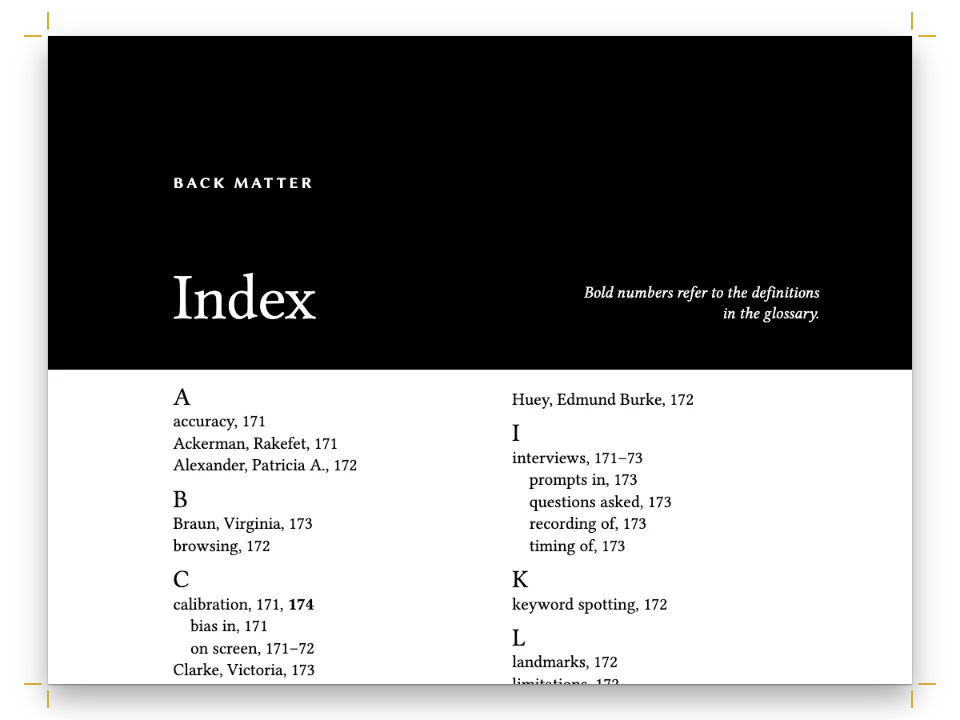
学术专著《Letters of Metal》的第四章,论述印刷字体,开本155 × 235 mm:正文单栏Crimson Pro,标题用Bodoni斜体,强调色为砖红。文章从古腾堡的textura哥特体讲起,经过Jenson、Aldus和Griffo、Garamond和Plantin、Caslon和Baskerville、Fournier的点制,以及Pradell和Gil刻制、Ibarra印刷的西班牙字体,一直到Bodoni的现代体。它像这类书一样以两个对页上的索引结束:左页是印刷商、刻字匠和赞助人,右页是字体、工具和书籍。两个索引都来自同一份带标记的文本,其中每个页码都是标记实际所在的页。
这道食谱解答
- 怎样用同一份标记好的正文印出两份索引,一份人名索引,一份主题索引?
- 怎样做一份页码随正文移动自动更新的书末索引?
简短回答
// Marks in the Markdown. A person goes to the names index, inverted:
//   :index[Aldus Manutius]{term="Manutius, Aldus" index="names" main}
// A subject goes to the main index, with levels split by "!" and a sort key when the
// printed form would file in the wrong place:
//   :index[textura]{term="Blackletter!textura" main}
//   :index{term="42-line Bible" sort="Forty-two-line Bible"}
//   :index{term="Cursive" see="Italic"}
// Printed at the end, each under its own heading:
//   # Index of Names {style="index"}    then    :::index{index="names"}
//   # Index of Subjects {style="index"} then    :::index
const indexHeading = {
  id: 'index',
  numbered: false, // no chapter number, and the next chapter is still chapter 5
  breakBefore: { enabled: true, parity: 'any' },
  layout: { layoutType: 'double', gutterWidth: mm(7) }, // the section after the heading
};
const index = {
  fontSize: pt(8.6), lineHeight: pt(11.2), // one leading for entries and letter heads
  indent: em(1), turnoverIndent: em(2),
  rangeFormat: 'chicago', // 212–14, as a monograph prints it
  main: { bold: true }, // the page of the principal discussion
  groups: { fontFamily: 'Bodoni Moda', fontSize: pt(11), fontWeight: 600, color: col('brick') },
};
用料
- 类型
- Crimson Pro, Bodoni Moda, Libre Franklin(SIL OFL 1.1)
- 素材
- 无:所有图片都用代码绘制
做法
#1 · 人物标记进人名索引,主题标记进主索引
代码见上面的简短回答,其余都在Markdown里。带index="names"的标记进入由:::index{index="names"}印出的索引,其他标记都进入由不带参数的:::index印出的主索引。所以:index[Aldus Manutius]{term="Manutius, Aldus" index="names" main}在正文中印出人名,并在人名索引的Manutius下登记一个粗体页码;两行之后的:index[italic]{term="Italic" main}则把同一页登记在主题索引的Italic下。如果某个人物本身也是本章的主题,可以同时带两种标记。
#2 · 人名倒装,并按读者会去查的字母排序
人名按姓氏在前登记:term="Garamond, Claude"、term="Dall’Aglio, Margherita"。逗号是条目的一部分,所以排序器会像索引编制者那样把Didot, Firmin排在Didot, François-Ambroise之前。印出的形式会被归到错误字母下时,用sort指定排序键:英文版标记为term="42-line Bible" sort="Forty-two-line Bible",这样这部圣经排在F下,而不是另开一个0–9组。子条目(term="Foundries!Plantin-Moretus")、粗体的主要页码(main)、Bodoni一节首尾的range="start"和range="end",以及互见(see="Italic"、seealso="Matrices")完成其余工作;带层级的see目标印出时用冒号连接,如Humanist type. See Roman type: Venetian。
#3 · 构建一次,文档自己确定页码
// A pass finds the page of every mark and prints both indexes with those numbers. When the
// printed index moves a mark (an index set before the text would), the layout runs again,
// until no page number changes (in a buildBundle book, the chapter with :::index gets them all).
const doc = await buildWithFonts(() => buildDocument({ markdown }, config()), markdown);
索引印的页码要排版后才存在,而印索引本身又要占页。buildDocument()处理这个问题:它排出本章,读取每个标记所在的页,印出两个索引,只要有页码变了就重新排版。这里索引在正文之后,所以第二遍只是确认第一遍;如果索引排在正文之前,它会让后面的每一页都移动,排版会一遍遍进行,直到结果一致为止。在Bodoni一节加一段,人名索引会自动给出Whittingham的新页码。
#4 · 给每个索引一个两栏的首页
const opener = (sink, size) => ({
  enabled: true,
  minHeight: pt(LEAD * sink), // the text starts on the same grid line in every chapter
  slot: { elements: [
    { kind: 'text', id: 'kicker', content: '{attr.kicker}', ...label, fontSize: pt(7.8),
      letterSpacing: pt(1.6), color: col('brick'), align: 'left',
      placement: at('container', 'top-left', 0, 10) },
    { kind: 'text', id: 'title', content: '{titleText}', fontFamily: 'Bodoni Moda', italic: true,
      fontSize: pt(size), lineHeight: 1.08, color: col('ink'), align: 'left',
      overflow: 'wrap', // design text ends in an ellipsis by default
      placement: { ...at('#kicker', 'below', 0, 3), size: { width: 'fill', height: 'auto' } } },
    { kind: 'rule', id: 'rule', direction: 'horizontal', thickness: pt(0.75), color: col('brick'),
      placement: { ...at('#title', 'below', 0, 4.5), size: { width: mm(16) } } },
  ] },
});
简短回答中的标题样式为# Index of Names {style="index"}做三件事:开新页(parity: 'any',所以两个索引紧接着排,中间没有空白页),把它后面的部分排成两栏、栏间距7 mm,并且通过numbered: false不计入章的编号。这个样式沿用章首页的设计,下沉六行,标题20 pt;字母标题重复它的Bodoni字体,使用强调色,高度为一行索引,使各栏保持行距节奏。
#5 · 在右页写出索引名
const head = (id, content, parity, edge, x, extra = {}) => ({
  kind: 'text', id, content, parity, pages: 'body', // never on openers
  ...label, fontSize: pt(7.2), letterSpacing: pt(1.3), color: col('muted'),
  placement: at('page', edge, x, 12.5), ...extra,
});
const folio = { color: col('brick'), fontWeight: 700 };
const header = { elements: [
  head('verso-folio', '{pageNumber}', 'even', 'top-left', MARGIN.outer,
    { ...folio, align: 'left' }),
  head('verso-title', '{title}', 'even', 'top-left', MARGIN.outer + 8, { align: 'left' }),
  head('recto-title', '{chapterTitle}', 'odd', 'top-right', -(MARGIN.outer + 8),
    { align: 'right' }),
  head('recto-folio', '{pageNumber}', 'odd', 'top-right', -MARGIN.outer,
    { ...folio, align: 'right' }),
] };
// Openers carry a drop folio instead, centred under the text block.
const footer = { elements: [{ ...head('drop-folio', '{pageNumber}', 'all', 'bottom', 0,
  { ...folio, align: 'center', placement: at('page', 'bottom', 0, -12) }), pages: 'opener' }] };
右页书眉印{chapterTitle},而索引标题和任何一章一样是一级标题,所以它之后的各页顶部印的是Index of Subjects。pages: 'body'让书眉不出现在两个索引的首页上,这两页改为在页脚印页码。
完整食谱
// ═══ Postext Cookbook · Nº 073 · An index of names and an index of subjects ═══════ // https://postext.dev/en/cookbook/names-and-subjects-indexes // Code: MIT · Text: original (CC BY 4.0) · Pictures: none // Fonts: Crimson Pro, Bodoni Moda, Libre Franklin (SIL OFL 1.1) · Needs postext ≥ 1.7.0 import { buildDocument, renderPageToCanvas, clearMeasurementCache } from 'https://esm.sh/postext'; import { renderToPdf, decompressWoff2 } from 'https://esm.sh/postext-pdf'; const LANG = 'en'; // @lang: the language of the sample document ('en' | 'es') const RECIPE = 'names-and-subjects-indexes'; // ─── 1 · Design ───────────────────────────────────────────────────────────── // #region palette: a warm black, one brick red for kickers, letter heads and folios const palette = { ink: '#211d19', // text: a warm near-black brick: '#8e3b24', // the one accent muted: '#6d645a', // running heads, colophon rule: '#c8bba9', // hairlines paper: '#fcfaf5', }; // A design element paints the hex written beside its paletteId (gotcha: palette-skips-designs). const col = (id) => ({ hex: palette[id], model: 'hex', paletteId: id }); const colorPalette = [ ...Object.entries(palette).map(([id, hex]) => ({ id, name: id, value: { hex, model: 'hex' } })), // The engine's defaults link to main-color: point it at the accent, never the default blue. { id: 'main-color', name: 'accent (defaults)', value: { hex: palette.brick, model: 'hex' } }, ]; // #endregion const TRIM = { width: 155, height: 235 }; // a scholarly monograph const MARGIN = { top: 22, bottom: 24, inner: 19, outer: 22 }; // mirrored: 114 mm measure const LEAD = 13.6; // body leading in pt const at = (to, edge, x = 0, y = 0) => ({ anchor: { to, edge }, offset: { x: mm(x), y: mm(y) } }); const label = { fontFamily: 'Libre Franklin', fontWeight: 600, textTransform: 'uppercase' }; // #region answer: two indexes from one text, each under a two-column heading style // Marks in the Markdown. A person goes to the names index, inverted: // :index[Aldus Manutius]{term="Manutius, Aldus" index="names" main} // A subject goes to the main index, with levels split by "!" and a sort key when the // printed form would file in the wrong place: // :index[textura]{term="Blackletter!textura" main} // :index{term="42-line Bible" sort="Forty-two-line Bible"} // :index{term="Cursive" see="Italic"} // Printed at the end, each under its own heading: // # Index of Names {style="index"} then :::index{index="names"} // # Index of Subjects {style="index"} then :::index const indexHeading = { id: 'index', numbered: false, // no chapter number, and the next chapter is still chapter 5 breakBefore: { enabled: true, parity: 'any' }, layout: { layoutType: 'double', gutterWidth: mm(7) }, // the section after the heading }; const index = { fontSize: pt(8.6), lineHeight: pt(11.2), // one leading for entries and letter heads indent: em(1), turnoverIndent: em(2), rangeFormat: 'chicago', // 212–14, as a monograph prints it main: { bold: true }, // the page of the principal discussion groups: { fontFamily: 'Bodoni Moda', fontSize: pt(11), fontWeight: 600, color: col('brick') }, }; // #endregion // #region opener: kicker, a Bodoni italic title and a short rule, sunk to the same line const opener = (sink, size) => ({ enabled: true, minHeight: pt(LEAD * sink), // the text starts on the same grid line in every chapter slot: { elements: [ { kind: 'text', id: 'kicker', content: '{attr.kicker}', ...label, fontSize: pt(7.8), letterSpacing: pt(1.6), color: col('brick'), align: 'left', placement: at('container', 'top-left', 0, 10) }, { kind: 'text', id: 'title', content: '{titleText}', fontFamily: 'Bodoni Moda', italic: true, fontSize: pt(size), lineHeight: 1.08, color: col('ink'), align: 'left', overflow: 'wrap', // design text ends in an ellipsis by default placement: { ...at('#kicker', 'below', 0, 3), size: { width: 'fill', height: 'auto' } } }, { kind: 'rule', id: 'rule', direction: 'horizontal', thickness: pt(0.75), color: col('brick'), placement: { ...at('#title', 'below', 0, 4.5), size: { width: mm(16) } } }, ] }, }); // #endregion // #region running-heads: book title on the verso, chapter or index on the recto const head = (id, content, parity, edge, x, extra = {}) => ({ kind: 'text', id, content, parity, pages: 'body', // never on openers ...label, fontSize: pt(7.2), letterSpacing: pt(1.3), color: col('muted'), placement: at('page', edge, x, 12.5), ...extra, }); const folio = { color: col('brick'), fontWeight: 700 }; const header = { elements: [ head('verso-folio', '{pageNumber}', 'even', 'top-left', MARGIN.outer, { ...folio, align: 'left' }), head('verso-title', '{title}', 'even', 'top-left', MARGIN.outer + 8, { align: 'left' }), head('recto-title', '{chapterTitle}', 'odd', 'top-right', -(MARGIN.outer + 8), { align: 'right' }), head('recto-folio', '{pageNumber}', 'odd', 'top-right', -MARGIN.outer, { ...folio, align: 'right' }), ] }; // Openers carry a drop folio instead, centred under the text block. const footer = { elements: [{ ...head('drop-folio', '{pageNumber}', 'all', 'bottom', 0, { ...folio, align: 'center', placement: at('page', 'bottom', 0, -12) }), pages: 'opener' }] }; // #endregion const config = () => ({ // a factory: the engine caches resolved configs per object locale: t({ en: 'en-us', es: 'es' }), // exact codes (gotcha: hyphenation-locales) colorPalette, page: { sizePreset: 'custom', width: mm(TRIM.width), height: mm(TRIM.height), dpi: 150, backgroundColor: col('paper'), margins: { top: mm(MARGIN.top), bottom: mm(MARGIN.bottom), left: mm(MARGIN.inner), right: mm(MARGIN.outer), mirror: true } }, // left = inner layout: { layoutType: 'single' }, bodyText: { fontFamily: 'Crimson Pro', fontSize: pt(10.6), lineHeight: pt(LEAD), color: col('ink'), boldColor: col('ink'), italicColor: col('ink'), referenceColor: col('ink'), textAlign: 'justify', firstLineIndent: mm(4.5), indentAfterHeading: false, hyphenation: { enabled: true }, optimalLineBreaking: true, avoidWidows: true, avoidOrphans: true, avoidRunts: true }, headings: { fontFamily: 'Bodoni Moda', fontWeight: 400, color: col('ink'), levels: [ // Restated on purpose: any headings object drops the H1 break // (gotcha: headings-drop-h1-break). { level: 1, advancedDesign: opener(9, 26), marginBottom: pt(0), breakBefore: { enabled: true, parity: 'odd' } }, { level: 2, fontSize: pt(12), lineHeight: pt(LEAD), italic: true, fontWeight: 400, color: col('brick'), marginTop: pt(LEAD), marginBottom: pt(LEAD * 0.5) }, ] }, // The index heading: a shallower opener over the two columns of entries. headingStyles: [{ ...indexHeading, span: 'page', advancedDesign: opener(6, 20), marginBottom: pt(0) }], index, paragraphStyles: [ { id: 'colophon', ...label, textTransform: 'none', fontWeight: 400, fontSize: pt(7), lineHeight: pt(10), color: col('muted'), textAlign: 'left', firstLineIndent: pt(0), marginTop: pt(LEAD * 2) }, ], header, footer, }); // ─── 2 · Content ──────────────────────────────────────────────────────────── const markdown = String.raw`---Markdown样例 · 70行 · content.en.md
title: "Letters of Metal" subtitle: "A Short History of Printing Types" --- # From Textura to Bodoni {kicker="Chapter four"} The first European types imitated the hand that readers trusted most. When :index[Johannes Gutenberg]{term="Gutenberg, Johannes" index="names" main} printed his Bible in Mainz, finished by 1455,:index{term="42-line Bible" sort="Forty-two-line Bible" main} he set it in :index[textura]{term="Blackletter!textura" main}, the tall, narrow letter of German choir books, with its broken strokes and diamond feet. The page was meant to pass for a manuscript, and it did: rubricators added the red initials by hand, and some copies were printed on vellum. What was new lay out of sight. Each letter had been cut in steel as a :index[punch]{term="Punchcutting" main}:index{term="Punchcutting" seealso="Matrices"}, struck into a bar of softer copper to make a :index[matrix]{term="Matrices"}, and cast in the :index[hand mould]{term="Hand mould"} from an alloy of lead, tin and antimony.:index{term="Type metal"} A single punch could yield thousands of identical sorts, and the whole chain, from punch to page, would stay in use with few changes for nearly four hundred years. Gutenberg’s partners saw the business before he did. :index[Johann Fust]{term="Fust, Johann" index="names"} took over the shop after a lawsuit in 1455, and with :index[Peter Schoeffer]{term="Schoeffer, Peter" index="names"} he printed the Mainz Psalter of 1457, the first book to carry a printer’s colophon and a date. When Mainz was sacked in 1462 its journeymen scattered, and within twenty years there were presses in more than a hundred towns. ## The Venetian roman Italian readers did not want German letters. The humanists of Florence had revived the Carolingian minuscule for their copies of the classics, a round, open hand they believed ancient, and the printers who came south followed them. The best of the early romans was cut in Venice by :index[Nicolas Jenson]{term="Jenson, Nicolas" index="names" main}, a Frenchman trained at the mint of Tours. His Eusebius of 1470 is set in a :index[roman]{term="Roman type!Venetian" main} of even colour and wide, well-fitted capitals, and it has been the model for revivals ever since. Twenty-five years later :index[Aldus Manutius]{term="Manutius, Aldus" index="names" main} opened his press in the same city, with a scholar’s programme: Greek texts first, then the Latin authors in editions a student could carry. His punchcutter was :index[Francesco Griffo]{term="Griffo, Francesco" index="names" main} of Bologna. For the short dialogue *De Aetna* by the young :index[Pietro Bembo]{term="Bembo, Pietro" index="names"}, printed in 1496,:index{term="*De Aetna*"} Griffo cut a roman lighter and more regular than Jenson’s, with capitals shorter than the ascenders, the proportion book faces have kept to this day. :index{term="Roman type!Aldine"} In 1501 Aldus issued a :index[Virgil]{term="Virgil" index="names"} in octavo, set entirely in a new letter: Griffo’s :index[italic]{term="Italic" main}, based on the sloped script of the papal chancery. It saved space, which suited a pocket book, and it looked learned. The Venetian Senate granted Aldus a privilege over it,:index{term="Privileges"} counterfeiters in Lyon copied it within a year, and Aldus and Griffo quarrelled over the credit until Griffo left Venice. For a century the italic was a text face in its own right. Only later did printers pair it with a roman and use it for emphasis, titles and foreign words, the role it still has. :index{term="Cursive" see="Italic"} ## Paris and Antwerp The roman became French in the 1530s. The Paris printer :index[Robert Estienne]{term="Estienne, Robert" index="names"} and his circle wanted Aldine letters, and the man who cut them best was :index[Claude Garamond]{term="Garamond, Claude" index="names" main}, a punchcutter who worked mostly for other men’s presses. His romans refine Griffo’s model: the thin strokes are finer, the serifs sharper, the capitals lighter against the lower case. Between 1540 and 1550 he also cut the *grecs du roi*,:index{term="Greek type"} three sizes of Greek for François I, closely modelled on the hand of the Cretan scribe Angelos Vergikios. When Garamond died in 1561 his punches were sold, and many went to Antwerp. :index[Christophe Plantin]{term="Plantin, Christophe" index="names" main}, a bookbinder from Touraine, had built there the largest printing house in Europe, and he bought type as a banker buys bonds. His shop kept the punches and matrices of Garamond, of :index[Robert Granjon]{term="Granjon, Robert" index="names" main} and of Guillaume Le Bé, and for the great Polyglot Bible of 1568–1572, in Latin, Greek, Hebrew, Aramaic and Syriac, he needed all of them. Granjon was the finest italic cutter of the century; he also cut, in Lyon in 1557, the *civilité*, a French secretary hand he hoped would become a national type. It did not, but his italics did. The house stayed with the Moretus family until the city of Antwerp bought it in 1876, and its punches, matrices and account books are still there, the most complete type foundry of its age to survive.:index{term="Foundries!Plantin-Moretus"} ## The English century England printed with Dutch type until the eighteenth century, when an engraver of gun locks set up a foundry in London. :index[William Caslon]{term="Caslon, William" index="names" main} issued his specimen sheet in 1734,:index{term="Specimens!Caslon, 1734"} and his roman, sturdy and a little irregular, became the ordinary type of the English-speaking world. It needed no explanation and drew no attention to itself, which is why printers still reach for it. :index[John Baskerville]{term="Baskerville, John" index="names" main}, a Birmingham writing master who had made his money in japanned ware, came to printing late and changed more than the letters. For his Virgil of 1757 he had his own type cut by John Handy, with a more vertical stress and a sharper contrast than Caslon’s, and he printed it on smooth wove paper,:index{term="Paper, wove"} with a blacker ink of his own recipe, and pressed the sheets between hot copper plates to give them a gloss. English printers found the pages too bright to read. Readers on the Continent admired them, and a :index[transitional]{term="Transitional type"} letter, between the old style and the modern, was born. ## Measuring type Until the middle of the eighteenth century every foundry named its sizes as it pleased: *pica*, *cicero*, *long primer*, *petit-romain*. A size was a habit of the house, not a measurement, and a printer who bought type from two foundries could not set it side by side. :index[Pierre-Simon Fournier]{term="Fournier, Pierre-Simon" index="names" main}, the younger son of a Paris family of typefounders, published in 1737 a table of proportions that divided an inch into seventy-two :index[points]{term="Point system" main range="start"} and gave every body a number of points. He set it out in full in his *Manuel typographique* of 1764–1766.:index{term="*Manuel typographique*"} :index[François-Ambroise Didot]{term="Didot, François-Ambroise" index="names"} tied the point to the royal foot about 1783, which made it slightly larger; the Didot point spread across the Continent, while American and British founders settled on a pica point of their own only in 1886 and 1898. :index{term="Point system" range="end"} ## Spanish types Spanish printers of the early eighteenth century bought their type in Holland and France, and the Crown thought this a disgrace for a kingdom that had printed the Complutensian Polyglot. :index[Charles III]{term="Charles III, king of Spain" index="names"} and his ministers set out to change it. The Royal Library in Madrid opened a foundry of its own,:index{term="Foundries!Royal Library, Madrid" main} and the Crown paid pensions to punchcutters who would work in Spain. Two of them came from very different trades. :index[Eudald Pradell]{term="Pradell, Eudald" index="names" main}, the son of a gunsmith from Ripoll, had learned to cut steel in his father’s forge and cut his first punches in Barcelona. Called to Madrid in 1764 with a royal pension, he cut romans and italics of an open, generous design that the Madrid printers took up at once. :index[Jerónimo Antonio Gil]{term="Gil, Jerónimo Antonio" index="names" main} came from the other end of the trade: he was an engraver of the Royal Mint, a medallist, and he cut for the Royal Library a series of romans, italics and Greek that the Library showed in its specimen of 1787.:index{term="Specimens!Royal Library, 1787"} Gil did not stay to see it. In 1778 he left for Mexico as chief engraver of the mint, and there he founded the school that became the Academy of San Carlos. The printer who made these types famous was :index[Joaquín Ibarra]{term="Ibarra, Joaquín" index="names" main}, born in Zaragoza in 1725 and printer to the King from 1779. His Sallust of 1772, translated by the Infante Gabriel,:index{term="Gabriel of Bourbon, Infante" index="names"} was praised in Paris and Parma for its presswork. For the Real Academia Española he printed in 1780 the *Quixote* in four quarto volumes,:index{term="*Quixote*, Academy edition" main}:index{term="Cervantes, Miguel de" index="names"} set in Gil’s types, illustrated by the best engravers of the court and printed on paper made for it in Catalonia. The ink, dark and even, was Ibarra’s own; the page, with generous margins and no ornament besides the plates, is the Spanish counterpart of Baskerville’s. ## Bodoni’s moderns The last step belonged to a printer at a small court.:index{term="Modern face" range="start"} :index[Giambattista Bodoni]{term="Bodoni, Giambattista" index="names" main}, born in Saluzzo in 1740, learned to cut punches at the press of the Propaganda Fide in Rome, where he cleaned and set in order its oriental types. In 1768 Duke Ferdinand called him to Parma to run the ducal press, and he stayed there for the rest of his life. His early types follow Fournier; by the 1790s he was cutting letters of a new kind, with hairline serifs, strictly vertical stress and a contrast between thick and thin that only smooth paper and careful printing could hold. These are the :index[modern]{term="Modern face" main} faces. In Paris, :index[Firmin Didot]{term="Didot, Firmin" index="names"} was drawing the same conclusions at the same time, and the two houses watched each other closely.:index{term="Didone" see="Modern face"} Bodoni printed few books that anyone read, and many that everyone admired: Homer in Greek, Horace, Tasso, folio after folio for collectors and kings. His life’s work was the :index[*Manuale tipografico*]{term="*Manuale tipografico*" main}, which his widow, :index[Margherita Dall’Aglio]{term="Dall’Aglio, Margherita" index="names"}, published in 1818, five years after his death: two volumes of romans and italics in more than a hundred sizes and cuts, with Greek, Hebrew and other alphabets, and a preface that says what a letter ought to be. The modern face swept the Continent and then England, where by 1820 hardly a printer still set books in old-style type.:index{term="Modern face" range="end"} ## Names for the families The words this chapter has used, :index[old style]{term="Old style" main}, transitional and modern, come from the printers of the nineteenth century, who needed a way to order their specimen books, and they are not precise. An old style in 1860 meant any letter cut on the model of Caslon; a modern meant anything after Bodoni, however clumsy. The old style came back in the 1840s, when :index[Charles Whittingham]{term="Whittingham, Charles" index="names"} of the Chiswick Press reissued Caslon’s type for a book set in the manner of the seventeenth century, and from then on the two lived side by side in every specimen. In 1921 the French typefounder :index[Francis Thibaudeau]{term="Thibaudeau, Francis" index="names"} proposed to sort types by their serifs alone: triangular, hairline, square or none.:index{term="Classification of types!Thibaudeau, 1921"} It was easy to apply and blind to history. :index[Maximilien Vox]{term="Vox, Maximilien" index="names"}, an illustrator and publisher, went further in 1954 with nine families whose names join the masters of each style: *humanes* for the Venetians after Jenson, *garaldes* for Garamond and Aldus, *réales* for the letters of Fournier and Baskerville, *didones* for Didot and Bodoni.:index{term="Classification of types!Vox, 1954" main} The Association Typographique Internationale adopted a version of it in 1962, and the British Standards Institution followed in 1967. :index{term="Garalde" see="Old style"} :index{term="Humanist type" see="Roman type!Venetian"} These labels leave out as much as they sort. Gil’s romans for the Royal Library are *réales* by the book and Spanish by every other measure; Pradell’s italics owe as much to Granjon as to anything cut in their own century. The quarrel between the two ideas of the letter, the one written with a pen and the one drawn with compasses and rule, is older than any of these names and has not been settled. :::paragraphs{style="colophon"} *Letters of Metal*, chapter four. Set in Crimson Pro, with Bodoni Moda for display and Libre Franklin for labels (SIL Open Font License). Text written for the Postext Cookbook, CC BY 4.0. ::: # Index of Names {style="index" kicker="Printers, punchcutters, patrons"} :::index{index="names"} # Index of Subjects {style="index" kicker="Types, tools and books"} :::index`; // content.<lang>.md, inlined by the Cookbook // ─── 3 · Fonts ────────────────────────────────────────────────────────────── // Every face the design uses (gotcha: fonts-first). const FONTS = { 'Crimson Pro': ['400', '400i', '600', '700'], 'Bodoni Moda': ['400', '400i', '600'], 'Libre Franklin': ['400', '400i', '600', '700'], }; // ─── 4 · Build & show ─────────────────────────────────────────────────────── await loadFonts(FONTS, markdown); // #region build: one buildDocument, laid out again until the index's page numbers settle // A pass finds the page of every mark and prints both indexes with those numbers. When the // printed index moves a mark (an index set before the text would), the layout runs again, // until no page number changes (in a buildBundle book, the chapter with :::index gets them all). const doc = await buildWithFonts(() => buildDocument({ markdown }, config()), markdown); // #endregion showPages(doc, { title: t({ en: 'Two indexes', es: 'Dos índices' }) }); offerPdf(() => renderToPdf(doc, { fontProvider: fontsourceProvider }), `${RECIPE}.pdf`);工具包 · core, fonts, viewer, pdf:每道食谱都相同 · 275行
// ─── Kit ── helpers shared by every Cookbook recipe · postext.dev/cookbook ───── // ─── Kit · core v1 ── the same in every recipe · postext.dev/cookbook ───────── function mm(value) { return { value, unit: 'mm' }; } function pt(value) { return { value, unit: 'pt' }; } function em(value) { return { value, unit: 'em' }; } /** The sample language's string: t({ en: 'Figure', es: 'Figura' }). */ function t(strings) { return strings[LANG] ?? Object.values(strings)[0]; } /** A file in this recipe's assets folder, served from the Postext repo by jsDelivr. */ function asset(file) { return `https://cdn.jsdelivr.net/gh/drnachio/postext@main/cookbook/${RECIPE}/assets/${file}`; } // ─── Kit · fonts v1 ── the same in every recipe · postext.dev/cookbook ──────── // Postext measures text with the faces the browser has loaded, and caches the // widths, so every face must be ready before the first build. Faces come from // Fontsource: the same static files the PDF embeds, so screen and PDF agree. /** faces = { 'Family Name': ['400', '400i', '700'] }. `text` is the sample: * letters beyond Latin-1 (č, ł, ő…) also load the latin-ext files. With * `optional`, a face Fontsource does not ship is skipped instead of failing. * Resolves to the number of faces added. */ async function loadFonts(faces, text = '', { optional = false } = {}) { kitStatus('Loading fonts…'); const ranges = { latin: 'U+0000-00FF,U+0131,U+0152-0153,U+02BB-02BC,U+02C6,U+02DA,U+02DC,U+0304,U+0308,U+0329,' + 'U+2000-206F,U+20AC,U+2122,U+2191,U+2193,U+2212,U+2215,U+FEFF,U+FFFD', 'latin-ext': 'U+0100-02BA,U+02BD-02C5,U+02C7-02CC,U+02CE-02D7,U+02DD-02FF,U+0304,U+0308,U+0329,' + 'U+1D00-1DBF,U+1E00-1E9F,U+1EF2-1EFF,U+2020,U+20A0-20AB,U+20AD-20C0,U+2113,U+2C60-2C7F,U+A720-A7FF', }; const subsets = /[Ā-˿Ḁ-ỿ]/.test(text) ? ['latin', 'latin-ext'] : ['latin']; const jobs = []; let added = 0; for (const [family, specs] of Object.entries(faces)) { const id = fontsourceId(family); const meta = optional ? await fontsourceMeta(family) : null; for (const spec of new Set(specs)) { const weight = parseInt(spec, 10); const style = spec.endsWith('i') ? 'italic' : 'normal'; if (hasFace(family, weight, style)) continue; if (optional && !(meta?.weights.includes(weight) && meta.styles.includes(style))) continue; for (const subset of subsets) { const url = `https://cdn.jsdelivr.net/npm/@fontsource/${id}@5/files/${id}-${subset}-${weight}-${style}.woff2`; const face = new FontFace(family, `url(${url}) format('woff2')`, { weight: String(weight), style, unicodeRange: ranges[subset] }); jobs.push(face.load().then((ready) => { document.fonts.add(ready); added++; }, () => { if (subset === 'latin' && !optional) throw new Error(`Fontsource has no ${family} ${weight} ${style}`); })); } } } await Promise.all(jobs).catch((error) => { kitFail(error); throw error; }); return added; } /** Runs `build` (a buildDocument or buildBundle call) and checks the faces * the pages use. A regular face missing from FONTS is loaded with a warning; * bold and italic variants are loaded when the family ships them. Then the * measurement caches are cleared and the build runs again. */ async function buildWithFonts(build, text = '') { const tried = new Set(); for (let round = 0; round < 3; round++) { kitStatus('Laying out…'); await new Promise(requestAnimationFrame); // let the status paint first const result = await Promise.resolve().then(build).catch((error) => { kitFail(error); throw error; }); const wanted = { base: {}, variants: {} }; for (const { font, base } of [result].flat().flatMap(fontStringsOf)) { const { family, weight, style } = parseFont(font); const key = `${family}|${weight}|${style}`; if (tried.has(key) || hasFace(family, weight, style)) continue; tried.add(key); (wanted[base ? 'base' : 'variants'][family] ??= []).push(`${weight}${style === 'italic' ? 'i' : ''}`); } if (Object.keys(wanted.base).length) { console.warn(`[cookbook] FONTS does not list ${JSON.stringify(wanted.base)}: loading them.`); } const added = await loadFonts(wanted.base, text) + await loadFonts(wanted.variants, text, { optional: true }); if (added === 0) return result; clearMeasurementCache(); } throw new Error('The fonts did not settle after three builds.'); } /** Every font string of the layout. `base` marks a block's own face; its * bold, italic and bold-italic variants are listed whether or not used. */ function fontStringsOf(doc) { const found = new Map(); const walk = (node) => { if (!node || typeof node !== 'object') return; if (Array.isArray(node)) { node.forEach(walk); return; } for (const [key, value] of Object.entries(node)) { if (typeof value === 'string' && /fontString$/i.test(key)) { found.set(value, found.get(value) || key === 'fontString'); } else if (value && typeof value === 'object') walk(value); } }; walk(doc.pages); walk(doc.blocks); return [...found].map(([font, base]) => ({ font, base })); } /** '700 37.5px Open Sans' / 'italic 400 13px "Source Serif 4"' → { family, weight, style }. * A string with no weight ('95.8px Young Serif', from a design text) is 400. */ function parseFont(font) { const m = /^(?:(italic|oblique)\s+)?(?:small-caps\s+)?(?:(\d+|bold|normal)\s+)?[\d.]+px\s+(.+)$/.exec(font.trim()); if (!m) throw new Error(`Unexpected font string: ${font}`); const weight = m[2] === 'bold' ? 700 : !m[2] || m[2] === 'normal' ? 400 : Number(m[2]); return { family: m[3].replace(/^["']|["']$/g, ''), weight, style: m[1] ? 'italic' : 'normal' }; } /** True when a loaded FontFace covers exactly this family, weight and style * (document.fonts.check() is also true for families nobody declared). */ function hasFace(family, weight, style) { for (const face of document.fonts) { if (face.status !== 'loaded' || face.style !== style) continue; if (face.family.replace(/^["']|["']$/g, '') !== family) continue; const [low, high = low] = face.weight.split(' ').map(Number); if (weight >= low && weight <= high) return true; } return false; } /** Fontsource's id for a family: 'Source Serif 4' → 'source-serif-4'. */ function fontsourceId(family) { return family.toLowerCase().replace(/\s+/g, '-'); } /** The weights and styles a family ships ({ weights: [400, 700], styles: ['normal', 'italic'] }), or null. */ function fontsourceMeta(family) { fontsourceMeta.cache ??= new Map(); const id = fontsourceId(family); if (!fontsourceMeta.cache.has(id)) { fontsourceMeta.cache.set(id, fetch(`https://api.fontsource.org/v1/fonts/${id}`) .then((res) => (res.ok ? res.json() : null), () => null)); } return fontsourceMeta.cache.get(id); } // ─── Kit · viewer v1 ── the same in every recipe · postext.dev/cookbook ─────── /** Shows the pages as facing spreads on a dark desk: the first page is a * recto on its own, then verso | recto pairs, as in a bound book. Pages * are painted when they scroll near the screen. */ function showPages(docs, { title, width = 460 } = {}) { const root = viewer(title); const pages = [docs].flat().flatMap((doc) => doc.pages.map((page) => ({ doc, page, n: (doc.pageIndexOffset ?? 0) + page.index }))); const spreads = []; let verso = null; for (const p of pages) { if (p.n % 2 === 1) { if (verso) spreads.push([verso, null]); verso = p; } else { spreads.push([verso, p]); verso = null; } } if (verso) spreads.push([verso, null]); const density = Math.min(window.devicePixelRatio || 1, 2); showPages.painter?.disconnect(); const painter = new IntersectionObserver((entries) => { for (const { isIntersecting, target } of entries) { if (!isIntersecting) continue; painter.unobserve(target); const { doc, page } = target.postext; renderPageToCanvas(page, doc, target, { scale: (width * density) / page.width }); } }, { rootMargin: '800px' }); showPages.painter = painter; root.replaceChildren(...spreads.map((pair) => { const spread = document.createElement('div'); spread.className = 'pt-spread'; for (const p of pair) { const figure = document.createElement('figure'); if (p) { const label = p.page.pageLabel || String(p.n + 1); const canvas = document.createElement('canvas'); canvas.postext = p; canvas.style.aspectRatio = `${p.page.width} / ${p.page.height}`; canvas.setAttribute('role', 'img'); canvas.setAttribute('aria-label', `Page ${label}`); const folio = document.createElement('figcaption'); folio.textContent = label; figure.append(canvas, folio); painter.observe(canvas); } else figure.className = 'pt-blank'; spread.append(figure); } return spread; })); kitStatus(`${pages.length} ${pages.length === 1 ? 'page' : 'pages'}`); document.documentElement.dataset.postext = 'ready'; return pages.length; } /** The desk, the bar and the error reporting, created once. */ function viewer(title) { if (!document.getElementById('pt-kit')) { document.head.insertAdjacentHTML('beforeend', `<style id="pt-kit"> :root { color-scheme: dark; } body { margin: 0; background: #0e1014; color: #b9bcc4; font: 13px/1.45 system-ui, sans-serif; } #pt-bar { position: sticky; top: 0; z-index: 1; display: flex; flex-wrap: wrap; align-items: center; gap: 6px 16px; padding: 10px 16px; background: rgb(14 16 20 / .92); backdrop-filter: blur(6px); border-bottom: 1px solid #23262d; } #pt-bar strong { color: #f4f1ea; font-weight: 600; } #pt-actions { display: flex; gap: 12px; margin-left: auto; } #pt-actions a, #pt-actions button { color: #d8a21a; font: inherit; background: none; border: 0; padding: 0; cursor: pointer; } #pages { display: grid; justify-items: center; gap: 48px; padding: 32px 16px 72px; } .pt-spread { display: flex; } .pt-spread figure { margin: 0; width: min(460px, 44vw); } .pt-spread canvas { display: block; width: 100%; background: #fff; box-shadow: 0 1px 2px rgb(0 0 0 / .5), 0 22px 44px -16px rgb(0 0 0 / .8); } .pt-spread figure:first-child canvas { box-shadow: inset -14px 0 14px -14px rgb(0 0 0 / .18), 0 1px 2px rgb(0 0 0 / .5), 0 22px 44px -16px rgb(0 0 0 / .8); } .pt-spread figcaption { margin-top: 10px; text-align: center; font: 600 10px/1 system-ui, sans-serif; letter-spacing: .18em; text-transform: uppercase; color: #6c7079; } .pt-blank { visibility: hidden; } @media (max-width: 760px) { .pt-spread { flex-direction: column; gap: 32px; } .pt-spread figure { width: min(460px, 92vw); } .pt-blank { display: none; } } </style>`); document.body.insertAdjacentHTML('afterbegin', '<header id="pt-bar"><strong id="pt-title"></strong><span id="pt-status" role="status"></span><span id="pt-actions"></span></header>'); document.getElementById('pt-title').textContent = document.title || 'Postext'; addEventListener('error', (event) => kitFail(event.error ?? event.message)); addEventListener('unhandledrejection', (event) => kitFail(event.reason)); } if (title) document.getElementById('pt-title').textContent = title; return document.getElementById('pages') ?? document.body.appendChild(Object.assign(document.createElement('main'), { id: 'pages' })); } function kitStatus(text) { viewer(); document.getElementById('pt-status').textContent = text; } function kitFail(error) { document.documentElement.dataset.postext = 'error'; kitStatus(`Error: ${error?.message ?? error}`); } // ─── Kit · pdf v1 ── the same in every recipe that exports a PDF ────────────── /** postext-pdf embeds TrueType bytes. Fetch the Fontsource file the screen * used, snapping to a weight the family ships and falling back to upright * when it has no italic: the PDF asks for every face a block could use. */ async function fontsourceProvider(family, weight, style) { const id = fontsourceId(family); const meta = await fontsourceMeta(family); const weights = meta?.weights?.length ? meta.weights : [400, 700]; const w = weights.reduce((a, b) => (Math.abs(b - weight) < Math.abs(a - weight) ? b : a)); const s = style === 'italic' && meta && !meta.styles.includes('italic') ? 'normal' : style; const res = await fetch(`https://cdn.jsdelivr.net/npm/@fontsource/${id}@5/files/${id}-latin-${w}-${s}.woff2`); if (!res.ok) throw new Error(`Fontsource has no ${family} ${w} ${s} (${res.status})`); return decompressWoff2(new Uint8Array(await res.arrayBuffer())); } /** A "Build the PDF" button in the bar. Once built: "Open the PDF" (a new * tab, since CodePen's preview frame cannot show PDFs) and a download link. */ function offerPdf(makePdf, filename) { viewer(); const button = Object.assign(document.createElement('button'), { type: 'button', textContent: 'Build the PDF' }); button.dataset.postextPdf = filename; button.addEventListener('click', async () => { button.disabled = true; button.textContent = 'Building the PDF…'; try { const bytes = await makePdf(); const url = URL.createObjectURL(new Blob([bytes], { type: 'application/pdf' })); const size = `${Math.max(1, Math.round(bytes.length / 1024))} KB`; button.replaceWith( Object.assign(document.createElement('a'), { href: url, target: '_blank', rel: 'noopener', textContent: 'Open the PDF ↗' }), Object.assign(document.createElement('a'), { href: url, download: filename, textContent: `Download ${filename} · ${size}` })); } catch (error) { button.disabled = false; button.textContent = 'Build the PDF'; kitFail(error); } }); document.getElementById('pt-actions').append(button); } // ─── /Kit ───────────────────────────────────────────────────────────────────────
组合好的script.js可以直接运行:把它粘贴到任何页面的模块脚本中,或在CodePen上打开这道食谱。 GitHub上的食谱文件夹 ↗
变化
#印一个合并索引
去掉人物标记和第二个标题上的index="names":所有标记都进入主索引,人名和主题排在同一个字母序里。
-:index[Aldus Manutius]{term="Manutius, Aldus" index="names" main}
+:index[Aldus Manutius]{term="Manutius, Aldus" main}#去掉字母标题
这么短的人名索引不用字母标题也好读。groups.enabled: false去掉字母标题,字母之间留一行空白;这项设置对两个索引都起作用。
-  groups: { fontFamily: 'Bodoni Moda', fontSize: pt(11), fontWeight: 600, color: col('brick') },
+ groups: { enabled: false },常见问题
易错点
传入任何headings对象都会关掉H1换页
默认情况下,H1换页到右页(always-odd),但只要传入headings对象,这个默认值就会被重置,于是各章接排,span: 'page'也不起作用。在每份配置中重新写明headings.levels[0].breakBefore: { enabled: true, parity }。 从右页开始的章 →
易错点
排版前加载所有字体
排版用浏览器已加载的字体测量文字,并缓存宽度,所以首次构建之后才到的字体会造成断行错误,PDF也不再与屏幕一致。先加载所有字重和样式;有字体迟到时,重新构建前调用clearMeasurementCache()。 排版前加载字体 →
易错点
替换调色板时,设计元素和引用颜色不会跟着变
postext 1.4.1把colorPalette读入文字样式(正文、标题、列表、题注、表格、框),但不读入页眉、页脚、章首页和篇章页的元素,也不读入bodyText.referenceColor:它们保留写在paletteId旁边的十六进制颜色。替换调色板时(例如做深色屏幕版或换色),在构建前根据colorPalette重写每一个关联的颜色。 语义调色板 →
易错点
配置按对象身份缓存:每次新建一个对象
引擎按对象身份缓存解析后的配置,所以就地修改配置再构建,会复用旧的结果。每次构建都新建一个对象,这也是食谱的配置写成工厂函数config()的原因。 在Canvas上绘制页面 →
index配置是共用的:两个索引使用同样的字体、行距和字母标题。- 题注或表格单元格中的标记会原样印出。应在引用该图的段落里标记人物。
致谢
- 文本
- “From Textura to Bodoni”, an essay on the history of printing types written for this recipe, in English and Spanish · Ignacio Ferro · CC BY 4.0
- 字体
- Crimson Pro (SIL OFL 1.1) · Bodoni Moda (SIL OFL 1.1) · Libre Franklin (SIL OFL 1.1)