成品一览
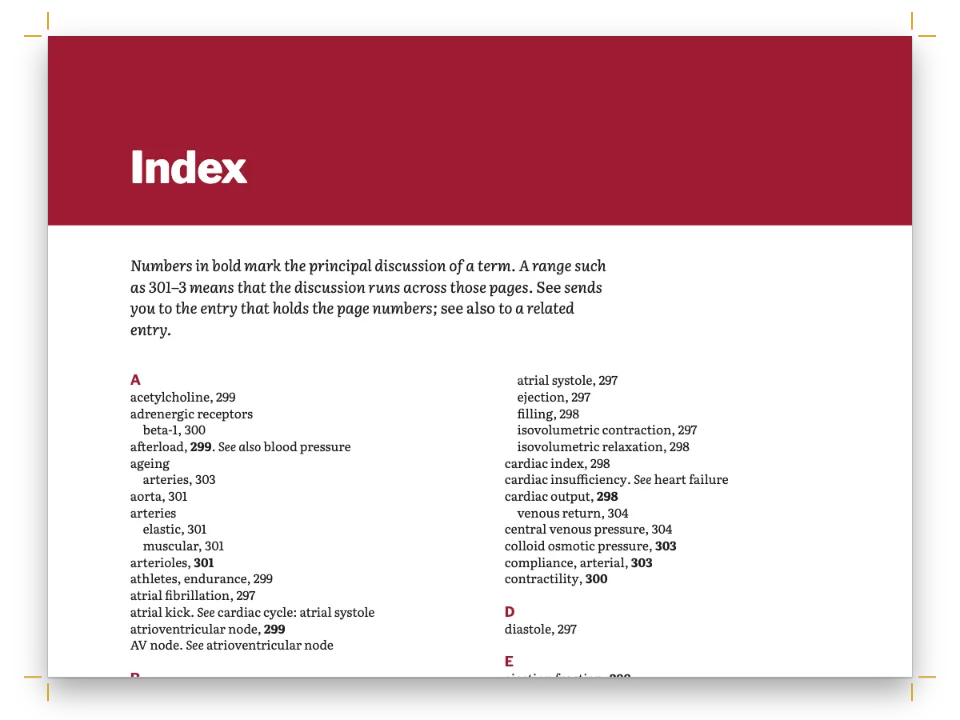
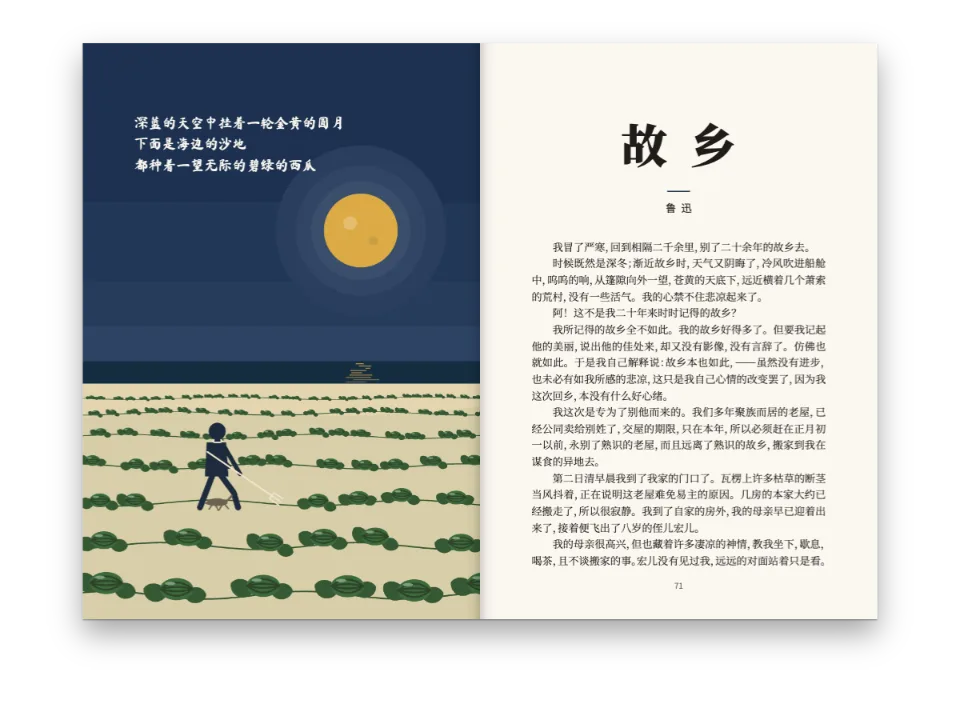
一本薄薄的《紅樓夢》读本,从第一回到第三回中选印了人物初次登场的段落,书末附一份人名索引,收47个人名,另有四条从别名指过来的参见。同一套标记生成两个版本。大陆版用简体字,按拼音首字母F、H、J……归组;台湾版用繁体字,按首字的笔画数三畫、四畫……归组。两版都是大32开平装,140 × 203 mm,每行26字,正文用Noto Serif,回目用楷体,眉题、页码和索引分组标题用Noto Sans。卡片上放大的是简体版索引的前几组,F到L。人名索引与主题索引为一本英文专著做了同类的索引。
这道食谱解答
- 怎样把中文人名索引按拼音或笔画数分组?
- 怎样让汉字在PDF里不显示成空框?
简短回答
// Marks in the Markdown, one per passage; main is the page where the character enters:
//   字:index[士隐]{term="甄士隐" main}      :index{term="贾化" see="贾雨村"}
// Printed at the end of each edition: # 人名索引 {style="index"}, then :::index
const index = (e) => ({
  // 'auto' reads the same from the locale: pinyin for zh-Hans, strokes for zh-Hant.
  groupBy: e.locale === 'zh-Hans' ? 'pinyin' : 'stroke', // A B C… or 三畫 四畫…
  fontFamily: e.serif, fontSize: pt(9), lineHeight: pt(14),
  separator: '\u3000', locatorSeparator: ',', // 贾宝玉 4,6: an ideographic space, then ,
  see: { italic: false }, // 见 / 見 upright: Chinese has no italic (gotcha: cjk-no-italic)
  groups: { fontFamily: e.sans, fontSize: pt(9.5), fontWeight: 700, color: col('cinnabar'),
    marginTop: pt(7) },
});
const indexHeading = { id: 'index', numbered: false, breakBefore: { enabled: true, parity: 'any' },
  layout: { layoutType: 'double', gutterWidth: pt(21) } }; // two columns, 2 characters apart
用料
- 类型
- Noto Serif SC, Noto Sans SC, Ma Shan Zheng, Noto Serif TC, Noto Sans TC, LXGW WenKai TC(SIL OFL 1.1)
- 素材
- 无:所有图片都用代码绘制
做法
#1 · 在读者遇到人名的地方加标记
代码见上文的简短回答,其余都在Markdown里。无论正文印的是什么,标记都以全名归档:字:index[士隐]{term="甄士隐" main}印出士隐,在甄士隐名下记一个页码。main让这个页码排成粗体,索引标题下的说明交代了粗体在这里的含义:人物亲自登场的那一页。贾宝玉在第二回出生时没有提名字(又生了一位公子),所以这里的标记不印任何文字,写作:index{term="贾宝玉"},他的条目读作4, 6。别名和绰号有自己的参见条目,:index[凤辣子]{term="凤辣子" see="王熙凤"},Postext按中文习惯印出,前面是句号,不留空格:凤辣子。见王熙凤(索引标记)。
#2 · 让语言区域决定排序
// The mainland edition in Simplified characters and the Taiwan edition in Traditional ones.
// Each takes the Song (serif), Hei (sans) and Kai faces cut for its script. Fontsource has no
// Kai text face with mainland forms: LXGW WenKai TC draws 冷 the Taiwan way, so the mainland
// titles take Ma Shan Zheng, a brush Kai.
const EDITIONS = {
  hans: { locale: 'zh-Hans', serif: 'Noto Serif SC', sans: 'Noto Sans SC', kai: 'Ma Shan Zheng' },
  hant: { locale: 'zh-Hant', serif: 'Noto Serif TC', sans: 'Noto Sans TC', kai: 'LXGW WenKai TC' },
};
两个版本共用同一份配置,索引只需要locale这一个开关:groupBy: 'auto'让zh-Hans索引按拼音分组,让zh-Hant索引按笔画分组;简短回答把这两个值明确写了出来,方便你看清。条目按分组标题所依据的顺序排列,所以同样的人名会换位置:在Z组下,甄费排在甄士隐之前(fèi在shì之前),在十四畫下则排在其后(士三画,費十二画);宁国公和荣国公分入N和R两组,而寧國公和榮國公在十四画的人名中仍然挨在一起(索引)。读音和笔画数来自浏览器的中文排序规则;遇到读错的姓(曾、单、解),就用读音正确的汉字给它一个sort键。
#3 · 每种字体只加载它要排的字符
const DIGITS = '0123456789';
const HEADS = '第回一二三四五六七八九十画畫ABCDEFGHIJKLMNOPQRSTUVWXYZ'; // 第一回, the index heads
const all = (md, re) => [...md.matchAll(re)].map((m) => m[1]).join('\n');
for (const [key, md] of [['hans', markdown], ['hant', traditional]]) {
  e = EDITIONS[key];
  await loadCjkFonts({ [e.serif]: ['400'] }, md); // the text, the index, the running heads
  await loadCjkFonts({ [e.serif]: ['700'] }, DIGITS); // the bold page numbers
  await loadCjkFonts({ [e.sans]: ['700'] }, all(md, /kicker="([^"]*)"/g) + HEADS + DIGITS);
  await loadCjkFonts({ [e.kai]: ['400'] }, all(md, /^# ([^{\n]*)/gm)); // the titles alone
}
Fontsource把每个中文字重拆成约一百个文件,loadCjkFonts只取文本用到的那些。宋体拿到整本书,所以书眉不额外占用它的文件;宋体粗体拿到主要页码的数字;黑体拿到kicker属性的文字、索引分组标题和页码的数字;楷体拿到三副对联和人名索引。PDF走同样的路线:cjkPdfProvider嵌入这些文件,每个文件都裁剪到页面上实际用到的字符,没有哪个字会变成空框。楷体随版本而变。LXGW WenKai TC是Fontsource上唯一的楷体正文字体,它用传承字形,比如冷字里令的下部写成旧式的卩,逗号和句号也居中,所以简体版的标题改用Ma Shan Zheng,一种采用大陆字形的毛笔楷体(中日韩字体)。
#4 · 把说明放进索引首页
const opener = (e, sink, kicker, note = []) => ({
  enabled: true,
  minHeight: pt(LEAD * sink), // the text starts on the same line after every opener
  slot: { elements: [
    { kind: 'text', id: 'kicker', content: kicker, fontFamily: e.sans, fontSize: pt(9),
      fontWeight: 700, letterSpacing: pt(2.7), color: col('cinnabar'), align: 'center',
      placement: { ...at('container', 'top', 0, 8), size: { width: 'fill', height: 'auto' } } },
    { kind: 'text', id: 'title', content: '{titleText}', fontFamily: e.kai, fontSize: pt(16),
      lineHeight: 1.45, color: col('ink'), align: 'center',
      overflow: 'wrap', // design text ends in an ellipsis by default
      placement: { ...at('#kicker', 'below', 0, 3), size: { width: 'fill', height: 'auto' } } },
    { kind: 'rule', id: 'rule', direction: 'horizontal', thickness: pt(0.5), color: col('rule'),
      placement: { ...at('#title', 'below', (MEASURE - 12) / 2, 4), size: { width: mm(12) } } },
    ...note,
  ] },
});
// The note (note="…" on the heading) sits above the columns: no paragraph for balancing to loosen.
const indexNote = (e) => [{ kind: 'text', id: 'note', content: '{attr.note}',
  fontFamily: e.serif, fontSize: pt(9), lineHeight: 1.6, color: col('muted'), align: 'center',
  overflow: 'wrap', placement: { ...at('#rule', 'below', -(MEASURE - 12) / 2, 4),
    size: { width: 'fill', height: 'auto' } } }];
说明是标题的一个属性,# 人名索引 {style="index" kicker="按汉语拼音排列" note="…"},排在两栏上方,占满整个行长。如果把它作为栏内的段落,它就会成为各栏齐底的调节手段:为了让繁体版最后一页齐底,排版把它放松到每行十二字,而栏宽是十四字。设计文本没有中文避头尾规则,所有标点都排全角,而简体正文把,、;排成半角,所以说明写成三个短句,每句一行(属性中用\n),每句只有句末一个句号。章首页也用这个设计,眉题是第{numberHan}回,按文档的字形印出第一回。
#5 · 把两个索引页并排展示
const indexPage = (doc) => doc.pages[doc.blocks.find((b) => b.headingStyleId === 'index')
  ?.pageIndex ?? doc.pages.length - 1];
const labels = { hans: t({ en: 'Simplified · by pinyin', es: 'Simplificado · por pinyin' }),
  hant: t({ en: 'Traditional · by strokes', es: 'Tradicional · por trazos' }) };
document.getElementById('pages').insertAdjacentHTML('beforebegin', `<section id="indexes" style="
  display:flex;flex-wrap:wrap;justify-content:center;gap:24px;padding:28px 16px;background:#e9e4da">
  ${Object.keys(docs).map((key) => `<figure style="margin:0;width:min(340px,44vw)">
  <canvas id="index-${key}" role="img" style="display:block;width:100%;background:#fff;
  box-shadow:0 18px 36px -18px rgb(0 0 0 / .45)"></canvas><figcaption style="margin-top:10px;
  font:600 11px/1 system-ui,sans-serif;letter-spacing:.14em;text-transform:uppercase;color:#5b534a">
  ${labels[key]}</figcaption></figure>`).join('')}</section>`);
for (const [key, doc] of Object.entries(docs)) {
  const canvas = document.getElementById(`index-${key}`);
  const page = indexPage(doc);
  canvas.setAttribute('aria-label', `${labels[key]}, ${page.pageLabel}`);
  renderPageToCanvas(page, doc, canvas, { scale: (2 * canvas.clientWidth) / page.width });
}
这个pen构建两个版本,桌面上显示简体版。简体版和繁體版两个按钮切换桌面,每次切换都提供当前版本的PDF,即chinese-name-index-hans.pdf或chinese-name-index-hant.pdf。截图记录两次构建(capture.doc: ['first', 'last']):上面前八页是简体版,其后四页来自繁体版,即它的第一页和笔画索引。桌面上方的条带放着两个版本各自的索引首页。随食谱提供的PDF是简体版的。
完整食谱
// ═══ Postext Cookbook · Nº 079 · An index of Chinese names, by pinyin and by strokes ═══ // https://postext.dev/en/cookbook/chinese-name-index // Code: MIT · Text: 紅樓夢 (1792), zh.wikisource revision 9685985 (CC BY-SA 4.0) · Pictures: none // Fonts: Noto Serif/Sans SC/TC, Ma Shan Zheng, LXGW WenKai TC (SIL OFL 1.1) · Needs postext ≥ 1.9.0 import { buildDocument, renderPageToCanvas, clearMeasurementCache } from 'https://esm.sh/postext'; import { renderToPdf, decompressWoff2 } from 'https://esm.sh/postext-pdf'; const LANG = 'en'; // @lang: the language of the sample document ('en' | 'es') const RECIPE = 'chinese-name-index'; // ─── 1 · Design ───────────────────────────────────────────────────────────── // #region palette: ink on a warm paper, one cinnabar for the heads and the index letters const palette = { ink: '#1f1b18', // text cinnabar: '#a3301f', // the one accent: 回 numbers, index heads muted: '#6b635a', // running heads, folios, colophon rule: '#d6cdbf', // the short rule under each title paper: '#fbf8f1', }; // A design element paints the hex written beside its paletteId (gotcha: palette-skips-designs). const col = (id) => ({ hex: palette[id], model: 'hex', paletteId: id }); const colorPalette = [ ...Object.entries(palette).map(([id, hex]) => ({ id, name: id, value: { hex, model: 'hex' } })), // The engine's defaults link to main-color: point it at the accent, never the default blue. { id: 'main-color', name: 'accent (defaults)', value: { hex: palette.cinnabar, model: 'hex' } }, ]; // #endregion // #region editions: one book, two scripts; the locale decides the index order // The mainland edition in Simplified characters and the Taiwan edition in Traditional ones. // Each takes the Song (serif), Hei (sans) and Kai faces cut for its script. Fontsource has no // Kai text face with mainland forms: LXGW WenKai TC draws 冷 the Taiwan way, so the mainland // titles take Ma Shan Zheng, a brush Kai. const EDITIONS = { hans: { locale: 'zh-Hans', serif: 'Noto Serif SC', sans: 'Noto Sans SC', kai: 'Ma Shan Zheng' }, hant: { locale: 'zh-Hant', serif: 'Noto Serif TC', sans: 'Noto Sans TC', kai: 'LXGW WenKai TC' }, }; // #endregion const LEAD = 18; // body leading in pt: 1.7 × the 10.5 pt text (五号) const MEASURE = (26 * 10.5 * 25.4) / 72; // the grid's 26 characters of 10.5 pt, in mm const at = (to, edge, x = 0, y = 0) => ({ anchor: { to, edge }, offset: { x: mm(x), y: mm(y) } }); // #region answer: the same marks, grouped by pinyin in zh-Hans and by strokes in zh-Hant // Marks in the Markdown, one per passage; main is the page where the character enters: // 字:index[士隐]{term="甄士隐" main} :index{term="贾化" see="贾雨村"} // Printed at the end of each edition: # 人名索引 {style="index"}, then :::index const index = (e) => ({ // 'auto' reads the same from the locale: pinyin for zh-Hans, strokes for zh-Hant. groupBy: e.locale === 'zh-Hans' ? 'pinyin' : 'stroke', // A B C… or 三畫 四畫… fontFamily: e.serif, fontSize: pt(9), lineHeight: pt(14), separator: '\u3000', locatorSeparator: ',', // 贾宝玉 4,6: an ideographic space, then , see: { italic: false }, // 见 / 見 upright: Chinese has no italic (gotcha: cjk-no-italic) groups: { fontFamily: e.sans, fontSize: pt(9.5), fontWeight: 700, color: col('cinnabar'), marginTop: pt(7) }, }); const indexHeading = { id: 'index', numbered: false, breakBefore: { enabled: true, parity: 'any' }, layout: { layoutType: 'double', gutterWidth: pt(21) } }; // two columns, 2 characters apart // #endregion // #region opener: 第一回 in Hei over the couplet in Kai; the index adds its note const opener = (e, sink, kicker, note = []) => ({ enabled: true, minHeight: pt(LEAD * sink), // the text starts on the same line after every opener slot: { elements: [ { kind: 'text', id: 'kicker', content: kicker, fontFamily: e.sans, fontSize: pt(9), fontWeight: 700, letterSpacing: pt(2.7), color: col('cinnabar'), align: 'center', placement: { ...at('container', 'top', 0, 8), size: { width: 'fill', height: 'auto' } } }, { kind: 'text', id: 'title', content: '{titleText}', fontFamily: e.kai, fontSize: pt(16), lineHeight: 1.45, color: col('ink'), align: 'center', overflow: 'wrap', // design text ends in an ellipsis by default placement: { ...at('#kicker', 'below', 0, 3), size: { width: 'fill', height: 'auto' } } }, { kind: 'rule', id: 'rule', direction: 'horizontal', thickness: pt(0.5), color: col('rule'), placement: { ...at('#title', 'below', (MEASURE - 12) / 2, 4), size: { width: mm(12) } } }, ...note, ] }, }); // The note (note="…" on the heading) sits above the columns: no paragraph for balancing to loosen. const indexNote = (e) => [{ kind: 'text', id: 'note', content: '{attr.note}', fontFamily: e.serif, fontSize: pt(9), lineHeight: 1.6, color: col('muted'), align: 'center', overflow: 'wrap', placement: { ...at('#rule', 'below', -(MEASURE - 12) / 2, 4), size: { width: 'fill', height: 'auto' } } }]; // #endregion // #region running-heads: book title on the verso, the chapter on the recto, folios outside // The heads in the Song face, which has every character of the book loaded; Hei for the folios. const head = (e, id, content, parity, edge, y, extra = {}) => ({ kind: 'text', id, content, parity, fontFamily: e.sans, fontSize: pt(7.5), fontWeight: 700, letterSpacing: pt(0.8), color: col('muted'), align: edge.endsWith('left') ? 'left' : 'right', placement: at('container', edge, 0, y), ...extra, }); const song = (e) => ({ pages: 'body', fontFamily: e.serif, fontWeight: 400, fontSize: pt(8) }); const header = (e) => ({ elements: [ head(e, 'verso-title', '{title}', 'even', 'top-left', 14, song(e)), head(e, 'recto-title', '{chapterTitle}', 'odd', 'top-right', 14, song(e)), ] }); const footer = (e) => ({ elements: [ // folios at the outer foot, openers included head(e, 'verso-folio', '{pageNumber}', 'even', 'bottom-left', -12), head(e, 'recto-folio', '{pageNumber}', 'odd', 'bottom-right', -12), ] }); // #endregion let e = EDITIONS.hans; // the edition config() lays out: the build loop below sets it const config = () => ({ // a factory: the engine caches resolved configs per object locale: e.locale, // zh-Hans or zh-Hant, never LANG (gotcha: cjk-locale-tag) colorPalette, page: { sizePreset: 'custom', width: mm(140), height: mm(203), dpi: 150, // 大32开 backgroundColor: col('paper'), // Minimums: the character grid centres its type area in what they leave, 天头 over 地脚. margins: { top: mm(24), bottom: mm(20), left: mm(16), right: mm(20), mirror: true } }, layout: { layoutType: 'single' }, cjk: { grid: { enabled: true, charsPerLine: 26, linesPerPage: 24 } }, bodyText: { fontFamily: e.serif, fontSize: pt(10.5), lineHeight: pt(LEAD), color: col('ink'), boldColor: col('ink'), italicColor: col('ink'), referenceColor: col('ink'), textAlign: 'justify', firstLineIndent: em(2), indentAfterHeading: true, // 2 characters avoidWidows: true, avoidOrphans: true }, headings: { fontFamily: e.kai, fontWeight: 400, color: col('ink'), levels: [ // Restated: any headings object drops the H1 break (gotcha: headings-drop-h1-break). { level: 1, fontSize: pt(16), marginBottom: pt(0), advancedDesign: opener(e, 6, '第{numberHan}回'), // 第一回, 第二回… in the edition's script breakBefore: { enabled: true, parity: 'any' } }, // each 回 on a new page ] }, headingStyles: [{ ...indexHeading, span: 'page', marginBottom: pt(0), advancedDesign: opener(e, 7, '{attr.kicker}', indexNote(e)) }], index: index(e), paragraphStyles: [{ id: 'colophon', fontFamily: e.serif, fontSize: pt(7), lineHeight: pt(10.5), color: col('muted'), textAlign: 'left', firstLineIndent: pt(0), marginTop: pt(LEAD) }], header: header(e), footer: footer(e), }); // ─── 2 · Content ──────────────────────────────────────────────────────────── const markdown = String.raw`---Markdown样例 · 63行 · content.en.md
title: "红楼梦人物初见" subtitle: "程乙本前三回选读" --- # 甄士隐梦幻识通灵 \\ 贾雨村风尘怀闺秀 却说那:index[女娲氏]{term="女娲"}炼石补天之时,于大荒山无稽崖炼成高十二丈、见方二十四丈大的顽石三万六千五百零一块。那娲皇只用了三万六千五百块,单单剩下一块未用,弃在青埂峰下。谁知此石自经锻炼之后,灵性已通,自去自来,可大可小。因见众石俱得补天,独自己无才,不得入选,遂自怨自愧,日夜悲哀。 又不知过了几世几劫,因有个:index[空空道人]{term="空空道人" main}访道求仙,从这大荒山无稽崖青埂峰下经过,忽见一块大石,上面字迹分明,编述历历。空空道人乃从头一看,原来是无才补天,幻形入世,被那:index[茫茫大士]{term="茫茫大士" main}:index[渺渺真人]{term="渺渺真人" main}携入红尘,引登彼岸的一块顽石。 按那石头上书云:当日地陷东南,这东南有个姑苏城,城中阊门,最是红尘中一二等富贵风流之地。这阊门外有个十里街,街内有个仁清巷,巷内有个古庙,因地方狭窄,人皆呼作“葫芦庙”。庙旁住着一家乡宦,姓甄,名费:index{term="甄费" see="甄士隐"},字:index[士隐]{term="甄士隐" main},嫡妻:index[封氏]{term="封氏" main}。性情贤淑,深明礼义。家中虽不甚富贵,然本地也推他为望族了。因这甄士隐禀性恬淡,不以功名为念,每日只以观花种竹、酌酒吟诗为乐,倒是神仙一流人物。只是一件不足:年过半百,膝下无儿,只有一女,乳名:index[英莲]{term="英莲" main},年方三岁。 那僧道:“此事说来好笑。只因当年这个石头,娲皇未用,自己却也落得逍遥自在,各处去游玩。……一日,来到:index[警幻仙子]{term="警幻仙子" main}处,那仙子知他有些来历,因留他在赤霞宫中,名他为赤霞宫:index[神瑛侍者]{term="神瑛侍者" main}。他却常在西方灵河岸上行走,看见那灵河岸上三生石畔有棵:index[绛珠仙草]{term="绛珠仙草" main},十分娇娜可爱,遂日以甘露灌溉,‘这绛珠草’始得久延岁月。……” 这士隐正在痴想,忽见隔壁葫芦庙内寄居的一个穷儒——姓贾名化:index{term="贾化" see="贾雨村"},表字时飞,别号:index[雨村]{term="贾雨村" main}的——走来。这贾雨村原系湖州人氏,也是诗书仕宦之族。因他生于末世,父母祖宗根基已尽,人口衰丧,只剩得他一身一口,在家乡无益,因进京求取功名,再整基业。自前岁来此,又淹蹇住了,暂寄庙中安身,每日卖文作字为生,故士隐常与他交接。 真是闲处光阴易过,倏忽又是元宵佳节。士隐令家人:index[霍启]{term="霍启" main}抱了英莲去看社火花灯。半夜中,霍启因要小解,便将英莲放在一家门坎上坐着。待他小解完了来抱时,那有英莲的踪影?急的霍启直寻了半夜,至天明不见,那霍启也不敢回来见主人,便逃往他乡去了。 他岳丈名唤:index[封肃]{term="封肃" main},本贯大如州人氏,虽是务农,家中却还殷实。 # 贾夫人仙逝扬州城 \\ 冷子兴演说荣国府 却说:index[娇杏]{term="娇杏"}那丫头便是当年回顾:index[雨村]{term="贾雨村"}的。因偶然一看,便弄出这段奇缘,也是意想不到之事。谁知他命运两济:不承望自到雨村身边,只一年,便生一子;又半载,雨村嫡配忽染疾下世,雨村便将他扶作正室夫人。正是:“偶因一回顾,便为人上人。” 那日偶又游至维扬地方,闻得今年盐政点的是:index[林如海]{term="林如海" main}。 这林如海,姓林,名海,表字如海,乃是前科的探花,今已升兰台寺大夫。本贯姑苏人氏,今钦点为巡盐御史,到任未久。……只嫡妻:index[贾氏]{term="贾敏"}生得一女,乳名:index[黛玉]{term="林黛玉"},年方五岁,夫妻爱之如掌上明珠。 刚入肆门,只见座上吃酒之客,有一人起身大笑,接了出来,口内说:“奇遇,奇遇!”雨村忙看时,此人是都中古董行中贸易,姓:index[冷号子兴]{term="冷子兴" main}的,旧日在都相识。 子兴叹道:“正说的是这两门呢!待我告诉你:当日:index[宁国公]{term="宁国公"}与:index[荣国公]{term="荣国公"}是一母同胞弟兄两个。宁公居长,生了两个儿子。宁公死后,长子:index[贾代化]{term="贾代化"}袭了官,也养了两个儿子。长子名贾敷,八九岁上死了。只剩了一个次子:index[贾敬]{term="贾敬"},袭了官,如今一味好道,只爱烧丹炼汞,别事一概不管。幸而早年留下一个儿子,名唤:index[贾珍]{term="贾珍"},因他父亲一心想作神仙,把官倒让他袭了。他父亲又不肯住在家里,只在都中城外和那些道士们胡羼。这位珍爷也生了一个儿子,今年才十六岁,名叫:index[贾蓉]{term="贾蓉"}。如今敬老爷不管事了。这珍爷那里干正事?只一味高乐不了,把那宁国府竟翻过来了,也没有敢来管他的人。……自荣公死后,长子:index[贾代善]{term="贾代善"}袭了官,娶的是金陵世勋史侯家的小姐:index{term="贾母"}为妻,生了两个儿子:长名:index[贾赦]{term="贾赦"},次名:index[贾政]{term="贾政"}。如今代善早已去世,太夫人尚在。……这政老爷的夫人:index[王氏]{term="王夫人"},头胎生的公子名叫:index[贾珠]{term="贾珠"},十四岁进学,后来娶了妻,生了子,不到二十岁,一病就死了。第二胎生了一位小姐,生在大年初一,就奇了。不想隔了十几年又生了一位公子:index{term="贾宝玉"},说来更奇:一落胞胎,嘴里便衔下一块五彩晶莹的玉来,还有许多字迹。你道是新闻不是?” 子兴道:“便是贾府中现在三个也不错。政老爷的长女名:index[元春]{term="贾元春"},因贤孝才德选入宫作女史去了。二小姐乃是赦老爷姨娘所出,名:index[迎春]{term="贾迎春"};三小姐,政老爷庶出,名:index[探春]{term="贾探春"};四小姐乃宁府珍爷的胞妹,名:index[惜春]{term="贾惜春"}。因史老夫人极爱孙女,都跟在祖母这边一处读书,听得个个不错。” 若问那赦老爷,也有一子,名叫:index[贾琏]{term="贾琏"},今已二十多岁了,亲上做亲,娶的是政老爷夫人王氏内侄女:index{term="王熙凤"},今已娶了四五年。 # 托内兄如海荐西宾 \\ 接外孙贾母惜孤女 却说雨村忙回头看时,不是别人,乃是当日同僚一案参革的:index[张如圭]{term="张如圭" main}。 :index[黛玉]{term="林黛玉" main}方进房,只见两个人扶着一位鬓发如银的老母迎上来。黛玉知是:index[外祖母]{term="贾母" main},正欲下拜,早被外祖母抱住,搂入怀中,“心肝儿肉”叫着大哭起来。当下侍立之人无不落泪,黛玉也哭个不休。待众人慢慢劝解住了,那黛玉方拜见了外祖母,贾母方一一指与黛玉道:“这是你:index[大舅母]{term="邢夫人" main}。这是:index[二舅母]{term="王夫人" main}。这是你先前珠大哥的媳妇:index[珠大嫂子]{term="李纨" main}。”黛玉一一拜见了。 一语未完,只听后院中有笑语声,说:“我来迟了,没得迎接远客!”黛玉思忖道:“这些人个个皆敛声屏气如此,这来者是谁,这样放诞无礼?……”心下想时,只见一群媳妇丫鬟拥着一个丽人:index{term="王熙凤" main}从后房门进来。……一双丹凤三角眼,两弯柳叶吊梢眉。身量苗条,体格风骚。粉面含春威不露,丹唇未启笑先闻。 黛玉连忙起身接见。贾母笑道:“你不认得他。他是我们这里有名的一个‘泼辣货’,南京所谓‘辣子’你只叫他:index[凤辣子]{term="凤辣子" see="王熙凤"}就是了。”黛玉正不知以何称呼,众姊妹都忙告诉黛玉道:“这是琏二嫂子。”黛玉虽不曾识面,听见他母亲说过:“大舅贾赦之子贾琏娶的就是二舅母王氏的内侄女,自幼假充男儿教养,学名叫做:index[王熙凤]{term="王熙凤"}。”黛玉忙陪笑见礼,以“嫂”呼之。 一语未了,只听外面一阵脚步响,丫鬟进来报道宝玉来了:index{term="贾宝玉" main}。黛玉心想:“这个宝玉不知是怎样个惫懒人呢。……”及至进来一看,却是位青年公子。……面若中秋之月,色如春晓之花,鬓若刀裁,眉如墨画,鼻如悬胆,睛若秋波。虽怒时而似笑,即瞋视而有情。项上金螭缨络,又有一根五色丝绦,系着一块美玉。 黛玉只带了两个人来:一个是自己的奶娘:index[王嬷嬷]{term="王嬷嬷" main},一个是十岁的小丫头,名唤:index[雪雁]{term="雪雁" main}。贾母见雪雁甚小,一团孩气,王嬷嬷又极老,料黛玉皆不遂心,将自己身边一个二等小丫头,名唤:index[鹦哥]{term="鹦哥" main}的,与了黛玉。 当下王嬷嬷与鹦哥陪侍黛玉在碧纱橱内;宝玉乳母:index[李嬷嬷]{term="李嬷嬷" main}并大丫头名唤:index[袭人]{term="袭人" main}的陪侍在外面大床上。 原来这袭人亦是贾母之婢,本名蕊珠:index{term="蕊珠" see="袭人"}。贾母因溺爱宝玉,恐宝玉之婢不中使,素喜蕊珠心地纯良,遂与宝玉。宝玉因知他本姓花,又曾见旧人诗句有“花气袭人”之句,遂回明贾母,即把蕊珠更名袭人。 黛玉虽不知原委,探春等却晓得是议论金陵城中居住的薛家姨母之子——表兄:index[薛蟠]{term="薛蟠"},倚财仗势打死人命,现在应天府案下审理。如今舅舅:index[王子腾]{term="王子腾"}得了信,遣人来告诉这边,意欲唤取进京之意。 # 人名索引 {style="index" kicker="按汉语拼音排列" note="本索引收录前三回选文中的人物。\n粗体页码为人物出场之页。\n别名与原名另立参见条目。"} :::index :::paragraphs{style="colophon"} Dream of the Red Chamber, chapters 1–3, Simplified edition: the passages where the characters first appear, from the Cheng–Gao text of 1792 (zh.wikisource, revision 9685985, CC BY-SA 4.0), converted to Simplified characters with OpenCC, with —— where the source has --. Cuts inside a paragraph are marked ……. Set in Noto Serif SC, Noto Sans SC and Ma Shan Zheng (SIL OFL). :::`; // the Simplified edition, content.<lang>.md const traditional = String.raw`---Markdown样例 · 63行 · content.hant.en.md
title: "紅樓夢人物初見" subtitle: "程乙本前三回選讀" --- # 甄士隱夢幻識通靈 \\ 賈雨村風塵懷閨秀 卻說那:index[女媧氏]{term="女媧"}煉石補天之時,於大荒山無稽崖煉成高十二丈、見方二十四丈大的頑石三萬六千五百零一塊。那媧皇只用了三萬六千五百塊,單單剩下一塊未用,棄在青埂峰下。誰知此石自經鍛鍊之後,靈性已通,自去自來,可大可小。因見眾石俱得補天,獨自己無才,不得入選,遂自怨自愧,日夜悲哀。 又不知過了幾世幾劫,因有個:index[空空道人]{term="空空道人" main}訪道求仙,從這大荒山無稽崖青埂峰下經過,忽見一塊大石,上面字跡分明,編述歷歷。空空道人乃從頭一看,原來是無才補天,幻形入世,被那:index[茫茫大士]{term="茫茫大士" main}:index[渺渺真人]{term="渺渺真人" main}攜入紅塵,引登彼岸的一塊頑石。 按那石頭上書云:當日地陷東南,這東南有個姑蘇城,城中閶門,最是紅塵中一二等富貴風流之地。這閶門外有個十里街,街內有個仁清巷,巷內有個古廟,因地方狹窄,人皆呼作「葫蘆廟」。廟旁住著一家鄉宦,姓甄,名費:index{term="甄費" see="甄士隱"},字:index[士隱]{term="甄士隱" main},嫡妻:index[封氏]{term="封氏" main}。性情賢淑,深明禮義。家中雖不甚富貴,然本地也推他為望族了。因這甄士隱稟性恬淡,不以功名為念,每日只以觀花種竹、酌酒吟詩為樂,倒是神仙一流人物。只是一件不足:年過半百,膝下無兒,只有一女,乳名:index[英蓮]{term="英蓮" main},年方三歲。 那僧道:「此事說來好笑。只因當年這個石頭,媧皇未用,自己卻也落得逍遙自在,各處去遊玩。……一日,來到:index[警幻仙子]{term="警幻仙子" main}處,那仙子知他有些來歷,因留他在赤霞宮中,名他為赤霞宮:index[神瑛侍者]{term="神瑛侍者" main}。他卻常在西方靈河岸上行走,看見那靈河岸上三生石畔有棵:index[絳珠仙草]{term="絳珠仙草" main},十分嬌娜可愛,遂日以甘露灌溉,『這絳珠草』始得久延歲月。……」 這士隱正在痴想,忽見隔壁葫蘆廟內寄居的一個窮儒——姓賈名化:index{term="賈化" see="賈雨村"},表字時飛,別號:index[雨村]{term="賈雨村" main}的——走來。這賈雨村原係湖州人氏,也是詩書仕宦之族。因他生於末世,父母祖宗根基已盡,人口衰喪,只剩得他一身一口,在家鄉無益,因進京求取功名,再整基業。自前歲來此,又淹蹇住了,暫寄廟中安身,每日賣文作字為生,故士隱常與他交接。 真是閒處光陰易過,倏忽又是元宵佳節。士隱令家人:index[霍啟]{term="霍啟" main}抱了英蓮去看社火花燈。半夜中,霍啟因要小解,便將英蓮放在一家門坎上坐著。待他小解完了來抱時,那有英蓮的蹤影?急的霍啟直尋了半夜,至天明不見,那霍啟也不敢回來見主人,便逃往他鄉去了。 他岳丈名喚:index[封肅]{term="封肅" main},本貫大如州人氏,雖是務農,家中卻還殷實。 # 賈夫人仙逝揚州城 \\ 冷子興演說榮國府 卻說:index[嬌杏]{term="嬌杏"}那丫頭便是當年回顧:index[雨村]{term="賈雨村"}的。因偶然一看,便弄出這段奇緣,也是意想不到之事。誰知他命運兩濟:不承望自到雨村身邊,只一年,便生一子;又半載,雨村嫡配忽染疾下世,雨村便將他扶作正室夫人。正是:「偶因一回顧,便為人上人。」 那日偶又遊至維揚地方,聞得今年鹽政點的是:index[林如海]{term="林如海" main}。 這林如海,姓林,名海,表字如海,乃是前科的探花,今已升蘭臺寺大夫。本貫姑蘇人氏,今欽點為巡鹽御史,到任未久。……只嫡妻:index[賈氏]{term="賈敏"}生得一女,乳名:index[黛玉]{term="林黛玉"},年方五歲,夫妻愛之如掌上明珠。 剛入肆門,只見座上吃酒之客,有一人起身大笑,接了出來,口內說:「奇遇,奇遇!」雨村忙看時,此人是都中古董行中貿易,姓:index[冷號子興]{term="冷子興" main}的,舊日在都相識。 子興嘆道:「正說的是這兩門呢!待我告訴你:當日:index[寧國公]{term="寧國公"}與:index[榮國公]{term="榮國公"}是一母同胞弟兄兩個。寧公居長,生了兩個兒子。寧公死後,長子:index[賈代化]{term="賈代化"}襲了官,也養了兩個兒子。長子名賈敷,八九歲上死了。只剩了一個次子:index[賈敬]{term="賈敬"},襲了官,如今一味好道,只愛燒丹鍊汞,別事一概不管。幸而早年留下一個兒子,名喚:index[賈珍]{term="賈珍"},因他父親一心想作神仙,把官倒讓他襲了。他父親又不肯住在家裡,只在都中城外和那些道士們胡羼。這位珍爺也生了一個兒子,今年才十六歲,名叫:index[賈蓉]{term="賈蓉"}。如今敬老爺不管事了。這珍爺那裡幹正事?只一味高樂不了,把那寧國府竟翻過來了,也沒有敢來管他的人。……自榮公死後,長子:index[賈代善]{term="賈代善"}襲了官,娶的是金陵世勳史侯家的小姐:index{term="賈母"}為妻,生了兩個兒子:長名:index[賈赦]{term="賈赦"},次名:index[賈政]{term="賈政"}。如今代善早已去世,太夫人尚在。……這政老爺的夫人:index[王氏]{term="王夫人"},頭胎生的公子名叫:index[賈珠]{term="賈珠"},十四歲進學,後來娶了妻,生了子,不到二十歲,一病就死了。第二胎生了一位小姐,生在大年初一,就奇了。不想隔了十幾年又生了一位公子:index{term="賈寶玉"},說來更奇:一落胞胎,嘴裡便銜下一塊五彩晶瑩的玉來,還有許多字跡。你道是新聞不是?」 子興道:「便是賈府中現在三個也不錯。政老爺的長女名:index[元春]{term="賈元春"},因賢孝才德選入宮作女史去了。二小姐乃是赦老爺姨娘所出,名:index[迎春]{term="賈迎春"};三小姐,政老爺庶出,名:index[探春]{term="賈探春"};四小姐乃寧府珍爺的胞妹,名:index[惜春]{term="賈惜春"}。因史老夫人極愛孫女,都跟在祖母這邊一處讀書,聽得個個不錯。」 若問那赦老爺,也有一子,名叫:index[賈璉]{term="賈璉"},今已二十多歲了,親上做親,娶的是政老爺夫人王氏內侄女:index{term="王熙鳳"},今已娶了四五年。 # 託內兄如海薦西賓 \\ 接外孫賈母惜孤女 卻說雨村忙回頭看時,不是別人,乃是當日同僚一案參革的:index[張如圭]{term="張如圭" main}。 :index[黛玉]{term="林黛玉" main}方進房,只見兩個人扶著一位鬢髮如銀的老母迎上來。黛玉知是:index[外祖母]{term="賈母" main},正欲下拜,早被外祖母抱住,摟入懷中,「心肝兒肉」叫著大哭起來。當下侍立之人無不落淚,黛玉也哭個不休。待眾人慢慢勸解住了,那黛玉方拜見了外祖母,賈母方一一指與黛玉道:「這是你:index[大舅母]{term="邢夫人" main}。這是:index[二舅母]{term="王夫人" main}。這是你先前珠大哥的媳婦:index[珠大嫂子]{term="李紈" main}。」黛玉一一拜見了。 一語未完,只聽後院中有笑語聲,說:「我來遲了,沒得迎接遠客!」黛玉思忖道:「這些人個個皆斂聲屏氣如此,這來者是誰,這樣放誕無禮?……」心下想時,只見一群媳婦丫鬟擁著一個麗人:index{term="王熙鳳" main}從後房門進來。……一雙丹鳳三角眼,兩彎柳葉吊梢眉。身量苗條,體格風騷。粉面含春威不露,丹脣未啟笑先聞。 黛玉連忙起身接見。賈母笑道:「你不認得他。他是我們這裡有名的一個『潑辣貨』,南京所謂『辣子』你只叫他:index[鳳辣子]{term="鳳辣子" see="王熙鳳"}就是了。」黛玉正不知以何稱呼,眾姊妹都忙告訴黛玉道:「這是璉二嫂子。」黛玉雖不曾識面,聽見他母親說過:「大舅賈赦之子賈璉娶的就是二舅母王氏的內侄女,自幼假充男兒教養,學名叫做:index[王熙鳳]{term="王熙鳳"}。」黛玉忙陪笑見禮,以「嫂」呼之。 一語未了,只聽外面一陣腳步響,丫鬟進來報道寶玉來了:index{term="賈寶玉" main}。黛玉心想:「這個寶玉不知是怎樣個憊懶人呢。……」及至進來一看,卻是位青年公子。……面若中秋之月,色如春曉之花,鬢若刀裁,眉如墨畫,鼻如懸膽,睛若秋波。雖怒時而似笑,即瞋視而有情。項上金螭纓絡,又有一根五色絲絛,繫著一塊美玉。 黛玉只帶了兩個人來:一個是自己的奶孃:index[王嬤嬤]{term="王嬤嬤" main},一個是十歲的小丫頭,名喚:index[雪雁]{term="雪雁" main}。賈母見雪雁甚小,一團孩氣,王嬤嬤又極老,料黛玉皆不遂心,將自己身邊一個二等小丫頭,名喚:index[鸚哥]{term="鸚哥" main}的,與了黛玉。 當下王嬤嬤與鸚哥陪侍黛玉在碧紗櫥內;寶玉乳母:index[李嬤嬤]{term="李嬤嬤" main}並大丫頭名喚:index[襲人]{term="襲人" main}的陪侍在外面大床上。 原來這襲人亦是賈母之婢,本名蕊珠:index{term="蕊珠" see="襲人"}。賈母因溺愛寶玉,恐寶玉之婢不中使,素喜蕊珠心地純良,遂與寶玉。寶玉因知他本姓花,又曾見舊人詩句有「花氣襲人」之句,遂回明賈母,即把蕊珠更名襲人。 黛玉雖不知原委,探春等卻曉得是議論金陵城中居住的薛家姨母之子——表兄:index[薛蟠]{term="薛蟠"},倚財仗勢打死人命,現在應天府案下審理。如今舅舅:index[王子騰]{term="王子騰"}得了信,遣人來告訴這邊,意欲喚取進京之意。 # 人名索引 {style="index" kicker="依筆畫排列" note="本索引收錄前三回選文中的人物。\n粗體頁碼為人物出場之頁。\n別名與原名另立參見條目。"} :::index :::paragraphs{style="colophon"} Dream of the Red Chamber, chapters 1–3, Traditional edition: the passages where the characters first appear, from the Cheng–Gao text of 1792 (zh.wikisource, revision 9685985, CC BY-SA 4.0), with 原係 where the source has 原系 and —— where it has --. Cuts inside a paragraph are marked ……. Set in Noto Serif TC, Noto Sans TC and LXGW WenKai TC (SIL OFL). :::`; // the Traditional edition, content.hant.<lang>.md // ─── 3 · Fonts ────────────────────────────────────────────────────────────── // Every face the design uses (gotcha: fonts-first). The CJK families load by slices. const FONTS = { 'Noto Serif SC': ['400', '700'], 'Noto Sans SC': ['700'], 'Ma Shan Zheng': ['400'], 'Noto Serif TC': ['400', '700'], 'Noto Sans TC': ['700'], 'LXGW WenKai TC': ['400'] }; // ─── 4 · Build & show ─────────────────────────────────────────────────────── await loadFonts(FONTS, markdown + traditional); // #region voices: each face loads the files of the characters it sets (gotcha: cjk-fonts-slices) const DIGITS = '0123456789'; const HEADS = '第回一二三四五六七八九十画畫ABCDEFGHIJKLMNOPQRSTUVWXYZ'; // 第一回, the index heads const all = (md, re) => [...md.matchAll(re)].map((m) => m[1]).join('\n'); for (const [key, md] of [['hans', markdown], ['hant', traditional]]) { e = EDITIONS[key]; await loadCjkFonts({ [e.serif]: ['400'] }, md); // the text, the index, the running heads await loadCjkFonts({ [e.serif]: ['700'] }, DIGITS); // the bold page numbers await loadCjkFonts({ [e.sans]: ['700'] }, all(md, /kicker="([^"]*)"/g) + HEADS + DIGITS); await loadCjkFonts({ [e.kai]: ['400'] }, all(md, /^# ([^{\n]*)/gm)); // the titles alone } // #endregion const docs = {}; for (const [key, md] of [['hans', markdown], ['hant', traditional]]) { e = EDITIONS[key]; docs[key] = await buildWithFonts(() => buildDocument({ markdown: md }, config()), md); } const title = t({ en: 'A Chinese name index', es: 'Un índice de nombres chinos' }); // The desk shows either edition, and the PDF is built from the one on it. const switches = ['hans', 'hant'].map((key) => Object.assign(document.createElement('button'), { type: 'button', value: key, textContent: key === 'hans' ? '简体版' : '繁體版' })); const show = (key) => { showPages(docs[key], { title }); for (const b of switches) b.ariaPressed = String(b.value === key); // the edition on the desk document.querySelectorAll('#pt-actions a, [data-postext-pdf]').forEach((old) => old.remove()); offerPdf(() => renderToPdf(docs[key], { fontProvider: cjkPdfProvider }), `${RECIPE}-${key}.pdf`); }; for (const b of switches) b.addEventListener('click', () => show(b.value)); show('hans'); document.getElementById('pt-actions').prepend(...switches); document.head.insertAdjacentHTML('beforeend', '<style>#pt-actions [aria-pressed=true] { text-decoration: underline }</style>'); // #region side-by-side: the first index page of each edition, above the desk const indexPage = (doc) => doc.pages[doc.blocks.find((b) => b.headingStyleId === 'index') ?.pageIndex ?? doc.pages.length - 1]; const labels = { hans: t({ en: 'Simplified · by pinyin', es: 'Simplificado · por pinyin' }), hant: t({ en: 'Traditional · by strokes', es: 'Tradicional · por trazos' }) }; document.getElementById('pages').insertAdjacentHTML('beforebegin', `<section id="indexes" style=" display:flex;flex-wrap:wrap;justify-content:center;gap:24px;padding:28px 16px;background:#e9e4da"> ${Object.keys(docs).map((key) => `<figure style="margin:0;width:min(340px,44vw)"> <canvas id="index-${key}" role="img" style="display:block;width:100%;background:#fff; box-shadow:0 18px 36px -18px rgb(0 0 0 / .45)"></canvas><figcaption style="margin-top:10px; font:600 11px/1 system-ui,sans-serif;letter-spacing:.14em;text-transform:uppercase;color:#5b534a"> ${labels[key]}</figcaption></figure>`).join('')}</section>`); for (const [key, doc] of Object.entries(docs)) { const canvas = document.getElementById(`index-${key}`); const page = indexPage(doc); canvas.setAttribute('aria-label', `${labels[key]}, ${page.pageLabel}`); renderPageToCanvas(page, doc, canvas, { scale: (2 * canvas.clientWidth) / page.width }); } // #endregion工具包 · core, fonts, viewer, pdf, cjk:每道食谱都相同 · 422行
// ─── Kit ── helpers shared by every Cookbook recipe · postext.dev/cookbook ───── // ─── Kit · core v1 ── the same in every recipe · postext.dev/cookbook ───────── function mm(value) { return { value, unit: 'mm' }; } function pt(value) { return { value, unit: 'pt' }; } function em(value) { return { value, unit: 'em' }; } /** The sample language's string: t({ en: 'Figure', es: 'Figura' }). */ function t(strings) { return strings[LANG] ?? Object.values(strings)[0]; } /** A file in this recipe's assets folder, served from the Postext repo by jsDelivr. */ function asset(file) { return `https://cdn.jsdelivr.net/gh/drnachio/postext@main/cookbook/${RECIPE}/assets/${file}`; } // ─── Kit · fonts v1 ── the same in every recipe · postext.dev/cookbook ──────── // Postext measures text with the faces the browser has loaded, and caches the // widths, so every face must be ready before the first build. Faces come from // Fontsource: the same static files the PDF embeds, so screen and PDF agree. /** faces = { 'Family Name': ['400', '400i', '700'] }. `text` is the sample: * letters beyond Latin-1 (č, ł, ő…) also load the latin-ext files. With * `optional`, a face Fontsource does not ship is skipped instead of failing. * Resolves to the number of faces added. */ async function loadFonts(faces, text = '', { optional = false } = {}) { kitStatus('Loading fonts…'); const ranges = { latin: 'U+0000-00FF,U+0131,U+0152-0153,U+02BB-02BC,U+02C6,U+02DA,U+02DC,U+0304,U+0308,U+0329,' + 'U+2000-206F,U+20AC,U+2122,U+2191,U+2193,U+2212,U+2215,U+FEFF,U+FFFD', 'latin-ext': 'U+0100-02BA,U+02BD-02C5,U+02C7-02CC,U+02CE-02D7,U+02DD-02FF,U+0304,U+0308,U+0329,' + 'U+1D00-1DBF,U+1E00-1E9F,U+1EF2-1EFF,U+2020,U+20A0-20AB,U+20AD-20C0,U+2113,U+2C60-2C7F,U+A720-A7FF', }; const subsets = /[Ā-˿Ḁ-ỿ]/.test(text) ? ['latin', 'latin-ext'] : ['latin']; const jobs = []; let added = 0; for (const [family, specs] of Object.entries(faces)) { const id = fontsourceId(family); const meta = optional ? await fontsourceMeta(family) : null; for (const spec of new Set(specs)) { const weight = parseInt(spec, 10); const style = spec.endsWith('i') ? 'italic' : 'normal'; if (hasFace(family, weight, style)) continue; if (optional && !(meta?.weights.includes(weight) && meta.styles.includes(style))) continue; for (const subset of subsets) { const url = `https://cdn.jsdelivr.net/npm/@fontsource/${id}@5/files/${id}-${subset}-${weight}-${style}.woff2`; const face = new FontFace(family, `url(${url}) format('woff2')`, { weight: String(weight), style, unicodeRange: ranges[subset] }); jobs.push(face.load().then((ready) => { document.fonts.add(ready); added++; }, () => { if (subset === 'latin' && !optional) throw new Error(`Fontsource has no ${family} ${weight} ${style}`); })); } } } await Promise.all(jobs).catch((error) => { kitFail(error); throw error; }); return added; } /** Runs `build` (a buildDocument or buildBundle call) and checks the faces * the pages use. A regular face missing from FONTS is loaded with a warning; * bold and italic variants are loaded when the family ships them. Then the * measurement caches are cleared and the build runs again. */ async function buildWithFonts(build, text = '') { const tried = new Set(); for (let round = 0; round < 3; round++) { kitStatus('Laying out…'); await new Promise(requestAnimationFrame); // let the status paint first const result = await Promise.resolve().then(build).catch((error) => { kitFail(error); throw error; }); const wanted = { base: {}, variants: {} }; for (const { font, base } of [result].flat().flatMap(fontStringsOf)) { const { family, weight, style } = parseFont(font); const key = `${family}|${weight}|${style}`; if (tried.has(key) || hasFace(family, weight, style)) continue; tried.add(key); (wanted[base ? 'base' : 'variants'][family] ??= []).push(`${weight}${style === 'italic' ? 'i' : ''}`); } if (Object.keys(wanted.base).length) { console.warn(`[cookbook] FONTS does not list ${JSON.stringify(wanted.base)}: loading them.`); } const added = await loadFonts(wanted.base, text) + await loadFonts(wanted.variants, text, { optional: true }); if (added === 0) return result; clearMeasurementCache(); } throw new Error('The fonts did not settle after three builds.'); } /** Every font string of the layout. `base` marks a block's own face; its * bold, italic and bold-italic variants are listed whether or not used. */ function fontStringsOf(doc) { const found = new Map(); const walk = (node) => { if (!node || typeof node !== 'object') return; if (Array.isArray(node)) { node.forEach(walk); return; } for (const [key, value] of Object.entries(node)) { if (typeof value === 'string' && /fontString$/i.test(key)) { found.set(value, found.get(value) || key === 'fontString'); } else if (value && typeof value === 'object') walk(value); } }; walk(doc.pages); walk(doc.blocks); return [...found].map(([font, base]) => ({ font, base })); } /** '700 37.5px Open Sans' / 'italic 400 13px "Source Serif 4"' → { family, weight, style }. * A string with no weight ('95.8px Young Serif', from a design text) is 400. */ function parseFont(font) { const m = /^(?:(italic|oblique)\s+)?(?:small-caps\s+)?(?:(\d+|bold|normal)\s+)?[\d.]+px\s+(.+)$/.exec(font.trim()); if (!m) throw new Error(`Unexpected font string: ${font}`); const weight = m[2] === 'bold' ? 700 : !m[2] || m[2] === 'normal' ? 400 : Number(m[2]); return { family: m[3].replace(/^["']|["']$/g, ''), weight, style: m[1] ? 'italic' : 'normal' }; } /** True when a loaded FontFace covers exactly this family, weight and style * (document.fonts.check() is also true for families nobody declared). */ function hasFace(family, weight, style) { for (const face of document.fonts) { if (face.status !== 'loaded' || face.style !== style) continue; if (face.family.replace(/^["']|["']$/g, '') !== family) continue; const [low, high = low] = face.weight.split(' ').map(Number); if (weight >= low && weight <= high) return true; } return false; } /** Fontsource's id for a family: 'Source Serif 4' → 'source-serif-4'. */ function fontsourceId(family) { return family.toLowerCase().replace(/\s+/g, '-'); } /** The weights and styles a family ships ({ weights: [400, 700], styles: ['normal', 'italic'] }), or null. */ function fontsourceMeta(family) { fontsourceMeta.cache ??= new Map(); const id = fontsourceId(family); if (!fontsourceMeta.cache.has(id)) { fontsourceMeta.cache.set(id, fetch(`https://api.fontsource.org/v1/fonts/${id}`) .then((res) => (res.ok ? res.json() : null), () => null)); } return fontsourceMeta.cache.get(id); } // ─── Kit · viewer v1 ── the same in every recipe · postext.dev/cookbook ─────── /** Shows the pages as facing spreads on a dark desk: the first page is a * recto on its own, then verso | recto pairs, as in a bound book. Pages * are painted when they scroll near the screen. */ function showPages(docs, { title, width = 460 } = {}) { const root = viewer(title); const pages = [docs].flat().flatMap((doc) => doc.pages.map((page) => ({ doc, page, n: (doc.pageIndexOffset ?? 0) + page.index }))); const spreads = []; let verso = null; for (const p of pages) { if (p.n % 2 === 1) { if (verso) spreads.push([verso, null]); verso = p; } else { spreads.push([verso, p]); verso = null; } } if (verso) spreads.push([verso, null]); const density = Math.min(window.devicePixelRatio || 1, 2); showPages.painter?.disconnect(); const painter = new IntersectionObserver((entries) => { for (const { isIntersecting, target } of entries) { if (!isIntersecting) continue; painter.unobserve(target); const { doc, page } = target.postext; renderPageToCanvas(page, doc, target, { scale: (width * density) / page.width }); } }, { rootMargin: '800px' }); showPages.painter = painter; root.replaceChildren(...spreads.map((pair) => { const spread = document.createElement('div'); spread.className = 'pt-spread'; for (const p of pair) { const figure = document.createElement('figure'); if (p) { const label = p.page.pageLabel || String(p.n + 1); const canvas = document.createElement('canvas'); canvas.postext = p; canvas.style.aspectRatio = `${p.page.width} / ${p.page.height}`; canvas.setAttribute('role', 'img'); canvas.setAttribute('aria-label', `Page ${label}`); const folio = document.createElement('figcaption'); folio.textContent = label; figure.append(canvas, folio); painter.observe(canvas); } else figure.className = 'pt-blank'; spread.append(figure); } return spread; })); kitStatus(`${pages.length} ${pages.length === 1 ? 'page' : 'pages'}`); document.documentElement.dataset.postext = 'ready'; return pages.length; } /** The desk, the bar and the error reporting, created once. */ function viewer(title) { if (!document.getElementById('pt-kit')) { document.head.insertAdjacentHTML('beforeend', `<style id="pt-kit"> :root { color-scheme: dark; } body { margin: 0; background: #0e1014; color: #b9bcc4; font: 13px/1.45 system-ui, sans-serif; } #pt-bar { position: sticky; top: 0; z-index: 1; display: flex; flex-wrap: wrap; align-items: center; gap: 6px 16px; padding: 10px 16px; background: rgb(14 16 20 / .92); backdrop-filter: blur(6px); border-bottom: 1px solid #23262d; } #pt-bar strong { color: #f4f1ea; font-weight: 600; } #pt-actions { display: flex; gap: 12px; margin-left: auto; } #pt-actions a, #pt-actions button { color: #d8a21a; font: inherit; background: none; border: 0; padding: 0; cursor: pointer; } #pages { display: grid; justify-items: center; gap: 48px; padding: 32px 16px 72px; } .pt-spread { display: flex; } .pt-spread figure { margin: 0; width: min(460px, 44vw); } .pt-spread canvas { display: block; width: 100%; background: #fff; box-shadow: 0 1px 2px rgb(0 0 0 / .5), 0 22px 44px -16px rgb(0 0 0 / .8); } .pt-spread figure:first-child canvas { box-shadow: inset -14px 0 14px -14px rgb(0 0 0 / .18), 0 1px 2px rgb(0 0 0 / .5), 0 22px 44px -16px rgb(0 0 0 / .8); } .pt-spread figcaption { margin-top: 10px; text-align: center; font: 600 10px/1 system-ui, sans-serif; letter-spacing: .18em; text-transform: uppercase; color: #6c7079; } .pt-blank { visibility: hidden; } @media (max-width: 760px) { .pt-spread { flex-direction: column; gap: 32px; } .pt-spread figure { width: min(460px, 92vw); } .pt-blank { display: none; } } </style>`); document.body.insertAdjacentHTML('afterbegin', '<header id="pt-bar"><strong id="pt-title"></strong><span id="pt-status" role="status"></span><span id="pt-actions"></span></header>'); document.getElementById('pt-title').textContent = document.title || 'Postext'; addEventListener('error', (event) => kitFail(event.error ?? event.message)); addEventListener('unhandledrejection', (event) => kitFail(event.reason)); } if (title) document.getElementById('pt-title').textContent = title; return document.getElementById('pages') ?? document.body.appendChild(Object.assign(document.createElement('main'), { id: 'pages' })); } function kitStatus(text) { viewer(); document.getElementById('pt-status').textContent = text; } function kitFail(error) { document.documentElement.dataset.postext = 'error'; kitStatus(`Error: ${error?.message ?? error}`); } // ─── Kit · pdf v1 ── the same in every recipe that exports a PDF ────────────── /** postext-pdf embeds TrueType bytes. Fetch the Fontsource file the screen * used, snapping to a weight the family ships and falling back to upright * when it has no italic: the PDF asks for every face a block could use. */ async function fontsourceProvider(family, weight, style) { const id = fontsourceId(family); const meta = await fontsourceMeta(family); const weights = meta?.weights?.length ? meta.weights : [400, 700]; const w = weights.reduce((a, b) => (Math.abs(b - weight) < Math.abs(a - weight) ? b : a)); const s = style === 'italic' && meta && !meta.styles.includes('italic') ? 'normal' : style; const res = await fetch(`https://cdn.jsdelivr.net/npm/@fontsource/${id}@5/files/${id}-latin-${w}-${s}.woff2`); if (!res.ok) throw new Error(`Fontsource has no ${family} ${w} ${s} (${res.status})`); return decompressWoff2(new Uint8Array(await res.arrayBuffer())); } /** A "Build the PDF" button in the bar. Once built: "Open the PDF" (a new * tab, since CodePen's preview frame cannot show PDFs) and a download link. */ function offerPdf(makePdf, filename) { viewer(); const button = Object.assign(document.createElement('button'), { type: 'button', textContent: 'Build the PDF' }); button.dataset.postextPdf = filename; button.addEventListener('click', async () => { button.disabled = true; button.textContent = 'Building the PDF…'; try { const bytes = await makePdf(); const url = URL.createObjectURL(new Blob([bytes], { type: 'application/pdf' })); const size = `${Math.max(1, Math.round(bytes.length / 1024))} KB`; button.replaceWith( Object.assign(document.createElement('a'), { href: url, target: '_blank', rel: 'noopener', textContent: 'Open the PDF ↗' }), Object.assign(document.createElement('a'), { href: url, download: filename, textContent: `Download ${filename} · ${size}` })); } catch (error) { button.disabled = false; button.textContent = 'Build the PDF'; kitFail(error); } }); document.getElementById('pt-actions').append(button); } // ─── Kit · cjk v1 ── Chinese, Japanese and Korean books · postext.dev/cookbook ─ // Fontsource ships a CJK family as about a hundred files per weight, each // declared in its stylesheet with the unicode-range it covers. The screen // loads the files the sample touches; the PDF gets the same files for the // characters its pages set in each face, and embeds each as a subset. // A book bound on the right (vertical text) is shown with its spreads // mirrored: page 1 alone on the left of the spine, then [3 | 2]. /** The files of a Fontsource face, read from its stylesheet: { url, range, * ranges }, the last declared first (the order the browser tries them in). */ function cjkSlices(family, weight, style) { cjkSlices.cache ??= new Map(); const id = fontsourceId(family); const css = `https://cdn.jsdelivr.net/npm/@fontsource/${id}@5/${weight}${style === 'italic' ? '-italic' : ''}.css`; if (!cjkSlices.cache.has(css)) { cjkSlices.cache.set(css, fetch(css) .then((res) => { if (!res.ok) throw new Error(`Fontsource has no ${family} ${weight} ${style} (${res.status})`); return res.text(); }) .then((text) => [...text.matchAll(/@font-face\s*{([^}]*)}/g)].map(([, rule]) => { const range = /unicode-range:\s*([^;]+);/.exec(rule)?.[1].trim() ?? 'U+0-10FFFF'; const ranges = range.split(',').map((part) => { const [lo, hi = lo] = part.trim().slice(2).split('-'); return [parseInt(lo, 16), parseInt(hi, 16)]; }); return { url: new URL(/url\(([^)]+?\.woff2)\)/.exec(rule)[1], css).href, range, ranges }; }).reverse())); } return cjkSlices.cache.get(css); } /** The file of `slices` that holds code point `cp`, if any. */ function cjkSliceFor(slices, cp) { return slices.find((slice) => slice.ranges.some(([lo, hi]) => cp >= lo && cp <= hi)); } /** Whether Fontsource serves `family` as a Chinese, Japanese or Korean * family (its subsets name the script). Fails when the API does not * answer: a CJK face taken for a Latin one would paint in a system face. */ async function isCjkFamily(family) { const meta = await fontsourceMeta(family); if (!meta) throw new Error(`api.fontsource.org did not describe ${family}: reload to try again`); return !!meta.subsets?.some((subset) => /^(chinese|japanese|korean)/.test(subset)); } /** faces = { 'Noto Serif TC': ['400', '700'] }, as for loadFonts: the * whole FONTS object may be passed, its other families are left to * loadFonts. Adds one FontFace per file of each CJK face with its * unicodeRange, then loads the files `text` touches. `text` is what the * faces set: the sample for the text face; a book in several voices calls * it once per voice (loadCjkFonts({ 'LXGW WenKai TC': ['400'] }, quotes)), * so the heading and quotation faces fetch and check only their own * characters. Fails when a character of `text` is in no file of a face. * List every weight the pages use: a weight left to buildWithFonts gets * the latin file only. With { vertical: true } it also loads each * family's vertical forms (brackets, quotes, pause marks) for the canvas, * which needs loadVerticalAlternates imported from postext. Resolves to * the number of files loaded. */ async function loadCjkFonts(faces, text, { vertical = false } = {}) { kitStatus('Loading fonts…'); let loaded = 0; try { if (vertical && typeof loadVerticalAlternates !== 'function') { throw new Error('loadCjkFonts(…, { vertical: true }) needs loadVerticalAlternates imported from postext'); } for (const [family, specs] of Object.entries(faces)) { if (!(await isCjkFamily(family))) continue; const twin = []; for (const spec of new Set(specs)) { const weight = parseInt(spec, 10); const style = spec.endsWith('i') ? 'italic' : 'normal'; const slices = await cjkSlices(family, weight, style); const missing = [...new Set(text)].filter((ch) => /\S/.test(ch) && !cjkSliceFor(slices, ch.codePointAt(0))); if (missing.length) { throw new Error(`${family} ${spec} has no file for ${missing.slice(0, 12).join(' ')}: ` + `give each face the text it sets (loadCjkFonts({ '${family}': ['${spec}'] }, text))`); } for (const slice of slices) { document.fonts.add(new FontFace(family, `url(${slice.url}) format('woff2')`, { weight: String(weight), style, unicodeRange: slice.range })); twin.push({ source: slice.url, weight: String(weight), style, unicodeRange: slice.range }); } const font = `${style === 'italic' ? 'italic ' : ''}${weight} 16px "${family}"`; loaded += (await document.fonts.load(font, text)).length; if (!document.fonts.check(font, text)) throw new Error(`${family} ${spec} did not load for the sample`); } // The same files under a twin name with the `vert` feature on: the // canvas paints the punctuation of vertical lines with it. if (vertical && twin.length) await loadVerticalAlternates(family, twin); } } catch (error) { kitFail(error); throw error; } return loaded; } /** The PDF font provider for recipes with CJK faces: a family whose * Fontsource subsets are Chinese, Japanese or Korean gets the files that * hold the characters its pages set (`request.codePoints`); any other * family goes to fontsourceProvider (the "pdf" block). */ async function cjkPdfProvider(family, weight, style, request) { if (!(await isCjkFamily(family))) return fontsourceProvider(family, weight, style); const meta = await fontsourceMeta(family); const weights = meta.weights?.length ? meta.weights : [400, 700]; const w = weights.reduce((a, b) => (Math.abs(b - weight) < Math.abs(a - weight) ? b : a)); const s = style === 'italic' && !meta.styles.includes('italic') ? 'normal' : style; const slices = await cjkSlices(family, w, s); const picked = new Set(); for (const cp of request?.codePoints ?? []) { const slice = cjkSliceFor(slices, cp); if (slice) picked.add(slice); } if (!picked.size) picked.add(slices[0]); return Promise.all(slices.filter((slice) => picked.has(slice)).map(async (slice) => { const res = await fetch(slice.url); if (!res.ok) throw new Error(`Fontsource file ${slice.url} (${res.status})`); return decompressWoff2(new Uint8Array(await res.arrayBuffer())); })); } /** showPages for a book bound on either edge. A right-bound book (the * document says so: doc.binding is 'right' for page.binding 'right' and * for vertical text) lies on the desk as it opens: page 1 alone on the * left of the spine, then [3 | 2], the spine shade on each page's inner * edge. `binding` ('left' | 'right') overrides the document's. */ function showBook(docs, { binding, ...options } = {}) { const count = showPages(docs, options); const right = (binding ?? [docs].flat()[0]?.binding) === 'right'; if (!document.getElementById('pt-kit-cjk')) { // The pages keep direction ltr: a canvas draws text in the direction its // element inherits, and under rtl each run would end where the engine // starts it, its brackets mirrored. document.head.insertAdjacentHTML('beforeend', `<style id="pt-kit-cjk"> .pt-spread[dir="rtl"] canvas { direction: ltr; } .pt-spread[dir="rtl"] figure:first-child canvas { box-shadow: inset 14px 0 14px -14px rgb(0 0 0 / .18), 0 1px 2px rgb(0 0 0 / .5), 0 22px 44px -16px rgb(0 0 0 / .8); } </style>`); } // Each pair stays [verso, recto] in the page; right to left, the verso // sits on the right. Phones stack the pages in reading order either way. for (const spread of document.querySelectorAll('#pages > .pt-spread')) spread.dir = right ? 'rtl' : 'ltr'; document.getElementById('pages').dataset.binding = right ? 'right' : 'left'; return count; } // ─── /Kit ───────────────────────────────────────────────────────────────────────
组合好的script.js可以直接运行:把它粘贴到任何页面的模块脚本中,或在CodePen上打开这道食谱。 GitHub上的食谱文件夹 ↗
变化
#繁体索引按拼音分组
面向按读音查名字的读者,繁体版也可以按拼音归档。在两个版本中都设groupBy: 'pinyin':分组标题为A–Z,条目保留繁体字形。眉题说明了索引的排列方式,所以繁体版的Markdown里也要把它改成kicker="依漢語拼音排列"。
-  groupBy: e.locale === 'zh-Hans' ? 'pinyin' : 'stroke', // A B C… or 三畫 四畫…
+ groupBy: 'pinyin', // A B C… in both scripts#不带分组标题的人名表
简短的人名表可以不加分组标题,只在各组之间空一行。保留分组,关掉标题即可。groupBy: 'none'做不到这一点:它只把符号、数字和词语分开,而这里每个人名都以汉字开头,47个人名会连成一整块。
-  groups: { fontFamily: e.sans, fontSize: pt(9.5), fontWeight: 700, color: col('cinnabar'),
-    marginTop: pt(7) },
+ groups: { enabled: false, marginTop: pt(14) }, // no heads; a blank line between groups常见问题
易错点
中文字体通过cjk块分片加载
Fontsource把一个中文、日文或韩文字体家族按每个字重约一百个文件提供,每个文件覆盖一段字符范围。loadFonts只获取latin文件,所以屏幕上的汉字来自系统字体,测量不准;fontsourceProvider交给PDF的也是这个latin文件,汉字印出来是空框。列出kit中的cjk块,在loadFonts之后调用loadCjkFonts(FONTS, markdown)(书中用到几种CJK字体时,每种字体调用一次,并传入它所排的文字),并给renderToPdf传fontProvider: cjkPdfProvider:两者都会取用包含文中字符的那些文件。 中日韩字体 →
易错点
中文没有斜体
CJK字体家族不带斜体,中文排版用字旁的着重号标示强调,而不是倾斜。在标记为中文的文档中,*…*给其中的汉字加着重号,拉丁文词仍用斜体(cjk.emphasis: 'dots',中文的默认值);:dots[…]可以在任何地方加着重号。设置cjk.emphasis: 'italic'时,或在标记为en或es的文档中,*…*会让Canvas把正体字形倾斜,这种合成的伪斜体是中文排版从来不用的(PDF会退回正体字型):保留中文标记,或者通过段落样式或标签样式,用粗体或楷体(LXGW WenKai)表示强调。 中日韩字体 →
易错点
用zh-Hans或zh-Hant标记文档,不要用LANG
食谱的版本是en和es,但中文示例在两个版本里都是中文:`locale: LANG`会把它标记为英文或西班牙文,给其中的拉丁文词断词,把图标注为Figure或Figura,并给PDF标上错误的语言。自己写出标记:'zh-Hans'(大陆规范:GB断行规则、开明式标点)或'zh-Hant'(台湾:全角居中标点);香港用'zh-HK'。单写'zh'按简体、大陆规范处理。 中文断行 →
易错点
各地区的标点要用该地区的字体排
标点宽度调整会把每个标点旁的空白移到文档所属地区规定的一侧,而不是字体绘制时的那一侧:在zh-Hans下,开明式的逗号保留字框的左半部分(简体字体把字形画在这里),让出右半部分。繁体字体把,。画在字框中央,所以让出的那一半含有部分字形,逗号就挤到了下一个字上。LXGW WenKai TC是Fontsource上唯一的楷体正文字体,在简体文字中就会这样。大陆的正文、注释和引文用Noto Serif SC或Noto Sans SC排,TC字体留给zh-Hant,简体毛笔字体(Ma Shan Zheng)只用于展示行,因为设计文本不做标点宽度调整。LXGW WenKai TC还会画出大陆和台湾标准都不采用的传承字形:為用爲的爫头,令(在冷、領中)用卩底。要检查页面上用它排的字。 中文标点宽度 →
易错点
传入任何headings对象都会关掉H1换页
默认情况下,H1换页到右页(always-odd),但只要传入headings对象,这个默认值就会被重置,于是各章接排,span: 'page'也不起作用。在每份配置中重新写明headings.levels[0].breakBefore: { enabled: true, parity }。 从右页开始的章 →
易错点
替换调色板时,设计元素和引用颜色不会跟着变
postext 1.4.1把colorPalette读入文字样式(正文、标题、列表、题注、表格、框),但不读入页眉、页脚、章首页和篇章页的元素,也不读入bodyText.referenceColor:它们保留写在paletteId旁边的十六进制颜色。替换调色板时(例如做深色屏幕版或换色),在构建前根据colorPalette重写每一个关联的颜色。 语义调色板 →
易错点
配置按对象身份缓存:每次新建一个对象
引擎按对象身份缓存解析后的配置,所以就地修改配置再构建,会复用旧的结果。每次构建都新建一个对象,这也是食谱的配置写成工厂函数config()的原因。 在Canvas上绘制页面 →
index配置属于文档,所以一个文档只能印出一种排序。一本书如果既要拼音索引又要笔画检字表,就要构建两次,就像这个pen一样。
致谢
- 文本
- Dream of the Red Chamber (紅樓夢), chapters 1–3, passages where the characters first appear, in the Cheng–Gao edition of 1792 (程乙本); Wikisource transcription, revision 9685985. The Traditional edition reads the source's 原系 as 原係; both set its -- as ——; the Simplified edition converted with OpenCC · Cao Xueqin, Cheng Weiyuan and Gao E; transcription by Wikisource editors · CC BY-SA 4.0
- 字体
- Noto Serif SC (SIL OFL 1.1) · Noto Sans SC (SIL OFL 1.1) · Ma Shan Zheng (SIL OFL 1.1) · Noto Serif TC (SIL OFL 1.1) · Noto Sans TC (SIL OFL 1.1) · LXGW WenKai TC (SIL OFL 1.1)