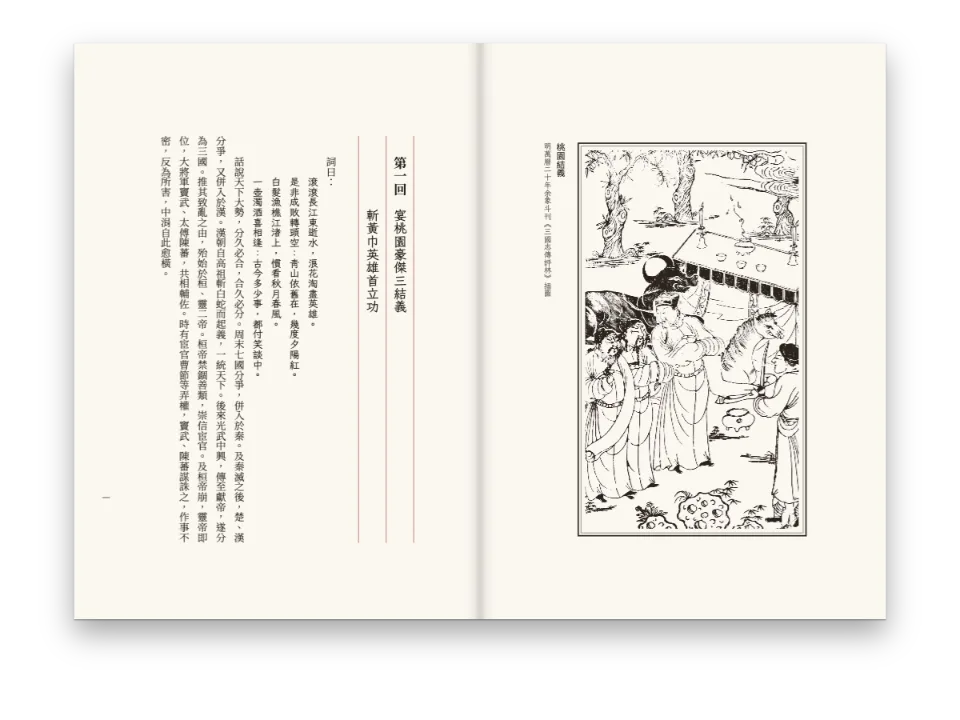
成品一览
甲戌本《石头记》是带有脂砚斋评语的抄本,这里把它第一回的开头重排成评点本的六页:16开,184 × 260 mm,竖排右翻。曹雪芹的正文用Noto Serif TC,每列36字,每页18列。抄本把节选中的61条侧批用红笔写在各列旁边。Postext不在两列之间排任何内容,所以本版把每条侧批移入行内,紧跟在它所评的文字之后,以半号字折成两行朱字,就像刻本评点排双行夹批那样。十条眉批用红色楷体排在正文上方42 mm高的天头一栏里,位于所评段落上方,读者读正文和评语一气呵成。
这道食谱解答
- 怎样排评注本:行内的双行小注和天头的批语?
- 怎样把中文书排成竖排、右侧装订?
简短回答
const layout = {
  writingMode: 'vertical-rl', // columns down the page, read from the right; bound on the right
  layoutType: 'oneAndHalf', // a text tier and a narrow tier for the comments
  sideColumnRole: 'floats', // no text runs into it: only boxes fenced with span="side"
  sideColumnSide: 'left', // in vertical text 'left' is the top tier: the head margin (天頭)
  sideColumnPercent: 19, // the grid rounds it to 10 characters of the body, 42 mm
  gutterWidth: mm(8), // rounded to 2 characters
  columnRule: { enabled: true, lineWidth: pt(0.5), color: col('rule') },
};
const cjk = {
  grid: { enabled: true, charsPerLine: 36, linesPerPage: 18 }, // 版心: 36 字 × 18 行
  // :warichu[…] folds a side comment into two rows at half the body size, in red
  // and with no brackets, as the manuscripts write their 雙行夾批.
  warichu: { color: col('vermilion') },
};
// A 眉批 is :::callout{type="meipi" span="side"}: span="side" sends it to the head
// margin, level with the column the text has reached at its fence, so the fence goes
// just before the passage it discusses (gotcha: side-box-starts-at-fence).
const meipi = {
  id: 'meipi', backgroundEnabled: false,
  border: { enabled: false }, stripe: { enabled: false },
  padding: { top: pt(0), right: pt(0), bottom: pt(0), left: pt(0) },
  // 17 characters of 7 pt down the 120 pt tier, a column every 10 pt. The next comment
  // starts on a text column at least one body column (21 pt) further on, whatever the margin.
  snapToGrid: false, marginBottom: pt(0),
  body: { fontFamily: KAI, fontSize: pt(7), lineHeight: pt(10), color: col('vermilion'),
    textAlign: 'left', firstLineIndent: pt(0) },
};
用料
- 类型
- Noto Serif TC, LXGW WenKai TC, Noto Sans TC(SIL OFL 1.1)
- 素材
- 无:所有图片都用代码绘制
做法
#1 · 把侧栏变成天头
代码就是上面的简短回答。竖排页面是把横排页面旋转90度,所以一栏半版式的侧栏变成横贯页面的一栏,sideColumnSide: 'left'把这一栏放到天头(竖排)。字符网格把sideColumnPercent: 19取整为正文的10个字,即120 pt,栏间距取整为两个字;栏线成为评语与正文之间的细线。评语样式不带框:7 pt楷体,每列17字,这个字号下十条评语没有一条以只有一个字的列结尾;snapToGrid: false让评语按自己10 pt的间距排列,而不是正文的21 pt。
两种评语都标在抄本原有的位置。侧批是:warichu[…]行内片段,由cjk.warichu着色;眉批是一个用span="side"围起的框,紧放在所评段落之前:
:::callout{type="meipi" span="side"}
妙!自謂落墮情根,故無補天之用。
:::

原來女媧氏煉石補天之時,:warichu[補天濟世,勿認真,用常言。]于大荒山:warichu[荒唐也。]…#2 · 把回数和回目排在开头几列
const opener = { enabled: true, minHeight: mm(46), slot: { elements: [
  { kind: 'text', id: 'book', content: '{title}', fontFamily: HEI, fontWeight: 500,
    fontSize: pt(10), letterSpacing: pt(3), color: col('vermilion'), align: 'left',
    placement: { anchor: { to: 'container', edge: 'top-left' } } },
  { kind: 'text', id: 'number', content: '{titleText}', fontFamily: SONG, fontWeight: 700,
    fontSize: pt(30), letterSpacing: pt(6), color: col('ink'), align: 'left',
    placement: { anchor: { to: '#book', edge: 'below' }, offset: { x: em(2), y: mm(4) } } },
  ...['a', 'b'].map((half, i) => ({ kind: 'text', id: `couplet-${half}`,
    content: `{attr.${half}}`, fontFamily: SONG, fontSize: pt(15), letterSpacing: pt(3),
    color: col('ink'), align: 'left',
    placement: { anchor: { to: i ? '#couplet-a' : '#number', edge: 'below' },
      offset: { x: i ? pt(0) : em(4), y: mm(i ? 1.5 : 4) } } })),
] } };
在竖排页面上,章首按文字流的坐标排版,所以文字向下走,below指向左边,x偏移让元素沿列向下移。先是红色黑体的书名,然后是30 pt的第一回,下移两个自身字高,再是来自标题属性{a="…" b="…"}的回目上下联,又下移一次,于是回数和回目像刻本回目那样逐级向下错开。minHeight: mm(46)在回目和正文之间留出一列空白。
#3 · 书口处的竖排书眉
// 'outer' is the margin away from the spine: a recto's left, a verso's right.
const edge = (id, content, edgeOf, y, extra = {}) => ({ kind: 'text', id, content,
  writingMode: 'vertical-rl', fontFamily: HEI, fontWeight: 500, fontSize: pt(9.5),
  letterSpacing: pt(2), color: col('muted'), overflow: 'clip', align: 'left',
  placement: { anchor: { to: 'outer', edge: edgeOf }, offset: { y: em(y) } }, ...extra });
const header = { elements: [
  // Four characters below the head: the book on a verso, the chapter on a recto,
  // never on the opener.
  edge('head-verso', '{title}', 'top', 4, { pages: 'body', parity: 'even' }),
  edge('head-recto', '{chapterTitle}', 'top', 4, { pages: 'body', parity: 'odd' }),
  edge('folio', '{pageNumber}', 'bottom', -5), // 一, 二, 三…: page.pageNumbering below
] };
这些是竖排文字元素中的书口书眉:anchor.to: 'outer'指远离书脊的页边距,在右翻书里是右页的左边、左页的右边;writingMode: 'vertical-rl'让文字竖排。这里的版心包括评语一栏,所以“天头下四格”是从红色评语的顶端量起。trad-chinese-informal把页码印成一到六。
#4 · 每种字体只加载它要排的文字
// Song sets the whole sample and its bold only 第一回, Kai the head-margin comments and
// the edition's note, Hei the running heads, the folios and the colophon
// (gotcha: cjk-fonts-slices).
const blocks = (style) => [...markdown.matchAll(
  new RegExp(`:::(?:callout|paragraphs)\\{[^}]*"${style}"[^}]*\\}\\n([^]*?)\\n:::`, 'g'))]
  .map((m) => m[1]).join('');
const numerals = '一二三四五六七八九十';
await loadFonts(FONTS, markdown);
await loadCjkFonts({ [SONG]: ['400'] }, markdown, { vertical: true });
await loadCjkFonts({ [SONG]: ['700'] }, '第一回'); // the bold weight sets three characters
await loadCjkFonts({ [KAI]: FONTS[KAI] }, blocks('meipi') + blocks('note'), { vertical: true });
await loadCjkFonts({ [HEI]: FONTS[HEI] }, `脂硯齋重評石頭記第一回${numerals}${blocks('colophon')}`,
  { vertical: true });
Fontsource把每种中文字体按字重各拆成约一百个文件。宋体用常规字重排整个样张,只有第一回用粗体;楷体只排眉批和本编说明;黑体只排书眉、页码和版权页,所以每次调用只取它自己的字符所需的文件。vertical: true还会为Canvas加载每种字体的竖排标点。
#5 · 双色
const palette = {
  ink: '#231d18', // the text: a warm black
  vermilion: '#b0362a', // 朱: every comment, the chapter's kicker; 5.5 : 1 on the paper
  rule: '#b9a78f', // the line under the head margin
  muted: '#6f6356', // folios, the colophon
  paper: '#f7f1e3',
};
const col = (id) => ({ hex: palette[id], model: 'hex', paletteId: id });
const colorPalette = [
  ...Object.entries(palette).map(([id, hex]) => ({ id, name: id, value: { hex, model: 'hex' } })),
  // The engine's defaults link to main-color: aimed at the vermilion, nothing prints blue.
  { id: 'main-color', name: 'vermilion (defaults)',
    value: { hex: palette.vermilion, model: 'hex' } },
];
页面用两种颜色印刷,和抄本的书写一致:正文用暖黑,每条评语和本章的眉题用朱红,别的都不用。朱红在纸色上的对比度为5.5 : 1,足够排6 pt的侧批双行。main-color指向朱红,所以配置里没有重设的默认值都印成红色,而不会是蓝色。
完整食谱
// ═══ Postext Cookbook · Nº 078 · Red-ink commentary in the line and the head margin ═══ // https://postext.dev/en/cookbook/red-ink-commentary // Code: MIT · Text: 脂硯齋重評石頭記, Jiaxu manuscript, Wikisource (CC BY-SA 4.0) · Pictures: none // Fonts: Noto Serif TC, LXGW WenKai TC, Noto Sans TC (SIL OFL 1.1) · Needs postext ≥ 1.9.0 // The first chapter of the Stone as a commentary edition: the text set vertically, the // comments the manuscript writes beside the columns folded into two small red rows inside // the line, the head-margin comments in red Kai above the columns they gloss. import { buildDocument, renderPageToCanvas, clearMeasurementCache, loadVerticalAlternates, } from 'https://esm.sh/postext'; import { renderToPdf, decompressWoff2 } from 'https://esm.sh/postext-pdf'; const LANG = 'en'; // @lang: the language of the sample document ('en' | 'es') const RECIPE = 'red-ink-commentary'; // ─── 1 · Design ───────────────────────────────────────────────────────────── // #region palette: black ink and vermilion on a warm paper const palette = { ink: '#231d18', // the text: a warm black vermilion: '#b0362a', // 朱: every comment, the chapter's kicker; 5.5 : 1 on the paper rule: '#b9a78f', // the line under the head margin muted: '#6f6356', // folios, the colophon paper: '#f7f1e3', }; const col = (id) => ({ hex: palette[id], model: 'hex', paletteId: id }); const colorPalette = [ ...Object.entries(palette).map(([id, hex]) => ({ id, name: id, value: { hex, model: 'hex' } })), // The engine's defaults link to main-color: aimed at the vermilion, nothing prints blue. { id: 'main-color', name: 'vermilion (defaults)', value: { hex: palette.vermilion, model: 'hex' } }, ]; // #endregion const [SONG, KAI, HEI] = ['Noto Serif TC', 'LXGW WenKai TC', 'Noto Sans TC']; // 宋, 楷, 黑 const BODY = 12; // pt, 小四: the notes fold to two rows of 6 pt in the same em const LEAD = 21; // pt between columns, 1.75 × the body // #region answer: side comments inside the line, head-margin comments above it const layout = { writingMode: 'vertical-rl', // columns down the page, read from the right; bound on the right layoutType: 'oneAndHalf', // a text tier and a narrow tier for the comments sideColumnRole: 'floats', // no text runs into it: only boxes fenced with span="side" sideColumnSide: 'left', // in vertical text 'left' is the top tier: the head margin (天頭) sideColumnPercent: 19, // the grid rounds it to 10 characters of the body, 42 mm gutterWidth: mm(8), // rounded to 2 characters columnRule: { enabled: true, lineWidth: pt(0.5), color: col('rule') }, }; const cjk = { grid: { enabled: true, charsPerLine: 36, linesPerPage: 18 }, // 版心: 36 字 × 18 行 // :warichu[…] folds a side comment into two rows at half the body size, in red // and with no brackets, as the manuscripts write their 雙行夾批. warichu: { color: col('vermilion') }, }; // A 眉批 is :::callout{type="meipi" span="side"}: span="side" sends it to the head // margin, level with the column the text has reached at its fence, so the fence goes // just before the passage it discusses (gotcha: side-box-starts-at-fence). const meipi = { id: 'meipi', backgroundEnabled: false, border: { enabled: false }, stripe: { enabled: false }, padding: { top: pt(0), right: pt(0), bottom: pt(0), left: pt(0) }, // 17 characters of 7 pt down the 120 pt tier, a column every 10 pt. The next comment // starts on a text column at least one body column (21 pt) further on, whatever the margin. snapToGrid: false, marginBottom: pt(0), body: { fontFamily: KAI, fontSize: pt(7), lineHeight: pt(10), color: col('vermilion'), textAlign: 'left', firstLineIndent: pt(0) }, }; // #endregion // #region opener: the chapter's number and its couplet (回目), set down the first columns const opener = { enabled: true, minHeight: mm(46), slot: { elements: [ { kind: 'text', id: 'book', content: '{title}', fontFamily: HEI, fontWeight: 500, fontSize: pt(10), letterSpacing: pt(3), color: col('vermilion'), align: 'left', placement: { anchor: { to: 'container', edge: 'top-left' } } }, { kind: 'text', id: 'number', content: '{titleText}', fontFamily: SONG, fontWeight: 700, fontSize: pt(30), letterSpacing: pt(6), color: col('ink'), align: 'left', placement: { anchor: { to: '#book', edge: 'below' }, offset: { x: em(2), y: mm(4) } } }, ...['a', 'b'].map((half, i) => ({ kind: 'text', id: `couplet-${half}`, content: `{attr.${half}}`, fontFamily: SONG, fontSize: pt(15), letterSpacing: pt(3), color: col('ink'), align: 'left', placement: { anchor: { to: i ? '#couplet-a' : '#number', edge: 'below' }, offset: { x: i ? pt(0) : em(4), y: mm(i ? 1.5 : 4) } } })), ] } }; // #endregion // #region fore-edge: the book's title and the folio down the outer margin // 'outer' is the margin away from the spine: a recto's left, a verso's right. const edge = (id, content, edgeOf, y, extra = {}) => ({ kind: 'text', id, content, writingMode: 'vertical-rl', fontFamily: HEI, fontWeight: 500, fontSize: pt(9.5), letterSpacing: pt(2), color: col('muted'), overflow: 'clip', align: 'left', placement: { anchor: { to: 'outer', edge: edgeOf }, offset: { y: em(y) } }, ...extra }); const header = { elements: [ // Four characters below the head: the book on a verso, the chapter on a recto, // never on the opener. edge('head-verso', '{title}', 'top', 4, { pages: 'body', parity: 'even' }), edge('head-recto', '{chapterTitle}', 'top', 4, { pages: 'body', parity: 'odd' }), edge('folio', '{pageNumber}', 'bottom', -5), // 一, 二, 三…: page.pageNumbering below ] }; // #endregion const config = () => ({ // a factory: the engine caches resolved configs by identity locale: 'zh-Hant', // Taiwan conventions: centred full-width marks (gotcha: cjk-locale-tag) colorPalette, layout, cjk, header, footer: { elements: [] }, page: { sizePreset: 'custom', width: mm(184), height: mm(260), dpi: 150, // 16开 backgroundColor: col('paper'), // Minimums: the grid centres its type area in what they leave. left is the inner // margin, which a right-bound recto has on its right. margins: { top: mm(16), bottom: mm(22), left: mm(20), right: mm(22), mirror: true }, pageNumbering: { format: 'trad-chinese-informal' }, }, bodyText: { fontFamily: SONG, fontSize: pt(BODY), lineHeight: pt(LEAD), color: col('ink'), boldColor: col('ink'), italicColor: col('ink'), referenceColor: col('ink'), textAlign: 'justify', firstLineIndent: em(2), indentAfterHeading: true, // A paragraph may open in a page's last column, so every page sets its 18. The // orphan rule stays on: a paragraph's last column never stands alone at the head of // a page (孤行不成頁). avoidWidows: false, }, headings: { fontFamily: SONG, color: col('ink'), // Restated: any headings object drops the H1 break (gotcha: headings-drop-h1-break). levels: [{ level: 1, fontSize: pt(30), breakBefore: { enabled: true, parity: 'any' }, advancedDesign: opener }], }, paragraphStyles: [ // The two poems: each line a paragraph, four characters down, never spread. { id: 'verse', textAlign: 'left', firstLineIndent: em(4) }, // The edition's note, two characters lower than the text (低二格), in Kai. { id: 'note', fontFamily: KAI, indent: em(2), firstLineIndent: pt(0), marginTop: pt(LEAD) }, // The colophon, in the edition's language: Latin runs sideways down a vertical line. { id: 'colophon', fontFamily: HEI, fontWeight: 500, fontSize: pt(7.5), lineHeight: pt(LEAD), color: col('muted'), textAlign: 'left', indent: em(2), firstLineIndent: pt(0) }, ], calloutStyles: [meipi], }); // ─── 2 · Content ──────────────────────────────────────────────────────────── const markdown = String.raw`---Markdown样例 · 97行 · content.en.md
title: "脂硯齋重評石頭記" author: "曹雪芹" --- # 第一回 {a="甄士隱夢幻識通靈" b="賈雨村風塵懷閨秀"} 列位看官:你道此書從何而來?說起根由雖近荒唐,:warichu[自占地步。] :warichu[自首荒唐,妙!]細諳則深有趣味。待在下將此來歷註明,方使閱者了然不惑。 :::callout{type="meipi" span="side"} 妙!自謂落墮情根,故無補天之用。 ::: 原來女媧氏煉石補天之時,:warichu[補天濟世,勿認真,用常言。]于大荒山:warichu[荒唐也。]無稽崖:warichu[無稽也。]煉成高經十二丈、:warichu[總應十二釵。]方經二十四丈:warichu[照應副十二釵。]頑石三萬六千五百零一塊。媧皇氏只用了三萬六千五百塊,:warichu[合週天之數。]只單單的剩了一塊未用,:warichu[剩了這一塊便生出這許多故事。使當日雖不以此補天,就該去補地之坑陷,使地平坦,而不得有此一部鬼話。]便棄在此山青埂峰下。誰知此石自經煆煉之後,靈性已通,:warichu[煆煉後性方通,甚哉!人生不能學也。]因見衆石俱得補天,獨自己無材不堪入選,遂自怨自嘆,日夜悲號慚愧。 一日,正當嗟悼之際,俄見一僧一道遠遠而來,生得骨格不凡,丰神迥別,說說笑笑來至峰下,坐于石邊高談快論。先是說些雲山霧海神仙玄幻之事,後便說到紅塵中榮華富貴。此石聽了,不覺打動凡心,也想要到人間去享一享這榮華富貴,但自恨粗蠢,不得已,便口吐人言,:warichu[竟有人問口生於何處,其無心肝,可咲可恨之極。]向那僧道說道:「大師,弟子蠢物,:warichu[豈敢豈敢。]不能見禮了。適聞二位談那人世間榮耀繁華,心切慕之。弟子質雖粗蠢,:warichu[豈敢豈敢。]性却稍通,况見二師仙形道體,定非凡品,必有補天濟世之材,利物濟人之德。如蒙發一點慈心,攜帶弟子得入紅塵,在那富貴場中、溫柔鄉裏受享幾年,自當永佩洪恩,萬劫不忘也。」二仙師聽畢,齊憨笑道:「善哉,善哉!那紅塵中有却有些樂事,但不能永遠依恃,况又有『美中不足,好事多魔』八箇字緊相連屬,瞬息間則又樂極悲生,人非物換,究竟是到頭一夢,萬境歸空。:warichu[四句乃一部之總綱。]到不如不去的好。」這石凡心已熾,那里聽得進這話去,乃復苦求再四。二仙知不可強制,乃嘆道:「此亦靜極思動,無中生有之數也。既如此,我們便携你去受享受享,只是到不得意時,切莫後悔。」石道:「自然,自然。」那僧又道:「若說你性靈,却又如此質蠢,並更無奇貴之處,如此也只好踮脚而已。:warichu[煆煉過尚與人踮腳,不學者又當如何?]也罷,我如今大施佛法助你助,待劫終之日,復還本質,以了此案。:warichu[妙!佛法亦湏償還,况世人之償乎?近之賴債者來看此句。所謂遊戲筆墨也。]你道好否?」石頭聽了,感謝不盡。那僧便念咒書符,大展幻:warichu[明點「幻」字。好!]術,將一塊大石登時變成一塊鮮明瑩潔的美玉,且又縮成扇墜大小的可佩可拿。:warichu[奇詭險怪之文,有如髯蘇《石鐘》《赤璧》用幻處。]那僧托于掌上,笑道:「形體到也是個寳物了!:warichu[自愧之語。]還只沒有實在的好處,:warichu[妙極!今之金玉其外敗絮其中者,見此大不歡喜。]湏得在鐫上數字,使人一見便知是奇物方妙。:warichu[世上原宜假,不宜真也。諺云:「一日賣了三千假,三日賣不出一個真。」信哉!]然後好携你到那昌明隆盛之邦,:warichu[伏長安大都。]詩禮簪〔纓〕之族,:warichu[伏榮國府。]花柳繁華地,:warichu[伏大觀園。]溫柔富貴鄉:warichu[伏紫芸軒。]去安身樂業。」:warichu[何不再添一句云「擇個絕世情痴作主人」?] :::callout{type="meipi" span="side"} 昔子房後謁黃石公,惟見一石。子房當時恨不能隨此石去。余亦恨不能隨此石而去也。聊供閱者一笑。 ::: 石頭聽了,喜不能禁,乃問:「不知賜了弟子那幾件奇處,:warichu[可知若果有奇貴之處,自己亦不知者。若自以奇貴而居,究竟是無真奇貴之人。]又不知携了弟子到何地方?望乞明示,使弟子不惑。」那僧笑道:「你且莫問,日後自然明白的。」說着,便袖了這石,同那道人飄然而去,竟不知投奔何方何舍。 後來,不知又過了幾世幾劫,因有個空空道人訪道求仙,忽從這大荒山無稽崖青埂峰下經過,忽見一大石上字跡分明,編述歷歷。空空道人乃從頭一看,原來就是無材補天,幻形入世,:warichu[八字便是作者一生慚恨。]蒙茫茫大士、渺渺真人携入紅塵,歷盡離合悲歡炎凉世態的一叚故事。後面又有一首偈云: :::paragraphs{style="verse"} 無材可去補蒼天,:warichu[書之本旨。] 枉入紅塵若許年。:warichu[慚愧之言,嗚咽如聞。] 此係身前身後事, 倩誰記去作奇傳? ::: 詩後便是此石墮落之鄉,投胎之處,親自經歷的一叚陳跡故事。其中家庭閨閣瑣事,以及閑情詩詞倒還全備,或:warichu[「或」字謙得好。]可適趣觧悶,然朝代年紀,地輿邦國,却反失落無考。:warichu[若用此套者,胸中必無好文字,手中斷無新筆墨。據余說,卻大有考證。] 空空道人遂向石頭說道:「石兄,你這一叚故事,據你自己說有些趣味,故編寫在此,意欲問世傳奇。據我看來,第一件,無朝代年紀可考,:warichu[先駁得妙。]第二件,並無大賢大忠理朝廷治風俗的善政,:warichu[將世人欲駁之腐言預先代人駁盡。妙!]其中只不過幾箇異樣的女子,或情或痴,或小才微善,亦無班姑蔡女之德能。我總抄去,恐世人不愛看呢。」 石頭笑荅道:「我師何太痴耶!若云無朝代可考,今我師竟假借漢唐等年紀添綴,又有何難?:warichu[所以答的好。]但我想,歷來野史,皆蹈一轍,莫如我這不借此套者,反到新奇別致,不過只取其事體情理罷了,又何必拘拘於朝代年紀哉!再者,世井俗人喜看理治之書者甚少,愛看適趣閒文者特多。歷代野史,或訕謗君相,或貶人妻女,:warichu[先批其大端。]姦滛凶惡,不可勝數。更有一種風月筆墨,其滛穢污臭,塗毒筆墨,壞人子弟,又不可勝數。至若佳人才子等書,則又千部共出一套,且其中終不能不涉于滛濫,以致滿紙潘安子建、西子文君,不過作者要寫出自己的那兩首情詩艶賦來,故假擬出男女二人名姓,又必傍出一小人其間撥亂,亦如劇中之小丑然。且嬛婢開口即者也之乎,非文即理。故逐一看去,悉皆自相矛盾,大不近情理之話。 :::callout{type="meipi" span="side"} 事則實事,然亦叙得有間架、有曲折、有順逆、有映帶、有隱有見、有正有閏,以至草蛇灰線、空谷傳聲、一擊兩鳴、明修棧道、暗度陳倉、雲龍霧雨、兩山對峙、烘雲托月、背面傳粉、千皴萬染諸奇。書中之秘法,亦不復少。余亦于逐回中搜剔刳剖明白注釋以待高明,再批示誤謬。 ::: :::callout{type="meipi" span="side"} 開卷一篇立意,真打破歷來小說窠臼。閱其筆則是《莊子》《離騷》之亞。 ::: :::callout{type="meipi" span="side"} 斯亦太過。 ::: 「竟不如我半世親睹親聞的這幾個女子,雖不敢說強似前代書中所有之人,但事跡原委,亦可以消愁破悶,也有幾首歪詩熟話,可以噴飯供酒。至若離合悲歡,興衰際遇,則又追踪攝跡,不敢稍加穿鑿,徒為供人之目而反失其真傳者。今之人,貧者日為衣食所累,富者又懷不足之心,總一時稍閒,又有貪滛戀色、好貸尋愁之事,那里去有工夫看那理治之書?所以我這一叚事,也不愿世人稱奇道妙,也不定要世人喜悅檢讀,:warichu[轉得更好。]只愿他們當那醉餘飽卧之時,或避世去愁之際,把此一玩,豈不省了此壽命筋力?就比那謀虛逐妄,去也省了口舌是非之害,腿脚奔忙之苦。再者,亦令世人換新眼目,不比那些胡牽亂扯,忽離忽遇,滿紙才人淑女、子建文君、紅娘小玉等通共熟套之舊稿。我師意為何如?」:warichu[余代空空道人答曰:「不獨破愁醒盹,且有大益。」] :::callout{type="meipi" span="side"} 雪芹舊有《風月寳鑑》之書,乃其弟棠村序也。今棠村已逝,余覩新懷舊,故仍因之。 ::: :::callout{type="meipi" span="side"} 若云雪芹披閱增刪,然後開卷至此這一篇楔子又係誰撰?足見作者之筆式狡猾之甚。後文如此處者不少。這正是作者用画家烟雲糢糊處,觀者萬不可被作者瞞蔽了去,方是巨眼。 ::: 空空道人聽如此說,思忖半晌,將這《石頭記》:warichu[本名。]再檢閱一遍,:warichu[這空空道人也太小心了,想亦世之一腐儒耳。]因見上面雖有些指奸責佞貶惡誅邪之語,:warichu[亦斷不可少。]亦非傷時罵世之旨,:warichu[要緊句。]及至君仁臣良父慈子孝,凡倫常所關之處,皆是稱功頌德,眷眷無窮,實非別書之可比。雖其中大旨談情,亦不過實錄其事,又非假擬妄稱,:warichu[要緊句。]一味滛邀艶約、私訂偷盟之可比。因毫不干涉時世,:warichu[要緊句。]方從頭至尾抄錄回來,問世傳奇。因空見色,由色生情,傳情入色,自色悟空,遂易名為情僧,改《石頭記》為《情僧錄》。至吳玉峰題曰《紅樓夢》。東魯孔梅溪則題曰《風月寶鑑》。後因曹雪芹于悼紅軒中披閱十載,增刪五次,纂成目錄,分出章回,則題曰《金陵十二釵》,並題一絕云: :::callout{type="meipi" span="side"} 能觧者方有辛酸之淚,哭成此書。壬午除夕,書未成,芹為淚盡而逝。余嘗哭芹,淚亦待盡。每意覓青埂峯再問石兄,余不遇獺頭和尚何!悵悵! ::: :::callout{type="meipi" span="side"} 今而後惟愿造化主再出一芹一脂,是書何本,余二人亦大快遂心于九泉矣。甲午八日淚筆。 ::: :::paragraphs{style="verse"} 滿紙荒唐言,一把辛酸淚! 都云作者痴,誰解其中味?:warichu[此是第一首標題詩。] ::: 至脂硯齋甲戌抄閱再評,仍用《石頭記》。 出則既明,且看石上是何故事。按那石上書云::warichu[以石上所記之文。] 當日地陷東南,這東南一隅有處曰姑蘇,:warichu[是金陵。]有城曰閶門者,最是紅塵中一二等富貴風流之地。:warichu[妙極!是石頭口氣,惜米顛不遇此石。]這閶門外有個十里街,:warichu[開口失云勢利,是伏甄、封二姓之事。]街內有個仁清巷,:warichu[又言人情,總為士隱火後伏筆。]巷內有個古廟,因地方窄狹,:warichu[世路寬平者甚少。亦鑿。]人皆呼作葫蘆廟。:warichu[糊塗也,故假語從此具焉。] :::callout{type="meipi" span="side"} 真。後之甄寶玉亦借此音,後不注。 ::: 廟傍住着一家鄉宦,:warichu[不出榮國大族,先寫鄉宦小家,從小至大,是此書章法。]姓甄,名費,:warichu[廢。]字士隱。:warichu[托言將真事隱去也。]嫡妻封氏,:warichu[風。因風俗來。]情性賢淑,深明禮義。:warichu[八字正是寫日後之香菱,見其根源不凡。]家中雖無甚富貴,然本地便也推他為望族了。:warichu[本地推為望族,寕、榮則天下推為望族,叙事有層落。]只因這甄士隱禀性恬淡,不以功名為念,:warichu[自是羲皇上人,便可作是書之朝代年紀矣。總寫香菱根基,原與正十二釵無異。]每日只以觀花修竹,酌酒吟詩為樂,到是神仙一流人品。只是一件不足:如今年已半百,膝下無兒,:warichu[所謂「美中不足」也。]只有一女,乳名英蓮,:warichu[設云「應怜」也。]年方三歲。 :::paragraphs{style="note"} 本編說明 正文與批語據甲戌本《脂硯齋重評石頭記》第一回,錄文取自維基文庫。朱筆側批改作雙行夾批,排在所批文字之下;眉批仍居天頭,列在所批一段之上。標點從錄文,分段稍有調整。原本空缺之字據他本補入,外加六角括號,如「詩禮簪〔纓〕之族」。字庫未收之異體字,如縂、竒、冩,改用通行字。 ::: :::paragraphs{style="colophon"} Set in Noto Serif TC, LXGW WenKai TC and Noto Sans TC (SIL OFL) · Text: the Jiaxu manuscript, Wikisource transcription (CC BY-SA 4.0) :::`; // content.<lang>.md, inlined by the Cookbook // ─── 3 · Fonts ────────────────────────────────────────────────────────────── const FONTS = { 'Noto Serif TC': ['400', '700'], // 宋: the text and the notes in the line; bold 第一回 'LXGW WenKai TC': ['400'], // 楷: the head-margin comments, the edition's note 'Noto Sans TC': ['500'], // 黑: the book's title, the folios, the colophon }; // ─── 4 · Build & show ─────────────────────────────────────────────────────── // #region voices: each face loads the files of the characters it sets // Song sets the whole sample and its bold only 第一回, Kai the head-margin comments and // the edition's note, Hei the running heads, the folios and the colophon // (gotcha: cjk-fonts-slices). const blocks = (style) => [...markdown.matchAll( new RegExp(`:::(?:callout|paragraphs)\\{[^}]*"${style}"[^}]*\\}\\n([^]*?)\\n:::`, 'g'))] .map((m) => m[1]).join(''); const numerals = '一二三四五六七八九十'; await loadFonts(FONTS, markdown); await loadCjkFonts({ [SONG]: ['400'] }, markdown, { vertical: true }); await loadCjkFonts({ [SONG]: ['700'] }, '第一回'); // the bold weight sets three characters await loadCjkFonts({ [KAI]: FONTS[KAI] }, blocks('meipi') + blocks('note'), { vertical: true }); await loadCjkFonts({ [HEI]: FONTS[HEI] }, `脂硯齋重評石頭記第一回${numerals}${blocks('colophon')}`, { vertical: true }); // #endregion const doc = await buildWithFonts(() => buildDocument({ markdown }, config()), markdown); showBook(doc, { title: t({ en: 'A red-ink commentary edition', es: 'Una edición comentada en rojo' }) }); offerPdf(() => renderToPdf(doc, { fontProvider: cjkPdfProvider }), `${RECIPE}.pdf`);工具包 · core, fonts, viewer, pdf, cjk:每道食谱都相同 · 422行
// ─── Kit ── helpers shared by every Cookbook recipe · postext.dev/cookbook ───── // ─── Kit · core v1 ── the same in every recipe · postext.dev/cookbook ───────── function mm(value) { return { value, unit: 'mm' }; } function pt(value) { return { value, unit: 'pt' }; } function em(value) { return { value, unit: 'em' }; } /** The sample language's string: t({ en: 'Figure', es: 'Figura' }). */ function t(strings) { return strings[LANG] ?? Object.values(strings)[0]; } /** A file in this recipe's assets folder, served from the Postext repo by jsDelivr. */ function asset(file) { return `https://cdn.jsdelivr.net/gh/drnachio/postext@main/cookbook/${RECIPE}/assets/${file}`; } // ─── Kit · fonts v1 ── the same in every recipe · postext.dev/cookbook ──────── // Postext measures text with the faces the browser has loaded, and caches the // widths, so every face must be ready before the first build. Faces come from // Fontsource: the same static files the PDF embeds, so screen and PDF agree. /** faces = { 'Family Name': ['400', '400i', '700'] }. `text` is the sample: * letters beyond Latin-1 (č, ł, ő…) also load the latin-ext files. With * `optional`, a face Fontsource does not ship is skipped instead of failing. * Resolves to the number of faces added. */ async function loadFonts(faces, text = '', { optional = false } = {}) { kitStatus('Loading fonts…'); const ranges = { latin: 'U+0000-00FF,U+0131,U+0152-0153,U+02BB-02BC,U+02C6,U+02DA,U+02DC,U+0304,U+0308,U+0329,' + 'U+2000-206F,U+20AC,U+2122,U+2191,U+2193,U+2212,U+2215,U+FEFF,U+FFFD', 'latin-ext': 'U+0100-02BA,U+02BD-02C5,U+02C7-02CC,U+02CE-02D7,U+02DD-02FF,U+0304,U+0308,U+0329,' + 'U+1D00-1DBF,U+1E00-1E9F,U+1EF2-1EFF,U+2020,U+20A0-20AB,U+20AD-20C0,U+2113,U+2C60-2C7F,U+A720-A7FF', }; const subsets = /[Ā-˿Ḁ-ỿ]/.test(text) ? ['latin', 'latin-ext'] : ['latin']; const jobs = []; let added = 0; for (const [family, specs] of Object.entries(faces)) { const id = fontsourceId(family); const meta = optional ? await fontsourceMeta(family) : null; for (const spec of new Set(specs)) { const weight = parseInt(spec, 10); const style = spec.endsWith('i') ? 'italic' : 'normal'; if (hasFace(family, weight, style)) continue; if (optional && !(meta?.weights.includes(weight) && meta.styles.includes(style))) continue; for (const subset of subsets) { const url = `https://cdn.jsdelivr.net/npm/@fontsource/${id}@5/files/${id}-${subset}-${weight}-${style}.woff2`; const face = new FontFace(family, `url(${url}) format('woff2')`, { weight: String(weight), style, unicodeRange: ranges[subset] }); jobs.push(face.load().then((ready) => { document.fonts.add(ready); added++; }, () => { if (subset === 'latin' && !optional) throw new Error(`Fontsource has no ${family} ${weight} ${style}`); })); } } } await Promise.all(jobs).catch((error) => { kitFail(error); throw error; }); return added; } /** Runs `build` (a buildDocument or buildBundle call) and checks the faces * the pages use. A regular face missing from FONTS is loaded with a warning; * bold and italic variants are loaded when the family ships them. Then the * measurement caches are cleared and the build runs again. */ async function buildWithFonts(build, text = '') { const tried = new Set(); for (let round = 0; round < 3; round++) { kitStatus('Laying out…'); await new Promise(requestAnimationFrame); // let the status paint first const result = await Promise.resolve().then(build).catch((error) => { kitFail(error); throw error; }); const wanted = { base: {}, variants: {} }; for (const { font, base } of [result].flat().flatMap(fontStringsOf)) { const { family, weight, style } = parseFont(font); const key = `${family}|${weight}|${style}`; if (tried.has(key) || hasFace(family, weight, style)) continue; tried.add(key); (wanted[base ? 'base' : 'variants'][family] ??= []).push(`${weight}${style === 'italic' ? 'i' : ''}`); } if (Object.keys(wanted.base).length) { console.warn(`[cookbook] FONTS does not list ${JSON.stringify(wanted.base)}: loading them.`); } const added = await loadFonts(wanted.base, text) + await loadFonts(wanted.variants, text, { optional: true }); if (added === 0) return result; clearMeasurementCache(); } throw new Error('The fonts did not settle after three builds.'); } /** Every font string of the layout. `base` marks a block's own face; its * bold, italic and bold-italic variants are listed whether or not used. */ function fontStringsOf(doc) { const found = new Map(); const walk = (node) => { if (!node || typeof node !== 'object') return; if (Array.isArray(node)) { node.forEach(walk); return; } for (const [key, value] of Object.entries(node)) { if (typeof value === 'string' && /fontString$/i.test(key)) { found.set(value, found.get(value) || key === 'fontString'); } else if (value && typeof value === 'object') walk(value); } }; walk(doc.pages); walk(doc.blocks); return [...found].map(([font, base]) => ({ font, base })); } /** '700 37.5px Open Sans' / 'italic 400 13px "Source Serif 4"' → { family, weight, style }. * A string with no weight ('95.8px Young Serif', from a design text) is 400. */ function parseFont(font) { const m = /^(?:(italic|oblique)\s+)?(?:small-caps\s+)?(?:(\d+|bold|normal)\s+)?[\d.]+px\s+(.+)$/.exec(font.trim()); if (!m) throw new Error(`Unexpected font string: ${font}`); const weight = m[2] === 'bold' ? 700 : !m[2] || m[2] === 'normal' ? 400 : Number(m[2]); return { family: m[3].replace(/^["']|["']$/g, ''), weight, style: m[1] ? 'italic' : 'normal' }; } /** True when a loaded FontFace covers exactly this family, weight and style * (document.fonts.check() is also true for families nobody declared). */ function hasFace(family, weight, style) { for (const face of document.fonts) { if (face.status !== 'loaded' || face.style !== style) continue; if (face.family.replace(/^["']|["']$/g, '') !== family) continue; const [low, high = low] = face.weight.split(' ').map(Number); if (weight >= low && weight <= high) return true; } return false; } /** Fontsource's id for a family: 'Source Serif 4' → 'source-serif-4'. */ function fontsourceId(family) { return family.toLowerCase().replace(/\s+/g, '-'); } /** The weights and styles a family ships ({ weights: [400, 700], styles: ['normal', 'italic'] }), or null. */ function fontsourceMeta(family) { fontsourceMeta.cache ??= new Map(); const id = fontsourceId(family); if (!fontsourceMeta.cache.has(id)) { fontsourceMeta.cache.set(id, fetch(`https://api.fontsource.org/v1/fonts/${id}`) .then((res) => (res.ok ? res.json() : null), () => null)); } return fontsourceMeta.cache.get(id); } // ─── Kit · viewer v1 ── the same in every recipe · postext.dev/cookbook ─────── /** Shows the pages as facing spreads on a dark desk: the first page is a * recto on its own, then verso | recto pairs, as in a bound book. Pages * are painted when they scroll near the screen. */ function showPages(docs, { title, width = 460 } = {}) { const root = viewer(title); const pages = [docs].flat().flatMap((doc) => doc.pages.map((page) => ({ doc, page, n: (doc.pageIndexOffset ?? 0) + page.index }))); const spreads = []; let verso = null; for (const p of pages) { if (p.n % 2 === 1) { if (verso) spreads.push([verso, null]); verso = p; } else { spreads.push([verso, p]); verso = null; } } if (verso) spreads.push([verso, null]); const density = Math.min(window.devicePixelRatio || 1, 2); showPages.painter?.disconnect(); const painter = new IntersectionObserver((entries) => { for (const { isIntersecting, target } of entries) { if (!isIntersecting) continue; painter.unobserve(target); const { doc, page } = target.postext; renderPageToCanvas(page, doc, target, { scale: (width * density) / page.width }); } }, { rootMargin: '800px' }); showPages.painter = painter; root.replaceChildren(...spreads.map((pair) => { const spread = document.createElement('div'); spread.className = 'pt-spread'; for (const p of pair) { const figure = document.createElement('figure'); if (p) { const label = p.page.pageLabel || String(p.n + 1); const canvas = document.createElement('canvas'); canvas.postext = p; canvas.style.aspectRatio = `${p.page.width} / ${p.page.height}`; canvas.setAttribute('role', 'img'); canvas.setAttribute('aria-label', `Page ${label}`); const folio = document.createElement('figcaption'); folio.textContent = label; figure.append(canvas, folio); painter.observe(canvas); } else figure.className = 'pt-blank'; spread.append(figure); } return spread; })); kitStatus(`${pages.length} ${pages.length === 1 ? 'page' : 'pages'}`); document.documentElement.dataset.postext = 'ready'; return pages.length; } /** The desk, the bar and the error reporting, created once. */ function viewer(title) { if (!document.getElementById('pt-kit')) { document.head.insertAdjacentHTML('beforeend', `<style id="pt-kit"> :root { color-scheme: dark; } body { margin: 0; background: #0e1014; color: #b9bcc4; font: 13px/1.45 system-ui, sans-serif; } #pt-bar { position: sticky; top: 0; z-index: 1; display: flex; flex-wrap: wrap; align-items: center; gap: 6px 16px; padding: 10px 16px; background: rgb(14 16 20 / .92); backdrop-filter: blur(6px); border-bottom: 1px solid #23262d; } #pt-bar strong { color: #f4f1ea; font-weight: 600; } #pt-actions { display: flex; gap: 12px; margin-left: auto; } #pt-actions a, #pt-actions button { color: #d8a21a; font: inherit; background: none; border: 0; padding: 0; cursor: pointer; } #pages { display: grid; justify-items: center; gap: 48px; padding: 32px 16px 72px; } .pt-spread { display: flex; } .pt-spread figure { margin: 0; width: min(460px, 44vw); } .pt-spread canvas { display: block; width: 100%; background: #fff; box-shadow: 0 1px 2px rgb(0 0 0 / .5), 0 22px 44px -16px rgb(0 0 0 / .8); } .pt-spread figure:first-child canvas { box-shadow: inset -14px 0 14px -14px rgb(0 0 0 / .18), 0 1px 2px rgb(0 0 0 / .5), 0 22px 44px -16px rgb(0 0 0 / .8); } .pt-spread figcaption { margin-top: 10px; text-align: center; font: 600 10px/1 system-ui, sans-serif; letter-spacing: .18em; text-transform: uppercase; color: #6c7079; } .pt-blank { visibility: hidden; } @media (max-width: 760px) { .pt-spread { flex-direction: column; gap: 32px; } .pt-spread figure { width: min(460px, 92vw); } .pt-blank { display: none; } } </style>`); document.body.insertAdjacentHTML('afterbegin', '<header id="pt-bar"><strong id="pt-title"></strong><span id="pt-status" role="status"></span><span id="pt-actions"></span></header>'); document.getElementById('pt-title').textContent = document.title || 'Postext'; addEventListener('error', (event) => kitFail(event.error ?? event.message)); addEventListener('unhandledrejection', (event) => kitFail(event.reason)); } if (title) document.getElementById('pt-title').textContent = title; return document.getElementById('pages') ?? document.body.appendChild(Object.assign(document.createElement('main'), { id: 'pages' })); } function kitStatus(text) { viewer(); document.getElementById('pt-status').textContent = text; } function kitFail(error) { document.documentElement.dataset.postext = 'error'; kitStatus(`Error: ${error?.message ?? error}`); } // ─── Kit · pdf v1 ── the same in every recipe that exports a PDF ────────────── /** postext-pdf embeds TrueType bytes. Fetch the Fontsource file the screen * used, snapping to a weight the family ships and falling back to upright * when it has no italic: the PDF asks for every face a block could use. */ async function fontsourceProvider(family, weight, style) { const id = fontsourceId(family); const meta = await fontsourceMeta(family); const weights = meta?.weights?.length ? meta.weights : [400, 700]; const w = weights.reduce((a, b) => (Math.abs(b - weight) < Math.abs(a - weight) ? b : a)); const s = style === 'italic' && meta && !meta.styles.includes('italic') ? 'normal' : style; const res = await fetch(`https://cdn.jsdelivr.net/npm/@fontsource/${id}@5/files/${id}-latin-${w}-${s}.woff2`); if (!res.ok) throw new Error(`Fontsource has no ${family} ${w} ${s} (${res.status})`); return decompressWoff2(new Uint8Array(await res.arrayBuffer())); } /** A "Build the PDF" button in the bar. Once built: "Open the PDF" (a new * tab, since CodePen's preview frame cannot show PDFs) and a download link. */ function offerPdf(makePdf, filename) { viewer(); const button = Object.assign(document.createElement('button'), { type: 'button', textContent: 'Build the PDF' }); button.dataset.postextPdf = filename; button.addEventListener('click', async () => { button.disabled = true; button.textContent = 'Building the PDF…'; try { const bytes = await makePdf(); const url = URL.createObjectURL(new Blob([bytes], { type: 'application/pdf' })); const size = `${Math.max(1, Math.round(bytes.length / 1024))} KB`; button.replaceWith( Object.assign(document.createElement('a'), { href: url, target: '_blank', rel: 'noopener', textContent: 'Open the PDF ↗' }), Object.assign(document.createElement('a'), { href: url, download: filename, textContent: `Download ${filename} · ${size}` })); } catch (error) { button.disabled = false; button.textContent = 'Build the PDF'; kitFail(error); } }); document.getElementById('pt-actions').append(button); } // ─── Kit · cjk v1 ── Chinese, Japanese and Korean books · postext.dev/cookbook ─ // Fontsource ships a CJK family as about a hundred files per weight, each // declared in its stylesheet with the unicode-range it covers. The screen // loads the files the sample touches; the PDF gets the same files for the // characters its pages set in each face, and embeds each as a subset. // A book bound on the right (vertical text) is shown with its spreads // mirrored: page 1 alone on the left of the spine, then [3 | 2]. /** The files of a Fontsource face, read from its stylesheet: { url, range, * ranges }, the last declared first (the order the browser tries them in). */ function cjkSlices(family, weight, style) { cjkSlices.cache ??= new Map(); const id = fontsourceId(family); const css = `https://cdn.jsdelivr.net/npm/@fontsource/${id}@5/${weight}${style === 'italic' ? '-italic' : ''}.css`; if (!cjkSlices.cache.has(css)) { cjkSlices.cache.set(css, fetch(css) .then((res) => { if (!res.ok) throw new Error(`Fontsource has no ${family} ${weight} ${style} (${res.status})`); return res.text(); }) .then((text) => [...text.matchAll(/@font-face\s*{([^}]*)}/g)].map(([, rule]) => { const range = /unicode-range:\s*([^;]+);/.exec(rule)?.[1].trim() ?? 'U+0-10FFFF'; const ranges = range.split(',').map((part) => { const [lo, hi = lo] = part.trim().slice(2).split('-'); return [parseInt(lo, 16), parseInt(hi, 16)]; }); return { url: new URL(/url\(([^)]+?\.woff2)\)/.exec(rule)[1], css).href, range, ranges }; }).reverse())); } return cjkSlices.cache.get(css); } /** The file of `slices` that holds code point `cp`, if any. */ function cjkSliceFor(slices, cp) { return slices.find((slice) => slice.ranges.some(([lo, hi]) => cp >= lo && cp <= hi)); } /** Whether Fontsource serves `family` as a Chinese, Japanese or Korean * family (its subsets name the script). Fails when the API does not * answer: a CJK face taken for a Latin one would paint in a system face. */ async function isCjkFamily(family) { const meta = await fontsourceMeta(family); if (!meta) throw new Error(`api.fontsource.org did not describe ${family}: reload to try again`); return !!meta.subsets?.some((subset) => /^(chinese|japanese|korean)/.test(subset)); } /** faces = { 'Noto Serif TC': ['400', '700'] }, as for loadFonts: the * whole FONTS object may be passed, its other families are left to * loadFonts. Adds one FontFace per file of each CJK face with its * unicodeRange, then loads the files `text` touches. `text` is what the * faces set: the sample for the text face; a book in several voices calls * it once per voice (loadCjkFonts({ 'LXGW WenKai TC': ['400'] }, quotes)), * so the heading and quotation faces fetch and check only their own * characters. Fails when a character of `text` is in no file of a face. * List every weight the pages use: a weight left to buildWithFonts gets * the latin file only. With { vertical: true } it also loads each * family's vertical forms (brackets, quotes, pause marks) for the canvas, * which needs loadVerticalAlternates imported from postext. Resolves to * the number of files loaded. */ async function loadCjkFonts(faces, text, { vertical = false } = {}) { kitStatus('Loading fonts…'); let loaded = 0; try { if (vertical && typeof loadVerticalAlternates !== 'function') { throw new Error('loadCjkFonts(…, { vertical: true }) needs loadVerticalAlternates imported from postext'); } for (const [family, specs] of Object.entries(faces)) { if (!(await isCjkFamily(family))) continue; const twin = []; for (const spec of new Set(specs)) { const weight = parseInt(spec, 10); const style = spec.endsWith('i') ? 'italic' : 'normal'; const slices = await cjkSlices(family, weight, style); const missing = [...new Set(text)].filter((ch) => /\S/.test(ch) && !cjkSliceFor(slices, ch.codePointAt(0))); if (missing.length) { throw new Error(`${family} ${spec} has no file for ${missing.slice(0, 12).join(' ')}: ` + `give each face the text it sets (loadCjkFonts({ '${family}': ['${spec}'] }, text))`); } for (const slice of slices) { document.fonts.add(new FontFace(family, `url(${slice.url}) format('woff2')`, { weight: String(weight), style, unicodeRange: slice.range })); twin.push({ source: slice.url, weight: String(weight), style, unicodeRange: slice.range }); } const font = `${style === 'italic' ? 'italic ' : ''}${weight} 16px "${family}"`; loaded += (await document.fonts.load(font, text)).length; if (!document.fonts.check(font, text)) throw new Error(`${family} ${spec} did not load for the sample`); } // The same files under a twin name with the `vert` feature on: the // canvas paints the punctuation of vertical lines with it. if (vertical && twin.length) await loadVerticalAlternates(family, twin); } } catch (error) { kitFail(error); throw error; } return loaded; } /** The PDF font provider for recipes with CJK faces: a family whose * Fontsource subsets are Chinese, Japanese or Korean gets the files that * hold the characters its pages set (`request.codePoints`); any other * family goes to fontsourceProvider (the "pdf" block). */ async function cjkPdfProvider(family, weight, style, request) { if (!(await isCjkFamily(family))) return fontsourceProvider(family, weight, style); const meta = await fontsourceMeta(family); const weights = meta.weights?.length ? meta.weights : [400, 700]; const w = weights.reduce((a, b) => (Math.abs(b - weight) < Math.abs(a - weight) ? b : a)); const s = style === 'italic' && !meta.styles.includes('italic') ? 'normal' : style; const slices = await cjkSlices(family, w, s); const picked = new Set(); for (const cp of request?.codePoints ?? []) { const slice = cjkSliceFor(slices, cp); if (slice) picked.add(slice); } if (!picked.size) picked.add(slices[0]); return Promise.all(slices.filter((slice) => picked.has(slice)).map(async (slice) => { const res = await fetch(slice.url); if (!res.ok) throw new Error(`Fontsource file ${slice.url} (${res.status})`); return decompressWoff2(new Uint8Array(await res.arrayBuffer())); })); } /** showPages for a book bound on either edge. A right-bound book (the * document says so: doc.binding is 'right' for page.binding 'right' and * for vertical text) lies on the desk as it opens: page 1 alone on the * left of the spine, then [3 | 2], the spine shade on each page's inner * edge. `binding` ('left' | 'right') overrides the document's. */ function showBook(docs, { binding, ...options } = {}) { const count = showPages(docs, options); const right = (binding ?? [docs].flat()[0]?.binding) === 'right'; if (!document.getElementById('pt-kit-cjk')) { // The pages keep direction ltr: a canvas draws text in the direction its // element inherits, and under rtl each run would end where the engine // starts it, its brackets mirrored. document.head.insertAdjacentHTML('beforeend', `<style id="pt-kit-cjk"> .pt-spread[dir="rtl"] canvas { direction: ltr; } .pt-spread[dir="rtl"] figure:first-child canvas { box-shadow: inset 14px 0 14px -14px rgb(0 0 0 / .18), 0 1px 2px rgb(0 0 0 / .5), 0 22px 44px -16px rgb(0 0 0 / .8); } </style>`); } // Each pair stays [verso, recto] in the page; right to left, the verso // sits on the right. Phones stack the pages in reading order either way. for (const spread of document.querySelectorAll('#pages > .pt-spread')) spread.dir = right ? 'rtl' : 'ltr'; document.getElementById('pages').dataset.binding = right ? 'right' : 'left'; return count; } // ─── /Kit ───────────────────────────────────────────────────────────────────────
组合好的script.js可以直接运行:把它粘贴到任何页面的模块脚本中,或在CodePen上打开这道食谱。 GitHub上的食谱文件夹 ↗
变化
#评语用单色印刷
单色印刷时,把夹批排成黑色并加括号,眉批用浅墨色;括号以正文字号排在夹批第一行之前和最后一行之后。
-  warichu: { color: col('vermilion') },
+  warichu: { color: col('ink'), open: '〔', close: '〕' },
-  body: { fontFamily: KAI, fontSize: pt(7), lineHeight: pt(10), color: col('vermilion'),
+ body: { fontFamily: KAI, fontSize: pt(7), lineHeight: pt(10), color: col('muted'),#对比拉丁文字的版本
同样的技法用在横排页面上,就是带页边注释的古典注释本:侧栏位于书口一侧(sideColumnSide: 'outer'),每条注释在所释段落旁边,而不是上方。
常见问题
易错点
侧栏框与其围栏之后的块齐平开始
在postext 1.4.1中,span: 'side'的框在侧栏中的位置,是正文排到其围栏处时的高度,落在下一个网格行上,并排在已在那里的框之下。把旁注围在它所解释的段落之前:围在段落之后,旁注就会从下一段旁边开始。会超出栏底的框会向上滑,在上方框允许的范围内,直到底边落在栏底;仍然放不下的,就等到下一页的侧栏。 旁注 →
易错点
竖排时侧栏变成一层,'left'是最上面一层
当layout.writingMode为'vertical-rl'时,页面相当于把横排页面转了四分之一圈,所以oneAndHalf版式的侧栏变成横贯页面的一层:sideColumnSide 'left'把它放在页头,即眉批的位置,'right'则放在页脚。'outer'和'inner'分别按'right'和'left'处理(一层没有外侧边),所以教科书边栏的'outer'会把注释送到页脚。sideColumnPercent是页面高度的比例。 放浮动体的边栏 →
易错点
中文字体通过cjk块分片加载
Fontsource把一个中文、日文或韩文字体家族按每个字重约一百个文件提供,每个文件覆盖一段字符范围。loadFonts只获取latin文件,所以屏幕上的汉字来自系统字体,测量不准;fontsourceProvider交给PDF的也是这个latin文件,汉字印出来是空框。列出kit中的cjk块,在loadFonts之后调用loadCjkFonts(FONTS, markdown)(书中用到几种CJK字体时,每种字体调用一次,并传入它所排的文字),并给renderToPdf传fontProvider: cjkPdfProvider:两者都会取用包含文中字符的那些文件。 中日韩字体 →
易错点
右装订的书用showBook显示跨页
在右装订的书中(竖排中文,或page.binding 'right'),第1页仍是奇数页(recto),但它位于书脊左侧,跨页读作[3 | 2]。showPages把所有书都按左装订排列;cjk块中的showBook读取doc.binding,把跨页左右镜像。capture.hero仍按阅读顺序[偶数页, 奇数页]指定跨页:[2, 3]。 右翻书 →
易错点
用zh-Hans或zh-Hant标记文档,不要用LANG
食谱的版本是en和es,但中文示例在两个版本里都是中文:`locale: LANG`会把它标记为英文或西班牙文,给其中的拉丁文词断词,把图标注为Figure或Figura,并给PDF标上错误的语言。自己写出标记:'zh-Hans'(大陆规范:GB断行规则、开明式标点)或'zh-Hant'(台湾:全角居中标点);香港用'zh-HK'。单写'zh'按简体、大陆规范处理。 中文断行 →
易错点
传入任何headings对象都会关掉H1换页
默认情况下,H1换页到右页(always-odd),但只要传入headings对象,这个默认值就会被重置,于是各章接排,span: 'page'也不起作用。在每份配置中重新写明headings.levels[0].breakBefore: { enabled: true, parity }。 从右页开始的章 →
- 眉批与正文排到其围栏时所在的列对齐,所以围栏要紧放在所评段落之前;放在段落之后,评语就从下一段旁边开始。围栏只能位于两个块之间,不能放在段落内部,所以抄本评的是长段中间某句话时,本版就在那里把段落拆开:在石頭聽了之前、在廟傍住着之前,以及石头的答话中竟不如我之前一次;新段落再以「开头,就像跨两段的引语那样。
- 天头一栏只容纳本页所能容纳的内容。一条评语排不进剩余空间时,会往右退,直到它的最后一列与正文左缘对齐;仍排不下就等下一页,它之后围起的所有评语也一起等。每条评语从一个正文列开始,与前一条之间空出一个正文列。抄本对石头答话的三条评语在天头占十一列:若按抄本的位置围在今之人之前,最后一条斯亦太過会等到第5页,把那里的评语都往后推一步。本版把答话提前一句拆开,放在竟不如我之前,三条就都排在第4页。
- 开启
avoidWidows时,一个会在页面最后一列开头的段落会整段移到下一页,这一页少排一列,围在该段之前的评语留在原页。中文书允许段落从任何一列开始,所以avoidWidows: false让每页排满18列。avoidOrphans保持开启:段落的最后一列单独排在一页开头(孤行),是中文编辑要避免的。 - 前后相连的两条侧批会折成看起来像一条的双行。Markdown在它们之间保留一个全角空格(U+3000)。
- Noto Serif TC缺少部分抄本字形,如縂、竒和数。Canvas用系统字体补上,PDF则留空并在C25下列出。本版改用这些字的通行字形,保留字体中有的异体。
致谢
- 文本
- 脂硯齋重評石頭記 (The Story of the Stone, re-annotated by Zhiyan Zhai), Jiaxu manuscript (1754), chapter 1 from its opening to the Zhen household, with the commentary; Wikisource transcription, revision 2644544 · Cao Xueqin and Zhiyan Zhai; transcription by Wikisource editors · CC BY-SA 4.0
- The note on this edition (本編說明) and the paragraph breaks added for the head-margin comments · Ignacio Ferro · CC BY 4.0
- 字体
- Noto Serif TC (SIL OFL 1.1) · LXGW WenKai TC (SIL OFL 1.1) · Noto Sans TC (SIL OFL 1.1)