简单来说
一篇被大量引用的生物学论文,经删节后按期刊样式重新排版。方法部分排在正文之后,字号更小,其中的参考文献从正文停下的序号接着往下数。
成品一览
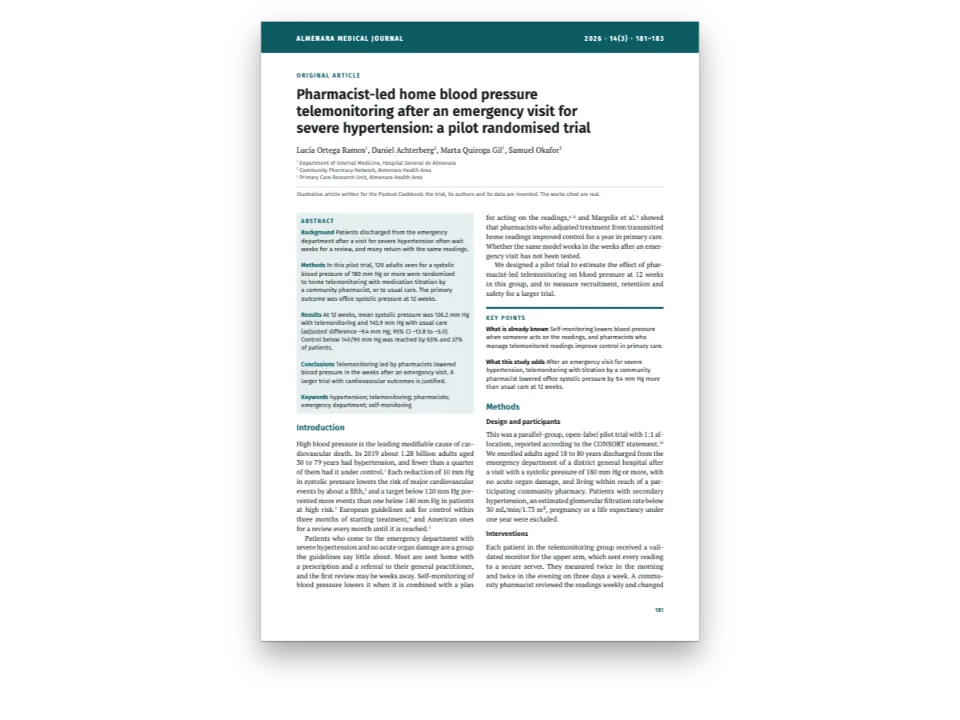
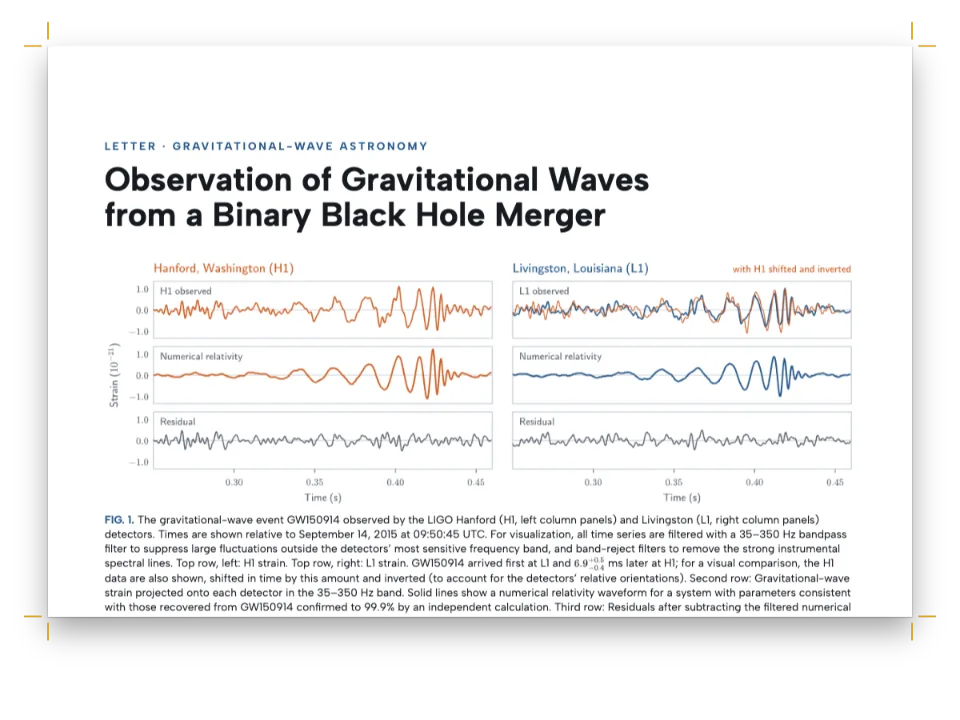
在A4上排出五页生命科学期刊论文:Jumper等人的Highly accurate protein structure prediction with AlphaFold,依据CC BY 4.0许可从Nature原文删节。第一页由一条蓝色色带开头,下面是标题、7.4 pt的全部34位作者(单位序号为上标)和横跨全页的粗体摘要。页脚是图1:一幅柱状图,画的是正文引用的CASP14精度;另一幅是根据PDB描出的靶标T1049主链,AlphaFold模型画在其中,按置信度着色。正文用Nature的上标数字引用。方法部分接在讨论之后,排成8.2 pt;方法部分第一次引用的文献,取正文最后一个序号之后的数字,因此文末只有一份参考文献表。
这道食谱解答
- 怎样把期刊论文的方法部分排在正文之后、用较小字号,并让其中的引用接续编号?
- 怎样用Postext重新排版arXiv或PubMed Central上的开放获取论文,并保留引用、图和许可声明?
- 怎样像医学期刊那样把引用序号排成上标,并让DOI成为可点击的链接?
- 怎样加一幅带编号题注的图,并在正文里引用它(“见图3.2”)?
简短回答
// [@key] prints a raised number in order of first citation, so a work the Methods cite for
// the first time takes the next number after the main text's last, and one cited again
// keeps its number. One list after the Methods holds them all.
registerCitationEngine(createCiteprocEngine({ styles: STYLES, locales: LOCALES }));
// The bundled Nature style prints a DOI twice for an article with no volume yet ("Proteins
// https://doi.org/… (2021) doi:…"): one edit keeps the first.
const nature = STYLES.nature.replace('<if variable="volume" type="article dataset software"',
  '<if variable="volume" type="article article-journal dataset software"');
const citations = {
  style: 'custom', customStyle: nature, // raised 1–4, "Nature 577, 706–710 (2020)." entries
  bibliography: { fontSize: em(0.8), lineHeight: pt(9.6), entrySpacing: pt(0.8),
    labelWidth: mm(5), labelAlign: 'right' }, // 9. and 10. end together
};
// "# Methods {style=\"methods\"}" opens a section that runs to the end of the article: an H1
// that breaks nothing, names no running chapter and sets its body two sizes down.
const methods = { id: 'methods', numbered: false, runningChapter: false,
  breakBefore: { enabled: false }, fontFamily: SANS, fontSize: pt(11.5), lineHeight: pt(LEAD),
  fontWeight: 700, color: col('ink'), marginTop: pt(LEAD), marginBottom: pt(LEAD / 2),
  bodyStyle: { fontSize: pt(8.2), lineHeight: pt(SMALL) } };
用料
- 功能
- 标题样式按引用样式排的引用由参考文献数据生成的文献表上标与下标设计过的章首页标题属性标注框横跨页面的框浮动框书眉与页码按页面角色显示书眉图就放在这里题注样式来源与出处行表格样式编号题注段落样式语义调色板导出PDF嵌入PDF的字体
- 类型
- Noto Serif, Noto Sans(SIL OFL 1.1)
- 素材
- Fig. 1b, experimental Cα coordinates of PDB 6Y4F (Jiang et al. 2020), drawn in code (Worldwide Protein Data Bank, CC0 1.0)
- Fig. 1b, AlphaFold DB model AF-B4EUK6-F1 (AlphaFold Monomer v2.0) and its pLDDT, superposed and drawn in code (DeepMind Technologies Limited and EMBL-EBI, AlphaFold Protein Structure Database, CC BY 4.0)
做法
#1 · 正文和方法部分共用一套序号
代码就是上面的简短回答。引用按首次出现的先后编号,所以续编序号不需要任何设置:方法部分排在正文之后,在那里首次引用的jackhmmer得到36,而正文中已引用过的Amber力场仍然是30。方法部分的标题是一个一级标题,带有自己的样式;标题样式开启的一节一直延续到下一个一级标题,其bodyStyle把这一节的正文排成8.2 pt字号、10.8 pt行距。breakBefore: { enabled: false }让它留在栏内,runningChapter: false让书眉继续显示论文标题。内置的nature样式需要改一处:有DOI但尚无卷号的文章,原来会把DOI印两遍。排你自己的论文时,把.bib导出内容贴进:::references{format=bibtex}块(这里分成两个块,一个放正文引用的文献,一个放方法部分的文献),在词后紧接着写[@key]引用,再把nature换成你投稿期刊的样式。
#2 · 容纳34位作者的标题区
const text = (id, content, family, size, extra) => ({ kind: 'text', id, content, align: 'left',
  fontFamily: family, fontSize: pt(size), color: col('ink'), overflow: 'wrap', ...extra });
const at = (to, edge, x, y, width) => ({ anchor: { to, edge }, offset: { x: mm(x), y: mm(y) },
  ...(width && { size: { width: mm(width), height: 'auto' } }) });
const caps = { fontFamily: SANS, fontWeight: 600, letterSpacing: pt(1.4),
  textTransform: 'uppercase' };
const titleBlock = { enabled: true,
  minHeight: mm(50),
  slot: { elements: [
    { kind: 'box', id: 'band', style: { backgroundColor: col('accent') },
      placement: { anchor: { to: 'page', edge: 'top-left' },
        size: { width: 'fill', height: mm(14) } } },
    text('kicker', '{attr.kicker}', SANS, 8.5, { ...caps, color: col('paper'),
      placement: at('page', 'top-left', INNER, 5.6, 120) }),
    text('title', '{titleText}', SANS, 23, { fontWeight: 700, lineHeight: 1.12,
      placement: at('container', 'top-left', 0, 1, MEASURE - 30) }),
    text('authors', '{attr.authors}', SANS, 7.4, { inlineMarks: true, lineHeight: 1.42,
      placement: at('#title', 'below', 0, 4, MEASURE) }),
    { kind: 'rule', id: 'rule', thickness: pt(0.5), color: col('rule'),
      placement: at('#authors', 'below', 0, 3, MEASURE) },
    text('source', '{attr.source}', SANS, 7, { fontStyle: 'italic', color: col('muted'),
      placement: at('#rule', 'below', 0, 1.6, MEASURE) }),
  ] },
};
作者名单是标题的一个属性,authors="John Jumper^1,4^, Richard Evans^1,4^, …",用7.4 pt的Noto Sans排满整个版心宽度,34个名字占五行。inlineMarks把单位序号排成上标。作者单位和同等贡献的说明放在文末的Author information下,与Nature的做法相同,这样第一页能留出摘要和插图的位置。没有删去任何作者:只有偶数页的书眉把名单缩写为Jumper et al.
#3 · 横跨全页的摘要,页脚的图1
const resources = () => [
  { id: 'fig1', typeId: 'figure', kind: 'svg', createdAt: 0, updatedAt: 0,
    placement: { position: 'here', span: 'page' },
    svg: { fileId: 'fig1.svg', width: 1780, height: 640 },
    caption: '**AlphaFold produces highly accurate structures.** **a**, Median accuracy on the '
      + 'CASP14 domains of AlphaFold and of the next best method, as r.m.s.d.~95~ over Cα atoms '
      + '(backbone) and over all atoms, with 95% confidence intervals; the dashed line is the '
      + 'width of a carbon atom, about 1.4 Å. **b**, CASP14 target T1049 (PDB 6Y4F): the '
      + 'experimental Cα trace (grey) and the AlphaFold model of the same chain, coloured by '
      + 'its per-residue confidence (pLDDT).',
    note: 'Redrawn for this edition. a, from the values given in the text (the original plots '
      + 'the top 15 of 146 entries). b, from PDB 6Y4F (CC0) and AlphaFold DB model '
      + 'AF-B4EUK6-F1, AlphaFold Monomer v2.0 (CC BY 4.0), superposed on 134 Cα atoms; the '
      + 'original shows the CASP14 prediction.',
    altText: 'Bars: AlphaFold 0.96 and 1.5 Å, next best 2.8 and 3.5 Å. Two backbones that '
      + 'lie almost on top of each other.' },
  { id: 'tbl-timings', typeId: 'table', kind: 'table', createdAt: 0, updatedAt: 0,
    placement: { position: 'here' },
    caption: '**Inference times.** One model on one V100 GPU, by protein length.',
    note: 'Compiled for this edition from the timings given in ‘Inference regimen’.',
    table: { model: { headerRowCount: 1, columnWidths: [1, 1.3, 1.3], rows: [
      ['Residues', 'With ensembling (CASP14)', 'Without ensembling'],
      ['256', '4.8 min', '0.6 min'], ['384', '9.2 min', '1.1 min'],
      ['2,500', '18 h', '2.1 h'],
    ].map((row, r) => row.map((content, c) => ({ content, ...(r === 0 && { isHeader: true }),
      ...(c > 0 && { align: 'right' }) }))) } } },
];
摘要是一个span: 'page'、没有边框的框,正文用Noto Sans半粗体。紧接着是第二个无边框的框,设为placement: 'bottom',里面放::resource{id="fig1"}:这个框浮动到第一页的页脚,双栏正文从摘要下方开始,排在它上面。图注以一句粗体开头,和Nature的图注一样;资源类型的captionPrefix和图注样式的labelSeparator让标签读作Fig. 1 |。表1用position: 'here'嵌在方法部分中它所在的位置。
#4 · 用公开坐标画出的蛋白质主链
// PDB 6Y4F chain A, residues 25–158: Cα x, y in tenths of Å, depth z in Å (CC0)
const EXP = [
  -56,-91,-6,-36,-77,-3,-4,-98,-2,26,-81,-1,63,-86,-1,95,-73,1,116,-100,2,146,
  -79,3,159,-46,2,187,-34,4,209,-6,3,211,10,0,187,17,-3,182,53,-2,185,46,2,
  167,14,3,148,-4,6,122,-28,4,109,-58,6,76,-67,4,45,-89,4,11,-79,3,-2,-114,
  3,-37,-116,1,-64,-95,0,-87,-117,-2,-124,-110,-2,-135,-80,-5,-161,-95,-7,-158,
  -74,-10,-173,-41,-9,-141,-20,-9,-148,15,-8,-128,31,-5,-105,55,-7,-106,82,-4,
  -144,80,-3,-156,116,-3,-122,132,-2,-126,155,1,-102,131,3,-88,98,2,-68,72,4,
  -58,37,3,-23,33,4,6,10,5,32,28,2,59,21,0,68,31,-4,89,62,-3,96,70,-7,102,
  52,-10,65,59,-11,53,41,-8,39,71,-6,38,70,-2,64,79,0,59,86,4,33,60,5,42,
  36,8,7,42,9,-29,48,8,-55,21,9,-88,39,8,-105,69,6,-122,57,3,-134,87,1,-170,
  78,2,-167,42,1,-180,38,-3,-165,5,-4,-132,-13,-3,-150,-42,-2,-161,-18,1,-125,
  -6,1,-114,-43,2,-141,-49,4,-129,-20,6,-92,-30,6,-98,-66,7,-120,-57,10,-94,
  -33,11,-62,-52,11,-54,-89,11,-36,-104,8,-8,-109,7,3,-73,8,40,-75,9,67,-51,
  10,93,-26,9,92,8,7,119,30,5,128,47,2,151,77,2,149,93,-2,152,82,-5,173,52,
  -6,150,22,-6,162,-13,-8,144,-44,-6,119,-43,-9,109,-8,-8,106,-15,-4,72,-24,
  -3,53,-20,0,15,-23,0,-19,-8,1,-20,28,-1,-48,53,-1,-38,89,0,-52,122,1,-25,
  128,3,-19,107,7,18,115,7,47,129,5,57,121,1,26,112,-1,28,122,-4,-9,117,-5,
  -8,83,-3,-9,51,-5,-13,14,-5,-49,3,-4,-61,-14,-8,-50,-50,-8,-19,-46,-6,8,
  -72,-7,43,-65,-6,67,-94,-5,43,-121,-6,32,-148,-3,-6,-157,-3,-17,-192,-4,-23,
  -216,-1,
];
// AlphaFold DB AF-B4EUK6-F1, the same residues superposed on 6Y4F (CC BY 4.0)
const MODEL = [
  -57,-93,-6,-37,-77,-3,-5,-98,-2,25,-82,-1,63,-87,-1,94,-74,1,112,-103,3,144,
  -84,3,158,-50,2,189,-34,4,209,-2,3,212,16,0,187,21,-3,181,57,-2,181,48,2,
  166,13,2,148,-4,5,122,-29,4,110,-58,6,76,-66,4,46,-88,4,12,-79,3,0,-115,3,
  -37,-113,2,-64,-95,0,-87,-118,-2,-125,-110,-2,-136,-81,-4,-162,-95,-7,-155,
  -74,-10,-173,-42,-9,-141,-22,-9,-146,14,-8,-126,31,-5,-102,55,-7,-106,83,-4,
  -143,81,-4,-156,117,-3,-122,132,-2,-123,157,1,-101,132,3,-86,98,2,-68,72,4,
  -58,36,3,-22,32,4,7,8,4,32,26,2,61,20,0,67,31,-4,89,62,-3,95,73,-7,100,
  56,-10,64,67,-11,52,44,-8,40,74,-6,38,68,-2,65,77,0,59,84,4,35,56,5,45,
  30,8,10,37,9,-25,47,8,-54,21,9,-86,40,8,-105,69,6,-120,56,3,-132,87,1,
  -169,78,2,-166,42,0,-177,37,-3,-163,3,-4,-130,-15,-3,-150,-42,-2,-162,-17,1,
  -125,-5,1,-114,-42,2,-142,-47,5,-129,-15,7,-93,-28,6,-103,-62,8,-122,-46,11,
  -90,-26,12,-62,-52,11,-59,-89,10,-37,-104,7,-8,-110,7,3,-74,8,40,-74,9,66,
  -48,10,95,-26,9,95,7,7,124,30,6,127,45,2,147,78,2,145,92,-1,153,87,-5,172,
  54,-6,147,26,-7,158,-6,-8,145,-39,-7,117,-42,-10,105,-7,-8,106,-14,-5,72,
  -24,-3,54,-21,0,16,-25,0,-18,-8,0,-19,27,-1,-48,52,-1,-37,88,0,-51,122,1,
  -26,127,4,-23,104,7,15,108,7,45,124,5,57,120,2,26,111,-1,31,123,-4,-7,116,
  -5,-5,83,-3,-8,51,-5,-12,14,-5,-48,2,-5,-62,-14,-8,-53,-52,-8,-20,-47,-6,5,
  -74,-7,39,-66,-5,64,-95,-5,99,-89,-7,117,-72,-4,146,-94,-2,178,-75,-3,190,
  -46,-1,
];
// The model's per-residue pLDDT, read from its B-factor column
const PLDDT = [
  87,89,87,87,83,87,82,84,85,84,82,79,81,86,90,89,93,93,94,95,92,95,87,90,
  93,87,89,88,82,75,87,92,97,98,98,98,98,98,98,98,98,99,99,99,99,99,98,96,
  94,93,90,84,87,89,95,95,96,97,98,98,98,98,98,98,99,99,99,98,98,98,98,97,
  97,98,98,98,98,98,98,97,98,98,96,95,89,96,97,96,96,96,96,94,93,91,88,86,
  82,73,67,61,61,69,83,89,96,97,98,99,99,98,98,97,96,97,96,96,95,95,96,97,
  97,96,97,94,87,90,84,82,69,65,64,61,55,53,
];
const n2 = (v) => +v.toFixed(2);
// An SVG drawn as an image cannot see the page's web fonts (gotcha: svg-no-webfonts), so the
// figure carries Noto Sans inline, as a data URL of the Fontsource file.
async function inlineFace(family, weight) {
  const id = family.toLowerCase().replace(/\s+/g, '-');
  const url = `https://cdn.jsdelivr.net/npm/@fontsource/${id}@5/files/${id}-latin-${weight}`
    + '-normal.woff2';
  const bytes = new Uint8Array(await (await fetch(url)).arrayBuffer());
  let bin = '';
  for (const b of bytes) bin += String.fromCharCode(b);
  return `<style>@font-face{font-family:F;src:url(data:font/woff2;base64,${btoa(bin)}) `
    + `format('woff2')}text{font-family:F}</style>`;
}
const label = (x, y, s, size = 2.5, extra = '') => { // ink unless extra sets a fill
  const fill = extra.includes('fill') ? '' : `fill="${palette.ink}" `;
  return `<text x="${n2(x)}" y="${n2(y)}" font-size="${size}" ${fill}${extra}>${s}</text>`;
};
// a: median r.m.s.d.95 with its 95% interval, as the text gives them
const ACCURACY = [
  { group: 'Backbone', af: [0.96, 0.85, 1.16], next: [2.8, 2.7, 4.0] },
  { group: 'All-atom', af: [1.5, 1.2, 1.6], next: [3.5, 3.1, 4.2] },
];
function bars() {
  const [L, B, T, H] = [9, 54, 8, 4.5]; // axis left, baseline, top, Å at the top
  const y = (v) => B - (v / H) * (B - T);
  let s = label(0, 3.2, 'a', 3.6, 'font-weight="700"');
  for (const v of [0, 1, 2, 3, 4]) {
    s += `<path d="M${L} ${n2(y(v))}H58" stroke="${palette.rule}" stroke-width="0.15"/>`
      + label(L - 1.5, y(v) + 0.9, v, 2.5, 'text-anchor="end"');
  }
  s += label(1.6, 31, 'r.m.s.d.<tspan font-size="1.8" dy="0.6">95</tspan><tspan dy="-0.6"> (Å)'
    + '</tspan>', 2.5, 'text-anchor="middle" transform="rotate(-90 1.6 31)"');
  ACCURACY.forEach(({ group, af, next }, g) => {
    const x0 = L + 4 + g * 24;
    [[af, palette.accent], [next, palette.rule]].forEach(([[m, lo, hi], fill], k) => {
      const x = x0 + k * 10;
      s += `<rect x="${x}" y="${n2(y(m))}" width="8" height="${n2(B - y(m))}" fill="${fill}"/>`
        + `<path d="M${x + 4} ${n2(y(lo))}V${n2(y(hi))}M${x + 2.6} ${n2(y(lo))}h2.8M${x + 2.6} `
        + `${n2(y(hi))}h2.8" stroke="${palette.ink}" stroke-width="0.3" fill="none"/>`
        + label(x + 4, B - 1.4, m.toFixed(m < 1 ? 2 : 1), 2.3, // inside the bar's foot
          `text-anchor="middle" fill="${k ? palette.ink : palette.paper}"`);
    });
    s += label(x0 + 9, B + 4, group, 2.6, 'text-anchor="middle"');
  });
  let dash = '';
  for (let x = L; x < 57; x += 2.4) dash += `M${n2(x)} ${n2(y(1.4))}h1.4`;
  s += `<path d="${dash}" stroke="${palette.ink}" stroke-width="0.3"/>`
    + `<path d="M${L} ${B}H58" stroke="${palette.ink}" stroke-width="0.35"/>`
    + `<rect x="${L + 2}" y="59.3" width="2.6" height="2.6" fill="${palette.accent}"/>`
    + label(L + 5.5, 61.6, 'AlphaFold') + `<rect x="${L + 22}" y="59.3" width="2.6" `
    + `height="2.6" fill="${palette.rule}"/>` + label(L + 25.5, 61.6, 'Next best method');
  return s;
}
// b: both chains as smooth Cα traces, far segments first
const BANDS = [[90, '#0053d6', 'pLDDT > 90'], [70, '#65cbf3', 'pLDDT 70–90'],
  [50, '#ffdb13', 'pLDDT 50–70'], [0, '#ff7d45', 'pLDDT < 50']];
const band = (p) => BANDS.find(([min]) => p > min);
function trace(xyz, cx, cy, k) {
  const pt = (i) => [cx + xyz[3 * i] * k, cy - xyz[3 * i + 1] * k, xyz[3 * i + 2]];
  const n = xyz.length / 3;
  return Array.from({ length: n - 1 }, (_, i) => {
    const [p0, p1, p2, p3] = [pt(Math.max(i - 1, 0)), pt(i), pt(i + 1), pt(Math.min(i + 2, n - 1))];
    const c1 = [0, 1].map((a) => p1[a] + (p2[a] - p0[a]) / 6);
    const c2 = [0, 1].map((a) => p2[a] - (p3[a] - p1[a]) / 6);
    return { i, z: (p1[2] + p2[2]) / 2, d: `M${n2(p1[0])} ${n2(p1[1])}C${n2(c1[0])} `
      + `${n2(c1[1])} ${n2(c2[0])} ${n2(c2[1])} ${n2(p2[0])} ${n2(p2[1])}` };
  });
}
function backbone() {
  const [cx, cy, k] = [103, 32, 0.142]; // mm per tenth of an Å
  const exp = trace(EXP, cx, cy, k);
  const model = trace(MODEL, cx, cy, k);
  const width = (z) => 1 + z / 40;
  let s = label(66, 3.2, 'b', 3.6, 'font-weight="700"');
  // the experiment as a grey band, then the model on top of it: where they agree, the model's
  // colour runs inside the band
  for (const [segs, halo, wide, colour] of [[exp, 2.4, 1.6, () => palette.rule],
    [model, 1.3, 0.75, (i) => band(Math.min(PLDDT[i], PLDDT[i + 1]))[1]]]) {
    for (const { i, z, d } of [...segs].sort((a, b) => a.z - b.z)) {
      const w = width(z);
      s += `<path d="${d}" stroke="${palette.paper}" stroke-width="${n2(w * halo)}" `
        + `fill="none"/><path d="${d}" stroke="${colour(i)}" ` // a butt halo: no notch at joins
        + `stroke-width="${n2(w * wide)}" fill="none" stroke-linecap="round"/>`;
    }
  }
  const legend = [[palette.rule, 'Experiment (PDB 6Y4F)'], ...BANDS.slice(0, 3)
    .map(([, c, t]) => [c, `Model: ${t}`])];
  legend.forEach(([c, t], j) => {
    s += `<path d="M138 ${44 + j * 4.6}h5" stroke="${c}" stroke-width="${j ? 1 : 1.6}" `
      + 'stroke-linecap="round"/>' + label(145, 44.9 + j * 4.6, t, 2.4);
  });
  return s + label(138, 39, 'T1049 · residues 25–158', 2.5, 'font-weight="700"');
}
const figure1 = (face) => '<svg xmlns="http://www.w3.org/2000/svg" width="1780" height="640" '
  + `viewBox="0 0 178 64">${face}${bars()}${backbone()}</svg>`;
坐标只在编写这份配方时读取了一次,来自PDB条目6Y4F(CC0)和AlphaFold Database中同一蛋白质的模型(CC BY 4.0),按Cα原子叠合,并转到实验结构的主轴上。脚本把它们保存在三个短数组里。每条轨迹是一串穿过Cα位置的贝塞尔曲线段,从最远的画到最近的,每段带一圈纸色描边,不用明暗也能看出前后。模型的颜色是AlphaFold Database使用的pLDDT分段,从其文件的B因子列读出。
#5 · PDF中的希腊字母和带变音符号的字母
// Fontsource cuts each face by script. The PDF gets every file the text of a face needs and
// draws a character from the first file that has it (gotcha: latin-subset).
const SUBSETS = [['latin-ext', /[\u0100-\u024f]/u], ['greek', /[\u0370-\u03ff]/u]];
const fileOf = (family, subset, weight, style) => 'https://cdn.jsdelivr.net/npm/@fontsource/'
  + `${fontsourceId(family)}@5/files/${fontsourceId(family)}-${subset}-${weight}-${style}.woff2`;
const woff = async (url) => decompressWoff2(new Uint8Array(await (await fetch(url)).arrayBuffer()));
const loadGreek = () => Promise.all(Object.entries(FONTS).flatMap(([family, specs]) =>
  specs.map(async (spec) => {
    const [weight, style] = [parseInt(spec, 10), spec.endsWith('i') ? 'italic' : 'normal'];
    const url = fileOf(family, 'greek', weight, style);
    const face = new FontFace(family, `url(${url})`, { weight: `${weight}`, style,
      unicodeRange: 'U+0370-03FF' });
    document.fonts.add(await face.load());
  })));
async function fontProvider(family, weight, style, request) {
  const text = String.fromCodePoint(...(request?.codePoints ?? []));
  const more = SUBSETS.filter(([, test]) => test.test(text))
    .map(([subset]) => woff(fileOf(family, subset, weight, style)));
  return [await fontsourceProvider(family, weight, style), ...(await Promise.all(more))];
}
Fontsource把每款字体按文字系统拆分成多个文件。工具包会加载latin文件,正文需要时也加载latin-ext,但不加载希腊字母文件,于是Cα和χ在屏幕上会用后备字体显示,在PDF中则会缺失。这个区块为画布加载每款字体的希腊字母文件,并给renderToPdf一个字体提供函数:某款字体排的文字需要时,就附上它的latin-ext和希腊字母文件。
完整食谱
// ═══ Postext Cookbook · Nº 139 · A protein paper with a Methods section ════════════ // https://postext.dev/en/cookbook/protein-paper-methods-section // Code: MIT · Text: Jumper et al. 2021, abridged (CC BY 4.0) · Figures: drawn in code // Fonts: Noto Serif, Noto Sans (SIL OFL 1.1) · Needs postext ≥ 1.18.0 import { buildDocument, renderPageToCanvas, clearMeasurementCache, registerCitationEngine, registerResourceImage, defaultResourceTypes, } from 'https://esm.sh/postext'; import { renderToPdf, decompressWoff2 } from 'https://esm.sh/postext-pdf'; import { createCiteprocEngine, STYLES, LOCALES } from 'https://esm.sh/postext-citeproc'; const LANG = 'en'; // @lang: the language of the sample document ('en' | 'es') const RECIPE = 'protein-paper-methods-section'; // ─── 1 · Design ───────────────────────────────────────────────────────────── // #region palette: near-black text and one deep blue, the blue of confident pLDDT const palette = { ink: '#161b22', accent: '#0b4ea2', tint: '#e9eff8', rule: '#b3bdcb', muted: '#59636f', paper: '#ffffff' }; const col = (id) => ({ hex: palette[id], model: 'hex', paletteId: id }); const colorPalette = Object.entries({ ...palette, 'main-color': palette.accent }) .map(([id, hex]) => ({ id, name: id, value: { hex, model: 'hex' } })); // #endregion const [SERIF, SANS] = ['Noto Serif', 'Noto Sans']; const [TRIM_W, TRIM_H, TOP, BOTTOM, INNER, OUTER, GUTTER] = [210, 297, 22, 22, 18, 16, 6]; const MEASURE = TRIM_W - INNER - OUTER; const LEAD = 12.6; // pt: 9.3 pt type in two columns of 85 mm const SMALL = 10.8; // pt: the Methods, at 8.2 pt // #region answer: Methods in smaller type, its citations numbered on from the main text // [@key] prints a raised number in order of first citation, so a work the Methods cite for // the first time takes the next number after the main text's last, and one cited again // keeps its number. One list after the Methods holds them all. registerCitationEngine(createCiteprocEngine({ styles: STYLES, locales: LOCALES })); // The bundled Nature style prints a DOI twice for an article with no volume yet ("Proteins // https://doi.org/… (2021) doi:…"): one edit keeps the first. const nature = STYLES.nature.replace('<if variable="volume" type="article dataset software"', '<if variable="volume" type="article article-journal dataset software"'); const citations = { style: 'custom', customStyle: nature, // raised 1–4, "Nature 577, 706–710 (2020)." entries bibliography: { fontSize: em(0.8), lineHeight: pt(9.6), entrySpacing: pt(0.8), labelWidth: mm(5), labelAlign: 'right' }, // 9. and 10. end together }; // "# Methods {style=\"methods\"}" opens a section that runs to the end of the article: an H1 // that breaks nothing, names no running chapter and sets its body two sizes down. const methods = { id: 'methods', numbered: false, runningChapter: false, breakBefore: { enabled: false }, fontFamily: SANS, fontSize: pt(11.5), lineHeight: pt(LEAD), fontWeight: 700, color: col('ink'), marginTop: pt(LEAD), marginBottom: pt(LEAD / 2), bodyStyle: { fontSize: pt(8.2), lineHeight: pt(SMALL) } }; // #endregion // #region title: a blue band, the title, 34 authors in small type and the source line const text = (id, content, family, size, extra) => ({ kind: 'text', id, content, align: 'left', fontFamily: family, fontSize: pt(size), color: col('ink'), overflow: 'wrap', ...extra }); const at = (to, edge, x, y, width) => ({ anchor: { to, edge }, offset: { x: mm(x), y: mm(y) }, ...(width && { size: { width: mm(width), height: 'auto' } }) }); const caps = { fontFamily: SANS, fontWeight: 600, letterSpacing: pt(1.4), textTransform: 'uppercase' }; const titleBlock = { enabled: true, minHeight: mm(50), slot: { elements: [ { kind: 'box', id: 'band', style: { backgroundColor: col('accent') }, placement: { anchor: { to: 'page', edge: 'top-left' }, size: { width: 'fill', height: mm(14) } } }, text('kicker', '{attr.kicker}', SANS, 8.5, { ...caps, color: col('paper'), placement: at('page', 'top-left', INNER, 5.6, 120) }), text('title', '{titleText}', SANS, 23, { fontWeight: 700, lineHeight: 1.12, placement: at('container', 'top-left', 0, 1, MEASURE - 30) }), text('authors', '{attr.authors}', SANS, 7.4, { inlineMarks: true, lineHeight: 1.42, placement: at('#title', 'below', 0, 4, MEASURE) }), { kind: 'rule', id: 'rule', thickness: pt(0.5), color: col('rule'), placement: at('#authors', 'below', 0, 3, MEASURE) }, text('source', '{attr.source}', SANS, 7, { fontStyle: 'italic', color: col('muted'), placement: at('#rule', 'below', 0, 1.6, MEASURE) }), ] }, }; // #endregion const flat = { border: { enabled: false }, backgroundEnabled: false, marginTop: pt(0), padding: { top: mm(0), right: mm(0), bottom: mm(0), left: mm(0) } }; const calloutStyles = [ { id: 'summary', span: 'page', ...flat, marginBottom: pt(LEAD), // the bold summary body: { fontFamily: SANS, fontSize: pt(9.4), lineHeight: pt(LEAD + 0.6), fontWeight: 600, boldColor: col('ink'), textAlign: 'justify', firstLineIndent: pt(0) } }, // Fig. 1 floats to the foot of the first page, under the opening paragraphs { id: 'plate', span: 'page', placement: 'bottom', ...flat, marginBottom: pt(0) }, ]; const head = (id, content, parity, edge, x, extra) => text(id, content, SANS, 7.8, { parity, pages: 'body', color: col('muted'), overflow: 'clip', placement: at('page', edge, x, 12.5, 110), ...extra }); const folio = { fontWeight: 700, color: col('accent') }; const right = { align: 'right' }; const header = { elements: [ head('v-folio', '{pageNumber}', 'even', 'top-left', OUTER, folio), head('v-title', 'Jumper et al. · Abridged from Nature 596, 583–589 (2021)', 'even', 'top-left', OUTER + 8), head('r-title', 'Highly accurate protein structure prediction with AlphaFold', 'odd', 'top-right', -OUTER - 8, right), head('r-folio', '{pageNumber}', 'odd', 'top-right', -OUTER, { ...folio, ...right }), ] }; const footer = { elements: [text('licence', 'Open access · CC BY 4.0 · ' + 'creativecommons.org/licenses/by/4.0', SANS, 7, { pages: 'opener', color: col('muted'), placement: at('page', 'bottom-left', INNER, -12, 150) })] }; const config = () => ({ // a factory: the engine caches resolved configs per object locale: 'en-gb', // Nature's labels: "Fig. 1 | Title." and "Table 1 | Title.", numbered 1, 2… not 1.1 resourceTypes: defaultResourceTypes(LANG).map((type) => ({ ...type, numberingTemplate: '{n}', captionPrefix: type.id === 'figure' ? 'Fig.' : type.name })), colorPalette, citations, header, footer, calloutStyles, headingStyles: [ { id: 'article', numbered: false, span: 'page', advancedDesign: titleBlock }, methods, ], page: { sizePreset: 'custom', width: mm(TRIM_W), height: mm(TRIM_H), dpi: 150, margins: { top: mm(TOP), bottom: mm(BOTTOM), left: mm(INNER), right: mm(OUTER), mirror: true } }, layout: { layoutType: 'double', gutterWidth: mm(GUTTER) }, bodyText: { fontFamily: SERIF, fontSize: pt(9.3), lineHeight: pt(LEAD), color: col('ink'), boldColor: col('ink'), italicColor: col('ink'), referenceColor: col('ink'), referenceBold: false, textAlign: 'justify', firstLineIndent: mm(3.5), indentAfterHeading: false, hyphenation: { enabled: true }, optimalLineBreaking: true, avoidWidows: true, avoidOrphans: true, avoidRunts: true }, headings: { fontFamily: SANS, color: col('ink'), fontWeight: 700, levels: [ { level: 1, breakBefore: { enabled: true, parity: 'any' } }, // gotcha: headings-drop-h1-break { level: 2, fontSize: pt(10), lineHeight: pt(LEAD), marginTop: pt(LEAD), marginBottom: pt(0) }, { level: 3, fontSize: pt(8.2), lineHeight: pt(SMALL), color: col('accent'), marginTop: pt(SMALL / 2), marginBottom: pt(0), snapToGrid: false }, // Methods' leading ] }, paragraphStyles: [{ id: 'back', fontFamily: SANS, fontSize: pt(7.2), lineHeight: pt(9.6), textAlign: 'left', firstLineIndent: pt(0), spaceBetween: pt(3), marginTop: pt(6) }], tableStyle: { rules: 'horizontal', borderColor: col('rule'), borderWidth: pt(0.5), headerBackground: col('accent'), headerColor: col('paper'), headerBold: true, headerFontFamily: SANS, headerFontSize: pt(7.4), bodyFontFamily: SANS, bodyFontSize: pt(7.4), bodyColor: col('ink'), cellPadding: mm(1.2) }, captionStyle: { fontFamily: SANS, fontSize: pt(7.6), color: col('ink'), labelBold: true, labelColor: col('accent'), labelSeparator: ' | ', gap: mm(2), note: { fontSize: pt(6.6), color: col('muted') } }, }); // ─── 2 · Content ──────────────────────────────────────────────────────────── const markdown = [String.raw`---Markdown样例 · 47行 · content.en.md
title: "Highly accurate protein structure prediction with AlphaFold" author: "John Jumper, Richard Evans, Alexander Pritzel et al." --- # Highly accurate protein structure prediction with AlphaFold {style="article" kicker="Article · Structural biology" source="Abridged from Nature 596, 583–589 (2021) · https://doi.org/10.1038/s41586-021-03819-2 · CC BY 4.0" authors="John Jumper^1,4^, Richard Evans^1,4^, Alexander Pritzel^1,4^, Tim Green^1,4^, Michael Figurnov^1,4^, Olaf Ronneberger^1,4^, Kathryn Tunyasuvunakool^1,4^, Russ Bates^1,4^, Augustin Žídek^1,4^, Anna Potapenko^1,4^, Alex Bridgland^1,4^, Clemens Meyer^1,4^, Simon A. A. Kohl^1,4^, Andrew J. Ballard^1,4^, Andrew Cowie^1,4^, Bernardino Romera-Paredes^1,4^, Stanislav Nikolov^1,4^, Rishub Jain^1,4^, Jonas Adler^1^, Trevor Back^1^, Stig Petersen^1^, David Reiman^1^, Ellen Clancy^1^, Michal Zielinski^1^, Martin Steinegger^2,3^, Michalina Pacholska^1^, Tamas Berghammer^1^, Sebastian Bodenstein^1^, David Silver^1^, Oriol Vinyals^1^, Andrew W. Senior^1^, Koray Kavukcuoglu^1^, Pushmeet Kohli^1^ & Demis Hassabis^1,4^"} :::callout{type="summary"} Proteins are essential to life, and understanding their structure can facilitate a mechanistic understanding of their function. Through an enormous experimental effort[@thompson2020; @bai2015; @jaskolski2014; @wuthrich2001], the structures of around 100,000 unique proteins have been determined[@wwpdb2018], but this represents a small fraction of the billions of known protein sequences[@mitchell2020; @steinegger2019]. Structural coverage is bottlenecked by the months to years of painstaking effort required to determine a single protein structure. Accurate computational approaches are needed to address this gap and to enable large-scale structural bioinformatics. Predicting the three-dimensional structure that a protein will adopt based solely on its amino acid sequence—the structure prediction component of the ‘protein folding problem’[@dill2008]—has been an important open research problem for more than 50 years[@anfinsen1973]. Despite recent progress[@senior2020; @wang2017; @zheng2019; @abriata2019; @pearce2021], existing methods fall far short of atomic accuracy, especially when no homologous structure is available. Here we provide the first computational method that can regularly predict protein structures with atomic accuracy even in cases in which no similar structure is known. We validated an entirely redesigned version of our neural network-based model, AlphaFold, in the challenging 14th Critical Assessment of protein Structure Prediction (CASP14)[@moult2020], demonstrating accuracy competitive with experimental structures in a majority of cases and greatly outperforming other methods. Underpinning the latest version of AlphaFold is a novel machine learning approach that incorporates physical and biological knowledge about protein structure, leveraging multi-sequence alignments, into the design of the deep learning algorithm. ::: :::callout{type="plate"} ::resource{id="fig1"} ::: The development of computational methods to predict three-dimensional (3D) protein structures from the protein sequence has proceeded along two complementary paths that focus on either the physical interactions or the evolutionary history. The physical interaction programme heavily integrates our understanding of molecular driving forces into either thermodynamic or kinetic simulation of protein physics[@brini2020] or statistical approximations thereof[@sippl1990]. Although theoretically very appealing, this approach has proved highly challenging for even moderate-sized proteins due to the computational intractability of molecular simulation, the context dependence of protein stability and the difficulty of producing sufficiently accurate models of protein physics. The evolutionary programme has provided an alternative in recent years, in which the constraints on protein structure are derived from bioinformatics analysis of the evolutionary history of proteins, homology to solved structures[@sali1993; @roy2010] and pairwise evolutionary correlations[@altschuh1987; @shindyalov1994; @weigt2009; @marks2011; @jones2012]. This bioinformatics approach has benefited greatly from the steady growth of experimental protein structures deposited in the Protein Data Bank (PDB)[@wwpdb2018], the explosion of genomic sequencing and the rapid development of deep learning techniques to interpret these correlations. Despite these advances, contemporary physical and evolutionary-history-based approaches produce predictions that are far short of experimental accuracy in the majority of cases in which a close homologue has not been solved experimentally and this has limited their utility for many biological applications. In this study, we develop the first, to our knowledge, computational approach capable of predicting protein structures to near experimental accuracy in a majority of cases. The neural network AlphaFold that we developed was entered into the CASP14 assessment (May–July 2020; entered under the team name ‘AlphaFold2’ and a completely different model from our CASP13 AlphaFold system[@senior2020]). The CASP assessment is carried out biennially using recently solved structures that have not been deposited in the PDB or publicly disclosed so that it is a blind test for the participating methods, and has long served as the gold-standard assessment for the accuracy of structure prediction[@moult1995; @kryshtafovych2019]. In CASP14, AlphaFold structures were vastly more accurate than competing methods. AlphaFold structures had a median backbone accuracy of 0.96 Å r.m.s.d.~95~ (Cα root-mean-square deviation at 95% residue coverage) (95% confidence interval = 0.85–1.16 Å) whereas the next best performing method had a median backbone accuracy of 2.8 Å r.m.s.d.~95~ (95% confidence interval = 2.7–4.0 Å) (measured on CASP domains; see :ref{id="fig1" text="Fig. 1a"} for backbone accuracy and Supplementary Fig. 14 for all-atom accuracy). As a comparison point for this accuracy, the width of a carbon atom is approximately 1.4 Å. In addition to very accurate domain structures (:ref{id="fig1" text="Fig. 1b"}), AlphaFold is able to produce highly accurate side chains when the backbone is highly accurate and considerably improves over template-based methods even when strong templates are available. The all-atom accuracy of AlphaFold was 1.5 Å r.m.s.d.~95~ (95% confidence interval = 1.2–1.6 Å) compared with the 3.5 Å r.m.s.d.~95~ (95% confidence interval = 3.1–4.2 Å) of the best alternative method. Finally, the model is able to provide precise, per-residue estimates of its reliability that should enable the confident use of these predictions. ## The AlphaFold network The AlphaFold network directly predicts the 3D coordinates of all heavy atoms for a given protein using the primary amino acid sequence and aligned sequences of homologues as inputs (see Methods for details of inputs including databases, MSA construction and use of templates). The network comprises two main stages. First, the trunk of the network processes the inputs through repeated layers of a novel neural network block that we term Evoformer to produce an *N*~seq~ × *N*~res~ array (*N*~seq~, number of sequences; *N*~res~, number of residues) that represents a processed MSA and an *N*~res~ × *N*~res~ array that represents residue pairs. The key innovations in the Evoformer block are new mechanisms to exchange information within the MSA and pair representations that enable direct reasoning about the spatial and evolutionary relationships. The trunk of the network is followed by the structure module that introduces an explicit 3D structure in the form of a rotation and translation for each residue of the protein (global rigid body frames). Both within the structure module and throughout the whole network, we reinforce the notion of iterative refinement by repeatedly applying the final loss to outputs and then feeding the outputs recursively into the same modules. The iterative refinement using the whole network (which we term ‘recycling’ and is related to approaches in computer vision[@tu2010; @carreira2016]) contributes markedly to accuracy with minor extra training time (see Supplementary Methods 1.8 for details). ## Evoformer The key principle of the building block of the network—named Evoformer—is to view the prediction of protein structures as a graph inference problem in 3D space in which the edges of the graph are defined by residues in proximity. The elements of the pair representation encode information about the relation between the residues. The columns of the MSA representation encode the individual residues of the input sequence while the rows represent the sequences in which those residues appear. Within the pair representation, there are two different update patterns. Both are inspired by the necessity of consistency of the pair representation—for a pairwise description of amino acids to be representable as a single 3D structure, many constraints must be satisfied including the triangle inequality on distances. On the basis of this intuition, we arrange the update operations on the pair representation in terms of triangles of edges involving three different nodes. In particular, we add an extra logit bias to axial attention[@huang2019] to include the ‘missing edge’ of the triangle and we define a non-attention update operation ‘triangle multiplicative update’ that uses two edges to update the missing third edge (see Supplementary Methods 1.6.5 for details). ## End-to-end structure prediction The structure module operates on a concrete 3D backbone structure using the pair representation and the original sequence row (single representation) of the MSA representation from the trunk. The 3D backbone structure is represented as *N*~res~ independent rotations and translations, each with respect to the global frame (residue gas). These rotations and translations—representing the geometry of the N-Cα-C atoms—prioritize the orientation of the protein backbone so that the location of the side chain of each residue is highly constrained within that frame. Conversely, the peptide bond geometry is completely unconstrained and the network is observed to frequently violate the chain constraint during the application of the structure module as breaking this constraint enables the local refinement of all parts of the chain without solving complex loop closure problems. Satisfaction of the peptide bond geometry is encouraged during fine-tuning by a violation loss term. Exact enforcement of peptide bond geometry is only achieved in the post-prediction relaxation of the structure by gradient descent in the Amber[@hornak2006] force field. Empirically, this final relaxation does not improve the accuracy of the model as measured by the global distance test (GDT)[@zemla2003] or lDDT-Cα[@mariani2013] but does remove distracting stereochemical violations without the loss of accuracy. The residue gas representation is updated iteratively in two stages. First, a geometry-aware attention operation that we term ‘invariant point attention’ (IPA) is used to update an *N*~res~ set of neural activations (single representation) without changing the 3D positions, then an equivariant update operation is performed on the residue gas using the updated activations. The IPA augments each of the usual attention queries, keys and values with 3D points that are produced in the local frame of each residue such that the final value is invariant to global rotations and translations (see Methods ‘IPA’ for details). Predictions of side-chain *χ* angles as well as the final, per-residue accuracy of the structure (pLDDT) are computed with small per-residue networks on the final activations at the end of the network. The estimate of the TM-score (pTM) is obtained from a pairwise error prediction that is computed as a linear projection from the final pair representation. ## Discussion AlphaFold has already demonstrated its utility to the experimental community, both for molecular replacement[@pereira2021] and for interpreting cryogenic electron microscopy maps[@gupta2021]. Moreover, because AlphaFold outputs protein coordinates directly, AlphaFold produces predictions in graphics processing unit (GPU) minutes to GPU hours depending on the length of the protein sequence (for example, around one GPU minute per model for 384 residues; see Methods for details). This opens up the exciting possibility of predicting structures at the proteome-scale and beyond—in a companion paper[@tunyasuvunakool2021], we demonstrate the application of AlphaFold to the entire human proteome[@tunyasuvunakool2021]. The explosion in available genomic sequencing techniques and data has revolutionized bioinformatics but the intrinsic challenge of experimental structure determination has prevented a similar expansion in our structural knowledge. By developing an accurate protein structure prediction algorithm, coupled with existing large and well-curated structure and sequence databases assembled by the experimental community, we hope to accelerate the advancement of structural bioinformatics that can keep pace with the genomics revolution. We hope that AlphaFold—and computational approaches that apply its techniques for other biophysical problems—will become essential tools of modern biology.`, String.raw`# Methods {style="methods"}Markdown样例 · 32行 · content.methods.en.md
### IPA The IPA module combines the pair representation, the single representation and the geometric representation to update the single representation (Supplementary Fig. 8). Each of these representations contributes affinities to the shared attention weights and then uses these weights to map its values to the output. The IPA operates in 3D space. Each residue produces query points, key points and value points in its local frame. These points are projected into the global frame using the backbone frame of the residue in which they interact with each other. The resulting points are then projected back into the local frame. The affinity computation in the 3D space uses squared distances and the coordinate transformations ensure the invariance of this module with respect to the global frame (see Supplementary Methods 1.8.2 ‘Invariant point attention (IPA)’ for the algorithm, proof of invariance and a description of the full multi-head version). ### Inputs and data sources Inputs to the network are the primary sequence, sequences from evolutionarily related proteins in the form of a MSA created by standard tools including jackhmmer[@johnson2010] and HHBlits[@remmert2012], and 3D atom coordinates of a small number of homologous structures (templates) where available. For both the MSA and templates, the search processes are tuned for high recall; spurious matches will probably appear in the raw MSA but this matches the training condition of the network. For MSA search on BFD + Uniclust30, and template search against PDB70, we used HHBlits[@remmert2012] and HHSearch[@steinegger2019b] from hh-suite v.3.0-beta.3 (version 14/07/2017). For MSA search on Uniref90 and clustered MGnify, we used jackhmmer from HMMER3[@eddy2011]. For constrained relaxation of structures, we used OpenMM v.7.3.1[@eastman2017] with the Amber99sb force field[@hornak2006]. For neural network construction, running and other analyses, we used TensorFlow[@ashish2015], Sonnet[@reynolds2017], NumPy[@harris2020], Python[@vanrossum2009] and Colab[@bisong2019]. ### Inference regimen Using our CASP14 configuration for AlphaFold, the trunk of the network is run multiple times with different random choices for the MSA cluster centres (see Supplementary Methods 1.11.2 for details of the ensembling procedure). The full time to make a structure prediction varies considerably depending on the length of the protein. Representative timings for the neural network using a single model on V100 GPU are 4.8 min with 256 residues, 9.2 min with 384 residues and 18 h at 2,500 residues. These timings are measured using our open-source code, and the open-source code is notably faster than the version we ran in CASP14 as we now use the XLA compiler[@xla2018]. Since CASP14, we have found that the accuracy of the network without ensembling is very close or equal to the accuracy with ensembling and we turn off ensembling for most inference. Without ensembling, the network is 8× faster and the representative timings for a single model are 0.6 min with 256 residues, 1.1 min with 384 residues and 2.1 h with 2,500 residues. ::resource{id="tbl-timings"} ### Metrics The predicted structure is compared to the true structure from the PDB in terms of lDDT metric[@mariani2013], as this metric reports the domain accuracy without requiring a domain segmentation of chain structures. The distances are either computed between all heavy atoms (lDDT) or only the Cα atoms to measure the backbone accuracy (lDDT-Cα). As lDDT-Cα only focuses on the Cα atoms, it does not include the penalty for structural violations and clashes. Domain accuracies in CASP are reported as GDT[@zemla2003] and the TM-score[@zhang2004] is used as a full chain global superposition metric. We also report accuracies using the r.m.s.d.~95~ (Cα r.m.s.d. at 95% coverage). We perform five iterations of (1) a least-squares alignment of the predicted structure and the PDB structure on the currently chosen Cα atoms (using all Cα atoms in the first iteration); (2) selecting the 95% of Cα atoms with the lowest alignment error. The r.m.s.d. of the atoms chosen for the final iterations is the r.m.s.d.~95~. This metric is more robust to apparent errors that can originate from crystal structure artefacts, although in some cases the removed 5% of residues will contain genuine modelling errors. ### Data availability All input data are freely available from public sources. We show experimental structures from the PDB with accession numbers 6Y4F[@jiang2020], 6YJ1[@dunne2020], 6VR4[@drobysheva2021], 6SK0[@flaugnatti2020], 6FES[@elgamacy2018], 6W6W[@lim2020], 6T1Z[@debruycker2020] and 7JTL[@flower2021]. ### Code availability Source code for the AlphaFold model, trained weights and inference script are available under an open-source license at https://github.com/deepmind/alphafold.`, String.raw`### ReferencesMarkdown样例 · 10行 · content.back.en.md
:::bibliography{title=""} :::paragraphs{style="back"} **Acknowledgements** We thank A. Rrustemi, A. Gu, A. Guseynov, B. Hechtman, C. Beattie, C. Jones, C. Donner, E. Parisotto, E. Elsen, F. Popovici, G. Necula, H. Maclean, J. Menick, J. Kirkpatrick, J. Molloy, J. Yim, J. Stanway, K. Simonyan, L. Sifre, L. Martens, M. Johnson, M. O’Neill, N. Antropova, R. Hadsell, S. Blackwell, S. Das, S. Hou, S. Gouws, S. Wheelwright, T. Hennigan, T. Ward, Z. Wu, Ž. Avsec and the Research Platform Team for their contributions; M. Mirdita for his help with the datasets; M. Piovesan-Forster, A. Nelson and R. Kemp for their help managing the project; the JAX, TensorFlow and XLA teams for detailed support and enabling machine learning models of the complexity of AlphaFold; our colleagues at DeepMind, Google and Alphabet for their encouragement and support; and J. Moult and the CASP14 organizers, and the experimentalists whose structures enabled the assessment. M.S. acknowledges support from the National Research Foundation of Korea grant (2019R1A6A1A10073437, 2020M3A9G7103933) and the Creative-Pioneering Researchers Program through Seoul National University. **Author information** ^1^DeepMind, London, UK. ^2^School of Biological Sciences, Seoul National University, Seoul, South Korea. ^3^Artificial Intelligence Institute, Seoul National University, Seoul, South Korea. ^4^These authors contributed equally. Correspondence to John Jumper or Demis Hassabis. **This edition** Abridged; Fig. 1 redrawn, Table 1 compiled from the Methods, Figs. 2–5 and the Supplementary information not reproduced. Set in Noto Serif and Noto Sans (SIL OFL). :::`, String.raw`:::references{format=bibtex}Markdown样例 · 35行 · content.refs.en.md
@article{thompson2020, author = {Thompson, M. C. and Yeates, T. O. and Rodriguez, J. A.}, title = {Advances in methods for atomic resolution macromolecular structure determination}, journal = {F1000Res.}, year = {2020}, volume = {9}, pages = {667}} @article{bai2015, author = {Bai, X.-C. and McMullan, G. and Scheres, S. H. W.}, title = {How cryo-EM is revolutionizing structural biology}, journal = {Trends Biochem. Sci.}, year = {2015}, volume = {40}, pages = {49--57}} @article{jaskolski2014, author = {Jaskolski, M. and Dauter, Z. and Wlodawer, A.}, title = {A brief history of macromolecular crystallography, illustrated by a family tree and its Nobel fruits}, journal = {FEBS J.}, year = {2014}, volume = {281}, pages = {3985--4009}} @article{wuthrich2001, author = {Wüthrich, K.}, title = {The way to NMR structures of proteins}, journal = {Nat. Struct. Biol.}, year = {2001}, volume = {8}, pages = {923--925}} @article{wwpdb2018, author = {{wwPDB Consortium}}, title = {Protein Data Bank: the single global archive for 3D macromolecular structure data}, journal = {Nucleic Acids Res.}, year = {2018}, volume = {47}, pages = {D520--D528}} @article{mitchell2020, author = {Mitchell, Alex L and Almeida, Alexandre and Beracochea, Martin and Boland, Miguel and Burgin, Josephine and Cochrane, Guy}, title = {MGnify: the microbiome analysis resource in 2020}, journal = {Nucleic Acids Res.}, year = {2020}, volume = {48}, pages = {D570--D578}} @article{steinegger2019, author = {Steinegger, M. and Mirdita, M. and Söding, J.}, title = {Protein-level assembly increases protein sequence recovery from metagenomic samples manyfold}, journal = {Nat. Methods}, year = {2019}, volume = {16}, pages = {603--606}} @article{dill2008, author = {Dill, K. A. and Ozkan, S. B. and Shell, M. S. and Weikl, T. R.}, title = {The protein folding problem}, journal = {Annu. Rev. Biophys.}, year = {2008}, volume = {37}, pages = {289--316}} @article{anfinsen1973, author = {Anfinsen, C. B.}, title = {Principles that govern the folding of protein chains}, journal = {Science}, year = {1973}, volume = {181}, pages = {223--230}} @article{senior2020, author = {Senior, Andrew W. and Evans, Richard and Jumper, John and Kirkpatrick, James and Sifre, Laurent and Green, Tim}, title = {Improved protein structure prediction using potentials from deep learning}, journal = {Nature}, year = {2020}, volume = {577}, pages = {706--710}} @article{wang2017, author = {Wang, S. and Sun, S. and Li, Z. and Zhang, R. and Xu, J.}, title = {Accurate de novo prediction of protein contact map by ultra-deep learning model}, journal = {PLOS Comput. Biol.}, year = {2017}, volume = {13}, pages = {e1005324}} @article{zheng2019, author = {Zheng, Wei and Li, Yang and Zhang, Chengxin and Pearce, Robin and Mortuza, S. M. and Zhang, Yang}, title = {Deep-learning contact-map guided protein structure prediction in CASP13}, journal = {Proteins}, year = {2019}, volume = {87}, pages = {1149--1164}} @article{abriata2019, author = {Abriata, L. A. and Tamò, G. E. and Dal Peraro, M.}, title = {A further leap of improvement in tertiary structure prediction in CASP13 prompts new routes for future assessments}, journal = {Proteins}, year = {2019}, volume = {87}, pages = {1100--1112}} @article{pearce2021, author = {Pearce, R. and Zhang, Y.}, title = {Deep learning techniques have significantly impacted protein structure prediction and protein design}, journal = {Curr. Opin. Struct. Biol.}, year = {2021}, volume = {68}, pages = {194--207}} @online{moult2020, author = {Moult, J. and Fidelis, K. and Kryshtafovych, A. and Schwede, T. and Topf, M.}, title = {Critical assessment of techniques for protein structure prediction, fourteenth round}, booktitle = {CASP 14 Abstract Book}, year = {2020}, url = {https://www.predictioncenter.org/casp14/doc/CASP14_Abstracts.pdf}} @article{brini2020, author = {Brini, E. and Simmerling, C. and Dill, K.}, title = {Protein storytelling through physics}, journal = {Science}, year = {2020}, volume = {370}, pages = {eaaz3041}} @article{sippl1990, author = {Sippl, M. J.}, title = {Calculation of conformational ensembles from potentials of mean force. An approach to the knowledge-based prediction of local structures in globular proteins}, journal = {J. Mol. Biol.}, year = {1990}, volume = {213}, pages = {859--883}} @article{sali1993, author = {Šali, A. and Blundell, T. L.}, title = {Comparative protein modelling by satisfaction of spatial restraints}, journal = {J. Mol. Biol.}, year = {1993}, volume = {234}, pages = {779--815}} @article{roy2010, author = {Roy, A. and Kucukural, A. and Zhang, Y.}, title = {I-TASSER: a unified platform for automated protein structure and function prediction}, journal = {Nat. Protocols}, year = {2010}, volume = {5}, pages = {725--738}} @article{altschuh1987, author = {Altschuh, D. and Lesk, A. M. and Bloomer, A. C. and Klug, A.}, title = {Correlation of co-ordinated amino acid substitutions with function in viruses related to tobacco mosaic virus}, journal = {J. Mol. Biol.}, year = {1987}, volume = {193}, pages = {693--707}} @article{shindyalov1994, author = {Shindyalov, I. N. and Kolchanov, N. A. and Sander, C.}, title = {Can three-dimensional contacts in protein structures be predicted by analysis of correlated mutations?}, journal = {Protein Eng.}, year = {1994}, volume = {7}, pages = {349--358}} @article{weigt2009, author = {Weigt, M. and White, R. A. and Szurmant, H. and Hoch, J. A. and Hwa, T.}, title = {Identification of direct residue contacts in protein–protein interaction by message passing}, journal = {Proc. Natl Acad. Sci. USA}, year = {2009}, volume = {106}, pages = {67--72}} @article{marks2011, author = {Marks, Debora S. and Colwell, Lucy J. and Sheridan, Robert and Hopf, Thomas A. and Pagnani, Andrea and Zecchina, Riccardo}, title = {Protein 3D structure computed from evolutionary sequence variation}, journal = {PLoS ONE}, year = {2011}, volume = {6}, pages = {e28766}} @article{jones2012, author = {Jones, D. T. and Buchan, D. W. A. and Cozzetto, D. and Pontil, M.}, title = {PSICOV: precise structural contact prediction using sparse inverse covariance estimation on large multiple sequence alignments}, journal = {Bioinformatics}, year = {2012}, volume = {28}, pages = {184--190}} @article{moult1995, author = {Moult, J. and Pedersen, J. T. and Judson, R. and Fidelis, K.}, title = {A large-scale experiment to assess protein structure prediction methods}, journal = {Proteins}, year = {1995}, volume = {23}, pages = {ii--iv}} @article{kryshtafovych2019, author = {Kryshtafovych, A. and Schwede, T. and Topf, M. and Fidelis, K. and Moult, J.}, title = {Critical assessment of methods of protein structure prediction (CASP)-round XIII}, journal = {Proteins}, year = {2019}, volume = {87}, pages = {1011--1020}} @article{tu2010, author = {Tu, Z. and Bai, X.}, title = {Auto-context and its application to high-level vision tasks and 3D brain image segmentation}, journal = {IEEE Trans. Pattern Anal. Mach. Intell.}, year = {2010}, volume = {32}, pages = {1744--1757}} @inproceedings{carreira2016, author = {Carreira, J. and Agrawal, P. and Fragkiadaki, K. and Malik, J.}, title = {Human pose estimation with iterative error feedback}, booktitle = {Proc. IEEE Conference on Computer Vision and Pattern Recognition}, pages = {4733--4742}, year = {2016}} @inproceedings{huang2019, author = {Huang, Zilong and Wang, Xinggang and Huang, Lichao and Huang, Chang and Wei, Yunchao and Liu, Wenyu}, title = {CCNet: criss-cross attention for semantic segmentation}, booktitle = {Proc. IEEE/CVF International Conference on Computer Vision}, pages = {603--612}, year = {2019}} @article{hornak2006, author = {Hornak, Viktor and Abel, Robert and Okur, Asim and Strockbine, Bentley and Roitberg, Adrian and Simmerling, Carlos}, title = {Comparison of multiple Amber force fields and development of improved protein backbone parameters}, journal = {Proteins}, year = {2006}, volume = {65}, pages = {712--725}} @article{zemla2003, author = {Zemla, A.}, title = {LGA: a method for finding 3D similarities in protein structures}, journal = {Nucleic Acids Res.}, year = {2003}, volume = {31}, pages = {3370--3374}} @article{mariani2013, author = {Mariani, V. and Biasini, M. and Barbato, A. and Schwede, T.}, title = {lDDT: a local superposition-free score for comparing protein structures and models using distance difference tests}, journal = {Bioinformatics}, year = {2013}, volume = {29}, pages = {2722--2728}} @article{pereira2021, author = {Pereira, Joana and Simpkin, Adam J. and Hartmann, Marcus D. and Rigden, Daniel J. and Keegan, Ronan M. and Lupas, Andrei N.}, title = {High-accuracy protein structure prediction in CASP14}, journal = {Proteins}, year = {2021}, doi = {10.1002/prot.26171}} @article{tunyasuvunakool2021, author = {Tunyasuvunakool, Kathryn and Adler, Jonas and Wu, Zachary and Green, Tim and Zielinski, Michal and Žídek, Augustin}, title = {Highly accurate protein structure prediction for the human proteome}, journal = {Nature}, year = {2021}, doi = {10.1038/s41586-021-03828-1}} :::`, String.raw`:::references{format=bibtex}Markdown样例 · 41行 · content.mrefs.en.md
@article{johnson2010, author = {Johnson, L. S. and Eddy, S. R. and Portugaly, E.}, title = {Hidden Markov model speed heuristic and iterative HMM search procedure}, journal = {BMC Bioinformatics}, year = {2010}, volume = {11}, pages = {431}} @article{remmert2012, author = {Remmert, M. and Biegert, A. and Hauser, A. and Söding, J.}, title = {HHblits: lightning-fast iterative protein sequence searching by HMM-HMM alignment}, journal = {Nat. Methods}, year = {2012}, volume = {9}, pages = {173--175}} @article{steinegger2019b, author = {Steinegger, Martin and Meier, Markus and Mirdita, Milot and Vöhringer, Harald and Haunsberger, Stephan J. and Söding, Johannes}, title = {HH-suite3 for fast remote homology detection and deep protein annotation}, journal = {BMC Bioinformatics}, year = {2019}, volume = {20}, pages = {473}} @article{eddy2011, author = {Eddy, S. R.}, title = {Accelerated profile HMM searches}, journal = {PLOS Comput. Biol.}, year = {2011}, volume = {7}, pages = {e1002195}} @article{eastman2017, author = {Eastman, Peter and Swails, Jason and Chodera, John D. and McGibbon, Robert T. and Zhao, Yutong and Beauchamp, Kyle A.}, title = {OpenMM 7: rapid development of high performance algorithms for molecular dynamics}, journal = {PLOS Comput. Biol.}, year = {2017}, volume = {13}, pages = {e1005659}} @article{harris2020, author = {Harris, Charles R. and Millman, K. Jarrod and van der Walt, Stéfan J. and Gommers, Ralf and Virtanen, Pauli and Cournapeau, David}, title = {Array programming with NumPy}, journal = {Nature}, year = {2020}, volume = {585}, pages = {357--362}} @book{vanrossum2009, author = {Van Rossum, G. and Drake, F. L.}, title = {Python 3 Reference Manual}, publisher = {CreateSpace}, year = {2009}} @incollection{bisong2019, author = {Bisong, E.}, booktitle = {Building Machine Learning and Deep Learning Models on Google Cloud Platform: A Comprehensive Guide for Beginners}, pages = {59--64}, publisher = {Apress}, year = {2019}} @online{xla2018, author = {{TensorFlow}}, title = {XLA: Optimizing Compiler for TensorFlow}, year = {2018}, url = {https://www.tensorflow.org/xla}} @article{zhang2004, author = {Zhang, Y. and Skolnick, J.}, title = {Scoring function for automated assessment of protein structure template quality}, journal = {Proteins}, year = {2004}, volume = {57}, pages = {702--710}} @article{jiang2020, author = {Jiang, Wangshu and Ubhayasekera, Wimal and Breed, Michael C. and Norsworthy, Allison N. and Serr, Nina and Mobley, Harry L. T.}, title = {MrpH, a new class of metal-binding adhesin, requires zinc to mediate biofilm formation}, journal = {PLoS Pathog.}, year = {2020}, volume = {16}, pages = {e1008707}} @dataset{dunne2020, author = {Dunne, M. and Ernst, P. and Sobieraj, A. and Pluckthun, A. and Loessner, M. J.}, title = {The M23 peptidase domain of the Staphylococcal phage 2638A endolysin}, publisher = {PDB}, year = {2020}, doi = {10.2210/pdb6YJ1/pdb}} @article{drobysheva2021, author = {Drobysheva, Arina V. and Panafidina, Sofia A. and Kolesnik, Matvei V. and Klimuk, Evgeny I. and Minakhin, Leonid and Yakunina, Maria V.}, title = {Structure and function of virion RNA polymerase of a crAss-like phage}, journal = {Nature}, year = {2021}, volume = {589}, pages = {306--309}} @article{flaugnatti2020, author = {Flaugnatti, Nicolas and Rapisarda, Chiara and Rey, Martial and Beauvois, Solène G and Nguyen, Viet Anh and Canaan, Stéphane}, title = {Structural basis for loading and inhibition of a bacterial T6SS phospholipase effector by the VgrG spike}, journal = {EMBO J.}, year = {2020}, volume = {39}, pages = {e104129}} @article{elgamacy2018, author = {ElGamacy, Mohammad and Coles, Murray and Ernst, Patrick and Zhu, Hongbo and Hartmann, Marcus D. and Plückthun, Andreas}, title = {An interface-driven design strategy yields a novel, corrugated protein architecture}, journal = {ACS Synth. Biol.}, year = {2018}, volume = {7}, pages = {2226--2235}} @article{lim2020, author = {Lim, Ci Ji and Barbour, Alexandra T. and Zaug, Arthur J. and Goodrich, Karen J. and McKay, Allison E. and Wuttke, Deborah S.}, title = {The structure of human CST reveals a decameric assembly bound to telomeric DNA}, journal = {Science}, year = {2020}, volume = {368}, pages = {1081--1085}} @article{debruycker2020, author = {Debruycker, Vincent and Hutchin, Andrew and Masureel, Matthieu and Ficici, Emel and Martens, Chloé and Legrand, Pierre}, title = {An embedded lipid in the multidrug transporter LmrP suggests a mechanism for polyspecificity}, journal = {Nat. Struct. Mol. Biol.}, year = {2020}, volume = {27}, pages = {829--835}} @article{flower2021, author = {Flower, Thomas G. and Buffalo, Cosmo Z. and Hooy, Richard M. and Allaire, Marc and Ren, Xuefeng and Hurley, James H.}, title = {Structure of SARS-CoV-2 ORF8, a rapidly evolving immune evasion protein}, journal = {Proc. Natl Acad. Sci. USA}, year = {2021}, volume = {118}, pages = {e2021785118}} ::: :::references{format=csl-yaml} - id: gupta2021 type: article author: [{family: "Gupta", given: "Meghna"}, {family: "Azumaya", given: "Caleigh M."}, {family: "Moritz", given: "Michelle"}, {family: "Pourmal", given: "Sergei"}, {family: "Diallo", given: "Amy"}, {family: "Merz", given: "Gregory E."}] title: "CryoEM and AI reveal a structure of SARS-CoV-2 Nsp2, a multifunctional protein involved in key host processes" DOI: "10.1101/2021.05.10.443524" issued: 2021 - id: ashish2015 type: article author: [{literal: "Ashish, A. M. A. et al."}] title: "TensorFlow: large-scale machine learning on heterogeneous systems" URL: "https://arxiv.org/abs/1603.04467" issued: 2015 - id: reynolds2017 type: webpage author: [{literal: "Reynolds, M. et al."}] title: "Open sourcing Sonnet – a new library for constructing neural networks" container-title: DeepMind URL: "https://deepmind.com/blog/open-sourcing-sonnet/" issued: 2017-04-07 :::`].join('\n\n'); // #region resources: Fig. 1 across the page under the summary, the timings table in Methods const resources = () => [ { id: 'fig1', typeId: 'figure', kind: 'svg', createdAt: 0, updatedAt: 0, placement: { position: 'here', span: 'page' }, svg: { fileId: 'fig1.svg', width: 1780, height: 640 }, caption: '**AlphaFold produces highly accurate structures.** **a**, Median accuracy on the ' + 'CASP14 domains of AlphaFold and of the next best method, as r.m.s.d.~95~ over Cα atoms ' + '(backbone) and over all atoms, with 95% confidence intervals; the dashed line is the ' + 'width of a carbon atom, about 1.4 Å. **b**, CASP14 target T1049 (PDB 6Y4F): the ' + 'experimental Cα trace (grey) and the AlphaFold model of the same chain, coloured by ' + 'its per-residue confidence (pLDDT).', note: 'Redrawn for this edition. a, from the values given in the text (the original plots ' + 'the top 15 of 146 entries). b, from PDB 6Y4F (CC0) and AlphaFold DB model ' + 'AF-B4EUK6-F1, AlphaFold Monomer v2.0 (CC BY 4.0), superposed on 134 Cα atoms; the ' + 'original shows the CASP14 prediction.', altText: 'Bars: AlphaFold 0.96 and 1.5 Å, next best 2.8 and 3.5 Å. Two backbones that ' + 'lie almost on top of each other.' }, { id: 'tbl-timings', typeId: 'table', kind: 'table', createdAt: 0, updatedAt: 0, placement: { position: 'here' }, caption: '**Inference times.** One model on one V100 GPU, by protein length.', note: 'Compiled for this edition from the timings given in ‘Inference regimen’.', table: { model: { headerRowCount: 1, columnWidths: [1, 1.3, 1.3], rows: [ ['Residues', 'With ensembling (CASP14)', 'Without ensembling'], ['256', '4.8 min', '0.6 min'], ['384', '9.2 min', '1.1 min'], ['2,500', '18 h', '2.1 h'], ].map((row, r) => row.map((content, c) => ({ content, ...(r === 0 && { isHeader: true }), ...(c > 0 && { align: 'right' }) }))) } } }, ]; // #endregion // #region art: Fig. 1 drawn from the paper's numbers and from open structure coordinates // PDB 6Y4F chain A, residues 25–158: Cα x, y in tenths of Å, depth z in Å (CC0) const EXP = [ -56,-91,-6,-36,-77,-3,-4,-98,-2,26,-81,-1,63,-86,-1,95,-73,1,116,-100,2,146, -79,3,159,-46,2,187,-34,4,209,-6,3,211,10,0,187,17,-3,182,53,-2,185,46,2, 167,14,3,148,-4,6,122,-28,4,109,-58,6,76,-67,4,45,-89,4,11,-79,3,-2,-114, 3,-37,-116,1,-64,-95,0,-87,-117,-2,-124,-110,-2,-135,-80,-5,-161,-95,-7,-158, -74,-10,-173,-41,-9,-141,-20,-9,-148,15,-8,-128,31,-5,-105,55,-7,-106,82,-4, -144,80,-3,-156,116,-3,-122,132,-2,-126,155,1,-102,131,3,-88,98,2,-68,72,4, -58,37,3,-23,33,4,6,10,5,32,28,2,59,21,0,68,31,-4,89,62,-3,96,70,-7,102, 52,-10,65,59,-11,53,41,-8,39,71,-6,38,70,-2,64,79,0,59,86,4,33,60,5,42, 36,8,7,42,9,-29,48,8,-55,21,9,-88,39,8,-105,69,6,-122,57,3,-134,87,1,-170, 78,2,-167,42,1,-180,38,-3,-165,5,-4,-132,-13,-3,-150,-42,-2,-161,-18,1,-125, -6,1,-114,-43,2,-141,-49,4,-129,-20,6,-92,-30,6,-98,-66,7,-120,-57,10,-94, -33,11,-62,-52,11,-54,-89,11,-36,-104,8,-8,-109,7,3,-73,8,40,-75,9,67,-51, 10,93,-26,9,92,8,7,119,30,5,128,47,2,151,77,2,149,93,-2,152,82,-5,173,52, -6,150,22,-6,162,-13,-8,144,-44,-6,119,-43,-9,109,-8,-8,106,-15,-4,72,-24, -3,53,-20,0,15,-23,0,-19,-8,1,-20,28,-1,-48,53,-1,-38,89,0,-52,122,1,-25, 128,3,-19,107,7,18,115,7,47,129,5,57,121,1,26,112,-1,28,122,-4,-9,117,-5, -8,83,-3,-9,51,-5,-13,14,-5,-49,3,-4,-61,-14,-8,-50,-50,-8,-19,-46,-6,8, -72,-7,43,-65,-6,67,-94,-5,43,-121,-6,32,-148,-3,-6,-157,-3,-17,-192,-4,-23, -216,-1, ]; // AlphaFold DB AF-B4EUK6-F1, the same residues superposed on 6Y4F (CC BY 4.0) const MODEL = [ -57,-93,-6,-37,-77,-3,-5,-98,-2,25,-82,-1,63,-87,-1,94,-74,1,112,-103,3,144, -84,3,158,-50,2,189,-34,4,209,-2,3,212,16,0,187,21,-3,181,57,-2,181,48,2, 166,13,2,148,-4,5,122,-29,4,110,-58,6,76,-66,4,46,-88,4,12,-79,3,0,-115,3, -37,-113,2,-64,-95,0,-87,-118,-2,-125,-110,-2,-136,-81,-4,-162,-95,-7,-155, -74,-10,-173,-42,-9,-141,-22,-9,-146,14,-8,-126,31,-5,-102,55,-7,-106,83,-4, -143,81,-4,-156,117,-3,-122,132,-2,-123,157,1,-101,132,3,-86,98,2,-68,72,4, -58,36,3,-22,32,4,7,8,4,32,26,2,61,20,0,67,31,-4,89,62,-3,95,73,-7,100, 56,-10,64,67,-11,52,44,-8,40,74,-6,38,68,-2,65,77,0,59,84,4,35,56,5,45, 30,8,10,37,9,-25,47,8,-54,21,9,-86,40,8,-105,69,6,-120,56,3,-132,87,1, -169,78,2,-166,42,0,-177,37,-3,-163,3,-4,-130,-15,-3,-150,-42,-2,-162,-17,1, -125,-5,1,-114,-42,2,-142,-47,5,-129,-15,7,-93,-28,6,-103,-62,8,-122,-46,11, -90,-26,12,-62,-52,11,-59,-89,10,-37,-104,7,-8,-110,7,3,-74,8,40,-74,9,66, -48,10,95,-26,9,95,7,7,124,30,6,127,45,2,147,78,2,145,92,-1,153,87,-5,172, 54,-6,147,26,-7,158,-6,-8,145,-39,-7,117,-42,-10,105,-7,-8,106,-14,-5,72, -24,-3,54,-21,0,16,-25,0,-18,-8,0,-19,27,-1,-48,52,-1,-37,88,0,-51,122,1, -26,127,4,-23,104,7,15,108,7,45,124,5,57,120,2,26,111,-1,31,123,-4,-7,116, -5,-5,83,-3,-8,51,-5,-12,14,-5,-48,2,-5,-62,-14,-8,-53,-52,-8,-20,-47,-6,5, -74,-7,39,-66,-5,64,-95,-5,99,-89,-7,117,-72,-4,146,-94,-2,178,-75,-3,190, -46,-1, ]; // The model's per-residue pLDDT, read from its B-factor column const PLDDT = [ 87,89,87,87,83,87,82,84,85,84,82,79,81,86,90,89,93,93,94,95,92,95,87,90, 93,87,89,88,82,75,87,92,97,98,98,98,98,98,98,98,98,99,99,99,99,99,98,96, 94,93,90,84,87,89,95,95,96,97,98,98,98,98,98,98,99,99,99,98,98,98,98,97, 97,98,98,98,98,98,98,97,98,98,96,95,89,96,97,96,96,96,96,94,93,91,88,86, 82,73,67,61,61,69,83,89,96,97,98,99,99,98,98,97,96,97,96,96,95,95,96,97, 97,96,97,94,87,90,84,82,69,65,64,61,55,53, ]; const n2 = (v) => +v.toFixed(2); // An SVG drawn as an image cannot see the page's web fonts (gotcha: svg-no-webfonts), so the // figure carries Noto Sans inline, as a data URL of the Fontsource file. async function inlineFace(family, weight) { const id = family.toLowerCase().replace(/\s+/g, '-'); const url = `https://cdn.jsdelivr.net/npm/@fontsource/${id}@5/files/${id}-latin-${weight}` + '-normal.woff2'; const bytes = new Uint8Array(await (await fetch(url)).arrayBuffer()); let bin = ''; for (const b of bytes) bin += String.fromCharCode(b); return `<style>@font-face{font-family:F;src:url(data:font/woff2;base64,${btoa(bin)}) ` + `format('woff2')}text{font-family:F}</style>`; } const label = (x, y, s, size = 2.5, extra = '') => { // ink unless extra sets a fill const fill = extra.includes('fill') ? '' : `fill="${palette.ink}" `; return `<text x="${n2(x)}" y="${n2(y)}" font-size="${size}" ${fill}${extra}>${s}</text>`; }; // a: median r.m.s.d.95 with its 95% interval, as the text gives them const ACCURACY = [ { group: 'Backbone', af: [0.96, 0.85, 1.16], next: [2.8, 2.7, 4.0] }, { group: 'All-atom', af: [1.5, 1.2, 1.6], next: [3.5, 3.1, 4.2] }, ]; function bars() { const [L, B, T, H] = [9, 54, 8, 4.5]; // axis left, baseline, top, Å at the top const y = (v) => B - (v / H) * (B - T); let s = label(0, 3.2, 'a', 3.6, 'font-weight="700"'); for (const v of [0, 1, 2, 3, 4]) { s += `<path d="M${L} ${n2(y(v))}H58" stroke="${palette.rule}" stroke-width="0.15"/>` + label(L - 1.5, y(v) + 0.9, v, 2.5, 'text-anchor="end"'); } s += label(1.6, 31, 'r.m.s.d.<tspan font-size="1.8" dy="0.6">95</tspan><tspan dy="-0.6"> (Å)' + '</tspan>', 2.5, 'text-anchor="middle" transform="rotate(-90 1.6 31)"'); ACCURACY.forEach(({ group, af, next }, g) => { const x0 = L + 4 + g * 24; [[af, palette.accent], [next, palette.rule]].forEach(([[m, lo, hi], fill], k) => { const x = x0 + k * 10; s += `<rect x="${x}" y="${n2(y(m))}" width="8" height="${n2(B - y(m))}" fill="${fill}"/>` + `<path d="M${x + 4} ${n2(y(lo))}V${n2(y(hi))}M${x + 2.6} ${n2(y(lo))}h2.8M${x + 2.6} ` + `${n2(y(hi))}h2.8" stroke="${palette.ink}" stroke-width="0.3" fill="none"/>` + label(x + 4, B - 1.4, m.toFixed(m < 1 ? 2 : 1), 2.3, // inside the bar's foot `text-anchor="middle" fill="${k ? palette.ink : palette.paper}"`); }); s += label(x0 + 9, B + 4, group, 2.6, 'text-anchor="middle"'); }); let dash = ''; for (let x = L; x < 57; x += 2.4) dash += `M${n2(x)} ${n2(y(1.4))}h1.4`; s += `<path d="${dash}" stroke="${palette.ink}" stroke-width="0.3"/>` + `<path d="M${L} ${B}H58" stroke="${palette.ink}" stroke-width="0.35"/>` + `<rect x="${L + 2}" y="59.3" width="2.6" height="2.6" fill="${palette.accent}"/>` + label(L + 5.5, 61.6, 'AlphaFold') + `<rect x="${L + 22}" y="59.3" width="2.6" ` + `height="2.6" fill="${palette.rule}"/>` + label(L + 25.5, 61.6, 'Next best method'); return s; } // b: both chains as smooth Cα traces, far segments first const BANDS = [[90, '#0053d6', 'pLDDT > 90'], [70, '#65cbf3', 'pLDDT 70–90'], [50, '#ffdb13', 'pLDDT 50–70'], [0, '#ff7d45', 'pLDDT < 50']]; const band = (p) => BANDS.find(([min]) => p > min); function trace(xyz, cx, cy, k) { const pt = (i) => [cx + xyz[3 * i] * k, cy - xyz[3 * i + 1] * k, xyz[3 * i + 2]]; const n = xyz.length / 3; return Array.from({ length: n - 1 }, (_, i) => { const [p0, p1, p2, p3] = [pt(Math.max(i - 1, 0)), pt(i), pt(i + 1), pt(Math.min(i + 2, n - 1))]; const c1 = [0, 1].map((a) => p1[a] + (p2[a] - p0[a]) / 6); const c2 = [0, 1].map((a) => p2[a] - (p3[a] - p1[a]) / 6); return { i, z: (p1[2] + p2[2]) / 2, d: `M${n2(p1[0])} ${n2(p1[1])}C${n2(c1[0])} ` + `${n2(c1[1])} ${n2(c2[0])} ${n2(c2[1])} ${n2(p2[0])} ${n2(p2[1])}` }; }); } function backbone() { const [cx, cy, k] = [103, 32, 0.142]; // mm per tenth of an Å const exp = trace(EXP, cx, cy, k); const model = trace(MODEL, cx, cy, k); const width = (z) => 1 + z / 40; let s = label(66, 3.2, 'b', 3.6, 'font-weight="700"'); // the experiment as a grey band, then the model on top of it: where they agree, the model's // colour runs inside the band for (const [segs, halo, wide, colour] of [[exp, 2.4, 1.6, () => palette.rule], [model, 1.3, 0.75, (i) => band(Math.min(PLDDT[i], PLDDT[i + 1]))[1]]]) { for (const { i, z, d } of [...segs].sort((a, b) => a.z - b.z)) { const w = width(z); s += `<path d="${d}" stroke="${palette.paper}" stroke-width="${n2(w * halo)}" ` + `fill="none"/><path d="${d}" stroke="${colour(i)}" ` // a butt halo: no notch at joins + `stroke-width="${n2(w * wide)}" fill="none" stroke-linecap="round"/>`; } } const legend = [[palette.rule, 'Experiment (PDB 6Y4F)'], ...BANDS.slice(0, 3) .map(([, c, t]) => [c, `Model: ${t}`])]; legend.forEach(([c, t], j) => { s += `<path d="M138 ${44 + j * 4.6}h5" stroke="${c}" stroke-width="${j ? 1 : 1.6}" ` + 'stroke-linecap="round"/>' + label(145, 44.9 + j * 4.6, t, 2.4); }); return s + label(138, 39, 'T1049 · residues 25–158', 2.5, 'font-weight="700"'); } const figure1 = (face) => '<svg xmlns="http://www.w3.org/2000/svg" width="1780" height="640" ' + `viewBox="0 0 178 64">${face}${bars()}${backbone()}</svg>`; // #endregion // ─── 3 · Fonts ────────────────────────────────────────────────────────────── const FONTS = { 'Noto Serif': ['400', '400i', '700', '700i'], 'Noto Sans': ['400', '400i', '600', '700'] }; // #region subsets: Cα and χ come from each face's greek file, which the kit does not load // Fontsource cuts each face by script. The PDF gets every file the text of a face needs and // draws a character from the first file that has it (gotcha: latin-subset). const SUBSETS = [['latin-ext', /[\u0100-\u024f]/u], ['greek', /[\u0370-\u03ff]/u]]; const fileOf = (family, subset, weight, style) => 'https://cdn.jsdelivr.net/npm/@fontsource/' + `${fontsourceId(family)}@5/files/${fontsourceId(family)}-${subset}-${weight}-${style}.woff2`; const woff = async (url) => decompressWoff2(new Uint8Array(await (await fetch(url)).arrayBuffer())); const loadGreek = () => Promise.all(Object.entries(FONTS).flatMap(([family, specs]) => specs.map(async (spec) => { const [weight, style] = [parseInt(spec, 10), spec.endsWith('i') ? 'italic' : 'normal']; const url = fileOf(family, 'greek', weight, style); const face = new FontFace(family, `url(${url})`, { weight: `${weight}`, style, unicodeRange: 'U+0370-03FF' }); document.fonts.add(await face.load()); }))); async function fontProvider(family, weight, style, request) { const text = String.fromCodePoint(...(request?.codePoints ?? [])); const more = SUBSETS.filter(([, test]) => test.test(text)) .map(([subset]) => woff(fileOf(family, subset, weight, style))); return [await fontsourceProvider(family, weight, style), ...(await Promise.all(more))]; } // #endregion // ─── 4 · Build & show ─────────────────────────────────────────────────────── await Promise.all([loadFonts(FONTS, markdown), loadGreek()]); // Žídek: latin-ext comes too await loadSvg('fig1.svg', figure1(await inlineFace(SANS, 400))); const doc = await buildWithFonts(() => buildDocument({ markdown, resources: resources() }, config()), markdown); showPages(doc, { title: 'A protein paper with a Methods section' }); offerPdf(() => renderToPdf(doc, { fontProvider, resourceBytes: imageBytes }), `${RECIPE}.pdf`);工具包 · core, fonts, viewer, pdf, images:每道食谱都相同 · 310行
// ─── Kit ── helpers shared by every Cookbook recipe · postext.dev/cookbook ───── // ─── Kit · core v1 ── the same in every recipe · postext.dev/cookbook ───────── function mm(value) { return { value, unit: 'mm' }; } function pt(value) { return { value, unit: 'pt' }; } function em(value) { return { value, unit: 'em' }; } /** The sample language's string: t({ en: 'Figure', es: 'Figura' }). */ function t(strings) { return strings[LANG] ?? Object.values(strings)[0]; } /** A file in this recipe's assets folder, served from the Postext repo by jsDelivr. */ function asset(file) { return `https://cdn.jsdelivr.net/gh/drnachio/postext@main/cookbook/${RECIPE}/assets/${file}`; } // ─── Kit · fonts v1 ── the same in every recipe · postext.dev/cookbook ──────── // Postext measures text with the faces the browser has loaded, and caches the // widths, so every face must be ready before the first build. Faces come from // Fontsource: the same static files the PDF embeds, so screen and PDF agree. /** faces = { 'Family Name': ['400', '400i', '700'] }. `text` is the sample: * letters beyond Latin-1 (č, ł, ő…) also load the latin-ext files. With * `optional`, a face Fontsource does not ship is skipped instead of failing. * Resolves to the number of faces added. */ async function loadFonts(faces, text = '', { optional = false } = {}) { kitStatus('Loading fonts…'); const ranges = { latin: 'U+0000-00FF,U+0131,U+0152-0153,U+02BB-02BC,U+02C6,U+02DA,U+02DC,U+0304,U+0308,U+0329,' + 'U+2000-206F,U+20AC,U+2122,U+2191,U+2193,U+2212,U+2215,U+FEFF,U+FFFD', 'latin-ext': 'U+0100-02BA,U+02BD-02C5,U+02C7-02CC,U+02CE-02D7,U+02DD-02FF,U+0304,U+0308,U+0329,' + 'U+1D00-1DBF,U+1E00-1E9F,U+1EF2-1EFF,U+2020,U+20A0-20AB,U+20AD-20C0,U+2113,U+2C60-2C7F,U+A720-A7FF', }; const subsets = /[Ā-˿Ḁ-ỿ]/.test(text) ? ['latin', 'latin-ext'] : ['latin']; const jobs = []; let added = 0; for (const [family, specs] of Object.entries(faces)) { const id = fontsourceId(family); const meta = optional ? await fontsourceMeta(family) : null; for (const spec of new Set(specs)) { const weight = parseInt(spec, 10); const style = spec.endsWith('i') ? 'italic' : 'normal'; if (hasFace(family, weight, style)) continue; if (optional && !(meta?.weights.includes(weight) && meta.styles.includes(style))) continue; for (const subset of subsets) { const url = `https://cdn.jsdelivr.net/npm/@fontsource/${id}@5/files/${id}-${subset}-${weight}-${style}.woff2`; const face = new FontFace(family, `url(${url}) format('woff2')`, { weight: String(weight), style, unicodeRange: ranges[subset] }); jobs.push(face.load().then((ready) => { document.fonts.add(ready); added++; }, () => { if (subset === 'latin' && !optional) throw new Error(`Fontsource has no ${family} ${weight} ${style}`); })); } } } await Promise.all(jobs).catch((error) => { kitFail(error); throw error; }); return added; } /** Runs `build` (a buildDocument or buildBundle call) and checks the faces * the pages use. A regular face missing from FONTS is loaded with a warning; * bold and italic variants are loaded when the family ships them. Then the * measurement caches are cleared and the build runs again. */ async function buildWithFonts(build, text = '') { const tried = new Set(); for (let round = 0; round < 3; round++) { kitStatus('Laying out…'); await new Promise(requestAnimationFrame); // let the status paint first const result = await Promise.resolve().then(build).catch((error) => { kitFail(error); throw error; }); const wanted = { base: {}, variants: {} }; for (const { font, base } of [result].flat().flatMap(fontStringsOf)) { const { family, weight, style } = parseFont(font); const key = `${family}|${weight}|${style}`; if (tried.has(key) || hasFace(family, weight, style)) continue; tried.add(key); (wanted[base ? 'base' : 'variants'][family] ??= []).push(`${weight}${style === 'italic' ? 'i' : ''}`); } if (Object.keys(wanted.base).length) { console.warn(`[cookbook] FONTS does not list ${JSON.stringify(wanted.base)}: loading them.`); } const added = await loadFonts(wanted.base, text) + await loadFonts(wanted.variants, text, { optional: true }); if (added === 0) return result; clearMeasurementCache(); } throw new Error('The fonts did not settle after three builds.'); } /** Every font string of the layout. `base` marks a block's own face; its * bold, italic and bold-italic variants are listed whether or not used. */ function fontStringsOf(doc) { const found = new Map(); const walk = (node) => { if (!node || typeof node !== 'object') return; if (Array.isArray(node)) { node.forEach(walk); return; } for (const [key, value] of Object.entries(node)) { if (typeof value === 'string' && /fontString$/i.test(key)) { found.set(value, found.get(value) || key === 'fontString'); } else if (value && typeof value === 'object') walk(value); } }; walk(doc.pages); walk(doc.blocks); return [...found].map(([font, base]) => ({ font, base })); } /** '700 37.5px Open Sans' / 'italic 400 13px "Source Serif 4"' → { family, weight, style }. * A string with no weight ('95.8px Young Serif', from a design text) is 400. */ function parseFont(font) { const m = /^(?:(italic|oblique)\s+)?(?:small-caps\s+)?(?:(\d+|bold|normal)\s+)?[\d.]+px\s+(.+)$/.exec(font.trim()); if (!m) throw new Error(`Unexpected font string: ${font}`); const weight = m[2] === 'bold' ? 700 : !m[2] || m[2] === 'normal' ? 400 : Number(m[2]); return { family: m[3].replace(/^["']|["']$/g, ''), weight, style: m[1] ? 'italic' : 'normal' }; } /** True when a loaded FontFace covers exactly this family, weight and style * (document.fonts.check() is also true for families nobody declared). */ function hasFace(family, weight, style) { for (const face of document.fonts) { if (face.status !== 'loaded' || face.style !== style) continue; if (face.family.replace(/^["']|["']$/g, '') !== family) continue; const [low, high = low] = face.weight.split(' ').map(Number); if (weight >= low && weight <= high) return true; } return false; } /** Fontsource's id for a family: 'Source Serif 4' → 'source-serif-4'. */ function fontsourceId(family) { return family.toLowerCase().replace(/\s+/g, '-'); } /** The weights and styles a family ships ({ weights: [400, 700], styles: ['normal', 'italic'] }), or null. */ function fontsourceMeta(family) { fontsourceMeta.cache ??= new Map(); const id = fontsourceId(family); if (!fontsourceMeta.cache.has(id)) { fontsourceMeta.cache.set(id, fetch(`https://api.fontsource.org/v1/fonts/${id}`) .then((res) => (res.ok ? res.json() : null), () => null)); } return fontsourceMeta.cache.get(id); } // ─── Kit · viewer v1 ── the same in every recipe · postext.dev/cookbook ─────── /** Shows the pages as facing spreads on a dark desk: the first page is a * recto on its own, then verso | recto pairs, as in a bound book. Pages * are painted when they scroll near the screen. */ function showPages(docs, { title, width = 460 } = {}) { const root = viewer(title); const pages = [docs].flat().flatMap((doc) => doc.pages.map((page) => ({ doc, page, n: (doc.pageIndexOffset ?? 0) + page.index }))); const spreads = []; let verso = null; for (const p of pages) { if (p.n % 2 === 1) { if (verso) spreads.push([verso, null]); verso = p; } else { spreads.push([verso, p]); verso = null; } } if (verso) spreads.push([verso, null]); const density = Math.min(window.devicePixelRatio || 1, 2); showPages.painter?.disconnect(); const painter = new IntersectionObserver((entries) => { for (const { isIntersecting, target } of entries) { if (!isIntersecting) continue; painter.unobserve(target); const { doc, page } = target.postext; renderPageToCanvas(page, doc, target, { scale: (width * density) / page.width }); } }, { rootMargin: '800px' }); showPages.painter = painter; root.replaceChildren(...spreads.map((pair) => { const spread = document.createElement('div'); spread.className = 'pt-spread'; for (const p of pair) { const figure = document.createElement('figure'); if (p) { const label = p.page.pageLabel || String(p.n + 1); const canvas = document.createElement('canvas'); canvas.postext = p; canvas.style.aspectRatio = `${p.page.width} / ${p.page.height}`; canvas.setAttribute('role', 'img'); canvas.setAttribute('aria-label', `Page ${label}`); const folio = document.createElement('figcaption'); folio.textContent = label; figure.append(canvas, folio); painter.observe(canvas); } else figure.className = 'pt-blank'; spread.append(figure); } return spread; })); kitStatus(`${pages.length} ${pages.length === 1 ? 'page' : 'pages'}`); document.documentElement.dataset.postext = 'ready'; return pages.length; } /** The desk, the bar and the error reporting, created once. */ function viewer(title) { if (!document.getElementById('pt-kit')) { document.head.insertAdjacentHTML('beforeend', `<style id="pt-kit"> :root { color-scheme: dark; } body { margin: 0; background: #0e1014; color: #b9bcc4; font: 13px/1.45 system-ui, sans-serif; } #pt-bar { position: sticky; top: 0; z-index: 1; display: flex; flex-wrap: wrap; align-items: center; gap: 6px 16px; padding: 10px 16px; background: rgb(14 16 20 / .92); backdrop-filter: blur(6px); border-bottom: 1px solid #23262d; } #pt-bar strong { color: #f4f1ea; font-weight: 600; } #pt-actions { display: flex; gap: 12px; margin-left: auto; } #pt-actions a, #pt-actions button { color: #d8a21a; font: inherit; background: none; border: 0; padding: 0; cursor: pointer; } #pages { display: grid; justify-items: center; gap: 48px; padding: 32px 16px 72px; } .pt-spread { display: flex; } .pt-spread figure { margin: 0; width: min(460px, 44vw); } .pt-spread canvas { display: block; width: 100%; background: #fff; box-shadow: 0 1px 2px rgb(0 0 0 / .5), 0 22px 44px -16px rgb(0 0 0 / .8); } .pt-spread figure:first-child canvas { box-shadow: inset -14px 0 14px -14px rgb(0 0 0 / .18), 0 1px 2px rgb(0 0 0 / .5), 0 22px 44px -16px rgb(0 0 0 / .8); } .pt-spread figcaption { margin-top: 10px; text-align: center; font: 600 10px/1 system-ui, sans-serif; letter-spacing: .18em; text-transform: uppercase; color: #6c7079; } .pt-blank { visibility: hidden; } @media (max-width: 760px) { .pt-spread { flex-direction: column; gap: 32px; } .pt-spread figure { width: min(460px, 92vw); } .pt-blank { display: none; } } </style>`); document.body.insertAdjacentHTML('afterbegin', '<header id="pt-bar"><strong id="pt-title"></strong><span id="pt-status" role="status"></span><span id="pt-actions"></span></header>'); document.getElementById('pt-title').textContent = document.title || 'Postext'; addEventListener('error', (event) => kitFail(event.error ?? event.message)); addEventListener('unhandledrejection', (event) => kitFail(event.reason)); } if (title) document.getElementById('pt-title').textContent = title; return document.getElementById('pages') ?? document.body.appendChild(Object.assign(document.createElement('main'), { id: 'pages' })); } function kitStatus(text) { viewer(); document.getElementById('pt-status').textContent = text; } function kitFail(error) { document.documentElement.dataset.postext = 'error'; kitStatus(`Error: ${error?.message ?? error}`); } // ─── Kit · pdf v1 ── the same in every recipe that exports a PDF ────────────── /** postext-pdf embeds TrueType bytes. Fetch the Fontsource file the screen * used, snapping to a weight the family ships and falling back to upright * when it has no italic: the PDF asks for every face a block could use. */ async function fontsourceProvider(family, weight, style) { const id = fontsourceId(family); const meta = await fontsourceMeta(family); const weights = meta?.weights?.length ? meta.weights : [400, 700]; const w = weights.reduce((a, b) => (Math.abs(b - weight) < Math.abs(a - weight) ? b : a)); const s = style === 'italic' && meta && !meta.styles.includes('italic') ? 'normal' : style; const res = await fetch(`https://cdn.jsdelivr.net/npm/@fontsource/${id}@5/files/${id}-latin-${w}-${s}.woff2`); if (!res.ok) throw new Error(`Fontsource has no ${family} ${w} ${s} (${res.status})`); return decompressWoff2(new Uint8Array(await res.arrayBuffer())); } /** A "Build the PDF" button in the bar. Once built: "Open the PDF" (a new * tab, since CodePen's preview frame cannot show PDFs) and a download link. */ function offerPdf(makePdf, filename) { viewer(); const button = Object.assign(document.createElement('button'), { type: 'button', textContent: 'Build the PDF' }); button.dataset.postextPdf = filename; button.addEventListener('click', async () => { button.disabled = true; button.textContent = 'Building the PDF…'; try { const bytes = await makePdf(); const url = URL.createObjectURL(new Blob([bytes], { type: 'application/pdf' })); const size = `${Math.max(1, Math.round(bytes.length / 1024))} KB`; button.replaceWith( Object.assign(document.createElement('a'), { href: url, target: '_blank', rel: 'noopener', textContent: 'Open the PDF ↗' }), Object.assign(document.createElement('a'), { href: url, download: filename, textContent: `Download ${filename} · ${size}` })); } catch (error) { button.disabled = false; button.textContent = 'Build the PDF'; kitFail(error); } }); document.getElementById('pt-actions').append(button); } // ─── Kit · images v1 ── recipes with pictures · postext.dev/cookbook ────────── /** Registers a photo or PNG for the canvas and keeps its bytes for the PDF. * fetch → ImageBitmap never taints the canvas (a plain cross-origin <img> would). */ async function loadImage(fileId, url) { const res = await fetch(url); if (!res.ok) throw new Error(`Image not found (${res.status}): ${url}`); const bytes = new Uint8Array(await res.arrayBuffer()); registerResourceImage(fileId, await createImageBitmap(new Blob([bytes]))); (loadImage.bytes ??= new Map()).set(fileId, bytes); } /** Registers SVG markup (drawn in code, or fetched) as a vector image. */ async function loadSvg(fileId, svg) { const img = new Image(); img.src = `data:image/svg+xml;charset=utf-8,${encodeURIComponent(svg)}`; await img.decode(); registerResourceImage(fileId, img); (loadImage.bytes ??= new Map()).set(fileId, new TextEncoder().encode(svg)); } /** renderToPdf({ resourceBytes: imageBytes }) */ function imageBytes(fileId) { return loadImage.bytes?.get(fileId); } /** renderToHtml({ resourceImageUrl: imageUrl }) */ function imageUrl(fileId) { const bytes = imageBytes(fileId); if (!bytes) return undefined; imageUrl.urls ??= new Map(); if (!imageUrl.urls.has(fileId)) { const type = /\.svg$/i.test(fileId) ? 'image/svg+xml' : /\.png$/i.test(fileId) ? 'image/png' : 'image/jpeg'; imageUrl.urls.set(fileId, URL.createObjectURL(new Blob([bytes], { type }))); } return imageUrl.urls.get(fileId); } // ─── /Kit ───────────────────────────────────────────────────────────────────────
组合好的script.js可以直接运行:把它粘贴到任何页面的模块脚本中,或在CodePen上打开这道食谱。 GitHub上的食谱文件夹 ↗ (在新标签页中打开)
变化
#方法部分用正文字号
有些期刊的方法部分与正文同一字号;去掉这一节的正文样式,保留标题即可。
-  bodyStyle: { fontSize: pt(8.2), lineHeight: pt(SMALL) } };
+};#序号放在方括号里
同一领域的有些期刊把[1]排在行内。
-  style: 'custom', customStyle: nature, // raised 1–4, "Nature 577, 706–710 (2020)." entries
+ style: 'custom', customStyle: nature, marker: 'brackets',#改用温哥华格式的文献表
投医学期刊时,可以从内置的NLM样式开始,做法见温哥华格式的医学论文。
常见问题
易错点
传入任何headings对象都会关掉H1换页
默认情况下,H1换页到右页(always-odd),但只要传入headings对象,这个默认值就会被重置,于是各章接排,span: 'page'也不起作用。在每份配置中重新写明headings.levels[0].breakBefore: { enabled: true, parity }。 从右页开始的章 →
易错点
Fontsource的latin文件不含拉丁字母以外的字形
PDF字体提供函数嵌入的是Fontsource的latin文件,它们覆盖西班牙语和西欧文字,但不包括→、≈、✓、★、希腊字母或中欧字母;这些字形在PDF中会缺失。PDF中的文字要保持在latin范围内。 嵌入PDF的字体 →
易错点
SVG <img>中的文字不能使用网络字体
SVG作为图像绘制,而图像无法使用页面的网络字体,所以其中的标签会退回系统字体。把文字转成轮廓,在SVG中嵌入@font-face子集,或者把标签移到题注里。 作为资源的图和表 →
易错点
排版前加载所有字体
排版用浏览器已加载的字体测量文字,并缓存宽度,所以首次构建之后才到的字体会造成断行错误,PDF也不再与屏幕一致。先加载所有字重和样式;有字体迟到时,重新构建前调用clearMeasurementCache()。 排版前加载字体 →
易错点
配置按对象身份缓存:每次新建一个对象
引擎按对象身份缓存解析后的配置,所以就地修改配置再构建,会复用旧的结果。每次构建都新建一个对象,这也是食谱的配置写成工厂函数config()的原因。 在Canvas上绘制页面 →
- BibTeX中的
and others会被读成一位名叫others的作者。Nature样式在一篇文献有六位及以上作者时,于第一作者后写et al.,所以这里的参考文献列出了从Crossref取得的前六位作者。 - Nature把正文的参考文献排在方法部分之前,把新增的排在其后。Postext只排一份文献表:
:::bibliography{scope=chapter}会列出一章引用的全部文献,所以放在方法部分之后的文献表会重复其中再次引用的文献。 - 标题样式的
bodyStyle改变正文的字号和行距,但不改变基线网格:方法部分的小标题用了snapToGrid: false,否则每个小标题下的那一行会跳到正文网格的下一行。
致谢
- 文本
- “Highly accurate protein structure prediction with AlphaFold”, Nature 596, 583–589 (2021), doi:10.1038/s41586-021-03819-2, PMC8371605, abridged (the sections ‘Interpreting the neural network’ and ‘Related work’, the description of Fig. 2, parts of other sections and of the Methods, the Supplementary information and the peer review note cut; pointers to omitted figures removed; references renumbered by first citation); Fig. 1 redrawn in code (panels c–e omitted), Figs. 2–5 omitted; Table 1 compiled from the Methods text · John Jumper, Richard Evans, Alexander Pritzel, Tim Green, Michael Figurnov, Olaf Ronneberger, Kathryn Tunyasuvunakool, Russ Bates, Augustin Žídek, Anna Potapenko, Alex Bridgland, Clemens Meyer, Simon A. A. Kohl, Andrew J. Ballard, Andrew Cowie, Bernardino Romera-Paredes, Stanislav Nikolov, Rishub Jain, Jonas Adler, Trevor Back, Stig Petersen, David Reiman, Ellen Clancy, Michal Zielinski, Martin Steinegger, Michalina Pacholska, Tamas Berghammer, Sebastian Bodenstein, David Silver, Oriol Vinyals, Andrew W. Senior, Koray Kavukcuoglu, Pushmeet Kohli, Demis Hassabis · CC BY 4.0
- 图片
- Fig. 1b, experimental Cα coordinates of PDB 6Y4F (Jiang et al. 2020), drawn in code · Worldwide Protein Data Bank · CC0 1.0
- Fig. 1b, AlphaFold DB model AF-B4EUK6-F1 (AlphaFold Monomer v2.0) and its pLDDT, superposed and drawn in code · DeepMind Technologies Limited and EMBL-EBI, AlphaFold Protein Structure Database · CC BY 4.0
- 字体
- Noto Serif (SIL OFL 1.1) · Noto Sans (SIL OFL 1.1)