简单来说
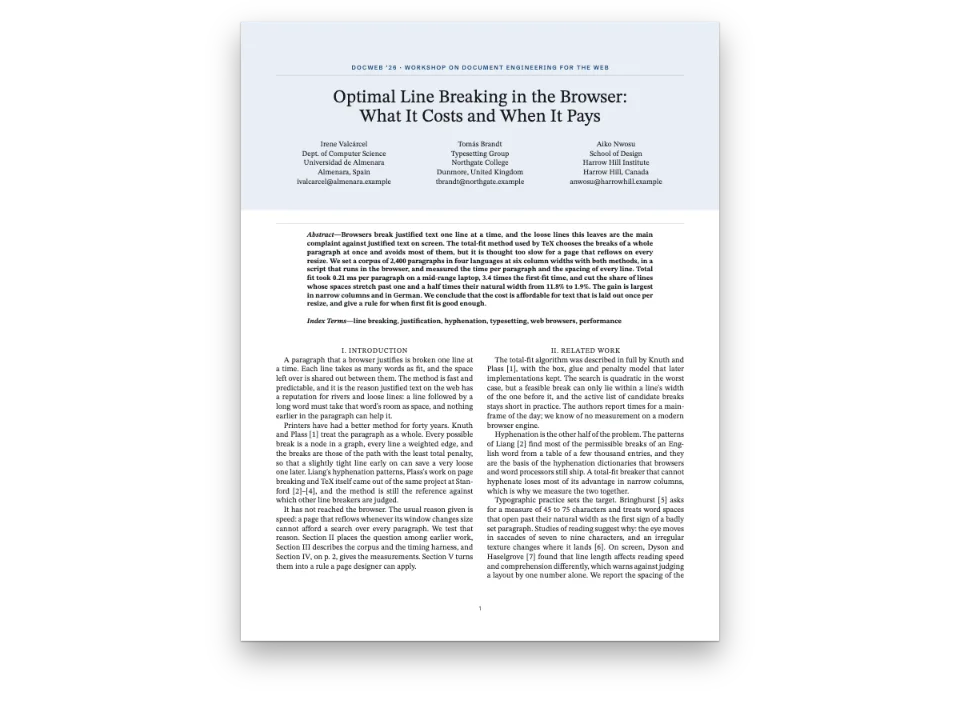
2016年宣布首次探测到引力波的那篇快报,经过删节后用美国信纸开本重新排版。两台探测器的信号用公开数据重新绘制,横跨第1页;参考文献按方括号编号。
成品一览
宣布首次探测到引力波的那篇快报《Observation of Gravitational Waves from a Binary Black Hole Merger》(Abbott et al., 2016)的五页删节重排本,美国信纸开本,双栏。第1页以证据开篇:Hanford和Livingston记录到的应变,用引力波开放科学中心(GWOSC)的开放数据文件重新绘制,在标题下横跨两栏。下面是合作组署名及其脚注、通栏摘要和正文,引用按APS期刊的习惯编号为[1,2]和[25–27]。啁啾质量是公式(1)。表I把非对称误差排成上下叠放的上标和下标,由MathJax在单元格里画出。换上你自己的BibTeX和数据文件,同一个脚本就能排出你的快报。
这道食谱解答
- 怎样排物理快报:合作组署名、横跨两栏的摘要,以及顶部通栏的数据图?
- 怎样控制图的位置:页面顶部、横跨两栏、就放在这里,还是放在边栏里?
- 怎样排数学公式(行内、行间、编号公式),并在PDF中保持矢量?
- 怎样用Postext重新排版arXiv或PubMed Central上的开放获取论文,并保留引用、图和许可声明?
简短回答
// [@key] numbers works by first citation. APS journals print [1,2] and [2–4] in one pair of
// brackets and list "A. Einstein, Sitzungsber. K. Preuss. Akad. Wiss. 1, 688 (1916).": no
// title, volume bold. No APS style is bundled: four edits turn the IEEE file into one.
registerCitationEngine(createCiteprocEngine({ styles: STYLES, locales: LOCALES }));
const ARTICLE = '<group delimiter=" "><text variable="container-title"/><text '
  + 'variable="volume" font-weight="bold" suffix=","/><text variable="page"/><date '
  + 'variable="issued" prefix="(" suffix=")"><date-part name="year"/></date></group>';
const BOOK = '<group delimiter=" "><group delimiter=", "><choose><if type="chapter"><text '
  + 'variable="container-title" prefix="in " font-style="italic"/></if><else><text variable='
  + '"title" font-style="italic"/></else></choose><names variable="editor" prefix="edited by ">'
  + '<name and="text" initialize-with=". "/></names><text variable="collection-title"/><text '
  + 'variable="volume" prefix="Vol. "/></group><group prefix="(" suffix=")" delimiter=", ">'
  + '<text variable="publisher"/><text variable="publisher-place"/><date variable="issued">'
  + '<date-part name="year"/></date></group></group><text variable="page" prefix="pp. "/>';
const aps = STYLES.ieee
  .replace('<citation>', '<citation collapse="citation-number">') // [2–4], not [2], [3], [4]
  .replace(/<layout delimiter=", ">\s*<group prefix="\[" suffix="\]" delimiter=", ">/,
    '<layout prefix="[" suffix="]" delimiter=","><group delimiter=", ">') // [1,2]
  .replace('et-al-min="7"', 'et-al-min="11"') // ten authors are listed, as in the letter
  .replace(/<bibliography[\s\S]*<\/bibliography>/, '<bibliography second-field-align="flush">'
    + '<layout suffix="."><text variable="citation-number" prefix="[" suffix="]"/><text '
    + 'macro="author"/><choose><if type="manuscript"><text variable="note" prefix=" "/></if>'
    + `<else><group prefix=", " delimiter=", "><choose><if type="article-journal">${ARTICLE}`
    + `</if><else-if type="book chapter" match="any">${BOOK}</else-if><else><text variable=`
    + '"URL"/><text variable="note"/></else></choose></group></else></choose></layout>'
    + '</bibliography>');
const citations = { style: 'custom', customStyle: aps, link: true,
  bibliography: { fontSize: em(0.84), lineHeight: pt(9.5), entrySpacing: pt(0.4),
    labelWidth: mm(6.2) } }; // the [64] column: turnovers line up after the widest label
用料
做法
#1 · 从IEEE样式改出物理学的编号引用
代码就是上面的简短回答。postext-citeproc没有附带APS样式,附带样式中最接近的是ieee:按引用顺序编号,数字放在方括号里,名字缩写在姓之前。对STYLES.ieee做四处字符串替换就能补上差别。collapse="citation-number"合并连续的编号([25–27]),在layout上只放一对方括号,印出*[1,2];et-al-min提高到十一,十位作者的名单可以完整列出;新的<bibliography>块按Physical Review的写法印出参考文献:刊名、粗体卷号、页码和年份,如Phys. Rev. Lett.* 74, 3515 (1995)。43条文献放在单独的:::references{format=bibtex}块中;用双层花括号写的名字,如{{J. Aasi et al.}},会照原样印出,快报引用本合作组那些极长的作者名单时就是这样写的。参见引用与参考文献。
#2 · 标题下横跨两栏的图1
const text = (id, content, family, size, extra) => ({ kind: 'text', id, content, align: 'left',
  fontFamily: family, fontSize: pt(size), color: col('ink'), overflow: 'wrap', ...extra });
const at = (to, edge, x, y, width) => ({ anchor: { to, edge }, offset: { x: mm(x), y: mm(y) },
  ...(width && { size: { width: mm(width), height: 'auto' } }) });
const caps = (size) => ({ fontWeight: 700, letterSpacing: pt(size * 0.2),
  textTransform: 'uppercase', color: col('accent') });
const letter = { id: 'letter', numbered: false, span: 'page', marginBottom: pt(0),
  advancedDesign: { enabled: true, minHeight: mm(21), slot: { elements: [
    text('kicker', '{attr.kicker}', SANS, 7.5, { ...caps(7.5),
      placement: at('container', 'top-left', 0, 2, MEASURE) }),
    text('title', '{titleText}', SANS, 23, { fontWeight: 700, lineHeight: 1.08,
      placement: at('#kicker', 'below', 0, 2.2, MEASURE) }),
  ] } } };
const box = { padding: { top: mm(2.6), right: mm(12), bottom: mm(2.4), left: mm(12) },
  background: col('tint'), marginTop: pt(0), marginBottom: pt(LEAD), span: 'page',
  body: { fontSize: pt(9.3), lineHeight: pt(12.6), firstLineIndent: pt(0) } };
// A 'here' figure inside a page-wide box spans the page: ::resource{id="fig1"} in the box
// sets Figure 1 under the title, on page 1, where a float could only follow its citation.
const plate = { id: 'plate', span: 'page', backgroundEnabled: false, border: { enabled: false },
  padding: mm(0), marginTop: pt(0), marginBottom: pt(LEAD / 2) };
const paragraphStyles = [
  { id: 'byline', fontFamily: SANS, fontSize: pt(10), lineHeight: pt(12.6), fontWeight: 600,
    textAlign: 'center', firstLineIndent: pt(0) },
  { id: 'dates', fontFamily: SANS, fontSize: pt(7.6), lineHeight: pt(12.6), textAlign: 'center',
    color: col('muted'), firstLineIndent: pt(0) },
  { id: 'colophon', fontFamily: SANS, fontSize: pt(7), lineHeight: pt(9.4), color: col('muted'),
    textAlign: 'left', firstLineIndent: pt(0), marginTop: pt(LEAD) },
];
浮动体不会出现在引用它的那一行之上,而带span: 'page'的标题总是另起一页,所以图1无法浮动到第1页的顶部。这篇快报直接把它放在那里:::resource{id="fig1"}配合placement.position: 'here',放在紧接标题的plate框里,这个框占满整个页宽。署名和摘要放在第二个通栏框front中,框里的:::paragraphs块把署名居中,并用小字号排日期。*et al.*后面的脚注标记把注文送到第一栏底部,APS期刊的作者说明就印在那里;footnotes.numberFormat: 'lower-alpha'用字母给脚注编号,读者不会把它们误认为参考文献。参见块级嵌入和脚注。
#3 · 单元格里有公式的表I
// Cells take no maths: each value is an SVG of MathJax paths at 9 pt, its width given as a
// fraction of the cell's inner width.
const CELL_PAD = 0.9; // mm
const VALUE_W = COLUMN * (1 / 2.3) - 2 * CELL_PAD; // the value column: weights [1.3, 1]
const VALUES = [['Primary black hole mass', '36^{+5}_{-4}\\,M_\\odot'],
  ['Secondary black hole mass', '29^{+4}_{-4}\\,M_\\odot'],
  ['Final black hole mass', '62^{+4}_{-4}\\,M_\\odot'],
  ['Final black hole spin', '0.67^{+0.05}_{-0.07}'],
  ['Luminosity distance', '410^{+160}_{-180}\\;\\mathrm{Mpc}'],
  ['Source redshift *z*', '0.09^{+0.03}_{-0.04}']];
const valueSvg = (tex) => { // 9 pt maths: 1000 MathJax units to the em
  const r = renderMath(tex, false, 100);
  const k = (9 * 25.4) / 72 / 1000; // mm per unit
  const [w, h] = [r.viewBox.width * k, r.viewBox.height * k];
  return { w, h, svg: svg(w, h, `<g transform="scale(${k}) translate(${-r.viewBox.minX} `
    + `${-r.viewBox.minY})" fill="${palette.ink}">${r.paths.map((p) => `<path d="${p.d}"/>`)
      .join('')}</g>`) };
};
表格单元格不按数学公式解析,^+5^~−4~会把两个误差一前一后地印出来。所以每个数值都由renderMath排出,写成SVG中的路径,再通过TableCell.image画进单元格;单元格的width是公式宽度占单元格宽度的比例,因此无论栏宽如何,每个数值都以9 pt印出。资源类型在图注中印出FIG. 1和TABLE I,在正文中印出Fig. 1和Table I:靠的是captionPrefix,表格再加上counterFormat: 'upper-roman'。图注同样不支持公式,两款字体也都没有希腊字母,所以图注只用拉丁字母加^sup^和~sub~。
#4 · 用开放数据绘制的图
const palette = { ink: '#171a21', accent: '#25578a', tint: '#eef2f6', rule: '#b7c0ca',
  muted: '#5a636e', paper: '#ffffff' };
const data = { hanford: '#cf5f24', livingston: palette.accent, purple: '#74519c' }; // figures
const col = (id) => ({ hex: palette[id], model: 'hex', paletteId: id });
const colorPalette = Object.entries({ ...palette, 'main-color': palette.accent })
  .map(([id, hex]) => ({ id, name: id, value: { hex, model: 'hex' } }));
四幅图都用代码绘制,数据来自GWOSC随这篇快报发布的数据文件,许可证为CC BY 4.0。每条曲线每八个采样点保留一个,图1的0.21秒共430个点;每个点以一个base-64字符记录它相对前一个点的变化,五条曲线在脚本里不到3 KB。残差一行是数据减去波形,与原文相同。所有图中Hanford用橙色、Livingston用蓝色,正文只用页面的墨色和一种蓝色。标注是MathJax无衬线字体(\textsf)的路径,因为作为图像绘制的SVG无法使用页面字体;PDF中每条线和每个标注都保持为矢量。
完整食谱
// ═══ Postext Cookbook · Nº 140 · A physics letter with a data figure across the top ═══ // https://postext.dev/en/cookbook/physics-letter-two-columns // Code: MIT · Text: Abbott et al., PRL 116, 061102 (CC BY 3.0) · Data: GWOSC (CC BY 4.0) // Fonts: Gelasio, Albert Sans (SIL OFL 1.1) · Needs postext ≥ 1.18.0 import { buildDocument, renderPageToCanvas, clearMeasurementCache, registerResourceImage, registerCitationEngine, defaultResourceTypes, initMathEngine, renderMath, } from 'https://esm.sh/postext?bundle'; import { renderToPdf, decompressWoff2 } from 'https://esm.sh/postext-pdf'; import { createCiteprocEngine, STYLES, LOCALES } from 'https://esm.sh/postext-citeproc'; const LANG = 'en'; // @lang: the language of the sample document ('en' | 'es') const RECIPE = 'physics-letter-two-columns'; // ─── 1 · Design ───────────────────────────────────────────────────────────── // #region palette: ink and one blue for the text; the detectors' colours for the data const palette = { ink: '#171a21', accent: '#25578a', tint: '#eef2f6', rule: '#b7c0ca', muted: '#5a636e', paper: '#ffffff' }; const data = { hanford: '#cf5f24', livingston: palette.accent, purple: '#74519c' }; // figures const col = (id) => ({ hex: palette[id], model: 'hex', paletteId: id }); const colorPalette = Object.entries({ ...palette, 'main-color': palette.accent }) .map(([id, hex]) => ({ id, name: id, value: { hex, model: 'hex' } })); // #endregion const [SERIF, SANS] = ['Gelasio', 'Albert Sans']; // mm: US Letter, head, foot and side margins, gutter; then the measure and one column const [TRIM_W, TRIM_H, TOP, BOTTOM, SIDE, GUTTER] = [215.9, 279.4, 21, 21, 16, 7]; const MEASURE = TRIM_W - 2 * SIDE; const COLUMN = (MEASURE - GUTTER) / 2; const [BODY, LEAD] = [9.3, 12.4]; // pt: a letter journal's density, two columns of 88 mm // #region answer: physics citations [1] and [2–4], from the bundled IEEE style // [@key] numbers works by first citation. APS journals print [1,2] and [2–4] in one pair of // brackets and list "A. Einstein, Sitzungsber. K. Preuss. Akad. Wiss. 1, 688 (1916).": no // title, volume bold. No APS style is bundled: four edits turn the IEEE file into one. registerCitationEngine(createCiteprocEngine({ styles: STYLES, locales: LOCALES })); const ARTICLE = '<group delimiter=" "><text variable="container-title"/><text ' + 'variable="volume" font-weight="bold" suffix=","/><text variable="page"/><date ' + 'variable="issued" prefix="(" suffix=")"><date-part name="year"/></date></group>'; const BOOK = '<group delimiter=" "><group delimiter=", "><choose><if type="chapter"><text ' + 'variable="container-title" prefix="in " font-style="italic"/></if><else><text variable=' + '"title" font-style="italic"/></else></choose><names variable="editor" prefix="edited by ">' + '<name and="text" initialize-with=". "/></names><text variable="collection-title"/><text ' + 'variable="volume" prefix="Vol. "/></group><group prefix="(" suffix=")" delimiter=", ">' + '<text variable="publisher"/><text variable="publisher-place"/><date variable="issued">' + '<date-part name="year"/></date></group></group><text variable="page" prefix="pp. "/>'; const aps = STYLES.ieee .replace('<citation>', '<citation collapse="citation-number">') // [2–4], not [2], [3], [4] .replace(/<layout delimiter=", ">\s*<group prefix="\[" suffix="\]" delimiter=", ">/, '<layout prefix="[" suffix="]" delimiter=","><group delimiter=", ">') // [1,2] .replace('et-al-min="7"', 'et-al-min="11"') // ten authors are listed, as in the letter .replace(/<bibliography[\s\S]*<\/bibliography>/, '<bibliography second-field-align="flush">' + '<layout suffix="."><text variable="citation-number" prefix="[" suffix="]"/><text ' + 'macro="author"/><choose><if type="manuscript"><text variable="note" prefix=" "/></if>' + `<else><group prefix=", " delimiter=", "><choose><if type="article-journal">${ARTICLE}` + `</if><else-if type="book chapter" match="any">${BOOK}</else-if><else><text variable=` + '"URL"/><text variable="note"/></else></choose></group></else></choose></layout>' + '</bibliography>'); const citations = { style: 'custom', customStyle: aps, link: true, bibliography: { fontSize: em(0.84), lineHeight: pt(9.5), entrySpacing: pt(0.4), labelWidth: mm(6.2) } }; // the [64] column: turnovers line up after the widest label // #endregion // #region title: the title, Figure 1 in a page-wide box, then the byline and the abstract const text = (id, content, family, size, extra) => ({ kind: 'text', id, content, align: 'left', fontFamily: family, fontSize: pt(size), color: col('ink'), overflow: 'wrap', ...extra }); const at = (to, edge, x, y, width) => ({ anchor: { to, edge }, offset: { x: mm(x), y: mm(y) }, ...(width && { size: { width: mm(width), height: 'auto' } }) }); const caps = (size) => ({ fontWeight: 700, letterSpacing: pt(size * 0.2), textTransform: 'uppercase', color: col('accent') }); const letter = { id: 'letter', numbered: false, span: 'page', marginBottom: pt(0), advancedDesign: { enabled: true, minHeight: mm(21), slot: { elements: [ text('kicker', '{attr.kicker}', SANS, 7.5, { ...caps(7.5), placement: at('container', 'top-left', 0, 2, MEASURE) }), text('title', '{titleText}', SANS, 23, { fontWeight: 700, lineHeight: 1.08, placement: at('#kicker', 'below', 0, 2.2, MEASURE) }), ] } } }; const box = { padding: { top: mm(2.6), right: mm(12), bottom: mm(2.4), left: mm(12) }, background: col('tint'), marginTop: pt(0), marginBottom: pt(LEAD), span: 'page', body: { fontSize: pt(9.3), lineHeight: pt(12.6), firstLineIndent: pt(0) } }; // A 'here' figure inside a page-wide box spans the page: ::resource{id="fig1"} in the box // sets Figure 1 under the title, on page 1, where a float could only follow its citation. const plate = { id: 'plate', span: 'page', backgroundEnabled: false, border: { enabled: false }, padding: mm(0), marginTop: pt(0), marginBottom: pt(LEAD / 2) }; const paragraphStyles = [ { id: 'byline', fontFamily: SANS, fontSize: pt(10), lineHeight: pt(12.6), fontWeight: 600, textAlign: 'center', firstLineIndent: pt(0) }, { id: 'dates', fontFamily: SANS, fontSize: pt(7.6), lineHeight: pt(12.6), textAlign: 'center', color: col('muted'), firstLineIndent: pt(0) }, { id: 'colophon', fontFamily: SANS, fontSize: pt(7), lineHeight: pt(9.4), color: col('muted'), textAlign: 'left', firstLineIndent: pt(0), marginTop: pt(LEAD) }, ]; // #endregion // Running heads 12 mm from the trim; the opener has the source line at its foot. const head = (id, content, parity, edge, x, extra) => text(id, content, SANS, 7.5, { parity, pages: 'body', fontWeight: 500, color: col('muted'), overflow: 'clip', placement: at('page', edge, x, 12, 120), ...extra }); const folio = { fontWeight: 700, color: col('accent') }; const right = { align: 'right' }; const header = { elements: [ head('v-folio', '{pageNumber}', 'even', 'top-left', SIDE, folio), head('v-title', 'B. P. Abbott et al. · Observation of gravitational waves', 'even', 'top-left', SIDE + 7), head('r-title', 'GW150914 · a binary black hole merger', 'odd', 'top-right', -SIDE - 7, right), head('r-folio', '{pageNumber}', 'odd', 'top-right', -SIDE, { ...folio, ...right }), ] }; const footer = { elements: [ head('source', 'Re-set from Phys. Rev. Lett. 116, 061102 (2016) · CC BY 3.0 · ' + 'doi:10.1103/PhysRevLett.116.061102', 'all', 'bottom-left', SIDE, { pages: 'opener', placement: at('page', 'bottom-left', SIDE, -12, 160) }), head('drop-folio', '{pageNumber}', 'all', 'bottom-right', -SIDE, { ...folio, ...right, pages: 'opener', placement: at('page', 'bottom-right', -SIDE, -12, 10) }), ] }; const sans = (size, weight) => ({ fontFamily: SANS, fontSize: pt(size), fontWeight: weight }); const config = () => ({ // a factory (gotcha: config-cache-identity) locale: 'en-us', colorPalette, citations, header, footer, paragraphStyles, // FIG. 1 and TABLE I in the captions, Fig. 1 and Table I in the text: the APS convention resourceTypes: defaultResourceTypes(LANG).map((type) => ({ ...type, numberingTemplate: '{n}', resetOn: 'never', ...(type.id === 'figure' ? { captionPrefix: 'FIG.' } : { captionPrefix: 'TABLE', counterFormat: 'upper-roman', shortLabel: 'Table', captionStyle: { position: 'above' } }) })), calloutStyles: [{ id: 'front', ...box }, plate], headingStyles: [letter, { id: 'back', numbered: false, ...sans(8, 700), textTransform: 'uppercase', color: col('ink') }], page: { sizePreset: 'custom', width: mm(TRIM_W), height: mm(TRIM_H), dpi: 150, margins: { top: mm(TOP), bottom: mm(BOTTOM), left: mm(SIDE), right: mm(SIDE), mirror: true } }, layout: { layoutType: 'double', gutterWidth: mm(GUTTER) }, bodyText: { fontFamily: SERIF, fontSize: pt(BODY), lineHeight: pt(LEAD), color: col('ink'), boldColor: col('ink'), italicColor: col('ink'), referenceColor: col('ink'), referenceBold: false, textAlign: 'justify', firstLineIndent: mm(3.5), indentAfterHeading: false, hyphenation: { enabled: true }, optimalLineBreaking: true, avoidWidows: true, avoidOrphans: true, avoidRunts: true }, math: { marginTop: pt(LEAD / 2), marginBottom: pt(LEAD / 2) }, // Notes lettered a, b: the numbers in brackets belong to the references. footnotes: { numberFormat: 'lower-alpha', fontSize: pt(7.8), lineHeight: pt(10), separator: { color: col('rule') } }, headings: { fontFamily: SANS, color: col('accent'), fontWeight: 700, levels: [ { level: 1, breakBefore: { enabled: true, parity: 'any' } }, // gotcha: headings-drop-h1-break { level: 2, numberingTemplate: '{2:I}.', ...sans(11.5, 700), lineHeight: pt(LEAD * 1.5), marginTop: pt(LEAD / 2), marginBottom: pt(0) }, { level: 3, numberingTemplate: '{3:A}.', ...sans(10, 600), color: col('ink'), lineHeight: pt(LEAD), marginTop: pt(LEAD / 2), marginBottom: pt(0) }, ] }, tableStyle: { rules: 'horizontal', borderColor: col('rule'), borderWidth: pt(0.5), headerBackgroundEnabled: false, bodyFontFamily: SANS, bodyFontSize: pt(8.2), bodyColor: col('ink'), cellPadding: mm(CELL_PAD) }, captionStyle: { fontFamily: SANS, fontSize: pt(7.6), lineHeight: pt(10), color: col('ink'), labelBold: true, labelColor: col('accent'), gap: mm(2), note: { fontSize: pt(6.8), color: col('muted') } }, }); // ─── 2 · Content ──────────────────────────────────────────────────────────── const markdown = String.raw`---Markdown样例 · 53行 · content.en.md
title: "Observation of Gravitational Waves from a Binary Black Hole Merger" author: "B. P. Abbott et al. (LIGO Scientific Collaboration and Virgo Collaboration)" --- # Observation of Gravitational Waves \\ from a Binary Black Hole Merger {style="letter" kicker="Letter · Gravitational-wave astronomy"} :::callout{type="plate"} ::resource{id="fig1"} ::: :::callout{type="front"} :::paragraphs{style="byline"} B. P. Abbott *et al.*[^authors] (LIGO Scientific Collaboration and Virgo Collaboration) ::: :::paragraphs{style="dates"} (Received 21 January 2016; published 11 February 2016) · DOI: 10.1103/PhysRevLett.116.061102 ::: On September 14, 2015 at 09:50:45 UTC the two detectors of the Laser Interferometer Gravitational-Wave Observatory simultaneously observed a transient gravitational-wave signal. The signal sweeps upwards in frequency from 35 to 250 Hz with a peak gravitational-wave strain of $1.0\times10^{-21}$. It matches the waveform predicted by general relativity for the inspiral and merger of a pair of black holes and the ringdown of the resulting single black hole. The signal was observed with a matched-filter signal-to-noise ratio of 24 and a false alarm rate estimated to be less than 1 event per 203 000 years, equivalent to a significance greater than $5.1\sigma$. The source lies at a luminosity distance of $410^{+160}_{-180}$ Mpc corresponding to a redshift $z = 0.09^{+0.03}_{-0.04}$. In the source frame, the initial black hole masses are $36^{+5}_{-4}\,M_\odot$ and $29^{+4}_{-4}\,M_\odot$, and the final black hole mass is $62^{+4}_{-4}\,M_\odot$, with $3.0^{+0.5}_{-0.5}\,M_\odot c^2$ radiated in gravitational waves. All uncertainties define 90% credible intervals. These observations demonstrate the existence of binary stellar-mass black hole systems. This is the first direct detection of gravitational waves and the first observation of a binary black hole merger. ::: [^authors]: Full author list given at the end of the published article; this abridged re-setting does not reproduce it. ## Introduction In 1916, the year after the final formulation of the field equations of general relativity, Albert Einstein predicted the existence of gravitational waves. He found that the linearized weak-field equations had wave solutions: transverse waves of spatial strain that travel at the speed of light, generated by time variations of the mass quadrupole moment of the source [@einstein1916; @einstein1918]. Einstein understood that gravitational-wave amplitudes would be remarkably small; moreover, until the Chapel Hill conference in 1957 there was significant debate about the physical reality of gravitational waves [@saulson2011]. The discovery of the binary pulsar system PSR B1913+16 by Hulse and Taylor [@hulse1975] and subsequent observations of its energy loss by Taylor and Weisberg [@taylor1982] demonstrated the existence of gravitational waves. This discovery, along with emerging astrophysical understanding [@press1972], led to the recognition that direct observations of the amplitude and phase of gravitational waves would enable studies of additional relativistic systems and provide new tests of general relativity, especially in the dynamic strong-field regime. A century after the fundamental predictions of Einstein and Schwarzschild, we report the first direct detection of gravitational waves and the first direct observation of a binary black hole system merging to form a single black hole. Our observations provide unique access to the properties of space-time in the strong-field, high-velocity regime and confirm predictions of general relativity for the nonlinear dynamics of highly disturbed black holes.[^abridged] [^abridged]: Abridged here: Sections IV (Detector validation) and VII (Outlook), parts of Sections I, III, V and VI, some figure panels and most acknowledgments are left out; sections and references are renumbered. ## Observation On September 14, 2015 at 09:50:45 UTC, the LIGO Hanford, WA, and Livingston, LA, observatories detected the coincident signal GW150914 shown in :ref{id="fig1"}. The initial detection was made by low-latency searches for generic gravitational-wave transients [@ligo-p1500229] and was reported within three minutes of data acquisition [@klimenko2016]. Subsequently, matched-filter analyses that use relativistic models of compact binary waveforms [@ligo-p1500269] recovered GW150914 as the most significant event from each detector for the observations reported here. Occurring within the 10-ms intersite propagation time, the events have a combined signal-to-noise ratio (SNR) of 24 [@usman2015]. Only the LIGO detectors were observing at the time of GW150914. The Virgo detector was being upgraded, and GEO 600, though not sufficiently sensitive to detect this event, was operating but not in observational mode. With only two detectors the source position is primarily determined by the relative arrival time and localized to an area of approximately 600 deg^2^ (90% credible region) [@ligo-p1500218; @ligo-p1500227]. The basic features of GW150914 point to it being produced by the coalescence of two black holes—i.e., their orbital inspiral and merger, and subsequent final black hole ringdown. Over 0.2 s, the signal increases in frequency and amplitude in about 8 cycles from 35 to 150 Hz, where the amplitude reaches a maximum. The most plausible explanation for this evolution is the inspiral of two orbiting masses, $m_1$ and $m_2$, due to gravitational-wave emission. At the lower frequencies, such evolution is characterized by the chirp mass [@blanchet1995] $$\mathcal{M} = \frac{(m_1 m_2)^{3/5}}{(m_1+m_2)^{1/5}} = \frac{c^3}{G}\left[\frac{5}{96}\,\pi^{-8/3} f^{-11/3}\,\dot f\,\right]^{3/5} , \tag{1}$$ where $f$ and $\dot f$ are the observed frequency and its time derivative and $G$ and $c$ are the gravitational constant and speed of light. Estimating $f$ and $\dot f$ from the data in :ref{id="fig1"}, we obtain a chirp mass of $\mathcal{M} \simeq 30\,M_\odot$, implying that the total mass $M = m_1 + m_2$ is $\gtrsim 70\,M_\odot$ in the detector frame. This bounds the sum of the Schwarzschild radii of the binary components to $2GM/c^2 \gtrsim 210$ km. To reach an orbital frequency of 75 Hz (half the gravitational-wave frequency) the objects must have been very close and very compact; equal Newtonian point masses orbiting at this frequency would be only $\simeq 350$ km apart. A pair of neutron stars, while compact, would not have the required mass, while a black hole neutron star binary with the deduced chirp mass would have a very large total mass, and would thus merge at much lower frequency. This leaves black holes as the only known objects compact enough to reach an orbital frequency of 75 Hz without contact. Furthermore, the decay of the waveform after it peaks is consistent with the damped oscillations of a black hole relaxing to a final stationary Kerr configuration. Below, we present a general-relativistic analysis of GW150914; :ref{id="fig2"} shows the calculated waveform using the resulting source parameters. ## Detectors Gravitational-wave astronomy exploits multiple, widely separated detectors to distinguish gravitational waves from local instrumental and environmental noise, to provide source sky localization, and to measure wave polarizations. The LIGO sites each operate a single Advanced LIGO detector [@aasi2015], a modified Michelson interferometer (see :ref{id="fig3"}) that measures gravitational-wave strain as a difference in length of its orthogonal arms. Each arm is formed by two mirrors, acting as test masses, separated by $L_x = L_y = L = 4$ km. A passing gravitational wave effectively alters the arm lengths such that the measured difference is $\Delta L(t) = \delta L_x - \delta L_y = h(t)L$, where $h$ is the gravitational-wave strain amplitude projected onto the detector. This differential length variation alters the phase difference between the two light fields returning to the beam splitter, transmitting an optical signal proportional to the gravitational-wave strain to the output photodetector. To achieve sufficient sensitivity to measure gravitational waves, the detectors include several enhancements to the basic Michelson interferometer. First, each arm contains a resonant optical cavity, formed by its two test mass mirrors, that multiplies the effect of a gravitational wave on the light phase by a factor of 300 [@drever1991]. Second, a partially transmissive power-recycling mirror at the input provides additional resonant buildup of the laser light in the interferometer as a whole [@drever1983; @schilling]: 20 W of laser input is increased to 700 W incident on the beam splitter, which is further increased to 100 kW circulating in each arm cavity. Third, a partially transmissive signal-recycling mirror at the output optimizes the gravitational-wave signal extraction by broadening the bandwidth of the arm cavities [@meers1988; @mizuno1993].`; // title, abstract, sections I–III const results = String.raw`## SearchesMarkdown样例 · 50行 · content.results.en.md
We present the analysis of 16 days of coincident observations between the two LIGO detectors from September 12 to October 20, 2015. This is a subset of the data from Advanced LIGO’s first observational period that ended on January 12, 2016. GW150914 is confidently detected by two different types of searches. One aims to recover signals from the coalescence of compact objects, using optimal matched filtering with waveforms predicted by general relativity. The other search targets a broad range of generic transient signals, with minimal assumptions about waveforms. These searches use independent methods, and their response to detector noise consists of different, uncorrelated, events. However, strong signals from binary black hole mergers are expected to be detected by both searches. ### Generic transient search Designed to operate without a specific waveform model, this search identifies coincident excess power in time-frequency representations of the detector strain data [@klimenko2016; @klimenko2008], for signal frequencies up to 1 kHz and durations up to a few seconds. The search reconstructs signal waveforms consistent with a common gravitational-wave signal in both detectors using a multidetector maximum likelihood method. Each event is ranked according to the detection statistic $$\eta_c = \sqrt{2E_c/(1+E_n/E_c)} ,$$ where $E_c$ is the dimensionless coherent signal energy obtained by cross-correlating the two reconstructed waveforms, and $E_n$ is the dimensionless residual noise energy after the reconstructed signal is subtracted from the data. The statistic $\eta_c$ thus quantifies the SNR of the event and the consistency of the data between the two detectors. Based on their time-frequency morphology, the events are divided into three mutually exclusive search classes, as described in [@ligo-p1500229]: events with time-frequency morphology of known populations of noise transients (class C1), events with frequency that increases with time (class C3), and all remaining events (class C2). Detected with $\eta_c = 20.0$, GW150914 is the strongest event of the entire search. Consistent with its coalescence signal signature, it is found in the search class C3 of events with increasing time-frequency evolution. Measured on a background equivalent to over 67 400 years of data and including a trials factor of 3 to account for the search classes, its false alarm rate is lower than 1 in 22 500 years. This corresponds to a probability $< 2\times10^{-6}$ of observing one or more noise events as strong as GW150914 during the analysis time, equivalent to $4.6\sigma$. The left panel of :ref{id="fig4"} shows the C3 class results and background. ### Binary coalescence search This search targets gravitational-wave emission from binary systems with individual masses from 1 to $99\,M_\odot$, total mass less than $100\,M_\odot$, and dimensionless spins up to 0.99 [@ligo-p1500269]. To model systems with total mass larger than $4\,M_\odot$, we use the effective-one-body formalism [@buonanno2000], which combines results from the post-Newtonian approach [@blanchet1995; @blanchet2004] with results from black hole perturbation theory and numerical relativity. The waveform model [@taracchini2014; @purrer2014] assumes that the spins of the merging objects are aligned with the orbital angular momentum, but the resulting templates can, nonetheless, effectively recover systems with misaligned spins in the parameter region of GW150914 [@ligo-p1500269]. Approximately 250 000 template waveforms are used to cover this parameter space. The search calculates the matched-filter signal-to-noise ratio $\rho(t)$ for each template in each detector and identifies maxima of $\rho(t)$ with respect to the time of arrival of the signal [@allen2012; @sathyaprakash1991; @owen1999]. For each maximum we calculate a chi-squared statistic $\chi^2_r$ to test whether the data in several different frequency bands are consistent with the matching template [@allen2005]. Values of $\chi^2_r$ near unity indicate that the signal is consistent with a coalescence. If $\chi^2_r$ is greater than unity, $\rho(t)$ is reweighted as $\hat\rho = \rho/\{[1+(\chi^2_r)^3]/2\}^{1/6}$ [@abadie2012; @babak2013]. The final step enforces coincidence between detectors by selecting event pairs that occur within a 15-ms window and come from the same template. The 15-ms window is determined by the 10-ms intersite propagation time plus 5 ms for uncertainty in arrival time of weak signals. We rank coincident events based on the quadrature sum $\hat\rho_c$ of the $\hat\rho$ from both detectors [@usman2015]. To produce background data for this search the SNR maxima of one detector are time shifted and a new set of coincident events is computed. Repeating this procedure $\sim 10^7$ times produces a noise background analysis time equivalent to 608 000 years. To account for the search background noise varying across the target signal space, candidate and background events are divided into three search classes based on template length. The right panel of :ref{id="fig4"} shows the background for the search class of GW150914. The GW150914 detection-statistic value of $\hat\rho_c = 23.6$ is larger than any background event, so only an upper bound can be placed on its false alarm rate. Across the three search classes this bound is 1 in 203 000 years. This translates to a false alarm probability $< 2\times10^{-7}$, corresponding to $5.1\sigma$. When an event is confidently identified as a real gravitational-wave signal, as for GW150914, the background used to determine the significance of other events is reestimated without the contribution of this event. This is the background distribution shown as a purple line in the right panel of :ref{id="fig4"}. Based on this, the second most significant event has a false alarm rate of 1 per 2.3 years and corresponding Poissonian false alarm probability of 0.02. Waveform analysis of this event indicates that if it is astrophysical in origin it is also a binary black hole merger [@ligo-p1500269]. ## Source discussion The matched-filter search is optimized for detecting signals, but it provides only approximate estimates of the source parameters. To refine them we use general relativity-based models [@taracchini2014; @purrer2014; @hannam2014; @khan2016], some of which include spin precession, and for each model perform a coherent Bayesian analysis to derive posterior distributions of the source parameters [@veitch2015]. The initial and final masses, final spin, distance, and redshift of the source are shown in :ref{id="tab1"}. The spin of the primary black hole is constrained to be $< 0.7$ (90% credible interval) indicating it is not maximally spinning, while the spin of the secondary is only weakly constrained. These source parameters are discussed in detail in [@ligo-p1500218]. The parameter uncertainties include statistical errors and systematic errors from averaging the results of different waveform models. Using the fits to numerical simulations of binary black hole mergers in [@healy2014; @husa2016], we provide estimates of the mass and spin of the final black hole, the total energy radiated in gravitational waves, and the peak gravitational-wave luminosity [@ligo-p1500218]. The estimated total energy radiated in gravitational waves is $3.0^{+0.5}_{-0.5}\,M_\odot c^2$. The system reached a peak gravitational-wave luminosity of $3.6^{+0.5}_{-0.4}\times10^{56}$ erg/s, equivalent to $200^{+30}_{-20}\,M_\odot c^2/\mathrm{s}$. GW150914 demonstrates the existence of stellar-mass black holes more massive than $\simeq 25\,M_\odot$, and establishes that binary black holes can form in nature and merge within a Hubble time. Binary black holes have been predicted to form both in isolated binaries [@tutukov1973; @lipunov1997; @belczynski2016] and in dense environments by dynamical interactions [@sigurdsson1993; @portegieszwart2000; @rodriguez2015]. The formation of such massive black holes from stellar evolution requires weak massive-star winds, which are possible in stellar environments with metallicity lower than $\simeq 1/2$ the solar value [@belczynski2010; @spera2015]. ## Conclusion The LIGO detectors have observed gravitational waves from the merger of two stellar-mass black holes. The detected waveform matches the predictions of general relativity for the inspiral and merger of a pair of black holes and the ringdown of the resulting single black hole. These observations demonstrate the existence of binary stellar-mass black hole systems. This is the first direct detection of gravitational waves and the first observation of a binary black hole merger. ## Acknowledgments {style="back"} The authors gratefully acknowledge the support of the United States National Science Foundation (NSF) for the construction and operation of the LIGO Laboratory and Advanced LIGO as well as the Science and Technology Facilities Council (STFC) of the United Kingdom, the Max-Planck Society (MPS), and the State of Niedersachsen, Germany, for support of the construction of Advanced LIGO and construction and operation of the GEO600 detector. :::bibliography{title=""} :::paragraphs{style="colophon"} Abridged from B. P. Abbott et al. (LIGO Scientific Collaboration and Virgo Collaboration), Phys. Rev. Lett. 116, 061102 (2016), doi:10.1103/PhysRevLett.116.061102, CC BY 3.0: sections and references renumbered, figures redrawn, captions shortened. Figure data from the Gravitational Wave Open Science Center (gwosc.org), a service of the LIGO Scientific Collaboration, the Virgo Collaboration and KAGRA (CC BY 4.0). Set in Gelasio and Albert Sans (SIL OFL); formulas by MathJax. :::`; // sections IV–VI, acknowledgments, colophon const refs = `:::references{format=bibtex}Markdown样例 · 49行 · content.refs.en.md
@string{spaw={Sitzungsber. K. Preuss. Akad. Wiss.}} @string{cqg={Classical Quantum Gravity}} @string{prd={Phys. Rev. D}} @string{prl={Phys. Rev. Lett.}} @string{apj={Astrophys. J.}} @article{einstein1916,author={Einstein, A.},journal=spaw,volume=1,pages={688},year=1916} @article{einstein1918,author={Einstein, A.},journal=spaw,volume=1,pages={154},year=1918} @article{saulson2011,author={Saulson, P. R.},journal={Gen. Relativ. Gravit.},volume=43,pages={3289},year=2011} @article{blanchet1995,author={Blanchet, L. and Damour, T. and Iyer, B. R. and Will, C. M. and Wiseman, A. G.},journal=prl,volume=74,pages={3515},year=1995} @article{hulse1975,author={Hulse, R. A. and Taylor, J. H.},journal=apj,volume=195,pages={L51},year=1975} @article{taylor1982,author={Taylor, J. H. and Weisberg, J. M.},journal=apj,volume=253,pages={908},year=1982} @article{press1972,author={Press, W. and Thorne, K.},journal={Annu. Rev. Astron. Astrophys.},volume=10,pages={335},year=1972} @article{aasi2015,author={{J. Aasi et al.}},journal=cqg,volume=32,pages={074001},year=2015} @misc{ligo-p1500218,author={{B. Abbott et al.}},url={https://dcc.ligo.org/LIGO-P1500218/public/main}} @misc{ligo-p1500229,author={{B. Abbott et al.}},url={https://dcc.ligo.org/LIGO-P1500229/public/main}} @misc{klimenko2016,author={{S. Klimenko et al.}},note={arXiv:1511.05999 [Phys. Rev. D (to be published)]}} @misc{ligo-p1500269,author={{B. Abbott et al.}},url={https://dcc.ligo.org/LIGO-P1500269/public/main}} @misc{usman2015,author={{S. A. Usman et al.}},note={arXiv:1508.02357}} @misc{ligo-p1500227,author={{B. Abbott et al.}},url={https://dcc.ligo.org/LIGO-P1500227/public/main}} @book{drever1991,author={Drever, R. W. P.},title={The Detection of Gravitational Waves},editor={Blair, D. G.},publisher={Cambridge University Press},address={Cambridge, England},year={1991}} @incollection{drever1983,author={{R. W. P. Drever et al.}},booktitle={Quantum Optics, Experimental Gravity, and Measurement Theory},editor={Meystre, P. and Scully, M. O.},series={NATO ASI, Ser. B},volume={94},publisher={Plenum Press},address={New York},year={1983},pages={503--514}} @unpublished{schilling,author={Schilling, R.},note={(unpublished)}} @article{meers1988,author={Meers, B. J.},journal=prd,volume=38,pages={2317},year=1988} @article{mizuno1993,author={Mizuno, J. and Strain, K. A. and Nelson, P. G. and Chen, J. M. and Schilling, R. and R{\\"u}diger, A. and Winkler, W. and Danzmann, K.},journal={Phys. Lett. A},volume=175,pages={273},year=1993} @article{klimenko2008,author={Klimenko, S. and Yakushin, I. and Mercer, A. and Mitselmakher, G.},journal=cqg,volume=25,pages={114029},year=2008} @article{buonanno2000,author={Buonanno, A. and Damour, T.},journal=prd,volume=62,pages={064015},year=2000} @article{blanchet2004,author={Blanchet, L. and Damour, T. and Esposito-Far{\\\`e}se, G. and Iyer, B. R.},journal=prl,volume=93,pages={091101},year=2004} @article{taracchini2014,author={{A. Taracchini et al.}},journal=prd,volume=89,pages={061502},year=2014} @article{purrer2014,author={P{\\"u}rrer, M.},journal=cqg,volume=31,pages={195010},year=2014} @article{allen2012,author={Allen, B. and Anderson, W. G. and Brady, P. R. and Brown, D. A. and Creighton, J. D. E.},journal=prd,volume=85,pages={122006},year=2012} @article{sathyaprakash1991,author={Sathyaprakash, B. S. and Dhurandhar, S. V.},journal=prd,volume=44,pages={3819},year=1991} @article{owen1999,author={Owen, B. J. and Sathyaprakash, B. S.},journal=prd,volume=60,pages={022002},year=1999} @article{allen2005,author={Allen, B.},journal=prd,volume=71,pages={062001},year=2005} @article{abadie2012,author={{J. Abadie et al.}},journal=prd,volume=85,pages={082002},year=2012} @article{babak2013,author={{S. Babak et al.}},journal=prd,volume=87,pages={024033},year=2013} @article{hannam2014,author={Hannam, M. and Schmidt, P. and Boh{\\'e}, A. and Haegel, L. and Husa, S. and Ohme, F. and Pratten, G. and P{\\"u}rrer, M.},journal=prl,volume=113,pages={151101},year=2014} @article{khan2016,author={Khan, S. and Husa, S. and Hannam, M. and Ohme, F. and P{\\"u}rrer, M. and Jim{\\'e}nez Forteza, X. and Boh{\\'e}, A.},journal=prd,volume=93,pages={044007},year=2016} @article{veitch2015,author={{J. Veitch et al.}},journal=prd,volume=91,pages={042003},year=2015} @article{healy2014,author={Healy, J. and Lousto, C. O. and Zlochower, Y.},journal=prd,volume=90,pages={104004},year=2014} @article{husa2016,author={Husa, S. and Khan, S. and Hannam, M. and P{\\"u}rrer, M. and Ohme, F. and Jim{\\'e}nez Forteza, X. and Boh{\\'e}, A.},journal=prd,volume=93,pages={044006},year=2016} @article{tutukov1973,author={Tutukov, A. and Yungelson, L.},journal={Nauchnye Informatsii},volume=27,pages={70},year=1973} @article{lipunov1997,author={Lipunov, V. M. and Postnov, K. A. and Prokhorov, M. E.},journal={Mon. Not. R. Astron. Soc.},volume=288,pages={245},year=1997} @misc{belczynski2016,author={Belczynski, K. and Repetto, S. and Holz, D. and O'Shaughnessy, R. and Bulik, T. and Berti, E. and Fryer, C. and Dominik, M.},note={arXiv:1510.04615 [Astrophys. J. (to be published)]}} @article{sigurdsson1993,author={Sigurdsson, S. and Hernquist, L.},journal={Nature (London)},volume=364,pages={423},year=1993} @article{portegieszwart2000,author={Portegies Zwart, S. F. and McMillan, S. L. W.},journal={Astrophys. J. Lett.},volume=528,pages={L17},year=2000} @article{rodriguez2015,author={Rodriguez, C. L. and Morscher, M. and Pattabiraman, B. and Chatterjee, S. and Haster, C.-J. and Rasio, F. A.},journal=prl,volume=115,pages={051101},year=2015} @article{belczynski2010,author={Belczynski, K. and Bulik, T. and Fryer, C. L. and Ruiter, A. and Valsecchi, F. and Vink, J. S. and Hurley, J. R.},journal=apj,volume=714,pages={1217},year=2010} @article{spera2015,author={Spera, M. and Mapelli, M. and Bressan, A.},journal={Mon. Not. R. Astron. Soc.},volume=451,pages={4086},year=2015} :::`; // BibTeX of the works the kept text cites const captions = String.raw`fig1Markdown样例 · 28行 · content.captions.en.md
The gravitational-wave event GW150914 observed by the LIGO Hanford (H1, left column panels) and Livingston (L1, right column panels) detectors. Times are shown relative to September 14, 2015 at 09:50:45 UTC. For visualization, all time series are filtered with a 35–350 Hz bandpass filter to suppress large fluctuations outside the detectors’ most sensitive frequency band, and band-reject filters to remove the strong instrumental spectral lines. Top row, left: H1 strain. Top row, right: L1 strain. GW150914 arrived first at L1 and 6.9^+0.5^~−0.4~ ms later at H1; for a visual comparison, the H1 data are also shown, shifted in time by this amount and inverted (to account for the detectors’ relative orientations). Second row: Gravitational-wave strain projected onto each detector in the 35–350 Hz band. Solid lines show a numerical relativity waveform for a system with parameters consistent with those recovered from GW150914 confirmed to 99.9% by an independent calculation. Third row: Residuals after subtracting the filtered numerical relativity waveform from the filtered detector time series. fig1.note Redrawn from GWOSC open data (LIGO and Virgo Collaborations, CC BY 4.0); reconstructions and time–frequency row omitted. fig2 Top: Estimated gravitational-wave strain amplitude from GW150914 projected onto H1. This shows the full bandwidth of the waveforms, without the filtering used for :ref{id="fig1"}. Bottom: The Keplerian effective black hole separation in units of Schwarzschild radii (*R*~S~ = 2*GM*/*c*^2^) and the effective relative velocity given by the post-Newtonian parameter *v*/*c*. fig2.note Redrawn from GWOSC data (CC BY 4.0); insets omitted; the panel prints the velocity formula of the published caption. fig3 Simplified diagram of an Advanced LIGO detector (not to scale). A gravitational wave propagating orthogonally to the detector plane and linearly polarized parallel to the 4-km optical cavities will have the effect of lengthening one 4-km arm and shortening the other during one half-cycle of the wave; these length changes are reversed during the other half-cycle. fig3.note Redrawn after the published diagram; its insets (a) and (b) are omitted. fig4 Search results from the generic transient search (left) and the binary coalescence search (right). These histograms show the number of candidate events (orange markers) and the mean number of background events (black lines) in the search class where GW150914 was found as a function of the search detection statistic and with a bin width of 0.2. Right: The tail in the black-line background of the binary coalescence search is due to random coincidences of GW150914 in one detector with noise in the other detector. (This type of event is practically absent in the generic transient search background because they do not pass the time-frequency consistency requirements used in that search.) The purple curve is the background excluding those coincidences, which is used to assess the significance of the second strongest event. fig4.note Redrawn from GWOSC data (CC BY 4.0); the C2 + C3 search and the significance scales omitted. tab1 Source parameters for GW150914. We report median values with 90% credible intervals that include statistical errors, and systematic errors from averaging the results of different waveform models. Masses are given in the source frame; to convert to the detector frame multiply by (1 + *z*). The source redshift assumes standard cosmology. tab1.note Values as published. The citations in the caption are omitted.`; // "fig1" on a line, then its caption const source = [markdown, results, refs].join('\n\n'); const caption = Object.fromEntries(captions.trim().split(/\n\s*\n/) .map((part) => [part.slice(0, part.indexOf('\n')), part.slice(part.indexOf('\n') + 1)])); // #region table: Table I, its asymmetric errors set by MathJax and drawn into the cells // Cells take no maths: each value is an SVG of MathJax paths at 9 pt, its width given as a // fraction of the cell's inner width. const CELL_PAD = 0.9; // mm const VALUE_W = COLUMN * (1 / 2.3) - 2 * CELL_PAD; // the value column: weights [1.3, 1] const VALUES = [['Primary black hole mass', '36^{+5}_{-4}\\,M_\\odot'], ['Secondary black hole mass', '29^{+4}_{-4}\\,M_\\odot'], ['Final black hole mass', '62^{+4}_{-4}\\,M_\\odot'], ['Final black hole spin', '0.67^{+0.05}_{-0.07}'], ['Luminosity distance', '410^{+160}_{-180}\\;\\mathrm{Mpc}'], ['Source redshift *z*', '0.09^{+0.03}_{-0.04}']]; const valueSvg = (tex) => { // 9 pt maths: 1000 MathJax units to the em const r = renderMath(tex, false, 100); const k = (9 * 25.4) / 72 / 1000; // mm per unit const [w, h] = [r.viewBox.width * k, r.viewBox.height * k]; return { w, h, svg: svg(w, h, `<g transform="scale(${k}) translate(${-r.viewBox.minX} ` + `${-r.viewBox.minY})" fill="${palette.ink}">${r.paths.map((p) => `<path d="${p.d}"/>`) .join('')}</g>`) }; }; // #endregion // #region art: the four figures, drawn from GWOSC's open data in the page's palette // GWOSC's Fig. 1, 2 and 4 files (strain in 10^-21, log10 of counts) on a regular grid, each // sample written as its change from the one before: a base-64 digit, 32 for none. const SERIES = { // [first value, step, one character per sample] hObs: [0.025, 0.03, 'eghgfegiigddfkmkeaaeijhgfhjhgdcdimplfXWZionhbadkmkfdglnjcZZgjjebdhlkdZZfjmiijmlhcbfjkgdaZa' + 'dgkkigefhijiihifedefhhhggfhihhfefghhiijifeddddgkjhddgjifbdfjkhdcdhiihgefghjjhedeghihhjkjhf' + 'fgihgfegfeeeggeedghhcabgijjiijjihgeeghggffhihhimnjecdgigecddfecacdfgghiggfgikkjhijkljihihg' + 'ffghgeccbehhfbWWbinmhbcglmjgeehloomgefkpohXUVaeecaZbfiiijjmmjijnppkfaZaYXWXZfjnqrtsojaSNOV' + 'hszynaQRalqpibbchiijjjgdbdhkkgdcdfijifecdehjkmjfdegheccfjmkigfffeghih'], lObs: [-0.119, 0.03, 'deghhhfgklifdegjihddgjjgdcdhjjgdcehlmjgdeikkhbaafhggfghhhgefgiigedeghiijiiijhedceiiigeeffg' + 'hiihggeddgihgeddfhihikjgdbbfkomhdbdfgjlljhecdghgeeghiigeddffeeehiifdcfhfffhjmmkifffddehjkg' + 'dcfijjhhihgghiigdceggdcbcfigfdeijjiffhihedgmpoicXYeknnjhgikieZYadfhhhfedefffdfgjjihhfhhjln' + 'mjfddghggfeeegffaYYchjihgihiiiiilmnlifdefdcbbbccbbdhjknnnmllljfZVSWbfgjnuxtjVMOZmuuofZXafg' + 'ggggefefhkmlhebcfhigddfjmnjfddfiigfefihgffhigfedefghhgffgghhfefghgghi'], hNR: [0.0, 0.03, 'ggghgggfgfgggggghggfgfggfggggggggghghhghggggggghghghggfgffggfgggfggggghghgggfggggghghgggff' + 'gfgfgfggfggggghghghgggggghhhhhgggggggfgggggfggggggggfgffffgggggggfgfgfggggghghghhhihihhhgg' + 'gghghggggfffeefefeffefffggghhghhghhhhiiiiihighggggfgffffefefffeffeefefgggihhiihihiiiiiiiih' + 'hghggfgeeddccdcddeeffffghhijjkklklkkkjjihffdcaaaaabbddffhiklmnonnljhebZXVVWZcgmrvxwriYPLPX' + 'lvyvkaSSYgopmhcacfikkifedffhiihhfgfggfgffgfgfgggfhgghhhggfggggghhhhhg'], lNR: [0.031, 0.03, 'gfgghgghggggggggggfgfgfgfggghggfggfgggghghghggghgggggggfgfggghggggggfgggghghghgghgggggggfg' + 'fgfggggggfgffgfgggghggghgggghggggggghghghhghgfggggghggghfggfgfgffffffffgfgghggggfhgghihhih' + 'highhhghgggffffgfffgffefeeffgfghghghhghihhihhhhghhhhhhgggeffeefeffeffeefffgggghhhhiiijjjjj' + 'ihhhhgfgffeeddccdcddeeefggiikkllllkkjhhgfedcbbaabcdfhjlnnponkheaWUTUZgnuxuncURTclssngaYafj' + 'lkhedcfgiiigffefgghhgghghghgggghgggfgffggggghgfgffgfggghhgghgggggghgf'], hFull: [0.436, 0.03, 'fgffffeffefefefeffefffffgfgfggghghhghhihhihihihiihhihhhhhhghggggfgfffffeffeefeefeefeffffff' + 'ggfhgghghhihhihiiihiiihihihhhhghgggfgffffefeeeeeefeeeeffefgfgfghghhhhihiiiiiiiiiiiihhhhhgg' + 'ggfffefeeeeedeedeeefeffgfgghhhhihijijijijiiiiihhghgffffeeededdddedeeeeffgghhhiijijkjjjjjji' + 'iihggffeeedcdcccdcdeeefghhijjklklklkjjiigfeddbbaababcdegijkmnooonlkhebZWVUVYbgmrwxwqiXOKNX' + 'lw1wlZRSZhppnhcabeijkhgeeeghihgfgfggghgggfggghgggfgggghggfgggggghfggg'], sep: [4.705, 0.01, 'ffeffeffefffeffefefefefefefefeefeeefeeeeeeeeeedeeedededdedddddcddccccccbbbaaaZZYXWVUSQNL'], vel: [0.326, 0.001, 'ghghghghgghghghghhghghghghhghhghhghhhghhhhhhhhhhhhhhhhihhihihiiihjiiijjjjjkkklmmnppsuy28'], pyBg: [0.453, 0.1, 'lihdcccbcbccccdeeefeeeheggdihhdiiggfWkcijOweVU3hRXggggg-icStiPU-iVUXggggggggggggg'], pyBgEx: [0.453, 0.1, 'lihdcccbcbccccddedfdffcZfdZXpgXgggggggggggggggggggggggggggggggggggggggggggggggggg'], cwbBg3: [1.247, 0.1, 'ededdeddddeddddddddddeecgZOyOygOgggggggggggggggggggggggggggggggggggggggggggggggggggggg'], }; const B64 = 'ABCDEFGHIJKLMNOPQRSTUVWXYZabcdefghijklmnopqrstuvwxyz0123456789-_'; const decode = (key) => { const [first, step, s] = SERIES[key]; const out = [first]; for (const c of s) out.push(out.at(-1) + step * (B64.indexOf(c) - 32)); return out; }; const PX_PER_MM = 10; // drawn in mm, declared at 10 px to the mm const R = (x) => Math.round(x * 100) / 100; const svg = (w, h, body) => `<svg xmlns="http://www.w3.org/2000/svg" width="${R(w * PX_PER_MM)}" ` + `height="${R(h * PX_PER_MM)}" viewBox="0 0 ${R(w)} ${R(h)}">${body}</svg>`; const line = (x1, y1, x2, y2, color, width, extra = '') => `<path d="M${R(x1)} ${R(y1)}L${R(x2)} ` + `${R(y2)}" stroke="${color}" stroke-width="${width}" fill="none" ${extra}/>`; const poly = (pts, color, width, extra = '') => `<path d="${pts.map(([x, y], i) => `${i ? 'L' : 'M'}${R(x)} ${R(y)}`).join('')}" fill="none" ` + `stroke="${color}" stroke-width="${width}" stroke-linejoin="round" ${extra}/>`; // Labels are MathJax paths, \textsf for words: an SVG drawn as an image cannot use the // page's web fonts (gotcha: svg-no-webfonts), and paths stay vector in the PDF. function tex(markup, x, y, size, anchor = 0, color = palette.ink, rotate = false) { const r = renderMath(markup, false, 100); const k = size / 1000; const dx = -anchor * r.viewBox.width * k; return `<g transform="translate(${R(x)} ${R(y)})${rotate ? ' rotate(-90)' : ''} ` + `translate(${R(dx)} 0) scale(${k})" fill="${color}">` + `${r.paths.map((p) => `<path d="${p.d}"/>`).join('')}</g>`; } const sf = (s) => `\\textsf{${s}}`; function panel(x, y, w, h, [t0, t1], [v0, v1], series) { const X = (t) => x + ((t - t0) / (t1 - t0)) * w; const Y = (v) => y + h - ((Math.max(v0, Math.min(v1, v)) - v0) / (v1 - v0)) * h; let out = `<rect x="${R(x)}" y="${R(y)}" width="${R(w)}" height="${R(h)}" fill="none" ` + `stroke="${palette.rule}" stroke-width="0.2"/>`; if (v0 < 0) out += line(x, Y(0), x + w, Y(0), palette.rule, 0.15); for (const [values, start, step, color, width] of series) { const pts = values.map((v, i) => [start + i * step, v]).filter(([t]) => t >= t0 && t <= t1); out += poly(pts.map(([t, v]) => [X(t), Y(v)]), color, width); } return { out, X, Y }; } const residual = (d) => { // the published residual is the data less the waveform const nr = decode(`${d}NR`); return decode(`${d}Obs`).map((v, i) => v - nr[i]); }; const DT = 8 / 16384; // s: every eighth sample of the 16 384 Hz files function figure1(W) { // the hero: three rows, Hanford left, Livingston right const [LM, GAP, TOPR, RH, RG] = [12, 5, 6, 14, 2]; const PW = (W - LM - GAP - 1) / 2; const H = TOPR + 3 * RH + 2 * RG + 8.4; const T = [0.25, 0.46]; const V = [-1.35, 1.35]; const hObs = decode('hObs'); const flipped = hObs.map((v) => -v); // H1 inverted, and moved 6.9 ms earlier below const rowsOf = [[[[hObs, 0.25, DT, data.hanford, 0.32]], [[decode('lObs'), 0.25, DT, data.livingston, 0.32], [flipped, 0.25 - 0.0069, DT, data.hanford, 0.22]]], [[[decode('hNR'), 0.25, DT, data.hanford, 0.38]], [[decode('lNR'), 0.25, DT, data.livingston, 0.38]]], [[[residual('h'), 0.25, DT, palette.muted, 0.28]], [[residual('l'), 0.25, DT, palette.muted, 0.28]]]]; const labels = [['H1 observed', 'L1 observed'], ['Numerical relativity', 'Numerical relativity'], ['Residual', 'Residual']]; let out = tex(sf('Hanford, Washington (H1)'), LM, 3.8, 3.1, 0, data.hanford) + tex(sf('Livingston, Louisiana (L1)'), LM + PW + GAP, 3.8, 3.1, 0, data.livingston) + tex(sf('with H1 shifted and inverted'), W - 1, 3.8, 2.5, 1, data.hanford); rowsOf.forEach((row, r) => row.forEach((series, c) => { const x = LM + c * (PW + GAP); const y = TOPR + r * (RH + RG); const p = panel(x, y, PW, RH, T, V, series); out += p.out + tex(sf(labels[r][c]), x + 1.6, y + 3.2, 2.5, 0, palette.muted); if (c === 0) { for (const v of [-1, 0, 1]) out += tex(v.toFixed(1), x - 1.2, p.Y(v) + 0.9, 2.4, 1, palette.muted); } if (r === 2) { for (const t of [0.3, 0.35, 0.4, 0.45]) { out += line(p.X(t), y + RH, p.X(t), y + RH + 0.9, palette.muted, 0.2) + tex(t.toFixed(2), p.X(t), y + RH + 4, 2.4, 0.5, palette.muted); } out += tex(sf('Time (s)'), x + PW / 2, y + RH + 7.8, 2.6, 0.5, palette.muted); } })); out += tex(`${sf('Strain (')}10^{-21}${sf(')')}`, 3.2, TOPR + (3 * RH + 2 * RG) / 2, 2.7, 0.5, palette.muted, true); return svg(W, H, out); } function figure2(W) { // one column: the full-band strain, then separation and velocity const [LM, RM, PH] = [10, 10, 20]; const PW = W - LM - RM; const H = 6 + PH + 4 + PH + 11; const T = [0.25, 0.46]; const top = panel(LM, 6, PW, PH, T, [-1.4, 1.4], [[decode('hFull'), 0.25, DT, data.hanford, 0.32]]); const y2 = 6 + PH + 4; const sep = panel(LM, y2, PW, PH, T, [0, 5], [[decode('sep'), 0.25, 32 / 16384, palette.ink, 0.38]]); const vel = panel(LM, y2, PW, PH, T, [0.3, 0.6], [[decode('vel'), 0.25, 32 / 16384, data.livingston, 0.38]]); let out = top.out + sep.out + vel.out + tex(`${sf('Strain (')}10^{-21}${sf(')')}`, 3, 6 + PH / 2, 2.5, 0.5, palette.muted, true) + tex(`${sf('Separation (')}R_S${sf(')')}`, 3, y2 + PH / 2, 2.5, 0.5, palette.ink, true) + tex(`${sf('Velocity (')}c${sf(')')}`, W - 1.2, y2 + PH / 2, 2.5, 0.5, data.livingston, true) + tex('v/c = (GM\\pi f/c^3)^{1/3}', LM + 2, vel.Y(0.36), 2.6, 0, data.livingston) + tex(sf('Separation'), LM + 2, sep.Y(3.9), 2.5, 0, palette.ink); const tick = (v, y) => tex(String(v), LM - 1.2, y + 0.9, 2.3, 1, palette.muted); for (const v of [-1, 0, 1]) out += tick(v, top.Y(v)); for (const v of [1, 2, 3, 4]) out += tick(v, sep.Y(v)); for (const v of [0.3, 0.4, 0.5]) { out += tex(v.toFixed(1), LM + PW + 1.2, vel.Y(v) + 0.9, 2.3, 0, data.livingston); } for (const t of [0.3, 0.35, 0.4, 0.45]) { out += tex(t.toFixed(2), top.X(t), y2 + PH + 4, 2.3, 0.5, palette.muted); } return svg(W, H, out + tex(sf('Time (s)'), LM + PW / 2, H - 1.4, 2.5, 0.5, palette.muted)); } function figure3(W) { // the interferometer, after the published diagram (not to scale) const [H, bx, by, iy, sy] = [57, 28, 40, 27, 46]; // height; beam splitter; mirror heights const beam = (x1, y1, x2, y2, w = 0.9) => line(x1, y1, x2, y2, data.hanford, w, 'stroke-opacity="0.55"'); const mirror = (x, y, vertical, color = palette.ink) => (vertical ? `<rect x="${x - 0.7}" y="${y - 3}" width="1.4" height="6" fill="${color}"/>` : `<rect x="${x - 3}" y="${y - 0.7}" width="6" height="1.4" fill="${color}"/>`); const label = (s, x, y, anchor = 0) => tex(sf(s), x, y, 2.4, anchor, palette.ink); const small = (s, x, y, anchor = 0) => tex(sf(s), x, y, 2.2, anchor, palette.muted); const mid = (40 + W - 6) / 2; // the middle of the inline arm return svg(W, H, beam(9, by, bx, by) + beam(bx, by, W - 6, by, 1.6) + beam(bx, by, bx, 4, 1.6) + beam(bx, by, bx, 51, 0.6) + `<rect x="1" y="${by - 3}" width="8" height="6" rx="0.6" fill="${palette.ink}"/>` + mirror(17, by, true) + mirror(40, by, true, palette.accent) + mirror(W - 6, by, true, palette.accent) + mirror(bx, iy, false, palette.accent) + mirror(bx, 4, false, palette.accent) + mirror(bx, sy, false) + line(bx - 3, by + 3, bx + 3, by - 3, palette.ink, 0.8) + `<rect x="${bx - 2.2}" y="51" width="4.4" height="3.4" fill="${palette.muted}"/>` + label('Laser source', 1, by + 6.4) + small('20 W', 5, by - 4.2, 0.5) + label('Power recycling', 17, by - 7.4, 0.5) + small('700 W', 22.5, by - 1.4, 0.5) + label('Beam splitter', bx + 2.4, by + 4.4) + label('Signal recycling', bx + 4, sy + 1.2) + label('Photodetector', bx + 4, 54) + label('Input test mass', 41.6, by - 4.2) + label('End test mass', W - 7.6, by - 4.2, 1) + label('Input test mass', bx + 4, iy + 1.2) + label('End test mass', bx + 4, 5.2) + small('4 km', mid, by + 4.4, 0.5) + small('4 km', bx - 2, (4 + iy) / 2 + 1, 1) + small('100 kW', mid, by - 1.4, 0.5) + line(40, by + 2, W - 6, by + 2, palette.muted, 0.15) + line(bx - 1.2, 4, bx - 1.2, iy, palette.muted, 0.15)); } function figure4(W) { // two histograms on a log scale, from GWOSC's Fig. 4 data const [LM, GAP, PH] = [12, 9, 44]; const PW = (W - LM - GAP - 2) / 2; const H = 4 + PH + 9.4; const X = [7, 24.5]; const LV = [-7, 2.6]; // 10^-7 to 400 events const stairs = (logs, first, p) => { // one step per 0.2-wide bin, broken where it is empty const pts = []; logs.forEach((v, i) => { if (v <= LV[0]) { if (pts.length && pts[pts.length - 1]) pts.push(null); return; } const [a, b] = [first + 0.2 * i, first + 0.2 * (i + 1)]; pts.push([p.X(a), p.Y(v)], [p.X(b), p.Y(v)]); }); return pts.reduce((acc, q) => { if (q) acc[acc.length - 1].push(q); else acc.push([]); return acc; }, [[]]).filter((run) => run.length); }; const marks = (list, p, color) => list.map(([x, n]) => `<circle cx="${R(p.X(x + 0.1))}" ` + `cy="${R(p.Y(Math.log10(n)))}" r="0.75" fill="${color}"/>`).join(''); const sides = [ { x: LM, label: '\\eta_c', lines: [['cwbBg3', 7.0724, palette.ink]], dots: [[C3, data.hanford]] }, { x: LM + PW + GAP, label: '\\hat\\rho_c', lines: [['pyBg', 7.2159, palette.ink], ['pyBgEx', 7.2159, data.purple]], dots: [[PYCBC, data.hanford]] }, ]; let out = ''; for (const side of sides) { const p = panel(side.x, 4, PW, PH, X, LV, []); out += p.out; for (const [key, first, color] of side.lines) { for (const run of stairs(decode(key), first, p)) out += poly(run, color, 0.35); } for (const [list, color] of side.dots) out += marks(list, p, color); for (const e of [-6, -4, -2, 0, 2]) { out += line(side.x, p.Y(e), side.x + 0.9, p.Y(e), palette.muted, 0.2) + tex(`10^{${e}}`, side.x - 1.2, p.Y(e) + 0.9, 2.3, 1, palette.muted); } for (const x of [8, 12, 16, 20, 24]) { out += line(p.X(x), 4 + PH, p.X(x), 4 + PH - 0.9, palette.muted, 0.2) + tex(String(x), p.X(x), 4 + PH + 3.8, 2.3, 0.5, palette.muted); } out += tex(`${sf('Detection statistic')}\\ ${side.label}`, side.x + PW / 2, H - 0.8, 2.6, 0.5, palette.muted) + tex(sf('GW150914'), p.X(side.dots[0][0].at(-1)[0] + 0.1) - 1.4, p.Y(0) - 2.2, 2.4, 1, data.hanford); } return svg(W, H, out + tex(sf('Number of events'), 3, 4 + PH / 2, 2.6, 0.5, palette.muted, true)); } // Candidate events [statistic, count]: the nonzero bins of the same files. const C3 = [[7.07, 11], [7.27, 8], [7.47, 7], [7.67, 3], [7.87, 3], [8.07, 1], [19.97, 1]]; const PYCBC = [[7.22, 4], [7.42, 14], [7.62, 12], [7.82, 16], [8.02, 7], [8.22, 3], [8.42, 1], [8.82, 1], [9.42, 1], [23.42, 1]]; // left edges of the 0.2-wide bins, as in the files // #endregion // ─── 3 · Fonts ────────────────────────────────────────────────────────────── const FONTS = { // every face the pages paint (gotcha: fonts-first) Gelasio: ['400', '400i', '700', '700i'], 'Albert Sans': ['400', '400i', '500', '600', '700', '700i'], }; // ─── 4 · Build & show ─────────────────────────────────────────────────────── await initMathEngine(); // gotcha: math-bundle. Unawaited, every formula is a grey box await loadFonts(FONTS, source); const figures = { // width, drawing, placement, alt text fig1: [MEASURE, figure1, { position: 'here', span: 'page' }, 'One chirp in both detectors.'], fig2: [COLUMN, figure2, { position: 'top' }, 'Strain; separation falls, speed rises.'], fig3: [COLUMN, figure3, { position: 'auto' }, 'A Michelson interferometer with arm cavities.'], fig4: [MEASURE, figure4, { position: 'top', span: 'page' }, 'GW150914 far beyond the noise.'] }; const resources = []; for (const [id, [width, draw, placement, altText]] of Object.entries(figures)) { const markup = draw(width); const height = Number(/height="([\d.]+)"/.exec(markup)[1]) / PX_PER_MM; await loadSvg(`${id}.svg`, markup); resources.push({ id, typeId: 'figure', kind: 'svg', createdAt: 0, updatedAt: 0, placement, svg: { fileId: `${id}.svg`, width: width * PX_PER_MM, height: height * PX_PER_MM }, caption: caption[id], note: caption[`${id}.note`], altText }); } const rows = []; for (const [i, [label, tex]] of VALUES.entries()) { const { w, h, svg: markup } = valueSvg(tex); await loadSvg(`v${i}.svg`, markup); resources.push({ id: `v${i}`, typeId: 'figure', kind: 'svg', createdAt: 0, updatedAt: 0, svg: { fileId: `v${i}.svg`, width: w * PX_PER_MM, height: h * PX_PER_MM }, altText: tex }); rows.push([{ content: label, verticalAlign: 'middle' }, { content: '', image: { resourceId: `v${i}`, width: Math.min(1, w / VALUE_W) } }]); } resources.push({ id: 'tab1', typeId: 'table', kind: 'table', createdAt: 0, updatedAt: 0, placement: { position: 'auto' }, caption: caption.tab1, note: caption['tab1.note'], table: { model: { columnWidths: [1.3, 1], rows } } }); const doc = await buildWithFonts( () => buildDocument({ markdown: source, resources }, config()), source); showPages(doc, { title: 'A physics letter with its figure across both columns' }); offerPdf(() => renderToPdf(doc, { fontProvider: fontsourceProvider, resourceBytes: imageBytes }), `${RECIPE}.pdf`); // formulas and figures stay vector paths工具包 · core, fonts, viewer, pdf, images:每道食谱都相同 · 310行
// ─── Kit ── helpers shared by every Cookbook recipe · postext.dev/cookbook ───── // ─── Kit · core v1 ── the same in every recipe · postext.dev/cookbook ───────── function mm(value) { return { value, unit: 'mm' }; } function pt(value) { return { value, unit: 'pt' }; } function em(value) { return { value, unit: 'em' }; } /** The sample language's string: t({ en: 'Figure', es: 'Figura' }). */ function t(strings) { return strings[LANG] ?? Object.values(strings)[0]; } /** A file in this recipe's assets folder, served from the Postext repo by jsDelivr. */ function asset(file) { return `https://cdn.jsdelivr.net/gh/drnachio/postext@main/cookbook/${RECIPE}/assets/${file}`; } // ─── Kit · fonts v1 ── the same in every recipe · postext.dev/cookbook ──────── // Postext measures text with the faces the browser has loaded, and caches the // widths, so every face must be ready before the first build. Faces come from // Fontsource: the same static files the PDF embeds, so screen and PDF agree. /** faces = { 'Family Name': ['400', '400i', '700'] }. `text` is the sample: * letters beyond Latin-1 (č, ł, ő…) also load the latin-ext files. With * `optional`, a face Fontsource does not ship is skipped instead of failing. * Resolves to the number of faces added. */ async function loadFonts(faces, text = '', { optional = false } = {}) { kitStatus('Loading fonts…'); const ranges = { latin: 'U+0000-00FF,U+0131,U+0152-0153,U+02BB-02BC,U+02C6,U+02DA,U+02DC,U+0304,U+0308,U+0329,' + 'U+2000-206F,U+20AC,U+2122,U+2191,U+2193,U+2212,U+2215,U+FEFF,U+FFFD', 'latin-ext': 'U+0100-02BA,U+02BD-02C5,U+02C7-02CC,U+02CE-02D7,U+02DD-02FF,U+0304,U+0308,U+0329,' + 'U+1D00-1DBF,U+1E00-1E9F,U+1EF2-1EFF,U+2020,U+20A0-20AB,U+20AD-20C0,U+2113,U+2C60-2C7F,U+A720-A7FF', }; const subsets = /[Ā-˿Ḁ-ỿ]/.test(text) ? ['latin', 'latin-ext'] : ['latin']; const jobs = []; let added = 0; for (const [family, specs] of Object.entries(faces)) { const id = fontsourceId(family); const meta = optional ? await fontsourceMeta(family) : null; for (const spec of new Set(specs)) { const weight = parseInt(spec, 10); const style = spec.endsWith('i') ? 'italic' : 'normal'; if (hasFace(family, weight, style)) continue; if (optional && !(meta?.weights.includes(weight) && meta.styles.includes(style))) continue; for (const subset of subsets) { const url = `https://cdn.jsdelivr.net/npm/@fontsource/${id}@5/files/${id}-${subset}-${weight}-${style}.woff2`; const face = new FontFace(family, `url(${url}) format('woff2')`, { weight: String(weight), style, unicodeRange: ranges[subset] }); jobs.push(face.load().then((ready) => { document.fonts.add(ready); added++; }, () => { if (subset === 'latin' && !optional) throw new Error(`Fontsource has no ${family} ${weight} ${style}`); })); } } } await Promise.all(jobs).catch((error) => { kitFail(error); throw error; }); return added; } /** Runs `build` (a buildDocument or buildBundle call) and checks the faces * the pages use. A regular face missing from FONTS is loaded with a warning; * bold and italic variants are loaded when the family ships them. Then the * measurement caches are cleared and the build runs again. */ async function buildWithFonts(build, text = '') { const tried = new Set(); for (let round = 0; round < 3; round++) { kitStatus('Laying out…'); await new Promise(requestAnimationFrame); // let the status paint first const result = await Promise.resolve().then(build).catch((error) => { kitFail(error); throw error; }); const wanted = { base: {}, variants: {} }; for (const { font, base } of [result].flat().flatMap(fontStringsOf)) { const { family, weight, style } = parseFont(font); const key = `${family}|${weight}|${style}`; if (tried.has(key) || hasFace(family, weight, style)) continue; tried.add(key); (wanted[base ? 'base' : 'variants'][family] ??= []).push(`${weight}${style === 'italic' ? 'i' : ''}`); } if (Object.keys(wanted.base).length) { console.warn(`[cookbook] FONTS does not list ${JSON.stringify(wanted.base)}: loading them.`); } const added = await loadFonts(wanted.base, text) + await loadFonts(wanted.variants, text, { optional: true }); if (added === 0) return result; clearMeasurementCache(); } throw new Error('The fonts did not settle after three builds.'); } /** Every font string of the layout. `base` marks a block's own face; its * bold, italic and bold-italic variants are listed whether or not used. */ function fontStringsOf(doc) { const found = new Map(); const walk = (node) => { if (!node || typeof node !== 'object') return; if (Array.isArray(node)) { node.forEach(walk); return; } for (const [key, value] of Object.entries(node)) { if (typeof value === 'string' && /fontString$/i.test(key)) { found.set(value, found.get(value) || key === 'fontString'); } else if (value && typeof value === 'object') walk(value); } }; walk(doc.pages); walk(doc.blocks); return [...found].map(([font, base]) => ({ font, base })); } /** '700 37.5px Open Sans' / 'italic 400 13px "Source Serif 4"' → { family, weight, style }. * A string with no weight ('95.8px Young Serif', from a design text) is 400. */ function parseFont(font) { const m = /^(?:(italic|oblique)\s+)?(?:small-caps\s+)?(?:(\d+|bold|normal)\s+)?[\d.]+px\s+(.+)$/.exec(font.trim()); if (!m) throw new Error(`Unexpected font string: ${font}`); const weight = m[2] === 'bold' ? 700 : !m[2] || m[2] === 'normal' ? 400 : Number(m[2]); return { family: m[3].replace(/^["']|["']$/g, ''), weight, style: m[1] ? 'italic' : 'normal' }; } /** True when a loaded FontFace covers exactly this family, weight and style * (document.fonts.check() is also true for families nobody declared). */ function hasFace(family, weight, style) { for (const face of document.fonts) { if (face.status !== 'loaded' || face.style !== style) continue; if (face.family.replace(/^["']|["']$/g, '') !== family) continue; const [low, high = low] = face.weight.split(' ').map(Number); if (weight >= low && weight <= high) return true; } return false; } /** Fontsource's id for a family: 'Source Serif 4' → 'source-serif-4'. */ function fontsourceId(family) { return family.toLowerCase().replace(/\s+/g, '-'); } /** The weights and styles a family ships ({ weights: [400, 700], styles: ['normal', 'italic'] }), or null. */ function fontsourceMeta(family) { fontsourceMeta.cache ??= new Map(); const id = fontsourceId(family); if (!fontsourceMeta.cache.has(id)) { fontsourceMeta.cache.set(id, fetch(`https://api.fontsource.org/v1/fonts/${id}`) .then((res) => (res.ok ? res.json() : null), () => null)); } return fontsourceMeta.cache.get(id); } // ─── Kit · viewer v1 ── the same in every recipe · postext.dev/cookbook ─────── /** Shows the pages as facing spreads on a dark desk: the first page is a * recto on its own, then verso | recto pairs, as in a bound book. Pages * are painted when they scroll near the screen. */ function showPages(docs, { title, width = 460 } = {}) { const root = viewer(title); const pages = [docs].flat().flatMap((doc) => doc.pages.map((page) => ({ doc, page, n: (doc.pageIndexOffset ?? 0) + page.index }))); const spreads = []; let verso = null; for (const p of pages) { if (p.n % 2 === 1) { if (verso) spreads.push([verso, null]); verso = p; } else { spreads.push([verso, p]); verso = null; } } if (verso) spreads.push([verso, null]); const density = Math.min(window.devicePixelRatio || 1, 2); showPages.painter?.disconnect(); const painter = new IntersectionObserver((entries) => { for (const { isIntersecting, target } of entries) { if (!isIntersecting) continue; painter.unobserve(target); const { doc, page } = target.postext; renderPageToCanvas(page, doc, target, { scale: (width * density) / page.width }); } }, { rootMargin: '800px' }); showPages.painter = painter; root.replaceChildren(...spreads.map((pair) => { const spread = document.createElement('div'); spread.className = 'pt-spread'; for (const p of pair) { const figure = document.createElement('figure'); if (p) { const label = p.page.pageLabel || String(p.n + 1); const canvas = document.createElement('canvas'); canvas.postext = p; canvas.style.aspectRatio = `${p.page.width} / ${p.page.height}`; canvas.setAttribute('role', 'img'); canvas.setAttribute('aria-label', `Page ${label}`); const folio = document.createElement('figcaption'); folio.textContent = label; figure.append(canvas, folio); painter.observe(canvas); } else figure.className = 'pt-blank'; spread.append(figure); } return spread; })); kitStatus(`${pages.length} ${pages.length === 1 ? 'page' : 'pages'}`); document.documentElement.dataset.postext = 'ready'; return pages.length; } /** The desk, the bar and the error reporting, created once. */ function viewer(title) { if (!document.getElementById('pt-kit')) { document.head.insertAdjacentHTML('beforeend', `<style id="pt-kit"> :root { color-scheme: dark; } body { margin: 0; background: #0e1014; color: #b9bcc4; font: 13px/1.45 system-ui, sans-serif; } #pt-bar { position: sticky; top: 0; z-index: 1; display: flex; flex-wrap: wrap; align-items: center; gap: 6px 16px; padding: 10px 16px; background: rgb(14 16 20 / .92); backdrop-filter: blur(6px); border-bottom: 1px solid #23262d; } #pt-bar strong { color: #f4f1ea; font-weight: 600; } #pt-actions { display: flex; gap: 12px; margin-left: auto; } #pt-actions a, #pt-actions button { color: #d8a21a; font: inherit; background: none; border: 0; padding: 0; cursor: pointer; } #pages { display: grid; justify-items: center; gap: 48px; padding: 32px 16px 72px; } .pt-spread { display: flex; } .pt-spread figure { margin: 0; width: min(460px, 44vw); } .pt-spread canvas { display: block; width: 100%; background: #fff; box-shadow: 0 1px 2px rgb(0 0 0 / .5), 0 22px 44px -16px rgb(0 0 0 / .8); } .pt-spread figure:first-child canvas { box-shadow: inset -14px 0 14px -14px rgb(0 0 0 / .18), 0 1px 2px rgb(0 0 0 / .5), 0 22px 44px -16px rgb(0 0 0 / .8); } .pt-spread figcaption { margin-top: 10px; text-align: center; font: 600 10px/1 system-ui, sans-serif; letter-spacing: .18em; text-transform: uppercase; color: #6c7079; } .pt-blank { visibility: hidden; } @media (max-width: 760px) { .pt-spread { flex-direction: column; gap: 32px; } .pt-spread figure { width: min(460px, 92vw); } .pt-blank { display: none; } } </style>`); document.body.insertAdjacentHTML('afterbegin', '<header id="pt-bar"><strong id="pt-title"></strong><span id="pt-status" role="status"></span><span id="pt-actions"></span></header>'); document.getElementById('pt-title').textContent = document.title || 'Postext'; addEventListener('error', (event) => kitFail(event.error ?? event.message)); addEventListener('unhandledrejection', (event) => kitFail(event.reason)); } if (title) document.getElementById('pt-title').textContent = title; return document.getElementById('pages') ?? document.body.appendChild(Object.assign(document.createElement('main'), { id: 'pages' })); } function kitStatus(text) { viewer(); document.getElementById('pt-status').textContent = text; } function kitFail(error) { document.documentElement.dataset.postext = 'error'; kitStatus(`Error: ${error?.message ?? error}`); } // ─── Kit · pdf v1 ── the same in every recipe that exports a PDF ────────────── /** postext-pdf embeds TrueType bytes. Fetch the Fontsource file the screen * used, snapping to a weight the family ships and falling back to upright * when it has no italic: the PDF asks for every face a block could use. */ async function fontsourceProvider(family, weight, style) { const id = fontsourceId(family); const meta = await fontsourceMeta(family); const weights = meta?.weights?.length ? meta.weights : [400, 700]; const w = weights.reduce((a, b) => (Math.abs(b - weight) < Math.abs(a - weight) ? b : a)); const s = style === 'italic' && meta && !meta.styles.includes('italic') ? 'normal' : style; const res = await fetch(`https://cdn.jsdelivr.net/npm/@fontsource/${id}@5/files/${id}-latin-${w}-${s}.woff2`); if (!res.ok) throw new Error(`Fontsource has no ${family} ${w} ${s} (${res.status})`); return decompressWoff2(new Uint8Array(await res.arrayBuffer())); } /** A "Build the PDF" button in the bar. Once built: "Open the PDF" (a new * tab, since CodePen's preview frame cannot show PDFs) and a download link. */ function offerPdf(makePdf, filename) { viewer(); const button = Object.assign(document.createElement('button'), { type: 'button', textContent: 'Build the PDF' }); button.dataset.postextPdf = filename; button.addEventListener('click', async () => { button.disabled = true; button.textContent = 'Building the PDF…'; try { const bytes = await makePdf(); const url = URL.createObjectURL(new Blob([bytes], { type: 'application/pdf' })); const size = `${Math.max(1, Math.round(bytes.length / 1024))} KB`; button.replaceWith( Object.assign(document.createElement('a'), { href: url, target: '_blank', rel: 'noopener', textContent: 'Open the PDF ↗' }), Object.assign(document.createElement('a'), { href: url, download: filename, textContent: `Download ${filename} · ${size}` })); } catch (error) { button.disabled = false; button.textContent = 'Build the PDF'; kitFail(error); } }); document.getElementById('pt-actions').append(button); } // ─── Kit · images v1 ── recipes with pictures · postext.dev/cookbook ────────── /** Registers a photo or PNG for the canvas and keeps its bytes for the PDF. * fetch → ImageBitmap never taints the canvas (a plain cross-origin <img> would). */ async function loadImage(fileId, url) { const res = await fetch(url); if (!res.ok) throw new Error(`Image not found (${res.status}): ${url}`); const bytes = new Uint8Array(await res.arrayBuffer()); registerResourceImage(fileId, await createImageBitmap(new Blob([bytes]))); (loadImage.bytes ??= new Map()).set(fileId, bytes); } /** Registers SVG markup (drawn in code, or fetched) as a vector image. */ async function loadSvg(fileId, svg) { const img = new Image(); img.src = `data:image/svg+xml;charset=utf-8,${encodeURIComponent(svg)}`; await img.decode(); registerResourceImage(fileId, img); (loadImage.bytes ??= new Map()).set(fileId, new TextEncoder().encode(svg)); } /** renderToPdf({ resourceBytes: imageBytes }) */ function imageBytes(fileId) { return loadImage.bytes?.get(fileId); } /** renderToHtml({ resourceImageUrl: imageUrl }) */ function imageUrl(fileId) { const bytes = imageBytes(fileId); if (!bytes) return undefined; imageUrl.urls ??= new Map(); if (!imageUrl.urls.has(fileId)) { const type = /\.svg$/i.test(fileId) ? 'image/svg+xml' : /\.png$/i.test(fileId) ? 'image/png' : 'image/jpeg'; imageUrl.urls.set(fileId, URL.createObjectURL(new Blob([bytes], { type }))); } return imageUrl.urls.get(fileId); } // ─── /Kit ───────────────────────────────────────────────────────────────────────
组合好的script.js可以直接运行:把它粘贴到任何页面的模块脚本中,或在CodePen上打开这道食谱。 GitHub上的食谱文件夹 ↗ (在新标签页中打开)
变化
#直接用附带的IEEE样式
去掉这些替换,正文会印成*[2], [3], [4],参考文献表印成A. Einstein, “title”, journal…*。
-const citations = { style: 'custom', customStyle: aps, link: true,
+const citations = { style: 'ieee', link: true,#像Nature那样用上标
Nature样式用上标数字,并列出文献标题;它是附带样式之一。
-const citations = { style: 'custom', customStyle: aps, link: true,
+const citations = { style: 'nature', link: true,#改排A4开本
改动成品尺寸;版心、栏和所有图都随之变化。
-const [TRIM_W, TRIM_H, TOP, BOTTOM, SIDE, GUTTER] = [215.9, 279.4, 21, 21, 16, 7];
+const [TRIM_W, TRIM_H, TOP, BOTTOM, SIDE, GUTTER] = [210, 297, 22, 22, 15, 7];常见问题
易错点
数学公式需要https://esm.sh/postext?bundle和initMathEngine()
从https://esm.sh/postext导入时,公式会画成灰色方框,而且不报错。所有符号都从https://esm.sh/postext?bundle导入,不要混用两个URL,并在首次构建前await initMathEngine()。 数学 →
易错点
SVG <img>中的文字不能使用网络字体
SVG作为图像绘制,而图像无法使用页面的网络字体,所以其中的标签会退回系统字体。把文字转成轮廓,在SVG中嵌入@font-face子集,或者把标签移到题注里。 作为资源的图和表 →
易错点
传入任何headings对象都会关掉H1换页
默认情况下,H1换页到右页(always-odd),但只要传入headings对象,这个默认值就会被重置,于是各章接排,span: 'page'也不起作用。在每份配置中重新写明headings.levels[0].breakBefore: { enabled: true, parity }。 从右页开始的章 →
易错点
排版前加载所有字体
排版用浏览器已加载的字体测量文字,并缓存宽度,所以首次构建之后才到的字体会造成断行错误,PDF也不再与屏幕一致。先加载所有字重和样式;有字体迟到时,重新构建前调用clearMeasurementCache()。 排版前加载字体 →
易错点
frontmatter的每个值都加引号
YAML会把title: 1984读成数字,把日期读成Date对象;非字符串的值在占位符中打印为空,PDF也会没有标题。每个值都加引号:title: "1984"。 文档元数据 →
易错点
配置按对象身份缓存:每次新建一个对象
引擎按对象身份缓存解析后的配置,所以就地修改配置再构建,会复用旧的结果。每次构建都新建一个对象,这也是食谱的配置写成工厂函数config()的原因。 在Canvas上绘制页面 →
- 在双栏排版中,带
span: 'page'的'here'资源只有一栏宽。把它放进样式带有span: 'page'的框里,就像这里的plate框。 - 图注或单元格里的希腊字母、⊙或≃在屏幕上会落到系统字体,在PDF中则会缺字,因为PDF只嵌入每款字体的拉丁字符文件。在正文中把这些符号写成公式,在图和单元格中把它们画出来。
- 数百位作者的名单不适合写进BibTeX文件。按期刊印出的样子写名字,并用双层花括号括起:
author={{B. Abbott et al.}}。 - 保留论文和数据的许可证说明。这里由一条脚注和版权页说明删去了哪些内容,每个图注的说明行写明数据来源以及重绘图省略的部分。
致谢
- 文本
- Text: B. P. Abbott et al. (LIGO Scientific Collaboration and Virgo Collaboration), “Observation of Gravitational Waves from a Binary Black Hole Merger”, Phys. Rev. Lett. 116, 061102 (2016), doi:10.1103/PhysRevLett.116.061102. Abridged from the published letter (Sections IV and VII, parts of Sections I, III, V and VI and most of the acknowledgments cut; sections and references renumbered); figures redrawn; figure captions shortened. Licence: CC BY 3.0, https://creativecommons.org/licenses/by/3.0/ · LIGO Scientific Collaboration and Virgo Collaboration · CC BY 3.0
- Data for Figures 1, 2 and 4: the GW150914 data files released by the Gravitational Wave Open Science Center (gwosc.org), a service of the LIGO Scientific Collaboration, the Virgo Collaboration and KAGRA; redrawn in code · LIGO Scientific Collaboration and Virgo Collaboration, GWOSC · CC BY 4.0
- 字体
- Gelasio (SIL OFL 1.1) · Albert Sans (SIL OFL 1.1)