简单来说
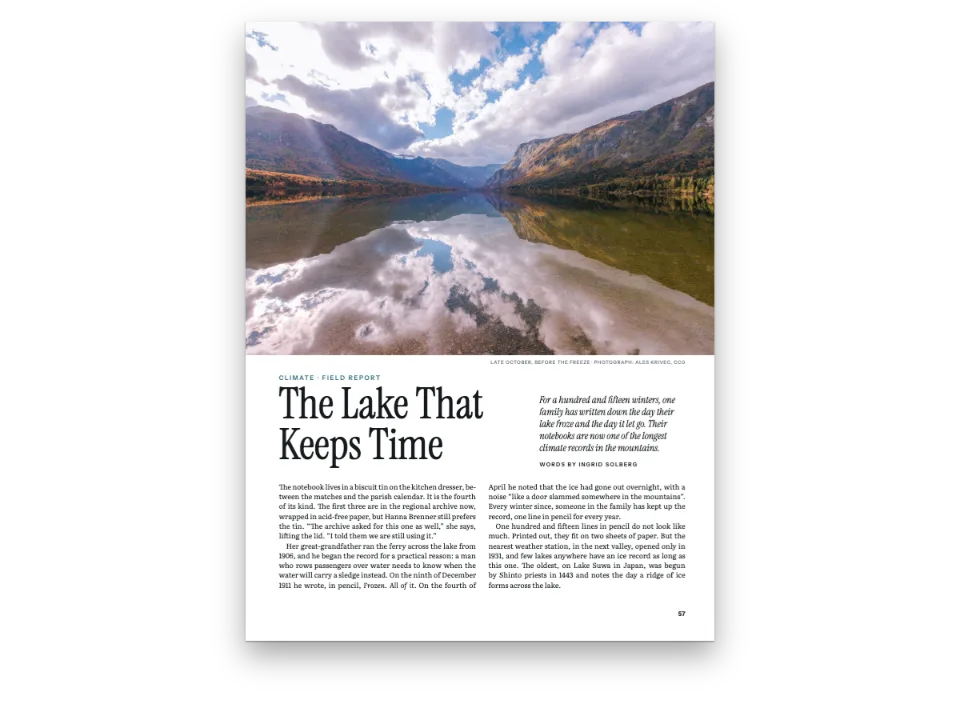
一本月刊旅行杂志的六页专题,排成三个窄栏。示例演示怎样让照片和大号引文横跨两栏或整页,以及把一个实用信息框放在一栏里。
成品一览
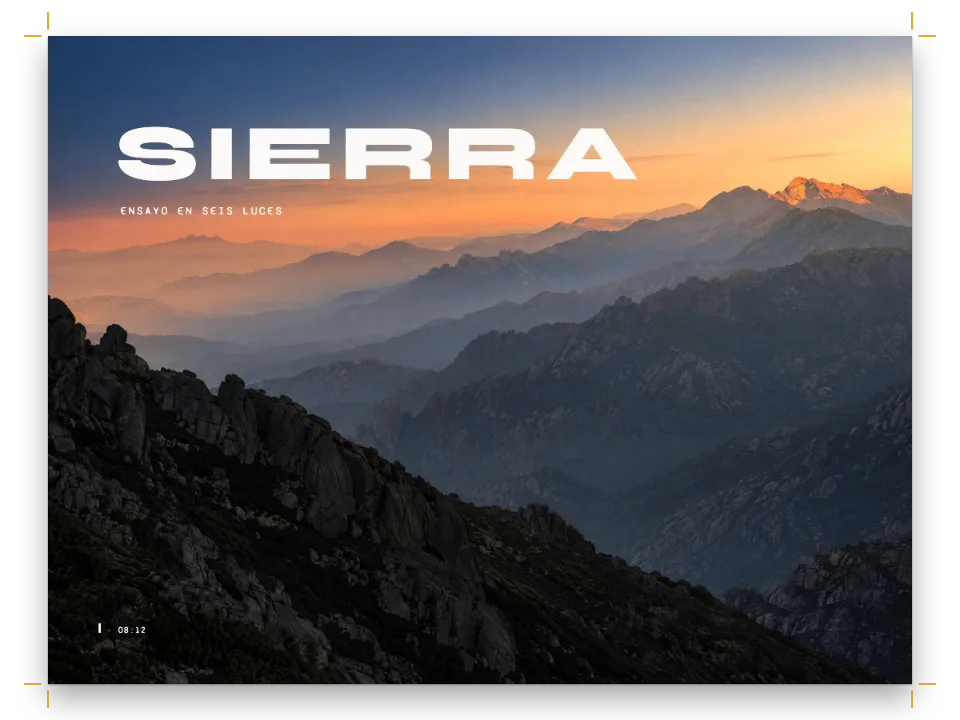
虚构旅行月刊《Meridian》十一月号的六页专题,页面尺寸225 × 297 mm。专题以跨页开篇:一张日出盐田的照片横贯左右两页,左页的标题反白压在水面上,右页照片下方是带首字下沉的首段、导语和署名。随后正文排成三栏两端对齐,每栏61.7 mm。照片有的横跨两栏,有的横贯整页,有的只占一栏;一个引文框横跨两栏,夹在段落之间;一个带小岛地图的浅色侧栏开启结尾页。正文以一个蓝色小方块结束。
这道食谱解答
- Postext能排三栏或更多栏,或者让文字绕图排吗?
- 怎样控制图的位置:页面顶部、横跨两栏、就放在这里,还是放在边栏里?
- 怎样把框浮动到页面顶部或底部,同时让正文继续排下去?
- 怎样给章首页加作者行、提要或带首字下沉的导语?
简短回答
const GUTTER = 5; // mm between the columns
const WIDTH = TRIM.width - MARGIN.inner - MARGIN.outer; // the text block, 195 mm
const COLUMN = (WIDTH - 2 * GUTTER) / 3; // 61.7 mm: about 40 characters of 9.6 pt text
const layout = { layoutType: 'multiple', columnCount: 3, gutterWidth: mm(GUTTER) };
// A float takes `columns` adjacent columns and the gutters between them: the head (or foot)
// of the first run of columns that are still empty, on its page or the next. As many columns
// as the page has is a page-wide float, like span: 'page'.
const across = {
  raker: { position: 'top', columns: 2 }, // 128.3 mm wide, at the head of two columns
  pans: { position: 'top', span: 'page' }, // 195 mm, the whole text block
  flor: { position: 'bottom' }, // 61.7 mm: one column, the default
  sieve: { position: 'top', columns: 2 }, // cited in the first column: heads the other two
  quay: { position: 'top', columns: 2 }, // two columns again, on the closing page
};
// A floated box takes `columns` the same way: the style sets it, a fence may override it
// with :::callout{type="pull" columns="3"}. A box set in the flow ('here') keeps to its column.
const pull = { id: 'pull', placement: 'top', columns: 2, backgroundEnabled: false,
  stripe: { enabled: true, side: 'top', width: pt(2.5), color: col('sea') }, // one device
  padding: { top: mm(3), right: pt(0), bottom: mm(1), left: pt(0) },
  body: { fontFamily: 'Fraunces', fontSize: pt(19), lineHeight: pt(2 * LEAD - 3),
    italic: true, textAlign: 'left', hyphenation: false, color: col('sea'),
    firstLineIndent: pt(0) } };
const visit = { id: 'visit', placement: 'top', // one column, at the head of the next free one
  background: col('tint'), padding: { top: mm(4), right: mm(4), bottom: mm(4), left: mm(4) },
  titleStyle: { ...label, fontWeight: 700, fontSize: pt(8.5), letterSpacing: pt(1.4),
    color: col('sea'), gap: mm(2) },
  body: { fontFamily: 'Barlow Condensed', fontWeight: 500, fontSize: pt(9.6),
    lineHeight: pt(12.4), textAlign: 'left', hyphenation: false, boldColor: col('sea'),
    paragraphSpacing: true, firstLineIndent: pt(0) } };
用料
- 功能
- 三栏及以上跨多栏的浮动体浮动框标注框图的放置设计过的章首页页面设计中的图片章首页中的首字下沉标题属性标题样式书眉与页码按页面角色显示书眉题注样式来源与出处行行内标签自定义资源类型作为资源的图和表语义调色板对称页边距
- 类型
- Source Serif 4, Fraunces, Barlow Condensed(SIL OFL 1.1)
- 素材
flor-1200.jpgpans-1840.jpgquay-960.jpgraker-1500.jpgsieve-1500.jpgspread-left-1200.jpgspread-right-1200.jpg- Sunrise on the salt pans (the opening spread, in two halves) (Generated With Diffusion Models, CC BY 4.0)
- Sunrise on the salt pans, the recto's half (Generated With Diffusion Models, CC BY 4.0)
- A rake drawing up wet salt (Generated With Diffusion Models, CC BY 4.0)
- The salt flats from above (Generated With Diffusion Models, CC BY 4.0)
- A salt maker with a basket of flor de sal (Generated With Diffusion Models, CC BY 4.0)
- Skimming flor de sal with a sieve (Generated With Diffusion Models, CC BY 4.0)
- Salt sacks on a harbour quay at dusk (Generated With Diffusion Models, CC BY 4.0)
- The sidebar's map of Marisal, drawn in code (Ignacio Ferro, MIT)
做法
#1 · 把页面分成三栏,让浮动体占一栏、两栏或三栏
代码见上面的简短回答。layoutType: 'multiple'配合columnCount: 3把195 mm的版心分成三个等宽的栏;栏间距5 mm时,每栏61.7 mm,约容纳40个9.6 pt的Source Serif字符。图片的placement.columns占用相应数量的相邻栏以及其间的栏间距:耙盐照片宽128.3 mm,盐田照片用span: 'page',占满195 mm。引文框的样式对方框也这样处理:在placement: 'top'的样式里写columns: 2,方框就浮到两个空栏的顶部,正文绕着它继续排。三栏网格适合图片多的杂志专题,因为每张图都可以占一栏、两栏或三栏。图片少而文字长的文章,排成两个较宽的栏更好读。
#2 · 以跨页开篇,一张照片横贯两页
const PHOTO = 165; // mm: how far down the recto the right half of the photograph bleeds
// The verso is its own heading style: the left half of the picture fills the page, and the
// kicker and headline are reversed out of the dark water at its foot. The picture reserves
// nothing, so nothing is pushed off the page; the recto's heading opens the next page.
const spread = { id: 'spread', span: 'page', advancedDesign: { enabled: true, slot: { elements: [
  { kind: 'image', id: 'photo', resourceId: 'spread-left', reserve: false,
    placement: { ...at('bleed', 'top-left'), size: { width: 'fill', height: 'fill' } } },
  { kind: 'text', id: 'kicker', content: '{attr.kicker}', ...label, fontSize: pt(10),
    letterSpacing: pt(2), color: col('paper'), // on a sea-blue tab: the water is too bright
    box: { backgroundColor: col('sea'), padding: { top: mm(1.2), right: mm(2.4),
      bottom: mm(1.2), left: mm(2.4) } },
    placement: at('page', 'top-left', 20, 188) },
  { kind: 'text', id: 'headline', content: '{titleText}', fontFamily: 'Fraunces',
    fontWeight: 600, fontSize: pt(66), lineHeight: 0.96, // a multiple of the size
    color: col('paper'), align: 'left', overflow: 'wrap', // gotcha: overflow-ellipsis-default
    placement: at('#kicker', 'below', 0, 3, 150) },
] } } };
// The recto: the right half of the picture, cut to PHOTO mm, then the lead with its drop cap
// in the first column and the standfirst (the heading's own text) across the other two.
const air = { padding: { bottom: mm(6) } }; // empty padding counts: the columns start lower
const deck = { id: 'deck', span: 'page', advancedDesign: { enabled: true, slot: { elements: [
  { kind: 'image', id: 'photo', resourceId: 'spread-right', // cropped to 225 × 165 mm
    placement: { ...at('bleed', 'top-left'), size: { width: 'fill', height: mm(PHOTO) } } },
  { kind: 'text', id: 'credit', content: '{attr.credit}', ...label, fontWeight: 500,
    fontSize: pt(6.8), letterSpacing: pt(0.5), color: col('muted'), align: 'right',
    placement: at('container', 'top-right', 0, PHOTO - MARGIN.top + 2) },
  { kind: 'text', id: 'lead', content: '{attr.lead}', fontFamily: 'Source Serif 4',
    fontSize: pt(9.6), lineHeight: LEAD / 9.6, color: col('ink'), align: 'justify',
    hyphenate: true, box: air, placement: at('container', 'top-left', 0, PHOTO - 10, COLUMN),
    dropCap: { lines: 4, fontFamily: 'Fraunces', fontWeight: 600, color: col('sea'),
      gap: mm(1.6) } },
  { kind: 'text', id: 'standfirst', content: '{titleText}', fontFamily: 'Fraunces', italic: true,
    fontSize: pt(16.5), lineHeight: 1.24, color: col('ink'), align: 'left', overflow: 'wrap',
    placement: at('container', 'top-left', COLUMN + GUTTER, PHOTO - 11, 2 * COLUMN + GUTTER) },
  { kind: 'text', id: 'byline', content: '{attr.byline}', ...label, fontSize: pt(8.5),
    letterSpacing: pt(1.5), color: col('sea'), box: air,
    placement: at('#standfirst', 'below', 0, 4) },
] } } };
照片的两半各属于一个span: 'page'的标题样式,而通栏标题总是另起一页,所以标题页和导语页前后相接。左半张铺满左页,不占预留高度(reserve: false),标题因此可以压在页脚的水面上。右半张裁成165 mm高,首段、导语和署名挂在它下方的容器上。首段是一个设计文字元素,带四行的dropCap,宽度为一栏;它底部的空白内边距计入首页高度,所以三栏正文从它下方6 mm处开始。continuation.pageIndexOffset: 83让第84页成为左页,两半照片因此左右相对。
#3 · 声明照片,并在想让它落下的地方引用
// No figure numbers: the pictures get a type with an empty caption prefix and template.
const photoType = { id: 'photo', name: 'Photograph', shortLabel: 'photo', captionPrefix: '',
  numberingTemplate: '', resetOn: 'never', counterFormat: 'decimal' };
const CREDIT = 'Photograph generated with diffusion models';
// Pixels at the page's 150 dpi (gotcha: bitmap-print-size): each shrinks to its frame.
const photo = (id, [w, h], altText, caption) => ({ id, typeId: 'photo',
  kind: 'bitmap', createdAt: 0, updatedAt: 0, altText,
  bitmap: { fileId: `${id}-${w}.jpg`, format: 'jpeg', width: w, height: h },
  note: CREDIT, ...(caption && { caption, placement: across[id] }) });
const resources = [ // the two halves of the spread are drawn by the headings, never cited
  photo('spread-left', [1200, 1584], 'Salt pans at sunrise, the sky mirrored in still brine.'),
  photo('spread-right', [1200, 880], 'A salt raker at work below a row of white salt heaps.'),
  photo('raker', [1500, 1125], 'A wooden rake pushing a ridge of wet salt crystals.',
    'Raking the crystallisers at dawn. The salt rolls up in a ridge; a rake that digs in '
    + 'tears the clay floor and greys the harvest.'),
  photo('pans', [1840, 1150], 'Rectangular salt pans in pink, ochre and grey by the sea.',
    'The Alvarra flats from the lighthouse hill. The pink basins are nearly ready: an alga '
    + 'colours the brine once it holds more than 200 grams of salt a litre.'),
  photo('flor', [1200, 1488], 'An older woman in a straw hat holding a basket of salt.',
    'Amélia Sousa with an afternoon’s flor de sal, about four kilos from two pans.'),
  photo('sieve', [1500, 1125], 'Hands skimming a crust of salt crystals with a round sieve.',
    'Skimming the flower: the sieve works the downwind edge of the pan, where the breeze has '
    + 'drifted the crust.'),
  photo('quay', [960, 1200], 'Sacks of salt on a harbour quay beside a blue boat at dusk.',
    'Porto Velho, the last week of September: fifty-kilo sacks wait for the mainland boat.'),
  { id: 'map', typeId: 'photo', kind: 'svg', createdAt: 0, updatedAt: 0, // drawn below
    svg: { fileId: 'map.svg', width: MAP.width * 10, height: MAP.height * 10 },
    placement: { position: 'here' }, // in the sidebar, under its title
    caption: 'The Alvarra pans (pink) lie on the eastern flats, 6 km from Porto Velho (the '
      + 'squares) by the coast road. The lighthouse hill is the triangle; the ferry, dashed.',
    altText: 'A map of a long, low island with salt pans at its eastern end and a harbour '
      + 'town at the west.' },
];
浮动体会放到引用它的那一行之后、所需各栏的第一个空闲栏顶(或栏底),所以::resource行决定了页面。筛子照片在第五页第一栏顶部被引用,那时第二、三栏还空着,所以它就在本页占据这两栏的顶部。港口照片在这一页末尾被引用,于是占据下一页两栏的顶部。同一类型的照片从不互相超越,所以引用顺序要和文章顺序一致。位图按页面的150 dpi计量:1500 px合254 mm,缩到两栏的128.3 mm。
#4 · 跨页首页不带书眉,书眉和页码在正文页
const head = { ...label, fontSize: pt(7.5), letterSpacing: pt(1.3), color: col('muted') };
const folio = { fontFamily: 'Barlow Condensed', fontWeight: 700, fontSize: pt(9.5),
  color: col('ink') };
const pin = (edge, x, y) => ({ anchor: { to: 'page', edge }, offset: { x: mm(x), y: mm(y) } });
const sides = [['even', 'left', 1], ['odd', 'right', -1]]; // 1: the outer edge is on the left
// The label is 2 pt smaller, so it sits 0.68 mm lower in its box: one shared baseline.
const DROP = (0.8 * 1.2 * 2 * 25.4) / 72;
const header = { elements: sides.flatMap(([parity, edge, s]) => [
  { kind: 'text', id: `folio-${parity}`, content: '{pageNumber}', ...folio, align: edge,
    placement: pin(`top-${edge}`, s * MARGIN.outer, 12) },
  { kind: 'text', id: `head-${parity}`, ...head, align: edge,
    content: s > 0 ? '{title} · {subtitle}' : '{chapterTitle}',
    placement: pin(`top-${edge}`, s * (MARGIN.outer + 9), 12 + DROP) },
].map((element) => ({ ...element, parity, pages: 'body' }))) }; // none on the spread
const footer = { elements: [{ kind: 'text', id: 'drop-folio', content: '{pageNumber}', ...folio,
  align: 'right', parity: 'odd', pages: 'opener', // the recto of the spread: a folio at the foot
  placement: pin('bottom-right', -MARGIN.outer, -12) }] };
页眉元素画在页面上,不占用空间,所以页码和标签锚定在页面的上边距里。pages: 'body'让它们不出现在首页跨页上;这两页都以通栏标题开头,属于首页类页面。跨页的右页用pages: 'opener'和parity: 'odd'在页脚印页码;左页整页是照片,不印页码。
#5 · 用代码画出侧栏的地图
function mulberry32(seed) {
  return () => {
    seed = (seed + 0x6d2b79f5) | 0;
    let r = Math.imul(seed ^ (seed >>> 15), 1 | seed);
    r = (r + Math.imul(r ^ (r >>> 7), 61 | r)) ^ r;
    return ((r ^ (r >>> 14)) >>> 0) / 4294967296;
  };
}
function islandMap() { // in mm: a long, low island lying south-west to north-east
  const rand = mulberry32(135);
  const f = (id, a = 1) => `fill="${palette[id]}"${a < 1 ? ` fill-opacity="${a}"` : ''}`;
  const [cx, cy, rx, ry, turn] = [28, 27, 23, 9.5, -0.5]; // centre, half-axes, radians
  const place = (u, v) => [cx + u * Math.cos(turn) - v * Math.sin(turn),
    cy + u * Math.sin(turn) + v * Math.cos(turn)]; // island frame to map
  const coast = Array.from({ length: 48 }, (_, i) => {
    const a = (i / 48) * 2 * Math.PI;
    const k = 0.9 + rand() * 0.16; // a ragged shore
    return place(rx * k * Math.cos(a), ry * k * Math.sin(a)).map((n) => n.toFixed(2)).join(' ');
  });
  const pans = []; // a grid of basins on the eastern flats, inside the shore
  for (let u = 6; u < 19; u += 2.4) {
    for (let v = -5; v < 5; v += 1.9) {
      if ((u / rx) ** 2 + (v / ry) ** 2 > 0.62) continue;
      const [x, y] = place(u, v);
      pans.push(`<rect x="${(x - 1).toFixed(2)}" y="${(y - 0.7).toFixed(2)}" width="2" `
        + `height="1.4" transform="rotate(${(turn * 180) / Math.PI} ${x.toFixed(2)} `
        + `${y.toFixed(2)})" ${f(rand() < 0.7 ? 'salt' : 'rule')}/>`);
    }
  }
  const [tx, ty] = place(-18, 3); // Porto Velho, on the south-west shore
  const town = [[0, 0], [1.3, 0.2], [0.4, 1.2], [1.7, 1.3], [-0.9, 0.9]].map(([dx, dy]) =>
    `<rect x="${(tx + dx).toFixed(2)}" y="${(ty + dy).toFixed(2)}" width="0.9" height="0.9" `
    + `${f('ink')}/>`).join('');
  const [lx, ly] = place(2, -6.5); // the lighthouse hill, on the north shore
  const ferry = `M${tx} ${ty + 1.5}C${tx - 6} ${ty + 6} 6 46 1.5 48`; // to the mainland, south-west
  return `<svg xmlns="http://www.w3.org/2000/svg" width="${MAP.width * 10}" `
    + `height="${MAP.height * 10}" viewBox="0 0 ${MAP.width} ${MAP.height}">`
    + `<rect width="${MAP.width}" height="${MAP.height}" ${f('sea', 0.16)}/>`
    + `<path d="M${coast.join('L')}Z" ${f('paper')} stroke="${palette.muted}" `
    + 'stroke-width="0.25"/>' + pans.join('') + town
    + `<path d="M${lx - 1.4} ${ly + 1.1}L${lx} ${ly - 1.3}L${lx + 1.4} ${ly + 1.1}Z" ${f('ink')}/>`
    + `<path d="${ferry}" fill="none" stroke="${palette.ink}" stroke-width="0.3" `
    + 'stroke-dasharray="1 0.8"/>'
    + `<path d="M0.4 46.4L1.5 48L2.9 47Z" ${f('ink')}/>` // the arrowhead, a path (no marker)
    + '</svg>';
}
地图是一个placement: 'here'的SVG资源,在侧栏的围栏里引用,所以排在侧栏标题之下,与侧栏同宽。图上没有文字:SVG里的文字不能使用页面的网络字体,所以由图片说明交代各个图形。渡轮航线的箭头是路径,因为<marker>在导出PDF时会丢失。
完整食谱
// ═══ Postext Cookbook · Nº 135 · Magazine feature on a three-column grid ═════════ // https://postext.dev/en/cookbook/magazine-three-column-feature // Code: MIT · Text: original (CC BY 4.0) · Photographs: generated with diffusion models // Fonts: Source Serif 4, Fraunces, Barlow Condensed (SIL OFL 1.1) · Needs postext ≥ 1.18.0 // A travel feature from a monthly magazine, pages 84–89 of the issue. The story opens on a // spread, a photograph bled across both pages, then runs on in three columns: pictures across // two of them, one across the page and one in a single column, a pull quote floated across // two columns, a sidebar in one, running heads, folios and an end mark. import { buildDocument, renderPageToCanvas, clearMeasurementCache, registerResourceImage, } from 'https://esm.sh/postext'; const LANG = 'en'; // @lang: the language of the sample document ('en' | 'es') const RECIPE = 'magazine-three-column-feature'; // ─── 1 · Design ───────────────────────────────────────────────────────────── // #region palette: an Atlantic blue for the one accent, a salt tint for the sidebar const palette = { ink: '#1c2024', // text: a blue-black sea: '#1d5470', // the accent: kickers, crossheads, the quote, the drop cap tint: '#edf1f2', // the sidebar's ground rule: '#c5ced3', // the map's resting pans muted: '#5c656d', // running heads, credits, the colophon paper: '#ffffff', // the page, and the headline reversed out of the photograph salt: '#dfa79c', // the pans on the sidebar's map, the pink of ripe brine }; const col = (id) => ({ hex: palette[id], model: 'hex', paletteId: id }); const colorPalette = [ ...Object.entries(palette).map(([id, hex]) => ({ id, name: id, value: { hex, model: 'hex' } })), // The engine's defaults link to 'main-color': point it at the accent, so nothing prints blue. { id: 'main-color', name: 'sea (defaults)', value: { hex: palette.sea, model: 'hex' } }, ]; // #endregion const TRIM = { width: 225, height: 297 }; // a magazine trim, in mm const MARGIN = { top: 22, bottom: 20, inner: 16, outer: 14 }; // mirrored const LEAD = 14; // body leading in pt: the baseline grid const MAP = { width: 54, height: 50 }; // mm: the sidebar's map, as wide as its measure const label = { fontFamily: 'Barlow Condensed', fontWeight: 600, textTransform: 'uppercase', align: 'left' }; // design text is centred by default const at = (to, edge, x = 0, y = 0, width) => ({ anchor: { to, edge }, offset: { x: mm(x), y: mm(y) }, ...(width && { size: { width: mm(width) } }) }); // #region answer: three equal columns, and floats that take one, two or all three of them const GUTTER = 5; // mm between the columns const WIDTH = TRIM.width - MARGIN.inner - MARGIN.outer; // the text block, 195 mm const COLUMN = (WIDTH - 2 * GUTTER) / 3; // 61.7 mm: about 40 characters of 9.6 pt text const layout = { layoutType: 'multiple', columnCount: 3, gutterWidth: mm(GUTTER) }; // A float takes `columns` adjacent columns and the gutters between them: the head (or foot) // of the first run of columns that are still empty, on its page or the next. As many columns // as the page has is a page-wide float, like span: 'page'. const across = { raker: { position: 'top', columns: 2 }, // 128.3 mm wide, at the head of two columns pans: { position: 'top', span: 'page' }, // 195 mm, the whole text block flor: { position: 'bottom' }, // 61.7 mm: one column, the default sieve: { position: 'top', columns: 2 }, // cited in the first column: heads the other two quay: { position: 'top', columns: 2 }, // two columns again, on the closing page }; // A floated box takes `columns` the same way: the style sets it, a fence may override it // with :::callout{type="pull" columns="3"}. A box set in the flow ('here') keeps to its column. const pull = { id: 'pull', placement: 'top', columns: 2, backgroundEnabled: false, stripe: { enabled: true, side: 'top', width: pt(2.5), color: col('sea') }, // one device padding: { top: mm(3), right: pt(0), bottom: mm(1), left: pt(0) }, body: { fontFamily: 'Fraunces', fontSize: pt(19), lineHeight: pt(2 * LEAD - 3), italic: true, textAlign: 'left', hyphenation: false, color: col('sea'), firstLineIndent: pt(0) } }; const visit = { id: 'visit', placement: 'top', // one column, at the head of the next free one background: col('tint'), padding: { top: mm(4), right: mm(4), bottom: mm(4), left: mm(4) }, titleStyle: { ...label, fontWeight: 700, fontSize: pt(8.5), letterSpacing: pt(1.4), color: col('sea'), gap: mm(2) }, body: { fontFamily: 'Barlow Condensed', fontWeight: 500, fontSize: pt(9.6), lineHeight: pt(12.4), textAlign: 'left', hyphenation: false, boldColor: col('sea'), paragraphSpacing: true, firstLineIndent: pt(0) } }; // #endregion // #region spread: one photograph across the opening spread, the headline on the verso const PHOTO = 165; // mm: how far down the recto the right half of the photograph bleeds // The verso is its own heading style: the left half of the picture fills the page, and the // kicker and headline are reversed out of the dark water at its foot. The picture reserves // nothing, so nothing is pushed off the page; the recto's heading opens the next page. const spread = { id: 'spread', span: 'page', advancedDesign: { enabled: true, slot: { elements: [ { kind: 'image', id: 'photo', resourceId: 'spread-left', reserve: false, placement: { ...at('bleed', 'top-left'), size: { width: 'fill', height: 'fill' } } }, { kind: 'text', id: 'kicker', content: '{attr.kicker}', ...label, fontSize: pt(10), letterSpacing: pt(2), color: col('paper'), // on a sea-blue tab: the water is too bright box: { backgroundColor: col('sea'), padding: { top: mm(1.2), right: mm(2.4), bottom: mm(1.2), left: mm(2.4) } }, placement: at('page', 'top-left', 20, 188) }, { kind: 'text', id: 'headline', content: '{titleText}', fontFamily: 'Fraunces', fontWeight: 600, fontSize: pt(66), lineHeight: 0.96, // a multiple of the size color: col('paper'), align: 'left', overflow: 'wrap', // gotcha: overflow-ellipsis-default placement: at('#kicker', 'below', 0, 3, 150) }, ] } } }; // The recto: the right half of the picture, cut to PHOTO mm, then the lead with its drop cap // in the first column and the standfirst (the heading's own text) across the other two. const air = { padding: { bottom: mm(6) } }; // empty padding counts: the columns start lower const deck = { id: 'deck', span: 'page', advancedDesign: { enabled: true, slot: { elements: [ { kind: 'image', id: 'photo', resourceId: 'spread-right', // cropped to 225 × 165 mm placement: { ...at('bleed', 'top-left'), size: { width: 'fill', height: mm(PHOTO) } } }, { kind: 'text', id: 'credit', content: '{attr.credit}', ...label, fontWeight: 500, fontSize: pt(6.8), letterSpacing: pt(0.5), color: col('muted'), align: 'right', placement: at('container', 'top-right', 0, PHOTO - MARGIN.top + 2) }, { kind: 'text', id: 'lead', content: '{attr.lead}', fontFamily: 'Source Serif 4', fontSize: pt(9.6), lineHeight: LEAD / 9.6, color: col('ink'), align: 'justify', hyphenate: true, box: air, placement: at('container', 'top-left', 0, PHOTO - 10, COLUMN), dropCap: { lines: 4, fontFamily: 'Fraunces', fontWeight: 600, color: col('sea'), gap: mm(1.6) } }, { kind: 'text', id: 'standfirst', content: '{titleText}', fontFamily: 'Fraunces', italic: true, fontSize: pt(16.5), lineHeight: 1.24, color: col('ink'), align: 'left', overflow: 'wrap', placement: at('container', 'top-left', COLUMN + GUTTER, PHOTO - 11, 2 * COLUMN + GUTTER) }, { kind: 'text', id: 'byline', content: '{attr.byline}', ...label, fontSize: pt(8.5), letterSpacing: pt(1.5), color: col('sea'), box: air, placement: at('#standfirst', 'below', 0, 4) }, ] } } }; // #endregion // #region heads: the magazine and the issue on the verso, the story on the recto const head = { ...label, fontSize: pt(7.5), letterSpacing: pt(1.3), color: col('muted') }; const folio = { fontFamily: 'Barlow Condensed', fontWeight: 700, fontSize: pt(9.5), color: col('ink') }; const pin = (edge, x, y) => ({ anchor: { to: 'page', edge }, offset: { x: mm(x), y: mm(y) } }); const sides = [['even', 'left', 1], ['odd', 'right', -1]]; // 1: the outer edge is on the left // The label is 2 pt smaller, so it sits 0.68 mm lower in its box: one shared baseline. const DROP = (0.8 * 1.2 * 2 * 25.4) / 72; const header = { elements: sides.flatMap(([parity, edge, s]) => [ { kind: 'text', id: `folio-${parity}`, content: '{pageNumber}', ...folio, align: edge, placement: pin(`top-${edge}`, s * MARGIN.outer, 12) }, { kind: 'text', id: `head-${parity}`, ...head, align: edge, content: s > 0 ? '{title} · {subtitle}' : '{chapterTitle}', placement: pin(`top-${edge}`, s * (MARGIN.outer + 9), 12 + DROP) }, ].map((element) => ({ ...element, parity, pages: 'body' }))) }; // none on the spread const footer = { elements: [{ kind: 'text', id: 'drop-folio', content: '{pageNumber}', ...folio, align: 'right', parity: 'odd', pages: 'opener', // the recto of the spread: a folio at the foot placement: pin('bottom-right', -MARGIN.outer, -12) }] }; // #endregion const config = () => ({ // a factory: the engine caches resolved configs per object locale: 'en-us', // an exact hyphenation code (gotcha: hyphenation-locales) colorPalette, resourceTypes: [photoType], page: { width: mm(TRIM.width), height: mm(TRIM.height), dpi: 150, margins: { top: mm(MARGIN.top), bottom: mm(MARGIN.bottom), left: mm(MARGIN.inner), right: mm(MARGIN.outer), mirror: true } }, // left is the inner side layout, bodyText: { fontFamily: 'Source Serif 4', fontSize: pt(9.6), lineHeight: pt(LEAD), color: col('ink'), boldColor: col('ink'), italicColor: col('ink'), referenceColor: col('ink'), textAlign: 'justify', firstLineIndent: mm(3), indentAfterHeading: false, // A 40-character measure: a line no break can set within twice the normal space takes up // to 0.015 em of tracking for the rest instead of spreading its spaces wider still. minWordSpacing: 0.7, maxJustifyTracking: 15 }, headings: { fontFamily: 'Fraunces', fontWeight: 600, color: col('sea'), levels: [ // Restated (gotcha: headings-drop-h1-break): the spread opens on the next page. { level: 1, span: 'page', breakBefore: { enabled: true, parity: 'any' } }, { level: 2, fontSize: pt(12.5), lineHeight: pt(LEAD), marginTop: pt(LEAD), marginBottom: pt(0) }, // crossheads, one grid line above ] }, headingStyles: [spread, deck], calloutStyles: [pull, visit], chipStyles: [{ id: 'end', background: col('sea'), borderWidth: pt(0), borderRadius: pt(0), fontSize: em(0.6), paddingX: em(0.5), paddingY: em(0), gap: em(0.6) }], // a square captionStyle: { fontFamily: 'Barlow Condensed', fontWeight: 500, fontSize: pt(8.6), lineHeight: pt(10.6), color: col('ink'), gap: mm(2), note: { fontSize: pt(7), color: col('muted'), gap: mm(0.5) } }, paragraphStyles: [{ id: 'colophon', fontFamily: 'Barlow Condensed', fontWeight: 500, fontSize: pt(7.4), lineHeight: pt(9.6), color: col('muted'), textAlign: 'left', firstLineIndent: pt(0), marginTop: pt(LEAD) }], header, footer, }); // ─── 2 · Content ──────────────────────────────────────────────────────────── // #region resources: the photographs, declared once by their real pixels // No figure numbers: the pictures get a type with an empty caption prefix and template. const photoType = { id: 'photo', name: 'Photograph', shortLabel: 'photo', captionPrefix: '', numberingTemplate: '', resetOn: 'never', counterFormat: 'decimal' }; const CREDIT = 'Photograph generated with diffusion models'; // Pixels at the page's 150 dpi (gotcha: bitmap-print-size): each shrinks to its frame. const photo = (id, [w, h], altText, caption) => ({ id, typeId: 'photo', kind: 'bitmap', createdAt: 0, updatedAt: 0, altText, bitmap: { fileId: `${id}-${w}.jpg`, format: 'jpeg', width: w, height: h }, note: CREDIT, ...(caption && { caption, placement: across[id] }) }); const resources = [ // the two halves of the spread are drawn by the headings, never cited photo('spread-left', [1200, 1584], 'Salt pans at sunrise, the sky mirrored in still brine.'), photo('spread-right', [1200, 880], 'A salt raker at work below a row of white salt heaps.'), photo('raker', [1500, 1125], 'A wooden rake pushing a ridge of wet salt crystals.', 'Raking the crystallisers at dawn. The salt rolls up in a ridge; a rake that digs in ' + 'tears the clay floor and greys the harvest.'), photo('pans', [1840, 1150], 'Rectangular salt pans in pink, ochre and grey by the sea.', 'The Alvarra flats from the lighthouse hill. The pink basins are nearly ready: an alga ' + 'colours the brine once it holds more than 200 grams of salt a litre.'), photo('flor', [1200, 1488], 'An older woman in a straw hat holding a basket of salt.', 'Amélia Sousa with an afternoon’s flor de sal, about four kilos from two pans.'), photo('sieve', [1500, 1125], 'Hands skimming a crust of salt crystals with a round sieve.', 'Skimming the flower: the sieve works the downwind edge of the pan, where the breeze has ' + 'drifted the crust.'), photo('quay', [960, 1200], 'Sacks of salt on a harbour quay beside a blue boat at dusk.', 'Porto Velho, the last week of September: fifty-kilo sacks wait for the mainland boat.'), { id: 'map', typeId: 'photo', kind: 'svg', createdAt: 0, updatedAt: 0, // drawn below svg: { fileId: 'map.svg', width: MAP.width * 10, height: MAP.height * 10 }, placement: { position: 'here' }, // in the sidebar, under its title caption: 'The Alvarra pans (pink) lie on the eastern flats, 6 km from Porto Velho (the ' + 'squares) by the coast road. The lighthouse hill is the triangle; the ferry, dashed.', altText: 'A map of a long, low island with salt pans at its eastern end and a harbour ' + 'town at the west.' }, ]; // #endregion const markdown = String.raw`---Markdown样例 · 97行 · content.en.md
title: "Meridian" subtitle: "November 2026" --- # The Salt Rakers of Marisal {style="spread" kicker="Islands · The Atlantic"} ## On a flat island at the edge of the Atlantic, nine families still make salt by hand, with sun, wind and a wooden rake. Their season lasts eleven weeks, and every year it starts a little later {style="deck" byline="Words by Marta Quintal" credit="Sunrise on the Alvarra pans · Photographs generated with diffusion models" lead="At five in the morning the brine in the Alvarra pans is the colour of pewter, and João Brás is already standing in it up to his ankles. He works the way his father taught him, walking backwards down the pan and drawing the rake towards him in long, even strokes, so that the salt rolls up into a ridge without tearing the clay floor beneath it."} Brás is fifty-eight. He has raked these pans every summer since he was eleven, except for two years of military service and one summer, in 1994, when he broke his wrist falling from the roof of the salt store. The pan he is working this morning measures nine metres by twenty-two, and by half past seven he will have drawn about four hundred kilos of salt into a white ridge along its edge. Then the sun will be too high, and the salt too bright to look at. Marisal is fourteen kilometres long and nowhere higher than a two-storey house. It has no river and almost no trees, and the wind from the north-east blows on two days out of three between June and September. For most of its history the island had nothing to sell except what the sea and that wind could make together. The first salt works were dug on the eastern flats in the 1680s. At their peak, in the years before the Second World War, more than six hundred pans were worked on the island, by some 140 families. The decline came quickly. In the 1960s a plant on the mainland began to make salt by boiling brine under vacuum, cheaply and all year round, and the canneries that had bought Marisal’s salt for two centuries switched to it within a decade. Young men left for the merchant fleet and the building sites of the north. The pans they left behind silted up in a few winters, and their clay walls slumped into the brine like sandcastles after a tide. ## Water, sun and wind The method has not changed in three centuries. At high tide, sea water flows through a sluice into a large reservoir, the *viveiro*, where it settles for a few days and drops its sand. From there it is let down, a few centimetres at a time, through a chain of ever shallower basins. In each one the sun and the wind take a little more of the water, and the brine grows heavier. The basins are laid out so that the water never has to be lifted: the whole works falls about forty centimetres from the sluice to the last pan, and gravity does the rest. Sea water holds about 35 grams of salt in every litre. By the time it reaches the last basins, the crystallisers, it holds more than 250, and salt begins to form on the surface like frost on a window. The whole passage takes about three weeks. The salt makers measure it with a glass hydrometer that floats higher as the brine thickens, but most of them can judge it without one. “You can see it in the colour,” says Brás. “It goes pink first, then a sort of grey. When it shines like oil, the salt is coming.” The pink comes from a single-celled alga that thrives in water too salty for anything else. It is harmless, and it gives the pans their colours when you see them from the lighthouse hill. ::resource{id="raker"} The skill lies in the water level. Too deep, and the salt forms slowly, in small grains; too shallow, and it crusts over with the clay. A salt maker opens and closes the little wooden gates between his basins several times a day, by hand or with the side of his foot. Brás has 46 gates on his eleven pans, and he can tell you the height of the water behind each one without looking. At noon the rakers go home to sleep, and the flats belong to the wind. Brás eats with his wife under the vine at the back of the house: grilled mackerel, bread, a tomato cut in half and rubbed with the coarse grey salt from the bottom of the heap, the salt nobody buys. In the evening he walks back down to the pans to check the gates, and on still nights he sometimes stays until dark, sitting on the wall of the reservoir and listening to the brine tick as the crystals form. ## Eleven weeks The harvest runs from early July to the middle of September, when the first autumn rain usually arrives. It used to begin in June. Over the past twenty years the records of the salt makers’ cooperative show the first raking moving back by about nine days, because late spring storms now fill the basins with rainwater just when they should be concentrating. A single heavy shower in August can dissolve a week’s salt in an hour. The rakers watch the forecast on their phones, and on uncertain evenings they draw the salt into heaps and cover them with plastic sheets held down by stones. ::resource{id="pans"} The work is heavy and short. Raking starts before dawn, while the salt is cool and the light is low enough to show the ridges. By nine the crystallisers glare white and the air above them shimmers. Each pan is raked every three or four days. The wet salt is shovelled into wooden wheelbarrows and pushed along the clay walkways to the heaps at the end of each row, where it drains and dries for two weeks before it goes into the store. The store at the end of the flats was built in 1911, a long whitewashed shed with no windows and a floor of beaten earth. Inside it smells of seaweed and tar, and by the end of September the heaps rise to the roof beams. Nothing made of metal is kept there: in a year the salt eats a nail down to a rust stain in the wood. :::callout{type="pull"} The sea gives you the water. The sun and the wind do the work. All we do is stop it running away. ::: A good pan gives about 60 tonnes of coarse salt in a season. Sold in bulk to the canning factory on the mainland, it brings the salt maker around 90 euros a tonne, less than the diesel it takes to ship it. By the late 1990s fewer than twenty families were still working pans, and most of the eastern flats had been left to the herons. ## The flower of the salt What saved the pans was not the coarse salt. On hot, still afternoons a thin crust forms on the surface of the crystallisers, made of flat, brittle crystals that float on the brine like ice on a pond. This is the *flor de sal*, the flower of the salt. It is skimmed off by hand with a wide, fine-meshed sieve on a long handle, a few millimetres at a time, before the evening wind breaks it up and sinks it. The skimmer works along the downwind edge of the pan, where the breeze has pushed the crust into a drift, and lifts it in shallow passes that barely touch the water. Lift too deep and the sieve brings up brine and clay with the crystals; too slowly, and the crust folds and sinks before it reaches the mesh. A pan gives only one or two per cent of its harvest as flower, and it has to be gathered on every day that it appears. On Marisal it was always women’s work, and for generations it was not sold at all. Families kept it for the table and gave it as a present at weddings. Amélia Sousa, who is seventy-four, has skimmed the pans behind her house every summer since 1962. “My mother called it the salt for visitors,” she says. “The coarse salt was for the fish. The flower was kept for the days when the priest came to eat with us.” Chefs on the mainland describe the flower in the language of wine. The crystals are hollow pyramids a few millimetres across, and they break between the teeth instead of dissolving on the tongue. It tastes less sharply of salt than the coarse grain, because it holds a little more of the sea’s magnesium and calcium, and it is never cooked with: a pinch goes on at the table, over a fried egg or a slice of tomato. ::resource{id="sieve"} ::resource{id="flor"} In 2011 nine families formed a cooperative, the Salineiros de Alvarra, and began to sell the flower in small tins under their own name. A 250-gram tin sells for six euros on the island and for three times that in city delicatessens. The flower now brings in more than the rest of the harvest put together. It has paid for a new sluice, a shared drying shed and the repair of 38 abandoned pans, and this year, for the first time since 1971, the cooperative turned buyers away in August. ## The herons’ share Not everyone welcomed the restoration. By 2010 the abandoned pans on the eastern flats had become one of the largest resting places for wading birds on the island’s side of the ocean: black-winged stilts, avocets, little egrets and, every autumn, a few hundred flamingos on their way south. The birdwatchers who came to count them were the first visitors Marisal had had in years, and they were not pleased to see the walls rebuilt. The answer was a map. The cooperative and the island’s naturalists’ society agreed to leave twenty-two of the old pans flooded all year as a refuge, to keep the working pans free of plastic and lime, and to stop raking near the nesting walls between April and June. The birds seem content with the arrangement. Stilts now nest on the working walls as well, and the rakers step round their eggs. Each September the society’s volunteers count the birds from the lighthouse hill, as they have since 1998. Last year they recorded 41 species on the flats in a single morning, among them a spoonbill ringed as a chick on the far side of the ocean. ## Nine families The cooperative has eleven members under forty. One of them is Rita Brás, João’s niece, who studied marine biology on the mainland and came back in 2019 to work four pans her grandfather had abandoned in 1987. It took her two winters to rebuild their clay walls and floors, treading the wet clay flat with her bare feet as the old salt makers did. She logs the salinity of every basin three times a day and shares the figures with a university group that studies salt marshes. “My uncle thinks I am measuring what he already knows,” she says. “He is right. But when he stops, someone will have to know it from the numbers instead.” Rita’s pans are the smallest on the flats, and the most watched. She has fitted one of them with a floating thermometer and a camera on a pole, and every evening she posts its picture for the cooperative’s customers, who can watch the crust form on brine they will eat a year later. Orders from the mainland doubled in the first summer she did it. The older members were doubtful at first. Now they come round after supper to look at the screen with her and argue about the colour of the water. ::resource{id="quay"} :::callout{type="visit" title="Visiting Marisal"} ::resource{id="map"} **Getting there** The ferry from the mainland takes 2 hours 40 minutes and sails daily from June to September, three times a week in winter. **Getting round** Bicycles for hire at the ferry quay, €12 a day. The pans are six kilometres from Porto Velho by the coast road, which is flat all the way. **When to go** The harvest runs from July to mid-September. The cooperative shows visitors round the pans on weekday mornings at eight; book a day ahead. **Where to stay** Three guesthouses in Porto Velho, from €65 a night. Bring a hat: there is no shade on the flats. **Where to eat** Casa do Moinho, on the harbour, grills the morning’s mackerel and serves it with the coarse grey salt. Lunch for two, about €38. **What to bring home** Flor de sal in 250 g tins, €6 at the cooperative’s shed by the sluice. ::: The old salt makers are not sentimental about their trade. Brás will tell you that his back hurts from June to October and that he would not wish the work on his sons, who drive taxis in the island’s one town. He also says that he has never had a better morning than the first raking of a good year, when the salt comes up under the rake in a single unbroken roll and the whole pan smells of the sea. On the last Saturday of the season the cooperative weighs the year’s harvest on the old platform scale in the salt store, sack by sack, with a notebook and a pencil. Last year it came to 1,860 tonnes of coarse salt and a little under eleven tonnes of flower, the best year since the cooperative began. The figure is chalked on the door of the store, where it stays until the rain washes it off, some time in October. At the end of September the salt goes down to the quay at Porto Velho in linen sacks of fifty kilos each, and the last boat of the season carries it to the mainland. The pans are flooded with sea water for the winter, to protect the clay from the rain and the frost. By November, when the rakers start mending their gates, the flats look like a lake again, and the herons are back on the walls, waiting. :chip[]{style="end"} :::paragraphs{style="colophon"} Marisal, the Alvarra pans and everyone in this feature are fictional · Set in Source Serif 4, Fraunces and Barlow Condensed (SIL Open Font License) · Text: CC BY 4.0 · Photographs generated with diffusion models :::`; // content.<lang>.md, inlined by the Cookbook // #region art: the sidebar's map of Marisal, drawn in code with a seeded PRNG function mulberry32(seed) { return () => { seed = (seed + 0x6d2b79f5) | 0; let r = Math.imul(seed ^ (seed >>> 15), 1 | seed); r = (r + Math.imul(r ^ (r >>> 7), 61 | r)) ^ r; return ((r ^ (r >>> 14)) >>> 0) / 4294967296; }; } function islandMap() { // in mm: a long, low island lying south-west to north-east const rand = mulberry32(135); const f = (id, a = 1) => `fill="${palette[id]}"${a < 1 ? ` fill-opacity="${a}"` : ''}`; const [cx, cy, rx, ry, turn] = [28, 27, 23, 9.5, -0.5]; // centre, half-axes, radians const place = (u, v) => [cx + u * Math.cos(turn) - v * Math.sin(turn), cy + u * Math.sin(turn) + v * Math.cos(turn)]; // island frame to map const coast = Array.from({ length: 48 }, (_, i) => { const a = (i / 48) * 2 * Math.PI; const k = 0.9 + rand() * 0.16; // a ragged shore return place(rx * k * Math.cos(a), ry * k * Math.sin(a)).map((n) => n.toFixed(2)).join(' '); }); const pans = []; // a grid of basins on the eastern flats, inside the shore for (let u = 6; u < 19; u += 2.4) { for (let v = -5; v < 5; v += 1.9) { if ((u / rx) ** 2 + (v / ry) ** 2 > 0.62) continue; const [x, y] = place(u, v); pans.push(`<rect x="${(x - 1).toFixed(2)}" y="${(y - 0.7).toFixed(2)}" width="2" ` + `height="1.4" transform="rotate(${(turn * 180) / Math.PI} ${x.toFixed(2)} ` + `${y.toFixed(2)})" ${f(rand() < 0.7 ? 'salt' : 'rule')}/>`); } } const [tx, ty] = place(-18, 3); // Porto Velho, on the south-west shore const town = [[0, 0], [1.3, 0.2], [0.4, 1.2], [1.7, 1.3], [-0.9, 0.9]].map(([dx, dy]) => `<rect x="${(tx + dx).toFixed(2)}" y="${(ty + dy).toFixed(2)}" width="0.9" height="0.9" ` + `${f('ink')}/>`).join(''); const [lx, ly] = place(2, -6.5); // the lighthouse hill, on the north shore const ferry = `M${tx} ${ty + 1.5}C${tx - 6} ${ty + 6} 6 46 1.5 48`; // to the mainland, south-west return `<svg xmlns="http://www.w3.org/2000/svg" width="${MAP.width * 10}" ` + `height="${MAP.height * 10}" viewBox="0 0 ${MAP.width} ${MAP.height}">` + `<rect width="${MAP.width}" height="${MAP.height}" ${f('sea', 0.16)}/>` + `<path d="M${coast.join('L')}Z" ${f('paper')} stroke="${palette.muted}" ` + 'stroke-width="0.25"/>' + pans.join('') + town + `<path d="M${lx - 1.4} ${ly + 1.1}L${lx} ${ly - 1.3}L${lx + 1.4} ${ly + 1.1}Z" ${f('ink')}/>` + `<path d="${ferry}" fill="none" stroke="${palette.ink}" stroke-width="0.3" ` + 'stroke-dasharray="1 0.8"/>' + `<path d="M0.4 46.4L1.5 48L2.9 47Z" ${f('ink')}/>` // the arrowhead, a path (no marker) + '</svg>'; } // #endregion // ─── 3 · Fonts ────────────────────────────────────────────────────────────── const FONTS = { // text, display and label faces, loaded before the build (gotcha: fonts-first) 'Source Serif 4': ['400', '400i', '600'], Fraunces: ['400i', '600'], 'Barlow Condensed': ['500', '600', '700'] }; // ─── 4 · Build & show ─────────────────────────────────────────────────────── await loadFonts(FONTS, markdown); await Promise.all([...resources.filter((r) => r.bitmap).map(({ bitmap }) => loadImage(bitmap.fileId, asset(bitmap.fileId))), loadSvg('map.svg', islandMap())]); // Pages 84–89 of the issue: page 84 is a verso, so the opener lies open as a spread. const continuation = { pageIndexOffset: 83, pageNumbering: { startAt: 84 } }; const doc = await buildWithFonts( () => buildDocument({ markdown, resources, continuation }, config()), markdown); showPages(doc, { title: 'Magazine feature on a three-column grid' });工具包 · core, fonts, viewer, images:每道食谱都相同 · 270行
// ─── Kit ── helpers shared by every Cookbook recipe · postext.dev/cookbook ───── // ─── Kit · core v1 ── the same in every recipe · postext.dev/cookbook ───────── function mm(value) { return { value, unit: 'mm' }; } function pt(value) { return { value, unit: 'pt' }; } function em(value) { return { value, unit: 'em' }; } /** The sample language's string: t({ en: 'Figure', es: 'Figura' }). */ function t(strings) { return strings[LANG] ?? Object.values(strings)[0]; } /** A file in this recipe's assets folder, served from the Postext repo by jsDelivr. */ function asset(file) { return `https://cdn.jsdelivr.net/gh/drnachio/postext@main/cookbook/${RECIPE}/assets/${file}`; } // ─── Kit · fonts v1 ── the same in every recipe · postext.dev/cookbook ──────── // Postext measures text with the faces the browser has loaded, and caches the // widths, so every face must be ready before the first build. Faces come from // Fontsource: the same static files the PDF embeds, so screen and PDF agree. /** faces = { 'Family Name': ['400', '400i', '700'] }. `text` is the sample: * letters beyond Latin-1 (č, ł, ő…) also load the latin-ext files. With * `optional`, a face Fontsource does not ship is skipped instead of failing. * Resolves to the number of faces added. */ async function loadFonts(faces, text = '', { optional = false } = {}) { kitStatus('Loading fonts…'); const ranges = { latin: 'U+0000-00FF,U+0131,U+0152-0153,U+02BB-02BC,U+02C6,U+02DA,U+02DC,U+0304,U+0308,U+0329,' + 'U+2000-206F,U+20AC,U+2122,U+2191,U+2193,U+2212,U+2215,U+FEFF,U+FFFD', 'latin-ext': 'U+0100-02BA,U+02BD-02C5,U+02C7-02CC,U+02CE-02D7,U+02DD-02FF,U+0304,U+0308,U+0329,' + 'U+1D00-1DBF,U+1E00-1E9F,U+1EF2-1EFF,U+2020,U+20A0-20AB,U+20AD-20C0,U+2113,U+2C60-2C7F,U+A720-A7FF', }; const subsets = /[Ā-˿Ḁ-ỿ]/.test(text) ? ['latin', 'latin-ext'] : ['latin']; const jobs = []; let added = 0; for (const [family, specs] of Object.entries(faces)) { const id = fontsourceId(family); const meta = optional ? await fontsourceMeta(family) : null; for (const spec of new Set(specs)) { const weight = parseInt(spec, 10); const style = spec.endsWith('i') ? 'italic' : 'normal'; if (hasFace(family, weight, style)) continue; if (optional && !(meta?.weights.includes(weight) && meta.styles.includes(style))) continue; for (const subset of subsets) { const url = `https://cdn.jsdelivr.net/npm/@fontsource/${id}@5/files/${id}-${subset}-${weight}-${style}.woff2`; const face = new FontFace(family, `url(${url}) format('woff2')`, { weight: String(weight), style, unicodeRange: ranges[subset] }); jobs.push(face.load().then((ready) => { document.fonts.add(ready); added++; }, () => { if (subset === 'latin' && !optional) throw new Error(`Fontsource has no ${family} ${weight} ${style}`); })); } } } await Promise.all(jobs).catch((error) => { kitFail(error); throw error; }); return added; } /** Runs `build` (a buildDocument or buildBundle call) and checks the faces * the pages use. A regular face missing from FONTS is loaded with a warning; * bold and italic variants are loaded when the family ships them. Then the * measurement caches are cleared and the build runs again. */ async function buildWithFonts(build, text = '') { const tried = new Set(); for (let round = 0; round < 3; round++) { kitStatus('Laying out…'); await new Promise(requestAnimationFrame); // let the status paint first const result = await Promise.resolve().then(build).catch((error) => { kitFail(error); throw error; }); const wanted = { base: {}, variants: {} }; for (const { font, base } of [result].flat().flatMap(fontStringsOf)) { const { family, weight, style } = parseFont(font); const key = `${family}|${weight}|${style}`; if (tried.has(key) || hasFace(family, weight, style)) continue; tried.add(key); (wanted[base ? 'base' : 'variants'][family] ??= []).push(`${weight}${style === 'italic' ? 'i' : ''}`); } if (Object.keys(wanted.base).length) { console.warn(`[cookbook] FONTS does not list ${JSON.stringify(wanted.base)}: loading them.`); } const added = await loadFonts(wanted.base, text) + await loadFonts(wanted.variants, text, { optional: true }); if (added === 0) return result; clearMeasurementCache(); } throw new Error('The fonts did not settle after three builds.'); } /** Every font string of the layout. `base` marks a block's own face; its * bold, italic and bold-italic variants are listed whether or not used. */ function fontStringsOf(doc) { const found = new Map(); const walk = (node) => { if (!node || typeof node !== 'object') return; if (Array.isArray(node)) { node.forEach(walk); return; } for (const [key, value] of Object.entries(node)) { if (typeof value === 'string' && /fontString$/i.test(key)) { found.set(value, found.get(value) || key === 'fontString'); } else if (value && typeof value === 'object') walk(value); } }; walk(doc.pages); walk(doc.blocks); return [...found].map(([font, base]) => ({ font, base })); } /** '700 37.5px Open Sans' / 'italic 400 13px "Source Serif 4"' → { family, weight, style }. * A string with no weight ('95.8px Young Serif', from a design text) is 400. */ function parseFont(font) { const m = /^(?:(italic|oblique)\s+)?(?:small-caps\s+)?(?:(\d+|bold|normal)\s+)?[\d.]+px\s+(.+)$/.exec(font.trim()); if (!m) throw new Error(`Unexpected font string: ${font}`); const weight = m[2] === 'bold' ? 700 : !m[2] || m[2] === 'normal' ? 400 : Number(m[2]); return { family: m[3].replace(/^["']|["']$/g, ''), weight, style: m[1] ? 'italic' : 'normal' }; } /** True when a loaded FontFace covers exactly this family, weight and style * (document.fonts.check() is also true for families nobody declared). */ function hasFace(family, weight, style) { for (const face of document.fonts) { if (face.status !== 'loaded' || face.style !== style) continue; if (face.family.replace(/^["']|["']$/g, '') !== family) continue; const [low, high = low] = face.weight.split(' ').map(Number); if (weight >= low && weight <= high) return true; } return false; } /** Fontsource's id for a family: 'Source Serif 4' → 'source-serif-4'. */ function fontsourceId(family) { return family.toLowerCase().replace(/\s+/g, '-'); } /** The weights and styles a family ships ({ weights: [400, 700], styles: ['normal', 'italic'] }), or null. */ function fontsourceMeta(family) { fontsourceMeta.cache ??= new Map(); const id = fontsourceId(family); if (!fontsourceMeta.cache.has(id)) { fontsourceMeta.cache.set(id, fetch(`https://api.fontsource.org/v1/fonts/${id}`) .then((res) => (res.ok ? res.json() : null), () => null)); } return fontsourceMeta.cache.get(id); } // ─── Kit · viewer v1 ── the same in every recipe · postext.dev/cookbook ─────── /** Shows the pages as facing spreads on a dark desk: the first page is a * recto on its own, then verso | recto pairs, as in a bound book. Pages * are painted when they scroll near the screen. */ function showPages(docs, { title, width = 460 } = {}) { const root = viewer(title); const pages = [docs].flat().flatMap((doc) => doc.pages.map((page) => ({ doc, page, n: (doc.pageIndexOffset ?? 0) + page.index }))); const spreads = []; let verso = null; for (const p of pages) { if (p.n % 2 === 1) { if (verso) spreads.push([verso, null]); verso = p; } else { spreads.push([verso, p]); verso = null; } } if (verso) spreads.push([verso, null]); const density = Math.min(window.devicePixelRatio || 1, 2); showPages.painter?.disconnect(); const painter = new IntersectionObserver((entries) => { for (const { isIntersecting, target } of entries) { if (!isIntersecting) continue; painter.unobserve(target); const { doc, page } = target.postext; renderPageToCanvas(page, doc, target, { scale: (width * density) / page.width }); } }, { rootMargin: '800px' }); showPages.painter = painter; root.replaceChildren(...spreads.map((pair) => { const spread = document.createElement('div'); spread.className = 'pt-spread'; for (const p of pair) { const figure = document.createElement('figure'); if (p) { const label = p.page.pageLabel || String(p.n + 1); const canvas = document.createElement('canvas'); canvas.postext = p; canvas.style.aspectRatio = `${p.page.width} / ${p.page.height}`; canvas.setAttribute('role', 'img'); canvas.setAttribute('aria-label', `Page ${label}`); const folio = document.createElement('figcaption'); folio.textContent = label; figure.append(canvas, folio); painter.observe(canvas); } else figure.className = 'pt-blank'; spread.append(figure); } return spread; })); kitStatus(`${pages.length} ${pages.length === 1 ? 'page' : 'pages'}`); document.documentElement.dataset.postext = 'ready'; return pages.length; } /** The desk, the bar and the error reporting, created once. */ function viewer(title) { if (!document.getElementById('pt-kit')) { document.head.insertAdjacentHTML('beforeend', `<style id="pt-kit"> :root { color-scheme: dark; } body { margin: 0; background: #0e1014; color: #b9bcc4; font: 13px/1.45 system-ui, sans-serif; } #pt-bar { position: sticky; top: 0; z-index: 1; display: flex; flex-wrap: wrap; align-items: center; gap: 6px 16px; padding: 10px 16px; background: rgb(14 16 20 / .92); backdrop-filter: blur(6px); border-bottom: 1px solid #23262d; } #pt-bar strong { color: #f4f1ea; font-weight: 600; } #pt-actions { display: flex; gap: 12px; margin-left: auto; } #pt-actions a, #pt-actions button { color: #d8a21a; font: inherit; background: none; border: 0; padding: 0; cursor: pointer; } #pages { display: grid; justify-items: center; gap: 48px; padding: 32px 16px 72px; } .pt-spread { display: flex; } .pt-spread figure { margin: 0; width: min(460px, 44vw); } .pt-spread canvas { display: block; width: 100%; background: #fff; box-shadow: 0 1px 2px rgb(0 0 0 / .5), 0 22px 44px -16px rgb(0 0 0 / .8); } .pt-spread figure:first-child canvas { box-shadow: inset -14px 0 14px -14px rgb(0 0 0 / .18), 0 1px 2px rgb(0 0 0 / .5), 0 22px 44px -16px rgb(0 0 0 / .8); } .pt-spread figcaption { margin-top: 10px; text-align: center; font: 600 10px/1 system-ui, sans-serif; letter-spacing: .18em; text-transform: uppercase; color: #6c7079; } .pt-blank { visibility: hidden; } @media (max-width: 760px) { .pt-spread { flex-direction: column; gap: 32px; } .pt-spread figure { width: min(460px, 92vw); } .pt-blank { display: none; } } </style>`); document.body.insertAdjacentHTML('afterbegin', '<header id="pt-bar"><strong id="pt-title"></strong><span id="pt-status" role="status"></span><span id="pt-actions"></span></header>'); document.getElementById('pt-title').textContent = document.title || 'Postext'; addEventListener('error', (event) => kitFail(event.error ?? event.message)); addEventListener('unhandledrejection', (event) => kitFail(event.reason)); } if (title) document.getElementById('pt-title').textContent = title; return document.getElementById('pages') ?? document.body.appendChild(Object.assign(document.createElement('main'), { id: 'pages' })); } function kitStatus(text) { viewer(); document.getElementById('pt-status').textContent = text; } function kitFail(error) { document.documentElement.dataset.postext = 'error'; kitStatus(`Error: ${error?.message ?? error}`); } // ─── Kit · images v1 ── recipes with pictures · postext.dev/cookbook ────────── /** Registers a photo or PNG for the canvas and keeps its bytes for the PDF. * fetch → ImageBitmap never taints the canvas (a plain cross-origin <img> would). */ async function loadImage(fileId, url) { const res = await fetch(url); if (!res.ok) throw new Error(`Image not found (${res.status}): ${url}`); const bytes = new Uint8Array(await res.arrayBuffer()); registerResourceImage(fileId, await createImageBitmap(new Blob([bytes]))); (loadImage.bytes ??= new Map()).set(fileId, bytes); } /** Registers SVG markup (drawn in code, or fetched) as a vector image. */ async function loadSvg(fileId, svg) { const img = new Image(); img.src = `data:image/svg+xml;charset=utf-8,${encodeURIComponent(svg)}`; await img.decode(); registerResourceImage(fileId, img); (loadImage.bytes ??= new Map()).set(fileId, new TextEncoder().encode(svg)); } /** renderToPdf({ resourceBytes: imageBytes }) */ function imageBytes(fileId) { return loadImage.bytes?.get(fileId); } /** renderToHtml({ resourceImageUrl: imageUrl }) */ function imageUrl(fileId) { const bytes = imageBytes(fileId); if (!bytes) return undefined; imageUrl.urls ??= new Map(); if (!imageUrl.urls.has(fileId)) { const type = /\.svg$/i.test(fileId) ? 'image/svg+xml' : /\.png$/i.test(fileId) ? 'image/png' : 'image/jpeg'; imageUrl.urls.set(fileId, URL.createObjectURL(new Blob([bytes], { type }))); } return imageUrl.urls.get(fileId); } // ─── /Kit ───────────────────────────────────────────────────────────────────────
组合好的script.js可以直接运行:把它粘贴到任何页面的模块脚本中,或在CodePen上打开这道食谱。 GitHub上的食谱文件夹 ↗ (在新标签页中打开)
变化
#让引文框横跨三栏
浮动框的columns以围栏属性为准,覆盖样式里的值,所以一条引文可以占满整个宽度。
- :::callout{type="pull"}
+ :::callout{type="pull" columns="3"}#把专题排成两栏
图片较少、段落较长的专题,见杂志专题:从照片首页到结束符,它用的是double版式。
常见问题
易错点
'top'浮动体不会出现在引用它的那一页
浮动体不会排在自己的引用之前,所以在第N页引用的整页宽'top'浮动体会出现在第N+1页的顶部。把引用提前,或者使用position 'auto'或'bottom',它们可以占用引用页的底部。 图的放置 →
易错点
章首页的图片从不计入它预留的高度
在postext 1.4.1中,高级设计标题计算预留高度时不算其中的图片:文字、线条和框都计入,即使它们锚定在页面上;但图片(例如出血铺满页面顶部的图)不预留任何空间,所以正文可能排到它上面。把minHeight设为正文应当开始的位置。 设计过的章首页 →
易错点
通栏标题总是开启新页
标题级别或样式设了span: 'page'的标题,会作为章首页排在页面顶部,不管它有没有breakBefore。放在其他文字之后,或同一页另一个章首页之后,它都会移到下一页,当前页余下部分留空。报头下横跨两栏(或竖排页面两层)的通栏大标题,要放进章首页自己的设计里,与报头并列;或者放进:::callout{span="page"}框中,作为不设span的标题,newspaper-front-page就是这样排通栏标题的。 设计过的章首页 →
易错点
位图按文档dpi以px排版:声明印刷尺寸
位图资源的尺寸取自它声明的宽和高,单位是文档dpi下的像素,而不是取自文件本身。声明印刷尺寸对应的像素数(按印刷宽度约300 dpi),图才会以正确的大小出现并保持清晰。 作为资源的图和表 →
易错点
传入任何headings对象都会关掉H1换页
默认情况下,H1换页到右页(always-odd),但只要传入headings对象,这个默认值就会被重置,于是各章接排,span: 'page'也不起作用。在每份配置中重新写明headings.levels[0].breakBefore: { enabled: true, parity }。 从右页开始的章 →
易错点
设计文本的lineHeight是倍数,不是尺寸
在设计槽位中,文本元素的lineHeight是其字号的倍数(lineHeight: 1.05)。在postext 1.4.1中,写成pt(15)这样的尺寸值不会被拒绝:章首页的高度会算成NaN,它预留的空间(连同minHeight)被丢弃,也不给出警告,正文就排到了标题底下。 页面设计中的文字、线条和框 →
易错点
排版前加载所有字体
排版用浏览器已加载的字体测量文字,并缓存宽度,所以首次构建之后才到的字体会造成断行错误,PDF也不再与屏幕一致。先加载所有字重和样式;有字体迟到时,重新构建前调用clearMeasurementCache()。 排版前加载字体 →
- 跨两栏的照片要放在两个仍然空着的栏顶部。如果在第二栏里引用,本页只剩第三栏,找不到这样一对栏,它就会等到下一页。
- 这篇专题经过调整,正好在第六页港口照片下方齐平结束。修改文字后,要检查最后一页是否仍然排满:少几行,照片就会单独占一页。
- 每行只有40个字符时,两端对齐的段落可选的断行点很少。
maxJustifyTracking: 15让一行在两倍正常词距内仍排不下时,改用最多0.015 em的字距。段末只剩一个词的行,要像这几页一样通过改写文字来解决。
致谢
- 文本
- 原创文字, CC BY 4.0
- 图片
- Sunrise on the salt pans (the opening spread, in two halves) · Generated With Diffusion Models · CC BY 4.0
- Sunrise on the salt pans, the recto's half · Generated With Diffusion Models · CC BY 4.0
- A rake drawing up wet salt · Generated With Diffusion Models · CC BY 4.0
- The salt flats from above · Generated With Diffusion Models · CC BY 4.0
- A salt maker with a basket of flor de sal · Generated With Diffusion Models · CC BY 4.0
- Skimming flor de sal with a sieve · Generated With Diffusion Models · CC BY 4.0
- Salt sacks on a harbour quay at dusk · Generated With Diffusion Models · CC BY 4.0
- The sidebar's map of Marisal, drawn in code · Ignacio Ferro · MIT
- 字体
- Source Serif 4 (SIL OFL 1.1) · Fraunces (SIL OFL 1.1) · Barlow Condensed (SIL OFL 1.1)