باختصار
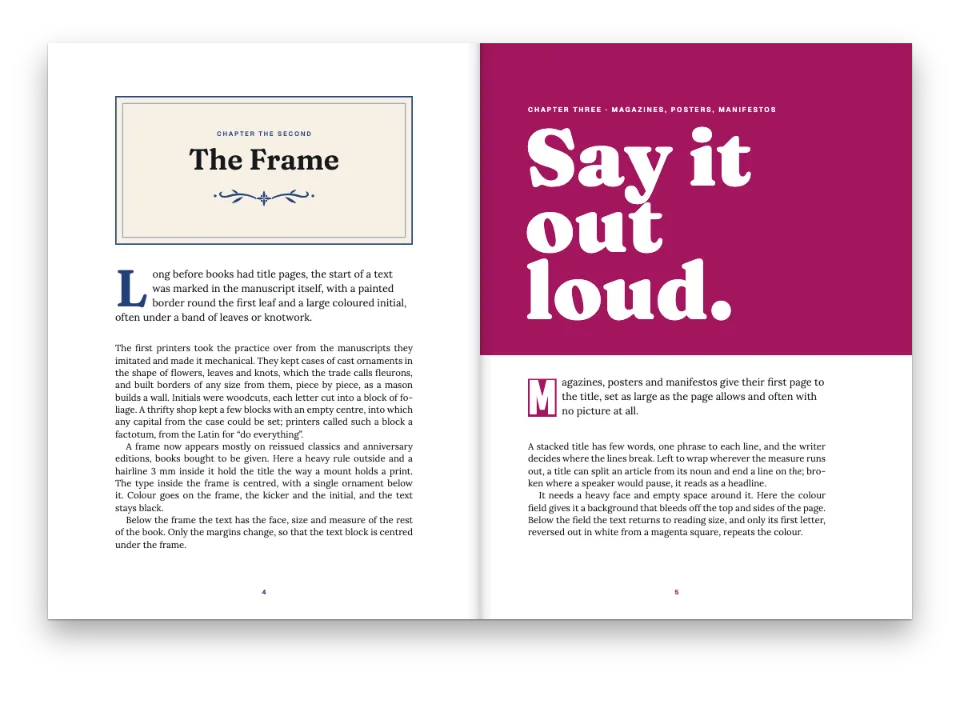
صفحات افتتاح الفصول في كتاب مدرسي عن علم الأرض. يمتد شريط ملوّن عليه رقم فصل كبير حتى الحافة العليا للصفحة، ويُضبط التصميم مرة واحدة لكل الفصول.
ما الذي ستنضده
صفحات افتتاح الفصول في Earth in Motion، كتاب مدرسي تمهيدي في علم الأرض على صفحة 210 × 280 مم. يفتتح الفصل الثالث تحت شريط بلون الطين المحروق يمتد إلى ما بعد الحافة العليا للصفحة. يحمل الشريط سطرًا تمهيديًا متباعد الحروف، والعنوان مكسورًا حيث اختار المؤلف، ومقدمة مائلة، ورقم فصل بحجم 168 pt يقف على قاعدة الشريط الداكنة جهة الحافة الأمامية. يبدأ عمودان مضبوطان تحت الشريط، ويحتل أسفل الصفحة مقطع عرضي لصفيحة غائصة. ويكرر الفصل الرابع التصميم باللون الأزرق المخضر، حتى علامة الحافة وأرقام الأقسام والإحالات وتسمية شكله. يُضبط التصميم مرة واحدة، على عنوان المستوى الأول. ويقدّم سطر عنوان كل فصل موضوع السطر التمهيدي والمقدمة في صورة سمات، ويسمّي نمطًا حين يأخذ الفصل لونًا آخر.
تجيب هذه الوصفة عن
- كيف أصمم صفحة افتتاح فصل فيها شريط لوني ممتد حتى النزف ورقم فصل كبير والعنوان؟
- كيف أنضد عنوان الفصل بعرض الصفحة بينما يجري المتن في عمودين تحته؟
- كيف أضيف إلى صفحة الافتتاح سطر المؤلف أو مقدمة تمهيدية أو فقرة أولى بحرف استهلالي؟
- كيف أعطي كل فصل صورته أو لونه أو شكل افتتاحه الخاص؟
- كيف أرقّم العناوين (1، 1.1، 1.1.1) وأنسّق كل مستوى بطريقة مختلفة؟
الجواب المختصر
const TOP = 24; // top margin, mm: the opener's container starts here
const OUTER = 16; // outer margin, mm: the numeral and the folios line up on it
const BLEED = 0; // mm: 0 on screen; about 3 for print, which also switches on page.cutLines
const BAND = 100; // mm from the trim to the foot of the band
const NUMERAL = 168; // pt; the baseline of a design text sits 0.8 down its line box
const PT = 25.4 / 72; // mm in a point
const AIR = 12; // mm, foot to text: ≥ 0.2 × NUMERAL × PT ≈ 11.9, the numeral box below its baseline
const BEARING = 2; // mm past the text edge: a rough optical nudge, as each digit's bearing differs
const bleedTop = { to: 'bleed', edge: 'top-left' }; // the trim's corner, pushed out by BLEED
// Design text centres and cuts with '…' by default (gotcha: overflow-ellipsis-default).
const onBand = { color: col('paper'), align: 'left', overflow: 'wrap' };
const below = (id, y, width) => ({ anchor: { to: `#${id}`, edge: 'below' }, offset: { y: mm(y) },
  size: { width: mm(width) } }); // chained: a longer title pushes the standfirst down
const opener = { enabled: true,
  // The text starts below the lowest element or minHeight (gotcha: opener-reserves-anchored).
  minHeight: mm(BAND - TOP + AIR), // clears the numeral, so the text starts AIR below the foot
  slot: {
    elements: [ // array order is paint order: the band first, the type on top
      { kind: 'box', id: 'band', style: { backgroundColor: col('band') }, placement: {
        anchor: bleedTop, size: { height: mm(BLEED + BAND) } } }, // no width: runs to the far edge
      { kind: 'rule', id: 'foot', color: col('ink'), thickness: mm(1.6), placement: {
        anchor: bleedTop, offset: { y: mm(BLEED + BAND) } } },
      // {numberDecimal} is empty on headings (gotcha: heading-number-placeholders)
      { kind: 'text', id: 'numeral', content: '{chapterNumber}', ...onBand,
        fontFamily: 'Archivo', fontWeight: 800, fontSize: pt(NUMERAL),
        lineHeight: 1, // a multiple of the size, never pt() (gotcha: design-lineheight-multiple)
        placement: { anchor: { to: 'page', edge: 'top-right' }, // the fore-edge of a recto
          offset: { x: mm(BEARING - OUTER), y: mm(BAND - 0.8 * NUMERAL * PT) } } }, // on the foot
      { kind: 'text', id: 'kicker', ...onBand, fontFamily: 'Archivo Narrow', fontWeight: 600,
        content: `${t({ en: 'Chapter', es: 'Capítulo' })} {chapterNumber} · {attr.topic}`,
        fontSize: pt(8.5), letterSpacing: pt(2), textTransform: 'uppercase',
        placement: { anchor: { to: 'container', edge: 'top-left' }, offset: { y: mm(7) } } },
      { kind: 'text', id: 'title', content: '{titleText}', ...onBand, // breaks at the \\
        fontFamily: 'Archivo', fontWeight: 800, fontSize: pt(34), lineHeight: 1.02,
        placement: below('kicker', 3, 118) },
      { kind: 'text', id: 'lead', content: '{attr.lead}', ...onBand, fontFamily: 'Roboto Serif',
        italic: true, fontSize: pt(10.5), lineHeight: 1.36, placement: below('title', 6, 100) },
    ],
  },
}; // hook-up: headings.levels[0] = { span: 'page', breakBefore, advancedDesign: opener }
المكونات
- الميزات
- صفحات افتتاح مصمَّمةشريط فصل بعرض الصفحةسمات العنوانفواصل الأسطر في العناوينأنماط العناوينألوان لكل جزءالعناوين المرقّمةفصول تبدأ في صفحة فرديةتثبيت عناصر التصميمالنصوص والخطوط والمربعات في تصاميم الصفحةأشرطة النزف وألسنة الإبهاملوحة ألوان دلاليةالترويسات وأرقام الصفحاتالترويسات بحسب دور الصفحةاستشهادات تضع الأشكالموضع الأشكالالأشكال والجداول بوصفها مواردكتب تُبنى فصلًا فصلًاصفحات على اللوحة (Canvas)
- الخطوط
- Roboto Serif, Archivo, Archivo Narrow (SIL OFL 1.1)
- الأصول
- لا شيء: كل صورة مرسومة بالكود
طريقة التحضير
#1 · علّق الشريط والرقم على الصفحة
الشيفرة هي الجواب المختصر أعلاه. يتعلق الشريط وقاعدته بالزاوية العليا اليسرى للنزف. وككل صندوق أو خط لا يُعطى عرضًا، يمتدان إلى الحافة البعيدة لذلك الإطار، فيبلغان حدّ القص، ثم النزف متى ضُبط BLEED. ويتعلق الرقم بالزاوية العليا اليمنى للصفحة: y: BAND - 0.8 * NUMERAL * PT يضع خط أساسه على القاعدة، وBEARING يحرّك صندوقه 2 مم إلى داخل الهامش تعويضًا عن الفراغ الجانبي للرقم، فيصطف الحبر تقريبًا مع حافة النص. ويتعلق السطر التمهيدي بالحاوية. ويتعلق العنوان تحت السطر التمهيدي، والمقدمة تحت العنوان، عبر مراسٍ below مع overflow: 'wrap'، فالعنوان الأطول يدفع المقدمة إلى الأسفل. والمقدمة عنصر نصي يُملأ من السمة lead في العنوان؛ وسطر المؤلف سيكون عنصرًا آخر، {attr.author}، يُربط بالطريقة نفسها. يحدد minHeight: BAND - TOP + AIR موضع بدء المتن. يمتد صندوق الرقم تحت القاعدة بمقدار 0.2 × حجمه (11.9 مم)، وصفحة الافتتاح تحجز المساحة حتى أدنى عناصرها، فيجب ألّا يقل AIR عن 11.9 مم؛ وإن قلّ، حدّد صندوق الرقم موضع بدء النص.
#2 · أعطِ عنوان الفصل الصفحة
  headings: {
    fontFamily: 'Archivo', color: col('band'),
    levels: [
      // span: 'page' alone opens each chapter on the next page, whatever its side. The break,
      // which any headings object drops (gotcha: headings-drop-h1-break), is restated for its
      // parity: 'odd' keeps openers on rectos, so the numeral's right-edge anchor is the fore-edge.
      // The copy is fitted so no chapter spills a few lines onto a page before an odd opener:
      // 1.4.1 sets such a page's column shorter than its text and drops the last line.
      { level: 1, span: 'page', breakBefore: { enabled: true, parity: 'odd' },
        // 0: the hidden title's default 0.5 em would add a grid line, and AIR alone sets the gap
        marginBottom: pt(0), advancedDesign: opener },
      { level: 2, fontSize: pt(11.5), lineHeight: pt(LEAD), numberingTemplate: '{1}.{2}',
        marginTop: pt(LEAD), marginBottom: pt(0) }, // one grid line above, none below
    ],
  },
يفتح span: 'page' كل فصل في صفحة جديدة ويضع عنوان المستوى الأول عبر العمودين؛ ويرسم advancedDesign صفحة الافتتاح مكان نص العنوان، ويبدأ المتن تحت الارتفاع المحجوز. وspan وحده يأخذ الصفحة التالية، فردية كانت أو زوجية، وأي كائن headings يُسقط الانتقال الافتراضي إلى صفحة فردية. لذلك يُعاد ذكر الانتقال مع parity: 'odd'، فتقع كل صفحة افتتاح على صفحة فردية، حيث يكون مرسى الرقم الأيمن هو الحافة الأمامية. وفي المستوى الثاني يرقّم numberingTemplate: '{1}.{2}' الأقسام 3.1، 3.2… بلون الشريط؛ ومستوى ثالث مع '{1}.{2}.{3}' سيتابع إلى 3.1.1.
#3 · سمِّ لون الفصل مرة واحدة
const palette = {
  ink: '#1b1f23', // text: a cool near-black
  band: '#c2562b', // the chapter colour: band, tab, section numbers, references, captions
  band2: '#2e6f73', // the second chapter colour, a teal; the sea in Figure 3.1
  land: '#d5cbc0', // the crust in the drawings
  muted: '#6b6259', // running heads and the colophon
  paper: '#ffffff', // type on the band
};
// col(id): a palette-linked colour. It carries the hex too, because 1.4.1 paints design
// elements and the reference colour from the hex (gotcha: palette-skips-designs).
const col = (id) => ({ hex: palette[id], model: 'hex', paletteId: id });
const colorPalette = [
  ...Object.entries(palette).map(([id, hex]) => ({ id, name: id, value: { hex, model: 'hex' } })),
  // The engine's defaults link to 'main-color': point it at the band, so nothing prints blue.
  { id: 'main-color', name: 'band (defaults)', value: { hex: palette.band, model: 'hex' } },
];
// {style="teal"} on a heading line swaps 'band' up to the next level-1 heading: the style's
// palette reaches design slots through their link and repaints every text colour equal to
// the base 'band'. (Swapping colorPalette itself would not reach the design slots.)
const headingStyles = [{ id: 'teal', palette: { band: palette.band2 } }];
كل لون في الإعدادات مرتبط بأحد هذه المدخلات. والقيم الافتراضية للمحرّك نفسه مرتبطة بـ main-color، فتوجيه هذا المدخل إلى لون الشريط يعيد أيضًا تلوين كل قيمة افتراضية تتركها الإعدادات دون ضبط. سطر عنوان الفصل الرابع، # Fire from \\ Below {style="teal" topic="Volcanoes" lead="…"}، يختار النمط، فيستبدل band حتى عنوان المستوى الأول التالي. تتبع خانات التصميم الاستبدال عبر ارتباطها باللوحة، ويُعاد تلوين النص الذي يساوي لونه band الأساسي، فتصير علامة الحافة وأرقام الأقسام والقوائم والإحالات وتسمية التعليق ورقم الصفحة السفلي زرقاء مخضرة في الصفحتين 43 و44. ويملأ السطر نفسه {attr.topic} و{attr.lead}، و\\ فيه يكسر {titleText} حيث يريد المؤلف (سمات العنوان، كسر الأسطر في العناوين).
#4 · دع الاستشهاد الأول يضع كل شكل
const figure = (id, placement, caption) => ({ id, typeId: 'figure', kind: 'svg', createdAt: 0,
  updatedAt: 0, svg: { fileId: `${id}.svg`, width: ART[id].width, height: ART[id].height },
  placement, caption, altText: ALT[id] }); // altText: read aloud in a PDF or HTML edition
const resources = [
  // 'auto' may take the citing page's foot, 'top' never can (gotcha: top-float-next-page)
  figure('plate-cycle', { position: 'auto', span: 'page' },
    t({ en: 'A plate’s life in cross-section: born at a ridge (left), it cools as it drifts away '
      + 'and sinks under a continent; dots mark earthquakes.',
    es: 'La vida de una placa, en corte: nace en la dorsal (izquierda), se enfría al alejarse y '
      + 'se hunde bajo el continente; los puntos son terremotos.' })),
  figure('two-volcanoes', { position: 'bottom', span: 'page' }, // under the text on a last page
    t({ en: 'Two volcanoes in cross-section: a broad shield built of runny basalt flows (left) '
      + 'and a steep stratovolcano of lava and ash layers (right).',
    es: 'Dos volcanes en corte: un escudo ancho, de coladas de basalto fluido (izquierda), y un '
      + 'estratovolcán de capas de lava y ceniza (derecha).' })),
];
يرقّم :ref شكله ويضعه في أول موضع شاغر بعد الفقرة التي تستشهد به. الشكل 3.1 مضبوط على auto. يُستشهد به في صفحة الافتتاح والعمودان ما زال فيهما متسع، فيأخذ أسفل تلك الصفحة؛ ولو كان عنصرًا عائمًا top لافتتح الصفحة 42، لأن العنصر العائم لا يصعد أبدًا فوق إحالته. ويُستشهد بالشكل 4.1 في أسفل العمود الثاني من الصفحة 43، حيث لم يعد شريط بعرض الصفحة يتسع، فيرسله bottom إلى الصفحة 44. تلك هي الصفحة الأخيرة من الفصل، وفي الصفحة الأخيرة يرفع المحرّك العناصر العائمة السفلية لتقع تحت آخر أسطر النص مباشرة، بلا فجوة فوقها.
#5 · الترويسات وعلامة الحافة ورقم الصفحة السفلي
const HEAD = 15.5; // mm from the trim to the folio's and the head's baseline: 8.5 above TOP
const INSET = 9; // mm from the folio's edge to the head: room for a three-digit folio
const TAB = { y: 36, w: 9, h: 26 }; // the thumb tab, mm: its top, its width, its height
const tabSize = (w) => ({ width: mm(w), height: mm(TAB.h) });
const baseline = (size) => mm(HEAD - 0.96 * size * PT); // box: 1.2 × size, baseline 0.8 down
const label = { fontFamily: 'Archivo Narrow', fontSize: pt(7.5), fontWeight: 600,
  letterSpacing: pt(1.3), textTransform: 'uppercase', color: col('muted') };
const folio = { fontFamily: 'Archivo', fontSize: pt(9), fontWeight: 800, color: col('ink') };
const side = (parity) => { // the fore-edge is a verso's left edge and a recto's right edge
  const [edge, s] = parity === 'even' ? ['left', 1] : ['right', -1]; // s: into the page
  const at = (to, x, y, size) => ({ anchor: { to, edge: `top-${edge}` },
    offset: { x: mm(s * x), y }, ...(size && { size }) });
  return [
    { kind: 'text', id: `folio-${parity}`, content: '{pageNumber}', ...folio,
      placement: at('page', OUTER, baseline(9)) },
    // Textbooks name the chapter on the verso and the section on the recto; 1.4.1 has no
    // section placeholder, so the recto names the book.
    { kind: 'text', id: `head-${parity}`, content: s > 0 ? '{chapterTitle}' : '{title}',
      ...label, placement: at('page', OUTER + INSET, baseline(7.5)) },
    { kind: 'box', id: `tab-${parity}`, style: { backgroundColor: col('band') }, // off the trim
      placement: at('bleed', 0, mm(BLEED + TAB.y), tabSize(BLEED + TAB.w)) },
    { kind: 'text', id: `tab-no-${parity}`, content: '{chapterNumber}', ...folio, fontSize: pt(13),
      color: col('paper'), // design text centres by default: here, on the trimmed tab
      placement: at('page', 0, mm(TAB.y), tabSize(TAB.w)) },
  ].map((element) => ({ ...element, parity, pages: 'body' })); // never on an opener
};
const header = { elements: [...side('even'), ...side('odd')] };
const footer = { elements: [{ kind: 'text', id: 'drop-folio', content: '{pageNumber}',
  ...folio, color: col('band'), pages: 'opener', // centred by its anchor
  placement: { anchor: { to: 'container', edge: 'top' }, offset: { y: mm(10) } } }] };
كل عنصر من عناصر الترويسة يتعلق بزاوية عليا من الصفحة ويُرشَّح بـ parity، فيقع رقم الصفحة والعلامة دائمًا على الحافة الأمامية. أما صندوق العلامة فيتعلق بزاوية النزف ويتسع مع BLEED، فيبقى ممتدًا إلى ما بعد الحافة بعد القص. ويُبقي pages: 'body' هذه العناصر كلها بعيدة عن صفحات الافتتاح، التي تأخذ رقم صفحة سفليًا من التذييل. تسمّي الصفحة الزوجية الفصل بـ {chapterTitle}، على سطر واحد، لأن \\ لا يكسر العنوان إلا في صفحة الافتتاح. والكتب المدرسية تسمّي القسم عادة في الصفحة الفردية. لا يملك Postext 1.4.1 عنصرًا نائبًا للقسم، فتطبع ترويسة الصفحة الفردية {title} الكتاب؛ ولا تظهر في هذه الصفحات الأربع، لأن صفحتيها الفرديتين كلتيهما صفحتا افتتاح.
#6 · ابدأ الكتاب من الفصل الثالث
const continuation = { pageNumbering: { startAt: 41 }, // an odd folio: page 1 is still a recto
  headings: { h1: 2, h2: 0, h3: 0, h4: 0, h5: 0, h6: 0 } }; // the next # is chapter 3
const doc = await buildWithFonts(
  () => buildDocument({ markdown, resources, continuation }, config()), markdown);
showPages(doc, { title: t({ en: 'Chapter opener on a full-bleed band',
  es: 'Apertura de capítulo sobre banda a sangre' }) });
هذه الصفحات هي الفصلان الثالث والرابع من كتاب أطول، فيأخذ buildDocument كائن continuation فيه العدّادات كما تركها الفصلان الأول والثاني. ومع h1: 2 في headings الخاص به، يكون # التالي الفصل الثالث: يطبع {chapterNumber} الرقم 3، وتُرقَّم الأقسام من 3.1، ويصير الشكل الأول 3.1. ويبدأ pageNumbering.startAt: 41 أرقام الصفحات من 41. وتبقى الصفحة الأولى فردية أيًّا كان رقمها، لأن الزوجية تُحسب على الصفحة الفعلية وpageIndexOffset متروك على 0؛ والرقم الأول، 41، فردي ليتوافق معها.
الوصفة كاملة
// ═══ Postext Cookbook · Nº 003 · Chapter opener on a full-bleed band ══════════════ // https://postext.dev/en/cookbook/chapter-opener-bleed-band // Code: MIT · Text: original (CC BY 4.0) · Drawings: generated in code (CC BY 4.0) // Fonts: Roboto Serif, Archivo, Archivo Narrow (SIL OFL 1.1) · Needs postext ≥ 1.4.1 // Two chapters of a geology textbook. Every level-1 heading becomes a colour band bled off the // top of the page, its number standing on the band's foot; a heading style recolours chapter 4. import { buildDocument, renderPageToCanvas, clearMeasurementCache, registerResourceImage, defaultResourceTypes, } from 'https://esm.sh/postext'; const LANG = 'en'; // @lang: the language of the sample document ('en' | 'es') const RECIPE = 'chapter-opener-bleed-band'; // ─── 1 · Design ───────────────────────────────────────────────────────────── // #region palette: semantic colours, and the style that swaps a chapter's const palette = { ink: '#1b1f23', // text: a cool near-black band: '#c2562b', // the chapter colour: band, tab, section numbers, references, captions band2: '#2e6f73', // the second chapter colour, a teal; the sea in Figure 3.1 land: '#d5cbc0', // the crust in the drawings muted: '#6b6259', // running heads and the colophon paper: '#ffffff', // type on the band }; // col(id): a palette-linked colour. It carries the hex too, because 1.4.1 paints design // elements and the reference colour from the hex (gotcha: palette-skips-designs). const col = (id) => ({ hex: palette[id], model: 'hex', paletteId: id }); const colorPalette = [ ...Object.entries(palette).map(([id, hex]) => ({ id, name: id, value: { hex, model: 'hex' } })), // The engine's defaults link to 'main-color': point it at the band, so nothing prints blue. { id: 'main-color', name: 'band (defaults)', value: { hex: palette.band, model: 'hex' } }, ]; // {style="teal"} on a heading line swaps 'band' up to the next level-1 heading: the style's // palette reaches design slots through their link and repaints every text colour equal to // the base 'band'. (Swapping colorPalette itself would not reach the design slots.) const headingStyles = [{ id: 'teal', palette: { band: palette.band2 } }]; // #endregion // #region answer: the opener: a bleed band, the numeral on its foot, texts from the heading const TOP = 24; // top margin, mm: the opener's container starts here const OUTER = 16; // outer margin, mm: the numeral and the folios line up on it const BLEED = 0; // mm: 0 on screen; about 3 for print, which also switches on page.cutLines const BAND = 100; // mm from the trim to the foot of the band const NUMERAL = 168; // pt; the baseline of a design text sits 0.8 down its line box const PT = 25.4 / 72; // mm in a point const AIR = 12; // mm, foot to text: ≥ 0.2 × NUMERAL × PT ≈ 11.9, the numeral box below its baseline const BEARING = 2; // mm past the text edge: a rough optical nudge, as each digit's bearing differs const bleedTop = { to: 'bleed', edge: 'top-left' }; // the trim's corner, pushed out by BLEED // Design text centres and cuts with '…' by default (gotcha: overflow-ellipsis-default). const onBand = { color: col('paper'), align: 'left', overflow: 'wrap' }; const below = (id, y, width) => ({ anchor: { to: `#${id}`, edge: 'below' }, offset: { y: mm(y) }, size: { width: mm(width) } }); // chained: a longer title pushes the standfirst down const opener = { enabled: true, // The text starts below the lowest element or minHeight (gotcha: opener-reserves-anchored). minHeight: mm(BAND - TOP + AIR), // clears the numeral, so the text starts AIR below the foot slot: { elements: [ // array order is paint order: the band first, the type on top { kind: 'box', id: 'band', style: { backgroundColor: col('band') }, placement: { anchor: bleedTop, size: { height: mm(BLEED + BAND) } } }, // no width: runs to the far edge { kind: 'rule', id: 'foot', color: col('ink'), thickness: mm(1.6), placement: { anchor: bleedTop, offset: { y: mm(BLEED + BAND) } } }, // {numberDecimal} is empty on headings (gotcha: heading-number-placeholders) { kind: 'text', id: 'numeral', content: '{chapterNumber}', ...onBand, fontFamily: 'Archivo', fontWeight: 800, fontSize: pt(NUMERAL), lineHeight: 1, // a multiple of the size, never pt() (gotcha: design-lineheight-multiple) placement: { anchor: { to: 'page', edge: 'top-right' }, // the fore-edge of a recto offset: { x: mm(BEARING - OUTER), y: mm(BAND - 0.8 * NUMERAL * PT) } } }, // on the foot { kind: 'text', id: 'kicker', ...onBand, fontFamily: 'Archivo Narrow', fontWeight: 600, content: `${t({ en: 'Chapter', es: 'Capítulo' })} {chapterNumber} · {attr.topic}`, fontSize: pt(8.5), letterSpacing: pt(2), textTransform: 'uppercase', placement: { anchor: { to: 'container', edge: 'top-left' }, offset: { y: mm(7) } } }, { kind: 'text', id: 'title', content: '{titleText}', ...onBand, // breaks at the \\ fontFamily: 'Archivo', fontWeight: 800, fontSize: pt(34), lineHeight: 1.02, placement: below('kicker', 3, 118) }, { kind: 'text', id: 'lead', content: '{attr.lead}', ...onBand, fontFamily: 'Roboto Serif', italic: true, fontSize: pt(10.5), lineHeight: 1.36, placement: below('title', 6, 100) }, ], }, }; // hook-up: headings.levels[0] = { span: 'page', breakBefore, advancedDesign: opener } // #endregion // #region heads: folios and heads on body pages, a thumb tab that bleeds, drop folios const HEAD = 15.5; // mm from the trim to the folio's and the head's baseline: 8.5 above TOP const INSET = 9; // mm from the folio's edge to the head: room for a three-digit folio const TAB = { y: 36, w: 9, h: 26 }; // the thumb tab, mm: its top, its width, its height const tabSize = (w) => ({ width: mm(w), height: mm(TAB.h) }); const baseline = (size) => mm(HEAD - 0.96 * size * PT); // box: 1.2 × size, baseline 0.8 down const label = { fontFamily: 'Archivo Narrow', fontSize: pt(7.5), fontWeight: 600, letterSpacing: pt(1.3), textTransform: 'uppercase', color: col('muted') }; const folio = { fontFamily: 'Archivo', fontSize: pt(9), fontWeight: 800, color: col('ink') }; const side = (parity) => { // the fore-edge is a verso's left edge and a recto's right edge const [edge, s] = parity === 'even' ? ['left', 1] : ['right', -1]; // s: into the page const at = (to, x, y, size) => ({ anchor: { to, edge: `top-${edge}` }, offset: { x: mm(s * x), y }, ...(size && { size }) }); return [ { kind: 'text', id: `folio-${parity}`, content: '{pageNumber}', ...folio, placement: at('page', OUTER, baseline(9)) }, // Textbooks name the chapter on the verso and the section on the recto; 1.4.1 has no // section placeholder, so the recto names the book. { kind: 'text', id: `head-${parity}`, content: s > 0 ? '{chapterTitle}' : '{title}', ...label, placement: at('page', OUTER + INSET, baseline(7.5)) }, { kind: 'box', id: `tab-${parity}`, style: { backgroundColor: col('band') }, // off the trim placement: at('bleed', 0, mm(BLEED + TAB.y), tabSize(BLEED + TAB.w)) }, { kind: 'text', id: `tab-no-${parity}`, content: '{chapterNumber}', ...folio, fontSize: pt(13), color: col('paper'), // design text centres by default: here, on the trimmed tab placement: at('page', 0, mm(TAB.y), tabSize(TAB.w)) }, ].map((element) => ({ ...element, parity, pages: 'body' })); // never on an opener }; const header = { elements: [...side('even'), ...side('odd')] }; const footer = { elements: [{ kind: 'text', id: 'drop-folio', content: '{pageNumber}', ...folio, color: col('band'), pages: 'opener', // centred by its anchor placement: { anchor: { to: 'container', edge: 'top' }, offset: { y: mm(10) } } }] }; // #endregion const LEAD = 13.2; // body leading in pt: the baseline grid const config = () => ({ // a factory: configs are cached by identity (gotcha: config-cache-identity) locale: t({ en: 'en-us', es: 'es' }), // exact codes only (gotcha: hyphenation-locales) resourceTypes: defaultResourceTypes(LANG), // "Figura" in Spanish (gotcha: resource-types-locale) colorPalette, headingStyles, page: { width: mm(210), height: mm(280), dpi: 150, // a textbook trim; 150 dpi is for the screen cutLines: { enabled: BLEED > 0, bleed: mm(BLEED) }, // bleed and crop marks once BLEED is set margins: { top: mm(TOP), bottom: mm(22), left: mm(20), right: mm(OUTER), mirror: true } }, layout: { layoutType: 'double', gutterWidth: mm(8) }, bodyText: { fontFamily: 'Roboto Serif', fontSize: pt(9.3), lineHeight: pt(LEAD), color: col('ink'), boldColor: col('ink'), italicColor: col('ink'), referenceColor: col('band'), textAlign: 'justify', firstLineIndent: mm(4), indentAfterHeading: false }, // book texture // #region levels: the H1 takes the page and draws the opener; sections number in the band headings: { fontFamily: 'Archivo', color: col('band'), levels: [ // span: 'page' alone opens each chapter on the next page, whatever its side. The break, // which any headings object drops (gotcha: headings-drop-h1-break), is restated for its // parity: 'odd' keeps openers on rectos, so the numeral's right-edge anchor is the fore-edge. // The copy is fitted so no chapter spills a few lines onto a page before an odd opener: // 1.4.1 sets such a page's column shorter than its text and drops the last line. { level: 1, span: 'page', breakBefore: { enabled: true, parity: 'odd' }, // 0: the hidden title's default 0.5 em would add a grid line, and AIR alone sets the gap marginBottom: pt(0), advancedDesign: opener }, { level: 2, fontSize: pt(11.5), lineHeight: pt(LEAD), numberingTemplate: '{1}.{2}', marginTop: pt(LEAD), marginBottom: pt(0) }, // one grid line above, none below ], }, // #endregion orderedLists: { fontFamily: 'Archivo', color: col('band'), // numbers bold by default marginTop: pt(0), marginBottom: pt(0) }, captionStyle: { fontFamily: 'Archivo Narrow', fontSize: pt(8.5), labelColor: col('band'), gap: mm(2.2) }, // the text in bodyText's ink, the label bold in the chapter colour paragraphStyles: [{ id: 'colophon', fontFamily: 'Archivo Narrow', fontSize: pt(7.5), lineHeight: pt(10), color: col('muted'), textAlign: 'left', firstLineIndent: pt(0), marginTop: pt(LEAD) }], header, footer, }); // ─── 2 · Content ──────────────────────────────────────────────────────────── const markdown = String.raw`---نموذج Markdown · أسطر: 83 · content.en.md
title: "Earth in Motion" subtitle: "An Introduction to Geology" --- # The Restless \\ Crust {topic="Plate tectonics" lead="The ground under your feet is moving at about the speed your fingernails grow. This chapter follows the plates that carry the continents and the oceans, and the seams where they part, collide and grind past each other."} The Earth’s surface is a mosaic of rigid plates, some of them larger than a continent, that move slowly but without pause over the hotter rock beneath them. New sea floor forms along the ridges in the middle of the oceans and is destroyed where it sinks back into the mantle at the deep trenches (:ref{id="plate-cycle"}). The continents travel with the plates like luggage on a conveyor belt, and nearly every earthquake, volcano and mountain range on the planet lies where two plates meet. The idea took a long time to be accepted. In 1915 the German meteorologist Alfred Wegener noticed that the coasts on either side of the Atlantic fit together like the pieces of a jigsaw, and argued that the continents had once been joined in a single landmass. He pointed to fossils of the same land reptiles on both sides of the ocean, rock formations that matched across it and the scratches of ancient glaciers in what are now the tropics. What he could not find was a force strong enough to push a continent through solid rock, and for half a century most geologists rejected the idea. The answer came from the ocean floor, where surveys after the Second World War revealed long undersea mountain chains, and rocks that grow steadily older with distance from their crests. ## A planet in pieces The outer shell of the Earth, the lithosphere, is cold and rigid. It takes in the crust and the uppermost part of the mantle, and it is about a hundred kilometres thick: much more under the old cores of the continents, much less under young oceans. Beneath it lies the asthenosphere, rock that is solid but hot enough to flow, very slowly, like warm wax. The lithosphere is broken into seven large plates and a dozen or so smaller ones, and each of them moves as a single slab over the softer layer below. Plates carry two kinds of crust. Oceanic crust is thin, about seven kilometres, and made of dark, dense basalt. Continental crust is 30 to 50 kilometres thick and made largely of lighter, granite-like rock. When plates meet, the denser ocean floor sinks into the mantle and the continent stays on top. That is why the oldest ocean floor anywhere is only about 180 million years old, while rocks on the continents reach back four billion years. Plates move between one and fifteen centimetres a year. At five centimetres a year a plate travels fifty kilometres in a million years, and the Atlantic has opened by several thousand kilometres since the age of the dinosaurs. ## Where plates meet Geologists recognise three kinds of plate boundary, named for the way the plates move against each other: 1. **Divergent boundaries**, where plates pull apart and magma rises to fill the gap. Most lie along the mid-ocean ridges; Iceland is a piece of the Mid-Atlantic Ridge that stands above the sea. 2. **Convergent boundaries**, where plates collide. When ocean floor meets a continent, the denser plate slides beneath the other and sinks into the mantle, a process called *subduction*. When two continents meet, neither sinks, and the crust crumples into ranges such as the Himalaya. 3. **Transform boundaries**, where plates slide past each other sideways: they lock, strain and then slip again. The San Andreas Fault in California is the best-known example on land. Each kind has its own pattern of earthquakes and volcanoes. Where plates part, the earthquakes are shallow and the eruptions quiet, pouring out runny basalt. Where they collide, they cause the most powerful earthquakes on Earth, open deep trenches and raise chains of explosive volcanoes. Where they slide past each other, earthquakes are frequent but volcanoes are almost absent, because crust is neither made nor destroyed there. ## Reading the evidence The clearest evidence for plate tectonics comes from the magnetism of the sea floor. As basalt cools at a ridge, tiny crystals of magnetite line up with the Earth’s magnetic field, like compass needles frozen in place. The field reverses its direction every few hundred thousand years on average, so the sea floor records the reversals as stripes of normal and reversed magnetism. In 1963 Fred Vine and Drummond Matthews explained the stripes, and by 1966 surveys had shown that those on either side of a ridge are mirror images of each other, which is what you would expect if new floor forms at the crest and moves away in both directions. The earthquake record agrees. On a map, earthquakes fall in narrow belts along the plate boundaries. Beneath the trenches they fall on an inclined plane that dips under the neighbouring plate to depths of 700 kilometres, marking the path of the sinking slab. Chains of volcanic islands add a third line of evidence. The Hawaiian Islands grew over a hot spot, a plume of unusually hot rock rising from deep in the mantle that stays put while the plate slides over it. Each volcano is carried away from the plume in turn and dies, and a new one grows in its place. The volcanoes line up like a trail of footprints: the Big Island still erupts, Kauai is about five million years old, and the drowned volcanoes beyond Midway are older still. The direction and the spacing of the chain record where the Pacific Plate has gone, and how fast. Today the motion can be measured directly. GPS receivers bolted to bedrock on every continent fix their own positions to within a millimetre or two, and they show Hawaii creeping north-west towards Japan and Australia moving so fast, about seven centimetres a year, that the country has to revise its official coordinates every few decades. Wegener thought that the continents ploughed through the rock of the ocean floor. In fact they ride on the plates, and the plates are driven by the slow escape of heat from the Earth’s interior. The next chapter turns to the places where that heat reaches the surface. # Fire from \\ Below {style="teal" topic="Volcanoes" lead="Volcanoes are where the heat of the Earth’s interior reaches the surface. This chapter asks why solid rock melts, why some magma pours out quietly while some explodes, and how the shape of a mountain records the way it erupts."} About 1,350 volcanoes on land are considered potentially active, meaning that they have erupted in the last 10,000 years, and many more lie hidden on the sea floor. Three quarters of the active ones stand around the rim of the Pacific Ocean, the so-called Ring of Fire, above the subduction zones described in the previous chapter (:ref{id="plate-cycle"}). Most of the others line the mid-ocean ridges or sit over isolated hot spots such as Hawaii. Every volcano is a pile of its own eruptions. Each one adds a layer of lava or ash to the slopes, so the shape of the mountain records how it has erupted over thousands of years. Its eruptions, in turn, depend on where and how its magma formed. ## Where magma comes from The mantle is almost entirely solid. It melts only when something upsets the balance between temperature and pressure, and there are three ways that happens. At ridges and hot spots, hot rock rises and the pressure on it falls; lower pressure lowers the melting point, so some of the rock melts without getting any hotter. This is *decompression melting*. At subduction zones, the sinking slab releases water into the hot mantle above it, and water, like salt on an icy road, lowers the melting point. This is *flux melting*, and it feeds the volcanoes of the Andes, Japan and the Cascades. Finally, a body of hot magma can melt the crust around it, adding to its own volume and changing its chemistry. Molten rock is lighter than the rock around it, so it rises and collects in magma chambers a few kilometres below the surface. There it may cool slowly into granite or gabbro and never erupt at all, or it may find a way out through the central conduit or through a crack in the side of the mountain. ## Quiet and violent eruptions Whether an eruption oozes or explodes depends mostly on two things: how much silica the magma holds and how much gas is dissolved in it. Silica makes magma thick. Basalt, about half silica by weight, is runny, and its gas escapes easily; its eruptions send out rivers of lava, as on Hawaii and Iceland, and build broad, gently sloping shield volcanoes. Magmas richer in silica, such as andesite and rhyolite, are so stiff that the gas cannot get out. Pressure builds until the magma shatters into ash and pumice, and the volcano blows apart. The cone volcanoes of subduction zones, called *stratovolcanoes*, record both kinds of behaviour. They are built of alternating layers of lava and ash, each layer an eruption, which is why their slopes are steep and their outlines so regular (:ref{id="two-volcanoes"}). Mount Fuji is one. Mount St Helens had the same outline until 18 May 1980, when the north side of the mountain collapsed in a landslide and the sudden release of pressure drove a sideways blast across 600 square kilometres of forest. The largest explosive eruptions reach far beyond their own region. In 1991 Mount Pinatubo in the Philippines injected about fifteen million tonnes of sulphur dioxide into the stratosphere. There it formed a veil of fine droplets that reflected sunlight back into space and lowered the average temperature of the whole planet by about half a degree Celsius for more than a year. Volcanologists compare eruptions on the Volcanic Explosivity Index, a scale from 0 to 8 based mainly on the volume of rock and ash thrown out, on which most steps are ten times larger than the one below. The lava fountains of Kilauea rate 0 or 1, Mount St Helens rated 5 and Pinatubo 6. In 1815 Tambora, in Indonesia, rated 7, and the year that followed was remembered in Europe and North America as the year without a summer. ## Living with volcanoes Some 800 million people live within a hundred kilometres of an active volcano, drawn by fertile soils and geothermal heat, or because their families have always lived there. Most volcanoes give warning before they erupt: swarms of small earthquakes as magma forces its way upwards, a swelling of the ground that satellites can measure to the centimetre, and changes in the gases that seep from the summit. Observatories that watch for these signs have given many towns time to evacuate. In Iceland, geothermal heat from young volcanic rock warms about nine homes in every ten and generates nearly a third of the country’s electricity, and the richest farmland of Java and southern Italy lies on weathered volcanic ash. Most lava flows move slowly enough for people to walk away; they bury houses, roads and fields but seldom take lives. Far more people have died in pyroclastic flows, fast, scorching avalanches of gas, ash and rock that can race down a mountainside at more than a hundred kilometres an hour, and in mudflows, which form when an eruption melts snow or when rain soaks loose ash. Scientists can say that an eruption is becoming more likely, but they can rarely say when it will happen or how large it will be, and a false alarm has its own cost when a city has to be emptied. Around Naples, where more than half a million people live in the zone most exposed to Vesuvius, the emergency plan counts on about three days of warning to move them all to safety. ## Check your understanding 1. Why does ocean floor sink at a subduction zone while a continent stays at the surface? 2. Explain how adding water to hot mantle rock can make it melt without heating it. 3. Mount Fuji and Mauna Loa are both volcanoes. Why is one steep and the other broad? 4. What signs warn volcanologists that magma is rising towards the surface? 5. Why can a single large eruption lower the temperature of the whole planet for a year? :::paragraphs{style="colophon"} From *Earth in Motion*, an imaginary textbook. Set in Roboto Serif, Archivo and Archivo Narrow (SIL OFL) · Text and drawings: original, CC BY 4.0. :::`; // content.<lang>.md, inlined by the Cookbook // #region art: two drawings made of shapes only; their labels live in the captions // No text in the SVG: an SVG image cannot use the page's web fonts (gotcha: svg-no-webfonts). const PX = 10; // SVG pixels per viewBox unit: 348 units = 174 mm, so about 500 dpi in print const svg = (w, h, body) => ({ width: w * PX, height: h * PX, // the size the resource declares markup: `<svg xmlns="http://www.w3.org/2000/svg" width="${w * PX}" height="${h * PX}" ` + `viewBox="0 0 ${w} ${h}">${body}</svg>` }); const fill = (id, a = 1) => `fill="${palette[id]}" fill-opacity="${a}"`; const path = (d, paint) => `<path d="${d}" ${paint}/>`; const poly = (pts, paint) => path(`M${pts.join('L').replaceAll(',', ' ')}Z`, paint); const dot = (x, y, r, paint) => `<circle cx="${x}" cy="${y}" r="${r}" ${paint}/>`; const plume = (x, y, w, h, paint, m = y + h / 2, f = y + h * 0.8) => path(`M${x} ${y}` + `C${x} ${m} ${x + w} ${m} ${x + w} ${f}A${w} ${h / 5} 0 0 1 ${x - w} ${f}` + `C${x - w} ${m} ${x} ${m} ${x} ${y}Z`, paint); // a teardrop of magma, its tip at (x, y) const arrow = (x, y, dx, id, a = 1, turn = 0, s = Math.sign(dx)) => path( // never a <marker> `M${x} ${y - 0.8}h${dx - s * 5}v-1.8l${s * 5} 2.6l${-s * 5} 2.6v-1.8H${x}Z`, `${fill(id, a)} transform="rotate(${turn} ${x} ${y})"`); // Each drawing takes its chapter's colour: a picture's colours are fixed when it is drawn. function plateCycle(hot) { // a plate is born at a ridge and sinks under a continent const top = [[0, 30], [40, 23], [80, 30], [160, 32], [212, 34], [222, 41], [254, 54], [300, 74], [348, 96]]; // the sea floor, then the top of the sinking slab const under = (d) => top.map(([x, y], i) => [x, y + (d[i] ?? d.at(-1))]); const back = (points) => [...points].reverse(); const crust = under([5]); const lith = under([9, 4, 11, 15]); const quakes = [226, 239, 252, 265, 278, 291, 304, 317, 330].map((x, i) => // in the slab dot(x, 40 + (x - 222) * 0.44 + (i % 3), 1.5, `${fill('ink')} stroke="${palette.paper}" ` + 'stroke-width=".6"')); return svg(348, 102, `<rect y="24" width="348" height="80" ${fill(hot, 0.15)}/>` + poly([[0, 16], [238, 16], [222, 41], ...back(top.slice(0, 5))], fill('band2', 0.3)) + poly([...crust, ...back(lith)], fill('muted', 0.45)) // the plate + poly([...top, ...back(crust)], fill('ink', 0.82)) // its oceanic crust + poly([[222, 41], [238, 16], [262, 15], [270, 10], [277, 5], [281, 5], [288, 10], [296, 14], [318, 12], [327, 9], [336, 12], [348, 10], [348, 50], [300, 45], [258, 44], [240, 47]], fill('land')) // the continent and its volcano + plume(41, 23, 9, 26, fill(hot)) + plume(279, 5, 5.5, 26, fill(hot)) + quakes.join('') + dot(272, 51, 2.2, fill(hot)) + dot(275, 43, 1.7, fill(hot)) // melt rising + arrow(34, 19, -26, 'ink', 0.7) + arrow(90, 23, 70, 'ink', 0.7) // the plates part + arrow(60, 68, 56, hot, 0.5) + arrow(284, 74, 31, 'paper', 1, 25)); } function twoVolcanoes(hot) { // a shield (left) and a stratovolcano (right), cut in half const G = 70; // the ground line const shield = (x, w, h) => `M${x - w} ${G}C${x - w * 0.55} ${G - 2} ${x - w * 0.35} ${G - h} ` + `${x} ${G - h}C${x + w * 0.35} ${G - h} ${x + w * 0.55} ${G - 2} ${x + w} ${G}Z`; // convex const cone = (x, w, h, c = w * 0.055) => `M${x - w} ${G}C${x - w * 0.5} ${G - 3} ${x - w * 0.2} ` + `${G - h * 0.6} ${x - c} ${G - h}H${x + c}` // concave flanks around a crater + `C${x + w * 0.2} ${G - h * 0.6} ${x + w * 0.5} ${G - 3} ${x + w} ${G}Z`; const layers = (shape, x, sizes, paints) => sizes.map(([w, h], i) => // eruption on eruption path(shape(x, w, h), fill('paper')) + path(shape(x, w, h), paints[i % 2])).join(''); const ash = [[267, 10, 4], [274, 7, 5.5], [282, 8.5, 5], [289, 5.5, 5], [297, 7, 4.5], [304, 5, 3.5], [279, 12, 3.5], [292, 10, 3.5]].map(([x, y, r]) => dot(x, y, r, fill('land'))); return svg(348, 92, `<rect y="${G}" width="348" height="${92 - G}" ${fill('land')}/>` + layers(shield, 91, [[86, 24], [70, 18], [54, 12], [38, 7]], [fill(hot, 0.3), fill(hot, 0.5)]) + layers(cone, 269, [[74, 56], [61, 46], [48, 36], [35, 26], [22, 16]], [fill(hot, 0.55), fill('muted', 0.35)]) // lava, then ash + ash.join('') // the explosive one blows ash; the shield only pours lava + `<ellipse cx="91" cy="80" rx="24" ry="4.5" ${fill(hot)}/>` // a shallow magma chamber + `<ellipse cx="269" cy="86" rx="20" ry="5" ${fill(hot)}/>` // a deeper one + path(`M89.5 77V${G - 24}h3V77Z`, fill(hot)) + path(`M267.5 83V${G - 56}h3V83Z`, fill(hot))); } const ART = { 'plate-cycle': plateCycle('band'), 'two-volcanoes': twoVolcanoes('band2') }; const ALT = { // the drawings described, for the figures' altText 'plate-cycle': t({ en: 'A dark plate spreads from a ridge on the left, where magma rises, runs ' + 'under a pale sea and bends down beneath a continent topped by a volcano; a row of dots ' + 'along the sinking slab marks earthquakes, and arrows show the plates moving apart.', es: 'Una placa oscura nace en una dorsal a la izquierda, donde sube el magma, corre bajo un mar ' + 'claro y se dobla hacia abajo bajo un continente coronado por un volcán; una fila de puntos ' + 'a lo largo de la placa que se hunde marca los terremotos, y unas flechas muestran cómo se ' + 'separan las placas.' }), 'two-volcanoes': t({ en: 'On the left, a low, broad volcano of thin layers over a shallow magma ' + 'chamber; on the right, a steep cone of alternating lava and ash layers over a deeper ' + 'chamber, with a cloud of ash above its crater.', es: 'A la izquierda, un volcán bajo y ancho, de capas finas, sobre una cámara magmática poco ' + 'profunda; a la derecha, un cono empinado de capas alternas de lava y ceniza sobre una ' + 'cámara más profunda, con una nube de ceniza sobre el cráter.' }), }; // #endregion // #region figure: each figure takes the first free slot after its first citation const figure = (id, placement, caption) => ({ id, typeId: 'figure', kind: 'svg', createdAt: 0, updatedAt: 0, svg: { fileId: `${id}.svg`, width: ART[id].width, height: ART[id].height }, placement, caption, altText: ALT[id] }); // altText: read aloud in a PDF or HTML edition const resources = [ // 'auto' may take the citing page's foot, 'top' never can (gotcha: top-float-next-page) figure('plate-cycle', { position: 'auto', span: 'page' }, t({ en: 'A plate’s life in cross-section: born at a ridge (left), it cools as it drifts away ' + 'and sinks under a continent; dots mark earthquakes.', es: 'La vida de una placa, en corte: nace en la dorsal (izquierda), se enfría al alejarse y ' + 'se hunde bajo el continente; los puntos son terremotos.' })), figure('two-volcanoes', { position: 'bottom', span: 'page' }, // under the text on a last page t({ en: 'Two volcanoes in cross-section: a broad shield built of runny basalt flows (left) ' + 'and a steep stratovolcano of lava and ash layers (right).', es: 'Dos volcanes en corte: un escudo ancho, de coladas de basalto fluido (izquierda), y un ' + 'estratovolcán de capas de lava y ceniza (derecha).' })), ]; // #endregion // ─── 3 · Fonts ────────────────────────────────────────────────────────────── const FONTS = { // text, display and label faces, loaded before the build (gotcha: fonts-first) 'Roboto Serif': ['400', '400i', '700'], Archivo: ['700', '800'], 'Archivo Narrow': ['400', '400i', '600', '700'] }; // 400i: the colophon's book title // ─── 4 · Build & show ─────────────────────────────────────────────────────── await loadFonts(FONTS, markdown); for (const [id, art] of Object.entries(ART)) await loadSvg(`${id}.svg`, art.markup); // #region build: chapters 3 and 4 of a longer book, so the counters start where 2 ended const continuation = { pageNumbering: { startAt: 41 }, // an odd folio: page 1 is still a recto headings: { h1: 2, h2: 0, h3: 0, h4: 0, h5: 0, h6: 0 } }; // the next # is chapter 3 const doc = await buildWithFonts( () => buildDocument({ markdown, resources, continuation }, config()), markdown); showPages(doc, { title: t({ en: 'Chapter opener on a full-bleed band', es: 'Apertura de capítulo sobre banda a sangre' }) }); // #endregionالعُدّة · core, fonts, viewer, images: نفسها في كل وصفة · أسطر: 270
// ─── Kit ── helpers shared by every Cookbook recipe · postext.dev/cookbook ───── // ─── Kit · core v1 ── the same in every recipe · postext.dev/cookbook ───────── function mm(value) { return { value, unit: 'mm' }; } function pt(value) { return { value, unit: 'pt' }; } function em(value) { return { value, unit: 'em' }; } /** The sample language's string: t({ en: 'Figure', es: 'Figura' }). */ function t(strings) { return strings[LANG] ?? Object.values(strings)[0]; } /** A file in this recipe's assets folder, served from the Postext repo by jsDelivr. */ function asset(file) { return `https://cdn.jsdelivr.net/gh/drnachio/postext@main/cookbook/${RECIPE}/assets/${file}`; } // ─── Kit · fonts v1 ── the same in every recipe · postext.dev/cookbook ──────── // Postext measures text with the faces the browser has loaded, and caches the // widths, so every face must be ready before the first build. Faces come from // Fontsource: the same static files the PDF embeds, so screen and PDF agree. /** faces = { 'Family Name': ['400', '400i', '700'] }. `text` is the sample: * letters beyond Latin-1 (č, ł, ő…) also load the latin-ext files. With * `optional`, a face Fontsource does not ship is skipped instead of failing. * Resolves to the number of faces added. */ async function loadFonts(faces, text = '', { optional = false } = {}) { kitStatus('Loading fonts…'); const ranges = { latin: 'U+0000-00FF,U+0131,U+0152-0153,U+02BB-02BC,U+02C6,U+02DA,U+02DC,U+0304,U+0308,U+0329,' + 'U+2000-206F,U+20AC,U+2122,U+2191,U+2193,U+2212,U+2215,U+FEFF,U+FFFD', 'latin-ext': 'U+0100-02BA,U+02BD-02C5,U+02C7-02CC,U+02CE-02D7,U+02DD-02FF,U+0304,U+0308,U+0329,' + 'U+1D00-1DBF,U+1E00-1E9F,U+1EF2-1EFF,U+2020,U+20A0-20AB,U+20AD-20C0,U+2113,U+2C60-2C7F,U+A720-A7FF', }; const subsets = /[Ā-˿Ḁ-ỿ]/.test(text) ? ['latin', 'latin-ext'] : ['latin']; const jobs = []; let added = 0; for (const [family, specs] of Object.entries(faces)) { const id = fontsourceId(family); const meta = optional ? await fontsourceMeta(family) : null; for (const spec of new Set(specs)) { const weight = parseInt(spec, 10); const style = spec.endsWith('i') ? 'italic' : 'normal'; if (hasFace(family, weight, style)) continue; if (optional && !(meta?.weights.includes(weight) && meta.styles.includes(style))) continue; for (const subset of subsets) { const url = `https://cdn.jsdelivr.net/npm/@fontsource/${id}@5/files/${id}-${subset}-${weight}-${style}.woff2`; const face = new FontFace(family, `url(${url}) format('woff2')`, { weight: String(weight), style, unicodeRange: ranges[subset] }); jobs.push(face.load().then((ready) => { document.fonts.add(ready); added++; }, () => { if (subset === 'latin' && !optional) throw new Error(`Fontsource has no ${family} ${weight} ${style}`); })); } } } await Promise.all(jobs).catch((error) => { kitFail(error); throw error; }); return added; } /** Runs `build` (a buildDocument or buildBundle call) and checks the faces * the pages use. A regular face missing from FONTS is loaded with a warning; * bold and italic variants are loaded when the family ships them. Then the * measurement caches are cleared and the build runs again. */ async function buildWithFonts(build, text = '') { const tried = new Set(); for (let round = 0; round < 3; round++) { kitStatus('Laying out…'); await new Promise(requestAnimationFrame); // let the status paint first const result = await Promise.resolve().then(build).catch((error) => { kitFail(error); throw error; }); const wanted = { base: {}, variants: {} }; for (const { font, base } of [result].flat().flatMap(fontStringsOf)) { const { family, weight, style } = parseFont(font); const key = `${family}|${weight}|${style}`; if (tried.has(key) || hasFace(family, weight, style)) continue; tried.add(key); (wanted[base ? 'base' : 'variants'][family] ??= []).push(`${weight}${style === 'italic' ? 'i' : ''}`); } if (Object.keys(wanted.base).length) { console.warn(`[cookbook] FONTS does not list ${JSON.stringify(wanted.base)}: loading them.`); } const added = await loadFonts(wanted.base, text) + await loadFonts(wanted.variants, text, { optional: true }); if (added === 0) return result; clearMeasurementCache(); } throw new Error('The fonts did not settle after three builds.'); } /** Every font string of the layout. `base` marks a block's own face; its * bold, italic and bold-italic variants are listed whether or not used. */ function fontStringsOf(doc) { const found = new Map(); const walk = (node) => { if (!node || typeof node !== 'object') return; if (Array.isArray(node)) { node.forEach(walk); return; } for (const [key, value] of Object.entries(node)) { if (typeof value === 'string' && /fontString$/i.test(key)) { found.set(value, found.get(value) || key === 'fontString'); } else if (value && typeof value === 'object') walk(value); } }; walk(doc.pages); walk(doc.blocks); return [...found].map(([font, base]) => ({ font, base })); } /** '700 37.5px Open Sans' / 'italic 400 13px "Source Serif 4"' → { family, weight, style }. * A string with no weight ('95.8px Young Serif', from a design text) is 400. */ function parseFont(font) { const m = /^(?:(italic|oblique)\s+)?(?:small-caps\s+)?(?:(\d+|bold|normal)\s+)?[\d.]+px\s+(.+)$/.exec(font.trim()); if (!m) throw new Error(`Unexpected font string: ${font}`); const weight = m[2] === 'bold' ? 700 : !m[2] || m[2] === 'normal' ? 400 : Number(m[2]); return { family: m[3].replace(/^["']|["']$/g, ''), weight, style: m[1] ? 'italic' : 'normal' }; } /** True when a loaded FontFace covers exactly this family, weight and style * (document.fonts.check() is also true for families nobody declared). */ function hasFace(family, weight, style) { for (const face of document.fonts) { if (face.status !== 'loaded' || face.style !== style) continue; if (face.family.replace(/^["']|["']$/g, '') !== family) continue; const [low, high = low] = face.weight.split(' ').map(Number); if (weight >= low && weight <= high) return true; } return false; } /** Fontsource's id for a family: 'Source Serif 4' → 'source-serif-4'. */ function fontsourceId(family) { return family.toLowerCase().replace(/\s+/g, '-'); } /** The weights and styles a family ships ({ weights: [400, 700], styles: ['normal', 'italic'] }), or null. */ function fontsourceMeta(family) { fontsourceMeta.cache ??= new Map(); const id = fontsourceId(family); if (!fontsourceMeta.cache.has(id)) { fontsourceMeta.cache.set(id, fetch(`https://api.fontsource.org/v1/fonts/${id}`) .then((res) => (res.ok ? res.json() : null), () => null)); } return fontsourceMeta.cache.get(id); } // ─── Kit · viewer v1 ── the same in every recipe · postext.dev/cookbook ─────── /** Shows the pages as facing spreads on a dark desk: the first page is a * recto on its own, then verso | recto pairs, as in a bound book. Pages * are painted when they scroll near the screen. */ function showPages(docs, { title, width = 460 } = {}) { const root = viewer(title); const pages = [docs].flat().flatMap((doc) => doc.pages.map((page) => ({ doc, page, n: (doc.pageIndexOffset ?? 0) + page.index }))); const spreads = []; let verso = null; for (const p of pages) { if (p.n % 2 === 1) { if (verso) spreads.push([verso, null]); verso = p; } else { spreads.push([verso, p]); verso = null; } } if (verso) spreads.push([verso, null]); const density = Math.min(window.devicePixelRatio || 1, 2); showPages.painter?.disconnect(); const painter = new IntersectionObserver((entries) => { for (const { isIntersecting, target } of entries) { if (!isIntersecting) continue; painter.unobserve(target); const { doc, page } = target.postext; renderPageToCanvas(page, doc, target, { scale: (width * density) / page.width }); } }, { rootMargin: '800px' }); showPages.painter = painter; root.replaceChildren(...spreads.map((pair) => { const spread = document.createElement('div'); spread.className = 'pt-spread'; for (const p of pair) { const figure = document.createElement('figure'); if (p) { const label = p.page.pageLabel || String(p.n + 1); const canvas = document.createElement('canvas'); canvas.postext = p; canvas.style.aspectRatio = `${p.page.width} / ${p.page.height}`; canvas.setAttribute('role', 'img'); canvas.setAttribute('aria-label', `Page ${label}`); const folio = document.createElement('figcaption'); folio.textContent = label; figure.append(canvas, folio); painter.observe(canvas); } else figure.className = 'pt-blank'; spread.append(figure); } return spread; })); kitStatus(`${pages.length} ${pages.length === 1 ? 'page' : 'pages'}`); document.documentElement.dataset.postext = 'ready'; return pages.length; } /** The desk, the bar and the error reporting, created once. */ function viewer(title) { if (!document.getElementById('pt-kit')) { document.head.insertAdjacentHTML('beforeend', `<style id="pt-kit"> :root { color-scheme: dark; } body { margin: 0; background: #0e1014; color: #b9bcc4; font: 13px/1.45 system-ui, sans-serif; } #pt-bar { position: sticky; top: 0; z-index: 1; display: flex; flex-wrap: wrap; align-items: center; gap: 6px 16px; padding: 10px 16px; background: rgb(14 16 20 / .92); backdrop-filter: blur(6px); border-bottom: 1px solid #23262d; } #pt-bar strong { color: #f4f1ea; font-weight: 600; } #pt-actions { display: flex; gap: 12px; margin-left: auto; } #pt-actions a, #pt-actions button { color: #d8a21a; font: inherit; background: none; border: 0; padding: 0; cursor: pointer; } #pages { display: grid; justify-items: center; gap: 48px; padding: 32px 16px 72px; } .pt-spread { display: flex; } .pt-spread figure { margin: 0; width: min(460px, 44vw); } .pt-spread canvas { display: block; width: 100%; background: #fff; box-shadow: 0 1px 2px rgb(0 0 0 / .5), 0 22px 44px -16px rgb(0 0 0 / .8); } .pt-spread figure:first-child canvas { box-shadow: inset -14px 0 14px -14px rgb(0 0 0 / .18), 0 1px 2px rgb(0 0 0 / .5), 0 22px 44px -16px rgb(0 0 0 / .8); } .pt-spread figcaption { margin-top: 10px; text-align: center; font: 600 10px/1 system-ui, sans-serif; letter-spacing: .18em; text-transform: uppercase; color: #6c7079; } .pt-blank { visibility: hidden; } @media (max-width: 760px) { .pt-spread { flex-direction: column; gap: 32px; } .pt-spread figure { width: min(460px, 92vw); } .pt-blank { display: none; } } </style>`); document.body.insertAdjacentHTML('afterbegin', '<header id="pt-bar"><strong id="pt-title"></strong><span id="pt-status" role="status"></span><span id="pt-actions"></span></header>'); document.getElementById('pt-title').textContent = document.title || 'Postext'; addEventListener('error', (event) => kitFail(event.error ?? event.message)); addEventListener('unhandledrejection', (event) => kitFail(event.reason)); } if (title) document.getElementById('pt-title').textContent = title; return document.getElementById('pages') ?? document.body.appendChild(Object.assign(document.createElement('main'), { id: 'pages' })); } function kitStatus(text) { viewer(); document.getElementById('pt-status').textContent = text; } function kitFail(error) { document.documentElement.dataset.postext = 'error'; kitStatus(`Error: ${error?.message ?? error}`); } // ─── Kit · images v1 ── recipes with pictures · postext.dev/cookbook ────────── /** Registers a photo or PNG for the canvas and keeps its bytes for the PDF. * fetch → ImageBitmap never taints the canvas (a plain cross-origin <img> would). */ async function loadImage(fileId, url) { const res = await fetch(url); if (!res.ok) throw new Error(`Image not found (${res.status}): ${url}`); const bytes = new Uint8Array(await res.arrayBuffer()); registerResourceImage(fileId, await createImageBitmap(new Blob([bytes]))); (loadImage.bytes ??= new Map()).set(fileId, bytes); } /** Registers SVG markup (drawn in code, or fetched) as a vector image. */ async function loadSvg(fileId, svg) { const img = new Image(); img.src = `data:image/svg+xml;charset=utf-8,${encodeURIComponent(svg)}`; await img.decode(); registerResourceImage(fileId, img); (loadImage.bytes ??= new Map()).set(fileId, new TextEncoder().encode(svg)); } /** renderToPdf({ resourceBytes: imageBytes }) */ function imageBytes(fileId) { return loadImage.bytes?.get(fileId); } /** renderToHtml({ resourceImageUrl: imageUrl }) */ function imageUrl(fileId) { const bytes = imageBytes(fileId); if (!bytes) return undefined; imageUrl.urls ??= new Map(); if (!imageUrl.urls.has(fileId)) { const type = /\.svg$/i.test(fileId) ? 'image/svg+xml' : /\.png$/i.test(fileId) ? 'image/png' : 'image/jpeg'; imageUrl.urls.set(fileId, URL.createObjectURL(new Blob([bytes], { type }))); } return imageUrl.urls.get(fileId); } // ─── /Kit ───────────────────────────────────────────────────────────────────────
يعمل ملف script.js المجمّع كما هو: الصقه في سكربت الوحدة (module) لأي صفحة، أو افتح الوصفة على CodePen. مجلد الوصفة على GitHub ↗ (يفتح في تبويب جديد)
تنويعات
#اجعل الشريط أعمق
يحدد BAND عمق الشريط وموضع الرقم والارتفاع المحجوز فوق النص. الشريط الأعمق يدفع النص إلى الصفحة التالية، فأعد ضبط طول كل فصل (انظر آخر الأخطاء الشائعة) أو دع الفصول تتوالى.
-const BAND = 100; // mm from the trim to the foot of the band
+const BAND = 128; // mm from the trim to the foot of the band#اطبعه مع النزف
مع نزف 3 مم، يتجاوز الشريط وقاعدته والعلامة حدّ القص بمقدار 3 مم، ويبقى الرقم على القاعدة، ويُفعَّل page.cutLines بالقيمة نفسها.
-const BLEED = 0; // mm: 0 on screen; about 3 for print, which also switches on page.cutLines
+const BLEED = 3; // mm: 0 on screen; about 3 for print, which also switches on page.cutLines#أضف لونًا لفصل آخر
كل لون فصل مدخل إضافي في اللوحة ونمط إضافي؛ اكتب {style="slate"} في سطر عنوان ذلك الفصل.
   band2: '#2e6f73', // the second chapter colour, a teal; the sea in Figure 3.1
+  band3: '#3d4f6b', // a third chapter colour, a slate blue
@@
-const headingStyles = [{ id: 'teal', palette: { band: palette.band2 } }];
+const headingStyles = [{ id: 'teal', palette: { band: palette.band2 } },
+ { id: 'slate', palette: { band: palette.band3 } }];#دع الفصول تتوالى
مع 'any' يُفتتح الفصل في الصفحة التالية. فبعد فصل ينتهي في صفحة فردية يُفتتح في الصفحة الزوجية، بلا صفحة بيضاء قبله، ويقف رقمه بجوار الكعب، لأنه معلّق بالحافة اليمنى للصفحة. وتبقى هذه الصفحات كما هي، إذ ينتهي الفصل الثالث أصلًا في صفحة زوجية.
-      { level: 1, span: 'page', breakBefore: { enabled: true, parity: 'odd' },
+ { level: 1, span: 'page', breakBefore: { enabled: true, parity: 'any' },أخطاء شائعة
خطأ شائع
تحجز الافتتاحية ارتفاعًا يصل إلى أدنى عناصرها المثبّتة على الصفحة
تحجز الافتتاحية ذات التصميم المتقدّم ارتفاع أدنى عناصرها، وتُحتسب كذلك العناصر المثبّتة على الصفحة أو على النزف تحت العنوان، فالزخرفة في أسفل الصفحة تدفع النص إلى الصفحة التالية. أبقِ هذه الزخرفة فوق العنوان، أو انقلها إلى خانة في الترويسة أو التذييل، أو حدّد الحجز بـ minHeight. صفحات افتتاح مصمَّمة →
خطأ شائع
فيض نص التصميم افتراضيًا 'ellipsis-end'
عنصر نص التصميم الذي لا يتسع له عرضه ينتهي افتراضيًا بعلامة الحذف. اضبط overflow: 'wrap' للعناوين التي يجب أن تنكسر على أسطر أكثر. النصوص والخطوط والمربعات في تصاميم الصفحة →
خطأ شائع
lineHeight لنص التصميم مُضاعِف، لا بُعد أبدًا
في خانة التصميم، يضاعف lineHeight لعنصر النص مقاس خطه (lineHeight: 1.05). في postext 1.4.1 لا يُرفض بُعدٌ مثل pt(15): يُقاس ارتفاع الافتتاحية NaN، ويسقط ما تحجزه من مساحة، بما فيه minHeight، دون تحذير، فيجري النص تحت العنوان. النصوص والخطوط والمربعات في تصاميم الصفحة →
خطأ شائع
{number}/{chapterNumber} يطبعان رقم H1؛ و{numberRoman} للأجزاء فقط
يطبع {number} و{chapterNumber} الرقم المنسَّق للعنوان، أما {numberRoman} و{numberDecimal} وسائر الصيغ الرقمية فلا تُملأ إلا في صفحات الأجزاء. نسّق رقم الفصل في numberingTemplate الخاص به ({1:I}) أو مرّره سمةً. العناوين المرقّمة →
خطأ شائع
قيم السمات: لا { ولا }؛ ضع القيمة التي فيها " بين علامتي اقتباس مفردتين
تنتهي قيمة السمة عند القوس المعقوف الختامي، فلا يمكن أن تحتوي { أو }. القيمة التي فيها علامة اقتباس مزدوجة توضع بين علامتي اقتباس مفردتين؛ أما علامة الدولار فلا مشكلة فيها. سمات العنوان →
خطأ شائع
لوحة الألوان المستبدلة لا تصل إلى عناصر التصميم ولا إلى لون الإحالة
يقرأ postext 1.4.1 الإعداد colorPalette في أنماط النص (المتن والعناوين والقوائم والتعليقات والجداول والإطارات) لكن لا في عناصر الترويسات والتذييلات والافتتاحيات وصفحات الأجزاء، ولا في bodyText.referenceColor: تحتفظ بالقيمة الست عشرية المكتوبة بجانب paletteId الخاص بها. حين تستبدل لوحة الألوان، لنسخة شاشة داكنة أو لإعادة تلوين، أعِد كتابة كل لون مرتبط من colorPalette قبل البناء. لوحة ألوان دلالية →
خطأ شائع
العنصر العائم 'top' لا يقع أبدًا في صفحة الإحالة إليه
لا يصعد العنصر العائم أبدًا فوق الإحالة إليه، فالعنصر العائم 'top' الممتد بعرض الصفحة والمُحال إليه في الصفحة N يفتتح الصفحة N+1. أحِل إليه في موضع أبكر، أو استخدم الموضع 'auto' أو 'bottom' الذي يمكنه أن يشغل أسفل صفحة الإحالة. موضع الأشكال →
خطأ شائع
النص داخل SVG في <img> لا يستطيع استخدام خطوط الويب
يُرسَم SVG صورةً، والصورة لا تصل إلى خطوط الويب في الصفحة، فتعود تسمياته إلى خط من النظام. حوّل النص إلى مسارات، أو ضمّن مجموعة فرعية بـ @font-face داخل SVG، أو انقل التسميات إلى التعليق. الأشكال والجداول بوصفها موارد →
خطأ شائع
ترجم Figure/Table بـ defaultResourceTypes(locale)
يضبط locale في الإعداد تقسيمَ الكلمات بالواصلة، لا التعليقات: من دون resourceTypes تقول الأنواع المدمجة Figure وTable بالإنجليزية. مرّر resourceTypes: defaultResourceTypes('es') للإسبانية؛ ولأي لغة أخرى اكتب الأسماء بنفسك في resourceTypes. «شكل» و«جدول» بلغتك →
خطأ شائع
8 لغات فقط تُقسَّم بالواصلة، بالرمز المطابق تمامًا
يتوفر تقسيم الكلمات بالواصلة للغات en-us وes وfr وde وit وpt وca وnl، بمطابقة تامة للرمز: 'es-ES' أو أي لغة أخرى تعود دون تنبيه إلى الإنجليزية الأمريكية. تقسيم الكلمات ولغة المستند →
- للشريط ارتفاع ثابت، بينما يتعلق السطر التمهيدي والعنوان والمقدمة بالهامش العلوي وتنمو إلى الأسفل، فالمقدمة الأطول أو العنوان ذو الأسطر الثلاثة يصطدم بالقاعدة. أبقِ المقدمات في حدود خمسة أسطر، كما تفعل الطبعتان، أو اشتقّ
BANDمن أطول صفحة افتتاح. - معادلة
yالخاصة بالرقم تفترضlineHeight: 1. يقع خط أساس نص التصميم عند 0.8 من ارتفاع صندوق سطره، ولا يساوي0.8 * NUMERALهذه المسافة إلا حين يكون الصندوق بطول الحرف. غيّر ارتفاع السطر أو المرسى، وعليك أن تغيّر المعادلة معه. ويُضبطBEARINGبالعين، لأن لكل رقم فراغه الجانبي الخاص (هنا ينتهي الرقمان 3 و4 بفارق 0.8 مم). - لوحة النمط تعيد تلوين عناصر التصميم والنص. أما الصورة فتحتفظ بالألوان التي رُسمت بها: الشكل 4.1 أزرق مخضر لأن الشيفرة ترسمه من
band2، والشكل المرسوم بلون الطين المحروق إن وُضع في الفصل الرابع يبقى بلونه. - مع
parity: 'odd'، الفصل الذي يتجاوز صفحته الأخيرة ببضعة أسطر يترك صفحة شبه فارغة وصفحة زوجية بيضاء قبل صفحة الافتتاح التالية، ويضع postext 1.4.1 تلك الصفحة بعمود أقصر من نصه، فيضيع السطر الأخير من الفصل. اضبط طول النص، كما تفعل الطبعتان هنا، وافحص الصفحة الأخيرة من كل فصل كلما تغيّر النص أوBAND.
الحقوق
- الوصفة
- Ignacio Ferro
- النص
- نص أصلي, CC BY 4.0
- الخطوط
- Roboto Serif (SIL OFL 1.1) · Archivo (SIL OFL 1.1) · Archivo Narrow (SIL OFL 1.1)
- الكود
- MIT، مثل Postext
حرّر هذا الشرح ↗ (يفتح في تبويب جديد)مجلد الوصفة على GitHub ↗ (يفتح في تبويب جديد)