باختصار
كتيّب قصير عن تربية النحل مكتوب في ملفات منفصلة، ملف لكل فصل. يجمعها Postext في كتاب واحد، وتتواصل أرقام الصفحات والفصول والصور من ملف إلى الذي يليه.
ما الذي ستنضده
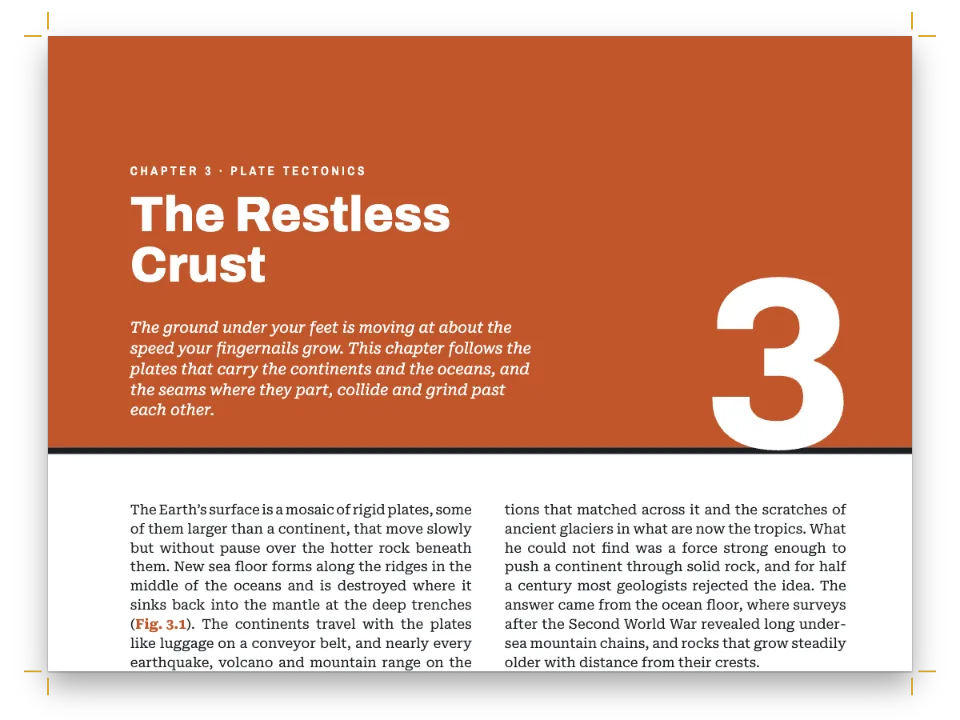
A Beekeeper’s Year كتيّب صغير في أربعة فصول، فصل لكل موسم. يبدأ بالخريف (Autumn)، لأن سنة النحّال تبدأ حين يُجنى آخر العسل. كل فصل ملف Markdown مستقل لا يحمل رقم صفحة ولا رقم فصل ولا رقم شكل. ينقل buildBundle هذه العدّادات من كل ملف إلى الذي يليه، وينضّد الفصول، ومعها ملف خامس للغلاف والمحتويات، كتابًا واحدًا من إحدى عشرة صفحة. يبدأ كل فصل على صفحة يمنى تحت ركن من أقراص الشمع يحمل رقمه. أما صفحة المحتويات، وهي الصفحة الزوجية المقابلة لفصل Autumn، فتعكس صفحة الافتتاح هذه بعنوانها الملاصق للكعب، وتذكر رقم الصفحة التي يبدأ عليها كل فصل. وإطار حضنة واحد، مرسوم بالشيفرة، يظهر مرة في كل فصل بوصفه الأشكال من 1.1 إلى 4.1. وتبقى الصفحة 6 بيضاء لأن فصل Winter يملأ صفحة واحدة ولا بد أن يبدأ Spring على صفحة فردية.
تجيب هذه الوصفة عن
- كيف أُخرج كتابًا من عدة فصول بحيث يتواصل ترقيم الصفحات والأشكال والفصول عبر الفصول؟
- كيف أضيف جدول محتويات يحدّث نفسه (نقاط توجيه، أرقام صفحات، مؤلفون، صفوف الأجزاء)؟
- كيف أفرض فاصل صفحة أو عمود، وأبدأ كل فصل على صفحة يمنى؟
- كيف أخفي الترويسات في صفحات الافتتاح والصفحات الفارغة، أو ألوّن صفحة زوجية فارغة بلون الجزء؟
الجواب المختصر
// buildBundle lays the documents out in order with one config and carries state from each to
// the next: the pages already set (so parity goes on), the folio, the chapter and figure counts.
const book = () => buildBundle({ chapters, config: config(), resources });
const config = () => ({ // a factory: the engine caches resolved configs per object
  headings: { ...display, levels: [
    // Every chapter opens on a recto: after a chapter that ends on one, the next document
    // starts with a blank verso of its own. Restated, because any headings object drops
    // the H1 break (gotcha: headings-drop-h1-break).
    { level: 1, breakBefore: { enabled: true, parity: 'odd' },
      // '{1}' puts the number in the PDF bookmarks ('1 Autumn'); the contents and
      // {chapterNumber} count the chapters in order either way.
      numberingTemplate: '{1}', advancedDesign: opener,
      span: 'page' }, // a page-wide opener, painted unclipped: the comb reaches the top edge
    subhead,
  ] },
  // The cover and the contents are headings that take no number, no contents entry and no
  // running heads, so Autumn is still chapter 1. Both inherit span 'page', which starts
  // each on a page of its own, and parity 'odd', which the contents turn off: it would
  // leave page 2 blank (gotcha: style-inherits-break).
  headingStyles: [
    { id: 'cover', numbered: false, toc: false, advancedDesign: cover, ...bare },
    { id: 'contents', numbered: false, toc: false, breakBefore: { enabled: false },
      advancedDesign: contentsOpener, ...bare },
  ],
  // Figures number {h1}.{n} and the counters carry on (Winter's is 2.1). The types are passed
  // only because config.locale does not turn Figure into Figura (gotcha: resource-types-locale).
  resourceTypes: defaultResourceTypes(LANG),
  // :::toc in the first document lists the whole book with the folio each chapter lands on:
  // buildBundle lays the book out again (three passes at most) until those folios settle.
  toc: contents,
  locale: t({ en: 'en-us', es: 'es' }), // hyphenation, by exact code (gotcha: hyphenation-locales)
  colorPalette, page, layout: { layoutType: 'single' }, bodyText, captionStyle, calloutStyles,
  header, footer, // the look: above, and in the regions below
});
المكونات
- الميزات
- كتب تُبنى فصلًا فصلًاجدول المحتوياتفصول تبدأ في صفحة فرديةتعليقات مرقّمةاستشهادات تضع الأشكالالعناوين المرقّمةأنماط العناوينفصول بلا أرقامترويسات لكل قسمالترويسات وأرقام الصفحاتالترويسات بحسب دور الصفحةصفحات افتتاح مصمَّمةسمات العنوانالصور في تصاميم الصفحةهوامش متناظرةإطارات عائمةالتصدير إلى PDFالعلامات المرجعية في PDF«شكل» و«جدول» بلغتكالأغلفة وصفحات العنوان وبيانات النشر
- تستخدم أيضًا
- إطارات التنبيهشريط فصل بعرض الصفحةلون الورقالخطوط المضمَّنة في PDFأنواع موارد مخصّصةالأشكال والجداول بوصفها مواردفواصل الأسطر في العناوين
- الخطوط
- Andada Pro, Rozha One, Figtree (SIL OFL 1.1)
- الأصول
- لا شيء: كل صورة مرسومة بالكود
طريقة التحضير
#1 · ملف لكل فصل
// Nothing in a chapter says where it lands: buildBundle works that out from the order.
const chapters = [front, autumn, winter, spring, summer].map((markdown) => ({ markdown }));
كل موسم مستند قائم بذاته، فتستطيع إعادة كتابة فصل دون أن تفتح الفصول الأخرى. يحمل المستند الأول البيانات التمهيدية (frontmatter) والغلاف والمحتويات. وفي Postext 1.4.1 لا ترث المستندات التالية شيئًا من بياناته الوصفية، ويقرأ ملف PDF العنوان والمؤلف من المستند الأول وحده.
#2 · قواعد تنتقل عبر المستندات
شيفرة هذه الخطوة هي الجواب المختصر أعلاه. يُخرج buildBundle المستندات بالترتيب بإعدادات مشتركة واحدة، ويمرّر إلى كل منها continuation مما سبقه: عدد الصفحات الفعلية المنضّدة حتى الآن، فتستمر الزوجية والفردية والهوامش المتناظرة وترويسات الصفحات الفردية والزوجية؛ ورقم الصفحة التالي؛ وعدّادات الفصول والأشكال. ومع parity: 'odd' يبدأ الفصل الذي يلي فصلًا انتهى على صفحة فردية بصفحة زوجية بيضاء، وهذه الصفحة البيضاء تنتمي إلى مستنده هو (الفصل قبل العنوان). الغلاف والمحتويات أنماط عناوين مع numbered: false، فيبقى Autumn الفصل 1. ويرث كلاهما span: 'page' من مستوى الفصل، فيوضع كل منهما على صفحة خاصة به دون :::pagebreak. ويُبطل نمط المحتويات الزوجية الموروثة، التي كانت ستترك الصفحة 2 بيضاء لولا ذلك.
#3 · محتويات الكتاب كله
const contents = {
  levels: [
    // The numbers sit ~0.7 mm high in Postext 1.4.1: they are centred on the line
    // (gotcha: toc-number-baseline).
    { level: 1, fontFamily: 'Rozha One', fontSize: pt(16), lineHeight: pt(18),
      numberFontFamily: 'Figtree', numberFontSize: pt(11), numberFontWeight: 700,
      numberColor: col('accent'), numberWidth: mm(7), numberGap: mm(4), marginTop: pt(8) },
    // Sections: 9.3 pt in the muted colour, indented 11 mm (number 7 + gap 4) to the titles.
    { level: 2, fontSize: pt(9.3), lineHeight: pt(13.5), indent: mm(11), color: col('muted') },
  ],
  pageNumber: { fontFamily: 'Figtree', fontSize: pt(8.5), fontWeight: 600, width: mm(7) },
  leader: { char: '. ', gap: mm(2) },
  // A second line under each chapter, from its {months="…"} heading attribute.
  subtitle: { enabled: true, attr: 'months', fontFamily: 'Andada Pro', fontSize: pt(9),
    color: col('muted') }, // italic by default
};
يقع :::toc في المستند الأول لكنه يسرد فصول الكتاب كله وأقسامه. يُخرج buildBundle الكتاب، ويجمع كل عنوان مع رقم الصفحة الذي ناله، ثم يُخرج الكتاب مرة أخرى بهذا المخطط حتى تكفّ الأرقام عن التحرك، في ثلاث جولات على الأكثر (جدول المحتويات). وتأتي الأشهر المكتوبة تحت كل عنوان من سمة على العنوان، {months="…"}، تطبعها صفحة الافتتاح أيضًا.
#4 · صفحة افتتاح واحدة، معكوسة للمحتويات
const corner = (id, edge) => ({ kind: 'image', id, resourceId: id,
  placement: { anchor: { to: 'bleed', edge }, size: { width: mm(CORNER.width) } } });
const months = { kind: 'text', id: 'months', content: '{attr.months}', ...label,
  color: col('accent'), placement: at('top-left', 0, 14, 'container') };
const title = { kind: 'text', id: 'title', content: '{titleText}', ...display, fontSize: pt(42),
  lineHeight: 1.05, align: 'left', overflow: 'wrap', placement: below('months', 1.5, 100) };
const opener = { enabled: true, minHeight: mm(52), slot: { elements: [
  corner('cells', 'top-right'),
  // The number's box is centred on its cell. Comb and number both hang from the bleed's top
  // right, so a bleed (page.cutLines) moves them together.
  { kind: 'text', id: 'number', content: '{chapterNumber}', ...display, fontSize: pt(40),
    lineHeight: 1, align: 'center', placement: { size: { width: mm(NUMBER.box) },
      ...at('top-right', NUMBER_CELL.x + NUMBER.box / 2 - CORNER.width,
        NUMBER_CELL.y - NUMBER.rise, 'bleed') } },
  months, title,
  { kind: 'text', id: 'lead', content: '{attr.lead}', fontFamily: 'Andada Pro', italic: true,
    fontSize: pt(11.5), lineHeight: 1.35, color: col('ink'), align: 'left', overflow: 'wrap',
    placement: below('title', 3, 88) },
] } };
// The contents mirror it on the verso: the comb in the outer corner, the book's subtitle and
// the title set flush right against the spine, on the same lines as Autumn's across the spread.
const flushRight = (element, placement) => ({ ...element, align: 'right',
  placement: { ...placement, size: { width: 'fill' } } });
const contentsOpener = { ...opener, minHeight: mm(40), slot: { elements: [
  corner('comb', 'top-left'),
  flushRight({ ...months, content: '{subtitle}' }, months.placement),
  flushRight(title, below('months', 1.5)),
] } };
يواصل {chapterNumber} العدّ مما أُخرج من المستندات قبله، فتطبع صفحة افتتاح Spring الرقم 3 مع أن ملفه لا يحمل أي رقم. يُحسب إطار الرقم من مركز خليته في القرص، ويتدلّى الرقم والقرص كلاهما من الركن الأيمن العلوي لمنطقة النزف، فإذا غيّرت حدّ القص أو أضفت نزفًا للطباعة تحرّكا معًا. وفي صفحة المحتويات يُنضَّد العنوان التمهيدي (kicker)، المقروء من {subtitle}، والعنوان ملاصقين للكعب إلى اليمين، وينتقل القرص إلى الركن الخارجي للصفحة الزوجية. فيقع عنوانها على ارتفاع عنوان Autumn نفسه في الصفحة المقابلة.
#5 · ترويسات في كل مستند
const head = (id, content, parity, placement, extra = {}) => ({
  kind: 'text', id, content, parity, pages: 'body', // never on openers or blank pages
  ...label, color: col('muted'), placement, ...extra,
});
const folio = { fontSize: pt(8.5), fontWeight: 700, color: col('accent') };
// In Postext 1.4.1 {title} is blank from the second document on (Autumn included): only the
// first one has frontmatter (gotcha: bundle-metadata). So the verso writes the title out.
const BOOK_TITLE = t({ en: 'A Beekeeper’s Year', es: 'Un año de colmenar' });
const header = { elements: [
  head('verso-folio', '{pageNumber}', 'even', at('top-left', MARGIN.outer, HEAD.y), folio),
  head('verso-title', BOOK_TITLE, 'even', at('top-left', MARGIN.outer + HEAD.gap, HEAD.y)),
  // {chapterTitle} and {pageNumber} are worked out page by page, in every document.
  head('recto-title', '{chapterTitle}', 'odd',
    at('top-right', -(MARGIN.outer + HEAD.gap), HEAD.y)),
  head('recto-folio', '{pageNumber}', 'odd', at('top-right', -MARGIN.outer, HEAD.y), folio),
] };
// Openers carry a drop folio instead, 8 mm under the text block.
const footer = { elements: [head('drop-folio', '{pageNumber}', 'all',
  at('top', 0, 8, 'container'), { pages: 'opener', fontWeight: 700 })] };
المستند الأول وحده يحمل بيانات تمهيدية، ففي Postext 1.4.1 لا يطبع {title} شيئًا في أي مستند لاحق، ومنها Autumn. لذلك كُتب عنوان الكتاب نصًّا عاديًّا في ترويسة الصفحة الزوجية. أما {chapterTitle} و{pageNumber} فيُحسبان صفحةً صفحة ويُطبعان في كل مستند؛ والصفحة 11، الصفحة اليمنى الوحيدة في المتن، تحمل SUMMER بجوار رقمها. ويُبعد pages: 'body' كل ترويسة عن صفحات الافتتاح وعن الصفحة البيضاء.
#6 · صفحات متقابلة على الشاشة وملف PDF واحد للكتاب
const text = chapters.map((chapter) => chapter.markdown).join('\n');
await loadFonts(FONTS, text);
const art = { cover: coverArt(), cells: cornerArt(true), comb: cornerArt(false) };
for (const [season, plan] of Object.entries(SEASONS)) art[`${season}-frame`] = frameArt(plan);
for (const [id, markup] of Object.entries(art)) await loadSvg(`${id}.svg`, markup);
const docs = await buildWithFonts(book, text); // one VDTDocument per Markdown document
showPages(docs, { title: BOOK_TITLE });
// renderToPdf takes the array: one file for the book, with a bookmark per chapter.
offerPdf(() => renderToPdf(docs, { fontProvider: fontsourceProvider, resourceBytes: imageBytes }),
  `${RECIPE}.pdf`);
يعيد buildBundle مصفوفة من المستندات، مستند لكل ملف Markdown. ويزاوج showPages بين الصفحات بحسب pageIndexOffset + page.index، فتقف الصفحة 1 وحدها صفحةً فردية، وتتقابل الصفحتان 2 و3، ثم 4 و5، وهكذا. ويأخذ renderToPdf المصفوفة نفسها ويكتب ملفًا واحدًا بأرقام صفحات الكتاب وإشارة مرجعية لكل فصل وقسم.
الوصفة كاملة
// ═══ Postext Cookbook · Nº 007 · One book from separate chapters ══════════════════════════ // https://postext.dev/en/cookbook/book-from-chapters // Code: MIT · Text: original (CC BY 4.0) · Drawings: generated in code (CC BY 4.0) // Fonts: Andada Pro, Rozha One, Figtree (SIL OFL 1.1) · Needs postext ≥ 1.4.1 // A handbook in four seasons written as five Markdown documents, laid out by buildBundle as // one book: parity, folios, chapter and figure numbers and the contents run straight through. import { buildBundle, renderPageToCanvas, clearMeasurementCache, registerResourceImage, defaultResourceTypes, } from 'https://esm.sh/postext'; import { renderToPdf, decompressWoff2 } from 'https://esm.sh/postext-pdf'; const LANG = 'en'; // @lang: the language of the sample document ('en' | 'es') const RECIPE = 'book-from-chapters'; // ─── 1 · Design ───────────────────────────────────────────────────────────── const palette = { // every colour in the config links to one of these, so the book can be retinted ink: '#2a2218', // text and display type honey: '#d99a1e', // the drawings only: the cover and the comb cells accent: '#7a4e12', // the text accent (7:1 on paper): numbers, labels, subheads; main-color too pollen: '#c4692b', comb: '#f7e7c4', rule: '#d8c8a8', // figures: pollen, wax, wood and walls muted: '#6e634f', paper: '#fffdf7', // running heads, colophon, contents sections; the page }; const col = (id) => ({ hex: palette[id], model: 'hex', paletteId: id }); const colorPalette = [ ...Object.entries(palette).map(([id, hex]) => ({ id, name: id, value: { hex, model: 'hex' } })), // The engine's defaults link to 'main-color': point it at the accent, so nothing prints blue. { id: 'main-color', name: 'accent (defaults)', value: { hex: palette.accent, model: 'hex' } }, ]; // The geometry, in mm. The drawings, the opener and the running heads are derived from it. const TRIM = { width: 150, height: 200 }; // a small handbook const MARGIN = { top: 22, bottom: 22, inner: 19, outer: 15 }; // mirrored const MEASURE = TRIM.width - MARGIN.inner - MARGIN.outer; // the text width: 116 mm const SQRT3 = Math.sqrt(3); // comb cells of radius r sit √3·r apart, their rows 1.5·r apart const CORNER = { width: 84, height: 70, r: 9.5 }; // the openers' comb, and its cell radius const NUMBER_CELL = { x: 4 * SQRT3 * CORNER.r, y: 2 * 1.5 * CORNER.r }; // row 2, cell 4 // The chapter number's box: 20 mm wide, its top 8 mm above the cell's centre, which is where // a 40 pt Rozha One figure sits optically centred in the cell. const NUMBER = { box: 20, rise: 8 }; const FRAME = { width: MEASURE, height: 50 }; // the brood frame figures, at the text width const HEAD = { y: 12, gap: 8 }; // running heads 12 mm from the top edge, 8 mm folio to text const LEAD = 14.2; // body leading in pt: the baseline grid // The look: a small handbook, mirrored, justified Andada Pro on the grid; Rozha One titles. const page = { // mirror: left is the inner margin, right the outer sizePreset: 'custom', width: mm(TRIM.width), height: mm(TRIM.height), dpi: 150, backgroundColor: col('paper'), margins: { top: mm(MARGIN.top), bottom: mm(MARGIN.bottom), left: mm(MARGIN.inner), right: mm(MARGIN.outer), mirror: true }, }; const bodyText = { // justified, hyphenated, optimal line breaks and widow control: by default fontFamily: 'Andada Pro', fontSize: pt(10.4), lineHeight: pt(LEAD), color: col('ink'), boldColor: col('ink'), italicColor: col('ink'), referenceColor: col('ink'), firstLineIndent: mm(4.5), indentAfterHeading: false, // Spaces stretch to 1.7× at most (the default is 2): the line breaker then takes the // hyphens it would otherwise avoid, and no line gapes. maxWordSpacing: 1.7, }; const display = { fontFamily: 'Rozha One', fontWeight: 400, color: col('ink') }; // titles // Subheads: the line box itself is a line and a half deep, so the gap to the text under it // is the same everywhere. A margin above would not do it: it drops at the head of a page. const subhead = { level: 2, fontFamily: 'Andada Pro', fontWeight: 700, fontSize: pt(12.5), lineHeight: pt(LEAD * 1.5), color: col('accent'), marginTop: pt(LEAD), marginBottom: pt(0) }; const captionStyle = { fontFamily: 'Figtree', fontSize: pt(7.6), gap: mm(2.5), labelColor: col('accent') }; // The colophon floats to the foot of the last page: a box with no background, placed // 'bottom'. One statement per paragraph, because a no-break space would not keep // "CC BY 4.0" on one line (gotcha: nbsp-breaks). const calloutStyles = [{ id: 'colophon', placement: 'bottom', backgroundEnabled: false, padding: { top: pt(0), right: pt(0), bottom: pt(0), left: pt(0) }, marginBottom: pt(0), body: { fontFamily: 'Figtree', fontSize: pt(7), lineHeight: pt(10), color: col('muted'), textAlign: 'left', firstLineIndent: pt(0) } }]; // #region answer: five Markdown documents, one book: buildBundle and the rules they share // buildBundle lays the documents out in order with one config and carries state from each to // the next: the pages already set (so parity goes on), the folio, the chapter and figure counts. const book = () => buildBundle({ chapters, config: config(), resources }); const config = () => ({ // a factory: the engine caches resolved configs per object headings: { ...display, levels: [ // Every chapter opens on a recto: after a chapter that ends on one, the next document // starts with a blank verso of its own. Restated, because any headings object drops // the H1 break (gotcha: headings-drop-h1-break). { level: 1, breakBefore: { enabled: true, parity: 'odd' }, // '{1}' puts the number in the PDF bookmarks ('1 Autumn'); the contents and // {chapterNumber} count the chapters in order either way. numberingTemplate: '{1}', advancedDesign: opener, span: 'page' }, // a page-wide opener, painted unclipped: the comb reaches the top edge subhead, ] }, // The cover and the contents are headings that take no number, no contents entry and no // running heads, so Autumn is still chapter 1. Both inherit span 'page', which starts // each on a page of its own, and parity 'odd', which the contents turn off: it would // leave page 2 blank (gotcha: style-inherits-break). headingStyles: [ { id: 'cover', numbered: false, toc: false, advancedDesign: cover, ...bare }, { id: 'contents', numbered: false, toc: false, breakBefore: { enabled: false }, advancedDesign: contentsOpener, ...bare }, ], // Figures number {h1}.{n} and the counters carry on (Winter's is 2.1). The types are passed // only because config.locale does not turn Figure into Figura (gotcha: resource-types-locale). resourceTypes: defaultResourceTypes(LANG), // :::toc in the first document lists the whole book with the folio each chapter lands on: // buildBundle lays the book out again (three passes at most) until those folios settle. toc: contents, locale: t({ en: 'en-us', es: 'es' }), // hyphenation, by exact code (gotcha: hyphenation-locales) colorPalette, page, layout: { layoutType: 'single' }, bodyText, captionStyle, calloutStyles, header, footer, // the look: above, and in the regions below }); // #endregion const bare = { header: { elements: [] }, footer: { elements: [] } }; // no running heads // #region art: honeycomb drawn in code, seeded so that every run draws the same cells let seed = 2026; // Mulberry32, a tiny seeded PRNG: never Math.random() in a recipe const rand = () => { let r = Math.imul((seed = (seed + 0x6d2b79f5) | 0) ^ (seed >>> 15), 1 | seed); r = (r + Math.imul(r ^ (r >>> 7), 61 | r)) ^ r; return ((r ^ (r >>> 14)) >>> 0) / 4294967296; }; const paint = (id, opacity = 1) => `fill="${palette[id]}" fill-opacity="${opacity}"`; // A w × h mm sheet (10 px per mm) of hexagonal cells of radius r; cell(x, y) paints each one. function comb(w, h, r, cell, under = '') { let svg = `<svg xmlns="http://www.w3.org/2000/svg" width="${w * 10}" height="${h * 10}" ` + `viewBox="0 0 ${w} ${h}">${under}`; for (let row = 0, y = 0; y < h + r; y = ++row * 1.5 * r) { for (let x = (row % 2) * SQRT3 / 2 * r; x < w + 2 * r; x += SQRT3 * r) { const corner = (a) => `${(x + 0.88 * r * Math.sin(a)).toFixed(2)} ` + (y - 0.88 * r * Math.cos(a)).toFixed(2); const hexagon = [0, 1, 2, 3, 4, 5].map((i) => corner(i * Math.PI / 3)).join('L'); const fill = cell(x, y); if (fill) svg += `<path d="M${hexagon}Z" ${fill}/>`; } } return `${svg}</svg>`; } // Comb that thins out with the distance d from a corner: solid cells with some open ones up to // d = 0.78, faint open cells up to 1, nothing beyond. const fade = (d, full, open, k = 1) => (d > 1 ? '' : d > 0.78 ? paint(open, 0.14 * k) : rand() < 0.3 ? paint(open, 0.28 * k) : paint(full, (d < 0.5 ? 0.95 : 0.6) * k)); const coverArt = () => comb(TRIM.width, TRIM.height, 7.5, (x, y) => fade(Math.hypot( (TRIM.width - x) / TRIM.width, y / (TRIM.height - 10)) + rand() * 0.22, 'comb', 'accent'), `<rect width="${TRIM.width}" height="${TRIM.height}" ${paint('honey')}/>`); // A paler cluster from the outer top corner; on a recto the cell under the number is solid. const cornerArt = (recto) => comb(CORNER.width, CORNER.height, CORNER.r, (x, y) => (recto && Math.hypot(x - NUMBER_CELL.x, y - NUMBER_CELL.y) < 1 ? paint('honey') : fade(Math.hypot(((recto ? CORNER.width : 0) - x) / (CORNER.width - 4), y / (CORNER.height - 6)) + rand() * 0.25, 'honey', 'honey', 0.85))); // One brood frame through the year. Per season: the brood nest (centre v, half-width, // half-height, what fills it) and where the honey sits, on a frame that runs −1…1 each way. const SEASONS = { autumn: [0.5, 0.3, 0.42, 'accent', () => true], winter: [0.4, 0.42, 0.62, 'ink', (u, v) => v < 0.25 - 0.4 * (1 - u * u)], // ink: the cluster spring: [0.2, 0.62, 0.8, 'accent', (u, v) => v < -0.3 && Math.abs(u) > 0.45], summer: [0.45, 0.5, 0.6, 'accent', (u, v) => v < 0.35 || Math.abs(u) > 0.7], }; function frameArt([cv, ru, rv, nest, honey]) { const { width: w, height: h } = FRAME; // a top bar with 4 mm lugs, slim side bars const wood = `<path d="M0 0H${w}V4.5H${w - 4}V${h}H4V4.5H0Z" ${paint('rule')}/>` + `<rect x="6.5" y="4.5" width="${w - 13}" height="${h - 7}" ${paint('rule', 0.5)}/>`; return comb(w, h, 2.5, (x, y) => { const [u, v] = [(x - w / 2) / (w / 2 - 7.5), (y - h / 2 - 1) / (h / 2 - 4)]; const d = Math.hypot(u / ru, (v - cv) / rv) + rand() * 0.12; if (x < 7 || x > w - 7 || y < 6 || y > h - 3.5) return ''; return paint(d < 1 ? nest : d < 1.3 && nest === 'accent' ? 'pollen' : honey(u, v) ? 'honey' : 'comb', d < 1 && nest === 'ink' ? 0.8 : 1); }, wood); } // #endregion // The cover: comb over a honey page, the title low on the inner side where the comb runs out. const label = { fontFamily: 'Figtree', fontSize: pt(7.5), fontWeight: 600, letterSpacing: pt(1.4), textTransform: 'uppercase' }; const at = (edge, x, y, to = 'page') => ({ anchor: { to, edge }, offset: { x: mm(x), y: mm(y) } }); const below = (id, y, width) => ({ ...at('below', 0, y, `#${id}`), ...(width && { size: { width: mm(width) } }) }); // No minHeight: the contents heading, which inherits span 'page', starts the next page. const cover = { enabled: true, slot: { elements: [ { kind: 'image', id: 'art', resourceId: 'cover', placement: { anchor: { to: 'bleed', edge: 'top-left' }, size: { width: 'fill' } } }, { kind: 'text', id: 'kicker', content: '{subtitle}', ...label, fontSize: pt(8.5), color: col('ink'), placement: at('top-left', 17, 116) }, // A design text's lineHeight is a multiple (gotcha: design-lineheight-multiple). { kind: 'text', id: 'title', content: '{titleText}', ...display, fontSize: pt(54), lineHeight: 0.98, align: 'left', overflow: 'wrap', placement: below('kicker', 4, 125) }, { kind: 'rule', id: 'rule', direction: 'horizontal', thickness: pt(2), color: col('ink'), placement: { ...below('title', 6), size: { width: mm(16) } } }, { kind: 'text', id: 'author', content: '{author}', ...label, fontSize: pt(9), fontWeight: 700, color: col('ink'), placement: below('rule', 5) }, ] } }; // #region opener: each chapter's opener: the number in a honey cell, months, title and lead const corner = (id, edge) => ({ kind: 'image', id, resourceId: id, placement: { anchor: { to: 'bleed', edge }, size: { width: mm(CORNER.width) } } }); const months = { kind: 'text', id: 'months', content: '{attr.months}', ...label, color: col('accent'), placement: at('top-left', 0, 14, 'container') }; const title = { kind: 'text', id: 'title', content: '{titleText}', ...display, fontSize: pt(42), lineHeight: 1.05, align: 'left', overflow: 'wrap', placement: below('months', 1.5, 100) }; const opener = { enabled: true, minHeight: mm(52), slot: { elements: [ corner('cells', 'top-right'), // The number's box is centred on its cell. Comb and number both hang from the bleed's top // right, so a bleed (page.cutLines) moves them together. { kind: 'text', id: 'number', content: '{chapterNumber}', ...display, fontSize: pt(40), lineHeight: 1, align: 'center', placement: { size: { width: mm(NUMBER.box) }, ...at('top-right', NUMBER_CELL.x + NUMBER.box / 2 - CORNER.width, NUMBER_CELL.y - NUMBER.rise, 'bleed') } }, months, title, { kind: 'text', id: 'lead', content: '{attr.lead}', fontFamily: 'Andada Pro', italic: true, fontSize: pt(11.5), lineHeight: 1.35, color: col('ink'), align: 'left', overflow: 'wrap', placement: below('title', 3, 88) }, ] } }; // The contents mirror it on the verso: the comb in the outer corner, the book's subtitle and // the title set flush right against the spine, on the same lines as Autumn's across the spread. const flushRight = (element, placement) => ({ ...element, align: 'right', placement: { ...placement, size: { width: 'fill' } } }); const contentsOpener = { ...opener, minHeight: mm(40), slot: { elements: [ corner('comb', 'top-left'), flushRight({ ...months, content: '{subtitle}' }, months.placement), flushRight(title, below('months', 1.5)), ] } }; // #endregion // #region contents: what :::toc prints: numbers in the accent, dotted leaders, folios const contents = { levels: [ // The numbers sit ~0.7 mm high in Postext 1.4.1: they are centred on the line // (gotcha: toc-number-baseline). { level: 1, fontFamily: 'Rozha One', fontSize: pt(16), lineHeight: pt(18), numberFontFamily: 'Figtree', numberFontSize: pt(11), numberFontWeight: 700, numberColor: col('accent'), numberWidth: mm(7), numberGap: mm(4), marginTop: pt(8) }, // Sections: 9.3 pt in the muted colour, indented 11 mm (number 7 + gap 4) to the titles. { level: 2, fontSize: pt(9.3), lineHeight: pt(13.5), indent: mm(11), color: col('muted') }, ], pageNumber: { fontFamily: 'Figtree', fontSize: pt(8.5), fontWeight: 600, width: mm(7) }, leader: { char: '. ', gap: mm(2) }, // A second line under each chapter, from its {months="…"} heading attribute. subtitle: { enabled: true, attr: 'months', fontFamily: 'Andada Pro', fontSize: pt(9), color: col('muted') }, // italic by default }; // #endregion // #region running-heads: the book on the verso, the chapter on the recto, folios outside const head = (id, content, parity, placement, extra = {}) => ({ kind: 'text', id, content, parity, pages: 'body', // never on openers or blank pages ...label, color: col('muted'), placement, ...extra, }); const folio = { fontSize: pt(8.5), fontWeight: 700, color: col('accent') }; // In Postext 1.4.1 {title} is blank from the second document on (Autumn included): only the // first one has frontmatter (gotcha: bundle-metadata). So the verso writes the title out. const BOOK_TITLE = t({ en: 'A Beekeeper’s Year', es: 'Un año de colmenar' }); const header = { elements: [ head('verso-folio', '{pageNumber}', 'even', at('top-left', MARGIN.outer, HEAD.y), folio), head('verso-title', BOOK_TITLE, 'even', at('top-left', MARGIN.outer + HEAD.gap, HEAD.y)), // {chapterTitle} and {pageNumber} are worked out page by page, in every document. head('recto-title', '{chapterTitle}', 'odd', at('top-right', -(MARGIN.outer + HEAD.gap), HEAD.y)), head('recto-folio', '{pageNumber}', 'odd', at('top-right', -MARGIN.outer, HEAD.y), folio), ] }; // Openers carry a drop folio instead, 8 mm under the text block. const footer = { elements: [head('drop-folio', '{pageNumber}', 'all', at('top', 0, 8, 'container'), { pages: 'opener', fontWeight: 700 })] }; // #endregion // ─── 2 · Content ──────────────────────────────────────────────────────────── const front = String.raw`---نموذج Markdown · أسطر: 10 · content.en.md
title: "A Beekeeper’s Year" subtitle: "A handbook in four seasons" author: "Clara Ibarrola" --- # A Beekeeper’s \\ Year {style="cover"} # Contents {style="contents"} :::toc`; // frontmatter, cover and contents (content.<lang>.md) const autumn = String.raw`# Autumn {months="September · October · November" lead="The beekeeper’s year begins when the last honey comes off. What you do in the next eight weeks decides whether there is a colony to wake in March."}نموذج Markdown · أسطر: 16 · content.autumn.en.md
Most calendars start in January, and most beekeeping books in spring, with the first warm day and the first bees on the crocuses. This one starts in September, because that is where the bees start. The colony that flies next April is being raised now: the workers born in autumn live five or six months instead of five or six weeks, and they are the ones that carry the colony through the winter. A colony that goes into October with a young queen, twenty kilos of stores and few mites will usually come out strong in spring. ## Taking the harvest Take the last supers off by the end of August, when at least four fifths of each frame is capped. Clear the bees with a board the evening before and lift the boxes early, before the robbers are up. Leave the brood box alone; the honey in it is the bees’ winter food. Then weigh what is left. A colony in a single brood box needs about twenty kilos of stores to see out a winter like ours, which means frames like the one in :ref{id="autumn-frame"}, capped honey from the top bar almost to the bottom one. If the hive is lighter than that, feed. ## Stores for winter Feed thick syrup, two kilos of sugar to a litre of water, in a feeder over the crownboard, and feed it fast: the bees must take it down, dry it and cap it while the days are still warm enough to fly. By the middle of October it is too late for syrup, and what they have then is what they will eat. A hive that covers fewer than five frames at the end of September seldom lasts the winter on its own. Unite it with a stronger one over a sheet of newspaper: the bees chew through the paper in a day or two and mix without fighting. Treat for varroa as soon as the supers are off, before the winter bees are raised. Narrow the entrance to one bee’s width against wasps, and fit a mouse guard before the first frost. Then close the hive, and do not open it again until the first warm day of spring.`; // content.autumn.<lang>.md, and so on const winter = String.raw`# Winter {months="December · January · February" lead="Below fourteen degrees the bees draw together into a ball on the comb and live on their autumn stores."}نموذج Markdown · أسطر: 2 · content.winter.en.md
The cluster in :ref{id="winter-frame"} is how the colony gets through the cold. The bees on the outside pack tight, heads in, and hold the heat in; those inside shiver their flight muscles to keep the core warm, and the whole ball moves slowly up the frames as it eats. Do not open the hive. Once a month, heft it from the back to feel the weight and clear the dead bees from the entrance.`; const spring = String.raw`# Spring {months="March · April · May" lead="The colony wakes before you do. Wait for the first warm afternoon to open the hive and see what the winter has left behind."}نموذج Markdown · أسطر: 14 · content.spring.en.md
On a still day above fifteen degrees, when the bees are flying freely and coming home with pollen, you can open the hive for the first time. Work quickly and quietly, with a little smoke at the entrance, and ask only three questions: is there a laying queen, is there enough food, and is there room? Keep the visit to ten minutes at most, and close up before the brood can chill. ## The first inspection Look for eggs rather than for the queen. Eggs in the cells mean she was there within the last three days, and an egg standing upright on the base of the cell was laid yesterday. A good frame at the end of April looks like :ref{id="spring-frame"}: a solid oval of capped brood with few gaps, a band of pollen round it and the last of the winter honey in the upper corners. Patchy brood, or eggs laid two and three to a cell, means trouble with the queen; find out now, while there is still time to replace her. If the frames are light, feed. More colonies starve in March and April than in the depth of winter, because the brood is growing fast and the flowers are not yet out. Give a light colony a frame of stores from a strong one, or a block of fondant over the feed hole; syrup can wait for warmer nights. ## Room to grow By May the colony can double in a few weeks. When the bees cover seven or eight frames of the brood box, add a super, and add the next one before the first is full. A crowded colony prepares to swarm, and from now until July you should look through the brood box every seven days for queen cells. Spring is also the time to renew the comb. Early in the season, move three or four of the darkest frames to the edge of the brood box; once the queen has left them, take them out and put in frames of fresh foundation. With nectar coming in, the bees draw new comb eagerly, and in three years every frame in the box has been replaced.`; const summer = String.raw`# Summer {months="June · July · August" lead="The colony is at its largest and the main flow is on. Miss a week in June and the bees may swarm into the apple tree."}نموذج Markdown · أسطر: 32 · content.summer.en.md
In summer the brood box fills with honey from the top down, as :ref{id="summer-frame"} shows, and the supers fill after it. Add supers before the bees need them and look through the brood box for queen cells every week. Leave full frames on the hive until they are capped. In June a missed week can cost you half the colony and most of the crop, so write down what you find at every visit. ## Swarm season Swarming is how a colony reproduces. When the old queen leaves with half the workers, the bees that stay raise a new one, and you have two colonies where you had one, or one colony and a cluster of bees hanging from the nearest branch. The signs are queen cells along the bottom of the frames, a crowded brood box and a queen who has slimmed down to fly. If you find queen cells with larvae in them and the old queen is still at home, make an artificial swarm. Move the old queen to a new box on the old site with one frame of brood, and move the parent colony, with its queen cells, a metre or two away. The flying bees return to the old site and to their queen, and the colony behaves as if it had already swarmed. Within ten days or so a new queen emerges in the parent box, and within a month she is laying. ## The main flow In a good year the flow comes in late June and July, from lime, bramble and clover, and a strong colony can bring in two or three kilos of nectar a day. The supers fill faster than you expect, so keep adding them. Harvest when the frames are capped and the honey no longer shakes out of the cells: it is ripe below eighteen per cent water. Take the supers off at the end of July or in August, clearing the bees as the first chapter describes, and carry the boxes indoors before the robbers find them. ## From comb to jar Uncap the frames over a tray with a knife or a fork, spin them in the extractor, and run the honey through a coarse sieve and then a fine one. Leave it in a settling tank for two or three days in a warm room: the wax and the air bubbles rise, you skim the froth off the top, and what runs from the tap at the bottom is clear. Jar it then, and label each batch with the month and the flowers it came from. Honey keeps for years if it is dry, but it draws water from the air, so seal the jars and store them somewhere cool and dark. Most of it sets in time: spring honey from oilseed rape turns solid within weeks, lime honey stays runny for months, and neither has gone off. A jar that has set runs clear again in a warm water bath, never above forty degrees. Put the wet frames back on the hives in the evening, when the robbers have stopped flying, and let the bees clean them. By September the workers have driven the drones out and the colony is shrinking; the next jobs, feeding and treating for varroa, are in the first chapter. :::callout{type="colophon"} Set in Andada Pro, Rozha One and Figtree (SIL Open Font License). Text and drawings: original, CC BY 4.0. The front matter and the four seasons are five Markdown documents; Postext sets them as one book. An imaginary handbook by an imaginary author. :::`; // #region chapters: five Markdown documents in reading order: the front matter, then a year // Nothing in a chapter says where it lands: buildBundle works that out from the order. const chapters = [front, autumn, winter, spring, summer].map((markdown) => ({ markdown })); // #endregion const svg = (id, [width, height], caption) => ({ id, typeId: 'figure', kind: 'svg', createdAt: 0, updatedAt: 0, caption, altText: caption, svg: { fileId: `${id}.svg`, width: width * 10, height: height * 10 } }); // as comb() draws const CAPTIONS = t({ en: { autumn: 'A frame in October: honey (gold) round the last brood (brown) and pollen (russet).', winter: 'The same frame in January: the cluster (dark) eats its way up from empty comb (pale).', spring: 'The same frame in late April: brood across the middle, the winter honey nearly gone.', summer: 'The same frame in July: an arch of new honey presses down on the brood.', }, es: { autumn: 'Un cuadro en octubre: la miel (dorada) rodea la última cría (marrón) ' + 'y el polen (rojizo).', winter: 'El mismo cuadro en enero: el racimo (oscuro) deja la cera vacía (clara) y sube.', spring: 'El mismo cuadro a finales de abril: cría en el centro; queda poca miel del invierno.', summer: 'El mismo cuadro en julio: un arco de miel nueva aprieta la cría hacia abajo.', } }); const resources = [svg('cover', [TRIM.width, TRIM.height]), svg('cells', [CORNER.width, CORNER.height]), svg('comb', [CORNER.width, CORNER.height]), ...Object.keys(SEASONS).map((season) => svg(`${season}-frame`, [FRAME.width, FRAME.height], CAPTIONS[season]))]; // ─── 3 · Fonts ────────────────────────────────────────────────────────────── // Every face the design uses, loaded before the first build (gotcha: fonts-first). // Rozha One ships one face: renderToPdf still asks for its bold and italic, which the kit's // provider snaps to that face (gotcha: pdf-provider-all-styles). const FONTS = { // text, display and labels 'Andada Pro': ['400', '400i', '700'], 'Rozha One': ['400'], Figtree: ['400', '600', '700'], }; // ─── 4 · Build & show ─────────────────────────────────────────────────────── // #region build: draw, lay the book out, show it as spreads, offer one PDF of all chapters const text = chapters.map((chapter) => chapter.markdown).join('\n'); await loadFonts(FONTS, text); const art = { cover: coverArt(), cells: cornerArt(true), comb: cornerArt(false) }; for (const [season, plan] of Object.entries(SEASONS)) art[`${season}-frame`] = frameArt(plan); for (const [id, markup] of Object.entries(art)) await loadSvg(`${id}.svg`, markup); const docs = await buildWithFonts(book, text); // one VDTDocument per Markdown document showPages(docs, { title: BOOK_TITLE }); // renderToPdf takes the array: one file for the book, with a bookmark per chapter. offerPdf(() => renderToPdf(docs, { fontProvider: fontsourceProvider, resourceBytes: imageBytes }), `${RECIPE}.pdf`); // #endregionالعُدّة · core, fonts, viewer, pdf, images: نفسها في كل وصفة · أسطر: 310
// ─── Kit ── helpers shared by every Cookbook recipe · postext.dev/cookbook ───── // ─── Kit · core v1 ── the same in every recipe · postext.dev/cookbook ───────── function mm(value) { return { value, unit: 'mm' }; } function pt(value) { return { value, unit: 'pt' }; } function em(value) { return { value, unit: 'em' }; } /** The sample language's string: t({ en: 'Figure', es: 'Figura' }). */ function t(strings) { return strings[LANG] ?? Object.values(strings)[0]; } /** A file in this recipe's assets folder, served from the Postext repo by jsDelivr. */ function asset(file) { return `https://cdn.jsdelivr.net/gh/drnachio/postext@main/cookbook/${RECIPE}/assets/${file}`; } // ─── Kit · fonts v1 ── the same in every recipe · postext.dev/cookbook ──────── // Postext measures text with the faces the browser has loaded, and caches the // widths, so every face must be ready before the first build. Faces come from // Fontsource: the same static files the PDF embeds, so screen and PDF agree. /** faces = { 'Family Name': ['400', '400i', '700'] }. `text` is the sample: * letters beyond Latin-1 (č, ł, ő…) also load the latin-ext files. With * `optional`, a face Fontsource does not ship is skipped instead of failing. * Resolves to the number of faces added. */ async function loadFonts(faces, text = '', { optional = false } = {}) { kitStatus('Loading fonts…'); const ranges = { latin: 'U+0000-00FF,U+0131,U+0152-0153,U+02BB-02BC,U+02C6,U+02DA,U+02DC,U+0304,U+0308,U+0329,' + 'U+2000-206F,U+20AC,U+2122,U+2191,U+2193,U+2212,U+2215,U+FEFF,U+FFFD', 'latin-ext': 'U+0100-02BA,U+02BD-02C5,U+02C7-02CC,U+02CE-02D7,U+02DD-02FF,U+0304,U+0308,U+0329,' + 'U+1D00-1DBF,U+1E00-1E9F,U+1EF2-1EFF,U+2020,U+20A0-20AB,U+20AD-20C0,U+2113,U+2C60-2C7F,U+A720-A7FF', }; const subsets = /[Ā-˿Ḁ-ỿ]/.test(text) ? ['latin', 'latin-ext'] : ['latin']; const jobs = []; let added = 0; for (const [family, specs] of Object.entries(faces)) { const id = fontsourceId(family); const meta = optional ? await fontsourceMeta(family) : null; for (const spec of new Set(specs)) { const weight = parseInt(spec, 10); const style = spec.endsWith('i') ? 'italic' : 'normal'; if (hasFace(family, weight, style)) continue; if (optional && !(meta?.weights.includes(weight) && meta.styles.includes(style))) continue; for (const subset of subsets) { const url = `https://cdn.jsdelivr.net/npm/@fontsource/${id}@5/files/${id}-${subset}-${weight}-${style}.woff2`; const face = new FontFace(family, `url(${url}) format('woff2')`, { weight: String(weight), style, unicodeRange: ranges[subset] }); jobs.push(face.load().then((ready) => { document.fonts.add(ready); added++; }, () => { if (subset === 'latin' && !optional) throw new Error(`Fontsource has no ${family} ${weight} ${style}`); })); } } } await Promise.all(jobs).catch((error) => { kitFail(error); throw error; }); return added; } /** Runs `build` (a buildDocument or buildBundle call) and checks the faces * the pages use. A regular face missing from FONTS is loaded with a warning; * bold and italic variants are loaded when the family ships them. Then the * measurement caches are cleared and the build runs again. */ async function buildWithFonts(build, text = '') { const tried = new Set(); for (let round = 0; round < 3; round++) { kitStatus('Laying out…'); await new Promise(requestAnimationFrame); // let the status paint first const result = await Promise.resolve().then(build).catch((error) => { kitFail(error); throw error; }); const wanted = { base: {}, variants: {} }; for (const { font, base } of [result].flat().flatMap(fontStringsOf)) { const { family, weight, style } = parseFont(font); const key = `${family}|${weight}|${style}`; if (tried.has(key) || hasFace(family, weight, style)) continue; tried.add(key); (wanted[base ? 'base' : 'variants'][family] ??= []).push(`${weight}${style === 'italic' ? 'i' : ''}`); } if (Object.keys(wanted.base).length) { console.warn(`[cookbook] FONTS does not list ${JSON.stringify(wanted.base)}: loading them.`); } const added = await loadFonts(wanted.base, text) + await loadFonts(wanted.variants, text, { optional: true }); if (added === 0) return result; clearMeasurementCache(); } throw new Error('The fonts did not settle after three builds.'); } /** Every font string of the layout. `base` marks a block's own face; its * bold, italic and bold-italic variants are listed whether or not used. */ function fontStringsOf(doc) { const found = new Map(); const walk = (node) => { if (!node || typeof node !== 'object') return; if (Array.isArray(node)) { node.forEach(walk); return; } for (const [key, value] of Object.entries(node)) { if (typeof value === 'string' && /fontString$/i.test(key)) { found.set(value, found.get(value) || key === 'fontString'); } else if (value && typeof value === 'object') walk(value); } }; walk(doc.pages); walk(doc.blocks); return [...found].map(([font, base]) => ({ font, base })); } /** '700 37.5px Open Sans' / 'italic 400 13px "Source Serif 4"' → { family, weight, style }. * A string with no weight ('95.8px Young Serif', from a design text) is 400. */ function parseFont(font) { const m = /^(?:(italic|oblique)\s+)?(?:small-caps\s+)?(?:(\d+|bold|normal)\s+)?[\d.]+px\s+(.+)$/.exec(font.trim()); if (!m) throw new Error(`Unexpected font string: ${font}`); const weight = m[2] === 'bold' ? 700 : !m[2] || m[2] === 'normal' ? 400 : Number(m[2]); return { family: m[3].replace(/^["']|["']$/g, ''), weight, style: m[1] ? 'italic' : 'normal' }; } /** True when a loaded FontFace covers exactly this family, weight and style * (document.fonts.check() is also true for families nobody declared). */ function hasFace(family, weight, style) { for (const face of document.fonts) { if (face.status !== 'loaded' || face.style !== style) continue; if (face.family.replace(/^["']|["']$/g, '') !== family) continue; const [low, high = low] = face.weight.split(' ').map(Number); if (weight >= low && weight <= high) return true; } return false; } /** Fontsource's id for a family: 'Source Serif 4' → 'source-serif-4'. */ function fontsourceId(family) { return family.toLowerCase().replace(/\s+/g, '-'); } /** The weights and styles a family ships ({ weights: [400, 700], styles: ['normal', 'italic'] }), or null. */ function fontsourceMeta(family) { fontsourceMeta.cache ??= new Map(); const id = fontsourceId(family); if (!fontsourceMeta.cache.has(id)) { fontsourceMeta.cache.set(id, fetch(`https://api.fontsource.org/v1/fonts/${id}`) .then((res) => (res.ok ? res.json() : null), () => null)); } return fontsourceMeta.cache.get(id); } // ─── Kit · viewer v1 ── the same in every recipe · postext.dev/cookbook ─────── /** Shows the pages as facing spreads on a dark desk: the first page is a * recto on its own, then verso | recto pairs, as in a bound book. Pages * are painted when they scroll near the screen. */ function showPages(docs, { title, width = 460 } = {}) { const root = viewer(title); const pages = [docs].flat().flatMap((doc) => doc.pages.map((page) => ({ doc, page, n: (doc.pageIndexOffset ?? 0) + page.index }))); const spreads = []; let verso = null; for (const p of pages) { if (p.n % 2 === 1) { if (verso) spreads.push([verso, null]); verso = p; } else { spreads.push([verso, p]); verso = null; } } if (verso) spreads.push([verso, null]); const density = Math.min(window.devicePixelRatio || 1, 2); showPages.painter?.disconnect(); const painter = new IntersectionObserver((entries) => { for (const { isIntersecting, target } of entries) { if (!isIntersecting) continue; painter.unobserve(target); const { doc, page } = target.postext; renderPageToCanvas(page, doc, target, { scale: (width * density) / page.width }); } }, { rootMargin: '800px' }); showPages.painter = painter; root.replaceChildren(...spreads.map((pair) => { const spread = document.createElement('div'); spread.className = 'pt-spread'; for (const p of pair) { const figure = document.createElement('figure'); if (p) { const label = p.page.pageLabel || String(p.n + 1); const canvas = document.createElement('canvas'); canvas.postext = p; canvas.style.aspectRatio = `${p.page.width} / ${p.page.height}`; canvas.setAttribute('role', 'img'); canvas.setAttribute('aria-label', `Page ${label}`); const folio = document.createElement('figcaption'); folio.textContent = label; figure.append(canvas, folio); painter.observe(canvas); } else figure.className = 'pt-blank'; spread.append(figure); } return spread; })); kitStatus(`${pages.length} ${pages.length === 1 ? 'page' : 'pages'}`); document.documentElement.dataset.postext = 'ready'; return pages.length; } /** The desk, the bar and the error reporting, created once. */ function viewer(title) { if (!document.getElementById('pt-kit')) { document.head.insertAdjacentHTML('beforeend', `<style id="pt-kit"> :root { color-scheme: dark; } body { margin: 0; background: #0e1014; color: #b9bcc4; font: 13px/1.45 system-ui, sans-serif; } #pt-bar { position: sticky; top: 0; z-index: 1; display: flex; flex-wrap: wrap; align-items: center; gap: 6px 16px; padding: 10px 16px; background: rgb(14 16 20 / .92); backdrop-filter: blur(6px); border-bottom: 1px solid #23262d; } #pt-bar strong { color: #f4f1ea; font-weight: 600; } #pt-actions { display: flex; gap: 12px; margin-left: auto; } #pt-actions a, #pt-actions button { color: #d8a21a; font: inherit; background: none; border: 0; padding: 0; cursor: pointer; } #pages { display: grid; justify-items: center; gap: 48px; padding: 32px 16px 72px; } .pt-spread { display: flex; } .pt-spread figure { margin: 0; width: min(460px, 44vw); } .pt-spread canvas { display: block; width: 100%; background: #fff; box-shadow: 0 1px 2px rgb(0 0 0 / .5), 0 22px 44px -16px rgb(0 0 0 / .8); } .pt-spread figure:first-child canvas { box-shadow: inset -14px 0 14px -14px rgb(0 0 0 / .18), 0 1px 2px rgb(0 0 0 / .5), 0 22px 44px -16px rgb(0 0 0 / .8); } .pt-spread figcaption { margin-top: 10px; text-align: center; font: 600 10px/1 system-ui, sans-serif; letter-spacing: .18em; text-transform: uppercase; color: #6c7079; } .pt-blank { visibility: hidden; } @media (max-width: 760px) { .pt-spread { flex-direction: column; gap: 32px; } .pt-spread figure { width: min(460px, 92vw); } .pt-blank { display: none; } } </style>`); document.body.insertAdjacentHTML('afterbegin', '<header id="pt-bar"><strong id="pt-title"></strong><span id="pt-status" role="status"></span><span id="pt-actions"></span></header>'); document.getElementById('pt-title').textContent = document.title || 'Postext'; addEventListener('error', (event) => kitFail(event.error ?? event.message)); addEventListener('unhandledrejection', (event) => kitFail(event.reason)); } if (title) document.getElementById('pt-title').textContent = title; return document.getElementById('pages') ?? document.body.appendChild(Object.assign(document.createElement('main'), { id: 'pages' })); } function kitStatus(text) { viewer(); document.getElementById('pt-status').textContent = text; } function kitFail(error) { document.documentElement.dataset.postext = 'error'; kitStatus(`Error: ${error?.message ?? error}`); } // ─── Kit · pdf v1 ── the same in every recipe that exports a PDF ────────────── /** postext-pdf embeds TrueType bytes. Fetch the Fontsource file the screen * used, snapping to a weight the family ships and falling back to upright * when it has no italic: the PDF asks for every face a block could use. */ async function fontsourceProvider(family, weight, style) { const id = fontsourceId(family); const meta = await fontsourceMeta(family); const weights = meta?.weights?.length ? meta.weights : [400, 700]; const w = weights.reduce((a, b) => (Math.abs(b - weight) < Math.abs(a - weight) ? b : a)); const s = style === 'italic' && meta && !meta.styles.includes('italic') ? 'normal' : style; const res = await fetch(`https://cdn.jsdelivr.net/npm/@fontsource/${id}@5/files/${id}-latin-${w}-${s}.woff2`); if (!res.ok) throw new Error(`Fontsource has no ${family} ${w} ${s} (${res.status})`); return decompressWoff2(new Uint8Array(await res.arrayBuffer())); } /** A "Build the PDF" button in the bar. Once built: "Open the PDF" (a new * tab, since CodePen's preview frame cannot show PDFs) and a download link. */ function offerPdf(makePdf, filename) { viewer(); const button = Object.assign(document.createElement('button'), { type: 'button', textContent: 'Build the PDF' }); button.dataset.postextPdf = filename; button.addEventListener('click', async () => { button.disabled = true; button.textContent = 'Building the PDF…'; try { const bytes = await makePdf(); const url = URL.createObjectURL(new Blob([bytes], { type: 'application/pdf' })); const size = `${Math.max(1, Math.round(bytes.length / 1024))} KB`; button.replaceWith( Object.assign(document.createElement('a'), { href: url, target: '_blank', rel: 'noopener', textContent: 'Open the PDF ↗' }), Object.assign(document.createElement('a'), { href: url, download: filename, textContent: `Download ${filename} · ${size}` })); } catch (error) { button.disabled = false; button.textContent = 'Build the PDF'; kitFail(error); } }); document.getElementById('pt-actions').append(button); } // ─── Kit · images v1 ── recipes with pictures · postext.dev/cookbook ────────── /** Registers a photo or PNG for the canvas and keeps its bytes for the PDF. * fetch → ImageBitmap never taints the canvas (a plain cross-origin <img> would). */ async function loadImage(fileId, url) { const res = await fetch(url); if (!res.ok) throw new Error(`Image not found (${res.status}): ${url}`); const bytes = new Uint8Array(await res.arrayBuffer()); registerResourceImage(fileId, await createImageBitmap(new Blob([bytes]))); (loadImage.bytes ??= new Map()).set(fileId, bytes); } /** Registers SVG markup (drawn in code, or fetched) as a vector image. */ async function loadSvg(fileId, svg) { const img = new Image(); img.src = `data:image/svg+xml;charset=utf-8,${encodeURIComponent(svg)}`; await img.decode(); registerResourceImage(fileId, img); (loadImage.bytes ??= new Map()).set(fileId, new TextEncoder().encode(svg)); } /** renderToPdf({ resourceBytes: imageBytes }) */ function imageBytes(fileId) { return loadImage.bytes?.get(fileId); } /** renderToHtml({ resourceImageUrl: imageUrl }) */ function imageUrl(fileId) { const bytes = imageBytes(fileId); if (!bytes) return undefined; imageUrl.urls ??= new Map(); if (!imageUrl.urls.has(fileId)) { const type = /\.svg$/i.test(fileId) ? 'image/svg+xml' : /\.png$/i.test(fileId) ? 'image/png' : 'image/jpeg'; imageUrl.urls.set(fileId, URL.createObjectURL(new Blob([bytes], { type }))); } return imageUrl.urls.get(fileId); } // ─── /Kit ───────────────────────────────────────────────────────────────────────
يعمل ملف script.js المجمّع كما هو: الصقه في سكربت الوحدة (module) لأي صفحة، أو افتح الوصفة على CodePen. مجلد الوصفة على GitHub ↗ (يفتح في تبويب جديد)
تنويعات
#اطبع فصلًا واحدًا بأرقام صفحاته في الكتاب
مرّر مستندًا واحدًا إلى renderToPdf لتراجع بروفة Spring وحده، مرقّمًا من 6 إلى 8 كما في الكتاب. وتأتي معه الصفحة البيضاء 6، لأن الصفحة الزوجية البيضاء التي تسبق صفحة افتتاح تنتمي إلى الفصل الذي يبدأ بعدها.
-offerPdf(() => renderToPdf(docs, { fontProvider: fontsourceProvider, resourceBytes: imageBytes }),
+offerPdf(() => renderToPdf(docs[3], { fontProvider: fontsourceProvider, resourceBytes: imageBytes }),#رقّم الأشكال ترقيمًا متصلًا في الكتاب كله
عدّاد أشكال لا يُصفَّر أبدًا يرقّم الإطارات الأربعة من 1 إلى 4 عبر المستندات بدلًا من 1.1 إلى 4.1.
-  resourceTypes: defaultResourceTypes(LANG),
+  resourceTypes: defaultResourceTypes(LANG)
+ .map((type) => ({ ...type, numberingTemplate: '{n}', resetOn: 'never' })),أخطاء شائعة
خطأ شائع
أي كائن headings يُلغي فاصل الصفحة قبل H1
ينتقل H1 افتراضيًا إلى صفحة فردية (always-odd)، لكن تمرير أي كائن headings يعيد ضبط هذا الافتراض، فتتوالى الفصول دون فاصل ولا يفعل span: 'page' شيئًا. أعد كتابة headings.levels[0].breakBefore: { enabled: true, parity } في كل إعداد. فصول تبدأ في صفحة فردية →
خطأ شائع
لا يمرّر buildBundle البيانات الوصفية بين الفصول؛ و{totalPages} لكل فصل على حدة
لا يمرّر buildBundle البيانات الوصفية من فصل إلى الفصل الذي يليه: {title} و{author} وسائرها تأتي فقط من الترويسة الأمامية (frontmatter) للفصل نفسه، فكل فصل بلا ترويسة أمامية يطبعها فارغة (ويُسقط Sandbox الترويسة الأمامية لكل فصل بعد الأول)، ويعدّ {totalPages} صفحات كل فصل وحده. اكتب عنوان الكتاب نصًا صريحًا في الترويسات. كتب تُبنى فصلًا فصلًا →
خطأ شائع
يرث نمط العنوان فاصل الصفحة من مستواه
يأخذ مُدخل headingStyles كل حقل يتركه من مستوى عنوانه، بما فيه breakBefore. فصفحة المحتويات أو صفحة بيانات النشر المنسّقة على H1 بعد :::pagebreak ترث الزوجية 'odd' وتقع بعد صفحة فارغة. أعطِ هذا النمط breakBefore: { enabled: false }. أنماط العناوين →
خطأ شائع
:ref إلى شكل من فصل سابق يضعه مرة أخرى
مع buildBundle في postext 1.4.1، الإحالة :ref إلى شكل أُحيل إليه أولًا في فصل سابق تطبع الرقم الصحيح لكنها تعوِّم الشكل مرة ثانية في الفصل اللاحق، حيث تُعدّ إحالة أولى. أحِل إليه بالكلمات (إطار أكتوبر، الشكل 1.1). كتب تُبنى فصلًا فصلًا →
خطأ شائع
lineHeight لنص التصميم مُضاعِف، لا بُعد أبدًا
في خانة التصميم، يضاعف lineHeight لعنصر النص مقاس خطه (lineHeight: 1.05). في postext 1.4.1 لا يُرفض بُعدٌ مثل pt(15): يُقاس ارتفاع الافتتاحية NaN، ويسقط ما تحجزه من مساحة، بما فيه minHeight، دون تحذير، فيجري النص تحت العنوان. النصوص والخطوط والمربعات في تصاميم الصفحة →
خطأ شائع
الصفحة 1 فردية: خطّط الصفحات بأرقامها الفعلية
الصفحة 1 صفحة يمنى والصفحة 2 أول صفحة زوجية، فخطّط الصفحتين المتقابلتين بأرقام الصفحات الفعلية: الافتتاحية في صفحة زوجية تقابل الصفحة الفردية التي تليها. فواصل الصفحات والأعمدة →
خطأ شائع
ترجم Figure/Table بـ defaultResourceTypes(locale)
يضبط locale في الإعداد تقسيمَ الكلمات بالواصلة، لا التعليقات: من دون resourceTypes تقول الأنواع المدمجة Figure وTable بالإنجليزية. مرّر resourceTypes: defaultResourceTypes('es') للإسبانية؛ ولأي لغة أخرى اكتب الأسماء بنفسك في resourceTypes. «شكل» و«جدول» بلغتك →
خطأ شائع
8 لغات فقط تُقسَّم بالواصلة، بالرمز المطابق تمامًا
يتوفر تقسيم الكلمات بالواصلة للغات en-us وes وfr وde وit وpt وca وnl، بمطابقة تامة للرمز: 'es-ES' أو أي لغة أخرى تعود دون تنبيه إلى الإنجليزية الأمريكية. تقسيم الكلمات ولغة المستند →
خطأ شائع
يطلب PDF كل وزن وكل نمط من كل عائلة
يطلب renderToPdf من مزوّد الخطوط الأوجه العريضة والمائلة والعريضة المائلة لكل عائلة قد تستخدمها أي كتلة، حتى التي لا تُطبع أبدًا، ورفضٌ واحد يوقف التصدير. يجب أن يلجأ المزوّد إلى أقرب وزن توفّره العائلة، وأن يعود إلى الوجه القائم حين لا يوجد وجه مائل. الخطوط المضمَّنة في PDF →
خطأ شائع
المسافة غير القابلة للكسر تكسر السطر مع ذلك
في postext 1.4.1 يعامل كاسر الأسطر U+00A0 معاملة المسافة العادية، فقد تنقسم 0.08 % أو 2.006 s أو Section 2 على سطرين. ألصق الجزأين (0.08%) أو أعد صياغة الجملة. الهروب والمحارف الحرفية →
خطأ شائع
حمّل كل أوجه الخط قبل الإخراج
يقيس الإخراج النص بأوجه الخط التي حمّلها المتصفح ويخزّن العروض مؤقتًا، فالوجه الذي يصل بعد البناء الأول يترك فواصل أسطر خاطئة وملف PDF لم يعد يطابق الشاشة. حمّل كل وزن وكل نمط أولًا، واستدعِ clearMeasurementCache() قبل إعادة البناء إذا تأخر وصول أحدها. الخطوط قبل الإخراج →
خطأ شائع
أرقام جدول المحتويات تقع أعلى قليلًا من خط أساس المُدخل
في postext 1.4.1 يرسم :::toc رقم كل مُدخل متمركزًا على السطر بدل أن يضعه على خط أساس النص، فترتفع أرقام الفصول قليلًا بجانب عناوينها، نحو 0.7 mm بجانب عنوان بمقاس 16 pt، أيًّا كان الخط أو المقاس الذي تعطيه لها. لا يوجد بعدُ خيار في toc يحرّكها، فانظر إلى صفحة المحتويات بمقاسها الكامل قبل الطباعة. جدول المحتويات →
فحص Sandbox · chapterFrontmatterIgnored
تجاهل الترويسة الأمامية للفصل
السبب. لا تُحتسب إلا الترويسة الأمامية (frontmatter) للفصل الأول؛ وفصل لاحق يبدأ بكتلة ترويسة أمامية تُسقَط.
الحل. احتفظ بالبيانات الوصفية للكتاب في الفصل الأول، واستعمل سمات العناوين للقيم الخاصة بكل فصل. التوثيق →
- في رأس الصفحة، وتحت شكل يتصدّر الصفحة، يفقد العنوان الفرعي قيمة
marginTop. فالعنوان الفرعي الذي يأخذ مسافته من الهامش يقف فوق نصه بسطر واحد في هذين الموضعين، وبسطر ونصف في كل موضع آخر. وهنا المسافة جزء من سطر العنوان الفرعي نفسه:lineHeightسطر ونصف والهامش سطر واحد، فيقف كل عنوان فرعي في الكتاب على المسافة نفسها فوق نصه. - السطر المضبوط يستطيع افتراضيًا أن يمدّ مسافاته إلى ضعف عرضها، ويفضّل مقسّم الأسطر ذلك على الواصلة. وبهذه القيمة الافتراضية خلت الطبعة الإنجليزية من الواصلات تمامًا، وجاورت أسطرٌ تقترب مسافاتها من ضعف العرض العادي أسطرًا مضغوطة إلى 0.7. يجعل
maxWordSpacing: 1.7المقسّمَ يلجأ إلى الواصلة بدلًا من ذلك. وبعد تغييره، افحص السطر الأخير من كل فقرة: قد يترك الحدّ الأضيق كلمة واحدة هناك، وتعيد صياغة بضع كلمات من الفقرة تصلح ذلك.
الحقوق
- الوصفة
- Ignacio Ferro
- النص
- نص أصلي, CC BY 4.0
- الخطوط
- Andada Pro (SIL OFL 1.1) · Rozha One (SIL OFL 1.1) · Figtree (SIL OFL 1.1)
- الكود
- MIT، مثل Postext
حرّر هذا الشرح ↗ (يفتح في تبويب جديد)مجلد الوصفة على GitHub ↗ (يفتح في تبويب جديد)