باختصار
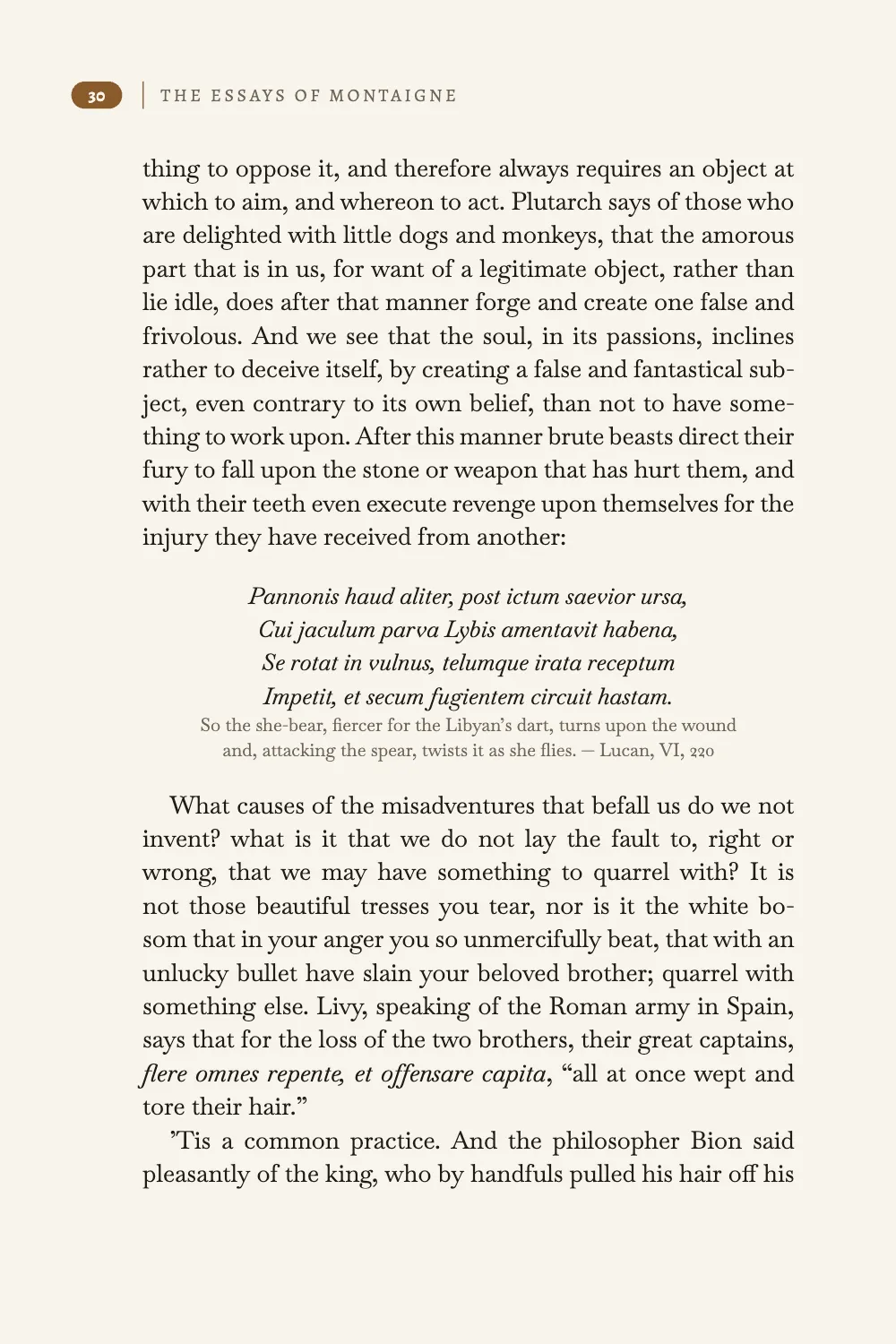
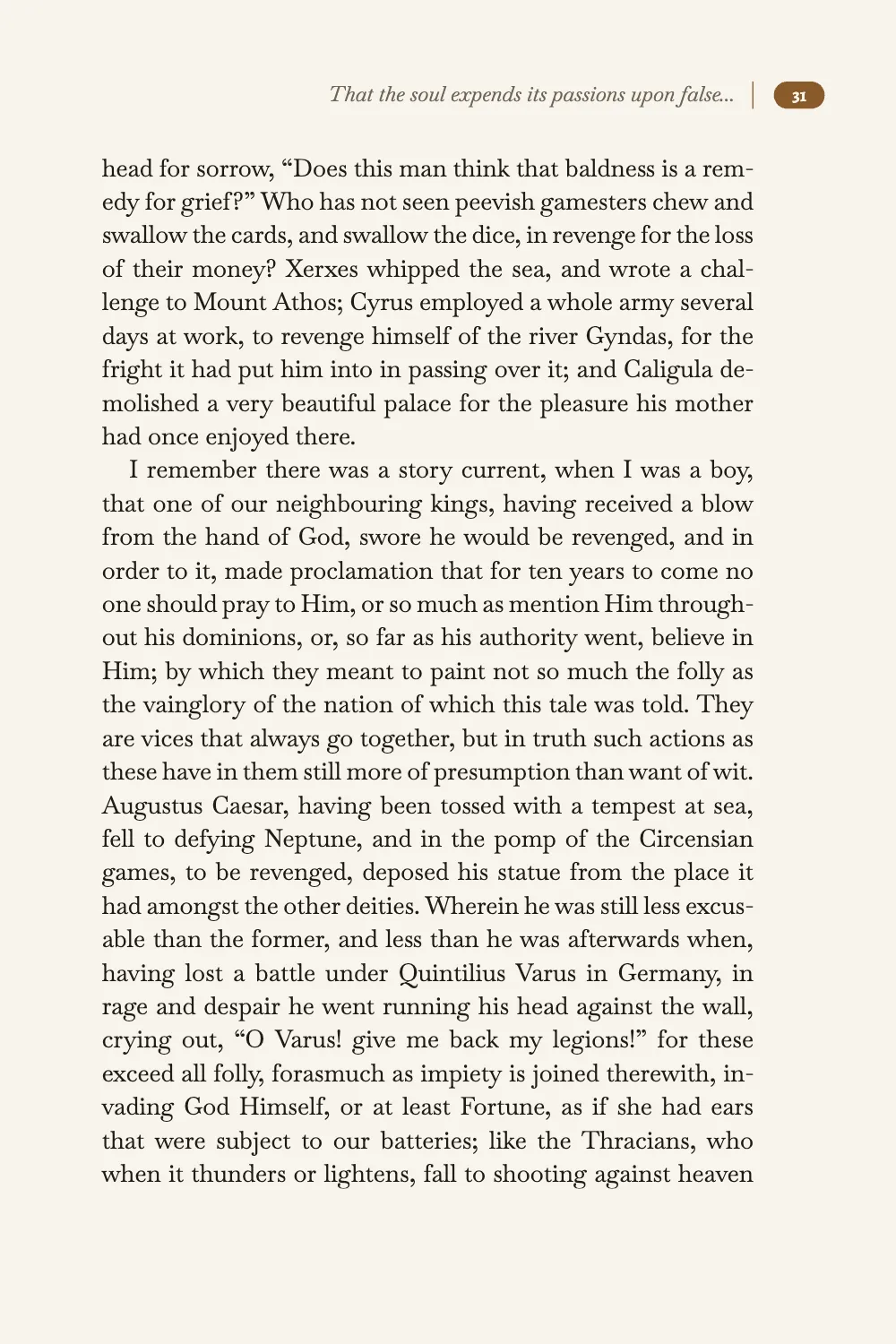
خمس صفحات من كتاب مقالات صغير. تبيّن كيف تطبع عنوان الكتاب أعلى الصفحات اليسرى وعنوان المقالة أعلى الصفحات اليمنى.
ما الذي ستنضده
الصفحات من 29 إلى 33 من طبعة جيب من Essays لمونتيني بترجمة تشارلز كوتون الإنجليزية: الفصل IV كاملًا ومطلع الفصل V. تحمل الصفحات الزوجية عنوان الكتاب بحروف كبيرة متباعدة. وتحمل الفردية عنوان المقالة بالمائل، مختصرًا بنقاط حذف، لأن عنوان الفصل IV يبلغ 81 حرفًا. يقع كل رقم صفحة في لسان بني داكن في الهامش الخارجي، على بعد 3 mm من خط بسماكة 0.5 pt عند حافة كتلة النص. ولا تحمل صفحة الافتتاح ترويسة، بل رقم صفحة في الأسفل فقط. النص بخط Baskervville على صفحة بيضاء مائلة إلى الدفء، والعناوين بخط Libre Caslon Display، وأرقام الصفحات وعنوان الكتاب بخط Alegreya SC. كل ترويسة معرّفة في الإعدادات، فلا تُطبع أبدًا الترويسة المدمجة في المحرّك، Open Sans أزرق بحجم 8 pt.
تجيب هذه الوصفة عن
- كيف أضبط الترويسات: عنوان الكتاب في الصفحة اليسرى، وعنوان الفصل في اليمنى، ورقم الصفحة في الجانب الخارجي؟
- كيف أخفي الترويسات في صفحات الافتتاح والصفحات الفارغة، أو ألوّن صفحة زوجية فارغة بلون الجزء؟
- كيف أمنع العناوين والكلمات العريضة والنقاط من الظهور باللون الأزرق؟
الجواب المختصر
const GAP = 3; // mm from the tab to the divider, which lands on the text block's edge
const HEAD = 12; // mm from the top edge of the page to the top of the tab
const CAP = t({ en: 60.5, es: 66.8 }); // mm: fitted so essay IV's head ends on a word
// (gotcha: ellipsis-mid-word); a short running title (see Variations) suits any title
const page = (edge) => ({ to: 'page', edge }); // the trim box (gotcha: negative-offsets)
const header = { elements: [
  // Verso (even): tab | divider | THE BOOK'S TITLE from the frontmatter (gotcha: quote-frontmatter)
  folio({ id: 'folio-even', parity: 'even', pages: 'body', anchor: page('top-left'),
    x: OUTER - GAP - TAB, y: HEAD }),
  divider({ id: 'rule-even', parity: 'even', from: 'folio-even', edge: 'right-of', x: GAP }),
  { kind: 'text', id: 'book', content: '{title}', parity: 'even', pages: 'body',
    fontFamily: 'Alegreya SC', fontSize: pt(FOLIO_PT), lineHeight: LINE / FOLIO_PT,
    color: col('muted'), textTransform: 'uppercase', letterSpacing: pt(1.3),
    placement: { anchor: { to: '#rule-even', edge: 'right-of' }, // top: the tab's top
      offset: { x: mm(2.5), y: pt(PAD.top) } } }, // PAD.top down: on the folio's baseline
  // Recto (odd): the essay's title, cut short with an ellipsis | divider | tab.
  folio({ id: 'folio-odd', parity: 'odd', pages: 'body', anchor: page('top-right'),
    x: -(OUTER - GAP - TAB), y: HEAD }), // from the right edge, a negative x runs inwards
  divider({ id: 'rule-odd', parity: 'odd', from: 'folio-odd', edge: 'left-of', x: -GAP }),
  { kind: 'text', id: 'essay', content: '{chapterTitle}', parity: 'odd', pages: 'body',
    fontFamily: 'Baskervville', italic: true, fontSize: pt(TITLE_PT),
    lineHeight: LINE / TITLE_PT, color: col('muted'),
    overflow: 'ellipsis-end', // stated, though default (gotcha: overflow-ellipsis-default)
    placement: { anchor: { to: '#rule-odd', edge: 'left-of' },
      offset: { x: mm(-2.5), y: pt(PAD.top) }, size: { maxWidth: mm(CAP) } } },
] };
// Openers: no head, only a drop folio HEAD above the page's foot, centred under the text block.
const footer = { elements: [folio({ id: 'drop-folio', parity: 'all', pages: 'opener',
  anchor: { to: 'container', edge: 'bottom' }, y: -HEAD })] };
المكونات
- الميزات
- الترويسات وأرقام الصفحاتالترويسات بحسب دور الصفحةتثبيت عناصر التصميمالنصوص والخطوط والمربعات في تصاميم الصفحةصفحات افتتاح مصمَّمةسمات العنوانفواصل الأسطر في العناوينفصول تبدأ في صفحة فرديةهوامش متناظرةمقاس القطعلون الورقالبيانات الوصفية للمستندالغامق والمائل وألوانهمالوحة ألوان دلاليةإطارات التنبيهأنماط الفقراتالأسطر الأرامل والأسطر اليتيمة والكلمات المعزولةصفحات على اللوحة (Canvas)كتب تُبنى فصلًا فصلًا
- تستخدم أيضًا
- شريط فصل بعرض الصفحة
- الخطوط
- Baskervville, Libre Caslon Display, Alegreya SC (SIL OFL 1.1)
- الأصول
- لا شيء: كل صورة مرسومة بالكود
طريقة التحضير
#1 · استبدل الترويسة الزرقاء المدمجة
const palette = {
  ink: '#1f1b16', // text: a warm near-black, never #000
  sepia: '#8a5a2b', // the one accent: folio tabs, dividers, opener plates (5.3:1 on paper)
  muted: '#6f6558', // running heads, verse glosses, the colophon (5.2:1 on paper)
  paper: '#f8f4ec', // a warm off-white page; also the type reversed out of the sepia
};
const col = (id) => ({ hex: palette[id], model: 'hex', paletteId: id });
const colorPalette = [
  ...Object.entries(palette).map(([id, hex]) => ({ id, name: id, value: { hex, model: 'hex' } })),
  // Text-style defaults (headings, bold, italic, lists, boxes) link to 'main-color'. The
  // built-in header and footer keep #295AA3, and design slots never read the palette
  // (gotcha: palette-skips-designs), so every element colour here carries its hex.
  { id: 'main-color', name: 'sepia (defaults)', value: { hex: palette.sepia, model: 'hex' } },
];
كل لون في الإعدادات مرتبط بأحد هذه المداخل. إن تركت header بلا تعريف رسم المحرّك ترويسته المدمجة: {title} على الصفحات الفردية و{chapterTitle} على الزوجية فوق خط بسماكة 1 pt، بخط Open Sans 600 بحجم 8 pt وبالأزرق #295AA3 (الترويسات والتذييلات). وتوجيه main-color إلى البني الداكن يعيد تلوين قيم النص الافتراضية لكنه يترك تلك الترويسة زرقاء، لأن خانات التصميم لا تقرأ لوحة الألوان أبدًا. لذلك تُكتب كل ترويسة هنا كاملة، بألوانها بالقيم الست عشرية. والعريض والمائل والإحالات تأخذ افتراضيًا main-color أيضًا، فيعيدها bodyText إلى لون الحبر.
#2 · ابنِ كل ترويسة من لسان واحد
const FOLIO_PT = 7.5; // pt: the folio, and the book's title in capitals beside it
const TITLE_PT = 8.8; // pt: the essay's title, whose italic lowercase reads small at 7.5
const LINE = FOLIO_PT * 1.2; // pt: the folio and both titles share this line box and baseline
const PAD = { top: 1, bottom: 1.4 }; // pt: 0.4 pt more below for the descending 3, 5, 7, 9
const TAB = 7.5; // mm: the tab's width
const TAB_H = LINE + PAD.top + PAD.bottom; // pt: the tab's height, which the divider matches
const folio = ({ id, parity, pages, anchor, x = 0, y }) => ({
  kind: 'text', id, content: '{pageNumber}', parity, pages, fontFamily: 'Alegreya SC',
  fontSize: pt(FOLIO_PT), fontWeight: 700, lineHeight: LINE / FOLIO_PT, color: col('paper'),
  box: { backgroundColor: col('sepia'), borderRadius: mm(2), // a pill; the number is centred
    padding: { top: pt(PAD.top), bottom: pt(PAD.bottom) } }, // by default in both directions
  placement: { anchor, offset: { x: mm(x), y: mm(y) }, size: { width: mm(TAB) } },
});
const divider = ({ id, parity, from, edge, x }) => ({
  kind: 'rule', id, parity, pages: 'body', direction: 'vertical', thickness: pt(0.5),
  color: col('sepia'), placement: { anchor: { to: `#${from}`, edge }, offset: { x: mm(x) },
    size: { height: pt(TAB_H) } },
});
يثبّت الجواب المختصر لسان كل ترويسة إلى 'page'، فتُقاس إزاحاته من حدّ القص. ومن الزاوية top-right تمتد قيمة x الموجبة إلى خارج الصفحة، ولهذا يأخذ لسان الصفحة الفردية قيمة سالبة. يتعلّق الفاصل باللسان، والعنوان بالفاصل (موضع العناصر). أحجام اللسان ثوابت مسمّاة لأن القطع الأخرى تُقاس منها. ارتفاع الفاصل TAB_H. ويتشارك رقم الصفحة والعنوانان صندوق سطر واحدًا بحجم 9 pt، ويقع خط الأساس لنص التصميم عند 80% من ارتفاع صندوق سطره، فتقف الثلاثة على خط أساس واحد بأي حجم حرف.
#3 · اعكس الهوامش واحسب أسطرًا كاملة
const TRIM = { width: 132, height: 198 }; // mm
const TOP = 22; // mm: the top margin, which holds the heads (gotcha: header-paints-over-text)
const INNER = 15; // mm
const OUTER = 21; // mm: the outer margin, where the folio tabs hang
const LINES = 31; // whole lines of LEAD in the text block, so full pages end level
const MEASURE = TRIM.width - INNER - OUTER; // the text block's width: 96 mm
const geometry = { // left is the inner margin on a recto; mirror swaps it on the versos
  width: mm(TRIM.width), height: mm(TRIM.height), dpi: 150, // 150 dpi is for the screen
  backgroundColor: col('paper'),
  margins: { top: mm(TOP), bottom: mm(TRIM.height - TOP - (LINES * LEAD * 25.4) / 72),
    left: mm(INNER), right: mm(OUTER), mirror: true },
};
مع mirror: true يكون الهامش right هو الخارجي في الصفحة الفردية وينتقل إلى اليسار في الزوجية، فيكون OUTER دائمًا هامش الحافة الأمامية، حيث تتعلّق الألسنة. يُشتق الهامش السفلي من قياس القص والهامش العلوي وLINES، فتبقى كتلة النص LINES سطرًا بالضبط من LEAD (31 × 14 pt هنا) مهما كان قياس القص أو الهامش العلوي الذي تضبطه. تنتهي كل صفحة ممتلئة على السطر الحادي والثلاثين، فتنتهي الصفحتان المتقابلتان مثل 30 و31 على مستوى واحد.
#4 · دع صفحة الافتتاح تُظهر العنوان كاملًا
const PLATE = 26; // mm: a square plate at the head of the text block
const opener = {
  enabled: true,
  minHeight: mm(58), // the text of every essay starts on the same line
  slot: { elements: [
    { kind: 'box', id: 'plate', style: { backgroundColor: col('sepia') },
      placement: { anchor: { to: 'container', edge: 'top-left' },
        size: { width: mm(PLATE), height: mm(PLATE) } } },
    { kind: 'text', id: 'numeral', content: '{attr.num}', fontFamily: 'Libre Caslon Display',
      fontSize: pt(48), lineHeight: 1, color: col('paper'),
      placement: { anchor: { to: '#plate', edge: 'align-top' }, // the plate's own box, where
        size: { width: mm(PLATE), height: mm(PLATE) } } }, // the text centres by default
    { kind: 'text', id: 'book', content: '{subtitle}', fontFamily: 'Alegreya SC',
      fontSize: pt(8.5), letterSpacing: pt(1.4), color: col('sepia'), align: 'left',
      placement: { anchor: { to: 'container', edge: 'top-left' },
        offset: { x: mm(PLATE + 4.5), y: mm(PLATE - 2.9) } } }, // its baseline on the plate's foot
    { kind: 'text', id: 'title', content: '{titleText}', fontFamily: 'Libre Caslon Display',
      fontSize: pt(20), lineHeight: 1.12, color: col('ink'), align: 'left',
      overflow: 'wrap', // an opener shows the whole title; the running head cuts it
      placement: { anchor: { to: '#plate', edge: 'below' }, offset: { y: mm(6) },
        size: { width: mm(MEASURE) } } },
  ] },
};
تنضّد صفحة الافتتاح العنوان كاملًا مع overflow: 'wrap' وتقطعه عند كل \\ في سطر العنوان. ولا يلتزم بهذه القطوع إلا افتتاح يمتد على عرض الصفحة، لذلك يأخذ المستوى span: 'page' (قطع الأسطر في العناوين). وفي الترويسة يعطي {chapterTitle} العنوان دائمًا على سطر واحد، وتقطع نقاط الحذف ذلك السطر. يأتي الرقم من السمة {num="IV"} في العنوان، والحروف الكبيرة المصغّرة بجانب المربع من subtitle في البيانات التمهيدية.
#5 · افتتح كل مقالة على صفحة فردية
  headings: { // 400, the face's only weight: the default 700 would ask for one that is missing
    fontFamily: 'Libre Caslon Display', fontWeight: 400, color: col('ink'),
    levels: [
      // Restated: any headings object drops the H1 break (gotcha: headings-drop-h1-break).
      // 'odd' puts every opener on a recto, adding a blank verso when one is needed;
      // span: 'page' makes the design an opener, where a \\ in the title breaks the line.
      { level: 1, span: 'page', breakBefore: { enabled: true, parity: 'odd' },
        marginTop: pt(0), marginBottom: pt(0), advancedDesign: opener },
    ],
  },
أي كائن headings يعطّل فاصل الصفحة قبل H1، لذلك يُعاد ذكره. ومع 'odd' تتبع المقالةَ التي تنتهي على صفحة فردية صفحةٌ زوجية فارغة. وفي الطبعة الإسبانية صفحة كهذه، لأن فصلها IV ينتهي في الصفحة 31؛ أما هنا فينتهي الفصل IV في الصفحة 32، وهي زوجية، ويبدأ الفصل V في الصفحة 33. ويُبعد pages: 'body' في الترويسات إياها عن الصفحات الفارغة وعن صفحات الافتتاح (الصفحات التي تكون أول كتلة فيها هذا العنوان). ويطبع pages: 'opener' في التذييل الرقم السفلي في صفحات الافتتاح وحدها (العناصر النصية).
#6 · ابدأ أرقام الصفحات من 29
// 28 pages come before this one, so recto and verso, the mirrored margins and the odd/even
// heads follow the book page (gotcha: parity-page1-recto); the folios start at 29.
const continuation = { pageIndexOffset: 28, pageNumbering: { startAt: 29 } };
const doc = await buildWithFonts(
  () => buildDocument({ markdown, continuation }, config()), markdown);
showPages(doc, { title: t({ en: 'Running heads by parity', es: 'Cabeceras según la paridad' }) });
يعتمد parity على موقع الصفحة في الكتاب ويتجاهل رقمها المطبوع. يضيف pageIndexOffset: 28 العدد 28 إلى ترتيب كل صفحة، فتتبع الصفحةُ الفردية والزوجية والهوامشُ المعكوسة والترويساتُ الفردية والزوجية صفحةَ الكتاب. ثم يرقّم pageNumbering.startAt هذه الصفحات من 29 إلى 33. ومن دون الإزاحة تكون الصفحة الأولى من البناء فردية أيًّا كان الرقم الذي تطبعه. وهذا يناسب الصفحة 29 مصادفةً، لكن مع startAt: 30 كان عنوان الكتاب سيقع في الصفحة 31 وعنوان المقالة في الصفحة 32، كل منهما على الجانب الخطأ من الصفحتين المتقابلتين.
الوصفة كاملة
// ═══ Postext Cookbook · Nº 005 · Running heads by parity ═══════════════════════════════ // https://postext.dev/en/cookbook/running-heads-by-parity // Code: MIT · Text: Montaigne, tr. Cotton (PD, Gutenberg #3600); es: new translation (MIT) // Fonts: Baskervville, Libre Caslon Display, Alegreya SC (SIL OFL 1.1) · Needs postext ≥ 1.4.1 // Pages 29 to 33 of a pocket Montaigne. Versos carry the book's title and rectos the essay's, // the folios sit in tabs in the outer margin, and an opener prints only a folio at the foot. import { buildDocument, renderPageToCanvas, clearMeasurementCache } from 'https://esm.sh/postext'; const LANG = 'en'; // @lang: the language of the sample document ('en' | 'es') const RECIPE = 'running-heads-by-parity'; // ─── 1 · Design ───────────────────────────────────────────────────────────── // #region palette: four colours with semantic ids; main-color points at the sepia const palette = { ink: '#1f1b16', // text: a warm near-black, never #000 sepia: '#8a5a2b', // the one accent: folio tabs, dividers, opener plates (5.3:1 on paper) muted: '#6f6558', // running heads, verse glosses, the colophon (5.2:1 on paper) paper: '#f8f4ec', // a warm off-white page; also the type reversed out of the sepia }; const col = (id) => ({ hex: palette[id], model: 'hex', paletteId: id }); const colorPalette = [ ...Object.entries(palette).map(([id, hex]) => ({ id, name: id, value: { hex, model: 'hex' } })), // Text-style defaults (headings, bold, italic, lists, boxes) link to 'main-color'. The // built-in header and footer keep #295AA3, and design slots never read the palette // (gotcha: palette-skips-designs), so every element colour here carries its hex. { id: 'main-color', name: 'sepia (defaults)', value: { hex: palette.sepia, model: 'hex' } }, ]; // #endregion const LEAD = 14; // pt: the body leading, the pitch of the baseline grid // #region tab: the folio tab and its divider, the two pieces every head is built from const FOLIO_PT = 7.5; // pt: the folio, and the book's title in capitals beside it const TITLE_PT = 8.8; // pt: the essay's title, whose italic lowercase reads small at 7.5 const LINE = FOLIO_PT * 1.2; // pt: the folio and both titles share this line box and baseline const PAD = { top: 1, bottom: 1.4 }; // pt: 0.4 pt more below for the descending 3, 5, 7, 9 const TAB = 7.5; // mm: the tab's width const TAB_H = LINE + PAD.top + PAD.bottom; // pt: the tab's height, which the divider matches const folio = ({ id, parity, pages, anchor, x = 0, y }) => ({ kind: 'text', id, content: '{pageNumber}', parity, pages, fontFamily: 'Alegreya SC', fontSize: pt(FOLIO_PT), fontWeight: 700, lineHeight: LINE / FOLIO_PT, color: col('paper'), box: { backgroundColor: col('sepia'), borderRadius: mm(2), // a pill; the number is centred padding: { top: pt(PAD.top), bottom: pt(PAD.bottom) } }, // by default in both directions placement: { anchor, offset: { x: mm(x), y: mm(y) }, size: { width: mm(TAB) } }, }); const divider = ({ id, parity, from, edge, x }) => ({ kind: 'rule', id, parity, pages: 'body', direction: 'vertical', thickness: pt(0.5), color: col('sepia'), placement: { anchor: { to: `#${from}`, edge }, offset: { x: mm(x) }, size: { height: pt(TAB_H) } }, }); // #endregion // #region page: a pocket trim; the margins mirror, the text block holds 31 whole lines const TRIM = { width: 132, height: 198 }; // mm const TOP = 22; // mm: the top margin, which holds the heads (gotcha: header-paints-over-text) const INNER = 15; // mm const OUTER = 21; // mm: the outer margin, where the folio tabs hang const LINES = 31; // whole lines of LEAD in the text block, so full pages end level const MEASURE = TRIM.width - INNER - OUTER; // the text block's width: 96 mm const geometry = { // left is the inner margin on a recto; mirror swaps it on the versos width: mm(TRIM.width), height: mm(TRIM.height), dpi: 150, // 150 dpi is for the screen backgroundColor: col('paper'), margins: { top: mm(TOP), bottom: mm(TRIM.height - TOP - (LINES * LEAD * 25.4) / 72), left: mm(INNER), right: mm(OUTER), mirror: true }, }; // #endregion // #region answer: running heads by parity: book on the verso, essay on the recto, folios outside const GAP = 3; // mm from the tab to the divider, which lands on the text block's edge const HEAD = 12; // mm from the top edge of the page to the top of the tab const CAP = t({ en: 60.5, es: 66.8 }); // mm: fitted so essay IV's head ends on a word // (gotcha: ellipsis-mid-word); a short running title (see Variations) suits any title const page = (edge) => ({ to: 'page', edge }); // the trim box (gotcha: negative-offsets) const header = { elements: [ // Verso (even): tab | divider | THE BOOK'S TITLE from the frontmatter (gotcha: quote-frontmatter) folio({ id: 'folio-even', parity: 'even', pages: 'body', anchor: page('top-left'), x: OUTER - GAP - TAB, y: HEAD }), divider({ id: 'rule-even', parity: 'even', from: 'folio-even', edge: 'right-of', x: GAP }), { kind: 'text', id: 'book', content: '{title}', parity: 'even', pages: 'body', fontFamily: 'Alegreya SC', fontSize: pt(FOLIO_PT), lineHeight: LINE / FOLIO_PT, color: col('muted'), textTransform: 'uppercase', letterSpacing: pt(1.3), placement: { anchor: { to: '#rule-even', edge: 'right-of' }, // top: the tab's top offset: { x: mm(2.5), y: pt(PAD.top) } } }, // PAD.top down: on the folio's baseline // Recto (odd): the essay's title, cut short with an ellipsis | divider | tab. folio({ id: 'folio-odd', parity: 'odd', pages: 'body', anchor: page('top-right'), x: -(OUTER - GAP - TAB), y: HEAD }), // from the right edge, a negative x runs inwards divider({ id: 'rule-odd', parity: 'odd', from: 'folio-odd', edge: 'left-of', x: -GAP }), { kind: 'text', id: 'essay', content: '{chapterTitle}', parity: 'odd', pages: 'body', fontFamily: 'Baskervville', italic: true, fontSize: pt(TITLE_PT), lineHeight: LINE / TITLE_PT, color: col('muted'), overflow: 'ellipsis-end', // stated, though default (gotcha: overflow-ellipsis-default) placement: { anchor: { to: '#rule-odd', edge: 'left-of' }, offset: { x: mm(-2.5), y: pt(PAD.top) }, size: { maxWidth: mm(CAP) } } }, ] }; // Openers: no head, only a drop folio HEAD above the page's foot, centred under the text block. const footer = { elements: [folio({ id: 'drop-folio', parity: 'all', pages: 'opener', anchor: { to: 'container', edge: 'bottom' }, y: -HEAD })] }; // #endregion // #region opener: the essay's numeral on a sepia plate; the title below it, set in full const PLATE = 26; // mm: a square plate at the head of the text block const opener = { enabled: true, minHeight: mm(58), // the text of every essay starts on the same line slot: { elements: [ { kind: 'box', id: 'plate', style: { backgroundColor: col('sepia') }, placement: { anchor: { to: 'container', edge: 'top-left' }, size: { width: mm(PLATE), height: mm(PLATE) } } }, { kind: 'text', id: 'numeral', content: '{attr.num}', fontFamily: 'Libre Caslon Display', fontSize: pt(48), lineHeight: 1, color: col('paper'), placement: { anchor: { to: '#plate', edge: 'align-top' }, // the plate's own box, where size: { width: mm(PLATE), height: mm(PLATE) } } }, // the text centres by default { kind: 'text', id: 'book', content: '{subtitle}', fontFamily: 'Alegreya SC', fontSize: pt(8.5), letterSpacing: pt(1.4), color: col('sepia'), align: 'left', placement: { anchor: { to: 'container', edge: 'top-left' }, offset: { x: mm(PLATE + 4.5), y: mm(PLATE - 2.9) } } }, // its baseline on the plate's foot { kind: 'text', id: 'title', content: '{titleText}', fontFamily: 'Libre Caslon Display', fontSize: pt(20), lineHeight: 1.12, color: col('ink'), align: 'left', overflow: 'wrap', // an opener shows the whole title; the running head cuts it placement: { anchor: { to: '#plate', edge: 'below' }, offset: { y: mm(6) }, size: { width: mm(MEASURE) } } }, ] }, }; // #endregion const config = () => ({ // a factory: the engine caches resolved configs per object locale: t({ en: 'en-us', es: 'es' }), // hyphenation by exact code (gotcha: hyphenation-locales) colorPalette, page: geometry, layout: { layoutType: 'single' }, bodyText: { // bold, italic and references default to main-color (the sepia): set to the ink fontFamily: 'Baskervville', fontSize: pt(10.2), lineHeight: pt(LEAD), color: col('ink'), boldColor: col('ink'), italicColor: col('ink'), referenceColor: col('ink'), textAlign: 'justify', firstLineIndent: mm(4), indentAfterHeading: false, // Hyphenation, optimal breaking and widow, orphan and runt control are on by default; a band // of 0.7–1.65 (default 0.6–2) evens the grey from line to line. At the default runt length, // 20 space widths, English essay IV ends on 'minds.' alone; at 16 it ends on 'our minds.'. minWordSpacing: 0.7, maxWordSpacing: 1.65, runtMinCharacters: 16, }, // #region levels: every essay opens on a recto; the heading draws the opener headings: { // 400, the face's only weight: the default 700 would ask for one that is missing fontFamily: 'Libre Caslon Display', fontWeight: 400, color: col('ink'), levels: [ // Restated: any headings object drops the H1 break (gotcha: headings-drop-h1-break). // 'odd' puts every opener on a recto, adding a blank verso when one is needed; // span: 'page' makes the design an opener, where a \\ in the title breaks the line. { level: 1, span: 'page', breakBefore: { enabled: true, parity: 'odd' }, marginTop: pt(0), marginBottom: pt(0), advancedDesign: opener }, ], }, // #endregion // Montaigne's quotations: a box with no fill keeps verse and gloss together. Its two 10.5 pt // margins and a two-line gloss (2 × 10.5 pt) make three whole lines, so the grid adds no space. calloutStyles: [{ id: 'quote', backgroundEnabled: false, padding: { top: pt(0), right: mm(8), bottom: pt(0), left: mm(8) }, marginTop: pt(LEAD * 0.75), marginBottom: pt(LEAD * 0.75) }], paragraphStyles: [ { id: 'verse', fontSize: pt(9.6), textAlign: 'center', firstLineIndent: pt(0) }, { id: 'gloss', fontSize: pt(7.6), lineHeight: pt(LEAD * 0.75), color: col('muted'), textAlign: 'center', firstLineIndent: pt(0) }, // Markdown has no horizontal rule (--- prints as text; gap: markdown-extras), so the rule // over the colophon is eight em dashes of Alegreya SC that overlap into a 0.5 pt line. { id: 'end', fontFamily: 'Alegreya SC', fontSize: pt(8), color: col('sepia'), textAlign: 'left', firstLineIndent: pt(0), marginTop: pt(LEAD) }, // No italics in the colophon: a style's italic runs take bodyText.italicColor, the ink, // and would print darker than the muted words around them (gotcha: style-italic-colour). { id: 'colophon', fontSize: pt(7), lineHeight: pt(9.5), color: col('muted'), textAlign: 'left', firstLineIndent: pt(0) }, ], header, footer, }); // ─── 2 · Content ──────────────────────────────────────────────────────────── const markdown = String.raw`---نموذج Markdown · أسطر: 70 · content.en.md
title: "The Essays of Montaigne" subtitle: "Book the First" author: "Michel de Montaigne" --- # That the soul expends its passions \\ upon false objects, \\ where the true are wanting {num="IV"} A gentleman of my country, marvellously tormented with the gout, being importuned by his physicians totally to abstain from all manner of salt meats, was wont pleasantly to reply, that in the extremity of his fits he must needs have something to quarrel with, and that railing at and cursing, one while the Bologna sausages, and another the dried tongues and the hams, was some mitigation to his pain. But, in good earnest, as the arm when it is advanced to strike, if it miss the blow, and goes by the wind, it pains us; and as also, that, to make a pleasant prospect, the sight should not be lost and dilated in vague air, but have some bound and object to limit and circumscribe it at a reasonable distance. :::callout{type="quote"} :::paragraphs{style="verse"} *Ventus ut amittit vires, nisi robore densae* *Occurrant sylvae, spatio diffusus inani.* ::: :::paragraphs{style="gloss"} As the wind loses its force diffused in void space, unless it in its strength encounters the thick wood. — Lucan, III, 362 ::: ::: So it seems that the soul, being transported and discomposed, turns its violence upon itself, if not supplied with something to oppose it, and therefore always requires an object at which to aim, and whereon to act. Plutarch says of those who are delighted with little dogs and monkeys, that the amorous part that is in us, for want of a legitimate object, rather than lie idle, does after that manner forge and create one false and frivolous. And we see that the soul, in its passions, inclines rather to deceive itself, by creating a false and fantastical subject, even contrary to its own belief, than not to have something to work upon. After this manner brute beasts direct their fury to fall upon the stone or weapon that has hurt them, and with their teeth even execute revenge upon themselves for the injury they have received from another: :::callout{type="quote"} :::paragraphs{style="verse"} *Pannonis haud aliter, post ictum saevior ursa,* *Cui jaculum parva Lybis amentavit habena,* *Se rotat in vulnus, telumque irata receptum* *Impetit, et secum fugientem circuit hastam.* ::: :::paragraphs{style="gloss"} So the she-bear, fiercer for the Libyan’s dart, turns upon the wound and, attacking the spear, twists it as she flies. — Lucan, VI, 220 ::: ::: What causes of the misadventures that befall us do we not invent? what is it that we do not lay the fault to, right or wrong, that we may have something to quarrel with? It is not those beautiful tresses you tear, nor is it the white bosom that in your anger you so unmercifully beat, that with an unlucky bullet have slain your beloved brother; quarrel with something else. Livy, speaking of the Roman army in Spain, says that for the loss of the two brothers, their great captains, *flere omnes repente, et offensare capita*, “all at once wept and tore their hair.” ’Tis a common practice. And the philosopher Bion said pleasantly of the king, who by handfuls pulled his hair off his head for sorrow, “Does this man think that baldness is a remedy for grief?” Who has not seen peevish gamesters chew and swallow the cards, and swallow the dice, in revenge for the loss of their money? Xerxes whipped the sea, and wrote a challenge to Mount Athos; Cyrus employed a whole army several days at work, to revenge himself of the river Gyndas, for the fright it had put him into in passing over it; and Caligula demolished a very beautiful palace for the pleasure his mother had once enjoyed there. I remember there was a story current, when I was a boy, that one of our neighbouring kings, having received a blow from the hand of God, swore he would be revenged, and in order to it, made proclamation that for ten years to come no one should pray to Him, or so much as mention Him throughout his dominions, or, so far as his authority went, believe in Him; by which they meant to paint not so much the folly as the vainglory of the nation of which this tale was told. They are vices that always go together, but in truth such actions as these have in them still more of presumption than want of wit. Augustus Caesar, having been tossed with a tempest at sea, fell to defying Neptune, and in the pomp of the Circensian games, to be revenged, deposed his statue from the place it had amongst the other deities. Wherein he was still less excusable than the former, and less than he was afterwards when, having lost a battle under Quintilius Varus in Germany, in rage and despair he went running his head against the wall, crying out, “O Varus! give me back my legions!” for these exceed all folly, forasmuch as impiety is joined therewith, invading God Himself, or at least Fortune, as if she had ears that were subject to our batteries; like the Thracians, who when it thunders or lightens, fall to shooting against heaven with Titanian vengeance, as if by flights of arrows they intended to bring God to reason. Though the ancient poet in Plutarch tells us: :::callout{type="quote"} :::paragraphs{style="verse"} *Point ne se faut couroucer aux affaires,* *Il ne leur chault de toutes nos choleres.* ::: :::paragraphs{style="gloss"} We must not trouble the gods with our affairs; they take no heed of our angers and disputes. — Plutarch ::: ::: But we can never enough decry the disorderly sallies of our minds. # Whether the governor of a place \\ besieged ought himself \\ to go out to parley {num="V"} Quintus Marcius, the Roman legate in the war against Perseus, King of Macedon, to gain time wherein to reinforce his army, set on foot some overtures of accommodation, with which the king being lulled asleep, concluded a truce for some days, by this means giving his enemy opportunity and leisure to recruit his forces, which was afterwards the occasion of the king’s final ruin. Yet the elder senators, mindful of their forefathers’ manners, condemned this proceeding as degenerating from their ancient practice, which, they said, was to fight by valour, and not by artifice, surprises, and night-encounters; neither by pretended flight nor unexpected rallies to overcome their enemies; never making war till having first proclaimed it, and very often assigned both the hour and place of battle. :::paragraphs{style="end"} ———————— ::: :::paragraphs{style="colophon"} Chapters IV and V of Book the First of Montaigne’s essays, in Charles Cotton’s translation as revised by W. C. Hazlitt (1877), Project Gutenberg eBook #3600; notes shortened or omitted, misprints corrected. Set in Baskervville, Libre Caslon Display and Alegreya SC (SIL Open Font License). :::`; // content.<lang>.md, inlined by the Cookbook // ─── 3 · Fonts ────────────────────────────────────────────────────────────── // Every face the design uses, loaded before the first build (gotcha: fonts-first). const FONTS = { // text, display and label faces (Libre Caslon Display has no italic) Baskervville: ['400', '400i'], 'Libre Caslon Display': ['400'], 'Alegreya SC': ['400', '700'], }; // ─── 4 · Build & show ─────────────────────────────────────────────────────── await loadFonts(FONTS, markdown); // #region build: pages 29 to 33 of the book // 28 pages come before this one, so recto and verso, the mirrored margins and the odd/even // heads follow the book page (gotcha: parity-page1-recto); the folios start at 29. const continuation = { pageIndexOffset: 28, pageNumbering: { startAt: 29 } }; const doc = await buildWithFonts( () => buildDocument({ markdown, continuation }, config()), markdown); showPages(doc, { title: t({ en: 'Running heads by parity', es: 'Cabeceras según la paridad' }) }); // #endregionالعُدّة · core, fonts, viewer: نفسها في كل وصفة · أسطر: 235
// ─── Kit ── helpers shared by every Cookbook recipe · postext.dev/cookbook ───── // ─── Kit · core v1 ── the same in every recipe · postext.dev/cookbook ───────── function mm(value) { return { value, unit: 'mm' }; } function pt(value) { return { value, unit: 'pt' }; } function em(value) { return { value, unit: 'em' }; } /** The sample language's string: t({ en: 'Figure', es: 'Figura' }). */ function t(strings) { return strings[LANG] ?? Object.values(strings)[0]; } /** A file in this recipe's assets folder, served from the Postext repo by jsDelivr. */ function asset(file) { return `https://cdn.jsdelivr.net/gh/drnachio/postext@main/cookbook/${RECIPE}/assets/${file}`; } // ─── Kit · fonts v1 ── the same in every recipe · postext.dev/cookbook ──────── // Postext measures text with the faces the browser has loaded, and caches the // widths, so every face must be ready before the first build. Faces come from // Fontsource: the same static files the PDF embeds, so screen and PDF agree. /** faces = { 'Family Name': ['400', '400i', '700'] }. `text` is the sample: * letters beyond Latin-1 (č, ł, ő…) also load the latin-ext files. With * `optional`, a face Fontsource does not ship is skipped instead of failing. * Resolves to the number of faces added. */ async function loadFonts(faces, text = '', { optional = false } = {}) { kitStatus('Loading fonts…'); const ranges = { latin: 'U+0000-00FF,U+0131,U+0152-0153,U+02BB-02BC,U+02C6,U+02DA,U+02DC,U+0304,U+0308,U+0329,' + 'U+2000-206F,U+20AC,U+2122,U+2191,U+2193,U+2212,U+2215,U+FEFF,U+FFFD', 'latin-ext': 'U+0100-02BA,U+02BD-02C5,U+02C7-02CC,U+02CE-02D7,U+02DD-02FF,U+0304,U+0308,U+0329,' + 'U+1D00-1DBF,U+1E00-1E9F,U+1EF2-1EFF,U+2020,U+20A0-20AB,U+20AD-20C0,U+2113,U+2C60-2C7F,U+A720-A7FF', }; const subsets = /[Ā-˿Ḁ-ỿ]/.test(text) ? ['latin', 'latin-ext'] : ['latin']; const jobs = []; let added = 0; for (const [family, specs] of Object.entries(faces)) { const id = fontsourceId(family); const meta = optional ? await fontsourceMeta(family) : null; for (const spec of new Set(specs)) { const weight = parseInt(spec, 10); const style = spec.endsWith('i') ? 'italic' : 'normal'; if (hasFace(family, weight, style)) continue; if (optional && !(meta?.weights.includes(weight) && meta.styles.includes(style))) continue; for (const subset of subsets) { const url = `https://cdn.jsdelivr.net/npm/@fontsource/${id}@5/files/${id}-${subset}-${weight}-${style}.woff2`; const face = new FontFace(family, `url(${url}) format('woff2')`, { weight: String(weight), style, unicodeRange: ranges[subset] }); jobs.push(face.load().then((ready) => { document.fonts.add(ready); added++; }, () => { if (subset === 'latin' && !optional) throw new Error(`Fontsource has no ${family} ${weight} ${style}`); })); } } } await Promise.all(jobs).catch((error) => { kitFail(error); throw error; }); return added; } /** Runs `build` (a buildDocument or buildBundle call) and checks the faces * the pages use. A regular face missing from FONTS is loaded with a warning; * bold and italic variants are loaded when the family ships them. Then the * measurement caches are cleared and the build runs again. */ async function buildWithFonts(build, text = '') { const tried = new Set(); for (let round = 0; round < 3; round++) { kitStatus('Laying out…'); await new Promise(requestAnimationFrame); // let the status paint first const result = await Promise.resolve().then(build).catch((error) => { kitFail(error); throw error; }); const wanted = { base: {}, variants: {} }; for (const { font, base } of [result].flat().flatMap(fontStringsOf)) { const { family, weight, style } = parseFont(font); const key = `${family}|${weight}|${style}`; if (tried.has(key) || hasFace(family, weight, style)) continue; tried.add(key); (wanted[base ? 'base' : 'variants'][family] ??= []).push(`${weight}${style === 'italic' ? 'i' : ''}`); } if (Object.keys(wanted.base).length) { console.warn(`[cookbook] FONTS does not list ${JSON.stringify(wanted.base)}: loading them.`); } const added = await loadFonts(wanted.base, text) + await loadFonts(wanted.variants, text, { optional: true }); if (added === 0) return result; clearMeasurementCache(); } throw new Error('The fonts did not settle after three builds.'); } /** Every font string of the layout. `base` marks a block's own face; its * bold, italic and bold-italic variants are listed whether or not used. */ function fontStringsOf(doc) { const found = new Map(); const walk = (node) => { if (!node || typeof node !== 'object') return; if (Array.isArray(node)) { node.forEach(walk); return; } for (const [key, value] of Object.entries(node)) { if (typeof value === 'string' && /fontString$/i.test(key)) { found.set(value, found.get(value) || key === 'fontString'); } else if (value && typeof value === 'object') walk(value); } }; walk(doc.pages); walk(doc.blocks); return [...found].map(([font, base]) => ({ font, base })); } /** '700 37.5px Open Sans' / 'italic 400 13px "Source Serif 4"' → { family, weight, style }. * A string with no weight ('95.8px Young Serif', from a design text) is 400. */ function parseFont(font) { const m = /^(?:(italic|oblique)\s+)?(?:small-caps\s+)?(?:(\d+|bold|normal)\s+)?[\d.]+px\s+(.+)$/.exec(font.trim()); if (!m) throw new Error(`Unexpected font string: ${font}`); const weight = m[2] === 'bold' ? 700 : !m[2] || m[2] === 'normal' ? 400 : Number(m[2]); return { family: m[3].replace(/^["']|["']$/g, ''), weight, style: m[1] ? 'italic' : 'normal' }; } /** True when a loaded FontFace covers exactly this family, weight and style * (document.fonts.check() is also true for families nobody declared). */ function hasFace(family, weight, style) { for (const face of document.fonts) { if (face.status !== 'loaded' || face.style !== style) continue; if (face.family.replace(/^["']|["']$/g, '') !== family) continue; const [low, high = low] = face.weight.split(' ').map(Number); if (weight >= low && weight <= high) return true; } return false; } /** Fontsource's id for a family: 'Source Serif 4' → 'source-serif-4'. */ function fontsourceId(family) { return family.toLowerCase().replace(/\s+/g, '-'); } /** The weights and styles a family ships ({ weights: [400, 700], styles: ['normal', 'italic'] }), or null. */ function fontsourceMeta(family) { fontsourceMeta.cache ??= new Map(); const id = fontsourceId(family); if (!fontsourceMeta.cache.has(id)) { fontsourceMeta.cache.set(id, fetch(`https://api.fontsource.org/v1/fonts/${id}`) .then((res) => (res.ok ? res.json() : null), () => null)); } return fontsourceMeta.cache.get(id); } // ─── Kit · viewer v1 ── the same in every recipe · postext.dev/cookbook ─────── /** Shows the pages as facing spreads on a dark desk: the first page is a * recto on its own, then verso | recto pairs, as in a bound book. Pages * are painted when they scroll near the screen. */ function showPages(docs, { title, width = 460 } = {}) { const root = viewer(title); const pages = [docs].flat().flatMap((doc) => doc.pages.map((page) => ({ doc, page, n: (doc.pageIndexOffset ?? 0) + page.index }))); const spreads = []; let verso = null; for (const p of pages) { if (p.n % 2 === 1) { if (verso) spreads.push([verso, null]); verso = p; } else { spreads.push([verso, p]); verso = null; } } if (verso) spreads.push([verso, null]); const density = Math.min(window.devicePixelRatio || 1, 2); showPages.painter?.disconnect(); const painter = new IntersectionObserver((entries) => { for (const { isIntersecting, target } of entries) { if (!isIntersecting) continue; painter.unobserve(target); const { doc, page } = target.postext; renderPageToCanvas(page, doc, target, { scale: (width * density) / page.width }); } }, { rootMargin: '800px' }); showPages.painter = painter; root.replaceChildren(...spreads.map((pair) => { const spread = document.createElement('div'); spread.className = 'pt-spread'; for (const p of pair) { const figure = document.createElement('figure'); if (p) { const label = p.page.pageLabel || String(p.n + 1); const canvas = document.createElement('canvas'); canvas.postext = p; canvas.style.aspectRatio = `${p.page.width} / ${p.page.height}`; canvas.setAttribute('role', 'img'); canvas.setAttribute('aria-label', `Page ${label}`); const folio = document.createElement('figcaption'); folio.textContent = label; figure.append(canvas, folio); painter.observe(canvas); } else figure.className = 'pt-blank'; spread.append(figure); } return spread; })); kitStatus(`${pages.length} ${pages.length === 1 ? 'page' : 'pages'}`); document.documentElement.dataset.postext = 'ready'; return pages.length; } /** The desk, the bar and the error reporting, created once. */ function viewer(title) { if (!document.getElementById('pt-kit')) { document.head.insertAdjacentHTML('beforeend', `<style id="pt-kit"> :root { color-scheme: dark; } body { margin: 0; background: #0e1014; color: #b9bcc4; font: 13px/1.45 system-ui, sans-serif; } #pt-bar { position: sticky; top: 0; z-index: 1; display: flex; flex-wrap: wrap; align-items: center; gap: 6px 16px; padding: 10px 16px; background: rgb(14 16 20 / .92); backdrop-filter: blur(6px); border-bottom: 1px solid #23262d; } #pt-bar strong { color: #f4f1ea; font-weight: 600; } #pt-actions { display: flex; gap: 12px; margin-left: auto; } #pt-actions a, #pt-actions button { color: #d8a21a; font: inherit; background: none; border: 0; padding: 0; cursor: pointer; } #pages { display: grid; justify-items: center; gap: 48px; padding: 32px 16px 72px; } .pt-spread { display: flex; } .pt-spread figure { margin: 0; width: min(460px, 44vw); } .pt-spread canvas { display: block; width: 100%; background: #fff; box-shadow: 0 1px 2px rgb(0 0 0 / .5), 0 22px 44px -16px rgb(0 0 0 / .8); } .pt-spread figure:first-child canvas { box-shadow: inset -14px 0 14px -14px rgb(0 0 0 / .18), 0 1px 2px rgb(0 0 0 / .5), 0 22px 44px -16px rgb(0 0 0 / .8); } .pt-spread figcaption { margin-top: 10px; text-align: center; font: 600 10px/1 system-ui, sans-serif; letter-spacing: .18em; text-transform: uppercase; color: #6c7079; } .pt-blank { visibility: hidden; } @media (max-width: 760px) { .pt-spread { flex-direction: column; gap: 32px; } .pt-spread figure { width: min(460px, 92vw); } .pt-blank { display: none; } } </style>`); document.body.insertAdjacentHTML('afterbegin', '<header id="pt-bar"><strong id="pt-title"></strong><span id="pt-status" role="status"></span><span id="pt-actions"></span></header>'); document.getElementById('pt-title').textContent = document.title || 'Postext'; addEventListener('error', (event) => kitFail(event.error ?? event.message)); addEventListener('unhandledrejection', (event) => kitFail(event.reason)); } if (title) document.getElementById('pt-title').textContent = title; return document.getElementById('pages') ?? document.body.appendChild(Object.assign(document.createElement('main'), { id: 'pages' })); } function kitStatus(text) { viewer(); document.getElementById('pt-status').textContent = text; } function kitFail(error) { document.documentElement.dataset.postext = 'error'; kitStatus(`Error: ${error?.message ?? error}`); } // ─── /Kit ───────────────────────────────────────────────────────────────────────
يعمل ملف script.js المجمّع كما هو: الصقه في سكربت الوحدة (module) لأي صفحة، أو افتح الوصفة على CodePen. مجلد الوصفة على GitHub ↗ (يفتح في تبويب جديد)
تنويعات
#أعطِ العناوين الطويلة عنوانًا جاريًا قصيرًا
اكتب العنوان الجاري في سطر العنوان، {num="IV" short="Of false objects"}، واطبع السمة بدل العنوان الكامل؛ والفصل الذي لا يحمل short لا يطبع شيئًا هناك.
-  { kind: 'text', id: 'essay', content: '{chapterTitle}', parity: 'odd', pages: 'body',
+ { kind: 'text', id: 'essay', content: '{attr.short}', parity: 'odd', pages: 'body',#دع المقالات تبدأ على أي جانب
مع 'any' تبدأ المقالة في الصفحة التالية، فردية أو زوجية، ولا تُضاف صفحة فارغة أبدًا. يتعلّق المربع بالزاوية العليا اليسرى لكتلة النص، والرقم السفلي موسّط تحته، فيقع كلاهما بالطريقة نفسها في الصفحة الزوجية كما في الفردية.
-      { level: 1, span: 'page', breakBefore: { enabled: true, parity: 'odd' },
+ { level: 1, span: 'page', breakBefore: { enabled: true, parity: 'any' },#اطلِ الصفحة الزوجية الفارغة بلون التمييز
الصندوق الذي يحمل pages: 'blank' لا يُطبع إلا في الصفحات التي يضيفها الفاصل إلى الصفحة الفردية: في الطبعة الإسبانية يملأ الصفحة 32 بالبني الداكن، ولا تتغيّر الطبعة الإنجليزية، التي لا صفحة فارغة فيها.
 const footer = { elements: [folio({ id: 'drop-folio', parity: 'all', pages: 'opener',
-  anchor: { to: 'container', edge: 'bottom' }, y: -HEAD })] };
+  anchor: { to: 'container', edge: 'bottom' }, y: -HEAD }),
+  { kind: 'box', id: 'blank-leaf', pages: 'blank', style: { backgroundColor: col('sepia') },
+    placement: { anchor: page('top-left'),
+ size: { width: mm(TRIM.width), height: mm(TRIM.height) } } }] };أخطاء شائعة
خطأ شائع
علامة الحذف تقطع وسط الكلمة وتُبقي مسافة قبلها
في postext 1.4.1 يقطع overflow: 'ellipsis-end' بعد آخر حرف يتسع، لا عند حدّ كلمة، ويُبقي المسافة إن وقع بعدها، فقد تنتهي الترويسة بـ 'fals…' أو 'false …'. اضبط maxWidth على نهاية كلمة لعنوان تعرفه، أو أعطِ العناوين الطويلة عنوانًا قصيرًا للترويسة في سمة العنوان. النصوص والخطوط والمربعات في تصاميم الصفحة →
خطأ شائع
فيض نص التصميم افتراضيًا 'ellipsis-end'
عنصر نص التصميم الذي لا يتسع له عرضه ينتهي افتراضيًا بعلامة الحذف. اضبط overflow: 'wrap' للعناوين التي يجب أن تنكسر على أسطر أكثر. النصوص والخطوط والمربعات في تصاميم الصفحة →
خطأ شائع
الإزاحات السالبة نسبةً إلى الحاوية لا ترسم شيئًا
يُقيَّد نص التصميم ذو العرض التلقائي بحاويته، فالإزاحة السالبة عن الحاوية تدفعه خارجها فلا يُرسَم شيء. ثبّت هذه العناصر على الصفحة أو على النزف بإزاحات صريحة بالمليمتر، أو أعطها عرضًا ثابتًا. تثبيت عناصر التصميم →
خطأ شائع
لوحة الألوان المستبدلة لا تصل إلى عناصر التصميم ولا إلى لون الإحالة
يقرأ postext 1.4.1 الإعداد colorPalette في أنماط النص (المتن والعناوين والقوائم والتعليقات والجداول والإطارات) لكن لا في عناصر الترويسات والتذييلات والافتتاحيات وصفحات الأجزاء، ولا في bodyText.referenceColor: تحتفظ بالقيمة الست عشرية المكتوبة بجانب paletteId الخاص بها. حين تستبدل لوحة الألوان، لنسخة شاشة داكنة أو لإعادة تلوين، أعِد كتابة كل لون مرتبط من colorPalette قبل البناء. لوحة ألوان دلالية →
خطأ شائع
عناصر الترويسة والتذييل تُرسَم فوق النص
تُرسَم عناصر الترويسة والتذييل فوق الصفحة، ولا تُفسح منطقة النص لها مكانًا. أبقِها داخل الهوامش، فالهوامش هي التي تحجز مساحتها. الترويسات وأرقام الصفحات →
خطأ شائع
الصفحة 1 فردية: خطّط الصفحات بأرقامها الفعلية
الصفحة 1 صفحة يمنى والصفحة 2 أول صفحة زوجية، فخطّط الصفحتين المتقابلتين بأرقام الصفحات الفعلية: الافتتاحية في صفحة زوجية تقابل الصفحة الفردية التي تليها. فواصل الصفحات والأعمدة →
خطأ شائع
أي كائن headings يُلغي فاصل الصفحة قبل H1
ينتقل H1 افتراضيًا إلى صفحة فردية (always-odd)، لكن تمرير أي كائن headings يعيد ضبط هذا الافتراض، فتتوالى الفصول دون فاصل ولا يفعل span: 'page' شيئًا. أعد كتابة headings.levels[0].breakBefore: { enabled: true, parity } في كل إعداد. فصول تبدأ في صفحة فردية →
خطأ شائع
ضع كل قيمة في الترويسة الأمامية (frontmatter) بين علامتي اقتباس
يقرأ YAML القيمة title: 1984 رقمًا، ويقرأ التاريخ كائن Date، والقيم غير النصية تُطبع فارغة في العناصر النائبة وتترك ملف PDF بلا عنوان. ضع كل قيمة بين علامتي اقتباس: title: "1984". البيانات الوصفية للمستند →
خطأ شائع
حمّل كل أوجه الخط قبل الإخراج
يقيس الإخراج النص بأوجه الخط التي حمّلها المتصفح ويخزّن العروض مؤقتًا، فالوجه الذي يصل بعد البناء الأول يترك فواصل أسطر خاطئة وملف PDF لم يعد يطابق الشاشة. حمّل كل وزن وكل نمط أولًا، واستدعِ clearMeasurementCache() قبل إعادة البناء إذا تأخر وصول أحدها. الخطوط قبل الإخراج →
خطأ شائع
نمط الفقرة ليس له لون للمائل
في postext 1.4.1 يضبط نمط الفقرة color وboldColor لكن لا يضبط italicColor: تأخذ مقاطعه المائلة bodyText.italicColor. فالنمط الخافت (الحرف الصغير، سطر المصدر) يطبع عناوينه المائلة أدكن من الكلمات المحيطة بها. أبقِ هذه الأنماط بحبر المتن، أو تجنّب المائل فيها. أنماط الفقرات →
خطأ شائع
8 لغات فقط تُقسَّم بالواصلة، بالرمز المطابق تمامًا
يتوفر تقسيم الكلمات بالواصلة للغات en-us وes وfr وde وit وpt وca وnl، بمطابقة تامة للرمز: 'es-ES' أو أي لغة أخرى تعود دون تنبيه إلى الإنجليزية الأمريكية. تقسيم الكلمات ولغة المستند →
- ضُبط
CAPعلى عنوان المقالة IV في كل طبعة، وهو العنوان الوحيد الذي تُظهره ترويسة هنا. أما ترويسة المقالة V فستبقى مقطوعة في منتصف كلمة («Whether the governor of a place besieged ou…»)، لذلك يحتاج كتاب ذو عناوين طويلة إلى العنوان الجاري القصير من التنويعات. - في الطبعة الإنجليزية، رفع
minWordSpacingمن 0.7 إلى 0.75 يترك السطر الأول من المقالة V («Quintus Marcius, the Roman legate…») بلا نقطة قطع داخل النطاق، فتتمدّد الفراغات بين كلماته إلى 2.4 ضعف عرضها العادي. ولا سطر كهذا في الطبعة الإسبانية. بعد أي تغيير، افحص أكثر الأسطر تباعدًا التي يسردها الالتقاط.
الحقوق
- الوصفة
- Ignacio Ferro
- النص
- Essays, Book I, chapters IV and V, in Charles Cotton’s translation edited by William Carew Hazlitt (1877) · Michel de Montaigne; Charles Cotton; William Carew Hazlitt · ملك عام
- Essais, livre I, chapitres IV et V: the 1595 French text in the Général Michaud edition (Firmin-Didot, 1907) · Michel de Montaigne · ملك عام
- Spanish translation, with its verse glosses · Postext Cookbook · أصلي
- الخطوط
- Baskervville (SIL OFL 1.1) · Libre Caslon Display (SIL OFL 1.1) · Alegreya SC (SIL OFL 1.1)
- الكود
- MIT، مثل Postext
حرّر هذا الشرح ↗ (يفتح في تبويب جديد)مجلد الوصفة على GitHub ↗ (يفتح في تبويب جديد)