باختصار
خمس صفحات من رواية برازيلية كلاسيكية في كتاب جيب صغير. يبدأ كل فصل قصير مباشرة بعد الفصل الذي قبله، ولا تبدأ أي صفحة أو تنتهي بسطر وحيد.
ما الذي ستنضده
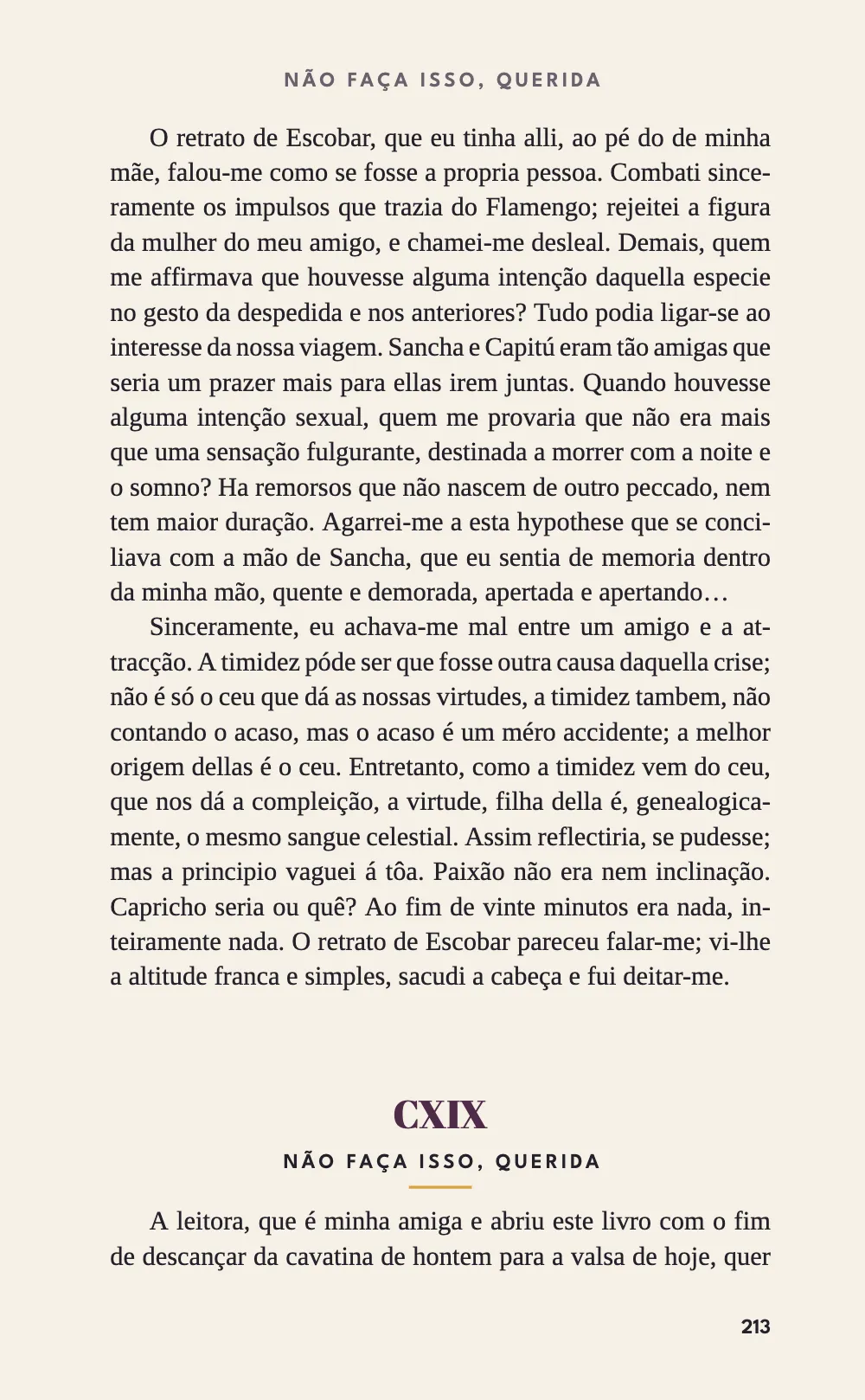
خمس صفحات نصية من قرب نهاية Dom Casmurro، رواية ماشادو دي أسيس الصادرة عام 1899، منضَّدة بالبرتغالية الأصلية كتابَ جيب قياسه 110 × 178 mm ضمن سلسلة متخيَّلة هي Coleção Casuarina. غلاف بأشرطة برقوقية وكريمية وبرقوقية يحمل العنوان بخط Abril Fatface وشعار السلسلة الدائري الزعفراني، ولوحة مرسومة للبحر الهائج قبالة فلامنغو، مولَّدة بنماذج الانتشار، تقابل الصفحة 213. يمتد النص من نهاية الفصل CXVIII إلى نهاية CXXIII، ولا يفتتح أي فصل صفحة. يبدأ كل فصل على بُعد سطرين تحت نهاية سابقه (ثلاثة عند CXIX، لملء الصفحة 213)، تحت رقم روماني برقوقي، وعنوانه بأحرف كبيرة متباعدة، وخط زعفراني قصير. في الصفحة 214 عنوانا فصلين، وفي كلٍّ من 215 و216 عنوان واحد. كل صفحة نصية عدا الأخيرة تنتهي عند سطرها الثالث والثلاثين، ولا تبدأ أي منها بسطر وحيد.
تجيب هذه الوصفة عن
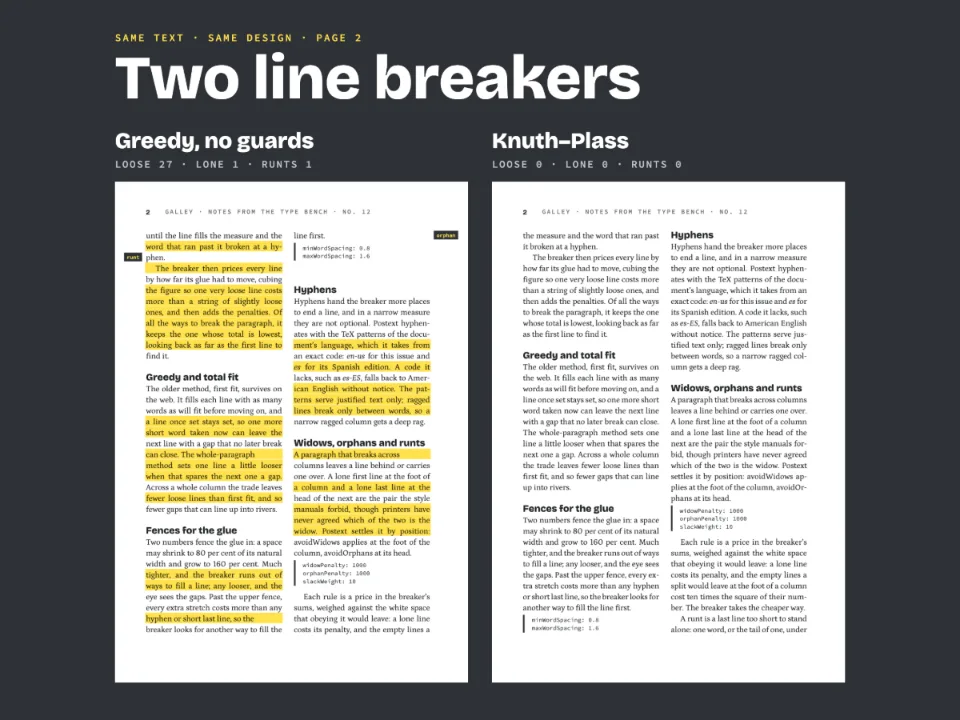
- كيف أتجنب الأسطر الأرامل والأسطر اليتيمة والأسطر الأخيرة ذات الكلمة الواحدة، وأبقي العنوان مع نصه؟
- كيف أجعل أسافل الأعمدة متساوية وأوازن الصفحة الأخيرة (الضبط العمودي)؟
- كيف أرقّم العناوين (1، 1.1، 1.1.1) وأنسّق كل مستوى بطريقة مختلفة؟
- كيف أضبط الترويسات: عنوان الكتاب في الصفحة اليسرى، وعنوان الفصل في اليمنى، ورقم الصفحة في الجانب الخارجي؟
الجواب المختصر
// Machado's chapters run a page or two, so none opens a page. The level's break is off
// (1.4.1 drops it anyway, gotcha: headings-drop-h1-break, but a release that keeps the H1
// default would open each chapter on a recto) and a chapter starts two lines under the last.
const [NUMERAL, TITLE, TRACK, GAP] = [14, 7.5, 1.3, 1.6]; // pt, pt, pt, mm
const RULE_Y = NUMERAL * PT + GAP + TITLE * 1.2 * PT + GAP; // mm: under the title's line
const chapterHead = { enabled: true, slot: { elements: [ // no span: the head stays in the text
  { kind: 'text', id: 'numeral', content: '{number}', fontFamily: DISPLAY, fontSize: pt(NUMERAL),
    lineHeight: 1, color: col('plum'), align: 'center',
    placement: { ...at('container', 'top'), size: { width: 'fill' } } },
  { kind: 'text', id: 'title', content: '{titleText}', ...caps(TITLE, TRACK), color: col('ink'),
    align: 'center', overflow: 'wrap', // a long title wraps instead of ending in '…'
    placement: { anchor: { to: '#numeral', edge: 'below' }, // centred tracked text sits
      offset: { x: pt(TRACK / 2), y: mm(GAP) }, size: { width: 'fill' } } }, // left by TRACK / 2
  { kind: 'rule', id: 'rule', direction: 'horizontal', thickness: pt(1), color: col('saffron'),
    placement: { ...at('container', 'top', 0, RULE_Y), size: { width: mm(8) } } },
] } }; // 11.7 mm deep: the head takes three lines, and the text under it stays on the grid
const chapters = { level: 1, numberingTemplate: '{1:I}', // {number} prints CXIX, CXX…
  fontSize: pt(TITLE), // the hidden heading line, measured in the headings' face
  breakBefore: { enabled: false }, marginTop: pt(2 * LEAD), advancedDesign: chapterHead };
// The keep rules are on by default. avoidWidows keeps widowMinLines (2) lines of a paragraph
// at the foot of a page, and headings.keepWithNext takes the head along when the paragraph
// moves on; avoidOrphans keeps two lines at the head of the next page; avoidRunts weighs a
// last line shorter than about 20 characters as a fault. Column balancing adds lines above
// a head so that the page ends on line 33.
المكونات
- الميزات
- الأسطر الأرامل والأسطر اليتيمة والكلمات المعزولةصفحات افتتاح مصمَّمةفصول تبدأ في صفحة فرديةالعناوين المرقّمةموازنة الأعمدةتقسيم الكلمات ولغة المستندالمسافات البادئة والمحاذاة والتباعد بين الفقراتالترويسات وأرقام الصفحاتالترويسات بحسب دور الصفحةأنماط العناوينفصول بلا أرقامالأغلفة وصفحات العنوان وبيانات النشرفواصل الصفحات والأعمدةالصور في تصاميم الصفحةالنصوص والخطوط والمربعات في تصاميم الصفحةسمات العنوانهوامش متناظرةإطارات عائمةالبيانات الوصفية للمستند
- تستخدم أيضًا
- أيقونات الإطارات وشارات الزواياإطارات التنبيهلون الورقالأشكال والجداول بوصفها مواردترقيم روماني للصفحات التمهيديةفواصل الأسطر في العناوين
- الخطوط
- Tinos (Apache 2.0) · Abril Fatface, League Spartan (SIL OFL 1.1)
- الأصول
plate-1100.jpg- The plate of the sea off Flamengo under the Sugarloaf, a painting (Generated With Diffusion Models, أصلي)
- The casuarina roundel, drawn in code in the book’s palette (Ignacio Ferro, MIT)
طريقة التحضير
#1 · تابع الفصول، وأبقِ كل عنوان مع نصه
// Machado's chapters run a page or two, so none opens a page. The level's break is off
// (1.4.1 drops it anyway, gotcha: headings-drop-h1-break, but a release that keeps the H1
// default would open each chapter on a recto) and a chapter starts two lines under the last.
const [NUMERAL, TITLE, TRACK, GAP] = [14, 7.5, 1.3, 1.6]; // pt, pt, pt, mm
const RULE_Y = NUMERAL * PT + GAP + TITLE * 1.2 * PT + GAP; // mm: under the title's line
const chapterHead = { enabled: true, slot: { elements: [ // no span: the head stays in the text
  { kind: 'text', id: 'numeral', content: '{number}', fontFamily: DISPLAY, fontSize: pt(NUMERAL),
    lineHeight: 1, color: col('plum'), align: 'center',
    placement: { ...at('container', 'top'), size: { width: 'fill' } } },
  { kind: 'text', id: 'title', content: '{titleText}', ...caps(TITLE, TRACK), color: col('ink'),
    align: 'center', overflow: 'wrap', // a long title wraps instead of ending in '…'
    placement: { anchor: { to: '#numeral', edge: 'below' }, // centred tracked text sits
      offset: { x: pt(TRACK / 2), y: mm(GAP) }, size: { width: 'fill' } } }, // left by TRACK / 2
  { kind: 'rule', id: 'rule', direction: 'horizontal', thickness: pt(1), color: col('saffron'),
    placement: { ...at('container', 'top', 0, RULE_Y), size: { width: mm(8) } } },
] } }; // 11.7 mm deep: the head takes three lines, and the text under it stays on the grid
const chapters = { level: 1, numberingTemplate: '{1:I}', // {number} prints CXIX, CXX…
  fontSize: pt(TITLE), // the hidden heading line, measured in the headings' face
  breakBefore: { enabled: false }, marginTop: pt(2 * LEAD), advancedDesign: chapterHead };
// The keep rules are on by default. avoidWidows keeps widowMinLines (2) lines of a paragraph
// at the foot of a page, and headings.keepWithNext takes the head along when the paragraph
// moves on; avoidOrphans keeps two lines at the head of the next page; avoidRunts weighs a
// last line shorter than about 20 characters as a fault. Column balancing adds lines above
// a head so that the page ends on line 33.
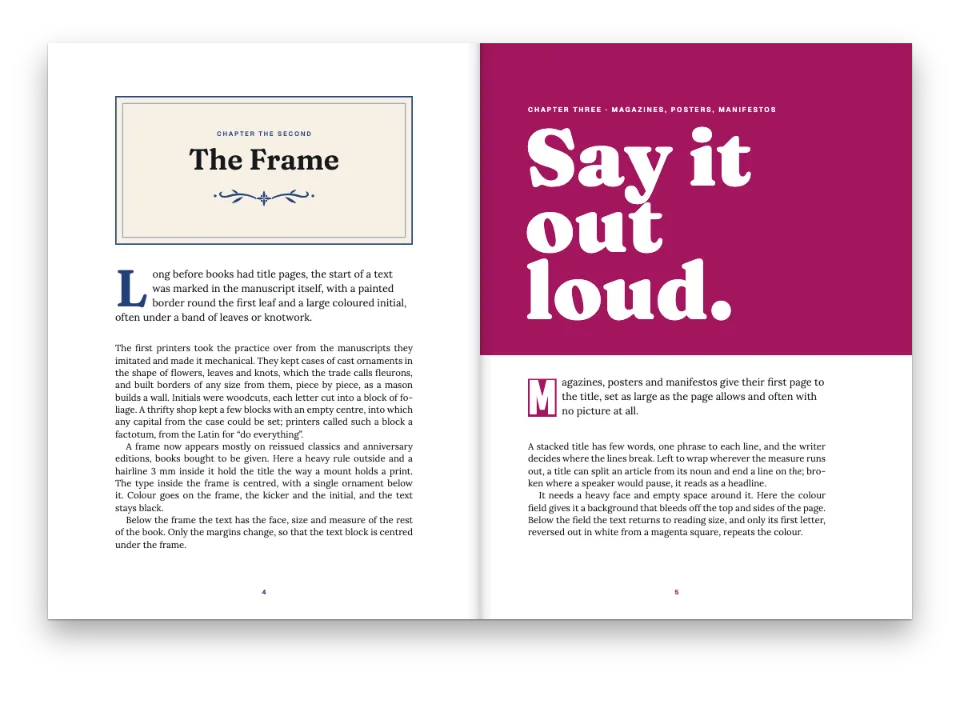
فاصل مستوى الفصل معطَّل، ويضع marginTop كل عنوان على بُعد سطرين تحت آخر سطر من الفصل السابق. لا يحمل تصميمه span، فيُرسم العنوان داخل العمود، في كتلة عمقها ثلاثة أسطر، ويبقى النص تحته على الشبكة (الفاصل قبل العنوان، الامتداد والتصميم المتقدم). تُركت قواعد الإبقاء على قيمها الافتراضية. الفقرتان ذواتا الأسطر الأربعة تحت CXIX وCXXI تترك كلٌّ منهما سطرين في ذيل صفحتها وتنقل سطرين؛ ومع avoidOrphans: false كانتا ستنقسمان ثلاثة وواحدًا، وكانت الصفحتان 214 و215 ستبدآن بسطر وحيد (اليتيمة والأرملة والكلمة المعزولة). تضيف موازنة الأعمدة سطرًا ثالثًا من المسافة فوق CXIX، لتنتهي الصفحة 213 عند السطر 33 (موازنة الأعمدة).
#2 · اضبط صفحة من 33 سطرًا، بتقسيم الكلمات على قواعد البرتغالية
const bodyText = { fontFamily: TEXT, fontSize: pt(BODY), lineHeight: pt(LEAD),
  color: col('ink'), referenceColor: col('ink'), // for a :ref added later: main-color does
  // not reach it in 1.4.1, and it would print blue
  firstLineIndent: mm(5), // every paragraph indented, the first after a head too
  maxRuntTracking: 0 }; // 1.4.1 measures a runt fix's tracking but never paints it
// (gotcha: runt-tracking-unpainted); the fix keeps its word spacing
const page = { sizePreset: 'custom', width: mm(TRIM.width), height: mm(TRIM.height), dpi: 150,
  backgroundColor: col('paper'),
  margins: { top: mm(TOP), bottom: mm(TRIM.height - TOP - LINES * LEAD * PT), // 16.3 mm
    left: mm(INNER), right: mm(OUTER), mirror: true } };
const LOCALE = 'pt'; // the Portuguese patterns, by their exact code (gotcha: hyphenation-locales)
الهامش السفلي 16.3 mm، وهو ما يتركه الارتفاع البالغ 178 mm بعد الهامش العلوي البالغ 15 mm و33 سطرًا بتباعد 12.6 pt، فتنتهي كل صفحة كاملة عند السطر نفسه. خط Tinos، الذي له عروض Times New Roman، ينضّد نحو 59 حرفًا في السطر على عرض 84 mm بحجم 9.5 pt. يقسّم locale: 'pt' الكلمات بأنماط التقسيم البرتغالية: at-tracção، af-fluencia، genealogica-mente (اللغات المدعومة). كل فقرة ذات مسافة بادئة، حتى الأولى بعد العنوان، كما جرت العادة في الطبعات البرتغالية والبرازيلية، لذلك يحتفظ indentAfterHeading بقيمته الافتراضية.
#3 · سمِّ الكتاب فوق الصفحة الزوجية والفصل فوق الفردية
const SHIFT = (INNER - OUTER) / 2; // mm: the text block sits off the page's centre
const [HEAD_Y, FOLIO_Y] = [8.5, 167]; // mm below the top edge
const head = (id, content, parity, x) => ({ kind: 'text', id, content, parity,
  pages: 'body', // never on the cover or the plate, which are opener pages
  ...caps(7.5, TRACK), color: col('muted'), align: 'center',
  placement: at('page', 'top', x + (TRACK / 2) * PT, HEAD_Y) }); // tracking, as in the answer
const folio = (id, parity, edge, x) => ({ kind: 'text', id, content: '{pageNumber}', parity,
  pages: 'body', ...caps(7.5, 0), color: col('ink'), placement: at('page', edge, x, FOLIO_Y) });
const header = { elements: [
  head('verso-title', '{title}', 'even', -SHIFT), // the title in the frontmatter
  head('recto-chapter', '{chapterTitle}', 'odd', SHIFT), // last chapter begun on or before it
] };
const footer = { elements: [folio('verso-folio', 'even', 'top-left', OUTER),
  { ...folio('recto-folio', 'odd', 'top-right', -OUTER), align: 'right' }] };
يطبع {title} العنوان الوارد في البيانات التمهيدية (frontmatter)، ويطبع {chapterTitle} آخر فصل يبدأ في الصفحة أو قبلها، فتسمّي الصفحة 217 الفصل CXXIII الذي بدأ في الصفحة 216 (عناصر النص). وتسمّي الصفحة 213 الفصل CXIX الذي يبدأ في ذيلها، مع أن أسطرها الخمسة والعشرين الأولى تختم CXVIII: لا يملك 1.4.1 عنصرًا نائبًا للفصل الذي تُفتتح فيه الصفحة. ينقل SHIFT الترويسات إلى منتصف كتلة النص، بعيدًا عن منتصف الصفحة بمقدار 1 mm لأن الهامش الداخلي أعرض من الخارجي بمقدار 2 mm.
#4 · ارسم الغلاف واللوحة عنوانين
// span: 'page', in one column too, paints their art whole and keeps the \\ in the title
// (gotcha: opener-clipped-at-top). A :::pagebreak follows each in the text (gotcha:
// cover-pagebreak): 1.4.1 drops the cover's reserved room, since its foot band runs past the
// column (gotcha: opener-taller-than-column), and the plate reserves room down to its caption
// only, since pictures do not count (gotcha: opener-image-no-reserve).
const onPage = (y, size) => ({ ...at('page', 'top', 0, y), ...(size && { size }) });
const cover = { id: 'cover', numbered: false, span: 'page',
  advancedDesign: { enabled: true, slot: { elements: [
    { kind: 'box', id: 'top-band', style: { backgroundColor: col('plum') },
      placement: { ...at('page', 'top-left'), size: { width: 'fill', height: mm(62) } } },
    { kind: 'text', id: 'author', content: '{author}', ...caps(10, 2.4), color: col('paper'),
      align: 'center', placement: at('page', 'top', 1.2 * PT, 44) },
    { kind: 'text', id: 'title', content: '{titleText}', fontFamily: DISPLAY, fontSize: pt(44),
      lineHeight: 1, color: col('plum'), align: 'center', overflow: 'wrap',
      placement: onPage(72, { width: 'fill' }) },
    { kind: 'rule', id: 'rule', direction: 'horizontal', thickness: pt(1.5),
      color: col('saffron'), placement: onPage(111, { width: mm(12) }) },
    { kind: 'box', id: 'foot-band', style: { backgroundColor: col('plum') },
      placement: { ...at('page', 'top-left', 0, 124), size: { width: 'fill', height: mm(54) } } },
    { kind: 'image', id: 'roundel', resourceId: 'roundel',
      placement: onPage(133, { width: mm(20) }) },
    { kind: 'text', id: 'series', content: 'Coleção Casuarina', ...caps(7.5, 1.8),
      color: col('saffron'), align: 'center', placement: at('page', 'top', 0.9 * PT, 159) },
  ] } } };
// The plate faces the first page of text: the morning sea off Flamengo, captioned with the
// line of chapter CXXIII it illustrates, which the heading carries in its quote attribute.
const plate = { id: 'plate', numbered: false, span: 'page',
  advancedDesign: { enabled: true, slot: { elements: [
    { kind: 'image', id: 'sea', resourceId: 'sea',
      placement: { ...at('page', 'top-left'), size: { width: 'fill', height: 'fill' } } },
    { kind: 'text', id: 'label', content: '{titleText}', ...caps(7.5, 1.6), color: col('saffron'),
      align: 'center', placement: at('page', 'top', 0.8 * PT, 146) },
    { kind: 'text', id: 'quote', content: '{attr.quote}', fontFamily: TEXT, italic: true,
      fontSize: pt(8.6), lineHeight: 1.35, color: col('paper'), align: 'center', overflow: 'wrap',
      placement: onPage(152, { width: mm(78) }) },
  ] } } };
const resources = [
  { id: 'roundel', typeId: 'figure', kind: 'svg', createdAt: 0, updatedAt: 0,
    svg: { fileId: 'roundel.svg', width: 60, height: 60 },
    altText: 'The series mark: a casuarina tree in a ring.' },
  // The plate is a painting, a JPEG in assets/ cut to the trim, declared at its pixels.
  { id: 'sea', typeId: 'figure', kind: 'bitmap', createdAt: 0, updatedAt: 0,
    bitmap: { fileId: 'plate-1100.jpg', format: 'jpeg', width: 1100, height: 1780 },
    altText: 'A heavy morning sea under the Sugarloaf, a low sun, and a lone swimmer among '
      + 'the breakers.' },
];
كلاهما نمط عنوان فيه numbered: false، فيبقى أول فصل مرقَّم هو CXIX. يجعل span: 'page' كلًّا منهما صفحة افتتاح. من دونه تتوقف أشرطة الغلاف عند أعلى كتلة النص وذيلها، وتُطبع الترويسة ورقم الصفحة 1 على الغلاف، ويُنضَّد العنوان على سطر واحد. يأتي تعليق اللوحة من عنوانها: CAPÍTULO CXXIII هو نص العنوان، والاقتباس المائل هو سمته quote (سمات العناوين). يُبعد :::pagebreak بعد كلٍّ منهما النصَّ عن العمل الفني، لأن 1.4.1 لا يحجز مساحة لشريط الغلاف السفلي ولا لصورة اللوحة.
#5 · أخبر المقتطف بموضعه من الكتاب
const continuation = { headings: { h1: 118, h2: 0, h3: 0, h4: 0, h5: 0, h6: 0 } };
يعطي continuation.headings عدّادات العناوين التي يبدأ منها المقتطف. مع h1: 118 يكون أول عنوان مرقَّم هو الفصل CXIX؛ ومن دونه تُرقَّم الفصول الخمسة من I إلى V. يضبط numberingTemplate: '{1:I}' في مستوى الفصل تلك الأرقام بالأرقام الرومانية، ويطبعها التصميم عبر {number}. ويرقّم :::numbering{startAt=212}، بعد فاصل صفحة الغلاف، اللوحةَ بالرقم 212 والصفحات النصية من 213 إلى 217 (الترقيم).
الوصفة كاملة
// ═══ Postext Cookbook · Nº 065 · Pocket classic: short chapters that run on ═══════════ // https://postext.dev/en/cookbook/short-chapters-run-on // Code: MIT · Text: Machado de Assis, Dom Casmurro, 1899 (PD, Gutenberg #55752) · Plate: painted // Fonts: Tinos (Apache 2.0), Abril Fatface, League Spartan (SIL OFL 1.1) · Needs postext ≥ 1.4.1 import { buildDocument, renderPageToCanvas, clearMeasurementCache, registerResourceImage } from 'https://esm.sh/postext'; const LANG = 'en'; // @lang: the language of the viewer's title; the sample is Portuguese const RECIPE = 'short-chapters-run-on'; // ─── 1 · Design ───────────────────────────────────────────────────────────── const palette = { ink: '#24202a', // the text: a violet near-black paper: '#f6f1e6', // the pocket book's paper plum: '#4f2a49', // the series colour: cover bands, the chapter numerals saffron: '#d9a03c', // the second ink: rules and drawings, never text on paper (2.1:1) muted: '#6b616e', // the running heads and the colophon (5.2:1 on paper) }; // Design slots read the hex, not the id, in 1.4.1 (gotcha: palette-skips-designs). const col = (id) => ({ hex: palette[id], model: 'hex', paletteId: id }); const colorPalette = [ ...Object.entries(palette).map(([id, hex]) => ({ id, name: id, value: { hex, model: 'hex' } })), // The default bold and italic colours link to main-color, set here to the ink, not blue. { id: 'main-color', name: 'ink (defaults)', value: { hex: palette.ink, model: 'hex' } }, ]; const [TEXT, DISPLAY, LABEL] = ['Tinos', 'Abril Fatface', 'League Spartan']; const TRIM = { width: 110, height: 178 }; // mm: a pocket book const [TOP, INNER, OUTER] = [15, 14, 12]; // mm; mirrored, so the inner margin is at the spine const [BODY, LEAD, LINES] = [9.5, 12.6, 33]; // pt, pt, and the lines of a full page const PT = 25.4 / 72; // mm per point const at = (to, edge, x = 0, y = 0) => ({ anchor: { to, edge }, offset: { x: mm(x), y: mm(y) } }); const caps = (size, track) => ({ fontFamily: LABEL, fontWeight: 600, fontSize: pt(size), letterSpacing: pt(track), textTransform: 'uppercase' }); // #region answer: chapters that run on, each under a centred head drawn in the column // Machado's chapters run a page or two, so none opens a page. The level's break is off // (1.4.1 drops it anyway, gotcha: headings-drop-h1-break, but a release that keeps the H1 // default would open each chapter on a recto) and a chapter starts two lines under the last. const [NUMERAL, TITLE, TRACK, GAP] = [14, 7.5, 1.3, 1.6]; // pt, pt, pt, mm const RULE_Y = NUMERAL * PT + GAP + TITLE * 1.2 * PT + GAP; // mm: under the title's line const chapterHead = { enabled: true, slot: { elements: [ // no span: the head stays in the text { kind: 'text', id: 'numeral', content: '{number}', fontFamily: DISPLAY, fontSize: pt(NUMERAL), lineHeight: 1, color: col('plum'), align: 'center', placement: { ...at('container', 'top'), size: { width: 'fill' } } }, { kind: 'text', id: 'title', content: '{titleText}', ...caps(TITLE, TRACK), color: col('ink'), align: 'center', overflow: 'wrap', // a long title wraps instead of ending in '…' placement: { anchor: { to: '#numeral', edge: 'below' }, // centred tracked text sits offset: { x: pt(TRACK / 2), y: mm(GAP) }, size: { width: 'fill' } } }, // left by TRACK / 2 { kind: 'rule', id: 'rule', direction: 'horizontal', thickness: pt(1), color: col('saffron'), placement: { ...at('container', 'top', 0, RULE_Y), size: { width: mm(8) } } }, ] } }; // 11.7 mm deep: the head takes three lines, and the text under it stays on the grid const chapters = { level: 1, numberingTemplate: '{1:I}', // {number} prints CXIX, CXX… fontSize: pt(TITLE), // the hidden heading line, measured in the headings' face breakBefore: { enabled: false }, marginTop: pt(2 * LEAD), advancedDesign: chapterHead }; // The keep rules are on by default. avoidWidows keeps widowMinLines (2) lines of a paragraph // at the foot of a page, and headings.keepWithNext takes the head along when the paragraph // moves on; avoidOrphans keeps two lines at the head of the next page; avoidRunts weighs a // last line shorter than about 20 characters as a fault. Column balancing adds lines above // a head so that the page ends on line 33. // #endregion // #region text: a pocket page of 33 lines, in Portuguese const bodyText = { fontFamily: TEXT, fontSize: pt(BODY), lineHeight: pt(LEAD), color: col('ink'), referenceColor: col('ink'), // for a :ref added later: main-color does // not reach it in 1.4.1, and it would print blue firstLineIndent: mm(5), // every paragraph indented, the first after a head too maxRuntTracking: 0 }; // 1.4.1 measures a runt fix's tracking but never paints it // (gotcha: runt-tracking-unpainted); the fix keeps its word spacing const page = { sizePreset: 'custom', width: mm(TRIM.width), height: mm(TRIM.height), dpi: 150, backgroundColor: col('paper'), margins: { top: mm(TOP), bottom: mm(TRIM.height - TOP - LINES * LEAD * PT), // 16.3 mm left: mm(INNER), right: mm(OUTER), mirror: true } }; const LOCALE = 'pt'; // the Portuguese patterns, by their exact code (gotcha: hyphenation-locales) // #endregion // #region heads: the book's title over the verso, the chapter over the recto, folios at the foot const SHIFT = (INNER - OUTER) / 2; // mm: the text block sits off the page's centre const [HEAD_Y, FOLIO_Y] = [8.5, 167]; // mm below the top edge const head = (id, content, parity, x) => ({ kind: 'text', id, content, parity, pages: 'body', // never on the cover or the plate, which are opener pages ...caps(7.5, TRACK), color: col('muted'), align: 'center', placement: at('page', 'top', x + (TRACK / 2) * PT, HEAD_Y) }); // tracking, as in the answer const folio = (id, parity, edge, x) => ({ kind: 'text', id, content: '{pageNumber}', parity, pages: 'body', ...caps(7.5, 0), color: col('ink'), placement: at('page', edge, x, FOLIO_Y) }); const header = { elements: [ head('verso-title', '{title}', 'even', -SHIFT), // the title in the frontmatter head('recto-chapter', '{chapterTitle}', 'odd', SHIFT), // last chapter begun on or before it ] }; const footer = { elements: [folio('verso-folio', 'even', 'top-left', OUTER), { ...folio('recto-folio', 'odd', 'top-right', -OUTER), align: 'right' }] }; // #endregion // #region cover: the cover and the plate, heading styles that fill a page each // span: 'page', in one column too, paints their art whole and keeps the \\ in the title // (gotcha: opener-clipped-at-top). A :::pagebreak follows each in the text (gotcha: // cover-pagebreak): 1.4.1 drops the cover's reserved room, since its foot band runs past the // column (gotcha: opener-taller-than-column), and the plate reserves room down to its caption // only, since pictures do not count (gotcha: opener-image-no-reserve). const onPage = (y, size) => ({ ...at('page', 'top', 0, y), ...(size && { size }) }); const cover = { id: 'cover', numbered: false, span: 'page', advancedDesign: { enabled: true, slot: { elements: [ { kind: 'box', id: 'top-band', style: { backgroundColor: col('plum') }, placement: { ...at('page', 'top-left'), size: { width: 'fill', height: mm(62) } } }, { kind: 'text', id: 'author', content: '{author}', ...caps(10, 2.4), color: col('paper'), align: 'center', placement: at('page', 'top', 1.2 * PT, 44) }, { kind: 'text', id: 'title', content: '{titleText}', fontFamily: DISPLAY, fontSize: pt(44), lineHeight: 1, color: col('plum'), align: 'center', overflow: 'wrap', placement: onPage(72, { width: 'fill' }) }, { kind: 'rule', id: 'rule', direction: 'horizontal', thickness: pt(1.5), color: col('saffron'), placement: onPage(111, { width: mm(12) }) }, { kind: 'box', id: 'foot-band', style: { backgroundColor: col('plum') }, placement: { ...at('page', 'top-left', 0, 124), size: { width: 'fill', height: mm(54) } } }, { kind: 'image', id: 'roundel', resourceId: 'roundel', placement: onPage(133, { width: mm(20) }) }, { kind: 'text', id: 'series', content: 'Coleção Casuarina', ...caps(7.5, 1.8), color: col('saffron'), align: 'center', placement: at('page', 'top', 0.9 * PT, 159) }, ] } } }; // The plate faces the first page of text: the morning sea off Flamengo, captioned with the // line of chapter CXXIII it illustrates, which the heading carries in its quote attribute. const plate = { id: 'plate', numbered: false, span: 'page', advancedDesign: { enabled: true, slot: { elements: [ { kind: 'image', id: 'sea', resourceId: 'sea', placement: { ...at('page', 'top-left'), size: { width: 'fill', height: 'fill' } } }, { kind: 'text', id: 'label', content: '{titleText}', ...caps(7.5, 1.6), color: col('saffron'), align: 'center', placement: at('page', 'top', 0.8 * PT, 146) }, { kind: 'text', id: 'quote', content: '{attr.quote}', fontFamily: TEXT, italic: true, fontSize: pt(8.6), lineHeight: 1.35, color: col('paper'), align: 'center', overflow: 'wrap', placement: onPage(152, { width: mm(78) }) }, ] } } }; const resources = [ { id: 'roundel', typeId: 'figure', kind: 'svg', createdAt: 0, updatedAt: 0, svg: { fileId: 'roundel.svg', width: 60, height: 60 }, altText: 'The series mark: a casuarina tree in a ring.' }, // The plate is a painting, a JPEG in assets/ cut to the trim, declared at its pixels. { id: 'sea', typeId: 'figure', kind: 'bitmap', createdAt: 0, updatedAt: 0, bitmap: { fileId: 'plate-1100.jpg', format: 'jpeg', width: 1100, height: 1780 }, altText: 'A heavy morning sea under the Sugarloaf, a low sun, and a lone swimmer among ' + 'the breakers.' }, ]; // #endregion // The colophon floats to the foot of the last page, beside the series roundel. const colophon = { id: 'colophon', placement: 'bottom', backgroundEnabled: false, padding: { top: pt(0), right: pt(0), bottom: pt(0), left: pt(0) }, marginBottom: pt(0), icon: { kind: 'resource', resourceId: 'roundel', size: mm(10) }, titleStyle: { gap: mm(3) }, body: { fontFamily: TEXT, fontSize: pt(7.6), lineHeight: pt(LEAD * 0.8), color: col('muted'), italicColor: col('muted'), textAlign: 'left', firstLineIndent: pt(0) } }; const config = () => ({ // a factory: the engine caches resolved configs per object locale: LOCALE, colorPalette, page, layout: { layoutType: 'single' }, bodyText, // The heading's own line is hidden under its design but still measured, in this face. headings: { fontFamily: LABEL, fontWeight: 600, levels: [chapters] }, headingStyles: [cover, plate], calloutStyles: [colophon], header, footer, }); // #region art: the series roundel, drawn in code in the book's two inks let seed = 1871; // Mulberry32, seeded: never Math.random() in a recipe const rand = () => { let r = Math.imul((seed = (seed + 0x6d2b79f5) | 0) ^ (seed >>> 15), 1 | seed); r = (r + Math.imul(r ^ (r >>> 7), 61 | r)) ^ r; return ((r ^ (r >>> 14)) >>> 0) / 4294967296; }; const n = (v) => v.toFixed(2); const svg = (w, h, body) => `<svg xmlns="http://www.w3.org/2000/svg" width="${w}mm" ` + `height="${h}mm" viewBox="0 0 ${w} ${h}">${body}</svg>`; const line = (d, stroke, width, extra = '') => `<path d="${d}" fill="none" stroke="${stroke}" ` + `stroke-width="${n(width)}" stroke-linecap="round" stroke-linejoin="round"${extra}/>`; // The casuarina of Bento's garden (chapter II): a leaning trunk, and branches that arch out // on alternate sides and let their needles hang. function roundelSvg() { const { plum, saffron } = palette; const out = [`<circle cx="30" cy="30" r="29" fill="${saffron}"/>`, line('M30 30m-25.5 0a25.5 25.5 0 1 0 51 0a25.5 25.5 0 1 0 -51 0', plum, 0.9), line('M28.6 50Q30.6 33 30.2 10.5', plum, 1.6), line('M18.5 50.2H41.5', plum, 1.3)]; for (let k = 0; k < 9; k++) { const side = k % 2 ? 1 : -1; const y0 = 12.5 + k * 3.7; const reach = (3 + k * 1.55) * (0.8 + rand() * 0.35); const x1 = 30.2 + side * reach; const y1 = y0 + 1.2 + rand() * 1.4; out.push(line(`M30.2 ${n(y0)}Q${n(30.2 + side * reach * 0.5)} ${n(y0 - 2.2)} ${n(x1)} ${n(y1)}`, plum, 0.95)); const strands = 3 + Math.round(reach / 1.6); for (let j = 1; j <= strands; j++) { // needles hang from the arch const u = j / (strands + 0.5); const x = 30.2 + side * reach * u; const y = y0 + (y1 - y0) * u ** 2 - 2.2 * 2 * u * (1 - u) + 0.3; out.push(line(`M${n(x)} ${n(y)}q${n(side * 0.4)} ${n(2)} ${n(side * 0.1)} ` + `${n(3 + rand() * 2.4)}`, plum, 0.7)); } } return svg(60, 60, out.join('')); } // #endregion // ─── 2 · Content ──────────────────────────────────────────────────────────── // Dom Casmurro in Portuguese, in the first edition's spelling: the cover, the plate, then // pages 213 to 217 (:::numbering in the text), from the end of chapter CXVIII. const markdown = String.raw`---نموذج Markdown · أسطر: 63 · content.en.md
title: "Dom Casmurro" author: "Machado de Assis" --- # Dom \\ Casmurro {style="cover"} :::pagebreak :::numbering{startAt=212} # Capítulo CXXIII {style="plate" quote="«…grandes e abertos, como a vaga do mar lá fóra, como se quizesse tragar tambem o nadador da manhã.»"} :::pagebreak O retrato de Escobar, que eu tinha alli, ao pé do de minha mãe, falou-me como se fosse a propria pessoa. Combati sinceramente os impulsos que trazia do Flamengo; rejeitei a figura da mulher do meu amigo, e chamei-me desleal. Demais, quem me affirmava que houvesse alguma intenção daquella especie no gesto da despedida e nos anteriores? Tudo podia ligar-se ao interesse da nossa viagem. Sancha e Capitú eram tão amigas que seria um prazer mais para ellas irem juntas. Quando houvesse alguma intenção sexual, quem me provaria que não era mais que uma sensação fulgurante, destinada a morrer com a noite e o somno? Ha remorsos que não nascem de outro peccado, nem tem maior duração. Agarrei-me a esta hypothese que se conciliava com a mão de Sancha, que eu sentia de memoria dentro da minha mão, quente e demorada, apertada e apertando… Sinceramente, eu achava-me mal entre um amigo e a attracção. A timidez póde ser que fosse outra causa daquella crise; não é só o ceu que dá as nossas virtudes, a timidez tambem, não contando o acaso, mas o acaso é um méro accidente; a melhor origem dellas é o ceu. Entretanto, como a timidez vem do ceu, que nos dá a compleição, a virtude, filha della é, genealogicamente, o mesmo sangue celestial. Assim reflectiria, se pudesse; mas a principio vaguei á tôa. Paixão não era nem inclinação. Capricho seria ou quê? Ao fim de vinte minutos era nada, inteiramente nada. O retrato de Escobar pareceu falar-me; vi-lhe a altitude franca e simples, sacudi a cabeça e fui deitar-me. # Não faça isso, querida A leitora, que é minha amiga e abriu este livro com o fim de descançar da cavatina de hontem para a valsa de hoje, quer fechal-o ás pressas, ao ver que beiramos um abysmo. Não faça isso, querida; eu mudo de rumo. # Os autos Na manhã seguinte accordei livre das abominações da vespera; chamei-lhes allucinações, tomei café, percorri os jornaes e fui estudar uns autos. Capitú e prima Justina sairam para a missa das nove, na Lapa. A figura de Sancha desappareceu inteiramente no meio das allegações da parte adversa, que eu ia lendo nos autos, allegações falsas, inadmissiveis, sem apoio na lei nem nas praxes. Vi que era facil ganhar a demanda; consultei Dalloz, Pereira e Souza… Uma só vez olhei para o retrato de Escobar. Era uma bella photographia tirada um anno antes. Estava de pé, sobrecasaca abotoada, a mão esquerda no dorso de uma cadeira, a direita mettida ao peito, o olhar ao longe para a esquerda do espectador. Tinha garbo e naturalidade. A moldura que lhe mandei pôr não encobria a dedicatoria, escripta embaixo, não nas costas do cartão: «Ao meu querido Bentinho o seu querido Escobar 20-4-70.» Estas palavras fortaleceram-me os pensamentos daquella manhã, e espancaram de todo as recordações da vespera. Naquelle tempo a minha vista era boa; eu podia lel-as do logar em que estava. Tornei aos autos. # A catastrophe No melhor delles, ouvi passos precipitados na escada, a campainha soou, soaram palmas, golpes na cancella, vozes, acudiram todos, acudi eu mesmo. Era um escravo da casa de Sancha que me chamava: —Para ir lá… sinhô nadando, sinhô morrendo. Não disse mais nada, ou eu não lhe ouvi o resto. Vesti-me, deixei recado a Capitú e corri ao Flamengo. Em caminho, fui adivinhando a verdade. Escobar metteu-se a nadar, como usava fazer, arriscou-se um pouco mais fóra que de costume, apesar do mar bravio, foi enrolado e morreu. As canoas que acudiram mal puderam trazer-lhe o cadaver. # O enterro A viuva… Poupo-vos as lagrimas da viuva, as minhas, as da outra gente. Sai de lá cerca de onze horas; Capitú e prima Justina esperavam-me, uma com o parecer abatido e estupido, outra enfastiada apenas. —Vão fazer companhia a pobre Sanchinha; eu vou cuidar do enterro. Assim fizemos. Quiz que o enterro fosse pomposo, e a affluencia dos amigos foi numerosa. Praia, ruas, praça da Gloria, tudo eram carros, muitos delles particulares. A casa, não sendo grande, não podiam lá caber todos; muitos estavam na praia, falando do desastre, apontando o logar em que Escobar fallecèra, ouvindo referir a chegada do morto. José Dias ouviu tambem falar dos negocios do finado, divergindo alguns na avaliação dos bens, mas havendo accordo em que o passivo devia ser pequeno. Elogiavam as qualidades de Escobar. Um ou outro discutia o recente gabinete Rio Branco; estavamos em Março de 1871. Nunca me esqueceu o mez nem o anno. Como eu houvesse resolvido falar no cemiterio, escrevi algumas linhas e mostrei-as em casa a José Dias, que as achou realmente dignas do morto e de mim. Pediu-me o papel, recitou lentamente o discurso, pesando as palavras, e confirmou a primeira opinião; no Flamengo espalhou a noticia. Alguns conhecidos vieram interrogar-me: —Então, vamos ouvil-o? —Quatro palavras. Poucas mais seriam. Tinha-as escripto com receio de que a emoção me impedisse de improvisar. No tilbury em que andei uma ou duas horas, não fizera mais que recordar o tempo do seminario, as relações de Escobar, as nossas sympathias, a nossa amizade, começada, continuada e nunca interrompida, até que um lance da fortuna fez separar para sempre duas creaturas que promettiam ficar por muito tempo unidas. De quando em quando enxugava os olhos. O cocheiro aventurou duas ou tres perguntas sobre a minha situação moral; não me arrancando nada, continuou o seu officio. Chegando a casa, deitei aquellas emoções ao papel; tal seria o discurso. # Olhos de ressaca Emfim, chegou a hora da encommendação e da partida. Sancha quiz despedir-se do marido, e o desespero daquelle lance consternou a todos. Muitos homens choravam tambem, as mulheres todas. Só Capitú, amparando a viuva, parecia vencer-se a si mesma. Consolava a outra, queria arrancal-a dalli. A confusão era geral. No meio della, Capitú olhou alguns instantes para o cadaver tão fixa, tão apaixonadamente fixa, que não admira lhe saltassem algumas lagrimas poucas e caladas… As minhas cessaram logo. Fiquei a ver as della; Capitú enxugou-as depressa, olhando a furto para a gente que estava na sala. Redobrou de caricias para a amiga, e quiz leval-a; mas o cadaver parece que a retinha tambem. Momento houve em que os olhos de Capitú fitaram o defuncto, quaes os da viuva, sem o pranto nem palavras desta, mas grandes e abertos, como a vaga do mar lá fóra, como se quizesse tragar tambem o nadador da manhã. :::callout{type="colophon"} Do fim do capítulo CXVIII ao fim do CXXIII de *Dom Casmurro* (1899), com a ortografia da edição Garnier transcrita pelo Project Gutenberg (n.º 55752); corrigiu-se um erro de transcrição no capítulo CXXIII. Ilustração pintada e marca da coleção feitas para esta edição. Composto em Tinos (Apache 2.0), Abril Fatface e League Spartan (SIL OFL). :::`; // ─── 3 · Fonts ────────────────────────────────────────────────────────────── const FONTS = { // every face the pages use, loaded before the build (gotcha: fonts-first) Tinos: ['400', '400i'], // text, colophon; italic: the plate's quote, the colophon's title 'Abril Fatface': ['400'], // chapter numerals and the cover title 'League Spartan': ['600'], // chapter titles, running heads, folios, the cover's capitals }; // ─── 4 · Build & show ─────────────────────────────────────────────────────── await loadFonts(FONTS, markdown); await loadSvg('roundel.svg', roundelSvg()); await loadImage('plate-1100.jpg', asset('plate-1100.jpg')); // #region excerpt: these pages continue a book: chapter CXVIII is under way, the next is CXIX const continuation = { headings: { h1: 118, h2: 0, h3: 0, h4: 0, h5: 0, h6: 0 } }; // #endregion const doc = await buildWithFonts( () => buildDocument({ markdown, resources, continuation }, config()), markdown); showPages(doc, { title: t({ en: 'Dom Casmurro, a pocket edition', es: 'Dom Casmurro, edición de bolsillo' }) });العُدّة · core, fonts, viewer, images: نفسها في كل وصفة · أسطر: 270
// ─── Kit ── helpers shared by every Cookbook recipe · postext.dev/cookbook ───── // ─── Kit · core v1 ── the same in every recipe · postext.dev/cookbook ───────── function mm(value) { return { value, unit: 'mm' }; } function pt(value) { return { value, unit: 'pt' }; } function em(value) { return { value, unit: 'em' }; } /** The sample language's string: t({ en: 'Figure', es: 'Figura' }). */ function t(strings) { return strings[LANG] ?? Object.values(strings)[0]; } /** A file in this recipe's assets folder, served from the Postext repo by jsDelivr. */ function asset(file) { return `https://cdn.jsdelivr.net/gh/drnachio/postext@main/cookbook/${RECIPE}/assets/${file}`; } // ─── Kit · fonts v1 ── the same in every recipe · postext.dev/cookbook ──────── // Postext measures text with the faces the browser has loaded, and caches the // widths, so every face must be ready before the first build. Faces come from // Fontsource: the same static files the PDF embeds, so screen and PDF agree. /** faces = { 'Family Name': ['400', '400i', '700'] }. `text` is the sample: * letters beyond Latin-1 (č, ł, ő…) also load the latin-ext files. With * `optional`, a face Fontsource does not ship is skipped instead of failing. * Resolves to the number of faces added. */ async function loadFonts(faces, text = '', { optional = false } = {}) { kitStatus('Loading fonts…'); const ranges = { latin: 'U+0000-00FF,U+0131,U+0152-0153,U+02BB-02BC,U+02C6,U+02DA,U+02DC,U+0304,U+0308,U+0329,' + 'U+2000-206F,U+20AC,U+2122,U+2191,U+2193,U+2212,U+2215,U+FEFF,U+FFFD', 'latin-ext': 'U+0100-02BA,U+02BD-02C5,U+02C7-02CC,U+02CE-02D7,U+02DD-02FF,U+0304,U+0308,U+0329,' + 'U+1D00-1DBF,U+1E00-1E9F,U+1EF2-1EFF,U+2020,U+20A0-20AB,U+20AD-20C0,U+2113,U+2C60-2C7F,U+A720-A7FF', }; const subsets = /[Ā-˿Ḁ-ỿ]/.test(text) ? ['latin', 'latin-ext'] : ['latin']; const jobs = []; let added = 0; for (const [family, specs] of Object.entries(faces)) { const id = fontsourceId(family); const meta = optional ? await fontsourceMeta(family) : null; for (const spec of new Set(specs)) { const weight = parseInt(spec, 10); const style = spec.endsWith('i') ? 'italic' : 'normal'; if (hasFace(family, weight, style)) continue; if (optional && !(meta?.weights.includes(weight) && meta.styles.includes(style))) continue; for (const subset of subsets) { const url = `https://cdn.jsdelivr.net/npm/@fontsource/${id}@5/files/${id}-${subset}-${weight}-${style}.woff2`; const face = new FontFace(family, `url(${url}) format('woff2')`, { weight: String(weight), style, unicodeRange: ranges[subset] }); jobs.push(face.load().then((ready) => { document.fonts.add(ready); added++; }, () => { if (subset === 'latin' && !optional) throw new Error(`Fontsource has no ${family} ${weight} ${style}`); })); } } } await Promise.all(jobs).catch((error) => { kitFail(error); throw error; }); return added; } /** Runs `build` (a buildDocument or buildBundle call) and checks the faces * the pages use. A regular face missing from FONTS is loaded with a warning; * bold and italic variants are loaded when the family ships them. Then the * measurement caches are cleared and the build runs again. */ async function buildWithFonts(build, text = '') { const tried = new Set(); for (let round = 0; round < 3; round++) { kitStatus('Laying out…'); await new Promise(requestAnimationFrame); // let the status paint first const result = await Promise.resolve().then(build).catch((error) => { kitFail(error); throw error; }); const wanted = { base: {}, variants: {} }; for (const { font, base } of [result].flat().flatMap(fontStringsOf)) { const { family, weight, style } = parseFont(font); const key = `${family}|${weight}|${style}`; if (tried.has(key) || hasFace(family, weight, style)) continue; tried.add(key); (wanted[base ? 'base' : 'variants'][family] ??= []).push(`${weight}${style === 'italic' ? 'i' : ''}`); } if (Object.keys(wanted.base).length) { console.warn(`[cookbook] FONTS does not list ${JSON.stringify(wanted.base)}: loading them.`); } const added = await loadFonts(wanted.base, text) + await loadFonts(wanted.variants, text, { optional: true }); if (added === 0) return result; clearMeasurementCache(); } throw new Error('The fonts did not settle after three builds.'); } /** Every font string of the layout. `base` marks a block's own face; its * bold, italic and bold-italic variants are listed whether or not used. */ function fontStringsOf(doc) { const found = new Map(); const walk = (node) => { if (!node || typeof node !== 'object') return; if (Array.isArray(node)) { node.forEach(walk); return; } for (const [key, value] of Object.entries(node)) { if (typeof value === 'string' && /fontString$/i.test(key)) { found.set(value, found.get(value) || key === 'fontString'); } else if (value && typeof value === 'object') walk(value); } }; walk(doc.pages); walk(doc.blocks); return [...found].map(([font, base]) => ({ font, base })); } /** '700 37.5px Open Sans' / 'italic 400 13px "Source Serif 4"' → { family, weight, style }. * A string with no weight ('95.8px Young Serif', from a design text) is 400. */ function parseFont(font) { const m = /^(?:(italic|oblique)\s+)?(?:small-caps\s+)?(?:(\d+|bold|normal)\s+)?[\d.]+px\s+(.+)$/.exec(font.trim()); if (!m) throw new Error(`Unexpected font string: ${font}`); const weight = m[2] === 'bold' ? 700 : !m[2] || m[2] === 'normal' ? 400 : Number(m[2]); return { family: m[3].replace(/^["']|["']$/g, ''), weight, style: m[1] ? 'italic' : 'normal' }; } /** True when a loaded FontFace covers exactly this family, weight and style * (document.fonts.check() is also true for families nobody declared). */ function hasFace(family, weight, style) { for (const face of document.fonts) { if (face.status !== 'loaded' || face.style !== style) continue; if (face.family.replace(/^["']|["']$/g, '') !== family) continue; const [low, high = low] = face.weight.split(' ').map(Number); if (weight >= low && weight <= high) return true; } return false; } /** Fontsource's id for a family: 'Source Serif 4' → 'source-serif-4'. */ function fontsourceId(family) { return family.toLowerCase().replace(/\s+/g, '-'); } /** The weights and styles a family ships ({ weights: [400, 700], styles: ['normal', 'italic'] }), or null. */ function fontsourceMeta(family) { fontsourceMeta.cache ??= new Map(); const id = fontsourceId(family); if (!fontsourceMeta.cache.has(id)) { fontsourceMeta.cache.set(id, fetch(`https://api.fontsource.org/v1/fonts/${id}`) .then((res) => (res.ok ? res.json() : null), () => null)); } return fontsourceMeta.cache.get(id); } // ─── Kit · viewer v1 ── the same in every recipe · postext.dev/cookbook ─────── /** Shows the pages as facing spreads on a dark desk: the first page is a * recto on its own, then verso | recto pairs, as in a bound book. Pages * are painted when they scroll near the screen. */ function showPages(docs, { title, width = 460 } = {}) { const root = viewer(title); const pages = [docs].flat().flatMap((doc) => doc.pages.map((page) => ({ doc, page, n: (doc.pageIndexOffset ?? 0) + page.index }))); const spreads = []; let verso = null; for (const p of pages) { if (p.n % 2 === 1) { if (verso) spreads.push([verso, null]); verso = p; } else { spreads.push([verso, p]); verso = null; } } if (verso) spreads.push([verso, null]); const density = Math.min(window.devicePixelRatio || 1, 2); showPages.painter?.disconnect(); const painter = new IntersectionObserver((entries) => { for (const { isIntersecting, target } of entries) { if (!isIntersecting) continue; painter.unobserve(target); const { doc, page } = target.postext; renderPageToCanvas(page, doc, target, { scale: (width * density) / page.width }); } }, { rootMargin: '800px' }); showPages.painter = painter; root.replaceChildren(...spreads.map((pair) => { const spread = document.createElement('div'); spread.className = 'pt-spread'; for (const p of pair) { const figure = document.createElement('figure'); if (p) { const label = p.page.pageLabel || String(p.n + 1); const canvas = document.createElement('canvas'); canvas.postext = p; canvas.style.aspectRatio = `${p.page.width} / ${p.page.height}`; canvas.setAttribute('role', 'img'); canvas.setAttribute('aria-label', `Page ${label}`); const folio = document.createElement('figcaption'); folio.textContent = label; figure.append(canvas, folio); painter.observe(canvas); } else figure.className = 'pt-blank'; spread.append(figure); } return spread; })); kitStatus(`${pages.length} ${pages.length === 1 ? 'page' : 'pages'}`); document.documentElement.dataset.postext = 'ready'; return pages.length; } /** The desk, the bar and the error reporting, created once. */ function viewer(title) { if (!document.getElementById('pt-kit')) { document.head.insertAdjacentHTML('beforeend', `<style id="pt-kit"> :root { color-scheme: dark; } body { margin: 0; background: #0e1014; color: #b9bcc4; font: 13px/1.45 system-ui, sans-serif; } #pt-bar { position: sticky; top: 0; z-index: 1; display: flex; flex-wrap: wrap; align-items: center; gap: 6px 16px; padding: 10px 16px; background: rgb(14 16 20 / .92); backdrop-filter: blur(6px); border-bottom: 1px solid #23262d; } #pt-bar strong { color: #f4f1ea; font-weight: 600; } #pt-actions { display: flex; gap: 12px; margin-left: auto; } #pt-actions a, #pt-actions button { color: #d8a21a; font: inherit; background: none; border: 0; padding: 0; cursor: pointer; } #pages { display: grid; justify-items: center; gap: 48px; padding: 32px 16px 72px; } .pt-spread { display: flex; } .pt-spread figure { margin: 0; width: min(460px, 44vw); } .pt-spread canvas { display: block; width: 100%; background: #fff; box-shadow: 0 1px 2px rgb(0 0 0 / .5), 0 22px 44px -16px rgb(0 0 0 / .8); } .pt-spread figure:first-child canvas { box-shadow: inset -14px 0 14px -14px rgb(0 0 0 / .18), 0 1px 2px rgb(0 0 0 / .5), 0 22px 44px -16px rgb(0 0 0 / .8); } .pt-spread figcaption { margin-top: 10px; text-align: center; font: 600 10px/1 system-ui, sans-serif; letter-spacing: .18em; text-transform: uppercase; color: #6c7079; } .pt-blank { visibility: hidden; } @media (max-width: 760px) { .pt-spread { flex-direction: column; gap: 32px; } .pt-spread figure { width: min(460px, 92vw); } .pt-blank { display: none; } } </style>`); document.body.insertAdjacentHTML('afterbegin', '<header id="pt-bar"><strong id="pt-title"></strong><span id="pt-status" role="status"></span><span id="pt-actions"></span></header>'); document.getElementById('pt-title').textContent = document.title || 'Postext'; addEventListener('error', (event) => kitFail(event.error ?? event.message)); addEventListener('unhandledrejection', (event) => kitFail(event.reason)); } if (title) document.getElementById('pt-title').textContent = title; return document.getElementById('pages') ?? document.body.appendChild(Object.assign(document.createElement('main'), { id: 'pages' })); } function kitStatus(text) { viewer(); document.getElementById('pt-status').textContent = text; } function kitFail(error) { document.documentElement.dataset.postext = 'error'; kitStatus(`Error: ${error?.message ?? error}`); } // ─── Kit · images v1 ── recipes with pictures · postext.dev/cookbook ────────── /** Registers a photo or PNG for the canvas and keeps its bytes for the PDF. * fetch → ImageBitmap never taints the canvas (a plain cross-origin <img> would). */ async function loadImage(fileId, url) { const res = await fetch(url); if (!res.ok) throw new Error(`Image not found (${res.status}): ${url}`); const bytes = new Uint8Array(await res.arrayBuffer()); registerResourceImage(fileId, await createImageBitmap(new Blob([bytes]))); (loadImage.bytes ??= new Map()).set(fileId, bytes); } /** Registers SVG markup (drawn in code, or fetched) as a vector image. */ async function loadSvg(fileId, svg) { const img = new Image(); img.src = `data:image/svg+xml;charset=utf-8,${encodeURIComponent(svg)}`; await img.decode(); registerResourceImage(fileId, img); (loadImage.bytes ??= new Map()).set(fileId, new TextEncoder().encode(svg)); } /** renderToPdf({ resourceBytes: imageBytes }) */ function imageBytes(fileId) { return loadImage.bytes?.get(fileId); } /** renderToHtml({ resourceImageUrl: imageUrl }) */ function imageUrl(fileId) { const bytes = imageBytes(fileId); if (!bytes) return undefined; imageUrl.urls ??= new Map(); if (!imageUrl.urls.has(fileId)) { const type = /\.svg$/i.test(fileId) ? 'image/svg+xml' : /\.png$/i.test(fileId) ? 'image/png' : 'image/jpeg'; imageUrl.urls.set(fileId, URL.createObjectURL(new Blob([bytes], { type }))); } return imageUrl.urls.get(fileId); } // ─── /Kit ───────────────────────────────────────────────────────────────────────
يعمل ملف script.js المجمّع كما هو: الصقه في سكربت الوحدة (module) لأي صفحة، أو افتح الوصفة على CodePen. مجلد الوصفة على GitHub ↗ (يفتح في تبويب جديد)
تنويعات
#افتتح كل فصل في صفحة جديدة
مع فاصل قبل كل فصل تصبح الصفحات النصية الخمس سبعًا: لا تحمل الصفحة 214 إلا CXIX، عنوانه وأربعة أسطر، وتأخذ الصفحة 213، التي لا يبدأ فيها أي فصل، عنوان اللوحة CAPÍTULO CXXIII ترويسةً لها.
-  breakBefore: { enabled: false }, marginTop: pt(2 * LEAD), advancedDesign: chapterHead };
+  breakBefore: { enabled: true, parity: 'any' }, marginTop: pt(2 * LEAD),
+ advancedDesign: chapterHead };#ضع رقم الفصل فوق الصفحة الفردية
يطبع {chapterNumber} رقم الفصل نفسه الذي يأتي منه العنوان: CXIX · NÃO FAÇA ISSO, QUERIDA.
-  head('recto-chapter', '{chapterTitle}', 'odd', SHIFT),
+ head('recto-chapter', '{chapterNumber} · {chapterTitle}', 'odd', SHIFT),أخطاء شائعة
خطأ شائع
avoidWidows يحرس أسفل العمود، وavoidOrphans أعلاه
يسمّي Postext السطرين المنفردين على طريقته: avoidWidows (widowMinLines وwidowPenalty) يمنع السطر الأول من الفقرة من أن يقف وحده في أسفل العمود، وavoidOrphans (orphanMinLines وorphanPenalty) يمنع سطرها الأخير من أن يقف وحده في أعلى العمود التالي. كثير من أدلة الأسلوب تعطي الاسمين بالعكس، فاختر الإعداد بحسب الموضع الذي يعمل فيه. كلاهما مفعَّل افتراضيًا ويعمل عقوبةً: يوازن الإخراج كلًّا منهما بالأسطر الفارغة التي يتركها الالتزام به. الأسطر الأرامل والأسطر اليتيمة والكلمات المعزولة →
خطأ شائع
أي كائن headings يُلغي فاصل الصفحة قبل H1
ينتقل H1 افتراضيًا إلى صفحة فردية (always-odd)، لكن تمرير أي كائن headings يعيد ضبط هذا الافتراض، فتتوالى الفصول دون فاصل ولا يفعل span: 'page' شيئًا. أعد كتابة headings.levels[0].breakBefore: { enabled: true, parity } في كل إعداد. فصول تبدأ في صفحة فردية →
خطأ شائع
{number}/{chapterNumber} يطبعان رقم H1؛ و{numberRoman} للأجزاء فقط
يطبع {number} و{chapterNumber} الرقم المنسَّق للعنوان، أما {numberRoman} و{numberDecimal} وسائر الصيغ الرقمية فلا تُملأ إلا في صفحات الأجزاء. نسّق رقم الفصل في numberingTemplate الخاص به ({1:I}) أو مرّره سمةً. العناوين المرقّمة →
خطأ شائع
8 لغات فقط تُقسَّم بالواصلة، بالرمز المطابق تمامًا
يتوفر تقسيم الكلمات بالواصلة للغات en-us وes وfr وde وit وpt وca وnl، بمطابقة تامة للرمز: 'es-ES' أو أي لغة أخرى تعود دون تنبيه إلى الإنجليزية الأمريكية. تقسيم الكلمات ولغة المستند →
خطأ شائع
إصلاح الكلمة المعزولة قد يضيّق تتبّعًا لا يُرسَم أبدًا
في postext 1.4.1، حين تنتهي فقرة بكلمة معزولة في آخرها، يجعلها الإخراج أقصر بسطر: أولًا بتضييق المسافات بين الكلمات، ثم بتتبّع سالب يصل إلى maxRuntTracking من الألف من em. لكن مُخرِجَي Canvas وPDF لا يرسمان التتبّع إلا إذا كان فوق الصفر، فتُطبع الفقرة المتتبَّعة بلا تتبّع: تفقد أسطرها المضبوطة الفرق من مسافات كلماتها فتبدو مضغوطة، وقد يتجاوز سطرها الأخير عرض السطر فيُقصّ عند حافة العمود. اضبط bodyText.maxRuntTracking: 0، فيبقى إصلاح المسافات بين الكلمات، وأعد صياغة أي كلمة معزولة تعود. الأسطر الأرامل والأسطر اليتيمة والكلمات المعزولة →
خطأ شائع
ضع :::pagebreak بعد الغلاف الذي يملأ الصفحة
في الإخراج متعدد الأعمدة، تسمح الافتتاحية التي تملأ الصفحة، كالغلاف، بأن تبدأ الكتلة التالية في العمود 2 من الصفحة نفسها، فوق الرسم. يُنهي :::pagebreak بعد عنوان الغلاف مباشرةً الصفحةَ ولا يترك صفحة فارغة. الأغلفة وصفحات العنوان وبيانات النشر →
خطأ شائع
الافتتاحية الأطول من عمودها تفقد حجزها كله
في postext 1.4.1، حين يكون الارتفاع الذي يحجزه العنوان ذو التصميم المتقدّم (minHeight أو أدنى عنصر في تصميمه) أطول من العمود الذي يفتتحه، لا يحتفظ العنوان إلا بارتفاع سطر عنوانه، دون تحذير، فيجري النص فوق التصميم. اللوحة التي تملأ الصفحة تحتاج إلى عمود بطول الصفحة: أعطِ نمط عنوانها هوامش صفرية، ثم اضبط minHeight على ارتفاع الصفحة. صفحات افتتاح مصمَّمة →
خطأ شائع
صور الافتتاحية لا تُحتسب أبدًا في الارتفاع الذي تحجزه
في postext 1.4.1 يقيس العنوان ذو التصميم المتقدّم الارتفاعَ الذي يحجزه دون صوره: تُحتسب نصوصه وخطوطه وإطاراته، حتى المثبّتة على الصفحة، أما الصورة، كصورة تمتد بالنزف عبر رأس الصفحة، فلا تحجز شيئًا، فقد يبدأ النص فوقها. اضبط minHeight على الموضع الذي يجب أن يبدأ فيه النص. صفحات افتتاح مصمَّمة →
خطأ شائع
الافتتاحية الباقية في عمودها تُقصّ عند أعلى كتلة النص
في postext 1.4.1 يُقصّ العنوان ذو التصميم المتقدّم الباقي في عموده عند الحافة العليا للعمود: الإطار أو الصورة المثبّتة على الصفحة أو على النزف يُرسَم في الهوامش الجانبية لكن لا في الهامش العلوي، ولا يقول ذلك أي تحذير. أعطِ هذا العنوان span: 'page'، حتى في كتاب بعمود واحد: فيُرسَم تصميمه حينئذ كاملًا شريطَ افتتاحية الصفحة. صفحات افتتاح مصمَّمة →
خطأ شائع
يسري :::numbering من الصفحة التالية
يغيّر :::numbering العدّ بدءًا من الصفحة التالية التي تبدأ، لا من الصفحة الحالية. ضعه مباشرةً بعد :::pagebreak (بالزوجية odd قبل الفصل الأول) ليبدأ الترقيم الجديد حيث تريد. ترقيم روماني للصفحات التمهيدية →
خطأ شائع
لوحة الألوان المستبدلة لا تصل إلى عناصر التصميم ولا إلى لون الإحالة
يقرأ postext 1.4.1 الإعداد colorPalette في أنماط النص (المتن والعناوين والقوائم والتعليقات والجداول والإطارات) لكن لا في عناصر الترويسات والتذييلات والافتتاحيات وصفحات الأجزاء، ولا في bodyText.referenceColor: تحتفظ بالقيمة الست عشرية المكتوبة بجانب paletteId الخاص بها. حين تستبدل لوحة الألوان، لنسخة شاشة داكنة أو لإعادة تلوين، أعِد كتابة كل لون مرتبط من colorPalette قبل البناء. لوحة ألوان دلالية →
خطأ شائع
فيض نص التصميم افتراضيًا 'ellipsis-end'
عنصر نص التصميم الذي لا يتسع له عرضه ينتهي افتراضيًا بعلامة الحذف. اضبط overflow: 'wrap' للعناوين التي يجب أن تنكسر على أسطر أكثر. النصوص والخطوط والمربعات في تصاميم الصفحة →
خطأ شائع
ضع كل قيمة في الترويسة الأمامية (frontmatter) بين علامتي اقتباس
يقرأ YAML القيمة title: 1984 رقمًا، ويقرأ التاريخ كائن Date، والقيم غير النصية تُطبع فارغة في العناصر النائبة وتترك ملف PDF بلا عنوان. ضع كل قيمة بين علامتي اقتباس: title: "1984". البيانات الوصفية للمستند →
خطأ شائع
حمّل كل أوجه الخط قبل الإخراج
يقيس الإخراج النص بأوجه الخط التي حمّلها المتصفح ويخزّن العروض مؤقتًا، فالوجه الذي يصل بعد البناء الأول يترك فواصل أسطر خاطئة وملف PDF لم يعد يطابق الشاشة. حمّل كل وزن وكل نمط أولًا، واستدعِ clearMeasurementCache() قبل إعادة البناء إذا تأخر وصول أحدها. الخطوط قبل الإخراج →
- رفع
widowMinLinesإلى 3 في 1.4.1 يسمح للفصلين CXIX وCXXI بإبقاء ثلاثة أسطر تحتهما في الذيل، فتنقسم فقرتاهما ذواتا الأسطر الأربعة ثلاثة وواحدًا: يفتتح سطر وحيد الصفحتين 214 و215، أيًّا كانت قيمةorphanPenalty. - إذا زاد CXVIII بضعة أسطر، لم يبقَ للفصل CXIX متسع إلا لسطر واحد تحت عنوانه. عندئذ ينقل
keepWithNextالعنوان إلى الصفحة 214 وتنتهي الصفحة 213 ناقصة أربعة أسطر أو خمسة؛ ومعkeepWithNext: falseيختم العنوان الصفحة 213 بلا نص تحته. - اللوحة عنوان H1، فيرجع
{chapterTitle}إليها: الصفحة النصية التي لم يبدأ فيها أي فصل منذ اللوحة، مثل الصفحة 213 بعد انتقال CXIX، تطبع CAPÍTULO CXXIII ترويسةً لها. - عطّل
avoidRuntsفيحمل السطر الأخير من الكتاب manhã. وحدها بدل nadador da manhã. - من دون
:::pagebreakبعد الغلاف، ومن غير لوحة، يبدأ الفصل CXVIII على بُعد 19.5 mm من أعلى الغلاف، تحت سطر عنوانه البالغ 3 mm. ومن دون الفاصل الذي بعد اللوحة، تُطبع أحد عشر سطرًا من النص فوق البحر حين يرتفع التعليق إلى 94 mm. - لا ينكسر أي سطر في هذه الصفحات عند واصلة الضمير المتصل (Vesti-me، metteu-se). نضّد Emfim، الكلمة الأولى من CXXIII، بالخط المائل، فيرسل 1.4.1 تلك الفقرة إلى مقسِّم الأسطر الخاص بالنص ذي العلامات المضمَّنة، فينهي سطرًا عند vencer- ويبدأ التالي بعبارة se a si mesma، من غير الواصلة التي يكررها الإملاء البرتغالي في أول السطر.
- فواصل الصفحات هذه لا تصح إلا لهذا النص بحجم 9.5 على 12.6 pt وعرض 84 mm. بعد أن تغيّر النص أو الحجم أو العرض، انظر من جديد إلى ذيل كل صفحة وإلى المسافة فوق كل عنوان.
الحقوق
- الوصفة
- Ignacio Ferro
- النص
- Dom Casmurro (1899), from the end of chapter CXVIII to the end of chapter CXXIII, in the spelling of the Garnier edition, with one transcription slip corrected (homens, chapter CXXIII) · Machado de Assis · ملك عام
- The colophon, and the series name Coleção Casuarina (invented for this recipe) · Postext Cookbook · أصلي
- الصور
- The plate of the sea off Flamengo under the Sugarloaf, a painting · Generated With Diffusion Models · أصلي
- The casuarina roundel, drawn in code in the book’s palette · Ignacio Ferro · MIT
- الخطوط
- Tinos (Apache 2.0) · Abril Fatface (SIL OFL 1.1) · League Spartan (SIL OFL 1.1)
- الكود
- MIT، مثل Postext
حرّر هذا الشرح ↗ (يفتح في تبويب جديد)مجلد الوصفة على GitHub ↗ (يفتح في تبويب جديد)