باختصار
فصل من دليل ميداني لعمّال صيانة الممرات الجبلية، عن تصريف الماء من الممرات. يبيّن كيف تعطي العناوين سبعة مستويات، لكل منها مظهره، فيرى القارئ كيف تترابط الأجزاء.
ما الذي ستنضده
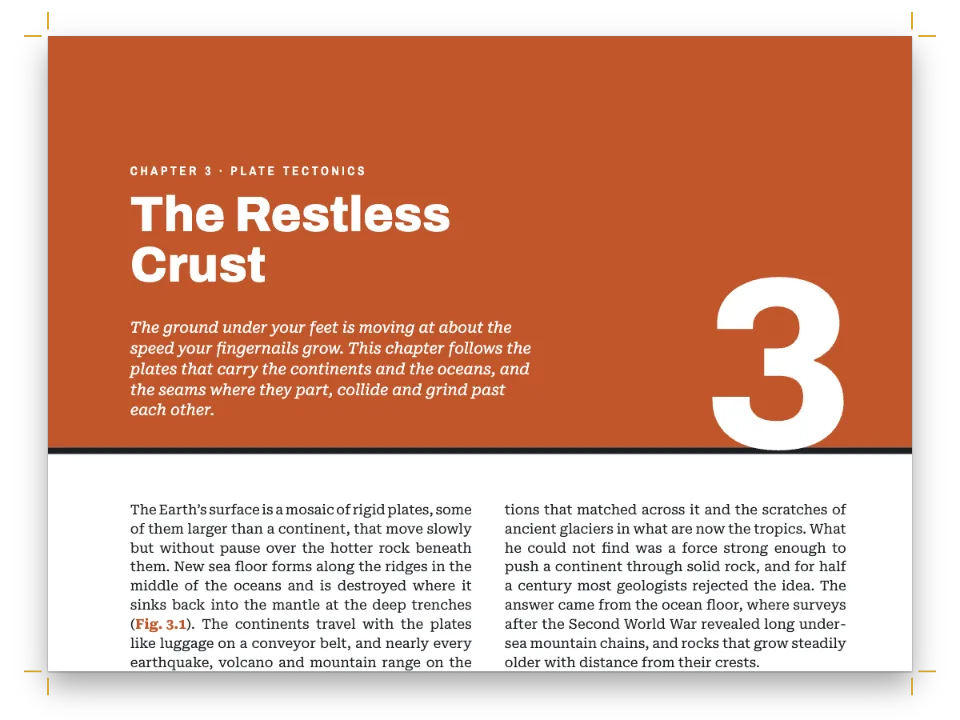
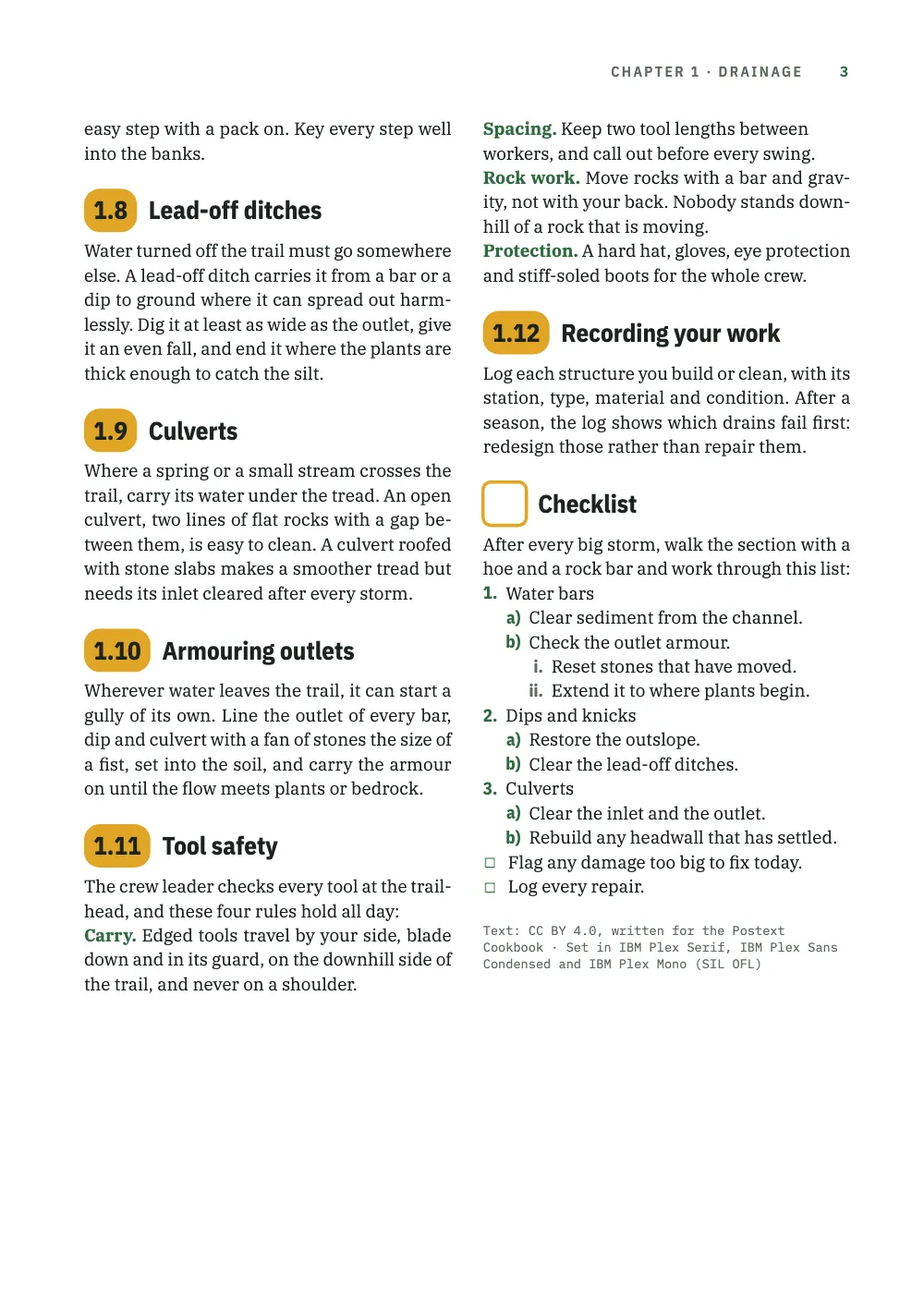
الفصل 1 من دليل ميداني لفريق صيانة الممرات الجبلية، Drainage، في ثلاث صفحات B5 بعمودين: IBM Plex Serif للنص، وIBM Plex Sans Condensed للعناوين وأرقام الأقسام، وIBM Plex Mono للتسميات وأرقام الصفحات وأرقام الأقسام الفرعية. تضع صفحة الافتتاح رقم الفصل في كبسولة كهرمانية كبيرة فوق مقطع ارتفاعات لممر، تعلّم فيه نقاط كهرمانية اثني عشر موقعًا محددة لحواجز تصريف جديدة. كبسولات أصغر ترقّم الأقسام من 1.1 إلى 1.12 وتتسع عند 1.10. والعناوين 1.2.1 و1.5.1 و1.5.2 حروف كبيرة متباعدة تحت خط أخضر. والمستويات 4 إلى 6 بلا أرقام وتغيّر خطها بدلًا من ذلك (serif مائل، وcondensed عريض أخضر، وحروف كبيرة أحادية العرض)، ومستوى سابع بالمائل الرمادي يسمّي الأدوات. تنفتح قواعد السلامة بمصطلحات خضراء داخل السطر. وتختم الفصلَ قائمةُ تحقق بلا رقم، يعلّمها مربع مجوّف، بقوائم مرقّمة 1. وa) وi. ومربعي مهام.
تجيب هذه الوصفة عن
- كيف أرقّم العناوين (1، 1.1، 1.1.1) وأنسّق كل مستوى بطريقة مختلفة؟
- كيف أبني شارة رقم بجانب العنوان تتسع حين يكبر الرقم (9 → 10)؟
- كيف أتعامل مع أكثر من ستة مستويات للعناوين؟
- كيف أخصّص القوائم: نقاط لكل مستوى، وترقيم (a)/(i)، ومربعات اختيار للمهام، وتباعد يبقى على الشبكة؟
الجواب المختصر
const H2 = 13.5; // pt: the number and the title share one size and one line height,
const LH = 1.2; // so, under the same top padding, they share one baseline
// Every section head starts on a grid line, so the 3 pt the pill falls short of two lines
// is the gap the grid snap leaves between the pill and the text under it.
const PILL_H = 2 * LEAD - 3, PAD = (PILL_H - H2 * LH) / 2; // pt
const face = { fontFamily: DISPLAY, fontWeight: 700, fontSize: pt(H2), lineHeight: LH };
const pill = { kind: 'text', id: 'pill', content: '{number}', ...face, color: col('ink'),
  box: { backgroundColor: col('signal'), borderRadius: mm(3), // no width: the pill is its
    padding: { top: pt(PAD), bottom: pt(PAD), left: mm(1.8), right: mm(1.8) } }, // number
  placement: at('container', 'top-left') }; // plus its padding
// 'right-of' hangs the title on the pill's right edge and aligns its lines left, so a long
// title wraps beside the number, never under it (gotcha: overflow-ellipsis-default).
const sectionTitle = (from) => ({ kind: 'text', id: 'title', content: '{titleText}', ...face,
  color: col('ink'), overflow: 'wrap', box: { padding: { top: pt(PAD) } },
  placement: at(`#${from}`, 'right-of', mm(2.2)) });
// The H1 counter, a point, the H2 counter: 1.1 … 1.12 in the pill. h2 joins headings.levels.
const h2 = { level: 2, numberingTemplate: '{1}.{2}',
  advancedDesign: { enabled: true, slot: { elements: [pill, sectionTitle('pill')] } } };
المكونات
- الميزات
- العناوين المرقّمةالنصوص والخطوط والمربعات في تصاميم الصفحةتثبيت عناصر التصميممستويات العناوينأنماط العناوينفصول بلا أرقامصفحات افتتاح مصمَّمةالصور في تصاميم الصفحةسمات العنوانأنماط الفقراتالغامق والمائل وألوانهماالقوائم النقطية وقوائم التحققالقوائم المرقّمةشبكة خطوط الأساسالأسطر الأرامل والأسطر اليتيمة والكلمات المعزولةالترويسات وأرقام الصفحاتالترويسات بحسب دور الصفحةهوامش متناظرةلوحة ألوان دلاليةالأشكال والجداول بوصفها موارد
- تستخدم أيضًا
- شريط فصل بعرض الصفحة
- الخطوط
- IBM Plex Serif, IBM Plex Sans Condensed, IBM Plex Mono (SIL OFL 1.1)
- الأصول
- لا شيء: كل صورة مرسومة بالكود
طريقة التحضير
#1 · ضع الرقم في كبسولة تكبر معه
الشيفرة في الجواب المختصر أعلاه. يجمع numberingTemplate: '{1}.{2}' عدّادي الفصل والقسم في 1.1 إلى 1.12 (تجاوزات كل مستوى). المستوى ذو التصميم المتقدم لا يطبع الرقم قبل عنوانه، فيضع التصميم {number} بنفسه. وهو هنا في عنصر نصي له box مملوء مستدير الزوايا وبلا عرض، فتكون الكبسولة بعرض الرقم مع حشوته: 10.1 مم لـ 1.9 و12.7 مم لـ 1.10. يعلّق 'right-of' العنوان على الحافة اليمنى للكبسولة ويحاذي أسطره إلى اليسار، ولهذا يلتف العنوان الطويل للقسم 1.5 بجانب الرقم (موضع العناصر). ويحتاج العنوان أيضًا إلى overflow: 'wrap'، لأن نص التصميم الذي لا يتسع يُقطع افتراضيًا بعلامة حذف. الكبسولة أقصر من سطري شبكة بـ 3 pt، وكل عنوان قسم يبدأ على سطر من الشبكة، فهذه الـ 3 pt هي الفجوة بين الكبسولة والنص تحتها، سواء افتتح العنوان عمودًا أو تلا فقرة.
#2 · سطّر المستوى الثالث وباعد حروفه
// Headings have no letterSpacing of their own; design text has, so this head is a design.
const small = { fontSize: pt(8.4), lineHeight: LH };
const DROP = 6; // pt: the rule drops this far toward the number, which keeps its grid line
const h3 = { level: 3, numberingTemplate: '{1}.{2}.{3}', // 1.5.1: restarts under every H2
  advancedDesign: { enabled: true, slot: { elements: [
    { kind: 'rule', id: 'rule', direction: 'horizontal', thickness: pt(0.75), color: col('band'),
      placement: { ...at('container', 'top-left', mm(0), pt(DROP)), size: { width: 'fill' } } },
    { kind: 'text', id: 'num', content: '{number}', fontFamily: LABEL, fontWeight: 500, ...small,
      color: col('band'), placement: at('#rule', 'below', mm(0), pt(LEAD - DROP)) },
    { kind: 'text', id: 'title', content: '{titleText}', fontFamily: DISPLAY, fontWeight: 600,
      ...small, letterSpacing: pt(1.35), textTransform: 'uppercase', color: col('ink'),
      overflow: 'wrap', placement: at('#num', 'right-of', mm(2)) },
  ] } } };
في 1.4.1 لا يملك مستوى العنوان letterSpacing، لكن نص التصميم يملكه، لذا يُرسم المستوى 3 بتصميم أيضًا: خط أخضر بسماكة 0.75 pt، والرقم بخط IBM Plex Mono والعنوان المتباعد الحروف بجانبه. العدّاد الثالث في '{1}.{2}.{3}' يبدأ من جديد تحت كل قسم، فينتهي 1.2.1 و1.5.1 كلاهما بـ 1. يُنزل DROP الخط وحده. والرقم موضوع على بعد LEAD - DROP تحته، فيبقى الرقم والعنوان سطرًا من الشبكة تحت أعلى العنوان مهما كانت قيمة DROP. ولأن الخط أقرب إلى الرقم منه إلى الفقرة التي فوقه، يُقرأ جزءًا من العنوان.
#3 · انزل درجة درجة عبر المستويات 4 إلى 6
const headings = { fontFamily: DISPLAY, color: col('ink'), // every head sits on the grid,
  lineHeight: pt(LEAD), marginTop: pt(LEAD), marginBottom: pt(0), // a line above, none below
  levels: [
    // Any headings object drops the H1 page break: restated (gotcha: headings-drop-h1-break).
    { level: 1, span: 'page', breakBefore: { enabled: true, parity: 'odd' },
      numberingTemplate: '{1}', advancedDesign: opener },
    h2, h3,
    // No template below level 3, so no number: each level changes face, colour or case.
    { level: 4, fontFamily: 'IBM Plex Serif', fontWeight: 400, italic: true, fontSize: pt(11) },
    { level: 5, fontSize: pt(9.4), color: col('band') },
    { level: 6, fontFamily: LABEL, fontWeight: 600, fontSize: pt(7.8), textTransform: 'uppercase' },
  ] };
المستوى الذي لا numberingTemplate له لا يطبع رقمًا، فمن المستوى 4 فما دون تختلف العناوين بالخط أو اللون أو حالة الحروف بدلًا من ذلك: serif مائل في المستوى 4، وخط العرض بالأخضر في 5، وحروف كبيرة أحادية العرض نصف عريضة في 6. ارتفاع السطر والهوامش المضبوطة على headings نفسه تبلغ كل المستويات وتضع كل عنوان على الشبكة، بسطر فارغ فوقه ولا شيء تحته. وأي كائن headings يُسقط فاصل الصفحة الافتراضي قبل الفصل، لذا يعيد المستوى 1 ذكره.
#4 · اصنع مستوى سابعًا وقسمًا بلا رقم بالأنماط
const headingStyles = [
  // Markdown stops at ######, and a heading drops *marks* (gotcha: heading-marks-dropped):
  // '###### Rock bar {style="level7"}' stays level 6, set in lower case, lighter and grey.
  { id: 'level7', fontFamily: DISPLAY, fontWeight: 500, italic: true, fontSize: pt(8.4),
    textTransform: 'none', color: col('muted') },
  // numbered: false: no number, and the H2 counter does not move. An empty {number} would
  // still paint the amber pill, so the style draws a hollow square in its place.
  { id: 'checklist', numbered: false, advancedDesign: { enabled: true, slot: { elements: [
    { kind: 'box', id: 'box', style: { borderColor: col('signal'), borderWidth: pt(1.8),
      borderRadius: mm(1.5) }, placement: { ...at('container', 'top-left'),
      size: { width: pt(PILL_H), height: pt(PILL_H) } } },
    sectionTitle('box'),
  ] } } },
];
const paragraphStyles = [
  // Run-in heads: the bold term opening each rule prints in the accent, not in body ink.
  { id: 'rules', boldColor: col('band'), firstLineIndent: pt(0) },
  { id: 'colophon', fontFamily: LABEL, fontSize: pt(6.8), lineHeight: pt(9),
    color: col('muted'), textAlign: 'left', firstLineIndent: pt(0), marginTop: pt(LEAD) },
];
يتوقف Markdown عند ######، والعنوان يُسقط علامات العريض والمائل، فكان ###### *Rock bar* سيُطبع مستوى سادسًا آخر. يضبط نمط العنوان 'level7' أسماء الأدوات بخط condensed مائل رمادي بوزن 500، أخف من وزن 600 في المستوى 6، ويوقف textTransform: 'none' الحروف الكبيرة التي كانت سترثها. وتُقرأ درجةً تحت التسمية أحادية العرض التي فوقها، مع أنها بحجم 8.4 pt أكبر من حجم تلك التسمية البالغ 7.8 pt (أنماط العناوين). يُخرج numbered: false قائمة التحقق من العدّ، فيظل القسم الذي بعدها 1.13. و{number} الفارغ كان سيرسم الكبسولة الكهرمانية رغم ذلك، فيأتي النمط بتصميمه الخاص، بمربع مجوّف في مكان الكبسولة. والمصطلحات الخضراء داخل سطور قواعد السلامة تأتي من boldColor لنمط فقرة.
#5 · غيّر علامات القوائم مع العمق
// Zero margins keep lists on the grid; a '- [ ]' item's bullet becomes taskCheckboxChar, '☐'.
const unorderedLists = { gap: mm(2), marginTop: pt(0), marginBottom: pt(0), color: col('band'),
  levels: [{ level: 2, bulletChar: '–', color: col('sage') }] }; // '•' stays at level 1
// Level 1 keeps the defaults: 'arabic', never CSS's 'decimal' (gotcha: numbering-vocabularies).
const orderedLists = { fontFamily: DISPLAY, color: col('band'), gap: mm(1.6),
  marginTop: pt(0), marginBottom: pt(0), levels: [
    { level: 2, numberFormat: 'lower-alpha', separator: ')' },
    { level: 3, numberFormat: 'lower-roman', color: col('muted') }] };
يأخذ كل عمق علامته ولونه وفاصله من levels: قائمة التحقق تعدّ 1. وa) وi. (تجاوزات كل مستوى للقوائم المرتبة) والنقاط تبهت من الأخضر إلى الأخضر الرمادي (تجاوزات كل مستوى للقوائم غير المرتبة). يحتفظ المستوى 1 بالصيغة الافتراضية، 'arabic'؛ أما 'decimal'، الكلمة التي يستعملها CSS، فكانت ستطبع «undefined». والبندان - [ ] اللذان يختمان قائمة التحقق يطبعان taskCheckboxChar، وهو ☐ افتراضيًا، مكان النقطة، بأخضر نقاط المستوى الأول (امتدادات قوائم المهام). ومع هوامش صفرية فوق وتحت، تبقى كل قائمة على شبكة خطوط الأساس.
#6 · افتح الفصل على مقطع ارتفاعات الممر
const DEPTH = 96; // mm: the profile's foot, measured from the top of the page
const CLEAR = 6; // mm: the least room between the profile's foot and the text under it
const LEGEND = 7; // mm: how far the legend's top sits above the profile's foot
const big = { ...face, fontSize: pt(54), lineHeight: 1, color: col('ink') };
// A picture reserves no height in an opener (gotcha: opener-image-no-reserve), so minHeight
// reaches past the profile: the text starts on the first grid line CLEAR mm or more under it.
const opener = { enabled: true, minHeight: mm(DEPTH - TOP + CLEAR), slot: { elements: [
  { kind: 'image', id: 'profile', resourceId: 'profile',
    placement: { ...at('page', 'top-left'), size: { width: 'fill' } } },
  { kind: 'text', id: 'num', content: '{number}', ...big, box: { backgroundColor: col('signal'),
    borderRadius: mm(4), padding: { top: pt(4), bottom: pt(4), left: mm(4), right: mm(4) } },
    placement: at('container', 'top-left') },
  { kind: 'text', id: 'title', content: '{titleText}', ...big, box: { padding: { top: pt(4) } },
    placement: at('#num', 'right-of', mm(4)) },
  { kind: 'text', id: 'lead', content: '{attr.lead}', fontFamily: 'IBM Plex Serif', italic: true,
    fontSize: pt(11.5), lineHeight: 1.3, color: col('ink'), align: 'left', overflow: 'wrap',
    placement: { ...at('#num', 'below', mm(0), mm(5)), size: { width: mm(100) } } },
  // Design text: an SVG drawn as an image cannot use web fonts (gotcha: svg-no-webfonts).
  { kind: 'text', id: 'legend', content: '{attr.profile}', fontFamily: LABEL, fontWeight: 500,
    fontSize: pt(7), color: col('tint'), placement: at('page', 'top-right', mm(-OUTER),
      mm(DEPTH - LEGEND)) },
] } };
مقطع الارتفاعات عنصر صورة في صفحة الافتتاح، مثبّت إلى الصفحة وبعرضها. ولو كان شكلًا بعرض الصفحة يطفو إلى الأعلى ويُحال إليه في الصفحة 1 لافتتح الصفحة 2 بدلًا من ذلك (عناصر الصور). في صفحة الافتتاح لا تحجز الصورة ارتفاعًا، فيبدأ minHeight النص على أول سطر شبكة يقع على بعد 6 مم أو أكثر تحتها. والتسمية التوضيحية على الأخضر نص تصميم، لأن SVG المرسوم صورةً لا يستطيع استعمال خطوط الصفحة. وتعيد الكبسولة الكبيرة استعمال خط كبسولة القسم وتعبئتها، ويطبع {number} رقم الفصل نفسه، من numberingTemplate: '{1}'.
الوصفة كاملة
// ═══ Postext Cookbook · Nº 018 · Section heads seven levels deep ═════════════════ // https://postext.dev/en/cookbook/section-heads-field-manual // Code: MIT · Text: original (CC BY 4.0) · Picture: drawn in code (MIT) // Fonts: IBM Plex Serif, Sans Condensed, Mono (SIL OFL 1.1) · Needs postext ≥ 1.4.1 import { buildDocument, renderPageToCanvas, clearMeasurementCache, registerResourceImage, } from 'https://esm.sh/postext'; const LANG = 'en'; // @lang: the language of the sample document ('en' | 'es') const RECIPE = 'section-heads-field-manual'; // ─── 1 · Design ───────────────────────────────────────────────────────────── const palette = { // forest green for structure, a signal amber for numbers ink: '#1d2320', // text: a green-black band: '#2f6b3f', // the accent: rules, run-in terms, bullets, numbers, folios (6.4:1) signal: '#e0a526', // the number pills, with ink on them (7.3:1) sage: '#7a9e80', // the second bullet and the profile's upper contours tint: '#e9f0e6', // the opener's sky; the legend on the green (5.5:1) muted: '#5f6a62', // running heads, level 7, roman list numbers, the colophon (5.6:1) }; // The hex as well as the id: design slots read only the hex (gotcha: palette-skips-designs). const col = (id) => ({ hex: palette[id], model: 'hex', paletteId: id }); // Defaults this config does not restate link to 'main-color', so it points at the accent. const colorPalette = Object.entries({ ...palette, 'main-color': palette.band }) .map(([id, hex]) => ({ id, name: id, value: { hex, model: 'hex' } })); const TRIM = { width: 176, height: 250 }; // mm: ISO B5, a common size for field manuals const [TOP, INNER, OUTER] = [22, 16, 14]; // mm: margins; the running heads align to OUTER const LEAD = 13.2; // pt: the body leading, the pitch of the baseline grid const LINES = 44; // grid lines in the text block, so every full column ends on one baseline const [DISPLAY, LABEL] = ['IBM Plex Sans Condensed', 'IBM Plex Mono']; // with the serif text const at = (to, edge, x, y) => ({ anchor: { to, edge }, offset: { x, y } }); // #region answer: section numbers 1.1 … 1.12 in an amber pill that widens with the number const H2 = 13.5; // pt: the number and the title share one size and one line height, const LH = 1.2; // so, under the same top padding, they share one baseline // Every section head starts on a grid line, so the 3 pt the pill falls short of two lines // is the gap the grid snap leaves between the pill and the text under it. const PILL_H = 2 * LEAD - 3, PAD = (PILL_H - H2 * LH) / 2; // pt const face = { fontFamily: DISPLAY, fontWeight: 700, fontSize: pt(H2), lineHeight: LH }; const pill = { kind: 'text', id: 'pill', content: '{number}', ...face, color: col('ink'), box: { backgroundColor: col('signal'), borderRadius: mm(3), // no width: the pill is its padding: { top: pt(PAD), bottom: pt(PAD), left: mm(1.8), right: mm(1.8) } }, // number placement: at('container', 'top-left') }; // plus its padding // 'right-of' hangs the title on the pill's right edge and aligns its lines left, so a long // title wraps beside the number, never under it (gotcha: overflow-ellipsis-default). const sectionTitle = (from) => ({ kind: 'text', id: 'title', content: '{titleText}', ...face, color: col('ink'), overflow: 'wrap', box: { padding: { top: pt(PAD) } }, placement: at(`#${from}`, 'right-of', mm(2.2)) }); // The H1 counter, a point, the H2 counter: 1.1 … 1.12 in the pill. h2 joins headings.levels. const h2 = { level: 2, numberingTemplate: '{1}.{2}', advancedDesign: { enabled: true, slot: { elements: [pill, sectionTitle('pill')] } } }; // #endregion // #region ruled: level 3, a green rule over the number and a tracked capital title // Headings have no letterSpacing of their own; design text has, so this head is a design. const small = { fontSize: pt(8.4), lineHeight: LH }; const DROP = 6; // pt: the rule drops this far toward the number, which keeps its grid line const h3 = { level: 3, numberingTemplate: '{1}.{2}.{3}', // 1.5.1: restarts under every H2 advancedDesign: { enabled: true, slot: { elements: [ { kind: 'rule', id: 'rule', direction: 'horizontal', thickness: pt(0.75), color: col('band'), placement: { ...at('container', 'top-left', mm(0), pt(DROP)), size: { width: 'fill' } } }, { kind: 'text', id: 'num', content: '{number}', fontFamily: LABEL, fontWeight: 500, ...small, color: col('band'), placement: at('#rule', 'below', mm(0), pt(LEAD - DROP)) }, { kind: 'text', id: 'title', content: '{titleText}', fontFamily: DISPLAY, fontWeight: 600, ...small, letterSpacing: pt(1.35), textTransform: 'uppercase', color: col('ink'), overflow: 'wrap', placement: at('#num', 'right-of', mm(2)) }, ] } } }; // #endregion // #region opener: the chapter number in the section pill, scaled up, over the trail's profile const DEPTH = 96; // mm: the profile's foot, measured from the top of the page const CLEAR = 6; // mm: the least room between the profile's foot and the text under it const LEGEND = 7; // mm: how far the legend's top sits above the profile's foot const big = { ...face, fontSize: pt(54), lineHeight: 1, color: col('ink') }; // A picture reserves no height in an opener (gotcha: opener-image-no-reserve), so minHeight // reaches past the profile: the text starts on the first grid line CLEAR mm or more under it. const opener = { enabled: true, minHeight: mm(DEPTH - TOP + CLEAR), slot: { elements: [ { kind: 'image', id: 'profile', resourceId: 'profile', placement: { ...at('page', 'top-left'), size: { width: 'fill' } } }, { kind: 'text', id: 'num', content: '{number}', ...big, box: { backgroundColor: col('signal'), borderRadius: mm(4), padding: { top: pt(4), bottom: pt(4), left: mm(4), right: mm(4) } }, placement: at('container', 'top-left') }, { kind: 'text', id: 'title', content: '{titleText}', ...big, box: { padding: { top: pt(4) } }, placement: at('#num', 'right-of', mm(4)) }, { kind: 'text', id: 'lead', content: '{attr.lead}', fontFamily: 'IBM Plex Serif', italic: true, fontSize: pt(11.5), lineHeight: 1.3, color: col('ink'), align: 'left', overflow: 'wrap', placement: { ...at('#num', 'below', mm(0), mm(5)), size: { width: mm(100) } } }, // Design text: an SVG drawn as an image cannot use web fonts (gotcha: svg-no-webfonts). { kind: 'text', id: 'legend', content: '{attr.profile}', fontFamily: LABEL, fontWeight: 500, fontSize: pt(7), color: col('tint'), placement: at('page', 'top-right', mm(-OUTER), mm(DEPTH - LEGEND)) }, ] } }; // #endregion // #region levels: numbers down to 1.1.1, then italic, bold and label faces for 4 to 6 const headings = { fontFamily: DISPLAY, color: col('ink'), // every head sits on the grid, lineHeight: pt(LEAD), marginTop: pt(LEAD), marginBottom: pt(0), // a line above, none below levels: [ // Any headings object drops the H1 page break: restated (gotcha: headings-drop-h1-break). { level: 1, span: 'page', breakBefore: { enabled: true, parity: 'odd' }, numberingTemplate: '{1}', advancedDesign: opener }, h2, h3, // No template below level 3, so no number: each level changes face, colour or case. { level: 4, fontFamily: 'IBM Plex Serif', fontWeight: 400, italic: true, fontSize: pt(11) }, { level: 5, fontSize: pt(9.4), color: col('band') }, { level: 6, fontFamily: LABEL, fontWeight: 600, fontSize: pt(7.8), textTransform: 'uppercase' }, ] }; // #endregion // #region styles: a seventh level and an unnumbered section as heading styles; run-in terms const headingStyles = [ // Markdown stops at ######, and a heading drops *marks* (gotcha: heading-marks-dropped): // '###### Rock bar {style="level7"}' stays level 6, set in lower case, lighter and grey. { id: 'level7', fontFamily: DISPLAY, fontWeight: 500, italic: true, fontSize: pt(8.4), textTransform: 'none', color: col('muted') }, // numbered: false: no number, and the H2 counter does not move. An empty {number} would // still paint the amber pill, so the style draws a hollow square in its place. { id: 'checklist', numbered: false, advancedDesign: { enabled: true, slot: { elements: [ { kind: 'box', id: 'box', style: { borderColor: col('signal'), borderWidth: pt(1.8), borderRadius: mm(1.5) }, placement: { ...at('container', 'top-left'), size: { width: pt(PILL_H), height: pt(PILL_H) } } }, sectionTitle('box'), ] } } }, ]; const paragraphStyles = [ // Run-in heads: the bold term opening each rule prints in the accent, not in body ink. { id: 'rules', boldColor: col('band'), firstLineIndent: pt(0) }, { id: 'colophon', fontFamily: LABEL, fontSize: pt(6.8), lineHeight: pt(9), color: col('muted'), textAlign: 'left', firstLineIndent: pt(0), marginTop: pt(LEAD) }, ]; // #endregion // #region lists: bullets that fade with depth; numbers 1. then a) then i.; task boxes // Zero margins keep lists on the grid; a '- [ ]' item's bullet becomes taskCheckboxChar, '☐'. const unorderedLists = { gap: mm(2), marginTop: pt(0), marginBottom: pt(0), color: col('band'), levels: [{ level: 2, bulletChar: '–', color: col('sage') }] }; // '•' stays at level 1 // Level 1 keeps the defaults: 'arabic', never CSS's 'decimal' (gotcha: numbering-vocabularies). const orderedLists = { fontFamily: DISPLAY, color: col('band'), gap: mm(1.6), marginTop: pt(0), marginBottom: pt(0), levels: [ { level: 2, numberFormat: 'lower-alpha', separator: ')' }, { level: 3, numberFormat: 'lower-roman', color: col('muted') }] }; // #endregion // Running heads, HEAD mm from the trim: folio and book on versos, chapter and folio on rectos. const HEAD = 12; // mm; an opener keeps only a drop folio, HEAD mm above its foot const FOLIO_GAP = 9; // mm from a folio to the title beside it const runHead = { fontFamily: DISPLAY, fontWeight: 600, fontSize: pt(7.8), letterSpacing: pt(1.2), textTransform: 'uppercase', color: col('muted') }; const folio = { ...runHead, fontFamily: LABEL, color: col('band') }; const head = (id, content, parity, edge, x, style = runHead) => ({ kind: 'text', id, content, parity, pages: 'body', ...style, placement: at('page', edge, mm(x), mm(HEAD)) }); const config = () => ({ // a factory: the engine caches resolved configs per object locale: t({ en: 'en-us', es: 'es' }), // exact codes (gotcha: hyphenation-locales) colorPalette, page: { sizePreset: 'custom', width: mm(TRIM.width), height: mm(TRIM.height), dpi: 150, margins: { top: mm(TOP), bottom: mm(TRIM.height - TOP - (LINES * LEAD * 25.4) / 72), left: mm(INNER), right: mm(OUTER), mirror: true } }, layout: { layoutType: 'double', gutterWidth: mm(6) }, bodyText: { fontFamily: 'IBM Plex Serif', fontSize: pt(9.4), lineHeight: pt(LEAD), color: col('ink'), boldColor: col('ink'), italicColor: col('ink'), referenceColor: col('ink'), textAlign: 'justify', firstLineIndent: mm(4), indentAfterHeading: false, minWordSpacing: 0.85, maxWordSpacing: 1.4, // a narrow band: an even grey, line to line maxRuntTracking: 0 }, // runt fixes tighten spaces only (gotcha: runt-tracking-unpainted) headings, headingStyles, paragraphStyles, unorderedLists, orderedLists, header: { elements: [head('v-folio', '{pageNumber}', 'even', 'top-left', OUTER, folio), head('v-book', '{title}', 'even', 'top-left', OUTER + FOLIO_GAP), head('r-chapter', t({ en: 'Chapter {chapterNumber} · {chapterTitle}', es: 'Capítulo {chapterNumber} · {chapterTitle}' }), 'odd', 'top-right', -(OUTER + FOLIO_GAP)), head('r-folio', '{pageNumber}', 'odd', 'top-right', -OUTER, folio), ] }, footer: { elements: [{ kind: 'text', id: 'drop-folio', content: '{pageNumber}', pages: 'opener', ...folio, placement: at('page', 'bottom', mm(0), mm(-HEAD)) }] }, }); // ─── 2 · Content ──────────────────────────────────────────────────────────── const markdown = String.raw`---نموذج Markdown · أسطر: 132 · content.en.md
title: "Trail Crew Field Manual" subtitle: "Maintenance with hand tools" author: "Postext Cookbook" --- # Drainage {lead="Where and how to build the drains of a trail, from an outsloped tread to a stone culvert." profile="Lookout Ridge Trail, km 0 to 4.2 · twelve sites flagged for new water bars"} In one season, boots pack a new trail until its tread sheds rain like a metal roof, and the rain runs down it, picking up speed and soil. This chapter shows how to turn that water off the trail before it cuts a rut. ## Why water is the enemy The faster water runs, the more soil it carries away, and it runs faster the steeper the grade and the longer the run. A sheet of water that barely moves on a flat tread turns into a cutting stream on a long, steep pitch. Once a rut forms, hikers walk beside it, the tread widens and each storm digs the rut deeper. Drainage breaks the run into short pieces, so the water never gets going. ## Reading the ground Walk the section during a storm if you can, or straight after one. Water will show you where it wants to go. Look for these signs: - silt fans below a steep pitch - puddles that hikers step around, wearing a new path beside them - a rut down the middle of the tread - shallower than a boot sole: reshape it - deeper: it needs a water bar - roots and rocks standing proud of the tread ### Flag before you dig Mark every site with flagging tape before the crew arrives, and record its station in the log: its distance from the trailhead, the grade and the structure you propose. When the section is walked and flagged, a crew leader can plan the day in minutes. ## Outslope first The cheapest drain is a tread that tilts. Shape it to fall by about 5 per cent toward the downhill edge, 3 cm across a tread 60 cm wide, so that water crosses it in a thin sheet instead of running down its length. Rake off the berm of loose soil that builds up along the outer edge, since a berm turns the tread back into a gutter. Check the tilt with a short level across the tread; an outslope too slight to see still sheds water, and a steeper one only turns ankles. ## Grade dips In a grade dip, the grade reverses for a short way: the trail drops, rises again for a few metres, then resumes its climb, and water leaves at the low point. Built into new trail, dips are almost invisible to hikers and need little upkeep. On an old trail you can often carve one with a grub hoe where the grade eases. ## Water bars: turning water off steep tread Where the grade is too steep for a dip, a water bar turns the flow across the tread. It is a line of rock or timber set into the tread at an angle, its top a little above the surface, with an armoured outlet at its lower end. ### Laying out a bar Skew the bar 30 to 45 degrees off the square, so the water keeps enough speed to carry its silt away; a bar laid straight across the tread fills with sediment after the first storm. Space the bars more closely as the grade steepens: on loose soil at 10 per cent, one every 25 or 30 metres, and closer still on a steeper pitch. #### Choosing the spot Place the bar where the water can leave with ease, in a natural hollow on the downhill side. Never let it drain onto a switchback or over a steep drop, where the outflow would cut into the slope below. ### Building a rock bar Dig a trench across the tread at the angle you chose, two thirds as deep as your tallest rock is high. Set the rocks on edge and shoulder to shoulder, with at least two thirds of each one buried, and key the upper end 30 cm into the bank so that water cannot run around it. #### The trench Keep the trench walls vertical and its floor on firm mineral soil. Throw the spoil well downhill, clear of the tread, and keep the best for backfill. On loose soil, widen the trench and line its downhill side with smaller stones, so that the bar rests on something firm. ##### Tools for the trench A grub hoe and a shovel open it, and two steel bars set the rocks. ###### Steel bars Each is about 1.5 m long; the heavier weighs as much as a loaded daypack. Lay them down when not in use, never upright against a tree. ###### Rock bar {style="level7"} The heavy one: a lever to pry rocks loose and walk them into place. Keep your fingers clear of the pivot rock and lift with your legs. ###### Tamping bar {style="level7"} The lighter bar, with a flat tamping foot at one end. Backfill in layers no thicker than a hand and tamp each one hard: the first flow carries off loose fill behind a bar. ## Knicks On flat or rolling tread where puddles gather, a knick drains water with no structure at all. It is a shallow half-moon about 3 metres long, shaved into the tread so its outer edge sits a hand’s depth below the rest. ## Check steps Where the trail climbs a gully and the water cannot be turned aside, slow it down instead. Check steps are low risers of stone or timber set across the tread, each one holding back a level bed of soil, and the water loses speed at every landing. A rise of 15 to 20 cm makes an easy step with a pack on. Key every step well into the banks. ## Lead-off ditches Water turned off the trail must go somewhere else. A lead-off ditch carries it from a bar or a dip to ground where it can spread out harmlessly. Dig it at least as wide as the outlet, give it an even fall, and end it where the plants are thick enough to catch the silt. ## Culverts Where a spring or a small stream crosses the trail, carry its water under the tread. An open culvert, two lines of flat rocks with a gap between them, is easy to clean. A culvert roofed with stone slabs makes a smoother tread but needs its inlet cleared after every storm. ## Armouring outlets Wherever water leaves the trail, it can start a gully of its own. Line the outlet of every bar, dip and culvert with a fan of stones the size of a fist, set into the soil, and carry the armour on until the flow meets plants or bedrock. ## Tool safety The crew leader checks every tool at the trailhead, and these four rules hold all day: :::paragraphs{style="rules"} **Carry.** Edged tools travel by your side, blade down and in its guard, on the downhill side of the trail, and never on a shoulder. **Spacing.** Keep two tool lengths between workers, and call out before every swing. **Rock work.** Move rocks with a bar and gravity, not with your back. Nobody stands downhill of a rock that is moving. **Protection.** A hard hat, gloves, eye protection and stiff-soled boots for the whole crew. ::: ## Recording your work Log each structure you build or clean, with its station, type, material and condition. After a season, the log shows which drains fail first: redesign those rather than repair them. ## Checklist {style="checklist"} After every big storm, walk the section with a hoe and a rock bar and work through this list: 1. Water bars 1. Clear sediment from the channel. 2. Check the outlet armour. 1. Reset stones that have moved. 2. Extend it to where plants begin. 2. Dips and knicks 1. Restore the outslope. 2. Clear the lead-off ditches. 3. Culverts 1. Clear the inlet and the outlet. 2. Rebuild any headwall that has settled. - [ ] Flag any damage too big to fix today. - [ ] Log every repair. :::paragraphs{style="colophon"} Text: CC BY 4.0, written for the Postext Cookbook · Set in IBM Plex Serif, IBM Plex Sans Condensed and IBM Plex Mono (SIL OFL) :::`; // content.<lang>.md, inlined by the Cookbook // The profile is a resource that no :ref cites: only the opener's image element draws it. const resources = [{ id: 'profile', typeId: 'figure', kind: 'svg', createdAt: 0, updatedAt: 0, svg: { fileId: 'profile.svg', width: TRIM.width * 10, height: DEPTH * 10 }, altText: t({ en: 'A 376 m climb in 4.2 km; amber dots mark twelve sites flagged for water bars.', es: 'Subida de 376 m en 4,2 km; puntos ámbar en doce sitios balizados para desviadores.' }) }]; // #region art: the trail's elevation profile, drawn in code with a seeded PRNG function profileSvg() { // Survey points, distance (km) and elevation (m): an easy valley, then the climb. const KM = 4.2; const pts = [[0, 1180], [0.8, 1190], [1.5, 1204], [2.1, 1226], [2.6, 1262], [3.0, 1330], [3.35, 1412], [3.7, 1486], [4.0, 1535], [4.2, 1556]]; const Y0 = DEPTH - 12; // mm: where 1180 m sits in the picture const K = 50 / 376; // mm of picture per metre of climb const elev = (d) => { // smoothstep between survey points: monotone, no overshoot const next = pts.findIndex(([x]) => x > d); const i = next < 0 ? pts.length - 2 : Math.max(0, next - 1); const [[x0, e0], [x1, e1]] = [pts[i], pts[i + 1]]; const u = Math.min(1, (d - x0) / (x1 - x0)); return e0 + (e1 - e0) * u * u * (3 - 2 * u); }; let seed = 18; // Mulberry32: the same wobble on every run const rand = () => { seed = (seed + 0x6d2b79f5) | 0; let r = Math.imul(seed ^ (seed >>> 15), 1 | seed); r = (r + Math.imul(r ^ (r >>> 7), 61 | r)) ^ r; return ((r ^ (r >>> 14)) >>> 0) / 4294967296; }; const N = 220; const crest = Array.from({ length: N + 1 }, (_, i) => [(TRIM.width * i) / N, Y0 - (elev((KM * i) / N) - 1180) * K + (rand() - 0.5) * 0.5]); const xy = (list) => list.map(([x, y]) => `${x.toFixed(2)} ${y.toFixed(2)}`).join('L'); // Contour bands every 50 m, from the band green in the valley to sage on the ridge: each // band is the profile clipped between two contours. const mix = (a, b, u) => '#' + [1, 3, 5].map((i) => Math.round(parseInt(a.slice(i, i + 2), 16) * (1 - u) + parseInt(b.slice(i, i + 2), 16) * u).toString(16).padStart(2, '0')).join(''); const bands = Array.from({ length: 8 }, (_, k) => { const floor = Y0 - k * 50 * K; const top = crest.map(([x, y]) => [x, Math.min(floor, Math.max(y, floor - 50 * K))]); return `<path d="M0 ${floor}L${xy(top)}L${TRIM.width} ${floor}Z" ` + `fill="${mix(palette.band, palette.sage, k / 7)}"/>`; }).join(''); // The twelve flagged sites, placed one per 32 m of climb: they crowd where it steepens. const dots = Array.from({ length: 12 }, (_, k) => { const target = 1180 + 32 * (k + 0.5); let [lo, hi] = [0, KM]; for (let it = 0; it < 40; it++) { const mid = (lo + hi) / 2; if (elev(mid) < target) lo = mid; else hi = mid; } return `<circle cx="${((TRIM.width * lo) / KM).toFixed(2)}" ` + `cy="${(Y0 - (target - 1180) * K).toFixed(2)}" r="1.9" fill="${palette.signal}" ` + `stroke="${palette.ink}" stroke-width="0.35"/>`; }).join(''); return `<svg xmlns="http://www.w3.org/2000/svg" width="${TRIM.width * 10}" ` + `height="${DEPTH * 10}" viewBox="0 0 ${TRIM.width} ${DEPTH}">` + `<rect width="${TRIM.width}" height="${DEPTH}" fill="${palette.tint}"/>` + `<path d="M0 ${DEPTH}L${xy(crest)}L${TRIM.width} ${DEPTH}Z" fill="${palette.band}"/>` + `${bands}<path d="M${xy(crest)}" fill="none" stroke="${palette.ink}" ` + `stroke-width="0.7" stroke-linejoin="round"/>${dots}</svg>`; } // #endregion // ─── 3 · Fonts ────────────────────────────────────────────────────────────── // Every face the pages paint, loaded before the first build (gotcha: fonts-first). const FONTS = { 'IBM Plex Serif': ['400', '400i', '700'], 'IBM Plex Sans Condensed': ['500i', '600', '700'], 'IBM Plex Mono': ['400', '500', '600'] }; // ─── 4 · Build & show ─────────────────────────────────────────────────────── await loadFonts(FONTS, markdown); await loadSvg('profile.svg', profileSvg()); const doc = await buildWithFonts(() => buildDocument({ markdown, resources }, config()), markdown); showPages(doc, { title: t({ en: 'Section heads seven levels deep', es: 'Títulos de sección hasta siete niveles' }) });العُدّة · core, fonts, viewer, images: نفسها في كل وصفة · أسطر: 270
// ─── Kit ── helpers shared by every Cookbook recipe · postext.dev/cookbook ───── // ─── Kit · core v1 ── the same in every recipe · postext.dev/cookbook ───────── function mm(value) { return { value, unit: 'mm' }; } function pt(value) { return { value, unit: 'pt' }; } function em(value) { return { value, unit: 'em' }; } /** The sample language's string: t({ en: 'Figure', es: 'Figura' }). */ function t(strings) { return strings[LANG] ?? Object.values(strings)[0]; } /** A file in this recipe's assets folder, served from the Postext repo by jsDelivr. */ function asset(file) { return `https://cdn.jsdelivr.net/gh/drnachio/postext@main/cookbook/${RECIPE}/assets/${file}`; } // ─── Kit · fonts v1 ── the same in every recipe · postext.dev/cookbook ──────── // Postext measures text with the faces the browser has loaded, and caches the // widths, so every face must be ready before the first build. Faces come from // Fontsource: the same static files the PDF embeds, so screen and PDF agree. /** faces = { 'Family Name': ['400', '400i', '700'] }. `text` is the sample: * letters beyond Latin-1 (č, ł, ő…) also load the latin-ext files. With * `optional`, a face Fontsource does not ship is skipped instead of failing. * Resolves to the number of faces added. */ async function loadFonts(faces, text = '', { optional = false } = {}) { kitStatus('Loading fonts…'); const ranges = { latin: 'U+0000-00FF,U+0131,U+0152-0153,U+02BB-02BC,U+02C6,U+02DA,U+02DC,U+0304,U+0308,U+0329,' + 'U+2000-206F,U+20AC,U+2122,U+2191,U+2193,U+2212,U+2215,U+FEFF,U+FFFD', 'latin-ext': 'U+0100-02BA,U+02BD-02C5,U+02C7-02CC,U+02CE-02D7,U+02DD-02FF,U+0304,U+0308,U+0329,' + 'U+1D00-1DBF,U+1E00-1E9F,U+1EF2-1EFF,U+2020,U+20A0-20AB,U+20AD-20C0,U+2113,U+2C60-2C7F,U+A720-A7FF', }; const subsets = /[Ā-˿Ḁ-ỿ]/.test(text) ? ['latin', 'latin-ext'] : ['latin']; const jobs = []; let added = 0; for (const [family, specs] of Object.entries(faces)) { const id = fontsourceId(family); const meta = optional ? await fontsourceMeta(family) : null; for (const spec of new Set(specs)) { const weight = parseInt(spec, 10); const style = spec.endsWith('i') ? 'italic' : 'normal'; if (hasFace(family, weight, style)) continue; if (optional && !(meta?.weights.includes(weight) && meta.styles.includes(style))) continue; for (const subset of subsets) { const url = `https://cdn.jsdelivr.net/npm/@fontsource/${id}@5/files/${id}-${subset}-${weight}-${style}.woff2`; const face = new FontFace(family, `url(${url}) format('woff2')`, { weight: String(weight), style, unicodeRange: ranges[subset] }); jobs.push(face.load().then((ready) => { document.fonts.add(ready); added++; }, () => { if (subset === 'latin' && !optional) throw new Error(`Fontsource has no ${family} ${weight} ${style}`); })); } } } await Promise.all(jobs).catch((error) => { kitFail(error); throw error; }); return added; } /** Runs `build` (a buildDocument or buildBundle call) and checks the faces * the pages use. A regular face missing from FONTS is loaded with a warning; * bold and italic variants are loaded when the family ships them. Then the * measurement caches are cleared and the build runs again. */ async function buildWithFonts(build, text = '') { const tried = new Set(); for (let round = 0; round < 3; round++) { kitStatus('Laying out…'); await new Promise(requestAnimationFrame); // let the status paint first const result = await Promise.resolve().then(build).catch((error) => { kitFail(error); throw error; }); const wanted = { base: {}, variants: {} }; for (const { font, base } of [result].flat().flatMap(fontStringsOf)) { const { family, weight, style } = parseFont(font); const key = `${family}|${weight}|${style}`; if (tried.has(key) || hasFace(family, weight, style)) continue; tried.add(key); (wanted[base ? 'base' : 'variants'][family] ??= []).push(`${weight}${style === 'italic' ? 'i' : ''}`); } if (Object.keys(wanted.base).length) { console.warn(`[cookbook] FONTS does not list ${JSON.stringify(wanted.base)}: loading them.`); } const added = await loadFonts(wanted.base, text) + await loadFonts(wanted.variants, text, { optional: true }); if (added === 0) return result; clearMeasurementCache(); } throw new Error('The fonts did not settle after three builds.'); } /** Every font string of the layout. `base` marks a block's own face; its * bold, italic and bold-italic variants are listed whether or not used. */ function fontStringsOf(doc) { const found = new Map(); const walk = (node) => { if (!node || typeof node !== 'object') return; if (Array.isArray(node)) { node.forEach(walk); return; } for (const [key, value] of Object.entries(node)) { if (typeof value === 'string' && /fontString$/i.test(key)) { found.set(value, found.get(value) || key === 'fontString'); } else if (value && typeof value === 'object') walk(value); } }; walk(doc.pages); walk(doc.blocks); return [...found].map(([font, base]) => ({ font, base })); } /** '700 37.5px Open Sans' / 'italic 400 13px "Source Serif 4"' → { family, weight, style }. * A string with no weight ('95.8px Young Serif', from a design text) is 400. */ function parseFont(font) { const m = /^(?:(italic|oblique)\s+)?(?:small-caps\s+)?(?:(\d+|bold|normal)\s+)?[\d.]+px\s+(.+)$/.exec(font.trim()); if (!m) throw new Error(`Unexpected font string: ${font}`); const weight = m[2] === 'bold' ? 700 : !m[2] || m[2] === 'normal' ? 400 : Number(m[2]); return { family: m[3].replace(/^["']|["']$/g, ''), weight, style: m[1] ? 'italic' : 'normal' }; } /** True when a loaded FontFace covers exactly this family, weight and style * (document.fonts.check() is also true for families nobody declared). */ function hasFace(family, weight, style) { for (const face of document.fonts) { if (face.status !== 'loaded' || face.style !== style) continue; if (face.family.replace(/^["']|["']$/g, '') !== family) continue; const [low, high = low] = face.weight.split(' ').map(Number); if (weight >= low && weight <= high) return true; } return false; } /** Fontsource's id for a family: 'Source Serif 4' → 'source-serif-4'. */ function fontsourceId(family) { return family.toLowerCase().replace(/\s+/g, '-'); } /** The weights and styles a family ships ({ weights: [400, 700], styles: ['normal', 'italic'] }), or null. */ function fontsourceMeta(family) { fontsourceMeta.cache ??= new Map(); const id = fontsourceId(family); if (!fontsourceMeta.cache.has(id)) { fontsourceMeta.cache.set(id, fetch(`https://api.fontsource.org/v1/fonts/${id}`) .then((res) => (res.ok ? res.json() : null), () => null)); } return fontsourceMeta.cache.get(id); } // ─── Kit · viewer v1 ── the same in every recipe · postext.dev/cookbook ─────── /** Shows the pages as facing spreads on a dark desk: the first page is a * recto on its own, then verso | recto pairs, as in a bound book. Pages * are painted when they scroll near the screen. */ function showPages(docs, { title, width = 460 } = {}) { const root = viewer(title); const pages = [docs].flat().flatMap((doc) => doc.pages.map((page) => ({ doc, page, n: (doc.pageIndexOffset ?? 0) + page.index }))); const spreads = []; let verso = null; for (const p of pages) { if (p.n % 2 === 1) { if (verso) spreads.push([verso, null]); verso = p; } else { spreads.push([verso, p]); verso = null; } } if (verso) spreads.push([verso, null]); const density = Math.min(window.devicePixelRatio || 1, 2); showPages.painter?.disconnect(); const painter = new IntersectionObserver((entries) => { for (const { isIntersecting, target } of entries) { if (!isIntersecting) continue; painter.unobserve(target); const { doc, page } = target.postext; renderPageToCanvas(page, doc, target, { scale: (width * density) / page.width }); } }, { rootMargin: '800px' }); showPages.painter = painter; root.replaceChildren(...spreads.map((pair) => { const spread = document.createElement('div'); spread.className = 'pt-spread'; for (const p of pair) { const figure = document.createElement('figure'); if (p) { const label = p.page.pageLabel || String(p.n + 1); const canvas = document.createElement('canvas'); canvas.postext = p; canvas.style.aspectRatio = `${p.page.width} / ${p.page.height}`; canvas.setAttribute('role', 'img'); canvas.setAttribute('aria-label', `Page ${label}`); const folio = document.createElement('figcaption'); folio.textContent = label; figure.append(canvas, folio); painter.observe(canvas); } else figure.className = 'pt-blank'; spread.append(figure); } return spread; })); kitStatus(`${pages.length} ${pages.length === 1 ? 'page' : 'pages'}`); document.documentElement.dataset.postext = 'ready'; return pages.length; } /** The desk, the bar and the error reporting, created once. */ function viewer(title) { if (!document.getElementById('pt-kit')) { document.head.insertAdjacentHTML('beforeend', `<style id="pt-kit"> :root { color-scheme: dark; } body { margin: 0; background: #0e1014; color: #b9bcc4; font: 13px/1.45 system-ui, sans-serif; } #pt-bar { position: sticky; top: 0; z-index: 1; display: flex; flex-wrap: wrap; align-items: center; gap: 6px 16px; padding: 10px 16px; background: rgb(14 16 20 / .92); backdrop-filter: blur(6px); border-bottom: 1px solid #23262d; } #pt-bar strong { color: #f4f1ea; font-weight: 600; } #pt-actions { display: flex; gap: 12px; margin-left: auto; } #pt-actions a, #pt-actions button { color: #d8a21a; font: inherit; background: none; border: 0; padding: 0; cursor: pointer; } #pages { display: grid; justify-items: center; gap: 48px; padding: 32px 16px 72px; } .pt-spread { display: flex; } .pt-spread figure { margin: 0; width: min(460px, 44vw); } .pt-spread canvas { display: block; width: 100%; background: #fff; box-shadow: 0 1px 2px rgb(0 0 0 / .5), 0 22px 44px -16px rgb(0 0 0 / .8); } .pt-spread figure:first-child canvas { box-shadow: inset -14px 0 14px -14px rgb(0 0 0 / .18), 0 1px 2px rgb(0 0 0 / .5), 0 22px 44px -16px rgb(0 0 0 / .8); } .pt-spread figcaption { margin-top: 10px; text-align: center; font: 600 10px/1 system-ui, sans-serif; letter-spacing: .18em; text-transform: uppercase; color: #6c7079; } .pt-blank { visibility: hidden; } @media (max-width: 760px) { .pt-spread { flex-direction: column; gap: 32px; } .pt-spread figure { width: min(460px, 92vw); } .pt-blank { display: none; } } </style>`); document.body.insertAdjacentHTML('afterbegin', '<header id="pt-bar"><strong id="pt-title"></strong><span id="pt-status" role="status"></span><span id="pt-actions"></span></header>'); document.getElementById('pt-title').textContent = document.title || 'Postext'; addEventListener('error', (event) => kitFail(event.error ?? event.message)); addEventListener('unhandledrejection', (event) => kitFail(event.reason)); } if (title) document.getElementById('pt-title').textContent = title; return document.getElementById('pages') ?? document.body.appendChild(Object.assign(document.createElement('main'), { id: 'pages' })); } function kitStatus(text) { viewer(); document.getElementById('pt-status').textContent = text; } function kitFail(error) { document.documentElement.dataset.postext = 'error'; kitStatus(`Error: ${error?.message ?? error}`); } // ─── Kit · images v1 ── recipes with pictures · postext.dev/cookbook ────────── /** Registers a photo or PNG for the canvas and keeps its bytes for the PDF. * fetch → ImageBitmap never taints the canvas (a plain cross-origin <img> would). */ async function loadImage(fileId, url) { const res = await fetch(url); if (!res.ok) throw new Error(`Image not found (${res.status}): ${url}`); const bytes = new Uint8Array(await res.arrayBuffer()); registerResourceImage(fileId, await createImageBitmap(new Blob([bytes]))); (loadImage.bytes ??= new Map()).set(fileId, bytes); } /** Registers SVG markup (drawn in code, or fetched) as a vector image. */ async function loadSvg(fileId, svg) { const img = new Image(); img.src = `data:image/svg+xml;charset=utf-8,${encodeURIComponent(svg)}`; await img.decode(); registerResourceImage(fileId, img); (loadImage.bytes ??= new Map()).set(fileId, new TextEncoder().encode(svg)); } /** renderToPdf({ resourceBytes: imageBytes }) */ function imageBytes(fileId) { return loadImage.bytes?.get(fileId); } /** renderToHtml({ resourceImageUrl: imageUrl }) */ function imageUrl(fileId) { const bytes = imageBytes(fileId); if (!bytes) return undefined; imageUrl.urls ??= new Map(); if (!imageUrl.urls.has(fileId)) { const type = /\.svg$/i.test(fileId) ? 'image/svg+xml' : /\.png$/i.test(fileId) ? 'image/png' : 'image/jpeg'; imageUrl.urls.set(fileId, URL.createObjectURL(new Blob([bytes], { type }))); } return imageUrl.urls.get(fileId); } // ─── /Kit ───────────────────────────────────────────────────────────────────────
يعمل ملف script.js المجمّع كما هو: الصقه في سكربت الوحدة (module) لأي صفحة، أو افتح الوصفة على CodePen. مجلد الوصفة على GitHub ↗ (يفتح في تبويب جديد)
تنويعات
#أسقط رقم الفصل من الكبسولات
أخرِج عدّاد الفصل من القالب فتقرأ الكبسولات 1 إلى 12، وتتسع عند 10؛ ويطبع المستوى 3 الرقم 1.5.1 إلى أن يُسقط قالبه هو أيضًا {1}.
-const h2 = { level: 2, numberingTemplate: '{1}.{2}',
+const h2 = { level: 2, numberingTemplate: '{2}',#أعطِ كل الكبسولات العرض نفسه
عرض ثابت، عرض 1.10، يوسّط كل رقم في كبسولة متساوية ويصفّ العناوين في عمود واحد.
-  placement: at('container', 'top-left') }; // plus its padding
+ placement: { ...at('container', 'top-left'), size: { width: mm(12.7) } } };أخطاء شائعة
خطأ شائع
أي كائن headings يُلغي فاصل الصفحة قبل H1
ينتقل H1 افتراضيًا إلى صفحة فردية (always-odd)، لكن تمرير أي كائن headings يعيد ضبط هذا الافتراض، فتتوالى الفصول دون فاصل ولا يفعل span: 'page' شيئًا. أعد كتابة headings.levels[0].breakBefore: { enabled: true, parity } في كل إعداد. فصول تبدأ في صفحة فردية →
خطأ شائع
العنوان يُسقط علامات العريض والمائل
في postext 1.4.1 يفقد سطر العنوان علاماته داخل السطر: ###### *Rock bar* يطبع Rock bar بخط المستوى 6 العادي، بلا نجمات وبلا مائل. المستوى السابع، أو كلمة مميَّزة داخل عنوان، يحتاج إلى نمط عنوان ({style="…"}) أو إلى تصميم متقدّم. أنماط العناوين →
خطأ شائع
فيض نص التصميم افتراضيًا 'ellipsis-end'
عنصر نص التصميم الذي لا يتسع له عرضه ينتهي افتراضيًا بعلامة الحذف. اضبط overflow: 'wrap' للعناوين التي يجب أن تنكسر على أسطر أكثر. النصوص والخطوط والمربعات في تصاميم الصفحة →
خطأ شائع
لوحة الألوان المستبدلة لا تصل إلى عناصر التصميم ولا إلى لون الإحالة
يقرأ postext 1.4.1 الإعداد colorPalette في أنماط النص (المتن والعناوين والقوائم والتعليقات والجداول والإطارات) لكن لا في عناصر الترويسات والتذييلات والافتتاحيات وصفحات الأجزاء، ولا في bodyText.referenceColor: تحتفظ بالقيمة الست عشرية المكتوبة بجانب paletteId الخاص بها. حين تستبدل لوحة الألوان، لنسخة شاشة داكنة أو لإعادة تلوين، أعِد كتابة كل لون مرتبط من colorPalette قبل البناء. لوحة ألوان دلالية →
خطأ شائع
صور الافتتاحية لا تُحتسب أبدًا في الارتفاع الذي تحجزه
في postext 1.4.1 يقيس العنوان ذو التصميم المتقدّم الارتفاعَ الذي يحجزه دون صوره: تُحتسب نصوصه وخطوطه وإطاراته، حتى المثبّتة على الصفحة، أما الصورة، كصورة تمتد بالنزف عبر رأس الصفحة، فلا تحجز شيئًا، فقد يبدأ النص فوقها. اضبط minHeight على الموضع الذي يجب أن يبدأ فيه النص. صفحات افتتاح مصمَّمة →
خطأ شائع
العنصر العائم 'top' لا يقع أبدًا في صفحة الإحالة إليه
لا يصعد العنصر العائم أبدًا فوق الإحالة إليه، فالعنصر العائم 'top' الممتد بعرض الصفحة والمُحال إليه في الصفحة N يفتتح الصفحة N+1. أحِل إليه في موضع أبكر، أو استخدم الموضع 'auto' أو 'bottom' الذي يمكنه أن يشغل أسفل صفحة الإحالة. موضع الأشكال →
خطأ شائع
النص داخل SVG في <img> لا يستطيع استخدام خطوط الويب
يُرسَم SVG صورةً، والصورة لا تصل إلى خطوط الويب في الصفحة، فتعود تسمياته إلى خط من النظام. حوّل النص إلى مسارات، أو ضمّن مجموعة فرعية بـ @font-face داخل SVG، أو انقل التسميات إلى التعليق. الأشكال والجداول بوصفها موارد →
خطأ شائع
القوائم تقول 'arabic'، والموارد 'roman-upper'، والصفحات 'upper-roman'
كل إعداد ترقيم يكتب صيغه بطريقة مختلفة: القوائم تأخذ numberFormat 'arabic' (القيمة 'decimal' تطبع "undefined")، وأنواع الموارد تأخذ counterFormat 'roman-upper'، والصفحات و:::numbering تأخذ 'upper-roman'. القوائم المرقّمة →
خطأ شائع
معظم التحذيرات موجودة في Sandbox وحده
المعرّفات والأنماط والتوجيهات المجهولة، والخطوط المفقودة، والأسطر المتخلخلة يفحصها Sandbox لا المحرّك: مثال CodePen لا يحصل إلا على doc.warnings وparseMarkdownWithIssues. النمط المجهول يعود إلى البديل دون تنبيه، والتوجيه المجهول يُطبع نصًا، فتحقّق من معرّفاتك. التحذيرات والتشخيص →
خطأ شائع
المسافة غير القابلة للكسر تكسر السطر مع ذلك
في postext 1.4.1 يعامل كاسر الأسطر U+00A0 معاملة المسافة العادية، فقد تنقسم 0.08 % أو 2.006 s أو Section 2 على سطرين. ألصق الجزأين (0.08%) أو أعد صياغة الجملة. الهروب والمحارف الحرفية →
خطأ شائع
ضع كل قيمة في الترويسة الأمامية (frontmatter) بين علامتي اقتباس
يقرأ YAML القيمة title: 1984 رقمًا، ويقرأ التاريخ كائن Date، والقيم غير النصية تُطبع فارغة في العناصر النائبة وتترك ملف PDF بلا عنوان. ضع كل قيمة بين علامتي اقتباس: title: "1984". البيانات الوصفية للمستند →
خطأ شائع
8 لغات فقط تُقسَّم بالواصلة، بالرمز المطابق تمامًا
يتوفر تقسيم الكلمات بالواصلة للغات en-us وes وfr وde وit وpt وca وnl، بمطابقة تامة للرمز: 'es-ES' أو أي لغة أخرى تعود دون تنبيه إلى الإنجليزية الأمريكية. تقسيم الكلمات ولغة المستند →
خطأ شائع
حمّل كل أوجه الخط قبل الإخراج
يقيس الإخراج النص بأوجه الخط التي حمّلها المتصفح ويخزّن العروض مؤقتًا، فالوجه الذي يصل بعد البناء الأول يترك فواصل أسطر خاطئة وملف PDF لم يعد يطابق الشاشة. حمّل كل وزن وكل نمط أولًا، واستدعِ clearMeasurementCache() قبل إعادة البناء إذا تأخر وصول أحدها. الخطوط قبل الإخراج →
خطأ شائع
إصلاح الكلمة المعزولة قد يضيّق تتبّعًا لا يُرسَم أبدًا
في postext 1.4.1، حين تنتهي فقرة بكلمة معزولة في آخرها، يجعلها الإخراج أقصر بسطر: أولًا بتضييق المسافات بين الكلمات، ثم بتتبّع سالب يصل إلى maxRuntTracking من الألف من em. لكن مُخرِجَي Canvas وPDF لا يرسمان التتبّع إلا إذا كان فوق الصفر، فتُطبع الفقرة المتتبَّعة بلا تتبّع: تفقد أسطرها المضبوطة الفرق من مسافات كلماتها فتبدو مضغوطة، وقد يتجاوز سطرها الأخير عرض السطر فيُقصّ عند حافة العمود. اضبط bodyText.maxRuntTracking: 0، فيبقى إصلاح المسافات بين الكلمات، وأعد صياغة أي كلمة معزولة تعود. الأسطر الأرامل والأسطر اليتيمة والكلمات المعزولة →
فحص Sandbox · headingHierarchy
قفزة في تسلسل العناوين
السبب. عنوان يتخطى مستوى، كعنوان H1 يليه مباشرةً عنوان H3.
الحل. استعمل المستوى التالي مباشرةً، أو أعد تنسيق المستوى الذي قصدته بدل تخطي مستوى. التوثيق →
- المستوى السابع عنوان من المستوى 6 بالنمط
level7، فلا ينزل أي عنوان في العيّنة أكثر من مستوى واحد تحت العنوان الذي قبله: The trench وTools for the trench وSTEEL BARS وRock bar تأتي 4 و5 و6 و6. وتحذير Sandbox «قفزة في تسلسل العناوين» يُبلغ عن هذا القفز تحديدًا، فلا يظهر أبدًا في هذا الفصل. - سطر التمهيد الذي ينتهي بنقطتين لا يبقى مع قائمته إلا إذا اتسعت المساحة الباقية للبند الأول: في 1.4.1 تتحقق القاعدة من سطر واحد، فالبند الأول ذو السطرين الذي يصادف سطرًا فارغًا واحدًا ينتقل وحده إلى العمود التالي ويترك النقطتين معزولتين. يُبقي القسم 1.2 بنده الأول في سطر واحد في الطبعتين.
الحقوق
- الوصفة
- Ignacio Ferro
- النص
- نص أصلي, CC BY 4.0
- الخطوط
- IBM Plex Serif (SIL OFL 1.1) · IBM Plex Sans Condensed (SIL OFL 1.1) · IBM Plex Mono (SIL OFL 1.1)
- الكود
- MIT، مثل Postext
حرّر هذا الشرح ↗ (يفتح في تبويب جديد)مجلد الوصفة على GitHub ↗ (يفتح في تبويب جديد)