باختصار
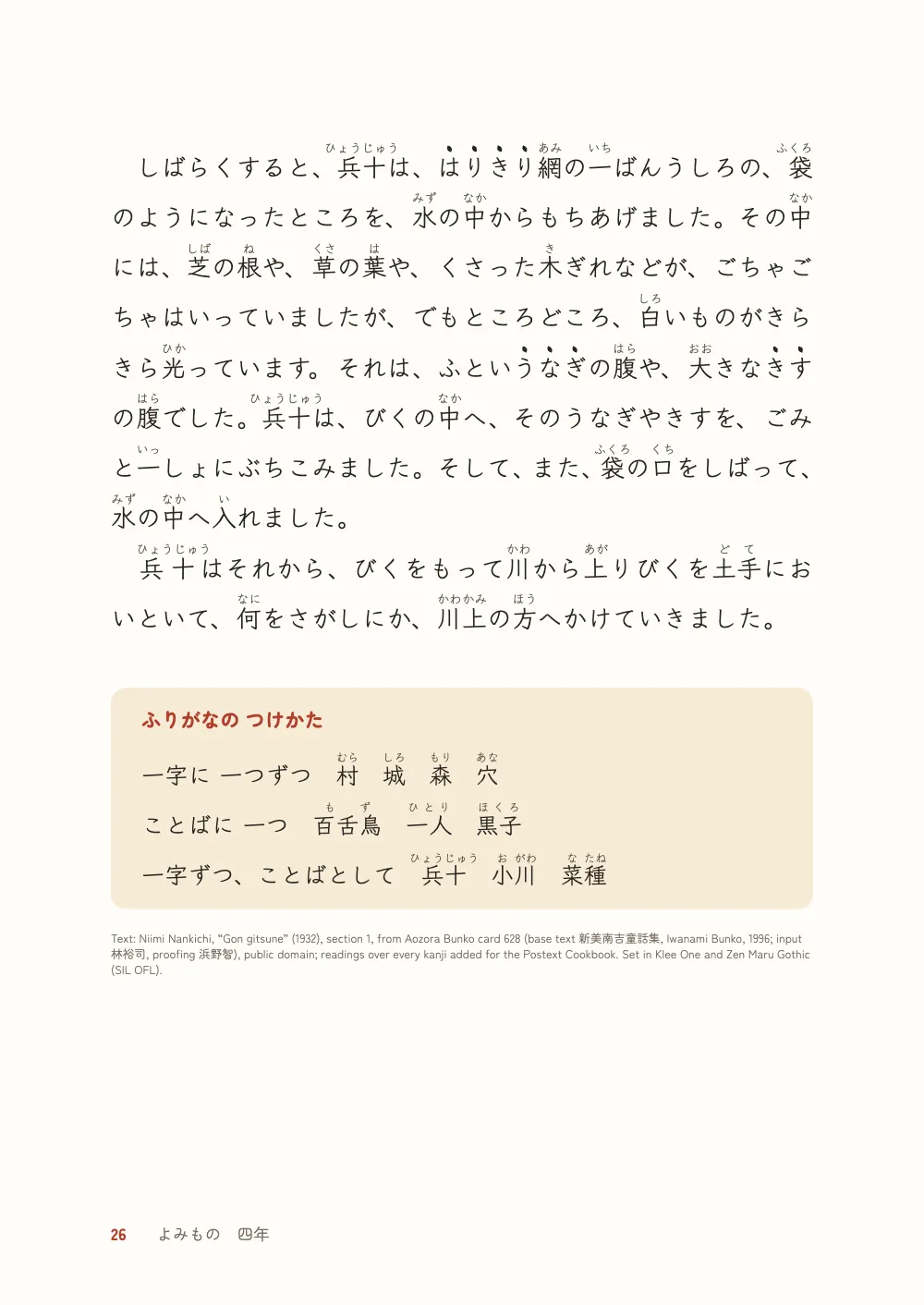
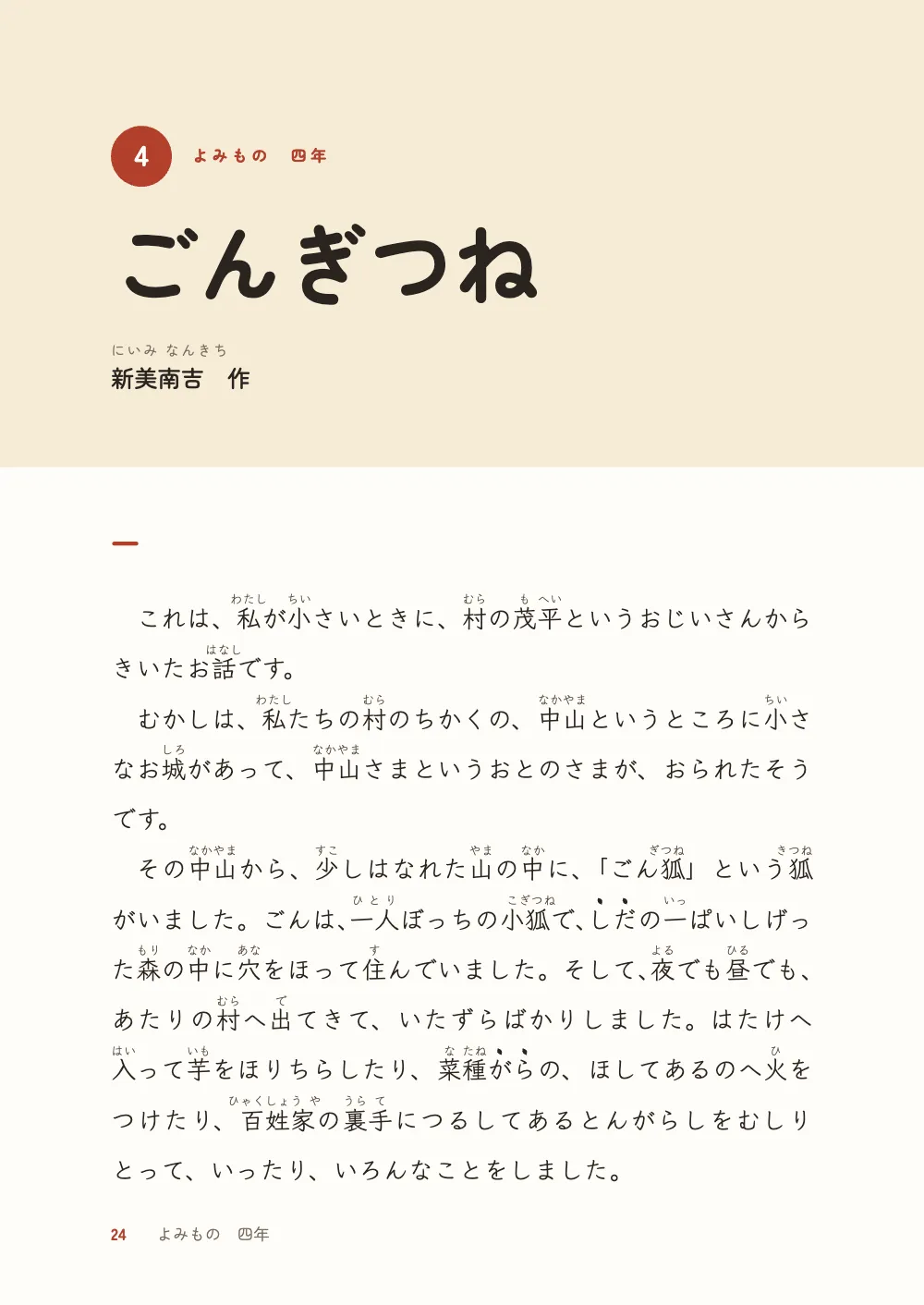
صفحة من كتاب قراءة مدرسي ياباني، فوق كل كانجي فيها كانا صغيرة ليقرأها الطفل بصوت عالٍ. يضع Postext كل قراءة فوق حروفها، ويسمح للقراءة الطويلة بأن تميل على الكانا المجاورة، لا على كانجي آخر.
ما الذي ستنضده
الصفحات الأولى من «غون الثعلب» (ごんぎつね، 1932) لنييمي نانكيتشي كما يطبعها كتاب القراءة للسنة الرابعة، وهي القصة التي يلقاها كل طفل ياباني في التاسعة أو العاشرة. تحمل صفحة B5 ثمانية وعشرين حرفًا في واحد وعشرين سطرًا بخط Klee One، المرسوم على طريقة يد الكتب المدرسية، بحجم 14 نقطة على سطر من 28 نقطة، وفوق كل كانجي قراءة بكانا صغيرة. والقراءات هي موضوع الصفحة: قراءة لكل حرف فوق 村 و森، وقراءة للكلمة كلها فوق 百舌鳥 (mozu)، التي لا قراءة لحروفها منفردة، وقراءات jukugo فوق 兵十 (Hyōjū)، كلٌّ منها فوق الكانجي الخاص به إلى أن تطول إحداها عن حرفها. ويعرض إطار في آخر الصفحات الحالات الثلاث للمعلّم. ويضع كتاب القراءة بالبينيين القراءات الصينية فوق كل حرف بالطريقة نفسها.
تجيب هذه الوصفة عن
- كيف أضيف الفوريغانا فوق الكانجي، قراءة لكل حرف أو قراءة واحدة للكلمة كلها؟
الجواب المختصر
// In a document tagged 'ja' the compact {漢字|かん|じ} (one reading per character) is jukugo
// ruby: each reading stays over its own kanji when it fits, and when one is longer it may run
// onto the next kanji of the same word; a break may fall between the two. {百舌鳥|もず} (one
// reading for the word) is group ruby, spread over the word 1:2:1. :ruby[菜種]{rt="な たね"
// mode=jukugo} says the same as the compact form; mode=mono keeps each reading to its kanji.
const cjk = {
  grid: { enabled: true, charsPerLine: CHARS, linesPerPage: LINES },
  ruby: {
    fontSize: em(0.5), // 7 pt: half the text, the size JLReq gives furigana
    color: col('reading'),
    align: 'jis', // a reading shorter than its base: ½ unit at each end, 1 between (1:2:1)
    overhang: 'kana', // a longer reading may run one ruby character onto a kana, never a kanji
    smallKana: 'keep', // ひょう with its small ょ, as today's books print it
  },
};
// The line gap (28 − 14 = 14 pt) holds a 7 pt reading with room to spare: no line moves for one.
const bodyText = {
  fontFamily: TEXT, fontSize: pt(SIZE), lineHeight: pt(PITCH), color: col('ink'),
  boldColor: col('ink'), italicColor: col('ink'), referenceColor: col('ink'),
  textAlign: 'justify', firstLineIndent: em(1), indentAfterHeading: true,
  avoidRunts: true, // no paragraph ends on one character
};
المكونات
- الميزات
- فوريغانا: قراءات الكانا فوق الكانجيقراءات ruby: pinyin وzhuyinالكانا والكانجي والروماجيعلامات التوكيد اليابانية (bōten)الخطوط الصينية واليابانية والكوريةشبكة المحارفتباعد علامات الترقيم اليابانية (yakumono)كسر الأسطر الياباني (kinsoku)عناوين تشغل أسطرًا من المتن (gyōdori)صفحات افتتاح مصمَّمةسمات العنوانإطارات التنبيهالترويسات وأرقام الصفحاتهوامش متناظرةلون الورقأنماط الفقراتلوحة ألوان دلاليةاستيراد نصوص Aozora Bunkoالتصدير إلى PDF
- تستخدم أيضًا
- تقسيم الأسطر في النص الصينيموازنة الأعمدةنقاط التوكيد وخطوط الأعلام والعناوينالخروج عن الشبكة عمدًاالخطوط المضمَّنة في PDF
- الخطوط
- Klee One, Zen Maru Gothic (SIL OFL 1.1)
- الأصول
- لا شيء: كل صورة مرسومة بالكود
طريقة التحضير
#1 · ثلاث طرق لكتابة القراءة
الشيفرة هي الجواب المختصر أعلاه. في Markdown يضع {村|むら} むら فوق 村، ويعطي {兵十|ひょう|じゅう} كل كانجي قراءته. وفي مستند موسوم 'ja' يكون هذا روبي jukugo: تبقى القراءات فوق حروفها ما دامت تتسع، ويجوز للقراءة الأطول أن تميل على الكانجي التالي من الكلمة نفسها، لا على كانجي من كلمة أخرى. أما {百舌鳥|もず}، قراءة واحدة لثلاثة كانجي، فروبي جماعي يتوزع على الكلمة كلها. ويكتب :ruby[菜種]{rt="な たね" mode=jukugo} آخر أمثلة الإطار بصيغة التوجيه، التي تقبل أيضًا mode=mono وalign (العلامات والروبي والواريتشو).
#2 · نسبة 1:2:1، وقراءات لا تميل إلا على الكانا
الإعدادان تحت cjk.ruby هما ما تختاره 'ja' بنفسها. يضبط align: 'jis' القراءة الأقصر من أساسها على طريقة JIS X 4051: نصف وحدة فراغ عند كل طرف ووحدة كاملة بين حروف الكانا، فتقع も وず فوق مواضع التقاء حروف 百舌鳥 في الصفحة 25 بدل أن تتجمّع في وسطها. ويسمح overhang: 'kana' للقراءة الأطول من أساسها بأن تمتد بمقدار حرف روبي واحد على الأكثر فوق كانا مجاورة أو فوق بياض علامة ترقيم، ولا تمتد فوق كانجي أبدًا: ぎつね فوق 狐 في 「ごん狐」 تميل على ん وعلى القوس بعده، وじゅう في 兵十だな تميل على だ. وحيث لا كانا تميل عليها، تتباعد حروف الكانجي حتى تبلغ عرض القراءة. وعند طرف السطر تبقى القراءة داخل عرضه.
#3 · فجوة أسطر تتسع للقراءات
القراءات بحجم 7 نقاط، أي نصف النص البالغ 14 نقطة، والسطر 28 نقطة، فتتسع لها النقاط الأربع عشرة بين السطرين ويبقى فائض، ويظل كل سطر من الشبكة في موضعه. وإذا ضُبطت خطوة الأسطر أضيق من النص مع قراءاته، حذّر البناء بـ rubyExceedsLeading.
#4 · صفحة الافتتاح لا تطبع قراءات
// Design text sets no furigana (gotcha: ruby-not-in-designs): the author's reading is a
// line of its own.
const BAND = 92; // mm from the trim's top
const opener = { enabled: true, minHeight: pt(PITCH * 6), slot: { elements: [
  { kind: 'box', id: 'band', reserve: false, style: { backgroundColor: col('straw') },
    placement: { anchor: { to: 'page', edge: 'top-left' },
      size: { width: 'fill', height: mm(BAND) } } },
  { kind: 'text', id: 'unit', content: '{attr.unit}', fontFamily: ROUND, fontSize: pt(16),
    fontWeight: 700, color: col('paper'), align: 'center', verticalAlign: 'middle',
    overflow: 'clip', box: { backgroundColor: col('red'), borderRadius: mm(6) },
    placement: { anchor: { to: 'container', edge: 'top-left' }, offset: { y: mm(-2) },
      size: { width: mm(12), height: mm(12) } } },
  { kind: 'text', id: 'series', content: '{title}', fontFamily: ROUND, fontSize: pt(9),
    fontWeight: 700, letterSpacing: pt(2), color: col('red'), align: 'left',
    verticalAlign: 'middle', placement: { anchor: { to: 'container', edge: 'top-left' },
      offset: { x: mm(16), y: mm(-2) }, size: { width: mm(80), height: mm(12) } } },
  { kind: 'text', id: 'title', content: '{titleText}', fontFamily: ROUND, fontSize: pt(48),
    lineHeight: 1.1, fontWeight: 700, color: col('ink'), align: 'left',
    placement: { anchor: { to: '#unit', edge: 'below' }, offset: { y: mm(7) } } },
  { kind: 'text', id: 'kana', content: '{attr.kana}', fontFamily: ROUND, fontSize: pt(8),
    letterSpacing: pt(1), color: col('muted'), align: 'left',
    placement: { anchor: { to: '#title', edge: 'below' }, offset: { y: mm(5) } } },
  { kind: 'text', id: 'author', content: '{attr.author} 作', fontFamily: ROUND,
    fontSize: pt(13), fontWeight: 500, color: col('ink'), align: 'left',
    placement: { anchor: { to: '#kana', edge: 'below' }, offset: { y: mm(1) } } },
] } };
العنوان واسم المؤلف نص تصميم، ونص التصميم لا ينضّد روبي، لذلك جاءت قراءة 新美南吉 سطرًا مستقلًا فوق الاسم، بالكانا، كما تطبعها كتب القراءة. والعنوان نفسه بالكانا، ごんぎつね، كما تكتبه كتب القراءة، مع أن نص Aozora يعنونه ごん狐.
#5 · لون مميِّز واحد، وقراءات أفتح بدرجة
const palette = {
  ink: '#2a2420', // text: a warm near-black
  red: '#b2402c', // the one accent: the unit badge, the section numbers, the box title
  reading: '#5a4e45', // the furigana, a shade off the ink so the two layers part
  straw: '#f6ecd6', // the opener band and the box
  muted: '#7a6d62', // folios, the series line, the colophon
  paper: '#fffdf8',
};
const col = (id) => ({ hex: palette[id], model: 'hex', paletteId: id });
const colorPalette = Object.entries({ ...palette, 'main-color': palette.red })
  .map(([id, hex]) => ({ id, name: id, value: { hex, model: 'hex' } }));
تأخذ القراءات اللون reading، وهو بنيّ أفتح من الحبر بدرجة، فتميّز العين الطبقتين دون أن تبهت الكانا. ويلوّن أحمرُ زهور higanbana التي تتفتح في القصة الشارةَ ورقمَ القسم وعنوانَ الإطار.
الوصفة كاملة
// ═══ Postext Cookbook · Nº 124 · A school reader with furigana: per character, per word ═══ // https://postext.dev/en/cookbook/jukugo-furigana-textbook // Code: MIT · Text: 新美南吉「ごん狐」(1932), Aozora Bunko 628 (PD); readings: CC BY 4.0 // Fonts: Klee One, Zen Maru Gothic (SIL OFL 1.1) · Needs postext ≥ 1.16.1 import { buildDocument, renderPageToCanvas, clearMeasurementCache } from 'https://esm.sh/postext'; import { renderToPdf, decompressWoff2 } from 'https://esm.sh/postext-pdf'; const LANG = 'en'; // @lang: the language of the frame; the story is Japanese in both const RECIPE = 'jukugo-furigana-textbook'; // ─── 1 · Design ───────────────────────────────────────────────────────────── // #region palette: an autumn reader: ink, the red of the higanbana, a pale straw ground const palette = { ink: '#2a2420', // text: a warm near-black red: '#b2402c', // the one accent: the unit badge, the section numbers, the box title reading: '#5a4e45', // the furigana, a shade off the ink so the two layers part straw: '#f6ecd6', // the opener band and the box muted: '#7a6d62', // folios, the series line, the colophon paper: '#fffdf8', }; const col = (id) => ({ hex: palette[id], model: 'hex', paletteId: id }); const colorPalette = Object.entries({ ...palette, 'main-color': palette.red }) .map(([id, hex]) => ({ id, name: id, value: { hex, model: 'hex' } })); // #endregion const [TEXT, ROUND] = ['Klee One', 'Zen Maru Gothic']; // 教科書体-like text, rounded gothic const [SIZE, PITCH] = [14, 28]; // pt: a fourth-year reader's size, on a line twice as tall const [CHARS, LINES] = [28, 21]; // the type area in characters // #region answer: readings over every kanji: by character, by word, jukugo, JIS 1:2:1 // In a document tagged 'ja' the compact {漢字|かん|じ} (one reading per character) is jukugo // ruby: each reading stays over its own kanji when it fits, and when one is longer it may run // onto the next kanji of the same word; a break may fall between the two. {百舌鳥|もず} (one // reading for the word) is group ruby, spread over the word 1:2:1. :ruby[菜種]{rt="な たね" // mode=jukugo} says the same as the compact form; mode=mono keeps each reading to its kanji. const cjk = { grid: { enabled: true, charsPerLine: CHARS, linesPerPage: LINES }, ruby: { fontSize: em(0.5), // 7 pt: half the text, the size JLReq gives furigana color: col('reading'), align: 'jis', // a reading shorter than its base: ½ unit at each end, 1 between (1:2:1) overhang: 'kana', // a longer reading may run one ruby character onto a kana, never a kanji smallKana: 'keep', // ひょう with its small ょ, as today's books print it }, }; // The line gap (28 − 14 = 14 pt) holds a 7 pt reading with room to spare: no line moves for one. const bodyText = { fontFamily: TEXT, fontSize: pt(SIZE), lineHeight: pt(PITCH), color: col('ink'), boldColor: col('ink'), italicColor: col('ink'), referenceColor: col('ink'), textAlign: 'justify', firstLineIndent: em(1), indentAfterHeading: true, avoidRunts: true, // no paragraph ends on one character }; // #endregion // #region opener: a straw band with the unit badge, the title and the author's name in kana // Design text sets no furigana (gotcha: ruby-not-in-designs): the author's reading is a // line of its own. const BAND = 92; // mm from the trim's top const opener = { enabled: true, minHeight: pt(PITCH * 6), slot: { elements: [ { kind: 'box', id: 'band', reserve: false, style: { backgroundColor: col('straw') }, placement: { anchor: { to: 'page', edge: 'top-left' }, size: { width: 'fill', height: mm(BAND) } } }, { kind: 'text', id: 'unit', content: '{attr.unit}', fontFamily: ROUND, fontSize: pt(16), fontWeight: 700, color: col('paper'), align: 'center', verticalAlign: 'middle', overflow: 'clip', box: { backgroundColor: col('red'), borderRadius: mm(6) }, placement: { anchor: { to: 'container', edge: 'top-left' }, offset: { y: mm(-2) }, size: { width: mm(12), height: mm(12) } } }, { kind: 'text', id: 'series', content: '{title}', fontFamily: ROUND, fontSize: pt(9), fontWeight: 700, letterSpacing: pt(2), color: col('red'), align: 'left', verticalAlign: 'middle', placement: { anchor: { to: 'container', edge: 'top-left' }, offset: { x: mm(16), y: mm(-2) }, size: { width: mm(80), height: mm(12) } } }, { kind: 'text', id: 'title', content: '{titleText}', fontFamily: ROUND, fontSize: pt(48), lineHeight: 1.1, fontWeight: 700, color: col('ink'), align: 'left', placement: { anchor: { to: '#unit', edge: 'below' }, offset: { y: mm(7) } } }, { kind: 'text', id: 'kana', content: '{attr.kana}', fontFamily: ROUND, fontSize: pt(8), letterSpacing: pt(1), color: col('muted'), align: 'left', placement: { anchor: { to: '#title', edge: 'below' }, offset: { y: mm(5) } } }, { kind: 'text', id: 'author', content: '{attr.author} 作', fontFamily: ROUND, fontSize: pt(13), fontWeight: 500, color: col('ink'), align: 'left', placement: { anchor: { to: '#kana', edge: 'below' }, offset: { y: mm(1) } } }, ] } }; // #endregion // Folios at the outer foot, the series beside them. const foot = (id, content, parity, edge, x, extra) => ({ kind: 'text', id, content, parity, fontFamily: ROUND, fontSize: pt(9), color: col('muted'), align: edge.endsWith('left') ? 'left' : 'right', placement: { anchor: { to: 'container', edge }, offset: { x: mm(x), y: mm(-12) } }, ...extra }); const folio = { fontWeight: 700, color: col('red') }; const config = () => ({ // a factory: the engine caches resolved configs per object locale: 'ja', // written out, never LANG (gotcha: ja-locale-tag) colorPalette, page: { sizePreset: 'custom', width: mm(182), height: mm(257), dpi: 150, // B5 backgroundColor: col('paper'), // Minimums: the grid centres its 28 × 21 area (138 × 207 mm) in what they leave. margins: { top: mm(26), bottom: mm(22), left: mm(20), right: mm(20), mirror: true } }, layout: { layoutType: 'single' }, cjk, bodyText, headings: { fontFamily: ROUND, fontWeight: 700, color: col('red'), balancing: { enabled: false }, // nothing added above heads: the grid holds levels: [ // Restated: any headings object drops the H1 break (gotcha: headings-drop-h1-break). { level: 1, breakBefore: { enabled: true, parity: 'any' }, advancedDesign: opener }, { level: 2, fontSize: pt(16), lineSpan: 2 }, // 一, 二…: two lines of the grid ] }, calloutStyles: [{ id: 'words', background: col('straw'), borderRadius: mm(3), snapToGrid: false, marginTop: pt(PITCH), marginBottom: pt(0), padding: { top: mm(4), right: mm(6), bottom: mm(3), left: mm(6) }, titleStyle: { fontFamily: ROUND, fontSize: pt(11), fontWeight: 700, color: col('red') }, body: { fontFamily: TEXT, fontSize: pt(13), lineHeight: pt(28), color: col('ink'), firstLineIndent: pt(0), textAlign: 'left' } }], paragraphStyles: [{ id: 'colophon', fontFamily: ROUND, fontSize: pt(6.5), lineHeight: pt(9), color: col('muted'), firstLineIndent: pt(0), textAlign: 'left', marginTop: mm(4) }], header: { elements: [] }, footer: { elements: [ foot('v-folio', '{pageNumber}', 'even', 'bottom-left', 0, folio), foot('v-series', '{title}', 'even', 'bottom-left', 9), foot('r-series', '{chapterTitle}', 'odd', 'bottom-right', -9), foot('r-folio', '{pageNumber}', 'odd', 'bottom-right', 0, folio), ] }, }); // ─── 2 · Content ──────────────────────────────────────────────────────────── const markdown = String.raw`---نموذج Markdown · أسطر: 38 · content.en.md
title: "よみもの 四年" --- # ごんぎつね {author="新美南吉" kana="にいみ なんきち" unit="4"} ## 一 これは、{私|わたし}が{小|ちい}さいときに、{村|むら}の{茂平|も|へい}というおじいさんからきいたお{話|はなし}です。 むかしは、{私|わたし}たちの{村|むら}のちかくの、{中山|なか|やま}というところに{小|ちい}さなお{城|しろ}があって、{中山|なか|やま}さまというおとのさまが、おられたそうです。 その{中山|なか|やま}から、{少|すこ}しはなれた{山|やま}の{中|なか}に、「ごん{狐|ぎつね}」という{狐|きつね}がいました。ごんは、{一人|ひとり}ぼっちの{小狐|こ|ぎつね}で、:dots[しだ]{style=sesame}の{一|いっ}ぱいしげった{森|もり}の{中|なか}に{穴|あな}をほって{住|す}んでいました。そして、{夜|よる}でも{昼|ひる}でも、あたりの{村|むら}へ{出|で}てきて、いたずらばかりしました。はたけへ{入|はい}って{芋|いも}をほりちらしたり、{菜種|な|たね}:dots[がら]{style=sesame}の、ほしてあるのへ{火|ひ}をつけたり、{百姓家|ひゃく|しょう|や}の{裏手|うら|て}につるしてあるとんがらしをむしりとって、いったり、いろんなことをしました。 {或|ある}{秋|あき}のことでした。{二|に}、{三日|さん|にち}{雨|あめ}がふりつづいたその{間|あいだ}、ごんは、{外|そと}へも{出|で}られなくて{穴|あな}の{中|なか}にしゃがんでいました。 {雨|あめ}があがると、ごんは、ほっとして{穴|あな}からはい{出|で}ました。{空|そら}はからっと{晴|は}れていて、{百舌鳥|もず}の{声|こえ}がきんきん、ひびいていました。 ごんは、{村|むら}の{小川|お|がわ}の{堤|つつみ}まで{出|で}て{来|き}ました。あたりの、すすきの{穂|ほ}には、まだ{雨|あめ}のしずくが{光|ひか}っていました。{川|かわ}は、いつもは{水|みず}が{少|すくな}いのですが、{三日|みっ|か}もの{雨|あめ}で、{水|みず}が、どっとましていました。ただのときは{水|みず}につかることのない、{川|かわ}べりのすすきや、{萩|はぎ}の{株|かぶ}が、{黄|き}いろくにごった{水|みず}に{横|よこ}だおしになって、もまれています。ごんは{川下|かわ|しも}の{方|ほう}へと、ぬかるみみちを{歩|ある}いていきました。 ふと{見|み}ると、{川|かわ}の{中|なか}に{人|ひと}がいて、{何|なに}かやっています。ごんは、{見|み}つからないように、そうっと{草|くさ}の{深|ふか}いところへ{歩|ある}きよって、そこからじっとのぞいてみました。 「{兵十|ひょう|じゅう}だな」と、ごんは{思|おも}いました。{兵十|ひょう|じゅう}はぼろぼろの{黒|くろ}いきものをまくし{上|あ}げて、{腰|こし}のところまで{水|みず}にひたりながら、{魚|さかな}をとる、:dots[はりきり]{style=sesame}という、{網|あみ}をゆすぶっていました。はちまきをした{顔|かお}の{横|よこ}っちょうに、まるい{萩|はぎ}の{葉|は}が{一|いち}まい、{大|おお}きな{黒子|ほくろ}みたいにへばりついていました。 しばらくすると、{兵十|ひょう|じゅう}は、:dots[はりきり]{style=sesame}{網|あみ}の{一|いち}ばんうしろの、{袋|ふくろ}のようになったところを、{水|みず}の{中|なか}からもちあげました。その{中|なか}には、{芝|しば}の{根|ね}や、{草|くさ}の{葉|は}や、くさった{木|き}ぎれなどが、ごちゃごちゃはいっていましたが、でもところどころ、{白|しろ}いものがきらきら{光|ひか}っています。それは、ふとい:dots[うなぎ]{style=sesame}の{腹|はら}や、{大|おお}きな:dots[きす]{style=sesame}の{腹|はら}でした。{兵十|ひょう|じゅう}は、びくの{中|なか}へ、そのうなぎやきすを、ごみと{一|いっ}しょにぶちこみました。そして、また、{袋|ふくろ}の{口|くち}をしばって、{水|みず}の{中|なか}へ{入|い}れました。 {兵十|ひょう|じゅう}はそれから、びくをもって{川|かわ}から{上|あが}りびくを{土手|ど|て}においといて、{何|なに}をさがしにか、{川上|かわ|かみ}の{方|ほう}へかけていきました。 :::callout{type="words" title="ふりがなの つけかた"} 一字に 一つずつ {村|むら} {城|しろ} {森|もり} {穴|あな} ことばに 一つ {百舌鳥|もず} {一人|ひとり} {黒子|ほくろ} 一字ずつ、ことばとして {兵十|ひょう|じゅう} {小川|お|がわ} :ruby[菜種]{rt="な たね" mode=jukugo} ::: :::paragraphs{style="colophon"} Text: Niimi Nankichi, “Gon gitsune” (1932), section 1, from Aozora Bunko card 628 (base text 新美南吉童話集, Iwanami Bunko, 1996; input 林裕司, proofing 浜野智), public domain; readings over every kanji added for the Postext Cookbook. Set in Klee One and Zen Maru Gothic (SIL OFL). :::`; // content.<lang>.md: the same Japanese page in both // ─── 3 · Fonts ────────────────────────────────────────────────────────────── const FONTS = { // every face the pages use, loaded before the build (gotcha: fonts-first) 'Klee One': ['400'], // the text and its readings: the hand of a school textbook 'Zen Maru Gothic': ['400', '500', '700'], // the title, heads, badge, box title, folios }; // ─── 4 · Build & show ─────────────────────────────────────────────────────── // Each face loads the files of what it sets (gotcha: cjk-fonts-slices). const all = (re) => (markdown.match(re) ?? []).join(''); await loadFonts(FONTS, markdown); await loadCjkFonts({ [TEXT]: FONTS[TEXT] }, markdown); await loadCjkFonts({ [ROUND]: FONTS[ROUND] }, `${all(/^#.*$/gm)}${all(/title="[^"]*"/g)}${all(/colophon"\}\n[^\n]*/g)}よみもの四年作0123456789`); // Page 1 is page 24 of the reader, a verso: the lesson opens on a spread. const continuation = { pageIndexOffset: 23, pageNumbering: { startAt: 24 } }; const doc = await buildWithFonts(() => buildDocument({ markdown, continuation }, config()), markdown); showPages(doc, { title: t({ en: 'A school reader with furigana', es: 'Un libro de lectura con furigana' }) }); offerPdf(() => renderToPdf(doc, { fontProvider: cjkPdfProvider }), `${RECIPE}.pdf`);العُدّة · core, fonts, viewer, pdf, cjk: نفسها في كل وصفة · أسطر: 453
// ─── Kit ── helpers shared by every Cookbook recipe · postext.dev/cookbook ───── // ─── Kit · core v1 ── the same in every recipe · postext.dev/cookbook ───────── function mm(value) { return { value, unit: 'mm' }; } function pt(value) { return { value, unit: 'pt' }; } function em(value) { return { value, unit: 'em' }; } /** The sample language's string: t({ en: 'Figure', es: 'Figura' }). */ function t(strings) { return strings[LANG] ?? Object.values(strings)[0]; } /** A file in this recipe's assets folder, served from the Postext repo by jsDelivr. */ function asset(file) { return `https://cdn.jsdelivr.net/gh/drnachio/postext@main/cookbook/${RECIPE}/assets/${file}`; } // ─── Kit · fonts v1 ── the same in every recipe · postext.dev/cookbook ──────── // Postext measures text with the faces the browser has loaded, and caches the // widths, so every face must be ready before the first build. Faces come from // Fontsource: the same static files the PDF embeds, so screen and PDF agree. /** faces = { 'Family Name': ['400', '400i', '700'] }. `text` is the sample: * letters beyond Latin-1 (č, ł, ő…) also load the latin-ext files. With * `optional`, a face Fontsource does not ship is skipped instead of failing. * Resolves to the number of faces added. */ async function loadFonts(faces, text = '', { optional = false } = {}) { kitStatus('Loading fonts…'); const ranges = { latin: 'U+0000-00FF,U+0131,U+0152-0153,U+02BB-02BC,U+02C6,U+02DA,U+02DC,U+0304,U+0308,U+0329,' + 'U+2000-206F,U+20AC,U+2122,U+2191,U+2193,U+2212,U+2215,U+FEFF,U+FFFD', 'latin-ext': 'U+0100-02BA,U+02BD-02C5,U+02C7-02CC,U+02CE-02D7,U+02DD-02FF,U+0304,U+0308,U+0329,' + 'U+1D00-1DBF,U+1E00-1E9F,U+1EF2-1EFF,U+2020,U+20A0-20AB,U+20AD-20C0,U+2113,U+2C60-2C7F,U+A720-A7FF', }; const subsets = /[Ā-˿Ḁ-ỿ]/.test(text) ? ['latin', 'latin-ext'] : ['latin']; const jobs = []; let added = 0; for (const [family, specs] of Object.entries(faces)) { const id = fontsourceId(family); const meta = optional ? await fontsourceMeta(family) : null; for (const spec of new Set(specs)) { const weight = parseInt(spec, 10); const style = spec.endsWith('i') ? 'italic' : 'normal'; if (hasFace(family, weight, style)) continue; if (optional && !(meta?.weights.includes(weight) && meta.styles.includes(style))) continue; for (const subset of subsets) { const url = `https://cdn.jsdelivr.net/npm/@fontsource/${id}@5/files/${id}-${subset}-${weight}-${style}.woff2`; const face = new FontFace(family, `url(${url}) format('woff2')`, { weight: String(weight), style, unicodeRange: ranges[subset] }); jobs.push(face.load().then((ready) => { document.fonts.add(ready); added++; }, () => { if (subset === 'latin' && !optional) throw new Error(`Fontsource has no ${family} ${weight} ${style}`); })); } } } await Promise.all(jobs).catch((error) => { kitFail(error); throw error; }); return added; } /** Runs `build` (a buildDocument or buildBundle call) and checks the faces * the pages use. A regular face missing from FONTS is loaded with a warning; * bold and italic variants are loaded when the family ships them. Then the * measurement caches are cleared and the build runs again. */ async function buildWithFonts(build, text = '') { const tried = new Set(); for (let round = 0; round < 3; round++) { kitStatus('Laying out…'); await new Promise(requestAnimationFrame); // let the status paint first const result = await Promise.resolve().then(build).catch((error) => { kitFail(error); throw error; }); const wanted = { base: {}, variants: {} }; for (const { font, base } of [result].flat().flatMap(fontStringsOf)) { const { family, weight, style } = parseFont(font); const key = `${family}|${weight}|${style}`; if (tried.has(key) || hasFace(family, weight, style)) continue; tried.add(key); (wanted[base ? 'base' : 'variants'][family] ??= []).push(`${weight}${style === 'italic' ? 'i' : ''}`); } if (Object.keys(wanted.base).length) { console.warn(`[cookbook] FONTS does not list ${JSON.stringify(wanted.base)}: loading them.`); } const added = await loadFonts(wanted.base, text) + await loadFonts(wanted.variants, text, { optional: true }); if (added === 0) return result; clearMeasurementCache(); } throw new Error('The fonts did not settle after three builds.'); } /** Every font string of the layout. `base` marks a block's own face; its * bold, italic and bold-italic variants are listed whether or not used. */ function fontStringsOf(doc) { const found = new Map(); const walk = (node) => { if (!node || typeof node !== 'object') return; if (Array.isArray(node)) { node.forEach(walk); return; } for (const [key, value] of Object.entries(node)) { if (typeof value === 'string' && /fontString$/i.test(key)) { found.set(value, found.get(value) || key === 'fontString'); } else if (value && typeof value === 'object') walk(value); } }; walk(doc.pages); walk(doc.blocks); return [...found].map(([font, base]) => ({ font, base })); } /** '700 37.5px Open Sans' / 'italic 400 13px "Source Serif 4"' → { family, weight, style }. * A string with no weight ('95.8px Young Serif', from a design text) is 400. */ function parseFont(font) { const m = /^(?:(italic|oblique)\s+)?(?:small-caps\s+)?(?:(\d+|bold|normal)\s+)?[\d.]+px\s+(.+)$/.exec(font.trim()); if (!m) throw new Error(`Unexpected font string: ${font}`); const weight = m[2] === 'bold' ? 700 : !m[2] || m[2] === 'normal' ? 400 : Number(m[2]); return { family: m[3].replace(/^["']|["']$/g, ''), weight, style: m[1] ? 'italic' : 'normal' }; } /** True when a loaded FontFace covers exactly this family, weight and style * (document.fonts.check() is also true for families nobody declared). */ function hasFace(family, weight, style) { for (const face of document.fonts) { if (face.status !== 'loaded' || face.style !== style) continue; if (face.family.replace(/^["']|["']$/g, '') !== family) continue; const [low, high = low] = face.weight.split(' ').map(Number); if (weight >= low && weight <= high) return true; } return false; } /** Fontsource's id for a family: 'Source Serif 4' → 'source-serif-4'. */ function fontsourceId(family) { return family.toLowerCase().replace(/\s+/g, '-'); } /** The weights and styles a family ships ({ weights: [400, 700], styles: ['normal', 'italic'] }), or null. */ function fontsourceMeta(family) { fontsourceMeta.cache ??= new Map(); const id = fontsourceId(family); if (!fontsourceMeta.cache.has(id)) { fontsourceMeta.cache.set(id, fetch(`https://api.fontsource.org/v1/fonts/${id}`) .then((res) => (res.ok ? res.json() : null), () => null)); } return fontsourceMeta.cache.get(id); } // ─── Kit · viewer v1 ── the same in every recipe · postext.dev/cookbook ─────── /** Shows the pages as facing spreads on a dark desk: the first page is a * recto on its own, then verso | recto pairs, as in a bound book. Pages * are painted when they scroll near the screen. */ function showPages(docs, { title, width = 460 } = {}) { const root = viewer(title); const pages = [docs].flat().flatMap((doc) => doc.pages.map((page) => ({ doc, page, n: (doc.pageIndexOffset ?? 0) + page.index }))); const spreads = []; let verso = null; for (const p of pages) { if (p.n % 2 === 1) { if (verso) spreads.push([verso, null]); verso = p; } else { spreads.push([verso, p]); verso = null; } } if (verso) spreads.push([verso, null]); const density = Math.min(window.devicePixelRatio || 1, 2); showPages.painter?.disconnect(); const painter = new IntersectionObserver((entries) => { for (const { isIntersecting, target } of entries) { if (!isIntersecting) continue; painter.unobserve(target); const { doc, page } = target.postext; renderPageToCanvas(page, doc, target, { scale: (width * density) / page.width }); } }, { rootMargin: '800px' }); showPages.painter = painter; root.replaceChildren(...spreads.map((pair) => { const spread = document.createElement('div'); spread.className = 'pt-spread'; for (const p of pair) { const figure = document.createElement('figure'); if (p) { const label = p.page.pageLabel || String(p.n + 1); const canvas = document.createElement('canvas'); canvas.postext = p; canvas.style.aspectRatio = `${p.page.width} / ${p.page.height}`; canvas.setAttribute('role', 'img'); canvas.setAttribute('aria-label', `Page ${label}`); const folio = document.createElement('figcaption'); folio.textContent = label; figure.append(canvas, folio); painter.observe(canvas); } else figure.className = 'pt-blank'; spread.append(figure); } return spread; })); kitStatus(`${pages.length} ${pages.length === 1 ? 'page' : 'pages'}`); document.documentElement.dataset.postext = 'ready'; return pages.length; } /** The desk, the bar and the error reporting, created once. */ function viewer(title) { if (!document.getElementById('pt-kit')) { document.head.insertAdjacentHTML('beforeend', `<style id="pt-kit"> :root { color-scheme: dark; } body { margin: 0; background: #0e1014; color: #b9bcc4; font: 13px/1.45 system-ui, sans-serif; } #pt-bar { position: sticky; top: 0; z-index: 1; display: flex; flex-wrap: wrap; align-items: center; gap: 6px 16px; padding: 10px 16px; background: rgb(14 16 20 / .92); backdrop-filter: blur(6px); border-bottom: 1px solid #23262d; } #pt-bar strong { color: #f4f1ea; font-weight: 600; } #pt-actions { display: flex; gap: 12px; margin-left: auto; } #pt-actions a, #pt-actions button { color: #d8a21a; font: inherit; background: none; border: 0; padding: 0; cursor: pointer; } #pages { display: grid; justify-items: center; gap: 48px; padding: 32px 16px 72px; } .pt-spread { display: flex; } .pt-spread figure { margin: 0; width: min(460px, 44vw); } .pt-spread canvas { display: block; width: 100%; background: #fff; box-shadow: 0 1px 2px rgb(0 0 0 / .5), 0 22px 44px -16px rgb(0 0 0 / .8); } .pt-spread figure:first-child canvas { box-shadow: inset -14px 0 14px -14px rgb(0 0 0 / .18), 0 1px 2px rgb(0 0 0 / .5), 0 22px 44px -16px rgb(0 0 0 / .8); } .pt-spread figcaption { margin-top: 10px; text-align: center; font: 600 10px/1 system-ui, sans-serif; letter-spacing: .18em; text-transform: uppercase; color: #6c7079; } .pt-blank { visibility: hidden; } @media (max-width: 760px) { .pt-spread { flex-direction: column; gap: 32px; } .pt-spread figure { width: min(460px, 92vw); } .pt-blank { display: none; } } </style>`); document.body.insertAdjacentHTML('afterbegin', '<header id="pt-bar"><strong id="pt-title"></strong><span id="pt-status" role="status"></span><span id="pt-actions"></span></header>'); document.getElementById('pt-title').textContent = document.title || 'Postext'; addEventListener('error', (event) => kitFail(event.error ?? event.message)); addEventListener('unhandledrejection', (event) => kitFail(event.reason)); } if (title) document.getElementById('pt-title').textContent = title; return document.getElementById('pages') ?? document.body.appendChild(Object.assign(document.createElement('main'), { id: 'pages' })); } function kitStatus(text) { viewer(); document.getElementById('pt-status').textContent = text; } function kitFail(error) { document.documentElement.dataset.postext = 'error'; kitStatus(`Error: ${error?.message ?? error}`); } // ─── Kit · pdf v1 ── the same in every recipe that exports a PDF ────────────── /** postext-pdf embeds TrueType bytes. Fetch the Fontsource file the screen * used, snapping to a weight the family ships and falling back to upright * when it has no italic: the PDF asks for every face a block could use. */ async function fontsourceProvider(family, weight, style) { const id = fontsourceId(family); const meta = await fontsourceMeta(family); const weights = meta?.weights?.length ? meta.weights : [400, 700]; const w = weights.reduce((a, b) => (Math.abs(b - weight) < Math.abs(a - weight) ? b : a)); const s = style === 'italic' && meta && !meta.styles.includes('italic') ? 'normal' : style; const res = await fetch(`https://cdn.jsdelivr.net/npm/@fontsource/${id}@5/files/${id}-latin-${w}-${s}.woff2`); if (!res.ok) throw new Error(`Fontsource has no ${family} ${w} ${s} (${res.status})`); return decompressWoff2(new Uint8Array(await res.arrayBuffer())); } /** A "Build the PDF" button in the bar. Once built: "Open the PDF" (a new * tab, since CodePen's preview frame cannot show PDFs) and a download link. */ function offerPdf(makePdf, filename) { viewer(); const button = Object.assign(document.createElement('button'), { type: 'button', textContent: 'Build the PDF' }); button.dataset.postextPdf = filename; button.addEventListener('click', async () => { button.disabled = true; button.textContent = 'Building the PDF…'; try { const bytes = await makePdf(); const url = URL.createObjectURL(new Blob([bytes], { type: 'application/pdf' })); const size = `${Math.max(1, Math.round(bytes.length / 1024))} KB`; button.replaceWith( Object.assign(document.createElement('a'), { href: url, target: '_blank', rel: 'noopener', textContent: 'Open the PDF ↗' }), Object.assign(document.createElement('a'), { href: url, download: filename, textContent: `Download ${filename} · ${size}` })); } catch (error) { button.disabled = false; button.textContent = 'Build the PDF'; kitFail(error); } }); document.getElementById('pt-actions').append(button); } // ─── Kit · cjk v1 ── Chinese, Japanese and Korean books · postext.dev/cookbook ─ // Fontsource ships a CJK family as about a hundred files per weight, each // declared in its stylesheet with the unicode-range it covers. The screen // loads the files the sample touches; the PDF gets the same files for the // characters its pages set in each face, and embeds each as a subset. // A book bound on the right (vertical text) is shown with its spreads // mirrored: page 1 alone on the left of the spine, then [3 | 2]. /** The files of a Fontsource face, read from its stylesheet: { url, range, * ranges }, the last declared first (the order the browser tries them in). */ function cjkSlices(family, weight, style) { cjkSlices.cache ??= new Map(); const id = fontsourceId(family); const css = `https://cdn.jsdelivr.net/npm/@fontsource/${id}@5/${weight}${style === 'italic' ? '-italic' : ''}.css`; if (!cjkSlices.cache.has(css)) { cjkSlices.cache.set(css, fetch(css) .then((res) => { if (!res.ok) throw new Error(`Fontsource has no ${family} ${weight} ${style} (${res.status})`); return res.text(); }) .then((text) => [...text.matchAll(/@font-face\s*{([^}]*)}/g)].map(([, rule]) => { const range = /unicode-range:\s*([^;]+);/.exec(rule)?.[1].trim() ?? 'U+0-10FFFF'; const ranges = range.split(',').map((part) => { const [lo, hi = lo] = part.trim().slice(2).split('-'); return [parseInt(lo, 16), parseInt(hi, 16)]; }); return { url: new URL(/url\(([^)]+?\.woff2)\)/.exec(rule)[1], css).href, range, ranges }; }).reverse())); } return cjkSlices.cache.get(css); } /** The file of `slices` that holds code point `cp`, if any. */ function cjkSliceFor(slices, cp) { return slices.find((slice) => slice.ranges.some(([lo, hi]) => cp >= lo && cp <= hi)); } /** Whether Fontsource serves `family` as a Chinese, Japanese or Korean * family (its subsets name the script). Fails when the API does not * answer: a CJK face taken for a Latin one would paint in a system face. */ async function isCjkFamily(family) { const meta = await fontsourceMeta(family); if (!meta) throw new Error(`api.fontsource.org did not describe ${family}: reload to try again`); return !!meta.subsets?.some((subset) => /^(chinese|japanese|korean)/.test(subset)); } /** faces = { 'Noto Serif TC': ['400', '700'] }, as for loadFonts: the * whole FONTS object may be passed, its other families are left to * loadFonts. Adds one FontFace per file of each CJK face with its * unicodeRange, then loads the files `text` touches. `text` is what the * faces set: the sample for the text face; a book in several voices calls * it once per voice (loadCjkFonts({ 'LXGW WenKai TC': ['400'] }, quotes)), * so the heading and quotation faces fetch and check only their own * characters. Fails when a character of `text` is in no file of a face. * List every weight the pages use: a weight left to buildWithFonts gets * the latin file only. With { vertical: true } it also loads each * family's vertical forms (brackets, quotes, pause marks) for the canvas, * which needs loadVerticalAlternates imported from postext. Resolves to * the number of files loaded. */ async function loadCjkFonts(faces, text, { vertical = false } = {}) { kitStatus('Loading fonts…'); let loaded = 0; try { if (vertical && typeof loadVerticalAlternates !== 'function') { throw new Error('loadCjkFonts(…, { vertical: true }) needs loadVerticalAlternates imported from postext'); } for (const [family, specs] of Object.entries(faces)) { if (!(await isCjkFamily(family))) continue; const twin = []; for (const spec of new Set(specs)) { const weight = parseInt(spec, 10); const style = spec.endsWith('i') ? 'italic' : 'normal'; const slices = await cjkSlices(family, weight, style); const missing = [...new Set(text)].filter((ch) => /\S/.test(ch) && !cjkSliceFor(slices, ch.codePointAt(0))); if (missing.length) { throw new Error(`${family} ${spec} has no file for ${missing.slice(0, 12).join(' ')}: ` + `give each face the text it sets (loadCjkFonts({ '${family}': ['${spec}'] }, text))`); } for (const slice of slices) { document.fonts.add(new FontFace(family, `url(${slice.url}) format('woff2')`, { weight: String(weight), style, unicodeRange: slice.range })); twin.push({ source: slice.url, weight: String(weight), style, unicodeRange: slice.range }); } const font = `${style === 'italic' ? 'italic ' : ''}${weight} 16px "${family}"`; loaded += (await document.fonts.load(font, text)).length; if (!document.fonts.check(font, text)) throw new Error(`${family} ${spec} did not load for the sample`); } // The same files under a twin name with the `vert` feature on: the // canvas paints the punctuation of vertical lines with it. if (vertical && twin.length) await loadVerticalAlternates(family, twin); } } catch (error) { kitFail(error); throw error; } return loaded; } /** The PDF font provider for recipes with CJK faces: a family whose * Fontsource subsets are Chinese, Japanese or Korean gets the files that * hold the characters its pages set (`request.codePoints`); any other * family gets the latin file fontsourceProvider fetches (the "pdf" block) * and, when the face sets letters only latin-ext has, that file too. */ async function cjkPdfProvider(family, weight, style, request) { if (!(await isCjkFamily(family))) return cjkLatinPdfFiles(family, weight, style, request); const meta = await fontsourceMeta(family); const weights = meta.weights?.length ? meta.weights : [400, 700]; const w = weights.reduce((a, b) => (Math.abs(b - weight) < Math.abs(a - weight) ? b : a)); const s = style === 'italic' && !meta.styles.includes('italic') ? 'normal' : style; const slices = await cjkSlices(family, w, s); const picked = new Set(); for (const cp of request?.codePoints ?? []) { const slice = cjkSliceFor(slices, cp); if (slice) picked.add(slice); } if (!picked.size) picked.add(slices[0]); return Promise.all(slices.filter((slice) => picked.has(slice)).map(async (slice) => { const res = await fetch(slice.url); if (!res.ok) throw new Error(`Fontsource file ${slice.url} (${res.status})`); return decompressWoff2(new Uint8Array(await res.arrayBuffer())); })); } /** A Latin family set next to the CJK faces: its latin file, then its * latin-ext file when the face sets letters only latin-ext has (ō ū in * Hepburn rōmaji, ǎ in pinyin), the file loadFonts adds on screen for * them. Latin comes first: postext-pdf draws a character from the first * file that has it, as the browser takes a character both files hold from * latin. A face Fontsource ships without latin-ext, or whose file does * not come, gets latin alone, and the PDF names the letters it lacks. */ async function cjkLatinPdfFiles(family, weight, style, request) { const meta = await fontsourceMeta(family); const beyond = [...(request?.codePoints ?? [])].some(cjkLatinExtOnly); if (!beyond || !meta?.subsets?.includes('latin-ext')) return fontsourceProvider(family, weight, style); const weights = meta.weights?.length ? meta.weights : [400, 700]; const w = weights.reduce((a, b) => (Math.abs(b - weight) < Math.abs(a - weight) ? b : a)); const s = style === 'italic' && !meta.styles.includes('italic') ? 'normal' : style; const id = fontsourceId(family); const url = `https://cdn.jsdelivr.net/npm/@fontsource/${id}@5/files/${id}-latin-ext-${w}-${s}.woff2`; const [latin, ext] = await Promise.all([fontsourceProvider(family, weight, style), fetch(url) .then(async (res) => (res.ok ? decompressWoff2(new Uint8Array(await res.arrayBuffer())) : null), () => null)]); return ext ? [latin, ext] : latin; } /** Whether code point `cp` is in Fontsource's latin-ext file and not in * its latin file: Latin Extended-A and -B, IPA, the spacing modifiers and * Latin Extended Additional (loadFonts's test for latin-ext), less the * few latin holds too (ı Œ œ ʻ ʼ ˆ ˚ ˜). */ function cjkLatinExtOnly(cp) { if (!((cp >= 0x100 && cp <= 0x2ff) || (cp >= 0x1e00 && cp <= 0x1eff))) return false; return ![0x131, 0x152, 0x153, 0x2bb, 0x2bc, 0x2c6, 0x2da, 0x2dc].includes(cp); } /** showPages for a book bound on either edge. A right-bound book (the * document says so: doc.binding is 'right' for page.binding 'right' and * for vertical text) lies on the desk as it opens: page 1 alone on the * left of the spine, then [3 | 2], the spine shade on each page's inner * edge. `binding` ('left' | 'right') overrides the document's. */ function showBook(docs, { binding, ...options } = {}) { const count = showPages(docs, options); const right = (binding ?? [docs].flat()[0]?.binding) === 'right'; if (!document.getElementById('pt-kit-cjk')) { // The pages keep direction ltr: a canvas draws text in the direction its // element inherits, and under rtl each run would end where the engine // starts it, its brackets mirrored. document.head.insertAdjacentHTML('beforeend', `<style id="pt-kit-cjk"> .pt-spread[dir="rtl"] canvas { direction: ltr; } .pt-spread[dir="rtl"] figure:first-child canvas { box-shadow: inset 14px 0 14px -14px rgb(0 0 0 / .18), 0 1px 2px rgb(0 0 0 / .5), 0 22px 44px -16px rgb(0 0 0 / .8); } </style>`); } // Each pair stays [verso, recto] in the page; right to left, the verso // sits on the right. Phones stack the pages in reading order either way. for (const spread of document.querySelectorAll('#pages > .pt-spread')) spread.dir = right ? 'rtl' : 'ltr'; document.getElementById('pages').dataset.binding = right ? 'right' : 'left'; return count; } // ─── /Kit ───────────────────────────────────────────────────────────────────────
يعمل ملف script.js المجمّع كما هو: الصقه في سكربت الوحدة (module) لأي صفحة، أو افتح الوصفة على CodePen. مجلد الوصفة على GitHub ↗ (يفتح في تبويب جديد)
تنويعات
#كانا بالحجم الكامل في القراءات
كانت الكتب القديمة تطبع っ وょ بالحجم الكامل في الروبي، がつこう بدل がっこう. ويفعل smallKana: 'full' الشيء نفسه، ويبقى النص الذي يُقرأ بصوت عالٍ ويُنسخ كما هو.
-    smallKana: 'keep', // ひょう with its small ょ, as today's books print it
+ smallKana: 'full', // ひよう: the small kana at full size, as letterpress books printed them#وسّط كل قراءة
يضع align: 'center' القراءة القصيرة في وسط أساسها، كما تفعل معظم الكتب الصينية؛ أما الافتراض الياباني فنسبة 1:2:1.
-    align: 'jis', // a reading shorter than its base: ½ unit at each end, 1 between (1:2:1)
+ align: 'center', // も ず together in the middle of 百舌鳥أخطاء شائعة
خطأ شائع
اوسم النص الياباني بـ 'ja'، لا بـ zh-Hans ولا بـ LANG
نسختا الوصفة هما en وes، لكن المثال الياباني ياباني في كلتيهما: `locale: LANG` سيسمه بالإنجليزية أو الإسبانية، والوسم الصيني سينضّده بالقواعد الصينية (ترقيم Kaiming، وكانا صغيرة يجوز أن تبدأ بها الأسطر، و图 بدل 図، وأشكال صينية للحروف في PDF). اكتب 'ja': يختار منطقة اليابان (كسر الأسطر والترقيم وفق JLReq، ونقاط السمسم، وتوزيع الفوريغانا، وتسميتي 図 و表) ويوقف تقسيم الكلمات. ويُفشل الفحصُ نصًّا فيه كانا موسومًا بـ zh أو ko. كسر الأسطر الياباني (kinsoku) →
خطأ شائع
انضد اليابانية بخط ياباني
في Noto Serif SC وTC كانا، لكنهما ترسمان الكانجي بأشكال صينية (يختلف 直 و骨 و角) والكانا بتصميم صيني. انضد النص بـ Noto Serif JP أو Shippori Mincho B1 والعناوين بـ Noto Sans JP، محمَّلة بـ loadCjkFonts. لا تحوي ملفات Fontsource اليابانية الهينتايغانا ولا غيرها من الكانا التاريخية (U+1B000–1B16F): يفشل loadCjkFonts عندها ويطبع PDF مربعات، فاكتب الكانا الحديثة أو ضع في أصول الوصفة خطًّا يحويها. ولا يحوي Shippori Mincho أيضًا الصائتين ō وū بالمدّة: انضد الروماجي بخط لاتيني. الكانا والكانجي والروماجي →
خطأ شائع
الخطوط الصينية تُحمَّل شرائح، عبر الكتلة cjk
يقدّم Fontsource العائلة الصينية أو اليابانية أو الكورية في نحو مئة ملف لكل وزن، يغطي كل منها نطاقًا من الحروف. لا يجلب loadFonts إلا ملف latin، فتأتي حروف الهان على الشاشة من خط النظام وتُقاس خطأً، ويسلّم fontsourceProvider ملف latin ذاك إلى PDF، فيطبعها مربعات فارغة. اذكر كتلة الأدوات cjk، واستدعِ loadCjkFonts(FONTS, markdown) بعد loadFonts (مرة لكل صوت، مع النص الذي يضعه، حين يستخدم الكتاب عدة خطوط CJK)، وأعطِ renderToPdf القيمة fontProvider: cjkPdfProvider: كلاهما يأخذ الملفات التي تحتوي حروف النص. الخطوط الصينية واليابانية والكورية →
خطأ شائع
القراءات تُطبع في النص، لا في التصاميم ولا في التعليقات ولا في الخلايا
تُرسَم قراءات ruby في الفقرات والعناوين وبنود القوائم والاقتباسات والإطارات. أما عنصر نص التصميم (افتتاحية، ترويسة، شارة)، والتعليق، والحاشية السفلية، وخلية الجدول، فتطبع الحروف الأساسية دون قراءاتها. العنوان الذي يحتاج إلى pinyin الخاص به عنوانٌ بلا تصميم خاص به: ارسم ما يحيط به (شريط، رقم الدرس) بتصميم العنوان الذي قبله، الذي تُرسَم عناصره ذات reserve: false تحت نص افتتاحية span: 'page'. قراءات ruby: pinyin وzhuyin →
خطأ شائع
اقرأ ملفات Aozora بترميز CP932 لا Shift_JIS
ملفات نصوص Aozora Bunko بترميز Windows-31J (CP932). إذا فُكّت بـ Shift_JIS العادي خرجت الشرطة ―― شرطات U+2014، و~ شرطة متموجة 〜، وفشلت بعض محارف NEC وIBM. اقرأها بـ cp932، ثم حوّل الترميز: ruby بين 《》 وملاحظات [#…] ومحارف gaiji ※[#…] ليست Markdown، وتُطبع كما هي إن بقيت. ويقوم aozora.py في المهارة بالأمرين. استيراد نصوص Aozora Bunko →
خطأ شائع
أي كائن headings يُلغي فاصل الصفحة قبل H1
ينتقل H1 افتراضيًا إلى صفحة فردية (always-odd)، لكن تمرير أي كائن headings يعيد ضبط هذا الافتراض، فتتوالى الفصول دون فاصل ولا يفعل span: 'page' شيئًا. أعد كتابة headings.levels[0].breakBefore: { enabled: true, parity } في كل إعداد. فصول تبدأ في صفحة فردية →
خطأ شائع
حمّل كل أوجه الخط قبل الإخراج
يقيس الإخراج النص بأوجه الخط التي حمّلها المتصفح ويخزّن العروض مؤقتًا، فالوجه الذي يصل بعد البناء الأول يترك فواصل أسطر خاطئة وملف PDF لم يعد يطابق الشاشة. حمّل كل وزن وكل نمط أولًا، واستدعِ clearMeasurementCache() قبل إعادة البناء إذا تأخر وصول أحدها. الخطوط قبل الإخراج →
تحذير الإخراج · rubyExceedsLeading
القراءات تزاحم السطر التالي
السبب. فقرة فيها قراءات روبي فوق نصها أو تحته، وفراغها بين الأسطر أضيق من القراءات: فهي تقع في تباعد الأسطر وتلامس السطر المجاور.
الحل. انضد الفقرة بتباعد أسطر أكبر (حجم النص مضافًا إليه `cjk.ruby.fontSize` على الأقل)، أو صغّر القراءات. التوثيق →
- يكتب Aozora Bunko قراءة واحدة للكلمة كلها، 兵十《ひょうじゅう》، ويحتفظ بها المحوّل روبيًا جماعيًا،
{兵十|ひょうじゅう}. ولروبي jukugo قسّم القراءة على حروف الكانجي بيدك:{兵十|ひょう|じゅう}. - لا تنقسم القراءة عند الشرطة العمودية إلى جزء لكل حرف إلا إذا طابق عدد الأجزاء عدد حروف الأساس. في
{一人|ひ|と|り}ثلاثة أجزاء لحرفين، فتُنضَّد قراءةً واحدة للكلمة، وهذا ما يحتاجه 一人 على أي حال.
الحقوق
- الوصفة
- Ignacio Ferro
- النص
- “Gon gitsune” (ごん狐), section 1, by Niimi Nankichi (1932): Aozora Bunko card 628, base text 新美南吉童話集 (Iwanami Bunko, 1996, second printing 1997), input by 林裕司, proofing by 浜野智 · Niimi Nankichi (1913–1943) · ملك عام
- The readings over every kanji, the box on furigana and the opener’s labels · Postext Cookbook · CC BY 4.0
- الخطوط
- Klee One (SIL OFL 1.1) · Zen Maru Gothic (SIL OFL 1.1)
- الكود
- MIT، مثل Postext
حرّر هذا الشرح ↗ (يفتح في تبويب جديد)مجلد الوصفة على GitHub ↗ (يفتح في تبويب جديد)