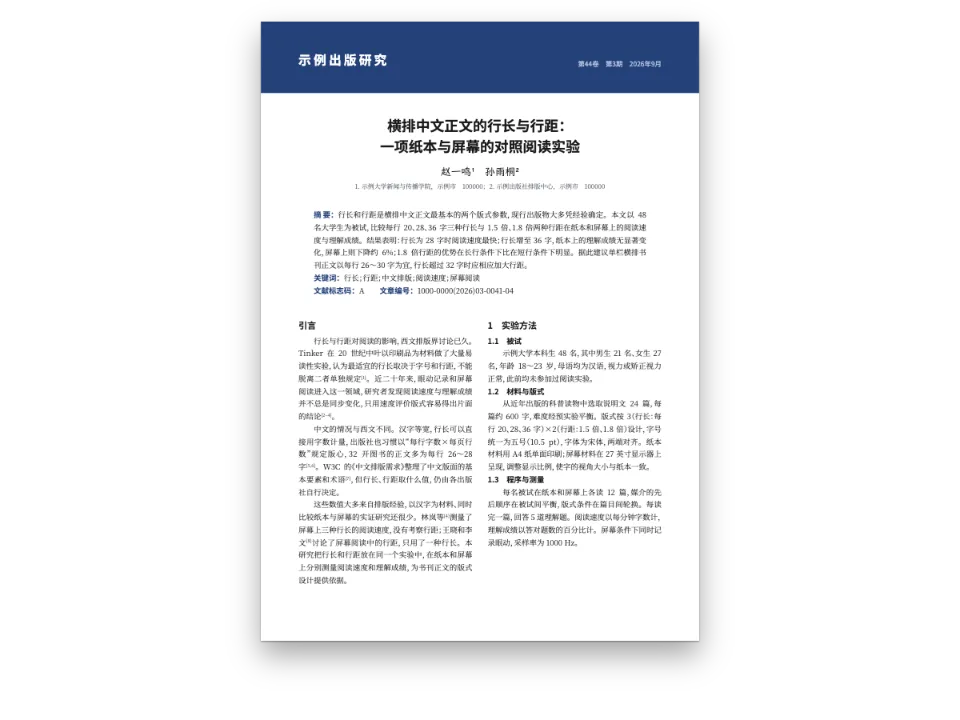
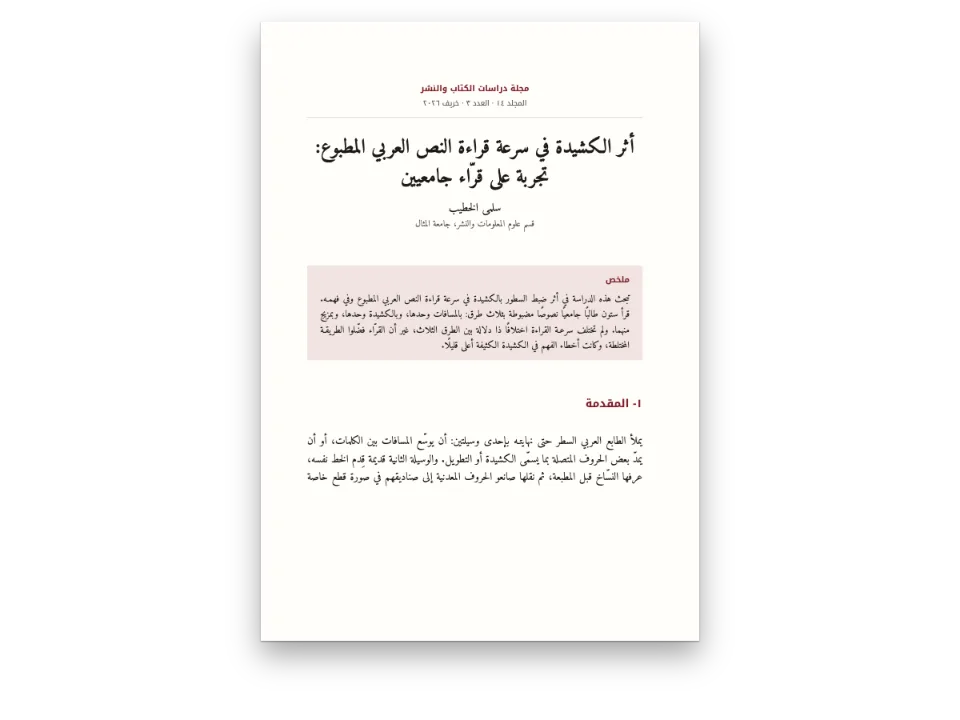
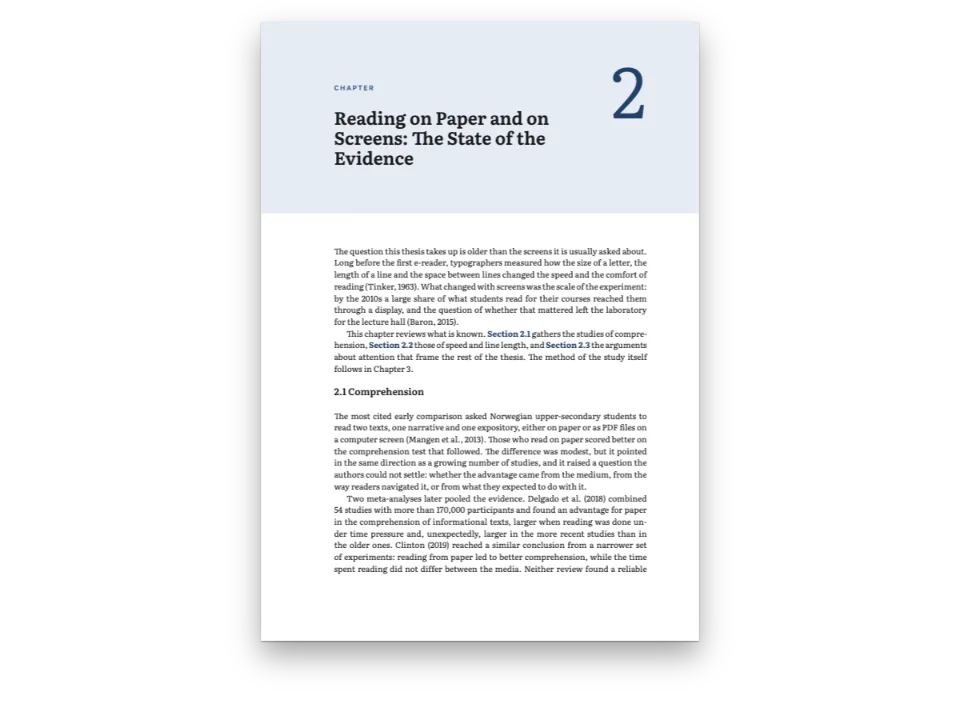
باختصار
مقالة بحثية قصيرة من مجلة يابانية. يكتب المؤلف رمزًا لكل مصدر، ويرقّم Postext المصادر بترتيب الاستشهاد بها ويطبع قائمة المراجع على النحو الذي تطلبه المجلات العلمية اليابانية.
ما الذي ستنضده
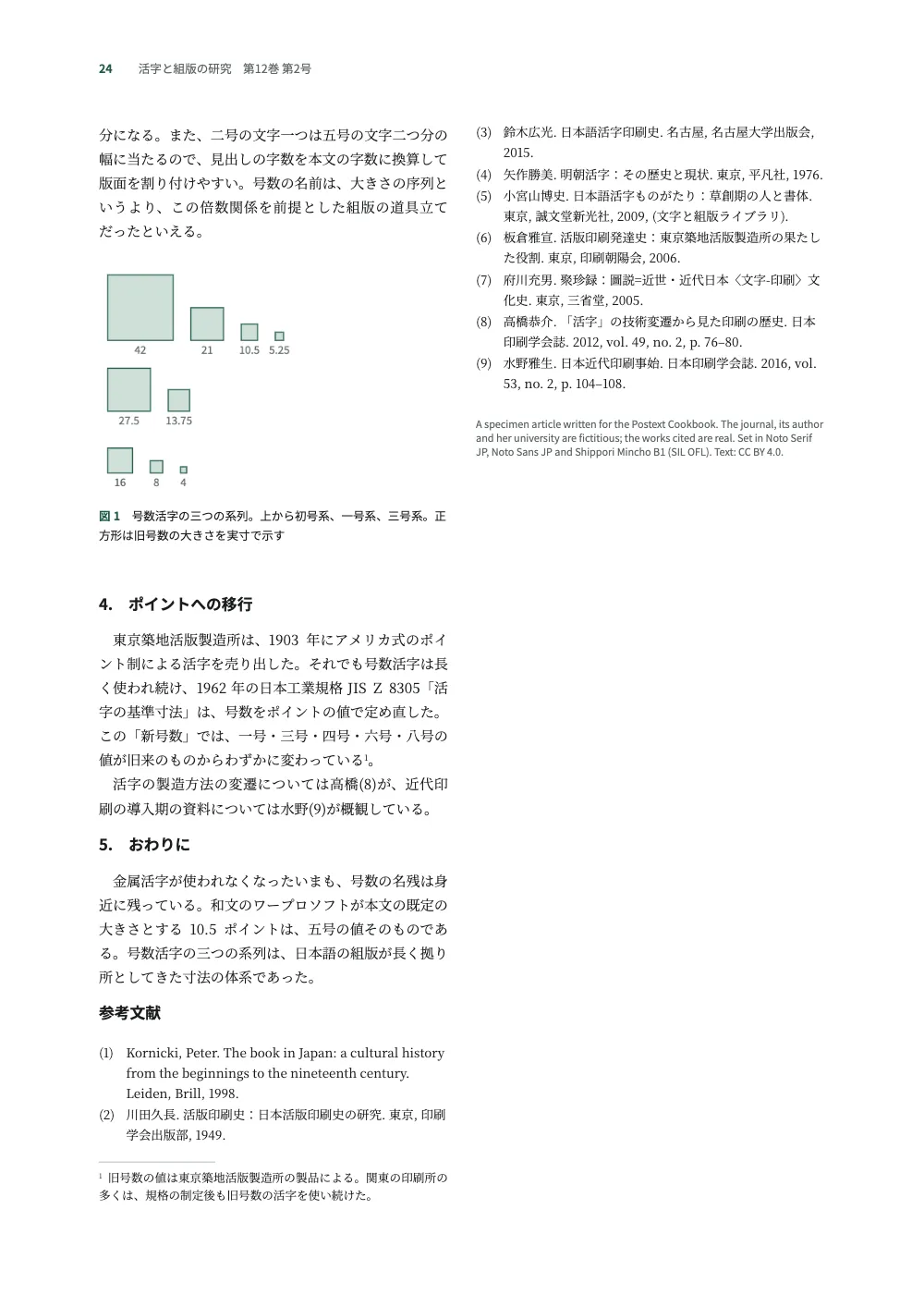
صفحتان من ملاحظة بحثية عنوانها 号数活字の三つの系列 («ثلاث سلاسل من أحجام حروف gōsū»)، من مجلة متخيَّلة عن الحروف والتنضيد، منضّدتان كما تنضّد الجمعيات العلمية اليابانية مجلاتها: قطع A4، وعمودان في كلٍّ منهما 25 حرفًا في 45 سطرًا بخط Noto Serif JP بحجم 9 نقاط، والعنوان بخط Shippori Mincho B1 على شريط المجلة الأخضر. تتبع الاستشهادات SIST 02، دليل المراجع الذي تعتمده مجلات العلوم والتقنية اليابانية: يأخذ كل عمل رقمًا بترتيب أول استشهاد به، (1)، (2, 3)، وتكتب القائمة تحت 参考文献 الأسماء اليابانية باسم العائلة أولًا، والمكان قبل الناشر، والسنة في الآخر. ويأتي جدول بأحجام الحروف التسعة، وشكل يرسمها بمقاسها، وحاشيتان، كلها بتسميات يابانية. ونظيرتها الصينية هي الورقة الصينية باستشهادات وفق GB/T 7714.
تجيب هذه الوصفة عن
- كيف أستشهد بالأعمال وأبني قائمة المراجع بأسلوب APA أو IEEE أو أسلوب استشهاد آخر؟
- كيف أنضّد حواشي كتاب ياباني: (1) في آخر الفصل، أو في ذيل الصفحة، أو بجانب النص على الصفحتين المتقابلتين؟
الجواب المختصر
// Register the engine once, before the first build. SIST 02, the standard Japanese science
// and technology journals cite to, numbers works in the order they are first cited; the
// ja-JP locale writes the list's words and joins authors with と and ほか. The document's
// own locale 'ja' gives the notes their Japanese defaults: at the foot of the column,
// numbered per page, a superscript marker and a rule a third of the column.
registerCitationEngine(createCiteprocEngine({ styles: STYLES, locales: LOCALES }));
const citations = {
  style: 'sist02',
  locale: 'ja-JP',
  bibliography: { fontSize: em(8 / BODY), lineHeight: pt(13), entrySpacing: pt(1),
    labelWidth: em(2.2) }, // turnovers under the text of the entry, past the (n)
};
const footnotes = { fontSize: pt(7.5), lineHeight: pt(11.5), color: col('ink'),
  separator: { color: col('rule') } }; // placement, numbering and marker: the 'ja' defaults
المكونات
- الميزات
- الاستشهادات بأسلوب توثيققائمة المراجع من البيانات المرجعيةالحواشي في الكتب اليابانيةالحواشي السفليةتعليقات مرقّمة«شكل» و«جدول» بلغتكنمط الجدولنمط التعليقالأشكال والجداول بوصفها مواردأشكال في هذا الموضع بالضبطالعناوين المرقّمةعناوين تشغل أسطرًا من المتن (gyōdori)عمود واحد أو عمودانشبكة المحارفصفحات افتتاح مصمَّمةأنماط العناوينالخطوط الصينية واليابانية والكوريةالشارات داخل السطرالترويسات وأرقام الصفحاتالتصدير إلى PDF
- تستخدم أيضًا
- إطارات التنبيهتقسيم الأسطر في النص الصينيموازنة الأعمدةالإحالاتسمات العنوانالترويسات بحسب دور الصفحةأنماط الفقراتالخطوط المضمَّنة في PDFأنواع موارد مخصّصةترقيم روماني للصفحات التمهيديةجداول من البياناتفواصل الأسطر في العناوينفصول بلا أرقام
- الخطوط
- Noto Serif JP, Noto Sans JP, Shippori Mincho B1 (SIL OFL 1.1)
- الأصول
- Figure 1, the three series of type sizes, drawn in code to scale (Postext Cookbook, CC BY 4.0)
طريقة التحضير
#1 · النمط والإعدادات المحلية والحواشي
الشيفرة هي الجواب المختصر أعلاه. يأتي postext-citeproc بنمط SIST 02 باسم 'sist02' وبإعدادات CSL المحلية ja-JP، التي تكتب مصطلحات القائمة باليابانية، وتصل في الاستشهاد السردي بين مؤلفَين يابانيين بـ と وتختصر ما زاد عليهما بـ ほか (الاستشهادات). في النص يطبع [@kawada1949; @suzuki2015] الرقمين (2, 3)، ويضع 高橋[@takahashi2012]が الرقم بعد الاسم، 高橋(8)が. ويختلف النمط عن GB/T 7714 الصيني في علامة الرقم: يضعه SIST 02 بين قوسين على السطر، ويضعه GB/T 7714 مرفوعًا بين قوسين معقوفين. ولا تحتاج الحواشي إلى شيء، فـ locale: 'ja' يعطي المستند الأفقي حواشي أسفل العمود، مرقّمة من 1 في كل صفحة، بعلامة مرفوعة وخط فاصل طوله ثلث عرض العمود.
#2 · المراجع في كتلة CSL-YAML
تُسرد الأعمال في آخر Markdown داخل :::references{format=csl-yaml}، بالصيغة التي يصدّرها Zotero باسم CSL YAML (الاستشهاد). تُدخَل الأسماء اليابانية في family وgiven، {family: 鈴木, given: 広光}، ويطبعها SIST 02 متصلة، 鈴木広光، بينما يحتفظ Kornicki بفاصلته: Kornicki, Peter. وتوضع سلسلة الكتب في collection-title وتُطبع بين قوسين بعد السنة؛ وتعطي المقالتان المنشورتان في 日本印刷学会誌 المجلد والعدد والصفحات بصيغة vol. 49, no. 2, p. 76–80. وكل الأعمال حقيقية، ويمكن التحقق من مداخلها في CiNii.
#3 · العنوان على شريط المجلة
const BAND = 78; // mm from the trim's top: the title sits on the journal's green
const at = (id, y) => ({ anchor: { to: `#${id}`, edge: 'below' }, offset: { y: mm(y) },
  size: { width: mm(AREA) } });
const line = (id, content, family, size, color, placement, extra) => ({ kind: 'text', id,
  content, fontFamily: family, fontSize: pt(size), color: col(color), align: 'center',
  overflow: 'wrap', placement, ...extra });
const top = (y) => ({ anchor: { to: 'container', edge: 'top-left' }, offset: { y: mm(y) },
  size: { width: mm(AREA) } });
const masthead = { enabled: true, minHeight: pt(10 * PITCH), slot: { elements: [
  { kind: 'box', id: 'band', style: { backgroundColor: col('green') },
    placement: { anchor: { to: 'page', edge: 'top-left' },
      size: { width: 'fill', height: mm(BAND) } } },
  line('journal', '活字と組版の研究', GOTHIC, 13, 'paper', top(-13), { fontWeight: 700,
    align: 'left', letterSpacing: pt(2) }),
  line('issue', '第12巻 第2号(2026)', GOTHIC, 8, 'mist', top(-12), { align: 'right' }),
  line('kind', '{attr.kind}', GOTHIC, 8, 'mist', top(2), { fontWeight: 700,
    letterSpacing: pt(2) }),
  line('title', '{titleText}', TITLE, 20, 'paper', at('kind', 3), { fontWeight: 700,
    lineHeight: 1.45 }),
  line('english', '{attr.english}', MINCHO, 8.5, 'mist', at('title', 3)),
  line('author', '{attr.authors}', MINCHO, 11, 'ink', top(BAND - 16)),
  line('affiliation', '{attr.affiliation}', MINCHO, 8, 'muted', at('author', 1.5)),
] } };
كتلة العنوان هي تصميم الـH1، نمط عنوان يمتد عبر العمودين. الشريط إطار مثبّت إلى حدّ القص، وعليه التسمية والعنوان وترجمته الإنجليزية، كلٌّ موضوع تحت ما قبله، فيدفع عنوانٌ من ثلاثة أسطر السطرَ الإنجليزي إلى الأسفل. وتأتي المؤلفة وانتماؤها من سمات العنوان، وتقعان تحت الشريط.
#4 · الملخّص وتسمياته
const calloutStyles = [{ id: 'abstract', span: 'page', backgroundEnabled: false,
  stripe: { enabled: true, side: 'top', width: pt(1.5), color: col('green') },
  padding: { top: mm(2.5), bottom: mm(2.5), left: em(2), right: em(2) },
  marginTop: pt(0), marginBottom: pt(PITCH),
  body: { fontFamily: MINCHO, fontSize: pt(8.5), lineHeight: pt(14), firstLineIndent: pt(0),
    textAlign: 'justify' } }];
const chipStyles = [{ id: 'label', fontFamily: GOTHIC, bold: true, color: col('green'),
  backgroundEnabled: false, borderWidth: pt(0), paddingX: em(0), gap: em(1) }];
الملخّص إطار عبر الصفحة تحت شريط علوي أخضر، وتسمياته شارات بخط Gothic عريض بلون المجلة. وبعد كل تسمية مسافة إيديوغرافية مكتوبة في Markdown، تفصل 要 旨 عن النص.
#5 · 表1 و図1 حيث يُستشهد بهما
const SIZES = `号数\t旧号数(pt)\t新号数(pt)\t系列
初号\t42\t42\t初号系
一号\t27.5\t26.25\t一号系
二号\t21\t21\t初号系
三号\t16\t15.75\t三号系
四号\t13.75\t13.125\t一号系
五号\t10.5\t10.5\t初号系
六号\t8\t7.875\t三号系
七号\t5.25\t5.25\t初号系
八号\t4\t3.9375\t三号系`;
const SERIES = [[42, 21, 10.5, 5.25], [27.5, 13.75], [16, 8, 4]]; // old values, pt
const resources = [
  { id: 'tbl:sizes', typeId: 'table', kind: 'table', createdAt: 0, updatedAt: 0,
    placement: { position: 'here' },
    caption: '号数活字の大きさ。新号数はJIS Z 8305(1962)による',
    table: { model: { ...parseTSV(SIZES), headerRowCount: 1, columnWidths: [16, 28, 28, 28] } } },
  { id: 'fig:series', typeId: 'figure', kind: 'svg', createdAt: 0, updatedAt: 0,
    placement: { position: 'here' },
    caption: '号数活字の三つの系列。上から初号系、一号系、三号系。正方形は旧号数の大きさを実寸で示す',
    altText: 'Three rows of squares drawn to scale: 42, 21, 10.5 and 5.25 pt; 27.5 and 13.75 pt; '
      + '16, 8 and 4 pt. Each square is half the one before it.',
    svg: { fileId: 'series.svg', width: 790, height: 520 } },
];
تعطي defaultResourceTypes('ja') النوعين 図 و表، والورقة ترقّمهما ترقيمًا متصلًا، 表1 و図1، لا بحسب الفصل، لذا فالقالب '{n}'. ويوضع كلاهما 'here'، تحت الفقرة التي تحيل إليه، داخل العمود. وتُرسم مربعات الشكل بحجم الحروف التي تمثّلها، من 42 نقطة لـ 初号 نزولًا إلى 4 نقاط لـ 八号، فيُرى التنصيف على الصفحة.
الوصفة كاملة
// ═══ Postext Cookbook · Nº 125 · A Japanese research paper cited to SIST 02 ═══════════ // https://postext.dev/en/cookbook/sist02-research-paper // Code: MIT · Text: original (CC BY 4.0) · Pictures: drawn in code // Fonts: Noto Serif JP, Noto Sans JP, Shippori Mincho B1 (SIL OFL 1.1) · Needs postext ≥ 1.16.1 import { buildDocument, renderPageToCanvas, clearMeasurementCache, registerCitationEngine, defaultResourceTypes, parseTSV, registerResourceImage, } from 'https://esm.sh/postext'; import { renderToPdf, decompressWoff2 } from 'https://esm.sh/postext-pdf'; import { createCiteprocEngine, STYLES, LOCALES } from 'https://esm.sh/postext-citeproc'; const LANG = 'en'; // @lang: the language of the frame; the paper is Japanese in both const RECIPE = 'sist02-research-paper'; // ─── 1 · Design ───────────────────────────────────────────────────────────── // #region palette: black text, one deep green for the journal, its rules and its labels const palette = { ink: '#1b1d1c', green: '#1f5a46', mist: '#cfe0d8', rule: '#a7b3ad', muted: '#5d6662', paper: '#ffffff', }; const col = (id) => ({ hex: palette[id], model: 'hex', paletteId: id }); const colorPalette = Object.entries({ ...palette, 'main-color': palette.green }) .map(([id, hex]) => ({ id, name: id, value: { hex, model: 'hex' } })); // #endregion const [MINCHO, GOTHIC, TITLE] = ['Noto Serif JP', 'Noto Sans JP', 'Shippori Mincho B1']; const [BODY, PITCH] = [9, 15.5]; // pt: 9 pt text on a 15.5 pt line const [CHARS, LINES] = [25, 45]; // characters to a column's line, lines to a column const PT = 25.4 / 72; // mm in a point const AREA = (2 * CHARS + 2) * BODY * PT; // mm: two columns and a 2-em gutter, 165 // #region answer: SIST 02 in Japanese: numbered citations, the list under 参考文献 // Register the engine once, before the first build. SIST 02, the standard Japanese science // and technology journals cite to, numbers works in the order they are first cited; the // ja-JP locale writes the list's words and joins authors with と and ほか. The document's // own locale 'ja' gives the notes their Japanese defaults: at the foot of the column, // numbered per page, a superscript marker and a rule a third of the column. registerCitationEngine(createCiteprocEngine({ styles: STYLES, locales: LOCALES })); const citations = { style: 'sist02', locale: 'ja-JP', bibliography: { fontSize: em(8 / BODY), lineHeight: pt(13), entrySpacing: pt(1), labelWidth: em(2.2) }, // turnovers under the text of the entry, past the (n) }; const footnotes = { fontSize: pt(7.5), lineHeight: pt(11.5), color: col('ink'), separator: { color: col('rule') } }; // placement, numbering and marker: the 'ja' defaults // #endregion // #region masthead: the journal, the paper's kind, its title and English title on a band const BAND = 78; // mm from the trim's top: the title sits on the journal's green const at = (id, y) => ({ anchor: { to: `#${id}`, edge: 'below' }, offset: { y: mm(y) }, size: { width: mm(AREA) } }); const line = (id, content, family, size, color, placement, extra) => ({ kind: 'text', id, content, fontFamily: family, fontSize: pt(size), color: col(color), align: 'center', overflow: 'wrap', placement, ...extra }); const top = (y) => ({ anchor: { to: 'container', edge: 'top-left' }, offset: { y: mm(y) }, size: { width: mm(AREA) } }); const masthead = { enabled: true, minHeight: pt(10 * PITCH), slot: { elements: [ { kind: 'box', id: 'band', style: { backgroundColor: col('green') }, placement: { anchor: { to: 'page', edge: 'top-left' }, size: { width: 'fill', height: mm(BAND) } } }, line('journal', '活字と組版の研究', GOTHIC, 13, 'paper', top(-13), { fontWeight: 700, align: 'left', letterSpacing: pt(2) }), line('issue', '第12巻 第2号(2026)', GOTHIC, 8, 'mist', top(-12), { align: 'right' }), line('kind', '{attr.kind}', GOTHIC, 8, 'mist', top(2), { fontWeight: 700, letterSpacing: pt(2) }), line('title', '{titleText}', TITLE, 20, 'paper', at('kind', 3), { fontWeight: 700, lineHeight: 1.45 }), line('english', '{attr.english}', MINCHO, 8.5, 'mist', at('title', 3)), line('author', '{attr.authors}', MINCHO, 11, 'ink', top(BAND - 16)), line('affiliation', '{attr.affiliation}', MINCHO, 8, 'muted', at('author', 1.5)), ] } }; // #endregion // #region abstract: across both columns, its labels in gothic the colour of the journal const calloutStyles = [{ id: 'abstract', span: 'page', backgroundEnabled: false, stripe: { enabled: true, side: 'top', width: pt(1.5), color: col('green') }, padding: { top: mm(2.5), bottom: mm(2.5), left: em(2), right: em(2) }, marginTop: pt(0), marginBottom: pt(PITCH), body: { fontFamily: MINCHO, fontSize: pt(8.5), lineHeight: pt(14), firstLineIndent: pt(0), textAlign: 'justify' } }]; const chipStyles = [{ id: 'label', fontFamily: GOTHIC, bold: true, color: col('green'), backgroundEnabled: false, borderWidth: pt(0), paddingX: em(0), gap: em(1) }]; // #endregion // Running heads on the body pages: the journal on the verso, the author on the recto. const head = (id, content, parity, edge, x, extra) => ({ kind: 'text', id, content, parity, pages: 'body', fontFamily: GOTHIC, fontSize: pt(7.5), color: col('muted'), align: edge.endsWith('left') ? 'left' : 'right', placement: { anchor: { to: 'container', edge }, offset: { x: mm(x), y: mm(14) } }, ...extra }); const folio = { fontWeight: 700, color: col('green') }; const header = { elements: [ head('v-folio', '{pageNumber}', 'even', 'top-left', 0, folio), head('v-head', '活字と組版の研究 第12巻 第2号', 'even', 'top-left', 9), head('r-head', '森川:号数活字の三つの系列', 'odd', 'top-right', -9), head('r-folio', '{pageNumber}', 'odd', 'top-right', 0, folio), ] }; const config = () => ({ // a factory: the engine caches resolved configs per object locale: 'ja', // written out, never LANG (gotcha: ja-locale-tag) resourceTypes: defaultResourceTypes('ja').map((type) => ({ ...type, numberingTemplate: '{n}' })), // 図1, 表1: a paper numbers through, not by chapter colorPalette, citations, footnotes, page: { sizePreset: 'custom', width: mm(210), height: mm(297), dpi: 150, // A4 pageNumbering: { startAt: 23 }, margins: { top: mm(24), bottom: mm(20), left: mm(18), right: mm(18), mirror: true } }, layout: { layoutType: 'double', gutterWidth: pt(2 * BODY) }, cjk: { grid: { enabled: true, charsPerLine: CHARS, linesPerPage: LINES } }, bodyText: { fontFamily: MINCHO, fontSize: pt(BODY), lineHeight: pt(PITCH), color: col('ink'), boldColor: col('ink'), italicColor: col('ink'), referenceColor: col('ink'), referenceBold: false, textAlign: 'justify', firstLineIndent: em(1), indentAfterHeading: true }, headings: { fontFamily: GOTHIC, fontWeight: 700, color: col('ink'), balancing: { enabled: false }, // heads stay on the grid levels: [ { level: 1, breakBefore: { enabled: true, parity: 'any' } }, // headings-drop-h1-break { level: 2, numberingTemplate: '{2}.', numberSeparator: ' ', fontSize: pt(10), lineSpan: 2 }, // 2行取り: 1. はじめに on two lines of the grid ] }, headingStyles: [ { id: 'article', numbered: false, span: 'page', advancedDesign: masthead }, { id: 'references', numbered: false }, ], calloutStyles, chipStyles, tableStyle: { rules: 'horizontal', borderColor: col('rule'), borderWidth: pt(0.5), headerBackground: col('green'), headerColor: col('paper'), headerFontFamily: GOTHIC, bodyFontFamily: MINCHO, bodyFontSize: pt(8), bodyColor: col('ink'), cellPadding: mm(1) }, captionStyle: { fontFamily: GOTHIC, fontSize: pt(7.5), color: col('ink'), labelBold: true, labelColor: col('green') }, // 表1 …, the ja default paragraphStyles: [{ id: 'colophon', fontFamily: GOTHIC, fontSize: pt(6.5), lineHeight: pt(9), color: col('muted'), firstLineIndent: pt(0), textAlign: 'left', marginTop: pt(PITCH) }], header, footer: { elements: [] }, }); // ─── 2 · Content ──────────────────────────────────────────────────────────── const markdown = String.raw`---نموذج Markdown · أسطر: 134 · content.en.md
title: "号数活字の三つの系列" --- # 号数活字の三つの系列:\\近代日本の活字の大きさはどう決められたか {style="article" kind="研究ノート" authors="森川 啓" affiliation="架空大学 文学部" english="Three Series of Gōsū Type Sizes: How the Sizes of Modern Japanese Type Were Set"} :::callout{type="abstract"} :chip[要 旨]{style="label"} 明治初期に日本で鋳造が始まった金属活字は、初号から八号までの九つの大きさを「号数」で呼び分けた。本稿では、号数活字の大きさが倍と半分の関係で結ばれた三つの系列からなることを示し、その構造が組版の実務に何をもたらしたかを整理する。また、1962年に日本工業規格が号数をポイントの値で定め直した経緯と、いまも五号に当たる10.5ポイントが和文の標準の大きさとして残っている理由を考察する。 :chip[キーワード]{style="label"} 号数活字、ポイント、明朝体、東京築地活版製造所、JIS Z 8305 ::: ## はじめに 日本語の活字印刷は、近世初期の古活字版のように早くから試みられてきたが[@kornicki1998]、出版の主流となったのは明治に入って金属活字が鋳造されてからである[@kawada1949; @suzuki2015]。その活字の大きさは、いまのようなポイントではなく、「号数」という独自の単位で呼ばれていた。 号数活字の名前は、組版や印刷の歴史を扱う文献にたびたび現れる[@yahagi1976; @komiyama2009]。しかし、九つの大きさがどのような関係で並んでいるのかは、個々の数値ほどには知られていない。本稿では、号数の大きさを系列ごとに整理し、その構造が組版に与えた影響を考える[^term]。 ## 号数活字の成立 号数の体系は、1869年に長崎で本木昌造らが上海の美華書館の技術者から活字鋳造を学んだことに始まるとされる。その後、平野富二が東京築地活版製造所を設け、号数活字は同所の製品として全国に広まった[@itakura2006]。同所の活字見本は、近代日本の書体と字形を知るための基本資料となっている[@fukawa2005]。 ## 三つの系列 号数活字の大きさを[@tbl:sizes]に示す。九つの大きさは、互いに倍と半分の関係で結ばれた三つの系列に分けられる。初号・二号・五号・七号の系列、一号・四号の系列、三号・六号・八号の系列である([@fig:series])。 ::resource{id="tbl:sizes"} この構造には実務上の利点があった。五号の本文に七号のルビを付けると、ルビの大きさはちょうど本文の半分になる。また、二号の文字一つは五号の文字二つ分の幅に当たるので、見出しの字数を本文の字数に換算して版面を割り付けやすい。号数の名前は、大きさの序列というより、この倍数関係を前提とした組版の道具立てだったといえる。 ::resource{id="fig:series"} ## ポイントへの移行 東京築地活版製造所は、1903年にアメリカ式のポイント制による活字を売り出した。それでも号数活字は長く使われ続け、1962年の日本工業規格JIS Z 8305「活字の基準寸法」は、号数をポイントの値で定め直した。この「新号数」では、一号・三号・四号・六号・八号の値が旧来のものからわずかに変わっている[^jis]。 活字の製造方法の変遷については高橋[@takahashi2012]が、近代印刷の導入期の資料については水野[@mizuno2016]が概観している。 ## おわりに 金属活字が使われなくなったいまも、号数の名残は身近に残っている。和文のワープロソフトが本文の既定の大きさとする10.5ポイントは、五号の値そのものである。号数活字の三つの系列は、日本語の組版が長く拠り所としてきた寸法の体系であった。 ## 参考文献 {style="references"} :::bibliography{title=""} [^term]: 本稿でいう「活字」は、鉛合金で鋳造した金属活字を指す。 [^jis]: 旧号数の値は東京築地活版製造所の製品による。関東の印刷所の多くは、規格の制定後も旧号数の活字を使い続けた。 :::paragraphs{style="colophon"} A specimen article written for the Postext Cookbook. The journal, its author and her university are fictitious; the works cited are real. Set in Noto Serif JP, Noto Sans JP and Shippori Mincho B1 (SIL OFL). Text: CC BY 4.0. ::: :::references{format=csl-yaml} - id: suzuki2015 type: book language: ja author: [{family: 鈴木, given: 広光}] title: 日本語活字印刷史 publisher: 名古屋大学出版会 publisher-place: 名古屋 issued: 2015 - id: yahagi1976 type: book language: ja author: [{family: 矢作, given: 勝美}] title: 明朝活字:その歴史と現状 publisher: 平凡社 publisher-place: 東京 issued: 1976 - id: komiyama2009 type: book language: ja author: [{family: 小宮山, given: 博史}] title: 日本語活字ものがたり:草創期の人と書体 publisher: 誠文堂新光社 publisher-place: 東京 collection-title: 文字と組版ライブラリ issued: 2009 - id: itakura2006 type: book language: ja author: [{family: 板倉, given: 雅宣}] title: 活版印刷発達史:東京築地活版製造所の果たした役割 publisher: 印刷朝陽会 publisher-place: 東京 issued: 2006 - id: fukawa2005 type: book language: ja author: [{family: 府川, given: 充男}] title: 聚珍録:圖説=近世・近代日本〈文字-印刷〉文化史 publisher: 三省堂 publisher-place: 東京 issued: 2005 - id: kawada1949 type: book language: ja author: [{family: 川田, given: 久長}] title: 活版印刷史:日本活版印刷史の研究 publisher: 印刷学会出版部 publisher-place: 東京 issued: 1949 - id: kornicki1998 type: book language: en author: [{family: Kornicki, given: Peter}] title: "The book in Japan: a cultural history from the beginnings to the nineteenth century" publisher: Brill publisher-place: Leiden issued: 1998 - id: takahashi2012 type: article-journal language: ja author: [{family: 高橋, given: 恭介}] title: 「活字」の技術変遷から見た印刷の歴史 container-title: 日本印刷学会誌 volume: 49 issue: 2 page: 76-80 issued: 2012 DOI: 10.11413/nig.49.076 - id: mizuno2016 type: article-journal language: ja author: [{family: 水野, given: 雅生}] title: 日本近代印刷事始 container-title: 日本印刷学会誌 volume: 53 issue: 2 page: 104-108 issued: 2016 DOI: 10.11413/nig.53.104 :::`; // content.<lang>.md: the same Japanese paper in both // #region resources: the table of sizes, and the three series drawn to scale const SIZES = `号数\t旧号数(pt)\t新号数(pt)\t系列 初号\t42\t42\t初号系 一号\t27.5\t26.25\t一号系 二号\t21\t21\t初号系 三号\t16\t15.75\t三号系 四号\t13.75\t13.125\t一号系 五号\t10.5\t10.5\t初号系 六号\t8\t7.875\t三号系 七号\t5.25\t5.25\t初号系 八号\t4\t3.9375\t三号系`; const SERIES = [[42, 21, 10.5, 5.25], [27.5, 13.75], [16, 8, 4]]; // old values, pt const resources = [ { id: 'tbl:sizes', typeId: 'table', kind: 'table', createdAt: 0, updatedAt: 0, placement: { position: 'here' }, caption: '号数活字の大きさ。新号数はJIS Z 8305(1962)による', table: { model: { ...parseTSV(SIZES), headerRowCount: 1, columnWidths: [16, 28, 28, 28] } } }, { id: 'fig:series', typeId: 'figure', kind: 'svg', createdAt: 0, updatedAt: 0, placement: { position: 'here' }, caption: '号数活字の三つの系列。上から初号系、一号系、三号系。正方形は旧号数の大きさを実寸で示す', altText: 'Three rows of squares drawn to scale: 42, 21, 10.5 and 5.25 pt; 27.5 and 13.75 pt; ' + '16, 8 and 4 pt. Each square is half the one before it.', svg: { fileId: 'series.svg', width: 790, height: 520 } }, ]; // #endregion // #region art: squares at their size in points, labelled in the gothic's latin file async function labelFace() { const url = 'https://cdn.jsdelivr.net/npm/@fontsource/noto-sans-jp@5/files/' + 'noto-sans-jp-latin-400-normal.woff2'; const bytes = new Uint8Array(await (await fetch(url)).arrayBuffer()); let bin = ''; for (let i = 0; i < bytes.length; i += 8192) { bin += String.fromCharCode(...bytes.subarray(i, i + 8192)); } return `@font-face{font-family:L;src:url(data:font/woff2;base64,${btoa(bin)}) format('woff2')}` + `text{font-family:L;font-size:2.4px;text-anchor:middle;fill:${palette.muted}}`; } function seriesArt(style) { let out = ''; SERIES.forEach((row, r) => { let x = 2; const base = [17, 33, 47][r]; // mm: the squares of a row stand on one line for (const size of row) { const s = size * PT; // a square as wide as the type body out += `<rect x="${x}" y="${base - s}" width="${s}" height="${s}" fill="${palette.mist}" ` + `stroke="${palette.green}" stroke-width=".25"/><text x="${x + s / 2}" y="${base + 3}">` + `${size}</text>`; x += s + 4; } }); return `<svg xmlns="http://www.w3.org/2000/svg" width="790" height="520" viewBox="0 0 79 52">` + `<style>${style}</style>${out}</svg>`; } // #endregion // ─── 3 · Fonts ────────────────────────────────────────────────────────────── const FONTS = { // every face the pages use, loaded before the build (gotcha: fonts-first) 'Noto Serif JP': ['400'], // 明朝: text, abstract, notes, references, author 'Noto Sans JP': ['400', '700'], // ゴシック: journal, heads, labels, captions, table head 'Shippori Mincho B1': ['700'], // the title, a display mincho }; // ─── 4 · Build & show ─────────────────────────────────────────────────────── // Each voice loads the files of what it sets (gotcha: cjk-fonts-slices); the text face also // gets the words SIST 02 adds to the list. const all = (re) => (markdown.match(re) ?? []).join(''); const gothic = `${all(/^#+ .*$/gm)}${all(/:chip\[[^\]]*\]/g)}${SIZES}` + `${resources.map((r) => r.caption).join('')}活字と組版の研究第巻号森川:三つの系列0123456789`; await loadFonts(FONTS, markdown); await loadCjkFonts({ [MINCHO]: FONTS[MINCHO] }, `${markdown}${SIZES}ほかと編巻号頁`); await loadCjkFonts({ [GOTHIC]: FONTS[GOTHIC] }, gothic); await loadCjkFonts({ [TITLE]: FONTS[TITLE] }, all(/^# .*$/gm)); await loadSvg('series.svg', seriesArt(await labelFace())); const doc = await buildWithFonts(() => buildDocument({ markdown, resources }, config()), markdown); showPages(doc, { title: t({ en: 'A Japanese paper cited to SIST 02', es: 'Un artículo japonés citado según SIST 02' }) }); offerPdf(() => renderToPdf(doc, { fontProvider: cjkPdfProvider, resourceBytes: imageBytes }), `${RECIPE}.pdf`);العُدّة · core, fonts, viewer, pdf, images, cjk: نفسها في كل وصفة · أسطر: 488
// ─── Kit ── helpers shared by every Cookbook recipe · postext.dev/cookbook ───── // ─── Kit · core v1 ── the same in every recipe · postext.dev/cookbook ───────── function mm(value) { return { value, unit: 'mm' }; } function pt(value) { return { value, unit: 'pt' }; } function em(value) { return { value, unit: 'em' }; } /** The sample language's string: t({ en: 'Figure', es: 'Figura' }). */ function t(strings) { return strings[LANG] ?? Object.values(strings)[0]; } /** A file in this recipe's assets folder, served from the Postext repo by jsDelivr. */ function asset(file) { return `https://cdn.jsdelivr.net/gh/drnachio/postext@main/cookbook/${RECIPE}/assets/${file}`; } // ─── Kit · fonts v1 ── the same in every recipe · postext.dev/cookbook ──────── // Postext measures text with the faces the browser has loaded, and caches the // widths, so every face must be ready before the first build. Faces come from // Fontsource: the same static files the PDF embeds, so screen and PDF agree. /** faces = { 'Family Name': ['400', '400i', '700'] }. `text` is the sample: * letters beyond Latin-1 (č, ł, ő…) also load the latin-ext files. With * `optional`, a face Fontsource does not ship is skipped instead of failing. * Resolves to the number of faces added. */ async function loadFonts(faces, text = '', { optional = false } = {}) { kitStatus('Loading fonts…'); const ranges = { latin: 'U+0000-00FF,U+0131,U+0152-0153,U+02BB-02BC,U+02C6,U+02DA,U+02DC,U+0304,U+0308,U+0329,' + 'U+2000-206F,U+20AC,U+2122,U+2191,U+2193,U+2212,U+2215,U+FEFF,U+FFFD', 'latin-ext': 'U+0100-02BA,U+02BD-02C5,U+02C7-02CC,U+02CE-02D7,U+02DD-02FF,U+0304,U+0308,U+0329,' + 'U+1D00-1DBF,U+1E00-1E9F,U+1EF2-1EFF,U+2020,U+20A0-20AB,U+20AD-20C0,U+2113,U+2C60-2C7F,U+A720-A7FF', }; const subsets = /[Ā-˿Ḁ-ỿ]/.test(text) ? ['latin', 'latin-ext'] : ['latin']; const jobs = []; let added = 0; for (const [family, specs] of Object.entries(faces)) { const id = fontsourceId(family); const meta = optional ? await fontsourceMeta(family) : null; for (const spec of new Set(specs)) { const weight = parseInt(spec, 10); const style = spec.endsWith('i') ? 'italic' : 'normal'; if (hasFace(family, weight, style)) continue; if (optional && !(meta?.weights.includes(weight) && meta.styles.includes(style))) continue; for (const subset of subsets) { const url = `https://cdn.jsdelivr.net/npm/@fontsource/${id}@5/files/${id}-${subset}-${weight}-${style}.woff2`; const face = new FontFace(family, `url(${url}) format('woff2')`, { weight: String(weight), style, unicodeRange: ranges[subset] }); jobs.push(face.load().then((ready) => { document.fonts.add(ready); added++; }, () => { if (subset === 'latin' && !optional) throw new Error(`Fontsource has no ${family} ${weight} ${style}`); })); } } } await Promise.all(jobs).catch((error) => { kitFail(error); throw error; }); return added; } /** Runs `build` (a buildDocument or buildBundle call) and checks the faces * the pages use. A regular face missing from FONTS is loaded with a warning; * bold and italic variants are loaded when the family ships them. Then the * measurement caches are cleared and the build runs again. */ async function buildWithFonts(build, text = '') { const tried = new Set(); for (let round = 0; round < 3; round++) { kitStatus('Laying out…'); await new Promise(requestAnimationFrame); // let the status paint first const result = await Promise.resolve().then(build).catch((error) => { kitFail(error); throw error; }); const wanted = { base: {}, variants: {} }; for (const { font, base } of [result].flat().flatMap(fontStringsOf)) { const { family, weight, style } = parseFont(font); const key = `${family}|${weight}|${style}`; if (tried.has(key) || hasFace(family, weight, style)) continue; tried.add(key); (wanted[base ? 'base' : 'variants'][family] ??= []).push(`${weight}${style === 'italic' ? 'i' : ''}`); } if (Object.keys(wanted.base).length) { console.warn(`[cookbook] FONTS does not list ${JSON.stringify(wanted.base)}: loading them.`); } const added = await loadFonts(wanted.base, text) + await loadFonts(wanted.variants, text, { optional: true }); if (added === 0) return result; clearMeasurementCache(); } throw new Error('The fonts did not settle after three builds.'); } /** Every font string of the layout. `base` marks a block's own face; its * bold, italic and bold-italic variants are listed whether or not used. */ function fontStringsOf(doc) { const found = new Map(); const walk = (node) => { if (!node || typeof node !== 'object') return; if (Array.isArray(node)) { node.forEach(walk); return; } for (const [key, value] of Object.entries(node)) { if (typeof value === 'string' && /fontString$/i.test(key)) { found.set(value, found.get(value) || key === 'fontString'); } else if (value && typeof value === 'object') walk(value); } }; walk(doc.pages); walk(doc.blocks); return [...found].map(([font, base]) => ({ font, base })); } /** '700 37.5px Open Sans' / 'italic 400 13px "Source Serif 4"' → { family, weight, style }. * A string with no weight ('95.8px Young Serif', from a design text) is 400. */ function parseFont(font) { const m = /^(?:(italic|oblique)\s+)?(?:small-caps\s+)?(?:(\d+|bold|normal)\s+)?[\d.]+px\s+(.+)$/.exec(font.trim()); if (!m) throw new Error(`Unexpected font string: ${font}`); const weight = m[2] === 'bold' ? 700 : !m[2] || m[2] === 'normal' ? 400 : Number(m[2]); return { family: m[3].replace(/^["']|["']$/g, ''), weight, style: m[1] ? 'italic' : 'normal' }; } /** True when a loaded FontFace covers exactly this family, weight and style * (document.fonts.check() is also true for families nobody declared). */ function hasFace(family, weight, style) { for (const face of document.fonts) { if (face.status !== 'loaded' || face.style !== style) continue; if (face.family.replace(/^["']|["']$/g, '') !== family) continue; const [low, high = low] = face.weight.split(' ').map(Number); if (weight >= low && weight <= high) return true; } return false; } /** Fontsource's id for a family: 'Source Serif 4' → 'source-serif-4'. */ function fontsourceId(family) { return family.toLowerCase().replace(/\s+/g, '-'); } /** The weights and styles a family ships ({ weights: [400, 700], styles: ['normal', 'italic'] }), or null. */ function fontsourceMeta(family) { fontsourceMeta.cache ??= new Map(); const id = fontsourceId(family); if (!fontsourceMeta.cache.has(id)) { fontsourceMeta.cache.set(id, fetch(`https://api.fontsource.org/v1/fonts/${id}`) .then((res) => (res.ok ? res.json() : null), () => null)); } return fontsourceMeta.cache.get(id); } // ─── Kit · viewer v1 ── the same in every recipe · postext.dev/cookbook ─────── /** Shows the pages as facing spreads on a dark desk: the first page is a * recto on its own, then verso | recto pairs, as in a bound book. Pages * are painted when they scroll near the screen. */ function showPages(docs, { title, width = 460 } = {}) { const root = viewer(title); const pages = [docs].flat().flatMap((doc) => doc.pages.map((page) => ({ doc, page, n: (doc.pageIndexOffset ?? 0) + page.index }))); const spreads = []; let verso = null; for (const p of pages) { if (p.n % 2 === 1) { if (verso) spreads.push([verso, null]); verso = p; } else { spreads.push([verso, p]); verso = null; } } if (verso) spreads.push([verso, null]); const density = Math.min(window.devicePixelRatio || 1, 2); showPages.painter?.disconnect(); const painter = new IntersectionObserver((entries) => { for (const { isIntersecting, target } of entries) { if (!isIntersecting) continue; painter.unobserve(target); const { doc, page } = target.postext; renderPageToCanvas(page, doc, target, { scale: (width * density) / page.width }); } }, { rootMargin: '800px' }); showPages.painter = painter; root.replaceChildren(...spreads.map((pair) => { const spread = document.createElement('div'); spread.className = 'pt-spread'; for (const p of pair) { const figure = document.createElement('figure'); if (p) { const label = p.page.pageLabel || String(p.n + 1); const canvas = document.createElement('canvas'); canvas.postext = p; canvas.style.aspectRatio = `${p.page.width} / ${p.page.height}`; canvas.setAttribute('role', 'img'); canvas.setAttribute('aria-label', `Page ${label}`); const folio = document.createElement('figcaption'); folio.textContent = label; figure.append(canvas, folio); painter.observe(canvas); } else figure.className = 'pt-blank'; spread.append(figure); } return spread; })); kitStatus(`${pages.length} ${pages.length === 1 ? 'page' : 'pages'}`); document.documentElement.dataset.postext = 'ready'; return pages.length; } /** The desk, the bar and the error reporting, created once. */ function viewer(title) { if (!document.getElementById('pt-kit')) { document.head.insertAdjacentHTML('beforeend', `<style id="pt-kit"> :root { color-scheme: dark; } body { margin: 0; background: #0e1014; color: #b9bcc4; font: 13px/1.45 system-ui, sans-serif; } #pt-bar { position: sticky; top: 0; z-index: 1; display: flex; flex-wrap: wrap; align-items: center; gap: 6px 16px; padding: 10px 16px; background: rgb(14 16 20 / .92); backdrop-filter: blur(6px); border-bottom: 1px solid #23262d; } #pt-bar strong { color: #f4f1ea; font-weight: 600; } #pt-actions { display: flex; gap: 12px; margin-left: auto; } #pt-actions a, #pt-actions button { color: #d8a21a; font: inherit; background: none; border: 0; padding: 0; cursor: pointer; } #pages { display: grid; justify-items: center; gap: 48px; padding: 32px 16px 72px; } .pt-spread { display: flex; } .pt-spread figure { margin: 0; width: min(460px, 44vw); } .pt-spread canvas { display: block; width: 100%; background: #fff; box-shadow: 0 1px 2px rgb(0 0 0 / .5), 0 22px 44px -16px rgb(0 0 0 / .8); } .pt-spread figure:first-child canvas { box-shadow: inset -14px 0 14px -14px rgb(0 0 0 / .18), 0 1px 2px rgb(0 0 0 / .5), 0 22px 44px -16px rgb(0 0 0 / .8); } .pt-spread figcaption { margin-top: 10px; text-align: center; font: 600 10px/1 system-ui, sans-serif; letter-spacing: .18em; text-transform: uppercase; color: #6c7079; } .pt-blank { visibility: hidden; } @media (max-width: 760px) { .pt-spread { flex-direction: column; gap: 32px; } .pt-spread figure { width: min(460px, 92vw); } .pt-blank { display: none; } } </style>`); document.body.insertAdjacentHTML('afterbegin', '<header id="pt-bar"><strong id="pt-title"></strong><span id="pt-status" role="status"></span><span id="pt-actions"></span></header>'); document.getElementById('pt-title').textContent = document.title || 'Postext'; addEventListener('error', (event) => kitFail(event.error ?? event.message)); addEventListener('unhandledrejection', (event) => kitFail(event.reason)); } if (title) document.getElementById('pt-title').textContent = title; return document.getElementById('pages') ?? document.body.appendChild(Object.assign(document.createElement('main'), { id: 'pages' })); } function kitStatus(text) { viewer(); document.getElementById('pt-status').textContent = text; } function kitFail(error) { document.documentElement.dataset.postext = 'error'; kitStatus(`Error: ${error?.message ?? error}`); } // ─── Kit · pdf v1 ── the same in every recipe that exports a PDF ────────────── /** postext-pdf embeds TrueType bytes. Fetch the Fontsource file the screen * used, snapping to a weight the family ships and falling back to upright * when it has no italic: the PDF asks for every face a block could use. */ async function fontsourceProvider(family, weight, style) { const id = fontsourceId(family); const meta = await fontsourceMeta(family); const weights = meta?.weights?.length ? meta.weights : [400, 700]; const w = weights.reduce((a, b) => (Math.abs(b - weight) < Math.abs(a - weight) ? b : a)); const s = style === 'italic' && meta && !meta.styles.includes('italic') ? 'normal' : style; const res = await fetch(`https://cdn.jsdelivr.net/npm/@fontsource/${id}@5/files/${id}-latin-${w}-${s}.woff2`); if (!res.ok) throw new Error(`Fontsource has no ${family} ${w} ${s} (${res.status})`); return decompressWoff2(new Uint8Array(await res.arrayBuffer())); } /** A "Build the PDF" button in the bar. Once built: "Open the PDF" (a new * tab, since CodePen's preview frame cannot show PDFs) and a download link. */ function offerPdf(makePdf, filename) { viewer(); const button = Object.assign(document.createElement('button'), { type: 'button', textContent: 'Build the PDF' }); button.dataset.postextPdf = filename; button.addEventListener('click', async () => { button.disabled = true; button.textContent = 'Building the PDF…'; try { const bytes = await makePdf(); const url = URL.createObjectURL(new Blob([bytes], { type: 'application/pdf' })); const size = `${Math.max(1, Math.round(bytes.length / 1024))} KB`; button.replaceWith( Object.assign(document.createElement('a'), { href: url, target: '_blank', rel: 'noopener', textContent: 'Open the PDF ↗' }), Object.assign(document.createElement('a'), { href: url, download: filename, textContent: `Download ${filename} · ${size}` })); } catch (error) { button.disabled = false; button.textContent = 'Build the PDF'; kitFail(error); } }); document.getElementById('pt-actions').append(button); } // ─── Kit · images v1 ── recipes with pictures · postext.dev/cookbook ────────── /** Registers a photo or PNG for the canvas and keeps its bytes for the PDF. * fetch → ImageBitmap never taints the canvas (a plain cross-origin <img> would). */ async function loadImage(fileId, url) { const res = await fetch(url); if (!res.ok) throw new Error(`Image not found (${res.status}): ${url}`); const bytes = new Uint8Array(await res.arrayBuffer()); registerResourceImage(fileId, await createImageBitmap(new Blob([bytes]))); (loadImage.bytes ??= new Map()).set(fileId, bytes); } /** Registers SVG markup (drawn in code, or fetched) as a vector image. */ async function loadSvg(fileId, svg) { const img = new Image(); img.src = `data:image/svg+xml;charset=utf-8,${encodeURIComponent(svg)}`; await img.decode(); registerResourceImage(fileId, img); (loadImage.bytes ??= new Map()).set(fileId, new TextEncoder().encode(svg)); } /** renderToPdf({ resourceBytes: imageBytes }) */ function imageBytes(fileId) { return loadImage.bytes?.get(fileId); } /** renderToHtml({ resourceImageUrl: imageUrl }) */ function imageUrl(fileId) { const bytes = imageBytes(fileId); if (!bytes) return undefined; imageUrl.urls ??= new Map(); if (!imageUrl.urls.has(fileId)) { const type = /\.svg$/i.test(fileId) ? 'image/svg+xml' : /\.png$/i.test(fileId) ? 'image/png' : 'image/jpeg'; imageUrl.urls.set(fileId, URL.createObjectURL(new Blob([bytes], { type }))); } return imageUrl.urls.get(fileId); } // ─── Kit · cjk v1 ── Chinese, Japanese and Korean books · postext.dev/cookbook ─ // Fontsource ships a CJK family as about a hundred files per weight, each // declared in its stylesheet with the unicode-range it covers. The screen // loads the files the sample touches; the PDF gets the same files for the // characters its pages set in each face, and embeds each as a subset. // A book bound on the right (vertical text) is shown with its spreads // mirrored: page 1 alone on the left of the spine, then [3 | 2]. /** The files of a Fontsource face, read from its stylesheet: { url, range, * ranges }, the last declared first (the order the browser tries them in). */ function cjkSlices(family, weight, style) { cjkSlices.cache ??= new Map(); const id = fontsourceId(family); const css = `https://cdn.jsdelivr.net/npm/@fontsource/${id}@5/${weight}${style === 'italic' ? '-italic' : ''}.css`; if (!cjkSlices.cache.has(css)) { cjkSlices.cache.set(css, fetch(css) .then((res) => { if (!res.ok) throw new Error(`Fontsource has no ${family} ${weight} ${style} (${res.status})`); return res.text(); }) .then((text) => [...text.matchAll(/@font-face\s*{([^}]*)}/g)].map(([, rule]) => { const range = /unicode-range:\s*([^;]+);/.exec(rule)?.[1].trim() ?? 'U+0-10FFFF'; const ranges = range.split(',').map((part) => { const [lo, hi = lo] = part.trim().slice(2).split('-'); return [parseInt(lo, 16), parseInt(hi, 16)]; }); return { url: new URL(/url\(([^)]+?\.woff2)\)/.exec(rule)[1], css).href, range, ranges }; }).reverse())); } return cjkSlices.cache.get(css); } /** The file of `slices` that holds code point `cp`, if any. */ function cjkSliceFor(slices, cp) { return slices.find((slice) => slice.ranges.some(([lo, hi]) => cp >= lo && cp <= hi)); } /** Whether Fontsource serves `family` as a Chinese, Japanese or Korean * family (its subsets name the script). Fails when the API does not * answer: a CJK face taken for a Latin one would paint in a system face. */ async function isCjkFamily(family) { const meta = await fontsourceMeta(family); if (!meta) throw new Error(`api.fontsource.org did not describe ${family}: reload to try again`); return !!meta.subsets?.some((subset) => /^(chinese|japanese|korean)/.test(subset)); } /** faces = { 'Noto Serif TC': ['400', '700'] }, as for loadFonts: the * whole FONTS object may be passed, its other families are left to * loadFonts. Adds one FontFace per file of each CJK face with its * unicodeRange, then loads the files `text` touches. `text` is what the * faces set: the sample for the text face; a book in several voices calls * it once per voice (loadCjkFonts({ 'LXGW WenKai TC': ['400'] }, quotes)), * so the heading and quotation faces fetch and check only their own * characters. Fails when a character of `text` is in no file of a face. * List every weight the pages use: a weight left to buildWithFonts gets * the latin file only. With { vertical: true } it also loads each * family's vertical forms (brackets, quotes, pause marks) for the canvas, * which needs loadVerticalAlternates imported from postext. Resolves to * the number of files loaded. */ async function loadCjkFonts(faces, text, { vertical = false } = {}) { kitStatus('Loading fonts…'); let loaded = 0; try { if (vertical && typeof loadVerticalAlternates !== 'function') { throw new Error('loadCjkFonts(…, { vertical: true }) needs loadVerticalAlternates imported from postext'); } for (const [family, specs] of Object.entries(faces)) { if (!(await isCjkFamily(family))) continue; const twin = []; for (const spec of new Set(specs)) { const weight = parseInt(spec, 10); const style = spec.endsWith('i') ? 'italic' : 'normal'; const slices = await cjkSlices(family, weight, style); const missing = [...new Set(text)].filter((ch) => /\S/.test(ch) && !cjkSliceFor(slices, ch.codePointAt(0))); if (missing.length) { throw new Error(`${family} ${spec} has no file for ${missing.slice(0, 12).join(' ')}: ` + `give each face the text it sets (loadCjkFonts({ '${family}': ['${spec}'] }, text))`); } for (const slice of slices) { document.fonts.add(new FontFace(family, `url(${slice.url}) format('woff2')`, { weight: String(weight), style, unicodeRange: slice.range })); twin.push({ source: slice.url, weight: String(weight), style, unicodeRange: slice.range }); } const font = `${style === 'italic' ? 'italic ' : ''}${weight} 16px "${family}"`; loaded += (await document.fonts.load(font, text)).length; if (!document.fonts.check(font, text)) throw new Error(`${family} ${spec} did not load for the sample`); } // The same files under a twin name with the `vert` feature on: the // canvas paints the punctuation of vertical lines with it. if (vertical && twin.length) await loadVerticalAlternates(family, twin); } } catch (error) { kitFail(error); throw error; } return loaded; } /** The PDF font provider for recipes with CJK faces: a family whose * Fontsource subsets are Chinese, Japanese or Korean gets the files that * hold the characters its pages set (`request.codePoints`); any other * family gets the latin file fontsourceProvider fetches (the "pdf" block) * and, when the face sets letters only latin-ext has, that file too. */ async function cjkPdfProvider(family, weight, style, request) { if (!(await isCjkFamily(family))) return cjkLatinPdfFiles(family, weight, style, request); const meta = await fontsourceMeta(family); const weights = meta.weights?.length ? meta.weights : [400, 700]; const w = weights.reduce((a, b) => (Math.abs(b - weight) < Math.abs(a - weight) ? b : a)); const s = style === 'italic' && !meta.styles.includes('italic') ? 'normal' : style; const slices = await cjkSlices(family, w, s); const picked = new Set(); for (const cp of request?.codePoints ?? []) { const slice = cjkSliceFor(slices, cp); if (slice) picked.add(slice); } if (!picked.size) picked.add(slices[0]); return Promise.all(slices.filter((slice) => picked.has(slice)).map(async (slice) => { const res = await fetch(slice.url); if (!res.ok) throw new Error(`Fontsource file ${slice.url} (${res.status})`); return decompressWoff2(new Uint8Array(await res.arrayBuffer())); })); } /** A Latin family set next to the CJK faces: its latin file, then its * latin-ext file when the face sets letters only latin-ext has (ō ū in * Hepburn rōmaji, ǎ in pinyin), the file loadFonts adds on screen for * them. Latin comes first: postext-pdf draws a character from the first * file that has it, as the browser takes a character both files hold from * latin. A face Fontsource ships without latin-ext, or whose file does * not come, gets latin alone, and the PDF names the letters it lacks. */ async function cjkLatinPdfFiles(family, weight, style, request) { const meta = await fontsourceMeta(family); const beyond = [...(request?.codePoints ?? [])].some(cjkLatinExtOnly); if (!beyond || !meta?.subsets?.includes('latin-ext')) return fontsourceProvider(family, weight, style); const weights = meta.weights?.length ? meta.weights : [400, 700]; const w = weights.reduce((a, b) => (Math.abs(b - weight) < Math.abs(a - weight) ? b : a)); const s = style === 'italic' && !meta.styles.includes('italic') ? 'normal' : style; const id = fontsourceId(family); const url = `https://cdn.jsdelivr.net/npm/@fontsource/${id}@5/files/${id}-latin-ext-${w}-${s}.woff2`; const [latin, ext] = await Promise.all([fontsourceProvider(family, weight, style), fetch(url) .then(async (res) => (res.ok ? decompressWoff2(new Uint8Array(await res.arrayBuffer())) : null), () => null)]); return ext ? [latin, ext] : latin; } /** Whether code point `cp` is in Fontsource's latin-ext file and not in * its latin file: Latin Extended-A and -B, IPA, the spacing modifiers and * Latin Extended Additional (loadFonts's test for latin-ext), less the * few latin holds too (ı Œ œ ʻ ʼ ˆ ˚ ˜). */ function cjkLatinExtOnly(cp) { if (!((cp >= 0x100 && cp <= 0x2ff) || (cp >= 0x1e00 && cp <= 0x1eff))) return false; return ![0x131, 0x152, 0x153, 0x2bb, 0x2bc, 0x2c6, 0x2da, 0x2dc].includes(cp); } /** showPages for a book bound on either edge. A right-bound book (the * document says so: doc.binding is 'right' for page.binding 'right' and * for vertical text) lies on the desk as it opens: page 1 alone on the * left of the spine, then [3 | 2], the spine shade on each page's inner * edge. `binding` ('left' | 'right') overrides the document's. */ function showBook(docs, { binding, ...options } = {}) { const count = showPages(docs, options); const right = (binding ?? [docs].flat()[0]?.binding) === 'right'; if (!document.getElementById('pt-kit-cjk')) { // The pages keep direction ltr: a canvas draws text in the direction its // element inherits, and under rtl each run would end where the engine // starts it, its brackets mirrored. document.head.insertAdjacentHTML('beforeend', `<style id="pt-kit-cjk"> .pt-spread[dir="rtl"] canvas { direction: ltr; } .pt-spread[dir="rtl"] figure:first-child canvas { box-shadow: inset 14px 0 14px -14px rgb(0 0 0 / .18), 0 1px 2px rgb(0 0 0 / .5), 0 22px 44px -16px rgb(0 0 0 / .8); } </style>`); } // Each pair stays [verso, recto] in the page; right to left, the verso // sits on the right. Phones stack the pages in reading order either way. for (const spread of document.querySelectorAll('#pages > .pt-spread')) spread.dir = right ? 'rtl' : 'ltr'; document.getElementById('pages').dataset.binding = right ? 'right' : 'left'; return count; } // ─── /Kit ───────────────────────────────────────────────────────────────────────
يعمل ملف script.js المجمّع كما هو: الصقه في سكربت الوحدة (module) لأي صفحة، أو افتح الوصفة على CodePen. مجلد الوصفة على GitHub ↗ (يفتح في تبويب جديد)
تنويعات
#أرقام استشهاد مرفوعة
ترفع مجلات يابانية كثيرة الرقم فوق السطر. يطبع marker: 'superscript' الرقم مرفوعًا بلا قوسين، ويترك القائمة كما هي.
   locale: 'ja-JP',
+ marker: 'superscript',#حواشٍ مرقّمة عبر الورقة كلها
قد تعدّ الورقة القصيرة حواشيها من 1 إلى آخرها بدل البدء من جديد في كل صفحة.
-const footnotes = { fontSize: pt(7.5), lineHeight: pt(11.5), color: col('ink'),
+const footnotes = { numbering: 'document', fontSize: pt(7.5), lineHeight: pt(11.5),
+ color: col('ink'),أخطاء شائعة
خطأ شائع
اوسم النص الياباني بـ 'ja'، لا بـ zh-Hans ولا بـ LANG
نسختا الوصفة هما en وes، لكن المثال الياباني ياباني في كلتيهما: `locale: LANG` سيسمه بالإنجليزية أو الإسبانية، والوسم الصيني سينضّده بالقواعد الصينية (ترقيم Kaiming، وكانا صغيرة يجوز أن تبدأ بها الأسطر، و图 بدل 図، وأشكال صينية للحروف في PDF). اكتب 'ja': يختار منطقة اليابان (كسر الأسطر والترقيم وفق JLReq، ونقاط السمسم، وتوزيع الفوريغانا، وتسميتي 図 و表) ويوقف تقسيم الكلمات. ويُفشل الفحصُ نصًّا فيه كانا موسومًا بـ zh أو ko. كسر الأسطر الياباني (kinsoku) →
خطأ شائع
انضد اليابانية بخط ياباني
في Noto Serif SC وTC كانا، لكنهما ترسمان الكانجي بأشكال صينية (يختلف 直 و骨 و角) والكانا بتصميم صيني. انضد النص بـ Noto Serif JP أو Shippori Mincho B1 والعناوين بـ Noto Sans JP، محمَّلة بـ loadCjkFonts. لا تحوي ملفات Fontsource اليابانية الهينتايغانا ولا غيرها من الكانا التاريخية (U+1B000–1B16F): يفشل loadCjkFonts عندها ويطبع PDF مربعات، فاكتب الكانا الحديثة أو ضع في أصول الوصفة خطًّا يحويها. ولا يحوي Shippori Mincho أيضًا الصائتين ō وū بالمدّة: انضد الروماجي بخط لاتيني. الكانا والكانجي والروماجي →
خطأ شائع
الخطوط الصينية تُحمَّل شرائح، عبر الكتلة cjk
يقدّم Fontsource العائلة الصينية أو اليابانية أو الكورية في نحو مئة ملف لكل وزن، يغطي كل منها نطاقًا من الحروف. لا يجلب loadFonts إلا ملف latin، فتأتي حروف الهان على الشاشة من خط النظام وتُقاس خطأً، ويسلّم fontsourceProvider ملف latin ذاك إلى PDF، فيطبعها مربعات فارغة. اذكر كتلة الأدوات cjk، واستدعِ loadCjkFonts(FONTS, markdown) بعد loadFonts (مرة لكل صوت، مع النص الذي يضعه، حين يستخدم الكتاب عدة خطوط CJK)، وأعطِ renderToPdf القيمة fontProvider: cjkPdfProvider: كلاهما يأخذ الملفات التي تحتوي حروف النص. الخطوط الصينية واليابانية والكورية →
خطأ شائع
على شبكة الحروف، أوقف موازنة الأعمدة
تملأ موازنة الأعمدة الصفحة التي تنتهي قصيرة، كما حين يترك عنوانٌ مُبقًى مع نصه أسطرًا فارغة في الأسفل، بإضافة أسطر شبكة فوق العناوين وبتوسيع فقرة بمقدار سطر. والسطر الصيني الموسَّع يباعد بين حروفه (0.13 em في صفحة GB/T 9704، وهو أبعد كثيرًا من balancing.maxTracking)، فتخرج الحروف من أعمدة الشبكة وتخرج العناوين من أسطرها. الصفحة المحسوبة بالخلايا تنتهي قصيرة بدلًا من ذلك: اضبط headings.balancing: { enabled: false }. شبكة المحارف →
خطأ شائع
النص داخل SVG في <img> لا يستطيع استخدام خطوط الويب
يُرسَم SVG صورةً، والصورة لا تصل إلى خطوط الويب في الصفحة، فتعود تسمياته إلى خط من النظام. حوّل النص إلى مسارات، أو ضمّن مجموعة فرعية بـ @font-face داخل SVG، أو انقل التسميات إلى التعليق. الأشكال والجداول بوصفها موارد →
خطأ شائع
أي كائن headings يُلغي فاصل الصفحة قبل H1
ينتقل H1 افتراضيًا إلى صفحة فردية (always-odd)، لكن تمرير أي كائن headings يعيد ضبط هذا الافتراض، فتتوالى الفصول دون فاصل ولا يفعل span: 'page' شيئًا. أعد كتابة headings.levels[0].breakBefore: { enabled: true, parity } في كل إعداد. فصول تبدأ في صفحة فردية →
خطأ شائع
ضع كل قيمة في الترويسة الأمامية (frontmatter) بين علامتي اقتباس
يقرأ YAML القيمة title: 1984 رقمًا، ويقرأ التاريخ كائن Date، والقيم غير النصية تُطبع فارغة في العناصر النائبة وتترك ملف PDF بلا عنوان. ضع كل قيمة بين علامتي اقتباس: title: "1984". البيانات الوصفية للمستند →
خطأ شائع
حمّل كل أوجه الخط قبل الإخراج
يقيس الإخراج النص بأوجه الخط التي حمّلها المتصفح ويخزّن العروض مؤقتًا، فالوجه الذي يصل بعد البناء الأول يترك فواصل أسطر خاطئة وملف PDF لم يعد يطابق الشاشة. حمّل كل وزن وكل نمط أولًا، واستدعِ clearMeasurementCache() قبل إعادة البناء إذا تأخر وصول أحدها. الخطوط قبل الإخراج →
- اكتب الاسم الياباني في
familyوgiven، أو فيliteralواحد بلا مسافة. فالاسم المكتوب سلسلة واحدة بمسافة بين اسم العائلة والاسم الشخصي، كما يحمله BibTeX كثيرًا (author = {夏目 漱石})، يُقرأ باسم العائلة أولًا، أما المكتوب بالحروف اللاتينية،Natsume Soseki، فيُقرأ اسمًا شخصيًا ثم اسم عائلة، كما تُقرأ الأسماء الإنجليزية. - لا يطبع نمط SIST 02 المرفق أي DOI، فالمقالة التي يهمّ الـDOI الخاص بها تحتاج إلى ذكره في النص أو في حاشية.
الحقوق
- الوصفة
- Ignacio Ferro
- النص
- نص أصلي, CC BY 4.0
- الصور
- Figure 1, the three series of type sizes, drawn in code to scale · Postext Cookbook · CC BY 4.0
- الخطوط
- Noto Serif JP (SIL OFL 1.1) · Noto Sans JP (SIL OFL 1.1) · Shippori Mincho B1 (SIL OFL 1.1)
- الكود
- MIT، مثل Postext
حرّر هذا الشرح ↗ (يفتح في تبويب جديد)مجلد الوصفة على GitHub ↗ (يفتح في تبويب جديد)