باختصار
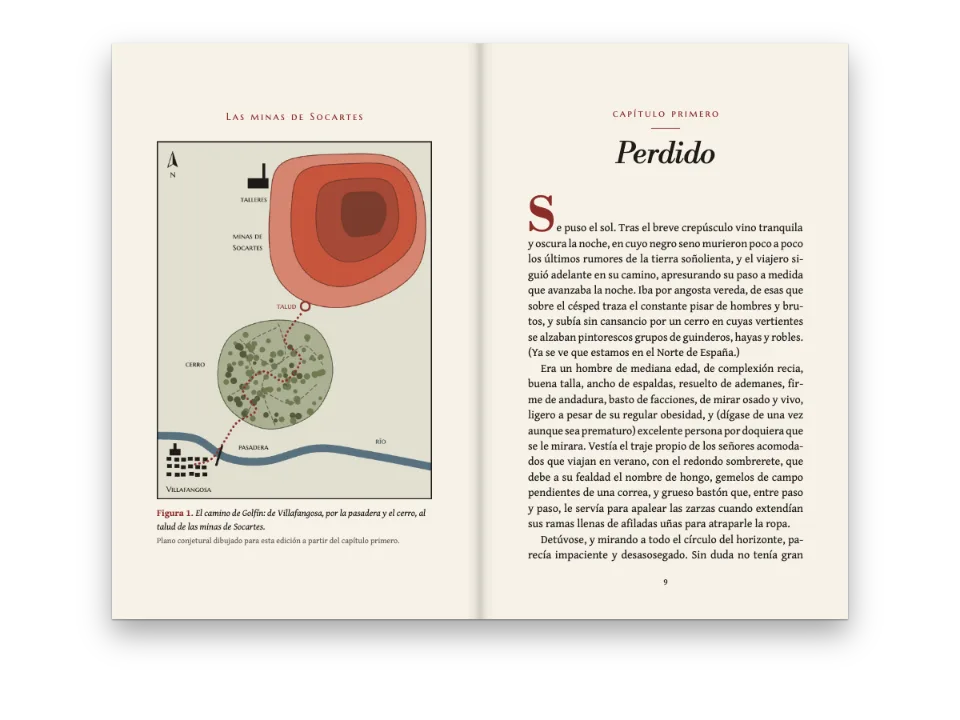
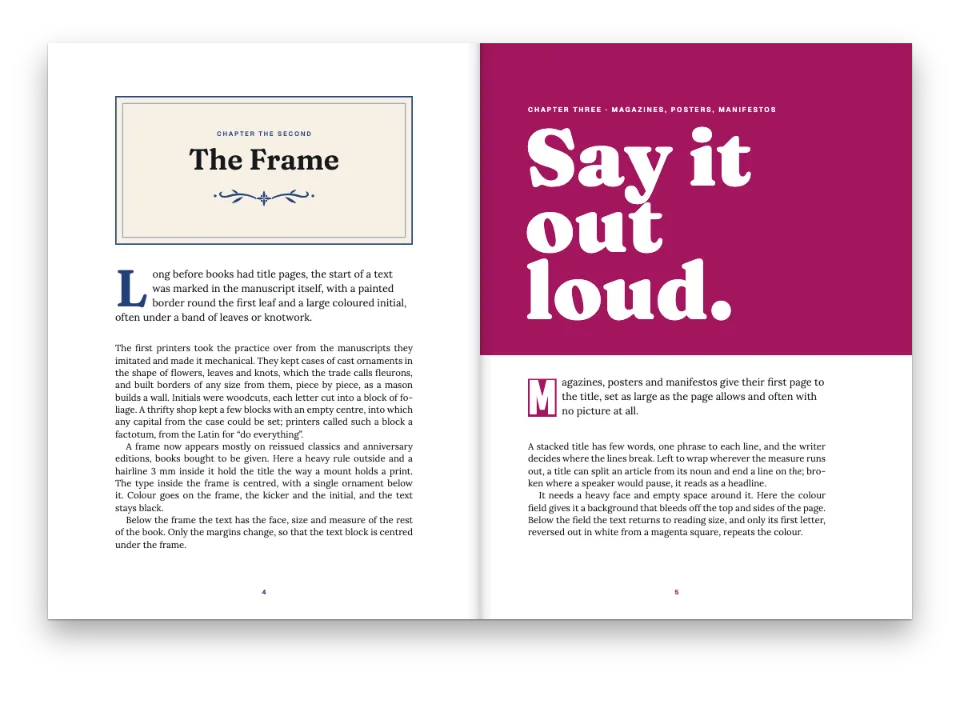
الفصلان الأولان من رواية أمريكية في كتاب ورقي الغلاف. يبدأ كل فصل على صفحة يمنى، في موضع أخفض، تحت رقم فصل كبير.
ما الذي ستنضده
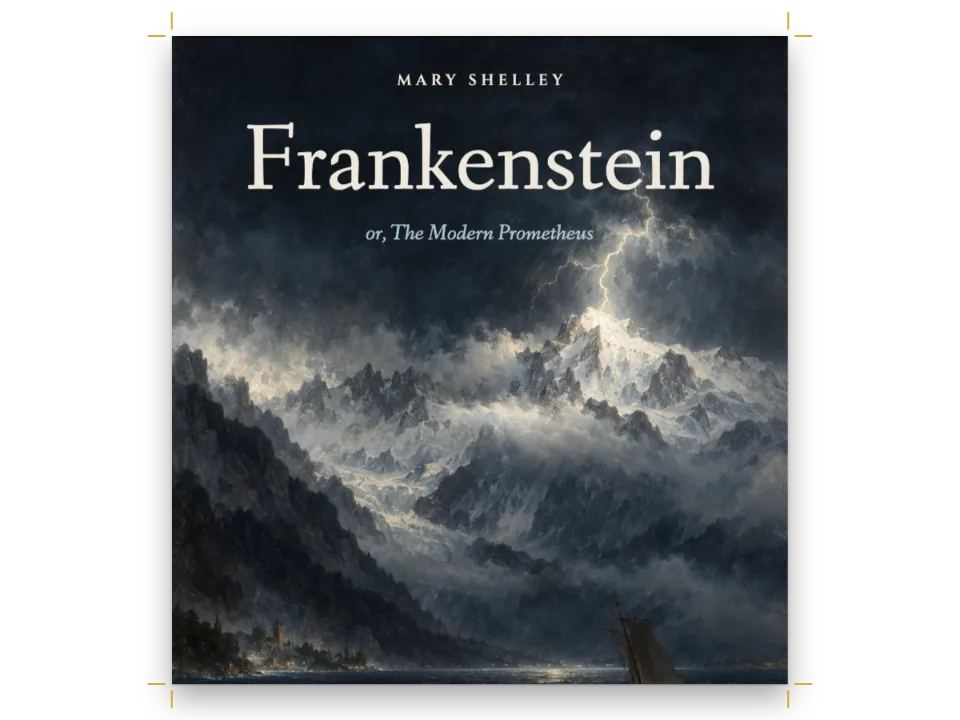
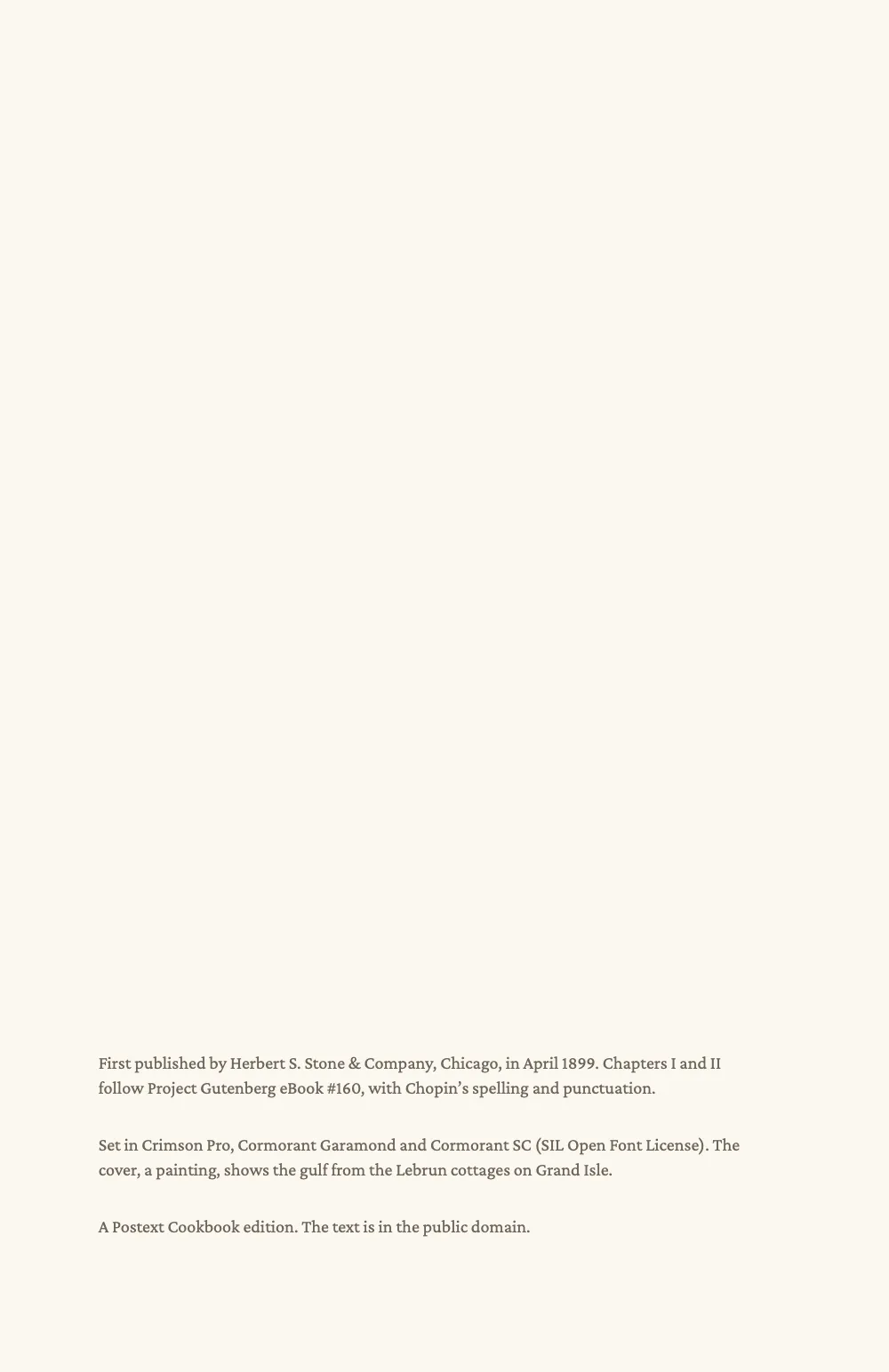
ثماني صفحات من كتاب ورقي تجاري بقياس 140 × 216 مم تحمل الفصلين الأولين من رواية The Awakening (1899) لكيت شوبان. يُظهر الغلاف، وهو لوحة مولَّدة بنماذج الانتشار ومحمّلة بصيغة JPEG، الخليجَ من أكواخ آل لوبران في جزيرة غراند آيل: مركب شراعي على الأفق بين أشجار البلوط المائي، ومظلة الشمس البيضاء تصعد بين البابونج. وتقع بيانات الطبع في أسفل صفحتها الزوجية. يُفتتح كل فصل على صفحة فردية ونصه على بعد 81 مم من الأعلى، تحت رقم مائل بحجم 48 نقطة، وخط رفيع بلون أحمر صدئي طوله 18 مم، والجملة الأولى من الفصل بحروف كبيرة مصغّرة، مكسورة بحسب المعنى إلى سطرين في الوسط. ينتهي الفصل I في الصفحة 5 بحلية ختام من البابونج، فتبقى الصفحة 6 فارغة، بلا ترويسة ولا رقم صفحة، ويُفتتح الفصل II في الصفحة 7. وتحمل الترويسات اسم المؤلفة على الصفحات الزوجية والعنوان بخط مائل على الفردية.
تجيب هذه الوصفة عن
- كيف أفرض فاصل صفحة أو عمود، وأبدأ كل فصل على صفحة يمنى؟
- كيف أضيف إلى صفحة الافتتاح سطر المؤلف أو مقدمة تمهيدية أو فقرة أولى بحرف استهلالي؟
- كيف أُدرج صفحات فارغة مقصودة، أو أبدأ قسمًا على صفحتين متقابلتين جديدتين؟
- كيف أضبط الترويسات: عنوان الكتاب في الصفحة اليسرى، وعنوان الفصل في اليمنى، ورقم الصفحة في الجانب الخارجي؟
- كيف أصمم غلافًا وصفحة عنوان مختصر وصفحة عنوان وصفحة بيانات النشر؟
- كيف أضيف فراغًا رأسيًّا إضافيًّا بين كتلتين، إذا لم تُجدِ الأسطر الفارغة شيئًا؟
- كيف أنضد رسومًا غير مرقّمة: زخارف، وحليات، وشعارات؟
الجواب المختصر
// # I {lead="A green and yellow parrot, … kept repeating over and over:"}
// The heading's text is the numeral, printed by {titleText}; the chapter's first sentence
// travels as the heading's lead attribute, printed by {attr.lead} in small capitals and
// centred, because design text is never justified (gotcha: design-text-ragged).
const [LEAD_AT, BODY_AT] = [9, 12]; // grid lines: the lead's top; where the text starts
const NUMERAL = 48; // pt
const RULE_Y = (LEAD_AT - 1.5) * LEAD * MM_PER_PT; // mm: a line and a half above the lead
const NUMERAL_Y = RULE_Y - NUMERAL * MM_PER_PT - 3; // mm: the numeral's box ends 3 mm above it
const centred = (y) => ({ anchor: { to: 'container', edge: 'top' }, offset: { y } });
const opener = {
  enabled: true,
  // The two-line lead ends on line LEAD_AT + 2; minHeight leaves a blank line under it and
  // starts the text on line BODY_AT (a one-line lead would leave two).
  minHeight: line(BODY_AT),
  slot: { elements: [
    { kind: 'text', id: 'numeral', content: '{titleText}', fontFamily: DISPLAY, italic: true,
      fontWeight: 500, fontSize: pt(NUMERAL), lineHeight: 1, color: col('ink'),
      align: 'center', placement: centred(mm(NUMERAL_Y)) },
    { kind: 'rule', id: 'hairline', direction: 'horizontal', thickness: pt(0.6),
      color: col('rubric'), placement: { ...centred(mm(RULE_Y)), size: { width: mm(18) } } },
    { kind: 'text', id: 'lead', content: '{attr.lead}', fontFamily: LABEL, fontWeight: 600,
      fontSize: pt(9.5), letterSpacing: pt(0.6), color: col('ink'), align: 'center',
      lineHeight: LEAD / 9.5, // a multiple, never pt() (gotcha: design-lineheight-multiple)
      overflow: 'wrap', // wrap, not '…' (gotcha: overflow-ellipsis-default)
      paragraphIndent: pt(0.01), // a \n in the lead breaks the line (gotcha: design-text-newline)
      placement: { ...centred(line(LEAD_AT)), size: { width: mm(MEASURE) } } },
  ] },
};
// Every chapter opens on a recto: 'odd' adds a blank verso only after a chapter that ends on
// a recto (restated: gotcha headings-drop-h1-break). marginBottom 0: the level's default
// 0.5 em would start the text a line lower.
const chapter = { level: 1, breakBefore: { enabled: true, parity: 'odd' },
  marginBottom: pt(0), italic: true, advancedDesign: opener };
المكونات
- الميزات
- صفحات افتتاح مصمَّمةفصول تبدأ في صفحة فرديةترويسات لكل قسمهوامش متناظرةأنماط العناوينالأغلفة وصفحات العنوان وبيانات النشرسمات العنوانالنصوص والخطوط والمربعات في تصاميم الصفحةالصور في تصاميم الصفحةهندسة القسمالترويسات بحسب دور الصفحةالترويسات وأرقام الصفحاتالبيانات الوصفية للمستندأنماط الفقراتمسافة عمودية صريحةالأشكال والجداول بوصفها مواردأنواع موارد مخصّصةأشكال في هذا الموضع بالضبطلون الورقالأسطر الأرامل والأسطر اليتيمة والكلمات المعزولة
- الخطوط
- Crimson Pro, Cormorant Garamond, Cormorant SC (SIL OFL 1.1)
- الأصول
cover-1190.jpg- The cover’s view of the gulf, a painting (Generated With Diffusion Models, أصلي)
- The camomile tailpiece, drawn in code in the page’s palette (Ignacio Ferro, MIT)
طريقة التحضير
#1 · الافتتاح يأتي من العنوان وسمته
الشيفرة هي الجواب المختصر أعلاه. فصول شوبان بلا عناوين، فلا يحمل كل عنوان إلا رقمه (# I)، الذي يطبعه {titleText}. ويطبع {attr.lead} سمة lead في العنوان، وهي تحمل الجملة الأولى من الفصل؛ وتبدأ فقرة Markdown تحت العنوان بالجملة التي تليها (سمات العناوين). نص التصميم لا يمكن ضبطه، فتأتي المقدمة في الوسط، ويكسرها \n في كل سمة بحسب المعنى، بعد cage وبعد bright;. ولا يكسر \n السطر إلا حين تكون paragraphIndent أكبر من صفر؛ وعند 0 تطبع المقدمة هذين الحرفين كما هما. يبدأ صندوق المقدمة على بعد تسعة أسطر من الشبكة تحت أعلى كتلة النص، ويترك minHeight بقيمة 12 سطرًا سطرًا فارغًا واحدًا تحتها؛ ومن دون minHeight يبدأ النص تحت المقدمة مباشرة (الامتداد والتصميم المتقدم). ويحلّ marginBottom: pt(0) محل الهامش الافتراضي للمستوى، وهو نصف em، الذي كان سيدفع النص سطرًا إلى الأسفل.
يرسل breakBefore بزوجية 'odd' كل فصل إلى صفحة فردية. وتعيد الإعدادات ذكره لأن أي كائن headings يُسقط الفاصل الافتراضي للمستوى (الفاصل قبل العنوان). ولتفرض صفحة فردية حيث لا عنوان، اكتب :::pagebreak{parity="odd"} في Markdown؛ وفي تخطيط من عمودين أو أكثر، ينقل :::columnbreak النص إلى العمود التالي بدلًا من ذلك (:::pagebreak).
#2 · صفحة تجارية من أسطر كاملة
const TRIM = { width: 140, height: 216 }; // mm: 5½ × 8½ in
const [TOP, INNER, OUTER] = [22, 20, 15.5]; // mm; mirrored, so INNER is left on a recto
const LINES = 35; // every full page ends on the same line
const MEASURE = TRIM.width - INNER - OUTER; // 104.5 mm: about 69 characters of Crimson Pro
const MM_PER_PT = 25.4 / 72;
const page = {
  sizePreset: 'custom', width: mm(TRIM.width), height: mm(TRIM.height), dpi: 150,
  backgroundColor: col('paper'),
  margins: { top: mm(TOP), bottom: mm(TRIM.height - TOP - LINES * LEAD * MM_PER_PT),
    left: mm(INNER), right: mm(OUTER), mirror: true },
};
الهامش السفلي هو ما يتركه حدّ القص البالغ 216 مم بعد الهامش العلوي و35 سطرًا بارتفاع 14 نقطة، فتنتهي كل صفحة ممتلئة على السطر نفسه، كما تفعل الصفحتان 3 و4. ومع mirror: true يقع الهامش الداخلي البالغ 20 مم في جهة الكعب على الصفحات الفردية والزوجية على السواء (الهوامش المتناظرة). ويتسع عرض السطر البالغ 104.5 مم لنحو 69 حرفًا من Crimson Pro بحجم 10.5 نقطة. ويُبقي نص المتن المسافات بين الكلمات بين 0.7 و1.9 من عرضها العادي؛ فعند الحد الأدنى الافتراضي 0.6 ينضغط سطر في هذه الصفحات إلى 0.62. ويضبط أيضًا maxRuntTracking: 0. فبالقيمة الافتراضية تُنضَّد الفقرة التي تنتهي بـnodding good-by to him. أقصر بسطر بتتبّع سالب لا ترسمه اللوحة (Canvas)، فتُطبع مسافاتها بين الكلمات مسحوقة.
#3 · ترويسات تتخطى صفحات الافتتاح والصفحات الفارغة
// {author} and {title} come from the frontmatter, every value quoted (gotcha: quote-frontmatter).
const HEAD_Y = 12; // mm from the top edge to the top of the running heads
const SHIFT = (INNER - OUTER) / 2; // mm: the text block's centre is off the page's centre
const head = (id, content, parity, edge, x, style) => ({
  kind: 'text', id, content, parity, pages: 'body', // never on openers or blank pages
  fontSize: pt(9), color: col('muted'), ...style,
  placement: { anchor: { to: 'page', edge }, offset: { x: mm(x), y: mm(HEAD_Y) } },
});
const smallCaps = { fontFamily: LABEL, fontWeight: 600, letterSpacing: pt(1.2) };
const italic = { fontFamily: DISPLAY, italic: true, fontWeight: 500, fontSize: pt(9.75) };
const folio = { fontFamily: TEXT, color: col('ink') };
const header = { elements: [
  head('verso-folio', '{pageNumber}', 'even', 'top-left', OUTER, folio),
  head('verso-author', '{author}', 'even', 'top', -SHIFT, smallCaps),
  head('recto-title', '{title}', 'odd', 'top', SHIFT, italic),
  head('recto-folio', '{pageNumber}', 'odd', 'top-right', -OUTER, folio),
] };
// Openers carry a drop folio instead, centred under the text block.
const footer = { elements: [{ kind: 'text', id: 'drop-folio', content: '{pageNumber}',
  pages: 'opener', fontFamily: TEXT, fontSize: pt(9), color: col('muted'), align: 'center',
  placement: { anchor: { to: 'container', edge: 'top' }, offset: { y: mm(7) } } }] };
يضع parity: 'even' اسم المؤلفة بالحروف الكبيرة المصغّرة لخط Cormorant SC على الصفحات الزوجية، ويضع 'odd' العنوان بخط مائل على الفردية؛ وتقف أرقام الصفحات عند الحافة الخارجية لكتلة النص. ويُبعد pages: 'body' العناصر الأربعة كلها عن صفحات الافتتاح وعن الصفحة 6، وهي الصفحة الزوجية الفارغة التي يضيفها فاصل الزوجية. ومع pages: 'all' كانت تلك الصفحة ستطبع 6 وKate Chopin. أما صفحات الافتتاح فتأخذ بدلًا من ذلك رقم صفحة منخفضًا، وهو عنصر تذييل يقصره pages: 'opener' عليها (عناصر النص).
#4 · الغلاف قسم بلا ترويسات
// Page 1 is a recto (gotcha: parity-page1-recto): the cover, the colophon on its verso, and
// chapter I on page 3. # The Awakening {style="cover"} opens the section; chapter I closes it.
// The colophon: 2 + 2 + 1 lines of 11 pt and two gaps of 14.5 pt make 84 pt, six grid lines.
const COLOPHON_LINES = 6;
const COLOPHON_TOP = TOP + (LINES - COLOPHON_LINES) * LEAD * MM_PER_PT; // mm: the section's margin
const onPage = (y) => ({ anchor: { to: 'page', edge: 'top' }, offset: { y: mm(y) } }); // y mm down
const cover = {
  id: 'cover',
  span: 'page', // kept in the column, the design is clipped at the column top, 165 mm down
  header: { elements: [] }, footer: { elements: [] }, // no running heads on p. 1 or p. 2
  margins: { top: mm(COLOPHON_TOP) },
  advancedDesign: { enabled: true, slot: { elements: [
    { kind: 'image', id: 'art', resourceId: 'cover',
      placement: { anchor: { to: 'bleed', edge: 'top-left' }, size: { width: 'fill' } } },
    { kind: 'text', id: 'title', content: '{title}', fontFamily: DISPLAY, italic: true,
      fontWeight: 500, fontSize: pt(50), lineHeight: 1, color: col('ink'), align: 'center',
      placement: onPage(155) },
    { kind: 'rule', id: 'rule', direction: 'horizontal', thickness: pt(0.6),
      color: col('rubric'), placement: { ...onPage(179), size: { width: mm(18) } } },
    { kind: 'text', id: 'author', content: '{author}', ...smallCaps, fontSize: pt(12),
      letterSpacing: pt(2.4), color: col('rubric'), align: 'center', placement: onPage(184) },
  ] } },
};
const colophon = { id: 'colophon', fontSize: pt(8), lineHeight: pt(11), color: col('muted'),
  textAlign: 'left', firstLineIndent: pt(0), spaceBetween: pt(14.5) };
الغلاف عنوان، # The Awakening {style="cover"}. يضع نمطه اللوحة على أعلى 134 مم، والعنوان الوارد في البيانات التمهيدية بحجم 50 نقطة، واسم المؤلفة بحروف كبيرة مصغّرة. وينطبق النمط أيضًا على القسم الذي يفتتحه العنوان، الصفحتين 1 و2، حتى الفصل I. ويُبعد header وfooter الفارغان فيه رقم الصفحة المنخفض عن الغلاف والترويسات عن صفحة بيانات الطبع. ويضع هامشه العلوي بيانات الطبع على آخر ستة أسطر من شبكة كتلة النص، فيقع آخر سطر منها على مستوى آخر سطر في الصفحة 3 (أنماط العناوين). ويحتاج النمط إلى span: 'page' حتى في عمود واحد. فالتصميم الذي يبقى في العمود يُقصّ عند أعلى العمود، وهو هنا على بعد 165 مم من الأعلى؛ ومن دون span: 'page' لم تكن اللوحة لتُطبع، وكان العنوان سيفقد جزءه الأعلى.
#5 · حلية ختام تُغلق كل فصل
// At a chapter's end: :::space, then ::resource{id="tailpiece-1"} (double quotes: gotcha
// resource-double-quotes). The space adds a line to the gap the embed keeps above it.
const ornament = { id: 'ornament', name: 'Ornament', shortLabel: '', captionPrefix: '',
  numberingTemplate: '{n}', resetOn: 'never', counterFormat: 'decimal',
  defaultPlacement: { position: 'here', width: 0.17, align: 'center' } };
const svg = (id, fileId, width, height, altText) => ({ id, typeId: 'ornament', kind: 'svg',
  svg: { fileId, width, height }, altText, createdAt: 0, updatedAt: 0 });
// The cover is a painting, a JPEG in assets/ cut to the art's 140 × 134 mm, declared at its pixels.
const painting = { id: 'cover', typeId: 'ornament', kind: 'bitmap', createdAt: 0, updatedAt: 0,
  bitmap: { fileId: 'cover-1190.jpg', format: 'jpeg', width: 1190, height: 1139 },
  altText: 'The gulf seen between the trunks of water-oaks, a lugger on the horizon; a white '
    + 'sunshade comes up from the beach through the camomile.' };
const resources = [
  painting,
  // ::resource places each ornament once, so each chapter end has its own id.
  ...['I', 'II'].map((n, i) => svg(`tailpiece-${i + 1}`, 'fleuron.svg', 40, 12,
    `A camomile flower between two sprigs closes chapter ${n}.`)),
];
نوع الزخرفة بلا سابقة تعليق، فتُطبع زهرة البابونج بلا تسمية، بعرض 17% من عرض السطر، حيث يقف ::resource{id="tailpiece-1"} (أنواع الموارد). يُبقي المورد المضمَّن في النص سطرًا واحدًا من الشبكة فوقه، ويضيف :::space قبله سطرًا ثانيًا بين آخر سطر في الفصل والزهرة (:::space). وترسم حليتا الختام الملف نفسه، fleuron.svg، تحت معرّفين، لأن المورد لا يوضع إلا مرة واحدة.
الوصفة كاملة
// ═══ Postext Cookbook · Nº 038 · Trade paperback: sunk openers and recto chapters ═══ // https://postext.dev/en/cookbook/trade-paperback-novel // Code: MIT · Text: Kate Chopin, The Awakening, 1899 (PD, Gutenberg #160) · Cover: diffusion models // Fonts: Crimson Pro, Cormorant Garamond, Cormorant SC (SIL OFL 1.1) · Needs postext ≥ 1.4.1 import { buildDocument, renderPageToCanvas, clearMeasurementCache, registerResourceImage, } from 'https://esm.sh/postext'; const LANG = 'en'; // @lang: the language of the sample document (this recipe is English only) const RECIPE = 'trade-paperback-novel'; // ─── 1 · Design ───────────────────────────────────────────────────────────── const palette = { // every colour in the config links to one of these ink: '#231d18', // the text: a warm near-black rubric: '#8e3b22', // the one accent: the opener's hairline, the author, the tailpiece muted: '#6e655b', // running heads, folios on openers, the colophon paper: '#fbf7ef', // a cream book paper }; // Each colour names its palette entry and carries its hex (gotcha: palette-skips-designs). const col = (id) => ({ hex: palette[id], model: 'hex', paletteId: id }); const colorPalette = [ ...Object.entries(palette).map(([id, hex]) => ({ id, name: id, value: { hex, model: 'hex' } })), // The engine's defaults (headings, lists, callouts, captions) link to 'main-color', the rubric. { id: 'main-color', name: 'rubric (defaults)', value: { hex: palette.rubric, model: 'hex' } }, ]; const TEXT = 'Crimson Pro'; // the text face const DISPLAY = 'Cormorant Garamond'; // italic numerals and the cover's title const LABEL = 'Cormorant SC'; // small capitals: the lead, the author's name const [BODY, LEAD] = [10.5, 14]; // pt: the body size and its leading, the grid's pitch const line = (n) => pt(n * LEAD); // n grid lines // #region page: a 140 × 216 mm trade page whose text block holds 35 whole lines const TRIM = { width: 140, height: 216 }; // mm: 5½ × 8½ in const [TOP, INNER, OUTER] = [22, 20, 15.5]; // mm; mirrored, so INNER is left on a recto const LINES = 35; // every full page ends on the same line const MEASURE = TRIM.width - INNER - OUTER; // 104.5 mm: about 69 characters of Crimson Pro const MM_PER_PT = 25.4 / 72; const page = { sizePreset: 'custom', width: mm(TRIM.width), height: mm(TRIM.height), dpi: 150, backgroundColor: col('paper'), margins: { top: mm(TOP), bottom: mm(TRIM.height - TOP - LINES * LEAD * MM_PER_PT), left: mm(INNER), right: mm(OUTER), mirror: true }, }; // #endregion // #region answer: a sunk opener: the numeral, a hairline, and the first sentence in small caps // # I {lead="A green and yellow parrot, … kept repeating over and over:"} // The heading's text is the numeral, printed by {titleText}; the chapter's first sentence // travels as the heading's lead attribute, printed by {attr.lead} in small capitals and // centred, because design text is never justified (gotcha: design-text-ragged). const [LEAD_AT, BODY_AT] = [9, 12]; // grid lines: the lead's top; where the text starts const NUMERAL = 48; // pt const RULE_Y = (LEAD_AT - 1.5) * LEAD * MM_PER_PT; // mm: a line and a half above the lead const NUMERAL_Y = RULE_Y - NUMERAL * MM_PER_PT - 3; // mm: the numeral's box ends 3 mm above it const centred = (y) => ({ anchor: { to: 'container', edge: 'top' }, offset: { y } }); const opener = { enabled: true, // The two-line lead ends on line LEAD_AT + 2; minHeight leaves a blank line under it and // starts the text on line BODY_AT (a one-line lead would leave two). minHeight: line(BODY_AT), slot: { elements: [ { kind: 'text', id: 'numeral', content: '{titleText}', fontFamily: DISPLAY, italic: true, fontWeight: 500, fontSize: pt(NUMERAL), lineHeight: 1, color: col('ink'), align: 'center', placement: centred(mm(NUMERAL_Y)) }, { kind: 'rule', id: 'hairline', direction: 'horizontal', thickness: pt(0.6), color: col('rubric'), placement: { ...centred(mm(RULE_Y)), size: { width: mm(18) } } }, { kind: 'text', id: 'lead', content: '{attr.lead}', fontFamily: LABEL, fontWeight: 600, fontSize: pt(9.5), letterSpacing: pt(0.6), color: col('ink'), align: 'center', lineHeight: LEAD / 9.5, // a multiple, never pt() (gotcha: design-lineheight-multiple) overflow: 'wrap', // wrap, not '…' (gotcha: overflow-ellipsis-default) paragraphIndent: pt(0.01), // a \n in the lead breaks the line (gotcha: design-text-newline) placement: { ...centred(line(LEAD_AT)), size: { width: mm(MEASURE) } } }, ] }, }; // Every chapter opens on a recto: 'odd' adds a blank verso only after a chapter that ends on // a recto (restated: gotcha headings-drop-h1-break). marginBottom 0: the level's default // 0.5 em would start the text a line lower. const chapter = { level: 1, breakBefore: { enabled: true, parity: 'odd' }, marginBottom: pt(0), italic: true, advancedDesign: opener }; // #endregion // #region heads: the author on the verso, the title on the recto, folios outside // {author} and {title} come from the frontmatter, every value quoted (gotcha: quote-frontmatter). const HEAD_Y = 12; // mm from the top edge to the top of the running heads const SHIFT = (INNER - OUTER) / 2; // mm: the text block's centre is off the page's centre const head = (id, content, parity, edge, x, style) => ({ kind: 'text', id, content, parity, pages: 'body', // never on openers or blank pages fontSize: pt(9), color: col('muted'), ...style, placement: { anchor: { to: 'page', edge }, offset: { x: mm(x), y: mm(HEAD_Y) } }, }); const smallCaps = { fontFamily: LABEL, fontWeight: 600, letterSpacing: pt(1.2) }; const italic = { fontFamily: DISPLAY, italic: true, fontWeight: 500, fontSize: pt(9.75) }; const folio = { fontFamily: TEXT, color: col('ink') }; const header = { elements: [ head('verso-folio', '{pageNumber}', 'even', 'top-left', OUTER, folio), head('verso-author', '{author}', 'even', 'top', -SHIFT, smallCaps), head('recto-title', '{title}', 'odd', 'top', SHIFT, italic), head('recto-folio', '{pageNumber}', 'odd', 'top-right', -OUTER, folio), ] }; // Openers carry a drop folio instead, centred under the text block. const footer = { elements: [{ kind: 'text', id: 'drop-folio', content: '{pageNumber}', pages: 'opener', fontFamily: TEXT, fontSize: pt(9), color: col('muted'), align: 'center', placement: { anchor: { to: 'container', edge: 'top' }, offset: { y: mm(7) } } }] }; // #endregion // #region cover: a section of its own: art, title, author, no heads, a colophon on its verso // Page 1 is a recto (gotcha: parity-page1-recto): the cover, the colophon on its verso, and // chapter I on page 3. # The Awakening {style="cover"} opens the section; chapter I closes it. // The colophon: 2 + 2 + 1 lines of 11 pt and two gaps of 14.5 pt make 84 pt, six grid lines. const COLOPHON_LINES = 6; const COLOPHON_TOP = TOP + (LINES - COLOPHON_LINES) * LEAD * MM_PER_PT; // mm: the section's margin const onPage = (y) => ({ anchor: { to: 'page', edge: 'top' }, offset: { y: mm(y) } }); // y mm down const cover = { id: 'cover', span: 'page', // kept in the column, the design is clipped at the column top, 165 mm down header: { elements: [] }, footer: { elements: [] }, // no running heads on p. 1 or p. 2 margins: { top: mm(COLOPHON_TOP) }, advancedDesign: { enabled: true, slot: { elements: [ { kind: 'image', id: 'art', resourceId: 'cover', placement: { anchor: { to: 'bleed', edge: 'top-left' }, size: { width: 'fill' } } }, { kind: 'text', id: 'title', content: '{title}', fontFamily: DISPLAY, italic: true, fontWeight: 500, fontSize: pt(50), lineHeight: 1, color: col('ink'), align: 'center', placement: onPage(155) }, { kind: 'rule', id: 'rule', direction: 'horizontal', thickness: pt(0.6), color: col('rubric'), placement: { ...onPage(179), size: { width: mm(18) } } }, { kind: 'text', id: 'author', content: '{author}', ...smallCaps, fontSize: pt(12), letterSpacing: pt(2.4), color: col('rubric'), align: 'center', placement: onPage(184) }, ] } }, }; const colophon = { id: 'colophon', fontSize: pt(8), lineHeight: pt(11), color: col('muted'), textAlign: 'left', firstLineIndent: pt(0), spaceBetween: pt(14.5) }; // #endregion // #region tailpiece: an ornament type that prints no caption, where ::resource stands // At a chapter's end: :::space, then ::resource{id="tailpiece-1"} (double quotes: gotcha // resource-double-quotes). The space adds a line to the gap the embed keeps above it. const ornament = { id: 'ornament', name: 'Ornament', shortLabel: '', captionPrefix: '', numberingTemplate: '{n}', resetOn: 'never', counterFormat: 'decimal', defaultPlacement: { position: 'here', width: 0.17, align: 'center' } }; const svg = (id, fileId, width, height, altText) => ({ id, typeId: 'ornament', kind: 'svg', svg: { fileId, width, height }, altText, createdAt: 0, updatedAt: 0 }); // The cover is a painting, a JPEG in assets/ cut to the art's 140 × 134 mm, declared at its pixels. const painting = { id: 'cover', typeId: 'ornament', kind: 'bitmap', createdAt: 0, updatedAt: 0, bitmap: { fileId: 'cover-1190.jpg', format: 'jpeg', width: 1190, height: 1139 }, altText: 'The gulf seen between the trunks of water-oaks, a lugger on the horizon; a white ' + 'sunshade comes up from the beach through the camomile.' }; const resources = [ painting, // ::resource places each ornament once, so each chapter end has its own id. ...['I', 'II'].map((n, i) => svg(`tailpiece-${i + 1}`, 'fleuron.svg', 40, 12, `A camomile flower between two sprigs closes chapter ${n}.`)), ]; // #endregion const config = () => ({ // a factory: the engine caches resolved configs per object colorPalette, resourceTypes: [ornament], page, layout: { layoutType: 'single' }, bodyText: { fontFamily: TEXT, fontSize: pt(BODY), lineHeight: pt(LEAD), color: col('ink'), boldColor: col('ink'), italicColor: col('ink'), firstLineIndent: mm(4), indentAfterHeading: false, minWordSpacing: 0.7, maxWordSpacing: 1.9, // at the default 0.6 a line closes to 0.62 maxRuntTracking: 0, // gotcha: runt-tracking-unpainted }, // The designs paint every heading; the level's own face is the numeral's (500 italic), so the // kit has no unused face to load. headings: { fontFamily: DISPLAY, fontWeight: 500, levels: [chapter] }, headingStyles: [cover], paragraphStyles: [colophon], header, footer, }); // ─── 2 · Content ──────────────────────────────────────────────────────────── const markdown = String.raw`---نموذج Markdown · أسطر: 79 · content.en.md
title: "The Awakening" author: "Kate Chopin" --- # The Awakening {style="cover"} :::paragraphs{style="colophon"} First published by Herbert S. Stone & Company, Chicago, in April 1899. Chapters I and II follow Project Gutenberg eBook #160, with Chopin’s spelling and punctuation. Set in Crimson Pro, Cormorant Garamond and Cormorant SC (SIL Open Font License). The cover, a painting, shows the gulf from the Lebrun cottages on Grand Isle. A Postext Cookbook edition. The text is in the public domain. ::: # I {lead="A green and yellow parrot, which hung in a cage\noutside the door, kept repeating over and over:"} “*Allez vous-en! Allez vous-en! Sapristi!* That’s all right!” He could speak a little Spanish, and also a language which nobody understood, unless it was the mocking-bird that hung on the other side of the door, whistling his fluty notes out upon the breeze with maddening persistence. Mr. Pontellier, unable to read his newspaper with any degree of comfort, arose with an expression and an exclamation of disgust. He walked down the gallery and across the narrow “bridges” which connected the Lebrun cottages one with the other. He had been seated before the door of the main house. The parrot and the mocking-bird were the property of Madame Lebrun, and they had the right to make all the noise they wished. Mr. Pontellier had the privilege of quitting their society when they ceased to be entertaining. He stopped before the door of his own cottage, which was the fourth one from the main building and next to the last. Seating himself in a wicker rocker which was there, he once more applied himself to the task of reading the newspaper. The day was Sunday; the paper was a day old. The Sunday papers had not yet reached Grand Isle. He was already acquainted with the market reports, and he glanced restlessly over the editorials and bits of news which he had not had time to read before quitting New Orleans the day before. Mr. Pontellier wore eye-glasses. He was a man of forty, of medium height and rather slender build; he stooped a little. His hair was brown and straight, parted on one side. His beard was neatly and closely trimmed. Once in a while he withdrew his glance from the newspaper and looked about him. There was more noise than ever over at the house. The main building was called “the house,” to distinguish it from the cottages. The chattering and whistling birds were still at it. Two young girls, the Farival twins, were playing a duet from “Zampa” upon the piano. Madame Lebrun was bustling in and out, giving orders in a high key to a yard-boy whenever she got inside the house, and directions in an equally high voice to a dining-room servant whenever she got outside. She was a fresh, pretty woman, clad always in white with elbow sleeves. Her starched skirts crinkled as she came and went. Farther down, before one of the cottages, a lady in black was walking demurely up and down, telling her beads. A good many persons of the *pension* had gone over to the *Chênière Caminada* in Beaudelet’s lugger to hear mass. Some young people were out under the water-oaks playing croquet. Mr. Pontellier’s two children were there—sturdy little fellows of four and five. A quadroon nurse followed them about with a faraway, meditative air. Mr. Pontellier finally lit a cigar and began to smoke, letting the paper drag idly from his hand. He fixed his gaze upon a white sunshade that was advancing at snail’s pace from the beach. He could see it plainly between the gaunt trunks of the water-oaks and across the stretch of yellow camomile. The gulf looked far away, melting hazily into the blue of the horizon. The sunshade continued to approach slowly. Beneath its pink-lined shelter were his wife, Mrs. Pontellier, and young Robert Lebrun. When they reached the cottage, the two seated themselves with some appearance of fatigue upon the upper step of the porch, facing each other, each leaning against a supporting post. “What folly! to bathe at such an hour in such heat!” exclaimed Mr. Pontellier. He himself had taken a plunge at daylight. That was why the morning seemed long to him. “You are burnt beyond recognition,” he added, looking at his wife as one looks at a valuable piece of personal property which has suffered some damage. She held up her hands, strong, shapely hands, and surveyed them critically, drawing up her fawn sleeves above the wrists. Looking at them reminded her of her rings, which she had given to her husband before leaving for the beach. She silently reached out to him, and he, understanding, took the rings from his vest pocket and dropped them into her open palm. She slipped them upon her fingers; then clasping her knees, she looked across at Robert and began to laugh. The rings sparkled upon her fingers. He sent back an answering smile. “What is it?” asked Pontellier, looking lazily and amused from one to the other. It was some utter nonsense; some adventure out there in the water, and they both tried to relate it at once. It did not seem half so amusing when told. They realized this, and so did Mr. Pontellier. He yawned and stretched himself. Then he got up, saying he had half a mind to go over to Klein’s hotel and play a game of billiards. “Come go along, Lebrun,” he proposed to Robert. But Robert admitted quite frankly that he preferred to stay where he was and talk to Mrs. Pontellier. “Well, send him about his business when he bores you, Edna,” instructed her husband as he prepared to leave. “Here, take the umbrella,” she exclaimed, holding it out to him. He accepted the sunshade, and lifting it over his head descended the steps and walked away. “Coming back to dinner?” his wife called after him. He halted a moment and shrugged his shoulders. He felt in his vest pocket; there was a ten-dollar bill there. He did not know; perhaps he would return for the early dinner and perhaps he would not. It all depended upon the company which he found over at Klein’s and the size of “the game.” He did not say this, but she understood it, and laughed, nodding good-by to him. Both children wanted to follow their father when they saw him starting out. He kissed them and promised to bring them back bonbons and peanuts. :::space ::resource{id="tailpiece-1"} # II {lead="Mrs. Pontellier’s eyes were quick and bright;\nthey were a yellowish brown, about the color of her hair."} She had a way of turning them swiftly upon an object and holding them there as if lost in some inward maze of contemplation or thought. Her eyebrows were a shade darker than her hair. They were thick and almost horizontal, emphasizing the depth of her eyes. She was rather handsome than beautiful. Her face was captivating by reason of a certain frankness of expression and a contradictory subtle play of features. Her manner was engaging. Robert rolled a cigarette. He smoked cigarettes because he could not afford cigars, he said. He had a cigar in his pocket which Mr. Pontellier had presented him with, and he was saving it for his after-dinner smoke. This seemed quite proper and natural on his part. In coloring he was not unlike his companion. A clean-shaved face made the resemblance more pronounced than it would otherwise have been. There rested no shadow of care upon his open countenance. His eyes gathered in and reflected the light and languor of the summer day. Mrs. Pontellier reached over for a palm-leaf fan that lay on the porch and began to fan herself, while Robert sent between his lips light puffs from his cigarette. They chatted incessantly: about the things around them; their amusing adventure out in the water—it had again assumed its entertaining aspect; about the wind, the trees, the people who had gone to the *Chênière;* about the children playing croquet under the oaks, and the Farival twins, who were now performing the overture to “The Poet and the Peasant.” Robert talked a good deal about himself. He was very young, and did not know any better. Mrs. Pontellier talked a little about herself for the same reason. Each was interested in what the other said. Robert spoke of his intention to go to Mexico in the autumn, where fortune awaited him. He was always intending to go to Mexico, but some way never got there. Meanwhile he held on to his modest position in a mercantile house in New Orleans, where an equal familiarity with English, French and Spanish gave him no small value as a clerk and correspondent. He was spending his summer vacation, as he always did, with his mother at Grand Isle. In former times, before Robert could remember, “the house” had been a summer luxury of the Lebruns. Now, flanked by its dozen or more cottages, which were always filled with exclusive visitors from the “*Quartier Français*,” it enabled Madame Lebrun to maintain the easy and comfortable existence which appeared to be her birthright. Mrs. Pontellier talked about her father’s Mississippi plantation and her girlhood home in the old Kentucky blue-grass country. She was an American woman, with a small infusion of French which seemed to have been lost in dilution. She read a letter from her sister, who was away in the East, and who had engaged herself to be married. Robert was interested, and wanted to know what manner of girls the sisters were, what the father was like, and how long the mother had been dead. When Mrs. Pontellier folded the letter it was time for her to dress for the early dinner. “I see Léonce isn’t coming back,” she said, with a glance in the direction whence her husband had disappeared. Robert supposed he was not, as there were a good many New Orleans club men over at Klein’s. When Mrs. Pontellier left him to enter her room, the young man descended the steps and strolled over toward the croquet players, where, during the half-hour before dinner, he amused himself with the little Pontellier children, who were very fond of him. :::space ::resource{id="tailpiece-2"}`; // content.en.md, inlined by the Cookbook // #region art: the fleuron, drawn in millimetres in the page's colour function drawFleuron(color) { // a camomile head between two leafy sprigs const petals = Array.from({ length: 10 }, (_, i) => `<ellipse cx="22.1" cy="6" rx="1.55" ` + `ry="0.62" transform="rotate(${i * 36} 20 6)" fill="${color}"/>`).join(''); const sprig = `<path d="M17.2 6.3C14 7.4 10 7.2 6.4 5.6C5.2 5.1 4.2 5.2 3.4 5.9" fill="none" ` + `stroke="${color}" stroke-width="0.55" stroke-linecap="round"/>` + `<path d="M13.4 6.9C12.6 4.9 10.8 4 9 4.2C10 5.6 11.4 6.6 13.4 6.9Z" fill="${color}"/>` + `<path d="M9.2 6.5C8.7 7.9 7.4 8.7 5.9 8.8C6.6 7.5 7.7 6.7 9.2 6.5Z" fill="${color}"/>` + `<circle cx="2.8" cy="6.3" r="0.7" fill="${color}"/>`; return '<svg xmlns="http://www.w3.org/2000/svg" width="40mm" height="12mm" ' + `viewBox="0 0 40 12">${petals}<circle cx="20" cy="6" r="1.05" fill="${color}"/>${sprig}` + `<g transform="translate(40 0) scale(-1 1)">${sprig}</g></svg>`; } // #endregion // ─── 3 · Fonts ────────────────────────────────────────────────────────────── const FONTS = { // every face the pages use, loaded before the build (gotcha: fonts-first) 'Crimson Pro': ['400', '400i'], // text, colophon, folios 'Cormorant Garamond': ['500i'], // numerals, cover title, the recto's running head 'Cormorant SC': ['600'], // the leads, the author on the cover and the verso }; // ─── 4 · Build & show ─────────────────────────────────────────────────────── await loadFonts(FONTS, markdown); await loadImage(painting.bitmap.fileId, asset(painting.bitmap.fileId)); await loadSvg('fleuron.svg', drawFleuron(palette.rubric)); const doc = await buildWithFonts( () => buildDocument({ markdown, resources }, config()), markdown); showPages(doc, { title: 'Trade paperback: sunk openers and recto chapters' });العُدّة · core, fonts, viewer, images: نفسها في كل وصفة · أسطر: 270
// ─── Kit ── helpers shared by every Cookbook recipe · postext.dev/cookbook ───── // ─── Kit · core v1 ── the same in every recipe · postext.dev/cookbook ───────── function mm(value) { return { value, unit: 'mm' }; } function pt(value) { return { value, unit: 'pt' }; } function em(value) { return { value, unit: 'em' }; } /** The sample language's string: t({ en: 'Figure', es: 'Figura' }). */ function t(strings) { return strings[LANG] ?? Object.values(strings)[0]; } /** A file in this recipe's assets folder, served from the Postext repo by jsDelivr. */ function asset(file) { return `https://cdn.jsdelivr.net/gh/drnachio/postext@main/cookbook/${RECIPE}/assets/${file}`; } // ─── Kit · fonts v1 ── the same in every recipe · postext.dev/cookbook ──────── // Postext measures text with the faces the browser has loaded, and caches the // widths, so every face must be ready before the first build. Faces come from // Fontsource: the same static files the PDF embeds, so screen and PDF agree. /** faces = { 'Family Name': ['400', '400i', '700'] }. `text` is the sample: * letters beyond Latin-1 (č, ł, ő…) also load the latin-ext files. With * `optional`, a face Fontsource does not ship is skipped instead of failing. * Resolves to the number of faces added. */ async function loadFonts(faces, text = '', { optional = false } = {}) { kitStatus('Loading fonts…'); const ranges = { latin: 'U+0000-00FF,U+0131,U+0152-0153,U+02BB-02BC,U+02C6,U+02DA,U+02DC,U+0304,U+0308,U+0329,' + 'U+2000-206F,U+20AC,U+2122,U+2191,U+2193,U+2212,U+2215,U+FEFF,U+FFFD', 'latin-ext': 'U+0100-02BA,U+02BD-02C5,U+02C7-02CC,U+02CE-02D7,U+02DD-02FF,U+0304,U+0308,U+0329,' + 'U+1D00-1DBF,U+1E00-1E9F,U+1EF2-1EFF,U+2020,U+20A0-20AB,U+20AD-20C0,U+2113,U+2C60-2C7F,U+A720-A7FF', }; const subsets = /[Ā-˿Ḁ-ỿ]/.test(text) ? ['latin', 'latin-ext'] : ['latin']; const jobs = []; let added = 0; for (const [family, specs] of Object.entries(faces)) { const id = fontsourceId(family); const meta = optional ? await fontsourceMeta(family) : null; for (const spec of new Set(specs)) { const weight = parseInt(spec, 10); const style = spec.endsWith('i') ? 'italic' : 'normal'; if (hasFace(family, weight, style)) continue; if (optional && !(meta?.weights.includes(weight) && meta.styles.includes(style))) continue; for (const subset of subsets) { const url = `https://cdn.jsdelivr.net/npm/@fontsource/${id}@5/files/${id}-${subset}-${weight}-${style}.woff2`; const face = new FontFace(family, `url(${url}) format('woff2')`, { weight: String(weight), style, unicodeRange: ranges[subset] }); jobs.push(face.load().then((ready) => { document.fonts.add(ready); added++; }, () => { if (subset === 'latin' && !optional) throw new Error(`Fontsource has no ${family} ${weight} ${style}`); })); } } } await Promise.all(jobs).catch((error) => { kitFail(error); throw error; }); return added; } /** Runs `build` (a buildDocument or buildBundle call) and checks the faces * the pages use. A regular face missing from FONTS is loaded with a warning; * bold and italic variants are loaded when the family ships them. Then the * measurement caches are cleared and the build runs again. */ async function buildWithFonts(build, text = '') { const tried = new Set(); for (let round = 0; round < 3; round++) { kitStatus('Laying out…'); await new Promise(requestAnimationFrame); // let the status paint first const result = await Promise.resolve().then(build).catch((error) => { kitFail(error); throw error; }); const wanted = { base: {}, variants: {} }; for (const { font, base } of [result].flat().flatMap(fontStringsOf)) { const { family, weight, style } = parseFont(font); const key = `${family}|${weight}|${style}`; if (tried.has(key) || hasFace(family, weight, style)) continue; tried.add(key); (wanted[base ? 'base' : 'variants'][family] ??= []).push(`${weight}${style === 'italic' ? 'i' : ''}`); } if (Object.keys(wanted.base).length) { console.warn(`[cookbook] FONTS does not list ${JSON.stringify(wanted.base)}: loading them.`); } const added = await loadFonts(wanted.base, text) + await loadFonts(wanted.variants, text, { optional: true }); if (added === 0) return result; clearMeasurementCache(); } throw new Error('The fonts did not settle after three builds.'); } /** Every font string of the layout. `base` marks a block's own face; its * bold, italic and bold-italic variants are listed whether or not used. */ function fontStringsOf(doc) { const found = new Map(); const walk = (node) => { if (!node || typeof node !== 'object') return; if (Array.isArray(node)) { node.forEach(walk); return; } for (const [key, value] of Object.entries(node)) { if (typeof value === 'string' && /fontString$/i.test(key)) { found.set(value, found.get(value) || key === 'fontString'); } else if (value && typeof value === 'object') walk(value); } }; walk(doc.pages); walk(doc.blocks); return [...found].map(([font, base]) => ({ font, base })); } /** '700 37.5px Open Sans' / 'italic 400 13px "Source Serif 4"' → { family, weight, style }. * A string with no weight ('95.8px Young Serif', from a design text) is 400. */ function parseFont(font) { const m = /^(?:(italic|oblique)\s+)?(?:small-caps\s+)?(?:(\d+|bold|normal)\s+)?[\d.]+px\s+(.+)$/.exec(font.trim()); if (!m) throw new Error(`Unexpected font string: ${font}`); const weight = m[2] === 'bold' ? 700 : !m[2] || m[2] === 'normal' ? 400 : Number(m[2]); return { family: m[3].replace(/^["']|["']$/g, ''), weight, style: m[1] ? 'italic' : 'normal' }; } /** True when a loaded FontFace covers exactly this family, weight and style * (document.fonts.check() is also true for families nobody declared). */ function hasFace(family, weight, style) { for (const face of document.fonts) { if (face.status !== 'loaded' || face.style !== style) continue; if (face.family.replace(/^["']|["']$/g, '') !== family) continue; const [low, high = low] = face.weight.split(' ').map(Number); if (weight >= low && weight <= high) return true; } return false; } /** Fontsource's id for a family: 'Source Serif 4' → 'source-serif-4'. */ function fontsourceId(family) { return family.toLowerCase().replace(/\s+/g, '-'); } /** The weights and styles a family ships ({ weights: [400, 700], styles: ['normal', 'italic'] }), or null. */ function fontsourceMeta(family) { fontsourceMeta.cache ??= new Map(); const id = fontsourceId(family); if (!fontsourceMeta.cache.has(id)) { fontsourceMeta.cache.set(id, fetch(`https://api.fontsource.org/v1/fonts/${id}`) .then((res) => (res.ok ? res.json() : null), () => null)); } return fontsourceMeta.cache.get(id); } // ─── Kit · viewer v1 ── the same in every recipe · postext.dev/cookbook ─────── /** Shows the pages as facing spreads on a dark desk: the first page is a * recto on its own, then verso | recto pairs, as in a bound book. Pages * are painted when they scroll near the screen. */ function showPages(docs, { title, width = 460 } = {}) { const root = viewer(title); const pages = [docs].flat().flatMap((doc) => doc.pages.map((page) => ({ doc, page, n: (doc.pageIndexOffset ?? 0) + page.index }))); const spreads = []; let verso = null; for (const p of pages) { if (p.n % 2 === 1) { if (verso) spreads.push([verso, null]); verso = p; } else { spreads.push([verso, p]); verso = null; } } if (verso) spreads.push([verso, null]); const density = Math.min(window.devicePixelRatio || 1, 2); showPages.painter?.disconnect(); const painter = new IntersectionObserver((entries) => { for (const { isIntersecting, target } of entries) { if (!isIntersecting) continue; painter.unobserve(target); const { doc, page } = target.postext; renderPageToCanvas(page, doc, target, { scale: (width * density) / page.width }); } }, { rootMargin: '800px' }); showPages.painter = painter; root.replaceChildren(...spreads.map((pair) => { const spread = document.createElement('div'); spread.className = 'pt-spread'; for (const p of pair) { const figure = document.createElement('figure'); if (p) { const label = p.page.pageLabel || String(p.n + 1); const canvas = document.createElement('canvas'); canvas.postext = p; canvas.style.aspectRatio = `${p.page.width} / ${p.page.height}`; canvas.setAttribute('role', 'img'); canvas.setAttribute('aria-label', `Page ${label}`); const folio = document.createElement('figcaption'); folio.textContent = label; figure.append(canvas, folio); painter.observe(canvas); } else figure.className = 'pt-blank'; spread.append(figure); } return spread; })); kitStatus(`${pages.length} ${pages.length === 1 ? 'page' : 'pages'}`); document.documentElement.dataset.postext = 'ready'; return pages.length; } /** The desk, the bar and the error reporting, created once. */ function viewer(title) { if (!document.getElementById('pt-kit')) { document.head.insertAdjacentHTML('beforeend', `<style id="pt-kit"> :root { color-scheme: dark; } body { margin: 0; background: #0e1014; color: #b9bcc4; font: 13px/1.45 system-ui, sans-serif; } #pt-bar { position: sticky; top: 0; z-index: 1; display: flex; flex-wrap: wrap; align-items: center; gap: 6px 16px; padding: 10px 16px; background: rgb(14 16 20 / .92); backdrop-filter: blur(6px); border-bottom: 1px solid #23262d; } #pt-bar strong { color: #f4f1ea; font-weight: 600; } #pt-actions { display: flex; gap: 12px; margin-left: auto; } #pt-actions a, #pt-actions button { color: #d8a21a; font: inherit; background: none; border: 0; padding: 0; cursor: pointer; } #pages { display: grid; justify-items: center; gap: 48px; padding: 32px 16px 72px; } .pt-spread { display: flex; } .pt-spread figure { margin: 0; width: min(460px, 44vw); } .pt-spread canvas { display: block; width: 100%; background: #fff; box-shadow: 0 1px 2px rgb(0 0 0 / .5), 0 22px 44px -16px rgb(0 0 0 / .8); } .pt-spread figure:first-child canvas { box-shadow: inset -14px 0 14px -14px rgb(0 0 0 / .18), 0 1px 2px rgb(0 0 0 / .5), 0 22px 44px -16px rgb(0 0 0 / .8); } .pt-spread figcaption { margin-top: 10px; text-align: center; font: 600 10px/1 system-ui, sans-serif; letter-spacing: .18em; text-transform: uppercase; color: #6c7079; } .pt-blank { visibility: hidden; } @media (max-width: 760px) { .pt-spread { flex-direction: column; gap: 32px; } .pt-spread figure { width: min(460px, 92vw); } .pt-blank { display: none; } } </style>`); document.body.insertAdjacentHTML('afterbegin', '<header id="pt-bar"><strong id="pt-title"></strong><span id="pt-status" role="status"></span><span id="pt-actions"></span></header>'); document.getElementById('pt-title').textContent = document.title || 'Postext'; addEventListener('error', (event) => kitFail(event.error ?? event.message)); addEventListener('unhandledrejection', (event) => kitFail(event.reason)); } if (title) document.getElementById('pt-title').textContent = title; return document.getElementById('pages') ?? document.body.appendChild(Object.assign(document.createElement('main'), { id: 'pages' })); } function kitStatus(text) { viewer(); document.getElementById('pt-status').textContent = text; } function kitFail(error) { document.documentElement.dataset.postext = 'error'; kitStatus(`Error: ${error?.message ?? error}`); } // ─── Kit · images v1 ── recipes with pictures · postext.dev/cookbook ────────── /** Registers a photo or PNG for the canvas and keeps its bytes for the PDF. * fetch → ImageBitmap never taints the canvas (a plain cross-origin <img> would). */ async function loadImage(fileId, url) { const res = await fetch(url); if (!res.ok) throw new Error(`Image not found (${res.status}): ${url}`); const bytes = new Uint8Array(await res.arrayBuffer()); registerResourceImage(fileId, await createImageBitmap(new Blob([bytes]))); (loadImage.bytes ??= new Map()).set(fileId, bytes); } /** Registers SVG markup (drawn in code, or fetched) as a vector image. */ async function loadSvg(fileId, svg) { const img = new Image(); img.src = `data:image/svg+xml;charset=utf-8,${encodeURIComponent(svg)}`; await img.decode(); registerResourceImage(fileId, img); (loadImage.bytes ??= new Map()).set(fileId, new TextEncoder().encode(svg)); } /** renderToPdf({ resourceBytes: imageBytes }) */ function imageBytes(fileId) { return loadImage.bytes?.get(fileId); } /** renderToHtml({ resourceImageUrl: imageUrl }) */ function imageUrl(fileId) { const bytes = imageBytes(fileId); if (!bytes) return undefined; imageUrl.urls ??= new Map(); if (!imageUrl.urls.has(fileId)) { const type = /\.svg$/i.test(fileId) ? 'image/svg+xml' : /\.png$/i.test(fileId) ? 'image/png' : 'image/jpeg'; imageUrl.urls.set(fileId, URL.createObjectURL(new Blob([bytes], { type }))); } return imageUrl.urls.get(fileId); } // ─── /Kit ───────────────────────────────────────────────────────────────────────
يعمل ملف script.js المجمّع كما هو: الصقه في سكربت الوحدة (module) لأي صفحة، أو افتح الوصفة على CodePen. مجلد الوصفة على GitHub ↗ (يفتح في تبويب جديد)
تنويعات
#دع الفصل II يلي في الصفحة التالية
مع زوجية 'any' يُفتتح الفصل II في الصفحة 6، وهي زوجية، وينتهي الكتاب في الصفحة 7؛ ورقم الصفحة المنخفض موسَّط على كتلة النص لا على الصفحة، فيبقى في تلك الصفحة الزوجية تحت منتصف النص.
-const chapter = { level: 1, breakBefore: { enabled: true, parity: 'odd' },
+const chapter = { level: 1, breakBefore: { enabled: true, parity: 'any' },#علّم فاصل مشهد داخل الفصل
بين سطري :::space، تعلّم الزهرة نفسها فاصل مشهد، وتبدأ الفقرة التي بعدها بلا إزاحة لأن indentAfterHeading معطّل. وإذا وُضعت بعد seemed long to him. وقعت الزهرة في أسفل الصفحة 4؛ ولا يعود الفراغ الثاني يتسع هناك فيُسقَط. ويضيف الفاصل أربعة أسطر، تدفع حلية ختام الفصل I وحدها إلى الصفحة 6، تحت ترويسة، فأعد ملاءمة نص الفصل بعد أن تضيف فاصلًا.
 const resources = [
+  svg('break-1', 'fleuron.svg', 40, 12, 'A scene break.'),
That was why the morning seemed long to him.
:::space
::resource{id="break-1"}
:::space
“You are burnt beyond recognition,” he added, …أخطاء شائعة
خطأ شائع
أي كائن headings يُلغي فاصل الصفحة قبل H1
ينتقل H1 افتراضيًا إلى صفحة فردية (always-odd)، لكن تمرير أي كائن headings يعيد ضبط هذا الافتراض، فتتوالى الفصول دون فاصل ولا يفعل span: 'page' شيئًا. أعد كتابة headings.levels[0].breakBefore: { enabled: true, parity } في كل إعداد. فصول تبدأ في صفحة فردية →
خطأ شائع
الصفحة 1 فردية: خطّط الصفحات بأرقامها الفعلية
الصفحة 1 صفحة يمنى والصفحة 2 أول صفحة زوجية، فخطّط الصفحتين المتقابلتين بأرقام الصفحات الفعلية: الافتتاحية في صفحة زوجية تقابل الصفحة الفردية التي تليها. فواصل الصفحات والأعمدة →
خطأ شائع
\n في السمة لا يكسر السطر إلا مع paragraphIndent > 0
في عنصر نص التصميم، لا يبدأ \n المكتوب في قيمة سمة سطرًا جديدًا إلا إذا كانت قيمة paragraphIndent أكبر من الصفر أو كان هناك حرف استهلالي؛ وإلا بقي النص على سطر واحد. اضبط paragraphIndent على قيمة ضئيلة جدًا (0.01 pt)، أو استخدم سمة لكل سطر. النصوص والخطوط والمربعات في تصاميم الصفحة →
خطأ شائع
lineHeight لنص التصميم مُضاعِف، لا بُعد أبدًا
في خانة التصميم، يضاعف lineHeight لعنصر النص مقاس خطه (lineHeight: 1.05). في postext 1.4.1 لا يُرفض بُعدٌ مثل pt(15): يُقاس ارتفاع الافتتاحية NaN، ويسقط ما تحجزه من مساحة، بما فيه minHeight، دون تحذير، فيجري النص تحت العنوان. النصوص والخطوط والمربعات في تصاميم الصفحة →
خطأ شائع
نص التصميم لا يُضبط أبدًا، فتكون الأسطر بجانب الحرف الاستهلالي غير مضبوطة
في postext 1.4.1 يحاذي عنصر نص التصميم إلى اليسار أو الوسط أو اليمين وينكسر كلمةً كلمة: لا توجد محاذاة مضبوطة، وhyphenate: true لا يقسم إلا كلمة أطول من سطر كامل. لذلك تنتهي أسطر المقدّمة الموضوعة بجانب dropCap بحافة حرّة بجانب نص متن مضبوط. اقصر المقدّمة على الأسطر التي بجانب الحرف الاستهلالي واضبطها يدويًا: مع lines: 1 (حرف استهلالي مرفوع) تكون المقدّمة سطرًا واحدًا، يستطيع فراغ dropCap أن يجعله مضبوطًا؛ وتكمل الفقرة في Markdown. الحروف الاستهلالية في صفحات الافتتاح →
خطأ شائع
فيض نص التصميم افتراضيًا 'ellipsis-end'
عنصر نص التصميم الذي لا يتسع له عرضه ينتهي افتراضيًا بعلامة الحذف. اضبط overflow: 'wrap' للعناوين التي يجب أن تنكسر على أسطر أكثر. النصوص والخطوط والمربعات في تصاميم الصفحة →
خطأ شائع
إصلاح الكلمة المعزولة قد يضيّق تتبّعًا لا يُرسَم أبدًا
في postext 1.4.1، حين تنتهي فقرة بكلمة معزولة في آخرها، يجعلها الإخراج أقصر بسطر: أولًا بتضييق المسافات بين الكلمات، ثم بتتبّع سالب يصل إلى maxRuntTracking من الألف من em. لكن مُخرِجَي Canvas وPDF لا يرسمان التتبّع إلا إذا كان فوق الصفر، فتُطبع الفقرة المتتبَّعة بلا تتبّع: تفقد أسطرها المضبوطة الفرق من مسافات كلماتها فتبدو مضغوطة، وقد يتجاوز سطرها الأخير عرض السطر فيُقصّ عند حافة العمود. اضبط bodyText.maxRuntTracking: 0، فيبقى إصلاح المسافات بين الكلمات، وأعد صياغة أي كلمة معزولة تعود. الأسطر الأرامل والأسطر اليتيمة والكلمات المعزولة →
خطأ شائع
لوحة الألوان المستبدلة لا تصل إلى عناصر التصميم ولا إلى لون الإحالة
يقرأ postext 1.4.1 الإعداد colorPalette في أنماط النص (المتن والعناوين والقوائم والتعليقات والجداول والإطارات) لكن لا في عناصر الترويسات والتذييلات والافتتاحيات وصفحات الأجزاء، ولا في bodyText.referenceColor: تحتفظ بالقيمة الست عشرية المكتوبة بجانب paletteId الخاص بها. حين تستبدل لوحة الألوان، لنسخة شاشة داكنة أو لإعادة تلوين، أعِد كتابة كل لون مرتبط من colorPalette قبل البناء. لوحة ألوان دلالية →
خطأ شائع
::resource{id="…"} لا يقبل إلا علامتي الاقتباس المزدوجتين
لا يُتعرَّف على التضمين الكتلي إلا بالصيغة ::resource{id="…"} بعلامتي اقتباس مزدوجتين؛ وأي صيغة أخرى تبقى في النص سطرًا ظاهرًا. أشكال في هذا الموضع بالضبط →
خطأ شائع
ضع كل قيمة في الترويسة الأمامية (frontmatter) بين علامتي اقتباس
يقرأ YAML القيمة title: 1984 رقمًا، ويقرأ التاريخ كائن Date، والقيم غير النصية تُطبع فارغة في العناصر النائبة وتترك ملف PDF بلا عنوان. ضع كل قيمة بين علامتي اقتباس: title: "1984". البيانات الوصفية للمستند →
خطأ شائع
حمّل كل أوجه الخط قبل الإخراج
يقيس الإخراج النص بأوجه الخط التي حمّلها المتصفح ويخزّن العروض مؤقتًا، فالوجه الذي يصل بعد البناء الأول يترك فواصل أسطر خاطئة وملف PDF لم يعد يطابق الشاشة. حمّل كل وزن وكل نمط أولًا، واستدعِ clearMeasurementCache() قبل إعادة البناء إذا تأخر وصول أحدها. الخطوط قبل الإخراج →
فحص Sandbox · parityCascade
تتابع فواصل الزوجية
السبب. فواصل الزوجية تتراكم وتُنتج أكثر من صفحتين فارغتين متتاليتين.
الحل. راجع فواصل always-odd وقيم الزوجية في breakBefore؛ وللفصول القصيرة، تتجنب الزوجية any عادةً الصفحات الفارغة. التوثيق →
- مع
'always-odd'تلي كل قسمٍ صفحةٌ فاصلة فارغة قبل أي حشو للزوجية، فينتقل الفصل I إلى الصفحة 5، بعد صفحتين فارغتين، ويمتد الكتاب إلى عشر صفحات. - هذه الصفحات مُلاءَمة النص بدقة. بهامش خارجي 16 مم بدل 15.5، تقسم الصفحة 7 كلمة after-din-ner عند واصلة ثانية وتنتهي أقصر بسطر، وتنهي الصفحة 8 فقرة على البقية spondent.، وتقع حلية الختام الثانية على صفحة تاسعة. افحص أسفل كل صفحة بعد أن تغيّر عرض السطر أو حجم الحرف أو مقدار الإنزال.
- Mr. وMrs. مربوطتان بالاسم بمسافة غير فاصلة (U+00A0). في 1.4.1 تصمد في الفقرات البسيطة، لكنها في فقرة فيها خط مائل تنكسر كمسافة عادية. والفقرة التي تنتهي بـseemed long to him. تحتفظ بمسافة عادية، لأن ربط الاسم هناك يفتح سطرها الأول إلى 2.2 ضعف المسافة العادية بين الكلمات.
الحقوق
- الوصفة
- Ignacio Ferro
- النص
- The Awakening (1899), chapters I and II · Kate Chopin · ملك عام
- The colophon · Postext Cookbook · أصلي
- الصور
- The cover’s view of the gulf, a painting · Generated With Diffusion Models · أصلي
- The camomile tailpiece, drawn in code in the page’s palette · Ignacio Ferro · MIT
- الخطوط
- Crimson Pro (SIL OFL 1.1) · Cormorant Garamond (SIL OFL 1.1) · Cormorant SC (SIL OFL 1.1)
- الكود
- MIT، مثل Postext
حرّر هذا الشرح ↗ (يفتح في تبويب جديد)مجلد الوصفة على GitHub ↗ (يفتح في تبويب جديد)