En poques paraules
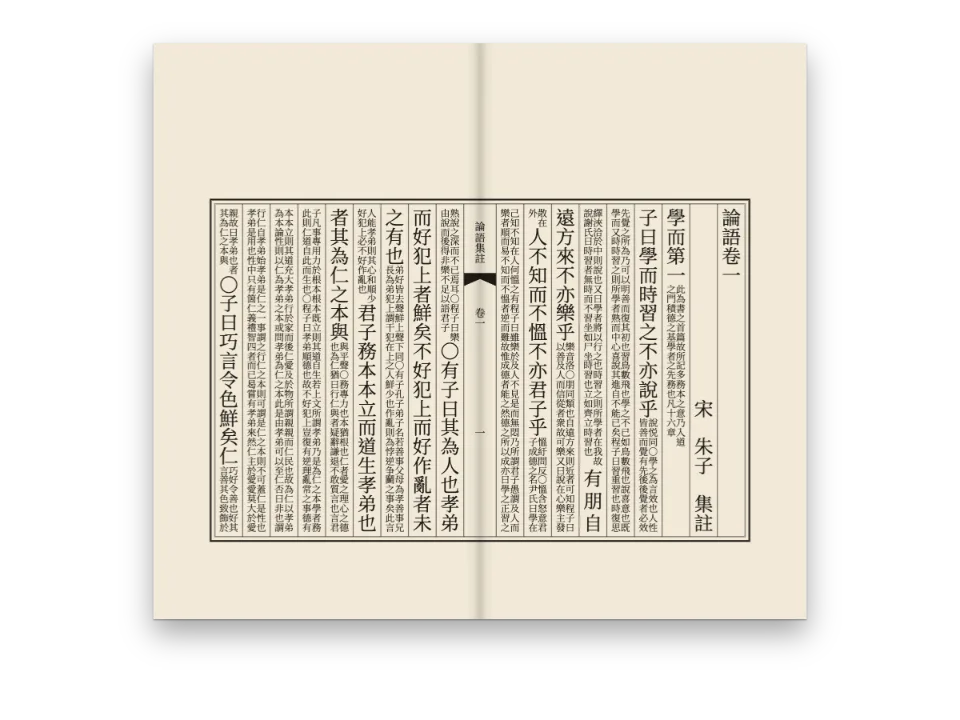
Dues pàgines encarades d’un llibre d’Història fetes com una de sola: una banda de color travessa el centre del llibre i a sota sis fitxes amb dibuix es reparteixen l’amplada, i la història més llarga s’emporta la fitxa més ampla.
Què compondràs
Les pàgines 48 i 49 d’un llibre de Geografia i Història de 2n d’ESO: La ruta del paper, mil anys d’ofici des del taller de Cai Lun fins a la mola de Keller. La pàgina parella obre amb el títol i dos paràgrafs; la senar, amb un requadre que explica com es feia un full a mà. Pel centre corre la cronologia: una banda anyil per a Àsia i una de terracota per a Europa, que comença a la pàgina parella i travessa el llom. A sota, sis fitxes amb el seu dibuix, penjades de la banda per un punt i un traç. Les fitxes es reparteixen l’amplada: la de 1844, la de la història més llarga, pren amplada de les dues veïnes (1 mm en castellà, 7 mm en japonès), i el seu punt es mou amb ella. Totes les paraules són al Markdown, en castellà, anglès i japonès; aquesta pàgina mostra l’edició castellana.
Aquesta recepta respon a
- Com maqueto una cronologia a doble pàgina, amb una banda que travessa el llom i fitxes a les dues pàgines?
- Com faig que una fila de caixes es reparteixi l’amplada i la del text més llarg s’eixampli?
La resposta curta
const pageTemplates = [{
  id: 'timeline',
  spread: true, // two facing pages laid as one sheet; it opens on a verso
  gutter: mm(10), // the band round the spine that frames keep off
  grid: { columns: 2, rows: ROWS, columnGap: mm(2 * PAGE.inner), rowGap: mm(ROW_GAP) },
  frames: [
    { name: 'title', takes: 'h1' },
    { name: 'lead', flow: true, fit: { minScale: 0.8 } },
    { name: 'box', style: 'box', grid: { col: 2, row: 1, rows: 4 }, height: 'fill',
      padding: { right: mm(66) }, fit: { minScale: 0.85 } },
    { name: 'box-picture', layer: 2, width: mm(56), placement: at('#box', 'top-right', -5, 10) },
    { name: 'band-1', style: 'band-asia', grid: { col: 1, row: 5 }, height: mm(BAND) },
    { name: 'band-2', style: 'band-europe', crossGutter: true, width: 'fill', height: mm(BAND),
      padding: { left: mm(2 * PAGE.inner + 4) }, // the colour crosses the fold, the words do not
      placement: at('#band-1', 'right-of') },
    ...cards.map(card),
    { name: 'colophon', style: 'colophon', optional: true, width: mm(170),
      placement: at('page', 'bottom-right', -PAGE.outer, -7) },
  ],
  groups: [
    { name: 'opening', kind: 'stack', grid: { col: 1, row: 1, rows: 4 }, gap: mm(4),
      frames: ['title', 'lead'] },
    // A card whose text runs past its drawn height takes width from its neighbours first;
    // only when they have none to give does the row grow taller.
    { name: 'asia', kind: 'row', gap: mm(5), frames: ['c1', 'c2', 'c3'] },
    { name: 'europe', kind: 'row', gap: mm(5), frames: ['c4', 'c5', 'c6'] },
  ],
  decoration: { elements: [ground(), ...cards.flatMap(marks)] },
}];
Ingredients
- Funcions
- Plantilles a doble pàginaMarcs que creixen en un grupDecoració ancorada als marcsPàgines compostesPestanyes numerades als requadresRequadresAncoratge d'elements de dissenyCapçaleres i folisMarges simètricsLlistes numeradesFonts xineses, japoneses i coreanesPaleta de color semànticaPàgines en un canvasExportació a PDF
- També fa servir
- Figures just aquíFonts incrustades al PDFTipus de recurs propisFigures i taules com a recursos
- Tipografia
- Literata, Archivo, Noto Serif JP, Noto Sans JP (SIL OFL 1.1)
- Recursos
forma-800.jpgv105-1000.jpgv1150-1000.jpgv1282-1000.jpgv1844-1000.jpgv610-1000.jpgv751-1000.jpg- A Han court official watches a craftsman lift a bamboo mould from a vat. (Generated With Diffusion Models, original)
- A monk shows two Japanese courtiers how to hold a papermaking mould. (Generated With Diffusion Models, original)
- Papermakers by a canal in Samarkand, sheets drying on a wall. (Generated With Diffusion Models, original)
- A paper workshop below the castle of Xàtiva. (Generated With Diffusion Models, original)
- A Fabriano mill with its water wheel; a sheet held up to the light. (Generated With Diffusion Models, original)
- A craftsman grinds a spruce log against a stone into wood pulp. (Generated With Diffusion Models, original)
- Two hands lift a papermaker's mould from a vat of pulp. (Generated With Diffusion Models, original)
Elaboració
#1 · Un full per a dues pàgines
const pageTemplates = [{
  id: 'timeline',
  spread: true, // two facing pages laid as one sheet; it opens on a verso
  gutter: mm(10), // the band round the spine that frames keep off
  grid: { columns: 2, rows: ROWS, columnGap: mm(2 * PAGE.inner), rowGap: mm(ROW_GAP) },
  frames: [
    { name: 'title', takes: 'h1' },
    { name: 'lead', flow: true, fit: { minScale: 0.8 } },
    { name: 'box', style: 'box', grid: { col: 2, row: 1, rows: 4 }, height: 'fill',
      padding: { right: mm(66) }, fit: { minScale: 0.85 } },
    { name: 'box-picture', layer: 2, width: mm(56), placement: at('#box', 'top-right', -5, 10) },
    { name: 'band-1', style: 'band-asia', grid: { col: 1, row: 5 }, height: mm(BAND) },
    { name: 'band-2', style: 'band-europe', crossGutter: true, width: 'fill', height: mm(BAND),
      padding: { left: mm(2 * PAGE.inner + 4) }, // the colour crosses the fold, the words do not
      placement: at('#band-1', 'right-of') },
    ...cards.map(card),
    { name: 'colophon', style: 'colophon', optional: true, width: mm(170),
      placement: at('page', 'bottom-right', -PAGE.outer, -7) },
  ],
  groups: [
    { name: 'opening', kind: 'stack', grid: { col: 1, row: 1, rows: 4 }, gap: mm(4),
      frames: ['title', 'lead'] },
    // A card whose text runs past its drawn height takes width from its neighbours first;
    // only when they have none to give does the row grow taller.
    { name: 'asia', kind: 'row', gap: mm(5), frames: ['c1', 'c2', 'c3'] },
    { name: 'europe', kind: 'row', gap: mm(5), frames: ['c4', 'c5', 'c6'] },
  ],
  decoration: { elements: [ground(), ...cards.flatMap(marks)] },
}];
spread: true converteix la plantilla en un sol full de l’amplada de les dues pàgines, i el bloc de la pàgina diu el mateix amb spread. Una doble pàgina comença en pàgina parella, així que la composició rep continuation: { pageIndexOffset: 1, pageNumbering: { startAt: 48 } }: la pàgina 1 d’aquest fragment és la 48 del llibre, una pàgina parella, i no cal cap pàgina en blanc al davant. La retícula té una columna per pàgina, separades pel doble del marge interior, de manera que només la banda s’acosta al plec. La segona banda porta crossGutter i 36 mm de farciment a l’esquerra: el seu color surt del final de la primera i travessa el llom, i les seves paraules comencen a la pàgina senar, que és on es llegeixen.
#2 · Fitxes que es reparteixen l’amplada
const cards = ['c1', 'c2', 'c3', 'c4', 'c5', 'c6'];
const card = (name, i) => ({ name, style: i < 3 ? 'card-asia' : 'card-europe',
  width: mm((HALF - 10) / 3), minWidth: mm(40), minHeight: mm(CARD),
  shrink: 1, // a card gives width to a neighbour whose text runs past the row
  ...(i % 3 === 0 && { placement: at('container', 'top-left', i ? HALF + 2 * PAGE.inner : 0,
    CARD_TOP) }) }); // where each row starts
Cada fila de tres fitxes és un grup row, i cada fitxa té un minHeight, l’alçada a què està dibuixada, i per sobre una alçada auto. Quan el text d’una fitxa no cap a l’alçada de la fila, pren de les veïnes amb shrink els mil·límetres sencers justos que necessita, i cada veïna conserva l’amplada en què el seu propi text encara hi cap. Només quan ja no li’n poden donar més creix la fila cap avall. A l’edició castellana la fitxa de 1844 pren 1 mm de la de 1282; a la japonesa en pren 7, 3 de la de 1150 i 4 de la de 1282; amb tots els textos un 30 % més llargs, la prova del banc, la castellana en pren 15, i el requadre i l’entradeta baixen el text al 92,5 % i al 85 %.
#3 · Punts que segueixen les fitxes
function marks(name, i) {
  const ink = col(i < 3 ? 'asia' : 'europe');
  return [
    { kind: 'rule', id: `${name}-tick`, direction: 'vertical', thickness: pt(1), color: ink,
      placement: { ...at(`#${name}`, 'top', 0, -DROP), size: { height: mm(DROP) } } },
    { kind: 'box', id: `${name}-dot`,
      placement: { ...at(`#${name}`, 'top', 0, -DROP + 0.6), size: { width: mm(4.4),
        height: mm(4.4) } },
      style: { backgroundColor: col('paper'), borderColor: ink, borderWidth: pt(1.6),
        borderRadius: mm(2.2) } },
  ];
}
Els punts i els traços són la decoració (decoration) de la plantilla, ancorats a #c1 … #c6 pel seu cantó superior (top) i pujats la distància que els separa de la banda. La decoració es col·loca després dels marcs, així que quan una fitxa es mou o s’eixampla, el seu punt continua sobre el seu centre. El fons crema també és decoració: una caixa ancorada al peu del sagnat, l’alçada de la qual arriba fins al peu de #band-1 (size: { height: { to: '#band-1', edge: 'bottom' } }), de manera que segueix la banda.
#4 · Dibuixos a la mida d’impressió
const ART = {
  v105: t({ es: 'Un funcionario de la corte Han mira cómo un artesano saca de la tina un molde '
      + 'de bambú lleno de pasta, junto a corteza, trapos y redes viejas.',
    en: 'A Han court official watches a craftsman lift a bamboo mould full of pulp from a vat, '
      + 'beside bark, rags and old nets.',
    ja: '漢の役人が見守るなか、職人が竹のすき枠を漉き舟から引き上げる。そばに樹皮、ぼろ布、古い網。' }),
  v610: t({ es: 'Un monje enseña a dos cortesanos japoneses a sostener el molde sobre una tina, '
      + 'con ramas de kozo en una estera.',
    en: 'A monk shows two Japanese courtiers how to hold the mould over a tub, with kozo '
      + 'branches on a mat.',
    ja: '僧が二人の宮廷人に、桶の上ですき枠を持つ手つきを見せる。むしろの上に楮の枝。' }),
  v751: t({ es: 'Papeleros de Samarcanda junto a un canal; las hojas se secan al sol contra un '
      + 'muro de adobe.',
    en: 'Samarkand papermakers by a canal; the sheets dry in the sun against a mud-brick wall.',
    ja: '水路のそばで働くサマルカンドの紙すき職人。日干しれんがの壁に紙が張られて乾いている。' }),
  v1150: t({ es: 'Un taller de Xàtiva bajo el castillo: un operario golpea trapos en una pila '
      + 'de piedra y las hojas cuelgan de cuerdas.',
    en: 'A workshop in Xàtiva below the castle: a worker pounds rags in a stone trough and the '
      + 'sheets hang on ropes.',
    ja: '城の下のシャティバの工房。職人が石の槽でぼろ布をたたき、紙が綱につるされている。' }),
  v1282: t({ es: 'Un molino de Fabriano con su rueda hidráulica y sus mazos; un papelero mira '
      + 'una filigrana al trasluz.',
    en: 'A Fabriano mill with its water wheel and hammers; a papermaker holds a watermark up '
      + 'to the light.',
    ja: '水車と木づちのあるファブリアーノの製紙場。職人が紙を光にかざして透かしを見ている。' }),
  v1844: t({ es: 'Un artesano aprieta un tronco de abeto contra una muela que gira; debajo se '
      + 'amontonan las fibras.',
    en: 'A craftsman presses a spruce log against a turning grindstone; the fibres pile up '
      + 'below.',
    ja: '職人がトウヒの丸太を回る砥石に押し当て、その下に木の繊維が積もっていく。' }),
  forma: t({ es: 'Dos manos sacan de la tina el molde con una capa fina de fibras.',
    en: 'Two hands lift the mould from the vat with a thin layer of fibres on it.',
    ja: '両手ですき枠を引き上げる。網の上に繊維の薄い層ができている。' }),
};
const SIZE = { forma: [800, 800, 363] }; // pixels and ppi: 56 mm wide; the cards' are 46 mm
const resources = await Promise.all(Object.entries(ART).map(async ([id, altText]) => {
  const px = SIZE[id] ?? [1000, 667, 550];
  const fileId = `${id}-${px[0]}.jpg`;
  await loadImage(fileId, asset(fileId));
  return { id, typeId: 'picture', kind: 'bitmap', caption: '', altText, createdAt: 0,
    updatedAt: 0,
    bitmap: { fileId, format: 'jpeg', width: px[0], height: px[1], resolution: px[2] } };
}));
Les vinyetes fan 1.000 px a 550 ppp, 46 mm a la pàgina, i una imatge no s’amplia mai: la fitxa que s’eixampla conserva el dibuix i deixa l’espai al text. Una fitxa de menys de 53 mm (el dibuix més 3,5 mm de marge a cada costat) redueix el dibuix, com mostra la prova del banc a l’edició japonesa: els dibuixos de 1150 i 1282 al 85 %.
La recepta completa
// ═══ Postext Cookbook · Nº 158 · An illustrated timeline across a double page ═══════ // https://postext.dev/en/cookbook/illustrated-timeline-spread // Code: MIT · Text: original (CC BY 4.0) · Pictures: generated with diffusion models // Fonts: Literata, Archivo, Noto Serif JP, Noto Sans JP (SIL OFL 1.1) · Needs postext ≥ 1.38.0 import { buildDocument, withLoadedFonts, renderPageToCanvas, registerResourceImage, } from 'https://esm.sh/postext'; import { renderToPdf, decompressWoff2 } from 'https://esm.sh/postext-pdf'; const LANG = 'es'; // @lang: the language of the sample document ('es' | 'en' | 'ja') const RECIPE = 'illustrated-timeline-spread'; // ─── 1 · Design ───────────────────────────────────────────────────────────── // #region palette: one ink, an accent for each half of the timeline, a pale ground const palette = { ink: '#22201d', // text asia: '#2f4f7a', // indigo: the Asian half of the timeline europe: '#a2412a', // terracotta: the European half ground: '#f1ebdf', // the cream under the cards rule: '#c9bfae', // hairlines and the card borders muted: '#6b6359', // running heads and the colophon paper: '#ffffff', }; const col = (id) => ({ hex: palette[id], model: 'hex', paletteId: id }); const colorPalette = [ ...Object.entries(palette).map(([id, hex]) => ({ id, name: id, value: { hex, model: 'hex' } })), { id: 'main-color', name: 'europe (defaults)', value: { hex: palette.europe, model: 'hex' } }, ]; // #endregion const JA = LANG === 'ja'; const SERIF = JA ? 'Noto Serif JP' : 'Literata'; const SANS = JA ? 'Noto Sans JP' : 'Archivo'; // A Western textbook page is 210 × 280 mm; a Japanese one is AB判, 210 × 257 mm. const PAGE = { w: 210, h: JA ? 257 : 280, top: 22, bottom: 20, inner: 16, outer: 15 }; const ROWS = 12; const ROW_GAP = 3; const ROW = (PAGE.h - PAGE.top - PAGE.bottom - (ROWS - 1) * ROW_GAP) / ROWS; // one grid row, mm const HALF = PAGE.w - PAGE.inner - PAGE.outer; // the width of one page's half of the sheet const BAND = 9; // the timeline band, in grid row 5 const DROP = ROW - BAND + ROW_GAP; // from the band's foot to the cards' heads const CARD_TOP = 5 * (ROW + ROW_GAP); // grid row 6 // The drawn height of a card; 16 mm of the area stay free for a longer text. const CARD = PAGE.h - PAGE.top - PAGE.bottom - CARD_TOP - 16; const at = (to, edge, x = 0, y = 0) => ({ anchor: { to, edge }, offset: { x: mm(x), y: mm(y) } }); // #region cards: six cards at least one height tall that trade width with their neighbours const cards = ['c1', 'c2', 'c3', 'c4', 'c5', 'c6']; const card = (name, i) => ({ name, style: i < 3 ? 'card-asia' : 'card-europe', width: mm((HALF - 10) / 3), minWidth: mm(40), minHeight: mm(CARD), shrink: 1, // a card gives width to a neighbour whose text runs past the row ...(i % 3 === 0 && { placement: at('container', 'top-left', i ? HALF + 2 * PAGE.inner : 0, CARD_TOP) }) }); // where each row starts // #endregion // #region answer: one sheet for two pages, a band across the spine, two rows of cards const pageTemplates = [{ id: 'timeline', spread: true, // two facing pages laid as one sheet; it opens on a verso gutter: mm(10), // the band round the spine that frames keep off grid: { columns: 2, rows: ROWS, columnGap: mm(2 * PAGE.inner), rowGap: mm(ROW_GAP) }, frames: [ { name: 'title', takes: 'h1' }, { name: 'lead', flow: true, fit: { minScale: 0.8 } }, { name: 'box', style: 'box', grid: { col: 2, row: 1, rows: 4 }, height: 'fill', padding: { right: mm(66) }, fit: { minScale: 0.85 } }, { name: 'box-picture', layer: 2, width: mm(56), placement: at('#box', 'top-right', -5, 10) }, { name: 'band-1', style: 'band-asia', grid: { col: 1, row: 5 }, height: mm(BAND) }, { name: 'band-2', style: 'band-europe', crossGutter: true, width: 'fill', height: mm(BAND), padding: { left: mm(2 * PAGE.inner + 4) }, // the colour crosses the fold, the words do not placement: at('#band-1', 'right-of') }, ...cards.map(card), { name: 'colophon', style: 'colophon', optional: true, width: mm(170), placement: at('page', 'bottom-right', -PAGE.outer, -7) }, ], groups: [ { name: 'opening', kind: 'stack', grid: { col: 1, row: 1, rows: 4 }, gap: mm(4), frames: ['title', 'lead'] }, // A card whose text runs past its drawn height takes width from its neighbours first; // only when they have none to give does the row grow taller. { name: 'asia', kind: 'row', gap: mm(5), frames: ['c1', 'c2', 'c3'] }, { name: 'europe', kind: 'row', gap: mm(5), frames: ['c4', 'c5', 'c6'] }, ], decoration: { elements: [ground(), ...cards.flatMap(marks)] }, }]; // #endregion // #region marks: a dot under the band and a tick down to each card, anchored to the card function marks(name, i) { const ink = col(i < 3 ? 'asia' : 'europe'); return [ { kind: 'rule', id: `${name}-tick`, direction: 'vertical', thickness: pt(1), color: ink, placement: { ...at(`#${name}`, 'top', 0, -DROP), size: { height: mm(DROP) } } }, { kind: 'box', id: `${name}-dot`, placement: { ...at(`#${name}`, 'top', 0, -DROP + 0.6), size: { width: mm(4.4), height: mm(4.4) } }, style: { backgroundColor: col('paper'), borderColor: ink, borderWidth: pt(1.6), borderRadius: mm(2.2) } }, ]; } // #endregion // The cream ground under the cards: from the foot of the band down to the bleed. function ground() { return { kind: 'box', id: 'ground', decorative: true, placement: { ...at('bleed', 'bottom-left'), size: { width: 'fill', height: { to: '#band-1', edge: 'bottom' } } }, style: { backgroundColor: col('ground') } }; } const tab = (ink) => ({ position: 'top-left', background: col(ink), color: col('paper'), fontFamily: SANS, fontSize: pt(10), fontWeight: 700, height: mm(6), paddingX: mm(2.6), offset: mm(3.5), inset: mm(0), rule: { enabled: false } }); const cardStyle = (id, ink) => ({ id, backgroundEnabled: true, background: col('paper'), border: { enabled: true, color: col('rule'), width: pt(0.5) }, borderRadius: mm(1.5), stripe: { enabled: true, side: 'top', width: pt(2.5), color: col(ink) }, padding: { top: mm(8), right: mm(3.5), bottom: mm(3.5), left: mm(3.5) }, label: tab(ink), body: { fontFamily: SERIF, fontSize: pt(JA ? 8.6 : 9.4), lineHeight: pt(JA ? 15 : 12.8), color: col('ink'), boldColor: col(ink), italicColor: col('ink'), textAlign: JA ? 'justify' : 'left', hyphenation: !JA, firstLineIndent: pt(0), boldFontWeight: 700 } }); const bandStyle = (id, ink) => ({ id, backgroundEnabled: true, background: col(ink), border: { enabled: false }, padding: { top: mm(1.6), right: mm(4), bottom: mm(1), left: mm(4) }, body: { fontFamily: SANS, fontSize: pt(9.5), lineHeight: pt(12), fontWeight: 700, color: col('paper'), firstLineIndent: pt(0) } }); const head = (id, content, parity, edge, x) => ({ kind: 'text', id, content, parity, fontFamily: SANS, fontSize: pt(8), fontWeight: 600, letterSpacing: pt(JA ? 0 : 0.8), color: col('muted'), placement: at('page', edge, x, 11) }); const folio = (id, parity, edge, x) => ({ kind: 'text', id, content: '{pageNumber}', parity, fontFamily: SANS, fontSize: pt(9), fontWeight: 700, color: col('ink'), placement: at('page', edge, x, -10) }); const config = { locale: t({ es: 'es', en: 'en-gb', ja: 'ja' }), resourceTypes: [{ id: 'picture', name: t({ es: 'Ilustración', en: 'Illustration', ja: 'イラスト' }), shortLabel: '', numberingTemplate: '', resetOn: 'never', counterFormat: 'decimal', captionPrefix: '', defaultPlacement: { position: 'here' } }], colorPalette, page: { sizePreset: 'custom', width: mm(PAGE.w), height: mm(PAGE.h), dpi: 150, margins: { top: mm(PAGE.top), bottom: mm(PAGE.bottom), left: mm(PAGE.inner), right: mm(PAGE.outer), mirror: true }, }, layout: { layoutType: 'single' }, bodyText: { fontFamily: SERIF, fontSize: pt(JA ? 10.5 : 12.4), lineHeight: pt(JA ? 18.5 : 17), paragraphSpacing: !JA, color: col('ink'), boldColor: col('ink'), italicColor: col('ink'), referenceColor: col('ink'), textAlign: JA ? 'justify' : 'left', firstLineIndent: JA ? em(1) : pt(0), // Japanese paragraphs open with a one-character indent hyphenation: { enabled: !JA }, }, headings: { fontFamily: SANS, color: col('ink'), fontWeight: 800, levels: [{ level: 1, fontSize: pt(JA ? 44 : 58), lineHeight: pt(JA ? 54 : 60), color: col('asia'), marginTop: pt(0), marginBottom: pt(0), breakBefore: { enabled: false } }], }, orderedLists: { numberFormat: 'arabic', color: col('europe'), fontWeight: 700 }, calloutStyles: [ { id: 'box', backgroundEnabled: true, background: col('paper'), border: { enabled: true, color: col('rule'), width: pt(0.5) }, borderRadius: mm(1.5), padding: { top: mm(9), right: mm(5), bottom: mm(4), left: mm(5) }, label: tab('europe'), body: { fontFamily: SERIF, fontSize: pt(JA ? 9.5 : 10.4), lineHeight: pt(JA ? 16.5 : 14.2), color: col('ink'), boldColor: col('ink'), italicColor: col('ink'), textAlign: 'left', firstLineIndent: pt(0), paragraphSpacing: true }, lists: { color: col('europe'), gap: mm(1.5), itemSpacing: mm(1.2) } }, cardStyle('card-asia', 'asia'), cardStyle('card-europe', 'europe'), bandStyle('band-asia', 'asia'), bandStyle('band-europe', 'europe'), { id: 'colophon', backgroundEnabled: false, border: { enabled: false }, padding: { top: mm(0), right: mm(0), bottom: mm(0), left: mm(0) }, body: { fontFamily: SANS, fontSize: pt(6.5), lineHeight: pt(8), color: col('muted'), firstLineIndent: pt(0) } }, ], header: { elements: [ head('subject', '{attr.subject}', 'even', 'top-left', PAGE.outer), head('unit', '{attr.unit}', 'odd', 'top-right', -PAGE.outer), ] }, footer: { elements: [ folio('verso-folio', 'even', 'bottom-left', PAGE.outer), folio('recto-folio', 'odd', 'bottom-right', -PAGE.outer), ] }, pageTemplates, }; // The spread opens on a verso: page 1 of this excerpt is book page 48. const continuation = { pageIndexOffset: 1, pageNumbering: { startAt: 48 } }; // ─── 2 · Content ──────────────────────────────────────────────────────────── const markdown = String.raw`::::page{template="timeline" spread subject="Geografía e Historia · 2.º ESO" unit="Unidad 5 · Los caminos del comercio"}Mostra en Markdown · 65 línies · content.es.md
# La ruta del papel Hacer papel fue durante siglos un secreto de los talleres chinos. Desde allí, el oficio tardó más de mil años en llegar a los molinos de Europa. Cada pueblo que lo aprendió cambió la receta según lo que tenía a mano: corteza de morera en China, kozo en Japón, lino y trapos en Samarcanda y en al-Ándalus y, en el siglo XIX, madera. :::frame{slot="box" label="Así se hacía una hoja"} 1. Se trituran las fibras y se dejan en remojo hasta que forman una pasta. 2. Se mete en la tina el molde, una rejilla fina en un marco de madera, y se saca cargado de pasta. 3. Se sacude el molde: el agua escurre y las fibras se traban en una capa uniforme. 4. La hoja se prensa entre fieltros y se cuelga para que se seque. Los hilos del molde dejan su huella en la hoja: son las líneas finas que se ven al mirar el papel a contraluz. ::: ::resource{id="forma" slot="box-picture"} :::frame{slot="band-1"} En Asia, del siglo II al VIII ::: :::frame{slot="band-2"} En el Mediterráneo y en Europa, del siglo XII al XIX ::: :::frame{slot="c1" label="105"} ::resource{id="v105"} **China.** Cai Lun, funcionario de la corte de los Han, presenta al emperador un papel hecho con corteza de morera, restos de cáñamo, trapos y redes de pesca viejas. Cuesta menos que la seda y pesa mucho menos que las tablillas de bambú. Los arqueólogos han encontrado papeles chinos dos siglos más antiguos, pero el de Cai Lun es el que se copia en todo el imperio. ::: :::frame{slot="c2" label="610"} ::resource{id="v610"} **Japón.** Según la crónica *Nihon shoki*, el monje Damjing, llegado del reino coreano de Goguryeo, enseña en la corte a fabricar papel y tinta. Con la corteza del kozo, los japoneses consiguen el *washi*, fino y muy resistente. En el Shōsōin de Nara se guardan todavía padrones de familias escritos en papel del año 702. ::: :::frame{slot="c3" label="751"} ::resource{id="v751"} **Samarcanda.** Una tradición cuenta que, tras la batalla de Talas, unos prisioneros chinos enseñaron el oficio en esta ciudad de la Ruta de la Seda. Los papeleros de Samarcanda usan lino y trapos de algodón. Hacia el año 800, Bagdad ya tiene talleres, y el papel sustituye al pergamino en los archivos del califa. ::: :::frame{slot="c4" label="1150"} ::resource{id="v1150"} **Xàtiva.** El geógrafo al-Idrisi escribe que en esta ciudad de al-Ándalus se hace un papel que no tiene igual en todo el mundo y que se vende a Oriente y a Occidente. Cuando Jaime I conquista la ciudad en 1244, los talleres siguen trabajando. ::: :::frame{slot="c5" label="1282"} ::resource{id="v1282"} **Fabriano.** Los molinos de esta ciudad italiana usan la fuerza del río para mover mazos que deshacen los trapos. Encolan las hojas con gelatina, que impide que la tinta se corra, y marcan los pliegos con una filigrana, un dibujo que solo se ve al trasluz. En el siglo XIV, el papel italiano se vende en media Europa. ::: :::frame{slot="c6" label="1844"} ::resource{id="v1844"} **Sajonia.** Después de la imprenta llegan los periódicos, y los trapos ya no bastan para tanto papel. En 1798, Louis-Nicolas Robert había construido en Francia una máquina que fabricaba una hoja continua, sin molde. En 1844, el tejedor Friedrich Gottlob Keller aprieta troncos de abeto contra una muela de piedra y obtiene pasta de madera. A partir de entonces el papel se vuelve barato y abundante, y un diario cuesta lo que una barra de pan. ::: :::frame{slot="colophon"} Compuesto en Literata y Archivo (SIL OFL) · Texto original (CC BY 4.0) · Ilustraciones generadas con modelos de difusión ::: ::::`; // content.<lang>.md, inlined by the Cookbook // #region art: seven pictures at the size they print, with what each shows const ART = { v105: t({ es: 'Un funcionario de la corte Han mira cómo un artesano saca de la tina un molde ' + 'de bambú lleno de pasta, junto a corteza, trapos y redes viejas.', en: 'A Han court official watches a craftsman lift a bamboo mould full of pulp from a vat, ' + 'beside bark, rags and old nets.', ja: '漢の役人が見守るなか、職人が竹のすき枠を漉き舟から引き上げる。そばに樹皮、ぼろ布、古い網。' }), v610: t({ es: 'Un monje enseña a dos cortesanos japoneses a sostener el molde sobre una tina, ' + 'con ramas de kozo en una estera.', en: 'A monk shows two Japanese courtiers how to hold the mould over a tub, with kozo ' + 'branches on a mat.', ja: '僧が二人の宮廷人に、桶の上ですき枠を持つ手つきを見せる。むしろの上に楮の枝。' }), v751: t({ es: 'Papeleros de Samarcanda junto a un canal; las hojas se secan al sol contra un ' + 'muro de adobe.', en: 'Samarkand papermakers by a canal; the sheets dry in the sun against a mud-brick wall.', ja: '水路のそばで働くサマルカンドの紙すき職人。日干しれんがの壁に紙が張られて乾いている。' }), v1150: t({ es: 'Un taller de Xàtiva bajo el castillo: un operario golpea trapos en una pila ' + 'de piedra y las hojas cuelgan de cuerdas.', en: 'A workshop in Xàtiva below the castle: a worker pounds rags in a stone trough and the ' + 'sheets hang on ropes.', ja: '城の下のシャティバの工房。職人が石の槽でぼろ布をたたき、紙が綱につるされている。' }), v1282: t({ es: 'Un molino de Fabriano con su rueda hidráulica y sus mazos; un papelero mira ' + 'una filigrana al trasluz.', en: 'A Fabriano mill with its water wheel and hammers; a papermaker holds a watermark up ' + 'to the light.', ja: '水車と木づちのあるファブリアーノの製紙場。職人が紙を光にかざして透かしを見ている。' }), v1844: t({ es: 'Un artesano aprieta un tronco de abeto contra una muela que gira; debajo se ' + 'amontonan las fibras.', en: 'A craftsman presses a spruce log against a turning grindstone; the fibres pile up ' + 'below.', ja: '職人がトウヒの丸太を回る砥石に押し当て、その下に木の繊維が積もっていく。' }), forma: t({ es: 'Dos manos sacan de la tina el molde con una capa fina de fibras.', en: 'Two hands lift the mould from the vat with a thin layer of fibres on it.', ja: '両手ですき枠を引き上げる。網の上に繊維の薄い層ができている。' }), }; const SIZE = { forma: [800, 800, 363] }; // pixels and ppi: 56 mm wide; the cards' are 46 mm const resources = await Promise.all(Object.entries(ART).map(async ([id, altText]) => { const px = SIZE[id] ?? [1000, 667, 550]; const fileId = `${id}-${px[0]}.jpg`; await loadImage(fileId, asset(fileId)); return { id, typeId: 'picture', kind: 'bitmap', caption: '', altText, createdAt: 0, updatedAt: 0, bitmap: { fileId, format: 'jpeg', width: px[0], height: px[1], resolution: px[2] } }; })); // #endregion // ─── 3 · Fonts ────────────────────────────────────────────────────────────── const FONTS = { Literata: ['400', '400i', '700'], Archivo: ['400', '600', '700', '800'], // es, en 'Noto Serif JP': ['400', '700'], 'Noto Sans JP': ['400', '600', '700', '800'], // ja }; // ─── 4 · Build & show ─────────────────────────────────────────────────────── await loadFonts(FONTS, markdown); // the latin files of every face await loadCjkFonts({ [SERIF]: FONTS[SERIF], [SANS]: FONTS[SANS] }, markdown); // ja only const doc = await withLoadedFonts( () => buildDocument({ markdown, resources, continuation }, config), { ...kitFonts(FONTS), text: markdown }); showPages(doc, { title: t({ es: 'Una cronología ilustrada a doble página', en: 'An illustrated timeline across a double page', ja: '見開きの絵入り年表' }) }); offerPdf(() => renderToPdf(doc, { fontProvider: cjkPdfProvider, resourceBytes: imageBytes }), `${RECIPE}.pdf`);Kit · core, fonts, viewer, pdf, images, cjk: igual a totes les receptes · 504 línies
// ─── Kit ── helpers shared by every Cookbook recipe · postext.dev/cookbook ───── // ─── Kit · core v1 ── the same in every recipe · postext.dev/cookbook function mm(value) { return { value, unit: 'mm' }; } function pt(value) { return { value, unit: 'pt' }; } function em(value) { return { value, unit: 'em' }; } /** The sample language's string: t({ en: 'Figure', es: 'Figura' }). */ function t(strings) { return strings[LANG] ?? Object.values(strings)[0]; } /** A file in this recipe's assets folder, served from the Postext repo by jsDelivr. */ function asset(file) { return `https://cdn.jsdelivr.net/gh/drnachio/postext@main/cookbook/${RECIPE}/assets/${file}`; } // ─── Kit · fonts v3 ── the same in every recipe · postext.dev/cookbook // Postext loads the faces a config asks for before layout (prepareFonts, // buildDocumentWithFonts) and asks the kit for the files: Fontsource's, the // files the PDF embeds too. /** The options of buildDocumentWithFonts / prepareFonts / withLoadedFonts: * the Fontsource resolver, and the faces of FONTS loaded with the ones the * config names. FONTS = { 'Family Name': ['400', '400i', '700'] }. */ function kitFonts(FONTS = {}) { const faces = Object.entries(FONTS).flatMap(([family, specs]) => specs.map((spec) => ({ family, weight: parseInt(spec, 10), style: spec.endsWith('i') ? 'italic' : 'normal' }))); return { resolve: fontsourceResolver, faces }; } /** A face's Fontsource files, in a fixed order: latin, then latin-ext and greek * when `text` needs them and the family ships them (kitSubsetsFor), each with * its unicode-range. Null for a weight or slant Fontsource does not ship. */ async function fontsourceResolver(family, weight, style, { text = '' } = {}) { const id = fontsourceId(family); const meta = await fontsourceMeta(family); if (meta && !(meta.weights.includes(weight) && meta.styles.includes(style))) return null; kitStatus('Loading fonts…'); const at = await fontsourceAt(id); return ['latin', ...kitSubsetsFor(text, meta)].map((subset) => ({ source: `${at}files/${id}-${subset}-${weight}-${style}.woff2`, unicodeRange: kitRanges()[subset], })); } /** The unicode-range of each Fontsource file the kit loads (a function: the * kit is inlined after the pen's code, which runs before a const would be set). */ function kitRanges() { return { latin: 'U+0000-00FF,U+0131,U+0152-0153,U+02BB-02BC,U+02C6,U+02DA,U+02DC,U+0304,U+0308,U+0329,' + 'U+2000-206F,U+20AC,U+2122,U+2191,U+2193,U+2212,U+2215,U+FEFF,U+FFFD', 'latin-ext': 'U+0100-02BA,U+02BD-02C5,U+02C7-02CC,U+02CE-02D7,U+02DD-02FF,U+0304,U+0308,U+0329,' + 'U+1D00-1DBF,U+1E00-1E9F,U+1EF2-1EFF,U+2020,U+20A0-20AB,U+20AD-20C0,U+2113,U+2C60-2C7F,U+A720-A7FF', greek: 'U+0370-03FF', }; } /** For the cjk, arabic and comics blocks, which add their own files: the * faces of `faces` = { 'Family Name': ['400', '400i', '700'] }. `text` is the sample: * č ł † α χ also load latin-ext and greek files (kitSubsetsFor). With * `optional`, a face Fontsource does not ship is skipped instead of failing. * The files are added once all have loaded, in the order asked (latin, then * latin-ext, then greek), whatever order they arrive in: the last one added * wins a character two files hold. Resolves to the number of faces added. */ async function loadFonts(faces, text = '', { optional = false } = {}) { kitStatus('Loading fonts…'); const ranges = kitRanges(); const jobs = []; for (const [family, specs] of Object.entries(faces)) { const id = fontsourceId(family); const todo = [...new Set(specs)].map((spec) => [parseInt(spec, 10), spec.endsWith('i') ? 'italic' : 'normal']) .filter(([weight, style]) => !hasFace(family, weight, style)); // before any await const at = fontsourceAt(id); const meta = optional || /[^\0-ÿ]/u.test(text) ? await fontsourceMeta(family) : null; const subsets = ['latin', ...kitSubsetsFor(text, meta)]; for (const [weight, style] of todo) { if (optional && !(meta?.weights.includes(weight) && meta.styles.includes(style))) continue; for (const subset of subsets) { const url = `${await at}files/${id}-${subset}-${weight}-${style}.woff2`; const face = new FontFace(family, `url(${url}) format('woff2')`, { weight: String(weight), style, unicodeRange: ranges[subset] }); jobs.push(face.load().catch(() => { if (subset === 'latin' && !optional) throw new Error(`Fontsource has no ${family} ${weight} ${style}`); })); } } } const ready = await Promise.all(jobs).catch((error) => { kitFail(error); throw error; }); return ready.filter((face) => face && document.fonts.add(face)).length; } /** A loaded FontFace covers this family, weight and style (fonts.check() would * also say yes for families nobody declared). */ function hasFace(family, weight, style) { for (const face of document.fonts) { if (face.status !== 'loaded' || face.style !== style) continue; if (face.family.replace(/^["']|["']$/g, '') !== family) continue; const [low, high = low] = face.weight.split(' ').map(Number); if (weight >= low && weight <= high) return true; } return false; } /** The files beyond latin `text` needs that `meta`'s family ships. */ function kitSubsetsFor(text, meta) { return [[/[Ā-˿ᴀ-ᶿḀ-ỿ†ℓⱠ-Ɀ꜠-ꟿ]/u, 'latin-ext'], [/[Ͱ-Ͽ]/u, 'greek']] .filter(([re, x]) => re.test(text) && meta?.subsets?.includes(x)).map(([, x]) => x); } /** Fontsource's id for a family: 'Source Serif 4' → 'source-serif-4'. */ function fontsourceId(family) { return family.toLowerCase().replace(/\s+/g, '-'); } /** A package's folder at the one version @5 names now (#766). */ function fontsourceAt(id, u = `https://cdn.jsdelivr.net/npm/@fontsource/${id}@`) { return (fontsourceAt.c ??= {})[id] ??= fetch(u + '5/package.json').then((r) => r.json()) .then((p) => p.version || 5, () => 5).then((v) => `${u}${v}/`); } /** The family's Fontsource metadata (weights, styles, subsets), or null. */ function fontsourceMeta(family) { fontsourceMeta.cache ??= new Map(); const id = fontsourceId(family); if (!fontsourceMeta.cache.has(id)) { fontsourceMeta.cache.set(id, fetch(`https://api.fontsource.org/v1/fonts/${id}`) .then((res) => (res.ok ? res.json() : null), () => null)); } return fontsourceMeta.cache.get(id); } // ─── Kit · viewer v2 ── the same in every recipe · postext.dev/cookbook /** The pages as spreads on a dark desk, page 1 alone, then verso | recto, * each painted when it scrolls near. Other options go to renderPageToCanvas. */ function showPages(docs, { title, width = 460, ...render } = {}) { const root = viewer(title); const pages = [docs].flat().flatMap((doc) => doc.pages.map((page) => ({ doc, page, n: (doc.pageIndexOffset ?? 0) + page.index }))); const spreads = []; let verso = null; for (const p of pages) { if (p.n % 2 === 1) { if (verso) spreads.push([verso, null]); verso = p; } else { spreads.push([verso, p]); verso = null; } } if (verso) spreads.push([verso, null]); const density = Math.min(window.devicePixelRatio || 1, 2); showPages.painter?.disconnect(); const painter = new IntersectionObserver((entries) => { for (const { isIntersecting, target } of entries) { if (!isIntersecting) continue; painter.unobserve(target); const { doc, page } = target.postext; renderPageToCanvas(page, doc, target, { ...render, scale: (width * density) / page.width }); } }, { rootMargin: '800px' }); showPages.painter = painter; root.replaceChildren(...spreads.map((pair) => { const spread = document.createElement('div'); spread.className = 'pt-spread'; for (const p of pair) { const figure = document.createElement('figure'); if (p) { const label = p.page.pageLabel || String(p.n + 1); const canvas = document.createElement('canvas'); canvas.postext = p; canvas.style.aspectRatio = `${p.page.width} / ${p.page.height}`; canvas.setAttribute('role', 'img'); canvas.setAttribute('aria-label', `Page ${label}`); const folio = document.createElement('figcaption'); folio.textContent = label; figure.append(canvas, folio); painter.observe(canvas); } else figure.className = 'pt-blank'; spread.append(figure); } return spread; })); kitStatus(`${pages.length} ${pages.length === 1 ? 'page' : 'pages'}`); document.documentElement.dataset.postext = 'ready'; return pages.length; } /** The desk, the bar and the error reporting, created once. */ function viewer(title) { if (!document.getElementById('pt-kit')) { document.head.insertAdjacentHTML('beforeend', `<style id="pt-kit"> :root { color-scheme: dark; } body { margin: 0; background: #0e1014; color: #b9bcc4; font: 13px/1.45 system-ui, sans-serif; } #pt-bar { position: sticky; top: 0; z-index: 1; display: flex; flex-wrap: wrap; align-items: center; gap: 6px 16px; padding: 10px 16px; background: rgb(14 16 20 / .92); backdrop-filter: blur(6px); border-bottom: 1px solid #23262d; } #pt-bar strong { color: #f4f1ea; font-weight: 600; } #pt-actions { display: flex; gap: 12px; margin-left: auto; } #pt-actions a, #pt-actions button { color: #d8a21a; font: inherit; background: none; border: 0; padding: 0; cursor: pointer; } #pages { display: grid; justify-items: center; gap: 48px; padding: 32px 16px 72px; } .pt-spread { display: flex; } .pt-spread figure { margin: 0; width: min(460px, 44vw); } .pt-spread canvas { display: block; width: 100%; background: #fff; box-shadow: 0 1px 2px rgb(0 0 0 / .5), 0 22px 44px -16px rgb(0 0 0 / .8); } .pt-spread figure:first-child canvas { box-shadow: inset -14px 0 14px -14px rgb(0 0 0 / .18), 0 1px 2px rgb(0 0 0 / .5), 0 22px 44px -16px rgb(0 0 0 / .8); } .pt-spread figcaption { margin-top: 10px; text-align: center; font: 600 10px/1 system-ui, sans-serif; letter-spacing: .18em; text-transform: uppercase; color: #6c7079; } .pt-blank { visibility: hidden; } @media (max-width: 760px) { .pt-spread { flex-direction: column; gap: 32px; } .pt-spread figure { width: min(460px, 92vw); } .pt-blank { display: none; } } </style>`); document.body.insertAdjacentHTML('afterbegin', '<header id="pt-bar"><strong id="pt-title"></strong><span id="pt-status" role="status"></span><span id="pt-actions"></span></header>'); document.getElementById('pt-title').textContent = document.title || 'Postext'; addEventListener('error', (event) => kitFail(event.error ?? event.message)); addEventListener('unhandledrejection', (event) => kitFail(event.reason)); } if (title) document.getElementById('pt-title').textContent = title; return document.getElementById('pages') ?? document.body.appendChild(Object.assign(document.createElement('main'), { id: 'pages' })); } function kitStatus(text) { viewer(); document.getElementById('pt-status').textContent = text; } function kitFail(error) { document.documentElement.dataset.postext = 'error'; kitStatus(`Error: ${error?.message ?? error}`); } // ─── Kit · pdf v3 ── the same in every recipe that exports a PDF /** The Fontsource files the screen used, as TrueType, with their range and * place: the nearest weight the family ships, upright with no italic; * latin, then what its letters need (kitSubsetsFor). */ async function fontsourceProvider(family, weight, style, request) { const id = fontsourceId(family); const meta = await fontsourceMeta(family); const weights = meta?.weights?.length ? meta.weights : [400, 700]; const w = weights.reduce((a, b) => (Math.abs(b - weight) < Math.abs(a - weight) ? b : a)); const s = style === 'italic' && meta && !meta.styles.includes('italic') ? 'normal' : style; const text = String.fromCodePoint(...(request?.codePoints ?? [])); const files = await Promise.all(['latin', ...kitSubsetsFor(text, meta)].map(async (subset, order) => { const res = await fetch(`${await fontsourceAt(id)}files/${id}-${subset}-${w}-${s}.woff2`); if (!res.ok) throw new Error(`Fontsource has no ${family} ${w} ${s} ${subset}`); return Object.assign(await decompressWoff2(new Uint8Array(await res.arrayBuffer())), { unicodeRange: kitRanges()[subset], order }); })); return files.length === 1 ? files[0] : files; } /** A "Build the PDF" button; then "Open the PDF" (a new tab: CodePen's frame * shows no PDFs) and a download link. */ function offerPdf(makePdf, filename) { viewer(); const button = Object.assign(document.createElement('button'), { type: 'button', textContent: 'Build the PDF' }); button.dataset.postextPdf = filename; button.addEventListener('click', async () => { button.disabled = true; button.textContent = 'Building the PDF…'; try { const bytes = await makePdf(); const url = URL.createObjectURL(new Blob([bytes], { type: 'application/pdf' })); const size = `${Math.max(1, Math.round(bytes.length / 1024))} KB`; button.replaceWith( Object.assign(document.createElement('a'), { href: url, target: '_blank', rel: 'noopener', textContent: 'Open the PDF ↗' }), Object.assign(document.createElement('a'), { href: url, download: filename, textContent: `Download ${filename} · ${size}` })); } catch (error) { button.disabled = false; button.textContent = 'Build the PDF'; kitFail(error); } }); document.getElementById('pt-actions').append(button); } // ─── Kit · images v3 ── recipes with pictures · postext.dev/cookbook /** Registers a photo or PNG for the canvas and keeps its bytes for the PDF. * fetch → ImageBitmap never taints the canvas (a plain cross-origin <img> would). */ async function loadImage(fileId, url) { const res = await fetch(url); if (!res.ok) throw new Error(`Image not found (${res.status}): ${url}`); const bytes = new Uint8Array(await res.arrayBuffer()); registerResourceImage(fileId, await createImageBitmap(new Blob([bytes]))); (loadImage.bytes ??= new Map()).set(fileId, bytes); } /** Registers SVG markup as a vector image, its fonts inside (inlineSvgFonts, ≥ 1.25). * `options` go to registerResourceImage: { singleInk: true } tints it on the canvas. */ async function loadSvg(fileId, svg, options) { if (typeof inlineSvgFonts === 'function') svg = await inlineSvgFonts(svg, svgFaces); const img = new Image(); img.src = `data:image/svg+xml;charset=utf-8,${encodeURIComponent(svg)}`; await img.decode(); registerResourceImage(fileId, img, options); (loadImage.bytes ??= new Map()).set(fileId, new TextEncoder().encode(svg)); } /** A face's Fontsource files: nearest weight; latin + what the SVG sets. */ async function svgFaces(family, weight, style, { codePoints = [] } = {}) { const [id, m] = [fontsourceId(family), await fontsourceMeta(family)]; const w = m?.weights.reduce((a, b) => (Math.abs(b - weight) < Math.abs(a - weight) ? b : a)) ?? weight; const s = m?.styles.includes(style) === false ? 'normal' : style; return Promise.all(['latin', ...kitSubsetsFor(String.fromCodePoint(...codePoints), m)].map(async (x) => new Uint8Array( await (await fetch(`${await fontsourceAt(id)}files/${id}-${x}-${w}-${s}.woff2`)).arrayBuffer()))); } /** renderToPdf({ resourceBytes: imageBytes }) */ function imageBytes(fileId) { return loadImage.bytes?.get(fileId); } /** renderToHtml({ resourceImageUrl: imageUrl }) */ function imageUrl(fileId) { const bytes = imageBytes(fileId); if (!bytes) return undefined; imageUrl.urls ??= new Map(); if (!imageUrl.urls.has(fileId)) { const type = /\.svg$/i.test(fileId) ? 'image/svg+xml' : /\.png$/i.test(fileId) ? 'image/png' : 'image/jpeg'; imageUrl.urls.set(fileId, URL.createObjectURL(new Blob([bytes], { type }))); } return imageUrl.urls.get(fileId); } // ─── Kit · cjk v2 ── Chinese, Japanese and Korean books · postext.dev/cookbook // Fontsource ships a CJK family as about a hundred files per weight, each // declared in its stylesheet with the unicode-range it covers. The screen // loads the files the sample touches; the PDF gets the same files for the // characters its pages set in each face, and embeds each as a subset. // A book bound on the right (vertical text) is shown with its spreads // mirrored: page 1 alone on the left of the spine, then [3 | 2]. /** The files of a Fontsource face, read from its stylesheet: { url, range, * ranges }, the last declared first (the order the browser tries them in). */ function cjkSlices(family, weight, style) { cjkSlices.cache ??= new Map(); const id = fontsourceId(family); const css = `${id}/${weight}${style === 'italic' ? '-italic' : ''}.css`; if (!cjkSlices.cache.has(css)) { let at; cjkSlices.cache.set(css, fontsourceAt(id).then((a) => fetch(at = a + css.slice(id.length + 1))) .then((res) => { if (!res.ok) throw new Error(`Fontsource has no ${family} ${weight} ${style} (${res.status})`); return res.text(); }) .then((text) => [...text.matchAll(/@font-face\s*{([^}]*)}/g)].map(([, rule]) => { const range = /unicode-range:\s*([^;]+);/.exec(rule)?.[1].trim() ?? 'U+0-10FFFF'; const ranges = range.split(',').map((part) => { const [lo, hi = lo] = part.trim().slice(2).split('-'); return [parseInt(lo, 16), parseInt(hi, 16)]; }); return { url: new URL(/url\(([^)]+?\.woff2)\)/.exec(rule)[1], at).href, range, ranges }; }).reverse())); } return cjkSlices.cache.get(css); } /** The file of `slices` the screen sets code point `cp` in, if any: the * last one loadCjkFonts adds whose range holds it. A numbered file that * repeats a letter of latin is added after latin, and wins it. */ function cjkSliceFor(slices, cp) { const holds = (slice) => slice.ranges.some(([lo, hi]) => cp >= lo && cp <= hi); return slices.reduce((last, slice) => (holds(slice) ? slice : last), undefined); } /** Whether Fontsource serves `family` as a Chinese, Japanese or Korean * family (its subsets name the script). Fails when the API does not * answer: a CJK face taken for a Latin one would paint in a system face. */ async function isCjkFamily(family) { const meta = await fontsourceMeta(family); if (!meta) throw new Error(`api.fontsource.org did not describe ${family}: reload to try again`); return !!meta.subsets?.some((subset) => /^(chinese|japanese|korean)/.test(subset)); } /** faces = { 'Noto Serif TC': ['400', '700'] }, as for loadFonts: the * whole FONTS object may be passed, its other families are left to * loadFonts. Adds one FontFace per file of each CJK face with its * unicodeRange, then loads the files `text` touches. `text` is what the * faces set: the sample for the text face; a book in several voices calls * it once per voice (loadCjkFonts({ 'LXGW WenKai TC': ['400'] }, quotes)), * so the heading and quotation faces fetch and check only their own * characters. Fails when a character of `text` is in no file of a face. * List every weight the pages use: a weight left to the engine's later round * gets the latin file only. With { vertical: true } it also loads each * family's vertical forms (brackets, quotes, pause marks) for the canvas, * which needs loadVerticalAlternates imported from postext. Resolves to * the number of files loaded. */ async function loadCjkFonts(faces, text, { vertical = false } = {}) { kitStatus('Loading fonts…'); let loaded = 0; try { if (vertical && typeof loadVerticalAlternates !== 'function') { throw new Error('loadCjkFonts(…, { vertical: true }) needs loadVerticalAlternates imported from postext'); } for (const [family, specs] of Object.entries(faces)) { if (!(await isCjkFamily(family))) continue; const twin = []; for (const spec of new Set(specs)) { const weight = parseInt(spec, 10); const style = spec.endsWith('i') ? 'italic' : 'normal'; const slices = await cjkSlices(family, weight, style); const missing = [...new Set(text)].filter((ch) => /\S/.test(ch) && !cjkSliceFor(slices, ch.codePointAt(0))); if (missing.length) { throw new Error(`${family} ${spec} has no file for ${missing.slice(0, 12).join(' ')}: ` + `give each face the text it sets (loadCjkFonts({ '${family}': ['${spec}'] }, text))`); } for (const slice of slices) { document.fonts.add(new FontFace(family, `url(${slice.url}) format('woff2')`, { weight: String(weight), style, unicodeRange: slice.range })); twin.push({ source: slice.url, weight: String(weight), style, unicodeRange: slice.range }); } const font = `${style === 'italic' ? 'italic ' : ''}${weight} 16px "${family}"`; loaded += (await document.fonts.load(font, text)).length; if (!document.fonts.check(font, text)) throw new Error(`${family} ${spec} did not load for the sample`); } // The same files under a twin name with the `vert` feature on: the // canvas paints the punctuation of vertical lines with it. if (vertical && twin.length) await loadVerticalAlternates(family, twin); } } catch (error) { kitFail(error); throw error; } return loaded; } /** The PDF font provider for recipes with CJK faces: a family whose * Fontsource subsets are Chinese, Japanese or Korean gets the files the * screen set its pages' characters in (`request.codePoints`), each marked * with its unicode-range and its place in the order loadCjkFonts added * them: postext-pdf sets a character two files hold in the one added * last, as the browser does. Any other family gets the latin file * fontsourceProvider fetches (the "pdf" block) and, when the face sets * letters only latin-ext has, that file too. */ async function cjkPdfProvider(family, weight, style, request) { if (!(await isCjkFamily(family))) return cjkLatinPdfFiles(family, weight, style, request); const meta = await fontsourceMeta(family); const weights = meta.weights?.length ? meta.weights : [400, 700]; const w = weights.reduce((a, b) => (Math.abs(b - weight) < Math.abs(a - weight) ? b : a)); const s = style === 'italic' && !meta.styles.includes('italic') ? 'normal' : style; const slices = await cjkSlices(family, w, s); const picked = new Set(); for (const cp of request?.codePoints ?? []) { const slice = cjkSliceFor(slices, cp); if (slice) picked.add(slice); } if (!picked.size) picked.add(slices[0]); return Promise.all(slices.map(async (slice, order) => { if (!picked.has(slice)) return null; const res = await fetch(slice.url); if (!res.ok) throw new Error(`Fontsource file ${slice.url} (${res.status})`); const bytes = await decompressWoff2(new Uint8Array(await res.arrayBuffer())); return Object.assign(bytes, { unicodeRange: slice.range, order }); })).then((files) => files.filter(Boolean)); } /** A Latin family set next to the CJK faces: its latin file, then its * latin-ext file when the face sets letters only latin-ext has (ō ū in * Hepburn rōmaji, ǎ in pinyin), the file loadFonts adds on screen for * them, each marked with its unicode-range and its place in that order: * the PDF sets a character in the file the browser took it from. A face * Fontsource ships without latin-ext, or whose file does not come, gets * latin alone, and the PDF names the letters it lacks. */ async function cjkLatinPdfFiles(family, weight, style, request) { const meta = await fontsourceMeta(family); const beyond = [...(request?.codePoints ?? [])].some(cjkLatinExtOnly); if (!beyond || !meta?.subsets?.includes('latin-ext')) return fontsourceProvider(family, weight, style); const weights = meta.weights?.length ? meta.weights : [400, 700]; const w = weights.reduce((a, b) => (Math.abs(b - weight) < Math.abs(a - weight) ? b : a)); const s = style === 'italic' && !meta.styles.includes('italic') ? 'normal' : style; const id = fontsourceId(family); const url = `${await fontsourceAt(id)}files/${id}-latin-ext-${w}-${s}.woff2`; const [latin, ext] = await Promise.all([fontsourceProvider(family, weight, style), fetch(url) .then(async (res) => (res.ok ? decompressWoff2(new Uint8Array(await res.arrayBuffer())) : null), () => null)]); const ranges = kitRanges(); return ext ? [Object.assign(latin, { unicodeRange: ranges.latin, order: 0 }), Object.assign(ext, { unicodeRange: ranges['latin-ext'], order: 1 })] : latin; } /** Whether code point `cp` is in Fontsource's latin-ext file and not in * its latin file: Latin Extended-A and -B, IPA, the spacing modifiers and * Latin Extended Additional (loadFonts's test for latin-ext), less the * few latin holds too (ı Œ œ ʻ ʼ ˆ ˚ ˜). */ function cjkLatinExtOnly(cp) { if (!((cp >= 0x100 && cp <= 0x2ff) || (cp >= 0x1e00 && cp <= 0x1eff))) return false; return ![0x131, 0x152, 0x153, 0x2bb, 0x2bc, 0x2c6, 0x2da, 0x2dc].includes(cp); } /** showPages for a book bound on either edge. A right-bound book (the * document says so: doc.binding is 'right' for page.binding 'right' and * for vertical text) lies on the desk as it opens: page 1 alone on the * left of the spine, then [3 | 2], the spine shade on each page's inner * edge. `binding` ('left' | 'right') overrides the document's. */ function showBook(docs, { binding, ...options } = {}) { const count = showPages(docs, options); const right = (binding ?? [docs].flat()[0]?.binding) === 'right'; if (!document.getElementById('pt-kit-cjk')) { // The pages keep direction ltr: a canvas draws text in the direction its // element inherits, and under rtl each run would end where the engine // starts it, its brackets mirrored. document.head.insertAdjacentHTML('beforeend', `<style id="pt-kit-cjk"> .pt-spread[dir="rtl"] canvas { direction: ltr; } .pt-spread[dir="rtl"] figure:first-child canvas { box-shadow: inset 14px 0 14px -14px rgb(0 0 0 / .18), 0 1px 2px rgb(0 0 0 / .5), 0 22px 44px -16px rgb(0 0 0 / .8); } </style>`); } // Each pair stays [verso, recto] in the page; right to left, the verso // sits on the right. Phones stack the pages in reading order either way. for (const spread of document.querySelectorAll('#pages > .pt-spread')) spread.dir = right ? 'rtl' : 'ltr'; document.getElementById('pages').dataset.binding = right ? 'right' : 'left'; return count; } // ─── /Kit ───────────────────────────────────────────────────────────────────────
L'script.js compost funciona tal com és: enganxa'l com a script de mòdul en qualsevol pàgina o obre la recepta a CodePen. Carpeta de la recepta a GitHub ↗ (s'obre en una pestanya nova)
Variants
#Fitxes de la mateixa amplada
Amb shrink: 0 cap fitxa no cedeix amplada: la fila creix cap avall, les tres fitxes juntes, i el seu peu baixa per la pàgina.
-  shrink: 1, // a card gives width to a neighbour whose text runs past the row
+ shrink: 0,Errors freqüents
- Una fitxa amb
heightfix no participa en el repartiment d’amplada, perquè no surt mai de la fila: dona a les fitxes unminHeight, com aquí, i deixa l’alçada enauto. - Una mida que arriba fins a la vora d’una altra caixa es compta des del punt d’ancoratge de l’element: el fons està ancorat al peu del sagnat i creix cap amunt fins a
#band-1. Una vora que queda darrere de l’àncora dona una alçada de 0.
Crèdits
- Recepta
- Ignacio Ferro
- Text
- The paper road, a double-page timeline written for this recipe in Spanish, English and Japanese · Postext Cookbook · CC BY 4.0
- Imatges
- A Han court official watches a craftsman lift a bamboo mould from a vat. · Generated With Diffusion Models · original
- A monk shows two Japanese courtiers how to hold a papermaking mould. · Generated With Diffusion Models · original
- Papermakers by a canal in Samarkand, sheets drying on a wall. · Generated With Diffusion Models · original
- A paper workshop below the castle of Xàtiva. · Generated With Diffusion Models · original
- A Fabriano mill with its water wheel; a sheet held up to the light. · Generated With Diffusion Models · original
- A craftsman grinds a spruce log against a stone into wood pulp. · Generated With Diffusion Models · original
- Two hands lift a papermaker's mould from a vat of pulp. · Generated With Diffusion Models · original
- Fonts
- Literata (SIL OFL 1.1) · Archivo (SIL OFL 1.1) · Noto Serif JP (SIL OFL 1.1) · Noto Sans JP (SIL OFL 1.1)
- Codi
- MIT, com Postext
Editar aquest text ↗ (s'obre en una pestanya nova)Carpeta de la recepta a GitHub ↗ (s'obre en una pestanya nova)