En poques paraules
Un article de biologia molt citat, abreujat i compost de nou com en una revista. Els Mètodes van després del text, en lletra més petita, i les seves referències continuen comptant des d'on ho va deixar el text principal.
Què compondràs
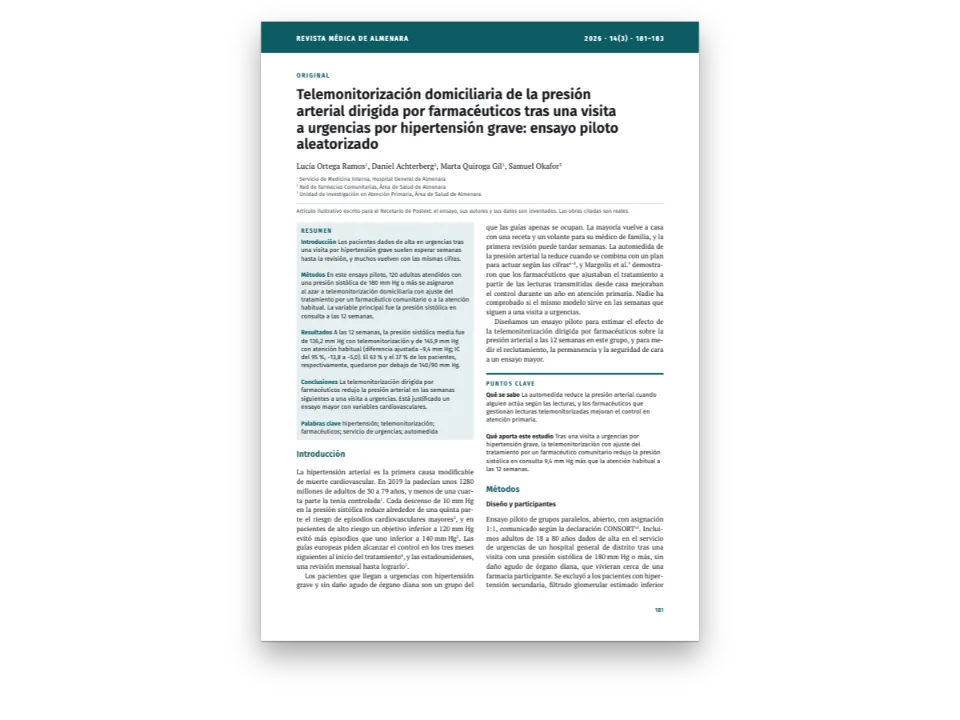
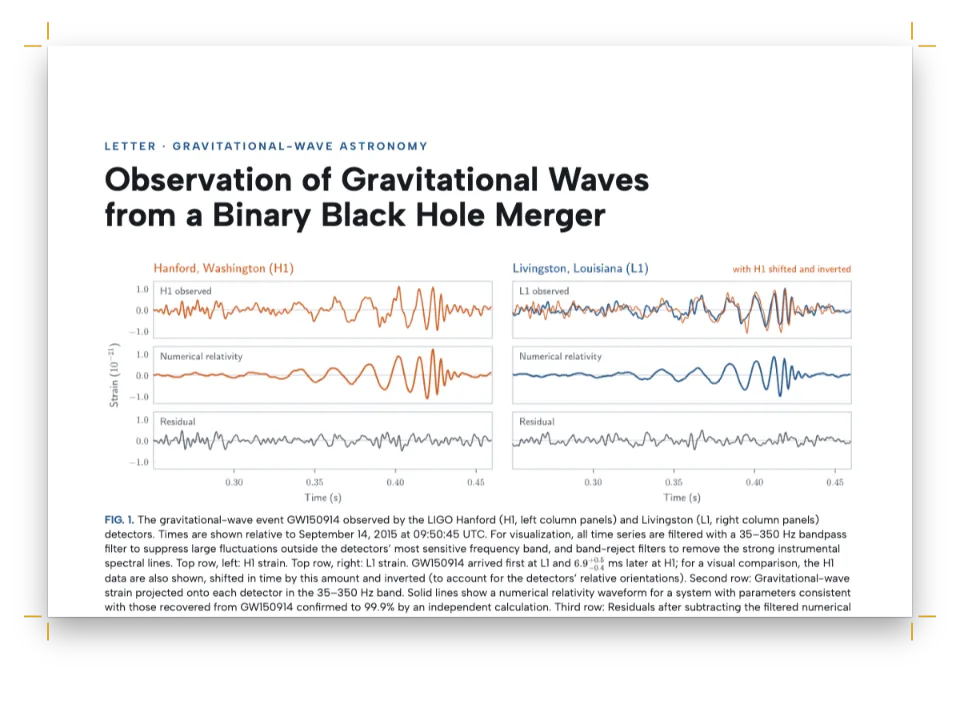
Cinc pàgines d'un article de revista de ciències de la vida en A4: Highly accurate protein structure prediction with AlphaFold, de Jumper i col·laboradors, abreujat a partir de Nature amb llicència CC BY 4.0. Una banda blava obre la primera pàgina sobre el títol, els 34 autors en 7,4 pt amb els números de filiació volats i el resum en negreta a tota l'amplada. A sota, a tota l'amplada, hi ha la figura 1: un gràfic de barres amb les precisions de CASP14 que cita el text i l'esquelet de la diana T1049 traçat des del PDB, amb el model d'AlphaFold dibuixat a dins i acolorit segons la seva confiança. El text cita amb els números volats de Nature. El text principal es tanca amb les referències 1–35. Els Mètodes segueixen en 8,2 pt, i una obra que citen per primera vegada pren el número següent, de manera que la seva pròpia llista comença al 36, com a la revista.
Aquesta recepta respon a
- Com componc la secció de Mètodes d'un article en un cos menor després del text principal, amb les cites continuant la numeració?
- Com torno a compondre amb Postext un article d'accés obert d'arXiv o PubMed Central, amb les seves cites, les seves figures i la seva línia de llicència?
- Com poso els números de cita en superíndex i faig que els DOI siguin enllaços, com a les revistes mèdiques?
- Com afegeixo una figura amb peu numerat i la cito en el text («vegeu la fig. 3.2»)?
La resposta curta
// [@key] prints a raised number in order of first citation, so a work the Methods cite for
// the first time takes the next number after the main text's last, and one cited again
// keeps its number. Nature prints two lists, and :::bibliography{scope=new} lists only the
// works no earlier list printed: the same block after the main text and after the Methods
// sets references 1–35, then 36–55.
registerCitationEngine(createCiteprocEngine({ styles: STYLES, locales: LOCALES }));
const citations = {
  style: 'nature', // raised 1–4, "Nature 577, 706–710 (2020)." entries
  bibliography: { fontSize: em(0.8), lineHeight: pt(9.6), entrySpacing: pt(0.8),
    labelWidth: mm(5), labelAlign: 'right' }, // 9. and 10. end together
};
const references = '### References\n\n:::bibliography{title="" scope=new}';
// "# Methods {style=\"methods\"}" opens a section that runs to the end of the article: an H1
// that breaks nothing, names no running chapter and sets its body two sizes down.
const methods = { id: 'methods', numbered: false, runningChapter: false,
  breakBefore: { enabled: false }, fontFamily: SANS, fontSize: pt(11.5), lineHeight: pt(LEAD),
  fontWeight: 700, color: col('ink'), marginTop: pt(LEAD), marginBottom: pt(LEAD / 2),
  bodyStyle: { fontSize: pt(8.2), lineHeight: pt(SMALL) } };
Ingredients
- Funcions
- Estils de títolCites en un estil de citaBibliografia a partir de les referènciesSuperíndexs i subíndexsObertures dissenyadesAtributs de títolRequadresRequadres a tota l'ampladaCapçaleres i folisCapçaleres segons el tipus de pàginaFigures just aquíEstil dels peusLínies de font i crèditEstil de taulesPeus numeratsEstils de paràgrafPaleta de color semànticaExportació a PDFFonts incrustades al PDF
- També fa servir
- Cites que col·loquen les figuresFigura i Taula en la teva llenguaTipus de recurs propisFigures i taules com a recursosCapítols sense número
- Tipografia
- Noto Serif, Noto Sans (SIL OFL 1.1)
- Recursos
- Fig. 1b, experimental Cα coordinates of PDB 6Y4F (Jiang et al. 2020), drawn in code (Worldwide Protein Data Bank, CC0 1.0)
- Fig. 1b, AlphaFold DB model AF-B4EUK6-F1 (AlphaFold Monomer v2.0) and its pLDDT, superposed and drawn in code (DeepMind Technologies Limited and EMBL-EBI, AlphaFold Protein Structure Database, CC BY 4.0)
Elaboració
#1 · Dues llistes de referències i una sola numeració
El codi és la resposta curta de dalt. Les cites es numeren per ordre de primera aparició, així que no cal fer res per continuar el compte: jackhmmer, que es cita per primera vegada als Mètodes, rep el 36, mentre que el camp de forces Amber, citat abans al text, conserva el seu 30. Les llistes surten de :::bibliography{scope=new}, que imprimeix només les obres que cap llista anterior no ha imprès. L'script posa el mateix bloc després de la Discussió i després dels Mètodes: el primer compon de l'1 a la 35, el segon de la 36 a la 55, i Amber no es repeteix. El títol dels Mètodes és un títol de primer nivell amb estil propi; el seu bodyStyle compon la secció en 8,2 pt sobre 10,8 pt, breakBefore: { enabled: false } el deixa a la columna i runningChapter: false manté a les capçaleres el títol de l'article. Per al teu propi article, enganxa l'exportació del teu .bib en un bloc :::references{format=bibtex}, cita amb [@clau] enganxat a la paraula i canvia nature per l'estil de la teva revista.
#2 · Un bloc de títol per a 34 autors
const text = (id, content, family, size, extra) => ({ kind: 'text', id, content, align: 'left',
  fontFamily: family, fontSize: pt(size), color: col('ink'), overflow: 'wrap', ...extra });
const at = (to, edge, x, y, width) => ({ anchor: { to, edge }, offset: { x: mm(x), y: mm(y) },
  ...(width && { size: { width: mm(width), height: 'auto' } }) });
const caps = { fontFamily: SANS, fontWeight: 600, letterSpacing: pt(1.4),
  textTransform: 'uppercase' };
const titleBlock = { enabled: true,
  minHeight: mm(50),
  slot: { elements: [
    { kind: 'box', id: 'band', style: { backgroundColor: col('accent') },
      placement: { anchor: { to: 'page', edge: 'top-left' },
        size: { width: 'fill', height: mm(14) } } },
    text('kicker', '{attr.kicker}', SANS, 8.5, { ...caps, color: col('paper'),
      placement: at('page', 'top-left', INNER, 5.6, 120) }),
    text('title', '{titleText}', SANS, 23, { fontWeight: 700, lineHeight: 1.12,
      placement: at('container', 'top-left', 0, 1, MEASURE - 30) }),
    text('authors', '{attr.authors}', SANS, 7.4, { inlineMarks: true, lineHeight: 1.42,
      placement: at('#title', 'below', 0, 4, MEASURE) }),
    { kind: 'rule', id: 'rule', thickness: pt(0.5), color: col('rule'),
      placement: at('#authors', 'below', 0, 3, MEASURE) },
    text('source', '{attr.source}', SANS, 7, { color: col('muted'),
      placement: at('#rule', 'below', 0, 1.6, MEASURE) }),
  ] },
};
La llista d'autors és un sol atribut del títol, authors="John Jumper^1,4^, Richard Evans^1,4^, …", compost en Noto Sans de 7,4 pt a tota la mesura, on els 34 noms ocupen cinc línies. inlineMarks puja els números de filiació. Les filiacions i la nota de contribució igual van al final, a Author information, com les imprimeix Nature, i així la primera pàgina conserva lloc per al resum i la figura. No s'omet cap autor: la capçalera de les pàgines parelles abreuja la llista a Jumper et al.
#3 · El resum a tota l'amplada i la figura 1 a sota
const resources = () => [
  { id: 'fig1', typeId: 'figure', kind: 'svg', createdAt: 0, updatedAt: 0,
    placement: { position: 'here', span: 'page' },
    svg: { fileId: 'fig1.svg', width: 1780, height: 640 },
    caption: '**AlphaFold produces highly accurate structures.** **a**, Median accuracy on the '
      + 'CASP14 domains of AlphaFold and of the next best method, as r.m.s.d.~95~ over Cα atoms '
      + '(backbone) and over all atoms, with 95% confidence intervals; the dashed line is the '
      + 'width of a carbon atom, about 1.4 Å. **b**, CASP14 target T1049 (PDB 6Y4F): the '
      + 'experimental Cα trace (grey) and the AlphaFold model of the same chain, coloured by '
      + 'its per-residue confidence (pLDDT).',
    note: 'Redrawn for this edition. a, from the values given in the text (the original plots '
      + 'the top 15 of 146 entries). b, from PDB 6Y4F (CC0) and AlphaFold DB model '
      + 'AF-B4EUK6-F1, AlphaFold Monomer v2.0 (CC BY 4.0), superposed on 134 Cα atoms; the '
      + 'original shows the CASP14 prediction.',
    altText: 'Bars: AlphaFold 0.96 and 1.5 Å, next best 2.8 and 3.5 Å. Two backbones that '
      + 'lie almost on top of each other.' },
  { id: 'tbl-timings', typeId: 'table', kind: 'table', createdAt: 0, updatedAt: 0,
    placement: { position: 'here' },
    caption: '**Inference times.** One model on one V100 GPU, by protein length.',
    note: 'Compiled for this edition from the timings given in ‘Inference regimen’.',
    table: { model: { headerRowCount: 1, columnWidths: [1, 1.3, 1.3], rows: [
      ['Residues', 'With ensembling (CASP14)', 'Without ensembling'],
      ['256', '4.8 min', '0.6 min'], ['384', '9.2 min', '1.1 min'],
      ['2,500', '18 h', '2.1 h'],
    ].map((row, r) => row.map((content, c) => ({ content, ...(r === 0 && { isHeader: true }),
      ...(c > 0 && { align: 'right' }) }))) } } },
];
El resum és un requadre amb span: 'page' i sense marc, amb el text en Noto Sans seminegreta. La figura 1 el segueix com a ::resource{id="fig1"}, i la seva col·locació, { position: 'here', span: 'page' }, la compon sobre les dues columnes en aquell punt; les dues columnes de text comencen sota el seu peu. El peu comença amb una frase en negreta, com els de Nature; el captionPrefix del tipus i el labelSeparator de l'estil de peu fan que l'etiqueta digui Fig. 1 |. La taula 1 va incrustada on és, als Mètodes, amb position: 'here', i es queda a la seva columna.
#4 · L'esquelet d'una proteïna a partir de coordenades obertes
// PDB 6Y4F chain A, residues 25–158: Cα x, y in tenths of Å, depth z in Å (CC0)
const EXP = [
  -56,-91,-6,-36,-77,-3,-4,-98,-2,26,-81,-1,63,-86,-1,95,-73,1,116,-100,2,146,
  -79,3,159,-46,2,187,-34,4,209,-6,3,211,10,0,187,17,-3,182,53,-2,185,46,2,
  167,14,3,148,-4,6,122,-28,4,109,-58,6,76,-67,4,45,-89,4,11,-79,3,-2,-114,
  3,-37,-116,1,-64,-95,0,-87,-117,-2,-124,-110,-2,-135,-80,-5,-161,-95,-7,-158,
  -74,-10,-173,-41,-9,-141,-20,-9,-148,15,-8,-128,31,-5,-105,55,-7,-106,82,-4,
  -144,80,-3,-156,116,-3,-122,132,-2,-126,155,1,-102,131,3,-88,98,2,-68,72,4,
  -58,37,3,-23,33,4,6,10,5,32,28,2,59,21,0,68,31,-4,89,62,-3,96,70,-7,102,
  52,-10,65,59,-11,53,41,-8,39,71,-6,38,70,-2,64,79,0,59,86,4,33,60,5,42,
  36,8,7,42,9,-29,48,8,-55,21,9,-88,39,8,-105,69,6,-122,57,3,-134,87,1,-170,
  78,2,-167,42,1,-180,38,-3,-165,5,-4,-132,-13,-3,-150,-42,-2,-161,-18,1,-125,
  -6,1,-114,-43,2,-141,-49,4,-129,-20,6,-92,-30,6,-98,-66,7,-120,-57,10,-94,
  -33,11,-62,-52,11,-54,-89,11,-36,-104,8,-8,-109,7,3,-73,8,40,-75,9,67,-51,
  10,93,-26,9,92,8,7,119,30,5,128,47,2,151,77,2,149,93,-2,152,82,-5,173,52,
  -6,150,22,-6,162,-13,-8,144,-44,-6,119,-43,-9,109,-8,-8,106,-15,-4,72,-24,
  -3,53,-20,0,15,-23,0,-19,-8,1,-20,28,-1,-48,53,-1,-38,89,0,-52,122,1,-25,
  128,3,-19,107,7,18,115,7,47,129,5,57,121,1,26,112,-1,28,122,-4,-9,117,-5,
  -8,83,-3,-9,51,-5,-13,14,-5,-49,3,-4,-61,-14,-8,-50,-50,-8,-19,-46,-6,8,
  -72,-7,43,-65,-6,67,-94,-5,43,-121,-6,32,-148,-3,-6,-157,-3,-17,-192,-4,-23,
  -216,-1,
];
// AlphaFold DB AF-B4EUK6-F1, the same residues superposed on 6Y4F (CC BY 4.0)
const MODEL = [
  -57,-93,-6,-37,-77,-3,-5,-98,-2,25,-82,-1,63,-87,-1,94,-74,1,112,-103,3,144,
  -84,3,158,-50,2,189,-34,4,209,-2,3,212,16,0,187,21,-3,181,57,-2,181,48,2,
  166,13,2,148,-4,5,122,-29,4,110,-58,6,76,-66,4,46,-88,4,12,-79,3,0,-115,3,
  -37,-113,2,-64,-95,0,-87,-118,-2,-125,-110,-2,-136,-81,-4,-162,-95,-7,-155,
  -74,-10,-173,-42,-9,-141,-22,-9,-146,14,-8,-126,31,-5,-102,55,-7,-106,83,-4,
  -143,81,-4,-156,117,-3,-122,132,-2,-123,157,1,-101,132,3,-86,98,2,-68,72,4,
  -58,36,3,-22,32,4,7,8,4,32,26,2,61,20,0,67,31,-4,89,62,-3,95,73,-7,100,
  56,-10,64,67,-11,52,44,-8,40,74,-6,38,68,-2,65,77,0,59,84,4,35,56,5,45,
  30,8,10,37,9,-25,47,8,-54,21,9,-86,40,8,-105,69,6,-120,56,3,-132,87,1,
  -169,78,2,-166,42,0,-177,37,-3,-163,3,-4,-130,-15,-3,-150,-42,-2,-162,-17,1,
  -125,-5,1,-114,-42,2,-142,-47,5,-129,-15,7,-93,-28,6,-103,-62,8,-122,-46,11,
  -90,-26,12,-62,-52,11,-59,-89,10,-37,-104,7,-8,-110,7,3,-74,8,40,-74,9,66,
  -48,10,95,-26,9,95,7,7,124,30,6,127,45,2,147,78,2,145,92,-1,153,87,-5,172,
  54,-6,147,26,-7,158,-6,-8,145,-39,-7,117,-42,-10,105,-7,-8,106,-14,-5,72,
  -24,-3,54,-21,0,16,-25,0,-18,-8,0,-19,27,-1,-48,52,-1,-37,88,0,-51,122,1,
  -26,127,4,-23,104,7,15,108,7,45,124,5,57,120,2,26,111,-1,31,123,-4,-7,116,
  -5,-5,83,-3,-8,51,-5,-12,14,-5,-48,2,-5,-62,-14,-8,-53,-52,-8,-20,-47,-6,5,
  -74,-7,39,-66,-5,64,-95,-5,99,-89,-7,117,-72,-4,146,-94,-2,178,-75,-3,190,
  -46,-1,
];
// The model's per-residue pLDDT, read from its B-factor column
const PLDDT = [
  87,89,87,87,83,87,82,84,85,84,82,79,81,86,90,89,93,93,94,95,92,95,87,90,
  93,87,89,88,82,75,87,92,97,98,98,98,98,98,98,98,98,99,99,99,99,99,98,96,
  94,93,90,84,87,89,95,95,96,97,98,98,98,98,98,98,99,99,99,98,98,98,98,97,
  97,98,98,98,98,98,98,97,98,98,96,95,89,96,97,96,96,96,96,94,93,91,88,86,
  82,73,67,61,61,69,83,89,96,97,98,99,99,98,98,97,96,97,96,96,95,95,96,97,
  97,96,97,94,87,90,84,82,69,65,64,61,55,53,
];
const n2 = (v) => +v.toFixed(2);
// The figure names Noto Sans on its root; loadSvg embeds the faces its labels set
// (inlineSvgFonts), so the canvas and the PDF draw them in the page's own sans.
const label = (x, y, s, size = 2.5, extra = '') => { // ink unless extra sets a fill
  const fill = extra.includes('fill') ? '' : `fill="${palette.ink}" `;
  return `<text x="${n2(x)}" y="${n2(y)}" font-size="${size}" ${fill}${extra}>${s}</text>`;
};
// a: median r.m.s.d.95 with its 95% interval, as the text gives them
const ACCURACY = [
  { group: 'Backbone', af: [0.96, 0.85, 1.16], next: [2.8, 2.7, 4.0] },
  { group: 'All-atom', af: [1.5, 1.2, 1.6], next: [3.5, 3.1, 4.2] },
];
function bars() {
  const [L, B, T, H] = [9, 54, 8, 4.5]; // axis left, baseline, top, Å at the top
  const y = (v) => B - (v / H) * (B - T);
  let s = label(0, 3.2, 'a', 3.6, 'font-weight="700"');
  for (const v of [0, 1, 2, 3, 4]) {
    s += `<path d="M${L} ${n2(y(v))}H58" stroke="${palette.rule}" stroke-width="0.15"/>`
      + label(L - 1.5, y(v) + 0.9, v, 2.5, 'text-anchor="end"');
  }
  s += label(1.6, 31, 'r.m.s.d.<tspan font-size="1.8" dy="0.6">95</tspan><tspan dy="-0.6"> (Å)'
    + '</tspan>', 2.5, 'text-anchor="middle" transform="rotate(-90 1.6 31)"');
  ACCURACY.forEach(({ group, af, next }, g) => {
    const x0 = L + 4 + g * 24;
    [[af, palette.accent], [next, palette.rule]].forEach(([[m, lo, hi], fill], k) => {
      const x = x0 + k * 10;
      s += `<rect x="${x}" y="${n2(y(m))}" width="8" height="${n2(B - y(m))}" fill="${fill}"/>`
        + `<path d="M${x + 4} ${n2(y(lo))}V${n2(y(hi))}M${x + 2.6} ${n2(y(lo))}h2.8M${x + 2.6} `
        + `${n2(y(hi))}h2.8" stroke="${palette.ink}" stroke-width="0.3" fill="none"/>`
        + label(x + 4, B - 1.4, m.toFixed(m < 1 ? 2 : 1), 2.3, // inside the bar's foot
          `text-anchor="middle" fill="${k ? palette.ink : palette.paper}"`);
    });
    s += label(x0 + 9, B + 4, group, 2.6, 'text-anchor="middle"');
  });
  let dash = '';
  for (let x = L; x < 57; x += 2.4) dash += `M${n2(x)} ${n2(y(1.4))}h1.4`;
  s += `<path d="${dash}" stroke="${palette.ink}" stroke-width="0.3"/>`
    + `<path d="M${L} ${B}H58" stroke="${palette.ink}" stroke-width="0.35"/>`
    + `<rect x="${L + 2}" y="59.3" width="2.6" height="2.6" fill="${palette.accent}"/>`
    + label(L + 5.5, 61.6, 'AlphaFold') + `<rect x="${L + 22}" y="59.3" width="2.6" `
    + `height="2.6" fill="${palette.rule}"/>` + label(L + 25.5, 61.6, 'Next best method');
  return s;
}
// b: both chains as smooth Cα traces, far segments first
const BANDS = [[90, '#0053d6', 'pLDDT > 90'], [70, '#65cbf3', 'pLDDT 70–90'],
  [50, '#ffdb13', 'pLDDT 50–70'], [0, '#ff7d45', 'pLDDT < 50']];
const band = (p) => BANDS.find(([min]) => p > min);
function trace(xyz, cx, cy, k) {
  const pt = (i) => [cx + xyz[3 * i] * k, cy - xyz[3 * i + 1] * k, xyz[3 * i + 2]];
  const n = xyz.length / 3;
  return Array.from({ length: n - 1 }, (_, i) => {
    const [p0, p1, p2, p3] = [pt(Math.max(i - 1, 0)), pt(i), pt(i + 1), pt(Math.min(i + 2, n - 1))];
    const c1 = [0, 1].map((a) => p1[a] + (p2[a] - p0[a]) / 6);
    const c2 = [0, 1].map((a) => p2[a] - (p3[a] - p1[a]) / 6);
    return { i, z: (p1[2] + p2[2]) / 2, d: `M${n2(p1[0])} ${n2(p1[1])}C${n2(c1[0])} `
      + `${n2(c1[1])} ${n2(c2[0])} ${n2(c2[1])} ${n2(p2[0])} ${n2(p2[1])}` };
  });
}
function backbone() {
  const [cx, cy, k] = [103, 32, 0.142]; // mm per tenth of an Å
  const exp = trace(EXP, cx, cy, k);
  const model = trace(MODEL, cx, cy, k);
  const width = (z) => 1 + z / 40;
  let s = label(66, 3.2, 'b', 3.6, 'font-weight="700"');
  // the experiment as a grey band, then the model on top of it: where they agree, the model's
  // colour runs inside the band
  for (const [segs, halo, wide, colour] of [[exp, 2.4, 1.6, () => palette.rule],
    [model, 1.3, 0.75, (i) => band(Math.min(PLDDT[i], PLDDT[i + 1]))[1]]]) {
    for (const { i, z, d } of [...segs].sort((a, b) => a.z - b.z)) {
      const w = width(z);
      s += `<path d="${d}" stroke="${palette.paper}" stroke-width="${n2(w * halo)}" `
        + `fill="none"/><path d="${d}" stroke="${colour(i)}" ` // a butt halo: no notch at joins
        + `stroke-width="${n2(w * wide)}" fill="none" stroke-linecap="round"/>`;
    }
  }
  const legend = [[palette.rule, 'Experiment (PDB 6Y4F)'], ...BANDS.slice(0, 3)
    .map(([, c, t]) => [c, `Model: ${t}`])];
  legend.forEach(([c, t], j) => {
    s += `<path d="M138 ${44 + j * 4.6}h5" stroke="${c}" stroke-width="${j ? 1 : 1.6}" `
      + 'stroke-linecap="round"/>' + label(145, 44.9 + j * 4.6, t, 2.4);
  });
  return s + label(138, 39, 'T1049 · residues 25–158', 2.5, 'font-weight="700"');
}
const figure1 = () => '<svg xmlns="http://www.w3.org/2000/svg" width="1780" height="640" '
  + `viewBox="0 0 178 64" font-family="${SANS}">${bars()}${backbone()}</svg>`;
Les coordenades es van llegir un sol cop, en escriure la recepta, de l'entrada 6Y4F del PDB (CC0) i del model de la mateixa proteïna a l'AlphaFold Database (CC BY 4.0); es van superposar sobre els àtoms Cα i es van girar sobre els eixos principals de l'experiment. L'script les desa en tres matrius curtes. Cada traç és una cadena de segments de Bézier per les posicions dels Cα, pintats del més llunyà al més proper amb un halo del color del paper, que dona profunditat sense ombrejat. Els colors del model són les bandes de pLDDT que fa servir l'AlphaFold Database, llegides de la columna de factors B del seu fitxer.
#5 · Lletres gregues i accents al PDF
Fontsource parteix cada font per sistemes d'escriptura. kitFonts(FONTS) llegeix el text que rep i carrega el fitxer latin-ext de cada font quan compon Ž o Š, i el grec quan compon α o χ; fontsourceProvider incrusta aquests mateixos fitxers al PDF a partir dels caràcters que compon cada font. Cα, χ, Žídek i Šali no demanen codi propi: la recepta passa el Markdown, que aplega tots els blocs de contingut, i el proveïdor del kit.
La recepta completa
// ═══ Postext Cookbook · Nº 139 · A protein paper with a Methods section ════════════
// https://postext.dev/en/cookbook/protein-paper-methods-section
// Code: MIT · Text: Jumper et al. 2021, abridged (CC BY 4.0) · Figures: drawn in code
// Fonts: Noto Serif, Noto Sans (SIL OFL 1.1) · Needs postext ≥ 1.34.0
import {
  buildDocumentWithFonts, renderPageToCanvas, registerCitationEngine, registerResourceImage,
  defaultResourceTypes, inlineSvgFonts,
} from 'https://esm.sh/postext';
import { renderToPdf, decompressWoff2 } from 'https://esm.sh/postext-pdf';
import { createCiteprocEngine, STYLES, LOCALES } from 'https://esm.sh/postext-citeproc';

const LANG = 'en'; // @lang: the language of the sample document ('en' | 'es')
const RECIPE = 'protein-paper-methods-section';

// ─── 1 · Design ─────────────────────────────────────────────────────────────
// #region palette: near-black text and one deep blue, the blue of confident pLDDT
const palette = { ink: '#161b22', accent: '#0b4ea2', tint: '#e9eff8', rule: '#b3bdcb',
  muted: '#59636f', paper: '#ffffff' };
const col = (id) => ({ hex: palette[id], model: 'hex', paletteId: id });
const colorPalette = Object.entries({ ...palette, 'main-color': palette.accent })
  .map(([id, hex]) => ({ id, name: id, value: { hex, model: 'hex' } }));
// #endregion
const [SERIF, SANS] = ['Noto Serif', 'Noto Sans'];
const [TRIM_W, TRIM_H, TOP, BOTTOM, INNER, OUTER, GUTTER] = [210, 297, 22, 22, 18, 16, 6];
const MEASURE = TRIM_W - INNER - OUTER;
const LEAD = 12.6; // pt: 9.3 pt type in two columns of 85 mm
const SMALL = 10.8; // pt: the Methods, at 8.2 pt

// #region answer: Methods in smaller type, with a second reference list that numbers on
// [@key] prints a raised number in order of first citation, so a work the Methods cite for
// the first time takes the next number after the main text's last, and one cited again
// keeps its number. Nature prints two lists, and :::bibliography{scope=new} lists only the
// works no earlier list printed: the same block after the main text and after the Methods
// sets references 1–35, then 36–55.
registerCitationEngine(createCiteprocEngine({ styles: STYLES, locales: LOCALES }));
const citations = {
  style: 'nature', // raised 1–4, "Nature 577, 706–710 (2020)." entries
  bibliography: { fontSize: em(0.8), lineHeight: pt(9.6), entrySpacing: pt(0.8),
    labelWidth: mm(5), labelAlign: 'right' }, // 9. and 10. end together
};
const references = '### References\n\n:::bibliography{title="" scope=new}';
// "# Methods {style=\"methods\"}" opens a section that runs to the end of the article: an H1
// that breaks nothing, names no running chapter and sets its body two sizes down.
const methods = { id: 'methods', numbered: false, runningChapter: false,
  breakBefore: { enabled: false }, fontFamily: SANS, fontSize: pt(11.5), lineHeight: pt(LEAD),
  fontWeight: 700, color: col('ink'), marginTop: pt(LEAD), marginBottom: pt(LEAD / 2),
  bodyStyle: { fontSize: pt(8.2), lineHeight: pt(SMALL) } };
// #endregion
L'script.js compost funciona tal com és: enganxa'l com a script de mòdul en qualsevol pàgina o obre la recepta a CodePen. Carpeta de la recepta a GitHub ↗ (s'obre en una pestanya nova)
Variants
#Deixa els Mètodes al cos del text
Algunes revistes componen els Mètodes amb la mateixa lletra que el text; treu l'estil de cos de la secció i conserva el títol.
-  bodyStyle: { fontSize: pt(8.2), lineHeight: pt(SMALL) } };
+};#Numera entre claudàtors
Algunes revistes del mateix camp imprimeixen [1] a la línia.
-  style: 'nature', // raised 1–4, "Nature 577, 706–710 (2020)." entries
+ style: 'nature', marker: 'brackets',#Imprimeix una sola llista al final
Les revistes que imprimeixen totes les referències després dels Mètodes, com Science, conserven només el segon bloc.
-const markdown = [/* @content */ '', references, /* @content:methods */ '', references,
+const markdown = [/* @content */ '', /* @content:methods */ '', references,#Fes servir la llista Vancouver
Per a una revista mèdica, parteix de l'estil NLM inclòs, com fa l'article mèdic en estil Vancouver.
Errors freqüents
Error freqüent
Els fitxers de Fontsource cobreixen lletres, no símbols
El kit incrusta el fitxer latin de Fontsource de cada font i, quan el text els fa servir, el seu fitxer latin-ext per a č, ł, † i el seu fitxer greek per a α, χ (en una família que en tingui: Lora i Gelasio no), a la pantalla i al PDF. Símbols com →, ≈, ✓ i ★ no són a cap d'aquests fitxers i falten al PDF: dibuixa'ls, escriu-los com a matemàtiques o tria una font els fitxers de la qual els tinguin. Fonts incrustades al PDF →
- Nature anomena fins a cinc autors i abreuja una llista més llarga al primer seguit d'et al. On la llista del mateix article ho fa, escriu
and othersa l'entrada BibTeX ({Senior, Andrew W. and others}) i l'estil imprimeix Senior, A. W. et al.; en CSL-YAML, acaba la llista amb"others". - El
bodyStyled'un estil d'encapçalament canvia el cos i l'interlineat del text, no la reixeta base: els títols dels Mètodes fan servirsnapToGrid: false, o la línia sota cadascun saltaria a la línia següent de la reixeta del text principal.
Crèdits
- Recepta
- Ignacio Ferro
- Text
- “Highly accurate protein structure prediction with AlphaFold”, Nature 596, 583–589 (2021), doi:10.1038/s41586-021-03819-2, PMC8371605, abridged (the sections ‘Interpreting the neural network’ and ‘Related work’, the description of Fig. 2, parts of other sections and of the Methods, the Supplementary information and the peer review note cut; pointers to omitted figures removed; references renumbered by first citation); Fig. 1 redrawn in code (panels c–e omitted), Figs. 2–5 omitted; Table 1 compiled from the Methods text · John Jumper, Richard Evans, Alexander Pritzel, Tim Green, Michael Figurnov, Olaf Ronneberger, Kathryn Tunyasuvunakool, Russ Bates, Augustin Žídek, Anna Potapenko, Alex Bridgland, Clemens Meyer, Simon A. A. Kohl, Andrew J. Ballard, Andrew Cowie, Bernardino Romera-Paredes, Stanislav Nikolov, Rishub Jain, Jonas Adler, Trevor Back, Stig Petersen, David Reiman, Ellen Clancy, Michal Zielinski, Martin Steinegger, Michalina Pacholska, Tamas Berghammer, Sebastian Bodenstein, David Silver, Oriol Vinyals, Andrew W. Senior, Koray Kavukcuoglu, Pushmeet Kohli, Demis Hassabis · CC BY 4.0
- Imatges
- Fig. 1b, experimental Cα coordinates of PDB 6Y4F (Jiang et al. 2020), drawn in code · Worldwide Protein Data Bank · CC0 1.0
- Fig. 1b, AlphaFold DB model AF-B4EUK6-F1 (AlphaFold Monomer v2.0) and its pLDDT, superposed and drawn in code · DeepMind Technologies Limited and EMBL-EBI, AlphaFold Protein Structure Database · CC BY 4.0
- Fonts
- Noto Serif (SIL OFL 1.1) · Noto Sans (SIL OFL 1.1)
- Codi
- MIT, com Postext
Editar aquest text ↗ (s'obre en una pestanya nova)Carpeta de la recepta a GitHub ↗ (s'obre en una pestanya nova)