Kurz gesagt
Die ersten Seiten eines arabischen Romans, gesetzt wie bei einem arabischen Verlag: Die Zeilen laufen von rechts nach links, das Buch öffnet sich von dem, was ein lateinischer Leser hinten nennt, die Seitenzahlen sind arabische Ziffern.
Was Sie setzen
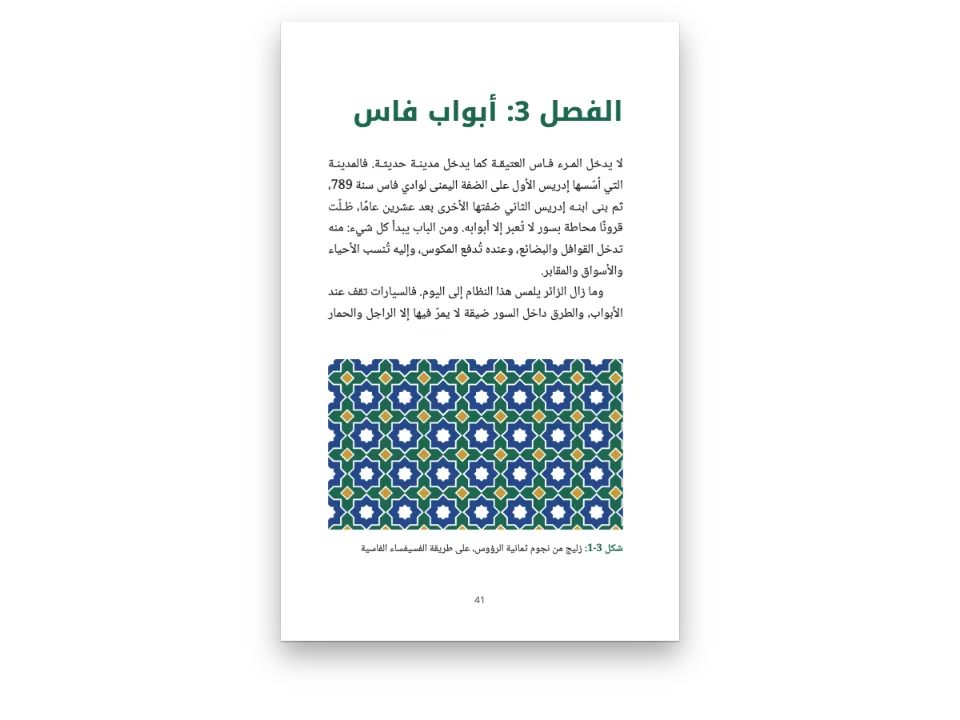
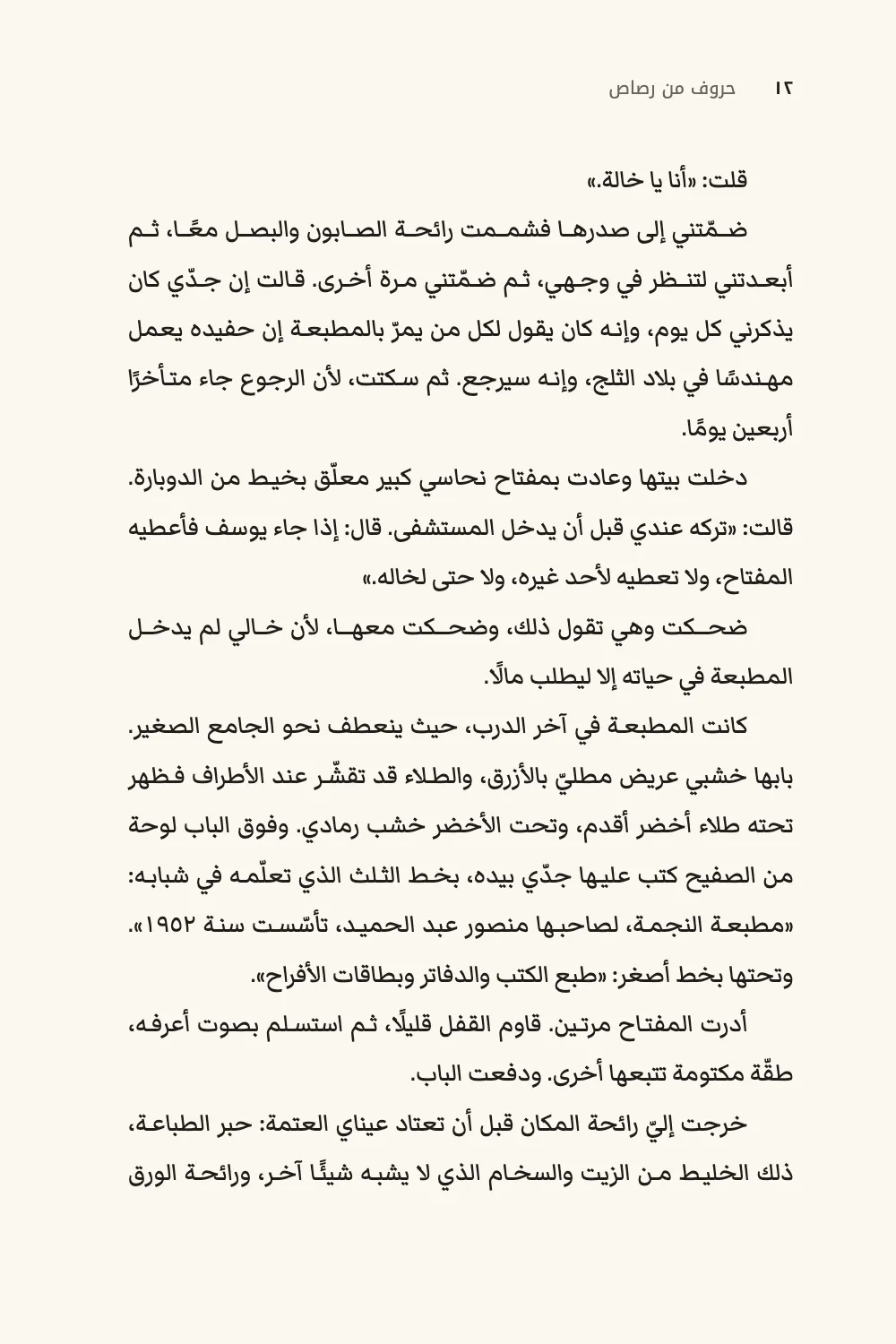
Der Anfang von حروف من رصاص (Lettern aus Blei), einem Roman über einen Enkel, der die Druckerei seines Großvaters in einer Kairoer Gasse wieder öffnet, gesetzt als arabisches Taschenbuch: 14 × 21 cm, Markazi Text in 13,5 pt auf 22 pt Zeilenabstand, Blocksatz, der Erstzeileneinzug rechts. Der Auszug beginnt auf Seite 10 mit einer Teiltitelseite im Blau der Werkstatttür, einem in Code gezeichneten Gitter achtzackiger Sterne und dem Namen des Teils in der Reem Kufi in 64 pt. Der Kapitelauftakt steht ihr gegenüber auf der linken Seite, in Worten nummeriert: الفصل الأول. Die Seitenzahlen lauten ١٠, ١١, ١٢; der Buchtitel steht über den rechten Seiten, das Kapitel über den linken. Ein Roman als Taschenbuch setzt dieselbe Art Buch von links nach rechts.
Dieses Rezept beantwortet
- Wie setze ich ein arabisches Buch von rechts nach links und binde es rechts?
Die kurze Antwort
const page = {
  width: mm(TRIM.width), height: mm(TRIM.height), dpi: 150, backgroundColor: col('paper'),
  // left and right are the flow's sides: in a right-to-left book left is the spine side,
  // so these margins put 20 mm at the spine and 16 mm outside on both pages of a spread.
  margins: { top: mm(23), bottom: mm(22), left: mm(20), right: mm(OUTER), mirror: true },
  // binding: 'auto' (unset) is 'right' for a right-to-left locale: page 1 is a left page.
};
const bodyText = {
  fontFamily: TEXT, fontSize: pt(BODY), lineHeight: pt(LEAD), color: col('ink'),
  boldColor: col('ink'), italicColor: col('ink'), referenceColor: col('ink'),
  // justify ends every line on both sides; the engine lengthens joined letters (kashida,
  // on by default for Arabic) after it opens the spaces a quarter. Never hyphenated.
  textAlign: 'justify', optimalLineBreaking: true,
  firstLineIndent: em(1.5), indentAfterHeading: false, // the indent is on the right
  avoidWidows: true, avoidOrphans: true, avoidRunts: true,
};
Zutaten
- Funktionen
- Text von rechts nach linksRechts gebundene BücherZiffern der erzeugten ZahlenBlocksatz mit KaschidaArabische SchriftenArabisch als DokumentspracheArabische Ordnungszahlen in WortenGrundschriftEinzüge, Ausrichtung und AbsatzabständeGestaltete AuftakteÜberschriftenformateNummerierte ÜberschriftenÜberschriftenattributeKolumnentitel und SeitenzahlenKopfzeilen nach SeitenrolleGespiegelte RänderBilder in SeitengestaltungenPDF-Export
- Nutzt außerdem
- Absätze in der anderen RichtungPapierfarbeAbsatzformateIm PDF eingebettete SchriftenAbbildungen und Tabellen als RessourcenKolumnentitel je AbschnittKapitel ohne Nummer
- Schrift
- Markazi Text, Reem Kufi, Noto Kufi Arabic (SIL OFL 1.1)
- Dateien
- Keine: Jedes Bild wird im Code gezeichnet
Zubereitung
#1 · Eine Locale, drei Entscheidungen
Der Code steht oben in der kurzen Antwort. locale: 'ar' ist alles, was die Konfiguration sagt, und die Engine leitet drei Dinge daraus ab: Der Text läuft von rechts nach links (direction: 'auto'), das Buch wird rechts gebunden (page.binding: 'auto'), und jede Zahl, die die Engine schreibt, verwendet ostarabische Ziffern (numerals: 'auto'), die Seitenzahlen eingeschlossen (Ein arabisches Buch anlegen). Ränder und Ausrichtungen behalten die Wörter left und right, bezeichnen in einem Buch von rechts nach links aber die Seiten des Textflusses: margins.left ist die Bundseite, und der Erstzeileneinzug steht rechts. Zeilen im Blocksatz öffnen zuerst ihre Wortabstände und dehnen dann verbundene Buchstaben mit dem Tatweel, der Kaschida arabischer Bücher; Silbentrennung gibt es im Text nie (Blocksatz und Kaschida).
#2 · Eine Kapitelnummer in Worten
const SINK = 58; // mm: where the text starts on an opener
const centred = (y, size) => ({ anchor: { to: 'container', edge: 'top' },
  offset: { y: mm(y) }, ...(size && { size }) });
const opener = {
  enabled: true, minHeight: mm(SINK),
  slot: { elements: [
    { kind: 'image', id: 'star', resourceId: 'star', placement: centred(8, { width: mm(9) }) },
    // {number} is the level's numbering template below: الفصل الأول, الفصل الثاني…
    { kind: 'text', id: 'kicker', content: '{number}', fontFamily: LABEL, fontSize: pt(10),
      fontWeight: 600, color: col('door'), align: 'center', placement: centred(22) },
    { kind: 'text', id: 'title', content: '{titleText}', fontFamily: DISPLAY, fontSize: pt(30),
      fontWeight: 600, lineHeight: 1.3, color: col('ink'), align: 'center', overflow: 'wrap',
      placement: centred(29, { width: 'fill' }) },
  ] },
};
const chapter = {
  level: 1, fontFamily: DISPLAY, fontWeight: 600, marginTop: pt(0), marginBottom: pt(0),
  // Each chapter opens a page, on either side of the spine.
  breakBefore: { enabled: true, parity: 'any' },
  // A masculine ordinal in words: {1:ordinal-feminine} would give الأولى, الثانية…
  numberingTemplate: 'الفصل {1:ordinal}', advancedDesign: opener,
};
Das numberingTemplate der Ebene schreibt الفصل und die Zahl als maskuline Ordnungszahl, sodass das zweite Kapitel ohne jede Änderung am Markdown الفصل الثاني heißt; {1:ordinal-feminine} ergibt الأولى, الثانية für ein feminines Nomen wie الليلة (Ordnungs- und Grundzahlen in Worten). Der Auftakt druckt sie mit {number} über dem Titel. Arabische Kapitelauftakte sind meist zentriert, deshalb erspart align: 'center' jede Frage, auf welcher Seite die Gestaltung beginnt.
#3 · Kolumnentitel bleiben auf ihren Seiten
// Running heads and folios keep their physical sides in a right-to-left book. The right page
// is an even page here and is read first: the book's title; the left page, the chapter's.
const label = { fontFamily: LABEL, fontSize: pt(8), color: col('muted'), pages: 'body' };
const at = (edge, x, y = 12) => ({ anchor: { to: 'page', edge }, offset: { x: mm(x), y: mm(y) } });
const folio = { ...label, fontWeight: 600, color: col('ink') };
const header = { elements: [
  { kind: 'text', id: 'r-folio', content: '{pageNumber}', parity: 'even', ...folio,
    align: 'right', placement: at('top-right', -OUTER) },
  { kind: 'text', id: 'r-title', content: '{title}', parity: 'even', ...label, align: 'right',
    placement: at('top-right', -(OUTER + 9)) },
  { kind: 'text', id: 'l-chapter', content: '{chapterTitle}', parity: 'odd', ...label,
    align: 'left', placement: at('top-left', OUTER + 9) },
  { kind: 'text', id: 'l-folio', content: '{pageNumber}', parity: 'odd', ...folio,
    align: 'left', placement: at('top-left', OUTER) },
] };
// The openers carry no head: their folio drops to the foot, centred.
const footer = { elements: [{ kind: 'text', id: 'drop-folio', content: '{pageNumber}', ...folio,
  pages: 'opener', align: 'center', placement: at('bottom', 0, -11) }] };
Der Grundtext folgt dem Textfluss, Kolumnentitel und Seitenzahlen aber behalten ihre physischen Seiten. Seite 12 ist in diesem Buch eine gerade und zugleich eine rechte Seite, deshalb steht ihre Seitenzahl oben rechts, daneben der Buchtitel; Seite 13 liegt links und trägt das Kapitel. Wer eine Doppelseite von rechts liest wie ein arabischer Leser, trifft zuerst auf den Buchtitel. showBook legt die Seiten gespiegelt aus, Seite 11 links von Seite 10, sodass der Bildschirm die Doppelseiten so zeigt, wie sich das Buch öffnet.
#4 · Eine in Code gezeichnete Teiltitelseite
// # الدرب {style="plate" kicker="…" line="…"}: a heading that paints a whole page.
const onPage = (y) => ({ anchor: { to: 'page', edge: 'top' }, offset: { y: mm(y) } });
const plate = {
  id: 'plate', span: 'page', numbered: false, runningChapter: false, toc: false,
  breakBefore: { enabled: true, parity: 'any' }, // (gotcha: style-inherits-break)
  header: { elements: [] }, footer: { elements: [] },
  advancedDesign: { enabled: true, slot: { elements: [
    // The drawing carries 3 mm of bleed a side: a box of the trim would fit it by its width
    // and leave a strip of paper at the head and the foot.
    { kind: 'image', id: 'field', resourceId: 'lattice', placement: {
      anchor: { to: 'page', edge: 'top-left' }, offset: { x: mm(-3), y: mm(-3) },
      size: { width: mm(TRIM.width + 6), height: mm(TRIM.height + 6) } } },
    { kind: 'text', id: 'part', content: '{attr.kicker}', fontFamily: LABEL, fontSize: pt(11),
      fontWeight: 600, color: col('brass'), align: 'center', placement: onPage(76) },
    { kind: 'text', id: 'name', content: '{titleText}', fontFamily: DISPLAY, fontSize: pt(64),
      fontWeight: 600, lineHeight: 1.2, color: col('paper'), align: 'center',
      placement: onPage(86) },
    { kind: 'text', id: 'line', content: '{attr.line}', fontFamily: TEXT, fontSize: pt(13),
      color: col('paper'), align: 'center', placement: onPage(124) },
  ] } },
};
Die Teiltitelseite ist eine Überschrift der Ebene 1, # الدرب {style="plate" …}, deren Stil das ganze Blatt bemalt und Kolumnentitel und Seitenzahl entfernt. Das Gitter ist ein SVG, das der Pen aus zwei um 45° gedrehten Quadraten erzeugt, dem Chātam-Stern der islamischen geometrischen Ornamentik, im Blau und Messing der Palette, sodass das PDF es als Vektorpfade behält. numbered: false hält die Teiltitelseite aus der Kapitelzählung heraus, und der folgende Auftakt ist الفصل الأول.
Das ganze Rezept
// ═══ Postext Cookbook · Nº 105 · An Arabic novel set right to left, bound on the right ═══ // https://postext.dev/en/cookbook/arabic-novel-right-bound // Code: MIT · Text: original Arabic prose (CC BY 4.0) · Pattern: drawn in code // Fonts: Markazi Text, Reem Kufi, Noto Kufi Arabic (SIL OFL 1.1) · Needs postext ≥ 1.25.0 import { buildDocument, withLoadedFonts, renderPageToCanvas, registerResourceImage, } from 'https://esm.sh/postext'; import { renderToPdf, decompressWoff2 } from 'https://esm.sh/postext-pdf'; const LANG = 'en'; // @lang: the language of the frame; the novel is Arabic in both editions const RECIPE = 'arabic-novel-right-bound'; // ─── 1 · Design ───────────────────────────────────────────────────────────── // The blue of the press's door, the brass of its key, ink on a cream book paper. // #region palette: the door's blue, the key's brass, every colour linked by id const palette = { ink: '#1f1c19', // text: a warm near-black door: '#2b4766', // the accent: the part page's field, the openers' kickers brass: '#b08d4a', // the second accent: the medallion's line and the openers' star lattice: '#3d5d82', // the pattern's lines, a step lighter than the field rule: '#cbc3b5', // hairlines muted: '#6b645b', // running heads, folios, the colophon paper: '#fbf8f1', // a cream book paper }; const col = (id) => ({ hex: palette[id], model: 'hex', paletteId: id }); const colorPalette = Object.entries({ ...palette, 'main-color': palette.door }) .map(([id, hex]) => ({ id, name: id, value: { hex, model: 'hex' } })); // #endregion const [TEXT, DISPLAY, LABEL] = ['Markazi Text', 'Reem Kufi', 'Noto Kufi Arabic']; const [BODY, LEAD] = [13.5, 22]; // pt: Naskh sets small, so 13.5 pt on 1.63 × the size const TRIM = { width: 140, height: 210 }; // mm: 14 × 21 cm, the Arab trade novel const OUTER = 16; // mm: the outer margin, where the folios stand // #region answer: the locale sets the direction, the binding and the digits const page = { width: mm(TRIM.width), height: mm(TRIM.height), dpi: 150, backgroundColor: col('paper'), // left and right are the flow's sides: in a right-to-left book left is the spine side, // so these margins put 20 mm at the spine and 16 mm outside on both pages of a spread. margins: { top: mm(23), bottom: mm(22), left: mm(20), right: mm(OUTER), mirror: true }, // binding: 'auto' (unset) is 'right' for a right-to-left locale: page 1 is a left page. }; const bodyText = { fontFamily: TEXT, fontSize: pt(BODY), lineHeight: pt(LEAD), color: col('ink'), boldColor: col('ink'), italicColor: col('ink'), referenceColor: col('ink'), // justify ends every line on both sides; the engine lengthens joined letters (kashida, // on by default for Arabic) after it opens the spaces a quarter. Never hyphenated. textAlign: 'justify', optimalLineBreaking: true, firstLineIndent: em(1.5), indentAfterHeading: false, // the indent is on the right avoidWidows: true, avoidOrphans: true, avoidRunts: true, }; // #endregion // #region opener: the chapter number in words over the title, sunk under a brass star const SINK = 58; // mm: where the text starts on an opener const centred = (y, size) => ({ anchor: { to: 'container', edge: 'top' }, offset: { y: mm(y) }, ...(size && { size }) }); const opener = { enabled: true, minHeight: mm(SINK), slot: { elements: [ { kind: 'image', id: 'star', resourceId: 'star', placement: centred(8, { width: mm(9) }) }, // {number} is the level's numbering template below: الفصل الأول, الفصل الثاني… { kind: 'text', id: 'kicker', content: '{number}', fontFamily: LABEL, fontSize: pt(10), fontWeight: 600, color: col('door'), align: 'center', placement: centred(22) }, { kind: 'text', id: 'title', content: '{titleText}', fontFamily: DISPLAY, fontSize: pt(30), fontWeight: 600, lineHeight: 1.3, color: col('ink'), align: 'center', overflow: 'wrap', placement: centred(29, { width: 'fill' }) }, ] }, }; const chapter = { level: 1, fontFamily: DISPLAY, fontWeight: 600, marginTop: pt(0), marginBottom: pt(0), // Each chapter opens a page, on either side of the spine. breakBefore: { enabled: true, parity: 'any' }, // A masculine ordinal in words: {1:ordinal-feminine} would give الأولى, الثانية… numberingTemplate: 'الفصل {1:ordinal}', advancedDesign: opener, }; // #endregion // #region heads: physical, so the right page carries the book and the left the chapter // Running heads and folios keep their physical sides in a right-to-left book. The right page // is an even page here and is read first: the book's title; the left page, the chapter's. const label = { fontFamily: LABEL, fontSize: pt(8), color: col('muted'), pages: 'body' }; const at = (edge, x, y = 12) => ({ anchor: { to: 'page', edge }, offset: { x: mm(x), y: mm(y) } }); const folio = { ...label, fontWeight: 600, color: col('ink') }; const header = { elements: [ { kind: 'text', id: 'r-folio', content: '{pageNumber}', parity: 'even', ...folio, align: 'right', placement: at('top-right', -OUTER) }, { kind: 'text', id: 'r-title', content: '{title}', parity: 'even', ...label, align: 'right', placement: at('top-right', -(OUTER + 9)) }, { kind: 'text', id: 'l-chapter', content: '{chapterTitle}', parity: 'odd', ...label, align: 'left', placement: at('top-left', OUTER + 9) }, { kind: 'text', id: 'l-folio', content: '{pageNumber}', parity: 'odd', ...folio, align: 'left', placement: at('top-left', OUTER) }, ] }; // The openers carry no head: their folio drops to the foot, centred. const footer = { elements: [{ kind: 'text', id: 'drop-folio', content: '{pageNumber}', ...folio, pages: 'opener', align: 'center', placement: at('bottom', 0, -11) }] }; // #endregion // #region plate: the part page, the door's blue edge to edge under a lattice of stars // # الدرب {style="plate" kicker="…" line="…"}: a heading that paints a whole page. const onPage = (y) => ({ anchor: { to: 'page', edge: 'top' }, offset: { y: mm(y) } }); const plate = { id: 'plate', span: 'page', numbered: false, runningChapter: false, toc: false, breakBefore: { enabled: true, parity: 'any' }, // (gotcha: style-inherits-break) header: { elements: [] }, footer: { elements: [] }, advancedDesign: { enabled: true, slot: { elements: [ // The drawing carries 3 mm of bleed a side: a box of the trim would fit it by its width // and leave a strip of paper at the head and the foot. { kind: 'image', id: 'field', resourceId: 'lattice', placement: { anchor: { to: 'page', edge: 'top-left' }, offset: { x: mm(-3), y: mm(-3) }, size: { width: mm(TRIM.width + 6), height: mm(TRIM.height + 6) } } }, { kind: 'text', id: 'part', content: '{attr.kicker}', fontFamily: LABEL, fontSize: pt(11), fontWeight: 600, color: col('brass'), align: 'center', placement: onPage(76) }, { kind: 'text', id: 'name', content: '{titleText}', fontFamily: DISPLAY, fontSize: pt(64), fontWeight: 600, lineHeight: 1.2, color: col('paper'), align: 'center', placement: onPage(86) }, { kind: 'text', id: 'line', content: '{attr.line}', fontFamily: TEXT, fontSize: pt(13), color: col('paper'), align: 'center', placement: onPage(124) }, ] } }, }; // #endregion const config = () => ({ locale: 'ar', // written out, never LANG (gotcha: arabic-locale-tag) colorPalette, page, bodyText, layout: { layoutType: 'single' }, headings: { fontFamily: DISPLAY, fontWeight: 600, color: col('ink'), levels: [chapter] }, headingStyles: [plate], paragraphStyles: [ // The colophon is in the reader's language, set left to right ({dir=ltr} on its block). { id: 'colophon', fontFamily: TEXT, fontSize: pt(8.5), lineHeight: pt(11), color: col('muted'), textAlign: 'left', firstLineIndent: pt(0), marginTop: pt(LEAD) }, ], header, footer, }); // ─── 2 · Content ──────────────────────────────────────────────────────────── const markdown = String.raw`---Markdown-Beispiel · 63 Zeilen · content.en.md
title: "حروف من رصاص" author: "نادية الشريف" --- # الدرب {style="plate" kicker="القسم الأول" line="«الحرف العربي لا يعيش وحده.»"} # الباب الأزرق نزلتُ من سيارة الأجرة عند مدخل الدرب، فالسائق لم يشأ أن يغامر بسيارته بين جدرانٍ تكاد تتلامس من فوق. كان الوقت ظهرًا، والشمس واقفة فوق الرؤوس لا تترك للظل إلا شريطًا رفيعًا عند أسفل البيوت. حملتُ حقيبتي ومشيت. اثنتا عشرة سنة لم أطأ فيها هذا البلاط، ومع ذلك عرفت قدماي الحجر المكسور أمام دكان الحلاق، فتجنّبته قبل أن أراه. لم يتغيّر الدرب كثيرًا. تغيّرت اللافتات وحدها: صار دكان الفول محلًّا لإصلاح الهواتف، وصارت ورشة النجار مخزنًا للبلاستيك تعلوه لافتة صفراء بخطٍّ مطبوع لا روح فيه. أما الشرفات الخشبية فبقيت مائلة كما كانت، وبقي الغسيل منشورًا عليها كأنه لم يُرفع منذ سافرت. كانت أم صابر جالسة على كرسيّها الخيزران أمام بابها، تقشّر البازلاء في صحن من الصاج. رفعت رأسها حين سمعت عجلات الحقيبة على الحجر، وظلّت تنظر إليّ لحظة طويلة قبل أن تضع الصحن على الأرض وتقوم. قالت: «يوسف؟ ابن سعاد؟» قلت: «أنا يا خالة.» ضمّتني إلى صدرها فشممت رائحة الصابون والبصل معًا، ثم أبعدتني لتنظر في وجهي، ثم ضمّتني مرة أخرى. قالت إن جدّي كان يذكرني كل يوم، وإنه كان يقول لكل من يمرّ بالمطبعة إن حفيده يعمل مهندسًا في بلاد الثلج، وإنه سيرجع. ثم سكتت، لأن الرجوع جاء متأخرًا أربعين يومًا. دخلت بيتها وعادت بمفتاح نحاسي كبير معلّق بخيط من الدوبارة. قالت: «تركه عندي قبل أن يدخل المستشفى. قال: إذا جاء يوسف فأعطيه المفتاح، ولا تعطيه لأحد غيره، ولا حتى لخاله.» ضحكت وهي تقول ذلك، وضحكت معها، لأن خالي لم يدخل المطبعة في حياته إلا ليطلب مالًا. كانت المطبعة في آخر الدرب، حيث ينعطف نحو الجامع الصغير. بابها خشبي عريض مطليّ بالأزرق، والطلاء قد تقشّر عند الأطراف فظهر تحته طلاء أخضر أقدم، وتحت الأخضر خشب رمادي. وفوق الباب لوحة من الصفيح كتب عليها جدّي بيده، بخط الثلث الذي تعلّمه في شبابه: «مطبعة النجمة، لصاحبها منصور عبد الحميد، تأسّست سنة ١٩٥٢». وتحتها بخط أصغر: «طبع الكتب والدفاتر وبطاقات الأفراح». أدرت المفتاح مرتين. قاوم القفل قليلًا، ثم استسلم بصوت أعرفه، طقّة مكتومة تتبعها أخرى. ودفعت الباب. خرجت إليّ رائحة المكان قبل أن تعتاد عيناي العتمة: حبر الطباعة، ذلك الخليط من الزيت والسخام الذي لا يشبه شيئًا آخر، ورائحة الورق المكدّس، ورائحة الرصاص الباردة التي كان جدّي يقول إنها رائحة الصبر. وقفت على العتبة حتى بدأت الأشياء تخرج من الظل واحدًا بعد الآخر. في الصدر آلة الطباعة الكبيرة، السوداء، ذات العجلة الحديدية التي كنت أحسبها وأنا صغير ساعة عملاقة. وعلى الجدار الأيمن الخزائن الخشبية العالية، بأدراجها الضيقة المائلة، كل درج منها صندوق حروف. وعلى الطاولة الطويلة تحت النافذة أوراق مصفوفة تحت قطعة من الرخام، ومقصّ، وفنجان قهوة جفّ في قاعه البُنّ. وكان التقويم المعلّق بجانب الباب ما يزال على شهر مايو، لم يمزّق أحد أوراقه بعد ذلك. فتحت النافذة. دخل الضوء مائلًا ومعه غبار ناعم أخذ يدور ببطء فوق الطاولة. وعلى مسمار خلف الباب وجدت مريلته الجلدية معلّقة، بنّية داكنة، لامعة عند البطن من كثرة ما مسحت عليها يداه. لم ألمسها. جلست على الكرسي العالي الذي كان يجلس عليه وهو يصفّ الحروف، ونظرت إلى الخزائن، وفكّرت أنني لا أعرف ماذا أفعل بكل هذا. جاءني صوت أم صابر من الباب: «الغداء جاهز يا يوسف. لا تجلس هنا وحدك في العتمة.» قلت إنني قادم. ولم أقم إلا بعد أن أغلقت النافذة، ومررت بيدي على حافة الطاولة، كما كان هو يفعل كل مساء قبل أن يطفئ النور. # صندوق الحروف استيقظت في السادسة على صوت بائع الخبز ينادي في الدرب، ولم أعرف أين أنا. كنت قد نمت على الأريكة في الغرفة الخلفية من المطبعة، تلك التي كان جدّي يستريح فيها بعد الظهر، لأنني لم أحتمل فكرة النوم في فندق على بعد عشر دقائق من هذا المكان. غسلت وجهي في الحوض الصغير، وصنعت قهوة على الموقد الذي لا يشتعل إلا إذا ضربته ضربة خفيفة من الجانب، كما علّمني جدّي. ثم وقفت أمام الخزائن. كان صندوق الحروف أول ما عرفته من هذه المهنة. كنت في السابعة حين أجلسني جدّي على هذا الكرسي نفسه، وفتح أمامي درجًا، وقال: «هذه هي العربية كلها يا يوسف. ثمانية وعشرون حرفًا، ولكن لا تصدّق من يقول لك إنها ثمانية وعشرون.» لم أفهم يومها، ففتح لي درجًا آخر، وثالثًا. كان في كل درج مئات من الخانات الصغيرة، وفي كل خانة قطع من الرصاص لا يزيد طول الواحدة منها على عُقلة الإصبع، وعلى رأس كل قطعة حرف بارز مقلوب. أخرج من خانة قطعة، ومن خانة أخرى قطعة ثانية، ووضعهما في كفّي. قال: «هذه عين في أول الكلمة، وهذه عين في آخرها. حرف واحد، وشكلان. وعندنا عين في الوسط، وعين وحدها. الحرف العربي يا ولدي لا يعيش وحده، يتغيّر بحسب جاره.» صرت بعد ذلك أقضي العطلة الصيفية كلها هنا. تعلّمت أن أمسك المِصَفّ، تلك المسطرة المعدنية ذات الحافة، بيدي اليسرى، وأن ألتقط الحروف باليمنى من غير أن أنظر، وأن أصفّها من اليمين إلى اليسار، مقلوبة، كما تُقرأ في المرآة. وتعلّمت أن السطر لا يُترك قصيرًا أبدًا. فإذا انتهت الكلمات قبل نهاية السطر، ملأ جدّي الفراغ بقطع صغيرة بلا حروف يدسّها بين الكلمات، أو مدّ بعض الحروف بقطع خاصة كان يسمّيها «المدّات»، حتى يستوي السطر مع جاره من الجانبين. كان يقول إن المدّ صنعة، وإن الصبي يمدّ حيث يشاء، أما الصنايعي فيعرف أين يجوز المدّ وأين لا يجوز: لا مدّ بعد الكاف، ولا في كلمتين متجاورتين، ولا تجعل المدّات تقف بعضها فوق بعض في سطور متتالية، فتبدو الصفحة كأن فيها نهرًا. وكان يمسك صفحة مطبوعة من كتاب قديم، ويمرّر إصبعه على سطورها، ويقول: «انظر. هنا مدّ، وهنا، وهنا. هل تراها؟ لا تراها. هذا هو الشغل.» فتحت الدرج الأول الآن. كانت الحروف في مكانها، مرصوصة ونظيفة. لكن الدرج الثاني كان ناقصًا، والثالث أيضًا، وحين بحثت عن الحروف الناقصة وجدتها مصفوفة على الطاولة الصغيرة بجانب الآلة: صفحة كاملة، محزومة بالخيط، مثبّتة داخل إطار حديدي، جاهزة للطبع. انحنيت عليها. القراءة في الرصاص صعبة، لأن كل شيء مقلوب، والحروف كلها بلون واحد رمادي. ولكنني عرفت بعد قليل أنها قصيدة، أبياتها مصفوفة شطرين شطرين، وفوقها عنوان بحروف أكبر. وفي الزاوية ورقة مطوية، بخط جدّي المرتعش في سنواته الأخيرة: «ديوان أحمد الصافي. الملزمة الأولى. يُطبع ألف نسخة على ورق أصفر.» لم يكن على الطاولة شيء آخر من الديوان: لا مخطوطة، ولا اسم ناشر، ولا عنوان. كانت الصفحة الأولى وحدها، تنتظر منذ مايو. جلست على الكرسي العالي، وأخذت أقرأ الأبيات حرفًا حرفًا، من اليمين إلى اليسار، كما علّمني. في الخارج بدأ الدرب يستيقظ: باب يُفتح، وماء يُرشّ على الحجر، وراديو بعيد يقرأ نشرة الأخبار. وفي الداخل، بيني وبين الصفحة المقلوبة، كان جدّي ما يزال يعمل. :::paragraphs{style="colophon" dir=ltr} An opening written in Arabic for the Postext Cookbook; the novel, its author and its people are invented. Set in Markazi Text, Reem Kufi and Noto Kufi Arabic (SIL OFL) · Text: CC BY 4.0. :::`; // content.<lang>.md: the same Arabic text in both // #region art: an eight-pointed star lattice and the brass star of the openers // Two squares turned 45° make the eight-pointed star (khātam); stars on a square grid, with a // small square between every four, make the lattice. Lines only: the PDF keeps them as paths. const star = (cx, cy, r) => { const pts = []; for (let k = 0; k < 16; k++) { const a = (k * Math.PI) / 8; const d = k % 2 ? r * 0.7654 : r; // 0.7654: where the two squares' sides cross pts.push(`${(cx + d * Math.sin(a)).toFixed(2)} ${(cy - d * Math.cos(a)).toFixed(2)}`); } return `M${pts.join('L')}Z`; }; function lattice() { const [W, H, S] = [TRIM.width + 6, TRIM.height + 6, 14]; // mm, 3 mm bleed a side let lines = ''; for (let y = -S; y <= H + S; y += S) { for (let x = -S / 2; x <= W + S; x += S) { lines += star(x, y, S * 0.46); lines += `M${x + S / 2} ${y + S / 2 - 2.6}l2.6 2.6l-2.6 2.6l-2.6 -2.6Z`; } } const [cx, cy] = [W / 2, 104]; // the medallion, behind the part's name return `<svg xmlns="http://www.w3.org/2000/svg" width="${W * 10}" height="${H * 10}" ` + `viewBox="0 0 ${W} ${H}"><rect width="${W}" height="${H}" fill="${palette.door}"/>` + `<path d="${lines}" fill="none" stroke="${palette.lattice}" stroke-width="0.4"/>` + `<path d="${star(cx, cy, 56)}" fill="${palette.door}" stroke="${palette.brass}" ` + 'stroke-width="0.7"/>' + `<path d="${star(cx, cy, 52)}" fill="none" stroke="${palette.brass}" stroke-width="0.3"/>` + '</svg>'; } const brassStar = () => '<svg xmlns="http://www.w3.org/2000/svg" width="200" height="200" ' + `viewBox="0 0 20 20"><path d="${star(10, 10, 9.5)}" fill="${palette.brass}"/>` + `<path d="${star(10, 10, 4)}" fill="${palette.paper}"/></svg>`; // #endregion const resources = [ { id: 'lattice', typeId: 'figure', kind: 'svg', createdAt: 0, updatedAt: 0, svg: { fileId: 'lattice.svg', width: (TRIM.width + 6) * 10, height: (TRIM.height + 6) * 10 }, altText: t({ en: 'A lattice of eight-pointed stars in blue lines on a deep blue field, ' + 'with a large star outlined in brass at its centre.', es: 'Una celosía de estrellas de ocho puntas en líneas azules sobre un fondo azul oscuro, ' + 'con una gran estrella perfilada en latón en el centro.' }) }, { id: 'star', typeId: 'figure', kind: 'svg', createdAt: 0, updatedAt: 0, svg: { fileId: 'star.svg', width: 200, height: 200 }, altText: t({ en: 'A small eight-pointed brass star.', es: 'Una pequeña estrella de latón de ocho puntas.' }) }, ]; // ─── 3 · Fonts ────────────────────────────────────────────────────────────── const FONTS = { // every face the pages use, loaded before the build 'Markazi Text': ['400'], // TEXT: the novel, the part page's line, the colophon 'Reem Kufi': ['600'], // DISPLAY: the part's name, the chapter titles 'Noto Kufi Arabic': ['400', '600'], // LABEL: running heads, folios, kickers }; // ─── 4 · Build & show ─────────────────────────────────────────────────────── await loadFonts(FONTS, markdown); // Each Arabic face's letters live in a file of their own (gotcha: arabic-fonts-subset). await loadArabicFonts(FONTS, markdown); await loadSvg('lattice.svg', lattice()); await loadSvg('star.svg', brassStar()); // The excerpt opens on page 10 of the book, a right-hand page: folios and parity follow it. const continuation = { pageIndexOffset: 9, pageNumbering: { startAt: 10 } }; const doc = await withLoadedFonts( () => buildDocument({ markdown, resources, continuation }, config()), { ...kitFonts(FONTS), text: markdown }); showBook(doc, { title: t({ en: 'An Arabic novel, bound on the right', es: 'Una novela árabe encuadernada por la derecha' }) }); offerPdf(() => renderToPdf(doc, { fontProvider: arabicPdfProvider, resourceBytes: imageBytes }), `${RECIPE}.pdf`);Kit · core, fonts, viewer, pdf, images, arabic, book: in jedem Rezept gleich · 455 Zeilen
// ─── Kit ── helpers shared by every Cookbook recipe · postext.dev/cookbook ───── // ─── Kit · core v1 ── the same in every recipe · postext.dev/cookbook function mm(value) { return { value, unit: 'mm' }; } function pt(value) { return { value, unit: 'pt' }; } function em(value) { return { value, unit: 'em' }; } /** The sample language's string: t({ en: 'Figure', es: 'Figura' }). */ function t(strings) { return strings[LANG] ?? Object.values(strings)[0]; } /** A file in this recipe's assets folder, served from the Postext repo by jsDelivr. */ function asset(file) { return `https://cdn.jsdelivr.net/gh/drnachio/postext@main/cookbook/${RECIPE}/assets/${file}`; } // ─── Kit · fonts v3 ── the same in every recipe · postext.dev/cookbook // Postext loads the faces a config asks for before layout (prepareFonts, // buildDocumentWithFonts) and asks the kit for the files: Fontsource's, the // files the PDF embeds too. /** The options of buildDocumentWithFonts / prepareFonts / withLoadedFonts: * the Fontsource resolver, and the faces of FONTS loaded with the ones the * config names. FONTS = { 'Family Name': ['400', '400i', '700'] }. */ function kitFonts(FONTS = {}) { const faces = Object.entries(FONTS).flatMap(([family, specs]) => specs.map((spec) => ({ family, weight: parseInt(spec, 10), style: spec.endsWith('i') ? 'italic' : 'normal' }))); return { resolve: fontsourceResolver, faces }; } /** A face's Fontsource files, in a fixed order: latin, then latin-ext and greek * when `text` needs them and the family ships them (kitSubsetsFor), each with * its unicode-range. Null for a weight or slant Fontsource does not ship. */ async function fontsourceResolver(family, weight, style, { text = '' } = {}) { const id = fontsourceId(family); const meta = await fontsourceMeta(family); if (meta && !(meta.weights.includes(weight) && meta.styles.includes(style))) return null; kitStatus('Loading fonts…'); const at = await fontsourceAt(id); return ['latin', ...kitSubsetsFor(text, meta)].map((subset) => ({ source: `${at}files/${id}-${subset}-${weight}-${style}.woff2`, unicodeRange: kitRanges()[subset], })); } /** The unicode-range of each Fontsource file the kit loads (a function: the * kit is inlined after the pen's code, which runs before a const would be set). */ function kitRanges() { return { latin: 'U+0000-00FF,U+0131,U+0152-0153,U+02BB-02BC,U+02C6,U+02DA,U+02DC,U+0304,U+0308,U+0329,' + 'U+2000-206F,U+20AC,U+2122,U+2191,U+2193,U+2212,U+2215,U+FEFF,U+FFFD', 'latin-ext': 'U+0100-02BA,U+02BD-02C5,U+02C7-02CC,U+02CE-02D7,U+02DD-02FF,U+0304,U+0308,U+0329,' + 'U+1D00-1DBF,U+1E00-1E9F,U+1EF2-1EFF,U+2020,U+20A0-20AB,U+20AD-20C0,U+2113,U+2C60-2C7F,U+A720-A7FF', greek: 'U+0370-03FF', }; } /** For the cjk, arabic and comics blocks, which add their own files: the * faces of `faces` = { 'Family Name': ['400', '400i', '700'] }. `text` is the sample: * č ł † α χ also load latin-ext and greek files (kitSubsetsFor). With * `optional`, a face Fontsource does not ship is skipped instead of failing. * The files are added once all have loaded, in the order asked (latin, then * latin-ext, then greek), whatever order they arrive in: the last one added * wins a character two files hold. Resolves to the number of faces added. */ async function loadFonts(faces, text = '', { optional = false } = {}) { kitStatus('Loading fonts…'); const ranges = kitRanges(); const jobs = []; for (const [family, specs] of Object.entries(faces)) { const id = fontsourceId(family); const todo = [...new Set(specs)].map((spec) => [parseInt(spec, 10), spec.endsWith('i') ? 'italic' : 'normal']) .filter(([weight, style]) => !hasFace(family, weight, style)); // before any await const at = fontsourceAt(id); const meta = optional || /[^\0-ÿ]/u.test(text) ? await fontsourceMeta(family) : null; const subsets = ['latin', ...kitSubsetsFor(text, meta)]; for (const [weight, style] of todo) { if (optional && !(meta?.weights.includes(weight) && meta.styles.includes(style))) continue; for (const subset of subsets) { const url = `${await at}files/${id}-${subset}-${weight}-${style}.woff2`; const face = new FontFace(family, `url(${url}) format('woff2')`, { weight: String(weight), style, unicodeRange: ranges[subset] }); jobs.push(face.load().catch(() => { if (subset === 'latin' && !optional) throw new Error(`Fontsource has no ${family} ${weight} ${style}`); })); } } } const ready = await Promise.all(jobs).catch((error) => { kitFail(error); throw error; }); return ready.filter((face) => face && document.fonts.add(face)).length; } /** A loaded FontFace covers this family, weight and style (fonts.check() would * also say yes for families nobody declared). */ function hasFace(family, weight, style) { for (const face of document.fonts) { if (face.status !== 'loaded' || face.style !== style) continue; if (face.family.replace(/^["']|["']$/g, '') !== family) continue; const [low, high = low] = face.weight.split(' ').map(Number); if (weight >= low && weight <= high) return true; } return false; } /** The files beyond latin `text` needs that `meta`'s family ships. */ function kitSubsetsFor(text, meta) { return [[/[Ā-˿ᴀ-ᶿḀ-ỿ†ℓⱠ-Ɀ꜠-ꟿ]/u, 'latin-ext'], [/[Ͱ-Ͽ]/u, 'greek']] .filter(([re, x]) => re.test(text) && meta?.subsets?.includes(x)).map(([, x]) => x); } /** Fontsource's id for a family: 'Source Serif 4' → 'source-serif-4'. */ function fontsourceId(family) { return family.toLowerCase().replace(/\s+/g, '-'); } /** A package's folder at the one version @5 names now (#766). */ function fontsourceAt(id, u = `https://cdn.jsdelivr.net/npm/@fontsource/${id}@`) { return (fontsourceAt.c ??= {})[id] ??= fetch(u + '5/package.json').then((r) => r.json()) .then((p) => p.version || 5, () => 5).then((v) => `${u}${v}/`); } /** The family's Fontsource metadata (weights, styles, subsets), or null. */ function fontsourceMeta(family) { fontsourceMeta.cache ??= new Map(); const id = fontsourceId(family); if (!fontsourceMeta.cache.has(id)) { fontsourceMeta.cache.set(id, fetch(`https://api.fontsource.org/v1/fonts/${id}`) .then((res) => (res.ok ? res.json() : null), () => null)); } return fontsourceMeta.cache.get(id); } // ─── Kit · viewer v2 ── the same in every recipe · postext.dev/cookbook /** The pages as spreads on a dark desk, page 1 alone, then verso | recto, * each painted when it scrolls near. Other options go to renderPageToCanvas. */ function showPages(docs, { title, width = 460, ...render } = {}) { const root = viewer(title); const pages = [docs].flat().flatMap((doc) => doc.pages.map((page) => ({ doc, page, n: (doc.pageIndexOffset ?? 0) + page.index }))); const spreads = []; let verso = null; for (const p of pages) { if (p.n % 2 === 1) { if (verso) spreads.push([verso, null]); verso = p; } else { spreads.push([verso, p]); verso = null; } } if (verso) spreads.push([verso, null]); const density = Math.min(window.devicePixelRatio || 1, 2); showPages.painter?.disconnect(); const painter = new IntersectionObserver((entries) => { for (const { isIntersecting, target } of entries) { if (!isIntersecting) continue; painter.unobserve(target); const { doc, page } = target.postext; renderPageToCanvas(page, doc, target, { ...render, scale: (width * density) / page.width }); } }, { rootMargin: '800px' }); showPages.painter = painter; root.replaceChildren(...spreads.map((pair) => { const spread = document.createElement('div'); spread.className = 'pt-spread'; for (const p of pair) { const figure = document.createElement('figure'); if (p) { const label = p.page.pageLabel || String(p.n + 1); const canvas = document.createElement('canvas'); canvas.postext = p; canvas.style.aspectRatio = `${p.page.width} / ${p.page.height}`; canvas.setAttribute('role', 'img'); canvas.setAttribute('aria-label', `Page ${label}`); const folio = document.createElement('figcaption'); folio.textContent = label; figure.append(canvas, folio); painter.observe(canvas); } else figure.className = 'pt-blank'; spread.append(figure); } return spread; })); kitStatus(`${pages.length} ${pages.length === 1 ? 'page' : 'pages'}`); document.documentElement.dataset.postext = 'ready'; return pages.length; } /** The desk, the bar and the error reporting, created once. */ function viewer(title) { if (!document.getElementById('pt-kit')) { document.head.insertAdjacentHTML('beforeend', `<style id="pt-kit"> :root { color-scheme: dark; } body { margin: 0; background: #0e1014; color: #b9bcc4; font: 13px/1.45 system-ui, sans-serif; } #pt-bar { position: sticky; top: 0; z-index: 1; display: flex; flex-wrap: wrap; align-items: center; gap: 6px 16px; padding: 10px 16px; background: rgb(14 16 20 / .92); backdrop-filter: blur(6px); border-bottom: 1px solid #23262d; } #pt-bar strong { color: #f4f1ea; font-weight: 600; } #pt-actions { display: flex; gap: 12px; margin-left: auto; } #pt-actions a, #pt-actions button { color: #d8a21a; font: inherit; background: none; border: 0; padding: 0; cursor: pointer; } #pages { display: grid; justify-items: center; gap: 48px; padding: 32px 16px 72px; } .pt-spread { display: flex; } .pt-spread figure { margin: 0; width: min(460px, 44vw); } .pt-spread canvas { display: block; width: 100%; background: #fff; box-shadow: 0 1px 2px rgb(0 0 0 / .5), 0 22px 44px -16px rgb(0 0 0 / .8); } .pt-spread figure:first-child canvas { box-shadow: inset -14px 0 14px -14px rgb(0 0 0 / .18), 0 1px 2px rgb(0 0 0 / .5), 0 22px 44px -16px rgb(0 0 0 / .8); } .pt-spread figcaption { margin-top: 10px; text-align: center; font: 600 10px/1 system-ui, sans-serif; letter-spacing: .18em; text-transform: uppercase; color: #6c7079; } .pt-blank { visibility: hidden; } @media (max-width: 760px) { .pt-spread { flex-direction: column; gap: 32px; } .pt-spread figure { width: min(460px, 92vw); } .pt-blank { display: none; } } </style>`); document.body.insertAdjacentHTML('afterbegin', '<header id="pt-bar"><strong id="pt-title"></strong><span id="pt-status" role="status"></span><span id="pt-actions"></span></header>'); document.getElementById('pt-title').textContent = document.title || 'Postext'; addEventListener('error', (event) => kitFail(event.error ?? event.message)); addEventListener('unhandledrejection', (event) => kitFail(event.reason)); } if (title) document.getElementById('pt-title').textContent = title; return document.getElementById('pages') ?? document.body.appendChild(Object.assign(document.createElement('main'), { id: 'pages' })); } function kitStatus(text) { viewer(); document.getElementById('pt-status').textContent = text; } function kitFail(error) { document.documentElement.dataset.postext = 'error'; kitStatus(`Error: ${error?.message ?? error}`); } // ─── Kit · pdf v3 ── the same in every recipe that exports a PDF /** The Fontsource files the screen used, as TrueType, with their range and * place: the nearest weight the family ships, upright with no italic; * latin, then what its letters need (kitSubsetsFor). */ async function fontsourceProvider(family, weight, style, request) { const id = fontsourceId(family); const meta = await fontsourceMeta(family); const weights = meta?.weights?.length ? meta.weights : [400, 700]; const w = weights.reduce((a, b) => (Math.abs(b - weight) < Math.abs(a - weight) ? b : a)); const s = style === 'italic' && meta && !meta.styles.includes('italic') ? 'normal' : style; const text = String.fromCodePoint(...(request?.codePoints ?? [])); const files = await Promise.all(['latin', ...kitSubsetsFor(text, meta)].map(async (subset, order) => { const res = await fetch(`${await fontsourceAt(id)}files/${id}-${subset}-${w}-${s}.woff2`); if (!res.ok) throw new Error(`Fontsource has no ${family} ${w} ${s} ${subset}`); return Object.assign(await decompressWoff2(new Uint8Array(await res.arrayBuffer())), { unicodeRange: kitRanges()[subset], order }); })); return files.length === 1 ? files[0] : files; } /** A "Build the PDF" button; then "Open the PDF" (a new tab: CodePen's frame * shows no PDFs) and a download link. */ function offerPdf(makePdf, filename) { viewer(); const button = Object.assign(document.createElement('button'), { type: 'button', textContent: 'Build the PDF' }); button.dataset.postextPdf = filename; button.addEventListener('click', async () => { button.disabled = true; button.textContent = 'Building the PDF…'; try { const bytes = await makePdf(); const url = URL.createObjectURL(new Blob([bytes], { type: 'application/pdf' })); const size = `${Math.max(1, Math.round(bytes.length / 1024))} KB`; button.replaceWith( Object.assign(document.createElement('a'), { href: url, target: '_blank', rel: 'noopener', textContent: 'Open the PDF ↗' }), Object.assign(document.createElement('a'), { href: url, download: filename, textContent: `Download ${filename} · ${size}` })); } catch (error) { button.disabled = false; button.textContent = 'Build the PDF'; kitFail(error); } }); document.getElementById('pt-actions').append(button); } // ─── Kit · images v3 ── recipes with pictures · postext.dev/cookbook /** Registers a photo or PNG for the canvas and keeps its bytes for the PDF. * fetch → ImageBitmap never taints the canvas (a plain cross-origin <img> would). */ async function loadImage(fileId, url) { const res = await fetch(url); if (!res.ok) throw new Error(`Image not found (${res.status}): ${url}`); const bytes = new Uint8Array(await res.arrayBuffer()); registerResourceImage(fileId, await createImageBitmap(new Blob([bytes]))); (loadImage.bytes ??= new Map()).set(fileId, bytes); } /** Registers SVG markup as a vector image, its fonts inside (inlineSvgFonts, ≥ 1.25). * `options` go to registerResourceImage: { singleInk: true } tints it on the canvas. */ async function loadSvg(fileId, svg, options) { if (typeof inlineSvgFonts === 'function') svg = await inlineSvgFonts(svg, svgFaces); const img = new Image(); img.src = `data:image/svg+xml;charset=utf-8,${encodeURIComponent(svg)}`; await img.decode(); registerResourceImage(fileId, img, options); (loadImage.bytes ??= new Map()).set(fileId, new TextEncoder().encode(svg)); } /** A face's Fontsource files: nearest weight; latin + what the SVG sets. */ async function svgFaces(family, weight, style, { codePoints = [] } = {}) { const [id, m] = [fontsourceId(family), await fontsourceMeta(family)]; const w = m?.weights.reduce((a, b) => (Math.abs(b - weight) < Math.abs(a - weight) ? b : a)) ?? weight; const s = m?.styles.includes(style) === false ? 'normal' : style; return Promise.all(['latin', ...kitSubsetsFor(String.fromCodePoint(...codePoints), m)].map(async (x) => new Uint8Array( await (await fetch(`${await fontsourceAt(id)}files/${id}-${x}-${w}-${s}.woff2`)).arrayBuffer()))); } /** renderToPdf({ resourceBytes: imageBytes }) */ function imageBytes(fileId) { return loadImage.bytes?.get(fileId); } /** renderToHtml({ resourceImageUrl: imageUrl }) */ function imageUrl(fileId) { const bytes = imageBytes(fileId); if (!bytes) return undefined; imageUrl.urls ??= new Map(); if (!imageUrl.urls.has(fileId)) { const type = /\.svg$/i.test(fileId) ? 'image/svg+xml' : /\.png$/i.test(fileId) ? 'image/png' : 'image/jpeg'; imageUrl.urls.set(fileId, URL.createObjectURL(new Blob([bytes], { type }))); } return imageUrl.urls.get(fileId); } // ─── Kit · arabic v2 ── Arabic-script faces · postext.dev/cookbook // Fontsource ships an Arabic family as one file per subset and weight: the // `arabic` file holds the letters, the harakat, the Arabic-Indic digits, the // Arabic punctuation and the presentation forms; `latin` and `latin-ext` // hold the rest. loadFonts loads the latin files; this block adds the arabic // file of every Arabic family, for the canvas and for the PDF, which shapes // the letters with HarfBuzz from the same bytes. /** The code points of Fontsource's `arabic` subset, as its stylesheets * declare them (the same unicode-range the browser picks the file by). A * function, not a const: the kit is inlined after the recipe's top-level * awaits, and a const read before its line throws, where a function * declaration is hoisted. */ function arabicRange() { return 'U+0600-06FF,U+0750-077F,U+0870-088E,U+0890-0891,U+0897-08E1,U+08E3-08FF,' + 'U+200C-200E,U+2010-2011,U+204F,U+2E41,U+FB50-FDFF,U+FE70-FE74,U+FE76-FEFC,U+102E0-102FB,' + 'U+10E60-10E7E,U+10EC2-10EC4,U+10EFC-10EFF,U+1EE00-1EEFF'; } /** Whether code point `cp` is in the arabic file. */ function inArabicRange(cp) { inArabicRange.ranges ??= arabicRange().split(',').map((part) => { const [lo, hi = lo] = part.slice(2).split('-'); return [parseInt(lo, 16), parseInt(hi, 16)]; }); return inArabicRange.ranges.some(([lo, hi]) => cp >= lo && cp <= hi); } /** Whether Fontsource serves `family` with an `arabic` subset. Fails when * the API does not answer: an Arabic face taken for a Latin one would set * its letters in a system face. */ async function isArabicFamily(family) { const meta = await fontsourceMeta(family); if (!meta) throw new Error(`api.fontsource.org did not describe ${family}: reload to try again`); return !!meta.subsets?.includes('arabic'); } /** The arabic file of a face. */ async function arabicFileUrl(family, weight, style) { const id = fontsourceId(family); return `${await fontsourceAt(id)}files/${id}-arabic-${weight}-${style}.woff2`; } /** faces = { Amiri: ['400', '700'] }, as for loadFonts, after it: the whole * FONTS object may be passed, its families without an arabic subset are * left alone. Adds the arabic file of every listed weight of each Arabic * family (the latin files come from loadFonts) and loads it. `text` is * the sample: fails when it holds an Arabic-script character the arabic * file does not cover. List every weight the pages set in Arabic: a weight * left to the engine's later round gets the latin file only, and its Arabic letters * fall back to a system face. Resolves to the number of files loaded. */ async function loadArabicFonts(faces, text = '') { kitStatus('Loading fonts…'); let loaded = 0; try { const outside = [...new Set(text)].filter((ch) => /\p{Script=Arabic}/u.test(ch) && !inArabicRange(ch.codePointAt(0))); if (outside.length) throw new Error(`Fontsource's arabic files have no ${outside.slice(0, 12).join(' ')}`); for (const [family, specs] of Object.entries(faces)) { if (!(await isArabicFamily(family))) continue; for (const spec of new Set(specs)) { const weight = parseInt(spec, 10); const style = spec.endsWith('i') ? 'italic' : 'normal'; const face = new FontFace(family, `url(${await arabicFileUrl(family, weight, style)}) format('woff2')`, { weight: String(weight), style, unicodeRange: arabicRange() }); document.fonts.add(await face.load().catch(() => { throw new Error(`Fontsource has no arabic file for ${family} ${weight} ${style}`); })); loaded++; } } } catch (error) { kitFail(error); throw error; } return loaded; } /** The PDF font provider for recipes with Arabic faces: a family with an * arabic subset gets its arabic file when its pages set Arabic letters * (`request.codePoints`), then its latin file, and its latin-ext file for * the letters beyond latin (transliteration: ā ḥ ʿ), each marked with its * unicode-range and its place in the order the screen added them (latin * and latin-ext by loadFonts, then arabic): the arabic file also has a * space and brackets, which the browser takes from latin, the file whose * range holds them, and postext-pdf follows it. Any other family goes to * fontsourceProvider (the "pdf" block). */ async function arabicPdfProvider(family, weight, style, request) { if (!(await isArabicFamily(family))) return fontsourceProvider(family, weight, style, request); const meta = await fontsourceMeta(family); const weights = meta.weights?.length ? meta.weights : [400, 700]; const w = weights.reduce((a, b) => (Math.abs(b - weight) < Math.abs(a - weight) ? b : a)); const s = style === 'italic' && !meta.styles.includes('italic') ? 'normal' : style; const wanted = [...(request?.codePoints ?? [])]; const id = fontsourceId(family); const subsets = !wanted.length || wanted.some(inArabicRange) ? ['arabic', 'latin'] : ['latin']; if (meta.subsets.includes('latin-ext') && wanted.some((cp) => /[Ā-˿Ḁ-ỿ]/u.test(String.fromCodePoint(cp)))) { subsets.push('latin-ext'); } const at = await fontsourceAt(id); return Promise.all(subsets.map(async (subset) => { const url = `${at}files/${id}-${subset}-${w}-${s}.woff2`; const res = await fetch(url); if (!res.ok) throw new Error(`Fontsource file ${url} (${res.status})`); const bytes = await decompressWoff2(new Uint8Array(await res.arrayBuffer())); return Object.assign(bytes, { unicodeRange: subset === 'arabic' ? arabicRange() : kitRanges()[subset], order: ['latin', 'latin-ext', 'greek', 'arabic'].indexOf(subset) }); })); } // ─── Kit · book v1 ── books bound on either edge · postext.dev/cookbook // A book bound on the right (Arabic, Hebrew or Persian text, vertical // Chinese, or page.binding 'right') opens from what a Latin reader calls // the back: page 1 lies alone on the left of the spine, then [3 | 2]. /** showPages for a book bound on either edge. A right-bound book (the * document says so: doc.binding is 'right' for page.binding 'right', for * text that runs right to left and for vertical text, when the binding is * left to 'auto') lies on the desk as it opens: page 1 alone on the left * of the spine, then [3 | 2], the spine shade on each page's inner edge. * `binding` ('left' | 'right') overrides the document's. */ function showBook(docs, { binding, ...options } = {}) { const count = showPages(docs, options); const right = (binding ?? [docs].flat()[0]?.binding) === 'right'; if (!document.getElementById('pt-kit-book')) { // The pages keep direction ltr, as in a left-bound book: a canvas takes // the direction its element inherits, and under the spread's rtl a run // painted for an ltr canvas would end where the engine starts it. document.head.insertAdjacentHTML('beforeend', `<style id="pt-kit-book"> .pt-spread[dir="rtl"] canvas { direction: ltr; } .pt-spread[dir="rtl"] figure:first-child canvas { box-shadow: inset 14px 0 14px -14px rgb(0 0 0 / .18), 0 1px 2px rgb(0 0 0 / .5), 0 22px 44px -16px rgb(0 0 0 / .8); } </style>`); } // Each pair stays [verso, recto] in the page; right to left, the verso // sits on the right. Phones stack the pages in reading order either way. for (const spread of document.querySelectorAll('#pages > .pt-spread')) spread.dir = right ? 'rtl' : 'ltr'; document.getElementById('pages').dataset.binding = right ? 'right' : 'left'; return count; } // ─── /Kit ───────────────────────────────────────────────────────────────────────
Das zusammengesetzte script.js läuft unverändert: Fügen Sie es in das Modulskript einer beliebigen Seite ein, oder öffnen Sie das Rezept auf CodePen. Ordner des Rezepts auf GitHub ↗ (öffnet in neuem Tab)
Varianten
#Europäische Ziffern drucken
Eine maghrebinische Ausgabe druckt 1, 2, 3; locale: 'ar-MA' erledigt das von selbst, und die maghrebinische Ausgabe zeigt das ganze Buch.
-  locale: 'ar', // written out, never LANG (gotcha: arabic-locale-tag)
+ locale: 'ar', numerals: 'latn',#Blocksatz nur über die Wortabstände
Manche Verlage halten den Tatweel aus dem Fließtext heraus: Die Wortabstände nehmen dann die ganze Differenz auf.
   textAlign: 'justify', optimalLineBreaking: true,
+ kashida: 'none',Häufige Fehler
Häufiger Fehler
Zeichnen Sie ein arabisches Buch mit 'ar' aus, nicht mit LANG
Die Ausgaben eines Rezepts sind en und es, ein arabisches Beispiel ist aber in beiden Arabisch: `locale: LANG` würde es von links nach rechts setzen, links binden, seine Seiten 1 2 3 nummerieren und seine Abbildungen mit Figure oder Figura beschriften. Seit postext 1.30 ist die Auszeichnung auch die Sprache, in der der Text geformt wird (gemessen, gezeichnet und eingebettet). Unter einer englischen oder spanischen Auszeichnung zeichnet eine Schrift wie Markazi Text daher die arabischen Formen ihrer Guillemets und Satzzeichen nicht, und die Zeilen brechen an anderer Stelle um. Schreiben Sie die Auszeichnung selbst: 'ar' (arabisch-indische Ziffern, die Maschrek-Konvention), eine Region wie 'ar-EG' oder 'ar-SA', oder 'ar-MA', 'ar-DZ' bzw. 'ar-TN' für eine Maghreb-Ausgabe mit europäischen Ziffern. Eine lateinische Seite, die Arabisch nur zitiert, behält ihr eigenes Gebietsschema. Text von rechts nach links →
Häufiger Fehler
Arabische Schnitte brauchen ihre arabic-Datei, über den Block arabic
Fontsource liefert Amiri, Noto Naskh Arabic oder Scheherazade New als eine Datei pro Teilmenge aus, und die arabischen Buchstaben stehen in der Datei arabic. loadFonts holt nur latin (und latin-ext), am Bildschirm stammt das Arabische also aus einer Systemschrift und wird falsch gemessen, und fontsourceProvider gibt dem PDF diese latin-Datei, die leere Kästchen druckt. Führen Sie den Kit-Block arabic auf, rufen Sie loadArabicFonts(FONTS, markdown) nach loadFonts auf, mit jeder Schriftstärke, die die Seiten auf Arabisch setzen, in FONTS aufgeführt, und geben Sie renderToPdf fontProvider: arabicPdfProvider. Arabische Schriften →
Häufiger Fehler
Ein rechts gebundenes Buch zeigt seine Doppelseiten mit showBook
In einem rechts gebundenen Buch (arabischer, hebräischer oder persischer Text, vertikales Chinesisch oder page.binding 'right') ist Seite 1 weiterhin die rechte Seite (recto), liegt aber links vom Rücken, und die Paare lesen sich [3 | 2]. showPages legt jedes Buch links gebunden aus; showBook aus dem Block book (der Block cjk enthält dieselbe Funktion) liest doc.binding und spiegelt die Paare. capture.hero benennt eine Doppelseite weiterhin in Lesereihenfolge, [verso, recto]: [2, 3]. Rechts gebundene Bücher →
Häufiger Fehler
Ein Überschriftenformat erbt den Seitenumbruch seiner Ebene
Ein Eintrag in headingStyles übernimmt jedes Feld, das er auslässt, von seiner Überschriftenebene, breakBefore eingeschlossen. Ein Inhaltsverzeichnis oder Impressum, das nach einem :::pagebreak über eine H1 gestaltet wird, erbt die Parität 'odd' und landet hinter einer Vakatseite. Geben Sie einem solchen Format breakBefore: { enabled: false }. Überschriftenformate →
- Ein englisches oder spanisches Impressum am Ende eines arabischen Buchs braucht
{dir=ltr}an seinem Block: Ohne diese Angabe wird die lateinische Zeile wie ein Absatz von rechts nach links ausgerichtet und interpunktiert, mit dem Schlusspunkt links.
Nachweise
- Rezept
- Ignacio Ferro
- Text
- The opening of a novel, حروف من رصاص (Letters of Lead), written in Arabic for the recipe; its author and its people are invented · Postext Cookbook · eigener Text
- Schriften
- Markazi Text (SIL OFL 1.1) · Reem Kufi (SIL OFL 1.1) · Noto Kufi Arabic (SIL OFL 1.1)
- Code
- MIT, wie Postext
Diesen Text bearbeiten ↗ (öffnet in neuem Tab)Ordner des Rezepts auf GitHub ↗ (öffnet in neuem Tab)