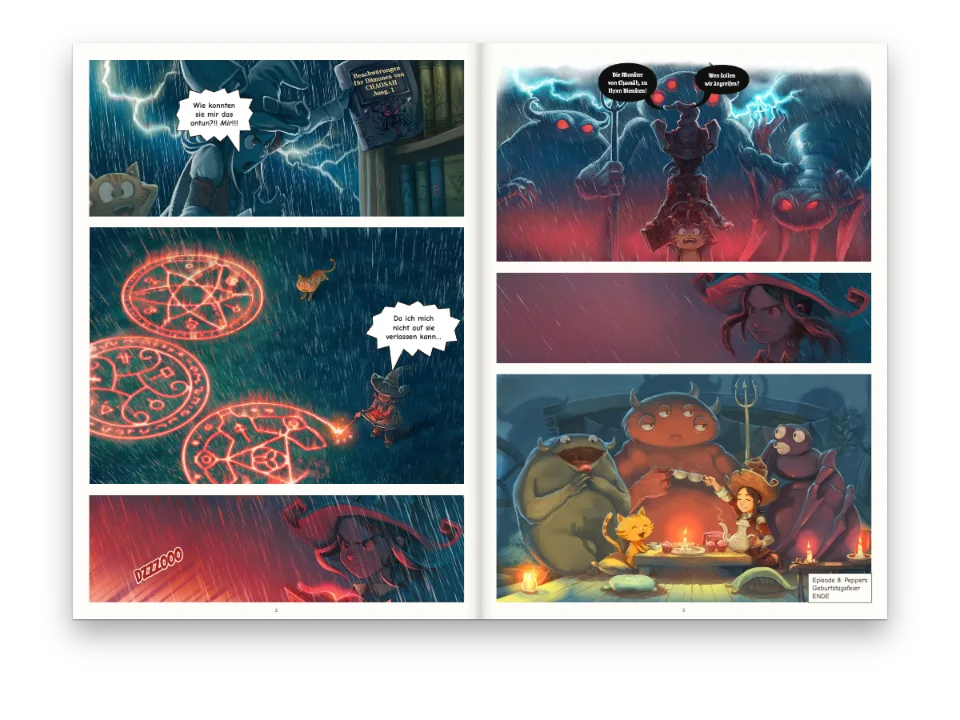
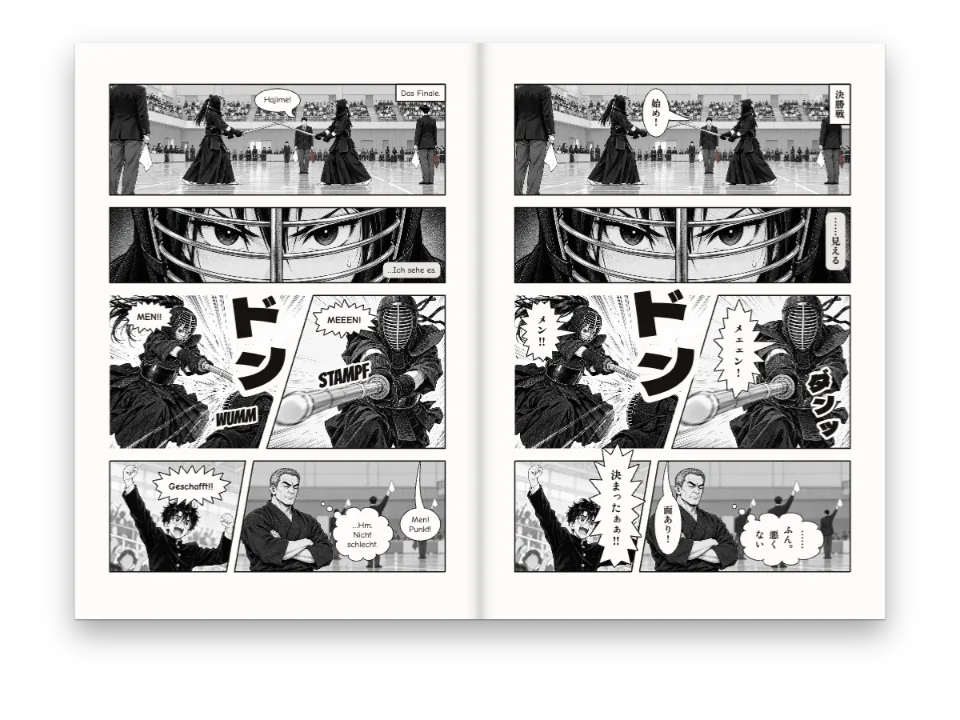
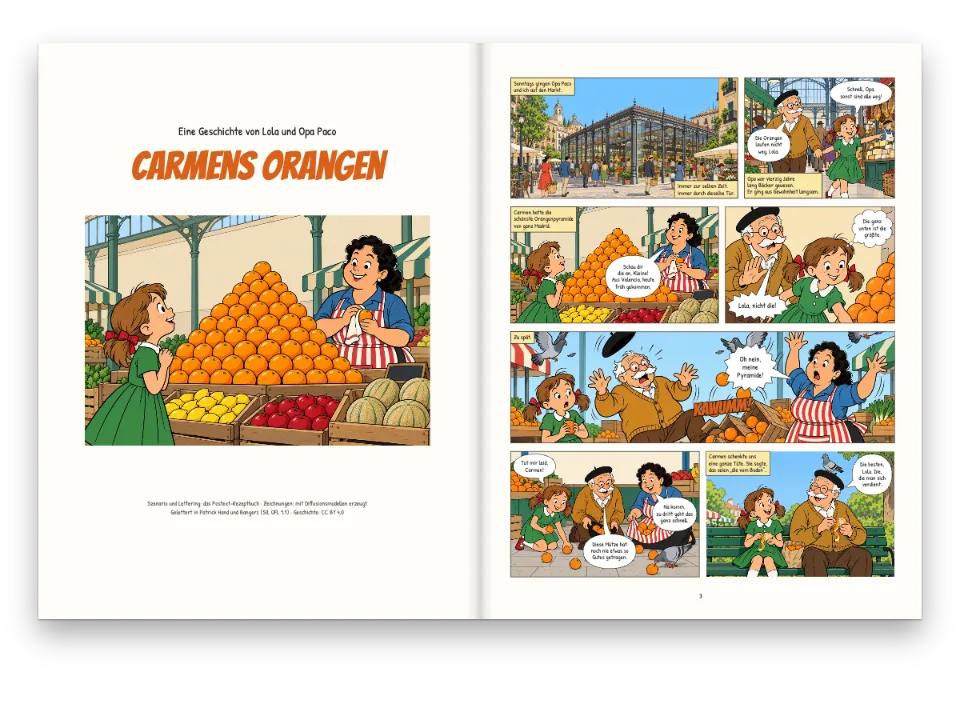
Kurz gesagt
Eine Comicseite über eine Rettung im Sturm, die jede Art von Sprechblase verwendet, mit einem Musterblatt des Letterers, das zeigt, wie jede im Skript geschrieben wird.
Was Sie setzen
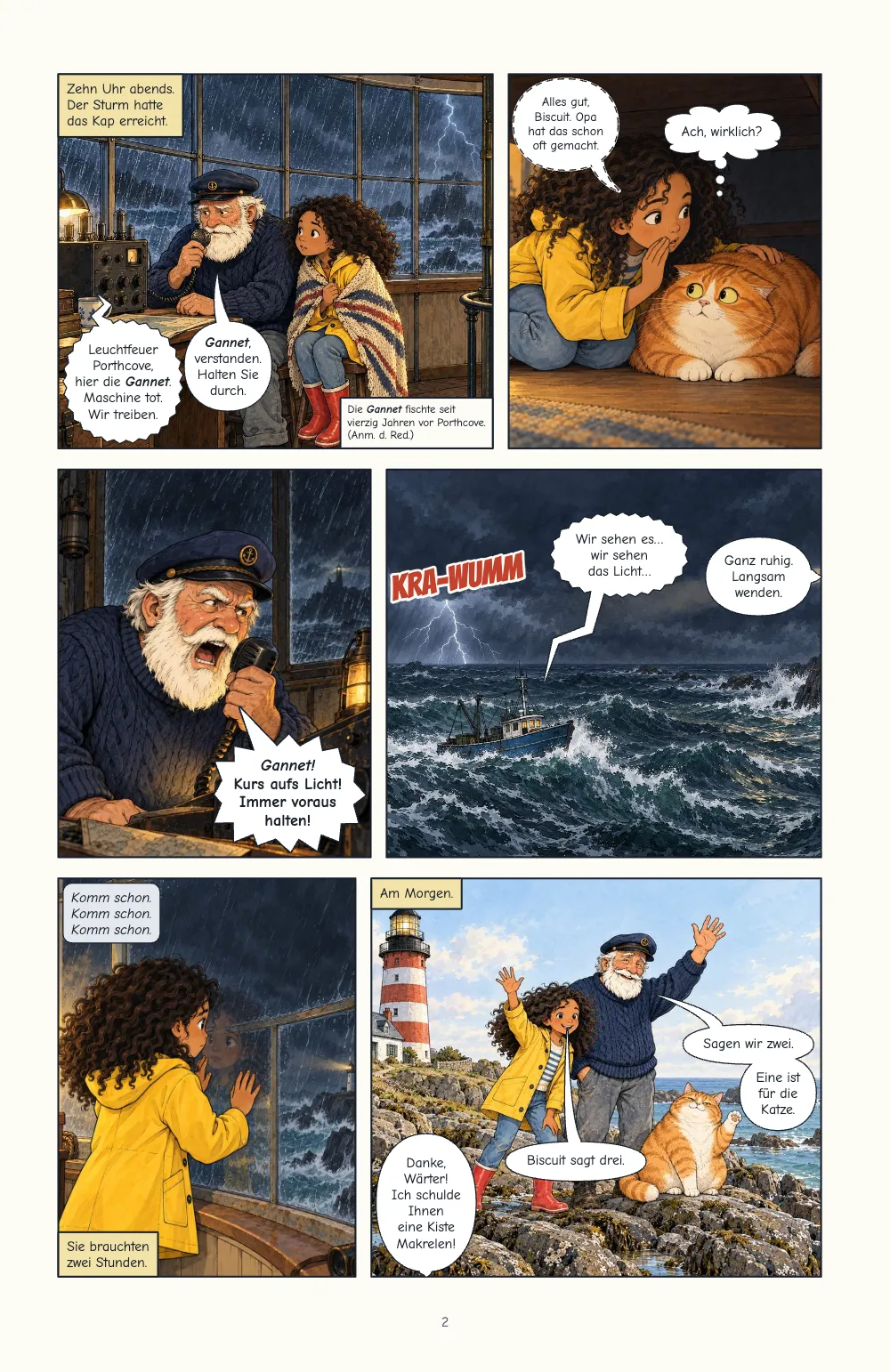
Seite 7 von Der Leuchtturm von Porthcove, einem Comic über eine Sturmnacht an einem Leuchtturm, mit dem Musterblatt des Letterers davor. Ein Trawler verliert seinen Motor, der Leuchtturmwärter lotst ihn über Funk herein, Maya wartet mit der Katze, und am Morgen bedankt sich der Kapitän. Die Seite verwendet jede Art von Sprechblase, die Postext zeichnet: Sprechblase, verbundene Sprechblasen, Denkblase, Flüsterblase, Schreiblase, Funkblase, erzählende Textkästen, eine innere Stimme, eine Anmerkung des Herausgebers, einen Soundeffekt, eine Stimme aus dem Off und eine festgesteckte Sprechblase. Das Endformat ist das eines amerikanischen Comicheftes, 168 × 259 mm, und die Seite liegt in zehn Sprachen vor.
Dieses Rezept beantwortet
- Wie zeige ich Gedanken-, Flüster-, Schrei- und Funkblasen?
- Wie richte ich den Dorn einer Sprechblase auf die sprechende Figur?
- Wie lettere ich Soundeffekte über die Zeichnung?
- Wie schreibe ich Sprechblasen in Markdown?
Die kurze Antwort
// A script line is `speaker{kind}: text`. The kinds are balloon styles: the engine ships
// speech, thought, whisper, shout, radio, caption, inner, note and sfx, and a style of the
// same id here changes only what it names. `caption`, `note` and `sfx` are reserved speakers.
const balloonStyles = [
  { id: 'speech', stroke: col('ink') }, // an oval, a curved tail to the mouth
  { id: 'thought', stroke: col('ink') }, // a cloud, bubbles to the head
  { id: 'whisper', stroke: col('ink') }, // a dashed outline, 0.9 × the type
  { id: 'shout', stroke: col('ink'), burstPoints: 16 }, // a burst, bold, 1.15 × the type
  { id: 'radio', stroke: col('ink') }, // a zig-zag outline and tail: a voice through a set
  { id: 'caption', fill: col('caption'), stroke: col('ink') }, // narration, butted to a corner
  { id: 'inner', fill: col('inner'), stroke: col('ink') }, // no tail, italic where it can be
  { id: 'note', fill: col('paper'), stroke: col('ink') }, // the editor's note, 0.8 × the type
  { id: 'sfx', fontFamily: SFX, color: col('accent'), haloColor: col('paper') }, // no balloon
];
const comics = {
  gutter: { horizontal: mm(4), vertical: mm(3) },
  panel: { borderWidth: pt(1), borderColor: col('ink'), background: col('paper') },
  lettering: { fontFamily: LETTERING, fontSize: pt(7.5), color: col('ink'), inset: mm(1) },
  balloonStyles,
  // A speaker's own style: every `skipper:` line comes through the radio unless it says not.
  cast: [{ id: 'skipper', balloonStyle: 'radio', name: t({ en: 'The skipper', es: 'El patrón',
    ca: 'El patró', zh: '船长', ar: 'الربّان', ja: '船長', pt: 'O capitão', fr: 'Le patron',
    de: 'Der Kapitän',
    it: 'Il capitano' }) }],
  runningHeads: true, // a comic page has no running head unless asked: here, its folio
};
Zutaten
- Funktionen
- SprechblasenformateSoundeffekteSprecher und AnkerPanel-AufteilungPanelbilder und ZuschnitteComicseitenComic-LetteringNeues Lettering in anderen SprachenSemantische FarbpaletteSeiten auf einem CanvasPDF-Export
- Nutzt außerdem
- Inline-ChipsPanelrahmen und ZwischenräumePapierfarbeAbsatzformateIm PDF eingebettete SchriftenAbbildungen und Tabellen als Ressourcen
- Schrift
- Comic Neue, Bangers, Zen Antique, Dela Gothic One, ZCOOL KuaiLe, ZCOOL QingKe HuangYou, Playpen Sans Arabic, Lalezar (SIL OFL 1.1)
- Dateien
bk-morning.jpgbk-sea.jpgbk-shout.jpgbk-storm.jpgbk-whisper.jpgbk-window.jpg- Panel picture: the storm in the lamp room (Generated With Diffusion Models, eigener Text)
- Panel picture: Maya and the cat under the desk (Generated With Diffusion Models, eigener Text)
- Panel picture: the keeper shouting into the microphone (Generated With Diffusion Models, eigener Text)
- Panel picture: the trawler in the storm (Generated With Diffusion Models, eigener Text)
- Panel picture: Maya at the window (Generated With Diffusion Models, eigener Text)
- Panel picture: the next morning on the rocks (Generated With Diffusion Models, eigener Text)
Zubereitung
#1 · Die Art in der Skriptzeile benennen
Der Code steht oben in der kurzen Antwort. Eine Skriptzeile lautet speaker{kind}: text, und die Art ist die ID eines Sprechblasenformats. Die neun eingebauten Formate decken die üblichen Arten ab: ein Oval mit gebogenem Dorn für Sprache, eine Wolke mit Bläschen für Gedanken, eine gestrichelte Kontur zum Flüstern, eine Explosion mit Keildorn für einen Schrei, eine gezackte Kontur mit Zickzackdorn für eine Stimme aus dem Funkgerät (Sprechblasenformate). Ein Format mit derselben ID in der Konfiguration ändert nur, was es nennt: hier die Konturfarbe, das Gelb der Textkästen und die 16 Zacken der Explosion. caption, note und sfx sind reservierte Sprecher: in eine Ecke gestoßene Erzähltextkästen, die Anmerkung des Herausgebers in 0,8-facher Größe und Display-Buchstaben ohne Blase.
#2 · Jeden Dorn auf einen Sprecher richten
// From the art manifest; fractions of each picture, the same in every language. `skipper` in
// the storm picture is the radio set, the voice's source; in the sea picture, his boat.
const ART = {
  'bk-storm': { width: 1100, height: 733, safeArea: { x: 0.05, y: 0.26, width: 0.52, height: 0.36 },
    anchors: [{ id: 'tomas', x: 0.3, y: 0.44, head: { x: 0.32, y: 0.33 },
      face: { x: 0.26, y: 0.29, width: 0.13, height: 0.21 } },
    { id: 'maya', x: 0.475, y: 0.47, head: { x: 0.48, y: 0.38 },
      face: { x: 0.43, y: 0.35, width: 0.09, height: 0.16 } },
    { id: 'skipper', x: 0.08, y: 0.52 }],
    avoid: [{ x: 0, y: 0.38, width: 0.18, height: 0.28 }],
    alt: t({ en: 'Storm at night in the lamp room: the keeper speaks into the radio microphone '
      + 'while Maya, wrapped in a blanket, listens.',
      es: 'Noche de tormenta en la sala de la linterna: el farero habla por el micrófono de la '
        + 'radio y Maya, envuelta en una manta, escucha.',
      ca: 'Nit de tempesta a la sala de la llanterna: el faroner parla pel micròfon de la ràdio i '
        + 'la Maya, embolicada amb una manta, escolta.',
      zh: '暴风雨之夜的灯室里,守塔人对着收音机的话筒说话,裹着毯子的玛雅在一旁听着。',
      ar: 'ليلة عاصفة في غرفة الفانوس: الحارس يتكلم في ميكروفون المذياع، ومايا الملتفّة ببطانية '
        + 'تصغي.',
      ja: '嵐の夜の灯室。灯台守が無線のマイクに話しかけ、毛布にくるまったマヤが耳をすます。',
      pt: 'Noite de tempestade na sala da lanterna: o faroleiro fala ao microfone do rádio e '
        + 'Maya, enrolada num cobertor, escuta.',
      fr: 'Nuit de tempête dans la chambre de la lanterne : le gardien parle dans le micro de '
        + 'la radio pendant que Maya, emmitouflée dans une couverture, écoute.',
      de: 'Sturmnacht im Laternenraum: Der Wärter spricht ins Mikrofon des Funkgeräts, während '
        + 'Maya, in eine Decke gewickelt, zuhört.',
      it: 'Notte di tempesta nella stanza della lanterna: il guardiano parla al microfono della '
        + 'radio e Maya, avvolta in una coperta, ascolta.' }) },
  'bk-whisper': { width: 1152, height: 1152,
    safeArea: { x: 0.36, y: 0.26, width: 0.44, height: 0.48 },
    anchors: [{ id: 'maya', x: 0.53, y: 0.47, head: { x: 0.52, y: 0.33 },
      face: { x: 0.41, y: 0.3, width: 0.19, height: 0.22 } },
    { id: 'biscuit', x: 0.625, y: 0.635, head: { x: 0.66, y: 0.57 },
      face: { x: 0.55, y: 0.5, width: 0.25, height: 0.22 } }],
    avoid: [],
    alt: t({ en: 'Under the desk, Maya whispers behind her hand to the frightened orange cat.',
      es: 'Bajo la mesa, Maya le susurra tapándose la boca al gato naranja asustado.',
      ca: 'Sota la taula, la Maya xiuxiueja tapant-se la boca al gat taronja espantat.',
      zh: '桌子底下,玛雅用手挡着嘴,对受惊的橘猫说悄悄话。',
      ar: 'تحت المكتب تهمس مايا من وراء يدها للقط البرتقالي الخائف.',
      ja: '机の下で、マヤが手で口をかくして、おびえたオレンジ色の猫にささやく。',
      pt: 'Debaixo da mesa, Maya cobre a boca com a mão e sussurra para o gato laranja '
        + 'assustado.',
      fr: 'Sous le bureau, Maya chuchote derrière sa main au chat roux effrayé.',
      de: 'Unter dem Schreibtisch flüstert Maya hinter vorgehaltener Hand der verängstigten '
        + 'roten Katze zu.',
      it: 'Sotto la scrivania, Maya sussurra dietro la mano al gatto rosso spaventato.' }) },
  'bk-shout': { width: 880, height: 1100, safeArea: { x: 0.22, y: 0.26, width: 0.46, height: 0.42 },
    anchors: [{ id: 'tomas', x: 0.48, y: 0.47, head: { x: 0.42, y: 0.33 },
      face: { x: 0.25, y: 0.28, width: 0.37, height: 0.32 } }],
    avoid: [{ x: 0.53, y: 0.43, width: 0.17, height: 0.27 }],
    alt: t({ en: 'Close-up of the keeper shouting into the microphone, lit from below by the '
      + 'radio dials.',
      es: 'Primer plano del farero gritando al micrófono, iluminado desde abajo por los diales de '
        + 'la radio.',
      ca: 'Primer pla del faroner cridant al micròfon, il·luminat des de baix pels dials de la '
        + 'ràdio.',
      zh: '守塔人对着话筒大喊的特写,收音机的刻度盘从下方照亮他的脸。',
      ar: 'لقطة قريبة للحارس يصرخ في الميكروفون، وأضواء لوحة المذياع تنيره من أسفل.',
      ja: 'マイクに向かって叫ぶ灯台守のアップ。無線機の目盛りの光が下から顔を照らす。',
      pt: 'Close do faroleiro gritando ao microfone, iluminado de baixo pelos mostradores do '
        + 'rádio.',
      fr: 'Gros plan sur le gardien qui crie dans le micro, éclairé par en dessous par les '
        + 'cadrans de la radio.',
      de: 'Nahaufnahme des Wärters, der ins Mikrofon schreit, von unten von den Skalen des '
        + 'Funkgeräts beleuchtet.',
      it: 'Primo piano del guardiano che grida nel microfono, illuminato dal basso dai '
        + 'quadranti della radio.' }) },
  'bk-sea': { width: 1200, height: 800, safeArea: { x: 0.1, y: 0.19, width: 0.37, height: 0.57 },
    anchors: [{ id: 'skipper', x: 0.28, y: 0.63 }, { id: 'sfx', x: 0.16, y: 0.36 }],
    avoid: [{ x: 0.13, y: 0.52, width: 0.24, height: 0.23 },
      { x: 0.85, y: 0.19, width: 0.08, height: 0.26 }],
    alt: t({ en: 'A small blue trawler heaves on storm waves at night; lightning on the left, the '
      + 'lighthouse beam on the right.',
      es: 'Un pesquero azul cabecea entre las olas de la tormenta; un rayo a la izquierda, el haz '
        + 'del faro a la derecha.',
      ca: 'Un pesquer blau capcineja entre les onades de la tempesta; un llamp a l’esquerra, el '
        + 'feix del far a la dreta.',
      zh: '夜里,一艘蓝色小渔船在暴风雨的浪头上颠簸;左边是闪电,右边是灯塔的光束。',
      ar: 'قارب صيد أزرق صغير يتقاذفه موج العاصفة ليلًا؛ برق على اليسار وشعاع المنارة على اليمين.',
      ja: '夜の嵐の波にもまれる青い小さな漁船。左に稲妻、右に灯台の光。',
      pt: 'Um pequeno barco pesqueiro azul jogado pelas ondas da tempestade à noite; um raio à '
        + 'esquerda, o facho do farol à direita.',
      fr: 'Un petit chalutier bleu tangue la nuit sur les vagues de la tempête ; un éclair à '
        + 'gauche, le faisceau du phare à droite.',
      de: 'Ein kleiner blauer Kutter schlingert nachts in den Wellen des Sturms; links ein '
        + 'Blitz, rechts der Strahl des Leuchtturms.',
      it: 'Un piccolo peschereccio blu sballottato di notte dalle onde della tempesta; un lampo a '
        + 'sinistra, il fascio del faro a destra.' }) },
  'bk-window': { width: 1000, height: 1000,
    safeArea: { x: 0.36, y: 0.27, width: 0.28, height: 0.33 },
    anchors: [{ id: 'maya', x: 0.49, y: 0.41, head: { x: 0.42, y: 0.3 },
      face: { x: 0.41, y: 0.33, width: 0.1, height: 0.13 } }],
    avoid: [{ x: 0.5, y: 0.33, width: 0.1, height: 0.17 },
      { x: 0.83, y: 0.45, width: 0.06, height: 0.08 }],
    alt: t({ en: 'Maya presses her hands and nose to the rainy window, staring out at the storm.',
      es: 'Maya pega las manos y la nariz al cristal mojado y mira la tormenta.',
      ca: 'La Maya enganxa les mans i el nas al vidre mullat i mira la tempesta.',
      zh: '玛雅把双手和鼻子贴在满是雨水的窗户上,望着外面的暴风雨。',
      ar: 'تلصق مايا يديها وأنفها بالزجاج المبلل وتحدّق في العاصفة.',
      ja: 'マヤが雨の窓に両手と鼻を押しつけ、嵐を見つめる。',
      pt: 'Maya cola as mãos e o nariz no vidro molhado e olha a tempestade.',
      fr: 'Maya colle les mains et le nez contre la vitre mouillée et regarde la tempête.',
      de: 'Maya drückt Hände und Nase gegen das regennasse Fenster und starrt hinaus in den '
        + 'Sturm.',
      it: 'Maya preme le mani e il naso contro il vetro bagnato e guarda la tempesta.' }) },
  'bk-morning': { width: 1000, height: 667,
    safeArea: { x: 0.33, y: 0.06, width: 0.42, height: 0.59 },
    anchors: [{ id: 'tomas', x: 0.565, y: 0.25, head: { x: 0.56, y: 0.15 },
      face: { x: 0.51, y: 0.13, width: 0.1, height: 0.17 } },
    { id: 'maya', x: 0.465, y: 0.29, head: { x: 0.45, y: 0.24 },
      face: { x: 0.41, y: 0.19, width: 0.09, height: 0.14 } },
    { id: 'biscuit', x: 0.685, y: 0.58, head: { x: 0.69, y: 0.55 },
      face: { x: 0.64, y: 0.51, width: 0.09, height: 0.11 } }],
    avoid: [{ x: 0.66, y: 0.08, width: 0.08, height: 0.12 },
      { x: 0.34, y: 0.14, width: 0.06, height: 0.08 }],
    alt: t({ en: 'Next morning on the sunny rocks, Maya, the keeper and the cat wave; the '
      + 'lighthouse stands behind them.',
      es: 'A la mañana siguiente, en las rocas al sol, Maya, el farero y el gato saludan; detrás '
        + 'está el faro.',
      ca: 'L’endemà al matí, a les roques al sol, la Maya, el faroner i el gat saluden; darrere '
        + 'hi ha el far.',
      zh: '第二天早上,阳光照着礁石,玛雅、守塔人和猫在挥手;灯塔立在他们身后。',
      ar: 'في الصباح التالي على الصخور المشمسة يلوّح مايا والحارس والقط، والمنارة خلفهم.',
      ja: '翌朝、日の当たる岩の上でマヤと灯台守と猫が手を振る。後ろに灯台が立つ。',
      pt: 'Na manhã seguinte, nas pedras ao sol, Maya, o faroleiro e o gato acenam; atrás deles '
        + 'está o farol.',
      fr: 'Le lendemain matin, sur les rochers au soleil, Maya, le gardien et le chat font signe '
        + 'de la main ; le phare se dresse derrière eux.',
      de: 'Am nächsten Morgen winken Maya, der Wärter und die Katze auf den sonnigen Felsen; '
        + 'hinter ihnen steht der Leuchtturm.',
      it: 'La mattina dopo, sugli scogli al sole, Maya, il guardiano e il gatto salutano con la '
        + 'mano; alle loro spalle si alza il faro.' }) },
};
Jedes Bild trägt Ankerpunkte in Bruchteilen des Bildes: den Mund, auf den ein Sprechdorn zielt, den Kopf, auf den ein Gedanke zielt, das Gesicht, das keine Blase verdecken darf (Sprecher und Anker). Der Kapitän wird nie gezeichnet: Sein Anker ist im Sturmbild das Funkgerät, im Seebild sein Boot. Ist der Sprecher nicht im Panel, führt tail=right (oder left, top, bottom) den Dorn an diesen Rand, und at="44% 22%" steckt die Mitte einer Blase auf einen Punkt des Bildes fest, sodass sie dort bleibt, wie auch immer beschnitten wird. Zwei aufeinanderfolgende Zeilen desselben Sprechers verbinden sich zu einer Kontur mit einem Dorn. left und right sind Seiten des Bildes, darum schreiben die zehn Ausgaben dieselbe Zeile für den Wärter im Seepanel, dessen Licht rechts im Bild steht: tail=right, ob von links nach rechts oder von rechts nach links gelesen. start und end folgen dagegen der Leserichtung der Seite.
#3 · Einer Figur eine eigene Stimme geben
Die Besetzung in der kurzen Antwort gibt jeder Zeile skipper: das Funkformat, sodass das Skript {radio} nie wiederholt. Eine Zeile kann trotzdem anderes verlangen: Im Morgenpanel ruft der Kapitän von seinem Boot aus, skipper{speech tail=bottom}:, in einer gewöhnlichen Sprechblase, deren Dorn unten aus dem Panel läuft.
#4 · Jede Ausgabe in ihren eigenen Schriften lettern
// The engine's default lettering and sound-effect faces, but for Chinese two ZCOOL faces drawn
// for cartoons. content.<lang>.md holds the words under the same speaker ids.
const [LETTERING, SFX] = t({
  en: ['Comic Neue', 'Bangers'], es: ['Comic Neue', 'Bangers'], ca: ['Comic Neue', 'Bangers'],
  ja: ['Zen Antique', 'Dela Gothic One'], zh: ['ZCOOL KuaiLe', 'ZCOOL QingKe HuangYou'],
  ar: ['Playpen Sans Arabic', 'Lalezar'], pt: ['Comic Neue', 'Bangers'],
  fr: ['Comic Neue', 'Bangers'], de: ['Comic Neue', 'Bangers'], it: ['Comic Neue', 'Bangers'],
});
Dieselbe Seite liegt in zehn Sprachen vor: content.<lang>.md enthält nur die Wörter. Die japanischen Sprechblasen sind vertikal in der Zen Antique gesetzt und ihre Soundeffekte in der Dela Gothic One, die arabischen in der Playpen Sans Arabic mit der Lalezar für den Donner. Kursiv und fett greifen dort, wo die Schrift sie hat: Die innere Stimme ist im Englischen kursiv, im Japanischen aufrecht (Lettering).
Das ganze Rezept
// ═══ Postext Cookbook · Nº 145 · Every kind of balloon on a lighthouse page ═════════ // https://postext.dev/en/cookbook/balloon-kinds // Code: MIT · Text: original (CC BY 4.0) · Pictures: generated with diffusion models // Fonts: Comic Neue, Bangers and the faces of five editions (OFL) · Needs postext ≥ 1.28.0 // // One comic page that uses every kind of balloon the engine draws, with a letterer's style // sheet in front of it. Each line of the script names its speaker and, when it is not plain // speech, its kind; the shape, the tail and the type follow from the balloon style. import { buildDocument, withLoadedFonts, renderPageToCanvas, registerResourceImage, loadVerticalAlternates, } from 'https://esm.sh/postext'; import { renderToPdf, decompressWoff2 } from 'https://esm.sh/postext-pdf'; const LANG = 'de'; // @lang: 'en' | 'es' | 'ca' | 'zh' | 'ar' | 'ja' | 'pt' | 'fr' | 'de' | 'it' const RECIPE = 'balloon-kinds'; // ─── 1 · Design ───────────────────────────────────────────────────────────── // #region palette: a storm at night, and the yellow of the captions const palette = { ink: '#18202b', // panel borders, lettering and text: a blue-black accent: '#c2412d', // sound effects and the style sheet's labels caption: '#f3e3a8', // narration boxes inner: '#e4e8ee', // the inner voice: a cold grey-blue muted: '#5c6672', // folios and the imprint paper: '#fdfbf6', }; const col = (id) => ({ hex: palette[id], model: 'hex', paletteId: id }); const colorPalette = [ ...Object.entries(palette).map(([id, hex]) => ({ id, name: id, value: { hex, model: 'hex' } })), { id: 'main-color', name: 'accent (defaults)', value: { hex: palette.accent, model: 'hex' } }, ]; // #endregion // #region editions: six editions, each lettered in faces for its script // The engine's default lettering and sound-effect faces, but for Chinese two ZCOOL faces drawn // for cartoons. content.<lang>.md holds the words under the same speaker ids. const [LETTERING, SFX] = t({ en: ['Comic Neue', 'Bangers'], es: ['Comic Neue', 'Bangers'], ca: ['Comic Neue', 'Bangers'], ja: ['Zen Antique', 'Dela Gothic One'], zh: ['ZCOOL KuaiLe', 'ZCOOL QingKe HuangYou'], ar: ['Playpen Sans Arabic', 'Lalezar'], pt: ['Comic Neue', 'Bangers'], fr: ['Comic Neue', 'Bangers'], de: ['Comic Neue', 'Bangers'], it: ['Comic Neue', 'Bangers'], }); // #endregion // #region answer: one balloon style per kind, and a cast that gives the skipper his radio // A script line is `speaker{kind}: text`. The kinds are balloon styles: the engine ships // speech, thought, whisper, shout, radio, caption, inner, note and sfx, and a style of the // same id here changes only what it names. `caption`, `note` and `sfx` are reserved speakers. const balloonStyles = [ { id: 'speech', stroke: col('ink') }, // an oval, a curved tail to the mouth { id: 'thought', stroke: col('ink') }, // a cloud, bubbles to the head { id: 'whisper', stroke: col('ink') }, // a dashed outline, 0.9 × the type { id: 'shout', stroke: col('ink'), burstPoints: 16 }, // a burst, bold, 1.15 × the type { id: 'radio', stroke: col('ink') }, // a zig-zag outline and tail: a voice through a set { id: 'caption', fill: col('caption'), stroke: col('ink') }, // narration, butted to a corner { id: 'inner', fill: col('inner'), stroke: col('ink') }, // no tail, italic where it can be { id: 'note', fill: col('paper'), stroke: col('ink') }, // the editor's note, 0.8 × the type { id: 'sfx', fontFamily: SFX, color: col('accent'), haloColor: col('paper') }, // no balloon ]; const comics = { gutter: { horizontal: mm(4), vertical: mm(3) }, panel: { borderWidth: pt(1), borderColor: col('ink'), background: col('paper') }, lettering: { fontFamily: LETTERING, fontSize: pt(7.5), color: col('ink'), inset: mm(1) }, balloonStyles, // A speaker's own style: every `skipper:` line comes through the radio unless it says not. cast: [{ id: 'skipper', balloonStyle: 'radio', name: t({ en: 'The skipper', es: 'El patrón', ca: 'El patró', zh: '船长', ar: 'الربّان', ja: '船長', pt: 'O capitão', fr: 'Le patron', de: 'Der Kapitän', it: 'Il capitano' }) }], runningHeads: true, // a comic page has no running head unless asked: here, its folio }; // #endregion const LABEL = { fontFamily: LETTERING, fontSize: pt(7.5), color: col('muted') }; const footer = { elements: [{ kind: 'text', id: 'folio', content: '{pageNumber}', ...LABEL, align: 'center', placement: { anchor: { to: 'page', edge: 'bottom' }, offset: { x: mm(0), y: mm(-8) } } }] }; const config = () => ({ locale: t({ en: 'en-us', es: 'es', ca: 'ca', ja: 'ja', zh: 'zh-Hans', ar: 'ar', pt: 'pt-BR', fr: 'fr', de: 'de', it: 'it' }), colorPalette, comics, // The trim of an American comic book, 6⅝ × 10³⁄₁₆ in; the type area is the panel frame. page: { sizePreset: 'custom', width: mm(168), height: mm(259), dpi: 150, backgroundColor: col('paper'), margins: { top: mm(14), bottom: mm(18), left: mm(13), right: mm(11), mirror: true } }, layout: { layoutType: 'single' }, // The style sheet is set in the lettering face of the edition. bodyText: { fontFamily: LETTERING, fontSize: pt(9.5), lineHeight: pt(13.5), color: col('ink'), boldColor: col('ink'), italicColor: col('ink'), referenceColor: col('ink'), textAlign: 'left', firstLineIndent: pt(0), paragraphSpacing: true, hyphenation: { enabled: false } }, headings: { fontFamily: SFX, color: col('accent'), fontWeight: 400, levels: [ // The style sheet's title opens a page, on either side. { level: 1, fontSize: pt(34), lineHeight: pt(38), breakBefore: { enabled: true, parity: 'any' }, marginTop: mm(18), marginBottom: pt(13.5) }, { level: 2, fontFamily: LETTERING, fontSize: pt(9.5), fontWeight: 700, color: col('accent'), marginTop: pt(13.5), marginBottom: pt(0) }, ] }, unorderedLists: { bulletChar: '–', color: col('accent'), fontWeight: 400, marginTop: pt(0), marginBottom: pt(0) }, // The script's markup on the style sheet: a chip in the caption yellow. chipStyles: [{ id: 'code', background: col('caption'), color: col('ink'), borderWidth: pt(0), borderRadius: pt(1.5), fontFamily: LETTERING, fontSize: em(0.9), paddingX: em(0.3), paddingY: em(0.1) }], paragraphStyles: [{ id: 'imprint', fontSize: pt(7.5), lineHeight: pt(10), color: col('muted'), marginTop: pt(27) }], header: { elements: [] }, footer, }); // ─── 2 · Content ──────────────────────────────────────────────────────────── const markdown = String.raw`# Lettering-MusterblattMarkdown-Beispiel · 47 Zeilen · content.de.md
## Der Leuchtturm von Porthcove · Heft 3 · Seite 7 Eine Zeile des Skripts ist eine Sprechblase: wer spricht, die Art in geschweiften Klammern, wenn es keine einfache Rede ist, ein Doppelpunkt, dann der Text. Die Formen unten sind die auf Seite 2. - **Sprechblase.** :chip[tomas: Sagen wir zwei.]{style="code"} Ein Oval; der Dorn endet kurz vor dem Mund des Sprechers. - **Verbunden.** Zwei Zeilen :chip[tomas:]{style="code"} hintereinander verschmelzen zu einer Kontur mit einem Dorn. - **Gedanke.** :chip[biscuit{thought}:]{style="code"} Eine Wolke, mit Bläschen, die zum Kopf aufsteigen. - **Flüstern.** :chip[maya{whisper}:]{style="code"} Eine gestrichelte Kontur und kleinere Buchstaben. - **Schrei.** :chip[tomas{shout}:]{style="code"} Eine Explosion, fett, eine Größe größer. - **Funk.** Der Kapitän spricht über das Funkgerät: Die Besetzung gibt jeder Zeile :chip[skipper:]{style="code"} eine gezackte Kontur und einen Zickzackdorn. - **Textkasten.** :chip[caption:]{style="code"} Die Erzählung in einem gelben Kasten, in eine Ecke gesetzt. - **Innere Stimme.** :chip[maya{inner}:]{style="code"} Was sie nicht laut sagt: kein Dorn, ein grauer Kasten, kursiv. - **Anmerkung der Redaktion.** :chip[note:]{style="code"} Klein, in der unteren Ecke des Panels. - **Soundeffekt.** :chip[sfx{at="16% 28%" rotate=-10}:]{style="code"} Keine Blase: Display-Buchstaben in Rot mit weißer Kontur, von Hand platziert und gedreht. - **Aus dem Off.** :chip[tomas{tail=right}:]{style="code"} Der Sprecher ist außerhalb des Bildes; der Dorn läuft bis zum Rand des Panels. - **Festgesteckt.** :chip[skipper{at="44% 22%"}:]{style="code"} Die Blase sitzt mittig auf diesem Punkt des Bildes, wie auch immer es beschnitten wird. :::paragraphs{style="imprint"} Geschichte und Lettering für das Postext-Rezeptbuch. Bilder mit Diffusionsmodellen erzeugt. Gelettert in Comic Neue und Bangers (SIL OFL). ::: :::page{split="32 [58 | *] / 34 [42 | *] / * [40 | *]"} ::panel{art=bk-storm} caption: Zehn Uhr abends. Der Sturm hatte das Kap erreicht. skipper: Leuchtfeuer Porthcove, hier die *Gannet*. Maschine tot. Wir treiben. tomas: *Gannet*, verstanden. Halten Sie durch. note{at=bottom-end}: Die *Gannet* fischte seit vierzig Jahren vor Porthcove. (Anm. d. Red.) ::panel{art=bk-whisper} maya{whisper}: Alles gut, Biscuit. Opa hat das schon oft gemacht. biscuit{thought}: Ach, wirklich? ::panel{art=bk-shout} tomas{shout}: *Gannet!* Kurs aufs Licht! Immer voraus halten! ::panel{art=bk-sea} sfx{at="16% 28%" rotate=-10}: KRA-WUMM skipper{at="44% 22%"}: Wir sehen es… wir sehen das Licht… tomas{tail=right}: Ganz ruhig. Langsam wenden. ::panel{art=bk-window} maya{inner}: Komm schon. Komm schon. Komm schon. caption{at=bottom-start}: Sie brauchten zwei Stunden. ::panel{art=bk-morning} caption{at=top-start}: Am Morgen. skipper{speech tail=bottom}: Danke, Wärter! Ich schulde Ihnen eine Kiste Makrelen! tomas: Sagen wir zwei. tomas: Eine ist für die Katze. maya: Biscuit sagt drei. :::`; // content.<lang>.md, inlined by the Cookbook // #region art: the six pictures: safe area, speakers' anchors and avoid zones // From the art manifest; fractions of each picture, the same in every language. `skipper` in // the storm picture is the radio set, the voice's source; in the sea picture, his boat. const ART = { 'bk-storm': { width: 1100, height: 733, safeArea: { x: 0.05, y: 0.26, width: 0.52, height: 0.36 }, anchors: [{ id: 'tomas', x: 0.3, y: 0.44, head: { x: 0.32, y: 0.33 }, face: { x: 0.26, y: 0.29, width: 0.13, height: 0.21 } }, { id: 'maya', x: 0.475, y: 0.47, head: { x: 0.48, y: 0.38 }, face: { x: 0.43, y: 0.35, width: 0.09, height: 0.16 } }, { id: 'skipper', x: 0.08, y: 0.52 }], avoid: [{ x: 0, y: 0.38, width: 0.18, height: 0.28 }], alt: t({ en: 'Storm at night in the lamp room: the keeper speaks into the radio microphone ' + 'while Maya, wrapped in a blanket, listens.', es: 'Noche de tormenta en la sala de la linterna: el farero habla por el micrófono de la ' + 'radio y Maya, envuelta en una manta, escucha.', ca: 'Nit de tempesta a la sala de la llanterna: el faroner parla pel micròfon de la ràdio i ' + 'la Maya, embolicada amb una manta, escolta.', zh: '暴风雨之夜的灯室里,守塔人对着收音机的话筒说话,裹着毯子的玛雅在一旁听着。', ar: 'ليلة عاصفة في غرفة الفانوس: الحارس يتكلم في ميكروفون المذياع، ومايا الملتفّة ببطانية ' + 'تصغي.', ja: '嵐の夜の灯室。灯台守が無線のマイクに話しかけ、毛布にくるまったマヤが耳をすます。', pt: 'Noite de tempestade na sala da lanterna: o faroleiro fala ao microfone do rádio e ' + 'Maya, enrolada num cobertor, escuta.', fr: 'Nuit de tempête dans la chambre de la lanterne : le gardien parle dans le micro de ' + 'la radio pendant que Maya, emmitouflée dans une couverture, écoute.', de: 'Sturmnacht im Laternenraum: Der Wärter spricht ins Mikrofon des Funkgeräts, während ' + 'Maya, in eine Decke gewickelt, zuhört.', it: 'Notte di tempesta nella stanza della lanterna: il guardiano parla al microfono della ' + 'radio e Maya, avvolta in una coperta, ascolta.' }) }, 'bk-whisper': { width: 1152, height: 1152, safeArea: { x: 0.36, y: 0.26, width: 0.44, height: 0.48 }, anchors: [{ id: 'maya', x: 0.53, y: 0.47, head: { x: 0.52, y: 0.33 }, face: { x: 0.41, y: 0.3, width: 0.19, height: 0.22 } }, { id: 'biscuit', x: 0.625, y: 0.635, head: { x: 0.66, y: 0.57 }, face: { x: 0.55, y: 0.5, width: 0.25, height: 0.22 } }], avoid: [], alt: t({ en: 'Under the desk, Maya whispers behind her hand to the frightened orange cat.', es: 'Bajo la mesa, Maya le susurra tapándose la boca al gato naranja asustado.', ca: 'Sota la taula, la Maya xiuxiueja tapant-se la boca al gat taronja espantat.', zh: '桌子底下,玛雅用手挡着嘴,对受惊的橘猫说悄悄话。', ar: 'تحت المكتب تهمس مايا من وراء يدها للقط البرتقالي الخائف.', ja: '机の下で、マヤが手で口をかくして、おびえたオレンジ色の猫にささやく。', pt: 'Debaixo da mesa, Maya cobre a boca com a mão e sussurra para o gato laranja ' + 'assustado.', fr: 'Sous le bureau, Maya chuchote derrière sa main au chat roux effrayé.', de: 'Unter dem Schreibtisch flüstert Maya hinter vorgehaltener Hand der verängstigten ' + 'roten Katze zu.', it: 'Sotto la scrivania, Maya sussurra dietro la mano al gatto rosso spaventato.' }) }, 'bk-shout': { width: 880, height: 1100, safeArea: { x: 0.22, y: 0.26, width: 0.46, height: 0.42 }, anchors: [{ id: 'tomas', x: 0.48, y: 0.47, head: { x: 0.42, y: 0.33 }, face: { x: 0.25, y: 0.28, width: 0.37, height: 0.32 } }], avoid: [{ x: 0.53, y: 0.43, width: 0.17, height: 0.27 }], alt: t({ en: 'Close-up of the keeper shouting into the microphone, lit from below by the ' + 'radio dials.', es: 'Primer plano del farero gritando al micrófono, iluminado desde abajo por los diales de ' + 'la radio.', ca: 'Primer pla del faroner cridant al micròfon, il·luminat des de baix pels dials de la ' + 'ràdio.', zh: '守塔人对着话筒大喊的特写,收音机的刻度盘从下方照亮他的脸。', ar: 'لقطة قريبة للحارس يصرخ في الميكروفون، وأضواء لوحة المذياع تنيره من أسفل.', ja: 'マイクに向かって叫ぶ灯台守のアップ。無線機の目盛りの光が下から顔を照らす。', pt: 'Close do faroleiro gritando ao microfone, iluminado de baixo pelos mostradores do ' + 'rádio.', fr: 'Gros plan sur le gardien qui crie dans le micro, éclairé par en dessous par les ' + 'cadrans de la radio.', de: 'Nahaufnahme des Wärters, der ins Mikrofon schreit, von unten von den Skalen des ' + 'Funkgeräts beleuchtet.', it: 'Primo piano del guardiano che grida nel microfono, illuminato dal basso dai ' + 'quadranti della radio.' }) }, 'bk-sea': { width: 1200, height: 800, safeArea: { x: 0.1, y: 0.19, width: 0.37, height: 0.57 }, anchors: [{ id: 'skipper', x: 0.28, y: 0.63 }, { id: 'sfx', x: 0.16, y: 0.36 }], avoid: [{ x: 0.13, y: 0.52, width: 0.24, height: 0.23 }, { x: 0.85, y: 0.19, width: 0.08, height: 0.26 }], alt: t({ en: 'A small blue trawler heaves on storm waves at night; lightning on the left, the ' + 'lighthouse beam on the right.', es: 'Un pesquero azul cabecea entre las olas de la tormenta; un rayo a la izquierda, el haz ' + 'del faro a la derecha.', ca: 'Un pesquer blau capcineja entre les onades de la tempesta; un llamp a l’esquerra, el ' + 'feix del far a la dreta.', zh: '夜里,一艘蓝色小渔船在暴风雨的浪头上颠簸;左边是闪电,右边是灯塔的光束。', ar: 'قارب صيد أزرق صغير يتقاذفه موج العاصفة ليلًا؛ برق على اليسار وشعاع المنارة على اليمين.', ja: '夜の嵐の波にもまれる青い小さな漁船。左に稲妻、右に灯台の光。', pt: 'Um pequeno barco pesqueiro azul jogado pelas ondas da tempestade à noite; um raio à ' + 'esquerda, o facho do farol à direita.', fr: 'Un petit chalutier bleu tangue la nuit sur les vagues de la tempête ; un éclair à ' + 'gauche, le faisceau du phare à droite.', de: 'Ein kleiner blauer Kutter schlingert nachts in den Wellen des Sturms; links ein ' + 'Blitz, rechts der Strahl des Leuchtturms.', it: 'Un piccolo peschereccio blu sballottato di notte dalle onde della tempesta; un lampo a ' + 'sinistra, il fascio del faro a destra.' }) }, 'bk-window': { width: 1000, height: 1000, safeArea: { x: 0.36, y: 0.27, width: 0.28, height: 0.33 }, anchors: [{ id: 'maya', x: 0.49, y: 0.41, head: { x: 0.42, y: 0.3 }, face: { x: 0.41, y: 0.33, width: 0.1, height: 0.13 } }], avoid: [{ x: 0.5, y: 0.33, width: 0.1, height: 0.17 }, { x: 0.83, y: 0.45, width: 0.06, height: 0.08 }], alt: t({ en: 'Maya presses her hands and nose to the rainy window, staring out at the storm.', es: 'Maya pega las manos y la nariz al cristal mojado y mira la tormenta.', ca: 'La Maya enganxa les mans i el nas al vidre mullat i mira la tempesta.', zh: '玛雅把双手和鼻子贴在满是雨水的窗户上,望着外面的暴风雨。', ar: 'تلصق مايا يديها وأنفها بالزجاج المبلل وتحدّق في العاصفة.', ja: 'マヤが雨の窓に両手と鼻を押しつけ、嵐を見つめる。', pt: 'Maya cola as mãos e o nariz no vidro molhado e olha a tempestade.', fr: 'Maya colle les mains et le nez contre la vitre mouillée et regarde la tempête.', de: 'Maya drückt Hände und Nase gegen das regennasse Fenster und starrt hinaus in den ' + 'Sturm.', it: 'Maya preme le mani e il naso contro il vetro bagnato e guarda la tempesta.' }) }, 'bk-morning': { width: 1000, height: 667, safeArea: { x: 0.33, y: 0.06, width: 0.42, height: 0.59 }, anchors: [{ id: 'tomas', x: 0.565, y: 0.25, head: { x: 0.56, y: 0.15 }, face: { x: 0.51, y: 0.13, width: 0.1, height: 0.17 } }, { id: 'maya', x: 0.465, y: 0.29, head: { x: 0.45, y: 0.24 }, face: { x: 0.41, y: 0.19, width: 0.09, height: 0.14 } }, { id: 'biscuit', x: 0.685, y: 0.58, head: { x: 0.69, y: 0.55 }, face: { x: 0.64, y: 0.51, width: 0.09, height: 0.11 } }], avoid: [{ x: 0.66, y: 0.08, width: 0.08, height: 0.12 }, { x: 0.34, y: 0.14, width: 0.06, height: 0.08 }], alt: t({ en: 'Next morning on the sunny rocks, Maya, the keeper and the cat wave; the ' + 'lighthouse stands behind them.', es: 'A la mañana siguiente, en las rocas al sol, Maya, el farero y el gato saludan; detrás ' + 'está el faro.', ca: 'L’endemà al matí, a les roques al sol, la Maya, el faroner i el gat saluden; darrere ' + 'hi ha el far.', zh: '第二天早上,阳光照着礁石,玛雅、守塔人和猫在挥手;灯塔立在他们身后。', ar: 'في الصباح التالي على الصخور المشمسة يلوّح مايا والحارس والقط، والمنارة خلفهم.', ja: '翌朝、日の当たる岩の上でマヤと灯台守と猫が手を振る。後ろに灯台が立つ。', pt: 'Na manhã seguinte, nas pedras ao sol, Maya, o faroleiro e o gato acenam; atrás deles ' + 'está o farol.', fr: 'Le lendemain matin, sur les rochers au soleil, Maya, le gardien et le chat font signe ' + 'de la main ; le phare se dresse derrière eux.', de: 'Am nächsten Morgen winken Maya, der Wärter und die Katze auf den sonnigen Felsen; ' + 'hinter ihnen steht der Leuchtturm.', it: 'La mattina dopo, sugli scogli al sole, Maya, il guardiano e il gatto salutano con la ' + 'mano; alle loro spalle si alza il faro.' }) }, }; // #endregion // ─── 3 · Fonts ────────────────────────────────────────────────────────────── // Every face of the six editions; each edition loads the latin files of all of them and the // Japanese, Chinese or Arabic files of its own two. const FONTS = { 'Comic Neue': ['400', '400i', '700', '700i'], Bangers: ['400'], 'Zen Antique': ['400'], 'Dela Gothic One': ['400'], 'ZCOOL KuaiLe': ['400'], 'ZCOOL QingKe HuangYou': ['400'], 'Playpen Sans Arabic': ['400', '700'], Lalezar: ['400'], }; // ─── 4 · Build & show ─────────────────────────────────────────────────────── const faces = { [LETTERING]: FONTS[LETTERING], [SFX]: FONTS[SFX] }; await loadFonts(FONTS, markdown); await loadCjkFonts(faces, markdown, { vertical: LANG === 'ja' }); // ja balloons are vertical await loadArabicFonts(faces, markdown); await loadComicFonts(faces, markdown); // the bold and italic the faces do not ship const resources = await Promise.all([ comicPanel('bk-storm', asset('bk-storm.jpg'), ART['bk-storm']), comicPanel('bk-whisper', asset('bk-whisper.jpg'), ART['bk-whisper']), comicPanel('bk-shout', asset('bk-shout.jpg'), ART['bk-shout']), comicPanel('bk-sea', asset('bk-sea.jpg'), ART['bk-sea']), comicPanel('bk-window', asset('bk-window.jpg'), ART['bk-window']), comicPanel('bk-morning', asset('bk-morning.jpg'), ART['bk-morning']), ]); const doc = await withLoadedFonts(() => buildDocument({ markdown, resources }, config()), { ...kitFonts(FONTS), text: markdown }); showBook(doc, { title: t({ en: 'Every kind of balloon on a lighthouse page', es: 'Todos los bocadillos en una página del faro', pt: 'Todos os tipos de balão numa página do farol', fr: 'Toutes les sortes de bulles sur une page du phare', de: 'Alle Arten von Sprechblasen auf einer Leuchtturmseite', it: 'Tutti i tipi di nuvoletta in una pagina del faro' }) }); offerPdf(() => renderToPdf(doc, { fontProvider: comicPdfProvider, resourceBytes: imageBytes }), `${RECIPE}.pdf`);Kit · core, fonts, viewer, pdf, images, cjk, arabic, comics: in jedem Rezept gleich · 740 Zeilen
// ─── Kit ── helpers shared by every Cookbook recipe · postext.dev/cookbook ───── // ─── Kit · core v1 ── the same in every recipe · postext.dev/cookbook function mm(value) { return { value, unit: 'mm' }; } function pt(value) { return { value, unit: 'pt' }; } function em(value) { return { value, unit: 'em' }; } /** The sample language's string: t({ en: 'Figure', es: 'Figura' }). */ function t(strings) { return strings[LANG] ?? Object.values(strings)[0]; } /** A file in this recipe's assets folder, served from the Postext repo by jsDelivr. */ function asset(file) { return `https://cdn.jsdelivr.net/gh/drnachio/postext@main/cookbook/${RECIPE}/assets/${file}`; } // ─── Kit · fonts v3 ── the same in every recipe · postext.dev/cookbook // Postext loads the faces a config asks for before layout (prepareFonts, // buildDocumentWithFonts) and asks the kit for the files: Fontsource's, the // files the PDF embeds too. /** The options of buildDocumentWithFonts / prepareFonts / withLoadedFonts: * the Fontsource resolver, and the faces of FONTS loaded with the ones the * config names. FONTS = { 'Family Name': ['400', '400i', '700'] }. */ function kitFonts(FONTS = {}) { const faces = Object.entries(FONTS).flatMap(([family, specs]) => specs.map((spec) => ({ family, weight: parseInt(spec, 10), style: spec.endsWith('i') ? 'italic' : 'normal' }))); return { resolve: fontsourceResolver, faces }; } /** A face's Fontsource files, in a fixed order: latin, then latin-ext and greek * when `text` needs them and the family ships them (kitSubsetsFor), each with * its unicode-range. Null for a weight or slant Fontsource does not ship. */ async function fontsourceResolver(family, weight, style, { text = '' } = {}) { const id = fontsourceId(family); const meta = await fontsourceMeta(family); if (meta && !(meta.weights.includes(weight) && meta.styles.includes(style))) return null; kitStatus('Loading fonts…'); const at = await fontsourceAt(id); return ['latin', ...kitSubsetsFor(text, meta)].map((subset) => ({ source: `${at}files/${id}-${subset}-${weight}-${style}.woff2`, unicodeRange: kitRanges()[subset], })); } /** The unicode-range of each Fontsource file the kit loads (a function: the * kit is inlined after the pen's code, which runs before a const would be set). */ function kitRanges() { return { latin: 'U+0000-00FF,U+0131,U+0152-0153,U+02BB-02BC,U+02C6,U+02DA,U+02DC,U+0304,U+0308,U+0329,' + 'U+2000-206F,U+20AC,U+2122,U+2191,U+2193,U+2212,U+2215,U+FEFF,U+FFFD', 'latin-ext': 'U+0100-02BA,U+02BD-02C5,U+02C7-02CC,U+02CE-02D7,U+02DD-02FF,U+0304,U+0308,U+0329,' + 'U+1D00-1DBF,U+1E00-1E9F,U+1EF2-1EFF,U+2020,U+20A0-20AB,U+20AD-20C0,U+2113,U+2C60-2C7F,U+A720-A7FF', greek: 'U+0370-03FF', }; } /** For the cjk, arabic and comics blocks, which add their own files: the * faces of `faces` = { 'Family Name': ['400', '400i', '700'] }. `text` is the sample: * č ł † α χ also load latin-ext and greek files (kitSubsetsFor). With * `optional`, a face Fontsource does not ship is skipped instead of failing. * The files are added once all have loaded, in the order asked (latin, then * latin-ext, then greek), whatever order they arrive in: the last one added * wins a character two files hold. Resolves to the number of faces added. */ async function loadFonts(faces, text = '', { optional = false } = {}) { kitStatus('Loading fonts…'); const ranges = kitRanges(); const jobs = []; for (const [family, specs] of Object.entries(faces)) { const id = fontsourceId(family); const todo = [...new Set(specs)].map((spec) => [parseInt(spec, 10), spec.endsWith('i') ? 'italic' : 'normal']) .filter(([weight, style]) => !hasFace(family, weight, style)); // before any await const at = fontsourceAt(id); const meta = optional || /[^\0-ÿ]/u.test(text) ? await fontsourceMeta(family) : null; const subsets = ['latin', ...kitSubsetsFor(text, meta)]; for (const [weight, style] of todo) { if (optional && !(meta?.weights.includes(weight) && meta.styles.includes(style))) continue; for (const subset of subsets) { const url = `${await at}files/${id}-${subset}-${weight}-${style}.woff2`; const face = new FontFace(family, `url(${url}) format('woff2')`, { weight: String(weight), style, unicodeRange: ranges[subset] }); jobs.push(face.load().catch(() => { if (subset === 'latin' && !optional) throw new Error(`Fontsource has no ${family} ${weight} ${style}`); })); } } } const ready = await Promise.all(jobs).catch((error) => { kitFail(error); throw error; }); return ready.filter((face) => face && document.fonts.add(face)).length; } /** A loaded FontFace covers this family, weight and style (fonts.check() would * also say yes for families nobody declared). */ function hasFace(family, weight, style) { for (const face of document.fonts) { if (face.status !== 'loaded' || face.style !== style) continue; if (face.family.replace(/^["']|["']$/g, '') !== family) continue; const [low, high = low] = face.weight.split(' ').map(Number); if (weight >= low && weight <= high) return true; } return false; } /** The files beyond latin `text` needs that `meta`'s family ships. */ function kitSubsetsFor(text, meta) { return [[/[Ā-˿ᴀ-ᶿḀ-ỿ†ℓⱠ-Ɀ꜠-ꟿ]/u, 'latin-ext'], [/[Ͱ-Ͽ]/u, 'greek']] .filter(([re, x]) => re.test(text) && meta?.subsets?.includes(x)).map(([, x]) => x); } /** Fontsource's id for a family: 'Source Serif 4' → 'source-serif-4'. */ function fontsourceId(family) { return family.toLowerCase().replace(/\s+/g, '-'); } /** A package's folder at the one version @5 names now (#766). */ function fontsourceAt(id, u = `https://cdn.jsdelivr.net/npm/@fontsource/${id}@`) { return (fontsourceAt.c ??= {})[id] ??= fetch(u + '5/package.json').then((r) => r.json()) .then((p) => p.version || 5, () => 5).then((v) => `${u}${v}/`); } /** The family's Fontsource metadata (weights, styles, subsets), or null. */ function fontsourceMeta(family) { fontsourceMeta.cache ??= new Map(); const id = fontsourceId(family); if (!fontsourceMeta.cache.has(id)) { fontsourceMeta.cache.set(id, fetch(`https://api.fontsource.org/v1/fonts/${id}`) .then((res) => (res.ok ? res.json() : null), () => null)); } return fontsourceMeta.cache.get(id); } // ─── Kit · viewer v2 ── the same in every recipe · postext.dev/cookbook /** The pages as spreads on a dark desk, page 1 alone, then verso | recto, * each painted when it scrolls near. Other options go to renderPageToCanvas. */ function showPages(docs, { title, width = 460, ...render } = {}) { const root = viewer(title); const pages = [docs].flat().flatMap((doc) => doc.pages.map((page) => ({ doc, page, n: (doc.pageIndexOffset ?? 0) + page.index }))); const spreads = []; let verso = null; for (const p of pages) { if (p.n % 2 === 1) { if (verso) spreads.push([verso, null]); verso = p; } else { spreads.push([verso, p]); verso = null; } } if (verso) spreads.push([verso, null]); const density = Math.min(window.devicePixelRatio || 1, 2); showPages.painter?.disconnect(); const painter = new IntersectionObserver((entries) => { for (const { isIntersecting, target } of entries) { if (!isIntersecting) continue; painter.unobserve(target); const { doc, page } = target.postext; renderPageToCanvas(page, doc, target, { ...render, scale: (width * density) / page.width }); } }, { rootMargin: '800px' }); showPages.painter = painter; root.replaceChildren(...spreads.map((pair) => { const spread = document.createElement('div'); spread.className = 'pt-spread'; for (const p of pair) { const figure = document.createElement('figure'); if (p) { const label = p.page.pageLabel || String(p.n + 1); const canvas = document.createElement('canvas'); canvas.postext = p; canvas.style.aspectRatio = `${p.page.width} / ${p.page.height}`; canvas.setAttribute('role', 'img'); canvas.setAttribute('aria-label', `Page ${label}`); const folio = document.createElement('figcaption'); folio.textContent = label; figure.append(canvas, folio); painter.observe(canvas); } else figure.className = 'pt-blank'; spread.append(figure); } return spread; })); kitStatus(`${pages.length} ${pages.length === 1 ? 'page' : 'pages'}`); document.documentElement.dataset.postext = 'ready'; return pages.length; } /** The desk, the bar and the error reporting, created once. */ function viewer(title) { if (!document.getElementById('pt-kit')) { document.head.insertAdjacentHTML('beforeend', `<style id="pt-kit"> :root { color-scheme: dark; } body { margin: 0; background: #0e1014; color: #b9bcc4; font: 13px/1.45 system-ui, sans-serif; } #pt-bar { position: sticky; top: 0; z-index: 1; display: flex; flex-wrap: wrap; align-items: center; gap: 6px 16px; padding: 10px 16px; background: rgb(14 16 20 / .92); backdrop-filter: blur(6px); border-bottom: 1px solid #23262d; } #pt-bar strong { color: #f4f1ea; font-weight: 600; } #pt-actions { display: flex; gap: 12px; margin-left: auto; } #pt-actions a, #pt-actions button { color: #d8a21a; font: inherit; background: none; border: 0; padding: 0; cursor: pointer; } #pages { display: grid; justify-items: center; gap: 48px; padding: 32px 16px 72px; } .pt-spread { display: flex; } .pt-spread figure { margin: 0; width: min(460px, 44vw); } .pt-spread canvas { display: block; width: 100%; background: #fff; box-shadow: 0 1px 2px rgb(0 0 0 / .5), 0 22px 44px -16px rgb(0 0 0 / .8); } .pt-spread figure:first-child canvas { box-shadow: inset -14px 0 14px -14px rgb(0 0 0 / .18), 0 1px 2px rgb(0 0 0 / .5), 0 22px 44px -16px rgb(0 0 0 / .8); } .pt-spread figcaption { margin-top: 10px; text-align: center; font: 600 10px/1 system-ui, sans-serif; letter-spacing: .18em; text-transform: uppercase; color: #6c7079; } .pt-blank { visibility: hidden; } @media (max-width: 760px) { .pt-spread { flex-direction: column; gap: 32px; } .pt-spread figure { width: min(460px, 92vw); } .pt-blank { display: none; } } </style>`); document.body.insertAdjacentHTML('afterbegin', '<header id="pt-bar"><strong id="pt-title"></strong><span id="pt-status" role="status"></span><span id="pt-actions"></span></header>'); document.getElementById('pt-title').textContent = document.title || 'Postext'; addEventListener('error', (event) => kitFail(event.error ?? event.message)); addEventListener('unhandledrejection', (event) => kitFail(event.reason)); } if (title) document.getElementById('pt-title').textContent = title; return document.getElementById('pages') ?? document.body.appendChild(Object.assign(document.createElement('main'), { id: 'pages' })); } function kitStatus(text) { viewer(); document.getElementById('pt-status').textContent = text; } function kitFail(error) { document.documentElement.dataset.postext = 'error'; kitStatus(`Error: ${error?.message ?? error}`); } // ─── Kit · pdf v3 ── the same in every recipe that exports a PDF /** The Fontsource files the screen used, as TrueType, with their range and * place: the nearest weight the family ships, upright with no italic; * latin, then what its letters need (kitSubsetsFor). */ async function fontsourceProvider(family, weight, style, request) { const id = fontsourceId(family); const meta = await fontsourceMeta(family); const weights = meta?.weights?.length ? meta.weights : [400, 700]; const w = weights.reduce((a, b) => (Math.abs(b - weight) < Math.abs(a - weight) ? b : a)); const s = style === 'italic' && meta && !meta.styles.includes('italic') ? 'normal' : style; const text = String.fromCodePoint(...(request?.codePoints ?? [])); const files = await Promise.all(['latin', ...kitSubsetsFor(text, meta)].map(async (subset, order) => { const res = await fetch(`${await fontsourceAt(id)}files/${id}-${subset}-${w}-${s}.woff2`); if (!res.ok) throw new Error(`Fontsource has no ${family} ${w} ${s} ${subset}`); return Object.assign(await decompressWoff2(new Uint8Array(await res.arrayBuffer())), { unicodeRange: kitRanges()[subset], order }); })); return files.length === 1 ? files[0] : files; } /** A "Build the PDF" button; then "Open the PDF" (a new tab: CodePen's frame * shows no PDFs) and a download link. */ function offerPdf(makePdf, filename) { viewer(); const button = Object.assign(document.createElement('button'), { type: 'button', textContent: 'Build the PDF' }); button.dataset.postextPdf = filename; button.addEventListener('click', async () => { button.disabled = true; button.textContent = 'Building the PDF…'; try { const bytes = await makePdf(); const url = URL.createObjectURL(new Blob([bytes], { type: 'application/pdf' })); const size = `${Math.max(1, Math.round(bytes.length / 1024))} KB`; button.replaceWith( Object.assign(document.createElement('a'), { href: url, target: '_blank', rel: 'noopener', textContent: 'Open the PDF ↗' }), Object.assign(document.createElement('a'), { href: url, download: filename, textContent: `Download ${filename} · ${size}` })); } catch (error) { button.disabled = false; button.textContent = 'Build the PDF'; kitFail(error); } }); document.getElementById('pt-actions').append(button); } // ─── Kit · images v3 ── recipes with pictures · postext.dev/cookbook /** Registers a photo or PNG for the canvas and keeps its bytes for the PDF. * fetch → ImageBitmap never taints the canvas (a plain cross-origin <img> would). */ async function loadImage(fileId, url) { const res = await fetch(url); if (!res.ok) throw new Error(`Image not found (${res.status}): ${url}`); const bytes = new Uint8Array(await res.arrayBuffer()); registerResourceImage(fileId, await createImageBitmap(new Blob([bytes]))); (loadImage.bytes ??= new Map()).set(fileId, bytes); } /** Registers SVG markup as a vector image, its fonts inside (inlineSvgFonts, ≥ 1.25). * `options` go to registerResourceImage: { singleInk: true } tints it on the canvas. */ async function loadSvg(fileId, svg, options) { if (typeof inlineSvgFonts === 'function') svg = await inlineSvgFonts(svg, svgFaces); const img = new Image(); img.src = `data:image/svg+xml;charset=utf-8,${encodeURIComponent(svg)}`; await img.decode(); registerResourceImage(fileId, img, options); (loadImage.bytes ??= new Map()).set(fileId, new TextEncoder().encode(svg)); } /** A face's Fontsource files: nearest weight; latin + what the SVG sets. */ async function svgFaces(family, weight, style, { codePoints = [] } = {}) { const [id, m] = [fontsourceId(family), await fontsourceMeta(family)]; const w = m?.weights.reduce((a, b) => (Math.abs(b - weight) < Math.abs(a - weight) ? b : a)) ?? weight; const s = m?.styles.includes(style) === false ? 'normal' : style; return Promise.all(['latin', ...kitSubsetsFor(String.fromCodePoint(...codePoints), m)].map(async (x) => new Uint8Array( await (await fetch(`${await fontsourceAt(id)}files/${id}-${x}-${w}-${s}.woff2`)).arrayBuffer()))); } /** renderToPdf({ resourceBytes: imageBytes }) */ function imageBytes(fileId) { return loadImage.bytes?.get(fileId); } /** renderToHtml({ resourceImageUrl: imageUrl }) */ function imageUrl(fileId) { const bytes = imageBytes(fileId); if (!bytes) return undefined; imageUrl.urls ??= new Map(); if (!imageUrl.urls.has(fileId)) { const type = /\.svg$/i.test(fileId) ? 'image/svg+xml' : /\.png$/i.test(fileId) ? 'image/png' : 'image/jpeg'; imageUrl.urls.set(fileId, URL.createObjectURL(new Blob([bytes], { type }))); } return imageUrl.urls.get(fileId); } // ─── Kit · cjk v2 ── Chinese, Japanese and Korean books · postext.dev/cookbook // Fontsource ships a CJK family as about a hundred files per weight, each // declared in its stylesheet with the unicode-range it covers. The screen // loads the files the sample touches; the PDF gets the same files for the // characters its pages set in each face, and embeds each as a subset. // A book bound on the right (vertical text) is shown with its spreads // mirrored: page 1 alone on the left of the spine, then [3 | 2]. /** The files of a Fontsource face, read from its stylesheet: { url, range, * ranges }, the last declared first (the order the browser tries them in). */ function cjkSlices(family, weight, style) { cjkSlices.cache ??= new Map(); const id = fontsourceId(family); const css = `${id}/${weight}${style === 'italic' ? '-italic' : ''}.css`; if (!cjkSlices.cache.has(css)) { let at; cjkSlices.cache.set(css, fontsourceAt(id).then((a) => fetch(at = a + css.slice(id.length + 1))) .then((res) => { if (!res.ok) throw new Error(`Fontsource has no ${family} ${weight} ${style} (${res.status})`); return res.text(); }) .then((text) => [...text.matchAll(/@font-face\s*{([^}]*)}/g)].map(([, rule]) => { const range = /unicode-range:\s*([^;]+);/.exec(rule)?.[1].trim() ?? 'U+0-10FFFF'; const ranges = range.split(',').map((part) => { const [lo, hi = lo] = part.trim().slice(2).split('-'); return [parseInt(lo, 16), parseInt(hi, 16)]; }); return { url: new URL(/url\(([^)]+?\.woff2)\)/.exec(rule)[1], at).href, range, ranges }; }).reverse())); } return cjkSlices.cache.get(css); } /** The file of `slices` the screen sets code point `cp` in, if any: the * last one loadCjkFonts adds whose range holds it. A numbered file that * repeats a letter of latin is added after latin, and wins it. */ function cjkSliceFor(slices, cp) { const holds = (slice) => slice.ranges.some(([lo, hi]) => cp >= lo && cp <= hi); return slices.reduce((last, slice) => (holds(slice) ? slice : last), undefined); } /** Whether Fontsource serves `family` as a Chinese, Japanese or Korean * family (its subsets name the script). Fails when the API does not * answer: a CJK face taken for a Latin one would paint in a system face. */ async function isCjkFamily(family) { const meta = await fontsourceMeta(family); if (!meta) throw new Error(`api.fontsource.org did not describe ${family}: reload to try again`); return !!meta.subsets?.some((subset) => /^(chinese|japanese|korean)/.test(subset)); } /** faces = { 'Noto Serif TC': ['400', '700'] }, as for loadFonts: the * whole FONTS object may be passed, its other families are left to * loadFonts. Adds one FontFace per file of each CJK face with its * unicodeRange, then loads the files `text` touches. `text` is what the * faces set: the sample for the text face; a book in several voices calls * it once per voice (loadCjkFonts({ 'LXGW WenKai TC': ['400'] }, quotes)), * so the heading and quotation faces fetch and check only their own * characters. Fails when a character of `text` is in no file of a face. * List every weight the pages use: a weight left to the engine's later round * gets the latin file only. With { vertical: true } it also loads each * family's vertical forms (brackets, quotes, pause marks) for the canvas, * which needs loadVerticalAlternates imported from postext. Resolves to * the number of files loaded. */ async function loadCjkFonts(faces, text, { vertical = false } = {}) { kitStatus('Loading fonts…'); let loaded = 0; try { if (vertical && typeof loadVerticalAlternates !== 'function') { throw new Error('loadCjkFonts(…, { vertical: true }) needs loadVerticalAlternates imported from postext'); } for (const [family, specs] of Object.entries(faces)) { if (!(await isCjkFamily(family))) continue; const twin = []; for (const spec of new Set(specs)) { const weight = parseInt(spec, 10); const style = spec.endsWith('i') ? 'italic' : 'normal'; const slices = await cjkSlices(family, weight, style); const missing = [...new Set(text)].filter((ch) => /\S/.test(ch) && !cjkSliceFor(slices, ch.codePointAt(0))); if (missing.length) { throw new Error(`${family} ${spec} has no file for ${missing.slice(0, 12).join(' ')}: ` + `give each face the text it sets (loadCjkFonts({ '${family}': ['${spec}'] }, text))`); } for (const slice of slices) { document.fonts.add(new FontFace(family, `url(${slice.url}) format('woff2')`, { weight: String(weight), style, unicodeRange: slice.range })); twin.push({ source: slice.url, weight: String(weight), style, unicodeRange: slice.range }); } const font = `${style === 'italic' ? 'italic ' : ''}${weight} 16px "${family}"`; loaded += (await document.fonts.load(font, text)).length; if (!document.fonts.check(font, text)) throw new Error(`${family} ${spec} did not load for the sample`); } // The same files under a twin name with the `vert` feature on: the // canvas paints the punctuation of vertical lines with it. if (vertical && twin.length) await loadVerticalAlternates(family, twin); } } catch (error) { kitFail(error); throw error; } return loaded; } /** The PDF font provider for recipes with CJK faces: a family whose * Fontsource subsets are Chinese, Japanese or Korean gets the files the * screen set its pages' characters in (`request.codePoints`), each marked * with its unicode-range and its place in the order loadCjkFonts added * them: postext-pdf sets a character two files hold in the one added * last, as the browser does. Any other family gets the latin file * fontsourceProvider fetches (the "pdf" block) and, when the face sets * letters only latin-ext has, that file too. */ async function cjkPdfProvider(family, weight, style, request) { if (!(await isCjkFamily(family))) return cjkLatinPdfFiles(family, weight, style, request); const meta = await fontsourceMeta(family); const weights = meta.weights?.length ? meta.weights : [400, 700]; const w = weights.reduce((a, b) => (Math.abs(b - weight) < Math.abs(a - weight) ? b : a)); const s = style === 'italic' && !meta.styles.includes('italic') ? 'normal' : style; const slices = await cjkSlices(family, w, s); const picked = new Set(); for (const cp of request?.codePoints ?? []) { const slice = cjkSliceFor(slices, cp); if (slice) picked.add(slice); } if (!picked.size) picked.add(slices[0]); return Promise.all(slices.map(async (slice, order) => { if (!picked.has(slice)) return null; const res = await fetch(slice.url); if (!res.ok) throw new Error(`Fontsource file ${slice.url} (${res.status})`); const bytes = await decompressWoff2(new Uint8Array(await res.arrayBuffer())); return Object.assign(bytes, { unicodeRange: slice.range, order }); })).then((files) => files.filter(Boolean)); } /** A Latin family set next to the CJK faces: its latin file, then its * latin-ext file when the face sets letters only latin-ext has (ō ū in * Hepburn rōmaji, ǎ in pinyin), the file loadFonts adds on screen for * them, each marked with its unicode-range and its place in that order: * the PDF sets a character in the file the browser took it from. A face * Fontsource ships without latin-ext, or whose file does not come, gets * latin alone, and the PDF names the letters it lacks. */ async function cjkLatinPdfFiles(family, weight, style, request) { const meta = await fontsourceMeta(family); const beyond = [...(request?.codePoints ?? [])].some(cjkLatinExtOnly); if (!beyond || !meta?.subsets?.includes('latin-ext')) return fontsourceProvider(family, weight, style); const weights = meta.weights?.length ? meta.weights : [400, 700]; const w = weights.reduce((a, b) => (Math.abs(b - weight) < Math.abs(a - weight) ? b : a)); const s = style === 'italic' && !meta.styles.includes('italic') ? 'normal' : style; const id = fontsourceId(family); const url = `${await fontsourceAt(id)}files/${id}-latin-ext-${w}-${s}.woff2`; const [latin, ext] = await Promise.all([fontsourceProvider(family, weight, style), fetch(url) .then(async (res) => (res.ok ? decompressWoff2(new Uint8Array(await res.arrayBuffer())) : null), () => null)]); const ranges = kitRanges(); return ext ? [Object.assign(latin, { unicodeRange: ranges.latin, order: 0 }), Object.assign(ext, { unicodeRange: ranges['latin-ext'], order: 1 })] : latin; } /** Whether code point `cp` is in Fontsource's latin-ext file and not in * its latin file: Latin Extended-A and -B, IPA, the spacing modifiers and * Latin Extended Additional (loadFonts's test for latin-ext), less the * few latin holds too (ı Œ œ ʻ ʼ ˆ ˚ ˜). */ function cjkLatinExtOnly(cp) { if (!((cp >= 0x100 && cp <= 0x2ff) || (cp >= 0x1e00 && cp <= 0x1eff))) return false; return ![0x131, 0x152, 0x153, 0x2bb, 0x2bc, 0x2c6, 0x2da, 0x2dc].includes(cp); } /** showPages for a book bound on either edge. A right-bound book (the * document says so: doc.binding is 'right' for page.binding 'right' and * for vertical text) lies on the desk as it opens: page 1 alone on the * left of the spine, then [3 | 2], the spine shade on each page's inner * edge. `binding` ('left' | 'right') overrides the document's. */ function showBook(docs, { binding, ...options } = {}) { const count = showPages(docs, options); const right = (binding ?? [docs].flat()[0]?.binding) === 'right'; if (!document.getElementById('pt-kit-cjk')) { // The pages keep direction ltr: a canvas draws text in the direction its // element inherits, and under rtl each run would end where the engine // starts it, its brackets mirrored. document.head.insertAdjacentHTML('beforeend', `<style id="pt-kit-cjk"> .pt-spread[dir="rtl"] canvas { direction: ltr; } .pt-spread[dir="rtl"] figure:first-child canvas { box-shadow: inset 14px 0 14px -14px rgb(0 0 0 / .18), 0 1px 2px rgb(0 0 0 / .5), 0 22px 44px -16px rgb(0 0 0 / .8); } </style>`); } // Each pair stays [verso, recto] in the page; right to left, the verso // sits on the right. Phones stack the pages in reading order either way. for (const spread of document.querySelectorAll('#pages > .pt-spread')) spread.dir = right ? 'rtl' : 'ltr'; document.getElementById('pages').dataset.binding = right ? 'right' : 'left'; return count; } // ─── Kit · arabic v2 ── Arabic-script faces · postext.dev/cookbook // Fontsource ships an Arabic family as one file per subset and weight: the // `arabic` file holds the letters, the harakat, the Arabic-Indic digits, the // Arabic punctuation and the presentation forms; `latin` and `latin-ext` // hold the rest. loadFonts loads the latin files; this block adds the arabic // file of every Arabic family, for the canvas and for the PDF, which shapes // the letters with HarfBuzz from the same bytes. /** The code points of Fontsource's `arabic` subset, as its stylesheets * declare them (the same unicode-range the browser picks the file by). A * function, not a const: the kit is inlined after the recipe's top-level * awaits, and a const read before its line throws, where a function * declaration is hoisted. */ function arabicRange() { return 'U+0600-06FF,U+0750-077F,U+0870-088E,U+0890-0891,U+0897-08E1,U+08E3-08FF,' + 'U+200C-200E,U+2010-2011,U+204F,U+2E41,U+FB50-FDFF,U+FE70-FE74,U+FE76-FEFC,U+102E0-102FB,' + 'U+10E60-10E7E,U+10EC2-10EC4,U+10EFC-10EFF,U+1EE00-1EEFF'; } /** Whether code point `cp` is in the arabic file. */ function inArabicRange(cp) { inArabicRange.ranges ??= arabicRange().split(',').map((part) => { const [lo, hi = lo] = part.slice(2).split('-'); return [parseInt(lo, 16), parseInt(hi, 16)]; }); return inArabicRange.ranges.some(([lo, hi]) => cp >= lo && cp <= hi); } /** Whether Fontsource serves `family` with an `arabic` subset. Fails when * the API does not answer: an Arabic face taken for a Latin one would set * its letters in a system face. */ async function isArabicFamily(family) { const meta = await fontsourceMeta(family); if (!meta) throw new Error(`api.fontsource.org did not describe ${family}: reload to try again`); return !!meta.subsets?.includes('arabic'); } /** The arabic file of a face. */ async function arabicFileUrl(family, weight, style) { const id = fontsourceId(family); return `${await fontsourceAt(id)}files/${id}-arabic-${weight}-${style}.woff2`; } /** faces = { Amiri: ['400', '700'] }, as for loadFonts, after it: the whole * FONTS object may be passed, its families without an arabic subset are * left alone. Adds the arabic file of every listed weight of each Arabic * family (the latin files come from loadFonts) and loads it. `text` is * the sample: fails when it holds an Arabic-script character the arabic * file does not cover. List every weight the pages set in Arabic: a weight * left to the engine's later round gets the latin file only, and its Arabic letters * fall back to a system face. Resolves to the number of files loaded. */ async function loadArabicFonts(faces, text = '') { kitStatus('Loading fonts…'); let loaded = 0; try { const outside = [...new Set(text)].filter((ch) => /\p{Script=Arabic}/u.test(ch) && !inArabicRange(ch.codePointAt(0))); if (outside.length) throw new Error(`Fontsource's arabic files have no ${outside.slice(0, 12).join(' ')}`); for (const [family, specs] of Object.entries(faces)) { if (!(await isArabicFamily(family))) continue; for (const spec of new Set(specs)) { const weight = parseInt(spec, 10); const style = spec.endsWith('i') ? 'italic' : 'normal'; const face = new FontFace(family, `url(${await arabicFileUrl(family, weight, style)}) format('woff2')`, { weight: String(weight), style, unicodeRange: arabicRange() }); document.fonts.add(await face.load().catch(() => { throw new Error(`Fontsource has no arabic file for ${family} ${weight} ${style}`); })); loaded++; } } } catch (error) { kitFail(error); throw error; } return loaded; } /** The PDF font provider for recipes with Arabic faces: a family with an * arabic subset gets its arabic file when its pages set Arabic letters * (`request.codePoints`), then its latin file, and its latin-ext file for * the letters beyond latin (transliteration: ā ḥ ʿ), each marked with its * unicode-range and its place in the order the screen added them (latin * and latin-ext by loadFonts, then arabic): the arabic file also has a * space and brackets, which the browser takes from latin, the file whose * range holds them, and postext-pdf follows it. Any other family goes to * fontsourceProvider (the "pdf" block). */ async function arabicPdfProvider(family, weight, style, request) { if (!(await isArabicFamily(family))) return fontsourceProvider(family, weight, style, request); const meta = await fontsourceMeta(family); const weights = meta.weights?.length ? meta.weights : [400, 700]; const w = weights.reduce((a, b) => (Math.abs(b - weight) < Math.abs(a - weight) ? b : a)); const s = style === 'italic' && !meta.styles.includes('italic') ? 'normal' : style; const wanted = [...(request?.codePoints ?? [])]; const id = fontsourceId(family); const subsets = !wanted.length || wanted.some(inArabicRange) ? ['arabic', 'latin'] : ['latin']; if (meta.subsets.includes('latin-ext') && wanted.some((cp) => /[Ā-˿Ḁ-ỿ]/u.test(String.fromCodePoint(cp)))) { subsets.push('latin-ext'); } const at = await fontsourceAt(id); return Promise.all(subsets.map(async (subset) => { const url = `${at}files/${id}-${subset}-${w}-${s}.woff2`; const res = await fetch(url); if (!res.ok) throw new Error(`Fontsource file ${url} (${res.status})`); const bytes = await decompressWoff2(new Uint8Array(await res.arrayBuffer())); return Object.assign(bytes, { unicodeRange: subset === 'arabic' ? arabicRange() : kitRanges()[subset], order: ['latin', 'latin-ext', 'greek', 'arabic'].indexOf(subset) }); })); } // ─── Kit · comics v2 ── comic pages · postext.dev/cookbook // The engine letters a comic in a face per language (defaultComicFont: // Comic Neue, Zen Antique for Japanese, Noto Sans SC, LXGW WenKai TC, // Playpen Sans Arabic; defaultComicSfxFont: Bangers, Dela Gothic One, // ZCOOL KuaiLe, Lalezar) and asks for the bold of a shout or a sound effect // and the italic of an inner voice. Most of these faces ship one weight and // no italic: this block declares the file Fontsource does ship for those // variants, so the canvas measures and paints the letters the PDF embeds // (the providers snap to the shipped file) and not a bold or a slant the // browser makes up. It also turns the art manifest into panel resources. /** faces = { 'Comic Neue': ['400', '700'], Bangers: ['400'] }, as for * loadFonts, after it (and after loadCjkFonts or loadArabicFonts for the * faces of those scripts); the whole FONTS object may be passed. List in * FONTS only what Fontsource ships (Bangers: ['400']): loadFonts fails on * the rest. For each family, the regular, bold, italic and bold italic it * lacks are declared with its nearest file (the regular for the bold, the * upright for the italic) and loaded for `text`. A CJK face needs the cjk * block; an Arabic face setting Arabic, the arabic block. Resolves to the * number of variants added. */ async function loadComicFonts(faces, text = '') { kitStatus('Loading fonts…'); let added = 0; try { for (const family of Object.keys(faces)) { const meta = await fontsourceMeta(family); if (!meta) throw new Error(`api.fontsource.org did not describe ${family}: reload to try again`); const weights = meta.weights?.length ? meta.weights : [400, 700]; const styles = meta.styles?.length ? meta.styles : ['normal']; for (const [weight, style] of [[400, 'normal'], [700, 'normal'], [400, 'italic'], [700, 'italic']]) { if ((weights.includes(weight) && styles.includes(style)) || hasFace(family, weight, style)) continue; const w = weights.reduce((a, b) => (Math.abs(b - weight) < Math.abs(a - weight) ? b : a)); const s = style === 'italic' && styles.includes('italic') ? 'italic' : 'normal'; for (const { url, range } of await comicFaceFiles(family, w, s, meta, text)) { document.fonts.add(new FontFace(family, `url(${url}) format('woff2')`, { weight: String(weight), style, unicodeRange: range })); } await document.fonts.load(`${style === 'italic' ? 'italic ' : ''}${weight} 16px "${family}"`, text || 'A'); added++; } } } catch (error) { kitFail(error); throw error; } return added; } /** The files of a shipped face ({ url, range }): a CJK face's slices (the * cjk block reads them from its stylesheet), else latin, the latin-ext * and greek files `text` needs, and the arabic file when `text` holds * Arabic. */ async function comicFaceFiles(family, weight, style, meta, text) { if (meta.subsets?.some((subset) => /^(chinese|japanese|korean)/.test(subset))) { if (typeof cjkSlices !== 'function') throw new Error(`${family} is a CJK face: list the cjk kit block`); return (await cjkSlices(family, weight, style)).map(({ url, range }) => ({ url, range })); } const id = fontsourceId(family); const at = await fontsourceAt(id); const file = (subset) => `${at}files/${id}-${subset}-${weight}-${style}.woff2`; const files = ['latin', ...kitSubsetsFor(text, meta)].map((subset) => ({ url: file(subset), range: comicRange(subset) })); if (meta.subsets?.includes('arabic') && /\p{Script=Arabic}/u.test(text)) { if (typeof arabicRange !== 'function') throw new Error(`${family} sets Arabic: list the arabic kit block`); files.unshift({ url: file('arabic'), range: arabicRange() }); } return files; } /** The unicode-range loadFonts gives a Fontsource file. A function, not a * const: the kit is inlined after the recipe's top-level awaits. */ function comicRange(subset) { return { latin: 'U+0000-00FF,U+0131,U+0152-0153,U+02BB-02BC,U+02C6,U+02DA,U+02DC,U+0304,U+0308,U+0329,' + 'U+2000-206F,U+20AC,U+2122,U+2191,U+2193,U+2212,U+2215,U+FEFF,U+FFFD', 'latin-ext': 'U+0100-02BA,U+02BD-02C5,U+02C7-02CC,U+02CE-02D7,U+02DD-02FF,U+0304,U+0308,U+0329,' + 'U+1D00-1DBF,U+1E00-1E9F,U+1EF2-1EFF,U+2020,U+20A0-20AB,U+20AD-20C0,U+2113,U+2C60-2C7F,U+A720-A7FF', greek: 'U+0370-03FF', }[subset]; } /** The PDF font provider of a comic in any script: a CJK face goes to * cjkPdfProvider, an Arabic face to arabicPdfProvider, any other to * fontsourceProvider (the "pdf" block). Each embeds the shipped weight * and style nearest to the one asked for, the file loadComicFonts * declared for the canvas. */ async function comicPdfProvider(family, weight, style, request) { const subsets = (await fontsourceMeta(family))?.subsets ?? []; if (subsets.some((subset) => /^(chinese|japanese|korean)/.test(subset))) { if (typeof cjkPdfProvider !== 'function') throw new Error(`${family} is a CJK face: list the cjk kit block`); return cjkPdfProvider(family, weight, style, request); } if (subsets.includes('arabic') && typeof arabicPdfProvider === 'function') { return arabicPdfProvider(family, weight, style, request); } return fontsourceProvider(family, weight, style, request); } /** A panel picture as a resource for art= (and pop=): loads `url` * (write asset('lh-arrive.jpg') in the call, so the lint checks the file) * and declares it with `meta`, its entry in the art manifest: * { width, height, alt, safeArea, anchors, avoid, faces }. The safe area * is what every crop keeps, the anchors the speakers' mouths, heads and * faces, the avoid zones what no balloon covers unless a panel has no * other room, and `faces` the faces of the people who do not speak, which * no balloon ever covers; all in fractions of the picture, the same in * every language. Without width and height, the picture's own size. Needs * the images block. Resolves to the resource. */ async function comicPanel(id, url, meta = {}) { const fileId = decodeURIComponent(url.split('/').pop()); await loadImage(fileId, url); let { width, height } = meta; if (!width || !height) { const bitmap = await createImageBitmap(new Blob([imageBytes(fileId)])); ({ width, height } = bitmap); bitmap.close(); } return { id, typeId: meta.typeId ?? 'figure', kind: 'bitmap', createdAt: 0, updatedAt: 0, bitmap: { fileId, format: /\.png$/i.test(fileId) ? 'png' : 'jpeg', width, height }, ...(meta.alt && { altText: meta.alt }), ...(meta.safeArea && { safeArea: meta.safeArea }), ...(meta.anchors?.length && { anchors: meta.anchors }), ...(meta.avoid?.length && { avoid: meta.avoid }), ...(meta.faces?.length && { faces: meta.faces }), }; } // ─── /Kit ───────────────────────────────────────────────────────────────────────
Das zusammengesetzte script.js läuft unverändert: Fügen Sie es in das Modulskript einer beliebigen Seite ein, oder öffnen Sie das Rezept auf CodePen. Ordner des Rezepts auf GitHub ↗ (öffnet in neuem Tab)
Varianten
#Eine Wellenblase für eine kranke oder schwache Stimme
Jede andere ID wird zu einem eigenen Format, das über die Sprechblase gelegt wird.
 const balloonStyles = [
+  { id: 'weak', shape: 'wavy', stroke: col('ink'), fontScale: 0.9 }, // maya{weak}: …
{ id: 'speech', stroke: col('ink') },#Zwei Zeilen stattdessen mit einem Hals verbinden
-  lettering: { fontFamily: LETTERING, fontSize: pt(7.5), color: col('ink'), inset: mm(1) },
+  lettering: { fontFamily: LETTERING, fontSize: pt(7.5), color: col('ink'), inset: mm(1),
+ joinSameSpeaker: 'connector' },Häufige Fehler
- Ein Pin ist ein Punkt des Bildes und bleibt bei jedem Beschnitt erhalten. Ein Soundeffekt, der so nah am Rand festgesteckt ist, dass er das Panel verlassen würde („KRA-WUMM“ bei
at="16% 28%"), wird nach innen zurückgeschoben und kann darum etwas neben dem angegebenen Punkt sitzen. - Eine Stimme aus dem Off wird an dem Rand gelettert, auf den ihr Dorn zeigt: Der Dank des Kapitäns,
tail=bottom, steht am Fuß des Morgenpanels, obwohl er die erste Zeile des Panels ist. Richten Sie den Dorn auf den oberen Rand, wenn eine solche Zeile zuerst gelesen werden muss.
Nachweise
- Rezept
- Ignacio Ferro
- Text
- Eigener Text, CC BY 4.0
- Bilder
- Panel picture: the storm in the lamp room · Generated With Diffusion Models · eigener Text
- Panel picture: Maya and the cat under the desk · Generated With Diffusion Models · eigener Text
- Panel picture: the keeper shouting into the microphone · Generated With Diffusion Models · eigener Text
- Panel picture: the trawler in the storm · Generated With Diffusion Models · eigener Text
- Panel picture: Maya at the window · Generated With Diffusion Models · eigener Text
- Panel picture: the next morning on the rocks · Generated With Diffusion Models · eigener Text
- Schriften
- Comic Neue (SIL OFL 1.1) · Bangers (SIL OFL 1.1) · Zen Antique (SIL OFL 1.1) · Dela Gothic One (SIL OFL 1.1) · ZCOOL KuaiLe (SIL OFL 1.1) · ZCOOL QingKe HuangYou (SIL OFL 1.1) · Playpen Sans Arabic (SIL OFL 1.1) · Lalezar (SIL OFL 1.1)
- Code
- MIT, wie Postext
Diesen Text bearbeiten ↗ (öffnet in neuem Tab)Ordner des Rezepts auf GitHub ↗ (öffnet in neuem Tab)