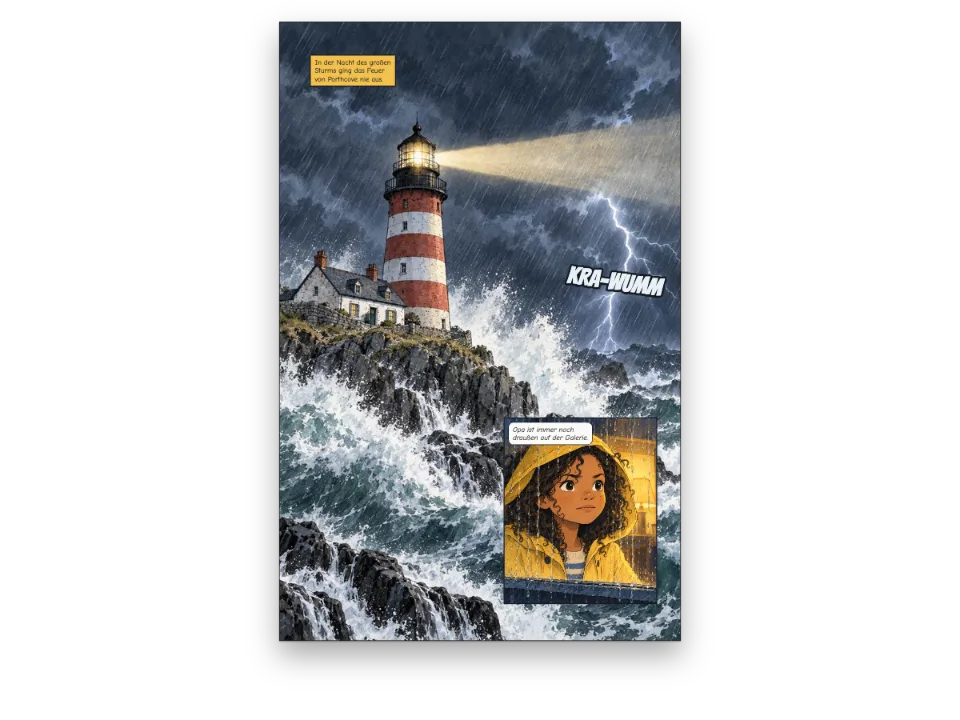
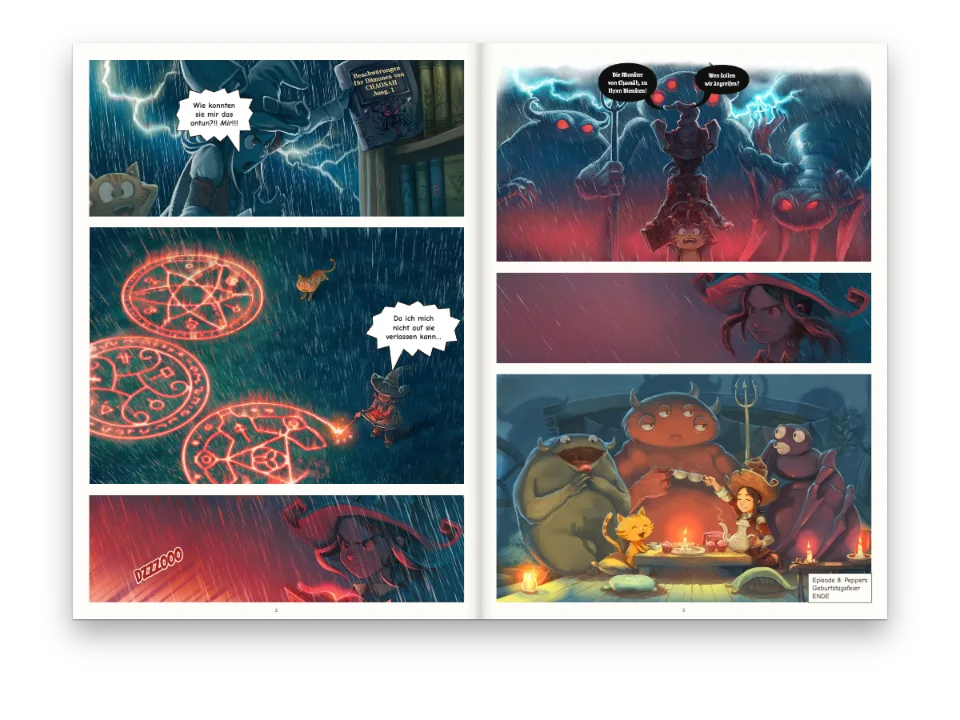
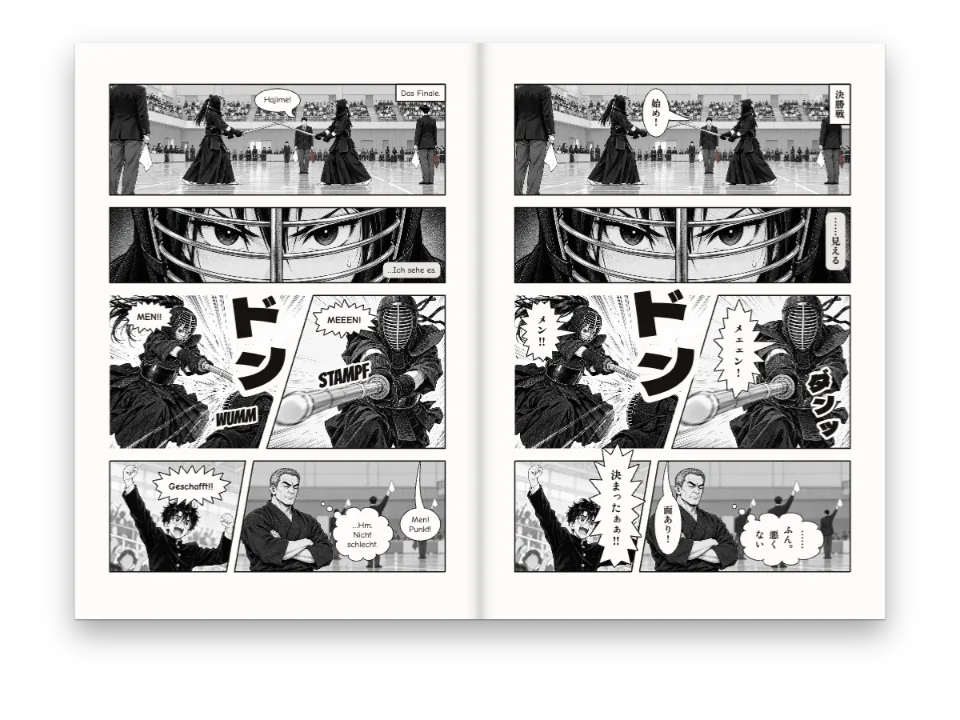
Kurz gesagt
Eine Comicseite, einmal gezeichnet und auf drei Arten angeordnet. Dieselben fünf Bilder und derselbe Dialog füllen drei verschiedene Panelraster, und jedes Bild wird für sein neues Panel neu beschnitten.
Was Sie setzen
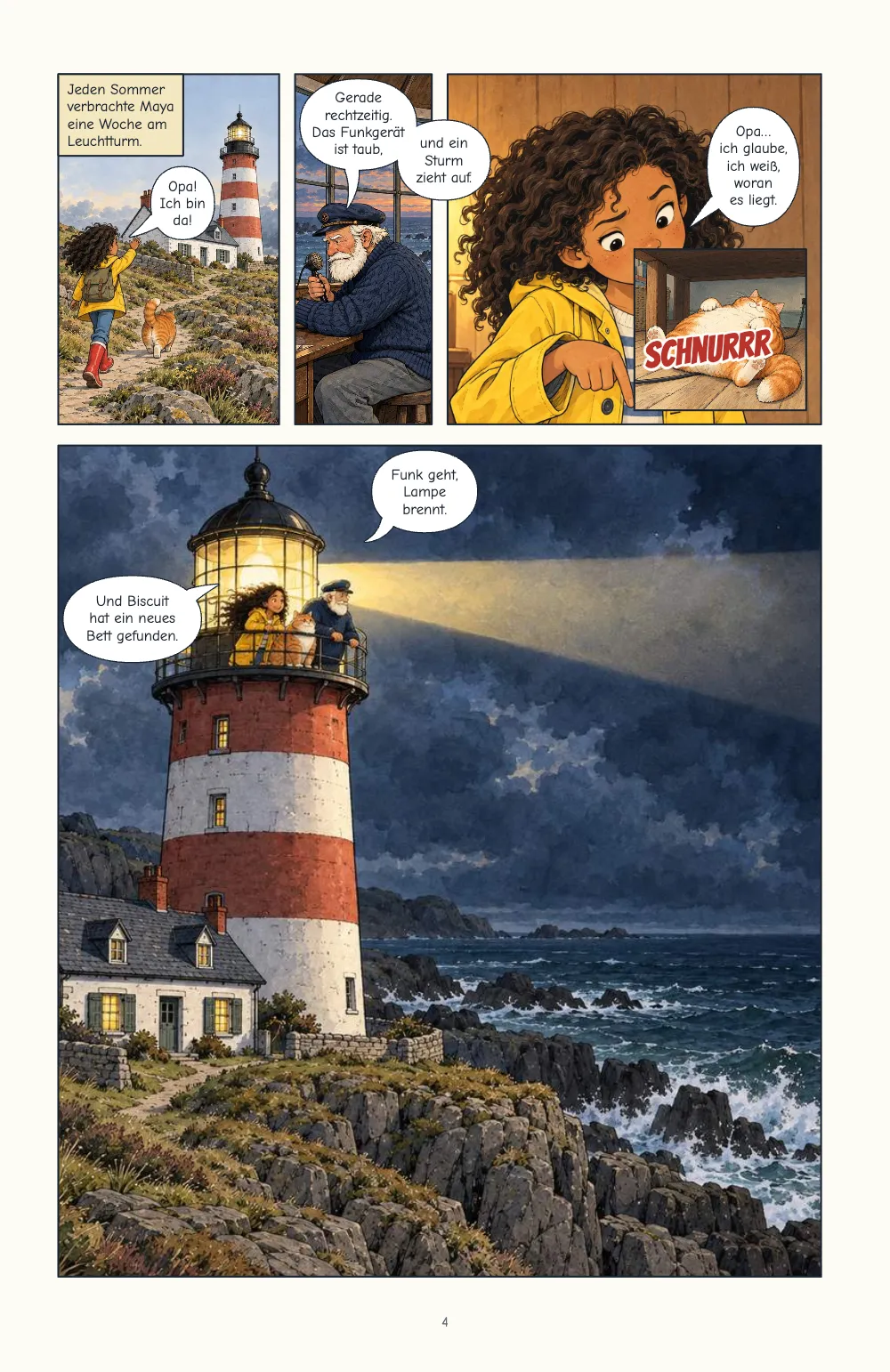
Ein Layoutandruck für eine Seite eines Comics, Der Leuchtturm von Porthcove: ein Deckblatt und dieselbe Seite in drei Plänen, unter denen die Autorin wählen kann. Die fünf Bilder (Maya steigt zum Leuchtturm hinauf, ihr Großvater an einem toten Funkgerät, Maya zeigt auf den Boden, die Katze schläft auf dem Kabel, die Lampe brennt bei Nacht) und die sechs Zeilen Lettering ändern sich nie; nur das split jedes :::page ändert sich. Jedes Bild wird für seine Zelle neu beschnitten und jede Sprechblase neu um ihren Sprecher gesetzt. Das Endformat ist das eines amerikanischen Comicheftes, 168 × 259 mm, und der Andruck erscheint in zehn Ausgaben, jede in ihrer eigenen Sprache gelettert.
Dieses Rezept beantwortet
- Wie teile ich eine Seite in Comic-Panels auf?
- Wie bleibt ein Gesicht sichtbar, wenn ein Panel das Bild beschneidet?
- Wie lettere ich einen Comic in einer anderen Sprache neu?
Die kurze Antwort
// Every :::page fills the type area; its split attribute cuts it into cells and its ::panel
// lines fill them in reading order (rows top to bottom, columns from the start side):
//   :::page{split="30 / 35 [* | * | *] / *"}    three tiers, the middle one in three
//   :::page{split="60 [* / *] | * [* / * / *]"} two columns, then each column in tiers
//   :::page{split="30 [30 | 20 | *] / *"}       a 30 % tier cut 30 | 20 | rest, then the rest
// A size is a percentage of the parent cell, * shares what is left, [ … ] cuts that cell
// on the other axis. A panel with inset="x y w h" sits over the panel before it.
const comics = {
  gutter: { horizontal: mm(4), vertical: mm(3) }, // between tiers, between panels in a tier
  panel: { borderWidth: pt(1), borderColor: col('ink'), background: col('paper') },
  lettering: { fontFamily: LETTERING, fontSize: pt(8), color: col('ink'), inset: mm(1) },
  balloonStyles: [
    { id: 'speech', stroke: col('ink') },
    { id: 'caption', fill: col('caption'), stroke: col('ink') },
    { id: 'sfx', fontFamily: SFX, color: col('accent'), haloColor: col('paper') },
  ],
  runningHeads: true, // a comic page has no running head unless asked: here, its folio
};
Zutaten
- Funktionen
- Panel-AufteilungPanelbilder und ZuschnitteSprecher und AnkerSicherer BildbereichPanelrahmen und ZwischenräumeComicseitenComic-LetteringNeues Lettering in anderen SprachenSprechblasenformateSoundeffekteSemantische FarbpaletteSeiten auf einem CanvasPDF-Export
- Nutzt außerdem
- Absätze in der anderen RichtungEinschübe, Anschnitt und durchbrochene RahmenPapierfarbeAbsatzformateIm PDF eingebettete SchriftenAbbildungen und Tabellen als Ressourcen
- Schrift
- Comic Neue, Bangers, Zen Antique, Dela Gothic One, ZCOOL KuaiLe, ZCOOL QingKe HuangYou, Playpen Sans Arabic, Lalezar (SIL OFL 1.1)
- Dateien
lh-arrive.jpglh-beam.jpglh-biscuit.jpglh-maya.jpglh-radio.jpg- Panel picture: Maya arrives at the lighthouse (Generated With Diffusion Models, eigener Text)
- Panel picture: Tomás at the radio (Generated With Diffusion Models, eigener Text)
- Panel picture: Maya finds the problem (Generated With Diffusion Models, eigener Text)
- Panel picture: Biscuit asleep on the cable (Generated With Diffusion Models, eigener Text)
- Panel picture: the lamp lit at night (Generated With Diffusion Models, eigener Text)
Zubereitung
#1 · Die Seite mit einem Aufteilungsbaum teilen
Der Code steht oben in der kurzen Antwort. Ein :::page füllt den Satzspiegel, hier 144 × 227 mm, und sein Attribut split teilt ihn. / trennt Reihen, | trennt Spalten, jede Größe ist ein Prozentsatz der Zelle, die sie teilt, * teilt den Rest, und eine Klammer teilt diese Zelle erneut auf der anderen Achse (die Seite aufteilen). Plan C, 30 [30 | 20 | *] / *, bildet eine Reihe von 30 % Höhe, teilt sie in Zellen von 30 % und 20 % Breite plus den Rest und lässt darunter eine hohe Zelle. Die Zwischenräume liegen mittig auf jeder Linie: 4 mm zwischen Reihen, 3 mm zwischen Panels einer Reihe. Die Zeilen ::panel füllen die Zellen in Leserichtung, Reihen von oben und Spalten von der Anfangsseite her.
#2 · Jedem Bild einen Sicherheitsbereich geben
// From the art manifest; fractions of each picture, the same in every language. The safe
// area is what every crop keeps: Tomás alone, not his radio, so a cell a fifth of the page
// wide still shows him; the lighthouse and the gallery, not the boat, so a tall cell holds them.
const ART = {
  'lh-arrive': { width: 1100, height: 733, safeArea: { x: 0.22, y: 0.08, width: 0.4, height: 0.64 },
    anchors: [{ id: 'maya', x: 0.29, y: 0.52, head: { x: 0.27, y: 0.47 },
      face: { x: 0.22, y: 0.42, width: 0.12, height: 0.16 } },
    { id: 'biscuit', x: 0.4, y: 0.68, face: { x: 0.37, y: 0.64, width: 0.07, height: 0.08 } }],
    avoid: [{ x: 0.51, y: 0.09, width: 0.1, height: 0.43 }],
    alt: t({ en: 'A girl in a yellow raincoat walks up a coastal path towards a red-and-white '
      + 'lighthouse, a fat orange cat ahead of her.',
      es: 'Una niña con chubasquero amarillo sube por un camino de costa hacia un faro rojo y '
        + 'blanco, con un gato naranja gordo delante.',
      ca: 'Una nena amb impermeable groc puja per un camí de costa cap a un far vermell i blanc, '
        + 'amb un gat taronja gras al davant.',
      zh: '一个穿黄色雨衣的女孩沿着海边小路走向红白相间的灯塔,一只胖胖的橘猫走在前面。',
      ar: 'فتاة بمعطف مطر أصفر تصعد دربًا ساحليًا نحو منارة حمراء وبيضاء، وأمامها قط برتقالي سمين.',
      ja: '黄色いレインコートの女の子が、赤と白の灯台へ続く海辺の小道をのぼっていく。前を太ったオレンジ色の猫が歩く。',
      pt: 'Uma menina de capa de chuva amarela sobe um caminho à beira-mar rumo a um farol '
        + 'vermelho e branco, com um gato laranja gordo à frente.',
      fr: 'Une fillette en ciré jaune monte un sentier côtier vers un phare rouge et blanc, '
        + 'précédée d’un gros chat roux.',
      de: 'Ein Mädchen in gelbem Regenmantel geht einen Küstenpfad zu einem rot-weißen '
        + 'Leuchtturm hinauf, eine dicke rote Katze vor ihr.',
      it: 'Una bambina con l’impermeabile giallo sale per un sentiero costiero verso un faro '
        + 'bianco e rosso, preceduta da un grosso gatto rosso.' }) },
  'lh-radio': { width: 1000, height: 1000,
    safeArea: { x: 0.27, y: 0.38, width: 0.24, height: 0.3 },
    anchors: [{ id: 'tomas', x: 0.345, y: 0.52, head: { x: 0.38, y: 0.44 },
      face: { x: 0.29, y: 0.4, width: 0.16, height: 0.18 } }],
    avoid: [{ x: 0, y: 0.44, width: 0.22, height: 0.26 }],
    alt: t({ en: 'The old keeper, white-bearded, in a navy sweater and cap, taps a valve radio '
      + 'with the microphone in his hand.',
      es: 'El viejo farero, de barba blanca, jersey azul marino y gorra, golpea una radio de '
        + 'válvulas con el micrófono en la mano.',
      ca: 'El vell faroner, de barba blanca, jersei blau marí i gorra, pica una ràdio de vàlvules '
        + 'amb el micròfon a la mà.',
      zh: '白胡子的老守塔人穿着藏青色毛衣、戴着帽子,手握话筒,敲着一台电子管收音机。',
      ar: 'حارس المنارة العجوز بلحيته البيضاء وكنزته الكحلية وقبعته ينقر على مذياع قديم '
        + 'والميكروفون في يده.',
      ja: '白いひげの老灯台守が、紺のセーターに帽子姿でマイクを握り、真空管ラジオをたたいている。',
      pt: 'O velho faroleiro, de barba branca, suéter azul-marinho e boné, dá batidinhas num '
        + 'rádio valvulado com o microfone na mão.',
      fr: 'Le vieux gardien, barbe blanche, pull bleu marine et casquette, tapote une radio à '
        + 'lampes, le micro à la main.',
      de: 'Der alte Wärter mit weißem Bart, marineblauem Pullover und Mütze klopft auf ein '
        + 'Röhrenradio, das Mikrofon in der Hand.',
      it: 'Il vecchio guardiano, barba bianca, maglione blu e berretto, picchietta su una radio a '
        + 'valvole con il microfono in mano.' }) },
  'lh-maya': { width: 1100, height: 1100, safeArea: { x: 0.25, y: 0.27, width: 0.41, height: 0.68 },
    anchors: [{ id: 'maya', x: 0.54, y: 0.565, head: { x: 0.5, y: 0.3 },
      face: { x: 0.4, y: 0.33, width: 0.24, height: 0.29 } }],
    avoid: [{ x: 0.27, y: 0.73, width: 0.25, height: 0.22 }],
    alt: t({ en: 'Close-up of Maya frowning at the floor and pointing down.',
      es: 'Primer plano de Maya, que frunce el ceño mirando al suelo y señala hacia abajo.',
      ca: 'Primer pla de la Maya, que arrufa les celles mirant a terra i assenyala avall.',
      zh: '玛雅的特写:她皱着眉头看着地板,手指向下指。',
      ar: 'لقطة قريبة لمايا وهي تعقد حاجبيها ناظرةً إلى الأرض وتشير إلى أسفل.',
      ja: 'マヤのアップ。眉をひそめて床を見つめ、下を指さしている。',
      pt: 'Close de Maya, de testa franzida, olhando para o chão e apontando para baixo.',
      fr: 'Gros plan sur Maya, sourcils froncés, qui fixe le sol et pointe le doigt vers le '
        + 'bas.',
      de: 'Nahaufnahme von Maya, die mit gerunzelter Stirn auf den Boden blickt und nach unten '
        + 'zeigt.',
      it: 'Primo piano di Maya, accigliata, che fissa il pavimento e indica in basso.' }) },
  'lh-biscuit': { width: 1000, height: 1000,
    safeArea: { x: 0.58, y: 0.25, width: 0.42, height: 0.33 },
    anchors: [{ id: 'biscuit', x: 0.72, y: 0.355, head: { x: 0.73, y: 0.32 },
      face: { x: 0.64, y: 0.27, width: 0.2, height: 0.18 } }],
    avoid: [{ x: 0.93, y: 0.28, width: 0.07, height: 0.24 },
      { x: 0, y: 0.72, width: 0.4, height: 0.1 }],
    alt: t({ en: 'Under the desk the fat orange cat sleeps on his back, right on top of the black '
      + 'radio cable.',
      es: 'Bajo la mesa, el gato naranja gordo duerme panza arriba justo encima del cable negro '
        + 'de la radio.',
      ca: 'Sota la taula, el gat taronja gras dorm panxa enlaire just a sobre del cable negre de '
        + 'la ràdio.',
      zh: '桌子底下,胖橘猫四脚朝天地睡着,正好压在收音机的黑色电线上。',
      ar: 'تحت المكتب ينام القط البرتقالي السمين على ظهره فوق سلك المذياع الأسود تمامًا.',
      ja: '机の下で、太ったオレンジ色の猫がラジオの黒いコードの真上にあおむけで眠っている。',
      pt: 'Debaixo da mesa, o gato laranja gordo dorme de barriga para cima bem em cima do cabo '
        + 'preto do rádio.',
      fr: 'Sous le bureau, le gros chat roux dort sur le dos, juste sur le câble noir de la '
        + 'radio.',
      it: 'Sotto la scrivania, il grosso gatto rosso dorme a pancia in su, proprio sopra il cavo '
        + 'nero della radio.',
      de: 'Unter dem Schreibtisch schläft die dicke rote Katze auf dem Rücken, genau auf dem '
        + 'schwarzen Kabel des Funkgeräts.' }) },
  'lh-beam': { width: 1200, height: 800, safeArea: { x: 0.15, y: 0.01, width: 0.25, height: 0.3 },
    anchors: [{ id: 'maya', x: 0.235, y: 0.15,
      face: { x: 0.21, y: 0.11, width: 0.05, height: 0.07 } },
      { id: 'tomas', x: 0.3, y: 0.145, face: { x: 0.28, y: 0.11, width: 0.04, height: 0.06 } }],
    avoid: [{ x: 0.79, y: 0.55, width: 0.08, height: 0.09 }],
    alt: t({ en: 'Night: the beam sweeps over a dark sea; Maya and her grandfather stand on the '
      + 'lantern gallery and a fishing boat shows its lights far out.',
      es: 'De noche, el haz barre un mar oscuro; Maya y su abuelo están en la galería de la '
        + 'linterna y a lo lejos se ven las luces de un pesquero.',
      ca: 'De nit, el feix escombra un mar fosc; la Maya i el seu avi són a la galeria de la '
        + 'llanterna i lluny es veuen els llums d’un pesquer.',
      zh: '夜里,灯塔的光束扫过漆黑的海面;玛雅和外公站在灯室外的回廊上,远处一艘渔船亮着灯。',
      ar: 'ليلًا يمسح الشعاع بحرًا مظلمًا، ومايا وجدّها واقفان على شرفة الفانوس، وفي البعيد قارب '
        + 'صيد بأضوائه.',
      ja: '夜。光の帯が暗い海をなでる。マヤと祖父は灯室の回廊に立ち、沖には漁船の明かりが見える。',
      pt: 'À noite, o facho varre um mar escuro; Maya e o avô estão na galeria da lanterna e, ao '
        + 'longe, aparecem as luzes de um barco de pesca.',
      fr: 'La nuit, le faisceau balaie une mer sombre ; Maya et son grand-père se tiennent sur '
        + 'la galerie de la lanterne et, au large, un bateau de pêche montre ses feux.',
      de: 'Nacht: Der Lichtstrahl streicht über ein dunkles Meer; Maya und ihr Großvater stehen '
        + 'auf der Galerie der Laterne, und weit draußen zeigt ein Fischerboot seine Lichter.',
      it: 'Di notte il fascio di luce spazza un mare scuro; Maya e suo nonno sono sulla balconata '
        + 'della lanterna e, al largo, si vedono le luci di un peschereccio.' }) },
};
Jedes Bild wird einmal gezeichnet und so beschnitten, dass es die Zelle füllt, in der es landet. Der Sicherheitsbereich ist der Teil, den jeder Beschnitt vollständig behält (Panels und Zeichnungen). Der Sicherheitsbereich des Funkgerätbildes ist allein der Wärter, 24 % seiner Breite, deshalb zeigt die 26 mm breite Zelle von Plan C ihn von der Mütze bis zu den Stiefeln und lässt das Funkgerät weg; die breiten Zellen der Pläne A und B zeigen beides. Eine Zelle, deren Form einen Sicherheitsbereich nicht fassen kann, setzt das Bild mit Balken ein (Letterbox), und der Build warnt (comicPanelLetterbox). Die Anker markieren Mund und Gesicht jedes Sprechers in denselben Bruchteilen, sodass die Dorne der Sprechblasen die Sprecher in jedem Ausschnitt finden.
#3 · Ein Panel über ein anderes legen
Die Aufteilung von Plan C ergibt vier Zellen für fünf Panels. Die Katze kommt mit inset="50 50 46 46" hinein: ein Panel von 46 % Breite und 46 % Höhe, bei 50 %, 50 % des Panels davor platziert, dem von Maya. Ein eingelassenes Panel nimmt keine Zelle ein, die Panels danach behalten also ihre Plätze, und es wird direkt nach dem Panel gelesen, das es überdeckt.
#4 · Zehn Ausgaben aus einem Layout lettern
// The lettering and sound-effect faces of each edition: the engine's defaults, but for Chinese
// two ZCOOL faces drawn for cartoons instead of Noto Sans SC. content.<lang>.md holds the words
// of each edition under the same speaker ids; Japanese balloons are set vertically, and the
// Japanese and Arabic editions, read right to left, mirror the order of the panels in every row.
const [LETTERING, SFX] = t({
  en: ['Comic Neue', 'Bangers'], es: ['Comic Neue', 'Bangers'], ca: ['Comic Neue', 'Bangers'],
  ja: ['Zen Antique', 'Dela Gothic One'], zh: ['ZCOOL KuaiLe', 'ZCOOL QingKe HuangYou'],
  ar: ['Playpen Sans Arabic', 'Lalezar'], pt: ['Comic Neue', 'Bangers'],
  fr: ['Comic Neue', 'Bangers'], de: ['Comic Neue', 'Bangers'], it: ['Comic Neue', 'Bangers'],
});
Aufteilung, Bilder, Ausschnitte und Anker sind in jeder Sprache gleich; content.<lang>.md enthält nur die Wörter, unter denselben Sprecher-Ids (maya, tomas). Die japanische Ausgabe setzt ihre Sprechblasen senkrecht, acht Zeichen pro Spalte, und lässt das abschließende 。 weg; sie liest sich von rechts nach links, wie die arabische, deshalb werden die Panels jeder Reihe gespiegelt, die Bilder aber nicht. Die Lettering-Größe bleibt in jeder Ausgabe 8 pt: Eine längere Zeile ergibt eine größere Sprechblase, nie eine kleinere Schrift (Lettering).
Das ganze Rezept
// ═══ Postext Cookbook · Nº 144 · One set of panels, three page splits ═══════════════ // https://postext.dev/en/cookbook/comic-page-splitters // Code: MIT · Text: original (CC BY 4.0) · Pictures: generated with diffusion models // Fonts: Comic Neue, Bangers and the faces of five editions (OFL) · Needs postext ≥ 1.25.0 // // A layout proof for one page of a comic: the same five pictures and the same lines of // dialogue laid out under three `split` trees. Each picture carries a safe area, so its subject // stays in view whether its cell is wide, tall or square, and the lettering is placed again // around the speakers' anchors on every page and in every language. import { buildDocument, withLoadedFonts, renderPageToCanvas, registerResourceImage, loadVerticalAlternates, } from 'https://esm.sh/postext'; import { renderToPdf, decompressWoff2 } from 'https://esm.sh/postext-pdf'; const LANG = 'de'; // @lang: 'en' | 'es' | 'ca' | 'zh' | 'ar' | 'ja' | 'pt' | 'fr' | 'de' | 'it' const RECIPE = 'comic-page-splitters'; // ─── 1 · Design ───────────────────────────────────────────────────────────── // #region palette: the night sea, the lighthouse red and the yellow of the captions const palette = { ink: '#1b2430', // panel borders, lettering and text: a blue-black accent: '#b8322a', // the lighthouse red: the proof's labels caption: '#f4e7bf', // caption boxes, an old-paper yellow muted: '#5f6873', // folios and the imprint paper: '#fdfbf6', }; const col = (id) => ({ hex: palette[id], model: 'hex', paletteId: id }); const colorPalette = [ ...Object.entries(palette).map(([id, hex]) => ({ id, name: id, value: { hex, model: 'hex' } })), { id: 'main-color', name: 'accent (defaults)', value: { hex: palette.accent, model: 'hex' } }, ]; // #endregion // #region editions: one comic, six editions, each lettered in faces for its script // The lettering and sound-effect faces of each edition: the engine's defaults, but for Chinese // two ZCOOL faces drawn for cartoons instead of Noto Sans SC. content.<lang>.md holds the words // of each edition under the same speaker ids; Japanese balloons are set vertically, and the // Japanese and Arabic editions, read right to left, mirror the order of the panels in every row. const [LETTERING, SFX] = t({ en: ['Comic Neue', 'Bangers'], es: ['Comic Neue', 'Bangers'], ca: ['Comic Neue', 'Bangers'], ja: ['Zen Antique', 'Dela Gothic One'], zh: ['ZCOOL KuaiLe', 'ZCOOL QingKe HuangYou'], ar: ['Playpen Sans Arabic', 'Lalezar'], pt: ['Comic Neue', 'Bangers'], fr: ['Comic Neue', 'Bangers'], de: ['Comic Neue', 'Bangers'], it: ['Comic Neue', 'Bangers'], }); // #endregion // #region answer: the comic: a frame, gutters, a panel border, and a page per split // Every :::page fills the type area; its split attribute cuts it into cells and its ::panel // lines fill them in reading order (rows top to bottom, columns from the start side): // :::page{split="30 / 35 [* | * | *] / *"} three tiers, the middle one in three // :::page{split="60 [* / *] | * [* / * / *]"} two columns, then each column in tiers // :::page{split="30 [30 | 20 | *] / *"} a 30 % tier cut 30 | 20 | rest, then the rest // A size is a percentage of the parent cell, * shares what is left, [ … ] cuts that cell // on the other axis. A panel with inset="x y w h" sits over the panel before it. const comics = { gutter: { horizontal: mm(4), vertical: mm(3) }, // between tiers, between panels in a tier panel: { borderWidth: pt(1), borderColor: col('ink'), background: col('paper') }, lettering: { fontFamily: LETTERING, fontSize: pt(8), color: col('ink'), inset: mm(1) }, balloonStyles: [ { id: 'speech', stroke: col('ink') }, { id: 'caption', fill: col('caption'), stroke: col('ink') }, { id: 'sfx', fontFamily: SFX, color: col('accent'), haloColor: col('paper') }, ], runningHeads: true, // a comic page has no running head unless asked: here, its folio }; // #endregion const LABEL = { fontFamily: LETTERING, fontSize: pt(7.5), color: col('muted') }; const footer = { elements: [{ kind: 'text', id: 'folio', content: '{pageNumber}', ...LABEL, align: 'center', placement: { anchor: { to: 'page', edge: 'bottom' }, offset: { x: mm(0), y: mm(-8) } } }] }; const config = () => ({ locale: t({ en: 'en-us', es: 'es', ca: 'ca', ja: 'ja', zh: 'zh-Hans', ar: 'ar', pt: 'pt-BR', fr: 'fr', de: 'de', it: 'it' }), colorPalette, comics, // The trim of an American comic book, 6⅝ × 10³⁄₁₆ in; the type area is the panel frame. page: { sizePreset: 'custom', width: mm(168), height: mm(259), dpi: 150, backgroundColor: col('paper'), margins: { top: mm(14), bottom: mm(18), left: mm(13), right: mm(11), mirror: true } }, layout: { layoutType: 'single' }, // The proof's cover sheet is set in the lettering face of the edition. bodyText: { fontFamily: LETTERING, fontSize: pt(10.5), lineHeight: pt(15), color: col('ink'), boldColor: col('ink'), italicColor: col('ink'), referenceColor: col('ink'), textAlign: 'left', firstLineIndent: pt(0), paragraphSpacing: true, hyphenation: { enabled: false } }, headings: { fontFamily: SFX, color: col('accent'), fontWeight: 400, levels: [ // The cover sheet's title opens a page, on either side. { level: 1, fontSize: pt(34), lineHeight: pt(38), breakBefore: { enabled: true, parity: 'any' }, marginTop: mm(30), marginBottom: pt(15) }, { level: 2, fontFamily: LETTERING, fontSize: pt(10.5), fontWeight: 700, color: col('accent'), marginTop: pt(15), marginBottom: pt(0) }, ] }, paragraphStyles: [ { id: 'split', fontSize: pt(10.5), color: col('accent'), textAlign: 'left' }, // the attribute { id: 'imprint', fontSize: pt(7.5), lineHeight: pt(10), color: col('muted'), marginTop: pt(30) }, ], header: { elements: [] }, footer, }); // ─── 2 · Content ──────────────────────────────────────────────────────────── const markdown = String.raw`# Eine Seite, drei VariantenMarkdown-Beispiel · 74 Zeilen · content.de.md
## Der Leuchtturm von Porthcove · Seite 12 · Layoutentwurf Drei Pläne für dieselbe Seite, unter denen der Autor wählen kann. Jeder enthält dieselben fünf Bilder und dieselben Dialogzeilen; nur die Aufteilung der Seite ändert sich, und Bildausschnitte und Sprechblasen folgen ihr. **Plan A, Seite 2.** Drei Streifen, der mittlere in drei Panels geteilt. :::paragraphs{style="split" dir=ltr} split="30 / 35 [\* | \* | \*] / \*" ::: **Plan B, Seite 3.** Zwei Spalten, die linke in zwei Panels, die rechte in drei. :::paragraphs{style="split" dir=ltr} split="60 [\* / \*] | \* [\* / \* / \*]" ::: **Plan C, Seite 4.** Ein Streifen von 30 % der Höhe, geteilt in 30 | 20 | den Rest, über einem hohen Panel; die Katze ist ein Einschub in Mayas Panel. :::paragraphs{style="split" dir=ltr} split="30 [30 | 20 | \*] / \*" ::: :::paragraphs{style="imprint"} Geschichte und Lettering für das Postext-Rezeptbuch. Bilder mit Diffusionsmodellen erzeugt. Gelettert in Comic Neue und Bangers (SIL OFL). ::: :::page{split="30 / 35 [* | * | *] / *"} ::panel{art=lh-arrive} caption: Jeden Sommer verbrachte Maya eine Woche am Leuchtturm. maya: Opa! Ich bin da! ::panel{art=lh-radio} tomas: Gerade rechtzeitig. Das Funkgerät ist taub, tomas: und ein Sturm zieht auf. ::panel{art=lh-maya} maya: Opa… ich glaube, ich weiß, woran es liegt. ::panel{art=lh-biscuit} sfx{rotate=-6}: schnurrr ::panel{art=lh-beam} tomas: Funk geht, Lampe brennt. maya: Und Biscuit hat ein neues Bett gefunden. ::: :::page{split="60 [* / *] | * [* / * / *]"} ::panel{art=lh-arrive} caption: Jeden Sommer verbrachte Maya eine Woche am Leuchtturm. maya: Opa! Ich bin da! ::panel{art=lh-radio} tomas: Gerade rechtzeitig. Das Funkgerät ist taub, tomas: und ein Sturm zieht auf. ::panel{art=lh-maya} maya: Opa… ich glaube, ich weiß, woran es liegt. ::panel{art=lh-biscuit} sfx{rotate=-6}: schnurrr ::panel{art=lh-beam} tomas: Funk geht, Lampe brennt. maya: Und Biscuit hat ein neues Bett gefunden. ::: :::page{split="30 [30 | 20 | *] / *"} ::panel{art=lh-arrive} caption: Jeden Sommer verbrachte Maya eine Woche am Leuchtturm. maya: Opa! Ich bin da! ::panel{art=lh-radio} tomas{break}: Gerade rechtzeitig. Das Funkgerät ist taub, tomas: und ein Sturm zieht auf. ::panel{art=lh-maya} maya: Opa… ich glaube, ich weiß, woran es liegt. ::panel{art=lh-biscuit inset="50 50 46 46"} sfx{rotate=-6}: schnurrr ::panel{art=lh-beam} tomas: Funk geht, Lampe brennt. maya: Und Biscuit hat ein neues Bett gefunden. :::`; // content.<lang>.md, inlined by the Cookbook // #region art: the five pictures: safe area, speakers' anchors and avoid zones // From the art manifest; fractions of each picture, the same in every language. The safe // area is what every crop keeps: Tomás alone, not his radio, so a cell a fifth of the page // wide still shows him; the lighthouse and the gallery, not the boat, so a tall cell holds them. const ART = { 'lh-arrive': { width: 1100, height: 733, safeArea: { x: 0.22, y: 0.08, width: 0.4, height: 0.64 }, anchors: [{ id: 'maya', x: 0.29, y: 0.52, head: { x: 0.27, y: 0.47 }, face: { x: 0.22, y: 0.42, width: 0.12, height: 0.16 } }, { id: 'biscuit', x: 0.4, y: 0.68, face: { x: 0.37, y: 0.64, width: 0.07, height: 0.08 } }], avoid: [{ x: 0.51, y: 0.09, width: 0.1, height: 0.43 }], alt: t({ en: 'A girl in a yellow raincoat walks up a coastal path towards a red-and-white ' + 'lighthouse, a fat orange cat ahead of her.', es: 'Una niña con chubasquero amarillo sube por un camino de costa hacia un faro rojo y ' + 'blanco, con un gato naranja gordo delante.', ca: 'Una nena amb impermeable groc puja per un camí de costa cap a un far vermell i blanc, ' + 'amb un gat taronja gras al davant.', zh: '一个穿黄色雨衣的女孩沿着海边小路走向红白相间的灯塔,一只胖胖的橘猫走在前面。', ar: 'فتاة بمعطف مطر أصفر تصعد دربًا ساحليًا نحو منارة حمراء وبيضاء، وأمامها قط برتقالي سمين.', ja: '黄色いレインコートの女の子が、赤と白の灯台へ続く海辺の小道をのぼっていく。前を太ったオレンジ色の猫が歩く。', pt: 'Uma menina de capa de chuva amarela sobe um caminho à beira-mar rumo a um farol ' + 'vermelho e branco, com um gato laranja gordo à frente.', fr: 'Une fillette en ciré jaune monte un sentier côtier vers un phare rouge et blanc, ' + 'précédée d’un gros chat roux.', de: 'Ein Mädchen in gelbem Regenmantel geht einen Küstenpfad zu einem rot-weißen ' + 'Leuchtturm hinauf, eine dicke rote Katze vor ihr.', it: 'Una bambina con l’impermeabile giallo sale per un sentiero costiero verso un faro ' + 'bianco e rosso, preceduta da un grosso gatto rosso.' }) }, 'lh-radio': { width: 1000, height: 1000, safeArea: { x: 0.27, y: 0.38, width: 0.24, height: 0.3 }, anchors: [{ id: 'tomas', x: 0.345, y: 0.52, head: { x: 0.38, y: 0.44 }, face: { x: 0.29, y: 0.4, width: 0.16, height: 0.18 } }], avoid: [{ x: 0, y: 0.44, width: 0.22, height: 0.26 }], alt: t({ en: 'The old keeper, white-bearded, in a navy sweater and cap, taps a valve radio ' + 'with the microphone in his hand.', es: 'El viejo farero, de barba blanca, jersey azul marino y gorra, golpea una radio de ' + 'válvulas con el micrófono en la mano.', ca: 'El vell faroner, de barba blanca, jersei blau marí i gorra, pica una ràdio de vàlvules ' + 'amb el micròfon a la mà.', zh: '白胡子的老守塔人穿着藏青色毛衣、戴着帽子,手握话筒,敲着一台电子管收音机。', ar: 'حارس المنارة العجوز بلحيته البيضاء وكنزته الكحلية وقبعته ينقر على مذياع قديم ' + 'والميكروفون في يده.', ja: '白いひげの老灯台守が、紺のセーターに帽子姿でマイクを握り、真空管ラジオをたたいている。', pt: 'O velho faroleiro, de barba branca, suéter azul-marinho e boné, dá batidinhas num ' + 'rádio valvulado com o microfone na mão.', fr: 'Le vieux gardien, barbe blanche, pull bleu marine et casquette, tapote une radio à ' + 'lampes, le micro à la main.', de: 'Der alte Wärter mit weißem Bart, marineblauem Pullover und Mütze klopft auf ein ' + 'Röhrenradio, das Mikrofon in der Hand.', it: 'Il vecchio guardiano, barba bianca, maglione blu e berretto, picchietta su una radio a ' + 'valvole con il microfono in mano.' }) }, 'lh-maya': { width: 1100, height: 1100, safeArea: { x: 0.25, y: 0.27, width: 0.41, height: 0.68 }, anchors: [{ id: 'maya', x: 0.54, y: 0.565, head: { x: 0.5, y: 0.3 }, face: { x: 0.4, y: 0.33, width: 0.24, height: 0.29 } }], avoid: [{ x: 0.27, y: 0.73, width: 0.25, height: 0.22 }], alt: t({ en: 'Close-up of Maya frowning at the floor and pointing down.', es: 'Primer plano de Maya, que frunce el ceño mirando al suelo y señala hacia abajo.', ca: 'Primer pla de la Maya, que arrufa les celles mirant a terra i assenyala avall.', zh: '玛雅的特写:她皱着眉头看着地板,手指向下指。', ar: 'لقطة قريبة لمايا وهي تعقد حاجبيها ناظرةً إلى الأرض وتشير إلى أسفل.', ja: 'マヤのアップ。眉をひそめて床を見つめ、下を指さしている。', pt: 'Close de Maya, de testa franzida, olhando para o chão e apontando para baixo.', fr: 'Gros plan sur Maya, sourcils froncés, qui fixe le sol et pointe le doigt vers le ' + 'bas.', de: 'Nahaufnahme von Maya, die mit gerunzelter Stirn auf den Boden blickt und nach unten ' + 'zeigt.', it: 'Primo piano di Maya, accigliata, che fissa il pavimento e indica in basso.' }) }, 'lh-biscuit': { width: 1000, height: 1000, safeArea: { x: 0.58, y: 0.25, width: 0.42, height: 0.33 }, anchors: [{ id: 'biscuit', x: 0.72, y: 0.355, head: { x: 0.73, y: 0.32 }, face: { x: 0.64, y: 0.27, width: 0.2, height: 0.18 } }], avoid: [{ x: 0.93, y: 0.28, width: 0.07, height: 0.24 }, { x: 0, y: 0.72, width: 0.4, height: 0.1 }], alt: t({ en: 'Under the desk the fat orange cat sleeps on his back, right on top of the black ' + 'radio cable.', es: 'Bajo la mesa, el gato naranja gordo duerme panza arriba justo encima del cable negro ' + 'de la radio.', ca: 'Sota la taula, el gat taronja gras dorm panxa enlaire just a sobre del cable negre de ' + 'la ràdio.', zh: '桌子底下,胖橘猫四脚朝天地睡着,正好压在收音机的黑色电线上。', ar: 'تحت المكتب ينام القط البرتقالي السمين على ظهره فوق سلك المذياع الأسود تمامًا.', ja: '机の下で、太ったオレンジ色の猫がラジオの黒いコードの真上にあおむけで眠っている。', pt: 'Debaixo da mesa, o gato laranja gordo dorme de barriga para cima bem em cima do cabo ' + 'preto do rádio.', fr: 'Sous le bureau, le gros chat roux dort sur le dos, juste sur le câble noir de la ' + 'radio.', it: 'Sotto la scrivania, il grosso gatto rosso dorme a pancia in su, proprio sopra il cavo ' + 'nero della radio.', de: 'Unter dem Schreibtisch schläft die dicke rote Katze auf dem Rücken, genau auf dem ' + 'schwarzen Kabel des Funkgeräts.' }) }, 'lh-beam': { width: 1200, height: 800, safeArea: { x: 0.15, y: 0.01, width: 0.25, height: 0.3 }, anchors: [{ id: 'maya', x: 0.235, y: 0.15, face: { x: 0.21, y: 0.11, width: 0.05, height: 0.07 } }, { id: 'tomas', x: 0.3, y: 0.145, face: { x: 0.28, y: 0.11, width: 0.04, height: 0.06 } }], avoid: [{ x: 0.79, y: 0.55, width: 0.08, height: 0.09 }], alt: t({ en: 'Night: the beam sweeps over a dark sea; Maya and her grandfather stand on the ' + 'lantern gallery and a fishing boat shows its lights far out.', es: 'De noche, el haz barre un mar oscuro; Maya y su abuelo están en la galería de la ' + 'linterna y a lo lejos se ven las luces de un pesquero.', ca: 'De nit, el feix escombra un mar fosc; la Maya i el seu avi són a la galeria de la ' + 'llanterna i lluny es veuen els llums d’un pesquer.', zh: '夜里,灯塔的光束扫过漆黑的海面;玛雅和外公站在灯室外的回廊上,远处一艘渔船亮着灯。', ar: 'ليلًا يمسح الشعاع بحرًا مظلمًا، ومايا وجدّها واقفان على شرفة الفانوس، وفي البعيد قارب ' + 'صيد بأضوائه.', ja: '夜。光の帯が暗い海をなでる。マヤと祖父は灯室の回廊に立ち、沖には漁船の明かりが見える。', pt: 'À noite, o facho varre um mar escuro; Maya e o avô estão na galeria da lanterna e, ao ' + 'longe, aparecem as luzes de um barco de pesca.', fr: 'La nuit, le faisceau balaie une mer sombre ; Maya et son grand-père se tiennent sur ' + 'la galerie de la lanterne et, au large, un bateau de pêche montre ses feux.', de: 'Nacht: Der Lichtstrahl streicht über ein dunkles Meer; Maya und ihr Großvater stehen ' + 'auf der Galerie der Laterne, und weit draußen zeigt ein Fischerboot seine Lichter.', it: 'Di notte il fascio di luce spazza un mare scuro; Maya e suo nonno sono sulla balconata ' + 'della lanterna e, al largo, si vedono le luci di un peschereccio.' }) }, }; // #endregion // ─── 3 · Fonts ────────────────────────────────────────────────────────────── // Every face of the six editions; each edition loads the latin files of all of them and the // Japanese, Chinese or Arabic files of its own two. const FONTS = { 'Comic Neue': ['400', '400i', '700', '700i'], Bangers: ['400'], 'Zen Antique': ['400'], 'Dela Gothic One': ['400'], 'ZCOOL KuaiLe': ['400'], 'ZCOOL QingKe HuangYou': ['400'], 'Playpen Sans Arabic': ['400', '700'], Lalezar: ['400'], }; // ─── 4 · Build & show ─────────────────────────────────────────────────────── const faces = { [LETTERING]: FONTS[LETTERING], [SFX]: FONTS[SFX] }; await loadFonts(FONTS, markdown); await loadCjkFonts(faces, markdown, { vertical: LANG === 'ja' }); // ja balloons are vertical await loadArabicFonts(faces, markdown); await loadComicFonts(faces, markdown); // the bold and italic the faces do not ship const resources = await Promise.all([ comicPanel('lh-arrive', asset('lh-arrive.jpg'), ART['lh-arrive']), comicPanel('lh-radio', asset('lh-radio.jpg'), ART['lh-radio']), comicPanel('lh-maya', asset('lh-maya.jpg'), ART['lh-maya']), comicPanel('lh-biscuit', asset('lh-biscuit.jpg'), ART['lh-biscuit']), comicPanel('lh-beam', asset('lh-beam.jpg'), ART['lh-beam']), ]); const doc = await withLoadedFonts(() => buildDocument({ markdown, resources }, config()), { ...kitFonts(FONTS), text: markdown }); showBook(doc, { title: t({ en: 'One set of panels, three page splits', es: 'Las mismas viñetas en tres divisiones de página', pt: 'Os mesmos quadros em três divisões de página', fr: 'Les mêmes cases en trois découpages de page', de: 'Dieselben Panels in drei Seitenaufteilungen', it: 'Le stesse vignette in tre suddivisioni della pagina' }) }); offerPdf(() => renderToPdf(doc, { fontProvider: comicPdfProvider, resourceBytes: imageBytes }), `${RECIPE}.pdf`);Kit · core, fonts, viewer, pdf, images, cjk, arabic, comics: in jedem Rezept gleich · 740 Zeilen
// ─── Kit ── helpers shared by every Cookbook recipe · postext.dev/cookbook ───── // ─── Kit · core v1 ── the same in every recipe · postext.dev/cookbook function mm(value) { return { value, unit: 'mm' }; } function pt(value) { return { value, unit: 'pt' }; } function em(value) { return { value, unit: 'em' }; } /** The sample language's string: t({ en: 'Figure', es: 'Figura' }). */ function t(strings) { return strings[LANG] ?? Object.values(strings)[0]; } /** A file in this recipe's assets folder, served from the Postext repo by jsDelivr. */ function asset(file) { return `https://cdn.jsdelivr.net/gh/drnachio/postext@main/cookbook/${RECIPE}/assets/${file}`; } // ─── Kit · fonts v3 ── the same in every recipe · postext.dev/cookbook // Postext loads the faces a config asks for before layout (prepareFonts, // buildDocumentWithFonts) and asks the kit for the files: Fontsource's, the // files the PDF embeds too. /** The options of buildDocumentWithFonts / prepareFonts / withLoadedFonts: * the Fontsource resolver, and the faces of FONTS loaded with the ones the * config names. FONTS = { 'Family Name': ['400', '400i', '700'] }. */ function kitFonts(FONTS = {}) { const faces = Object.entries(FONTS).flatMap(([family, specs]) => specs.map((spec) => ({ family, weight: parseInt(spec, 10), style: spec.endsWith('i') ? 'italic' : 'normal' }))); return { resolve: fontsourceResolver, faces }; } /** A face's Fontsource files, in a fixed order: latin, then latin-ext and greek * when `text` needs them and the family ships them (kitSubsetsFor), each with * its unicode-range. Null for a weight or slant Fontsource does not ship. */ async function fontsourceResolver(family, weight, style, { text = '' } = {}) { const id = fontsourceId(family); const meta = await fontsourceMeta(family); if (meta && !(meta.weights.includes(weight) && meta.styles.includes(style))) return null; kitStatus('Loading fonts…'); const at = await fontsourceAt(id); return ['latin', ...kitSubsetsFor(text, meta)].map((subset) => ({ source: `${at}files/${id}-${subset}-${weight}-${style}.woff2`, unicodeRange: kitRanges()[subset], })); } /** The unicode-range of each Fontsource file the kit loads (a function: the * kit is inlined after the pen's code, which runs before a const would be set). */ function kitRanges() { return { latin: 'U+0000-00FF,U+0131,U+0152-0153,U+02BB-02BC,U+02C6,U+02DA,U+02DC,U+0304,U+0308,U+0329,' + 'U+2000-206F,U+20AC,U+2122,U+2191,U+2193,U+2212,U+2215,U+FEFF,U+FFFD', 'latin-ext': 'U+0100-02BA,U+02BD-02C5,U+02C7-02CC,U+02CE-02D7,U+02DD-02FF,U+0304,U+0308,U+0329,' + 'U+1D00-1DBF,U+1E00-1E9F,U+1EF2-1EFF,U+2020,U+20A0-20AB,U+20AD-20C0,U+2113,U+2C60-2C7F,U+A720-A7FF', greek: 'U+0370-03FF', }; } /** For the cjk, arabic and comics blocks, which add their own files: the * faces of `faces` = { 'Family Name': ['400', '400i', '700'] }. `text` is the sample: * č ł † α χ also load latin-ext and greek files (kitSubsetsFor). With * `optional`, a face Fontsource does not ship is skipped instead of failing. * The files are added once all have loaded, in the order asked (latin, then * latin-ext, then greek), whatever order they arrive in: the last one added * wins a character two files hold. Resolves to the number of faces added. */ async function loadFonts(faces, text = '', { optional = false } = {}) { kitStatus('Loading fonts…'); const ranges = kitRanges(); const jobs = []; for (const [family, specs] of Object.entries(faces)) { const id = fontsourceId(family); const todo = [...new Set(specs)].map((spec) => [parseInt(spec, 10), spec.endsWith('i') ? 'italic' : 'normal']) .filter(([weight, style]) => !hasFace(family, weight, style)); // before any await const at = fontsourceAt(id); const meta = optional || /[^\0-ÿ]/u.test(text) ? await fontsourceMeta(family) : null; const subsets = ['latin', ...kitSubsetsFor(text, meta)]; for (const [weight, style] of todo) { if (optional && !(meta?.weights.includes(weight) && meta.styles.includes(style))) continue; for (const subset of subsets) { const url = `${await at}files/${id}-${subset}-${weight}-${style}.woff2`; const face = new FontFace(family, `url(${url}) format('woff2')`, { weight: String(weight), style, unicodeRange: ranges[subset] }); jobs.push(face.load().catch(() => { if (subset === 'latin' && !optional) throw new Error(`Fontsource has no ${family} ${weight} ${style}`); })); } } } const ready = await Promise.all(jobs).catch((error) => { kitFail(error); throw error; }); return ready.filter((face) => face && document.fonts.add(face)).length; } /** A loaded FontFace covers this family, weight and style (fonts.check() would * also say yes for families nobody declared). */ function hasFace(family, weight, style) { for (const face of document.fonts) { if (face.status !== 'loaded' || face.style !== style) continue; if (face.family.replace(/^["']|["']$/g, '') !== family) continue; const [low, high = low] = face.weight.split(' ').map(Number); if (weight >= low && weight <= high) return true; } return false; } /** The files beyond latin `text` needs that `meta`'s family ships. */ function kitSubsetsFor(text, meta) { return [[/[Ā-˿ᴀ-ᶿḀ-ỿ†ℓⱠ-Ɀ꜠-ꟿ]/u, 'latin-ext'], [/[Ͱ-Ͽ]/u, 'greek']] .filter(([re, x]) => re.test(text) && meta?.subsets?.includes(x)).map(([, x]) => x); } /** Fontsource's id for a family: 'Source Serif 4' → 'source-serif-4'. */ function fontsourceId(family) { return family.toLowerCase().replace(/\s+/g, '-'); } /** A package's folder at the one version @5 names now (#766). */ function fontsourceAt(id, u = `https://cdn.jsdelivr.net/npm/@fontsource/${id}@`) { return (fontsourceAt.c ??= {})[id] ??= fetch(u + '5/package.json').then((r) => r.json()) .then((p) => p.version || 5, () => 5).then((v) => `${u}${v}/`); } /** The family's Fontsource metadata (weights, styles, subsets), or null. */ function fontsourceMeta(family) { fontsourceMeta.cache ??= new Map(); const id = fontsourceId(family); if (!fontsourceMeta.cache.has(id)) { fontsourceMeta.cache.set(id, fetch(`https://api.fontsource.org/v1/fonts/${id}`) .then((res) => (res.ok ? res.json() : null), () => null)); } return fontsourceMeta.cache.get(id); } // ─── Kit · viewer v2 ── the same in every recipe · postext.dev/cookbook /** The pages as spreads on a dark desk, page 1 alone, then verso | recto, * each painted when it scrolls near. Other options go to renderPageToCanvas. */ function showPages(docs, { title, width = 460, ...render } = {}) { const root = viewer(title); const pages = [docs].flat().flatMap((doc) => doc.pages.map((page) => ({ doc, page, n: (doc.pageIndexOffset ?? 0) + page.index }))); const spreads = []; let verso = null; for (const p of pages) { if (p.n % 2 === 1) { if (verso) spreads.push([verso, null]); verso = p; } else { spreads.push([verso, p]); verso = null; } } if (verso) spreads.push([verso, null]); const density = Math.min(window.devicePixelRatio || 1, 2); showPages.painter?.disconnect(); const painter = new IntersectionObserver((entries) => { for (const { isIntersecting, target } of entries) { if (!isIntersecting) continue; painter.unobserve(target); const { doc, page } = target.postext; renderPageToCanvas(page, doc, target, { ...render, scale: (width * density) / page.width }); } }, { rootMargin: '800px' }); showPages.painter = painter; root.replaceChildren(...spreads.map((pair) => { const spread = document.createElement('div'); spread.className = 'pt-spread'; for (const p of pair) { const figure = document.createElement('figure'); if (p) { const label = p.page.pageLabel || String(p.n + 1); const canvas = document.createElement('canvas'); canvas.postext = p; canvas.style.aspectRatio = `${p.page.width} / ${p.page.height}`; canvas.setAttribute('role', 'img'); canvas.setAttribute('aria-label', `Page ${label}`); const folio = document.createElement('figcaption'); folio.textContent = label; figure.append(canvas, folio); painter.observe(canvas); } else figure.className = 'pt-blank'; spread.append(figure); } return spread; })); kitStatus(`${pages.length} ${pages.length === 1 ? 'page' : 'pages'}`); document.documentElement.dataset.postext = 'ready'; return pages.length; } /** The desk, the bar and the error reporting, created once. */ function viewer(title) { if (!document.getElementById('pt-kit')) { document.head.insertAdjacentHTML('beforeend', `<style id="pt-kit"> :root { color-scheme: dark; } body { margin: 0; background: #0e1014; color: #b9bcc4; font: 13px/1.45 system-ui, sans-serif; } #pt-bar { position: sticky; top: 0; z-index: 1; display: flex; flex-wrap: wrap; align-items: center; gap: 6px 16px; padding: 10px 16px; background: rgb(14 16 20 / .92); backdrop-filter: blur(6px); border-bottom: 1px solid #23262d; } #pt-bar strong { color: #f4f1ea; font-weight: 600; } #pt-actions { display: flex; gap: 12px; margin-left: auto; } #pt-actions a, #pt-actions button { color: #d8a21a; font: inherit; background: none; border: 0; padding: 0; cursor: pointer; } #pages { display: grid; justify-items: center; gap: 48px; padding: 32px 16px 72px; } .pt-spread { display: flex; } .pt-spread figure { margin: 0; width: min(460px, 44vw); } .pt-spread canvas { display: block; width: 100%; background: #fff; box-shadow: 0 1px 2px rgb(0 0 0 / .5), 0 22px 44px -16px rgb(0 0 0 / .8); } .pt-spread figure:first-child canvas { box-shadow: inset -14px 0 14px -14px rgb(0 0 0 / .18), 0 1px 2px rgb(0 0 0 / .5), 0 22px 44px -16px rgb(0 0 0 / .8); } .pt-spread figcaption { margin-top: 10px; text-align: center; font: 600 10px/1 system-ui, sans-serif; letter-spacing: .18em; text-transform: uppercase; color: #6c7079; } .pt-blank { visibility: hidden; } @media (max-width: 760px) { .pt-spread { flex-direction: column; gap: 32px; } .pt-spread figure { width: min(460px, 92vw); } .pt-blank { display: none; } } </style>`); document.body.insertAdjacentHTML('afterbegin', '<header id="pt-bar"><strong id="pt-title"></strong><span id="pt-status" role="status"></span><span id="pt-actions"></span></header>'); document.getElementById('pt-title').textContent = document.title || 'Postext'; addEventListener('error', (event) => kitFail(event.error ?? event.message)); addEventListener('unhandledrejection', (event) => kitFail(event.reason)); } if (title) document.getElementById('pt-title').textContent = title; return document.getElementById('pages') ?? document.body.appendChild(Object.assign(document.createElement('main'), { id: 'pages' })); } function kitStatus(text) { viewer(); document.getElementById('pt-status').textContent = text; } function kitFail(error) { document.documentElement.dataset.postext = 'error'; kitStatus(`Error: ${error?.message ?? error}`); } // ─── Kit · pdf v3 ── the same in every recipe that exports a PDF /** The Fontsource files the screen used, as TrueType, with their range and * place: the nearest weight the family ships, upright with no italic; * latin, then what its letters need (kitSubsetsFor). */ async function fontsourceProvider(family, weight, style, request) { const id = fontsourceId(family); const meta = await fontsourceMeta(family); const weights = meta?.weights?.length ? meta.weights : [400, 700]; const w = weights.reduce((a, b) => (Math.abs(b - weight) < Math.abs(a - weight) ? b : a)); const s = style === 'italic' && meta && !meta.styles.includes('italic') ? 'normal' : style; const text = String.fromCodePoint(...(request?.codePoints ?? [])); const files = await Promise.all(['latin', ...kitSubsetsFor(text, meta)].map(async (subset, order) => { const res = await fetch(`${await fontsourceAt(id)}files/${id}-${subset}-${w}-${s}.woff2`); if (!res.ok) throw new Error(`Fontsource has no ${family} ${w} ${s} ${subset}`); return Object.assign(await decompressWoff2(new Uint8Array(await res.arrayBuffer())), { unicodeRange: kitRanges()[subset], order }); })); return files.length === 1 ? files[0] : files; } /** A "Build the PDF" button; then "Open the PDF" (a new tab: CodePen's frame * shows no PDFs) and a download link. */ function offerPdf(makePdf, filename) { viewer(); const button = Object.assign(document.createElement('button'), { type: 'button', textContent: 'Build the PDF' }); button.dataset.postextPdf = filename; button.addEventListener('click', async () => { button.disabled = true; button.textContent = 'Building the PDF…'; try { const bytes = await makePdf(); const url = URL.createObjectURL(new Blob([bytes], { type: 'application/pdf' })); const size = `${Math.max(1, Math.round(bytes.length / 1024))} KB`; button.replaceWith( Object.assign(document.createElement('a'), { href: url, target: '_blank', rel: 'noopener', textContent: 'Open the PDF ↗' }), Object.assign(document.createElement('a'), { href: url, download: filename, textContent: `Download ${filename} · ${size}` })); } catch (error) { button.disabled = false; button.textContent = 'Build the PDF'; kitFail(error); } }); document.getElementById('pt-actions').append(button); } // ─── Kit · images v3 ── recipes with pictures · postext.dev/cookbook /** Registers a photo or PNG for the canvas and keeps its bytes for the PDF. * fetch → ImageBitmap never taints the canvas (a plain cross-origin <img> would). */ async function loadImage(fileId, url) { const res = await fetch(url); if (!res.ok) throw new Error(`Image not found (${res.status}): ${url}`); const bytes = new Uint8Array(await res.arrayBuffer()); registerResourceImage(fileId, await createImageBitmap(new Blob([bytes]))); (loadImage.bytes ??= new Map()).set(fileId, bytes); } /** Registers SVG markup as a vector image, its fonts inside (inlineSvgFonts, ≥ 1.25). * `options` go to registerResourceImage: { singleInk: true } tints it on the canvas. */ async function loadSvg(fileId, svg, options) { if (typeof inlineSvgFonts === 'function') svg = await inlineSvgFonts(svg, svgFaces); const img = new Image(); img.src = `data:image/svg+xml;charset=utf-8,${encodeURIComponent(svg)}`; await img.decode(); registerResourceImage(fileId, img, options); (loadImage.bytes ??= new Map()).set(fileId, new TextEncoder().encode(svg)); } /** A face's Fontsource files: nearest weight; latin + what the SVG sets. */ async function svgFaces(family, weight, style, { codePoints = [] } = {}) { const [id, m] = [fontsourceId(family), await fontsourceMeta(family)]; const w = m?.weights.reduce((a, b) => (Math.abs(b - weight) < Math.abs(a - weight) ? b : a)) ?? weight; const s = m?.styles.includes(style) === false ? 'normal' : style; return Promise.all(['latin', ...kitSubsetsFor(String.fromCodePoint(...codePoints), m)].map(async (x) => new Uint8Array( await (await fetch(`${await fontsourceAt(id)}files/${id}-${x}-${w}-${s}.woff2`)).arrayBuffer()))); } /** renderToPdf({ resourceBytes: imageBytes }) */ function imageBytes(fileId) { return loadImage.bytes?.get(fileId); } /** renderToHtml({ resourceImageUrl: imageUrl }) */ function imageUrl(fileId) { const bytes = imageBytes(fileId); if (!bytes) return undefined; imageUrl.urls ??= new Map(); if (!imageUrl.urls.has(fileId)) { const type = /\.svg$/i.test(fileId) ? 'image/svg+xml' : /\.png$/i.test(fileId) ? 'image/png' : 'image/jpeg'; imageUrl.urls.set(fileId, URL.createObjectURL(new Blob([bytes], { type }))); } return imageUrl.urls.get(fileId); } // ─── Kit · cjk v2 ── Chinese, Japanese and Korean books · postext.dev/cookbook // Fontsource ships a CJK family as about a hundred files per weight, each // declared in its stylesheet with the unicode-range it covers. The screen // loads the files the sample touches; the PDF gets the same files for the // characters its pages set in each face, and embeds each as a subset. // A book bound on the right (vertical text) is shown with its spreads // mirrored: page 1 alone on the left of the spine, then [3 | 2]. /** The files of a Fontsource face, read from its stylesheet: { url, range, * ranges }, the last declared first (the order the browser tries them in). */ function cjkSlices(family, weight, style) { cjkSlices.cache ??= new Map(); const id = fontsourceId(family); const css = `${id}/${weight}${style === 'italic' ? '-italic' : ''}.css`; if (!cjkSlices.cache.has(css)) { let at; cjkSlices.cache.set(css, fontsourceAt(id).then((a) => fetch(at = a + css.slice(id.length + 1))) .then((res) => { if (!res.ok) throw new Error(`Fontsource has no ${family} ${weight} ${style} (${res.status})`); return res.text(); }) .then((text) => [...text.matchAll(/@font-face\s*{([^}]*)}/g)].map(([, rule]) => { const range = /unicode-range:\s*([^;]+);/.exec(rule)?.[1].trim() ?? 'U+0-10FFFF'; const ranges = range.split(',').map((part) => { const [lo, hi = lo] = part.trim().slice(2).split('-'); return [parseInt(lo, 16), parseInt(hi, 16)]; }); return { url: new URL(/url\(([^)]+?\.woff2)\)/.exec(rule)[1], at).href, range, ranges }; }).reverse())); } return cjkSlices.cache.get(css); } /** The file of `slices` the screen sets code point `cp` in, if any: the * last one loadCjkFonts adds whose range holds it. A numbered file that * repeats a letter of latin is added after latin, and wins it. */ function cjkSliceFor(slices, cp) { const holds = (slice) => slice.ranges.some(([lo, hi]) => cp >= lo && cp <= hi); return slices.reduce((last, slice) => (holds(slice) ? slice : last), undefined); } /** Whether Fontsource serves `family` as a Chinese, Japanese or Korean * family (its subsets name the script). Fails when the API does not * answer: a CJK face taken for a Latin one would paint in a system face. */ async function isCjkFamily(family) { const meta = await fontsourceMeta(family); if (!meta) throw new Error(`api.fontsource.org did not describe ${family}: reload to try again`); return !!meta.subsets?.some((subset) => /^(chinese|japanese|korean)/.test(subset)); } /** faces = { 'Noto Serif TC': ['400', '700'] }, as for loadFonts: the * whole FONTS object may be passed, its other families are left to * loadFonts. Adds one FontFace per file of each CJK face with its * unicodeRange, then loads the files `text` touches. `text` is what the * faces set: the sample for the text face; a book in several voices calls * it once per voice (loadCjkFonts({ 'LXGW WenKai TC': ['400'] }, quotes)), * so the heading and quotation faces fetch and check only their own * characters. Fails when a character of `text` is in no file of a face. * List every weight the pages use: a weight left to the engine's later round * gets the latin file only. With { vertical: true } it also loads each * family's vertical forms (brackets, quotes, pause marks) for the canvas, * which needs loadVerticalAlternates imported from postext. Resolves to * the number of files loaded. */ async function loadCjkFonts(faces, text, { vertical = false } = {}) { kitStatus('Loading fonts…'); let loaded = 0; try { if (vertical && typeof loadVerticalAlternates !== 'function') { throw new Error('loadCjkFonts(…, { vertical: true }) needs loadVerticalAlternates imported from postext'); } for (const [family, specs] of Object.entries(faces)) { if (!(await isCjkFamily(family))) continue; const twin = []; for (const spec of new Set(specs)) { const weight = parseInt(spec, 10); const style = spec.endsWith('i') ? 'italic' : 'normal'; const slices = await cjkSlices(family, weight, style); const missing = [...new Set(text)].filter((ch) => /\S/.test(ch) && !cjkSliceFor(slices, ch.codePointAt(0))); if (missing.length) { throw new Error(`${family} ${spec} has no file for ${missing.slice(0, 12).join(' ')}: ` + `give each face the text it sets (loadCjkFonts({ '${family}': ['${spec}'] }, text))`); } for (const slice of slices) { document.fonts.add(new FontFace(family, `url(${slice.url}) format('woff2')`, { weight: String(weight), style, unicodeRange: slice.range })); twin.push({ source: slice.url, weight: String(weight), style, unicodeRange: slice.range }); } const font = `${style === 'italic' ? 'italic ' : ''}${weight} 16px "${family}"`; loaded += (await document.fonts.load(font, text)).length; if (!document.fonts.check(font, text)) throw new Error(`${family} ${spec} did not load for the sample`); } // The same files under a twin name with the `vert` feature on: the // canvas paints the punctuation of vertical lines with it. if (vertical && twin.length) await loadVerticalAlternates(family, twin); } } catch (error) { kitFail(error); throw error; } return loaded; } /** The PDF font provider for recipes with CJK faces: a family whose * Fontsource subsets are Chinese, Japanese or Korean gets the files the * screen set its pages' characters in (`request.codePoints`), each marked * with its unicode-range and its place in the order loadCjkFonts added * them: postext-pdf sets a character two files hold in the one added * last, as the browser does. Any other family gets the latin file * fontsourceProvider fetches (the "pdf" block) and, when the face sets * letters only latin-ext has, that file too. */ async function cjkPdfProvider(family, weight, style, request) { if (!(await isCjkFamily(family))) return cjkLatinPdfFiles(family, weight, style, request); const meta = await fontsourceMeta(family); const weights = meta.weights?.length ? meta.weights : [400, 700]; const w = weights.reduce((a, b) => (Math.abs(b - weight) < Math.abs(a - weight) ? b : a)); const s = style === 'italic' && !meta.styles.includes('italic') ? 'normal' : style; const slices = await cjkSlices(family, w, s); const picked = new Set(); for (const cp of request?.codePoints ?? []) { const slice = cjkSliceFor(slices, cp); if (slice) picked.add(slice); } if (!picked.size) picked.add(slices[0]); return Promise.all(slices.map(async (slice, order) => { if (!picked.has(slice)) return null; const res = await fetch(slice.url); if (!res.ok) throw new Error(`Fontsource file ${slice.url} (${res.status})`); const bytes = await decompressWoff2(new Uint8Array(await res.arrayBuffer())); return Object.assign(bytes, { unicodeRange: slice.range, order }); })).then((files) => files.filter(Boolean)); } /** A Latin family set next to the CJK faces: its latin file, then its * latin-ext file when the face sets letters only latin-ext has (ō ū in * Hepburn rōmaji, ǎ in pinyin), the file loadFonts adds on screen for * them, each marked with its unicode-range and its place in that order: * the PDF sets a character in the file the browser took it from. A face * Fontsource ships without latin-ext, or whose file does not come, gets * latin alone, and the PDF names the letters it lacks. */ async function cjkLatinPdfFiles(family, weight, style, request) { const meta = await fontsourceMeta(family); const beyond = [...(request?.codePoints ?? [])].some(cjkLatinExtOnly); if (!beyond || !meta?.subsets?.includes('latin-ext')) return fontsourceProvider(family, weight, style); const weights = meta.weights?.length ? meta.weights : [400, 700]; const w = weights.reduce((a, b) => (Math.abs(b - weight) < Math.abs(a - weight) ? b : a)); const s = style === 'italic' && !meta.styles.includes('italic') ? 'normal' : style; const id = fontsourceId(family); const url = `${await fontsourceAt(id)}files/${id}-latin-ext-${w}-${s}.woff2`; const [latin, ext] = await Promise.all([fontsourceProvider(family, weight, style), fetch(url) .then(async (res) => (res.ok ? decompressWoff2(new Uint8Array(await res.arrayBuffer())) : null), () => null)]); const ranges = kitRanges(); return ext ? [Object.assign(latin, { unicodeRange: ranges.latin, order: 0 }), Object.assign(ext, { unicodeRange: ranges['latin-ext'], order: 1 })] : latin; } /** Whether code point `cp` is in Fontsource's latin-ext file and not in * its latin file: Latin Extended-A and -B, IPA, the spacing modifiers and * Latin Extended Additional (loadFonts's test for latin-ext), less the * few latin holds too (ı Œ œ ʻ ʼ ˆ ˚ ˜). */ function cjkLatinExtOnly(cp) { if (!((cp >= 0x100 && cp <= 0x2ff) || (cp >= 0x1e00 && cp <= 0x1eff))) return false; return ![0x131, 0x152, 0x153, 0x2bb, 0x2bc, 0x2c6, 0x2da, 0x2dc].includes(cp); } /** showPages for a book bound on either edge. A right-bound book (the * document says so: doc.binding is 'right' for page.binding 'right' and * for vertical text) lies on the desk as it opens: page 1 alone on the * left of the spine, then [3 | 2], the spine shade on each page's inner * edge. `binding` ('left' | 'right') overrides the document's. */ function showBook(docs, { binding, ...options } = {}) { const count = showPages(docs, options); const right = (binding ?? [docs].flat()[0]?.binding) === 'right'; if (!document.getElementById('pt-kit-cjk')) { // The pages keep direction ltr: a canvas draws text in the direction its // element inherits, and under rtl each run would end where the engine // starts it, its brackets mirrored. document.head.insertAdjacentHTML('beforeend', `<style id="pt-kit-cjk"> .pt-spread[dir="rtl"] canvas { direction: ltr; } .pt-spread[dir="rtl"] figure:first-child canvas { box-shadow: inset 14px 0 14px -14px rgb(0 0 0 / .18), 0 1px 2px rgb(0 0 0 / .5), 0 22px 44px -16px rgb(0 0 0 / .8); } </style>`); } // Each pair stays [verso, recto] in the page; right to left, the verso // sits on the right. Phones stack the pages in reading order either way. for (const spread of document.querySelectorAll('#pages > .pt-spread')) spread.dir = right ? 'rtl' : 'ltr'; document.getElementById('pages').dataset.binding = right ? 'right' : 'left'; return count; } // ─── Kit · arabic v2 ── Arabic-script faces · postext.dev/cookbook // Fontsource ships an Arabic family as one file per subset and weight: the // `arabic` file holds the letters, the harakat, the Arabic-Indic digits, the // Arabic punctuation and the presentation forms; `latin` and `latin-ext` // hold the rest. loadFonts loads the latin files; this block adds the arabic // file of every Arabic family, for the canvas and for the PDF, which shapes // the letters with HarfBuzz from the same bytes. /** The code points of Fontsource's `arabic` subset, as its stylesheets * declare them (the same unicode-range the browser picks the file by). A * function, not a const: the kit is inlined after the recipe's top-level * awaits, and a const read before its line throws, where a function * declaration is hoisted. */ function arabicRange() { return 'U+0600-06FF,U+0750-077F,U+0870-088E,U+0890-0891,U+0897-08E1,U+08E3-08FF,' + 'U+200C-200E,U+2010-2011,U+204F,U+2E41,U+FB50-FDFF,U+FE70-FE74,U+FE76-FEFC,U+102E0-102FB,' + 'U+10E60-10E7E,U+10EC2-10EC4,U+10EFC-10EFF,U+1EE00-1EEFF'; } /** Whether code point `cp` is in the arabic file. */ function inArabicRange(cp) { inArabicRange.ranges ??= arabicRange().split(',').map((part) => { const [lo, hi = lo] = part.slice(2).split('-'); return [parseInt(lo, 16), parseInt(hi, 16)]; }); return inArabicRange.ranges.some(([lo, hi]) => cp >= lo && cp <= hi); } /** Whether Fontsource serves `family` with an `arabic` subset. Fails when * the API does not answer: an Arabic face taken for a Latin one would set * its letters in a system face. */ async function isArabicFamily(family) { const meta = await fontsourceMeta(family); if (!meta) throw new Error(`api.fontsource.org did not describe ${family}: reload to try again`); return !!meta.subsets?.includes('arabic'); } /** The arabic file of a face. */ async function arabicFileUrl(family, weight, style) { const id = fontsourceId(family); return `${await fontsourceAt(id)}files/${id}-arabic-${weight}-${style}.woff2`; } /** faces = { Amiri: ['400', '700'] }, as for loadFonts, after it: the whole * FONTS object may be passed, its families without an arabic subset are * left alone. Adds the arabic file of every listed weight of each Arabic * family (the latin files come from loadFonts) and loads it. `text` is * the sample: fails when it holds an Arabic-script character the arabic * file does not cover. List every weight the pages set in Arabic: a weight * left to the engine's later round gets the latin file only, and its Arabic letters * fall back to a system face. Resolves to the number of files loaded. */ async function loadArabicFonts(faces, text = '') { kitStatus('Loading fonts…'); let loaded = 0; try { const outside = [...new Set(text)].filter((ch) => /\p{Script=Arabic}/u.test(ch) && !inArabicRange(ch.codePointAt(0))); if (outside.length) throw new Error(`Fontsource's arabic files have no ${outside.slice(0, 12).join(' ')}`); for (const [family, specs] of Object.entries(faces)) { if (!(await isArabicFamily(family))) continue; for (const spec of new Set(specs)) { const weight = parseInt(spec, 10); const style = spec.endsWith('i') ? 'italic' : 'normal'; const face = new FontFace(family, `url(${await arabicFileUrl(family, weight, style)}) format('woff2')`, { weight: String(weight), style, unicodeRange: arabicRange() }); document.fonts.add(await face.load().catch(() => { throw new Error(`Fontsource has no arabic file for ${family} ${weight} ${style}`); })); loaded++; } } } catch (error) { kitFail(error); throw error; } return loaded; } /** The PDF font provider for recipes with Arabic faces: a family with an * arabic subset gets its arabic file when its pages set Arabic letters * (`request.codePoints`), then its latin file, and its latin-ext file for * the letters beyond latin (transliteration: ā ḥ ʿ), each marked with its * unicode-range and its place in the order the screen added them (latin * and latin-ext by loadFonts, then arabic): the arabic file also has a * space and brackets, which the browser takes from latin, the file whose * range holds them, and postext-pdf follows it. Any other family goes to * fontsourceProvider (the "pdf" block). */ async function arabicPdfProvider(family, weight, style, request) { if (!(await isArabicFamily(family))) return fontsourceProvider(family, weight, style, request); const meta = await fontsourceMeta(family); const weights = meta.weights?.length ? meta.weights : [400, 700]; const w = weights.reduce((a, b) => (Math.abs(b - weight) < Math.abs(a - weight) ? b : a)); const s = style === 'italic' && !meta.styles.includes('italic') ? 'normal' : style; const wanted = [...(request?.codePoints ?? [])]; const id = fontsourceId(family); const subsets = !wanted.length || wanted.some(inArabicRange) ? ['arabic', 'latin'] : ['latin']; if (meta.subsets.includes('latin-ext') && wanted.some((cp) => /[Ā-˿Ḁ-ỿ]/u.test(String.fromCodePoint(cp)))) { subsets.push('latin-ext'); } const at = await fontsourceAt(id); return Promise.all(subsets.map(async (subset) => { const url = `${at}files/${id}-${subset}-${w}-${s}.woff2`; const res = await fetch(url); if (!res.ok) throw new Error(`Fontsource file ${url} (${res.status})`); const bytes = await decompressWoff2(new Uint8Array(await res.arrayBuffer())); return Object.assign(bytes, { unicodeRange: subset === 'arabic' ? arabicRange() : kitRanges()[subset], order: ['latin', 'latin-ext', 'greek', 'arabic'].indexOf(subset) }); })); } // ─── Kit · comics v2 ── comic pages · postext.dev/cookbook // The engine letters a comic in a face per language (defaultComicFont: // Comic Neue, Zen Antique for Japanese, Noto Sans SC, LXGW WenKai TC, // Playpen Sans Arabic; defaultComicSfxFont: Bangers, Dela Gothic One, // ZCOOL KuaiLe, Lalezar) and asks for the bold of a shout or a sound effect // and the italic of an inner voice. Most of these faces ship one weight and // no italic: this block declares the file Fontsource does ship for those // variants, so the canvas measures and paints the letters the PDF embeds // (the providers snap to the shipped file) and not a bold or a slant the // browser makes up. It also turns the art manifest into panel resources. /** faces = { 'Comic Neue': ['400', '700'], Bangers: ['400'] }, as for * loadFonts, after it (and after loadCjkFonts or loadArabicFonts for the * faces of those scripts); the whole FONTS object may be passed. List in * FONTS only what Fontsource ships (Bangers: ['400']): loadFonts fails on * the rest. For each family, the regular, bold, italic and bold italic it * lacks are declared with its nearest file (the regular for the bold, the * upright for the italic) and loaded for `text`. A CJK face needs the cjk * block; an Arabic face setting Arabic, the arabic block. Resolves to the * number of variants added. */ async function loadComicFonts(faces, text = '') { kitStatus('Loading fonts…'); let added = 0; try { for (const family of Object.keys(faces)) { const meta = await fontsourceMeta(family); if (!meta) throw new Error(`api.fontsource.org did not describe ${family}: reload to try again`); const weights = meta.weights?.length ? meta.weights : [400, 700]; const styles = meta.styles?.length ? meta.styles : ['normal']; for (const [weight, style] of [[400, 'normal'], [700, 'normal'], [400, 'italic'], [700, 'italic']]) { if ((weights.includes(weight) && styles.includes(style)) || hasFace(family, weight, style)) continue; const w = weights.reduce((a, b) => (Math.abs(b - weight) < Math.abs(a - weight) ? b : a)); const s = style === 'italic' && styles.includes('italic') ? 'italic' : 'normal'; for (const { url, range } of await comicFaceFiles(family, w, s, meta, text)) { document.fonts.add(new FontFace(family, `url(${url}) format('woff2')`, { weight: String(weight), style, unicodeRange: range })); } await document.fonts.load(`${style === 'italic' ? 'italic ' : ''}${weight} 16px "${family}"`, text || 'A'); added++; } } } catch (error) { kitFail(error); throw error; } return added; } /** The files of a shipped face ({ url, range }): a CJK face's slices (the * cjk block reads them from its stylesheet), else latin, the latin-ext * and greek files `text` needs, and the arabic file when `text` holds * Arabic. */ async function comicFaceFiles(family, weight, style, meta, text) { if (meta.subsets?.some((subset) => /^(chinese|japanese|korean)/.test(subset))) { if (typeof cjkSlices !== 'function') throw new Error(`${family} is a CJK face: list the cjk kit block`); return (await cjkSlices(family, weight, style)).map(({ url, range }) => ({ url, range })); } const id = fontsourceId(family); const at = await fontsourceAt(id); const file = (subset) => `${at}files/${id}-${subset}-${weight}-${style}.woff2`; const files = ['latin', ...kitSubsetsFor(text, meta)].map((subset) => ({ url: file(subset), range: comicRange(subset) })); if (meta.subsets?.includes('arabic') && /\p{Script=Arabic}/u.test(text)) { if (typeof arabicRange !== 'function') throw new Error(`${family} sets Arabic: list the arabic kit block`); files.unshift({ url: file('arabic'), range: arabicRange() }); } return files; } /** The unicode-range loadFonts gives a Fontsource file. A function, not a * const: the kit is inlined after the recipe's top-level awaits. */ function comicRange(subset) { return { latin: 'U+0000-00FF,U+0131,U+0152-0153,U+02BB-02BC,U+02C6,U+02DA,U+02DC,U+0304,U+0308,U+0329,' + 'U+2000-206F,U+20AC,U+2122,U+2191,U+2193,U+2212,U+2215,U+FEFF,U+FFFD', 'latin-ext': 'U+0100-02BA,U+02BD-02C5,U+02C7-02CC,U+02CE-02D7,U+02DD-02FF,U+0304,U+0308,U+0329,' + 'U+1D00-1DBF,U+1E00-1E9F,U+1EF2-1EFF,U+2020,U+20A0-20AB,U+20AD-20C0,U+2113,U+2C60-2C7F,U+A720-A7FF', greek: 'U+0370-03FF', }[subset]; } /** The PDF font provider of a comic in any script: a CJK face goes to * cjkPdfProvider, an Arabic face to arabicPdfProvider, any other to * fontsourceProvider (the "pdf" block). Each embeds the shipped weight * and style nearest to the one asked for, the file loadComicFonts * declared for the canvas. */ async function comicPdfProvider(family, weight, style, request) { const subsets = (await fontsourceMeta(family))?.subsets ?? []; if (subsets.some((subset) => /^(chinese|japanese|korean)/.test(subset))) { if (typeof cjkPdfProvider !== 'function') throw new Error(`${family} is a CJK face: list the cjk kit block`); return cjkPdfProvider(family, weight, style, request); } if (subsets.includes('arabic') && typeof arabicPdfProvider === 'function') { return arabicPdfProvider(family, weight, style, request); } return fontsourceProvider(family, weight, style, request); } /** A panel picture as a resource for art= (and pop=): loads `url` * (write asset('lh-arrive.jpg') in the call, so the lint checks the file) * and declares it with `meta`, its entry in the art manifest: * { width, height, alt, safeArea, anchors, avoid, faces }. The safe area * is what every crop keeps, the anchors the speakers' mouths, heads and * faces, the avoid zones what no balloon covers unless a panel has no * other room, and `faces` the faces of the people who do not speak, which * no balloon ever covers; all in fractions of the picture, the same in * every language. Without width and height, the picture's own size. Needs * the images block. Resolves to the resource. */ async function comicPanel(id, url, meta = {}) { const fileId = decodeURIComponent(url.split('/').pop()); await loadImage(fileId, url); let { width, height } = meta; if (!width || !height) { const bitmap = await createImageBitmap(new Blob([imageBytes(fileId)])); ({ width, height } = bitmap); bitmap.close(); } return { id, typeId: meta.typeId ?? 'figure', kind: 'bitmap', createdAt: 0, updatedAt: 0, bitmap: { fileId, format: /\.png$/i.test(fileId) ? 'png' : 'jpeg', width, height }, ...(meta.alt && { altText: meta.alt }), ...(meta.safeArea && { safeArea: meta.safeArea }), ...(meta.anchors?.length && { anchors: meta.anchors }), ...(meta.avoid?.length && { avoid: meta.avoid }), ...(meta.faces?.length && { faces: meta.faces }), }; } // ─── /Kit ───────────────────────────────────────────────────────────────────────
Das zusammengesetzte script.js läuft unverändert: Fügen Sie es in das Modulskript einer beliebigen Seite ein, oder öffnen Sie das Rezept auf CodePen. Ordner des Rezepts auf GitHub ↗ (öffnet in neuem Tab)
Varianten
#Die mittlere Reihe schräg stellen
Eine Größe in der Form 30~40 führt den hinteren Zwischenraum dieser Zelle von 30 % am einen Ende zu 40 % am anderen. Schräge Zellen verlieren ihre abgerundeten Ecken.
-:::page{split="30 / 35 [* | * | *] / *"}
+:::page{split="30 / 35 [30~40 | * | *] / *"}#Die Zeichnungen in den Ausgaben von rechts nach links spiegeln
Bilder behalten standardmäßig ihre Seitenrichtung. Ein Comic, der ohne Schrift im Bild und ohne Uhren gezeichnet ist, kann der Leserichtung folgen.
 const comics = {
+  mirrorArt: true, // pictures flip in a right-to-left edition
gutter: { horizontal: mm(4), vertical: mm(3) },Häufige Fehler
- Eine Zelle von einem Fünftel der Seitenbreite fasst bei 8 pt etwa vier Wörter pro Zeile, und in Plan C liegt das Gesicht des Wärters mitten in seiner: Seine beiden Sprechblasen über den Sturm sind höher als der Raum darüber oder darunter. Dort trägt die erste der beiden Zeilen
break(tomas{break}:), sodass das Paar über den Zwischenraum in Mayas Panel reichen darf; die Engine hält die zweite Sprechblase hinter der ersten und lässt sie nie in den Seitenrand laufen. Ohnebreakwarnt der BuildcomicBalloonOverflow. - Ein engerer Sicherheitsbereich gibt mehr Zellen einen sauberen Ausschnitt, doch was außerhalb liegt, kann abgeschnitten werden: die Stiefel in der ersten Reihe von Plan A, das Funkgerät in Plan C.
Nachweise
- Rezept
- Ignacio Ferro
- Text
- Eigener Text, CC BY 4.0
- Bilder
- Panel picture: Maya arrives at the lighthouse · Generated With Diffusion Models · eigener Text
- Panel picture: Tomás at the radio · Generated With Diffusion Models · eigener Text
- Panel picture: Maya finds the problem · Generated With Diffusion Models · eigener Text
- Panel picture: Biscuit asleep on the cable · Generated With Diffusion Models · eigener Text
- Panel picture: the lamp lit at night · Generated With Diffusion Models · eigener Text
- Schriften
- Comic Neue (SIL OFL 1.1) · Bangers (SIL OFL 1.1) · Zen Antique (SIL OFL 1.1) · Dela Gothic One (SIL OFL 1.1) · ZCOOL KuaiLe (SIL OFL 1.1) · ZCOOL QingKe HuangYou (SIL OFL 1.1) · Playpen Sans Arabic (SIL OFL 1.1) · Lalezar (SIL OFL 1.1)
- Code
- MIT, wie Postext
Diesen Text bearbeiten ↗ (öffnet in neuem Tab)Ordner des Rezepts auf GitHub ↗ (öffnet in neuem Tab)