Kurz gesagt
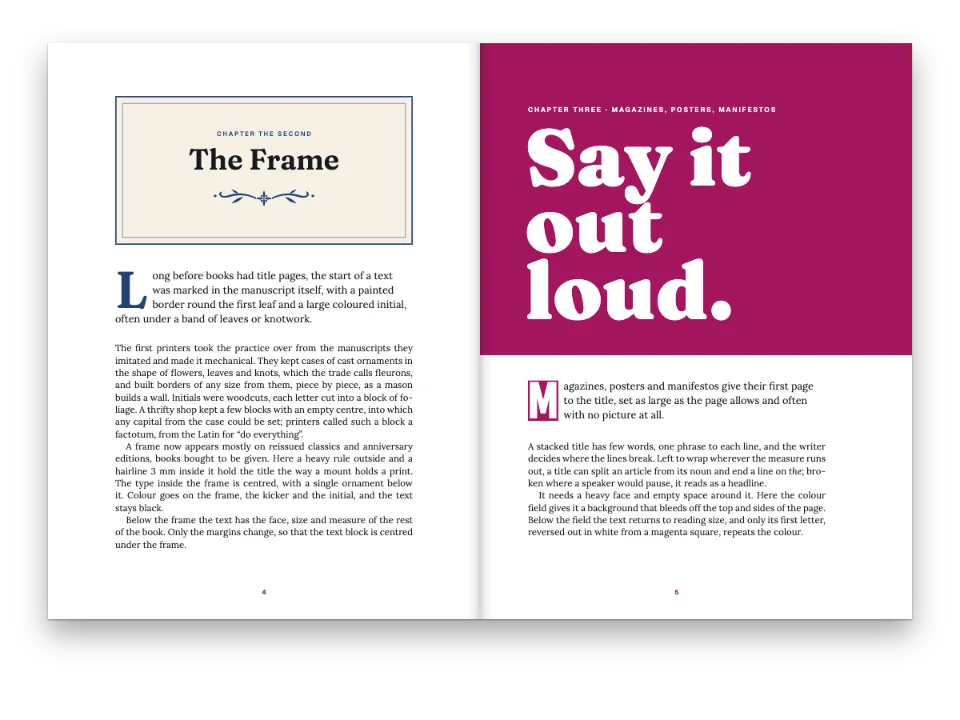
Kapitelauftakte für ein Geologie-Lehrbuch. Ein farbiges Band mit großer Kapitelnummer läuft über den oberen Seitenrand hinaus, und die Gestaltung wird einmal für alle Kapitel angelegt.
Was Sie setzen
Die Kapitelauftakte von Earth in Motion, einem einführenden Geologie-Lehrbuch auf einer Seite von 210 × 280 mm. Kapitel 3 beginnt unter einem terrakottafarbenen Band, das über die Oberkante der Seite hinaus angeschnitten ist. Das Band trägt eine gesperrte Dachzeile, den Titel, umbrochen an der Stelle, die der Autor gewählt hat, einen kursiven Vorspann und eine Kapitelnummer in 168 pt, die am Außenrand auf dem dunklen Fuß des Bands steht. Unter dem Band beginnen zwei Spalten im Blocksatz, und ein Querschnitt durch eine abtauchende Platte nimmt den Fuß der Seite ein. Kapitel 4 wiederholt die Gestaltung in Petrol, bis hin zur Registermarke, den Abschnittsnummern, den Verweisen und der Bezeichnung seiner Abbildung. Die Gestaltung wird einmal angelegt, an der Überschrift der Ebene 1. Die Überschriftenzeile jedes Kapitels liefert das Thema der Dachzeile und den Vorspann als Attribute und nennt einen Stil, wenn das Kapitel eine andere Farbe bekommt.
Dieses Rezept beantwortet
- Wie gestalte ich einen Kapitelauftakt mit randabfallendem Farbband, großer Kapitelnummer und Titel?
- Wie setze ich einen Kapiteltitel über die ganze Seitenbreite, während der Text darunter zweispaltig läuft?
- Wie füge ich einem Auftakt eine Autorenzeile, einen Vorspann oder einen Einstieg mit Initiale hinzu?
- Wie gebe ich jedem Kapitel ein eigenes Foto, eine eigene Farbe oder eine eigene Auftaktvariante?
- Wie nummeriere ich Überschriften (1, 1.1, 1.1.1) und gestalte jede Ebene anders?
Die kurze Antwort
const TOP = 24; // top margin, mm: the opener's container starts here
const OUTER = 16; // outer margin, mm: the numeral and the folios line up on it
const BLEED = 0; // mm: 0 on screen; about 3 for print, which also switches on page.cutLines
const BAND = 100; // mm from the trim to the foot of the band
const NUMERAL = 168; // pt; the baseline of a design text sits 0.8 down its line box
const PT = 25.4 / 72; // mm in a point
const AIR = 12; // mm, foot to text: ≥ 0.2 × NUMERAL × PT ≈ 11.9, the numeral box below its baseline
const BEARING = 2; // mm past the text edge: a rough optical nudge, as each digit's bearing differs
const bleedTop = { to: 'bleed', edge: 'top-left' }; // the trim's corner, pushed out by BLEED
// Design text centres by default; in a heading design it wraps by default too.
const onBand = { color: col('paper'), align: 'left' };
const below = (id, y, width) => ({ anchor: { to: `#${id}`, edge: 'below' }, offset: { y: mm(y) },
  size: { width: mm(width) } }); // chained: a longer title pushes the standfirst down
const opener = { enabled: true,
  // The text starts below the lowest element or minHeight (gotcha: opener-reserves-anchored).
  minHeight: mm(BAND - TOP + AIR), // clears the numeral, so the text starts AIR below the foot
  slot: {
    elements: [ // array order is paint order: the band first, the type on top
      { kind: 'box', id: 'band', style: { backgroundColor: col('band') }, placement: {
        anchor: bleedTop, size: { height: mm(BLEED + BAND) } } }, // no width: runs to the far edge
      { kind: 'rule', id: 'foot', color: col('ink'), thickness: mm(1.6), placement: {
        anchor: bleedTop, offset: { y: mm(BLEED + BAND) } } },
      { kind: 'text', id: 'numeral', content: '{chapterNumber}', ...onBand,
        fontFamily: 'Archivo', fontWeight: 800, fontSize: pt(NUMERAL),
        lineHeight: 1, // a box as tall as the type: the y below counts on it
        placement: { anchor: { to: 'page', edge: 'top-right' }, // the fore-edge of a recto
          offset: { x: mm(BEARING - OUTER), y: mm(BAND - 0.8 * NUMERAL * PT) } } }, // on the foot
      { kind: 'text', id: 'kicker', ...onBand, fontFamily: 'Archivo Narrow', fontWeight: 600,
        content: `${t({ en: 'Chapter', es: 'Capítulo' })} {chapterNumber} · {attr.topic}`,
        fontSize: pt(8.5), letterSpacing: pt(2), textTransform: 'uppercase',
        placement: { anchor: { to: 'container', edge: 'top-left' }, offset: { y: mm(7) } } },
      { kind: 'text', id: 'title', content: '{titleText}', ...onBand, // breaks at the \\
        fontFamily: 'Archivo', fontWeight: 800, fontSize: pt(34), lineHeight: 1.02,
        placement: below('kicker', 3, 118) },
      { kind: 'text', id: 'lead', content: '{attr.lead}', ...onBand, fontFamily: 'Roboto Serif',
        italic: true, fontSize: pt(10.5), lineHeight: 1.36, placement: below('title', 6, 100) },
    ],
  },
}; // hook-up: headings.levels[0] = { span: 'page', breakBefore, advancedDesign: opener }
Zutaten
- Funktionen
- Gestaltete AuftakteKapitelband über die ganze BreiteÜberschriftenattributeZeilenumbrüche in TitelnÜberschriftenformateFarben je TeilNummerierte ÜberschriftenKapitel, die rechts beginnenGestaltungselemente verankernText, Linien und Kästen in SeitengestaltungenAnschnittbänder und DaumenregisterSemantische FarbpaletteKolumnentitel und SeitenzahlenKopfzeilen nach SeitenrolleVerweise, die Abbildungen platzierenPlatzierung von AbbildungenAbbildungen und Tabellen als RessourcenKapitel für Kapitel gebaute BücherSeiten auf einem Canvas
- Nutzt außerdem
- Anschnitt und SchnittmarkenAbsatzformate
- Schrift
- Roboto Serif, Archivo, Archivo Narrow (SIL OFL 1.1)
- Dateien
- Keine: Jedes Bild wird im Code gezeichnet
Zubereitung
#1 · Band und Ziffer an der Seite aufhängen
Der Code steht oben in der kurzen Antwort. Das Band und sein Fuß hängen an der oberen linken Ecke des Anschnitts. Wie jeder Kasten und jede Linie ohne Breitenangabe dehnen sie sich bis zum gegenüberliegenden Rand dieses Rahmens, reichen also bis zum Endformat und, sobald BLEED gesetzt ist, bis in den Anschnitt. Die Ziffer hängt an der oberen rechten Ecke der Seite: y: BAND - 0.8 * NUMERAL * PT setzt ihre Grundlinie auf den Fuß, und BEARING schiebt ihren Kasten 2 mm in den Rand, um die Vor- und Nachbreite der Ziffer auszugleichen, sodass die Farbe ungefähr mit der Textkante abschließt. Die Dachzeile hängt am Container. Der Titel hängt unter der Dachzeile und der Vorspann unter dem Titel, über below-Anker, und eine Überschriftengestaltung bricht ihren Text standardmäßig um, sodass ein längerer Titel den Vorspann nach unten schiebt. Der Vorspann ist ein Textelement, das aus dem Attribut lead der Überschrift gefüllt wird; eine Autorenzeile wäre ein weiteres, {attr.author}, auf dieselbe Weise verkettet. minHeight: BAND - TOP + AIR legt fest, wo der Grundtext beginnt. Der Kasten der Ziffer reicht das 0,2-Fache ihrer Größe (11,9 mm) unter den Fuß, und ein Auftakt reserviert Platz bis zu seinem untersten Element, also muss AIR mindestens 11,9 mm betragen; bei weniger würde der Kasten der Ziffer bestimmen, wo der Text beginnt.
#2 · Der Kapitelüberschrift die Seite geben
  headings: {
    fontFamily: 'Archivo', color: col('band'),
    levels: [
      // parity: 'odd' keeps openers on rectos, so the numeral's right-edge anchor is the
      // fore-edge. The copy is fitted so no chapter spills a few lines onto a page of its own,
      // which would leave that page and a blank verso before the next opener.
      { level: 1, span: 'page', breakBefore: { enabled: true, parity: 'odd' },
        // 0: the hidden title's default 0.5 em would add a grid line, and AIR alone sets the gap
        marginBottom: pt(0), advancedDesign: opener },
      { level: 2, fontSize: pt(11.5), lineHeight: pt(LEAD), numberingTemplate: '{1}.{2}',
        marginTop: pt(LEAD), marginBottom: pt(0) }, // one grid line above, none below
    ],
  },
span: 'page' beginnt jedes Kapitel auf einer neuen Seite und setzt die Überschrift der Ebene 1 über beide Spalten; advancedDesign zeichnet den Auftakt anstelle des Überschriftentexts, und der Grundtext beginnt unter der reservierten Höhe. breakBefore mit parity: 'odd' setzt jeden Auftakt auf eine rechte Seite, wo der rechte Anker der Ziffer der Außenrand ist. Auf Ebene 2 nummeriert numberingTemplate: '{1}.{2}' die Abschnitte 3.1, 3.2 … in der Farbe des Bands; eine Ebene 3 mit '{1}.{2}.{3}' ginge weiter mit 3.1.1.
#3 · Die Kapitelfarbe einmal benennen
const palette = {
  ink: '#1b1f23', // text: a cool near-black
  band: '#c2562b', // the chapter colour: band, tab, section numbers, references, captions
  band2: '#2e6f73', // the second chapter colour, a teal; the sea in Figure 3.1
  land: '#d5cbc0', // the crust in the drawings
  muted: '#6b6259', // running heads and the colophon
  paper: '#ffffff', // type on the band
};
// col(id): a colour linked to its palette entry, with the entry's hex beside the link.
const col = (id) => ({ hex: palette[id], model: 'hex', paletteId: id });
const colorPalette = [
  ...Object.entries(palette).map(([id, hex]) => ({ id, name: id, value: { hex, model: 'hex' } })),
  // The engine's defaults link to 'main-color': point it at the band, so nothing prints blue.
  { id: 'main-color', name: 'band (defaults)', value: { hex: palette.band, model: 'hex' } },
];
// {style="teal"} on a heading line swaps 'band' up to the next level-1 heading: the style's
// palette reaches design slots through their link and repaints every text colour equal to
// the base 'band'.
const headingStyles = [{ id: 'teal', palette: { band: palette.band2 } }];
Jede Farbe der Konfiguration ist mit einem dieser Einträge verknüpft. Die eigenen Standardwerte der Engine sind mit main-color verknüpft, sodass dieser Eintrag, auf die Farbe des Bands gerichtet, auch jeden Standardwert umfärbt, den die Konfiguration nicht setzt. Die Überschriftenzeile von Kapitel 4, # Fire from \\ Below {style="teal" topic="Volcanoes" lead="…"}, wählt den Stil, der band bis zur nächsten Überschrift der Ebene 1 austauscht. Gestaltungsfelder folgen dem Tausch über ihre Palettenverknüpfung, und Textfarben, die dem Basiswert von band gleichen, werden neu eingefärbt, sodass Registermarke, Abschnitts- und Listennummern, Verweise, Abbildungsbezeichnung und die Seitenzahl am Fuß auf den Seiten 43 und 44 petrolfarben werden. Dieselbe Zeile füllt {attr.topic} und {attr.lead}, und ihr \\ bricht {titleText} dort um, wo der Autor es will (Attribute von Überschriften, Zeilenumbrüche in Titeln).
#4 · Den ersten Verweis jede Abbildung platzieren lassen
const figure = (id, placement, caption) => ({ id, typeId: 'figure', kind: 'svg', createdAt: 0,
  updatedAt: 0, svg: { fileId: `${id}.svg`, width: ART[id].width, height: ART[id].height },
  placement, caption, altText: ALT[id] }); // altText: read aloud in a PDF or HTML edition
const resources = [
  // 'auto' may take the citing page's foot, 'top' never can (gotcha: top-float-next-page)
  figure('plate-cycle', { position: 'auto', span: 'page' },
    t({ en: 'A plate’s life in cross-section: born at a ridge (left), it cools as it drifts away '
      + 'and sinks under a continent; dots mark earthquakes.',
    es: 'La vida de una placa, en corte: nace en la dorsal (izquierda), se enfría al alejarse y '
      + 'se hunde bajo el continente; los puntos son terremotos.' })),
  figure('two-volcanoes', { position: 'bottom', span: 'page' }, // under the text on a last page
    t({ en: 'Two volcanoes in cross-section: a broad shield built of runny basalt flows (left) '
      + 'and a steep stratovolcano of lava and ash layers (right).',
    es: 'Dos volcanes en corte: un escudo ancho, de coladas de basalto fluido (izquierda), y un '
      + 'estratovolcán de capas de lava y ceniza (derecha).' })),
];
Ein :ref nummeriert seine Abbildung und setzt sie an die erste freie Stelle nach dem Absatz, der sie zitiert. Abbildung 3.1 ist auto. Sie wird auf der Auftaktseite zitiert, solange beide Spalten noch Platz haben, und nimmt deshalb den Fuß dieser Seite ein; als Gleitobjekt top hätte sie Seite 42 eröffnet, weil ein Gleitobjekt nie über seinen eigenen Verweis steigt. Abbildung 4.1 wird weit unten in der zweiten Spalte von Seite 43 zitiert, wo ein Band über die ganze Seitenbreite nicht mehr passt, also schickt bottom sie auf Seite 44. Das ist die letzte Seite des Kapitels, und auf einer letzten Seite hebt die Engine Gleitobjekte am Fuß direkt unter die letzten Textzeilen, ohne Abstand darüber.
#5 · Kolumnentitel, Registermarke und Seitenzahl am Fuß
const HEAD = 15.5; // mm from the trim to the folio's and the head's baseline: 8.5 above TOP
const INSET = 9; // mm from the folio's edge to the head: room for a three-digit folio
const TAB = { y: 36, w: 9, h: 26 }; // the thumb tab, mm: its top, its width, its height
const tabSize = (w) => ({ width: mm(w), height: mm(TAB.h) });
const baseline = (size) => mm(HEAD - 0.96 * size * PT); // box: 1.2 × size, baseline 0.8 down
const label = { fontFamily: 'Archivo Narrow', fontSize: pt(7.5), fontWeight: 600,
  letterSpacing: pt(1.3), textTransform: 'uppercase', color: col('muted') };
const folio = { fontFamily: 'Archivo', fontSize: pt(9), fontWeight: 800, color: col('ink') };
const side = (parity) => { // the fore-edge is a verso's left edge and a recto's right edge
  const [edge, s] = parity === 'even' ? ['left', 1] : ['right', -1]; // s: into the page
  const at = (to, x, y, size) => ({ anchor: { to, edge: `top-${edge}` },
    offset: { x: mm(s * x), y }, ...(size && { size }) });
  return [
    { kind: 'text', id: `folio-${parity}`, content: '{pageNumber}', ...folio,
      placement: at('page', OUTER, baseline(9)) },
    // Textbooks name the chapter on the verso and the section on the recto; there is no
    // section placeholder, so the recto names the book.
    { kind: 'text', id: `head-${parity}`, content: s > 0 ? '{chapterTitle}' : '{title}',
      ...label, placement: at('page', OUTER + INSET, baseline(7.5)) },
    { kind: 'box', id: `tab-${parity}`, style: { backgroundColor: col('band') }, // off the trim
      placement: at('bleed', 0, mm(BLEED + TAB.y), tabSize(BLEED + TAB.w)) },
    { kind: 'text', id: `tab-no-${parity}`, content: '{chapterNumber}', ...folio, fontSize: pt(13),
      color: col('paper'), // design text centres by default: here, on the trimmed tab
      placement: at('page', 0, mm(TAB.y), tabSize(TAB.w)) },
  ].map((element) => ({ ...element, parity, pages: 'body' })); // never on an opener
};
const header = { elements: [...side('even'), ...side('odd')] };
const footer = { elements: [{ kind: 'text', id: 'drop-folio', content: '{pageNumber}',
  ...folio, color: col('band'), pages: 'opener', // centred by its anchor
  placement: { anchor: { to: 'container', edge: 'top' }, offset: { y: mm(10) } } }] };
Jedes Element der Kopfzeile hängt an einer oberen Ecke der Seite und wird über parity gefiltert, sodass Seitenzahl und Registermarke immer am Außenrand stehen. Der Kasten der Registermarke hängt dagegen an der Ecke des Anschnitts und wird mit BLEED breiter, sodass er auch nach dem Beschnitt randabfallend bleibt. pages: 'body' hält all diese Elemente von den Auftaktseiten fern, die eine Seitenzahl am Fuß aus der Fußzeile bekommen. Die linke Seite nennt das Kapitel mit {chapterTitle} auf einer Zeile, weil \\ den Titel nur im Auftakt umbricht. Lehrbücher nennen auf der rechten Seite meist den Abschnitt. Postext hat keinen Platzhalter für den Abschnitt, deshalb druckt der Kolumnentitel der rechten Seite den {title} des Buchs; diese vier Seiten zeigen ihn nie, weil beide rechten Seiten Auftaktseiten sind.
#6 · Das Buch mit Kapitel 3 beginnen
const continuation = { pageNumbering: { startAt: 41 }, // an odd folio: page 1 is still a recto
  headings: { h1: 2, h2: 0, h3: 0, h4: 0, h5: 0, h6: 0 } }; // the next # is chapter 3
const doc = await buildDocumentWithFonts({ markdown, resources, continuation }, config(),
  kitFonts(FONTS));
showPages(doc, { title: t({ en: 'Chapter opener on a full-bleed band',
  es: 'Apertura de capítulo sobre banda a sangre' }) });
Diese Seiten sind die Kapitel 3 und 4 eines längeren Buchs, deshalb bekommt buildDocument eine continuation mit den Zählern, wie die Kapitel 1 und 2 sie hinterlassen haben. Mit h1: 2 in ihren headings ist das nächste # Kapitel 3: {chapterNumber} druckt 3, die Abschnitte zählen ab 3.1, und die erste Abbildung wird 3.1. pageNumbering.startAt: 41 beginnt die Seitenzahlen bei 41. Die erste Seite bleibt unabhängig von ihrer Seitenzahl eine rechte Seite, weil die Parität an der physischen Seite gezählt wird und pageIndexOffset auf 0 bleibt; die erste Seitenzahl, 41, ist passend dazu ungerade.
Das ganze Rezept
// ═══ Postext Cookbook · Nº 003 · Chapter opener on a full-bleed band ══════════════ // https://postext.dev/en/cookbook/chapter-opener-bleed-band // Code: MIT · Text: original (CC BY 4.0) · Drawings: generated in code (CC BY 4.0) // Fonts: Roboto Serif, Archivo, Archivo Narrow (SIL OFL 1.1) · Needs postext ≥ 1.25.0 // Two chapters of a geology textbook. Every level-1 heading becomes a colour band bled off the // top of the page, its number standing on the band's foot; a heading style recolours chapter 4. import { buildDocumentWithFonts, renderPageToCanvas, registerResourceImage, } from 'https://esm.sh/postext'; const LANG = 'en'; // @lang: the language of the sample document ('en' | 'es') const RECIPE = 'chapter-opener-bleed-band'; // ─── 1 · Design ───────────────────────────────────────────────────────────── // #region palette: semantic colours, and the style that swaps a chapter's const palette = { ink: '#1b1f23', // text: a cool near-black band: '#c2562b', // the chapter colour: band, tab, section numbers, references, captions band2: '#2e6f73', // the second chapter colour, a teal; the sea in Figure 3.1 land: '#d5cbc0', // the crust in the drawings muted: '#6b6259', // running heads and the colophon paper: '#ffffff', // type on the band }; // col(id): a colour linked to its palette entry, with the entry's hex beside the link. const col = (id) => ({ hex: palette[id], model: 'hex', paletteId: id }); const colorPalette = [ ...Object.entries(palette).map(([id, hex]) => ({ id, name: id, value: { hex, model: 'hex' } })), // The engine's defaults link to 'main-color': point it at the band, so nothing prints blue. { id: 'main-color', name: 'band (defaults)', value: { hex: palette.band, model: 'hex' } }, ]; // {style="teal"} on a heading line swaps 'band' up to the next level-1 heading: the style's // palette reaches design slots through their link and repaints every text colour equal to // the base 'band'. const headingStyles = [{ id: 'teal', palette: { band: palette.band2 } }]; // #endregion // #region answer: the opener: a bleed band, the numeral on its foot, texts from the heading const TOP = 24; // top margin, mm: the opener's container starts here const OUTER = 16; // outer margin, mm: the numeral and the folios line up on it const BLEED = 0; // mm: 0 on screen; about 3 for print, which also switches on page.cutLines const BAND = 100; // mm from the trim to the foot of the band const NUMERAL = 168; // pt; the baseline of a design text sits 0.8 down its line box const PT = 25.4 / 72; // mm in a point const AIR = 12; // mm, foot to text: ≥ 0.2 × NUMERAL × PT ≈ 11.9, the numeral box below its baseline const BEARING = 2; // mm past the text edge: a rough optical nudge, as each digit's bearing differs const bleedTop = { to: 'bleed', edge: 'top-left' }; // the trim's corner, pushed out by BLEED // Design text centres by default; in a heading design it wraps by default too. const onBand = { color: col('paper'), align: 'left' }; const below = (id, y, width) => ({ anchor: { to: `#${id}`, edge: 'below' }, offset: { y: mm(y) }, size: { width: mm(width) } }); // chained: a longer title pushes the standfirst down const opener = { enabled: true, // The text starts below the lowest element or minHeight (gotcha: opener-reserves-anchored). minHeight: mm(BAND - TOP + AIR), // clears the numeral, so the text starts AIR below the foot slot: { elements: [ // array order is paint order: the band first, the type on top { kind: 'box', id: 'band', style: { backgroundColor: col('band') }, placement: { anchor: bleedTop, size: { height: mm(BLEED + BAND) } } }, // no width: runs to the far edge { kind: 'rule', id: 'foot', color: col('ink'), thickness: mm(1.6), placement: { anchor: bleedTop, offset: { y: mm(BLEED + BAND) } } }, { kind: 'text', id: 'numeral', content: '{chapterNumber}', ...onBand, fontFamily: 'Archivo', fontWeight: 800, fontSize: pt(NUMERAL), lineHeight: 1, // a box as tall as the type: the y below counts on it placement: { anchor: { to: 'page', edge: 'top-right' }, // the fore-edge of a recto offset: { x: mm(BEARING - OUTER), y: mm(BAND - 0.8 * NUMERAL * PT) } } }, // on the foot { kind: 'text', id: 'kicker', ...onBand, fontFamily: 'Archivo Narrow', fontWeight: 600, content: `${t({ en: 'Chapter', es: 'Capítulo' })} {chapterNumber} · {attr.topic}`, fontSize: pt(8.5), letterSpacing: pt(2), textTransform: 'uppercase', placement: { anchor: { to: 'container', edge: 'top-left' }, offset: { y: mm(7) } } }, { kind: 'text', id: 'title', content: '{titleText}', ...onBand, // breaks at the \\ fontFamily: 'Archivo', fontWeight: 800, fontSize: pt(34), lineHeight: 1.02, placement: below('kicker', 3, 118) }, { kind: 'text', id: 'lead', content: '{attr.lead}', ...onBand, fontFamily: 'Roboto Serif', italic: true, fontSize: pt(10.5), lineHeight: 1.36, placement: below('title', 6, 100) }, ], }, }; // hook-up: headings.levels[0] = { span: 'page', breakBefore, advancedDesign: opener } // #endregion // #region heads: folios and heads on body pages, a thumb tab that bleeds, drop folios const HEAD = 15.5; // mm from the trim to the folio's and the head's baseline: 8.5 above TOP const INSET = 9; // mm from the folio's edge to the head: room for a three-digit folio const TAB = { y: 36, w: 9, h: 26 }; // the thumb tab, mm: its top, its width, its height const tabSize = (w) => ({ width: mm(w), height: mm(TAB.h) }); const baseline = (size) => mm(HEAD - 0.96 * size * PT); // box: 1.2 × size, baseline 0.8 down const label = { fontFamily: 'Archivo Narrow', fontSize: pt(7.5), fontWeight: 600, letterSpacing: pt(1.3), textTransform: 'uppercase', color: col('muted') }; const folio = { fontFamily: 'Archivo', fontSize: pt(9), fontWeight: 800, color: col('ink') }; const side = (parity) => { // the fore-edge is a verso's left edge and a recto's right edge const [edge, s] = parity === 'even' ? ['left', 1] : ['right', -1]; // s: into the page const at = (to, x, y, size) => ({ anchor: { to, edge: `top-${edge}` }, offset: { x: mm(s * x), y }, ...(size && { size }) }); return [ { kind: 'text', id: `folio-${parity}`, content: '{pageNumber}', ...folio, placement: at('page', OUTER, baseline(9)) }, // Textbooks name the chapter on the verso and the section on the recto; there is no // section placeholder, so the recto names the book. { kind: 'text', id: `head-${parity}`, content: s > 0 ? '{chapterTitle}' : '{title}', ...label, placement: at('page', OUTER + INSET, baseline(7.5)) }, { kind: 'box', id: `tab-${parity}`, style: { backgroundColor: col('band') }, // off the trim placement: at('bleed', 0, mm(BLEED + TAB.y), tabSize(BLEED + TAB.w)) }, { kind: 'text', id: `tab-no-${parity}`, content: '{chapterNumber}', ...folio, fontSize: pt(13), color: col('paper'), // design text centres by default: here, on the trimmed tab placement: at('page', 0, mm(TAB.y), tabSize(TAB.w)) }, ].map((element) => ({ ...element, parity, pages: 'body' })); // never on an opener }; const header = { elements: [...side('even'), ...side('odd')] }; const footer = { elements: [{ kind: 'text', id: 'drop-folio', content: '{pageNumber}', ...folio, color: col('band'), pages: 'opener', // centred by its anchor placement: { anchor: { to: 'container', edge: 'top' }, offset: { y: mm(10) } } }] }; // #endregion const LEAD = 13.2; // body leading in pt: the baseline grid const config = () => ({ locale: t({ en: 'en-us', es: 'es' }), // hyphenation, and "Figura" in the Spanish captions colorPalette, headingStyles, page: { width: mm(210), height: mm(280), dpi: 150, // a textbook trim; 150 dpi is for the screen cutLines: { enabled: BLEED > 0, bleed: mm(BLEED) }, // bleed and crop marks once BLEED is set margins: { top: mm(TOP), bottom: mm(22), left: mm(20), right: mm(OUTER), mirror: true } }, layout: { layoutType: 'double', gutterWidth: mm(8) }, bodyText: { fontFamily: 'Roboto Serif', fontSize: pt(9.3), lineHeight: pt(LEAD), color: col('ink'), boldColor: col('ink'), italicColor: col('ink'), referenceColor: col('band'), textAlign: 'justify', firstLineIndent: mm(4), indentAfterHeading: false }, // book texture // #region levels: the H1 takes the page and draws the opener; sections number in the band headings: { fontFamily: 'Archivo', color: col('band'), levels: [ // parity: 'odd' keeps openers on rectos, so the numeral's right-edge anchor is the // fore-edge. The copy is fitted so no chapter spills a few lines onto a page of its own, // which would leave that page and a blank verso before the next opener. { level: 1, span: 'page', breakBefore: { enabled: true, parity: 'odd' }, // 0: the hidden title's default 0.5 em would add a grid line, and AIR alone sets the gap marginBottom: pt(0), advancedDesign: opener }, { level: 2, fontSize: pt(11.5), lineHeight: pt(LEAD), numberingTemplate: '{1}.{2}', marginTop: pt(LEAD), marginBottom: pt(0) }, // one grid line above, none below ], }, // #endregion orderedLists: { fontFamily: 'Archivo', color: col('band'), // numbers bold by default marginTop: pt(0), marginBottom: pt(0) }, captionStyle: { fontFamily: 'Archivo Narrow', fontSize: pt(8.5), labelColor: col('band'), gap: mm(2.2) }, // the text in bodyText's ink, the label bold in the chapter colour paragraphStyles: [{ id: 'colophon', fontFamily: 'Archivo Narrow', fontSize: pt(7.5), lineHeight: pt(10), color: col('muted'), textAlign: 'left', firstLineIndent: pt(0), marginTop: pt(LEAD) }], header, footer, }); // ─── 2 · Content ──────────────────────────────────────────────────────────── const markdown = String.raw`---Markdown-Beispiel · 83 Zeilen · content.en.md
title: "Earth in Motion" subtitle: "An Introduction to Geology" --- # The Restless \\ Crust {topic="Plate tectonics" lead="The ground under your feet is moving at about the speed your fingernails grow. This chapter follows the plates that carry the continents and the oceans, and the seams where they part, collide and grind past each other."} The Earth’s surface is a mosaic of rigid plates, some of them larger than a continent, that move slowly but without pause over the hotter rock beneath them. New sea floor forms along the ridges in the middle of the oceans and is destroyed where it sinks back into the mantle at the deep trenches (:ref{id="plate-cycle"}). The continents travel with the plates like luggage on a conveyor belt, and nearly every earthquake, volcano and mountain range on the planet lies where two plates meet. The idea took a long time to be accepted. In 1915 the German meteorologist Alfred Wegener noticed that the coasts on either side of the Atlantic fit together like the pieces of a jigsaw, and argued that the continents had once been joined in a single landmass. He pointed to fossils of the same land reptiles on both sides of the ocean, rock formations that matched across it and the scratches of ancient glaciers in what are now the tropics. What he could not find was a force strong enough to push a continent through solid rock, and for half a century most geologists rejected the idea. The answer came from the ocean floor, where surveys after the Second World War revealed long undersea mountain chains, and rocks that grow steadily older with distance from their crests. ## A planet in pieces The outer shell of the Earth, the lithosphere, is cold and rigid. It takes in the crust and the uppermost part of the mantle, and it is about a hundred kilometres thick: much more under the old cores of the continents, much less under young oceans. Beneath it lies the asthenosphere, rock that is solid but hot enough to flow, very slowly, like warm wax. The lithosphere is broken into seven large plates and a dozen or so smaller ones, and each of them moves as a single slab over the softer layer below. Plates carry two kinds of crust. Oceanic crust is thin, about seven kilometres, and made of dark, dense basalt. Continental crust is 30 to 50 kilometres thick and made largely of lighter, granite-like rock. When plates meet, the denser ocean floor sinks into the mantle and the continent stays on top. That is why the oldest ocean floor anywhere is only about 180 million years old, while rocks on the continents reach back four billion years. Plates move between one and fifteen centimetres a year. At five centimetres a year a plate travels fifty kilometres in a million years, and the Atlantic has opened by several thousand kilometres since the age of the dinosaurs. ## Where plates meet Geologists recognise three kinds of plate boundary, named for the way the plates move against each other: 1. **Divergent boundaries**, where plates pull apart and magma rises to fill the gap. Most lie along the mid-ocean ridges; Iceland is a piece of the Mid-Atlantic Ridge that stands above the sea. 2. **Convergent boundaries**, where plates collide. When ocean floor meets a continent, the denser plate slides beneath the other and sinks into the mantle, a process called *subduction*. When two continents meet, neither sinks, and the crust crumples into ranges such as the Himalaya. 3. **Transform boundaries**, where plates slide past each other sideways: they lock, strain and then slip again. The San Andreas Fault in California is the best-known example on land. Each kind has its own pattern of earthquakes and volcanoes. Where plates part, the earthquakes are shallow and the eruptions quiet, pouring out runny basalt. Where they collide, they cause the most powerful earthquakes on Earth, open deep trenches and raise chains of explosive volcanoes. Where they slide past each other, earthquakes are frequent but volcanoes are almost absent, because crust is neither made nor destroyed there. ## Reading the evidence The clearest evidence for plate tectonics comes from the magnetism of the sea floor. As basalt cools at a ridge, tiny crystals of magnetite line up with the Earth’s magnetic field, like compass needles frozen in place. The field reverses its direction every few hundred thousand years on average, so the sea floor records the reversals as stripes of normal and reversed magnetism. In 1963 Fred Vine and Drummond Matthews explained the stripes, and by 1966 surveys had shown that those on either side of a ridge are mirror images of each other, which is what you would expect if new floor forms at the crest and moves away in both directions. The earthquake record agrees. On a map, earthquakes fall in narrow belts along the plate boundaries. Beneath the trenches they fall on an inclined plane that dips under the neighbouring plate to depths of 700 kilometres, marking the path of the sinking slab. Chains of volcanic islands add a third line of evidence. The Hawaiian Islands grew over a hot spot, a plume of unusually hot rock rising from deep in the mantle that stays put while the plate slides over it. Each volcano is carried away from the plume in turn and dies, and a new one grows in its place. The volcanoes line up like a trail of footprints: the Big Island still erupts, Kauai is about five million years old, and the drowned volcanoes beyond Midway are older still. The direction and the spacing of the chain record where the Pacific Plate has gone, and how fast. Today the motion can be measured directly. GPS receivers bolted to bedrock on every continent fix their own positions to within a millimetre or two, and they show Hawaii creeping north-west towards Japan and Australia moving so fast, about seven centimetres a year, that the country has to revise its official coordinates every few decades. Wegener thought that the continents ploughed through the rock of the ocean floor. In fact they ride on the plates, and the plates are driven by the slow escape of heat from the Earth’s interior. The next chapter turns to the places where that heat reaches the surface. # Fire from \\ Below {style="teal" topic="Volcanoes" lead="Volcanoes are where the heat of the Earth’s interior reaches the surface. This chapter asks why solid rock melts, why some magma pours out quietly while some explodes, and how the shape of a mountain records the way it erupts."} About 1,350 volcanoes on land are considered potentially active, meaning that they have erupted in the last 10,000 years, and many more lie hidden on the sea floor. Three quarters of the active ones stand around the rim of the Pacific Ocean, the so-called Ring of Fire, above the subduction zones described in the previous chapter (:ref{id="plate-cycle"}). Most of the others line the mid-ocean ridges or sit over isolated hot spots such as Hawaii. Every volcano is a pile of its own eruptions. Each one adds a layer of lava or ash to the slopes, so the shape of the mountain records how it has erupted over thousands of years. Its eruptions, in turn, depend on where and how its magma formed. ## Where magma comes from The mantle is almost entirely solid. It melts only when something upsets the balance between temperature and pressure, and there are three ways that happens. At ridges and hot spots, hot rock rises and the pressure on it falls; lower pressure lowers the melting point, so some of the rock melts without getting any hotter. This is *decompression melting*. At subduction zones, the sinking slab releases water into the hot mantle above it, and water, like salt on an icy road, lowers the melting point. This is *flux melting*, and it feeds the volcanoes of the Andes, Japan and the Cascades. Finally, a body of hot magma can melt the crust around it, adding to its own volume and changing its chemistry. Molten rock is lighter than the rock around it, so it rises and collects in magma chambers a few kilometres below the surface. There it may cool slowly into granite or gabbro and never erupt at all, or it may find a way out through the central conduit or through a crack in the side of the mountain. ## Quiet and violent eruptions Whether an eruption oozes or explodes depends mostly on two things: how much silica the magma holds and how much gas is dissolved in it. Silica makes magma thick. Basalt, about half silica by weight, is runny, and its gas escapes easily; its eruptions send out rivers of lava, as on Hawaii and Iceland, and build broad, gently sloping shield volcanoes. Magmas richer in silica, such as andesite and rhyolite, are so stiff that the gas cannot get out. Pressure builds until the magma shatters into ash and pumice, and the volcano blows apart. The cone volcanoes of subduction zones, called *stratovolcanoes*, record both kinds of behaviour. They are built of alternating layers of lava and ash, each layer an eruption, which is why their slopes are steep and their outlines so regular (:ref{id="two-volcanoes"}). Mount Fuji is one. Mount St Helens had the same outline until 18 May 1980, when the north side of the mountain collapsed in a landslide and the sudden release of pressure drove a sideways blast across 600 square kilometres of forest. The largest explosive eruptions reach far beyond their own region. In 1991 Mount Pinatubo in the Philippines injected about fifteen million tonnes of sulphur dioxide into the stratosphere. There it formed a veil of fine droplets that reflected sunlight back into space and lowered the average temperature of the whole planet by about half a degree Celsius for more than a year. Volcanologists compare eruptions on the Volcanic Explosivity Index, a scale from 0 to 8 based mainly on the volume of rock and ash thrown out, on which most steps are ten times larger than the one below. The lava fountains of Kilauea rate 0 or 1, Mount St Helens rated 5 and Pinatubo 6. In 1815 Tambora, in Indonesia, rated 7, and the year that followed was remembered in Europe and North America as the year without a summer. ## Living with volcanoes Some 800 million people live within a hundred kilometres of an active volcano, drawn by fertile soils and geothermal heat, or because their families have always lived there. Most volcanoes give warning before they erupt: swarms of small earthquakes as magma forces its way upwards, a swelling of the ground that satellites can measure to the centimetre, and changes in the gases that seep from the summit. Observatories that watch for these signs have given towns time to evacuate. In Iceland, geothermal heat from young volcanic rock warms about nine homes in every ten and generates nearly a third of the country’s electricity, and the richest farmland of Java and southern Italy lies on weathered volcanic ash. Most lava flows move slowly enough for people to walk away; they bury houses, roads and fields but seldom take lives. Far more people have died in pyroclastic flows, fast, scorching avalanches of gas, ash and rock that can race down a mountainside at more than a hundred kilometres an hour, and in mudflows, which form when an eruption melts snow or when rain soaks loose ash. Scientists can say that an eruption is becoming more likely, but they can rarely say when it will happen or how large it will be, and a false alarm has its own cost when a city has to be emptied. Around Naples, where more than half a million people live in the zone most exposed to Vesuvius, the emergency plan counts on about three days of warning to move them all to safety. ## Check your understanding 1. Why does ocean floor sink at a subduction zone while a continent stays at the surface? 2. Explain how adding water to hot mantle rock can make it melt without heating it. 3. Mount Fuji and Mauna Loa are both volcanoes. Why is one steep and the other broad? 4. What signs warn volcanologists that magma is rising towards the surface? 5. Why can a single large eruption lower the temperature of the whole planet for a year? :::paragraphs{style="colophon"} From *Earth in Motion*, an imaginary textbook. Set in Roboto Serif, Archivo and Archivo Narrow (SIL OFL) · Text and drawings: original, CC BY 4.0. :::`; // content.<lang>.md, inlined by the Cookbook // #region art: two drawings made of shapes only; their labels live in the captions const PX = 10; // SVG pixels per viewBox unit: 348 units = 174 mm, so about 500 dpi in print const svg = (w, h, body) => ({ width: w * PX, height: h * PX, // the size the resource declares markup: `<svg xmlns="http://www.w3.org/2000/svg" width="${w * PX}" height="${h * PX}" ` + `viewBox="0 0 ${w} ${h}">${body}</svg>` }); const fill = (id, a = 1) => `fill="${palette[id]}" fill-opacity="${a}"`; const path = (d, paint) => `<path d="${d}" ${paint}/>`; const poly = (pts, paint) => path(`M${pts.join('L').replaceAll(',', ' ')}Z`, paint); const dot = (x, y, r, paint) => `<circle cx="${x}" cy="${y}" r="${r}" ${paint}/>`; const plume = (x, y, w, h, paint, m = y + h / 2, f = y + h * 0.8) => path(`M${x} ${y}` + `C${x} ${m} ${x + w} ${m} ${x + w} ${f}A${w} ${h / 5} 0 0 1 ${x - w} ${f}` + `C${x - w} ${m} ${x} ${m} ${x} ${y}Z`, paint); // a teardrop of magma, its tip at (x, y) const arrow = (x, y, dx, id, a = 1, turn = 0, s = Math.sign(dx)) => path( // never a <marker> `M${x} ${y - 0.8}h${dx - s * 5}v-1.8l${s * 5} 2.6l${-s * 5} 2.6v-1.8H${x}Z`, `${fill(id, a)} transform="rotate(${turn} ${x} ${y})"`); // Each drawing takes its chapter's colour: a picture's colours are fixed when it is drawn. function plateCycle(hot) { // a plate is born at a ridge and sinks under a continent const top = [[0, 30], [40, 23], [80, 30], [160, 32], [212, 34], [222, 41], [254, 54], [300, 74], [348, 96]]; // the sea floor, then the top of the sinking slab const under = (d) => top.map(([x, y], i) => [x, y + (d[i] ?? d.at(-1))]); const back = (points) => [...points].reverse(); const crust = under([5]); const lith = under([9, 4, 11, 15]); const quakes = [226, 239, 252, 265, 278, 291, 304, 317, 330].map((x, i) => // in the slab dot(x, 40 + (x - 222) * 0.44 + (i % 3), 1.5, `${fill('ink')} stroke="${palette.paper}" ` + 'stroke-width=".6"')); return svg(348, 102, `<rect y="24" width="348" height="80" ${fill(hot, 0.15)}/>` + poly([[0, 16], [238, 16], [222, 41], ...back(top.slice(0, 5))], fill('band2', 0.3)) + poly([...crust, ...back(lith)], fill('muted', 0.45)) // the plate + poly([...top, ...back(crust)], fill('ink', 0.82)) // its oceanic crust + poly([[222, 41], [238, 16], [262, 15], [270, 10], [277, 5], [281, 5], [288, 10], [296, 14], [318, 12], [327, 9], [336, 12], [348, 10], [348, 50], [300, 45], [258, 44], [240, 47]], fill('land')) // the continent and its volcano + plume(41, 23, 9, 26, fill(hot)) + plume(279, 5, 5.5, 26, fill(hot)) + quakes.join('') + dot(272, 51, 2.2, fill(hot)) + dot(275, 43, 1.7, fill(hot)) // melt rising + arrow(34, 19, -26, 'ink', 0.7) + arrow(90, 23, 70, 'ink', 0.7) // the plates part + arrow(60, 68, 56, hot, 0.5) + arrow(284, 74, 31, 'paper', 1, 25)); } function twoVolcanoes(hot) { // a shield (left) and a stratovolcano (right), cut in half const G = 70; // the ground line const shield = (x, w, h) => `M${x - w} ${G}C${x - w * 0.55} ${G - 2} ${x - w * 0.35} ${G - h} ` + `${x} ${G - h}C${x + w * 0.35} ${G - h} ${x + w * 0.55} ${G - 2} ${x + w} ${G}Z`; // convex const cone = (x, w, h, c = w * 0.055) => `M${x - w} ${G}C${x - w * 0.5} ${G - 3} ${x - w * 0.2} ` + `${G - h * 0.6} ${x - c} ${G - h}H${x + c}` // concave flanks around a crater + `C${x + w * 0.2} ${G - h * 0.6} ${x + w * 0.5} ${G - 3} ${x + w} ${G}Z`; const layers = (shape, x, sizes, paints) => sizes.map(([w, h], i) => // eruption on eruption path(shape(x, w, h), fill('paper')) + path(shape(x, w, h), paints[i % 2])).join(''); const ash = [[267, 10, 4], [274, 7, 5.5], [282, 8.5, 5], [289, 5.5, 5], [297, 7, 4.5], [304, 5, 3.5], [279, 12, 3.5], [292, 10, 3.5]].map(([x, y, r]) => dot(x, y, r, fill('land'))); return svg(348, 92, `<rect y="${G}" width="348" height="${92 - G}" ${fill('land')}/>` + layers(shield, 91, [[86, 24], [70, 18], [54, 12], [38, 7]], [fill(hot, 0.3), fill(hot, 0.5)]) + layers(cone, 269, [[74, 56], [61, 46], [48, 36], [35, 26], [22, 16]], [fill(hot, 0.55), fill('muted', 0.35)]) // lava, then ash + ash.join('') // the explosive one blows ash; the shield only pours lava + `<ellipse cx="91" cy="80" rx="24" ry="4.5" ${fill(hot)}/>` // a shallow magma chamber + `<ellipse cx="269" cy="86" rx="20" ry="5" ${fill(hot)}/>` // a deeper one + path(`M89.5 77V${G - 24}h3V77Z`, fill(hot)) + path(`M267.5 83V${G - 56}h3V83Z`, fill(hot))); } const ART = { 'plate-cycle': plateCycle('band'), 'two-volcanoes': twoVolcanoes('band2') }; const ALT = { // the drawings described, for the figures' altText 'plate-cycle': t({ en: 'A dark plate spreads from a ridge on the left, where magma rises, runs ' + 'under a pale sea and bends down beneath a continent topped by a volcano; a row of dots ' + 'along the sinking slab marks earthquakes, and arrows show the plates moving apart.', es: 'Una placa oscura nace en una dorsal a la izquierda, donde sube el magma, corre bajo un mar ' + 'claro y se dobla hacia abajo bajo un continente coronado por un volcán; una fila de puntos ' + 'a lo largo de la placa que se hunde marca los terremotos, y unas flechas muestran cómo se ' + 'separan las placas.' }), 'two-volcanoes': t({ en: 'On the left, a low, broad volcano of thin layers over a shallow magma ' + 'chamber; on the right, a steep cone of alternating lava and ash layers over a deeper ' + 'chamber, with a cloud of ash above its crater.', es: 'A la izquierda, un volcán bajo y ancho, de capas finas, sobre una cámara magmática poco ' + 'profunda; a la derecha, un cono empinado de capas alternas de lava y ceniza sobre una ' + 'cámara más profunda, con una nube de ceniza sobre el cráter.' }), }; // #endregion // #region figure: each figure takes the first free slot after its first citation const figure = (id, placement, caption) => ({ id, typeId: 'figure', kind: 'svg', createdAt: 0, updatedAt: 0, svg: { fileId: `${id}.svg`, width: ART[id].width, height: ART[id].height }, placement, caption, altText: ALT[id] }); // altText: read aloud in a PDF or HTML edition const resources = [ // 'auto' may take the citing page's foot, 'top' never can (gotcha: top-float-next-page) figure('plate-cycle', { position: 'auto', span: 'page' }, t({ en: 'A plate’s life in cross-section: born at a ridge (left), it cools as it drifts away ' + 'and sinks under a continent; dots mark earthquakes.', es: 'La vida de una placa, en corte: nace en la dorsal (izquierda), se enfría al alejarse y ' + 'se hunde bajo el continente; los puntos son terremotos.' })), figure('two-volcanoes', { position: 'bottom', span: 'page' }, // under the text on a last page t({ en: 'Two volcanoes in cross-section: a broad shield built of runny basalt flows (left) ' + 'and a steep stratovolcano of lava and ash layers (right).', es: 'Dos volcanes en corte: un escudo ancho, de coladas de basalto fluido (izquierda), y un ' + 'estratovolcán de capas de lava y ceniza (derecha).' })), ]; // #endregion // ─── 3 · Fonts ────────────────────────────────────────────────────────────── const FONTS = { // text, display and label faces, loaded before the build 'Roboto Serif': ['400', '400i', '700'], Archivo: ['700', '800'], 'Archivo Narrow': ['400', '400i', '600', '700'] }; // 400i: the colophon's book title // ─── 4 · Build & show ─────────────────────────────────────────────────────── for (const [id, art] of Object.entries(ART)) await loadSvg(`${id}.svg`, art.markup); // #region build: chapters 3 and 4 of a longer book, so the counters start where 2 ended const continuation = { pageNumbering: { startAt: 41 }, // an odd folio: page 1 is still a recto headings: { h1: 2, h2: 0, h3: 0, h4: 0, h5: 0, h6: 0 } }; // the next # is chapter 3 const doc = await buildDocumentWithFonts({ markdown, resources, continuation }, config(), kitFonts(FONTS)); showPages(doc, { title: t({ en: 'Chapter opener on a full-bleed band', es: 'Apertura de capítulo sobre banda a sangre' }) }); // #endregionKit · core, fonts, viewer, images: in jedem Rezept gleich · 270 Zeilen
// ─── Kit ── helpers shared by every Cookbook recipe · postext.dev/cookbook ───── // ─── Kit · core v1 ── the same in every recipe · postext.dev/cookbook function mm(value) { return { value, unit: 'mm' }; } function pt(value) { return { value, unit: 'pt' }; } function em(value) { return { value, unit: 'em' }; } /** The sample language's string: t({ en: 'Figure', es: 'Figura' }). */ function t(strings) { return strings[LANG] ?? Object.values(strings)[0]; } /** A file in this recipe's assets folder, served from the Postext repo by jsDelivr. */ function asset(file) { return `https://cdn.jsdelivr.net/gh/drnachio/postext@main/cookbook/${RECIPE}/assets/${file}`; } // ─── Kit · fonts v3 ── the same in every recipe · postext.dev/cookbook // Postext loads the faces a config asks for before layout (prepareFonts, // buildDocumentWithFonts) and asks the kit for the files: Fontsource's, the // files the PDF embeds too. /** The options of buildDocumentWithFonts / prepareFonts / withLoadedFonts: * the Fontsource resolver, and the faces of FONTS loaded with the ones the * config names. FONTS = { 'Family Name': ['400', '400i', '700'] }. */ function kitFonts(FONTS = {}) { const faces = Object.entries(FONTS).flatMap(([family, specs]) => specs.map((spec) => ({ family, weight: parseInt(spec, 10), style: spec.endsWith('i') ? 'italic' : 'normal' }))); return { resolve: fontsourceResolver, faces }; } /** A face's Fontsource files, in a fixed order: latin, then latin-ext and greek * when `text` needs them and the family ships them (kitSubsetsFor), each with * its unicode-range. Null for a weight or slant Fontsource does not ship. */ async function fontsourceResolver(family, weight, style, { text = '' } = {}) { const id = fontsourceId(family); const meta = await fontsourceMeta(family); if (meta && !(meta.weights.includes(weight) && meta.styles.includes(style))) return null; kitStatus('Loading fonts…'); const at = await fontsourceAt(id); return ['latin', ...kitSubsetsFor(text, meta)].map((subset) => ({ source: `${at}files/${id}-${subset}-${weight}-${style}.woff2`, unicodeRange: kitRanges()[subset], })); } /** The unicode-range of each Fontsource file the kit loads (a function: the * kit is inlined after the pen's code, which runs before a const would be set). */ function kitRanges() { return { latin: 'U+0000-00FF,U+0131,U+0152-0153,U+02BB-02BC,U+02C6,U+02DA,U+02DC,U+0304,U+0308,U+0329,' + 'U+2000-206F,U+20AC,U+2122,U+2191,U+2193,U+2212,U+2215,U+FEFF,U+FFFD', 'latin-ext': 'U+0100-02BA,U+02BD-02C5,U+02C7-02CC,U+02CE-02D7,U+02DD-02FF,U+0304,U+0308,U+0329,' + 'U+1D00-1DBF,U+1E00-1E9F,U+1EF2-1EFF,U+2020,U+20A0-20AB,U+20AD-20C0,U+2113,U+2C60-2C7F,U+A720-A7FF', greek: 'U+0370-03FF', }; } /** For the cjk, arabic and comics blocks, which add their own files: the * faces of `faces` = { 'Family Name': ['400', '400i', '700'] }. `text` is the sample: * č ł † α χ also load latin-ext and greek files (kitSubsetsFor). With * `optional`, a face Fontsource does not ship is skipped instead of failing. * The files are added once all have loaded, in the order asked (latin, then * latin-ext, then greek), whatever order they arrive in: the last one added * wins a character two files hold. Resolves to the number of faces added. */ async function loadFonts(faces, text = '', { optional = false } = {}) { kitStatus('Loading fonts…'); const ranges = kitRanges(); const jobs = []; for (const [family, specs] of Object.entries(faces)) { const id = fontsourceId(family); const todo = [...new Set(specs)].map((spec) => [parseInt(spec, 10), spec.endsWith('i') ? 'italic' : 'normal']) .filter(([weight, style]) => !hasFace(family, weight, style)); // before any await const at = fontsourceAt(id); const meta = optional || /[^\0-ÿ]/u.test(text) ? await fontsourceMeta(family) : null; const subsets = ['latin', ...kitSubsetsFor(text, meta)]; for (const [weight, style] of todo) { if (optional && !(meta?.weights.includes(weight) && meta.styles.includes(style))) continue; for (const subset of subsets) { const url = `${await at}files/${id}-${subset}-${weight}-${style}.woff2`; const face = new FontFace(family, `url(${url}) format('woff2')`, { weight: String(weight), style, unicodeRange: ranges[subset] }); jobs.push(face.load().catch(() => { if (subset === 'latin' && !optional) throw new Error(`Fontsource has no ${family} ${weight} ${style}`); })); } } } const ready = await Promise.all(jobs).catch((error) => { kitFail(error); throw error; }); return ready.filter((face) => face && document.fonts.add(face)).length; } /** A loaded FontFace covers this family, weight and style (fonts.check() would * also say yes for families nobody declared). */ function hasFace(family, weight, style) { for (const face of document.fonts) { if (face.status !== 'loaded' || face.style !== style) continue; if (face.family.replace(/^["']|["']$/g, '') !== family) continue; const [low, high = low] = face.weight.split(' ').map(Number); if (weight >= low && weight <= high) return true; } return false; } /** The files beyond latin `text` needs that `meta`'s family ships. */ function kitSubsetsFor(text, meta) { return [[/[Ā-˿ᴀ-ᶿḀ-ỿ†ℓⱠ-Ɀ꜠-ꟿ]/u, 'latin-ext'], [/[Ͱ-Ͽ]/u, 'greek']] .filter(([re, x]) => re.test(text) && meta?.subsets?.includes(x)).map(([, x]) => x); } /** Fontsource's id for a family: 'Source Serif 4' → 'source-serif-4'. */ function fontsourceId(family) { return family.toLowerCase().replace(/\s+/g, '-'); } /** A package's folder at the one version @5 names now (#766). */ function fontsourceAt(id, u = `https://cdn.jsdelivr.net/npm/@fontsource/${id}@`) { return (fontsourceAt.c ??= {})[id] ??= fetch(u + '5/package.json').then((r) => r.json()) .then((p) => p.version || 5, () => 5).then((v) => `${u}${v}/`); } /** The family's Fontsource metadata (weights, styles, subsets), or null. */ function fontsourceMeta(family) { fontsourceMeta.cache ??= new Map(); const id = fontsourceId(family); if (!fontsourceMeta.cache.has(id)) { fontsourceMeta.cache.set(id, fetch(`https://api.fontsource.org/v1/fonts/${id}`) .then((res) => (res.ok ? res.json() : null), () => null)); } return fontsourceMeta.cache.get(id); } // ─── Kit · viewer v2 ── the same in every recipe · postext.dev/cookbook /** The pages as spreads on a dark desk, page 1 alone, then verso | recto, * each painted when it scrolls near. Other options go to renderPageToCanvas. */ function showPages(docs, { title, width = 460, ...render } = {}) { const root = viewer(title); const pages = [docs].flat().flatMap((doc) => doc.pages.map((page) => ({ doc, page, n: (doc.pageIndexOffset ?? 0) + page.index }))); const spreads = []; let verso = null; for (const p of pages) { if (p.n % 2 === 1) { if (verso) spreads.push([verso, null]); verso = p; } else { spreads.push([verso, p]); verso = null; } } if (verso) spreads.push([verso, null]); const density = Math.min(window.devicePixelRatio || 1, 2); showPages.painter?.disconnect(); const painter = new IntersectionObserver((entries) => { for (const { isIntersecting, target } of entries) { if (!isIntersecting) continue; painter.unobserve(target); const { doc, page } = target.postext; renderPageToCanvas(page, doc, target, { ...render, scale: (width * density) / page.width }); } }, { rootMargin: '800px' }); showPages.painter = painter; root.replaceChildren(...spreads.map((pair) => { const spread = document.createElement('div'); spread.className = 'pt-spread'; for (const p of pair) { const figure = document.createElement('figure'); if (p) { const label = p.page.pageLabel || String(p.n + 1); const canvas = document.createElement('canvas'); canvas.postext = p; canvas.style.aspectRatio = `${p.page.width} / ${p.page.height}`; canvas.setAttribute('role', 'img'); canvas.setAttribute('aria-label', `Page ${label}`); const folio = document.createElement('figcaption'); folio.textContent = label; figure.append(canvas, folio); painter.observe(canvas); } else figure.className = 'pt-blank'; spread.append(figure); } return spread; })); kitStatus(`${pages.length} ${pages.length === 1 ? 'page' : 'pages'}`); document.documentElement.dataset.postext = 'ready'; return pages.length; } /** The desk, the bar and the error reporting, created once. */ function viewer(title) { if (!document.getElementById('pt-kit')) { document.head.insertAdjacentHTML('beforeend', `<style id="pt-kit"> :root { color-scheme: dark; } body { margin: 0; background: #0e1014; color: #b9bcc4; font: 13px/1.45 system-ui, sans-serif; } #pt-bar { position: sticky; top: 0; z-index: 1; display: flex; flex-wrap: wrap; align-items: center; gap: 6px 16px; padding: 10px 16px; background: rgb(14 16 20 / .92); backdrop-filter: blur(6px); border-bottom: 1px solid #23262d; } #pt-bar strong { color: #f4f1ea; font-weight: 600; } #pt-actions { display: flex; gap: 12px; margin-left: auto; } #pt-actions a, #pt-actions button { color: #d8a21a; font: inherit; background: none; border: 0; padding: 0; cursor: pointer; } #pages { display: grid; justify-items: center; gap: 48px; padding: 32px 16px 72px; } .pt-spread { display: flex; } .pt-spread figure { margin: 0; width: min(460px, 44vw); } .pt-spread canvas { display: block; width: 100%; background: #fff; box-shadow: 0 1px 2px rgb(0 0 0 / .5), 0 22px 44px -16px rgb(0 0 0 / .8); } .pt-spread figure:first-child canvas { box-shadow: inset -14px 0 14px -14px rgb(0 0 0 / .18), 0 1px 2px rgb(0 0 0 / .5), 0 22px 44px -16px rgb(0 0 0 / .8); } .pt-spread figcaption { margin-top: 10px; text-align: center; font: 600 10px/1 system-ui, sans-serif; letter-spacing: .18em; text-transform: uppercase; color: #6c7079; } .pt-blank { visibility: hidden; } @media (max-width: 760px) { .pt-spread { flex-direction: column; gap: 32px; } .pt-spread figure { width: min(460px, 92vw); } .pt-blank { display: none; } } </style>`); document.body.insertAdjacentHTML('afterbegin', '<header id="pt-bar"><strong id="pt-title"></strong><span id="pt-status" role="status"></span><span id="pt-actions"></span></header>'); document.getElementById('pt-title').textContent = document.title || 'Postext'; addEventListener('error', (event) => kitFail(event.error ?? event.message)); addEventListener('unhandledrejection', (event) => kitFail(event.reason)); } if (title) document.getElementById('pt-title').textContent = title; return document.getElementById('pages') ?? document.body.appendChild(Object.assign(document.createElement('main'), { id: 'pages' })); } function kitStatus(text) { viewer(); document.getElementById('pt-status').textContent = text; } function kitFail(error) { document.documentElement.dataset.postext = 'error'; kitStatus(`Error: ${error?.message ?? error}`); } // ─── Kit · images v3 ── recipes with pictures · postext.dev/cookbook /** Registers a photo or PNG for the canvas and keeps its bytes for the PDF. * fetch → ImageBitmap never taints the canvas (a plain cross-origin <img> would). */ async function loadImage(fileId, url) { const res = await fetch(url); if (!res.ok) throw new Error(`Image not found (${res.status}): ${url}`); const bytes = new Uint8Array(await res.arrayBuffer()); registerResourceImage(fileId, await createImageBitmap(new Blob([bytes]))); (loadImage.bytes ??= new Map()).set(fileId, bytes); } /** Registers SVG markup as a vector image, its fonts inside (inlineSvgFonts, ≥ 1.25). * `options` go to registerResourceImage: { singleInk: true } tints it on the canvas. */ async function loadSvg(fileId, svg, options) { if (typeof inlineSvgFonts === 'function') svg = await inlineSvgFonts(svg, svgFaces); const img = new Image(); img.src = `data:image/svg+xml;charset=utf-8,${encodeURIComponent(svg)}`; await img.decode(); registerResourceImage(fileId, img, options); (loadImage.bytes ??= new Map()).set(fileId, new TextEncoder().encode(svg)); } /** A face's Fontsource files: nearest weight; latin + what the SVG sets. */ async function svgFaces(family, weight, style, { codePoints = [] } = {}) { const [id, m] = [fontsourceId(family), await fontsourceMeta(family)]; const w = m?.weights.reduce((a, b) => (Math.abs(b - weight) < Math.abs(a - weight) ? b : a)) ?? weight; const s = m?.styles.includes(style) === false ? 'normal' : style; return Promise.all(['latin', ...kitSubsetsFor(String.fromCodePoint(...codePoints), m)].map(async (x) => new Uint8Array( await (await fetch(`${await fontsourceAt(id)}files/${id}-${x}-${w}-${s}.woff2`)).arrayBuffer()))); } /** renderToPdf({ resourceBytes: imageBytes }) */ function imageBytes(fileId) { return loadImage.bytes?.get(fileId); } /** renderToHtml({ resourceImageUrl: imageUrl }) */ function imageUrl(fileId) { const bytes = imageBytes(fileId); if (!bytes) return undefined; imageUrl.urls ??= new Map(); if (!imageUrl.urls.has(fileId)) { const type = /\.svg$/i.test(fileId) ? 'image/svg+xml' : /\.png$/i.test(fileId) ? 'image/png' : 'image/jpeg'; imageUrl.urls.set(fileId, URL.createObjectURL(new Blob([bytes], { type }))); } return imageUrl.urls.get(fileId); } // ─── /Kit ───────────────────────────────────────────────────────────────────────
Das zusammengesetzte script.js läuft unverändert: Fügen Sie es in das Modulskript einer beliebigen Seite ein, oder öffnen Sie das Rezept auf CodePen. Ordner des Rezepts auf GitHub ↗ (öffnet in neuem Tab)
Varianten
#Das Band tiefer machen
BAND legt die Tiefe des Bands fest, die Position der Ziffer und die über dem Text reservierte Höhe. Ein tieferes Band schiebt Text auf die nächste Seite; passen Sie also jedes Kapitel neu ein (siehe den letzten häufigen Fehler) oder lassen Sie die Kapitel fortlaufend beginnen.
-const BAND = 100; // mm from the trim to the foot of the band
+const BAND = 128; // mm from the trim to the foot of the band#Mit Anschnitt drucken
Mit 3 mm Anschnitt laufen Band, Fuß und Registermarke 3 mm über das Endformat hinaus, die Ziffer bleibt auf dem Fuß, und page.cutLines wird mit demselben Wert eingeschaltet.
-const BLEED = 0; // mm: 0 on screen; about 3 for print, which also switches on page.cutLines
+const BLEED = 3; // mm: 0 on screen; about 3 for print, which also switches on page.cutLines#Eine Farbe für ein weiteres Kapitel hinzufügen
Jede Kapitelfarbe ist ein weiterer Paletteneintrag und ein weiterer Stil; schreiben Sie {style="slate"} in die Überschriftenzeile dieses Kapitels.
   band2: '#2e6f73', // the second chapter colour, a teal; the sea in Figure 3.1
+  band3: '#3d4f6b', // a third chapter colour, a slate blue
@@
-const headingStyles = [{ id: 'teal', palette: { band: palette.band2 } }];
+const headingStyles = [{ id: 'teal', palette: { band: palette.band2 } },
+ { id: 'slate', palette: { band: palette.band3 } }];#Kapitel fortlaufend beginnen lassen
Mit 'any' beginnt ein Kapitel auf der nächsten Seite. Nach einem Kapitel, das auf einer rechten Seite endet, beginnt es auf der linken, ohne Vakatseite davor, und seine Ziffer steht am Bund, weil sie am rechten Seitenrand hängt. Diese Seiten bleiben gleich, da Kapitel 3 ohnehin auf einer linken Seite endet.
-      { level: 1, span: 'page', breakBefore: { enabled: true, parity: 'odd' },
+ { level: 1, span: 'page', breakBefore: { enabled: true, parity: 'any' },Häufige Fehler
Häufiger Fehler
Ein Auftakt reserviert Höhe bis zu seinem tiefsten an der Seite verankerten Element
Ein Auftakt mit erweiterter Gestaltung reserviert die Höhe seines tiefsten Elements, und an der Seite oder am Anschnitt verankerte Elemente unterhalb der Überschrift zählen mit, sodass Schmuck am Seitenfuß den Text auf die nächste Seite schiebt. Geben Sie einem solchen Element reserve: false (seit postext 1.5): es wird dort gemalt, wo es verankert ist, und reserviert nichts. Elemente, die dem Band selbst folgen (an seinem Fuß verankert oder 'fill' hoch), bestimmen nie seine Höhe. Gestaltete Auftakte →
Häufiger Fehler
Attributwerte: kein { oder }; einen Wert mit " in einfache Anführungszeichen setzen
Ein Attributwert endet an der schließenden geschweiften Klammer, kann also kein { oder } enthalten. Ein Wert, der ein doppeltes Anführungszeichen enthält, kommt in einfache Anführungszeichen; ein Dollarzeichen ist unproblematisch. Überschriftenattribute →
Häufiger Fehler
Ein 'top'-Gleitobjekt kommt auf die Seite nach seinem Verweis, außer es darf die verweisende Seite eröffnen
Standardmäßig steht ein Gleitobjekt nie über seinem eigenen Verweis, sodass ein seitenbreites 'top'-Gleitobjekt, auf das auf Seite N verwiesen wird, Seite N+1 eröffnet. Setzen Sie placement.citingPage: true an der Ressource oder am defaultPlacement ihres Typs (oder layout.floatsAtCitingPage für das ganze Buch, seit postext 1.25), dann steht es stattdessen oben auf Seite N, und der Text über dem Verweis rückt darunter, sofern es in layout.maxTopFraction passt und die verweisende Zeile auf dieser Seite bleibt. Es eröffnet nie die erste Seite eines Kapitels oder eine Seite nach einem erzwungenen Umbruch: dort eröffnet es weiterhin die nächste Seite, und 'auto' oder 'bottom' können den Fuß der verweisenden Seite einnehmen. Platzierung von Abbildungen →
- Das Band hat eine feste Höhe, während Dachzeile, Titel und Vorspann am oberen Rand hängen und nach unten wachsen; ein längerer Vorspann oder ein dreizeiliger Titel läuft deshalb in den Fuß. Halten Sie Vorspanne bei etwa fünf Zeilen, wie es beide Ausgaben tun, oder leiten Sie
BANDaus dem längsten Auftakt ab. - Die Formel für das
yder Ziffer setztlineHeight: 1voraus. Die Grundlinie eines Gestaltungstexts liegt bei 0,8 der Höhe seines Zeilenkastens, und0.8 * NUMERAList dieser Abstand nur, wenn der Kasten so hoch ist wie die Schrift. Ändern Sie Zeilenhöhe oder Anker, muss die Formel mitgehen.BEARINGist nach Augenmaß gesetzt, weil jede Ziffer ihre eigene Vor- und Nachbreite hat (hier enden die 3 und die 4 um 0,8 mm versetzt). - Die Palette eines Stils färbt Gestaltungselemente und Text um. Ein Bild behält die Farben, mit denen es gezeichnet wurde: Abbildung 4.1 ist petrolfarben, weil der Code sie aus
band2zeichnet, und eine terrakottafarbene Abbildung in Kapitel 4 bliebe terrakottafarben. - Mit
parity: 'odd'hinterlässt ein Kapitel, das ein paar Zeilen über seine letzte Seite hinausläuft, eine fast leere Seite und eine leere linke Seite vor dem nächsten Auftakt. Passen Sie den Text ein, wie es beide Ausgaben hier tun, und prüfen Sie die letzte Seite jedes Kapitels, sobald sich der Text oderBANDändert.
Nachweise
- Rezept
- Ignacio Ferro
- Text
- Eigener Text, CC BY 4.0
- Schriften
- Roboto Serif (SIL OFL 1.1) · Archivo (SIL OFL 1.1) · Archivo Narrow (SIL OFL 1.1)
- Code
- MIT, wie Postext
Diesen Text bearbeiten ↗ (öffnet in neuem Tab)Ordner des Rezepts auf GitHub ↗ (öffnet in neuem Tab)