Kurz gesagt
Ein kurzes Buch darüber, wie Kapitel beginnen können, in dem jedes Kapitel in einem anderen Stil anfängt. Es zeigt, wie ein Kapitel mit einer Einstellung eigene Farben, Ränder und Aufbau bekommt.
Was Sie setzen
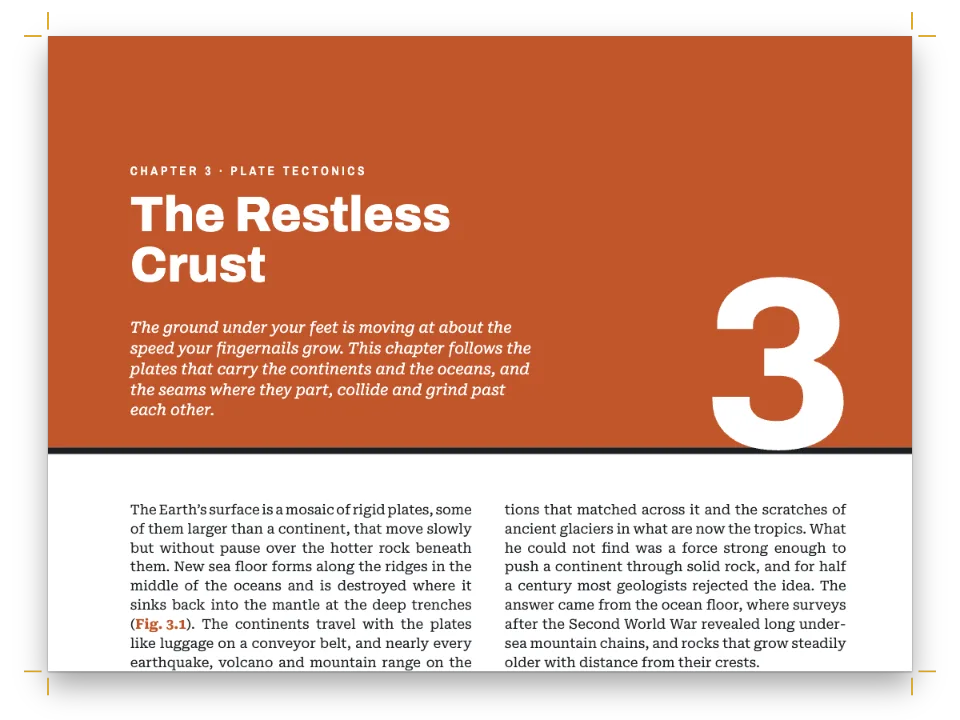
Five Ways to Begin ist ein siebenseitiges Buch über Kapitelauftakte, 180 × 240 mm, und jedes Kapitel ist im Auftakt gesetzt, den es beschreibt. Kapitel eins hat den Auftakt eines Romans: eine gesperrte Dachzeile, ein leichter kursiver Titel und eine fünfzeilige rote Initiale, mit Kolumnentiteln auf den folgenden Seiten. Kapitel zwei setzt Titel und Fleuron in eine cremefarbene Kartusche aus zwei blauen Linien. Kapitel drei stapelt seinen Titel in weißer Fraunces Black auf einem magentafarbenen, randabfallenden Feld, über einer dicktengleichen Initiale, die negativ aus einem Kasten steht. Kapitel vier, das Handbuch, hat dicktengleiche Kolumnentitel, ein oranges Nummernbadge neben dem Titel und zwei Spalten aus der Geist. Die Coda setzt ihren Titel auf halbe Höhe einer leeren Seite, über eine hochgestellte Initiale. Kapitel eins verwendet den eigenen Auftakt der Ebene 1; die anderen vier nennen in ihrer Überschriftenzeile einen Überschriftenstil.
Dieses Rezept beantwortet
- Wie gebe ich jedem Kapitel ein eigenes Foto, eine eigene Farbe oder eine eigene Auftaktvariante?
- Wie füge ich einem Auftakt eine Autorenzeile, einen Vorspann oder einen Einstieg mit Initiale hinzu?
- Wie setze ich einen Kapiteltitel über die ganze Seitenbreite, während der Text darunter zweispaltig läuft?
- Wie baue ich ein Nummernabzeichen neben dem Titel, das breiter wird, wenn die Nummer wächst (9 → 10)?
Die kurze Antwort
// A heading line picks a style by id, and its attributes feed the opener's {attr.…} texts:
//   # The Frame {style="framed" kicker="Chapter the Second"}
// A style overrides the level fields it names (opener, drop cap) and, until the next level-1
// heading, the section fields it names; the rest comes from the level and the document.
const level1 = () => ({ level: 1,
  // span 'page' opens each chapter at the head of a new page and runs its opener across
  // every column (chapter four has two). By default an H1 waits for a recto, with a blank
  // page before it; parity 'any' lets these short chapters open on either side.
  span: 'page',
  breakBefore: { enabled: true, parity: 'any' },
  marginBottom: pt(0), // each opener ends where its first paragraph starts
  advancedDesign: literary, // chapter one, unstyled: the book's own opener
  dropCap: { lines: 5, fontFamily: 'Fraunces', fontWeight: 400, color: col('accent'),
    gap: mm(2.5) } }); // a five-line drop in rubric red
const headingStyles = () => [ // factories, called by config() once every design exists
  // Each style brings its opener and swaps 'accent' for a colour of its own, on its pages.
  { id: 'framed', advancedDesign: framed, palette: { accent: palette.lapis },
    margins: { left: mm(EVEN), right: mm(EVEN) }, // a centred text block; 'accent' is blue:
    dropCap: { lines: 3, fontFamily: 'Fraunces', fontWeight: 600, color: col('accent'),
      gap: mm(2) } },
  { id: 'stacked', advancedDesign: stacked, palette: { accent: palette.magenta }, // white, on
    dropCap: { lines: BOXED, fontFamily: 'Geist Mono', fontWeight: 700, color: col('paper'),
      gap: mm(2.2) } }, // the square the opener draws for it
  { id: 'spec', advancedDesign: spec, palette: { accent: palette.signal }, dropCap: false,
    marginBottom: pt(0), // the hairline under the title is the separator
    margins: { left: mm(SPEC), right: mm(SPEC) }, // a 144 mm text block
    layout: { layoutType: 'double', gutterWidth: mm(7) },
    bodyStyle: { fontFamily: 'Geist', fontSize: pt(9.8), textAlign: 'left' }, // on the grid
    header: { elements: [...specHead('even'), ...specHead('odd')] },
    footer: { elements: [] } }, // no folio at the foot: the head gives the page
  { id: 'quiet', numbered: false, // a coda: it advances no chapter counter
    advancedDesign: quiet, palette: { accent: palette.graphite }, footer: tinyFolio,
    dropCap: { lines: 1, fontFamily: 'Fraunces', fontWeight: 300, fontSize: pt(46), // raised:
      color: col('accent'), gap: mm(1.2) }, // on the first baseline, rising into the white
    margins: { left: mm(QUIET.inner), right: mm(QUIET.outer) }, // a 106 mm measure
    bodyStyle: { fontSize: pt(QUIET.size), lineHeight: pt(QUIET.lead), textAlign: 'left' } },
]; // hook-up in config(): headings: { levels: [level1(), …] }, headingStyles()
Zutaten
- Funktionen
- ÜberschriftenformateAbschnittsgeometrieInitialen in TextabsätzenKolumnentitel je AbschnittGestaltete AuftakteFarben je TeilKapitel ohne NummerKapitelband über die ganze BreiteText, Linien und Kästen in SeitengestaltungenBilder in SeitengestaltungenÜberschriftenattributeAnschnittbänder und DaumenregisterZeilenumbrüche in TitelnGestaltungselemente verankernKolumnentitel und SeitenzahlenKopfzeilen nach SeitenrolleSemantische FarbpaletteNummerierte ÜberschriftenAbsatzformateAbbildungen und Tabellen als Ressourcen
- Nutzt außerdem
- Expliziter vertikaler Abstand
- Schrift
- Lora, Fraunces, Geist, Geist Mono (SIL OFL 1.1)
- Dateien
- Keine: Jedes Bild wird im Code gezeichnet
Zubereitung
#1 · Den eigenen Auftakt des Buchs an der Ebene festlegen
// The first paragraph, in :::paragraphs{style="lead"}, starts 17 mm under the title.
const literary = design([
  text('kicker', '{attr.kicker}', 'Geist', 8, centred(22), { ...caps(1.7), align: 'center' }),
  text('title', '{titleText}', 'Fraunces', 32, at('#kicker', 'below', 0, 4, 'fill'),
    { fontWeight: 300, italic: true, lineHeight: 1.05, align: 'center' }),
  { kind: 'rule', id: 'rule', direction: 'horizontal', thickness: pt(0.8), color: col('accent'),
    placement: at('#title', 'below', (MEASURE - 18) / 2, 6, 18) }, // an 18 mm rule, centred
  room('#title', 17),
]);
Kapitel eins hat keinen Stil und nimmt deshalb die eigene Gestaltung der Ebene 1, von der jeder Stil ausgeht (die kurze Antwort zeigt Ebene und Stile). Der erste Absatz des Kapitels steht im Markdown in einer Gruppe :::paragraphs{style="lead"}, einen Grad größer als der Text (12/17 pt gegenüber 10,8/14,5), und das dropCap der Ebene eröffnet ihn (Initialen): Das M steht auf der fünften Grundlinie, und ohne fontSize schließt seine Oberkante mit den Versalien der ersten Zeile ab, beide Versalhöhen aus Fraunces und Lora gemessen. Der Auftakt endet mit einem leeren Kasten, room(), 17 mm unter dem Titel, wo der Einstiegsabsatz beginnt; ein :::space unter dem Einstiegsabsatz lässt eine Zeile frei und beginnt den Text stumpf.
#2 · Den Titel in zwei Kästen rahmen
const FRAME = 62; // mm: the outer box's height
const INSET = 3; // mm: the hairline box runs this far inside it
const FLEURON = 44; // mm: the ornament's width, centred under the title
const framed = design([ // array order is paint order: the boxes first, the type on top
  { kind: 'box', id: 'frame', placement: { ...at('container', 'top-left', 0, 0),
    size: { width: 'fill', height: mm(FRAME) } },
  style: { backgroundColor: col('tint'), borderColor: col('accent'), borderWidth: pt(1.6) } },
  { kind: 'box', id: 'hairline', placement: { ...at('#frame', 'align-top', INSET, INSET),
    size: { width: mm(MEASURE - 2 * INSET), height: mm(FRAME - 2 * INSET) } },
  style: { borderColor: col('accent'), borderWidth: pt(0.5) } },
  text('kicker', '{attr.kicker}', 'Geist', 7.5, centred(14), { ...caps(1.6), align: 'center' }),
  text('title', '{titleText}', 'Fraunces', 34, at('#kicker', 'below', 0, 3.5, 'fill'),
    { fontWeight: 600, lineHeight: 1.05, align: 'center' }),
  // An image element draws a registered resource, never numbered or captioned. Its resourceId
  // may be '{attr.photo}' (postext ≥ 1.8): then each heading names its own photo.
  { kind: 'image', id: 'fleuron', resourceId: 'fleuron',
    placement: at('#title', 'below', (MEASURE - FLEURON) / 2, 4.5, FLEURON) },
  room('#frame', 9), // the text starts 9 mm under the frame
]);
Die Reihenfolge im Array ist die Zeichenreihenfolge, also kommen die Kästen zuerst und die Schrift obenauf; das Ornament ist ein Bildelement, das eine registrierte SVG-Ressource zeichnet, die nie nummeriert oder zitiert wird. Über ein Bildelement bekommt auch jedes Kapitel ein eigenes Foto: Seit postext 1.8 nimmt sein resourceId Platzhalter an, sodass ein Stil mit resourceId: '{attr.photo}' das Foto zeichnet, das jede Überschrift nennt, # The Frame {style="framed" photo="lake"}, so wie es die Gerichte der Rezeptkarte tun (Bildelemente). Der Stil framed aus der kurzen Antwort setzt palette, um accent auf den Seiten dieses Kapitels blau zu färben, sodass Linien, Dachzeile und Seitenzahl am Fuß blau gedruckt werden, und seine margins zentrieren den Satzspiegel unter dem Rahmen. Das eigene dropCap des Stils nennt col('accent'), das die Palette ebenfalls blau färbt, sodass das dreizeilige L zum Rahmen passt.
#3 · Den Titel stapeln, die Initiale in einen Kasten setzen
const FIELD = 130; // mm from the trim: the foot of the colour field
const S_BEARING = 1.2; // mm: the white left of the title's S (0.0365 em at 94 pt)
// The boxed initial: the style's drop cap sets the white letter; the opener draws the square,
// fitted by hand in pt. The text starts on the grid line 8 mm under the field (from the trim).
const TEXT_TOP = Math.ceil(((FIELD - TOP + 8) * 72) / 25.4 / LEAD) * LEAD; // pt
const BASE = 0.8; // a line's baseline stands 0.8 down its line box
const CAPS = 0.7; // the height of a capital in Lora, em
// Geist Mono, em: cap height, the advance every capital shares, the white either side of an M
const MONO = { caps: 0.71, advance: 0.6, side: 0.044 };
const BOXED = 3; // lines the initial spans
const capsTop = TEXT_TOP + BASE * LEADIN.lead - CAPS * LEADIN.size; // the first line's capitals
const foot = TEXT_TOP + (BOXED - 1 + BASE) * LEADIN.lead; // the third baseline: the letter's foot
// The M runs from the first line's capitals to its foot; the square runs past both as far as
// the M's sides sit in, so the colour is as wide on all four sides.
const letter = (foot - capsTop) / MONO.caps, pad = MONO.side * letter;
const stacked = design([
  { kind: 'box', id: 'field', style: { backgroundColor: col('accent') },
    placement: { anchor: { to: 'bleed', edge: 'top-left' }, size: { height: mm(FIELD) } } },
  text('kicker', '{attr.kicker}', 'Geist', 8, at('container', 'top-left', 0, 4),
    { ...caps(1.8), color: col('paper') }),
  // {titleText} keeps the \\ breaks from the Markdown, so each line ends at the writer's \\.
  // Moved left by the S's side bearing, so its curve meets the text edge.
  text('title', '{titleText}', 'Fraunces', 94,
    at('container', 'top-left', -S_BEARING, 15, 'fill'),
    { fontWeight: 900, lineHeight: 0.84, color: col('paper') }),
  { kind: 'box', id: 'initial', style: { backgroundColor: col('accent') }, reserve: false,
    placement: { anchor: { to: 'container', edge: 'top-left' }, offset: { y: pt(capsTop - pad) },
      size: { width: pt(MONO.advance * letter), height: pt(foot - capsTop + 2 * pad) } } },
  room('container', (TEXT_TOP * 25.4) / 72, 'top-left'), // the opener ends where the text starts
]);
Der Stapel steht im Markdown: # Say it \\ out \\ loud. bricht {titleText} an jedem \\ um, während Kolumnentitel und PDF-Gliederung den Titel auf einer Zeile lesen (Zeilenumbrüche in Titeln). Das Feld hängt an der Oberkante des Anschnitts, in voller Breite und 130 mm tief, und der Einstiegsabsatz beginnt auf der ersten Rasterlinie 8 mm darunter (TEXT_TOP). Die Initiale im Kasten besteht aus zwei Teilen. Das dropCap des Stils setzt das M weiß über drei Zeilen des Einstiegsabsatzes, und der Auftakt zeichnet darunter einen magentafarbenen Kasten, platziert anhand von TEXT_TOP, dem Zeilenabstand des Einstiegsabsatzes und den Metriken der Geist Mono, sodass die Farbe über und unter dem M so breit ist wie seine Vor- und Nachbreite. Der Kasten nimmt im Auftakt keinen Platz ein (reserve: false); ein leerer Kasten room beendet den Auftakt dort, wo der Einstiegsabsatz beginnt.
#4 · Dem Handbuch ein Badge, zwei Spalten und eigene Kolumnentitel geben
const SPEC = 18; // mm: both side margins, for a 144 mm text block in two columns
const PAD = 1.6; // mm of colour over the badge's figures
const spec = design([
  { kind: 'rule', id: 'top-rule', direction: 'horizontal', thickness: pt(2.4), color: col('ink'),
    placement: at('container', 'top-left', 0, 0, 'fill') },
  text('kicker', '{attr.kicker}', 'Geist Mono', 7.5, at('container', 'top-left', 0, 3.2),
    { ...caps(1.2, 500), color: col('graphite') }),
  // The badge's width follows its text, with padding on both sides, so 9 → 10 widens it. Its
  // line box holds 1 mm more under the figures than over them, so the foot pads 1 mm less.
  text('badge', '{chapterNumber}', 'Geist Mono', 26, at('container', 'top-left', 0, 12),
    { fontWeight: 700, lineHeight: 1, box: { backgroundColor: col('accent'), padding: {
      top: mm(PAD), right: mm(2.4), bottom: mm(PAD - 1), left: mm(2.4) } } }),
  // Same size and line height as the badge, dropped by its top padding, so the baselines meet.
  text('title', '{titleText}', 'Geist', 26, at('#badge', 'right-of', 4, PAD),
    { fontWeight: 700, lineHeight: 1 }),
  { kind: 'rule', id: 'hairline', direction: 'horizontal', thickness: pt(0.5), color: col('ink'),
    placement: at('container', 'top-left', 0, 31, 'fill') }, // room for a one-line title
]);
const specHead = (parity) => { // mono labels over the opener's rule, on every page of the section
  const [edge, s] = parity === 'even' ? ['top-left', 1] : ['top-right', -1];
  const mono = { ...caps(1.1, 500), color: col('graphite'), parity, pages: 'all' };
  return [
    text(`sp-page-${parity}`, '{pageNumber} / {totalPages}', 'Geist Mono', 7,
      at('container', edge, 0, HEAD_Y), mono),
    text(`sp-chap-${parity}`, '§ {chapterNumber} · {chapterTitle}', 'Geist Mono', 7,
      at('container', edge, s * 16, HEAD_Y), mono),
  ];
};
Das Badge ist ein Textelement mit Fläche und Innenabstand, aber ohne Breite, sodass seine Breite {chapterNumber} folgt, und der Titel steht right-of davon: Bei Kapitel 10 wächst das Badge um eine Ziffer, 5,5 mm, und der Titel rückt mit. Sein unterer Innenabstand ist 1 mm kleiner als der obere, weil der Zeilenkasten unter den Ziffern um so viel mehr Raum hat, sodass die 4 mittig sitzt. Im Stil spec setzt layout den Abschnitt zweispaltig, und das span: 'page' der Ebene zieht den Auftakt über beide Spalten. Seine margins verbreitern den Satzspiegel auf 144 mm, bodyStyle setzt die Geist im Flattersatz auf das 14,5-pt-Raster des Buchs, header ersetzt die Kolumnentitel des Buchs, und ein leeres footer lässt die Seitenzahl weg.
#5 · Der Coda Raum lassen
const quiet = design([ // the kicker is in the accent, which this style turns graphite
  text('kicker', '{attr.kicker}', 'Geist', 7.5, at('container', 'top-left', 0, 92),
    caps(1.6, 500)),
  text('title', '{titleText}', 'Fraunces', 26, at('#kicker', 'below', 0, 3),
    { fontWeight: 300, lineHeight: 1.1 }),
  room('#title', 3), // and the initial's rise, in whole lines: the text 16 mm under the title
]);
const tiny = (parity, edge) => text(`tiny-${parity}`, '{pageNumber}', 'Geist', 6.5,
  at('container', edge, 0, -12), { fontWeight: 500, color: col('muted'), parity });
const tinyFolio = { elements: [tiny('even', 'bottom-left'), tiny('odd', 'bottom-right')] };
Die Dachzeile hängt 92 mm unter der Oberkante des Satzspiegels, und die hochgestellte Initiale ist die einzeilige Initiale des Stils quiet: Ihr Fuß steht auf der ersten Grundlinie, und in 46 pt ragt sie in den Weißraum darüber, statt in den Absatz einzusinken. Der Absatz hält diesen Überstand in ganzen Zeilen über sich frei, deshalb ist der room des Auftakts unter dem Titel nur 3 mm hoch. Im Stil quiet verengen margins die Satzbreite auf 106 mm, bodyStyle setzt den Text im Flattersatz in 12,5/17,5 pt, footer tauscht die Seitenzahl am Fuß gegen eine kleine an der Außenecke, und palette färbt die Dachzeile grau. Nichts auf dieser Seite druckt eine Kapitelnummer, deshalb zeigte sich numbered: false nur an einem Kapitel nach der Coda, das trotzdem das fünfte wäre.
Das ganze Rezept
// ═══ Postext Cookbook · Nº 017 · Five chapter openers in one book ═════════════════ // https://postext.dev/en/cookbook/five-chapter-openers // Code: MIT · Text: original (CC BY 4.0) · Ornament: generated in code (CC BY 4.0) // Fonts: Lora, Fraunces, Geist, Geist Mono (SIL OFL 1.1) · Needs postext ≥ 1.25.0 // A small book about openers, each chapter set in the one it describes. Every heading style // brings its opener and palette; three move the margins, two bring their own type and folios. import { buildDocumentWithFonts, renderPageToCanvas, registerResourceImage, } from 'https://esm.sh/postext'; const LANG = 'en'; // @lang: the language of the sample document ('en' | 'es') const RECIPE = 'five-chapter-openers'; // ─── 1 · Design ───────────────────────────────────────────────────────────── // #region answer: one opener per chapter: the level's own, then heading styles by name // A heading line picks a style by id, and its attributes feed the opener's {attr.…} texts: // # The Frame {style="framed" kicker="Chapter the Second"} // A style overrides the level fields it names (opener, drop cap) and, until the next level-1 // heading, the section fields it names; the rest comes from the level and the document. const level1 = () => ({ level: 1, // span 'page' opens each chapter at the head of a new page and runs its opener across // every column (chapter four has two). By default an H1 waits for a recto, with a blank // page before it; parity 'any' lets these short chapters open on either side. span: 'page', breakBefore: { enabled: true, parity: 'any' }, marginBottom: pt(0), // each opener ends where its first paragraph starts advancedDesign: literary, // chapter one, unstyled: the book's own opener dropCap: { lines: 5, fontFamily: 'Fraunces', fontWeight: 400, color: col('accent'), gap: mm(2.5) } }); // a five-line drop in rubric red const headingStyles = () => [ // factories, called by config() once every design exists // Each style brings its opener and swaps 'accent' for a colour of its own, on its pages. { id: 'framed', advancedDesign: framed, palette: { accent: palette.lapis }, margins: { left: mm(EVEN), right: mm(EVEN) }, // a centred text block; 'accent' is blue: dropCap: { lines: 3, fontFamily: 'Fraunces', fontWeight: 600, color: col('accent'), gap: mm(2) } }, { id: 'stacked', advancedDesign: stacked, palette: { accent: palette.magenta }, // white, on dropCap: { lines: BOXED, fontFamily: 'Geist Mono', fontWeight: 700, color: col('paper'), gap: mm(2.2) } }, // the square the opener draws for it { id: 'spec', advancedDesign: spec, palette: { accent: palette.signal }, dropCap: false, marginBottom: pt(0), // the hairline under the title is the separator margins: { left: mm(SPEC), right: mm(SPEC) }, // a 144 mm text block layout: { layoutType: 'double', gutterWidth: mm(7) }, bodyStyle: { fontFamily: 'Geist', fontSize: pt(9.8), textAlign: 'left' }, // on the grid header: { elements: [...specHead('even'), ...specHead('odd')] }, footer: { elements: [] } }, // no folio at the foot: the head gives the page { id: 'quiet', numbered: false, // a coda: it advances no chapter counter advancedDesign: quiet, palette: { accent: palette.graphite }, footer: tinyFolio, dropCap: { lines: 1, fontFamily: 'Fraunces', fontWeight: 300, fontSize: pt(46), // raised: color: col('accent'), gap: mm(1.2) }, // on the first baseline, rising into the white margins: { left: mm(QUIET.inner), right: mm(QUIET.outer) }, // a 106 mm measure bodyStyle: { fontSize: pt(QUIET.size), lineHeight: pt(QUIET.lead), textAlign: 'left' } }, ]; // hook-up in config(): headings: { levels: [level1(), …] }, headingStyles() // #endregion const palette = { // every colour in the config links to one of these by id ink: '#16181c', // text: a cool near-black accent: '#8c1c13', // the one accent of a section; the book's own is a rubric red tint: '#f6f0e3', // the frame's cream muted: '#6b6760', // running heads and the colophon paper: '#ffffff', // type on colour lapis: '#24427a', magenta: '#a3155e', signal: '#ff5a1f', graphite: '#4a4f57', }; // col(id): a palette-linked colour, so a style's palette can swap 'accent' on its own pages. // The hex is the value the entry holds in the book's palette. const col = (id) => ({ hex: palette[id], model: 'hex', paletteId: id }); const colorPalette = [ ...Object.entries(palette).map(([id, hex]) => ({ id, name: id, value: { hex, model: 'hex' } })), // The engine's defaults link to 'main-color': point it at the accent, so nothing prints blue. { id: 'main-color', name: 'accent (defaults)', value: { hex: palette.accent, model: 'hex' } }, ]; const TRIM = { w: 180, h: 240 }; // mm const TOP = 22, INNER = 20, OUTER = 36; // margins, mm: a wide outer margin keeps 124 mm lines const MEASURE = TRIM.w - INNER - OUTER; // mm const EVEN = (TRIM.w - MEASURE) / 2; // mm: equal side margins, for the framed chapter const LEAD = 14.5; // body leading, pt: the baseline grid const LEADIN = { size: 12, lead: 17 }; // pt: a chapter's opening paragraph, a size larger const QUIET = { size: 12.5, lead: 17.5, inner: 30, outer: 44 }; // the coda: pt, and mm margins // Design-slot shorthands. at(): a placement from an anchor's edge, x and y in mm. const at = (to, edge, x, y, width) => ({ anchor: { to, edge }, offset: { x: mm(x), y: mm(y) }, ...(width !== undefined && { size: { width: width === 'fill' ? 'fill' : mm(width) } }) }); // Every design text wraps: an opener's would anyway, a running head's would end in '…'. // A number lineHeight multiplies the size. const text = (id, content, fontFamily, size, placement, extra = {}) => ({ kind: 'text', id, content, fontFamily, fontSize: pt(size), color: col('ink'), align: 'left', overflow: 'wrap', placement, ...extra }); const caps = (tracking, weight = 600) => ({ fontWeight: weight, letterSpacing: pt(tracking), textTransform: 'uppercase', color: col('accent') }); const centred = (y) => at('container', 'top', 0, y, 'fill'); // a full-width line, centred // No minHeight: the text starts under the lowest element of each opener. const design = (elements) => ({ enabled: true, slot: { elements } }); // An empty box reserves room: the text starts y mm under the element it hangs from. const room = (anchor, y, edge = 'below') => ({ kind: 'box', id: 'room', style: {}, placement: { ...at(anchor, edge, 0, 0, 'fill'), size: { width: 'fill', height: mm(y) } } }); // #region literary: chapter one, the level's own opener: a five-line drop in rubric red // The first paragraph, in :::paragraphs{style="lead"}, starts 17 mm under the title. const literary = design([ text('kicker', '{attr.kicker}', 'Geist', 8, centred(22), { ...caps(1.7), align: 'center' }), text('title', '{titleText}', 'Fraunces', 32, at('#kicker', 'below', 0, 4, 'fill'), { fontWeight: 300, italic: true, lineHeight: 1.05, align: 'center' }), { kind: 'rule', id: 'rule', direction: 'horizontal', thickness: pt(0.8), color: col('accent'), placement: at('#title', 'below', (MEASURE - 18) / 2, 6, 18) }, // an 18 mm rule, centred room('#title', 17), ]); // #endregion // #region framed: a cartouche of two boxes around the title, an ornament, a three-line initial const FRAME = 62; // mm: the outer box's height const INSET = 3; // mm: the hairline box runs this far inside it const FLEURON = 44; // mm: the ornament's width, centred under the title const framed = design([ // array order is paint order: the boxes first, the type on top { kind: 'box', id: 'frame', placement: { ...at('container', 'top-left', 0, 0), size: { width: 'fill', height: mm(FRAME) } }, style: { backgroundColor: col('tint'), borderColor: col('accent'), borderWidth: pt(1.6) } }, { kind: 'box', id: 'hairline', placement: { ...at('#frame', 'align-top', INSET, INSET), size: { width: mm(MEASURE - 2 * INSET), height: mm(FRAME - 2 * INSET) } }, style: { borderColor: col('accent'), borderWidth: pt(0.5) } }, text('kicker', '{attr.kicker}', 'Geist', 7.5, centred(14), { ...caps(1.6), align: 'center' }), text('title', '{titleText}', 'Fraunces', 34, at('#kicker', 'below', 0, 3.5, 'fill'), { fontWeight: 600, lineHeight: 1.05, align: 'center' }), // An image element draws a registered resource, never numbered or captioned. Its resourceId // may be '{attr.photo}' (postext ≥ 1.8): then each heading names its own photo. { kind: 'image', id: 'fleuron', resourceId: 'fleuron', placement: at('#title', 'below', (MEASURE - FLEURON) / 2, 4.5, FLEURON) }, room('#frame', 9), // the text starts 9 mm under the frame ]); // #endregion // #region stacked: a colour field, the title's words stacked, a boxed initial const FIELD = 130; // mm from the trim: the foot of the colour field const S_BEARING = 1.2; // mm: the white left of the title's S (0.0365 em at 94 pt) // The boxed initial: the style's drop cap sets the white letter; the opener draws the square, // fitted by hand in pt. The text starts on the grid line 8 mm under the field (from the trim). const TEXT_TOP = Math.ceil(((FIELD - TOP + 8) * 72) / 25.4 / LEAD) * LEAD; // pt const BASE = 0.8; // a line's baseline stands 0.8 down its line box const CAPS = 0.7; // the height of a capital in Lora, em // Geist Mono, em: cap height, the advance every capital shares, the white either side of an M const MONO = { caps: 0.71, advance: 0.6, side: 0.044 }; const BOXED = 3; // lines the initial spans const capsTop = TEXT_TOP + BASE * LEADIN.lead - CAPS * LEADIN.size; // the first line's capitals const foot = TEXT_TOP + (BOXED - 1 + BASE) * LEADIN.lead; // the third baseline: the letter's foot // The M runs from the first line's capitals to its foot; the square runs past both as far as // the M's sides sit in, so the colour is as wide on all four sides. const letter = (foot - capsTop) / MONO.caps, pad = MONO.side * letter; const stacked = design([ { kind: 'box', id: 'field', style: { backgroundColor: col('accent') }, placement: { anchor: { to: 'bleed', edge: 'top-left' }, size: { height: mm(FIELD) } } }, text('kicker', '{attr.kicker}', 'Geist', 8, at('container', 'top-left', 0, 4), { ...caps(1.8), color: col('paper') }), // {titleText} keeps the \\ breaks from the Markdown, so each line ends at the writer's \\. // Moved left by the S's side bearing, so its curve meets the text edge. text('title', '{titleText}', 'Fraunces', 94, at('container', 'top-left', -S_BEARING, 15, 'fill'), { fontWeight: 900, lineHeight: 0.84, color: col('paper') }), { kind: 'box', id: 'initial', style: { backgroundColor: col('accent') }, reserve: false, placement: { anchor: { to: 'container', edge: 'top-left' }, offset: { y: pt(capsTop - pad) }, size: { width: pt(MONO.advance * letter), height: pt(foot - capsTop + 2 * pad) } } }, room('container', (TEXT_TOP * 25.4) / 72, 'top-left'), // the opener ends where the text starts ]); // #endregion // The book's running heads and folios, anchored to the text block, whatever its margins. const HEAD_Y = 14; // mm from the trim to the running heads const label = (id, content, parity, edge, x, extra = {}) => text(id, content, 'Geist', 7.5, at('container', edge, x, HEAD_Y), { ...caps(1.4, 500), color: col('muted'), parity, pages: 'body', ...extra }); const folio = { fontWeight: 700, color: col('ink'), letterSpacing: pt(0.4) }; // Title on the verso, chapter on the recto, folios at the outer corners. const header = { elements: [ label('verso-folio', '{pageNumber}', 'even', 'top-left', 0, folio), label('verso-title', '{title}', 'even', 'top-left', 9), label('recto-title', '{chapterTitle}', 'odd', 'top-right', -9), label('recto-folio', '{pageNumber}', 'odd', 'top-right', 0, folio), ] }; // Openers carry a drop folio instead, centred under the text block, in the section's accent. const footer = { elements: [text('drop-folio', '{pageNumber}', 'Geist', 7.5, at('container', 'top', 0, 9), { ...folio, color: col('accent'), pages: 'opener' })] }; // #region spec: a ruled title, a number badge that widens with the number, two columns const SPEC = 18; // mm: both side margins, for a 144 mm text block in two columns const PAD = 1.6; // mm of colour over the badge's figures const spec = design([ { kind: 'rule', id: 'top-rule', direction: 'horizontal', thickness: pt(2.4), color: col('ink'), placement: at('container', 'top-left', 0, 0, 'fill') }, text('kicker', '{attr.kicker}', 'Geist Mono', 7.5, at('container', 'top-left', 0, 3.2), { ...caps(1.2, 500), color: col('graphite') }), // The badge's width follows its text, with padding on both sides, so 9 → 10 widens it. Its // line box holds 1 mm more under the figures than over them, so the foot pads 1 mm less. text('badge', '{chapterNumber}', 'Geist Mono', 26, at('container', 'top-left', 0, 12), { fontWeight: 700, lineHeight: 1, box: { backgroundColor: col('accent'), padding: { top: mm(PAD), right: mm(2.4), bottom: mm(PAD - 1), left: mm(2.4) } } }), // Same size and line height as the badge, dropped by its top padding, so the baselines meet. text('title', '{titleText}', 'Geist', 26, at('#badge', 'right-of', 4, PAD), { fontWeight: 700, lineHeight: 1 }), { kind: 'rule', id: 'hairline', direction: 'horizontal', thickness: pt(0.5), color: col('ink'), placement: at('container', 'top-left', 0, 31, 'fill') }, // room for a one-line title ]); const specHead = (parity) => { // mono labels over the opener's rule, on every page of the section const [edge, s] = parity === 'even' ? ['top-left', 1] : ['top-right', -1]; const mono = { ...caps(1.1, 500), color: col('graphite'), parity, pages: 'all' }; return [ text(`sp-page-${parity}`, '{pageNumber} / {totalPages}', 'Geist Mono', 7, at('container', edge, 0, HEAD_Y), mono), text(`sp-chap-${parity}`, '§ {chapterNumber} · {chapterTitle}', 'Geist Mono', 7, at('container', edge, s * 16, HEAD_Y), mono), ]; }; // #endregion // #region quiet: the coda: a title far down the page, a raised initial, a folio at the side const quiet = design([ // the kicker is in the accent, which this style turns graphite text('kicker', '{attr.kicker}', 'Geist', 7.5, at('container', 'top-left', 0, 92), caps(1.6, 500)), text('title', '{titleText}', 'Fraunces', 26, at('#kicker', 'below', 0, 3), { fontWeight: 300, lineHeight: 1.1 }), room('#title', 3), // and the initial's rise, in whole lines: the text 16 mm under the title ]); const tiny = (parity, edge) => text(`tiny-${parity}`, '{pageNumber}', 'Geist', 6.5, at('container', edge, 0, -12), { fontWeight: 500, color: col('muted'), parity }); const tinyFolio = { elements: [tiny('even', 'bottom-left'), tiny('odd', 'bottom-right')] }; // #endregion const flush = { textAlign: 'left', firstLineIndent: pt(0) }; const config = () => ({ colorPalette, locale: t({ en: 'en-us', es: 'es' }), // the hyphenation patterns of each edition page: { width: mm(TRIM.w), height: mm(TRIM.h), dpi: 150, // 150 dpi: a screen edition margins: { top: mm(TOP), bottom: mm(22), left: mm(INNER), right: mm(OUTER), mirror: true } }, layout: { layoutType: 'single' }, bodyText: { fontFamily: 'Lora', fontSize: pt(10.8), lineHeight: pt(LEAD), color: col('ink'), boldColor: col('ink'), italicColor: col('ink'), referenceColor: col('ink'), textAlign: 'justify', firstLineIndent: mm(4.5), indentAfterHeading: false, minWordSpacing: 0.8, maxWordSpacing: 1.6 }, // an even texture on 124 mm lines headings: { fontFamily: 'Geist', color: col('ink'), levels: [level1(), { level: 2, fontSize: pt(11.5), lineHeight: pt(LEAD), fontWeight: 700, // the manual's numberingTemplate: '{1}.{2}', marginTop: pt(LEAD), marginBottom: pt(0) }] }, headingStyles: headingStyles(), paragraphStyles: [ // A chapter's opening paragraph, a size larger and ragged (the coda's in its own size); // a :::space under it in the Markdown leaves a line and starts the text flush. { id: 'lead', fontSize: pt(LEADIN.size), lineHeight: pt(LEADIN.lead), ...flush }, { id: 'coda-lead', fontSize: pt(QUIET.size), lineHeight: pt(QUIET.lead), ...flush }, { id: 'colophon', fontFamily: 'Geist', fontSize: pt(7), lineHeight: pt(10), color: col('muted'), textAlign: 'left', firstLineIndent: pt(0), marginTop: pt(2 * LEAD) }], header, footer, }); // ─── 2 · Content ──────────────────────────────────────────────────────────── const markdown = String.raw`---Markdown-Beispiel · 93 Zeilen · content.en.md
title: "Five Ways to Begin" subtitle: "Notes on the chapter opener" --- # The Voice {kicker="Chapter One"} :::paragraphs{style="lead"} Most books begin quietly. A novel opens each chapter with a number, sometimes a title, some white space and then the first sentence, set in the same face as the rest of the text. The arrangement is meant to go unnoticed. It tells a reader who has finished one chapter that the next one has started, and lets them go on reading without stopping to look at the page. ::: :::space The one ornament the novel has kept is the initial. It goes back to the rubricator, the scribe who went through a finished manuscript adding the headings and the capital letters in red ink; the word *rubric* comes from *rubrica*, the Latin for red ochre. The custom survived into print. Many early printed books leave a blank square where a chapter begins, sometimes with a small guide letter printed in it, so that a rubricator could paint the initial by hand once the sheets came off the press. Some copies were finished in gold and colour and others never were; in those the squares are still empty but for the guide letter. A drop cap is positioned from the lines beside it. Its top aligns with the capitals of the first line, and its foot stands on the baseline of the last line it spans, so the letter sits inside the text block. The lines it displaces all start the same distance from its right edge. Set above the capitals, the letter looks pasted on; set below them, it seems to sink into the paragraph. Five lines is a deep drop, usually kept for the first chapter of a long book. Two or three lines are more common, and many novels have no initial at all and mark the start of a chapter with the white space above the first line. A plain opener still follows exact measurements. The white space above the title, which printers call the sinkage, is the same depth on every opener, so the titles sit at one height as the pages turn, whether a title is one word long or eight. The first line of text falls on the same grid line as in the rest of the book, so that the lines on facing pages align when the book lies open. A sinkage that changes by a few millimetres from one chapter to the next shows as soon as you flick through the book. The chapter number can be spelled out, as it is here, printed in figures or, for an older look, set in roman numerals, and a book keeps to the form it chooses. Some novels leave out the word *Chapter* and print the number alone above the text, which suits a book of many short chapters. Others give each chapter a title and no number. The title is then the only element of the opener, so it is set a size larger, with more space above it. After the initial, many books set the rest of the first line, or the first phrase, in small capitals, which eases the step down from the large letter to the size of the text; others continue in roman. The first paragraph is not indented. An indent separates a paragraph from the one before it, and the first paragraph of a chapter has none before it. Chapters of a novel usually start on a new page, and in a long book often on a right-hand page, even when that leaves the page before it blank. In a novel of twenty chapters this can add about ten blank pages. Publishers accept them because every opener then falls on the same side of the book, and a reader looking for a chapter can find it by riffling the pages. The opener has no running head. The chapter title is already on the page and a head above it would repeat it, so the page number moves to the foot of the page instead, centred under the text. Printers call this a drop folio. Many books leave it out as well, and the opener is then counted but carries no printed number, a blind folio. On the chapter’s second page the running heads come back, the book’s title on the left-hand page and the chapter’s on the right, and the folios return to the outer corners. From there to the end of the chapter the text keeps to the same grid. A chapter that ends on its first page never shows the running heads at all. This book sets each chapter in the opener it describes, and so far it has followed the conventions of the novel. The next four chapters depart from them: a framed title for a gift edition, a title stacked on a colour field for a magazine, a numbered and ruled opener for a manual, and a title set low on an empty page for a coda. # The Frame {style="framed" kicker="Chapter the Second"} :::paragraphs{style="lead"} Long before books had title pages, the start of a text was marked in the manuscript itself, with a painted border round the first leaf and a large coloured initial, often under a band of leaves or knotwork. ::: :::space The first printers took the practice over from the manuscripts they imitated and made it mechanical. They kept cases of cast ornaments in the shape of flowers, leaves and knots, which the trade calls fleurons, and built borders of any size from them, piece by piece, as a mason builds a wall. Initials were woodcuts, each letter cut into a block of foliage. A thrifty shop kept a few blocks with an empty centre, into which any capital from the case could be set; printers called such a block a factotum, from the Latin for “do everything”. A frame now appears mostly on reissued classics and anniversary editions, books bought to be given. Here a heavy rule outside and a hairline 3 mm inside it hold the title the way a mount holds a print. The type inside the frame is centred, with a single ornament below it. Colour goes on the frame, the kicker and the initial, and the text stays black. Below the frame the text has the face, size and measure of the rest of the book. Only the margins change, so that the text block is centred under the frame. # Say it \\ out \\ loud. {style="stacked" kicker="Chapter Three · Magazines, posters, manifestos"} :::paragraphs{style="lead"} Magazines, posters and manifestos give their first page to the title, set as large as the page allows and often with no picture at all. ::: :::space A stacked title has few words, one phrase to each line, and the writer decides where the lines break. Left to wrap wherever the measure runs out, a title can split an article from its noun and end a line on *the*; broken where a speaker would pause, it reads as a headline. It needs a heavy face and empty space around it. Here the colour field gives it a background that bleeds off the top and sides of the page. Below the field the text returns to reading size, and only its first letter, reversed out in white from a magenta square, repeats the colour. # Number Everything {style="spec" kicker="Manuals · Standards · Datasheets"} Few people read a manual from the first page to the last. They open it at the section they need, often with the machine it describes in the other hand, and close it once the question is answered. The chapter number is what they write in a margin or quote in an email, so the opener sets it large, in figures of equal width, at the top left, where the eye starts. ## Numbers before names Readers cite a section by its number. A reference to section 4.2 still works after the section’s title has been reworded, which a reference to “the section on columns” may not. Headings are numbered down to the second level, and the number of a withdrawn section is never given to a new one, so an old reference cannot lead to different text. The badge that carries the chapter number widens with it. One- and two-figure numbers get the same padding on either side, and the title moves along to make room, so chapter 10 has the same gap between badge and title as chapter 9. At this size each extra figure adds 5.5 mm. ## Two columns, short lines Technical text is often set in two columns because a short line is easier to scan. Here each column is 68.5 mm wide, about forty characters of this text. A reader looking for one value can run down a narrow column, and at the end of each line the eye finds the start of the next without losing its place. The text is ragged right, so every word space keeps its natural width, and a long string such as a part number never stretches the spaces of the line before it. The title runs across both columns. It has to be read before anything else on the page, and in the first column alone it would look like one more paragraph. ## Rules and colour The rules divide the page. A heavy rule across the top of the text block marks the start of the chapter, and a hairline separates the title from the text. Both run the full width of the text block, across the two columns. The running head above them gives the chapter and the page number over the total, so a reader can see how far into the document they are without turning to the contents. The only colour is the orange of the badge, and the figure printed on it is black. Everything else a reader has to read is black or dark grey, so a black-and-white photocopy of the page loses no information. # Leave Room {style="quiet" kicker="Coda"} :::paragraphs{style="coda-lead"} Some books need no signal at all. A collection of poems or a memoir can use its openers to slow the reader down. ::: :::space This coda does it with white space: its title starts more than 90 mm down the text block, and its initial rises above the first line into the empty page. :::paragraphs{style="colophon"} *Five Ways to Begin* is set in Lora, Fraunces, Geist and Geist Mono (SIL Open Font License). Text and ornament: CC BY 4.0. :::`; // content.<lang>.md, inlined by the Cookbook // #region art: the fleuron, a printer's flower drawn in paths in the frame's blue function fleuron(ink) { // two scrolls with a leaf above and below, a rosette between them const scroll = 'M51 14.2C42 9.5 31 8.6 22 11.4C16 13.2 11.6 13 9.6 10.2C8.2 7.8 10.2 5.3 13 5.8' + 'C11 6.8 10.6 8.8 12 9.9C14.6 11.4 18 10.2 21.6 9.1C30.6 6.4 42 7.6 51 12.4Z' + 'M36 11.4C33.4 15.6 28.6 18.4 23.4 18.8C26.4 15 31 12.4 36 11.4Z' // the leaf below + 'M31 8.3C29.6 5.2 26.4 3.4 23 3.5C25.2 5.8 27.8 7.6 31 8.3Z'; // the leaf above const petal = 'M60 13.4C58.2 10.6 58.2 7.2 60 4.4C61.8 7.2 61.8 10.6 60 13.4Z'; const turn = (a) => `transform="rotate(${a} 60 13.4)"`; const rosette = [0, 90, 180, 270].map((a) => `<path d="${petal}" ${turn(a)}/>`).join('') + [45, 135, 225, 315].map((a) => `<circle cx="60" cy="9.6" r="1.1" ${turn(a)}/>`).join(''); return '<svg xmlns="http://www.w3.org/2000/svg" width="720" height="162" viewBox="0 0 120 27">' + `<g fill="${ink}"><path d="${scroll}"/>` // the right half is the left one mirrored + `<path d="${scroll}" transform="translate(120 0) scale(-1 1)"/>${rosette}` + '<circle cx="4.5" cy="10.5" r="1.5"/><circle cx="115.5" cy="10.5" r="1.5"/></g></svg>'; } // #endregion const resources = [{ id: 'fleuron', typeId: 'figure', kind: 'svg', createdAt: 0, updatedAt: 0, svg: { fileId: 'fleuron.svg', width: 720, height: 162 }, altText: t({ en: 'A printer’s flower: a four-petalled rosette between two leafy scrolls.', es: 'Un florón de imprenta: una roseta de cuatro pétalos entre dos volutas con hojas.' }) }]; // ─── 3 · Fonts ────────────────────────────────────────────────────────────── const FONTS = { // text, display, label and figure faces Lora: ['400', '400i'], Fraunces: ['300', '300i', '400', '600', '900'], Geist: ['400', '400i', '500', '600', '700'], 'Geist Mono': ['500', '700'] }; // ─── 4 · Build & show ─────────────────────────────────────────────────────── await loadSvg('fleuron.svg', fleuron(palette.lapis)); // a picture's colours are fixed when drawn const doc = await buildDocumentWithFonts({ markdown, resources }, config(), kitFonts(FONTS)); showPages(doc, { title: t({ en: 'Five chapter openers', es: 'Cinco aperturas de capítulo' }) });Kit · core, fonts, viewer, images: in jedem Rezept gleich · 270 Zeilen
// ─── Kit ── helpers shared by every Cookbook recipe · postext.dev/cookbook ───── // ─── Kit · core v1 ── the same in every recipe · postext.dev/cookbook function mm(value) { return { value, unit: 'mm' }; } function pt(value) { return { value, unit: 'pt' }; } function em(value) { return { value, unit: 'em' }; } /** The sample language's string: t({ en: 'Figure', es: 'Figura' }). */ function t(strings) { return strings[LANG] ?? Object.values(strings)[0]; } /** A file in this recipe's assets folder, served from the Postext repo by jsDelivr. */ function asset(file) { return `https://cdn.jsdelivr.net/gh/drnachio/postext@main/cookbook/${RECIPE}/assets/${file}`; } // ─── Kit · fonts v3 ── the same in every recipe · postext.dev/cookbook // Postext loads the faces a config asks for before layout (prepareFonts, // buildDocumentWithFonts) and asks the kit for the files: Fontsource's, the // files the PDF embeds too. /** The options of buildDocumentWithFonts / prepareFonts / withLoadedFonts: * the Fontsource resolver, and the faces of FONTS loaded with the ones the * config names. FONTS = { 'Family Name': ['400', '400i', '700'] }. */ function kitFonts(FONTS = {}) { const faces = Object.entries(FONTS).flatMap(([family, specs]) => specs.map((spec) => ({ family, weight: parseInt(spec, 10), style: spec.endsWith('i') ? 'italic' : 'normal' }))); return { resolve: fontsourceResolver, faces }; } /** A face's Fontsource files, in a fixed order: latin, then latin-ext and greek * when `text` needs them and the family ships them (kitSubsetsFor), each with * its unicode-range. Null for a weight or slant Fontsource does not ship. */ async function fontsourceResolver(family, weight, style, { text = '' } = {}) { const id = fontsourceId(family); const meta = await fontsourceMeta(family); if (meta && !(meta.weights.includes(weight) && meta.styles.includes(style))) return null; kitStatus('Loading fonts…'); const at = await fontsourceAt(id); return ['latin', ...kitSubsetsFor(text, meta)].map((subset) => ({ source: `${at}files/${id}-${subset}-${weight}-${style}.woff2`, unicodeRange: kitRanges()[subset], })); } /** The unicode-range of each Fontsource file the kit loads (a function: the * kit is inlined after the pen's code, which runs before a const would be set). */ function kitRanges() { return { latin: 'U+0000-00FF,U+0131,U+0152-0153,U+02BB-02BC,U+02C6,U+02DA,U+02DC,U+0304,U+0308,U+0329,' + 'U+2000-206F,U+20AC,U+2122,U+2191,U+2193,U+2212,U+2215,U+FEFF,U+FFFD', 'latin-ext': 'U+0100-02BA,U+02BD-02C5,U+02C7-02CC,U+02CE-02D7,U+02DD-02FF,U+0304,U+0308,U+0329,' + 'U+1D00-1DBF,U+1E00-1E9F,U+1EF2-1EFF,U+2020,U+20A0-20AB,U+20AD-20C0,U+2113,U+2C60-2C7F,U+A720-A7FF', greek: 'U+0370-03FF', }; } /** For the cjk, arabic and comics blocks, which add their own files: the * faces of `faces` = { 'Family Name': ['400', '400i', '700'] }. `text` is the sample: * č ł † α χ also load latin-ext and greek files (kitSubsetsFor). With * `optional`, a face Fontsource does not ship is skipped instead of failing. * The files are added once all have loaded, in the order asked (latin, then * latin-ext, then greek), whatever order they arrive in: the last one added * wins a character two files hold. Resolves to the number of faces added. */ async function loadFonts(faces, text = '', { optional = false } = {}) { kitStatus('Loading fonts…'); const ranges = kitRanges(); const jobs = []; for (const [family, specs] of Object.entries(faces)) { const id = fontsourceId(family); const todo = [...new Set(specs)].map((spec) => [parseInt(spec, 10), spec.endsWith('i') ? 'italic' : 'normal']) .filter(([weight, style]) => !hasFace(family, weight, style)); // before any await const at = fontsourceAt(id); const meta = optional || /[^\0-ÿ]/u.test(text) ? await fontsourceMeta(family) : null; const subsets = ['latin', ...kitSubsetsFor(text, meta)]; for (const [weight, style] of todo) { if (optional && !(meta?.weights.includes(weight) && meta.styles.includes(style))) continue; for (const subset of subsets) { const url = `${await at}files/${id}-${subset}-${weight}-${style}.woff2`; const face = new FontFace(family, `url(${url}) format('woff2')`, { weight: String(weight), style, unicodeRange: ranges[subset] }); jobs.push(face.load().catch(() => { if (subset === 'latin' && !optional) throw new Error(`Fontsource has no ${family} ${weight} ${style}`); })); } } } const ready = await Promise.all(jobs).catch((error) => { kitFail(error); throw error; }); return ready.filter((face) => face && document.fonts.add(face)).length; } /** A loaded FontFace covers this family, weight and style (fonts.check() would * also say yes for families nobody declared). */ function hasFace(family, weight, style) { for (const face of document.fonts) { if (face.status !== 'loaded' || face.style !== style) continue; if (face.family.replace(/^["']|["']$/g, '') !== family) continue; const [low, high = low] = face.weight.split(' ').map(Number); if (weight >= low && weight <= high) return true; } return false; } /** The files beyond latin `text` needs that `meta`'s family ships. */ function kitSubsetsFor(text, meta) { return [[/[Ā-˿ᴀ-ᶿḀ-ỿ†ℓⱠ-Ɀ꜠-ꟿ]/u, 'latin-ext'], [/[Ͱ-Ͽ]/u, 'greek']] .filter(([re, x]) => re.test(text) && meta?.subsets?.includes(x)).map(([, x]) => x); } /** Fontsource's id for a family: 'Source Serif 4' → 'source-serif-4'. */ function fontsourceId(family) { return family.toLowerCase().replace(/\s+/g, '-'); } /** A package's folder at the one version @5 names now (#766). */ function fontsourceAt(id, u = `https://cdn.jsdelivr.net/npm/@fontsource/${id}@`) { return (fontsourceAt.c ??= {})[id] ??= fetch(u + '5/package.json').then((r) => r.json()) .then((p) => p.version || 5, () => 5).then((v) => `${u}${v}/`); } /** The family's Fontsource metadata (weights, styles, subsets), or null. */ function fontsourceMeta(family) { fontsourceMeta.cache ??= new Map(); const id = fontsourceId(family); if (!fontsourceMeta.cache.has(id)) { fontsourceMeta.cache.set(id, fetch(`https://api.fontsource.org/v1/fonts/${id}`) .then((res) => (res.ok ? res.json() : null), () => null)); } return fontsourceMeta.cache.get(id); } // ─── Kit · viewer v2 ── the same in every recipe · postext.dev/cookbook /** The pages as spreads on a dark desk, page 1 alone, then verso | recto, * each painted when it scrolls near. Other options go to renderPageToCanvas. */ function showPages(docs, { title, width = 460, ...render } = {}) { const root = viewer(title); const pages = [docs].flat().flatMap((doc) => doc.pages.map((page) => ({ doc, page, n: (doc.pageIndexOffset ?? 0) + page.index }))); const spreads = []; let verso = null; for (const p of pages) { if (p.n % 2 === 1) { if (verso) spreads.push([verso, null]); verso = p; } else { spreads.push([verso, p]); verso = null; } } if (verso) spreads.push([verso, null]); const density = Math.min(window.devicePixelRatio || 1, 2); showPages.painter?.disconnect(); const painter = new IntersectionObserver((entries) => { for (const { isIntersecting, target } of entries) { if (!isIntersecting) continue; painter.unobserve(target); const { doc, page } = target.postext; renderPageToCanvas(page, doc, target, { ...render, scale: (width * density) / page.width }); } }, { rootMargin: '800px' }); showPages.painter = painter; root.replaceChildren(...spreads.map((pair) => { const spread = document.createElement('div'); spread.className = 'pt-spread'; for (const p of pair) { const figure = document.createElement('figure'); if (p) { const label = p.page.pageLabel || String(p.n + 1); const canvas = document.createElement('canvas'); canvas.postext = p; canvas.style.aspectRatio = `${p.page.width} / ${p.page.height}`; canvas.setAttribute('role', 'img'); canvas.setAttribute('aria-label', `Page ${label}`); const folio = document.createElement('figcaption'); folio.textContent = label; figure.append(canvas, folio); painter.observe(canvas); } else figure.className = 'pt-blank'; spread.append(figure); } return spread; })); kitStatus(`${pages.length} ${pages.length === 1 ? 'page' : 'pages'}`); document.documentElement.dataset.postext = 'ready'; return pages.length; } /** The desk, the bar and the error reporting, created once. */ function viewer(title) { if (!document.getElementById('pt-kit')) { document.head.insertAdjacentHTML('beforeend', `<style id="pt-kit"> :root { color-scheme: dark; } body { margin: 0; background: #0e1014; color: #b9bcc4; font: 13px/1.45 system-ui, sans-serif; } #pt-bar { position: sticky; top: 0; z-index: 1; display: flex; flex-wrap: wrap; align-items: center; gap: 6px 16px; padding: 10px 16px; background: rgb(14 16 20 / .92); backdrop-filter: blur(6px); border-bottom: 1px solid #23262d; } #pt-bar strong { color: #f4f1ea; font-weight: 600; } #pt-actions { display: flex; gap: 12px; margin-left: auto; } #pt-actions a, #pt-actions button { color: #d8a21a; font: inherit; background: none; border: 0; padding: 0; cursor: pointer; } #pages { display: grid; justify-items: center; gap: 48px; padding: 32px 16px 72px; } .pt-spread { display: flex; } .pt-spread figure { margin: 0; width: min(460px, 44vw); } .pt-spread canvas { display: block; width: 100%; background: #fff; box-shadow: 0 1px 2px rgb(0 0 0 / .5), 0 22px 44px -16px rgb(0 0 0 / .8); } .pt-spread figure:first-child canvas { box-shadow: inset -14px 0 14px -14px rgb(0 0 0 / .18), 0 1px 2px rgb(0 0 0 / .5), 0 22px 44px -16px rgb(0 0 0 / .8); } .pt-spread figcaption { margin-top: 10px; text-align: center; font: 600 10px/1 system-ui, sans-serif; letter-spacing: .18em; text-transform: uppercase; color: #6c7079; } .pt-blank { visibility: hidden; } @media (max-width: 760px) { .pt-spread { flex-direction: column; gap: 32px; } .pt-spread figure { width: min(460px, 92vw); } .pt-blank { display: none; } } </style>`); document.body.insertAdjacentHTML('afterbegin', '<header id="pt-bar"><strong id="pt-title"></strong><span id="pt-status" role="status"></span><span id="pt-actions"></span></header>'); document.getElementById('pt-title').textContent = document.title || 'Postext'; addEventListener('error', (event) => kitFail(event.error ?? event.message)); addEventListener('unhandledrejection', (event) => kitFail(event.reason)); } if (title) document.getElementById('pt-title').textContent = title; return document.getElementById('pages') ?? document.body.appendChild(Object.assign(document.createElement('main'), { id: 'pages' })); } function kitStatus(text) { viewer(); document.getElementById('pt-status').textContent = text; } function kitFail(error) { document.documentElement.dataset.postext = 'error'; kitStatus(`Error: ${error?.message ?? error}`); } // ─── Kit · images v3 ── recipes with pictures · postext.dev/cookbook /** Registers a photo or PNG for the canvas and keeps its bytes for the PDF. * fetch → ImageBitmap never taints the canvas (a plain cross-origin <img> would). */ async function loadImage(fileId, url) { const res = await fetch(url); if (!res.ok) throw new Error(`Image not found (${res.status}): ${url}`); const bytes = new Uint8Array(await res.arrayBuffer()); registerResourceImage(fileId, await createImageBitmap(new Blob([bytes]))); (loadImage.bytes ??= new Map()).set(fileId, bytes); } /** Registers SVG markup as a vector image, its fonts inside (inlineSvgFonts, ≥ 1.25). * `options` go to registerResourceImage: { singleInk: true } tints it on the canvas. */ async function loadSvg(fileId, svg, options) { if (typeof inlineSvgFonts === 'function') svg = await inlineSvgFonts(svg, svgFaces); const img = new Image(); img.src = `data:image/svg+xml;charset=utf-8,${encodeURIComponent(svg)}`; await img.decode(); registerResourceImage(fileId, img, options); (loadImage.bytes ??= new Map()).set(fileId, new TextEncoder().encode(svg)); } /** A face's Fontsource files: nearest weight; latin + what the SVG sets. */ async function svgFaces(family, weight, style, { codePoints = [] } = {}) { const [id, m] = [fontsourceId(family), await fontsourceMeta(family)]; const w = m?.weights.reduce((a, b) => (Math.abs(b - weight) < Math.abs(a - weight) ? b : a)) ?? weight; const s = m?.styles.includes(style) === false ? 'normal' : style; return Promise.all(['latin', ...kitSubsetsFor(String.fromCodePoint(...codePoints), m)].map(async (x) => new Uint8Array( await (await fetch(`${await fontsourceAt(id)}files/${id}-${x}-${w}-${s}.woff2`)).arrayBuffer()))); } /** renderToPdf({ resourceBytes: imageBytes }) */ function imageBytes(fileId) { return loadImage.bytes?.get(fileId); } /** renderToHtml({ resourceImageUrl: imageUrl }) */ function imageUrl(fileId) { const bytes = imageBytes(fileId); if (!bytes) return undefined; imageUrl.urls ??= new Map(); if (!imageUrl.urls.has(fileId)) { const type = /\.svg$/i.test(fileId) ? 'image/svg+xml' : /\.png$/i.test(fileId) ? 'image/png' : 'image/jpeg'; imageUrl.urls.set(fileId, URL.createObjectURL(new Blob([bytes], { type }))); } return imageUrl.urls.get(fileId); } // ─── /Kit ───────────────────────────────────────────────────────────────────────
Das zusammengesetzte script.js läuft unverändert: Fügen Sie es in das Modulskript einer beliebigen Seite ein, oder öffnen Sie das Rezept auf CodePen. Ordner des Rezepts auf GitHub ↗ (öffnet in neuem Tab)
Varianten
#Jedes Kapitel auf eine rechte Seite setzen
Mit 'odd' beginnt jedes Kapitel auf einer rechten Seite, und die Kapitel zwei bis fünf bekommen jeweils eine leere linke Seite davor, sodass das Buch von 7 auf 11 Seiten wächst.
-  breakBefore: { enabled: true, parity: 'any' },
+ breakBefore: { enabled: true, parity: 'odd' },#Die Initiale über drei Zeilen setzen
Ohne fontSize folgt die Größe der Zeilenzahl, sodass auch eine dreizeilige Initiale mit den Versalien der ersten Zeile abschließt.
-  dropCap: { lines: 5, fontFamily: 'Fraunces', fontWeight: 400, color: col('accent'),
+ dropCap: { lines: 3, fontFamily: 'Fraunces', fontWeight: 400, color: col('accent'),#Kapitälchen nach der Initiale
leadIn setzt die ersten Wörter nach dem Buchstaben in Kapitälchen, wie viele Romane es tun; words: 'line' nimmt die ganze erste Zeile.
-    gap: mm(2.5) } });
+ gap: mm(2.5), leadIn: { words: 'line' } } });Häufige Fehler
Häufiger Fehler
Attributwerte: kein { oder }; einen Wert mit " in einfache Anführungszeichen setzen
Ein Attributwert endet an der schließenden geschweiften Klammer, kann also kein { oder } enthalten. Ein Wert, der ein doppeltes Anführungszeichen enthält, kommt in einfache Anführungszeichen; ein Dollarzeichen ist unproblematisch. Überschriftenattribute →
- Die Einstiegsabsätze stehen im Flattersatz wie im Auftakt eines Magazins; ein Einstiegsabsatz im Blocksatz neben einer fünfzeiligen Initiale kann auf einer Zeile mit wenigen Wörtern seine Wortabstände weit öffnen.
- Der magentafarbene Kasten ist von Hand eingepasst: auf Lora 12/17, auf das M der Geist Mono und auf die Grundlinie der Zeile, 0,8 tief in ihrem Zeilenkasten (
BASE). Ändern Sie Schrift, Größe oder Zeilenabstand des Einstiegsabsatzes, den Buchstaben, die Zeilenzahl oder die Tiefe des Felds, prüfen Sie den Kasten erneut an den Versalien der ersten Zeile. - Titel drehen sich nie und laufen nie vertikal: Gestaltungstext ist immer horizontal. Stapeln Sie die Wörter stattdessen mit
\\, wie es Kapitel drei tut.
Nachweise
- Rezept
- Ignacio Ferro
- Text
- Eigener Text, CC BY 4.0
- Schriften
- Lora (SIL OFL 1.1) · Fraunces (SIL OFL 1.1) · Geist (SIL OFL 1.1) · Geist Mono (SIL OFL 1.1)
- Code
- MIT, wie Postext
Diesen Text bearbeiten ↗ (öffnet in neuem Tab)Ordner des Rezepts auf GitHub ↗ (öffnet in neuem Tab)