Kurz gesagt
Ein Kapitel aus einem japanischen Programmierbuch, dessen Sätze voller englischer Wörter, Code und Zahlen sind. Postext setzt Satzzeichen und Umbrüche nach japanischen Regeln und setzt einen schmalen Abstand, wo Japanisch auf Latein trifft.
Was Sie setzen
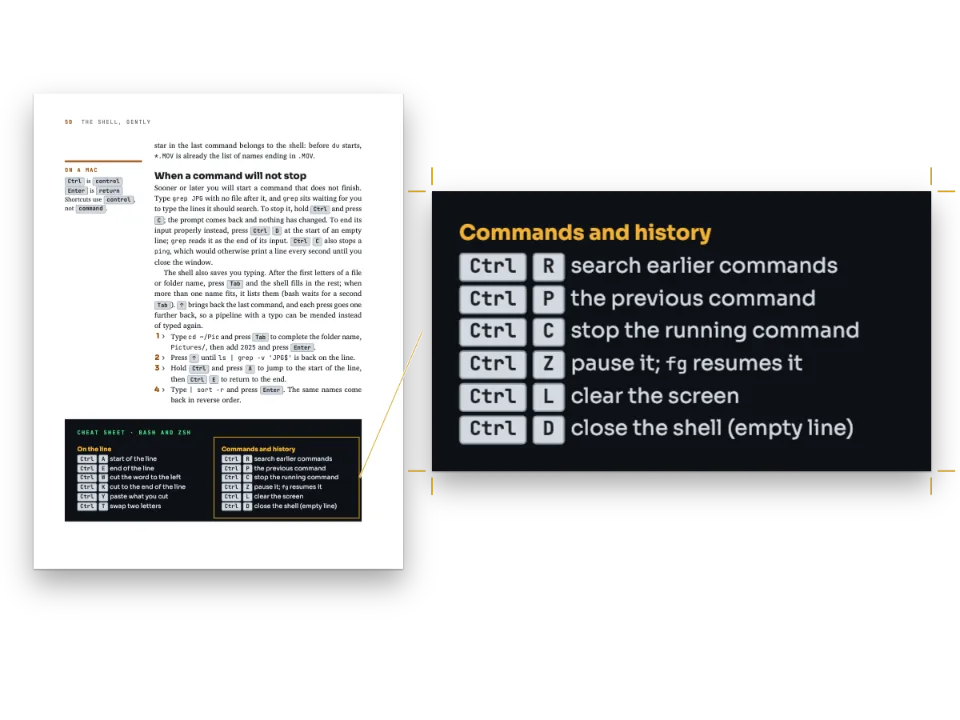
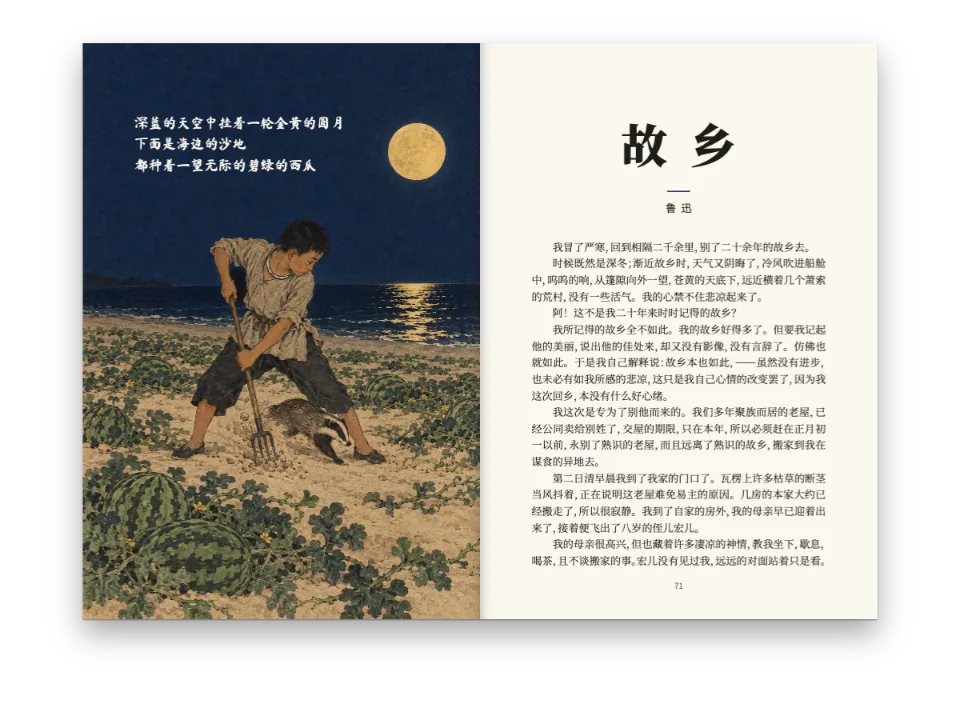
Fünf Seiten aus Kapitel 3 eines erfundenen japanischen Programmierbuchs, 実践 日本語テキスト処理 (Japanische Textverarbeitung in der Praxis), über Unicode-Normalisierung. Es ist gesetzt, wie japanische Computerbücher gesetzt werden: A5, eine Spalte zu 36 Zeichen auf 29 Zeilen aus der Noto Serif JP in 9 pt, Überschriften in der Noto Sans JP, Code in der BIZ UDGothic. Der Text ist der schwierige Fall des japanischen Satzes, denn jeder zweite Satz enthält ein lateinisches Wort, einen Codepoint, eine Zahl oder einen Funktionsnamen: Die Zeilenumbrüche folgen dem strengsten 禁則処理 (Kinsoku Shori) aus JLReq, die Satzzeichen behalten ihre volle Breite, und ein Viertelgeviert trennt Japanisch von Latein, ohne dass jemand ein Leerzeichen tippt. Abbildung, Tabelle, Codelisting und Fußnoten tragen japanische Bezeichnungen: 図3-1, 表3-1, hochgestellte Fußnotennummern, pro Seite gezählt. Codelistings und Tastenkappen ist dieselbe Art Seite auf Englisch.
Dieses Rezept beantwortet
- Wie gestalte ich die Abstände japanischer Interpunktion: 、。「」 gestaucht, wo sie aufeinandertreffen, ein Abstand nach ?! und die Klammer, die einen Absatz eröffnet?
- Warum dürfen kleine Kana, ー und schließende Klammern keine japanische Zeile beginnen, und wie wähle ich, wie streng die Regel ist?
- Warum erscheint mein japanischer Text nach chinesischen Regeln: Beschriftungen mit 图, kleine Kana am Zeilenanfang, Kanji in chinesischen Formen?
Die kurze Antwort
// locale 'ja' turns on JLReq composition: kinsoku at its strictest, full-width marks squeezed
// where two meet (」、 takes one em, not two), a closing mark keeps its half em at a line
// end, 、。 may hang past it, and a paragraph opening with 「 sets the bracket in the indent.
// The values below are the ones 'auto' picks for 'ja'; they are spelled out to be seen.
const cjk = {
  lineBreak: 'ja-very-strict', // no line starts with ー, small kana, 々, 」、。?・ or :
  punctuationWidth: 'fullwidth', // 、。「」 keep their em inside the line (JLReq §3.1.2)
  hangingPunctuation: 'allow', // 、。 hang only when the line would otherwise break before them
  paragraphStartBracket: 'half', // 「 at a paragraph start sits in the indent's second half
  latinSpacing: em(0.25), // 四分アキ between kana or kanji and Latin letters or digits
  grid: { enabled: true, charsPerLine: CHARS, linesPerPage: LINES }, // whole ems, whole lines
};
// The Latin is the Japanese face's own proportional Latin, at the text's size: never
// full-width A or a second face for the words in parentheses.
const bodyText = {
  fontFamily: MINCHO, fontSize: pt(BODY), lineHeight: pt(PITCH), color: col('ink'),
  boldColor: col('ink'), italicColor: col('ink'), referenceColor: col('ink'),
  textAlign: 'justify', firstLineIndent: em(1), indentAfterHeading: true, // 1 字下げ
  referenceBold: false, // 図3-1 and 表3-1 in the text weight: the face loads no bold
  hyphenation: { enabled: false }, avoidRunts: true, // no one-character last line
  // The grid cuts a list where the page ends: the four forms stay in one piece.
  shortListSplit: 'avoid', shortListMaxItems: 4,
};
Zutaten
- Funktionen
- Abstände japanischer Satzzeichen (Yakumono)Japanischer Zeilenumbruch (Kinsoku)Abstand zwischen Chinesisch und LateinAnmerkungen in japanischen BüchernFußnotenNummerierte BildunterschriftenAbbildung und Tabelle in Ihrer SpracheNummerierte ÜberschriftenÜberschriften über Textzeilen (Gyōdori)ZeichenrasterChinesische, japanische und koreanische SchriftenCode-ListingsKästenTabellenformatFormat der BildunterschriftAbbildungen und Tabellen als RessourcenKolumnentitel und SeitenzahlenGestaltete AuftakteSemantische FarbpalettePDF-Export
- Nutzt außerdem
- Zitate in einem ZitierstilChinesischer ZeilenumbruchBreite chinesischer SatzzeichenSpaltenausgleichQuerverweiseAbbildungen genau hierKopfzeilen nach SeitenrolleAbsatzformateIm PDF eingebettete SchriftenEigene RessourcentypenTabellen aus Daten
- Schrift
- Noto Serif JP, Noto Sans JP, BIZ UDGothic (SIL OFL 1.1)
- Dateien
- Figure 3-1, the bytes of が, drawn in code in the page’s palette (Postext Cookbook, CC BY 4.0)
Zubereitung
#1 · Die japanischen Regeln kommen mit der Sprachangabe
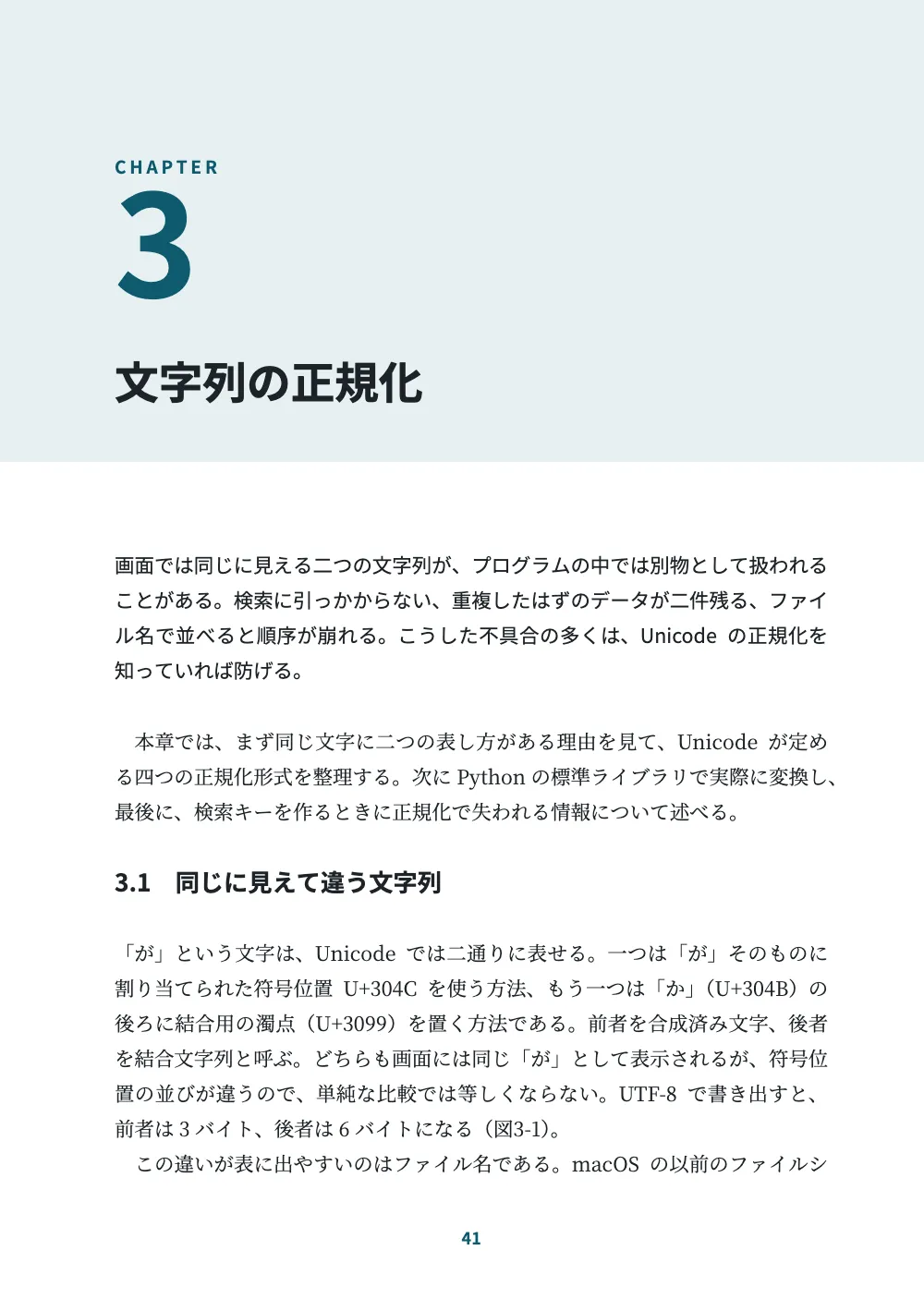
Der Code steht oben in der kurzen Antwort. locale: 'ja' schaltet die Regeln von JLReq ein, den Requirements for Japanese Text Layout des W3C, und die unter cjk ausgeschriebenen Werte sind die, die 'auto' für Japanisch wählt (Ostasiatische Typografie). Bei ja-very-strict beginnt keine Zeile mit ー, einem kleinen Kana, 々 oder einem schließenden Zeichen, und keine Zeile endet mit einer öffnenden Klammer. Die Satzzeichen (約物, Yakumono) behalten innerhalb der Zeile ihr volles Geviert, und zwei aufeinandertreffende Zeichen wie 」、 teilen sich ein Geviert. Auf Seite 41 setzt die Zeile, die auf 実際に変換し、 endet, ihr 、 über den rechten Rand der Satzbreite hinaus: Das ist ぶら下げ (Burasage), und die Engine greift nur dann dazu, wenn die Zeile das Zeichen sonst in die nächste Zeile schieben müsste. latinSpacing setzt ein Viertelgeviert (四分アキ, Shibun Aki) zwischen Unicode und では und zwischen U+304C und を, obwohl das Markdown dort kein Leerzeichen hat. Es steht nur neben einem Buchstaben oder einer Ziffer: normalize() und is_normalized() enden mit einer Klammer, deshalb tippt das Markdown ein Leerzeichen zwischen sie und 関数.
Der Unterschied zum Chinesischen liegt in den Satzzeichen. Ein festlandchinesisches Buch setzt 、 und , standardmäßig in halber Breite und 。 in voller (Kaiming); ein japanisches behält jedes Zeichen in voller Breite und staucht nur dort, wo zwei aufeinandertreffen. Der chinesische Zeilenumbruch kennt keine kleinen Kana und kein ー, die vom Zeilenanfang fernzuhalten wären, deshalb ist ja-very-strict eine eigene Stufe.
#2 · Code in einer dicktengleichen Schrift mit Kana
// A ``` fence is set line by line as written, in codeStyle's face: the monospaced face,
// which has kana and kanji too, so a full-width character takes two half-width cells.
// The rest of the fence line (normalize.py) is the listing's title. Inline `code` is set
// in the same face, in the accent.
const codeStyle = {
  fontFamily: CODE, fontSize: pt(8), lineHeight: pt(12), color: col('ink'),
  background: col('tint'), snapToGrid: false, highlight: 'none', // one ink, as in print
  padding: { top: mm(2.5), right: mm(4), bottom: mm(3), left: mm(4) },
  marginTop: mm(2), marginBottom: mm(2),
  titleStyle: { fontFamily: CODE, fontSize: pt(7), fontWeight: 400, color: col('teal') },
  inline: { fontSize: pt(8.5), color: col('teal') },
};
Das Listing ist ein Codeblock: Postext setzt seine Zeilen so, wie sie getippt wurden, in der Schrift, die codeStyle nennt, in einem getönten Kasten unter dem Titel normalize.py aus der öffnenden Zeile des Codeblocks (Codelistings). highlight: 'none' hält das Listing in einer Farbe, wie den Rest der Seite, und codeStyle.inline setzt jedes `name` in derselben Schrift, in Türkisblau. Hier zählt die Schrift: Die Zeichenkette des Beispiels, ガイド ABC ①, braucht Katakana in halber Breite, Buchstaben in voller Breite und eingekreiste Ziffern, die einer westlichen Codeschrift fehlen. BIZ UDGothic setzt lateinische Zeichen in halber und Kana in voller Breite mit festem Schritt, und ein Listing zählt ein Zeichen voller Breite als zwei Zellen, sodass die Spalten halten.
#3 · 図3-1 und 表3-1
const FORMS = `入力\tNFC\tNFD\tNFKC
が(U+304C)\tU+304C\tU+304B U+3099\tU+304C
ガ(U+FF76 U+FF9E)\tそのまま\tそのまま\tガ(U+30AC)
ABC(全角)\tそのまま\tそのまま\tABC
①\tそのまま\tそのまま\t1
㍻\tそのまま\tそのまま\t平成`;
const resources = [
  { id: 'tbl:forms', typeId: 'table', kind: 'table', createdAt: 0, updatedAt: 0,
    placement: { position: 'here' }, // at its ::resource line, under the paragraph citing it
    caption: '日本語の文字と四つの正規化形式(NFKDは、NFKCで合成された文字を分解した形になる)',
    table: { model: { ...parseTSV(FORMS), headerRowCount: 1, columnWidths: [34, 18, 26, 22] } } },
  { id: 'fig:bytes', typeId: 'figure', kind: 'svg', createdAt: 0, updatedAt: 0,
    caption: '「が」の二つの表し方。上段が符号位置、下段がUTF-8のバイト列',
    altText: 'が as one code point U+304C, three UTF-8 bytes E3 81 8C; and as U+304B and the '
      + 'combining voiced mark U+3099, six bytes E3 81 8B E3 82 99.',
    svg: { fileId: 'bytes.svg', width: 1175, height: 400 } },
];
defaultResourceTypes('ja') benennt die Typen 図 und 表 und nummeriert sie kapitelweise mit Bindestrich, und continuation.headings macht dieses Kapitel zu Kapitel 3, sodass die erste Abbildung 図3-1 ist. Ein Dokument mit ja setzt Bezeichnung und Nummer ohne Abstand und fügt nach der Nummer ein ideografisches Leerzeichen ein, wie japanische Bücher 図3-1 「が」の二つの表し方 drucken; der Legendenstil wählt also nur Schrift und Farben. Die Tabelle ist 'here' platziert, unter dem Absatz, der sie zitiert. Die Beschriftungen der Abbildung sind rein lateinisch, U+304C und E3 81 8C: Das SVG nennt in seinem Stil die Codeschrift, und loadSvg bettet die Schriftdatei ein, bevor das Bild gezeichnet wird.
#4 · Fußnoten pro Seite, auf japanische Art
  footnotes: { fontSize: pt(7.5), lineHeight: pt(12), color: col('ink'),
    separator: { color: col('rule') } }, // at the column foot, 1 on each page, superscript
Die Fußnoten brauchen außer ihrer Größe keine Einstellung: In einem horizontalen japanischen Dokument sind die Standardwerte die, die JLReq für horizontale Bücher beschreibt, eine Fußnote am Fuß der Spalte, in der sie zitiert wird, auf jeder Seite ab 1 nummeriert, eine hochgestellte Marke und eine Linie von einem Drittel der Satzbreite (Fußnoten). Die Marke steht vor dem Punkt, 保存していた[^hfs]。, sodass das 。 nie getrennt von ihr die nächste Zeile beginnt.
#5 · Eine dreizeilige Abschnittsüberschrift
const BAND = 74; // mm from the trim's top
const opener = { enabled: true, minHeight: pt(PITCH * 10), slot: { elements: [ // text: line 11
  { kind: 'box', id: 'band', reserve: false, style: { backgroundColor: col('tint') },
    placement: { anchor: { to: 'page', edge: 'top-left' },
      size: { width: 'fill', height: mm(BAND) } } },
  { kind: 'text', id: 'kicker', content: 'CHAPTER', fontFamily: GOTHIC, fontSize: pt(8),
    fontWeight: 700, letterSpacing: pt(1.6), color: col('teal'), align: 'left',
    placement: { anchor: { to: 'container', edge: 'top-left' }, offset: { y: mm(0) } } },
  { kind: 'text', id: 'number', content: '{numberDecimal}', fontFamily: GOTHIC, fontSize: pt(64),
    lineHeight: 1, fontWeight: 700, color: col('teal'), align: 'left',
    placement: { anchor: { to: '#kicker', edge: 'below' }, offset: { y: mm(1) } } },
  { kind: 'text', id: 'title', content: '{titleText}', fontFamily: GOTHIC,
    fontSize: pt(20), fontWeight: 700, color: col('ink'), align: 'left', overflow: 'wrap',
    placement: { anchor: { to: '#number', edge: 'below' }, offset: { y: mm(5) },
      size: { width: mm(MEASURE) } } },
] } };
Der Kapitelauftakt ist eine Gestaltung an der H1: ein türkisblaues Band, die Kapitelnummer in 64 pt aus {numberDecimal} und der Titel. Die Abschnittsüberschriften verwenden lineSpan: 3, 行取り (Gyōdori): Jede nimmt genau drei Grundtextzeilen ein, ihr Text darin zentriert, sodass der Text danach im Gleichschritt mit dem Raster weiterläuft. headings.balancing.enabled: false hindert die Engine daran, über Überschriften Zeilen einzufügen, um eine Seite auszugleichen.
Das ganze Rezept
// ═══ Postext Cookbook · Nº 123 · A Japanese technical manual: kana, kanji and Latin ═══ // https://postext.dev/en/cookbook/japanese-technical-manual // Code: MIT · Text: original (CC BY 4.0) · Pictures: drawn in code // Fonts: Noto Serif JP, Noto Sans JP, BIZ UDGothic (SIL OFL 1.1) · Needs postext ≥ 1.28.0 import { buildDocument, withLoadedFonts, renderPageToCanvas, defaultResourceTypes, parseTSV, registerResourceImage, inlineSvgFonts, } from 'https://esm.sh/postext'; import { renderToPdf, decompressWoff2 } from 'https://esm.sh/postext-pdf'; const LANG = 'en'; // @lang: the language of the frame; the chapter is Japanese in both const RECIPE = 'japanese-technical-manual'; // ─── 1 · Design ───────────────────────────────────────────────────────────── // #region palette: ink, one deep teal for numbers, rules and labels, a pale tint for code const palette = { ink: '#1d2327', // text: a cool near-black teal: '#0e5a6e', // the one accent: chapter number, heads' numbers, labels, the point box tint: '#e7f0f2', // the opener band, the listing's ground rule: '#b9c6cc', // hairlines: table rules, the note rule muted: '#5b666d', // running heads, folios, colophon paper: '#ffffff', }; const col = (id) => ({ hex: palette[id], model: 'hex', paletteId: id }); const colorPalette = Object.entries({ ...palette, 'main-color': palette.teal }) .map(([id, hex]) => ({ id, name: id, value: { hex, model: 'hex' } })); // #endregion const [MINCHO, GOTHIC, CODE] = ['Noto Serif JP', 'Noto Sans JP', 'BIZ UDGothic']; const [BODY, PITCH] = [9, 16]; // pt: 9 pt text on a 16 pt line, 1.78 × the size const [CHARS, LINES] = [36, 29]; // the type area in characters: 36 to a line, 29 lines const MEASURE = CHARS * BODY * 25.4 / 72; // mm: 114.3 // #region answer: Japanese rules from the tag, written out; the quarter-em Latin space // locale 'ja' turns on JLReq composition: kinsoku at its strictest, full-width marks squeezed // where two meet (」、 takes one em, not two), a closing mark keeps its half em at a line // end, 、。 may hang past it, and a paragraph opening with 「 sets the bracket in the indent. // The values below are the ones 'auto' picks for 'ja'; they are spelled out to be seen. const cjk = { lineBreak: 'ja-very-strict', // no line starts with ー, small kana, 々, 」、。?・ or : punctuationWidth: 'fullwidth', // 、。「」 keep their em inside the line (JLReq §3.1.2) hangingPunctuation: 'allow', // 、。 hang only when the line would otherwise break before them paragraphStartBracket: 'half', // 「 at a paragraph start sits in the indent's second half latinSpacing: em(0.25), // 四分アキ between kana or kanji and Latin letters or digits grid: { enabled: true, charsPerLine: CHARS, linesPerPage: LINES }, // whole ems, whole lines }; // The Latin is the Japanese face's own proportional Latin, at the text's size: never // full-width A or a second face for the words in parentheses. const bodyText = { fontFamily: MINCHO, fontSize: pt(BODY), lineHeight: pt(PITCH), color: col('ink'), boldColor: col('ink'), italicColor: col('ink'), referenceColor: col('ink'), textAlign: 'justify', firstLineIndent: em(1), indentAfterHeading: true, // 1 字下げ referenceBold: false, // 図3-1 and 表3-1 in the text weight: the face loads no bold hyphenation: { enabled: false }, avoidRunts: true, // no one-character last line // The grid cuts a list where the page ends: the four forms stay in one piece. shortListSplit: 'avoid', shortListMaxItems: 4, }; // #endregion // #region listing: a fenced block is a code listing in a tinted box // A ``` fence is set line by line as written, in codeStyle's face: the monospaced face, // which has kana and kanji too, so a full-width character takes two half-width cells. // The rest of the fence line (normalize.py) is the listing's title. Inline `code` is set // in the same face, in the accent. const codeStyle = { fontFamily: CODE, fontSize: pt(8), lineHeight: pt(12), color: col('ink'), background: col('tint'), snapToGrid: false, highlight: 'none', // one ink, as in print padding: { top: mm(2.5), right: mm(4), bottom: mm(3), left: mm(4) }, marginTop: mm(2), marginBottom: mm(2), titleStyle: { fontFamily: CODE, fontSize: pt(7), fontWeight: 400, color: col('teal') }, inline: { fontSize: pt(8.5), color: col('teal') }, }; // #endregion // #region opener: a tinted band, the chapter number large in the accent, the title under it const BAND = 74; // mm from the trim's top const opener = { enabled: true, minHeight: pt(PITCH * 10), slot: { elements: [ // text: line 11 { kind: 'box', id: 'band', reserve: false, style: { backgroundColor: col('tint') }, placement: { anchor: { to: 'page', edge: 'top-left' }, size: { width: 'fill', height: mm(BAND) } } }, { kind: 'text', id: 'kicker', content: 'CHAPTER', fontFamily: GOTHIC, fontSize: pt(8), fontWeight: 700, letterSpacing: pt(1.6), color: col('teal'), align: 'left', placement: { anchor: { to: 'container', edge: 'top-left' }, offset: { y: mm(0) } } }, { kind: 'text', id: 'number', content: '{numberDecimal}', fontFamily: GOTHIC, fontSize: pt(64), lineHeight: 1, fontWeight: 700, color: col('teal'), align: 'left', placement: { anchor: { to: '#kicker', edge: 'below' }, offset: { y: mm(1) } } }, { kind: 'text', id: 'title', content: '{titleText}', fontFamily: GOTHIC, fontSize: pt(20), fontWeight: 700, color: col('ink'), align: 'left', overflow: 'wrap', placement: { anchor: { to: '#number', edge: 'below' }, offset: { y: mm(5) }, size: { width: mm(MEASURE) } } }, ] } }; // #endregion // Running heads: the book on the verso, the chapter on the recto, folios outside. // Anchored to the header's container, which spans the measure, so they align with the text // wherever the grid puts its margins. const head = (id, content, parity, edge, x, extra) => ({ kind: 'text', id, content, parity, pages: 'body', fontFamily: GOTHIC, fontSize: pt(7.5), color: col('muted'), align: edge.endsWith('left') ? 'left' : 'right', placement: { anchor: { to: 'container', edge }, offset: { x: mm(x), y: mm(13) } }, ...extra }); const folio = { fontWeight: 700, color: col('teal') }; const header = { elements: [ head('v-folio', '{pageNumber}', 'even', 'top-left', 0, folio), head('v-title', '{title}', 'even', 'top-left', 8), head('r-title', '{chapterNumber} {chapterTitle}', 'odd', 'top-right', -8), head('r-folio', '{pageNumber}', 'odd', 'top-right', 0, folio), ] }; const config = () => ({ locale: 'ja', // written out, never LANG (gotcha: ja-locale-tag) resourceTypes: defaultResourceTypes('ja'), // 図 and 表, numbered by chapter: 図3-1 colorPalette, page: { sizePreset: 'custom', width: mm(148), height: mm(210), dpi: 150, // A5 // Minimums: the grid grows them to centre its 36 × 29 area, the head deeper than the foot. margins: { top: mm(23), bottom: mm(19), left: mm(17), right: mm(14), mirror: true } }, layout: { layoutType: 'single' }, cjk, bodyText, headings: { fontFamily: GOTHIC, fontWeight: 700, color: col('ink'), balancing: { enabled: false }, // no lines added above heads: the grid holds levels: [ // parity 'odd': the chapter opens on a recto, after a blank verso only when one is needed. { level: 1, numberingTemplate: '第{1}章', breakBefore: { enabled: true, parity: 'odd' }, advancedDesign: opener }, // 3行取り: each section head takes three body lines, so the grid holds across it. { level: 2, numberingTemplate: '{1}.{2}', numberSeparator: ' ', fontSize: pt(11), lineSpan: 3 }, ] }, // #region notes: only their size and colour; placement and numbering are the 'ja' defaults footnotes: { fontSize: pt(7.5), lineHeight: pt(12), color: col('ink'), separator: { color: col('rule') } }, // at the column foot, 1 on each page, superscript // #endregion unorderedLists: { bulletChar: '・', color: col('teal'), fontWeight: 400, marginTop: pt(0), marginBottom: pt(0) }, codeStyle, calloutStyles: [ { id: 'point', backgroundEnabled: false, stripe: { enabled: true, side: 'left', width: pt(3), color: col('teal') }, padding: { top: mm(0), right: mm(0), bottom: mm(0), left: mm(5) }, marginTop: pt(PITCH), marginBottom: pt(PITCH), titleStyle: { fontFamily: GOTHIC, fontSize: pt(8), fontWeight: 700, color: col('teal') }, body: { fontFamily: GOTHIC, fontSize: pt(BODY), lineHeight: pt(PITCH), color: col('ink'), firstLineIndent: pt(0), textAlign: 'justify' } }, ], tableStyle: { rules: 'horizontal', borderColor: col('rule'), borderWidth: pt(0.5), headerBackground: col('teal'), headerColor: col('paper'), headerFontFamily: GOTHIC, bodyFontFamily: MINCHO, bodyFontSize: pt(8), bodyColor: col('ink'), cellPadding: mm(1.2) }, captionStyle: { fontFamily: GOTHIC, fontSize: pt(8), color: col('ink'), labelBold: true, labelColor: col('teal') }, // 図3-1 …, the ja default paragraphStyles: [ { id: 'lead', fontFamily: GOTHIC, fontSize: pt(BODY), lineHeight: pt(PITCH), color: col('ink'), firstLineIndent: pt(0), marginBottom: pt(PITCH) }, { id: 'colophon', fontFamily: GOTHIC, fontSize: pt(6.5), lineHeight: pt(9), color: col('muted'), firstLineIndent: pt(0), textAlign: 'left', marginTop: pt(PITCH) }, ], header, footer: { elements: [{ kind: 'text', id: 'drop-folio', content: '{pageNumber}', pages: 'opener', fontFamily: GOTHIC, fontSize: pt(7.5), fontWeight: 700, color: col('teal'), align: 'center', placement: { anchor: { to: 'container', edge: 'bottom' }, offset: { y: mm(-10) } } }] }, // a drop folio on the opener }); // ─── 2 · Content ──────────────────────────────────────────────────────────── const markdown = `---Markdown-Beispiel · 69 Zeilen · content.en.md
title: "実践 日本語テキスト処理" --- # 文字列の正規化 :::paragraphs{style="lead"} 画面では同じに見える二つの文字列が、プログラムの中では別物として扱われることがある。検索に引っかからない、重複したはずのデータが二件残る、ファイル名で並べると順序が崩れる。こうした不具合の多くは、Unicodeの正規化を知っていれば防げる。 ::: 本章では、まず同じ文字に二つの表し方がある理由を見て、Unicodeが定める四つの正規化形式を整理する。次にPythonの標準ライブラリで実際に変換し、最後に、検索キーを作るときに正規化で失われる情報について述べる。 ## 同じに見えて違う文字列 「が」という文字は、Unicodeでは二通りに表せる。一つは「が」そのものに割り当てられた符号位置U+304Cを使う方法、もう一つは「か」(U+304B)の後ろに結合用の濁点(U+3099)を置く方法である。前者を合成済み文字、後者を結合文字列と呼ぶ。どちらも画面には同じ「が」として表示されるが、符号位置の並びが違うので、単純な比較では等しくならない。UTF-8で書き出すと、前者は3バイト、後者は6バイトになる([@fig:bytes])。 ::resource{id="fig:bytes"} この違いが表に出やすいのはファイル名である。macOSの以前のファイルシステムHFS+は、ファイル名を分解した形で保存していた[^hfs]。Macで作った「データ.csv」をWindowsやLinuxのサーバーにコピーすると、「テ」と濁点が分かれた名前のまま届く。見た目は同じ名前のファイルが二つ並んだり、プログラムからファイルを開けなかったりするのはこのためだ。 ## 四つの正規化形式 Unicodeは、こうした表し方の違いをそろえる手順を「正規化形式」として定めている[^uax15]。正規化形式は、二つの観点の組み合わせで四つある。 一つ目の観点は、合成するか分解するかである。分解(decomposition)は「が」を「か」と濁点に分け、合成(composition)は分けたものを一文字に戻す。二つ目の観点は、どこまでを同じ文字とみなすかである。正準等価は、見た目も意味も同じものだけを同一視する。互換等価は、半角カナと全角カナ、丸数字と数字のように、形は違っても同じ文字として扱えるものまで同一視する。 - NFC:正準分解したあと、正準合成する - NFD:正準分解する - NFKC:互換分解したあと、正準合成する - NFKD:互換分解する 日本語の文字がそれぞれの形式でどう変わるかを[@tbl:forms]に示す。NFCとNFDが変えるのは濁点と半濁点の付け方だけで、文字の種類は変わらない。一方、NFKCとNFKDは、半角カナを全角に、全角英数字を半角に、「①」を「1」に、「㍻」を「平成」に置き換える。 ::resource{id="tbl:forms"} ## Pythonで正規化する Pythonでは、標準ライブラリの\`unicodedata\`モジュールにある\`normalize()\`関数で正規化できる。第1引数に形式の名前を、第2引数に文字列を渡す。 \`\`\`python normalize.py import unicodedata s = "ガイド ABC ①" for form in ("NFC", "NFKC"): print(form, unicodedata.normalize(form, s)) \`\`\` 実行すると、NFCの行には入力がそのまま出力され、NFKCの行には「ガイド ABC 1」が出力される。半角の「カ」と「゙」が、一文字の「ガ」になっている点に注意してほしい。互換分解で「ガ」が「カ」と結合用の濁点に分かれ、続く正準合成で「ガ」にまとめられるからだ。 Python 3.8で加わった\`is_normalized()\`関数を使うと、文字列がすでに正規化されているかどうかを調べられる。読み込んだデータのうち変換の要るものだけを選べるので、大量のファイル名やレコードを処理するときに役に立つ。 ## 検索キーを作るときの注意 利用者が入力した語で検索する場合、検索キーと検索対象の両方をNFKCで正規化しておけば、半角と全角の違いを気にせずに照合できる。ただし、NFKCは情報を捨てる変換でもある。「①」は「1」に、「㈱」は「(株)」になり、元の文字には戻せない。 :::callout{type="point" title="ポイント"} 正規化した文字列は、検索と照合のためだけに使う。画面に表示する文字列と保存する文字列には、利用者が入力したものをそのまま残しておく。 ::: もう一つ、NFKCでもそろわない揺れがある。波ダッシュ「〜」(U+301C)と全角チルダ「~」(U+FF5E)だ。NFKCは全角チルダを半角の「~」に変えるが、波ダッシュは変えない[^wave]。そのため「10〜20」と「10~20」は、NFKCを通しても一致しない。こうした文字は、正規化とは別に対応表を用意して置き換える必要がある。 [^hfs]: HFS+が使うのは、Unicodeの規格のNFDに近い独自の分解形である。2017年に導入されたAPFSは、ファイル名を書かれたとおりに保存する。 [^uax15]: Unicode Standard Annex #15「Unicode Normalization Forms」。Unicodeの版ごとに改訂され、unicode.orgで公開されている。 [^wave]: Shift_JISの0x8160は、JISの対応表では波ダッシュに、マイクロソフトのCP932の表では全角チルダに変換される。同じ文書でも、変換に使った表によって符号位置が分かれる。 :::paragraphs{style="colophon"} A specimen chapter written for the Postext Cookbook; the book and its other chapters are fictitious. Set in Noto Serif JP, Noto Sans JP and BIZ UDGothic (SIL OFL). Text: CC BY 4.0. :::`; // content.<lang>.md: the same Japanese chapter in both // #region resources: the table of forms, and the bytes of が drawn in code const FORMS = `入力\tNFC\tNFD\tNFKC が(U+304C)\tU+304C\tU+304B U+3099\tU+304C ガ(U+FF76 U+FF9E)\tそのまま\tそのまま\tガ(U+30AC) ABC(全角)\tそのまま\tそのまま\tABC ①\tそのまま\tそのまま\t1 ㍻\tそのまま\tそのまま\t平成`; const resources = [ { id: 'tbl:forms', typeId: 'table', kind: 'table', createdAt: 0, updatedAt: 0, placement: { position: 'here' }, // at its ::resource line, under the paragraph citing it caption: '日本語の文字と四つの正規化形式(NFKDは、NFKCで合成された文字を分解した形になる)', table: { model: { ...parseTSV(FORMS), headerRowCount: 1, columnWidths: [34, 18, 26, 22] } } }, { id: 'fig:bytes', typeId: 'figure', kind: 'svg', createdAt: 0, updatedAt: 0, caption: '「が」の二つの表し方。上段が符号位置、下段がUTF-8のバイト列', altText: 'が as one code point U+304C, three UTF-8 bytes E3 81 8C; and as U+304B and the ' + 'combining voiced mark U+3099, six bytes E3 81 8B E3 82 99.', svg: { fileId: 'bytes.svg', width: 1175, height: 400 } }, ]; // #endregion // #region art: the figure's labels name the code face, and loadSvg embeds its file const LABELS = `text{font-family:"${CODE}";font-size:3.2px;text-anchor:middle;fill:${palette.ink}}`; function bytesArt() { const box = (x, y, w, h, fill, stroke, text) => `<rect x="${x}" y="${y}" width="${w}" ` + `height="${h}" fill="${palette[fill]}" stroke="${palette[stroke]}" stroke-width=".3"/>` + `<text x="${x + w / 2}" y="${y + h / 2 + 1.1}">${text}</text>`; const side = (x, y, text, color) => `<text x="${x}" y="${y}" style="fill:${palette[color]};` + `font-size:3.6px">${text}</text>`; const row = (y, label, points, bytes) => side(14, y + 9, label, 'teal') + points.map((p, i) => box(26 + i * 31, y, 30, 7, 'tint', 'teal', p)).join('') + bytes.map((b, i) => box(26 + i * 10 + Math.floor(i / 3), y + 9, 9.5, 7, 'paper', 'rule', b)) .join('') + side(103, y + 9, `${bytes.length} bytes`, 'muted'); return `<svg xmlns="http://www.w3.org/2000/svg" width="1175" height="400" viewBox="0 0 117.5 40">` + `<style>${LABELS}</style>${row(3, 'NFC', ['U+304C'], ['E3', '81', '8C'])}` + `${row(22, 'NFD', ['U+304B', 'U+3099'], ['E3', '81', '8B', 'E3', '82', '99'])}</svg>`; } // #endregion // ─── 3 · Fonts ────────────────────────────────────────────────────────────── const FONTS = { // every face the pages use, loaded before the build 'Noto Serif JP': ['400'], // 明朝: the text, the notes, the table 'Noto Sans JP': ['400', '700'], // ゴシック: heads, the lead, labels, the point box, folios 'BIZ UDGothic': ['400'], // the code: fixed pitch, half-width Latin, inline and in the listing }; // ─── 4 · Build & show ─────────────────────────────────────────────────────── // Each Japanese face loads the files of what it sets (gotcha: cjk-fonts-slices). const all = (re) => (markdown.match(re) ?? []).join(''); const gothic = `${all(/^#+ .*$/gm)}${all(/:::paragraphs\{style="lead"\}\n[^\n]*/g)}` + `${all(/:::callout\{type="point"[\s\S]*?\n:::/g)}${resources.map((r) => r.caption).join('')}` + '入力NFCDK第章実践日本語テキスト処理CHAPTER0123456789'; await loadFonts(FONTS, markdown); await loadCjkFonts({ [MINCHO]: FONTS[MINCHO] }, `${markdown}${FORMS}`); await loadCjkFonts({ [GOTHIC]: FONTS[GOTHIC] }, gothic); const code = (markdown.match(/^```[\s\S]*?^```$|`[^`\n]+`/gm) ?? []).join(''); await loadCjkFonts({ [CODE]: FONTS[CODE] }, code); await loadSvg('bytes.svg', bytesArt()); const continuation = { pageIndexOffset: 40, pageNumbering: { startAt: 41 }, headings: { h1: 2 } }; const doc = await withLoadedFonts(() => buildDocument({ markdown, resources, continuation }, config()), { ...kitFonts(FONTS), text: markdown }); showPages(doc, { title: t({ en: 'A Japanese technical manual', es: 'Un manual técnico japonés' }) }); offerPdf(() => renderToPdf(doc, { fontProvider: cjkPdfProvider, resourceBytes: imageBytes }), `${RECIPE}.pdf`);Kit · core, fonts, viewer, pdf, images, cjk: in jedem Rezept gleich · 504 Zeilen
// ─── Kit ── helpers shared by every Cookbook recipe · postext.dev/cookbook ───── // ─── Kit · core v1 ── the same in every recipe · postext.dev/cookbook function mm(value) { return { value, unit: 'mm' }; } function pt(value) { return { value, unit: 'pt' }; } function em(value) { return { value, unit: 'em' }; } /** The sample language's string: t({ en: 'Figure', es: 'Figura' }). */ function t(strings) { return strings[LANG] ?? Object.values(strings)[0]; } /** A file in this recipe's assets folder, served from the Postext repo by jsDelivr. */ function asset(file) { return `https://cdn.jsdelivr.net/gh/drnachio/postext@main/cookbook/${RECIPE}/assets/${file}`; } // ─── Kit · fonts v3 ── the same in every recipe · postext.dev/cookbook // Postext loads the faces a config asks for before layout (prepareFonts, // buildDocumentWithFonts) and asks the kit for the files: Fontsource's, the // files the PDF embeds too. /** The options of buildDocumentWithFonts / prepareFonts / withLoadedFonts: * the Fontsource resolver, and the faces of FONTS loaded with the ones the * config names. FONTS = { 'Family Name': ['400', '400i', '700'] }. */ function kitFonts(FONTS = {}) { const faces = Object.entries(FONTS).flatMap(([family, specs]) => specs.map((spec) => ({ family, weight: parseInt(spec, 10), style: spec.endsWith('i') ? 'italic' : 'normal' }))); return { resolve: fontsourceResolver, faces }; } /** A face's Fontsource files, in a fixed order: latin, then latin-ext and greek * when `text` needs them and the family ships them (kitSubsetsFor), each with * its unicode-range. Null for a weight or slant Fontsource does not ship. */ async function fontsourceResolver(family, weight, style, { text = '' } = {}) { const id = fontsourceId(family); const meta = await fontsourceMeta(family); if (meta && !(meta.weights.includes(weight) && meta.styles.includes(style))) return null; kitStatus('Loading fonts…'); const at = await fontsourceAt(id); return ['latin', ...kitSubsetsFor(text, meta)].map((subset) => ({ source: `${at}files/${id}-${subset}-${weight}-${style}.woff2`, unicodeRange: kitRanges()[subset], })); } /** The unicode-range of each Fontsource file the kit loads (a function: the * kit is inlined after the pen's code, which runs before a const would be set). */ function kitRanges() { return { latin: 'U+0000-00FF,U+0131,U+0152-0153,U+02BB-02BC,U+02C6,U+02DA,U+02DC,U+0304,U+0308,U+0329,' + 'U+2000-206F,U+20AC,U+2122,U+2191,U+2193,U+2212,U+2215,U+FEFF,U+FFFD', 'latin-ext': 'U+0100-02BA,U+02BD-02C5,U+02C7-02CC,U+02CE-02D7,U+02DD-02FF,U+0304,U+0308,U+0329,' + 'U+1D00-1DBF,U+1E00-1E9F,U+1EF2-1EFF,U+2020,U+20A0-20AB,U+20AD-20C0,U+2113,U+2C60-2C7F,U+A720-A7FF', greek: 'U+0370-03FF', }; } /** For the cjk, arabic and comics blocks, which add their own files: the * faces of `faces` = { 'Family Name': ['400', '400i', '700'] }. `text` is the sample: * č ł † α χ also load latin-ext and greek files (kitSubsetsFor). With * `optional`, a face Fontsource does not ship is skipped instead of failing. * The files are added once all have loaded, in the order asked (latin, then * latin-ext, then greek), whatever order they arrive in: the last one added * wins a character two files hold. Resolves to the number of faces added. */ async function loadFonts(faces, text = '', { optional = false } = {}) { kitStatus('Loading fonts…'); const ranges = kitRanges(); const jobs = []; for (const [family, specs] of Object.entries(faces)) { const id = fontsourceId(family); const todo = [...new Set(specs)].map((spec) => [parseInt(spec, 10), spec.endsWith('i') ? 'italic' : 'normal']) .filter(([weight, style]) => !hasFace(family, weight, style)); // before any await const at = fontsourceAt(id); const meta = optional || /[^\0-ÿ]/u.test(text) ? await fontsourceMeta(family) : null; const subsets = ['latin', ...kitSubsetsFor(text, meta)]; for (const [weight, style] of todo) { if (optional && !(meta?.weights.includes(weight) && meta.styles.includes(style))) continue; for (const subset of subsets) { const url = `${await at}files/${id}-${subset}-${weight}-${style}.woff2`; const face = new FontFace(family, `url(${url}) format('woff2')`, { weight: String(weight), style, unicodeRange: ranges[subset] }); jobs.push(face.load().catch(() => { if (subset === 'latin' && !optional) throw new Error(`Fontsource has no ${family} ${weight} ${style}`); })); } } } const ready = await Promise.all(jobs).catch((error) => { kitFail(error); throw error; }); return ready.filter((face) => face && document.fonts.add(face)).length; } /** A loaded FontFace covers this family, weight and style (fonts.check() would * also say yes for families nobody declared). */ function hasFace(family, weight, style) { for (const face of document.fonts) { if (face.status !== 'loaded' || face.style !== style) continue; if (face.family.replace(/^["']|["']$/g, '') !== family) continue; const [low, high = low] = face.weight.split(' ').map(Number); if (weight >= low && weight <= high) return true; } return false; } /** The files beyond latin `text` needs that `meta`'s family ships. */ function kitSubsetsFor(text, meta) { return [[/[Ā-˿ᴀ-ᶿḀ-ỿ†ℓⱠ-Ɀ꜠-ꟿ]/u, 'latin-ext'], [/[Ͱ-Ͽ]/u, 'greek']] .filter(([re, x]) => re.test(text) && meta?.subsets?.includes(x)).map(([, x]) => x); } /** Fontsource's id for a family: 'Source Serif 4' → 'source-serif-4'. */ function fontsourceId(family) { return family.toLowerCase().replace(/\s+/g, '-'); } /** A package's folder at the one version @5 names now (#766). */ function fontsourceAt(id, u = `https://cdn.jsdelivr.net/npm/@fontsource/${id}@`) { return (fontsourceAt.c ??= {})[id] ??= fetch(u + '5/package.json').then((r) => r.json()) .then((p) => p.version || 5, () => 5).then((v) => `${u}${v}/`); } /** The family's Fontsource metadata (weights, styles, subsets), or null. */ function fontsourceMeta(family) { fontsourceMeta.cache ??= new Map(); const id = fontsourceId(family); if (!fontsourceMeta.cache.has(id)) { fontsourceMeta.cache.set(id, fetch(`https://api.fontsource.org/v1/fonts/${id}`) .then((res) => (res.ok ? res.json() : null), () => null)); } return fontsourceMeta.cache.get(id); } // ─── Kit · viewer v2 ── the same in every recipe · postext.dev/cookbook /** The pages as spreads on a dark desk, page 1 alone, then verso | recto, * each painted when it scrolls near. Other options go to renderPageToCanvas. */ function showPages(docs, { title, width = 460, ...render } = {}) { const root = viewer(title); const pages = [docs].flat().flatMap((doc) => doc.pages.map((page) => ({ doc, page, n: (doc.pageIndexOffset ?? 0) + page.index }))); const spreads = []; let verso = null; for (const p of pages) { if (p.n % 2 === 1) { if (verso) spreads.push([verso, null]); verso = p; } else { spreads.push([verso, p]); verso = null; } } if (verso) spreads.push([verso, null]); const density = Math.min(window.devicePixelRatio || 1, 2); showPages.painter?.disconnect(); const painter = new IntersectionObserver((entries) => { for (const { isIntersecting, target } of entries) { if (!isIntersecting) continue; painter.unobserve(target); const { doc, page } = target.postext; renderPageToCanvas(page, doc, target, { ...render, scale: (width * density) / page.width }); } }, { rootMargin: '800px' }); showPages.painter = painter; root.replaceChildren(...spreads.map((pair) => { const spread = document.createElement('div'); spread.className = 'pt-spread'; for (const p of pair) { const figure = document.createElement('figure'); if (p) { const label = p.page.pageLabel || String(p.n + 1); const canvas = document.createElement('canvas'); canvas.postext = p; canvas.style.aspectRatio = `${p.page.width} / ${p.page.height}`; canvas.setAttribute('role', 'img'); canvas.setAttribute('aria-label', `Page ${label}`); const folio = document.createElement('figcaption'); folio.textContent = label; figure.append(canvas, folio); painter.observe(canvas); } else figure.className = 'pt-blank'; spread.append(figure); } return spread; })); kitStatus(`${pages.length} ${pages.length === 1 ? 'page' : 'pages'}`); document.documentElement.dataset.postext = 'ready'; return pages.length; } /** The desk, the bar and the error reporting, created once. */ function viewer(title) { if (!document.getElementById('pt-kit')) { document.head.insertAdjacentHTML('beforeend', `<style id="pt-kit"> :root { color-scheme: dark; } body { margin: 0; background: #0e1014; color: #b9bcc4; font: 13px/1.45 system-ui, sans-serif; } #pt-bar { position: sticky; top: 0; z-index: 1; display: flex; flex-wrap: wrap; align-items: center; gap: 6px 16px; padding: 10px 16px; background: rgb(14 16 20 / .92); backdrop-filter: blur(6px); border-bottom: 1px solid #23262d; } #pt-bar strong { color: #f4f1ea; font-weight: 600; } #pt-actions { display: flex; gap: 12px; margin-left: auto; } #pt-actions a, #pt-actions button { color: #d8a21a; font: inherit; background: none; border: 0; padding: 0; cursor: pointer; } #pages { display: grid; justify-items: center; gap: 48px; padding: 32px 16px 72px; } .pt-spread { display: flex; } .pt-spread figure { margin: 0; width: min(460px, 44vw); } .pt-spread canvas { display: block; width: 100%; background: #fff; box-shadow: 0 1px 2px rgb(0 0 0 / .5), 0 22px 44px -16px rgb(0 0 0 / .8); } .pt-spread figure:first-child canvas { box-shadow: inset -14px 0 14px -14px rgb(0 0 0 / .18), 0 1px 2px rgb(0 0 0 / .5), 0 22px 44px -16px rgb(0 0 0 / .8); } .pt-spread figcaption { margin-top: 10px; text-align: center; font: 600 10px/1 system-ui, sans-serif; letter-spacing: .18em; text-transform: uppercase; color: #6c7079; } .pt-blank { visibility: hidden; } @media (max-width: 760px) { .pt-spread { flex-direction: column; gap: 32px; } .pt-spread figure { width: min(460px, 92vw); } .pt-blank { display: none; } } </style>`); document.body.insertAdjacentHTML('afterbegin', '<header id="pt-bar"><strong id="pt-title"></strong><span id="pt-status" role="status"></span><span id="pt-actions"></span></header>'); document.getElementById('pt-title').textContent = document.title || 'Postext'; addEventListener('error', (event) => kitFail(event.error ?? event.message)); addEventListener('unhandledrejection', (event) => kitFail(event.reason)); } if (title) document.getElementById('pt-title').textContent = title; return document.getElementById('pages') ?? document.body.appendChild(Object.assign(document.createElement('main'), { id: 'pages' })); } function kitStatus(text) { viewer(); document.getElementById('pt-status').textContent = text; } function kitFail(error) { document.documentElement.dataset.postext = 'error'; kitStatus(`Error: ${error?.message ?? error}`); } // ─── Kit · pdf v3 ── the same in every recipe that exports a PDF /** The Fontsource files the screen used, as TrueType, with their range and * place: the nearest weight the family ships, upright with no italic; * latin, then what its letters need (kitSubsetsFor). */ async function fontsourceProvider(family, weight, style, request) { const id = fontsourceId(family); const meta = await fontsourceMeta(family); const weights = meta?.weights?.length ? meta.weights : [400, 700]; const w = weights.reduce((a, b) => (Math.abs(b - weight) < Math.abs(a - weight) ? b : a)); const s = style === 'italic' && meta && !meta.styles.includes('italic') ? 'normal' : style; const text = String.fromCodePoint(...(request?.codePoints ?? [])); const files = await Promise.all(['latin', ...kitSubsetsFor(text, meta)].map(async (subset, order) => { const res = await fetch(`${await fontsourceAt(id)}files/${id}-${subset}-${w}-${s}.woff2`); if (!res.ok) throw new Error(`Fontsource has no ${family} ${w} ${s} ${subset}`); return Object.assign(await decompressWoff2(new Uint8Array(await res.arrayBuffer())), { unicodeRange: kitRanges()[subset], order }); })); return files.length === 1 ? files[0] : files; } /** A "Build the PDF" button; then "Open the PDF" (a new tab: CodePen's frame * shows no PDFs) and a download link. */ function offerPdf(makePdf, filename) { viewer(); const button = Object.assign(document.createElement('button'), { type: 'button', textContent: 'Build the PDF' }); button.dataset.postextPdf = filename; button.addEventListener('click', async () => { button.disabled = true; button.textContent = 'Building the PDF…'; try { const bytes = await makePdf(); const url = URL.createObjectURL(new Blob([bytes], { type: 'application/pdf' })); const size = `${Math.max(1, Math.round(bytes.length / 1024))} KB`; button.replaceWith( Object.assign(document.createElement('a'), { href: url, target: '_blank', rel: 'noopener', textContent: 'Open the PDF ↗' }), Object.assign(document.createElement('a'), { href: url, download: filename, textContent: `Download ${filename} · ${size}` })); } catch (error) { button.disabled = false; button.textContent = 'Build the PDF'; kitFail(error); } }); document.getElementById('pt-actions').append(button); } // ─── Kit · images v3 ── recipes with pictures · postext.dev/cookbook /** Registers a photo or PNG for the canvas and keeps its bytes for the PDF. * fetch → ImageBitmap never taints the canvas (a plain cross-origin <img> would). */ async function loadImage(fileId, url) { const res = await fetch(url); if (!res.ok) throw new Error(`Image not found (${res.status}): ${url}`); const bytes = new Uint8Array(await res.arrayBuffer()); registerResourceImage(fileId, await createImageBitmap(new Blob([bytes]))); (loadImage.bytes ??= new Map()).set(fileId, bytes); } /** Registers SVG markup as a vector image, its fonts inside (inlineSvgFonts, ≥ 1.25). * `options` go to registerResourceImage: { singleInk: true } tints it on the canvas. */ async function loadSvg(fileId, svg, options) { if (typeof inlineSvgFonts === 'function') svg = await inlineSvgFonts(svg, svgFaces); const img = new Image(); img.src = `data:image/svg+xml;charset=utf-8,${encodeURIComponent(svg)}`; await img.decode(); registerResourceImage(fileId, img, options); (loadImage.bytes ??= new Map()).set(fileId, new TextEncoder().encode(svg)); } /** A face's Fontsource files: nearest weight; latin + what the SVG sets. */ async function svgFaces(family, weight, style, { codePoints = [] } = {}) { const [id, m] = [fontsourceId(family), await fontsourceMeta(family)]; const w = m?.weights.reduce((a, b) => (Math.abs(b - weight) < Math.abs(a - weight) ? b : a)) ?? weight; const s = m?.styles.includes(style) === false ? 'normal' : style; return Promise.all(['latin', ...kitSubsetsFor(String.fromCodePoint(...codePoints), m)].map(async (x) => new Uint8Array( await (await fetch(`${await fontsourceAt(id)}files/${id}-${x}-${w}-${s}.woff2`)).arrayBuffer()))); } /** renderToPdf({ resourceBytes: imageBytes }) */ function imageBytes(fileId) { return loadImage.bytes?.get(fileId); } /** renderToHtml({ resourceImageUrl: imageUrl }) */ function imageUrl(fileId) { const bytes = imageBytes(fileId); if (!bytes) return undefined; imageUrl.urls ??= new Map(); if (!imageUrl.urls.has(fileId)) { const type = /\.svg$/i.test(fileId) ? 'image/svg+xml' : /\.png$/i.test(fileId) ? 'image/png' : 'image/jpeg'; imageUrl.urls.set(fileId, URL.createObjectURL(new Blob([bytes], { type }))); } return imageUrl.urls.get(fileId); } // ─── Kit · cjk v2 ── Chinese, Japanese and Korean books · postext.dev/cookbook // Fontsource ships a CJK family as about a hundred files per weight, each // declared in its stylesheet with the unicode-range it covers. The screen // loads the files the sample touches; the PDF gets the same files for the // characters its pages set in each face, and embeds each as a subset. // A book bound on the right (vertical text) is shown with its spreads // mirrored: page 1 alone on the left of the spine, then [3 | 2]. /** The files of a Fontsource face, read from its stylesheet: { url, range, * ranges }, the last declared first (the order the browser tries them in). */ function cjkSlices(family, weight, style) { cjkSlices.cache ??= new Map(); const id = fontsourceId(family); const css = `${id}/${weight}${style === 'italic' ? '-italic' : ''}.css`; if (!cjkSlices.cache.has(css)) { let at; cjkSlices.cache.set(css, fontsourceAt(id).then((a) => fetch(at = a + css.slice(id.length + 1))) .then((res) => { if (!res.ok) throw new Error(`Fontsource has no ${family} ${weight} ${style} (${res.status})`); return res.text(); }) .then((text) => [...text.matchAll(/@font-face\s*{([^}]*)}/g)].map(([, rule]) => { const range = /unicode-range:\s*([^;]+);/.exec(rule)?.[1].trim() ?? 'U+0-10FFFF'; const ranges = range.split(',').map((part) => { const [lo, hi = lo] = part.trim().slice(2).split('-'); return [parseInt(lo, 16), parseInt(hi, 16)]; }); return { url: new URL(/url\(([^)]+?\.woff2)\)/.exec(rule)[1], at).href, range, ranges }; }).reverse())); } return cjkSlices.cache.get(css); } /** The file of `slices` the screen sets code point `cp` in, if any: the * last one loadCjkFonts adds whose range holds it. A numbered file that * repeats a letter of latin is added after latin, and wins it. */ function cjkSliceFor(slices, cp) { const holds = (slice) => slice.ranges.some(([lo, hi]) => cp >= lo && cp <= hi); return slices.reduce((last, slice) => (holds(slice) ? slice : last), undefined); } /** Whether Fontsource serves `family` as a Chinese, Japanese or Korean * family (its subsets name the script). Fails when the API does not * answer: a CJK face taken for a Latin one would paint in a system face. */ async function isCjkFamily(family) { const meta = await fontsourceMeta(family); if (!meta) throw new Error(`api.fontsource.org did not describe ${family}: reload to try again`); return !!meta.subsets?.some((subset) => /^(chinese|japanese|korean)/.test(subset)); } /** faces = { 'Noto Serif TC': ['400', '700'] }, as for loadFonts: the * whole FONTS object may be passed, its other families are left to * loadFonts. Adds one FontFace per file of each CJK face with its * unicodeRange, then loads the files `text` touches. `text` is what the * faces set: the sample for the text face; a book in several voices calls * it once per voice (loadCjkFonts({ 'LXGW WenKai TC': ['400'] }, quotes)), * so the heading and quotation faces fetch and check only their own * characters. Fails when a character of `text` is in no file of a face. * List every weight the pages use: a weight left to the engine's later round * gets the latin file only. With { vertical: true } it also loads each * family's vertical forms (brackets, quotes, pause marks) for the canvas, * which needs loadVerticalAlternates imported from postext. Resolves to * the number of files loaded. */ async function loadCjkFonts(faces, text, { vertical = false } = {}) { kitStatus('Loading fonts…'); let loaded = 0; try { if (vertical && typeof loadVerticalAlternates !== 'function') { throw new Error('loadCjkFonts(…, { vertical: true }) needs loadVerticalAlternates imported from postext'); } for (const [family, specs] of Object.entries(faces)) { if (!(await isCjkFamily(family))) continue; const twin = []; for (const spec of new Set(specs)) { const weight = parseInt(spec, 10); const style = spec.endsWith('i') ? 'italic' : 'normal'; const slices = await cjkSlices(family, weight, style); const missing = [...new Set(text)].filter((ch) => /\S/.test(ch) && !cjkSliceFor(slices, ch.codePointAt(0))); if (missing.length) { throw new Error(`${family} ${spec} has no file for ${missing.slice(0, 12).join(' ')}: ` + `give each face the text it sets (loadCjkFonts({ '${family}': ['${spec}'] }, text))`); } for (const slice of slices) { document.fonts.add(new FontFace(family, `url(${slice.url}) format('woff2')`, { weight: String(weight), style, unicodeRange: slice.range })); twin.push({ source: slice.url, weight: String(weight), style, unicodeRange: slice.range }); } const font = `${style === 'italic' ? 'italic ' : ''}${weight} 16px "${family}"`; loaded += (await document.fonts.load(font, text)).length; if (!document.fonts.check(font, text)) throw new Error(`${family} ${spec} did not load for the sample`); } // The same files under a twin name with the `vert` feature on: the // canvas paints the punctuation of vertical lines with it. if (vertical && twin.length) await loadVerticalAlternates(family, twin); } } catch (error) { kitFail(error); throw error; } return loaded; } /** The PDF font provider for recipes with CJK faces: a family whose * Fontsource subsets are Chinese, Japanese or Korean gets the files the * screen set its pages' characters in (`request.codePoints`), each marked * with its unicode-range and its place in the order loadCjkFonts added * them: postext-pdf sets a character two files hold in the one added * last, as the browser does. Any other family gets the latin file * fontsourceProvider fetches (the "pdf" block) and, when the face sets * letters only latin-ext has, that file too. */ async function cjkPdfProvider(family, weight, style, request) { if (!(await isCjkFamily(family))) return cjkLatinPdfFiles(family, weight, style, request); const meta = await fontsourceMeta(family); const weights = meta.weights?.length ? meta.weights : [400, 700]; const w = weights.reduce((a, b) => (Math.abs(b - weight) < Math.abs(a - weight) ? b : a)); const s = style === 'italic' && !meta.styles.includes('italic') ? 'normal' : style; const slices = await cjkSlices(family, w, s); const picked = new Set(); for (const cp of request?.codePoints ?? []) { const slice = cjkSliceFor(slices, cp); if (slice) picked.add(slice); } if (!picked.size) picked.add(slices[0]); return Promise.all(slices.map(async (slice, order) => { if (!picked.has(slice)) return null; const res = await fetch(slice.url); if (!res.ok) throw new Error(`Fontsource file ${slice.url} (${res.status})`); const bytes = await decompressWoff2(new Uint8Array(await res.arrayBuffer())); return Object.assign(bytes, { unicodeRange: slice.range, order }); })).then((files) => files.filter(Boolean)); } /** A Latin family set next to the CJK faces: its latin file, then its * latin-ext file when the face sets letters only latin-ext has (ō ū in * Hepburn rōmaji, ǎ in pinyin), the file loadFonts adds on screen for * them, each marked with its unicode-range and its place in that order: * the PDF sets a character in the file the browser took it from. A face * Fontsource ships without latin-ext, or whose file does not come, gets * latin alone, and the PDF names the letters it lacks. */ async function cjkLatinPdfFiles(family, weight, style, request) { const meta = await fontsourceMeta(family); const beyond = [...(request?.codePoints ?? [])].some(cjkLatinExtOnly); if (!beyond || !meta?.subsets?.includes('latin-ext')) return fontsourceProvider(family, weight, style); const weights = meta.weights?.length ? meta.weights : [400, 700]; const w = weights.reduce((a, b) => (Math.abs(b - weight) < Math.abs(a - weight) ? b : a)); const s = style === 'italic' && !meta.styles.includes('italic') ? 'normal' : style; const id = fontsourceId(family); const url = `${await fontsourceAt(id)}files/${id}-latin-ext-${w}-${s}.woff2`; const [latin, ext] = await Promise.all([fontsourceProvider(family, weight, style), fetch(url) .then(async (res) => (res.ok ? decompressWoff2(new Uint8Array(await res.arrayBuffer())) : null), () => null)]); const ranges = kitRanges(); return ext ? [Object.assign(latin, { unicodeRange: ranges.latin, order: 0 }), Object.assign(ext, { unicodeRange: ranges['latin-ext'], order: 1 })] : latin; } /** Whether code point `cp` is in Fontsource's latin-ext file and not in * its latin file: Latin Extended-A and -B, IPA, the spacing modifiers and * Latin Extended Additional (loadFonts's test for latin-ext), less the * few latin holds too (ı Œ œ ʻ ʼ ˆ ˚ ˜). */ function cjkLatinExtOnly(cp) { if (!((cp >= 0x100 && cp <= 0x2ff) || (cp >= 0x1e00 && cp <= 0x1eff))) return false; return ![0x131, 0x152, 0x153, 0x2bb, 0x2bc, 0x2c6, 0x2da, 0x2dc].includes(cp); } /** showPages for a book bound on either edge. A right-bound book (the * document says so: doc.binding is 'right' for page.binding 'right' and * for vertical text) lies on the desk as it opens: page 1 alone on the * left of the spine, then [3 | 2], the spine shade on each page's inner * edge. `binding` ('left' | 'right') overrides the document's. */ function showBook(docs, { binding, ...options } = {}) { const count = showPages(docs, options); const right = (binding ?? [docs].flat()[0]?.binding) === 'right'; if (!document.getElementById('pt-kit-cjk')) { // The pages keep direction ltr: a canvas draws text in the direction its // element inherits, and under rtl each run would end where the engine // starts it, its brackets mirrored. document.head.insertAdjacentHTML('beforeend', `<style id="pt-kit-cjk"> .pt-spread[dir="rtl"] canvas { direction: ltr; } .pt-spread[dir="rtl"] figure:first-child canvas { box-shadow: inset 14px 0 14px -14px rgb(0 0 0 / .18), 0 1px 2px rgb(0 0 0 / .5), 0 22px 44px -16px rgb(0 0 0 / .8); } </style>`); } // Each pair stays [verso, recto] in the page; right to left, the verso // sits on the right. Phones stack the pages in reading order either way. for (const spread of document.querySelectorAll('#pages > .pt-spread')) spread.dir = right ? 'rtl' : 'ltr'; document.getElementById('pages').dataset.binding = right ? 'right' : 'left'; return count; } // ─── /Kit ───────────────────────────────────────────────────────────────────────
Das zusammengesetzte script.js läuft unverändert: Fügen Sie es in das Modulskript einer beliebigen Seite ein, oder öffnen Sie das Rezept auf CodePen. Ordner des Rezepts auf GitHub ↗ (öffnet in neuem Tab)
Varianten
#Kleine Kana und ー am Zeilenanfang erlauben
ja-strict ist die Regel von JLReq für allgemeine Bücher: っ, ゃ und ー dürfen eine Zeile eröffnen, was dem Zeilenumbruch mehr Trennstellen und weniger gesperrte Zeilen gibt.
-  lineBreak: 'ja-very-strict', // no line starts with ー, small kana, 々, 」、。?・ or :
+ lineBreak: 'ja-strict', // small kana, ー and 々 may open a line#Kein Abstand zwischen Japanisch und Latein
Manche Verlage setzen lateinische Wörter ohne Viertelgeviert direkt an die Kana.
-  latinSpacing: em(0.25), // 四分アキ between kana or kanji and Latin letters or digits
+ latinSpacing: em(0), // Unicodeでは, set solidHäufige Fehler
Häufiger Fehler
Zeichnen Sie japanischen Text mit 'ja' aus, nie mit zh-Hans oder LANG
Die Ausgaben eines Rezepts sind en und es, ein japanisches Beispiel ist aber in beiden Japanisch: `locale: LANG` würde es als Englisch oder Spanisch auszeichnen, und eine chinesische Auszeichnung würde es nach chinesischen Regeln setzen (Kaiming-Interpunktion, kleine Kana dürfen eine Zeile beginnen, 图 statt 図, chinesische Glyphenformen im PDF). Seit postext 1.30 ist die Auszeichnung auch die Sprache, in der der Text geformt wird (gemessen, gezeichnet und eingebettet). Jede Auszeichnung außer 'ja' liefert daher andere Glyphenformen als die japanischen (unter einer chinesischen Auszeichnung die chinesischen) und andere Zeilenumbrüche. Schreiben Sie 'ja': Das wählt die Region Japan (JLReq-Zeilenumbruch und -Interpunktion, Sesam-Betonungszeichen, Furigana-Abstände, die Beschriftungen 図 und 表) und schaltet die Silbentrennung ab. Der Lint schlägt bei einem Text mit Kana unter einer zh- oder ko-Auszeichnung fehl. Japanischer Zeilenumbruch (Kinsoku) →
Häufiger Fehler
Setzen Sie Japanisch in einer japanischen Schrift
Noto Serif SC und TC haben Kana, zeichnen die Kanji aber in chinesischen Formen (直, 骨 und 角 unterscheiden sich) und die Kana in chinesischer Gestaltung. Setzen Sie den Text in Noto Serif JP oder Shippori Mincho B1 und die Überschriften in Noto Sans JP, geladen mit loadCjkFonts. Die japanischen Dateien von Fontsource enthalten keine Hentaigana oder andere historische Kana (U+1B000–1B16F): loadCjkFonts scheitert daran und das PDF druckt Kästchen. Schreiben Sie also die modernen Kana oder liefern Sie eine Schrift, die sie hat, in den Assets des Rezepts mit. Shippori Mincho fehlen außerdem die Makronvokale ō und ū: Setzen Sie Rōmaji in einer lateinischen Schrift. Kana, Kanji und Rōmaji →
Häufiger Fehler
Chinesische Schnitte werden in Teilstücken geladen, über den Block cjk
Fontsource liefert eine chinesische, japanische oder koreanische Familie als etwa hundert Dateien pro Schriftstärke aus, jede für einen Zeichenbereich. loadFonts holt nur die Datei latin, am Bildschirm stammen die Han-Zeichen also aus einer Systemschrift und werden falsch gemessen, und fontsourceProvider gibt dem PDF diese latin-Datei, die sie als leere Kästchen druckt. Führen Sie den Kit-Block cjk auf, rufen Sie loadCjkFonts(FONTS, markdown) nach loadFonts auf (einmal pro Stimme, mit dem Text, den sie setzt, wenn das Buch mehrere CJK-Schriften verwendet), und geben Sie renderToPdf fontProvider: cjkPdfProvider: Beide nehmen die Dateien, die die Zeichen des Textes enthalten. Chinesische, japanische und koreanische Schriften →
- Ein lateinisches Wort lässt sich in einer japanischen Zeile nicht trennen, deshalb hinterlässt ein langes am Zeilenende davor eine Zeile, die zwischen ihren Zeichen gesperrt ist. Der erste Entwurf dieses Kapitels erläuterte seine Fachbegriffe auf Englisch, 正準等価(canonical equivalence), und zwei Zeilen fielen zu locker aus; die englischen Begriffe wurden gestrichen, wo sie dem Leser nicht halfen.
- Wählen Sie die Codeschrift nach den Zeichen, die der Code enthält. M PLUS 1 Code, die hier zuerst versuchte Schrift, hat keine Katakana in halber Breite: Der Bildschirm wich für ガイド auf eine Systemschrift aus, und dem PDF fehlten die Glyphen.
- Ein Listing teilt sich seitenübergreifend zwischen seinen Zeilen, mit mindestens zwei Zeilen auf jeder Seite (
codeStyle.splitMinLines). Auf Seite 43 fasst der Raum unter 3.3 den Titel und eine Zeile, nicht zwei, deshalb eröffnet das ganze Listing Seite 44;keepTogether: truehält jedes Listing in einem Stück. - In einem Zeichenraster nimmt eine Seite ihre 29 Zeilen auf, gleich was ein Absatz oder eine Liste am Seitenwechsel tut; die Liste der vier Formen würde deshalb ihren ersten Eintrag, NFC, allein am Fuß von Seite 42 lassen.
shortListSplit: 'avoid'mitshortListMaxItems: 4rückt die ganze Liste auf Seite 43, und Seite 42 endet eine Zeile früher über ihren Fußnoten.
Nachweise
- Rezept
- Ignacio Ferro
- Text
- Eigener Text, CC BY 4.0
- Bilder
- Figure 3-1, the bytes of が, drawn in code in the page’s palette · Postext Cookbook · CC BY 4.0
- Schriften
- Noto Serif JP (SIL OFL 1.1) · Noto Sans JP (SIL OFL 1.1) · BIZ UDGothic (SIL OFL 1.1)
- Code
- MIT, wie Postext
Diesen Text bearbeiten ↗ (öffnet in neuem Tab)Ordner des Rezepts auf GitHub ↗ (öffnet in neuem Tab)