Kurz gesagt
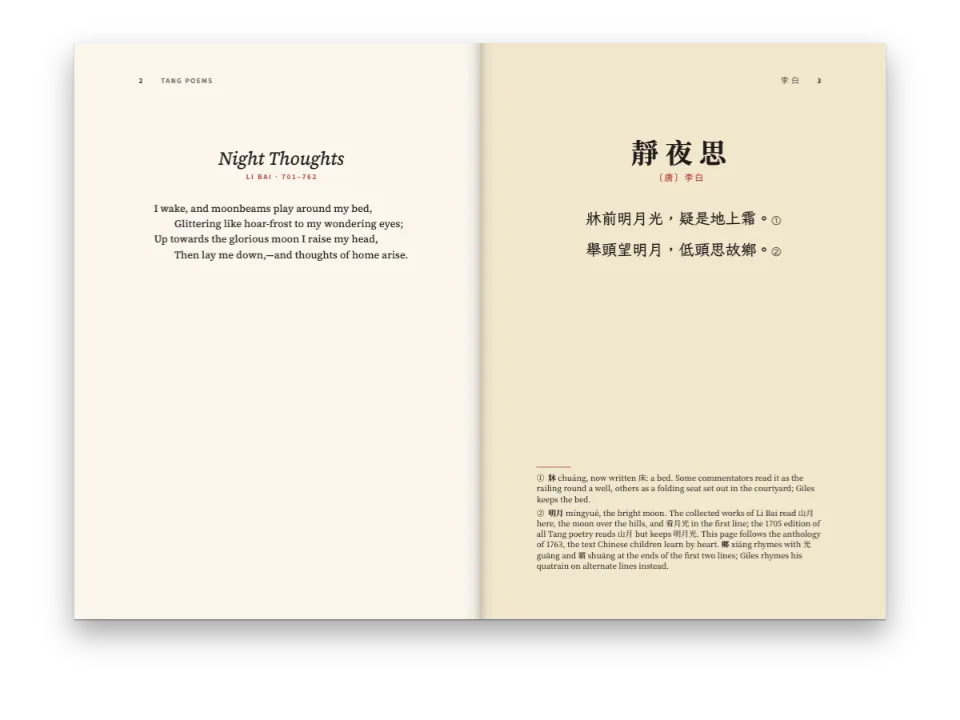
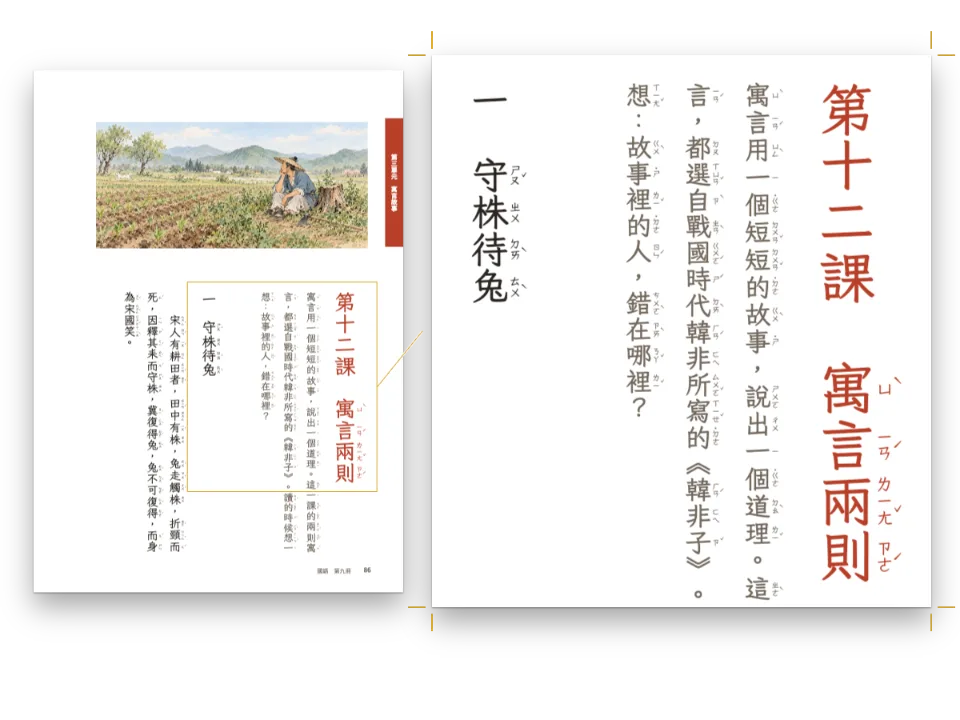
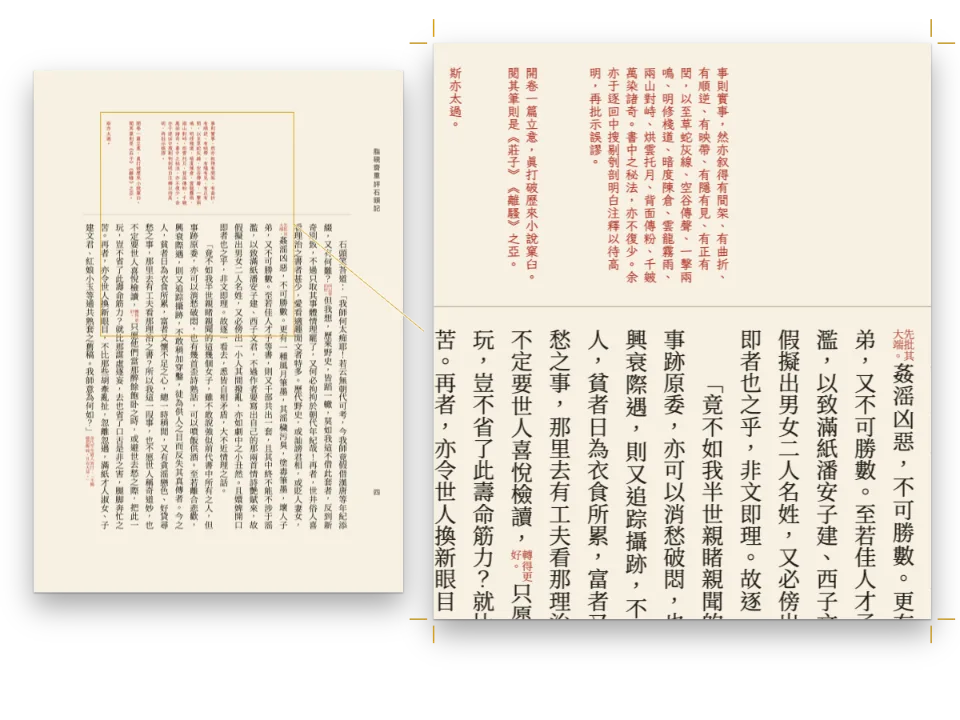
Klassisches Chinesisch, wie Japaner es lernen: Kleine rote Zeichen neben den Schriftzeichen sagen, in welcher Reihenfolge man liest und welche japanischen Endungen hinzukommen, und die japanische Lesung folgt jeder Passage.
Was Sie setzen
Drei Seiten eines japanischen Schullesebuchs für 漢文 (Kanbun), klassisches Chinesisch, als Japanisch gelesen, auf einer A5-Seite mit Bindung rechts: drei Sprüche der Analekten und Meng Haorans Vierzeiler Spring Dawn. Jede Passage ist in Zen Old Mincho in 15 pt in chinesischer Reihenfolge gesetzt, mit ihren 訓点 (Kunten) in Zinnober neben den Schriftzeichen, halb so groß wie diese: Die Rückkehrzeichen (返り点) unten links an einem Schriftzeichen sagen dem Leser, weiterzulesen und dann zu ihm zurückzukehren, und die Okurigana (送り仮名) rechts davon fügen die japanischen Endungen hinzu. Unter jeder Passage läuft ihre 書き下し文 (Yomikudashi), derselbe Text als Japanisch ausgeschrieben, in Klee One, einer Schulbuchschrift, mit Furigana, wo eine Lesung schwierig ist. Chinesische Klassiker mit ihren eigenen Lesehilfen zeigt Nº 080.
Dieses Rezept beantwortet
- Wie drucke ich Kanbun mit seinen Umstellungszeichen und Okurigana?
- Wie füge ich Furigana über Kanji hinzu, eine Lesung pro Zeichen oder eine für das ganze Wort?
Die kurze Antwort
// :kunten[習]{kaeri="レ" okuri="フ"} sets the return mark small at the character's lower
// left and the okurigana at its lower right, down the line; the text keeps its Chinese
// order, which the reader follows by the marks. cjk.kunten sizes and colours them: half
// the character, in vermilion. The Japanese reading under each passage is plain kana and
// kanji with furigana: {君子|くん|し} gives each character its reading (jukugo ruby).
const cjk = {
  grid: { enabled: true, charsPerLine: CHARS, linesPerPage: LINES },
  kunten: { fontSize: em(0.5), color: col('vermilion'), placement: 'inline' },
};
const paragraphStyles = [
  // The text: 15 pt on a pitch of two grid lines, room for the okurigana beside it. A
  // quatrain takes two lines, a couplet to the line with a space between its verses.
  { id: 'kanbun', fontFamily: MINCHO, fontSize: pt(KANBUN), lineHeight: pt(2 * LEAD),
    firstLineIndent: em(0), textAlign: 'justify' },
  { id: 'shi', fontFamily: MINCHO, fontSize: pt(KANBUN), lineHeight: pt(2 * LEAD),
    indent: em(2), firstLineIndent: em(0), marginTop: pt(0), marginBottom: pt(0) },
  // The reading (書き下し文), two characters down in a school-book hand.
  { id: 'kudashi', indent: em(2), firstLineIndent: em(0), marginTop: pt(LEAD) },
  { id: 'kudashi-shi', indent: em(4), firstLineIndent: em(0), marginTop: pt(0),
    marginBottom: pt(0) },
];
Zutaten
- Funktionen
- Kanbun-Lesezeichen (Kunten)Furigana: Kana-Lesungen über KanjiSenkrechter TextRechts gebundene BücherRuby: Pinyin- und Zhuyin-LesungenAbsatzformateÜberschriften über Textzeilen (Gyōdori)Kana, Kanji und RōmajiJapanischer Zeilenumbruch (Kinsoku)Japanische Zahlzeichen und Kana-ZählerZeichenrasterChinesische, japanische und koreanische SchriftenÜberschriftenformateGestaltete AuftakteKolumnentitel und SeitenzahlenKopfzeilen nach SeitenrolleGespiegelte RänderSemantische FarbpalettePDF-Export
- Nutzt außerdem
- Chinesischer ZeilenumbruchÜberschriftenattributePapierfarbeIm PDF eingebettete SchriftenRömisch paginierte TiteleiKolumnentitel je Abschnitt
- Schrift
- Zen Old Mincho, Klee One, Noto Sans JP (SIL OFL 1.1)
- Dateien
- Keine: Jedes Bild wird im Code gezeichnet
Zubereitung
#1 · Jedes Schriftzeichen mit :kunten markieren
Der Code steht oben in der kurzen Antwort. :kunten[習]{kaeri="レ" okuri="フ"} gibt 習 das Rückkehrzeichen レ und das Okurigana フ; der Text behält das Schriftzeichen, sodass Suche, Kopieren und das PDF die Passage so lesen, wie sie geschrieben ist, und die Zeichen nehmen ihr kein Schriftzeichen weg (Zeichen, Ruby und Warichu). Lesen Sie 学ビテ而時ニ習フレ之ヲ: レ an 習 schickt den Leser zuerst zu 之 und wieder zurück, 之を習ふ; 而 hat kein Zeichen und wird nicht gelesen. Im vertikalen Text steht das Rückkehrzeichen unten links an seinem Schriftzeichen und nimmt ein halbes Zeichen der Zeile ein, und die Okurigana stehen rechts, auf halber Höhe des Schriftzeichens beginnend, so wie JIS X 4051 sie setzt. cjk.kunten bestimmt ihre Größe, halb so groß wie der Text, und ihre Farbe, das Zinnober, in dem ein Leser sie schreibt; eine Passage steht in 15 pt auf zwei Rasterzeilen, was neben jeder Zeile 27 pt für die Okurigana lässt.
#2 · Mit 一 二 und mit 一レ springen
Die Zahlen führen den Leser weiter zurück. In 不二亦タ説バシカラ一乎 überspringt der Leser 不, das 二 trägt, liest 亦た説ばしから und kehrt bei 一 zu 不 zurück: 亦た説ばしからずや. In 為政 erledigt das kombinierte Zeichen 一レ an 為 beides: 可二以テ為一レ師ト矣 liest 以て, 師と (レ), 為る, dann zurück zu 可 (一 zu 二), 以て師と為るべし. Die Kanbun-Codepunkte ㆑ ㆒ ㆓ werden als die Zeichen gelesen, für die sie stehen, sodass ein von anderswo kopierter Text seine Zeichen behält.
#3 · Lange Okurigana das nächste Schriftzeichen weiterschieben lassen
Ein Okurigana, das länger ist als sein Schriftzeichen, läuft nicht neben dem nächsten weiter: In 花落ツルコト知ル多少 nehmen die vier Kana von ツルコト die Länge zweier Schriftzeichen ein, und 知 rückt nach unten und beginnt danach, so wie JIS X 4051 sie setzt (§5.6.4). Die Zeile wird länger; ihr nächster Umbruch verschiebt sich mit.
#4 · Jeder Passage eine Bezeichnung von zwei Zeilen Höhe geben
const at = (down, across) => ({ anchor: { to: 'container', edge: 'top-left' },
  offset: { x: pt(down), y: pt(across) } });
const TITLE = 26; // pt
const part = { level: 1, breakBefore: { enabled: true, parity: 'any' },
  advancedDesign: { enabled: true, minHeight: pt(5 * LEAD), slot: { elements: [
    { kind: 'text', id: 'title', content: '{titleText}', fontFamily: MINCHO, fontWeight: 700,
      fontSize: pt(TITLE), lineHeight: 1, letterSpacing: pt(TITLE / 2), color: col('ink'),
      placement: at(2 * BODY, 2 * LEAD - TITLE / 2) },
    { kind: 'text', id: 'kicker', content: '{attr.kicker}', fontFamily: GOTHIC, fontSize: pt(8.5),
      letterSpacing: pt(2), color: col('vermilion'), placement: at(2 * BODY + 3 * TITLE + 18,
        2 * LEAD - 8.5 / 2) },
  ] } } };
// 2行取り, the passage's book and number in gothic, two characters down.
const passage = { level: 2, fontFamily: GOTHIC, fontWeight: 700, fontSize: pt(9.5),
  color: col('muted'), lineSpan: 2, indent: em(2) };
Jedes Buch des Lesebuchs eröffnet eine Seite mit seinem Titel, 論語 oder 唐詩, das erste mit einer kleinen zinnoberroten Notiz zu seinem Inhalt; jede Passage erhält eine Bezeichnung in einer Gothic-Schrift, zwei Grundtextzeilen breit (2行取り), 学而第一 oder 春暁 孟浩然, sodass die Passagen darunter auf dem Raster bleiben. Die Lesung ist ein Block :::paragraphs{style="kudashi"}, zwei Zeichen tiefer, in Schrift und Größe des Grundtextes, mit Jukugo-Furigana: {君子|くん|し} gibt jedem Schriftzeichen seine eigene Lesung, sodass eine Zeile zwischen ihnen umbrechen könnte.
#5 · Jede Stimme mit ihren Schriftzeichen laden
const FENCE = /:::paragraphs\{style="([\w-]+)"\}\n([\s\S]*?)\n:::/g;
const fence = (style) => [...markdown.matchAll(FENCE)].filter((m) => m[1] === style)
  .map((m) => m[2]).join('');
const kanbun = `${fence('kanbun')}${fence('shi')}`; // the text and its marks' kana
const reading = `${fence('kudashi')}${fence('kudashi-shi')}`;
const heads = markdown.match(/^#+ [^{\n]*/gm).join('');
const colophon = markdown.match(/colophon="([^"]*)"/)[1];
await loadFonts(FONTS, markdown); // the Latin files: the colophon
await loadCjkFonts({ [MINCHO]: ['400'] }, kanbun, { vertical: true });
await loadCjkFonts({ [MINCHO]: ['700'] }, heads);
await loadCjkFonts({ [KYOKASHO]: ['400'] }, reading, { vertical: true });
await loadCjkFonts({ [GOTHIC]: ['400', '700'] },
  `${heads}${colophon}${markdown.match(/kicker="([^"]*)"/)[1]}漢文訓読一二三四五六七八九十`,
  { vertical: true });
Der klassische Text und die Lesung stehen in verschiedenen Schriften, sodass jede die Dateien für ihre eigenen Schriftzeichen lädt: Zen Old Mincho für die Passagen und ihre Zeichen, deren Kana in den Attributen von :kunten stehen, Klee One für die Lesungen und ihre Furigana, Noto Sans JP für die Bezeichnungen. Der Vierzeiler steht mit zwei Versen pro Zeile und einem ideografischen Leerzeichen dazwischen, eine übliche Art, ihn zu drucken, sodass Gedicht und Lesung unter dem Titel auf die Seite passen.
Das ganze Rezept
// ═══ Postext Cookbook · Nº 122 · Kanbun with its reading marks, and the Japanese reading ═══ // https://postext.dev/en/cookbook/kanbun-kundoku // Code: MIT · Text: 論語, 孟浩然「春暁」 (public domain); kunten and readings CC BY 4.0 // Fonts: Zen Old Mincho, Klee One, Noto Sans JP (SIL OFL 1.1) · Needs postext ≥ 1.25.0 import { buildDocument, withLoadedFonts, renderPageToCanvas, loadVerticalAlternates, } from 'https://esm.sh/postext'; import { renderToPdf, decompressWoff2 } from 'https://esm.sh/postext-pdf'; const LANG = 'en'; // @lang: the language of the colophon; the page is Japanese in both const RECIPE = 'kanbun-kundoku'; // ─── 1 · Design ───────────────────────────────────────────────────────────── // #region palette: ink, the vermilion of hand-written kunten, a school-book paper const palette = { ink: '#1e1c1a', // the text vermilion: '#c0392b', // 朱: the reading marks, as a reader adds them by hand muted: '#6a635c', // the headings' labels, the folios paper: '#fcfbf7', }; const col = (id) => ({ hex: palette[id], model: 'hex', paletteId: id }); const colorPalette = [ ...Object.entries(palette).map(([id, hex]) => ({ id, name: id, value: { hex, model: 'hex' } })), { id: 'main-color', name: 'defaults', value: { hex: palette.vermilion, model: 'hex' } }, ]; // #endregion const [MINCHO, KYOKASHO, GOTHIC] = ['Zen Old Mincho', 'Klee One', 'Noto Sans JP']; const [BODY, LEAD, CHARS, LINES] = [10.5, 21, 36, 16]; // pt, pt: 36字 × 16行, a 2 em pitch const KANBUN = 15; // pt: the classical text, set larger on two lines of the grid // #region answer: kanbun with 返り点 and 送り仮名, its yomikudashi beside it in furigana // :kunten[習]{kaeri="レ" okuri="フ"} sets the return mark small at the character's lower // left and the okurigana at its lower right, down the line; the text keeps its Chinese // order, which the reader follows by the marks. cjk.kunten sizes and colours them: half // the character, in vermilion. The Japanese reading under each passage is plain kana and // kanji with furigana: {君子|くん|し} gives each character its reading (jukugo ruby). const cjk = { grid: { enabled: true, charsPerLine: CHARS, linesPerPage: LINES }, kunten: { fontSize: em(0.5), color: col('vermilion'), placement: 'inline' }, }; const paragraphStyles = [ // The text: 15 pt on a pitch of two grid lines, room for the okurigana beside it. A // quatrain takes two lines, a couplet to the line with a space between its verses. { id: 'kanbun', fontFamily: MINCHO, fontSize: pt(KANBUN), lineHeight: pt(2 * LEAD), firstLineIndent: em(0), textAlign: 'justify' }, { id: 'shi', fontFamily: MINCHO, fontSize: pt(KANBUN), lineHeight: pt(2 * LEAD), indent: em(2), firstLineIndent: em(0), marginTop: pt(0), marginBottom: pt(0) }, // The reading (書き下し文), two characters down in a school-book hand. { id: 'kudashi', indent: em(2), firstLineIndent: em(0), marginTop: pt(LEAD) }, { id: 'kudashi-shi', indent: em(4), firstLineIndent: em(0), marginTop: pt(0), marginBottom: pt(0) }, ]; // #endregion // #region headings: each part opens a page; each passage under a two-line label const at = (down, across) => ({ anchor: { to: 'container', edge: 'top-left' }, offset: { x: pt(down), y: pt(across) } }); const TITLE = 26; // pt const part = { level: 1, breakBefore: { enabled: true, parity: 'any' }, advancedDesign: { enabled: true, minHeight: pt(5 * LEAD), slot: { elements: [ { kind: 'text', id: 'title', content: '{titleText}', fontFamily: MINCHO, fontWeight: 700, fontSize: pt(TITLE), lineHeight: 1, letterSpacing: pt(TITLE / 2), color: col('ink'), placement: at(2 * BODY, 2 * LEAD - TITLE / 2) }, { kind: 'text', id: 'kicker', content: '{attr.kicker}', fontFamily: GOTHIC, fontSize: pt(8.5), letterSpacing: pt(2), color: col('vermilion'), placement: at(2 * BODY + 3 * TITLE + 18, 2 * LEAD - 8.5 / 2) }, ] } } }; // 2行取り, the passage's book and number in gothic, two characters down. const passage = { level: 2, fontFamily: GOTHIC, fontWeight: 700, fontSize: pt(9.5), color: col('muted'), lineSpan: 2, indent: em(2) }; // #endregion const foreEdge = (id, content, edge, y, pages) => ({ kind: 'text', id, content, pages, writingMode: 'vertical-rl', fontFamily: GOTHIC, fontSize: pt(7.5), letterSpacing: pt(1), color: col('muted'), placement: { anchor: { to: 'outer', edge }, offset: { y: em(y) } } }); const header = { elements: [ foreEdge('hashira', '{title} {chapterTitle}', 'top', 3, 'body'), foreEdge('folio', '{pageNumber}', 'bottom', -3, 'all'), ] }; // The first part's opening page carries the colophon across the foot. const first = { id: 'first', footer: { elements: [{ kind: 'text', id: 'colophon', content: '{attr.colophon}', pages: 'opener', fontFamily: GOTHIC, fontSize: pt(5.5), lineHeight: 1.45, color: col('muted'), overflow: 'wrap', align: 'center', placement: { anchor: { to: 'page', edge: 'bottom' }, offset: { y: mm(-7) }, size: { width: mm(118) } } }] } }; const config = () => ({ locale: 'ja', // written out, never LANG (gotcha: ja-locale-tag) colorPalette, page: { sizePreset: 'custom', width: mm(148), height: mm(210), dpi: 150, // A5 backgroundColor: col('paper'), margins: { top: mm(40), bottom: mm(32), left: mm(13), right: mm(16), mirror: true }, pageNumbering: { format: 'japanese-informal' }, }, layout: { layoutType: 'single', writingMode: 'vertical-rl' }, cjk, bodyText: { fontFamily: KYOKASHO, fontSize: pt(BODY), lineHeight: pt(LEAD), color: col('ink'), boldColor: col('ink'), italicColor: col('ink'), referenceColor: col('ink'), textAlign: 'justify', firstLineIndent: em(1), indentAfterHeading: true, }, headings: { fontFamily: MINCHO, color: col('ink'), levels: [part, passage] }, headingStyles: [first], paragraphStyles, header, footer: { elements: [] }, }); // ─── 2 · Content ──────────────────────────────────────────────────────────── const markdown = String.raw`---Markdown-Beispiel · 50 Zeilen · content.en.md
title: "漢文訓読" --- # 論語 {style="first" kicker="学而・為政より" colophon="Confucius, 論語 (the Analects), three sayings from the books 學而 and 爲政; Meng Haoran, 春曉 (Spring Dawn). Kunten and reading after the usual school reading, set for this recipe. Set in Zen Old Mincho, Klee One and Noto Sans JP (SIL OFL)."} ## 学而第一 :::paragraphs{style="kanbun"} 子:kunten[曰]{okuri="ハク"}、:kunten[学]{okuri="ビテ"}而:kunten[時]{okuri="ニ"}:kunten[習]{kaeri="レ" okuri="フ"}:kunten[之]{okuri="ヲ"}、:kunten[不]{kaeri="二"}:kunten[亦]{okuri="タ"}:kunten[説]{kaeri="一" okuri="バシカラ"}乎。:kunten[有]{kaeri="レ" okuri="リ"}朋:kunten[自]{kaeri="二" okuri="リ"}遠:kunten[方]{kaeri="一"}:kunten[来]{okuri="タル"}、:kunten[不]{kaeri="二"}:kunten[亦]{okuri="タ"}:kunten[楽]{kaeri="一" okuri="シカラ"}乎。人:kunten[不]{kaeri="レ" okuri="シテ"}:kunten[知]{okuri="ラ"}而:kunten[不]{kaeri="レ"}:kunten[慍]{okuri="ミ"}、:kunten[不]{kaeri="二"}:kunten[亦]{okuri="タ"}君:kunten[子]{kaeri="一" okuri="ナラ"}乎。 ::: :::paragraphs{style="kudashi"} 子{曰|い}はく、{学|まな}びて時に{之|これ}を習ふ、{亦|ま}た{説|よろこ}ばしからずや。{朋|とも}有り{遠方|えん|ぽう}より来たる、{亦|ま}た楽しからずや。人知らずして{慍|うら}みず、{亦|ま}た{君子|くん|し}ならずや。 ::: ## 学而第三 :::paragraphs{style="kanbun"} 子:kunten[曰]{okuri="ハク"}、巧言令色、:kunten[鮮]{okuri="ナシ"}矣仁。 ::: :::paragraphs{style="kudashi"} 子{曰|い}はく、{巧言令色|こう|げん|れい|しょく}、{鮮|すく}なし{仁|じん}。 ::: ## 為政第十一 :::paragraphs{style="kanbun"} 子:kunten[曰]{okuri="ハク"}、:kunten[温]{kaeri="レ" okuri="メテ"}:kunten[故]{okuri="キヲ"}而:kunten[知]{kaeri="レ" okuri="レバ"}:kunten[新]{okuri="シキヲ"}、:kunten[可]{kaeri="二" okuri="シ"}:kunten[以]{okuri="テ"}:kunten[為]{kaeri="一レ" okuri="ル"}:kunten[師]{okuri="ト"}矣。 ::: :::paragraphs{style="kudashi"} 子{曰|い}はく、{故|ふる}きを{温|あたた}めて新しきを知れば、{以|もっ}て師と{為|な}るべし。 ::: # 唐詩 ## 春暁 孟浩然 :::paragraphs{style="shi"} 春眠:kunten[不]{kaeri="レ"}:kunten[覚]{kaeri="レ" okuri="エ"}:kunten[暁]{okuri="ヲ"} 処処:kunten[聞]{kaeri="二" okuri="ク"}啼:kunten[鳥]{kaeri="一" okuri="ヲ"} 夜来風:kunten[雨]{okuri="ノ"}声 花:kunten[落]{okuri="ツルコト"}:kunten[知]{okuri="ル"}多少 ::: :::paragraphs{style="kudashi-shi"} {春眠|しゅん|みん}{暁|あかつき}を{覚|おぼ}えず {処処|しょ|しょ}{啼鳥|てい|ちょう}を聞く {夜来|や|らい}{風雨|ふう|う}の声 花落つること知る{多少|た|しょう} :::`; // content.<lang>.md: the same Japanese text in both // ─── 3 · Fonts ────────────────────────────────────────────────────────────── const FONTS = { 'Zen Old Mincho': ['400', '700'], // the classical text and its marks; the part titles 'Klee One': ['400'], // the reading, in a school-book hand 'Noto Sans JP': ['400', '700'], // labels, the hashira and folios, the colophon }; // ─── 4 · Build & show ─────────────────────────────────────────────────────── // #region voices: each face loads the files that hold the characters it sets const FENCE = /:::paragraphs\{style="([\w-]+)"\}\n([\s\S]*?)\n:::/g; const fence = (style) => [...markdown.matchAll(FENCE)].filter((m) => m[1] === style) .map((m) => m[2]).join(''); const kanbun = `${fence('kanbun')}${fence('shi')}`; // the text and its marks' kana const reading = `${fence('kudashi')}${fence('kudashi-shi')}`; const heads = markdown.match(/^#+ [^{\n]*/gm).join(''); const colophon = markdown.match(/colophon="([^"]*)"/)[1]; await loadFonts(FONTS, markdown); // the Latin files: the colophon await loadCjkFonts({ [MINCHO]: ['400'] }, kanbun, { vertical: true }); await loadCjkFonts({ [MINCHO]: ['700'] }, heads); await loadCjkFonts({ [KYOKASHO]: ['400'] }, reading, { vertical: true }); await loadCjkFonts({ [GOTHIC]: ['400', '700'] }, `${heads}${colophon}${markdown.match(/kicker="([^"]*)"/)[1]}漢文訓読一二三四五六七八九十`, { vertical: true }); // #endregion const doc = await withLoadedFonts(() => buildDocument({ markdown }, config()), { ...kitFonts(FONTS), text: markdown }); showBook(doc, { title: t({ en: 'Kanbun with its reading marks, and the Japanese reading', es: 'Kanbun con sus marcas de lectura y la lectura japonesa' }) }); offerPdf(() => renderToPdf(doc, { fontProvider: cjkPdfProvider }), `${RECIPE}.pdf`);Kit · core, fonts, viewer, pdf, cjk: in jedem Rezept gleich · 458 Zeilen
// ─── Kit ── helpers shared by every Cookbook recipe · postext.dev/cookbook ───── // ─── Kit · core v1 ── the same in every recipe · postext.dev/cookbook function mm(value) { return { value, unit: 'mm' }; } function pt(value) { return { value, unit: 'pt' }; } function em(value) { return { value, unit: 'em' }; } /** The sample language's string: t({ en: 'Figure', es: 'Figura' }). */ function t(strings) { return strings[LANG] ?? Object.values(strings)[0]; } /** A file in this recipe's assets folder, served from the Postext repo by jsDelivr. */ function asset(file) { return `https://cdn.jsdelivr.net/gh/drnachio/postext@main/cookbook/${RECIPE}/assets/${file}`; } // ─── Kit · fonts v3 ── the same in every recipe · postext.dev/cookbook // Postext loads the faces a config asks for before layout (prepareFonts, // buildDocumentWithFonts) and asks the kit for the files: Fontsource's, the // files the PDF embeds too. /** The options of buildDocumentWithFonts / prepareFonts / withLoadedFonts: * the Fontsource resolver, and the faces of FONTS loaded with the ones the * config names. FONTS = { 'Family Name': ['400', '400i', '700'] }. */ function kitFonts(FONTS = {}) { const faces = Object.entries(FONTS).flatMap(([family, specs]) => specs.map((spec) => ({ family, weight: parseInt(spec, 10), style: spec.endsWith('i') ? 'italic' : 'normal' }))); return { resolve: fontsourceResolver, faces }; } /** A face's Fontsource files, in a fixed order: latin, then latin-ext and greek * when `text` needs them and the family ships them (kitSubsetsFor), each with * its unicode-range. Null for a weight or slant Fontsource does not ship. */ async function fontsourceResolver(family, weight, style, { text = '' } = {}) { const id = fontsourceId(family); const meta = await fontsourceMeta(family); if (meta && !(meta.weights.includes(weight) && meta.styles.includes(style))) return null; kitStatus('Loading fonts…'); const at = await fontsourceAt(id); return ['latin', ...kitSubsetsFor(text, meta)].map((subset) => ({ source: `${at}files/${id}-${subset}-${weight}-${style}.woff2`, unicodeRange: kitRanges()[subset], })); } /** The unicode-range of each Fontsource file the kit loads (a function: the * kit is inlined after the pen's code, which runs before a const would be set). */ function kitRanges() { return { latin: 'U+0000-00FF,U+0131,U+0152-0153,U+02BB-02BC,U+02C6,U+02DA,U+02DC,U+0304,U+0308,U+0329,' + 'U+2000-206F,U+20AC,U+2122,U+2191,U+2193,U+2212,U+2215,U+FEFF,U+FFFD', 'latin-ext': 'U+0100-02BA,U+02BD-02C5,U+02C7-02CC,U+02CE-02D7,U+02DD-02FF,U+0304,U+0308,U+0329,' + 'U+1D00-1DBF,U+1E00-1E9F,U+1EF2-1EFF,U+2020,U+20A0-20AB,U+20AD-20C0,U+2113,U+2C60-2C7F,U+A720-A7FF', greek: 'U+0370-03FF', }; } /** For the cjk, arabic and comics blocks, which add their own files: the * faces of `faces` = { 'Family Name': ['400', '400i', '700'] }. `text` is the sample: * č ł † α χ also load latin-ext and greek files (kitSubsetsFor). With * `optional`, a face Fontsource does not ship is skipped instead of failing. * The files are added once all have loaded, in the order asked (latin, then * latin-ext, then greek), whatever order they arrive in: the last one added * wins a character two files hold. Resolves to the number of faces added. */ async function loadFonts(faces, text = '', { optional = false } = {}) { kitStatus('Loading fonts…'); const ranges = kitRanges(); const jobs = []; for (const [family, specs] of Object.entries(faces)) { const id = fontsourceId(family); const todo = [...new Set(specs)].map((spec) => [parseInt(spec, 10), spec.endsWith('i') ? 'italic' : 'normal']) .filter(([weight, style]) => !hasFace(family, weight, style)); // before any await const at = fontsourceAt(id); const meta = optional || /[^\0-ÿ]/u.test(text) ? await fontsourceMeta(family) : null; const subsets = ['latin', ...kitSubsetsFor(text, meta)]; for (const [weight, style] of todo) { if (optional && !(meta?.weights.includes(weight) && meta.styles.includes(style))) continue; for (const subset of subsets) { const url = `${await at}files/${id}-${subset}-${weight}-${style}.woff2`; const face = new FontFace(family, `url(${url}) format('woff2')`, { weight: String(weight), style, unicodeRange: ranges[subset] }); jobs.push(face.load().catch(() => { if (subset === 'latin' && !optional) throw new Error(`Fontsource has no ${family} ${weight} ${style}`); })); } } } const ready = await Promise.all(jobs).catch((error) => { kitFail(error); throw error; }); return ready.filter((face) => face && document.fonts.add(face)).length; } /** A loaded FontFace covers this family, weight and style (fonts.check() would * also say yes for families nobody declared). */ function hasFace(family, weight, style) { for (const face of document.fonts) { if (face.status !== 'loaded' || face.style !== style) continue; if (face.family.replace(/^["']|["']$/g, '') !== family) continue; const [low, high = low] = face.weight.split(' ').map(Number); if (weight >= low && weight <= high) return true; } return false; } /** The files beyond latin `text` needs that `meta`'s family ships. */ function kitSubsetsFor(text, meta) { return [[/[Ā-˿ᴀ-ᶿḀ-ỿ†ℓⱠ-Ɀ꜠-ꟿ]/u, 'latin-ext'], [/[Ͱ-Ͽ]/u, 'greek']] .filter(([re, x]) => re.test(text) && meta?.subsets?.includes(x)).map(([, x]) => x); } /** Fontsource's id for a family: 'Source Serif 4' → 'source-serif-4'. */ function fontsourceId(family) { return family.toLowerCase().replace(/\s+/g, '-'); } /** A package's folder at the one version @5 names now (#766). */ function fontsourceAt(id, u = `https://cdn.jsdelivr.net/npm/@fontsource/${id}@`) { return (fontsourceAt.c ??= {})[id] ??= fetch(u + '5/package.json').then((r) => r.json()) .then((p) => p.version || 5, () => 5).then((v) => `${u}${v}/`); } /** The family's Fontsource metadata (weights, styles, subsets), or null. */ function fontsourceMeta(family) { fontsourceMeta.cache ??= new Map(); const id = fontsourceId(family); if (!fontsourceMeta.cache.has(id)) { fontsourceMeta.cache.set(id, fetch(`https://api.fontsource.org/v1/fonts/${id}`) .then((res) => (res.ok ? res.json() : null), () => null)); } return fontsourceMeta.cache.get(id); } // ─── Kit · viewer v2 ── the same in every recipe · postext.dev/cookbook /** The pages as spreads on a dark desk, page 1 alone, then verso | recto, * each painted when it scrolls near. Other options go to renderPageToCanvas. */ function showPages(docs, { title, width = 460, ...render } = {}) { const root = viewer(title); const pages = [docs].flat().flatMap((doc) => doc.pages.map((page) => ({ doc, page, n: (doc.pageIndexOffset ?? 0) + page.index }))); const spreads = []; let verso = null; for (const p of pages) { if (p.n % 2 === 1) { if (verso) spreads.push([verso, null]); verso = p; } else { spreads.push([verso, p]); verso = null; } } if (verso) spreads.push([verso, null]); const density = Math.min(window.devicePixelRatio || 1, 2); showPages.painter?.disconnect(); const painter = new IntersectionObserver((entries) => { for (const { isIntersecting, target } of entries) { if (!isIntersecting) continue; painter.unobserve(target); const { doc, page } = target.postext; renderPageToCanvas(page, doc, target, { ...render, scale: (width * density) / page.width }); } }, { rootMargin: '800px' }); showPages.painter = painter; root.replaceChildren(...spreads.map((pair) => { const spread = document.createElement('div'); spread.className = 'pt-spread'; for (const p of pair) { const figure = document.createElement('figure'); if (p) { const label = p.page.pageLabel || String(p.n + 1); const canvas = document.createElement('canvas'); canvas.postext = p; canvas.style.aspectRatio = `${p.page.width} / ${p.page.height}`; canvas.setAttribute('role', 'img'); canvas.setAttribute('aria-label', `Page ${label}`); const folio = document.createElement('figcaption'); folio.textContent = label; figure.append(canvas, folio); painter.observe(canvas); } else figure.className = 'pt-blank'; spread.append(figure); } return spread; })); kitStatus(`${pages.length} ${pages.length === 1 ? 'page' : 'pages'}`); document.documentElement.dataset.postext = 'ready'; return pages.length; } /** The desk, the bar and the error reporting, created once. */ function viewer(title) { if (!document.getElementById('pt-kit')) { document.head.insertAdjacentHTML('beforeend', `<style id="pt-kit"> :root { color-scheme: dark; } body { margin: 0; background: #0e1014; color: #b9bcc4; font: 13px/1.45 system-ui, sans-serif; } #pt-bar { position: sticky; top: 0; z-index: 1; display: flex; flex-wrap: wrap; align-items: center; gap: 6px 16px; padding: 10px 16px; background: rgb(14 16 20 / .92); backdrop-filter: blur(6px); border-bottom: 1px solid #23262d; } #pt-bar strong { color: #f4f1ea; font-weight: 600; } #pt-actions { display: flex; gap: 12px; margin-left: auto; } #pt-actions a, #pt-actions button { color: #d8a21a; font: inherit; background: none; border: 0; padding: 0; cursor: pointer; } #pages { display: grid; justify-items: center; gap: 48px; padding: 32px 16px 72px; } .pt-spread { display: flex; } .pt-spread figure { margin: 0; width: min(460px, 44vw); } .pt-spread canvas { display: block; width: 100%; background: #fff; box-shadow: 0 1px 2px rgb(0 0 0 / .5), 0 22px 44px -16px rgb(0 0 0 / .8); } .pt-spread figure:first-child canvas { box-shadow: inset -14px 0 14px -14px rgb(0 0 0 / .18), 0 1px 2px rgb(0 0 0 / .5), 0 22px 44px -16px rgb(0 0 0 / .8); } .pt-spread figcaption { margin-top: 10px; text-align: center; font: 600 10px/1 system-ui, sans-serif; letter-spacing: .18em; text-transform: uppercase; color: #6c7079; } .pt-blank { visibility: hidden; } @media (max-width: 760px) { .pt-spread { flex-direction: column; gap: 32px; } .pt-spread figure { width: min(460px, 92vw); } .pt-blank { display: none; } } </style>`); document.body.insertAdjacentHTML('afterbegin', '<header id="pt-bar"><strong id="pt-title"></strong><span id="pt-status" role="status"></span><span id="pt-actions"></span></header>'); document.getElementById('pt-title').textContent = document.title || 'Postext'; addEventListener('error', (event) => kitFail(event.error ?? event.message)); addEventListener('unhandledrejection', (event) => kitFail(event.reason)); } if (title) document.getElementById('pt-title').textContent = title; return document.getElementById('pages') ?? document.body.appendChild(Object.assign(document.createElement('main'), { id: 'pages' })); } function kitStatus(text) { viewer(); document.getElementById('pt-status').textContent = text; } function kitFail(error) { document.documentElement.dataset.postext = 'error'; kitStatus(`Error: ${error?.message ?? error}`); } // ─── Kit · pdf v3 ── the same in every recipe that exports a PDF /** The Fontsource files the screen used, as TrueType, with their range and * place: the nearest weight the family ships, upright with no italic; * latin, then what its letters need (kitSubsetsFor). */ async function fontsourceProvider(family, weight, style, request) { const id = fontsourceId(family); const meta = await fontsourceMeta(family); const weights = meta?.weights?.length ? meta.weights : [400, 700]; const w = weights.reduce((a, b) => (Math.abs(b - weight) < Math.abs(a - weight) ? b : a)); const s = style === 'italic' && meta && !meta.styles.includes('italic') ? 'normal' : style; const text = String.fromCodePoint(...(request?.codePoints ?? [])); const files = await Promise.all(['latin', ...kitSubsetsFor(text, meta)].map(async (subset, order) => { const res = await fetch(`${await fontsourceAt(id)}files/${id}-${subset}-${w}-${s}.woff2`); if (!res.ok) throw new Error(`Fontsource has no ${family} ${w} ${s} ${subset}`); return Object.assign(await decompressWoff2(new Uint8Array(await res.arrayBuffer())), { unicodeRange: kitRanges()[subset], order }); })); return files.length === 1 ? files[0] : files; } /** A "Build the PDF" button; then "Open the PDF" (a new tab: CodePen's frame * shows no PDFs) and a download link. */ function offerPdf(makePdf, filename) { viewer(); const button = Object.assign(document.createElement('button'), { type: 'button', textContent: 'Build the PDF' }); button.dataset.postextPdf = filename; button.addEventListener('click', async () => { button.disabled = true; button.textContent = 'Building the PDF…'; try { const bytes = await makePdf(); const url = URL.createObjectURL(new Blob([bytes], { type: 'application/pdf' })); const size = `${Math.max(1, Math.round(bytes.length / 1024))} KB`; button.replaceWith( Object.assign(document.createElement('a'), { href: url, target: '_blank', rel: 'noopener', textContent: 'Open the PDF ↗' }), Object.assign(document.createElement('a'), { href: url, download: filename, textContent: `Download ${filename} · ${size}` })); } catch (error) { button.disabled = false; button.textContent = 'Build the PDF'; kitFail(error); } }); document.getElementById('pt-actions').append(button); } // ─── Kit · cjk v2 ── Chinese, Japanese and Korean books · postext.dev/cookbook // Fontsource ships a CJK family as about a hundred files per weight, each // declared in its stylesheet with the unicode-range it covers. The screen // loads the files the sample touches; the PDF gets the same files for the // characters its pages set in each face, and embeds each as a subset. // A book bound on the right (vertical text) is shown with its spreads // mirrored: page 1 alone on the left of the spine, then [3 | 2]. /** The files of a Fontsource face, read from its stylesheet: { url, range, * ranges }, the last declared first (the order the browser tries them in). */ function cjkSlices(family, weight, style) { cjkSlices.cache ??= new Map(); const id = fontsourceId(family); const css = `${id}/${weight}${style === 'italic' ? '-italic' : ''}.css`; if (!cjkSlices.cache.has(css)) { let at; cjkSlices.cache.set(css, fontsourceAt(id).then((a) => fetch(at = a + css.slice(id.length + 1))) .then((res) => { if (!res.ok) throw new Error(`Fontsource has no ${family} ${weight} ${style} (${res.status})`); return res.text(); }) .then((text) => [...text.matchAll(/@font-face\s*{([^}]*)}/g)].map(([, rule]) => { const range = /unicode-range:\s*([^;]+);/.exec(rule)?.[1].trim() ?? 'U+0-10FFFF'; const ranges = range.split(',').map((part) => { const [lo, hi = lo] = part.trim().slice(2).split('-'); return [parseInt(lo, 16), parseInt(hi, 16)]; }); return { url: new URL(/url\(([^)]+?\.woff2)\)/.exec(rule)[1], at).href, range, ranges }; }).reverse())); } return cjkSlices.cache.get(css); } /** The file of `slices` the screen sets code point `cp` in, if any: the * last one loadCjkFonts adds whose range holds it. A numbered file that * repeats a letter of latin is added after latin, and wins it. */ function cjkSliceFor(slices, cp) { const holds = (slice) => slice.ranges.some(([lo, hi]) => cp >= lo && cp <= hi); return slices.reduce((last, slice) => (holds(slice) ? slice : last), undefined); } /** Whether Fontsource serves `family` as a Chinese, Japanese or Korean * family (its subsets name the script). Fails when the API does not * answer: a CJK face taken for a Latin one would paint in a system face. */ async function isCjkFamily(family) { const meta = await fontsourceMeta(family); if (!meta) throw new Error(`api.fontsource.org did not describe ${family}: reload to try again`); return !!meta.subsets?.some((subset) => /^(chinese|japanese|korean)/.test(subset)); } /** faces = { 'Noto Serif TC': ['400', '700'] }, as for loadFonts: the * whole FONTS object may be passed, its other families are left to * loadFonts. Adds one FontFace per file of each CJK face with its * unicodeRange, then loads the files `text` touches. `text` is what the * faces set: the sample for the text face; a book in several voices calls * it once per voice (loadCjkFonts({ 'LXGW WenKai TC': ['400'] }, quotes)), * so the heading and quotation faces fetch and check only their own * characters. Fails when a character of `text` is in no file of a face. * List every weight the pages use: a weight left to the engine's later round * gets the latin file only. With { vertical: true } it also loads each * family's vertical forms (brackets, quotes, pause marks) for the canvas, * which needs loadVerticalAlternates imported from postext. Resolves to * the number of files loaded. */ async function loadCjkFonts(faces, text, { vertical = false } = {}) { kitStatus('Loading fonts…'); let loaded = 0; try { if (vertical && typeof loadVerticalAlternates !== 'function') { throw new Error('loadCjkFonts(…, { vertical: true }) needs loadVerticalAlternates imported from postext'); } for (const [family, specs] of Object.entries(faces)) { if (!(await isCjkFamily(family))) continue; const twin = []; for (const spec of new Set(specs)) { const weight = parseInt(spec, 10); const style = spec.endsWith('i') ? 'italic' : 'normal'; const slices = await cjkSlices(family, weight, style); const missing = [...new Set(text)].filter((ch) => /\S/.test(ch) && !cjkSliceFor(slices, ch.codePointAt(0))); if (missing.length) { throw new Error(`${family} ${spec} has no file for ${missing.slice(0, 12).join(' ')}: ` + `give each face the text it sets (loadCjkFonts({ '${family}': ['${spec}'] }, text))`); } for (const slice of slices) { document.fonts.add(new FontFace(family, `url(${slice.url}) format('woff2')`, { weight: String(weight), style, unicodeRange: slice.range })); twin.push({ source: slice.url, weight: String(weight), style, unicodeRange: slice.range }); } const font = `${style === 'italic' ? 'italic ' : ''}${weight} 16px "${family}"`; loaded += (await document.fonts.load(font, text)).length; if (!document.fonts.check(font, text)) throw new Error(`${family} ${spec} did not load for the sample`); } // The same files under a twin name with the `vert` feature on: the // canvas paints the punctuation of vertical lines with it. if (vertical && twin.length) await loadVerticalAlternates(family, twin); } } catch (error) { kitFail(error); throw error; } return loaded; } /** The PDF font provider for recipes with CJK faces: a family whose * Fontsource subsets are Chinese, Japanese or Korean gets the files the * screen set its pages' characters in (`request.codePoints`), each marked * with its unicode-range and its place in the order loadCjkFonts added * them: postext-pdf sets a character two files hold in the one added * last, as the browser does. Any other family gets the latin file * fontsourceProvider fetches (the "pdf" block) and, when the face sets * letters only latin-ext has, that file too. */ async function cjkPdfProvider(family, weight, style, request) { if (!(await isCjkFamily(family))) return cjkLatinPdfFiles(family, weight, style, request); const meta = await fontsourceMeta(family); const weights = meta.weights?.length ? meta.weights : [400, 700]; const w = weights.reduce((a, b) => (Math.abs(b - weight) < Math.abs(a - weight) ? b : a)); const s = style === 'italic' && !meta.styles.includes('italic') ? 'normal' : style; const slices = await cjkSlices(family, w, s); const picked = new Set(); for (const cp of request?.codePoints ?? []) { const slice = cjkSliceFor(slices, cp); if (slice) picked.add(slice); } if (!picked.size) picked.add(slices[0]); return Promise.all(slices.map(async (slice, order) => { if (!picked.has(slice)) return null; const res = await fetch(slice.url); if (!res.ok) throw new Error(`Fontsource file ${slice.url} (${res.status})`); const bytes = await decompressWoff2(new Uint8Array(await res.arrayBuffer())); return Object.assign(bytes, { unicodeRange: slice.range, order }); })).then((files) => files.filter(Boolean)); } /** A Latin family set next to the CJK faces: its latin file, then its * latin-ext file when the face sets letters only latin-ext has (ō ū in * Hepburn rōmaji, ǎ in pinyin), the file loadFonts adds on screen for * them, each marked with its unicode-range and its place in that order: * the PDF sets a character in the file the browser took it from. A face * Fontsource ships without latin-ext, or whose file does not come, gets * latin alone, and the PDF names the letters it lacks. */ async function cjkLatinPdfFiles(family, weight, style, request) { const meta = await fontsourceMeta(family); const beyond = [...(request?.codePoints ?? [])].some(cjkLatinExtOnly); if (!beyond || !meta?.subsets?.includes('latin-ext')) return fontsourceProvider(family, weight, style); const weights = meta.weights?.length ? meta.weights : [400, 700]; const w = weights.reduce((a, b) => (Math.abs(b - weight) < Math.abs(a - weight) ? b : a)); const s = style === 'italic' && !meta.styles.includes('italic') ? 'normal' : style; const id = fontsourceId(family); const url = `${await fontsourceAt(id)}files/${id}-latin-ext-${w}-${s}.woff2`; const [latin, ext] = await Promise.all([fontsourceProvider(family, weight, style), fetch(url) .then(async (res) => (res.ok ? decompressWoff2(new Uint8Array(await res.arrayBuffer())) : null), () => null)]); const ranges = kitRanges(); return ext ? [Object.assign(latin, { unicodeRange: ranges.latin, order: 0 }), Object.assign(ext, { unicodeRange: ranges['latin-ext'], order: 1 })] : latin; } /** Whether code point `cp` is in Fontsource's latin-ext file and not in * its latin file: Latin Extended-A and -B, IPA, the spacing modifiers and * Latin Extended Additional (loadFonts's test for latin-ext), less the * few latin holds too (ı Œ œ ʻ ʼ ˆ ˚ ˜). */ function cjkLatinExtOnly(cp) { if (!((cp >= 0x100 && cp <= 0x2ff) || (cp >= 0x1e00 && cp <= 0x1eff))) return false; return ![0x131, 0x152, 0x153, 0x2bb, 0x2bc, 0x2c6, 0x2da, 0x2dc].includes(cp); } /** showPages for a book bound on either edge. A right-bound book (the * document says so: doc.binding is 'right' for page.binding 'right' and * for vertical text) lies on the desk as it opens: page 1 alone on the * left of the spine, then [3 | 2], the spine shade on each page's inner * edge. `binding` ('left' | 'right') overrides the document's. */ function showBook(docs, { binding, ...options } = {}) { const count = showPages(docs, options); const right = (binding ?? [docs].flat()[0]?.binding) === 'right'; if (!document.getElementById('pt-kit-cjk')) { // The pages keep direction ltr: a canvas draws text in the direction its // element inherits, and under rtl each run would end where the engine // starts it, its brackets mirrored. document.head.insertAdjacentHTML('beforeend', `<style id="pt-kit-cjk"> .pt-spread[dir="rtl"] canvas { direction: ltr; } .pt-spread[dir="rtl"] figure:first-child canvas { box-shadow: inset 14px 0 14px -14px rgb(0 0 0 / .18), 0 1px 2px rgb(0 0 0 / .5), 0 22px 44px -16px rgb(0 0 0 / .8); } </style>`); } // Each pair stays [verso, recto] in the page; right to left, the verso // sits on the right. Phones stack the pages in reading order either way. for (const spread of document.querySelectorAll('#pages > .pt-spread')) spread.dir = right ? 'rtl' : 'ltr'; document.getElementById('pages').dataset.binding = right ? 'right' : 'left'; return count; } // ─── /Kit ───────────────────────────────────────────────────────────────────────
Das zusammengesetzte script.js läuft unverändert: Fügen Sie es in das Modulskript einer beliebigen Seite ein, oder öffnen Sie das Rezept auf CodePen. Ordner des Rezepts auf GitHub ↗ (öffnet in neuem Tab)
Varianten
#Die Zeichen in Schwarz drucken
Ein gedrucktes Lesebuch setzt die Kunten in der Textfarbe; lassen Sie die Farbe weg.
-  kunten: { fontSize: em(0.5), color: col('vermilion'), placement: 'inline' },
+ kunten: { fontSize: em(0.5), placement: 'inline' },#Die Zeichen zwischen die Zeilen setzen
placement: 'interlinear' nimmt die Rückkehrzeichen aus der Zeile in den Zwischenraum neben der unteren Hälfte des Schriftzeichens, sodass die Passage die Abstände des blanken Textes (白文) behält. JIS setzt sie in der Zeile, wie der Standardwert.
-  kunten: { fontSize: em(0.5), color: col('vermilion'), placement: 'inline' },
+ kunten: { fontSize: em(0.5), color: col('vermilion'), placement: 'interlinear' },Häufige Fehler
Häufiger Fehler
Zeichnen Sie japanischen Text mit 'ja' aus, nie mit zh-Hans oder LANG
Die Ausgaben eines Rezepts sind en und es, ein japanisches Beispiel ist aber in beiden Japanisch: `locale: LANG` würde es als Englisch oder Spanisch auszeichnen, und eine chinesische Auszeichnung würde es nach chinesischen Regeln setzen (Kaiming-Interpunktion, kleine Kana dürfen eine Zeile beginnen, 图 statt 図, chinesische Glyphenformen im PDF). Seit postext 1.30 ist die Auszeichnung auch die Sprache, in der der Text geformt wird (gemessen, gezeichnet und eingebettet). Jede Auszeichnung außer 'ja' liefert daher andere Glyphenformen als die japanischen (unter einer chinesischen Auszeichnung die chinesischen) und andere Zeilenumbrüche. Schreiben Sie 'ja': Das wählt die Region Japan (JLReq-Zeilenumbruch und -Interpunktion, Sesam-Betonungszeichen, Furigana-Abstände, die Beschriftungen 図 und 表) und schaltet die Silbentrennung ab. Der Lint schlägt bei einem Text mit Kana unter einer zh- oder ko-Auszeichnung fehl. Japanischer Zeilenumbruch (Kinsoku) →
Häufiger Fehler
Chinesische Schnitte werden in Teilstücken geladen, über den Block cjk
Fontsource liefert eine chinesische, japanische oder koreanische Familie als etwa hundert Dateien pro Schriftstärke aus, jede für einen Zeichenbereich. loadFonts holt nur die Datei latin, am Bildschirm stammen die Han-Zeichen also aus einer Systemschrift und werden falsch gemessen, und fontsourceProvider gibt dem PDF diese latin-Datei, die sie als leere Kästchen druckt. Führen Sie den Kit-Block cjk auf, rufen Sie loadCjkFonts(FONTS, markdown) nach loadFonts auf (einmal pro Stimme, mit dem Text, den sie setzt, wenn das Buch mehrere CJK-Schriften verwendet), und geben Sie renderToPdf fontProvider: cjkPdfProvider: Beide nehmen die Dateien, die die Zeichen des Textes enthalten. Chinesische, japanische und koreanische Schriften →
Häufiger Fehler
Ein rechts gebundenes Buch zeigt seine Doppelseiten mit showBook
In einem rechts gebundenen Buch (arabischer, hebräischer oder persischer Text, vertikales Chinesisch oder page.binding 'right') ist Seite 1 weiterhin die rechte Seite (recto), liegt aber links vom Rücken, und die Paare lesen sich [3 | 2]. showPages legt jedes Buch links gebunden aus; showBook aus dem Block book (der Block cjk enthält dieselbe Funktion) liest doc.binding und spiegelt die Paare. capture.hero benennt eine Doppelseite weiterhin in Lesereihenfolge, [verso, recto]: [2, 3]. Rechts gebundene Bücher →
Nachweise
- Rezept
- Ignacio Ferro
- Text
- 論語 (the Analects of Confucius), 學而 1 and 3, 爲政 11, and 孟浩然「春曉」 (Spring Dawn), in shinjitai; the kunten (返り点, 送り仮名) and the yomikudashi follow the usual Japanese school reading and were set for this recipe (CC BY 4.0) · Confucius and his disciples; Meng Haoran; Ignacio Ferro (kunten and reading) · gemeinfrei
- Schriften
- Zen Old Mincho (SIL OFL 1.1) · Klee One (SIL OFL 1.1) · Noto Sans JP (SIL OFL 1.1)
- Code
- MIT, wie Postext
Diesen Text bearbeiten ↗ (öffnet in neuem Tab)Ordner des Rezepts auf GitHub ↗ (öffnet in neuem Tab)