Kurz gesagt
Ein Kapitel eines chinesischen Buchs, in Spalten von oben nach unten gesetzt. Jede Quelle wird in einer kleinen zweizeiligen Notiz innerhalb der Spalte zitiert, und die zitierten Werke stehen am Ende in einer Liste.
Was Sie setzen
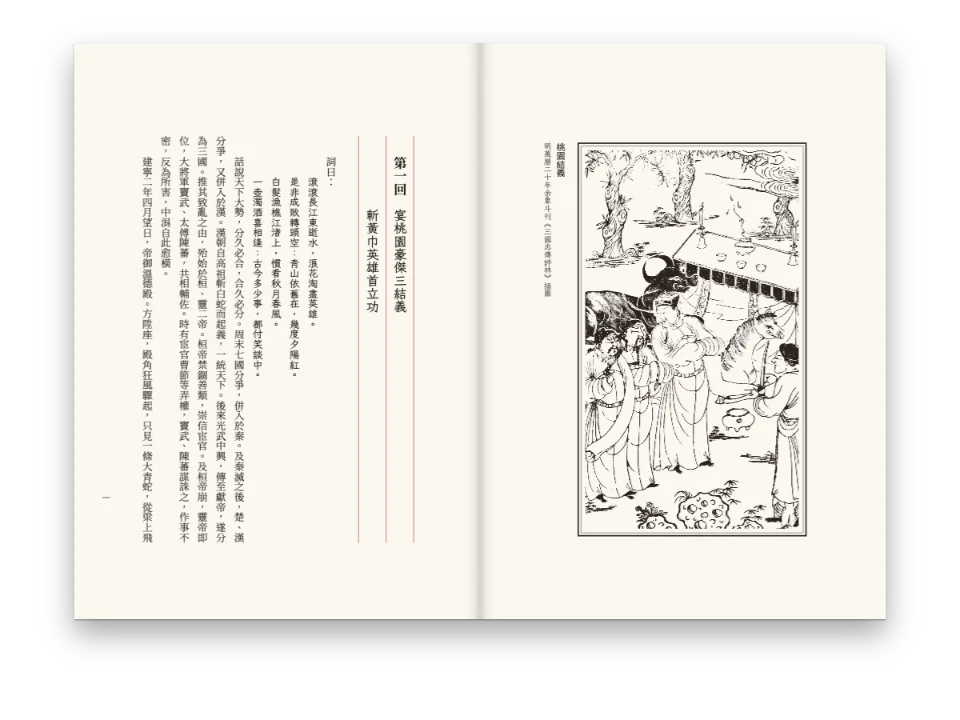
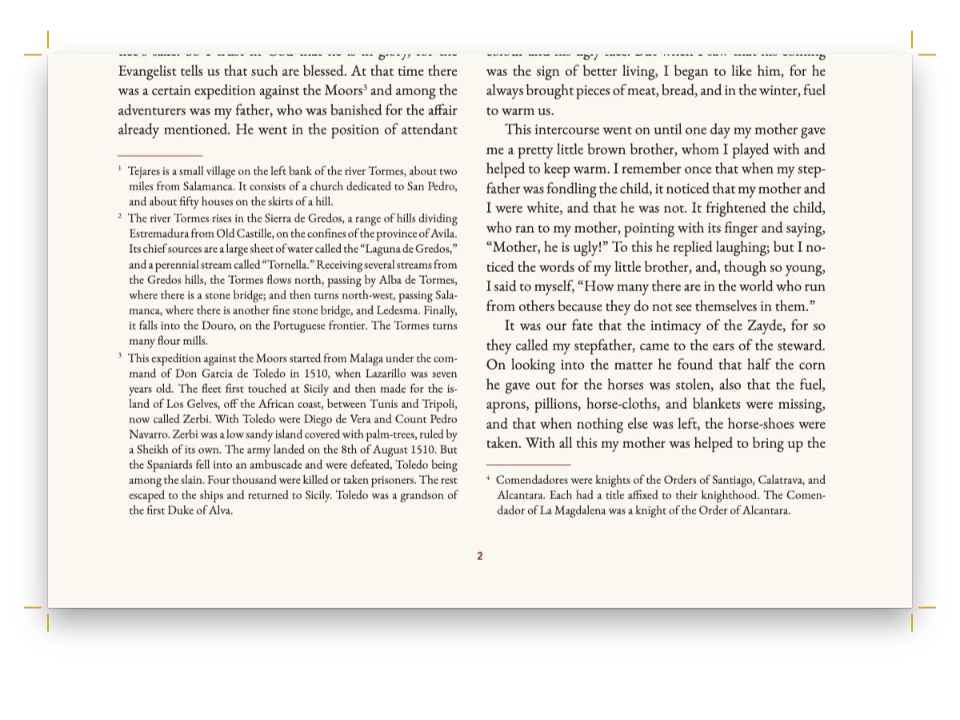
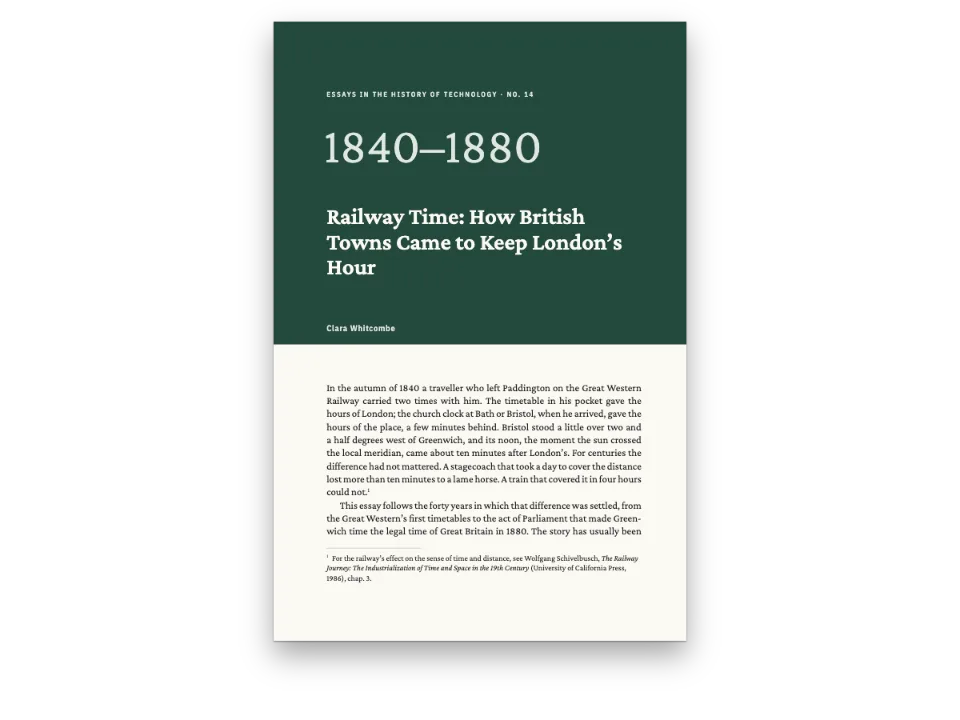
Das Ende eines Kapitels aus einem erfundenen Buch über den chinesischen Druck, 版刻叢談 („Gespräche über den Holztafeldruck“), in Langzeichen gesetzt, von oben nach unten in Spalten, die von rechts gelesen werden, auf einer 大32開-Seite von 140 × 203 mm, rechts gebunden. Das Kapitel handelt vom Seitenbild der Song-Ausgaben und zitiert fünf echte Werke. Jedes Zitat ist so gesetzt, wie chinesische Bücher seit Jahrhunderten Kommentare setzen: als 夾注, eine Notiz in zwei Zeilen in halber Textgröße, innerhalb der Spalte, in der das Zitat steht. Eine Notiz, die nicht in den Rest einer Spalte passt, läuft am Kopf der nächsten weiter, und eine läuft über das Umblättern hinweg. Die Notizen folgen der Anmerkungsform von GB/T 7714—2015, der festlandchinesischen Norm für Literaturangaben, und das Kapitel endet mit einer nummerierten Liste der Werke, die es zitiert, die englischen quer gestellt. Dasselbe Kapitel mit Fußnoten am Fuß der Seite würde wie Nº 071 gesetzt.
Dieses Rezept beantwortet
- Wie zitiere ich nach dem chinesischen Standard GB/T 7714, auch in vertikalem Text?
- Wie setze ich Zitate als Fußnoten im Chicago-Stil, mit Kurzformen für spätere Zitate?
Die kurze Antwort
// The GB/T 7714 note style turns each citation into a note. notes: 'warichu' sets the note
// in the column where the citation stands, in two rows at half the text size, the right
// row read first; a note longer than what is left of the column goes on in the next one.
// The list at the chapter's end comes from :::bibliography{scope=chapter}, numbered in
// the order the works are cited. Latin words turn sideways in the notes and in the list.
registerCitationEngine(createCiteprocEngine({ styles: STYLES, locales: LOCALES }));
const citations = {
  style: 'china-national-standard-gb-t-7714-2015-note',
  notes: 'warichu', // 夾注; 'footnote' sets the same notes at the foot of the page
  bibliography: { fontSize: em(0.9), entrySpacing: pt(0) },
};
const cjk = {
  grid: { enabled: true, charsPerLine: 36, linesPerPage: 15 },
  warichu: { fontSize: em(0.5), color: col('ink') }, // no brackets: the half size sets it off
};
Zutaten
- Funktionen
- Zitate in FußnotenZitate in einem ZitierstilWarichu: zweizeilige Anmerkungen in der ZeileLiteraturverzeichnis aus den QuellenSenkrechter TextRechts gebundene BücherZeichenrasterChinesische ZahlzeichenBreite chinesischer SatzzeichenChinesische, japanische und koreanische SchriftenGestaltete AuftakteNummerierte ÜberschriftenKolumnentitel und SeitenzahlenKopfzeilen nach SeitenrolleGespiegelte RänderSemantische FarbpalettePDF-Export
- Nutzt außerdem
- Chinesischer ZeilenumbruchÜberschriftenattributePapierfarbeIm PDF eingebettete SchriftenRömisch paginierte Titelei
- Schrift
- Noto Serif SC, Noto Sans SC, LXGW WenKai TC (SIL OFL 1.1)
- Dateien
- Keine: Jedes Bild wird im Code gezeichnet
Zubereitung
#1 · Ein Anmerkungsstil, in der Zeile gesetzt
Der Code steht oben in der kurzen Antwort. Der Anmerkungsstil von GB/T 7714 (china-national-standard-gb-t-7714-2015-note) ist ein Notenstil: Jedes Zitat wird zu einer Anmerkung, die das Werk vollständig nennt (Zitate). Standardmäßig schickt ein Notenstil seine Anmerkungen an den Fuß der Seite. notes: 'warichu' hält jede Anmerkung stattdessen in der Spalte, als Warichu gesetzt: zwei Zeilen in cjk.warichu.fontSize, der halben Textgröße, auf der Spalte zentriert, die rechte Zeile zuerst gelesen (Markierungen, Ruby und Warichu). Das Markdown ist dasselbe wie bei jedem Stil, [@su1999] nach den Wörtern, die es belegt, und die Anmerkung tritt an die Stelle des Zitats, vor das 。, das den Satz beendet.
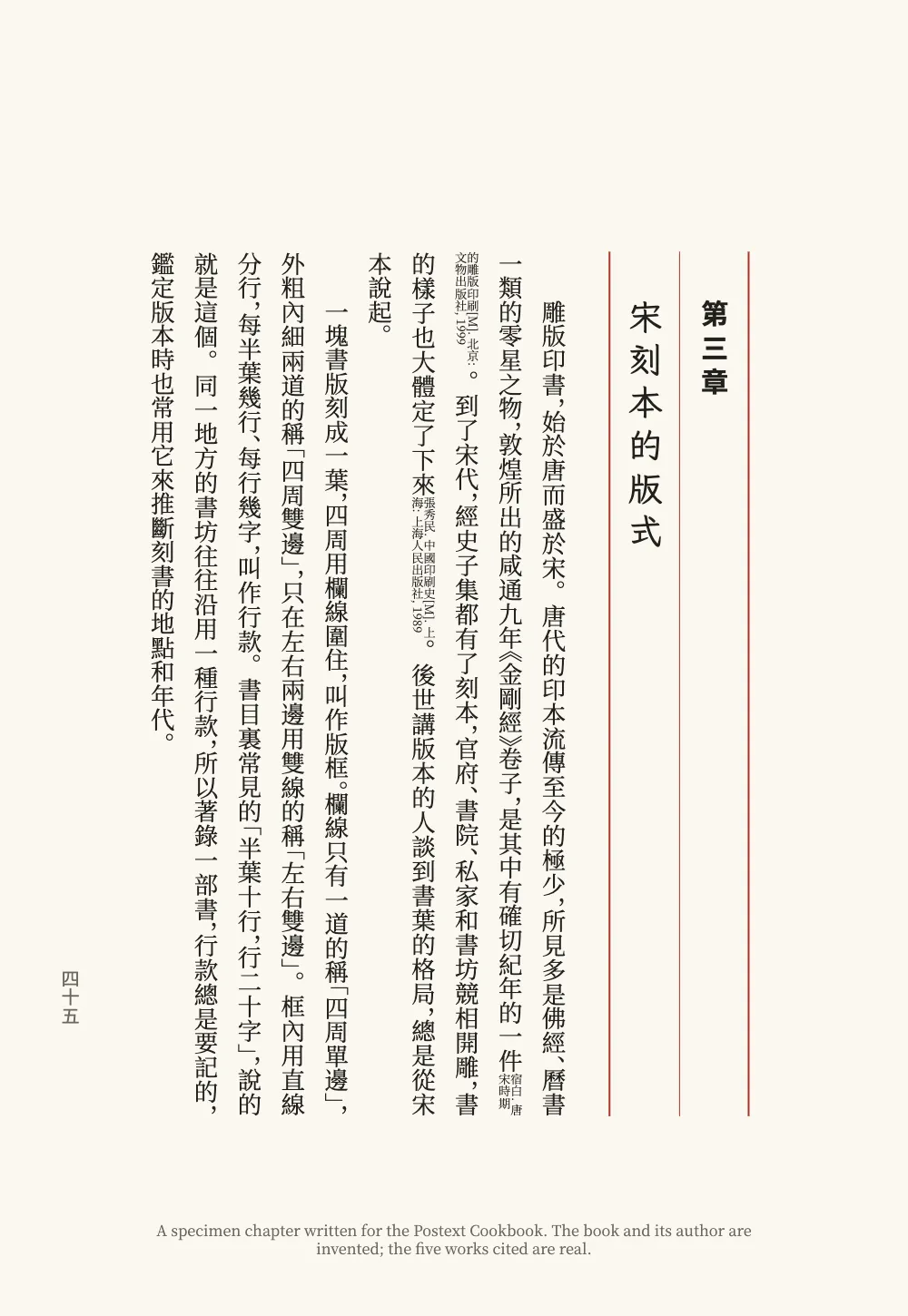
Die Zeilen werden Stück für Stück gefüllt. Am Fuß der dritten Spalte ist Platz für 宿白. 唐宋時期 und nicht mehr, also wird es in zwei Zeilen zu drei und vier Zellen geteilt; der Rest der Notiz füllt den Kopf der nächsten Spalte, wieder in zwei Zeilen. Auf Seite 2 beginnt Twitchetts Notiz am Fuß der letzten Spalte, und der Leser blättert um, um sie zu Ende zu lesen.
#2 · Die zitierten Werke am Ende des Kapitels
:::bibliography{title="本章引用書目" scope=chapter} setzt die Liste dort, wo es steht, und führt nur die Werke auf, die dieses Kapitel zitiert (Das Literaturverzeichnis). Die Literaturangaben stammen aus einem BibTeX-Block. Jeder Eintrag trägt eine langid, chinese oder english, die der Stil als Sprache des Werks liest, und in Schriftzeichen geschriebene Namen bleiben ganz. Die Liste ist in der Reihenfolge des ersten Zitats nummeriert, und die Folgespalten eines Eintrags beginnen unterhalb seiner Nummer.
#3 · Langzeichen nach festlandchinesischen Regeln
locale: 'zh-Hant-CN' verlangt Langzeichen, nach den Regeln des Festlands gesetzt, wie Verlage in Peking und Schanghai klassische Gelehrsamkeit setzen: Komma und Punkt stehen in der oberen rechten Ecke ihrer Zelle, und ein vertikales Buch wird rechts gebunden. Die Zitate folgen der Sprachangabe: Die traditionelle Schrift wählt die CSL-Locale zh-TW, sodass auch die Wörter, die der Stil hinzufügt, in Langzeichen stehen. Noto Serif SC zeichnet Langzeichen in den Formen des Festlands, was zu dieser Ausgabe passt; LXGW WenKai TC, eine taiwanische Schrift, setzt nur den Kapiteltitel, der keine Satzzeichen hat (Zahlen im vertikalen Satz erklärt, was mit den Ziffern geschieht).
In den Notizen und der Liste drehen sich ein lateinischer Titel und eine vierstellige Jahreszahl quer und laufen die Spalte hinunter. Eine kurze Zahl neben chinesischem Text, etwa die 1 einer Nummer, steht aufrecht in ihrer Zelle.
#4 · Der Auftakt zwischen Linien
// In the flow frame x runs down the column and y across the page, right to left, so a
// 'horizontal' rule is a vertical line on the sheet: three of them rule the two columns.
const [TITLE, PITCH] = [15, 1.6 * LEAD]; // pt: the title's size and its column pitch
const rule = (n) => ({ kind: 'rule', id: `rule-${n}`, direction: 'horizontal',
  thickness: pt(n === 1 ? 0.4 : 0.8), color: col('vermilion'),
  placement: { anchor: { to: 'container', edge: 'top-left' },
    offset: { y: pt(LEAD + n * PITCH) }, size: { width: 'fill' } } });
// A line of PITCH in column n (0, 1), its characters centred between two rules.
const title = (id, content, n, family, size, weight) => ({ kind: 'text', id, content,
  fontFamily: family, fontWeight: weight, fontSize: pt(size), lineHeight: PITCH / size,
  color: col('ink'), letterSpacing: pt(size * 0.25), align: 'left',
  placement: { anchor: { to: 'container', edge: 'top-left' },
    offset: { x: pt(2 * BODY), y: pt(LEAD + n * PITCH) } } }); // two characters down
const opener = { enabled: true, minHeight: cols(5), slot: { elements: [
  rule(0), rule(1), rule(2),
  title('number', '{number}', 0, HEI, 12, 700), // 第三章 in the first column, in 黑
  title('title', '{titleText}', 1, KAI, TITLE, 400), // the title in the second, in 楷
] } };
Auf einer vertikalen Seite wird eine Überschriftengestaltung im Rahmen des Textflusses angelegt: x läuft die Spalte hinunter und y quer über die Seite von ihrem rechten Rand aus, sodass eine Linie 'horizontal' auf dem Blatt eine senkrechte Linie ist. Drei Linien rahmen zwei Spalten im Abstand von 30,4 pt. 第三章 steht in der ersten in fetter Hei, der Titel in der zweiten in Kai (Seitenbreite und erweiterte Gestaltung). Die Kapitelnummer kommt aus startAt=3 an der Überschrift und der Vorlage 第{1:一}章, die Seitenzahlen aus pageNumbering: trad-chinese-informal ab 45. Kolumnentitel und Seitenzahlen laufen den Außenrand hinunter wie in Nº 075 (Vertikale Textelemente).
const palette = {
  ink: '#22201c', vermilion: '#a8352a', muted: '#6d665d', paper: '#fbf8f1',
};
const col = (id) => ({ hex: palette[id], model: 'hex', paletteId: id });
const colorPalette = Object.entries({ ...palette, 'main-color': palette.vermilion })
  .map(([id, hex]) => ({ id, name: id, value: { hex, model: 'hex' } }));
Das ganze Rezept
// ═══ Postext Cookbook · Nº 091 · Vertical Chinese with citations in inline notes ══════ // https://postext.dev/en/cookbook/vertical-book-with-jiazhu-citations // Code: MIT · Text: original (CC BY 4.0) · Pictures: none // Fonts: Noto Serif SC, Noto Sans SC, LXGW WenKai TC (SIL OFL 1.1) · Needs postext ≥ 1.25.0 import { buildDocument, withLoadedFonts, renderPageToCanvas, registerCitationEngine, loadVerticalAlternates, } from 'https://esm.sh/postext'; import { renderToPdf, decompressWoff2 } from 'https://esm.sh/postext-pdf'; import { createCiteprocEngine, STYLES, LOCALES } from 'https://esm.sh/postext-citeproc'; const LANG = 'en'; // @lang: the language of the frame; the chapter is Chinese in both editions const RECIPE = 'vertical-book-with-jiazhu-citations'; // ─── 1 · Design ───────────────────────────────────────────────────────────── // #region palette: black ink, one vermilion for the opener's rules, the paper of the page const palette = { ink: '#22201c', vermilion: '#a8352a', muted: '#6d665d', paper: '#fbf8f1', }; const col = (id) => ({ hex: palette[id], model: 'hex', paletteId: id }); const colorPalette = Object.entries({ ...palette, 'main-color': palette.vermilion }) .map(([id, hex]) => ({ id, name: id, value: { hex, model: 'hex' } })); // #endregion const [SONG, HEI, KAI] = ['Noto Serif SC', 'Noto Sans SC', 'LXGW WenKai TC']; // 宋, 黑, 楷 const [BODY, LEAD] = [10.5, 19]; // pt: 五號 on a column pitch of 1.8 em const cols = (n) => pt(n * LEAD); // n columns across the page // #region answer: a note style set as 夾注, two half-size rows inside the column // The GB/T 7714 note style turns each citation into a note. notes: 'warichu' sets the note // in the column where the citation stands, in two rows at half the text size, the right // row read first; a note longer than what is left of the column goes on in the next one. // The list at the chapter's end comes from :::bibliography{scope=chapter}, numbered in // the order the works are cited. Latin words turn sideways in the notes and in the list. registerCitationEngine(createCiteprocEngine({ styles: STYLES, locales: LOCALES })); const citations = { style: 'china-national-standard-gb-t-7714-2015-note', notes: 'warichu', // 夾注; 'footnote' sets the same notes at the foot of the page bibliography: { fontSize: em(0.9), entrySpacing: pt(0) }, }; const cjk = { grid: { enabled: true, charsPerLine: 36, linesPerPage: 15 }, warichu: { fontSize: em(0.5), color: col('ink') }, // no brackets: the half size sets it off }; // #endregion // #region opener: 第三章 and the title in two ruled columns, the text after a blank one // In the flow frame x runs down the column and y across the page, right to left, so a // 'horizontal' rule is a vertical line on the sheet: three of them rule the two columns. const [TITLE, PITCH] = [15, 1.6 * LEAD]; // pt: the title's size and its column pitch const rule = (n) => ({ kind: 'rule', id: `rule-${n}`, direction: 'horizontal', thickness: pt(n === 1 ? 0.4 : 0.8), color: col('vermilion'), placement: { anchor: { to: 'container', edge: 'top-left' }, offset: { y: pt(LEAD + n * PITCH) }, size: { width: 'fill' } } }); // A line of PITCH in column n (0, 1), its characters centred between two rules. const title = (id, content, n, family, size, weight) => ({ kind: 'text', id, content, fontFamily: family, fontWeight: weight, fontSize: pt(size), lineHeight: PITCH / size, color: col('ink'), letterSpacing: pt(size * 0.25), align: 'left', placement: { anchor: { to: 'container', edge: 'top-left' }, offset: { x: pt(2 * BODY), y: pt(LEAD + n * PITCH) } } }); // two characters down const opener = { enabled: true, minHeight: cols(5), slot: { elements: [ rule(0), rule(1), rule(2), title('number', '{number}', 0, HEI, 12, 700), // 第三章 in the first column, in 黑 title('title', '{titleText}', 1, KAI, TITLE, 400), // the title in the second, in 楷 ] } }; // #endregion // The fore-edge: the book's title or the chapter's down the outer margin, the folio low. const foreEdge = (id, content, parity, edge, y, pages) => ({ kind: 'text', id, content, parity, pages, writingMode: 'vertical-rl', fontFamily: HEI, fontSize: pt(8), color: col('muted'), overflow: 'clip', placement: { anchor: { to: 'outer', edge }, offset: { y: em(y) } }, }); const header = { elements: [ foreEdge('book', '{title}', 'even', 'top', 4, 'body'), foreEdge('chapter', '{chapterNumber} {chapterTitle}', 'odd', 'top', 4, 'body'), foreEdge('folio', '{pageNumber}', 'all', 'bottom', -5, 'all'), // Across the foot of the opening page, in the edition's language: what is invented. { kind: 'text', id: 'imprint', content: '{subtitle}', pages: 'opener', fontFamily: SONG, fontSize: pt(6.5), color: col('muted'), align: 'center', overflow: 'wrap', placement: { anchor: { to: 'page', edge: 'bottom' }, offset: { y: mm(-9) }, size: { width: mm(100) } } }, ] }; const config = () => ({ // Traditional characters to the mainland's rules, as Beijing and Shanghai publishers set // classical scholarship (gotcha: cjk-locale-tag). The citations follow it: zh-TW terms. locale: 'zh-Hant-CN', colorPalette, citations, cjk, page: { sizePreset: 'custom', width: mm(140), height: mm(203), dpi: 150, // 大32開 backgroundColor: col('paper'), margins: { top: mm(34), bottom: mm(26), left: mm(15), right: mm(19), mirror: true }, pageNumbering: { format: 'trad-chinese-informal', startAt: 45 } }, // 四十五 layout: { layoutType: 'single', writingMode: 'vertical-rl' }, // bound on the right bodyText: { fontFamily: SONG, fontSize: pt(BODY), lineHeight: pt(LEAD), color: col('ink'), boldColor: col('ink'), italicColor: col('ink'), referenceColor: col('ink'), textAlign: 'justify', firstLineIndent: em(2), indentAfterHeading: true, }, headings: { fontFamily: SONG, fontWeight: 700, color: col('ink'), levels: [{ level: 1, numberingTemplate: '第{1:一}章', numberSeparator: ' ', breakBefore: { enabled: true, parity: 'odd' }, // a chapter opens on an odd page marginBottom: pt(0), advancedDesign: opener }] }, header, footer: { elements: [] }, }); // ─── 2 · Content ──────────────────────────────────────────────────────────── const markdown = String.raw`---Markdown-Beispiel · 28 Zeilen · content.en.md
title: "版刻叢談" author: "沈硯秋" subtitle: "A specimen chapter written for the Postext Cookbook. The book and its author are invented; the five works cited are real." --- # 宋刻本的版式 {startAt=3} 雕版印書,始於唐而盛於宋。唐代的印本流傳至今的極少,所見多是佛經、曆書一類的零星之物,敦煌所出的咸通九年《金剛經》卷子,是其中有確切紀年的一件[@su1999]。到了宋代,經史子集都有了刻本,官府、書院、私家和書坊競相開雕,書的樣子也大體定了下來[@zhang1989]。後世講版本的人談到書葉的格局,總是從宋本說起。 一塊書版刻成一葉,四周用欄線圍住,叫作版框。欄線只有一道的稱「四周單邊」,外粗內細兩道的稱「四周雙邊」,只在左右兩邊用雙線的稱「左右雙邊」。框內用直線分行,每半葉幾行、每行幾字,叫作行款。書目裏常見的「半葉十行,行二十字」,說的就是這個。同一地方的書坊往往沿用一種行款,所以著錄一部書,行款總是要記的,鑑定版本時也常用它來推斷刻書的地點和年代。 版框正中留出窄窄的一行,不刻正文,是為版心。印好的紙沿這一行對折,版心便落在書口上,翻檢時一眼可見。版心裏刻書名、卷次和葉碼,有時還刻上刻工的姓名和這一版的字數,那是當年計算工錢用的。版心上下各有一個形如魚尾的標記,叫作魚尾;魚尾到欄線之間若刻一道黑線,叫作黑口,空著不刻的叫作白口。 大體說來,浙江一帶的官刻和家刻,字體方整,多作白口、左右雙邊;福建建陽的坊刻,字體瘦勁,版式緊湊,常在框外左上角加一個小方格,刻上篇名,稱為書耳,便於讀者翻檢[@huang2005]。坊刻的書要賣得出去,處處替讀者打算,這一點從版式上也看得出來。 書末或目錄之後,常有一塊刻記,寫明何人於何年在何處刊行,有時兼作書坊的廣告,叫作牌記。牌記的形制有長方的,也有鐘形、亞字形的。後人鑑定版本,牌記是最直接的依據,可也最容易被書賈挖改作偽,所以不能單憑牌記下斷語,還要和行款、字體、紙墨、避諱字一起看。 西方學者系統地研究中國的雕版書,是二十世紀的事。Carter的專著第一次把中國印刷術的發明及其西傳完整地介紹給英語讀者[@carter1925];Twitchett則從書業和讀者的角度,討論中古時期的印刷與出版[@twitchett1983]。兩書所談雖不限於版式,卻都把宋代看作雕版書定型的時代,和中國學者的看法相合。 :::bibliography{title="本章引用書目" scope=chapter} :::references{format=bibtex} @book{su1999, author = {宿白}, title = {唐宋時期的雕版印刷}, publisher = {文物出版社}, address = {北京}, year = 1999, langid = {chinese}} @book{zhang1989, author = {張秀民}, title = {中國印刷史}, publisher = {上海人民出版社}, address = {上海}, year = 1989, langid = {chinese}} @book{huang2005, author = {黃永年}, title = {古籍版本學}, publisher = {江蘇教育出版社}, address = {南京}, year = 2005, langid = {chinese}} @book{carter1925, author = {Carter, Thomas Francis}, title = {The invention of printing in China and its spread westward}, publisher = {Columbia University Press}, address = {New York}, year = 1925, langid = {english}} @book{twitchett1983, author = {Twitchett, Denis}, title = {Printing and publishing in medieval China}, publisher = {Frederic C. Beil}, address = {New York}, year = 1983, langid = {english}} :::`; // content.<lang>.md: the same Chinese text in both // ─── 3 · Fonts ────────────────────────────────────────────────────────────── const FONTS = { // every face the pages use, loaded before the build 'Noto Serif SC': ['400', '700'], // SONG: the text, notes, list, imprint; the list's title 'Noto Sans SC': ['400', '700'], // HEI: the fore-edge heads and folios; 第三章 'LXGW WenKai TC': ['400'], // KAI: the chapter's title }; // ─── 4 · Build & show ─────────────────────────────────────────────────────── // Each voice loads the files of what it sets; the Song also what the style writes. const heading = markdown.match(/^# (.*?)(?: \{.*\})?$/m)[1]; // the title, no attributes const book = markdown.match(/^title: "(.*)"/m)[1]; // 版刻叢談, the head of the even pages const numerals = '第章一二三四五六七八九十'; await loadFonts(FONTS, markdown); await loadCjkFonts({ [SONG]: ['400'] }, `${markdown}卷等頁`, { vertical: true }); await loadCjkFonts({ [HEI]: ['400'] }, `${heading}${book}${numerals}`, { vertical: true }); await loadCjkFonts({ [SONG]: ['700'] }, markdown.match(/bibliography\{title="([^"]*)"/)[1], { vertical: true }); await loadCjkFonts({ [HEI]: ['700'] }, numerals); await loadCjkFonts({ [KAI]: ['400'] }, heading); const doc = await withLoadedFonts(() => buildDocument({ markdown }, config()), { ...kitFonts(FONTS), text: markdown }); showBook(doc, { title: t({ en: 'Vertical Chinese with citations in inline notes', es: 'Chino vertical con citas en notas dentro del renglón' }) }); offerPdf(() => renderToPdf(doc, { fontProvider: cjkPdfProvider }), `${RECIPE}.pdf`);Kit · core, fonts, viewer, pdf, cjk: in jedem Rezept gleich · 458 Zeilen
// ─── Kit ── helpers shared by every Cookbook recipe · postext.dev/cookbook ───── // ─── Kit · core v1 ── the same in every recipe · postext.dev/cookbook function mm(value) { return { value, unit: 'mm' }; } function pt(value) { return { value, unit: 'pt' }; } function em(value) { return { value, unit: 'em' }; } /** The sample language's string: t({ en: 'Figure', es: 'Figura' }). */ function t(strings) { return strings[LANG] ?? Object.values(strings)[0]; } /** A file in this recipe's assets folder, served from the Postext repo by jsDelivr. */ function asset(file) { return `https://cdn.jsdelivr.net/gh/drnachio/postext@main/cookbook/${RECIPE}/assets/${file}`; } // ─── Kit · fonts v3 ── the same in every recipe · postext.dev/cookbook // Postext loads the faces a config asks for before layout (prepareFonts, // buildDocumentWithFonts) and asks the kit for the files: Fontsource's, the // files the PDF embeds too. /** The options of buildDocumentWithFonts / prepareFonts / withLoadedFonts: * the Fontsource resolver, and the faces of FONTS loaded with the ones the * config names. FONTS = { 'Family Name': ['400', '400i', '700'] }. */ function kitFonts(FONTS = {}) { const faces = Object.entries(FONTS).flatMap(([family, specs]) => specs.map((spec) => ({ family, weight: parseInt(spec, 10), style: spec.endsWith('i') ? 'italic' : 'normal' }))); return { resolve: fontsourceResolver, faces }; } /** A face's Fontsource files, in a fixed order: latin, then latin-ext and greek * when `text` needs them and the family ships them (kitSubsetsFor), each with * its unicode-range. Null for a weight or slant Fontsource does not ship. */ async function fontsourceResolver(family, weight, style, { text = '' } = {}) { const id = fontsourceId(family); const meta = await fontsourceMeta(family); if (meta && !(meta.weights.includes(weight) && meta.styles.includes(style))) return null; kitStatus('Loading fonts…'); const at = await fontsourceAt(id); return ['latin', ...kitSubsetsFor(text, meta)].map((subset) => ({ source: `${at}files/${id}-${subset}-${weight}-${style}.woff2`, unicodeRange: kitRanges()[subset], })); } /** The unicode-range of each Fontsource file the kit loads (a function: the * kit is inlined after the pen's code, which runs before a const would be set). */ function kitRanges() { return { latin: 'U+0000-00FF,U+0131,U+0152-0153,U+02BB-02BC,U+02C6,U+02DA,U+02DC,U+0304,U+0308,U+0329,' + 'U+2000-206F,U+20AC,U+2122,U+2191,U+2193,U+2212,U+2215,U+FEFF,U+FFFD', 'latin-ext': 'U+0100-02BA,U+02BD-02C5,U+02C7-02CC,U+02CE-02D7,U+02DD-02FF,U+0304,U+0308,U+0329,' + 'U+1D00-1DBF,U+1E00-1E9F,U+1EF2-1EFF,U+2020,U+20A0-20AB,U+20AD-20C0,U+2113,U+2C60-2C7F,U+A720-A7FF', greek: 'U+0370-03FF', }; } /** For the cjk, arabic and comics blocks, which add their own files: the * faces of `faces` = { 'Family Name': ['400', '400i', '700'] }. `text` is the sample: * č ł † α χ also load latin-ext and greek files (kitSubsetsFor). With * `optional`, a face Fontsource does not ship is skipped instead of failing. * The files are added once all have loaded, in the order asked (latin, then * latin-ext, then greek), whatever order they arrive in: the last one added * wins a character two files hold. Resolves to the number of faces added. */ async function loadFonts(faces, text = '', { optional = false } = {}) { kitStatus('Loading fonts…'); const ranges = kitRanges(); const jobs = []; for (const [family, specs] of Object.entries(faces)) { const id = fontsourceId(family); const todo = [...new Set(specs)].map((spec) => [parseInt(spec, 10), spec.endsWith('i') ? 'italic' : 'normal']) .filter(([weight, style]) => !hasFace(family, weight, style)); // before any await const at = fontsourceAt(id); const meta = optional || /[^\0-ÿ]/u.test(text) ? await fontsourceMeta(family) : null; const subsets = ['latin', ...kitSubsetsFor(text, meta)]; for (const [weight, style] of todo) { if (optional && !(meta?.weights.includes(weight) && meta.styles.includes(style))) continue; for (const subset of subsets) { const url = `${await at}files/${id}-${subset}-${weight}-${style}.woff2`; const face = new FontFace(family, `url(${url}) format('woff2')`, { weight: String(weight), style, unicodeRange: ranges[subset] }); jobs.push(face.load().catch(() => { if (subset === 'latin' && !optional) throw new Error(`Fontsource has no ${family} ${weight} ${style}`); })); } } } const ready = await Promise.all(jobs).catch((error) => { kitFail(error); throw error; }); return ready.filter((face) => face && document.fonts.add(face)).length; } /** A loaded FontFace covers this family, weight and style (fonts.check() would * also say yes for families nobody declared). */ function hasFace(family, weight, style) { for (const face of document.fonts) { if (face.status !== 'loaded' || face.style !== style) continue; if (face.family.replace(/^["']|["']$/g, '') !== family) continue; const [low, high = low] = face.weight.split(' ').map(Number); if (weight >= low && weight <= high) return true; } return false; } /** The files beyond latin `text` needs that `meta`'s family ships. */ function kitSubsetsFor(text, meta) { return [[/[Ā-˿ᴀ-ᶿḀ-ỿ†ℓⱠ-Ɀ꜠-ꟿ]/u, 'latin-ext'], [/[Ͱ-Ͽ]/u, 'greek']] .filter(([re, x]) => re.test(text) && meta?.subsets?.includes(x)).map(([, x]) => x); } /** Fontsource's id for a family: 'Source Serif 4' → 'source-serif-4'. */ function fontsourceId(family) { return family.toLowerCase().replace(/\s+/g, '-'); } /** A package's folder at the one version @5 names now (#766). */ function fontsourceAt(id, u = `https://cdn.jsdelivr.net/npm/@fontsource/${id}@`) { return (fontsourceAt.c ??= {})[id] ??= fetch(u + '5/package.json').then((r) => r.json()) .then((p) => p.version || 5, () => 5).then((v) => `${u}${v}/`); } /** The family's Fontsource metadata (weights, styles, subsets), or null. */ function fontsourceMeta(family) { fontsourceMeta.cache ??= new Map(); const id = fontsourceId(family); if (!fontsourceMeta.cache.has(id)) { fontsourceMeta.cache.set(id, fetch(`https://api.fontsource.org/v1/fonts/${id}`) .then((res) => (res.ok ? res.json() : null), () => null)); } return fontsourceMeta.cache.get(id); } // ─── Kit · viewer v2 ── the same in every recipe · postext.dev/cookbook /** The pages as spreads on a dark desk, page 1 alone, then verso | recto, * each painted when it scrolls near. Other options go to renderPageToCanvas. */ function showPages(docs, { title, width = 460, ...render } = {}) { const root = viewer(title); const pages = [docs].flat().flatMap((doc) => doc.pages.map((page) => ({ doc, page, n: (doc.pageIndexOffset ?? 0) + page.index }))); const spreads = []; let verso = null; for (const p of pages) { if (p.n % 2 === 1) { if (verso) spreads.push([verso, null]); verso = p; } else { spreads.push([verso, p]); verso = null; } } if (verso) spreads.push([verso, null]); const density = Math.min(window.devicePixelRatio || 1, 2); showPages.painter?.disconnect(); const painter = new IntersectionObserver((entries) => { for (const { isIntersecting, target } of entries) { if (!isIntersecting) continue; painter.unobserve(target); const { doc, page } = target.postext; renderPageToCanvas(page, doc, target, { ...render, scale: (width * density) / page.width }); } }, { rootMargin: '800px' }); showPages.painter = painter; root.replaceChildren(...spreads.map((pair) => { const spread = document.createElement('div'); spread.className = 'pt-spread'; for (const p of pair) { const figure = document.createElement('figure'); if (p) { const label = p.page.pageLabel || String(p.n + 1); const canvas = document.createElement('canvas'); canvas.postext = p; canvas.style.aspectRatio = `${p.page.width} / ${p.page.height}`; canvas.setAttribute('role', 'img'); canvas.setAttribute('aria-label', `Page ${label}`); const folio = document.createElement('figcaption'); folio.textContent = label; figure.append(canvas, folio); painter.observe(canvas); } else figure.className = 'pt-blank'; spread.append(figure); } return spread; })); kitStatus(`${pages.length} ${pages.length === 1 ? 'page' : 'pages'}`); document.documentElement.dataset.postext = 'ready'; return pages.length; } /** The desk, the bar and the error reporting, created once. */ function viewer(title) { if (!document.getElementById('pt-kit')) { document.head.insertAdjacentHTML('beforeend', `<style id="pt-kit"> :root { color-scheme: dark; } body { margin: 0; background: #0e1014; color: #b9bcc4; font: 13px/1.45 system-ui, sans-serif; } #pt-bar { position: sticky; top: 0; z-index: 1; display: flex; flex-wrap: wrap; align-items: center; gap: 6px 16px; padding: 10px 16px; background: rgb(14 16 20 / .92); backdrop-filter: blur(6px); border-bottom: 1px solid #23262d; } #pt-bar strong { color: #f4f1ea; font-weight: 600; } #pt-actions { display: flex; gap: 12px; margin-left: auto; } #pt-actions a, #pt-actions button { color: #d8a21a; font: inherit; background: none; border: 0; padding: 0; cursor: pointer; } #pages { display: grid; justify-items: center; gap: 48px; padding: 32px 16px 72px; } .pt-spread { display: flex; } .pt-spread figure { margin: 0; width: min(460px, 44vw); } .pt-spread canvas { display: block; width: 100%; background: #fff; box-shadow: 0 1px 2px rgb(0 0 0 / .5), 0 22px 44px -16px rgb(0 0 0 / .8); } .pt-spread figure:first-child canvas { box-shadow: inset -14px 0 14px -14px rgb(0 0 0 / .18), 0 1px 2px rgb(0 0 0 / .5), 0 22px 44px -16px rgb(0 0 0 / .8); } .pt-spread figcaption { margin-top: 10px; text-align: center; font: 600 10px/1 system-ui, sans-serif; letter-spacing: .18em; text-transform: uppercase; color: #6c7079; } .pt-blank { visibility: hidden; } @media (max-width: 760px) { .pt-spread { flex-direction: column; gap: 32px; } .pt-spread figure { width: min(460px, 92vw); } .pt-blank { display: none; } } </style>`); document.body.insertAdjacentHTML('afterbegin', '<header id="pt-bar"><strong id="pt-title"></strong><span id="pt-status" role="status"></span><span id="pt-actions"></span></header>'); document.getElementById('pt-title').textContent = document.title || 'Postext'; addEventListener('error', (event) => kitFail(event.error ?? event.message)); addEventListener('unhandledrejection', (event) => kitFail(event.reason)); } if (title) document.getElementById('pt-title').textContent = title; return document.getElementById('pages') ?? document.body.appendChild(Object.assign(document.createElement('main'), { id: 'pages' })); } function kitStatus(text) { viewer(); document.getElementById('pt-status').textContent = text; } function kitFail(error) { document.documentElement.dataset.postext = 'error'; kitStatus(`Error: ${error?.message ?? error}`); } // ─── Kit · pdf v3 ── the same in every recipe that exports a PDF /** The Fontsource files the screen used, as TrueType, with their range and * place: the nearest weight the family ships, upright with no italic; * latin, then what its letters need (kitSubsetsFor). */ async function fontsourceProvider(family, weight, style, request) { const id = fontsourceId(family); const meta = await fontsourceMeta(family); const weights = meta?.weights?.length ? meta.weights : [400, 700]; const w = weights.reduce((a, b) => (Math.abs(b - weight) < Math.abs(a - weight) ? b : a)); const s = style === 'italic' && meta && !meta.styles.includes('italic') ? 'normal' : style; const text = String.fromCodePoint(...(request?.codePoints ?? [])); const files = await Promise.all(['latin', ...kitSubsetsFor(text, meta)].map(async (subset, order) => { const res = await fetch(`${await fontsourceAt(id)}files/${id}-${subset}-${w}-${s}.woff2`); if (!res.ok) throw new Error(`Fontsource has no ${family} ${w} ${s} ${subset}`); return Object.assign(await decompressWoff2(new Uint8Array(await res.arrayBuffer())), { unicodeRange: kitRanges()[subset], order }); })); return files.length === 1 ? files[0] : files; } /** A "Build the PDF" button; then "Open the PDF" (a new tab: CodePen's frame * shows no PDFs) and a download link. */ function offerPdf(makePdf, filename) { viewer(); const button = Object.assign(document.createElement('button'), { type: 'button', textContent: 'Build the PDF' }); button.dataset.postextPdf = filename; button.addEventListener('click', async () => { button.disabled = true; button.textContent = 'Building the PDF…'; try { const bytes = await makePdf(); const url = URL.createObjectURL(new Blob([bytes], { type: 'application/pdf' })); const size = `${Math.max(1, Math.round(bytes.length / 1024))} KB`; button.replaceWith( Object.assign(document.createElement('a'), { href: url, target: '_blank', rel: 'noopener', textContent: 'Open the PDF ↗' }), Object.assign(document.createElement('a'), { href: url, download: filename, textContent: `Download ${filename} · ${size}` })); } catch (error) { button.disabled = false; button.textContent = 'Build the PDF'; kitFail(error); } }); document.getElementById('pt-actions').append(button); } // ─── Kit · cjk v2 ── Chinese, Japanese and Korean books · postext.dev/cookbook // Fontsource ships a CJK family as about a hundred files per weight, each // declared in its stylesheet with the unicode-range it covers. The screen // loads the files the sample touches; the PDF gets the same files for the // characters its pages set in each face, and embeds each as a subset. // A book bound on the right (vertical text) is shown with its spreads // mirrored: page 1 alone on the left of the spine, then [3 | 2]. /** The files of a Fontsource face, read from its stylesheet: { url, range, * ranges }, the last declared first (the order the browser tries them in). */ function cjkSlices(family, weight, style) { cjkSlices.cache ??= new Map(); const id = fontsourceId(family); const css = `${id}/${weight}${style === 'italic' ? '-italic' : ''}.css`; if (!cjkSlices.cache.has(css)) { let at; cjkSlices.cache.set(css, fontsourceAt(id).then((a) => fetch(at = a + css.slice(id.length + 1))) .then((res) => { if (!res.ok) throw new Error(`Fontsource has no ${family} ${weight} ${style} (${res.status})`); return res.text(); }) .then((text) => [...text.matchAll(/@font-face\s*{([^}]*)}/g)].map(([, rule]) => { const range = /unicode-range:\s*([^;]+);/.exec(rule)?.[1].trim() ?? 'U+0-10FFFF'; const ranges = range.split(',').map((part) => { const [lo, hi = lo] = part.trim().slice(2).split('-'); return [parseInt(lo, 16), parseInt(hi, 16)]; }); return { url: new URL(/url\(([^)]+?\.woff2)\)/.exec(rule)[1], at).href, range, ranges }; }).reverse())); } return cjkSlices.cache.get(css); } /** The file of `slices` the screen sets code point `cp` in, if any: the * last one loadCjkFonts adds whose range holds it. A numbered file that * repeats a letter of latin is added after latin, and wins it. */ function cjkSliceFor(slices, cp) { const holds = (slice) => slice.ranges.some(([lo, hi]) => cp >= lo && cp <= hi); return slices.reduce((last, slice) => (holds(slice) ? slice : last), undefined); } /** Whether Fontsource serves `family` as a Chinese, Japanese or Korean * family (its subsets name the script). Fails when the API does not * answer: a CJK face taken for a Latin one would paint in a system face. */ async function isCjkFamily(family) { const meta = await fontsourceMeta(family); if (!meta) throw new Error(`api.fontsource.org did not describe ${family}: reload to try again`); return !!meta.subsets?.some((subset) => /^(chinese|japanese|korean)/.test(subset)); } /** faces = { 'Noto Serif TC': ['400', '700'] }, as for loadFonts: the * whole FONTS object may be passed, its other families are left to * loadFonts. Adds one FontFace per file of each CJK face with its * unicodeRange, then loads the files `text` touches. `text` is what the * faces set: the sample for the text face; a book in several voices calls * it once per voice (loadCjkFonts({ 'LXGW WenKai TC': ['400'] }, quotes)), * so the heading and quotation faces fetch and check only their own * characters. Fails when a character of `text` is in no file of a face. * List every weight the pages use: a weight left to the engine's later round * gets the latin file only. With { vertical: true } it also loads each * family's vertical forms (brackets, quotes, pause marks) for the canvas, * which needs loadVerticalAlternates imported from postext. Resolves to * the number of files loaded. */ async function loadCjkFonts(faces, text, { vertical = false } = {}) { kitStatus('Loading fonts…'); let loaded = 0; try { if (vertical && typeof loadVerticalAlternates !== 'function') { throw new Error('loadCjkFonts(…, { vertical: true }) needs loadVerticalAlternates imported from postext'); } for (const [family, specs] of Object.entries(faces)) { if (!(await isCjkFamily(family))) continue; const twin = []; for (const spec of new Set(specs)) { const weight = parseInt(spec, 10); const style = spec.endsWith('i') ? 'italic' : 'normal'; const slices = await cjkSlices(family, weight, style); const missing = [...new Set(text)].filter((ch) => /\S/.test(ch) && !cjkSliceFor(slices, ch.codePointAt(0))); if (missing.length) { throw new Error(`${family} ${spec} has no file for ${missing.slice(0, 12).join(' ')}: ` + `give each face the text it sets (loadCjkFonts({ '${family}': ['${spec}'] }, text))`); } for (const slice of slices) { document.fonts.add(new FontFace(family, `url(${slice.url}) format('woff2')`, { weight: String(weight), style, unicodeRange: slice.range })); twin.push({ source: slice.url, weight: String(weight), style, unicodeRange: slice.range }); } const font = `${style === 'italic' ? 'italic ' : ''}${weight} 16px "${family}"`; loaded += (await document.fonts.load(font, text)).length; if (!document.fonts.check(font, text)) throw new Error(`${family} ${spec} did not load for the sample`); } // The same files under a twin name with the `vert` feature on: the // canvas paints the punctuation of vertical lines with it. if (vertical && twin.length) await loadVerticalAlternates(family, twin); } } catch (error) { kitFail(error); throw error; } return loaded; } /** The PDF font provider for recipes with CJK faces: a family whose * Fontsource subsets are Chinese, Japanese or Korean gets the files the * screen set its pages' characters in (`request.codePoints`), each marked * with its unicode-range and its place in the order loadCjkFonts added * them: postext-pdf sets a character two files hold in the one added * last, as the browser does. Any other family gets the latin file * fontsourceProvider fetches (the "pdf" block) and, when the face sets * letters only latin-ext has, that file too. */ async function cjkPdfProvider(family, weight, style, request) { if (!(await isCjkFamily(family))) return cjkLatinPdfFiles(family, weight, style, request); const meta = await fontsourceMeta(family); const weights = meta.weights?.length ? meta.weights : [400, 700]; const w = weights.reduce((a, b) => (Math.abs(b - weight) < Math.abs(a - weight) ? b : a)); const s = style === 'italic' && !meta.styles.includes('italic') ? 'normal' : style; const slices = await cjkSlices(family, w, s); const picked = new Set(); for (const cp of request?.codePoints ?? []) { const slice = cjkSliceFor(slices, cp); if (slice) picked.add(slice); } if (!picked.size) picked.add(slices[0]); return Promise.all(slices.map(async (slice, order) => { if (!picked.has(slice)) return null; const res = await fetch(slice.url); if (!res.ok) throw new Error(`Fontsource file ${slice.url} (${res.status})`); const bytes = await decompressWoff2(new Uint8Array(await res.arrayBuffer())); return Object.assign(bytes, { unicodeRange: slice.range, order }); })).then((files) => files.filter(Boolean)); } /** A Latin family set next to the CJK faces: its latin file, then its * latin-ext file when the face sets letters only latin-ext has (ō ū in * Hepburn rōmaji, ǎ in pinyin), the file loadFonts adds on screen for * them, each marked with its unicode-range and its place in that order: * the PDF sets a character in the file the browser took it from. A face * Fontsource ships without latin-ext, or whose file does not come, gets * latin alone, and the PDF names the letters it lacks. */ async function cjkLatinPdfFiles(family, weight, style, request) { const meta = await fontsourceMeta(family); const beyond = [...(request?.codePoints ?? [])].some(cjkLatinExtOnly); if (!beyond || !meta?.subsets?.includes('latin-ext')) return fontsourceProvider(family, weight, style); const weights = meta.weights?.length ? meta.weights : [400, 700]; const w = weights.reduce((a, b) => (Math.abs(b - weight) < Math.abs(a - weight) ? b : a)); const s = style === 'italic' && !meta.styles.includes('italic') ? 'normal' : style; const id = fontsourceId(family); const url = `${await fontsourceAt(id)}files/${id}-latin-ext-${w}-${s}.woff2`; const [latin, ext] = await Promise.all([fontsourceProvider(family, weight, style), fetch(url) .then(async (res) => (res.ok ? decompressWoff2(new Uint8Array(await res.arrayBuffer())) : null), () => null)]); const ranges = kitRanges(); return ext ? [Object.assign(latin, { unicodeRange: ranges.latin, order: 0 }), Object.assign(ext, { unicodeRange: ranges['latin-ext'], order: 1 })] : latin; } /** Whether code point `cp` is in Fontsource's latin-ext file and not in * its latin file: Latin Extended-A and -B, IPA, the spacing modifiers and * Latin Extended Additional (loadFonts's test for latin-ext), less the * few latin holds too (ı Œ œ ʻ ʼ ˆ ˚ ˜). */ function cjkLatinExtOnly(cp) { if (!((cp >= 0x100 && cp <= 0x2ff) || (cp >= 0x1e00 && cp <= 0x1eff))) return false; return ![0x131, 0x152, 0x153, 0x2bb, 0x2bc, 0x2c6, 0x2da, 0x2dc].includes(cp); } /** showPages for a book bound on either edge. A right-bound book (the * document says so: doc.binding is 'right' for page.binding 'right' and * for vertical text) lies on the desk as it opens: page 1 alone on the * left of the spine, then [3 | 2], the spine shade on each page's inner * edge. `binding` ('left' | 'right') overrides the document's. */ function showBook(docs, { binding, ...options } = {}) { const count = showPages(docs, options); const right = (binding ?? [docs].flat()[0]?.binding) === 'right'; if (!document.getElementById('pt-kit-cjk')) { // The pages keep direction ltr: a canvas draws text in the direction its // element inherits, and under rtl each run would end where the engine // starts it, its brackets mirrored. document.head.insertAdjacentHTML('beforeend', `<style id="pt-kit-cjk"> .pt-spread[dir="rtl"] canvas { direction: ltr; } .pt-spread[dir="rtl"] figure:first-child canvas { box-shadow: inset 14px 0 14px -14px rgb(0 0 0 / .18), 0 1px 2px rgb(0 0 0 / .5), 0 22px 44px -16px rgb(0 0 0 / .8); } </style>`); } // Each pair stays [verso, recto] in the page; right to left, the verso // sits on the right. Phones stack the pages in reading order either way. for (const spread of document.querySelectorAll('#pages > .pt-spread')) spread.dir = right ? 'rtl' : 'ltr'; document.getElementById('pages').dataset.binding = right ? 'right' : 'left'; return count; } // ─── /Kit ───────────────────────────────────────────────────────────────────────
Das zusammengesetzte script.js läuft unverändert: Fügen Sie es in das Modulskript einer beliebigen Seite ein, oder öffnen Sie das Rezept auf CodePen. Ordner des Rezepts auf GitHub ↗ (öffnet in neuem Tab)
Varianten
#Klammern um jede Notiz
Manche Ausgaben schließen ein 夾注 in Klammern in Textgröße ein. cjk.warichu setzt sie für jede Notiz, die Zitate eingeschlossen.
-  warichu: { fontSize: em(0.5), color: col('ink') }, // no brackets: the half size sets it off
+ warichu: { fontSize: em(0.5), color: col('ink'), open: '〔', close: '〕' },#Nummern in der Spalte statt Notizen
Der numerische Stil von GB/T 7714 mit Eckklammern druckt 〔1〕 aufrecht in der Spalte, und die Liste bleibt, wie sie ist.
-  style: 'china-national-standard-gb-t-7714-2015-note',
-  notes: 'warichu', // 夾注; 'footnote' sets the same notes at the foot of the page
+  style: 'china-national-standard-gb-t-7714-2015-numeric',
+ marker: 'corner', // 〔1〕, upright in vertical textHäufige Fehler
Häufiger Fehler
Zeichnen Sie das Dokument mit zh-Hans oder zh-Hant aus, nicht mit LANG
Die Ausgaben eines Rezepts sind en und es, ein chinesisches Beispiel ist aber in beiden Chinesisch: `locale: LANG` würde es als Englisch oder Spanisch auszeichnen, seine lateinischen Wörter trennen, seine Abbildungen mit Figure oder Figura beschriften und dem PDF die falsche Sprache geben. Seit postext 1.30 ist die Auszeichnung auch die Sprache, in der der Text geformt wird (gemessen, gezeichnet und eingebettet). Unter einer englischen oder spanischen Auszeichnung setzt eine chinesische Schrift daher ihre Ziffern und die mit lateinischem Text geteilte Interpunktion in anderen Formen, und die Zeilen brechen an anderer Stelle um. Schreiben Sie die Auszeichnung selbst: 'zh-Hans' (Festlandkonventionen: GB-Zeilenumbruch, Kaiming-Interpunktion) oder 'zh-Hant' (Taiwan: zentrierte Interpunktion voller Breite); 'zh-HK' für Hongkong. Ein bloßes 'zh' gilt als vereinfacht, Festland. Ein japanisches Beispiel erhält 'ja' (Häufiger Fehler ja-locale-tag). Chinesischer Zeilenumbruch →
Häufiger Fehler
Chinesische Schnitte werden in Teilstücken geladen, über den Block cjk
Fontsource liefert eine chinesische, japanische oder koreanische Familie als etwa hundert Dateien pro Schriftstärke aus, jede für einen Zeichenbereich. loadFonts holt nur die Datei latin, am Bildschirm stammen die Han-Zeichen also aus einer Systemschrift und werden falsch gemessen, und fontsourceProvider gibt dem PDF diese latin-Datei, die sie als leere Kästchen druckt. Führen Sie den Kit-Block cjk auf, rufen Sie loadCjkFonts(FONTS, markdown) nach loadFonts auf (einmal pro Stimme, mit dem Text, den sie setzt, wenn das Buch mehrere CJK-Schriften verwendet), und geben Sie renderToPdf fontProvider: cjkPdfProvider: Beide nehmen die Dateien, die die Zeichen des Textes enthalten. Chinesische, japanische und koreanische Schriften →
Häufiger Fehler
Setzen Sie die Interpunktion jeder Region in einer Schrift dieser Region
Die Interpunktionsbreiten verschieben den Leerraum neben jedem Zeichen auf die Seite, auf die die Region des Dokuments ihn legt, nicht auf die, auf der die Schrift ihn zeichnet: Unter zh-Hans behält ein Kaiming-Komma die linke Hälfte seines Kastens, wo eine vereinfachte Schrift die Glyphe zeichnet, und gibt die rechte Hälfte auf. Eine traditionelle Schrift zentriert ,。 im Kasten, die wegfallende Hälfte enthält also einen Teil der Glyphe, und das Komma bedrängt das nächste Zeichen. LXGW WenKai TC, die einzige Kai-Textschrift bei Fontsource, tut genau das in vereinfachtem Text. Setzen Sie Festlandtext, Anmerkungen und Zitate in Noto Serif SC oder Noto Sans SC, behalten Sie die TC-Schriften für zh-Hant, und verwenden Sie eine vereinfachte Pinselschrift (Ma Shan Zheng) nur für Displayzeilen, wo Gestaltungstext keine Interpunktionsbreiten anwendet. Sie zeichnet außerdem überlieferte Formen, die weder der Festland- noch der Taiwan-Standard druckt, 為 mit dem 爫-Kopf von 爲 und 令 (in 冷, 領) mit einem 卩-Fuß: Prüfen Sie die Zeichen, die eine Seite darin setzt. Breite chinesischer Satzzeichen →
Häufiger Fehler
Ein rechts gebundenes Buch zeigt seine Doppelseiten mit showBook
In einem rechts gebundenen Buch (arabischer, hebräischer oder persischer Text, vertikales Chinesisch oder page.binding 'right') ist Seite 1 weiterhin die rechte Seite (recto), liegt aber links vom Rücken, und die Paare lesen sich [3 | 2]. showPages legt jedes Buch links gebunden aus; showBook aus dem Block book (der Block cjk enthält dieselbe Funktion) liest doc.binding und spiegelt die Paare. capture.hero benennt eine Doppelseite weiterhin in Lesereihenfolge, [verso, recto]: [2, 3]. Rechts gebundene Bücher →
- Ein Notenstil schreibt ein zum zweiten Mal zitiertes Werk in Kurzform, und der Anmerkungsstil von GB/T 7714 kürzt es zu 同1, „wie in Anmerkung 1“. Ein Warichu hat keine Nummer, also kann der Leser Anmerkung 1 nicht finden. Dieses Kapitel zitiert jedes Werk einmal; ein Text, der ein Werk erneut zitiert, sollte das zweite Zitat von Hand schreiben oder den numerischen Stil der zweiten Variante verwenden.
- Der Stil schreibt westliche Satzzeichen in chinesische Einträge,
宿白. 唐宋時期的雕版印刷[M]. 北京: 文物出版社, 1999., wie die Norm sie druckt. In einer vertikalen Spalte behalten diese Zeichen ihre westliche Form: Sie drehen sich quer und nehmen weniger als eine Zelle ein, anders als das 。 und , des Texts. - Eine Warichu-Zeile hat die halbe Textgröße: Bei 10,5 pt ist jede Zeile 5,25 pt groß, die kleinste Schrift auf der Seite. Setzen Sie den Text in 五號 oder größer, oder erhöhen Sie
cjk.warichu.fontSize; die beiden Zeilen teilen sich immer die Breite einer Spalte.
Nachweise
- Rezept
- Ignacio Ferro
- Text
- Eigener Text, CC BY 4.0
- Schriften
- Noto Serif SC (SIL OFL 1.1) · Noto Sans SC (SIL OFL 1.1) · LXGW WenKai TC (SIL OFL 1.1)
- Code
- MIT, wie Postext
Diesen Text bearbeiten ↗ (öffnet in neuem Tab)Ordner des Rezepts auf GitHub ↗ (öffnet in neuem Tab)