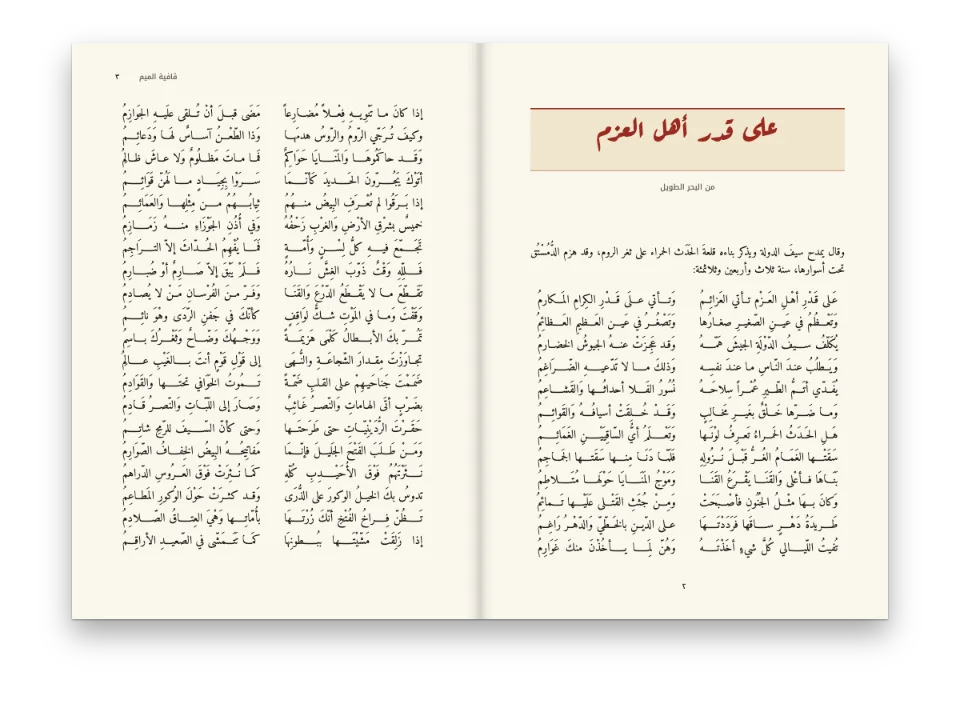
En pocas palabras
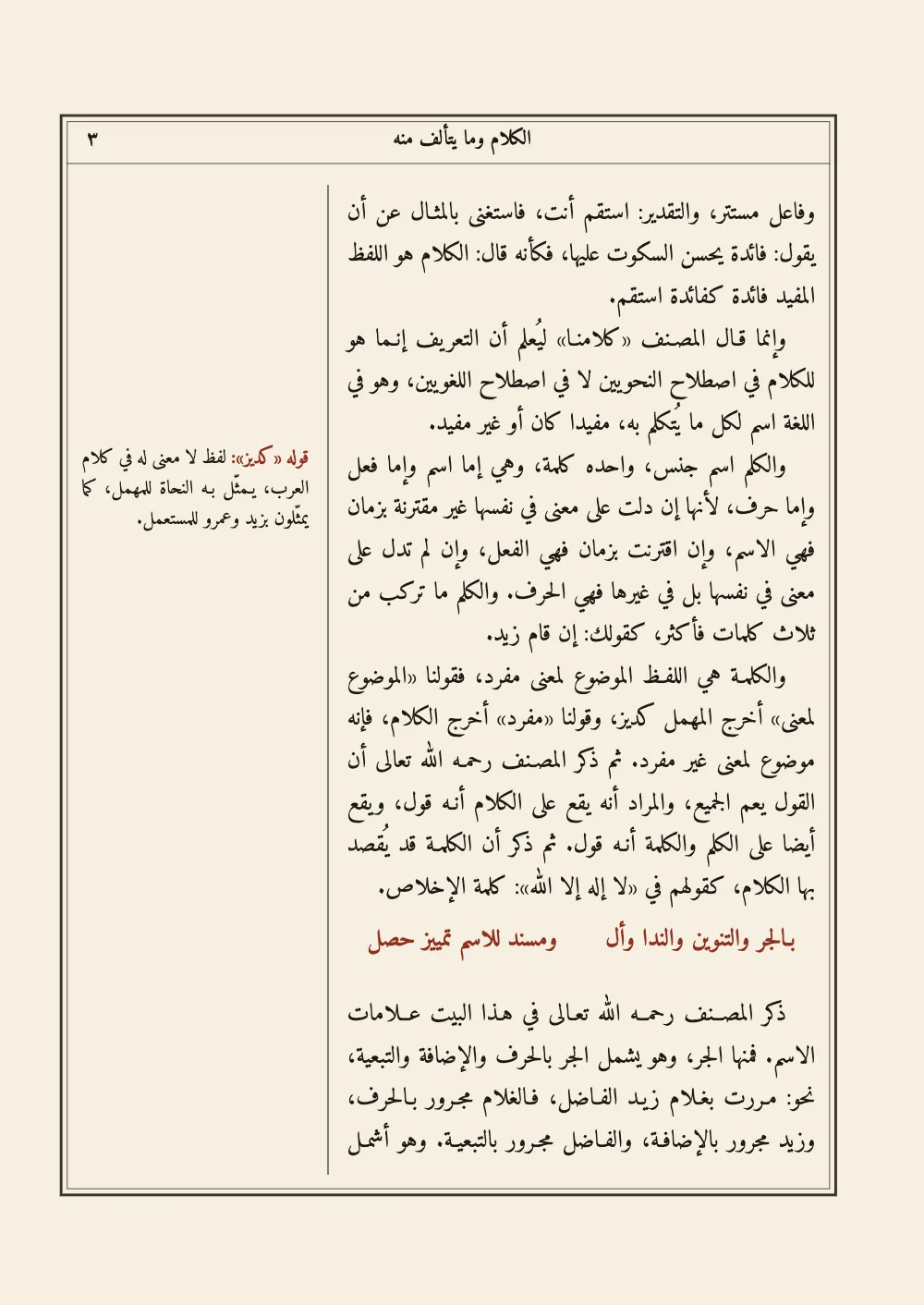
Una página hecha como los libros árabes impresos en El Cairo en el siglo XIX: el texto principal en el centro, notas breves sobre él en una columna estrecha junto al borde y toda la página encerrada entre filetes impresos.
Lo que vas a componer
Seis páginas compuestas como imprimían un comentario la imprenta de Bulaq y sus sucesoras de El Cairo en el siglo XIX. La explicación de Ibn ʿAqīl a los primeros versos de la Alfiyya, la gramática en mil versos de Ibn Mālik, corre por la columna principal, con los versos en rojo; en el margen exterior va una ḥāshiya, glosas breves que empiezan con las palabras del texto que explican, junto al pasaje al que pertenecen. Un filete doble enmarca la caja, con una banda en la cabeza para el capítulo y el folio, y un filete simple separa el texto de su margen. En una página de Bulaq auténtica la ḥāshiya rodea el texto por tres lados; Postext la pone en uno solo, y la receta lo dice.
Esta receta responde a
- ¿Cómo compongo una página de Bulaq, con el comentario enmarcado alrededor del texto?
La respuesta corta
// The text runs in the main column of a column-and-a-half layout; the side column, on the
// outer side, takes only boxes with span 'side', so each gloss stands level with the
// paragraph it comments on. A column rule parts the two, as the jadwal of a Bulaq page does.
const layout = { layoutType: 'oneAndHalf', sideColumnRole: 'floats', sideColumnSide: 'outer',
  sideColumnPercent: 31, gutterWidth: mm(7),
  columnRule: { enabled: true, color: col('rule'), lineWidth: pt(0.6) } };
// A gloss is a callout with no box: the margin's own face, its lemma bold in the rubric.
const hashiya = { id: 'hashiya', span: 'side', backgroundEnabled: false, borderRadius: pt(0),
  padding: { top: pt(0), right: pt(0), bottom: pt(0), left: pt(0) },
  stripe: { enabled: false }, border: { enabled: false },
  body: { fontFamily: NASKH, fontSize: pt(10), lineHeight: pt(16), color: col('ink'),
    boldColor: col('rubric'), textAlign: 'justify', firstLineIndent: pt(0),
    paragraphSpacing: true } };
Ingredientes
- Funciones
- Notas al margenTextos, filetes y cajas en los diseños de páginaTexto de derecha a izquierdaColumna y mediaColumna al margen para flotantesFilete de columnaLibros encuadernados por la derechaFuentes árabesEl árabe como idioma del documentoVerso árabe (bayt en dos hemistiquios)Cifras de los números generadosCubiertas, portadas y colofonesEstilos de títuloAtributos de títuloCabeceras y foliosColor del papelEstilos de párrafoPárrafos en la otra direcciónPaleta de color semánticaExportación a PDF
- También usa
- RecuadrosAperturas diseñadasCabeceras según el tipo de páginaFuentes incrustadas en el PDFCabeceras por sección
- Tipografía
- Amiri, Aref Ruqaa (SIL OFL 1.1)
- Recursos
- Ninguno: todas las imágenes se dibujan en código
Elaboración
#1 · La ḥāshiya en una columna lateral propia
El código es la respuesta corta de arriba. Un diseño en columna y media cuya columna lateral solo admite flotantes deja el comentario fuera del flujo del texto: cada glosa es un :::callout{type="hashiya" span="side"} escrito después del párrafo que explica, y queda a su altura (Disposición). El recuadro no tiene fondo, borde ni relleno, así que se lee como texto compuesto en el margen, con el lema en negrita, que boldColor pone en rojo. sideColumnSide: 'outer' lleva la columna al corte delantero de las dos páginas: a la derecha de la página par, que en un libro encuadernado por la derecha queda a la derecha del pliego.
#2 · Un marco dibujado para cada lado del pliego
// Page-level design elements are physical: the frame follows the margins of each side of
// the spread. In a book bound on the right the even page is the right-hand one, its spine
// on its left, so its inner margin is the left one.
const frame = (parity, withBand = true) => {
  const left = parity === 'even' ? M.inner : M.outer;
  const width = TRIM.width - M.inner - M.outer;
  const box = (id, inset, thickness) => ({ kind: 'box', id: `${id}-${parity}`, parity,
    style: { borderColor: col('rule'), borderWidth: pt(thickness) },
    placement: { anchor: { to: 'page', edge: 'top-left' },
      offset: { x: mm(left - 4 + inset), y: mm(M.top - 13 + inset) },
      size: { width: mm(width + 8 - 2 * inset),
        height: mm(TRIM.height - M.top - M.bottom + 17 - 2 * inset) } } });
  return [box('outer', 0, 1.4), box('inner', 1.3, 0.4), ...(withBand ? [
    { kind: 'rule', id: `band-${parity}`, parity, direction: 'horizontal', thickness: pt(0.4),
      color: col('rule'), placement: { anchor: { to: 'page', edge: 'top-left' },
        offset: { x: mm(left - 2.7), y: mm(M.top - 4) },
        size: { width: mm(width + 5.4) } } }] : [])];
};
// The chapter centred in the band, the folio at its outer end.
const band = (id, content, parity, edge, x, extra = {}) => ({ kind: 'text', id, content,
  parity, pages: 'body', fontFamily: NASKH, fontWeight: 700, fontSize: pt(10.5),
  color: col('ink'),
  placement: { anchor: { to: 'page', edge }, offset: { x: mm(x), y: mm(M.top - 11) } }, ...extra });
const header = { elements: [...frame('even'), ...frame('odd'),
  band('head', '{chapterTitle}', 'all', 'top', 0),
  band('folio-even', '{pageNumber}', 'even', 'top-right', -(M.outer + 1), { pages: 'all' }),
  band('folio-odd', '{pageNumber}', 'odd', 'top-left', M.outer + 1, { pages: 'all' })] };
El marco son tres elementos de diseño de página en la cabecera: dos cajas con borde y sin relleno, separadas 1,3 mm, y un filete bajo la banda que lleva la cabecera. Los elementos de página son físicos, así que el marco se construye dos veces, una por paridad, con los márgenes de ese lado (Orden de las páginas y encuadernación por la derecha). El folio va en el extremo exterior de la banda en todas las páginas, también en las aperturas; el título del capítulo va centrado y no aparece en la apertura, donde el propio título queda debajo.
#3 · Una portada dentro del mismo marco
const line = (id, content, y, style) => ({ kind: 'text', id, content, align: 'center',
  overflow: 'wrap', color: col('ink'),
  placement: { anchor: { to: 'page', edge: 'top' }, offset: { y: mm(y) },
    size: { width: mm(110) } }, ...style });
const titlePage = { id: 'title', span: 'page', runningChapter: false,
  breakBefore: { enabled: true, parity: 'any' }, header: { elements: [] },
  footer: { elements: [] },
  advancedDesign: { enabled: true, slot: { elements: [...frame('odd', false),
    line('book', '{titleText}', 64, { fontFamily: RUQAA, fontWeight: 700, fontSize: pt(40),
      lineHeight: 1.3, color: col('rubric') }),
    line('on', '{attr.on}', 88, { fontFamily: NASKH, fontWeight: 700, fontSize: pt(17) }),
    { kind: 'rule', id: 'rule', direction: 'horizontal', thickness: pt(0.75), color: col('rubric'),
      placement: { anchor: { to: 'page', edge: 'top' }, offset: { y: mm(104) },
        size: { width: mm(30) } } },
    line('margin', '{attr.margin}', 112, { fontFamily: NASKH, fontSize: pt(13) }),
    line('latin', '{attr.latin}', 196, { fontFamily: NASKH, fontSize: pt(9), italic: true,
      color: col('muted') }),
  ] } } };
La portada reutiliza el marco sin la banda. Sus líneas salen de atributos del título, on y margin, de modo que toda la portada es una línea de Markdown, y la línea latina de debajo cambia con la edición.
La receta completa
// ═══ Postext Cookbook · Nº 114 · A Bulaq page: the text framed by its commentary ════════ // https://postext.dev/en/cookbook/bulaq-framed-page // Code: MIT · Text: Ibn ʿAqīl, Sharḥ; Ibn Mālik, Alfiyya, ar.wikisource (PD) · Pictures: none // Fonts: Amiri, Aref Ruqaa (SIL OFL 1.1) · Needs postext ≥ 1.15.0 import { buildDocument, renderPageToCanvas, clearMeasurementCache } from 'https://esm.sh/postext'; import { renderToPdf, decompressWoff2 } from 'https://esm.sh/postext-pdf'; const LANG = 'es'; // @lang: the language of the sample document ('en' | 'es') const RECIPE = 'bulaq-framed-page'; // ─── 1 · Design ───────────────────────────────────────────────────────────── // Black and a brown-red on a toned paper: the two inks of a Cairo press around 1900. const palette = { ink: '#1d1915', // text and frame rules rubric: '#8e3020', // the accent: lemmas of the glosses, the matn, titles rule: '#3a312a', // the frame muted: '#6a6056', // the note on the text paper: '#f6efe0', // a toned paper }; const col = (id) => ({ hex: palette[id], model: 'hex', paletteId: id }); const colorPalette = [ ...Object.entries(palette).map(([id, hex]) => ({ id, name: id, value: { hex, model: 'hex' } })), { id: 'main-color', name: 'rubric (defaults)', value: { hex: palette.rubric, model: 'hex' } }, ]; const NASKH = 'Amiri'; // the text, the matn and the glosses const RUQAA = 'Aref Ruqaa'; // the title page and the chapter title const TRIM = { width: 170, height: 240 }; // mm const M = { top: 34, bottom: 24, inner: 20, outer: 15 }; // mm: the type area inside the frame // #region answer: the commentary's column beside the text, both inside one ruled frame // The text runs in the main column of a column-and-a-half layout; the side column, on the // outer side, takes only boxes with span 'side', so each gloss stands level with the // paragraph it comments on. A column rule parts the two, as the jadwal of a Bulaq page does. const layout = { layoutType: 'oneAndHalf', sideColumnRole: 'floats', sideColumnSide: 'outer', sideColumnPercent: 31, gutterWidth: mm(7), columnRule: { enabled: true, color: col('rule'), lineWidth: pt(0.6) } }; // A gloss is a callout with no box: the margin's own face, its lemma bold in the rubric. const hashiya = { id: 'hashiya', span: 'side', backgroundEnabled: false, borderRadius: pt(0), padding: { top: pt(0), right: pt(0), bottom: pt(0), left: pt(0) }, stripe: { enabled: false }, border: { enabled: false }, body: { fontFamily: NASKH, fontSize: pt(10), lineHeight: pt(16), color: col('ink'), boldColor: col('rubric'), textAlign: 'justify', firstLineIndent: pt(0), paragraphSpacing: true } }; // #endregion // #region frame: a double rule round the type area and a band for the running head // Page-level design elements are physical: the frame follows the margins of each side of // the spread. In a book bound on the right the even page is the right-hand one, its spine // on its left, so its inner margin is the left one. const frame = (parity, withBand = true) => { const left = parity === 'even' ? M.inner : M.outer; const width = TRIM.width - M.inner - M.outer; const box = (id, inset, thickness) => ({ kind: 'box', id: `${id}-${parity}`, parity, style: { borderColor: col('rule'), borderWidth: pt(thickness) }, placement: { anchor: { to: 'page', edge: 'top-left' }, offset: { x: mm(left - 4 + inset), y: mm(M.top - 13 + inset) }, size: { width: mm(width + 8 - 2 * inset), height: mm(TRIM.height - M.top - M.bottom + 17 - 2 * inset) } } }); return [box('outer', 0, 1.4), box('inner', 1.3, 0.4), ...(withBand ? [ { kind: 'rule', id: `band-${parity}`, parity, direction: 'horizontal', thickness: pt(0.4), color: col('rule'), placement: { anchor: { to: 'page', edge: 'top-left' }, offset: { x: mm(left - 2.7), y: mm(M.top - 4) }, size: { width: mm(width + 5.4) } } }] : [])]; }; // The chapter centred in the band, the folio at its outer end. const band = (id, content, parity, edge, x, extra = {}) => ({ kind: 'text', id, content, parity, pages: 'body', fontFamily: NASKH, fontWeight: 700, fontSize: pt(10.5), color: col('ink'), placement: { anchor: { to: 'page', edge }, offset: { x: mm(x), y: mm(M.top - 11) } }, ...extra }); const header = { elements: [...frame('even'), ...frame('odd'), band('head', '{chapterTitle}', 'all', 'top', 0), band('folio-even', '{pageNumber}', 'even', 'top-right', -(M.outer + 1), { pages: 'all' }), band('folio-odd', '{pageNumber}', 'odd', 'top-left', M.outer + 1, { pages: 'all' })] }; // #endregion // #region title: the title page, framed like the text pages const line = (id, content, y, style) => ({ kind: 'text', id, content, align: 'center', overflow: 'wrap', color: col('ink'), placement: { anchor: { to: 'page', edge: 'top' }, offset: { y: mm(y) }, size: { width: mm(110) } }, ...style }); const titlePage = { id: 'title', span: 'page', runningChapter: false, breakBefore: { enabled: true, parity: 'any' }, header: { elements: [] }, footer: { elements: [] }, advancedDesign: { enabled: true, slot: { elements: [...frame('odd', false), line('book', '{titleText}', 64, { fontFamily: RUQAA, fontWeight: 700, fontSize: pt(40), lineHeight: 1.3, color: col('rubric') }), line('on', '{attr.on}', 88, { fontFamily: NASKH, fontWeight: 700, fontSize: pt(17) }), { kind: 'rule', id: 'rule', direction: 'horizontal', thickness: pt(0.75), color: col('rubric'), placement: { anchor: { to: 'page', edge: 'top' }, offset: { y: mm(104) }, size: { width: mm(30) } } }, line('margin', '{attr.margin}', 112, { fontFamily: NASKH, fontSize: pt(13) }), line('latin', '{attr.latin}', 196, { fontFamily: NASKH, fontSize: pt(9), italic: true, color: col('muted') }), ] } } }; // #endregion const config = () => ({ // a factory: the engine caches resolved configs per object locale: 'ar', // right to left, bound on the right, digits ٠–٩ (gotcha: arabic-locale-tag) colorPalette, page: { width: mm(TRIM.width), height: mm(TRIM.height), dpi: 150, backgroundColor: col('paper'), margins: { top: mm(M.top), bottom: mm(M.bottom), left: mm(M.inner), right: mm(M.outer), mirror: true } }, layout, bodyText: { fontFamily: NASKH, fontSize: pt(12.5), lineHeight: pt(22), color: col('ink'), boldColor: col('ink'), italicColor: col('ink'), referenceColor: col('ink'), textAlign: 'justify', firstLineIndent: em(1.2), indentAfterHeading: false, optimalLineBreaking: true, avoidWidows: true, avoidOrphans: true }, // Restated: any headings object drops the H1 break (gotcha: headings-drop-h1-break). headings: { fontFamily: RUQAA, fontWeight: 700, color: col('rubric'), textAlign: 'center', levels: [{ level: 1, fontSize: pt(22), lineHeight: pt(32), marginTop: pt(0), marginBottom: pt(8), breakBefore: { enabled: true, parity: 'any' } }] }, headingStyles: [titlePage], calloutStyles: [hashiya], paragraphStyles: [ // The matn's bayts: bold and in the rubric, as Ibn ʿAqīl's printers set the Alfiyya. { id: 'matn', fontFamily: NASKH, fontWeight: 700, fontSize: pt(12.5), lineHeight: pt(23), color: col('rubric'), marginTop: pt(4), marginBottom: pt(6) }, { id: 'note', fontFamily: NASKH, fontSize: pt(9), lineHeight: pt(13), color: col('muted'), boldColor: col('ink'), textAlign: 'justify', firstLineIndent: pt(0), marginTop: pt(10), hyphenation: { enabled: true, locale: LANG } }, { id: 'colophon', fontFamily: NASKH, fontSize: pt(7.5), lineHeight: pt(10), color: col('muted'), textAlign: 'left', firstLineIndent: pt(0), marginTop: pt(6) }, ], header, footer: { elements: [] }, }); // ─── 2 · Content ──────────────────────────────────────────────────────────── const markdown = String.raw`---Muestra en Markdown · 100 líneas · content.es.md
title: "شرح ابن عقيل" subtitle: "الكلام وما يتألف منه" --- # شرح ابن عقيل {style="title" on="على ألفية ابن مالك" margin="وبهامشه حواشٍ على مواضع منه" latin="El comentario de Ibn ʿAqīl a la Alfiyya de Ibn Mālik, con glosas en su margen"} # الكلام وما يتألف منه بسم الله الرحمن الرحيم، الحمد لله وحده، وصلاته وسلامه على من لا نبي بعده. :::verse{style="matn"} قال محمد هو ابن مالك || أحمد ربي الله خير مالك مصليا على النبي المصطفى || وآله المستكملين الشرفا وأستعين الله في ألفيه || مقاصد النحو بها محويه تقرب الأقصى بلفظ موجز || وتبسط البذل بوعد منجز وتقتضي رضا بغير سخط || فائقة ألفية ابن معط وهو بسبق حائز تفضيلا || مستوجب ثنائي الجميلا والله يقضي بهبات وافره || لي وله في درجات الآخره ::: :::callout{type="hashiya" span="side"} **قوله «ابن مالك»:** هو جمال الدين محمد بن عبد الله بن مالك الطائي الجيّاني، وُلد بجيّان من بلاد الأندلس، ونزل دمشق وبها توفي سنة اثنتين وسبعين وستمئة. **قوله «ألفية ابن معط»:** هي الدرّة الألفية ليحيى بن عبد المعطي الزواوي، المتوفى بالقاهرة سنة ثمان وعشرين وستمئة، وهي أسبق من ألفية ابن مالك، ولذلك قال: «وهو بسبق حائز تفضيلا». ::: :::verse{style="matn"} كلامنا لفظ مفيد كاستقم || واسم وفعل ثم حرف الكلم واحده كلمة والقول عم || وكلمة بها كلام قد يؤم ::: الكلام المصطلح عليه عند النحاة عبارة عن اللفظ المفيد فائدة يحسن السكوت عليها. فاللفظ جنس يشمل الكلام والكلمة والكلم، ويشمل المهمل كديز والمستعمل كعمرو. ومفيد أخرج المهمل، وفائدة يحسن السكوت عليها أخرج الكلمة وبعض الكلم، وهو ما تركب من ثلاث كلمات فأكثر ولم يحسن السكوت عليه، نحو: إن قام زيد. ولا يتركب الكلام إلا من اسمين، نحو: زيد قائم، أو من فعل واسم، كقام زيد، وكقول المصنف «استقم»، فإنه كلام مركب من فعل أمر وفاعل مستتر، والتقدير: استقم أنت، فاستغنى بالمثال عن أن يقول: فائدة يحسن السكوت عليها، فكأنه قال: الكلام هو اللفظ المفيد فائدة كفائدة استقم. وإنما قال المصنف «كلامنا» ليُعلم أن التعريف إنما هو للكلام في اصطلاح النحويين لا في اصطلاح اللغويين، وهو في اللغة اسم لكل ما يُتكلم به، مفيدا كان أو غير مفيد. :::callout{type="hashiya" span="side"} **قوله «كديز»:** لفظ لا معنى له في كلام العرب، يمثّل به النحاة للمهمل، كما يمثّلون بزيد وعمرو للمستعمل. ::: والكلم اسم جنس، واحده كلمة، وهي إما اسم وإما فعل وإما حرف، لأنها إن دلت على معنى في نفسها غير مقترنة بزمان فهي الاسم، وإن اقترنت بزمان فهي الفعل، وإن لم تدل على معنى في نفسها بل في غيرها فهي الحرف. والكلم ما تركب من ثلاث كلمات فأكثر، كقولك: إن قام زيد. والكلمة هي اللفظ الموضوع لمعنى مفرد، فقولنا «الموضوع لمعنى» أخرج المهمل كديز، وقولنا «مفرد» أخرج الكلام، فإنه موضوع لمعنى غير مفرد. ثم ذكر المصنف رحمه الله تعالى أن القول يعم الجميع، والمراد أنه يقع على الكلام أنه قول، ويقع أيضا على الكلم والكلمة أنه قول. ثم ذكر أن الكلمة قد يُقصد بها الكلام، كقولهم في «لا إله إلا الله»: كلمة الإخلاص. :::verse{style="matn"} بالجر والتنوين والندا وأل || ومسند للاسم تمييز حصل ::: ذكر المصنف رحمه الله تعالى في هذا البيت علامات الاسم. فمنها الجر، وهو يشمل الجر بالحرف والإضافة والتبعية، نحو: مررت بغلام زيد الفاضل، فالغلام مجرور بالحرف، وزيد مجرور بالإضافة، والفاضل مجرور بالتبعية. وهو أشمل من قول غيره «بحرف الجر»، لأن هذا لا يتناول الجر بالإضافة ولا الجر بالتبعية. ومنها التنوين، وهو على أربعة أقسام: تنوين التمكين، وهو اللاحق للأسماء المعربة كزيد ورجل. وتنوين التنكير، وهو اللاحق للأسماء المبنية فرقا بين معرفتها ونكرتها، نحو: مررت بسيبويه وبسيبويهٍ آخر. وتنوين المقابلة، وهو اللاحق لجمع المؤنث السالم، نحو: مسلمات، فإنه في مقابلة النون في جمع المذكر السالم كمسلمين. وتنوين العوض، وهو على ثلاثة أقسام: عوض عن جملة، وهو الذي يلحق «إذ» عوضا عن جملة تكون بعدها، كقوله تعالى: ﴿وَأَنتُمْ حِينَئِذٍ تَنظُرُونَ﴾، أي حين إذ بلغت الروح الحلقوم، فحذف «بلغت الروح الحلقوم» وأتى بالتنوين عوضا عنه. :::callout{type="hashiya" span="side"} **قوله ﴿وأنتم حينئذ تنظرون﴾:** من سورة الواقعة، الآية الرابعة والثمانون، وقبلها: ﴿فَلَوْلَا إِذَا بَلَغَتِ الْحُلْقُومَ﴾، فمنها قدّر الشارح الجملة المحذوفة. **قوله «سيبويه»:** هو أبو بشر عمرو بن عثمان بن قنبر، إمام البصريين وصاحب الكتاب، توفي نحو سنة ثمانين ومئة. ::: وقسم يكون عوضا عن اسم، وهو اللاحق لكل عوضا عما تضاف إليه، نحو: كلٌّ قائم، أي كل إنسان قائم، فحذف إنسان وأتى بالتنوين عوضا عنه. وقسم يكون عوضا عن حرف، وهو اللاحق لجوار وغواش ونحوهما رفعا وجرا، نحو: هؤلاء جوارٍ، ومررت بجوارٍ، فحذفت الياء وأتي بالتنوين عوضا عنها. وتنوين الترنم، وهو الذي يلحق القوافي المطلقة بحرف علة، كقوله: :::verse{style="matn"} أقلّي اللوم عاذل والعتابن || وقولي إن أصبت لقد أصابن ::: فجيء بالتنوين بدلا من الألف لأجل الترنم. :::callout{type="hashiya" span="side"} **قوله «كقوله»:** البيت لجرير من قصيدة يهجو بها الراعي النميري، والقافية فيه «والعتابا… أصابا»، فأبدل التنوين من ألف الإطلاق. ::: وظاهر كلام المصنف أن التنوين كله من خواص الاسم، وليس كذلك، بل الذي يختص به الاسم إنما هو تنوين التمكين والتنكير والمقابلة والعوض، وأما تنوين الترنم فيكون في الاسم والفعل والحرف. ومن خواص الاسم النداء، نحو: يا زيد، والألف واللام، نحو: الرجل، والإسناد إليه، نحو: زيد قائم. فمعنى البيت: حصل للاسم تمييز عن الفعل والحرف بالجر والتنوين والنداء والألف واللام والإسناد إليه، أي الإخبار عنه. واستعمل المصنف «أل» مكان الألف واللام، وقد وقع ذلك في عبارة بعض المتقدمين، وهو الخليل، واستعمل «مسند» مكان الإسناد له. :::callout{type="hashiya" span="side"} **قوله «وهو الخليل»:** الخليل بن أحمد الفراهيدي البصري، شيخ سيبويه وواضع علم العروض، توفي بالبصرة سنة سبعين ومئة، وقيل غير ذلك. ::: :::verse{style="matn"} بتا فعلت وأتت ويا افعلي || ونون أقبلن فعل ينجلي ::: ثم ذكر المصنف أن الفعل يمتاز عن الاسم والحرف بتاء فعلت، والمراد بها تاء الفاعل، وهي المضمومة للمتكلم نحو: فعلتُ، والمفتوحة للمخاطب نحو: تباركتَ، والمكسورة للمخاطبة نحو: فعلتِ. ويمتاز أيضا بتاء أتت، والمراد بها تاء التأنيث الساكنة، نحو: نعمت وبئست، فاحترزنا بالساكنة عن اللاحقة للأسماء، فإنها تكون متحركة بحركة الإعراب، نحو: هذه مسلمةٌ، ورأيت مسلمةً، ومررت بمسلمةٍ. ويمتاز أيضا بياء افعلي، والمراد بها ياء الفاعلة، وتلحق فعل الأمر نحو: اضربي، والفعل المضارع نحو: تضربين، ولا تلحق الماضي. ومما يميز الفعل نون أقبلن، والمراد بها نون التوكيد، خفيفة كانت أو ثقيلة، فالخفيفة نحو قوله تعالى: ﴿لَنَسْفَعًا بِالنَّاصِيَةِ﴾، والثقيلة نحو قوله تعالى: ﴿لَنُخْرِجَنَّكَ يَا شُعَيْبُ﴾. فمعنى البيت: ينجلي الفعل بتاء الفاعل وتاء التأنيث الساكنة وياء الفاعلة ونون التوكيد. :::callout{type="hashiya" span="side"} **قوله ﴿لنسفعا بالناصية﴾:** من سورة العلق، الآية الخامسة عشرة، وتُكتب النون الخفيفة فيها ألفا في المصحف. **قوله ﴿لنخرجنك يا شعيب﴾:** من سورة الأعراف، الآية الثامنة والثمانين، من قول الملأ الذين استكبروا من قوم شعيب. ::: :::paragraphs{style="note" dir=ltr} **Nota sobre el texto.** Ibn ʿAqīl (m. 1367) sobre el comienzo de la Alfiyya de Ibn Mālik, de ar.wikisource, sin las notas del editor moderno ni dos pasajes sobre el tanwīn de la rima; se añade la puntuación y se corrigen algunas erratas. Las glosas del margen se han escrito para esta página y cada una empieza con las palabras que explica, como en una ḥāshiya de Bulaq. ::: :::paragraphs{style="colophon" dir=ltr} Compuesto en Amiri y Aref Ruqaa (SIL OFL) · Texto: Ibn ʿAqīl e Ibn Mālik, dominio público, de ar.wikisource · Glosas: Postext Cookbook :::`; // content.<lang>.md, inlined by the Cookbook // ─── 3 · Fonts ────────────────────────────────────────────────────────────── const FONTS = { // every face the pages use, loaded before the build (gotcha: fonts-first) Amiri: ['400', '400i', '700'], // NASKH: text, matn, glosses; the Latin lines 'Aref Ruqaa': ['700'], // RUQAA: the title page and the chapter title }; // ─── 4 · Build & show ─────────────────────────────────────────────────────── await loadFonts(FONTS, markdown); // The arabic file of each face, which loadFonts leaves out (gotcha: arabic-fonts-subset). await loadArabicFonts(FONTS, markdown); const doc = await buildWithFonts(() => buildDocument({ markdown }, config()), markdown); showBook(doc, { title: t({ en: 'A Bulaq page', es: 'Una página de Bulaq' }) }); offerPdf(() => renderToPdf(doc, { fontProvider: arabicPdfProvider }), `${RECIPE}.pdf`);Kit · core, fonts, viewer, pdf, arabic, book: igual en todas las recetas · 411 líneas
// ─── Kit ── helpers shared by every Cookbook recipe · postext.dev/cookbook ───── // ─── Kit · core v1 ── the same in every recipe · postext.dev/cookbook ───────── function mm(value) { return { value, unit: 'mm' }; } function pt(value) { return { value, unit: 'pt' }; } function em(value) { return { value, unit: 'em' }; } /** The sample language's string: t({ en: 'Figure', es: 'Figura' }). */ function t(strings) { return strings[LANG] ?? Object.values(strings)[0]; } /** A file in this recipe's assets folder, served from the Postext repo by jsDelivr. */ function asset(file) { return `https://cdn.jsdelivr.net/gh/drnachio/postext@main/cookbook/${RECIPE}/assets/${file}`; } // ─── Kit · fonts v1 ── the same in every recipe · postext.dev/cookbook ──────── // Postext measures text with the faces the browser has loaded, and caches the // widths, so every face must be ready before the first build. Faces come from // Fontsource: the same static files the PDF embeds, so screen and PDF agree. /** faces = { 'Family Name': ['400', '400i', '700'] }. `text` is the sample: * letters beyond Latin-1 (č, ł, ő…) also load the latin-ext files. With * `optional`, a face Fontsource does not ship is skipped instead of failing. * Resolves to the number of faces added. */ async function loadFonts(faces, text = '', { optional = false } = {}) { kitStatus('Loading fonts…'); const ranges = { latin: 'U+0000-00FF,U+0131,U+0152-0153,U+02BB-02BC,U+02C6,U+02DA,U+02DC,U+0304,U+0308,U+0329,' + 'U+2000-206F,U+20AC,U+2122,U+2191,U+2193,U+2212,U+2215,U+FEFF,U+FFFD', 'latin-ext': 'U+0100-02BA,U+02BD-02C5,U+02C7-02CC,U+02CE-02D7,U+02DD-02FF,U+0304,U+0308,U+0329,' + 'U+1D00-1DBF,U+1E00-1E9F,U+1EF2-1EFF,U+2020,U+20A0-20AB,U+20AD-20C0,U+2113,U+2C60-2C7F,U+A720-A7FF', }; const subsets = /[Ā-˿Ḁ-ỿ]/.test(text) ? ['latin', 'latin-ext'] : ['latin']; const jobs = []; let added = 0; for (const [family, specs] of Object.entries(faces)) { const id = fontsourceId(family); const meta = optional ? await fontsourceMeta(family) : null; for (const spec of new Set(specs)) { const weight = parseInt(spec, 10); const style = spec.endsWith('i') ? 'italic' : 'normal'; if (hasFace(family, weight, style)) continue; if (optional && !(meta?.weights.includes(weight) && meta.styles.includes(style))) continue; for (const subset of subsets) { const url = `https://cdn.jsdelivr.net/npm/@fontsource/${id}@5/files/${id}-${subset}-${weight}-${style}.woff2`; const face = new FontFace(family, `url(${url}) format('woff2')`, { weight: String(weight), style, unicodeRange: ranges[subset] }); jobs.push(face.load().then((ready) => { document.fonts.add(ready); added++; }, () => { if (subset === 'latin' && !optional) throw new Error(`Fontsource has no ${family} ${weight} ${style}`); })); } } } await Promise.all(jobs).catch((error) => { kitFail(error); throw error; }); return added; } /** Runs `build` (a buildDocument or buildBundle call) and checks the faces * the pages use. A regular face missing from FONTS is loaded with a warning; * bold and italic variants are loaded when the family ships them. Then the * measurement caches are cleared and the build runs again. */ async function buildWithFonts(build, text = '') { const tried = new Set(); for (let round = 0; round < 3; round++) { kitStatus('Laying out…'); await new Promise(requestAnimationFrame); // let the status paint first const result = await Promise.resolve().then(build).catch((error) => { kitFail(error); throw error; }); const wanted = { base: {}, variants: {} }; for (const { font, base } of [result].flat().flatMap(fontStringsOf)) { const { family, weight, style } = parseFont(font); const key = `${family}|${weight}|${style}`; if (tried.has(key) || hasFace(family, weight, style)) continue; tried.add(key); (wanted[base ? 'base' : 'variants'][family] ??= []).push(`${weight}${style === 'italic' ? 'i' : ''}`); } if (Object.keys(wanted.base).length) { console.warn(`[cookbook] FONTS does not list ${JSON.stringify(wanted.base)}: loading them.`); } const added = await loadFonts(wanted.base, text) + await loadFonts(wanted.variants, text, { optional: true }); if (added === 0) return result; clearMeasurementCache(); } throw new Error('The fonts did not settle after three builds.'); } /** Every font string of the layout. `base` marks a block's own face; its * bold, italic and bold-italic variants are listed whether or not used. */ function fontStringsOf(doc) { const found = new Map(); const walk = (node) => { if (!node || typeof node !== 'object') return; if (Array.isArray(node)) { node.forEach(walk); return; } for (const [key, value] of Object.entries(node)) { if (typeof value === 'string' && /fontString$/i.test(key)) { found.set(value, found.get(value) || key === 'fontString'); } else if (value && typeof value === 'object') walk(value); } }; walk(doc.pages); walk(doc.blocks); return [...found].map(([font, base]) => ({ font, base })); } /** '700 37.5px Open Sans' / 'italic 400 13px "Source Serif 4"' → { family, weight, style }. * A string with no weight ('95.8px Young Serif', from a design text) is 400. */ function parseFont(font) { const m = /^(?:(italic|oblique)\s+)?(?:small-caps\s+)?(?:(\d+|bold|normal)\s+)?[\d.]+px\s+(.+)$/.exec(font.trim()); if (!m) throw new Error(`Unexpected font string: ${font}`); const weight = m[2] === 'bold' ? 700 : !m[2] || m[2] === 'normal' ? 400 : Number(m[2]); return { family: m[3].replace(/^["']|["']$/g, ''), weight, style: m[1] ? 'italic' : 'normal' }; } /** True when a loaded FontFace covers exactly this family, weight and style * (document.fonts.check() is also true for families nobody declared). */ function hasFace(family, weight, style) { for (const face of document.fonts) { if (face.status !== 'loaded' || face.style !== style) continue; if (face.family.replace(/^["']|["']$/g, '') !== family) continue; const [low, high = low] = face.weight.split(' ').map(Number); if (weight >= low && weight <= high) return true; } return false; } /** Fontsource's id for a family: 'Source Serif 4' → 'source-serif-4'. */ function fontsourceId(family) { return family.toLowerCase().replace(/\s+/g, '-'); } /** The weights and styles a family ships ({ weights: [400, 700], styles: ['normal', 'italic'] }), or null. */ function fontsourceMeta(family) { fontsourceMeta.cache ??= new Map(); const id = fontsourceId(family); if (!fontsourceMeta.cache.has(id)) { fontsourceMeta.cache.set(id, fetch(`https://api.fontsource.org/v1/fonts/${id}`) .then((res) => (res.ok ? res.json() : null), () => null)); } return fontsourceMeta.cache.get(id); } // ─── Kit · viewer v1 ── the same in every recipe · postext.dev/cookbook ─────── /** Shows the pages as facing spreads on a dark desk: the first page is a * recto on its own, then verso | recto pairs, as in a bound book. Pages * are painted when they scroll near the screen. */ function showPages(docs, { title, width = 460 } = {}) { const root = viewer(title); const pages = [docs].flat().flatMap((doc) => doc.pages.map((page) => ({ doc, page, n: (doc.pageIndexOffset ?? 0) + page.index }))); const spreads = []; let verso = null; for (const p of pages) { if (p.n % 2 === 1) { if (verso) spreads.push([verso, null]); verso = p; } else { spreads.push([verso, p]); verso = null; } } if (verso) spreads.push([verso, null]); const density = Math.min(window.devicePixelRatio || 1, 2); showPages.painter?.disconnect(); const painter = new IntersectionObserver((entries) => { for (const { isIntersecting, target } of entries) { if (!isIntersecting) continue; painter.unobserve(target); const { doc, page } = target.postext; renderPageToCanvas(page, doc, target, { scale: (width * density) / page.width }); } }, { rootMargin: '800px' }); showPages.painter = painter; root.replaceChildren(...spreads.map((pair) => { const spread = document.createElement('div'); spread.className = 'pt-spread'; for (const p of pair) { const figure = document.createElement('figure'); if (p) { const label = p.page.pageLabel || String(p.n + 1); const canvas = document.createElement('canvas'); canvas.postext = p; canvas.style.aspectRatio = `${p.page.width} / ${p.page.height}`; canvas.setAttribute('role', 'img'); canvas.setAttribute('aria-label', `Page ${label}`); const folio = document.createElement('figcaption'); folio.textContent = label; figure.append(canvas, folio); painter.observe(canvas); } else figure.className = 'pt-blank'; spread.append(figure); } return spread; })); kitStatus(`${pages.length} ${pages.length === 1 ? 'page' : 'pages'}`); document.documentElement.dataset.postext = 'ready'; return pages.length; } /** The desk, the bar and the error reporting, created once. */ function viewer(title) { if (!document.getElementById('pt-kit')) { document.head.insertAdjacentHTML('beforeend', `<style id="pt-kit"> :root { color-scheme: dark; } body { margin: 0; background: #0e1014; color: #b9bcc4; font: 13px/1.45 system-ui, sans-serif; } #pt-bar { position: sticky; top: 0; z-index: 1; display: flex; flex-wrap: wrap; align-items: center; gap: 6px 16px; padding: 10px 16px; background: rgb(14 16 20 / .92); backdrop-filter: blur(6px); border-bottom: 1px solid #23262d; } #pt-bar strong { color: #f4f1ea; font-weight: 600; } #pt-actions { display: flex; gap: 12px; margin-left: auto; } #pt-actions a, #pt-actions button { color: #d8a21a; font: inherit; background: none; border: 0; padding: 0; cursor: pointer; } #pages { display: grid; justify-items: center; gap: 48px; padding: 32px 16px 72px; } .pt-spread { display: flex; } .pt-spread figure { margin: 0; width: min(460px, 44vw); } .pt-spread canvas { display: block; width: 100%; background: #fff; box-shadow: 0 1px 2px rgb(0 0 0 / .5), 0 22px 44px -16px rgb(0 0 0 / .8); } .pt-spread figure:first-child canvas { box-shadow: inset -14px 0 14px -14px rgb(0 0 0 / .18), 0 1px 2px rgb(0 0 0 / .5), 0 22px 44px -16px rgb(0 0 0 / .8); } .pt-spread figcaption { margin-top: 10px; text-align: center; font: 600 10px/1 system-ui, sans-serif; letter-spacing: .18em; text-transform: uppercase; color: #6c7079; } .pt-blank { visibility: hidden; } @media (max-width: 760px) { .pt-spread { flex-direction: column; gap: 32px; } .pt-spread figure { width: min(460px, 92vw); } .pt-blank { display: none; } } </style>`); document.body.insertAdjacentHTML('afterbegin', '<header id="pt-bar"><strong id="pt-title"></strong><span id="pt-status" role="status"></span><span id="pt-actions"></span></header>'); document.getElementById('pt-title').textContent = document.title || 'Postext'; addEventListener('error', (event) => kitFail(event.error ?? event.message)); addEventListener('unhandledrejection', (event) => kitFail(event.reason)); } if (title) document.getElementById('pt-title').textContent = title; return document.getElementById('pages') ?? document.body.appendChild(Object.assign(document.createElement('main'), { id: 'pages' })); } function kitStatus(text) { viewer(); document.getElementById('pt-status').textContent = text; } function kitFail(error) { document.documentElement.dataset.postext = 'error'; kitStatus(`Error: ${error?.message ?? error}`); } // ─── Kit · pdf v1 ── the same in every recipe that exports a PDF ────────────── /** postext-pdf embeds TrueType bytes. Fetch the Fontsource file the screen * used, snapping to a weight the family ships and falling back to upright * when it has no italic: the PDF asks for every face a block could use. */ async function fontsourceProvider(family, weight, style) { const id = fontsourceId(family); const meta = await fontsourceMeta(family); const weights = meta?.weights?.length ? meta.weights : [400, 700]; const w = weights.reduce((a, b) => (Math.abs(b - weight) < Math.abs(a - weight) ? b : a)); const s = style === 'italic' && meta && !meta.styles.includes('italic') ? 'normal' : style; const res = await fetch(`https://cdn.jsdelivr.net/npm/@fontsource/${id}@5/files/${id}-latin-${w}-${s}.woff2`); if (!res.ok) throw new Error(`Fontsource has no ${family} ${w} ${s} (${res.status})`); return decompressWoff2(new Uint8Array(await res.arrayBuffer())); } /** A "Build the PDF" button in the bar. Once built: "Open the PDF" (a new * tab, since CodePen's preview frame cannot show PDFs) and a download link. */ function offerPdf(makePdf, filename) { viewer(); const button = Object.assign(document.createElement('button'), { type: 'button', textContent: 'Build the PDF' }); button.dataset.postextPdf = filename; button.addEventListener('click', async () => { button.disabled = true; button.textContent = 'Building the PDF…'; try { const bytes = await makePdf(); const url = URL.createObjectURL(new Blob([bytes], { type: 'application/pdf' })); const size = `${Math.max(1, Math.round(bytes.length / 1024))} KB`; button.replaceWith( Object.assign(document.createElement('a'), { href: url, target: '_blank', rel: 'noopener', textContent: 'Open the PDF ↗' }), Object.assign(document.createElement('a'), { href: url, download: filename, textContent: `Download ${filename} · ${size}` })); } catch (error) { button.disabled = false; button.textContent = 'Build the PDF'; kitFail(error); } }); document.getElementById('pt-actions').append(button); } // ─── Kit · arabic v1 ── Arabic-script faces · postext.dev/cookbook ─────────── // Fontsource ships an Arabic family as one file per subset and weight: the // `arabic` file holds the letters, the harakat, the Arabic-Indic digits, the // Arabic punctuation and the presentation forms; `latin` and `latin-ext` // hold the rest. loadFonts loads the latin files; this block adds the arabic // file of every Arabic family, for the canvas and for the PDF, which shapes // the letters with HarfBuzz from the same bytes. /** The code points of Fontsource's `arabic` subset, as its stylesheets * declare them (the same unicode-range the browser picks the file by). A * function, not a const: the kit is inlined after the recipe's top-level * awaits, and a const read before its line throws, where a function * declaration is hoisted. */ function arabicRange() { return 'U+0600-06FF,U+0750-077F,U+0870-088E,U+0890-0891,U+0897-08E1,U+08E3-08FF,' + 'U+200C-200E,U+2010-2011,U+204F,U+2E41,U+FB50-FDFF,U+FE70-FE74,U+FE76-FEFC,U+102E0-102FB,' + 'U+10E60-10E7E,U+10EC2-10EC4,U+10EFC-10EFF,U+1EE00-1EEFF'; } /** Whether code point `cp` is in the arabic file. */ function inArabicRange(cp) { inArabicRange.ranges ??= arabicRange().split(',').map((part) => { const [lo, hi = lo] = part.slice(2).split('-'); return [parseInt(lo, 16), parseInt(hi, 16)]; }); return inArabicRange.ranges.some(([lo, hi]) => cp >= lo && cp <= hi); } /** Whether Fontsource serves `family` with an `arabic` subset. Fails when * the API does not answer: an Arabic face taken for a Latin one would set * its letters in a system face. */ async function isArabicFamily(family) { const meta = await fontsourceMeta(family); if (!meta) throw new Error(`api.fontsource.org did not describe ${family}: reload to try again`); return !!meta.subsets?.includes('arabic'); } /** The arabic file of a face. */ function arabicFileUrl(family, weight, style) { const id = fontsourceId(family); return `https://cdn.jsdelivr.net/npm/@fontsource/${id}@5/files/${id}-arabic-${weight}-${style}.woff2`; } /** faces = { Amiri: ['400', '700'] }, as for loadFonts, after it: the whole * FONTS object may be passed, its families without an arabic subset are * left alone. Adds the arabic file of every listed weight of each Arabic * family (the latin files come from loadFonts) and loads it. `text` is * the sample: fails when it holds an Arabic-script character the arabic * file does not cover. List every weight the pages set in Arabic: a weight * left to buildWithFonts gets the latin file only, and its Arabic letters * fall back to a system face. Resolves to the number of files loaded. */ async function loadArabicFonts(faces, text = '') { kitStatus('Loading fonts…'); let loaded = 0; try { const outside = [...new Set(text)].filter((ch) => /\p{Script=Arabic}/u.test(ch) && !inArabicRange(ch.codePointAt(0))); if (outside.length) throw new Error(`Fontsource's arabic files have no ${outside.slice(0, 12).join(' ')}`); for (const [family, specs] of Object.entries(faces)) { if (!(await isArabicFamily(family))) continue; for (const spec of new Set(specs)) { const weight = parseInt(spec, 10); const style = spec.endsWith('i') ? 'italic' : 'normal'; const face = new FontFace(family, `url(${arabicFileUrl(family, weight, style)}) format('woff2')`, { weight: String(weight), style, unicodeRange: arabicRange() }); document.fonts.add(await face.load().catch(() => { throw new Error(`Fontsource has no arabic file for ${family} ${weight} ${style}`); })); loaded++; } } } catch (error) { kitFail(error); throw error; } return loaded; } /** The PDF font provider for recipes with Arabic faces: a family with an * arabic subset gets its arabic file when its pages set Arabic letters * (`request.codePoints`), then its latin file, and its latin-ext file for * the letters beyond latin (transliteration: ā ḥ ʿ). The arabic file comes * first: it also holds the space and the brackets, so a line of Arabic is * shaped as one run and not cut at every space. Any other family goes to * fontsourceProvider (the "pdf" block). */ async function arabicPdfProvider(family, weight, style, request) { if (!(await isArabicFamily(family))) return fontsourceProvider(family, weight, style); const meta = await fontsourceMeta(family); const weights = meta.weights?.length ? meta.weights : [400, 700]; const w = weights.reduce((a, b) => (Math.abs(b - weight) < Math.abs(a - weight) ? b : a)); const s = style === 'italic' && !meta.styles.includes('italic') ? 'normal' : style; const wanted = [...(request?.codePoints ?? [])]; const id = fontsourceId(family); const urls = []; if (!wanted.length || wanted.some(inArabicRange)) urls.push(arabicFileUrl(family, w, s)); urls.push(`https://cdn.jsdelivr.net/npm/@fontsource/${id}@5/files/${id}-latin-${w}-${s}.woff2`); if (meta.subsets.includes('latin-ext') && wanted.some((cp) => /[Ā-˿Ḁ-ỿ]/u.test(String.fromCodePoint(cp)))) { urls.push(`https://cdn.jsdelivr.net/npm/@fontsource/${id}@5/files/${id}-latin-ext-${w}-${s}.woff2`); } return Promise.all(urls.map(async (url) => { const res = await fetch(url); if (!res.ok) throw new Error(`Fontsource file ${url} (${res.status})`); return decompressWoff2(new Uint8Array(await res.arrayBuffer())); })); } // ─── Kit · book v1 ── books bound on either edge · postext.dev/cookbook ────── // A book bound on the right (Arabic, Hebrew or Persian text, vertical // Chinese, or page.binding 'right') opens from what a Latin reader calls // the back: page 1 lies alone on the left of the spine, then [3 | 2]. /** showPages for a book bound on either edge. A right-bound book (the * document says so: doc.binding is 'right' for page.binding 'right', for * text that runs right to left and for vertical text, when the binding is * left to 'auto') lies on the desk as it opens: page 1 alone on the left * of the spine, then [3 | 2], the spine shade on each page's inner edge. * `binding` ('left' | 'right') overrides the document's. */ function showBook(docs, { binding, ...options } = {}) { const count = showPages(docs, options); const right = (binding ?? [docs].flat()[0]?.binding) === 'right'; if (!document.getElementById('pt-kit-book')) { // The pages keep direction ltr, as in a left-bound book: a canvas takes // the direction its element inherits, and under the spread's rtl a run // painted for an ltr canvas would end where the engine starts it. document.head.insertAdjacentHTML('beforeend', `<style id="pt-kit-book"> .pt-spread[dir="rtl"] canvas { direction: ltr; } .pt-spread[dir="rtl"] figure:first-child canvas { box-shadow: inset 14px 0 14px -14px rgb(0 0 0 / .18), 0 1px 2px rgb(0 0 0 / .5), 0 22px 44px -16px rgb(0 0 0 / .8); } </style>`); } // Each pair stays [verso, recto] in the page; right to left, the verso // sits on the right. Phones stack the pages in reading order either way. for (const spread of document.querySelectorAll('#pages > .pt-spread')) spread.dir = right ? 'rtl' : 'ltr'; document.getElementById('pages').dataset.binding = right ? 'right' : 'left'; return count; } // ─── /Kit ───────────────────────────────────────────────────────────────────────
El script.js compuesto funciona tal cual: pégalo como script de módulo en cualquier página o abre la receta en CodePen. Carpeta de la receta en GitHub ↗ (se abre en una nueva pestaña)
Variantes
#Pon el comentario en el lado interior
Algunas imprentas ponen la ḥāshiya junto al lomo, y el texto conserva el margen exterior, más ancho.
-const layout = { layoutType: 'oneAndHalf', sideColumnRole: 'floats', sideColumnSide: 'outer',
+const layout = { layoutType: 'oneAndHalf', sideColumnRole: 'floats', sideColumnSide: 'inner',#Encierra cada glosa en un filete
Un filete fino alrededor de cada glosa, como en algunos impresos cairotas posteriores, es el borde propio del recuadro.
-  stripe: { enabled: false }, border: { enabled: false },
+ stripe: { enabled: false }, border: { enabled: true, width: pt(0.4), color: col('rule') },Errores frecuentes
Error frecuente
Etiqueta un libro árabe 'ar', no con LANG
Las ediciones de una receta son en y es, pero una muestra árabe es árabe en las dos: `locale: LANG` la compondría de izquierda a derecha, la encuadernaría por la izquierda, numeraría sus páginas 1 2 3 y llamaría Figure o Figura a sus figuras. Escribe tú la etiqueta: 'ar' (cifras arábigo-índicas, la convención del Mashriq), una región como 'ar-EG' o 'ar-SA', o 'ar-MA', 'ar-DZ' o 'ar-TN' para una edición magrebí con cifras europeas. Una página latina que solo cita árabe conserva su propio locale. Texto de derecha a izquierda →
Error frecuente
Las fuentes árabes necesitan su archivo arabic, con el bloque arabic
Fontsource sirve Amiri, Noto Naskh Arabic o Scheherazade New en un archivo por subconjunto, y las letras árabes están en el archivo arabic. loadFonts solo descarga latin (y latin-ext), así que en pantalla el árabe sale de una fuente del sistema y se mide mal, y fontsourceProvider entrega al PDF ese archivo latin, que imprime cajas vacías. Añade el bloque arabic del kit, llama a loadArabicFonts(FONTS, markdown) después de loadFonts, con todos los pesos que las páginas usan en árabe listados en FONTS, y pasa a renderToPdf fontProvider: arabicPdfProvider. Fuentes árabes →
Error frecuente
Cualquier objeto headings desactiva el salto de página del H1
Por defecto un H1 salta a una página impar (always-odd), pero cualquier objeto headings anula ese valor, así que los capítulos van seguidos y span: 'page' no hace nada. Vuelve a declarar headings.levels[0].breakBefore: { enabled: true, parity } en cada configuración. Capítulos que abren en página impar →
Error frecuente
Carga todas las fuentes antes de componer
La composición mide el texto con las fuentes que el navegador ha cargado y guarda los anchos, así que una fuente que llega después de la primera composición deja cortes de línea erróneos y un PDF que ya no coincide con la pantalla. Carga antes todos los pesos y estilos, y llama a clearMeasurementCache() antes de recomponer si alguna llega tarde. Fuentes antes de componer →
Créditos
- Receta
- Ignacio Ferro
- Texto
- El comentario de Ibn ʿAqīl al comienzo de la Alfiyya, con los versos de Ibn Mālik, tal como lo da ar.wikisource (revisión 521625), sin las notas del editor moderno · Ibn ʿAqīl, Ibn Mālik · dominio público
- Las glosas del margen, la portada, la nota sobre el texto y el colofón · Postext Cookbook · original
- Fuentes
- Amiri (SIL OFL 1.1) · Aref Ruqaa (SIL OFL 1.1)
- Código
- MIT, como Postext
Editar este texto ↗ (se abre en una nueva pestaña)Carpeta de la receta en GitHub ↗ (se abre en una nueva pestaña)