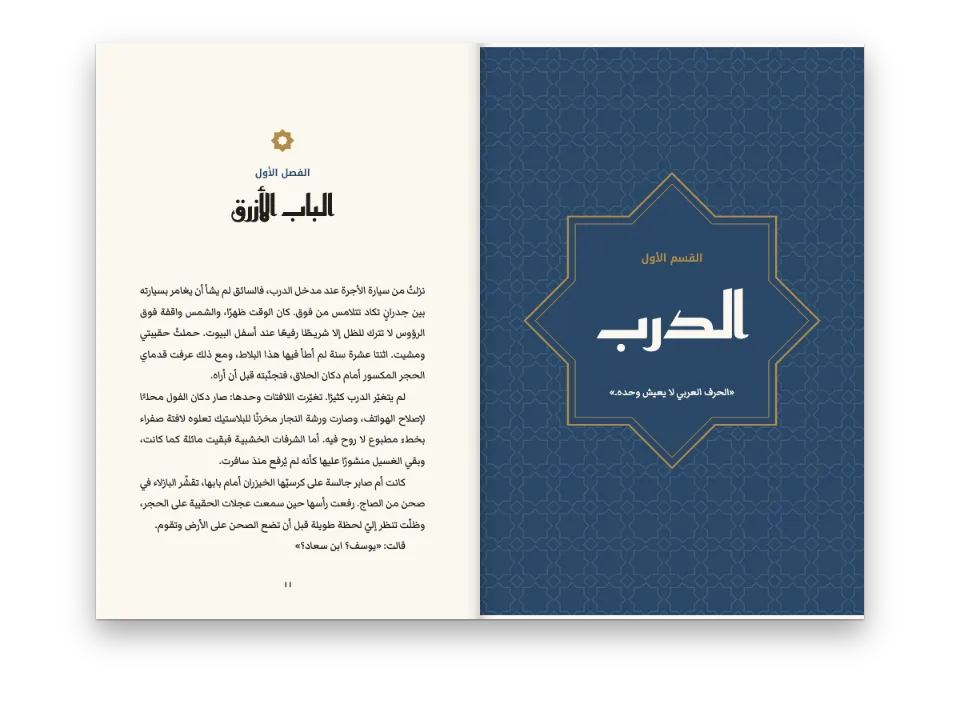
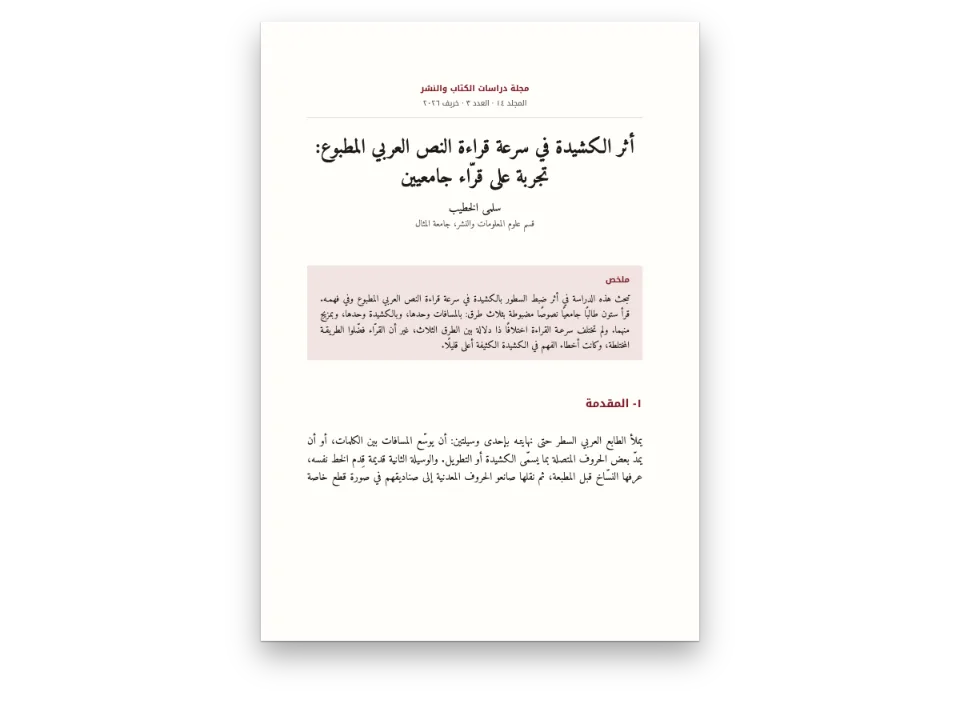
En pocas palabras
En Marruecos, Argelia y Túnez los libros en árabe imprimen los números con las cifras que usa Europa, 1, 2, 3, y no con ١، ٢، ٣. Un solo ajuste, el idioma y el país del documento, da esas cifras a todo el libro.
Lo que vas a componer
Un capítulo de una guía de las ciudades antiguas de Marruecos, dedicado a las puertas de Fez, tal como lo imprimiría una editorial marroquí: 13,5 × 21 cm, Noto Naskh Arabic de 12,5 pt y títulos en Noto Kufi Arabic con el verde de los azulejos de Fez. El texto va de derecha a izquierda y el libro se encuaderna por la derecha, como cualquier libro árabe, pero todos los números de la página se escriben 1, 2, 3: los folios del 41 al 44, الفصل 3, los apartados 3-1 y 3-2, la lista de puertas del 1- al 5-, las llamadas de nota (1) y el número de figura شكل 3-1. Es el uso del Magreb, de Marruecos a Túnez, y la página lo consigue con un solo ajuste. Una novela árabe encuadernada por la derecha enseña el mismo libro con las cifras ١٢ del Mashreq.
Esta receta responde a
- ¿Cómo imprimo cifras europeas (1, 2, 3) en un libro árabe para una edición magrebí?
La respuesta corta
const config = () => ({ // a factory: the engine caches resolved configs per object
  // Written out, never LANG (gotcha: arabic-locale-tag). The Moroccan tag keeps the text right
  // to left and the binding on the right, and sets numerals: 'auto' to European digits: the
  // folios, the chapter and section numbers, the list, the notes and the figure number.
  locale: 'ar-MA',
  colorPalette,
  page: { width: mm(135), height: mm(210), dpi: 150, pageNumbering: { startAt: 41 },
    margins: { top: mm(22), bottom: mm(22), left: mm(19), right: mm(16), mirror: true } },
  layout: { layoutType: 'single' },
  bodyText: { fontFamily: TEXT, fontSize: pt(12.5), lineHeight: pt(20.5), color: col('ink'),
    boldColor: col('ink'), italicColor: col('ink'), referenceColor: col('ink'),
    textAlign: 'justify', firstLineIndent: em(1.5), indentAfterHeading: false },
  headings: { fontFamily: LABEL, fontWeight: 700, color: col('green'), levels: [
    // Restated: any headings object drops the H1 break (gotcha: headings-drop-h1-break).
    { level: 1, fontSize: pt(26), lineHeight: pt(41), numberingTemplate: 'الفصل {1}',
      numberSeparator: ': ', breakBefore: { enabled: true, parity: 'odd' },
      marginTop: pt(0), marginBottom: pt(10) },
    { level: 2, fontSize: pt(13), lineHeight: pt(20.5), numberingTemplate: '{1}-{2}',
      numberSeparator: '  ', marginTop: pt(20.5), marginBottom: pt(0) },
  ] },
  orderedLists, footnotes, captionStyle,
  paragraphStyles: [{ id: 'colophon', fontFamily: TEXT, fontSize: pt(8.5), lineHeight: pt(11),
    color: col('muted'), textAlign: 'left', firstLineIndent: pt(0), marginTop: pt(20.5) }],
  header: { elements: [] },
  footer: { elements: [{ kind: 'text', id: 'folio', content: '{pageNumber}', fontFamily: LABEL,
    fontSize: pt(9), color: col('muted'), align: 'center',
    placement: { anchor: { to: 'page', edge: 'bottom' }, offset: { y: mm(-12) } } }] },
});
Ingredientes
- Funciones
- Cifras de los números generadosTexto de derecha a izquierdaEl árabe como idioma del documentoLibros encuadernados por la derechaFuentes árabesTipografía del textoTítulos numeradosNotas al pieListas numeradasEstilo de los piesExportación a PDF
- También usa
- Párrafos en la otra direcciónAtributos de títuloFiguras justo aquíEstilos de párrafoFuentes incrustadas en el PDFFiguras y tablas como recursosPreliminares en romanos
- Tipografía
- Noto Naskh Arabic, Noto Kufi Arabic (SIL OFL 1.1)
- Recursos
- Ninguno: todas las imágenes se dibujan en código
Elaboración
#1 · El país elige las cifras
El código está en la respuesta corta, más arriba. numerals se queda en 'auto' y el motor saca las cifras de la etiqueta: ar-MA, ar-DZ, ar-TN, ar-LY, ar-MR y ar-EH dan cifras europeas; ar a secas y las regiones del Mashreq dan ١٢٣ (Cifras y estilos de numeración). Solo cambian los números que escribe el motor: el folio, los contadores de los títulos, los números de la lista, las llamadas de nota y los números de figura. Los años del texto, 789 y 1913, son del autor, tecleados con las cifras de la edición, y el motor nunca los reescribe. El {startAt=3} del título lee tanto ٣ como 3, así que el mismo Markdown sirve para las dos ediciones.
#2 · Los signos que rodean los números
// «1-» and «(1)», as Arabic books write them; the number itself follows numerals.
const orderedLists = { color: col('green'), fontWeight: 700, marginTop: pt(0),
  marginBottom: pt(0), levels: [{ level: 1, numberFormat: 'arabic', separator: '-' }] };
const footnotes = { markerTemplate: '({n})', numbering: 'page', noteNumberPosition: 'inline',
  fontSize: pt(10), lineHeight: pt(15), separator: { width: 0.3, color: col('green') } };
// A colon after the label: a full stop after a number reads as a decimal point.
const captionStyle = { fontFamily: TEXT, fontSize: pt(10), color: col('ink'), labelBold: true,
  labelColor: col('green'), labelSeparator: ': ', note: { color: col('muted') } };
Los libros árabes escriben el número de lista seguido de un guion, 1-, y la llamada de nota entre paréntesis, (1); las dos plantillas toman las cifras del documento, así que la edición del Mashreq imprime ١- y (١) con los mismos ajustes (Notas al pie). La etiqueta del pie termina en dos puntos, شكل 3-1:, porque un punto detrás de un número se lee como separador decimal. Las notas vuelven a empezar en (1) en cada página, como las numeran casi todos los libros árabes.
#3 · Una franja de azulejos dibujada con código
// The star is two squares turned 45°; between four stars a small square. Paths only.
const star = (cx, cy, r) => {
  const pts = [];
  for (let k = 0; k < 16; k++) {
    const a = (k * Math.PI) / 8;
    const d = k % 2 ? r * 0.7654 : r; // where the two squares' sides cross
    pts.push(`${(cx + d * Math.sin(a)).toFixed(2)} ${(cy - d * Math.cos(a)).toFixed(2)}`);
  }
  return `M${pts.join('L')}Z`;
};
function zellige(W, H, S) {
  let stars = '';
  let inner = '';
  let squares = '';
  for (let y = 0; y <= H + S; y += S) {
    for (let x = 0; x <= W + S; x += S) {
      stars += star(x, y, S * 0.47);
      inner += star(x, y, S * 0.2);
      squares += `M${x + S / 2} ${y + S / 2 - S * 0.17}l${S * 0.17} ${S * 0.17}`
        + `l${-S * 0.17} ${S * 0.17}l${-S * 0.17} ${-S * 0.17}Z`;
    }
  }
  return `<svg xmlns="http://www.w3.org/2000/svg" width="${W * 10}" height="${H * 10}" `
    + `viewBox="0 0 ${W} ${H}"><rect width="${W}" height="${H}" fill="${palette.green}"/>`
    + `<path d="${stars}" fill="${palette.cobalt}" stroke="${palette.paper}" stroke-width="0.5"/>`
    + `<path d="${inner}" fill="${palette.paper}"/>`
    + `<path d="${squares}" fill="${palette.ochre}" stroke="${palette.paper}" stroke-width="0.4"/>`
    + '</svg>';
}
La figura es un SVG generado en el propio script: estrellas de ocho puntas hechas con dos cuadrados girados 45° y cuadrados pequeños entre ellas, en el verde, el cobalto y el ocre de la paleta. Su pie está en árabe en las dos ediciones y se numera por capítulo, {h1}-{n}, como numeran sus figuras los tipos de recurso árabes.
La receta completa
// ═══ Postext Cookbook · Nº 109 · A Maghreb edition of an Arabic text, with European digits ═══ // https://postext.dev/en/cookbook/maghreb-edition-european-digits // Code: MIT · Text: original Arabic prose (CC BY 4.0) · Pattern: drawn in code // Fonts: Noto Naskh Arabic, Noto Kufi Arabic (SIL OFL 1.1) · Needs postext ≥ 1.15.0 import { buildDocument, renderPageToCanvas, clearMeasurementCache, registerResourceImage, } from 'https://esm.sh/postext'; import { renderToPdf, decompressWoff2 } from 'https://esm.sh/postext-pdf'; const LANG = 'es'; // @lang: the language of the frame; the chapter is Arabic in both editions const RECIPE = 'maghreb-edition-european-digits'; // ─── 1 · Design ───────────────────────────────────────────────────────────── // The green and cobalt of Fes tilework, on a white book paper. const palette = { ink: '#1c1d1b', // text green: '#1d6650', // the accent: headings, the list numbers, the notes' rule cobalt: '#25488a', // the tile's second colour ochre: '#c99a3e', // the tile's third colour muted: '#62655f', // folios, captions' notes, the colophon paper: '#ffffff', }; const col = (id) => ({ hex: palette[id], model: 'hex', paletteId: id }); const colorPalette = Object.entries({ ...palette, 'main-color': palette.green }) .map(([id, hex]) => ({ id, name: id, value: { hex, model: 'hex' } })); const [TEXT, LABEL] = ['Noto Naskh Arabic', 'Noto Kufi Arabic']; // #region marks: list numbers, note markers and figure numbers in the same digits // «1-» and «(1)», as Arabic books write them; the number itself follows numerals. const orderedLists = { color: col('green'), fontWeight: 700, marginTop: pt(0), marginBottom: pt(0), levels: [{ level: 1, numberFormat: 'arabic', separator: '-' }] }; const footnotes = { markerTemplate: '({n})', numbering: 'page', noteNumberPosition: 'inline', fontSize: pt(10), lineHeight: pt(15), separator: { width: 0.3, color: col('green') } }; // A colon after the label: a full stop after a number reads as a decimal point. const captionStyle = { fontFamily: TEXT, fontSize: pt(10), color: col('ink'), labelBold: true, labelColor: col('green'), labelSeparator: ': ', note: { color: col('muted') } }; // #endregion // #region answer: ar-MA prints 1, 2, 3 in every number the engine writes const config = () => ({ // a factory: the engine caches resolved configs per object // Written out, never LANG (gotcha: arabic-locale-tag). The Moroccan tag keeps the text right // to left and the binding on the right, and sets numerals: 'auto' to European digits: the // folios, the chapter and section numbers, the list, the notes and the figure number. locale: 'ar-MA', colorPalette, page: { width: mm(135), height: mm(210), dpi: 150, pageNumbering: { startAt: 41 }, margins: { top: mm(22), bottom: mm(22), left: mm(19), right: mm(16), mirror: true } }, layout: { layoutType: 'single' }, bodyText: { fontFamily: TEXT, fontSize: pt(12.5), lineHeight: pt(20.5), color: col('ink'), boldColor: col('ink'), italicColor: col('ink'), referenceColor: col('ink'), textAlign: 'justify', firstLineIndent: em(1.5), indentAfterHeading: false }, headings: { fontFamily: LABEL, fontWeight: 700, color: col('green'), levels: [ // Restated: any headings object drops the H1 break (gotcha: headings-drop-h1-break). { level: 1, fontSize: pt(26), lineHeight: pt(41), numberingTemplate: 'الفصل {1}', numberSeparator: ': ', breakBefore: { enabled: true, parity: 'odd' }, marginTop: pt(0), marginBottom: pt(10) }, { level: 2, fontSize: pt(13), lineHeight: pt(20.5), numberingTemplate: '{1}-{2}', numberSeparator: ' ', marginTop: pt(20.5), marginBottom: pt(0) }, ] }, orderedLists, footnotes, captionStyle, paragraphStyles: [{ id: 'colophon', fontFamily: TEXT, fontSize: pt(8.5), lineHeight: pt(11), color: col('muted'), textAlign: 'left', firstLineIndent: pt(0), marginTop: pt(20.5) }], header: { elements: [] }, footer: { elements: [{ kind: 'text', id: 'folio', content: '{pageNumber}', fontFamily: LABEL, fontSize: pt(9), color: col('muted'), align: 'center', placement: { anchor: { to: 'page', edge: 'bottom' }, offset: { y: mm(-12) } } }] }, }); // #endregion // ─── 2 · Content ──────────────────────────────────────────────────────────── const markdown = String.raw`---Muestra en Markdown · 45 líneas · content.es.md
title: "مدن المغرب العتيقة" --- # أبواب فاس {startAt=3} ::resource{id="zellige"} لا يدخل المرء فاس العتيقة كما يدخل مدينة حديثة. فالمدينة التي أسّسها إدريس الأول على الضفة اليمنى لوادي فاس سنة 789، ثم بنى ابنه إدريس الثاني ضفتها الأخرى بعد عشرين عامًا، ظلّت قرونًا محاطة بسور لا تُعبر إلا أبوابه. ومن الباب يبدأ كل شيء: منه تدخل القوافل والبضائع، وعنده تُدفع المكوس، وإليه تُنسب الأحياء والأسواق والمقابر. وما زال الزائر يلمس هذا النظام إلى اليوم. فالسيارات تقف عند الأبواب، والطرق داخل السور ضيقة لا يمرّ فيها إلا الراجل والحمار والعربة الصغيرة التي يدفعها الحمّال وهو ينادي: «بالاك!» أي: انتبه. ولذلك يختار أهل فاس الباب الذي يدخلون منه بحسب وجهتهم، لا بحسب قربه، كما يختار المسافر الميناء الذي يرسو فيه. ## الأبواب الكبرى يصعب أن يُحصى عدد أبواب فاس إحصاءً واحدًا، لأن بعضها سُدّ وبعضها فُتح في القرن العشرين، ولأن المؤرخين لا يعدّون الأبواب الصغيرة بين الأحياء. لكن خمسة منها تكفي لرسم صورة المدينة: 1. **باب بوجلود**، المدخل الغربي الذي يعرفه كل زائر. بُني بشكله الحالي سنة 1913، وكُسي من الخارج بزليج أزرق هو لون فاس، ومن الداخل بزليج أخضر هو لون الإسلام. 2. **باب المحروق**، في الشمال الغربي، من العهد الموحدي. تقول الرواية إنه سُمّي بهذا الاسم لأن ثائرًا أُحرق عنده، ولا يثبت ذلك مصدر يُعتمد عليه. 3. **باب الكيسة**، في الشمال، قرب الطريق الصاعد إلى قبور المرينيين، ومنه يُشرف الماشي على المدينة كلها في المساء. 4. **باب الفتوح**، في الجنوب الشرقي، على عدوة الأندلس، وبجانبه مقبرة واسعة تحمل اسمه. 5. **باب الجديد**، في الجنوب، وهو كما يدلّ اسمه أحدث عهدًا من الأبواب الأربعة السابقة، فُتح ليصل المدينة العتيقة بالأحياء التي نشأت خارج سورها. وليس الترتيب هنا ترتيب أهمية، بل ترتيب الدورة التي يقوم بها الماشي حول السور إذا بدأ من الغرب وسار مع عقارب الساعة. وتستغرق هذه الدورة على القدمين نحو 4 ساعات، إذا لم يتوقف الماشي لشرب الشاي، وهو أمر نادر.[^tour] ## مدينة داخل السور تمتد فاس البالي داخل أسوارها على نحو 280 هكتارًا، وتضم أكثر من 9000 زقاق، بعضها لا يزيد عرضه على متر واحد. وفي قلبها جامع القرويين، الذي أسّسته فاطمة الفهرية سنة 859، وتحوّل مع الزمن إلى أحد أقدم مراكز التعليم في العالم. وحوله تتوزع الأسواق بحسب الحِرف: سوق العطارين، وسوق النجارين، والدباغة الكبرى التي تُصبغ فيها الجلود في أحواض حجرية كما كانت تُصبغ منذ قرون. وقد أدرجت منظمة اليونسكو المدينة العتيقة في قائمة التراث العالمي سنة 1981، فصار ترميم الأبواب والأسوار عملًا تتعاقب عليه الهيئات والمهندسون والحرفيون. وفي ورشات الترميم يتعلم الشباب صناعة الزليج من جديد: يُقطع الطين المشويّ قطعًا صغيرة بالمطرقة الحادة، قطعة قطعة، ثم تُصفّ القطع مقلوبة على الأرض حسب الرسم، ويُصبّ عليها الجص، فإذا جفّ قُلبت اللوحة فظهرت النجمة.[^zellige] ## الباب والكتاب يقول أهل فاس إن من عرف أبواب المدينة عرف المدينة. وقد يصدق هذا على الكتب أيضًا: فلكل كتاب أبوابه، والقارئ الذي يعرف من أين يدخل لا يضيع في أزقته. ولهذا قُسّم هذا الكتاب أبوابًا وفصولًا، ورُقّمت صفحاته بالأرقام التي يقرؤها أهل المغرب في كتبهم وصحفهم ولافتات شوارعهم: 1 و2 و3، لا ١ و٢ و٣. وليس في ذلك خروج عن العربية. فالأرقام التي يسمّيها الأوروبيون «عربية» وصلت إليهم من الأندلس والمغرب، وكانت تُكتب بهذا الشكل في مخطوطات المغرب قبل أن تصل إلى أوروبا، بينما بقيت الأرقام الهندية المشرقية في مصر والشام والعراق.[^digits] فالكتاب المغربي حين يطبع 41 و42 و43 في أسفل صفحاته لا يقلّد أحدًا، بل يعود إلى ما كان عليه. [^tour]: يُفضَّل أن تبدأ الدورة صباحًا، قبل أن تشتد الشمس على الجهة الجنوبية من السور. [^zellige]: تُسمّى القطعة الواحدة من الزليج «فرْمة»، ويحتاج المعلّم إلى عشرات الأشكال المختلفة لرسم نجمة واحدة. [^digits]: تُعرف الأرقام المغربية في كتب الحساب القديمة باسم «الأرقام الغبارية»، لأن الحُسّاب كانوا يرسمونها على لوح مغطى بالغبار. :::paragraphs{style="colophon" dir=ltr} Capítulo escrito en árabe para el Recetario de Postext, de un libro inventado sobre las ciudades antiguas de Marruecos. Compuesto en Noto Naskh Arabic y Noto Kufi Arabic (SIL OFL) · Texto: CC BY 4.0. :::`; // content.<lang>.md: the same Arabic text in both // #region art: a band of zellige, eight-pointed stars set in cobalt, green and ochre // The star is two squares turned 45°; between four stars a small square. Paths only. const star = (cx, cy, r) => { const pts = []; for (let k = 0; k < 16; k++) { const a = (k * Math.PI) / 8; const d = k % 2 ? r * 0.7654 : r; // where the two squares' sides cross pts.push(`${(cx + d * Math.sin(a)).toFixed(2)} ${(cy - d * Math.cos(a)).toFixed(2)}`); } return `M${pts.join('L')}Z`; }; function zellige(W, H, S) { let stars = ''; let inner = ''; let squares = ''; for (let y = 0; y <= H + S; y += S) { for (let x = 0; x <= W + S; x += S) { stars += star(x, y, S * 0.47); inner += star(x, y, S * 0.2); squares += `M${x + S / 2} ${y + S / 2 - S * 0.17}l${S * 0.17} ${S * 0.17}` + `l${-S * 0.17} ${S * 0.17}l${-S * 0.17} ${-S * 0.17}Z`; } } return `<svg xmlns="http://www.w3.org/2000/svg" width="${W * 10}" height="${H * 10}" ` + `viewBox="0 0 ${W} ${H}"><rect width="${W}" height="${H}" fill="${palette.green}"/>` + `<path d="${stars}" fill="${palette.cobalt}" stroke="${palette.paper}" stroke-width="0.5"/>` + `<path d="${inner}" fill="${palette.paper}"/>` + `<path d="${squares}" fill="${palette.ochre}" stroke="${palette.paper}" stroke-width="0.4"/>` + '</svg>'; } // #endregion const [BAND_W, BAND_H] = [100, 58]; // mm: the measure, and a band a little over half as deep const resources = [{ id: 'zellige', typeId: 'figure', kind: 'svg', createdAt: 0, updatedAt: 0, svg: { fileId: 'zellige.svg', width: BAND_W * 10, height: BAND_H * 10 }, caption: 'زليج من نجوم ثمانية الرؤوس، على طريقة الفسيفساء الفاسية', altText: t({ en: 'Eight-pointed cobalt stars outlined in white on a green ground, with small ' + 'ochre squares between them.', es: 'Estrellas cobalto de ocho puntas perfiladas en blanco ' + 'sobre fondo verde, con pequeños cuadrados ocre entre ellas.' }) }]; // ─── 3 · Fonts ────────────────────────────────────────────────────────────── const FONTS = { // every face the pages use, loaded before the build (gotcha: fonts-first) 'Noto Naskh Arabic': ['400', '700'], // TEXT: the chapter, notes, captions; bold emphasis 'Noto Kufi Arabic': ['400', '700'], // LABEL: headings, folios }; // ─── 4 · Build & show ─────────────────────────────────────────────────────── await loadFonts(FONTS, markdown); // Each Arabic face's letters live in a file of their own (gotcha: arabic-fonts-subset). await loadArabicFonts(FONTS, markdown + resources[0].caption); await loadSvg('zellige.svg', zellige(BAND_W, BAND_H, 13)); const doc = await buildWithFonts(() => buildDocument({ markdown, resources }, config()), markdown); showBook(doc, { title: t({ en: 'A Maghreb edition with European digits', es: 'Una edición magrebí con cifras europeas' }) }); offerPdf(() => renderToPdf(doc, { fontProvider: arabicPdfProvider, resourceBytes: imageBytes }), `${RECIPE}.pdf`);Kit · core, fonts, viewer, pdf, images, arabic, book: igual en todas las recetas · 446 líneas
// ─── Kit ── helpers shared by every Cookbook recipe · postext.dev/cookbook ───── // ─── Kit · core v1 ── the same in every recipe · postext.dev/cookbook ───────── function mm(value) { return { value, unit: 'mm' }; } function pt(value) { return { value, unit: 'pt' }; } function em(value) { return { value, unit: 'em' }; } /** The sample language's string: t({ en: 'Figure', es: 'Figura' }). */ function t(strings) { return strings[LANG] ?? Object.values(strings)[0]; } /** A file in this recipe's assets folder, served from the Postext repo by jsDelivr. */ function asset(file) { return `https://cdn.jsdelivr.net/gh/drnachio/postext@main/cookbook/${RECIPE}/assets/${file}`; } // ─── Kit · fonts v1 ── the same in every recipe · postext.dev/cookbook ──────── // Postext measures text with the faces the browser has loaded, and caches the // widths, so every face must be ready before the first build. Faces come from // Fontsource: the same static files the PDF embeds, so screen and PDF agree. /** faces = { 'Family Name': ['400', '400i', '700'] }. `text` is the sample: * letters beyond Latin-1 (č, ł, ő…) also load the latin-ext files. With * `optional`, a face Fontsource does not ship is skipped instead of failing. * Resolves to the number of faces added. */ async function loadFonts(faces, text = '', { optional = false } = {}) { kitStatus('Loading fonts…'); const ranges = { latin: 'U+0000-00FF,U+0131,U+0152-0153,U+02BB-02BC,U+02C6,U+02DA,U+02DC,U+0304,U+0308,U+0329,' + 'U+2000-206F,U+20AC,U+2122,U+2191,U+2193,U+2212,U+2215,U+FEFF,U+FFFD', 'latin-ext': 'U+0100-02BA,U+02BD-02C5,U+02C7-02CC,U+02CE-02D7,U+02DD-02FF,U+0304,U+0308,U+0329,' + 'U+1D00-1DBF,U+1E00-1E9F,U+1EF2-1EFF,U+2020,U+20A0-20AB,U+20AD-20C0,U+2113,U+2C60-2C7F,U+A720-A7FF', }; const subsets = /[Ā-˿Ḁ-ỿ]/.test(text) ? ['latin', 'latin-ext'] : ['latin']; const jobs = []; let added = 0; for (const [family, specs] of Object.entries(faces)) { const id = fontsourceId(family); const meta = optional ? await fontsourceMeta(family) : null; for (const spec of new Set(specs)) { const weight = parseInt(spec, 10); const style = spec.endsWith('i') ? 'italic' : 'normal'; if (hasFace(family, weight, style)) continue; if (optional && !(meta?.weights.includes(weight) && meta.styles.includes(style))) continue; for (const subset of subsets) { const url = `https://cdn.jsdelivr.net/npm/@fontsource/${id}@5/files/${id}-${subset}-${weight}-${style}.woff2`; const face = new FontFace(family, `url(${url}) format('woff2')`, { weight: String(weight), style, unicodeRange: ranges[subset] }); jobs.push(face.load().then((ready) => { document.fonts.add(ready); added++; }, () => { if (subset === 'latin' && !optional) throw new Error(`Fontsource has no ${family} ${weight} ${style}`); })); } } } await Promise.all(jobs).catch((error) => { kitFail(error); throw error; }); return added; } /** Runs `build` (a buildDocument or buildBundle call) and checks the faces * the pages use. A regular face missing from FONTS is loaded with a warning; * bold and italic variants are loaded when the family ships them. Then the * measurement caches are cleared and the build runs again. */ async function buildWithFonts(build, text = '') { const tried = new Set(); for (let round = 0; round < 3; round++) { kitStatus('Laying out…'); await new Promise(requestAnimationFrame); // let the status paint first const result = await Promise.resolve().then(build).catch((error) => { kitFail(error); throw error; }); const wanted = { base: {}, variants: {} }; for (const { font, base } of [result].flat().flatMap(fontStringsOf)) { const { family, weight, style } = parseFont(font); const key = `${family}|${weight}|${style}`; if (tried.has(key) || hasFace(family, weight, style)) continue; tried.add(key); (wanted[base ? 'base' : 'variants'][family] ??= []).push(`${weight}${style === 'italic' ? 'i' : ''}`); } if (Object.keys(wanted.base).length) { console.warn(`[cookbook] FONTS does not list ${JSON.stringify(wanted.base)}: loading them.`); } const added = await loadFonts(wanted.base, text) + await loadFonts(wanted.variants, text, { optional: true }); if (added === 0) return result; clearMeasurementCache(); } throw new Error('The fonts did not settle after three builds.'); } /** Every font string of the layout. `base` marks a block's own face; its * bold, italic and bold-italic variants are listed whether or not used. */ function fontStringsOf(doc) { const found = new Map(); const walk = (node) => { if (!node || typeof node !== 'object') return; if (Array.isArray(node)) { node.forEach(walk); return; } for (const [key, value] of Object.entries(node)) { if (typeof value === 'string' && /fontString$/i.test(key)) { found.set(value, found.get(value) || key === 'fontString'); } else if (value && typeof value === 'object') walk(value); } }; walk(doc.pages); walk(doc.blocks); return [...found].map(([font, base]) => ({ font, base })); } /** '700 37.5px Open Sans' / 'italic 400 13px "Source Serif 4"' → { family, weight, style }. * A string with no weight ('95.8px Young Serif', from a design text) is 400. */ function parseFont(font) { const m = /^(?:(italic|oblique)\s+)?(?:small-caps\s+)?(?:(\d+|bold|normal)\s+)?[\d.]+px\s+(.+)$/.exec(font.trim()); if (!m) throw new Error(`Unexpected font string: ${font}`); const weight = m[2] === 'bold' ? 700 : !m[2] || m[2] === 'normal' ? 400 : Number(m[2]); return { family: m[3].replace(/^["']|["']$/g, ''), weight, style: m[1] ? 'italic' : 'normal' }; } /** True when a loaded FontFace covers exactly this family, weight and style * (document.fonts.check() is also true for families nobody declared). */ function hasFace(family, weight, style) { for (const face of document.fonts) { if (face.status !== 'loaded' || face.style !== style) continue; if (face.family.replace(/^["']|["']$/g, '') !== family) continue; const [low, high = low] = face.weight.split(' ').map(Number); if (weight >= low && weight <= high) return true; } return false; } /** Fontsource's id for a family: 'Source Serif 4' → 'source-serif-4'. */ function fontsourceId(family) { return family.toLowerCase().replace(/\s+/g, '-'); } /** The weights and styles a family ships ({ weights: [400, 700], styles: ['normal', 'italic'] }), or null. */ function fontsourceMeta(family) { fontsourceMeta.cache ??= new Map(); const id = fontsourceId(family); if (!fontsourceMeta.cache.has(id)) { fontsourceMeta.cache.set(id, fetch(`https://api.fontsource.org/v1/fonts/${id}`) .then((res) => (res.ok ? res.json() : null), () => null)); } return fontsourceMeta.cache.get(id); } // ─── Kit · viewer v1 ── the same in every recipe · postext.dev/cookbook ─────── /** Shows the pages as facing spreads on a dark desk: the first page is a * recto on its own, then verso | recto pairs, as in a bound book. Pages * are painted when they scroll near the screen. */ function showPages(docs, { title, width = 460 } = {}) { const root = viewer(title); const pages = [docs].flat().flatMap((doc) => doc.pages.map((page) => ({ doc, page, n: (doc.pageIndexOffset ?? 0) + page.index }))); const spreads = []; let verso = null; for (const p of pages) { if (p.n % 2 === 1) { if (verso) spreads.push([verso, null]); verso = p; } else { spreads.push([verso, p]); verso = null; } } if (verso) spreads.push([verso, null]); const density = Math.min(window.devicePixelRatio || 1, 2); showPages.painter?.disconnect(); const painter = new IntersectionObserver((entries) => { for (const { isIntersecting, target } of entries) { if (!isIntersecting) continue; painter.unobserve(target); const { doc, page } = target.postext; renderPageToCanvas(page, doc, target, { scale: (width * density) / page.width }); } }, { rootMargin: '800px' }); showPages.painter = painter; root.replaceChildren(...spreads.map((pair) => { const spread = document.createElement('div'); spread.className = 'pt-spread'; for (const p of pair) { const figure = document.createElement('figure'); if (p) { const label = p.page.pageLabel || String(p.n + 1); const canvas = document.createElement('canvas'); canvas.postext = p; canvas.style.aspectRatio = `${p.page.width} / ${p.page.height}`; canvas.setAttribute('role', 'img'); canvas.setAttribute('aria-label', `Page ${label}`); const folio = document.createElement('figcaption'); folio.textContent = label; figure.append(canvas, folio); painter.observe(canvas); } else figure.className = 'pt-blank'; spread.append(figure); } return spread; })); kitStatus(`${pages.length} ${pages.length === 1 ? 'page' : 'pages'}`); document.documentElement.dataset.postext = 'ready'; return pages.length; } /** The desk, the bar and the error reporting, created once. */ function viewer(title) { if (!document.getElementById('pt-kit')) { document.head.insertAdjacentHTML('beforeend', `<style id="pt-kit"> :root { color-scheme: dark; } body { margin: 0; background: #0e1014; color: #b9bcc4; font: 13px/1.45 system-ui, sans-serif; } #pt-bar { position: sticky; top: 0; z-index: 1; display: flex; flex-wrap: wrap; align-items: center; gap: 6px 16px; padding: 10px 16px; background: rgb(14 16 20 / .92); backdrop-filter: blur(6px); border-bottom: 1px solid #23262d; } #pt-bar strong { color: #f4f1ea; font-weight: 600; } #pt-actions { display: flex; gap: 12px; margin-left: auto; } #pt-actions a, #pt-actions button { color: #d8a21a; font: inherit; background: none; border: 0; padding: 0; cursor: pointer; } #pages { display: grid; justify-items: center; gap: 48px; padding: 32px 16px 72px; } .pt-spread { display: flex; } .pt-spread figure { margin: 0; width: min(460px, 44vw); } .pt-spread canvas { display: block; width: 100%; background: #fff; box-shadow: 0 1px 2px rgb(0 0 0 / .5), 0 22px 44px -16px rgb(0 0 0 / .8); } .pt-spread figure:first-child canvas { box-shadow: inset -14px 0 14px -14px rgb(0 0 0 / .18), 0 1px 2px rgb(0 0 0 / .5), 0 22px 44px -16px rgb(0 0 0 / .8); } .pt-spread figcaption { margin-top: 10px; text-align: center; font: 600 10px/1 system-ui, sans-serif; letter-spacing: .18em; text-transform: uppercase; color: #6c7079; } .pt-blank { visibility: hidden; } @media (max-width: 760px) { .pt-spread { flex-direction: column; gap: 32px; } .pt-spread figure { width: min(460px, 92vw); } .pt-blank { display: none; } } </style>`); document.body.insertAdjacentHTML('afterbegin', '<header id="pt-bar"><strong id="pt-title"></strong><span id="pt-status" role="status"></span><span id="pt-actions"></span></header>'); document.getElementById('pt-title').textContent = document.title || 'Postext'; addEventListener('error', (event) => kitFail(event.error ?? event.message)); addEventListener('unhandledrejection', (event) => kitFail(event.reason)); } if (title) document.getElementById('pt-title').textContent = title; return document.getElementById('pages') ?? document.body.appendChild(Object.assign(document.createElement('main'), { id: 'pages' })); } function kitStatus(text) { viewer(); document.getElementById('pt-status').textContent = text; } function kitFail(error) { document.documentElement.dataset.postext = 'error'; kitStatus(`Error: ${error?.message ?? error}`); } // ─── Kit · pdf v1 ── the same in every recipe that exports a PDF ────────────── /** postext-pdf embeds TrueType bytes. Fetch the Fontsource file the screen * used, snapping to a weight the family ships and falling back to upright * when it has no italic: the PDF asks for every face a block could use. */ async function fontsourceProvider(family, weight, style) { const id = fontsourceId(family); const meta = await fontsourceMeta(family); const weights = meta?.weights?.length ? meta.weights : [400, 700]; const w = weights.reduce((a, b) => (Math.abs(b - weight) < Math.abs(a - weight) ? b : a)); const s = style === 'italic' && meta && !meta.styles.includes('italic') ? 'normal' : style; const res = await fetch(`https://cdn.jsdelivr.net/npm/@fontsource/${id}@5/files/${id}-latin-${w}-${s}.woff2`); if (!res.ok) throw new Error(`Fontsource has no ${family} ${w} ${s} (${res.status})`); return decompressWoff2(new Uint8Array(await res.arrayBuffer())); } /** A "Build the PDF" button in the bar. Once built: "Open the PDF" (a new * tab, since CodePen's preview frame cannot show PDFs) and a download link. */ function offerPdf(makePdf, filename) { viewer(); const button = Object.assign(document.createElement('button'), { type: 'button', textContent: 'Build the PDF' }); button.dataset.postextPdf = filename; button.addEventListener('click', async () => { button.disabled = true; button.textContent = 'Building the PDF…'; try { const bytes = await makePdf(); const url = URL.createObjectURL(new Blob([bytes], { type: 'application/pdf' })); const size = `${Math.max(1, Math.round(bytes.length / 1024))} KB`; button.replaceWith( Object.assign(document.createElement('a'), { href: url, target: '_blank', rel: 'noopener', textContent: 'Open the PDF ↗' }), Object.assign(document.createElement('a'), { href: url, download: filename, textContent: `Download ${filename} · ${size}` })); } catch (error) { button.disabled = false; button.textContent = 'Build the PDF'; kitFail(error); } }); document.getElementById('pt-actions').append(button); } // ─── Kit · images v1 ── recipes with pictures · postext.dev/cookbook ────────── /** Registers a photo or PNG for the canvas and keeps its bytes for the PDF. * fetch → ImageBitmap never taints the canvas (a plain cross-origin <img> would). */ async function loadImage(fileId, url) { const res = await fetch(url); if (!res.ok) throw new Error(`Image not found (${res.status}): ${url}`); const bytes = new Uint8Array(await res.arrayBuffer()); registerResourceImage(fileId, await createImageBitmap(new Blob([bytes]))); (loadImage.bytes ??= new Map()).set(fileId, bytes); } /** Registers SVG markup (drawn in code, or fetched) as a vector image. */ async function loadSvg(fileId, svg) { const img = new Image(); img.src = `data:image/svg+xml;charset=utf-8,${encodeURIComponent(svg)}`; await img.decode(); registerResourceImage(fileId, img); (loadImage.bytes ??= new Map()).set(fileId, new TextEncoder().encode(svg)); } /** renderToPdf({ resourceBytes: imageBytes }) */ function imageBytes(fileId) { return loadImage.bytes?.get(fileId); } /** renderToHtml({ resourceImageUrl: imageUrl }) */ function imageUrl(fileId) { const bytes = imageBytes(fileId); if (!bytes) return undefined; imageUrl.urls ??= new Map(); if (!imageUrl.urls.has(fileId)) { const type = /\.svg$/i.test(fileId) ? 'image/svg+xml' : /\.png$/i.test(fileId) ? 'image/png' : 'image/jpeg'; imageUrl.urls.set(fileId, URL.createObjectURL(new Blob([bytes], { type }))); } return imageUrl.urls.get(fileId); } // ─── Kit · arabic v1 ── Arabic-script faces · postext.dev/cookbook ─────────── // Fontsource ships an Arabic family as one file per subset and weight: the // `arabic` file holds the letters, the harakat, the Arabic-Indic digits, the // Arabic punctuation and the presentation forms; `latin` and `latin-ext` // hold the rest. loadFonts loads the latin files; this block adds the arabic // file of every Arabic family, for the canvas and for the PDF, which shapes // the letters with HarfBuzz from the same bytes. /** The code points of Fontsource's `arabic` subset, as its stylesheets * declare them (the same unicode-range the browser picks the file by). A * function, not a const: the kit is inlined after the recipe's top-level * awaits, and a const read before its line throws, where a function * declaration is hoisted. */ function arabicRange() { return 'U+0600-06FF,U+0750-077F,U+0870-088E,U+0890-0891,U+0897-08E1,U+08E3-08FF,' + 'U+200C-200E,U+2010-2011,U+204F,U+2E41,U+FB50-FDFF,U+FE70-FE74,U+FE76-FEFC,U+102E0-102FB,' + 'U+10E60-10E7E,U+10EC2-10EC4,U+10EFC-10EFF,U+1EE00-1EEFF'; } /** Whether code point `cp` is in the arabic file. */ function inArabicRange(cp) { inArabicRange.ranges ??= arabicRange().split(',').map((part) => { const [lo, hi = lo] = part.slice(2).split('-'); return [parseInt(lo, 16), parseInt(hi, 16)]; }); return inArabicRange.ranges.some(([lo, hi]) => cp >= lo && cp <= hi); } /** Whether Fontsource serves `family` with an `arabic` subset. Fails when * the API does not answer: an Arabic face taken for a Latin one would set * its letters in a system face. */ async function isArabicFamily(family) { const meta = await fontsourceMeta(family); if (!meta) throw new Error(`api.fontsource.org did not describe ${family}: reload to try again`); return !!meta.subsets?.includes('arabic'); } /** The arabic file of a face. */ function arabicFileUrl(family, weight, style) { const id = fontsourceId(family); return `https://cdn.jsdelivr.net/npm/@fontsource/${id}@5/files/${id}-arabic-${weight}-${style}.woff2`; } /** faces = { Amiri: ['400', '700'] }, as for loadFonts, after it: the whole * FONTS object may be passed, its families without an arabic subset are * left alone. Adds the arabic file of every listed weight of each Arabic * family (the latin files come from loadFonts) and loads it. `text` is * the sample: fails when it holds an Arabic-script character the arabic * file does not cover. List every weight the pages set in Arabic: a weight * left to buildWithFonts gets the latin file only, and its Arabic letters * fall back to a system face. Resolves to the number of files loaded. */ async function loadArabicFonts(faces, text = '') { kitStatus('Loading fonts…'); let loaded = 0; try { const outside = [...new Set(text)].filter((ch) => /\p{Script=Arabic}/u.test(ch) && !inArabicRange(ch.codePointAt(0))); if (outside.length) throw new Error(`Fontsource's arabic files have no ${outside.slice(0, 12).join(' ')}`); for (const [family, specs] of Object.entries(faces)) { if (!(await isArabicFamily(family))) continue; for (const spec of new Set(specs)) { const weight = parseInt(spec, 10); const style = spec.endsWith('i') ? 'italic' : 'normal'; const face = new FontFace(family, `url(${arabicFileUrl(family, weight, style)}) format('woff2')`, { weight: String(weight), style, unicodeRange: arabicRange() }); document.fonts.add(await face.load().catch(() => { throw new Error(`Fontsource has no arabic file for ${family} ${weight} ${style}`); })); loaded++; } } } catch (error) { kitFail(error); throw error; } return loaded; } /** The PDF font provider for recipes with Arabic faces: a family with an * arabic subset gets its arabic file when its pages set Arabic letters * (`request.codePoints`), then its latin file, and its latin-ext file for * the letters beyond latin (transliteration: ā ḥ ʿ). The arabic file comes * first: it also holds the space and the brackets, so a line of Arabic is * shaped as one run and not cut at every space. Any other family goes to * fontsourceProvider (the "pdf" block). */ async function arabicPdfProvider(family, weight, style, request) { if (!(await isArabicFamily(family))) return fontsourceProvider(family, weight, style); const meta = await fontsourceMeta(family); const weights = meta.weights?.length ? meta.weights : [400, 700]; const w = weights.reduce((a, b) => (Math.abs(b - weight) < Math.abs(a - weight) ? b : a)); const s = style === 'italic' && !meta.styles.includes('italic') ? 'normal' : style; const wanted = [...(request?.codePoints ?? [])]; const id = fontsourceId(family); const urls = []; if (!wanted.length || wanted.some(inArabicRange)) urls.push(arabicFileUrl(family, w, s)); urls.push(`https://cdn.jsdelivr.net/npm/@fontsource/${id}@5/files/${id}-latin-${w}-${s}.woff2`); if (meta.subsets.includes('latin-ext') && wanted.some((cp) => /[Ā-˿Ḁ-ỿ]/u.test(String.fromCodePoint(cp)))) { urls.push(`https://cdn.jsdelivr.net/npm/@fontsource/${id}@5/files/${id}-latin-ext-${w}-${s}.woff2`); } return Promise.all(urls.map(async (url) => { const res = await fetch(url); if (!res.ok) throw new Error(`Fontsource file ${url} (${res.status})`); return decompressWoff2(new Uint8Array(await res.arrayBuffer())); })); } // ─── Kit · book v1 ── books bound on either edge · postext.dev/cookbook ────── // A book bound on the right (Arabic, Hebrew or Persian text, vertical // Chinese, or page.binding 'right') opens from what a Latin reader calls // the back: page 1 lies alone on the left of the spine, then [3 | 2]. /** showPages for a book bound on either edge. A right-bound book (the * document says so: doc.binding is 'right' for page.binding 'right', for * text that runs right to left and for vertical text, when the binding is * left to 'auto') lies on the desk as it opens: page 1 alone on the left * of the spine, then [3 | 2], the spine shade on each page's inner edge. * `binding` ('left' | 'right') overrides the document's. */ function showBook(docs, { binding, ...options } = {}) { const count = showPages(docs, options); const right = (binding ?? [docs].flat()[0]?.binding) === 'right'; if (!document.getElementById('pt-kit-book')) { // The pages keep direction ltr, as in a left-bound book: a canvas takes // the direction its element inherits, and under the spread's rtl a run // painted for an ltr canvas would end where the engine starts it. document.head.insertAdjacentHTML('beforeend', `<style id="pt-kit-book"> .pt-spread[dir="rtl"] canvas { direction: ltr; } .pt-spread[dir="rtl"] figure:first-child canvas { box-shadow: inset 14px 0 14px -14px rgb(0 0 0 / .18), 0 1px 2px rgb(0 0 0 / .5), 0 22px 44px -16px rgb(0 0 0 / .8); } </style>`); } // Each pair stays [verso, recto] in the page; right to left, the verso // sits on the right. Phones stack the pages in reading order either way. for (const spread of document.querySelectorAll('#pages > .pt-spread')) spread.dir = right ? 'rtl' : 'ltr'; document.getElementById('pages').dataset.binding = right ? 'right' : 'left'; return count; } // ─── /Kit ───────────────────────────────────────────────────────────────────────
El script.js compuesto funciona tal cual: pégalo como script de módulo en cualquier página o abre la receta en CodePen. Carpeta de la receta en GitHub ↗ (se abre en una nueva pestaña)
Variantes
Errores frecuentes
Error frecuente
Etiqueta un libro árabe 'ar', no con LANG
Las ediciones de una receta son en y es, pero una muestra árabe es árabe en las dos: `locale: LANG` la compondría de izquierda a derecha, la encuadernaría por la izquierda, numeraría sus páginas 1 2 3 y llamaría Figure o Figura a sus figuras. Escribe tú la etiqueta: 'ar' (cifras arábigo-índicas, la convención del Mashriq), una región como 'ar-EG' o 'ar-SA', o 'ar-MA', 'ar-DZ' o 'ar-TN' para una edición magrebí con cifras europeas. Una página latina que solo cita árabe conserva su propio locale. Texto de derecha a izquierda →
Error frecuente
Las fuentes árabes necesitan su archivo arabic, con el bloque arabic
Fontsource sirve Amiri, Noto Naskh Arabic o Scheherazade New en un archivo por subconjunto, y las letras árabes están en el archivo arabic. loadFonts solo descarga latin (y latin-ext), así que en pantalla el árabe sale de una fuente del sistema y se mide mal, y fontsourceProvider entrega al PDF ese archivo latin, que imprime cajas vacías. Añade el bloque arabic del kit, llama a loadArabicFonts(FONTS, markdown) después de loadFonts, con todos los pesos que las páginas usan en árabe listados en FONTS, y pasa a renderToPdf fontProvider: arabicPdfProvider. Fuentes árabes →
Error frecuente
Cualquier objeto headings desactiva el salto de página del H1
Por defecto un H1 salta a una página impar (always-odd), pero cualquier objeto headings anula ese valor, así que los capítulos van seguidos y span: 'page' no hace nada. Vuelve a declarar headings.levels[0].breakBefore: { enabled: true, parity } en cada configuración. Capítulos que abren en página impar →
Error frecuente
«1998. » o «- » al principio de un párrafo abren una lista
Un párrafo que empieza por un número, un punto y un espacio, o por un guion y un espacio, se convierte en un elemento de lista. Pon un unidor de palabras (U+2060) antes del número y escribe los diálogos con raya. Escapes y caracteres literales →
Error frecuente
Carga todas las fuentes antes de componer
La composición mide el texto con las fuentes que el navegador ha cargado y guarda los anchos, así que una fuente que llega después de la primera composición deja cortes de línea erróneos y un PDF que ya no coincide con la pantalla. Carga antes todos los pesos y estilos, y llama a clearMeasurementCache() antes de recomponer si alguna llega tarde. Fuentes antes de componer →
Créditos
- Receta
- Ignacio Ferro
- Texto
- «Las puertas de Fez», capítulo escrito en árabe para la receta, de un libro inventado sobre las ciudades antiguas de Marruecos · Postext Cookbook · original
- Fuentes
- Noto Naskh Arabic (SIL OFL 1.1) · Noto Kufi Arabic (SIL OFL 1.1)
- Código
- MIT, como Postext
Editar este texto ↗ (se abre en una nueva pestaña)Carpeta de la receta en GitHub ↗ (se abre en una nueva pestaña)