En pocas palabras
Un artículo breve de una revista científica japonesa. El autor escribe un código para cada fuente; Postext las numera por orden de cita y compone la lista de referencias como la piden las revistas científicas japonesas.
Lo que vas a componer
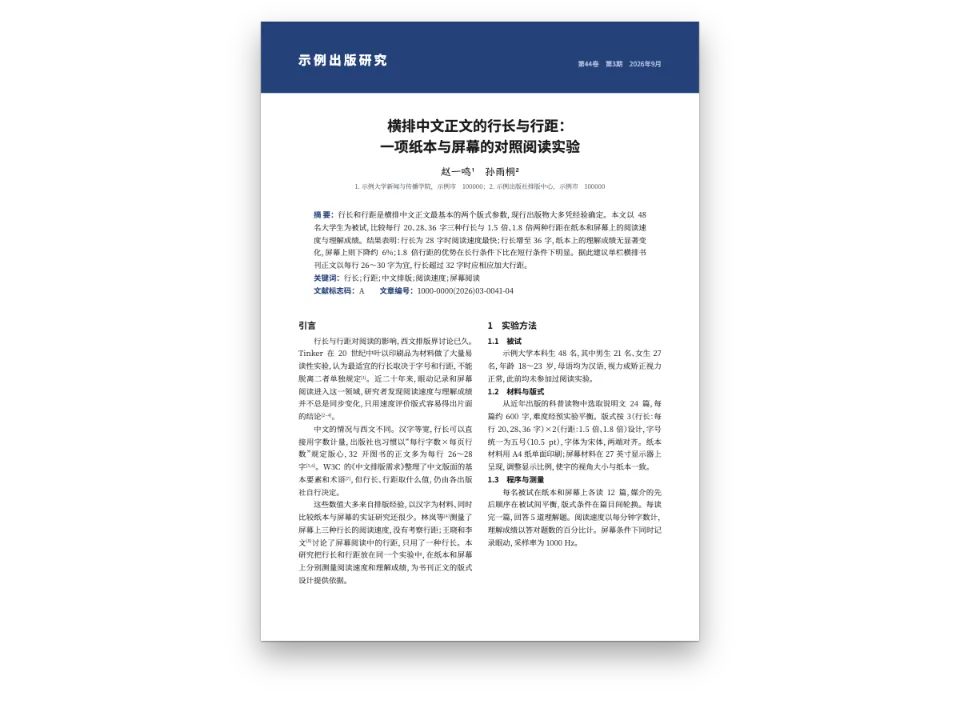
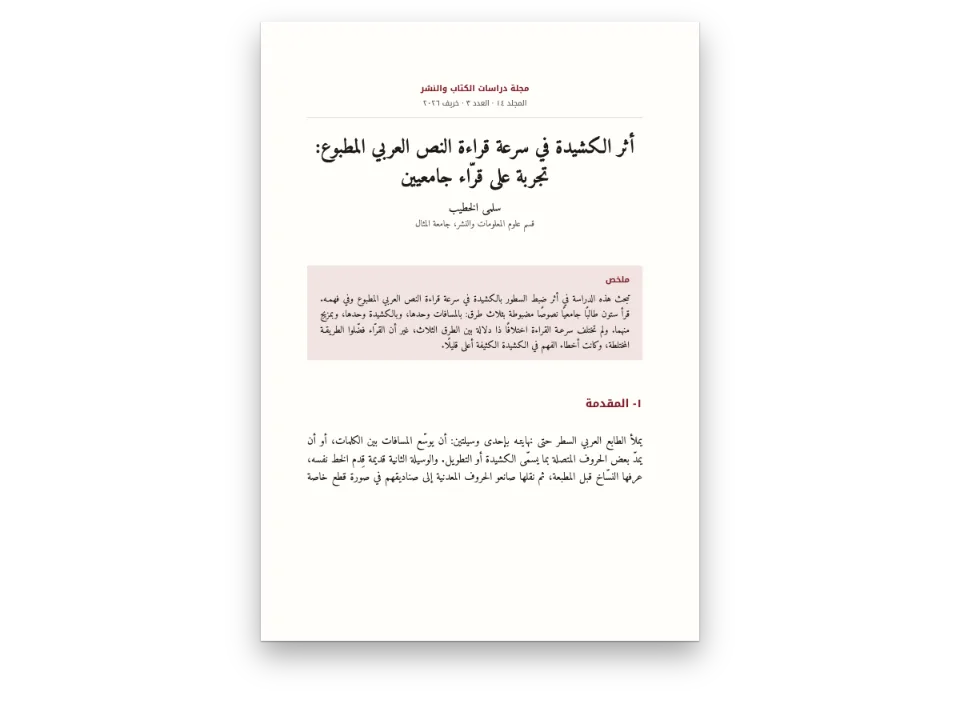
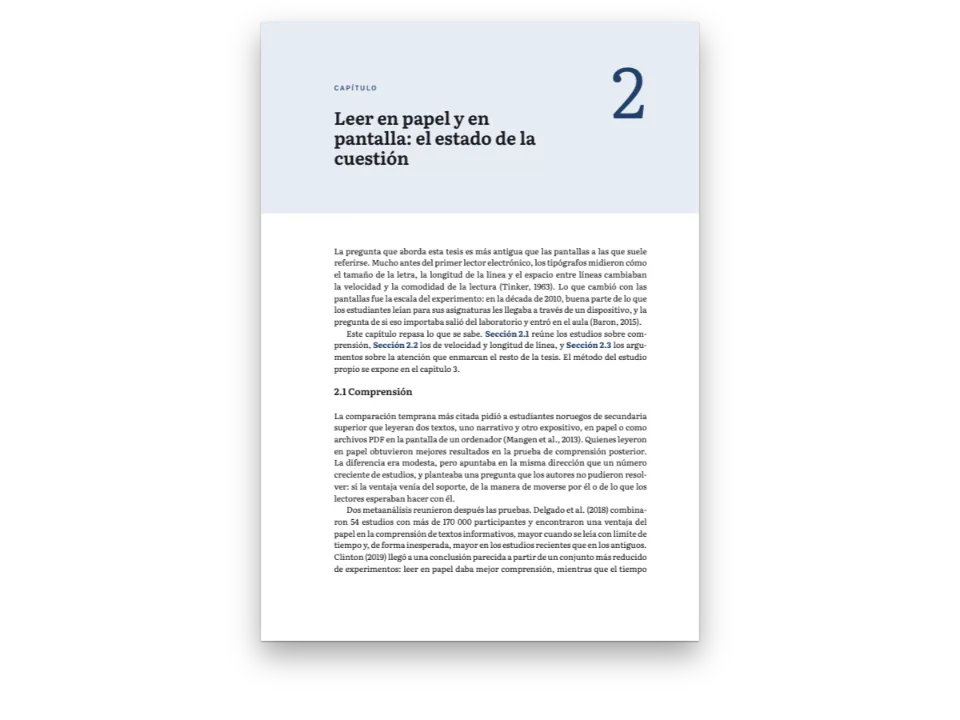
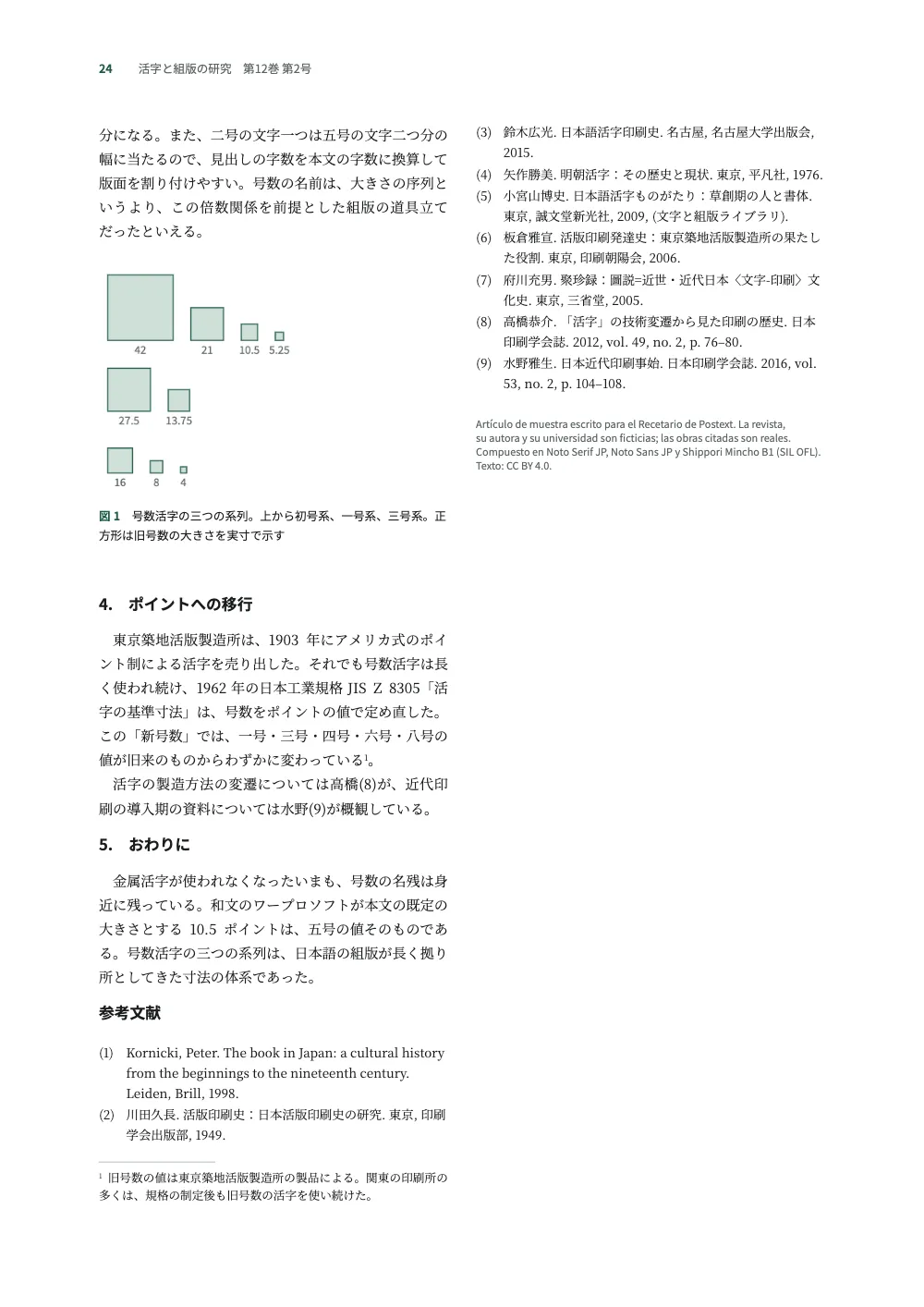
Dos páginas de una nota de investigación, 号数活字の三つの系列 («Las tres series de cuerpos gōsū»), de una revista inventada sobre tipos y composición, compuesta como componen sus revistas las sociedades académicas japonesas: A4, dos columnas de 25 caracteres por 45 líneas de Noto Serif JP a 9 pt, y el título en Shippori Mincho B1 sobre la banda verde de la revista. Las citas siguen SIST 02, la guía de referencias que usan las revistas japonesas de ciencia y tecnología: cada obra se numera por el orden en que se cita por primera vez, (1), (2, 3), y la lista bajo 参考文献 da los nombres japoneses con el apellido delante, el lugar antes de la editorial y el año al final. Una tabla de los nueve cuerpos, una figura que los dibuja a escala y dos notas al pie llevan rótulos japoneses. El artículo chino citado según la GB/T 7714 es su equivalente en chino.
Esta receta responde a
- ¿Cómo cito obras y compongo la bibliografía en APA, IEEE u otro estilo de cita?
- ¿Cómo compongo las notas de un libro japonés: (1) al final del capítulo, al pie de la página o junto al texto en la doble página?
La respuesta corta
// Register the engine once, before the first build. SIST 02, the standard Japanese science
// and technology journals cite to, numbers works in the order they are first cited; the
// ja-JP locale writes the list's words and joins authors with と and ほか. The document's
// own locale 'ja' gives the notes their Japanese defaults: at the foot of the column,
// numbered per page, a superscript marker and a rule a third of the column.
registerCitationEngine(createCiteprocEngine({ styles: STYLES, locales: LOCALES }));
const citations = {
  style: 'sist02',
  locale: 'ja-JP',
  bibliography: { fontSize: em(8 / BODY), lineHeight: pt(13), entrySpacing: pt(1),
    labelWidth: em(2.2) }, // turnovers under the text of the entry, past the (n)
};
const footnotes = { fontSize: pt(7.5), lineHeight: pt(11.5), color: col('ink'),
  separator: { color: col('rule') } }; // placement, numbering and marker: the 'ja' defaults
Ingredientes
- Funciones
- Citas en un estilo de citaBibliografía a partir de las referenciasNotas de los libros japonesesNotas al piePies numeradosFigura y Tabla en tu idiomaEstilo de tablasEstilo de los piesFiguras y tablas como recursosFiguras justo aquíTítulos numeradosTítulos que ocupan líneas del texto (gyōdori)Una o dos columnasRetícula de caracteresAperturas diseñadasEstilos de títuloFuentes chinas, japonesas y coreanasChips en líneaCabeceras y foliosExportación a PDF
- También usa
- RecuadrosCorte de líneas en chinoEquilibrado de columnasReferencias cruzadasAtributos de títuloCabeceras según el tipo de páginaEstilos de párrafoFuentes incrustadas en el PDFTipos de recurso propiosPreliminares en romanosTablas a partir de datosSaltos de línea en los títulosCapítulos sin número
- Tipografía
- Noto Serif JP, Noto Sans JP, Shippori Mincho B1 (SIL OFL 1.1)
- Recursos
- La figura 1, las tres series de cuerpos, dibujada en código a escala (Postext Cookbook, CC BY 4.0)
Elaboración
#1 · El estilo, la locale y las notas
El código es la respuesta corta de arriba. postext-citeproc trae SIST 02 como 'sist02' y la locale CSL ja-JP, que escribe en japonés los términos de la lista y une dos autores japoneses con と y más de dos con ほか en una cita narrativa (Citas). En el texto, [@kawada1949; @suzuki2015] imprime (2, 3), y 高橋[@takahashi2012]が pone el número tras el nombre, 高橋(8)が. El estilo se distingue del chino GB/T 7714 en la llamada: SIST 02 pone el número entre paréntesis en la línea; la GB/T 7714, entre corchetes y volado. Las notas no necesitan nada: locale: 'ja' da a un documento horizontal notas al pie de la columna, numeradas desde 1 en cada página, con la llamada volada y un filete de un tercio de la columna.
#2 · Las referencias en un bloque CSL-YAML
Las obras van al final del Markdown en :::references{format=csl-yaml}, el formato que Zotero exporta como CSL YAML (Citar). Los nombres japoneses entran como family y given, {family: 鈴木, given: 広光}, y SIST 02 los imprime juntos, 鈴木広光, mientras que Kornicki conserva su coma: Kornicki, Peter. Una colección va en collection-title y sale entre paréntesis tras el año; los dos artículos de 日本印刷学会誌 dan volumen, número y páginas como vol. 49, no. 2, p. 76–80. Todas las obras son reales; sus fichas se pueden comprobar en CiNii.
#3 · El título sobre la banda de la revista
const BAND = 78; // mm from the trim's top: the title sits on the journal's green
const at = (id, y) => ({ anchor: { to: `#${id}`, edge: 'below' }, offset: { y: mm(y) },
  size: { width: mm(AREA) } });
const line = (id, content, family, size, color, placement, extra) => ({ kind: 'text', id,
  content, fontFamily: family, fontSize: pt(size), color: col(color), align: 'center',
  overflow: 'wrap', placement, ...extra });
const top = (y) => ({ anchor: { to: 'container', edge: 'top-left' }, offset: { y: mm(y) },
  size: { width: mm(AREA) } });
const masthead = { enabled: true, minHeight: pt(10 * PITCH), slot: { elements: [
  { kind: 'box', id: 'band', style: { backgroundColor: col('green') },
    placement: { anchor: { to: 'page', edge: 'top-left' },
      size: { width: 'fill', height: mm(BAND) } } },
  line('journal', '活字と組版の研究', GOTHIC, 13, 'paper', top(-13), { fontWeight: 700,
    align: 'left', letterSpacing: pt(2) }),
  line('issue', '第12巻 第2号(2026)', GOTHIC, 8, 'mist', top(-12), { align: 'right' }),
  line('kind', '{attr.kind}', GOTHIC, 8, 'mist', top(2), { fontWeight: 700,
    letterSpacing: pt(2) }),
  line('title', '{titleText}', TITLE, 20, 'paper', at('kind', 3), { fontWeight: 700,
    lineHeight: 1.45 }),
  line('english', '{attr.english}', MINCHO, 8.5, 'mist', at('title', 3)),
  line('author', '{attr.authors}', MINCHO, 11, 'ink', top(BAND - 16)),
  line('affiliation', '{attr.affiliation}', MINCHO, 8, 'muted', at('author', 1.5)),
] } };
El bloque de título es el diseño del H1, un estilo de título que cruza las dos columnas. La banda es una caja anclada al corte; la etiqueta, el título y su traducción inglesa van sobre ella, cada uno bajo el anterior, así que un título de tres líneas empuja hacia abajo la línea inglesa. La autora y su filiación salen de atributos del título y van bajo la banda.
#4 · El resumen y sus etiquetas
const calloutStyles = [{ id: 'abstract', span: 'page', backgroundEnabled: false,
  stripe: { enabled: true, side: 'top', width: pt(1.5), color: col('green') },
  padding: { top: mm(2.5), bottom: mm(2.5), left: em(2), right: em(2) },
  marginTop: pt(0), marginBottom: pt(PITCH),
  body: { fontFamily: MINCHO, fontSize: pt(8.5), lineHeight: pt(14), firstLineIndent: pt(0),
    textAlign: 'justify' } }];
const chipStyles = [{ id: 'label', fontFamily: GOTHIC, bold: true, color: col('green'),
  backgroundEnabled: false, borderWidth: pt(0), paddingX: em(0), gap: em(1) }];
El resumen es un recuadro a todo el ancho bajo una franja superior verde, y sus etiquetas son chips en gótica negrita del color de la revista. Un espacio ideográfico tras cada etiqueta, escrito en el Markdown, separa 要 旨 del texto.
#5 · 表1 y 図1 donde se citan
const SIZES = `号数\t旧号数(pt)\t新号数(pt)\t系列
初号\t42\t42\t初号系
一号\t27.5\t26.25\t一号系
二号\t21\t21\t初号系
三号\t16\t15.75\t三号系
四号\t13.75\t13.125\t一号系
五号\t10.5\t10.5\t初号系
六号\t8\t7.875\t三号系
七号\t5.25\t5.25\t初号系
八号\t4\t3.9375\t三号系`;
const SERIES = [[42, 21, 10.5, 5.25], [27.5, 13.75], [16, 8, 4]]; // old values, pt
const resources = [
  { id: 'tbl:sizes', typeId: 'table', kind: 'table', createdAt: 0, updatedAt: 0,
    placement: { position: 'here' },
    caption: '号数活字の大きさ。新号数はJIS Z 8305(1962)による',
    table: { model: { ...parseTSV(SIZES), headerRowCount: 1, columnWidths: [16, 28, 28, 28] } } },
  { id: 'fig:series', typeId: 'figure', kind: 'svg', createdAt: 0, updatedAt: 0,
    placement: { position: 'here' },
    caption: '号数活字の三つの系列。上から初号系、一号系、三号系。正方形は旧号数の大きさを実寸で示す',
    altText: 'Three rows of squares drawn to scale: 42, 21, 10.5 and 5.25 pt; 27.5 and 13.75 pt; '
      + '16, 8 and 4 pt. Each square is half the one before it.',
    svg: { fileId: 'series.svg', width: 790, height: 520 } },
];
defaultResourceTypes('ja') da 図 y 表; el artículo los numera seguidos, 表1 y 図1, no por capítulo, así que la plantilla es '{n}'. Los dos van en 'here', debajo del párrafo que los cita, dentro de la columna. Los cuadrados de la figura se dibujan del tamaño del tipo que representan, de 42 pt para el 初号 a 4 pt para el 八号, para que la mitad de cada paso se vea en la página.
La receta completa
// ═══ Postext Cookbook · Nº 125 · A Japanese research paper cited to SIST 02 ═══════════ // https://postext.dev/en/cookbook/sist02-research-paper // Code: MIT · Text: original (CC BY 4.0) · Pictures: drawn in code // Fonts: Noto Serif JP, Noto Sans JP, Shippori Mincho B1 (SIL OFL 1.1) · Needs postext ≥ 1.16.1 import { buildDocument, renderPageToCanvas, clearMeasurementCache, registerCitationEngine, defaultResourceTypes, parseTSV, registerResourceImage, } from 'https://esm.sh/postext'; import { renderToPdf, decompressWoff2 } from 'https://esm.sh/postext-pdf'; import { createCiteprocEngine, STYLES, LOCALES } from 'https://esm.sh/postext-citeproc'; const LANG = 'es'; // @lang: the language of the frame; the paper is Japanese in both const RECIPE = 'sist02-research-paper'; // ─── 1 · Design ───────────────────────────────────────────────────────────── // #region palette: black text, one deep green for the journal, its rules and its labels const palette = { ink: '#1b1d1c', green: '#1f5a46', mist: '#cfe0d8', rule: '#a7b3ad', muted: '#5d6662', paper: '#ffffff', }; const col = (id) => ({ hex: palette[id], model: 'hex', paletteId: id }); const colorPalette = Object.entries({ ...palette, 'main-color': palette.green }) .map(([id, hex]) => ({ id, name: id, value: { hex, model: 'hex' } })); // #endregion const [MINCHO, GOTHIC, TITLE] = ['Noto Serif JP', 'Noto Sans JP', 'Shippori Mincho B1']; const [BODY, PITCH] = [9, 15.5]; // pt: 9 pt text on a 15.5 pt line const [CHARS, LINES] = [25, 45]; // characters to a column's line, lines to a column const PT = 25.4 / 72; // mm in a point const AREA = (2 * CHARS + 2) * BODY * PT; // mm: two columns and a 2-em gutter, 165 // #region answer: SIST 02 in Japanese: numbered citations, the list under 参考文献 // Register the engine once, before the first build. SIST 02, the standard Japanese science // and technology journals cite to, numbers works in the order they are first cited; the // ja-JP locale writes the list's words and joins authors with と and ほか. The document's // own locale 'ja' gives the notes their Japanese defaults: at the foot of the column, // numbered per page, a superscript marker and a rule a third of the column. registerCitationEngine(createCiteprocEngine({ styles: STYLES, locales: LOCALES })); const citations = { style: 'sist02', locale: 'ja-JP', bibliography: { fontSize: em(8 / BODY), lineHeight: pt(13), entrySpacing: pt(1), labelWidth: em(2.2) }, // turnovers under the text of the entry, past the (n) }; const footnotes = { fontSize: pt(7.5), lineHeight: pt(11.5), color: col('ink'), separator: { color: col('rule') } }; // placement, numbering and marker: the 'ja' defaults // #endregion // #region masthead: the journal, the paper's kind, its title and English title on a band const BAND = 78; // mm from the trim's top: the title sits on the journal's green const at = (id, y) => ({ anchor: { to: `#${id}`, edge: 'below' }, offset: { y: mm(y) }, size: { width: mm(AREA) } }); const line = (id, content, family, size, color, placement, extra) => ({ kind: 'text', id, content, fontFamily: family, fontSize: pt(size), color: col(color), align: 'center', overflow: 'wrap', placement, ...extra }); const top = (y) => ({ anchor: { to: 'container', edge: 'top-left' }, offset: { y: mm(y) }, size: { width: mm(AREA) } }); const masthead = { enabled: true, minHeight: pt(10 * PITCH), slot: { elements: [ { kind: 'box', id: 'band', style: { backgroundColor: col('green') }, placement: { anchor: { to: 'page', edge: 'top-left' }, size: { width: 'fill', height: mm(BAND) } } }, line('journal', '活字と組版の研究', GOTHIC, 13, 'paper', top(-13), { fontWeight: 700, align: 'left', letterSpacing: pt(2) }), line('issue', '第12巻 第2号(2026)', GOTHIC, 8, 'mist', top(-12), { align: 'right' }), line('kind', '{attr.kind}', GOTHIC, 8, 'mist', top(2), { fontWeight: 700, letterSpacing: pt(2) }), line('title', '{titleText}', TITLE, 20, 'paper', at('kind', 3), { fontWeight: 700, lineHeight: 1.45 }), line('english', '{attr.english}', MINCHO, 8.5, 'mist', at('title', 3)), line('author', '{attr.authors}', MINCHO, 11, 'ink', top(BAND - 16)), line('affiliation', '{attr.affiliation}', MINCHO, 8, 'muted', at('author', 1.5)), ] } }; // #endregion // #region abstract: across both columns, its labels in gothic the colour of the journal const calloutStyles = [{ id: 'abstract', span: 'page', backgroundEnabled: false, stripe: { enabled: true, side: 'top', width: pt(1.5), color: col('green') }, padding: { top: mm(2.5), bottom: mm(2.5), left: em(2), right: em(2) }, marginTop: pt(0), marginBottom: pt(PITCH), body: { fontFamily: MINCHO, fontSize: pt(8.5), lineHeight: pt(14), firstLineIndent: pt(0), textAlign: 'justify' } }]; const chipStyles = [{ id: 'label', fontFamily: GOTHIC, bold: true, color: col('green'), backgroundEnabled: false, borderWidth: pt(0), paddingX: em(0), gap: em(1) }]; // #endregion // Running heads on the body pages: the journal on the verso, the author on the recto. const head = (id, content, parity, edge, x, extra) => ({ kind: 'text', id, content, parity, pages: 'body', fontFamily: GOTHIC, fontSize: pt(7.5), color: col('muted'), align: edge.endsWith('left') ? 'left' : 'right', placement: { anchor: { to: 'container', edge }, offset: { x: mm(x), y: mm(14) } }, ...extra }); const folio = { fontWeight: 700, color: col('green') }; const header = { elements: [ head('v-folio', '{pageNumber}', 'even', 'top-left', 0, folio), head('v-head', '活字と組版の研究 第12巻 第2号', 'even', 'top-left', 9), head('r-head', '森川:号数活字の三つの系列', 'odd', 'top-right', -9), head('r-folio', '{pageNumber}', 'odd', 'top-right', 0, folio), ] }; const config = () => ({ // a factory: the engine caches resolved configs per object locale: 'ja', // written out, never LANG (gotcha: ja-locale-tag) resourceTypes: defaultResourceTypes('ja').map((type) => ({ ...type, numberingTemplate: '{n}' })), // 図1, 表1: a paper numbers through, not by chapter colorPalette, citations, footnotes, page: { sizePreset: 'custom', width: mm(210), height: mm(297), dpi: 150, // A4 pageNumbering: { startAt: 23 }, margins: { top: mm(24), bottom: mm(20), left: mm(18), right: mm(18), mirror: true } }, layout: { layoutType: 'double', gutterWidth: pt(2 * BODY) }, cjk: { grid: { enabled: true, charsPerLine: CHARS, linesPerPage: LINES } }, bodyText: { fontFamily: MINCHO, fontSize: pt(BODY), lineHeight: pt(PITCH), color: col('ink'), boldColor: col('ink'), italicColor: col('ink'), referenceColor: col('ink'), referenceBold: false, textAlign: 'justify', firstLineIndent: em(1), indentAfterHeading: true }, headings: { fontFamily: GOTHIC, fontWeight: 700, color: col('ink'), balancing: { enabled: false }, // heads stay on the grid levels: [ { level: 1, breakBefore: { enabled: true, parity: 'any' } }, // headings-drop-h1-break { level: 2, numberingTemplate: '{2}.', numberSeparator: ' ', fontSize: pt(10), lineSpan: 2 }, // 2行取り: 1. はじめに on two lines of the grid ] }, headingStyles: [ { id: 'article', numbered: false, span: 'page', advancedDesign: masthead }, { id: 'references', numbered: false }, ], calloutStyles, chipStyles, tableStyle: { rules: 'horizontal', borderColor: col('rule'), borderWidth: pt(0.5), headerBackground: col('green'), headerColor: col('paper'), headerFontFamily: GOTHIC, bodyFontFamily: MINCHO, bodyFontSize: pt(8), bodyColor: col('ink'), cellPadding: mm(1) }, captionStyle: { fontFamily: GOTHIC, fontSize: pt(7.5), color: col('ink'), labelBold: true, labelColor: col('green') }, // 表1 …, the ja default paragraphStyles: [{ id: 'colophon', fontFamily: GOTHIC, fontSize: pt(6.5), lineHeight: pt(9), color: col('muted'), firstLineIndent: pt(0), textAlign: 'left', marginTop: pt(PITCH) }], header, footer: { elements: [] }, }); // ─── 2 · Content ──────────────────────────────────────────────────────────── const markdown = String.raw`---Muestra en Markdown · 134 líneas · content.es.md
title: "号数活字の三つの系列" --- # 号数活字の三つの系列:\\近代日本の活字の大きさはどう決められたか {style="article" kind="研究ノート" authors="森川 啓" affiliation="架空大学 文学部" english="Three Series of Gōsū Type Sizes: How the Sizes of Modern Japanese Type Were Set"} :::callout{type="abstract"} :chip[要 旨]{style="label"} 明治初期に日本で鋳造が始まった金属活字は、初号から八号までの九つの大きさを「号数」で呼び分けた。本稿では、号数活字の大きさが倍と半分の関係で結ばれた三つの系列からなることを示し、その構造が組版の実務に何をもたらしたかを整理する。また、1962年に日本工業規格が号数をポイントの値で定め直した経緯と、いまも五号に当たる10.5ポイントが和文の標準の大きさとして残っている理由を考察する。 :chip[キーワード]{style="label"} 号数活字、ポイント、明朝体、東京築地活版製造所、JIS Z 8305 ::: ## はじめに 日本語の活字印刷は、近世初期の古活字版のように早くから試みられてきたが[@kornicki1998]、出版の主流となったのは明治に入って金属活字が鋳造されてからである[@kawada1949; @suzuki2015]。その活字の大きさは、いまのようなポイントではなく、「号数」という独自の単位で呼ばれていた。 号数活字の名前は、組版や印刷の歴史を扱う文献にたびたび現れる[@yahagi1976; @komiyama2009]。しかし、九つの大きさがどのような関係で並んでいるのかは、個々の数値ほどには知られていない。本稿では、号数の大きさを系列ごとに整理し、その構造が組版に与えた影響を考える[^term]。 ## 号数活字の成立 号数の体系は、1869年に長崎で本木昌造らが上海の美華書館の技術者から活字鋳造を学んだことに始まるとされる。その後、平野富二が東京築地活版製造所を設け、号数活字は同所の製品として全国に広まった[@itakura2006]。同所の活字見本は、近代日本の書体と字形を知るための基本資料となっている[@fukawa2005]。 ## 三つの系列 号数活字の大きさを[@tbl:sizes]に示す。九つの大きさは、互いに倍と半分の関係で結ばれた三つの系列に分けられる。初号・二号・五号・七号の系列、一号・四号の系列、三号・六号・八号の系列である([@fig:series])。 ::resource{id="tbl:sizes"} この構造には実務上の利点があった。五号の本文に七号のルビを付けると、ルビの大きさはちょうど本文の半分になる。また、二号の文字一つは五号の文字二つ分の幅に当たるので、見出しの字数を本文の字数に換算して版面を割り付けやすい。号数の名前は、大きさの序列というより、この倍数関係を前提とした組版の道具立てだったといえる。 ::resource{id="fig:series"} ## ポイントへの移行 東京築地活版製造所は、1903年にアメリカ式のポイント制による活字を売り出した。それでも号数活字は長く使われ続け、1962年の日本工業規格JIS Z 8305「活字の基準寸法」は、号数をポイントの値で定め直した。この「新号数」では、一号・三号・四号・六号・八号の値が旧来のものからわずかに変わっている[^jis]。 活字の製造方法の変遷については高橋[@takahashi2012]が、近代印刷の導入期の資料については水野[@mizuno2016]が概観している。 ## おわりに 金属活字が使われなくなったいまも、号数の名残は身近に残っている。和文のワープロソフトが本文の既定の大きさとする10.5ポイントは、五号の値そのものである。号数活字の三つの系列は、日本語の組版が長く拠り所としてきた寸法の体系であった。 ## 参考文献 {style="references"} :::bibliography{title=""} [^term]: 本稿でいう「活字」は、鉛合金で鋳造した金属活字を指す。 [^jis]: 旧号数の値は東京築地活版製造所の製品による。関東の印刷所の多くは、規格の制定後も旧号数の活字を使い続けた。 :::paragraphs{style="colophon"} Artículo de muestra escrito para el Recetario de Postext. La revista, su autora y su universidad son ficticias; las obras citadas son reales. Compuesto en Noto Serif JP, Noto Sans JP y Shippori Mincho B1 (SIL OFL). Texto: CC BY 4.0. ::: :::references{format=csl-yaml} - id: suzuki2015 type: book language: ja author: [{family: 鈴木, given: 広光}] title: 日本語活字印刷史 publisher: 名古屋大学出版会 publisher-place: 名古屋 issued: 2015 - id: yahagi1976 type: book language: ja author: [{family: 矢作, given: 勝美}] title: 明朝活字:その歴史と現状 publisher: 平凡社 publisher-place: 東京 issued: 1976 - id: komiyama2009 type: book language: ja author: [{family: 小宮山, given: 博史}] title: 日本語活字ものがたり:草創期の人と書体 publisher: 誠文堂新光社 publisher-place: 東京 collection-title: 文字と組版ライブラリ issued: 2009 - id: itakura2006 type: book language: ja author: [{family: 板倉, given: 雅宣}] title: 活版印刷発達史:東京築地活版製造所の果たした役割 publisher: 印刷朝陽会 publisher-place: 東京 issued: 2006 - id: fukawa2005 type: book language: ja author: [{family: 府川, given: 充男}] title: 聚珍録:圖説=近世・近代日本〈文字-印刷〉文化史 publisher: 三省堂 publisher-place: 東京 issued: 2005 - id: kawada1949 type: book language: ja author: [{family: 川田, given: 久長}] title: 活版印刷史:日本活版印刷史の研究 publisher: 印刷学会出版部 publisher-place: 東京 issued: 1949 - id: kornicki1998 type: book language: en author: [{family: Kornicki, given: Peter}] title: "The book in Japan: a cultural history from the beginnings to the nineteenth century" publisher: Brill publisher-place: Leiden issued: 1998 - id: takahashi2012 type: article-journal language: ja author: [{family: 高橋, given: 恭介}] title: 「活字」の技術変遷から見た印刷の歴史 container-title: 日本印刷学会誌 volume: 49 issue: 2 page: 76-80 issued: 2012 DOI: 10.11413/nig.49.076 - id: mizuno2016 type: article-journal language: ja author: [{family: 水野, given: 雅生}] title: 日本近代印刷事始 container-title: 日本印刷学会誌 volume: 53 issue: 2 page: 104-108 issued: 2016 DOI: 10.11413/nig.53.104 :::`; // content.<lang>.md: the same Japanese paper in both // #region resources: the table of sizes, and the three series drawn to scale const SIZES = `号数\t旧号数(pt)\t新号数(pt)\t系列 初号\t42\t42\t初号系 一号\t27.5\t26.25\t一号系 二号\t21\t21\t初号系 三号\t16\t15.75\t三号系 四号\t13.75\t13.125\t一号系 五号\t10.5\t10.5\t初号系 六号\t8\t7.875\t三号系 七号\t5.25\t5.25\t初号系 八号\t4\t3.9375\t三号系`; const SERIES = [[42, 21, 10.5, 5.25], [27.5, 13.75], [16, 8, 4]]; // old values, pt const resources = [ { id: 'tbl:sizes', typeId: 'table', kind: 'table', createdAt: 0, updatedAt: 0, placement: { position: 'here' }, caption: '号数活字の大きさ。新号数はJIS Z 8305(1962)による', table: { model: { ...parseTSV(SIZES), headerRowCount: 1, columnWidths: [16, 28, 28, 28] } } }, { id: 'fig:series', typeId: 'figure', kind: 'svg', createdAt: 0, updatedAt: 0, placement: { position: 'here' }, caption: '号数活字の三つの系列。上から初号系、一号系、三号系。正方形は旧号数の大きさを実寸で示す', altText: 'Three rows of squares drawn to scale: 42, 21, 10.5 and 5.25 pt; 27.5 and 13.75 pt; ' + '16, 8 and 4 pt. Each square is half the one before it.', svg: { fileId: 'series.svg', width: 790, height: 520 } }, ]; // #endregion // #region art: squares at their size in points, labelled in the gothic's latin file async function labelFace() { const url = 'https://cdn.jsdelivr.net/npm/@fontsource/noto-sans-jp@5/files/' + 'noto-sans-jp-latin-400-normal.woff2'; const bytes = new Uint8Array(await (await fetch(url)).arrayBuffer()); let bin = ''; for (let i = 0; i < bytes.length; i += 8192) { bin += String.fromCharCode(...bytes.subarray(i, i + 8192)); } return `@font-face{font-family:L;src:url(data:font/woff2;base64,${btoa(bin)}) format('woff2')}` + `text{font-family:L;font-size:2.4px;text-anchor:middle;fill:${palette.muted}}`; } function seriesArt(style) { let out = ''; SERIES.forEach((row, r) => { let x = 2; const base = [17, 33, 47][r]; // mm: the squares of a row stand on one line for (const size of row) { const s = size * PT; // a square as wide as the type body out += `<rect x="${x}" y="${base - s}" width="${s}" height="${s}" fill="${palette.mist}" ` + `stroke="${palette.green}" stroke-width=".25"/><text x="${x + s / 2}" y="${base + 3}">` + `${size}</text>`; x += s + 4; } }); return `<svg xmlns="http://www.w3.org/2000/svg" width="790" height="520" viewBox="0 0 79 52">` + `<style>${style}</style>${out}</svg>`; } // #endregion // ─── 3 · Fonts ────────────────────────────────────────────────────────────── const FONTS = { // every face the pages use, loaded before the build (gotcha: fonts-first) 'Noto Serif JP': ['400'], // 明朝: text, abstract, notes, references, author 'Noto Sans JP': ['400', '700'], // ゴシック: journal, heads, labels, captions, table head 'Shippori Mincho B1': ['700'], // the title, a display mincho }; // ─── 4 · Build & show ─────────────────────────────────────────────────────── // Each voice loads the files of what it sets (gotcha: cjk-fonts-slices); the text face also // gets the words SIST 02 adds to the list. const all = (re) => (markdown.match(re) ?? []).join(''); const gothic = `${all(/^#+ .*$/gm)}${all(/:chip\[[^\]]*\]/g)}${SIZES}` + `${resources.map((r) => r.caption).join('')}活字と組版の研究第巻号森川:三つの系列0123456789`; await loadFonts(FONTS, markdown); await loadCjkFonts({ [MINCHO]: FONTS[MINCHO] }, `${markdown}${SIZES}ほかと編巻号頁`); await loadCjkFonts({ [GOTHIC]: FONTS[GOTHIC] }, gothic); await loadCjkFonts({ [TITLE]: FONTS[TITLE] }, all(/^# .*$/gm)); await loadSvg('series.svg', seriesArt(await labelFace())); const doc = await buildWithFonts(() => buildDocument({ markdown, resources }, config()), markdown); showPages(doc, { title: t({ en: 'A Japanese paper cited to SIST 02', es: 'Un artículo japonés citado según SIST 02' }) }); offerPdf(() => renderToPdf(doc, { fontProvider: cjkPdfProvider, resourceBytes: imageBytes }), `${RECIPE}.pdf`);Kit · core, fonts, viewer, pdf, images, cjk: igual en todas las recetas · 488 líneas
// ─── Kit ── helpers shared by every Cookbook recipe · postext.dev/cookbook ───── // ─── Kit · core v1 ── the same in every recipe · postext.dev/cookbook ───────── function mm(value) { return { value, unit: 'mm' }; } function pt(value) { return { value, unit: 'pt' }; } function em(value) { return { value, unit: 'em' }; } /** The sample language's string: t({ en: 'Figure', es: 'Figura' }). */ function t(strings) { return strings[LANG] ?? Object.values(strings)[0]; } /** A file in this recipe's assets folder, served from the Postext repo by jsDelivr. */ function asset(file) { return `https://cdn.jsdelivr.net/gh/drnachio/postext@main/cookbook/${RECIPE}/assets/${file}`; } // ─── Kit · fonts v1 ── the same in every recipe · postext.dev/cookbook ──────── // Postext measures text with the faces the browser has loaded, and caches the // widths, so every face must be ready before the first build. Faces come from // Fontsource: the same static files the PDF embeds, so screen and PDF agree. /** faces = { 'Family Name': ['400', '400i', '700'] }. `text` is the sample: * letters beyond Latin-1 (č, ł, ő…) also load the latin-ext files. With * `optional`, a face Fontsource does not ship is skipped instead of failing. * Resolves to the number of faces added. */ async function loadFonts(faces, text = '', { optional = false } = {}) { kitStatus('Loading fonts…'); const ranges = { latin: 'U+0000-00FF,U+0131,U+0152-0153,U+02BB-02BC,U+02C6,U+02DA,U+02DC,U+0304,U+0308,U+0329,' + 'U+2000-206F,U+20AC,U+2122,U+2191,U+2193,U+2212,U+2215,U+FEFF,U+FFFD', 'latin-ext': 'U+0100-02BA,U+02BD-02C5,U+02C7-02CC,U+02CE-02D7,U+02DD-02FF,U+0304,U+0308,U+0329,' + 'U+1D00-1DBF,U+1E00-1E9F,U+1EF2-1EFF,U+2020,U+20A0-20AB,U+20AD-20C0,U+2113,U+2C60-2C7F,U+A720-A7FF', }; const subsets = /[Ā-˿Ḁ-ỿ]/.test(text) ? ['latin', 'latin-ext'] : ['latin']; const jobs = []; let added = 0; for (const [family, specs] of Object.entries(faces)) { const id = fontsourceId(family); const meta = optional ? await fontsourceMeta(family) : null; for (const spec of new Set(specs)) { const weight = parseInt(spec, 10); const style = spec.endsWith('i') ? 'italic' : 'normal'; if (hasFace(family, weight, style)) continue; if (optional && !(meta?.weights.includes(weight) && meta.styles.includes(style))) continue; for (const subset of subsets) { const url = `https://cdn.jsdelivr.net/npm/@fontsource/${id}@5/files/${id}-${subset}-${weight}-${style}.woff2`; const face = new FontFace(family, `url(${url}) format('woff2')`, { weight: String(weight), style, unicodeRange: ranges[subset] }); jobs.push(face.load().then((ready) => { document.fonts.add(ready); added++; }, () => { if (subset === 'latin' && !optional) throw new Error(`Fontsource has no ${family} ${weight} ${style}`); })); } } } await Promise.all(jobs).catch((error) => { kitFail(error); throw error; }); return added; } /** Runs `build` (a buildDocument or buildBundle call) and checks the faces * the pages use. A regular face missing from FONTS is loaded with a warning; * bold and italic variants are loaded when the family ships them. Then the * measurement caches are cleared and the build runs again. */ async function buildWithFonts(build, text = '') { const tried = new Set(); for (let round = 0; round < 3; round++) { kitStatus('Laying out…'); await new Promise(requestAnimationFrame); // let the status paint first const result = await Promise.resolve().then(build).catch((error) => { kitFail(error); throw error; }); const wanted = { base: {}, variants: {} }; for (const { font, base } of [result].flat().flatMap(fontStringsOf)) { const { family, weight, style } = parseFont(font); const key = `${family}|${weight}|${style}`; if (tried.has(key) || hasFace(family, weight, style)) continue; tried.add(key); (wanted[base ? 'base' : 'variants'][family] ??= []).push(`${weight}${style === 'italic' ? 'i' : ''}`); } if (Object.keys(wanted.base).length) { console.warn(`[cookbook] FONTS does not list ${JSON.stringify(wanted.base)}: loading them.`); } const added = await loadFonts(wanted.base, text) + await loadFonts(wanted.variants, text, { optional: true }); if (added === 0) return result; clearMeasurementCache(); } throw new Error('The fonts did not settle after three builds.'); } /** Every font string of the layout. `base` marks a block's own face; its * bold, italic and bold-italic variants are listed whether or not used. */ function fontStringsOf(doc) { const found = new Map(); const walk = (node) => { if (!node || typeof node !== 'object') return; if (Array.isArray(node)) { node.forEach(walk); return; } for (const [key, value] of Object.entries(node)) { if (typeof value === 'string' && /fontString$/i.test(key)) { found.set(value, found.get(value) || key === 'fontString'); } else if (value && typeof value === 'object') walk(value); } }; walk(doc.pages); walk(doc.blocks); return [...found].map(([font, base]) => ({ font, base })); } /** '700 37.5px Open Sans' / 'italic 400 13px "Source Serif 4"' → { family, weight, style }. * A string with no weight ('95.8px Young Serif', from a design text) is 400. */ function parseFont(font) { const m = /^(?:(italic|oblique)\s+)?(?:small-caps\s+)?(?:(\d+|bold|normal)\s+)?[\d.]+px\s+(.+)$/.exec(font.trim()); if (!m) throw new Error(`Unexpected font string: ${font}`); const weight = m[2] === 'bold' ? 700 : !m[2] || m[2] === 'normal' ? 400 : Number(m[2]); return { family: m[3].replace(/^["']|["']$/g, ''), weight, style: m[1] ? 'italic' : 'normal' }; } /** True when a loaded FontFace covers exactly this family, weight and style * (document.fonts.check() is also true for families nobody declared). */ function hasFace(family, weight, style) { for (const face of document.fonts) { if (face.status !== 'loaded' || face.style !== style) continue; if (face.family.replace(/^["']|["']$/g, '') !== family) continue; const [low, high = low] = face.weight.split(' ').map(Number); if (weight >= low && weight <= high) return true; } return false; } /** Fontsource's id for a family: 'Source Serif 4' → 'source-serif-4'. */ function fontsourceId(family) { return family.toLowerCase().replace(/\s+/g, '-'); } /** The weights and styles a family ships ({ weights: [400, 700], styles: ['normal', 'italic'] }), or null. */ function fontsourceMeta(family) { fontsourceMeta.cache ??= new Map(); const id = fontsourceId(family); if (!fontsourceMeta.cache.has(id)) { fontsourceMeta.cache.set(id, fetch(`https://api.fontsource.org/v1/fonts/${id}`) .then((res) => (res.ok ? res.json() : null), () => null)); } return fontsourceMeta.cache.get(id); } // ─── Kit · viewer v1 ── the same in every recipe · postext.dev/cookbook ─────── /** Shows the pages as facing spreads on a dark desk: the first page is a * recto on its own, then verso | recto pairs, as in a bound book. Pages * are painted when they scroll near the screen. */ function showPages(docs, { title, width = 460 } = {}) { const root = viewer(title); const pages = [docs].flat().flatMap((doc) => doc.pages.map((page) => ({ doc, page, n: (doc.pageIndexOffset ?? 0) + page.index }))); const spreads = []; let verso = null; for (const p of pages) { if (p.n % 2 === 1) { if (verso) spreads.push([verso, null]); verso = p; } else { spreads.push([verso, p]); verso = null; } } if (verso) spreads.push([verso, null]); const density = Math.min(window.devicePixelRatio || 1, 2); showPages.painter?.disconnect(); const painter = new IntersectionObserver((entries) => { for (const { isIntersecting, target } of entries) { if (!isIntersecting) continue; painter.unobserve(target); const { doc, page } = target.postext; renderPageToCanvas(page, doc, target, { scale: (width * density) / page.width }); } }, { rootMargin: '800px' }); showPages.painter = painter; root.replaceChildren(...spreads.map((pair) => { const spread = document.createElement('div'); spread.className = 'pt-spread'; for (const p of pair) { const figure = document.createElement('figure'); if (p) { const label = p.page.pageLabel || String(p.n + 1); const canvas = document.createElement('canvas'); canvas.postext = p; canvas.style.aspectRatio = `${p.page.width} / ${p.page.height}`; canvas.setAttribute('role', 'img'); canvas.setAttribute('aria-label', `Page ${label}`); const folio = document.createElement('figcaption'); folio.textContent = label; figure.append(canvas, folio); painter.observe(canvas); } else figure.className = 'pt-blank'; spread.append(figure); } return spread; })); kitStatus(`${pages.length} ${pages.length === 1 ? 'page' : 'pages'}`); document.documentElement.dataset.postext = 'ready'; return pages.length; } /** The desk, the bar and the error reporting, created once. */ function viewer(title) { if (!document.getElementById('pt-kit')) { document.head.insertAdjacentHTML('beforeend', `<style id="pt-kit"> :root { color-scheme: dark; } body { margin: 0; background: #0e1014; color: #b9bcc4; font: 13px/1.45 system-ui, sans-serif; } #pt-bar { position: sticky; top: 0; z-index: 1; display: flex; flex-wrap: wrap; align-items: center; gap: 6px 16px; padding: 10px 16px; background: rgb(14 16 20 / .92); backdrop-filter: blur(6px); border-bottom: 1px solid #23262d; } #pt-bar strong { color: #f4f1ea; font-weight: 600; } #pt-actions { display: flex; gap: 12px; margin-left: auto; } #pt-actions a, #pt-actions button { color: #d8a21a; font: inherit; background: none; border: 0; padding: 0; cursor: pointer; } #pages { display: grid; justify-items: center; gap: 48px; padding: 32px 16px 72px; } .pt-spread { display: flex; } .pt-spread figure { margin: 0; width: min(460px, 44vw); } .pt-spread canvas { display: block; width: 100%; background: #fff; box-shadow: 0 1px 2px rgb(0 0 0 / .5), 0 22px 44px -16px rgb(0 0 0 / .8); } .pt-spread figure:first-child canvas { box-shadow: inset -14px 0 14px -14px rgb(0 0 0 / .18), 0 1px 2px rgb(0 0 0 / .5), 0 22px 44px -16px rgb(0 0 0 / .8); } .pt-spread figcaption { margin-top: 10px; text-align: center; font: 600 10px/1 system-ui, sans-serif; letter-spacing: .18em; text-transform: uppercase; color: #6c7079; } .pt-blank { visibility: hidden; } @media (max-width: 760px) { .pt-spread { flex-direction: column; gap: 32px; } .pt-spread figure { width: min(460px, 92vw); } .pt-blank { display: none; } } </style>`); document.body.insertAdjacentHTML('afterbegin', '<header id="pt-bar"><strong id="pt-title"></strong><span id="pt-status" role="status"></span><span id="pt-actions"></span></header>'); document.getElementById('pt-title').textContent = document.title || 'Postext'; addEventListener('error', (event) => kitFail(event.error ?? event.message)); addEventListener('unhandledrejection', (event) => kitFail(event.reason)); } if (title) document.getElementById('pt-title').textContent = title; return document.getElementById('pages') ?? document.body.appendChild(Object.assign(document.createElement('main'), { id: 'pages' })); } function kitStatus(text) { viewer(); document.getElementById('pt-status').textContent = text; } function kitFail(error) { document.documentElement.dataset.postext = 'error'; kitStatus(`Error: ${error?.message ?? error}`); } // ─── Kit · pdf v1 ── the same in every recipe that exports a PDF ────────────── /** postext-pdf embeds TrueType bytes. Fetch the Fontsource file the screen * used, snapping to a weight the family ships and falling back to upright * when it has no italic: the PDF asks for every face a block could use. */ async function fontsourceProvider(family, weight, style) { const id = fontsourceId(family); const meta = await fontsourceMeta(family); const weights = meta?.weights?.length ? meta.weights : [400, 700]; const w = weights.reduce((a, b) => (Math.abs(b - weight) < Math.abs(a - weight) ? b : a)); const s = style === 'italic' && meta && !meta.styles.includes('italic') ? 'normal' : style; const res = await fetch(`https://cdn.jsdelivr.net/npm/@fontsource/${id}@5/files/${id}-latin-${w}-${s}.woff2`); if (!res.ok) throw new Error(`Fontsource has no ${family} ${w} ${s} (${res.status})`); return decompressWoff2(new Uint8Array(await res.arrayBuffer())); } /** A "Build the PDF" button in the bar. Once built: "Open the PDF" (a new * tab, since CodePen's preview frame cannot show PDFs) and a download link. */ function offerPdf(makePdf, filename) { viewer(); const button = Object.assign(document.createElement('button'), { type: 'button', textContent: 'Build the PDF' }); button.dataset.postextPdf = filename; button.addEventListener('click', async () => { button.disabled = true; button.textContent = 'Building the PDF…'; try { const bytes = await makePdf(); const url = URL.createObjectURL(new Blob([bytes], { type: 'application/pdf' })); const size = `${Math.max(1, Math.round(bytes.length / 1024))} KB`; button.replaceWith( Object.assign(document.createElement('a'), { href: url, target: '_blank', rel: 'noopener', textContent: 'Open the PDF ↗' }), Object.assign(document.createElement('a'), { href: url, download: filename, textContent: `Download ${filename} · ${size}` })); } catch (error) { button.disabled = false; button.textContent = 'Build the PDF'; kitFail(error); } }); document.getElementById('pt-actions').append(button); } // ─── Kit · images v1 ── recipes with pictures · postext.dev/cookbook ────────── /** Registers a photo or PNG for the canvas and keeps its bytes for the PDF. * fetch → ImageBitmap never taints the canvas (a plain cross-origin <img> would). */ async function loadImage(fileId, url) { const res = await fetch(url); if (!res.ok) throw new Error(`Image not found (${res.status}): ${url}`); const bytes = new Uint8Array(await res.arrayBuffer()); registerResourceImage(fileId, await createImageBitmap(new Blob([bytes]))); (loadImage.bytes ??= new Map()).set(fileId, bytes); } /** Registers SVG markup (drawn in code, or fetched) as a vector image. */ async function loadSvg(fileId, svg) { const img = new Image(); img.src = `data:image/svg+xml;charset=utf-8,${encodeURIComponent(svg)}`; await img.decode(); registerResourceImage(fileId, img); (loadImage.bytes ??= new Map()).set(fileId, new TextEncoder().encode(svg)); } /** renderToPdf({ resourceBytes: imageBytes }) */ function imageBytes(fileId) { return loadImage.bytes?.get(fileId); } /** renderToHtml({ resourceImageUrl: imageUrl }) */ function imageUrl(fileId) { const bytes = imageBytes(fileId); if (!bytes) return undefined; imageUrl.urls ??= new Map(); if (!imageUrl.urls.has(fileId)) { const type = /\.svg$/i.test(fileId) ? 'image/svg+xml' : /\.png$/i.test(fileId) ? 'image/png' : 'image/jpeg'; imageUrl.urls.set(fileId, URL.createObjectURL(new Blob([bytes], { type }))); } return imageUrl.urls.get(fileId); } // ─── Kit · cjk v1 ── Chinese, Japanese and Korean books · postext.dev/cookbook ─ // Fontsource ships a CJK family as about a hundred files per weight, each // declared in its stylesheet with the unicode-range it covers. The screen // loads the files the sample touches; the PDF gets the same files for the // characters its pages set in each face, and embeds each as a subset. // A book bound on the right (vertical text) is shown with its spreads // mirrored: page 1 alone on the left of the spine, then [3 | 2]. /** The files of a Fontsource face, read from its stylesheet: { url, range, * ranges }, the last declared first (the order the browser tries them in). */ function cjkSlices(family, weight, style) { cjkSlices.cache ??= new Map(); const id = fontsourceId(family); const css = `https://cdn.jsdelivr.net/npm/@fontsource/${id}@5/${weight}${style === 'italic' ? '-italic' : ''}.css`; if (!cjkSlices.cache.has(css)) { cjkSlices.cache.set(css, fetch(css) .then((res) => { if (!res.ok) throw new Error(`Fontsource has no ${family} ${weight} ${style} (${res.status})`); return res.text(); }) .then((text) => [...text.matchAll(/@font-face\s*{([^}]*)}/g)].map(([, rule]) => { const range = /unicode-range:\s*([^;]+);/.exec(rule)?.[1].trim() ?? 'U+0-10FFFF'; const ranges = range.split(',').map((part) => { const [lo, hi = lo] = part.trim().slice(2).split('-'); return [parseInt(lo, 16), parseInt(hi, 16)]; }); return { url: new URL(/url\(([^)]+?\.woff2)\)/.exec(rule)[1], css).href, range, ranges }; }).reverse())); } return cjkSlices.cache.get(css); } /** The file of `slices` that holds code point `cp`, if any. */ function cjkSliceFor(slices, cp) { return slices.find((slice) => slice.ranges.some(([lo, hi]) => cp >= lo && cp <= hi)); } /** Whether Fontsource serves `family` as a Chinese, Japanese or Korean * family (its subsets name the script). Fails when the API does not * answer: a CJK face taken for a Latin one would paint in a system face. */ async function isCjkFamily(family) { const meta = await fontsourceMeta(family); if (!meta) throw new Error(`api.fontsource.org did not describe ${family}: reload to try again`); return !!meta.subsets?.some((subset) => /^(chinese|japanese|korean)/.test(subset)); } /** faces = { 'Noto Serif TC': ['400', '700'] }, as for loadFonts: the * whole FONTS object may be passed, its other families are left to * loadFonts. Adds one FontFace per file of each CJK face with its * unicodeRange, then loads the files `text` touches. `text` is what the * faces set: the sample for the text face; a book in several voices calls * it once per voice (loadCjkFonts({ 'LXGW WenKai TC': ['400'] }, quotes)), * so the heading and quotation faces fetch and check only their own * characters. Fails when a character of `text` is in no file of a face. * List every weight the pages use: a weight left to buildWithFonts gets * the latin file only. With { vertical: true } it also loads each * family's vertical forms (brackets, quotes, pause marks) for the canvas, * which needs loadVerticalAlternates imported from postext. Resolves to * the number of files loaded. */ async function loadCjkFonts(faces, text, { vertical = false } = {}) { kitStatus('Loading fonts…'); let loaded = 0; try { if (vertical && typeof loadVerticalAlternates !== 'function') { throw new Error('loadCjkFonts(…, { vertical: true }) needs loadVerticalAlternates imported from postext'); } for (const [family, specs] of Object.entries(faces)) { if (!(await isCjkFamily(family))) continue; const twin = []; for (const spec of new Set(specs)) { const weight = parseInt(spec, 10); const style = spec.endsWith('i') ? 'italic' : 'normal'; const slices = await cjkSlices(family, weight, style); const missing = [...new Set(text)].filter((ch) => /\S/.test(ch) && !cjkSliceFor(slices, ch.codePointAt(0))); if (missing.length) { throw new Error(`${family} ${spec} has no file for ${missing.slice(0, 12).join(' ')}: ` + `give each face the text it sets (loadCjkFonts({ '${family}': ['${spec}'] }, text))`); } for (const slice of slices) { document.fonts.add(new FontFace(family, `url(${slice.url}) format('woff2')`, { weight: String(weight), style, unicodeRange: slice.range })); twin.push({ source: slice.url, weight: String(weight), style, unicodeRange: slice.range }); } const font = `${style === 'italic' ? 'italic ' : ''}${weight} 16px "${family}"`; loaded += (await document.fonts.load(font, text)).length; if (!document.fonts.check(font, text)) throw new Error(`${family} ${spec} did not load for the sample`); } // The same files under a twin name with the `vert` feature on: the // canvas paints the punctuation of vertical lines with it. if (vertical && twin.length) await loadVerticalAlternates(family, twin); } } catch (error) { kitFail(error); throw error; } return loaded; } /** The PDF font provider for recipes with CJK faces: a family whose * Fontsource subsets are Chinese, Japanese or Korean gets the files that * hold the characters its pages set (`request.codePoints`); any other * family gets the latin file fontsourceProvider fetches (the "pdf" block) * and, when the face sets letters only latin-ext has, that file too. */ async function cjkPdfProvider(family, weight, style, request) { if (!(await isCjkFamily(family))) return cjkLatinPdfFiles(family, weight, style, request); const meta = await fontsourceMeta(family); const weights = meta.weights?.length ? meta.weights : [400, 700]; const w = weights.reduce((a, b) => (Math.abs(b - weight) < Math.abs(a - weight) ? b : a)); const s = style === 'italic' && !meta.styles.includes('italic') ? 'normal' : style; const slices = await cjkSlices(family, w, s); const picked = new Set(); for (const cp of request?.codePoints ?? []) { const slice = cjkSliceFor(slices, cp); if (slice) picked.add(slice); } if (!picked.size) picked.add(slices[0]); return Promise.all(slices.filter((slice) => picked.has(slice)).map(async (slice) => { const res = await fetch(slice.url); if (!res.ok) throw new Error(`Fontsource file ${slice.url} (${res.status})`); return decompressWoff2(new Uint8Array(await res.arrayBuffer())); })); } /** A Latin family set next to the CJK faces: its latin file, then its * latin-ext file when the face sets letters only latin-ext has (ō ū in * Hepburn rōmaji, ǎ in pinyin), the file loadFonts adds on screen for * them. Latin comes first: postext-pdf draws a character from the first * file that has it, as the browser takes a character both files hold from * latin. A face Fontsource ships without latin-ext, or whose file does * not come, gets latin alone, and the PDF names the letters it lacks. */ async function cjkLatinPdfFiles(family, weight, style, request) { const meta = await fontsourceMeta(family); const beyond = [...(request?.codePoints ?? [])].some(cjkLatinExtOnly); if (!beyond || !meta?.subsets?.includes('latin-ext')) return fontsourceProvider(family, weight, style); const weights = meta.weights?.length ? meta.weights : [400, 700]; const w = weights.reduce((a, b) => (Math.abs(b - weight) < Math.abs(a - weight) ? b : a)); const s = style === 'italic' && !meta.styles.includes('italic') ? 'normal' : style; const id = fontsourceId(family); const url = `https://cdn.jsdelivr.net/npm/@fontsource/${id}@5/files/${id}-latin-ext-${w}-${s}.woff2`; const [latin, ext] = await Promise.all([fontsourceProvider(family, weight, style), fetch(url) .then(async (res) => (res.ok ? decompressWoff2(new Uint8Array(await res.arrayBuffer())) : null), () => null)]); return ext ? [latin, ext] : latin; } /** Whether code point `cp` is in Fontsource's latin-ext file and not in * its latin file: Latin Extended-A and -B, IPA, the spacing modifiers and * Latin Extended Additional (loadFonts's test for latin-ext), less the * few latin holds too (ı Œ œ ʻ ʼ ˆ ˚ ˜). */ function cjkLatinExtOnly(cp) { if (!((cp >= 0x100 && cp <= 0x2ff) || (cp >= 0x1e00 && cp <= 0x1eff))) return false; return ![0x131, 0x152, 0x153, 0x2bb, 0x2bc, 0x2c6, 0x2da, 0x2dc].includes(cp); } /** showPages for a book bound on either edge. A right-bound book (the * document says so: doc.binding is 'right' for page.binding 'right' and * for vertical text) lies on the desk as it opens: page 1 alone on the * left of the spine, then [3 | 2], the spine shade on each page's inner * edge. `binding` ('left' | 'right') overrides the document's. */ function showBook(docs, { binding, ...options } = {}) { const count = showPages(docs, options); const right = (binding ?? [docs].flat()[0]?.binding) === 'right'; if (!document.getElementById('pt-kit-cjk')) { // The pages keep direction ltr: a canvas draws text in the direction its // element inherits, and under rtl each run would end where the engine // starts it, its brackets mirrored. document.head.insertAdjacentHTML('beforeend', `<style id="pt-kit-cjk"> .pt-spread[dir="rtl"] canvas { direction: ltr; } .pt-spread[dir="rtl"] figure:first-child canvas { box-shadow: inset 14px 0 14px -14px rgb(0 0 0 / .18), 0 1px 2px rgb(0 0 0 / .5), 0 22px 44px -16px rgb(0 0 0 / .8); } </style>`); } // Each pair stays [verso, recto] in the page; right to left, the verso // sits on the right. Phones stack the pages in reading order either way. for (const spread of document.querySelectorAll('#pages > .pt-spread')) spread.dir = right ? 'rtl' : 'ltr'; document.getElementById('pages').dataset.binding = right ? 'right' : 'left'; return count; } // ─── /Kit ───────────────────────────────────────────────────────────────────────
El script.js compuesto funciona tal cual: pégalo como script de módulo en cualquier página o abre la receta en CodePen. Carpeta de la receta en GitHub ↗ (se abre en una nueva pestaña)
Variantes
#Números de cita volados
Muchas revistas japonesas suben el número sobre la línea. marker: 'superscript' lo imprime volado, sin paréntesis, y deja la lista como está.
   locale: 'ja-JP',
+ marker: 'superscript',#Notas numeradas en todo el artículo
Un artículo de pocas páginas puede contar sus notas de 1 al final en lugar de por página.
-const footnotes = { fontSize: pt(7.5), lineHeight: pt(11.5), color: col('ink'),
+const footnotes = { numbering: 'document', fontSize: pt(7.5), lineHeight: pt(11.5),
+ color: col('ink'),Errores frecuentes
Error frecuente
Etiqueta un texto japonés 'ja', nunca zh-Hans ni LANG
Las ediciones de una receta son en y es, pero una muestra japonesa es japonesa en las dos: `locale: LANG` la etiquetaría como inglés o español, y una etiqueta china la compondría con las reglas chinas (puntuación Kaiming, kana pequeño libre de empezar línea, 图 en lugar de 図, formas chinas de los caracteres en el PDF). Escribe 'ja': elige la región de Japón (corte y puntuación de la JLReq, puntos de sésamo, reparto de los furigana, etiquetas 図 y 表) y desactiva la separación silábica. El lint falla un texto con kana bajo una etiqueta zh o ko. Corte de líneas japonés (kinsoku) →
Error frecuente
Compón el japonés con una fuente japonesa
Noto Serif SC y TC tienen kana, pero dibujan los kanji con formas chinas (直, 骨 y 角 cambian) y el kana con un diseño chino. Compón el texto en Noto Serif JP o Shippori Mincho B1 y los títulos en Noto Sans JP, cargadas con loadCjkFonts. Los archivos japoneses de Fontsource no tienen hentaigana ni otros kana históricos (U+1B000–1B16F): loadCjkFonts falla con ellos y el PDF imprime cajas, así que escribe el kana moderno o lleva en los recursos de la receta una fuente que los tenga. Shippori Mincho tampoco tiene las vocales con macrón ō y ū: compón el rōmaji con una fuente latina. Kana, kanji y rōmaji →
Error frecuente
Las fuentes chinas se cargan por fragmentos, con el bloque cjk
Fontsource sirve una familia china, japonesa o coreana en un centenar de archivos por peso, cada uno con un intervalo de caracteres. loadFonts solo descarga el archivo latin, así que en pantalla los caracteres chinos salen de una fuente del sistema y se miden mal, y fontsourceProvider entrega al PDF ese archivo latin, que los imprime como cajas vacías. Añade el bloque cjk del kit, llama a loadCjkFonts(FONTS, markdown) después de loadFonts (una vez por voz, con el texto que compone, si el libro usa varias fuentes chinas) y pasa a renderToPdf fontProvider: cjkPdfProvider: ambos toman los archivos que contienen los caracteres del texto. Fuentes chinas, japonesas y coreanas →
Error frecuente
En una retícula de caracteres, desactiva el equilibrado de columnas
El equilibrado de columnas llena una página que acaba corta (un título que se queda con su texto deja líneas en blanco al pie) añadiendo líneas de la retícula encima de los títulos y componiendo un párrafo una línea más holgado. Una línea china más holgada separa sus caracteres (0,13 em en una página GB/T 9704, muy por encima de balancing.maxTracking), así que los caracteres se salen de las columnas de la retícula y los títulos de sus líneas. Una página contada en casillas acaba corta: pon headings.balancing: { enabled: false }. Retícula de caracteres →
Error frecuente
El texto dentro de un SVG <img> no puede usar fuentes web
Un SVG se dibuja como imagen, y una imagen no tiene acceso a las fuentes web de la página, así que sus rótulos salen con una fuente del sistema. Convierte el texto en trazados, incrusta un subconjunto @font-face en el SVG o lleva los rótulos al pie. Figuras y tablas como recursos →
Error frecuente
Cualquier objeto headings desactiva el salto de página del H1
Por defecto un H1 salta a una página impar (always-odd), pero cualquier objeto headings anula ese valor, así que los capítulos van seguidos y span: 'page' no hace nada. Vuelve a declarar headings.levels[0].breakBefore: { enabled: true, parity } en cada configuración. Capítulos que abren en página impar →
Error frecuente
Entrecomilla cada valor del frontmatter
YAML lee title: 1984 como un número y una fecha como un objeto Date, y los valores que no son cadenas se imprimen vacíos en los marcadores y dejan el PDF sin título. Entrecomilla cada valor: title: "1984". Metadatos del documento →
Error frecuente
Carga todas las fuentes antes de componer
La composición mide el texto con las fuentes que el navegador ha cargado y guarda los anchos, así que una fuente que llega después de la primera composición deja cortes de línea erróneos y un PDF que ya no coincide con la pantalla. Carga antes todos los pesos y estilos, y llama a clearMeasurementCache() antes de recomponer si alguna llega tarde. Fuentes antes de componer →
- Escribe un nombre japonés como
familyygiven, o como un sololiteralsin espacio. Un nombre escrito como una cadena con un espacio entre apellido y nombre, como suele llegar en BibTeX (author = {夏目 漱石}), se lee con el apellido delante, pero uno romanizado,Natsume Soseki, se lee como nombre y apellido, igual que los nombres ingleses. - El SIST 02 incluido no imprime el DOI; si el DOI de un artículo importa, ponlo en el texto o en una nota.
Créditos
- Receta
- Ignacio Ferro
- Texto
- Texto original, CC BY 4.0
- Imágenes
- La figura 1, las tres series de cuerpos, dibujada en código a escala · Postext Cookbook · CC BY 4.0
- Fuentes
- Noto Serif JP (SIL OFL 1.1) · Noto Sans JP (SIL OFL 1.1) · Shippori Mincho B1 (SIL OFL 1.1)
- Código
- MIT, como Postext
Editar este texto ↗ (se abre en una nueva pestaña)Carpeta de la receta en GitHub ↗ (se abre en una nueva pestaña)