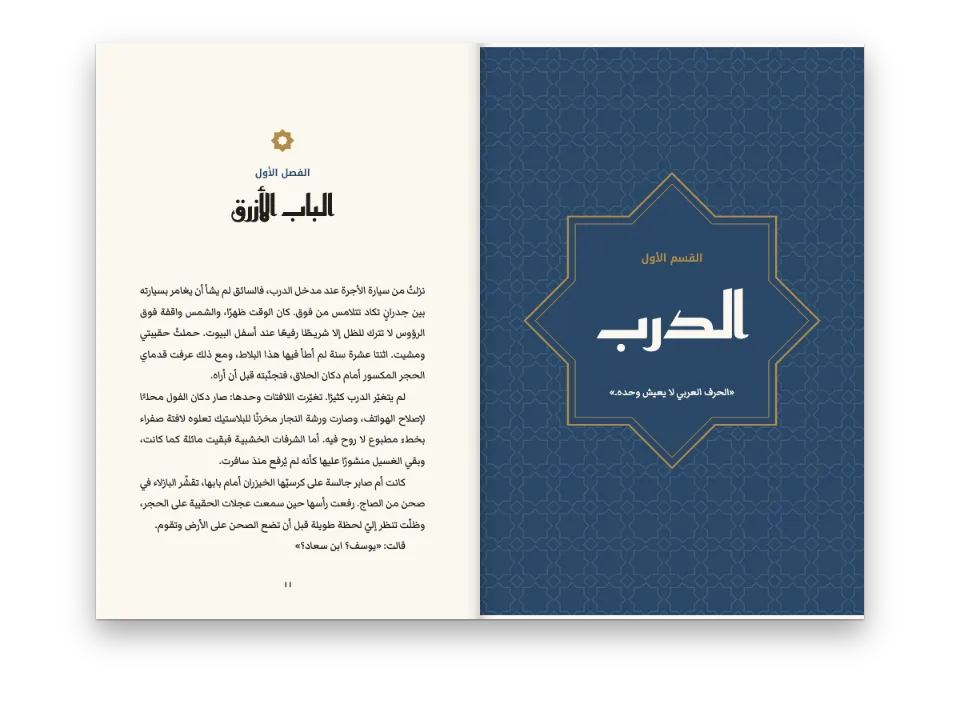
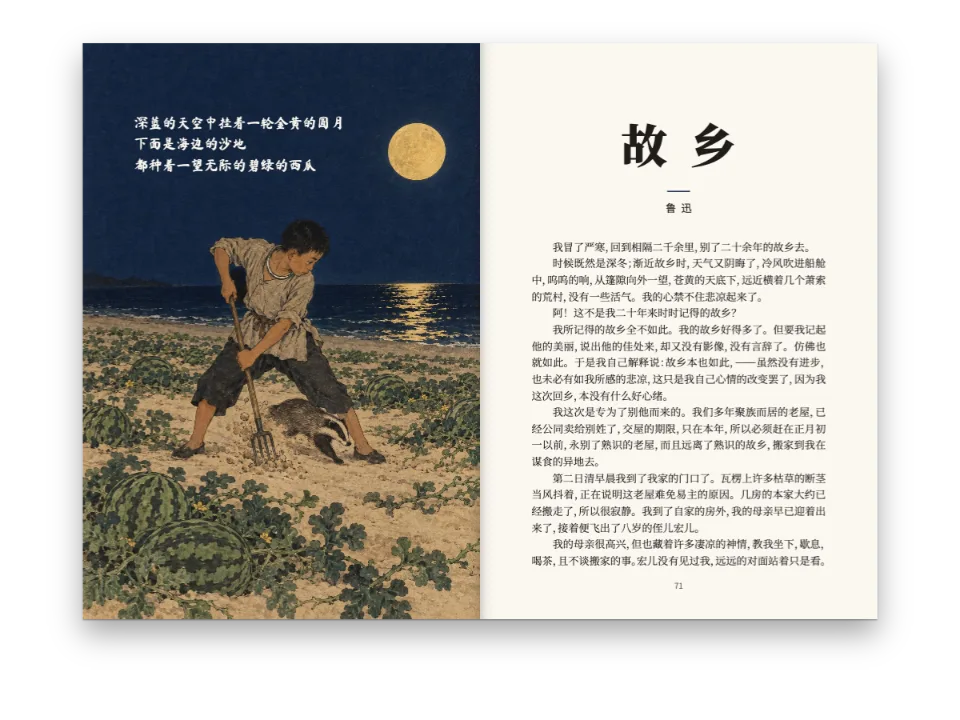
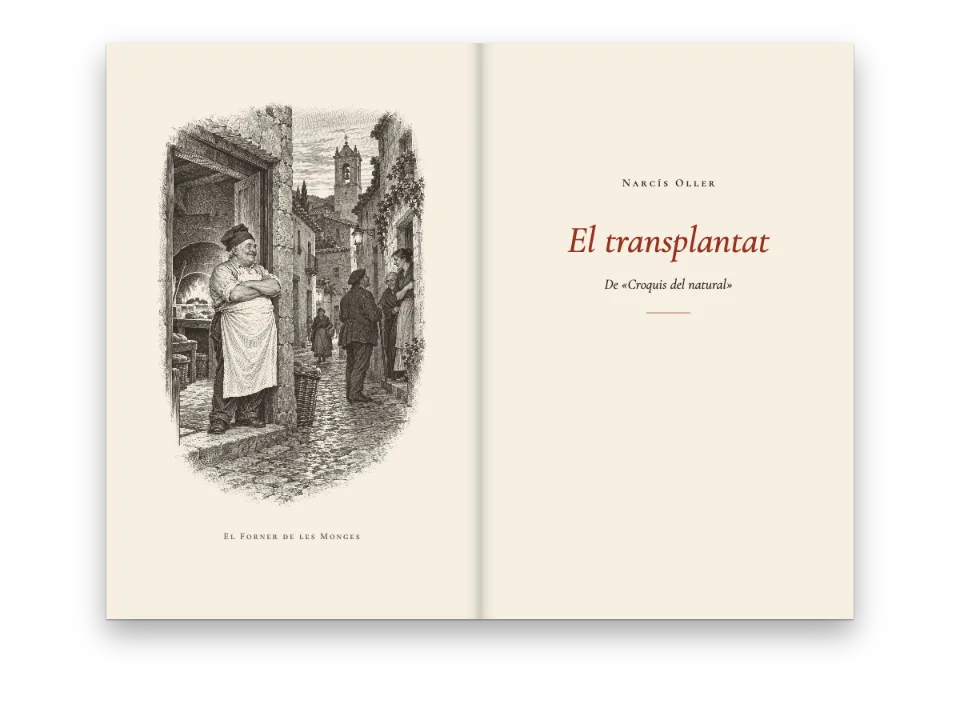
En pocas palabras
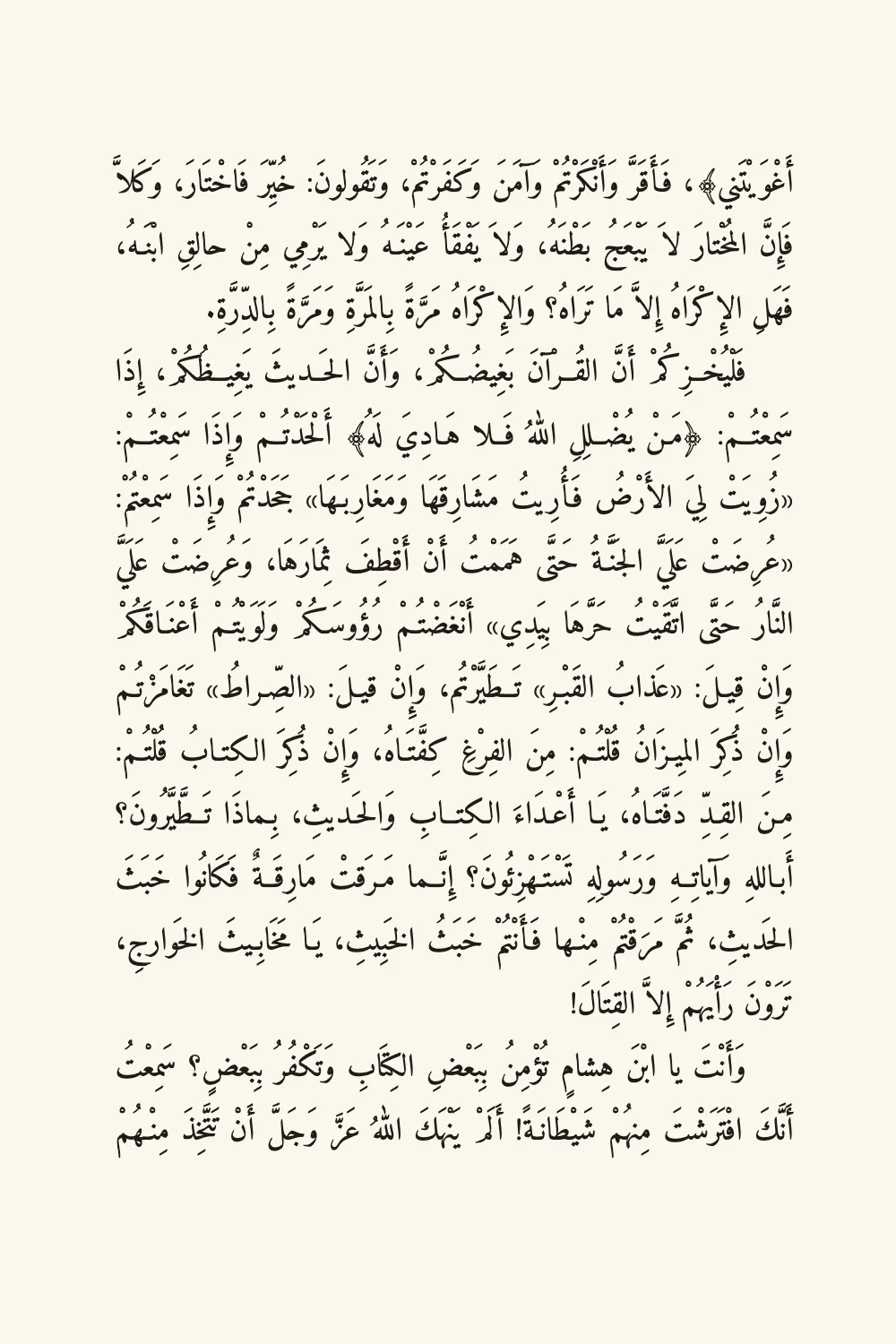
Un relato árabe antiguo impreso con todos sus pequeños signos de vocal encima y debajo de las letras. Las líneas van tan separadas que los signos de una no chocan con la de abajo.
Lo que vas a componer
Cuatro páginas de un libro árabe clásico en el que cada letra lleva su vocal: la Maqāma del manicomio de al-Hamadhānī, en la que un loco del manicomio de Basora deja sin respuesta a un teólogo y luego dice su nombre en verso. El texto con todas sus vocales apila fatḥa y šadda encima de las letras y kasra debajo, y esos signos viven en el espacio entre líneas. Por eso la página se compone en Amiri a 14 pt sobre 28 pt, el doble del cuerpo, y nada más: el interlineado es el diseño. El texto va justificado con cachidas, con una sangría de 1,5 em a la derecha, y sus tres citas del Corán van entre los paréntesis ornamentales ﴿ ﴾ del muṣḥaf impreso. Solo la línea latina del título y la nota sobre el texto cambian con la edición.
Esta receta responde a
- ¿Cuánto interlineado necesita el árabe con todas sus vocales?
La respuesta corta
// Every letter of this maqāma carries its vowel: fatḥa and shadda over the letters, kasra
// and kasratān under them, often two marks on one letter. The marks sit in the leading,
// which never grows for them, so the leading is chosen for the most vocalised line of the
// book. Unvocalised prose sets well at 1.6 × the size; fully vocalised text needs
// 1.9–2.1 ×: here 14 pt on 28 pt, 2 ×, so a kasra hanging under one line clears a shadda
// standing on the line below. Any closer and the build reports the paragraph
// (arabicMarksExceedLeading) with the leading it would need.
const SIZE = 14; // pt
const LEAD = 2 * SIZE; // pt: 28
const bodyText = {
  fontFamily: NASKH, fontSize: pt(SIZE), lineHeight: pt(LEAD), color: col('ink'),
  boldColor: col('ink'), italicColor: col('ink'), referenceColor: col('ink'),
  // Justified with kashidas, the default in an Arabic book, written out to say so:
  // a line widens at its joins as well as at its spaces.
  textAlign: 'justify', kashida: 'auto', kashidaPatterns: 'naskh',
  firstLineIndent: em(1.5), indentAfterHeading: false, // on the start side, the right
  optimalLineBreaking: true, avoidWidows: true, avoidOrphans: true,
};
Ingredientes
- Funciones
- Fuentes árabesTipografía del textoTexto de derecha a izquierdaEl árabe como idioma del documentoSangrías, alineación y separación de párrafosJustificación con cachidaVerso árabe (bayt en dos hemistiquios)Libros encuadernados por la derechaPárrafos en la otra direcciónNiveles de títuloFormato de páginaMárgenes simétricosColor del papelPaleta de color semánticaPáginas en un canvas
- Tipografía
- Amiri, Aref Ruqaa (SIL OFL 1.1)
- Recursos
- Ninguno: todas las imágenes se dibujan en código
Elaboración
#1 · Un interlineado del doble del cuerpo
El código es la respuesta corta de arriba. El interlineado nunca crece para hacer sitio a los signos: la kasra de una línea y la šadda de la siguiente comparten el mismo hueco, así que el hueco se elige para la línea más vocalizada del libro (Signos vocálicos). Con este texto, un interlineado de 1,6 veces el cuerpo deja seis párrafos con signos que chocan, y 1,9 aún deja uno; con 2 no queda ninguno. La composición lo avisa: cuando dos líneas chocan, señala el párrafo con arabicMarksExceedLeading y el interlineado que necesitaría (Texto árabe).
#2 · Una página pequeña con una medida ancha
// 166 mm of text block hold seventeen lines on the 28 pt pitch (9.88 mm). The measure is
// 106 mm, about twelve words of vocalised Naskh.
const page = {
  sizePreset: 'custom', width: mm(140), height: mm(210), dpi: 150,
  backgroundColor: col('paper'),
  // mirror: left is the inner margin, at the spine (the right edge of an odd page here)
  margins: { top: mm(22), bottom: mm(22), left: mm(18), right: mm(16), mirror: true },
};
Una página de 14 × 21 cm con márgenes laterales de 16 y 18 mm deja una medida de 106 mm, unas doce palabras vocalizadas, y diecisiete líneas con el paso de 28 pt. Los signos agrisan las líneas, así que la página se queda sobria: sin cabeceras, papel crema y un único título en rojo. mirror: true pone el margen más ancho en el lomo, que en un libro encuadernado por la derecha es el borde derecho de la página impar (Orden de las páginas y encuadernación por la derecha).
#3 · Títulos que respetan la retícula
// The headings carry no design: the title's line box, three lines of the grid deep, lowers
// it on the page (a top margin is dropped at the head of a page), and the levels under it
// keep to the 28 pt pitch, so the text starts on a line of the grid.
const headings = {
  fontFamily: NASKH, color: col('ink'), textAlign: 'center',
  levels: [
    // Restated: any headings object drops the H1 break (gotcha: headings-drop-h1-break).
    { level: 1, fontFamily: RUQAA, fontWeight: 700, fontSize: pt(32), lineHeight: pt(LEAD * 3),
      color: col('rubric'), marginTop: pt(0), marginBottom: pt(0),
      breakBefore: { enabled: true, parity: 'odd' } },
    { level: 2, fontWeight: 700, fontSize: pt(15), lineHeight: pt(LEAD), color: col('ink'),
      marginTop: pt(0), marginBottom: pt(0) },
    { level: 3, fontWeight: 400, fontSize: pt(10), lineHeight: pt(LEAD), color: col('muted'),
      marginTop: pt(0), marginBottom: pt(LEAD) },
  ],
};
Los títulos no llevan diseño: el título en ruqʿa ocupa una caja de línea de tres líneas de la retícula, y el autor y la línea latina ocupan una línea de 28 pt cada uno, así que la primera línea de texto cae en la retícula. La línea latina lleva {dir=ltr}: un título de izquierda a derecha en un libro de derecha a izquierda (Dirección del documento, del bloque y del texto en línea).
La receta completa
// ═══ Postext Cookbook · Nº 111 · Fully vocalised classical prose with Qur'anic brackets ═══ // https://postext.dev/en/cookbook/vocalised-classical-prose // Code: MIT · Text: al-Hamadhānī, Maqāmāt, ar.wikisource (PD) · Pictures: none // Fonts: Amiri, Aref Ruqaa (SIL OFL 1.1) · Needs postext ≥ 1.15.0 import { buildDocument, renderPageToCanvas, clearMeasurementCache } from 'https://esm.sh/postext'; const LANG = 'es'; // @lang: the language of the sample document ('en' | 'es') const RECIPE = 'vocalised-classical-prose'; // ─── 1 · Design ───────────────────────────────────────────────────────────── // Black text and a red title on a cream page, as the Beirut and Cairo editions of the // Maqāmāt print them. const palette = { ink: '#211b17', // text: a warm near-black rubric: '#94291d', // the accent: the title muted: '#6b6156', // the author's name, the Latin title line, the note on the text paper: '#fbf7ee', // a cream paper }; const col = (id) => ({ hex: palette[id], model: 'hex', paletteId: id }); const colorPalette = [ ...Object.entries(palette).map(([id, hex]) => ({ id, name: id, value: { hex, model: 'hex' } })), { id: 'main-color', name: 'rubric (defaults)', value: { hex: palette.rubric, model: 'hex' } }, ]; const NASKH = 'Amiri'; // the text: a Bulaq Naskh, with its own Latin for the note const RUQAA = 'Aref Ruqaa'; // display: the title // #region answer: a leading of 2 × the size for text with every vowel written // Every letter of this maqāma carries its vowel: fatḥa and shadda over the letters, kasra // and kasratān under them, often two marks on one letter. The marks sit in the leading, // which never grows for them, so the leading is chosen for the most vocalised line of the // book. Unvocalised prose sets well at 1.6 × the size; fully vocalised text needs // 1.9–2.1 ×: here 14 pt on 28 pt, 2 ×, so a kasra hanging under one line clears a shadda // standing on the line below. Any closer and the build reports the paragraph // (arabicMarksExceedLeading) with the leading it would need. const SIZE = 14; // pt const LEAD = 2 * SIZE; // pt: 28 const bodyText = { fontFamily: NASKH, fontSize: pt(SIZE), lineHeight: pt(LEAD), color: col('ink'), boldColor: col('ink'), italicColor: col('ink'), referenceColor: col('ink'), // Justified with kashidas, the default in an Arabic book, written out to say so: // a line widens at its joins as well as at its spaces. textAlign: 'justify', kashida: 'auto', kashidaPatterns: 'naskh', firstLineIndent: em(1.5), indentAfterHeading: false, // on the start side, the right optimalLineBreaking: true, avoidWidows: true, avoidOrphans: true, }; // #endregion // #region page: a 14 × 21 cm book page, seventeen lines of 28 pt // 166 mm of text block hold seventeen lines on the 28 pt pitch (9.88 mm). The measure is // 106 mm, about twelve words of vocalised Naskh. const page = { sizePreset: 'custom', width: mm(140), height: mm(210), dpi: 150, backgroundColor: col('paper'), // mirror: left is the inner margin, at the spine (the right edge of an odd page here) margins: { top: mm(22), bottom: mm(22), left: mm(18), right: mm(16), mirror: true }, }; // #endregion // #region titles: the maqāma's title in Ruqʿa, its author and a Latin line under it // The headings carry no design: the title's line box, three lines of the grid deep, lowers // it on the page (a top margin is dropped at the head of a page), and the levels under it // keep to the 28 pt pitch, so the text starts on a line of the grid. const headings = { fontFamily: NASKH, color: col('ink'), textAlign: 'center', levels: [ // Restated: any headings object drops the H1 break (gotcha: headings-drop-h1-break). { level: 1, fontFamily: RUQAA, fontWeight: 700, fontSize: pt(32), lineHeight: pt(LEAD * 3), color: col('rubric'), marginTop: pt(0), marginBottom: pt(0), breakBefore: { enabled: true, parity: 'odd' } }, { level: 2, fontWeight: 700, fontSize: pt(15), lineHeight: pt(LEAD), color: col('ink'), marginTop: pt(0), marginBottom: pt(0) }, { level: 3, fontWeight: 400, fontSize: pt(10), lineHeight: pt(LEAD), color: col('muted'), marginTop: pt(0), marginBottom: pt(LEAD) }, ], }; // #endregion const config = () => ({ // a factory: the engine caches resolved configs per object locale: 'ar', // right to left, bound on the right, digits ٠–٩ (gotcha: arabic-locale-tag) colorPalette, page, layout: { layoutType: 'single' }, // the default is two columns bodyText, headings, header: { elements: [] }, // a single maqāma: no running heads footer: { elements: [] }, }); // ─── 2 · Content ──────────────────────────────────────────────────────────── const markdown = String.raw`---Muestra en Markdown · 29 líneas · content.es.md
title: "مقامات بديع الزمان الهمذاني" --- # المقامة المارستانية ## بديع الزمان الهمذاني ### Al-Maqāma al-Māristāniyya · La maqāma del manicomio {dir=ltr} حَدَّثَنا عِيسَى بْنُ هِشَامٍ قَالَ: دَخَلْتُ مَارسْتانَ البَصْرَةِ وَمَعِي أَبُو داوُدَ المُتَكَلِّمُ، فَنَظَرْتُ إِلَى مَجْنُونٍ تَأْخُذُنِي عَيْنُهُ وَتَدَعُنِي فَقالَ: إِنْ تَصْدُقِ الطَّيْرُ فَأَنْتُمْ غُرَباءُ، فَقُلْنَا: كَذلِكَ، فَقَالَ: مَنِ القَوْمُ للهِ أَبُوهُمْ؟ فَقُلْتُ: أَنَا عِيسَى ابْنُ هِشامٍ وَهَذَا أَبُو دَاوُدَ المُتَكَلِّمُ فَقالَ: العَسْكَرِيُّ؟ قُلْتُ: نَعَمْ، فَقَالَ: شَاهَتِ الوُجُوهُ وَأَهْلُهَا إِنَّ الخَيْرَةَ للهِ لا لِعَبْدِهِ، وَالأُمُورَ بِيَدِ اللهِ لا بِيَدِهِ وَأَنْتُمْ يا مَجُوسَ هذِهِ الأُمَّةِ تَعِيشُونَ جَبْراً، وَتَمُوتُونَ صَبْراً وَتُسَاقُونَ إِلى المَقْدُورِ قَهْراً، وَ﴿لَوْ كُنْتُمْ في بُيُوتِكُمْ لَبَرَزَ الَّذينَ كُتِبَ عَلَيْهِمُ القَتْلُ إِلى مَضَاجِعِهِمْ﴾، أَفَلا تُنْصِفُونَ، إِنْ كَانَ الأَمْرُ كَمَا تَصِفُونَ؟ وَتَقُولونَ: خالِقُ الظُلْمِ ظَالِمٌ! أَفَلا تَقُولُونَ: خَالِقُ الهُلْكِ هَالِكٌ؟ أَتَعْلَمُونَ يَقِينَاً، أَنَّكُمْ أَخْبَثُ مِنْ إِبْليسَ دِيناً؟ قَالَ: ﴿رَبِّ بِمَا أَغْوَيْتَني﴾، فَأَقَرَّ وَأَنْكَرْتُمْ وَآمَنَ وَكَفَرْتُمْ، وَتَقُولونَ: خُيِّرَ فَاخْتَارَ، وَكَلاَّ فَإِنَّ المُخْتارَ لاَ يَبْعَجُ بَطْنَهُ، وَلاَ يَفْقَأُ عَيْنَهُ وَلا يَرْمِي مِنْ حالِقِ ابْنَهُ، فَهَلِ الإِكْرَاهُ إِلاَّ مَا تَرَاهُ؟ وَالإِكْرَاهُ مَرَّةً بِالمَرَّةِ وَمَرَّةً بِالدِّرَّةِ. فَلْيُخْزِكُمْ أَنَّ القُرْآنَ بَغِيضُكُمْ، وَأَنَّ الحَديثَ يَغِيظُكُمْ، إِذَا سَمِعْتُمْ: ﴿مَنْ يُضْلِلِ اللهُ فَلا هَادِيَ لَهُ﴾ أَلْحَدْتُمْ وَإِذَا سَمِعْتُمْ: «زُوِيَتْ لِيَ الأَرْضُ فَأُرِيتُ مَشَارِقَهَا وَمَغَارِبَهَا» جَحَدْتُمْ وَإِذَا سَمِعْتُمْ: «عُرِضَتْ عَلَيَّ الجَنَّةُ حَتَّى هَمَمْتُ أَنْ أَقْطِفَ ثِمَارَهَا، وَعُرِضَتْ عَلَيَّ النَّارُ حَتَّى اتَّقَيْتُ حَرَّهَا بِيَدِي» أَنْغَضْتُمْ رُؤُوسَكُمْ وَلَوَيْتُمْ أَعْنَاقَكُمْ وَإِنْ قِيلَ: «عَذابُ القَبْرِ» تَطَيَّرْتُم، وَإِنْ قيلَ: «الصِّراطُ» تَغَامَزْتُمْ وَإِنْ ذُكِرَ المِيزَانُ قُلْتُمْ: مِنَ الفِرْغِ كِفَّتَاهُ، وَإِنْ ذُكِرَ الكِتابُ قُلْتُمْ: مِنَ القِدِّ دَفَّتَاهُ، يَا أَعْدَاءَ الكِتابِ وَالحَديثِ، بِماذَا تَطَّيَّرُونَ؟ أَباللهِ وَآياتِهِ وَرَسُولِهِ تَسْتَهْزِئُونَ؟ إِنَّما مَرَقتْ مَارِقَةٌ فَكَانُوا خَبَثَ الحَديثِ، ثُمَّ مَرَقْتُمْ مِنْها فَأَنْتُمْ خَبَثُ الخَبِيثِ، يَا مَخَابِيثَ الخَوارجِ، تَرَوْنَ رَأْيَهُمْ إِلاَّ القِتَالَ! وَأَنْتَ يا ابْنَ هِشامٍ تُؤْمِنُ بِبَعْضِ الكِتَابِ وَتَكْفُرُ بِبَعْضٍ؟ سَمِعْتُ أَنَّكَ افْتَرَشْتَ مِنهُمْ شَيْطَانَةً! أَلَمْ يَنْهَكَ اللهُ عَزَّ وَجَلَّ أَنْ تَتَّخِذَ مِنْهُمْ بِطَانَةً؟ وَيْلَكَ هَلاَّ تَخَيَّرْتَ لِنُطْفَتِكَ، وَنَظَرْتَ لِعَقِبِكَ؟ ثُمَّ قَالَ: اللَّهُمَّ أَبْدِلْنِي بِهؤُلاءِ خَيْراً مِنْهُمْ، وَأَشْهِدْنِي مَلائِكَتَكَ. قَالَ عِيسَى بْنُ هِشَامٍ: فَبَقِيتُ وَبَقِي أَبُو دَاوُدَ لا نُحِيرُ جَوَاباً، وَرَجَعْنَا عَنْهُ بِشَرٍّ وإِنِّي لأَعْرِفُ فِي أَبي دَاوُدَ انْكِسَاراً، حَتَّى إِذَا أَرَدْنَا الافْتِراقَ قَالَ: يا عِيسَى هَذا وَأَبِيكَ الحَدِيثُ، فَمَا الَّذي أَرَادَ بِالشَّيْطَانَةِ؟ قُلْتُ: لاَ واللهِ مَا أَدْرِي، غَيْرَ أَنِّي هَمَمْتُ أَنْ أَخْطُبَ إِلَى أَحَدِهِمْ وَلَمْ أُحَدِّثْ بِما هَمَمْتُ بِهِ أَحَداً، وَاللهِ لا أَفْعَلُ ذَلِكَ أَبَداً، فَقَالَ: مَا هَذا وَاللهِ إِلاَّ شَيْطَانٌ فِي أَشْطَانٍ، فَرَجَعْنَا إِلَيْهِ، وَوَقَفْنَا عَلَيْهِ، فَابْتَدَرَ بِالْمَقَالِ، وَبَدَأَنَا بِالسُّؤَالِ، فَقالَ: لَعَلَّكُمَا آثَرْتُمَا، أَنْ تَعْرِفَا مِنْ أَمْرِي ما أَنْكَرْتُمَا، فَقُلْنَا: كُنْتَ مِنْ قَبْلُ مُطَّلِعَاً على أُمُورِنَا، وَلَمْ تَعْدُ الآنَ مَا في صُدُورِنَا، فَفَسِّرْ لَنَا أَمْرَكَ، وَاكْشِفْ لَنَا سِرَّكَ، فَقالَ: :::verse أَنَا يَنْبُوعُ العَجَائِبْ || فِي احْتِيَالِي ذُو مَرَاتِبْ أَنَا فِي الحَقِّ سَنَامٌ || أَنَا في البَاطِلِ غَارِبْ أَنَا إِسكَنْدَرُ دَارِي || فِي بِلادِ اللهِ سَارِبْ أَغْتَدِي فِي الدَّيْرِ قِسِّيساً || وَفي المَسْجِدِ رَاهِبْ ::: :::paragraphs{dir=ltr} **Nota sobre el texto.** Badīʿ al-Zamān al-Hamadhānī (968-1008) escribió las primeras maqāmāt, relatos en prosa rimada en los que el narrador ʿĪsā ibn Hishām se encuentra con el pícaro Abū al-Fatḥ al-Iskandarī bajo un disfraz distinto cada vez. Aquí, un loco del manicomio de Basora deja sin respuesta a un teólogo que sostiene que el hombre elige sus actos. El texto es el de ar.wikisource, con todas sus vocales; se corrigen veinte erratas y la división en párrafos es nuestra. Las tres citas del Corán (3:154, 15:39, 7:186) van entre paréntesis ornamentales; los dichos del Profeta, entre « ». Compuesto en Amiri y Aref Ruqaa (SIL OFL) · Texto: al-Hamadhānī, dominio público, de ar.wikisource :::`; // content.<lang>.md, inlined by the Cookbook // ─── 3 · Fonts ────────────────────────────────────────────────────────────── const FONTS = { // every face the pages use, loaded before the build (gotcha: fonts-first) Amiri: ['400', '700'], // NASKH: the maqāma, the author, the note and its Latin 'Aref Ruqaa': ['700'], // RUQAA: the title }; // ─── 4 · Build & show ─────────────────────────────────────────────────────── await loadFonts(FONTS, markdown); // The arabic file of each face, which loadFonts leaves out (gotcha: arabic-fonts-subset). await loadArabicFonts(FONTS, markdown); const doc = await buildWithFonts(() => buildDocument({ markdown }, config()), markdown); showBook(doc, { title: t({ en: 'Fully vocalised classical prose', es: 'Prosa clásica con todas sus vocales' }) });Kit · core, fonts, viewer, arabic, book: igual en todas las recetas · 371 líneas
// ─── Kit ── helpers shared by every Cookbook recipe · postext.dev/cookbook ───── // ─── Kit · core v1 ── the same in every recipe · postext.dev/cookbook ───────── function mm(value) { return { value, unit: 'mm' }; } function pt(value) { return { value, unit: 'pt' }; } function em(value) { return { value, unit: 'em' }; } /** The sample language's string: t({ en: 'Figure', es: 'Figura' }). */ function t(strings) { return strings[LANG] ?? Object.values(strings)[0]; } /** A file in this recipe's assets folder, served from the Postext repo by jsDelivr. */ function asset(file) { return `https://cdn.jsdelivr.net/gh/drnachio/postext@main/cookbook/${RECIPE}/assets/${file}`; } // ─── Kit · fonts v1 ── the same in every recipe · postext.dev/cookbook ──────── // Postext measures text with the faces the browser has loaded, and caches the // widths, so every face must be ready before the first build. Faces come from // Fontsource: the same static files the PDF embeds, so screen and PDF agree. /** faces = { 'Family Name': ['400', '400i', '700'] }. `text` is the sample: * letters beyond Latin-1 (č, ł, ő…) also load the latin-ext files. With * `optional`, a face Fontsource does not ship is skipped instead of failing. * Resolves to the number of faces added. */ async function loadFonts(faces, text = '', { optional = false } = {}) { kitStatus('Loading fonts…'); const ranges = { latin: 'U+0000-00FF,U+0131,U+0152-0153,U+02BB-02BC,U+02C6,U+02DA,U+02DC,U+0304,U+0308,U+0329,' + 'U+2000-206F,U+20AC,U+2122,U+2191,U+2193,U+2212,U+2215,U+FEFF,U+FFFD', 'latin-ext': 'U+0100-02BA,U+02BD-02C5,U+02C7-02CC,U+02CE-02D7,U+02DD-02FF,U+0304,U+0308,U+0329,' + 'U+1D00-1DBF,U+1E00-1E9F,U+1EF2-1EFF,U+2020,U+20A0-20AB,U+20AD-20C0,U+2113,U+2C60-2C7F,U+A720-A7FF', }; const subsets = /[Ā-˿Ḁ-ỿ]/.test(text) ? ['latin', 'latin-ext'] : ['latin']; const jobs = []; let added = 0; for (const [family, specs] of Object.entries(faces)) { const id = fontsourceId(family); const meta = optional ? await fontsourceMeta(family) : null; for (const spec of new Set(specs)) { const weight = parseInt(spec, 10); const style = spec.endsWith('i') ? 'italic' : 'normal'; if (hasFace(family, weight, style)) continue; if (optional && !(meta?.weights.includes(weight) && meta.styles.includes(style))) continue; for (const subset of subsets) { const url = `https://cdn.jsdelivr.net/npm/@fontsource/${id}@5/files/${id}-${subset}-${weight}-${style}.woff2`; const face = new FontFace(family, `url(${url}) format('woff2')`, { weight: String(weight), style, unicodeRange: ranges[subset] }); jobs.push(face.load().then((ready) => { document.fonts.add(ready); added++; }, () => { if (subset === 'latin' && !optional) throw new Error(`Fontsource has no ${family} ${weight} ${style}`); })); } } } await Promise.all(jobs).catch((error) => { kitFail(error); throw error; }); return added; } /** Runs `build` (a buildDocument or buildBundle call) and checks the faces * the pages use. A regular face missing from FONTS is loaded with a warning; * bold and italic variants are loaded when the family ships them. Then the * measurement caches are cleared and the build runs again. */ async function buildWithFonts(build, text = '') { const tried = new Set(); for (let round = 0; round < 3; round++) { kitStatus('Laying out…'); await new Promise(requestAnimationFrame); // let the status paint first const result = await Promise.resolve().then(build).catch((error) => { kitFail(error); throw error; }); const wanted = { base: {}, variants: {} }; for (const { font, base } of [result].flat().flatMap(fontStringsOf)) { const { family, weight, style } = parseFont(font); const key = `${family}|${weight}|${style}`; if (tried.has(key) || hasFace(family, weight, style)) continue; tried.add(key); (wanted[base ? 'base' : 'variants'][family] ??= []).push(`${weight}${style === 'italic' ? 'i' : ''}`); } if (Object.keys(wanted.base).length) { console.warn(`[cookbook] FONTS does not list ${JSON.stringify(wanted.base)}: loading them.`); } const added = await loadFonts(wanted.base, text) + await loadFonts(wanted.variants, text, { optional: true }); if (added === 0) return result; clearMeasurementCache(); } throw new Error('The fonts did not settle after three builds.'); } /** Every font string of the layout. `base` marks a block's own face; its * bold, italic and bold-italic variants are listed whether or not used. */ function fontStringsOf(doc) { const found = new Map(); const walk = (node) => { if (!node || typeof node !== 'object') return; if (Array.isArray(node)) { node.forEach(walk); return; } for (const [key, value] of Object.entries(node)) { if (typeof value === 'string' && /fontString$/i.test(key)) { found.set(value, found.get(value) || key === 'fontString'); } else if (value && typeof value === 'object') walk(value); } }; walk(doc.pages); walk(doc.blocks); return [...found].map(([font, base]) => ({ font, base })); } /** '700 37.5px Open Sans' / 'italic 400 13px "Source Serif 4"' → { family, weight, style }. * A string with no weight ('95.8px Young Serif', from a design text) is 400. */ function parseFont(font) { const m = /^(?:(italic|oblique)\s+)?(?:small-caps\s+)?(?:(\d+|bold|normal)\s+)?[\d.]+px\s+(.+)$/.exec(font.trim()); if (!m) throw new Error(`Unexpected font string: ${font}`); const weight = m[2] === 'bold' ? 700 : !m[2] || m[2] === 'normal' ? 400 : Number(m[2]); return { family: m[3].replace(/^["']|["']$/g, ''), weight, style: m[1] ? 'italic' : 'normal' }; } /** True when a loaded FontFace covers exactly this family, weight and style * (document.fonts.check() is also true for families nobody declared). */ function hasFace(family, weight, style) { for (const face of document.fonts) { if (face.status !== 'loaded' || face.style !== style) continue; if (face.family.replace(/^["']|["']$/g, '') !== family) continue; const [low, high = low] = face.weight.split(' ').map(Number); if (weight >= low && weight <= high) return true; } return false; } /** Fontsource's id for a family: 'Source Serif 4' → 'source-serif-4'. */ function fontsourceId(family) { return family.toLowerCase().replace(/\s+/g, '-'); } /** The weights and styles a family ships ({ weights: [400, 700], styles: ['normal', 'italic'] }), or null. */ function fontsourceMeta(family) { fontsourceMeta.cache ??= new Map(); const id = fontsourceId(family); if (!fontsourceMeta.cache.has(id)) { fontsourceMeta.cache.set(id, fetch(`https://api.fontsource.org/v1/fonts/${id}`) .then((res) => (res.ok ? res.json() : null), () => null)); } return fontsourceMeta.cache.get(id); } // ─── Kit · viewer v1 ── the same in every recipe · postext.dev/cookbook ─────── /** Shows the pages as facing spreads on a dark desk: the first page is a * recto on its own, then verso | recto pairs, as in a bound book. Pages * are painted when they scroll near the screen. */ function showPages(docs, { title, width = 460 } = {}) { const root = viewer(title); const pages = [docs].flat().flatMap((doc) => doc.pages.map((page) => ({ doc, page, n: (doc.pageIndexOffset ?? 0) + page.index }))); const spreads = []; let verso = null; for (const p of pages) { if (p.n % 2 === 1) { if (verso) spreads.push([verso, null]); verso = p; } else { spreads.push([verso, p]); verso = null; } } if (verso) spreads.push([verso, null]); const density = Math.min(window.devicePixelRatio || 1, 2); showPages.painter?.disconnect(); const painter = new IntersectionObserver((entries) => { for (const { isIntersecting, target } of entries) { if (!isIntersecting) continue; painter.unobserve(target); const { doc, page } = target.postext; renderPageToCanvas(page, doc, target, { scale: (width * density) / page.width }); } }, { rootMargin: '800px' }); showPages.painter = painter; root.replaceChildren(...spreads.map((pair) => { const spread = document.createElement('div'); spread.className = 'pt-spread'; for (const p of pair) { const figure = document.createElement('figure'); if (p) { const label = p.page.pageLabel || String(p.n + 1); const canvas = document.createElement('canvas'); canvas.postext = p; canvas.style.aspectRatio = `${p.page.width} / ${p.page.height}`; canvas.setAttribute('role', 'img'); canvas.setAttribute('aria-label', `Page ${label}`); const folio = document.createElement('figcaption'); folio.textContent = label; figure.append(canvas, folio); painter.observe(canvas); } else figure.className = 'pt-blank'; spread.append(figure); } return spread; })); kitStatus(`${pages.length} ${pages.length === 1 ? 'page' : 'pages'}`); document.documentElement.dataset.postext = 'ready'; return pages.length; } /** The desk, the bar and the error reporting, created once. */ function viewer(title) { if (!document.getElementById('pt-kit')) { document.head.insertAdjacentHTML('beforeend', `<style id="pt-kit"> :root { color-scheme: dark; } body { margin: 0; background: #0e1014; color: #b9bcc4; font: 13px/1.45 system-ui, sans-serif; } #pt-bar { position: sticky; top: 0; z-index: 1; display: flex; flex-wrap: wrap; align-items: center; gap: 6px 16px; padding: 10px 16px; background: rgb(14 16 20 / .92); backdrop-filter: blur(6px); border-bottom: 1px solid #23262d; } #pt-bar strong { color: #f4f1ea; font-weight: 600; } #pt-actions { display: flex; gap: 12px; margin-left: auto; } #pt-actions a, #pt-actions button { color: #d8a21a; font: inherit; background: none; border: 0; padding: 0; cursor: pointer; } #pages { display: grid; justify-items: center; gap: 48px; padding: 32px 16px 72px; } .pt-spread { display: flex; } .pt-spread figure { margin: 0; width: min(460px, 44vw); } .pt-spread canvas { display: block; width: 100%; background: #fff; box-shadow: 0 1px 2px rgb(0 0 0 / .5), 0 22px 44px -16px rgb(0 0 0 / .8); } .pt-spread figure:first-child canvas { box-shadow: inset -14px 0 14px -14px rgb(0 0 0 / .18), 0 1px 2px rgb(0 0 0 / .5), 0 22px 44px -16px rgb(0 0 0 / .8); } .pt-spread figcaption { margin-top: 10px; text-align: center; font: 600 10px/1 system-ui, sans-serif; letter-spacing: .18em; text-transform: uppercase; color: #6c7079; } .pt-blank { visibility: hidden; } @media (max-width: 760px) { .pt-spread { flex-direction: column; gap: 32px; } .pt-spread figure { width: min(460px, 92vw); } .pt-blank { display: none; } } </style>`); document.body.insertAdjacentHTML('afterbegin', '<header id="pt-bar"><strong id="pt-title"></strong><span id="pt-status" role="status"></span><span id="pt-actions"></span></header>'); document.getElementById('pt-title').textContent = document.title || 'Postext'; addEventListener('error', (event) => kitFail(event.error ?? event.message)); addEventListener('unhandledrejection', (event) => kitFail(event.reason)); } if (title) document.getElementById('pt-title').textContent = title; return document.getElementById('pages') ?? document.body.appendChild(Object.assign(document.createElement('main'), { id: 'pages' })); } function kitStatus(text) { viewer(); document.getElementById('pt-status').textContent = text; } function kitFail(error) { document.documentElement.dataset.postext = 'error'; kitStatus(`Error: ${error?.message ?? error}`); } // ─── Kit · arabic v1 ── Arabic-script faces · postext.dev/cookbook ─────────── // Fontsource ships an Arabic family as one file per subset and weight: the // `arabic` file holds the letters, the harakat, the Arabic-Indic digits, the // Arabic punctuation and the presentation forms; `latin` and `latin-ext` // hold the rest. loadFonts loads the latin files; this block adds the arabic // file of every Arabic family, for the canvas and for the PDF, which shapes // the letters with HarfBuzz from the same bytes. /** The code points of Fontsource's `arabic` subset, as its stylesheets * declare them (the same unicode-range the browser picks the file by). A * function, not a const: the kit is inlined after the recipe's top-level * awaits, and a const read before its line throws, where a function * declaration is hoisted. */ function arabicRange() { return 'U+0600-06FF,U+0750-077F,U+0870-088E,U+0890-0891,U+0897-08E1,U+08E3-08FF,' + 'U+200C-200E,U+2010-2011,U+204F,U+2E41,U+FB50-FDFF,U+FE70-FE74,U+FE76-FEFC,U+102E0-102FB,' + 'U+10E60-10E7E,U+10EC2-10EC4,U+10EFC-10EFF,U+1EE00-1EEFF'; } /** Whether code point `cp` is in the arabic file. */ function inArabicRange(cp) { inArabicRange.ranges ??= arabicRange().split(',').map((part) => { const [lo, hi = lo] = part.slice(2).split('-'); return [parseInt(lo, 16), parseInt(hi, 16)]; }); return inArabicRange.ranges.some(([lo, hi]) => cp >= lo && cp <= hi); } /** Whether Fontsource serves `family` with an `arabic` subset. Fails when * the API does not answer: an Arabic face taken for a Latin one would set * its letters in a system face. */ async function isArabicFamily(family) { const meta = await fontsourceMeta(family); if (!meta) throw new Error(`api.fontsource.org did not describe ${family}: reload to try again`); return !!meta.subsets?.includes('arabic'); } /** The arabic file of a face. */ function arabicFileUrl(family, weight, style) { const id = fontsourceId(family); return `https://cdn.jsdelivr.net/npm/@fontsource/${id}@5/files/${id}-arabic-${weight}-${style}.woff2`; } /** faces = { Amiri: ['400', '700'] }, as for loadFonts, after it: the whole * FONTS object may be passed, its families without an arabic subset are * left alone. Adds the arabic file of every listed weight of each Arabic * family (the latin files come from loadFonts) and loads it. `text` is * the sample: fails when it holds an Arabic-script character the arabic * file does not cover. List every weight the pages set in Arabic: a weight * left to buildWithFonts gets the latin file only, and its Arabic letters * fall back to a system face. Resolves to the number of files loaded. */ async function loadArabicFonts(faces, text = '') { kitStatus('Loading fonts…'); let loaded = 0; try { const outside = [...new Set(text)].filter((ch) => /\p{Script=Arabic}/u.test(ch) && !inArabicRange(ch.codePointAt(0))); if (outside.length) throw new Error(`Fontsource's arabic files have no ${outside.slice(0, 12).join(' ')}`); for (const [family, specs] of Object.entries(faces)) { if (!(await isArabicFamily(family))) continue; for (const spec of new Set(specs)) { const weight = parseInt(spec, 10); const style = spec.endsWith('i') ? 'italic' : 'normal'; const face = new FontFace(family, `url(${arabicFileUrl(family, weight, style)}) format('woff2')`, { weight: String(weight), style, unicodeRange: arabicRange() }); document.fonts.add(await face.load().catch(() => { throw new Error(`Fontsource has no arabic file for ${family} ${weight} ${style}`); })); loaded++; } } } catch (error) { kitFail(error); throw error; } return loaded; } /** The PDF font provider for recipes with Arabic faces: a family with an * arabic subset gets its arabic file when its pages set Arabic letters * (`request.codePoints`), then its latin file, and its latin-ext file for * the letters beyond latin (transliteration: ā ḥ ʿ). The arabic file comes * first: it also holds the space and the brackets, so a line of Arabic is * shaped as one run and not cut at every space. Any other family goes to * fontsourceProvider (the "pdf" block). */ async function arabicPdfProvider(family, weight, style, request) { if (!(await isArabicFamily(family))) return fontsourceProvider(family, weight, style); const meta = await fontsourceMeta(family); const weights = meta.weights?.length ? meta.weights : [400, 700]; const w = weights.reduce((a, b) => (Math.abs(b - weight) < Math.abs(a - weight) ? b : a)); const s = style === 'italic' && !meta.styles.includes('italic') ? 'normal' : style; const wanted = [...(request?.codePoints ?? [])]; const id = fontsourceId(family); const urls = []; if (!wanted.length || wanted.some(inArabicRange)) urls.push(arabicFileUrl(family, w, s)); urls.push(`https://cdn.jsdelivr.net/npm/@fontsource/${id}@5/files/${id}-latin-${w}-${s}.woff2`); if (meta.subsets.includes('latin-ext') && wanted.some((cp) => /[Ā-˿Ḁ-ỿ]/u.test(String.fromCodePoint(cp)))) { urls.push(`https://cdn.jsdelivr.net/npm/@fontsource/${id}@5/files/${id}-latin-ext-${w}-${s}.woff2`); } return Promise.all(urls.map(async (url) => { const res = await fetch(url); if (!res.ok) throw new Error(`Fontsource file ${url} (${res.status})`); return decompressWoff2(new Uint8Array(await res.arrayBuffer())); })); } // ─── Kit · book v1 ── books bound on either edge · postext.dev/cookbook ────── // A book bound on the right (Arabic, Hebrew or Persian text, vertical // Chinese, or page.binding 'right') opens from what a Latin reader calls // the back: page 1 lies alone on the left of the spine, then [3 | 2]. /** showPages for a book bound on either edge. A right-bound book (the * document says so: doc.binding is 'right' for page.binding 'right', for * text that runs right to left and for vertical text, when the binding is * left to 'auto') lies on the desk as it opens: page 1 alone on the left * of the spine, then [3 | 2], the spine shade on each page's inner edge. * `binding` ('left' | 'right') overrides the document's. */ function showBook(docs, { binding, ...options } = {}) { const count = showPages(docs, options); const right = (binding ?? [docs].flat()[0]?.binding) === 'right'; if (!document.getElementById('pt-kit-book')) { // The pages keep direction ltr, as in a left-bound book: a canvas takes // the direction its element inherits, and under the spread's rtl a run // painted for an ltr canvas would end where the engine starts it. document.head.insertAdjacentHTML('beforeend', `<style id="pt-kit-book"> .pt-spread[dir="rtl"] canvas { direction: ltr; } .pt-spread[dir="rtl"] figure:first-child canvas { box-shadow: inset 14px 0 14px -14px rgb(0 0 0 / .18), 0 1px 2px rgb(0 0 0 / .5), 0 22px 44px -16px rgb(0 0 0 / .8); } </style>`); } // Each pair stays [verso, recto] in the page; right to left, the verso // sits on the right. Phones stack the pages in reading order either way. for (const spread of document.querySelectorAll('#pages > .pt-spread')) spread.dir = right ? 'rtl' : 'ltr'; document.getElementById('pages').dataset.binding = right ? 'right' : 'left'; return count; } // ─── /Kit ───────────────────────────────────────────────────────────────────────
El script.js compuesto funciona tal cual: pégalo como script de módulo en cualquier página o abre la receta en CodePen. Carpeta de la receta en GitHub ↗ (se abre en una nueva pestaña)
Variantes
#Quita las vocales para una edición de lectura
tashkil: 'strip' quita las vocales breves y la šadda de la composición, de modo que el mismo texto puede ir a 1,6 veces el cuerpo; 'strip-vowels' conserva la šadda.
-  textAlign: 'justify', kashida: 'auto', kashidaPatterns: 'naskh',
+ textAlign: 'justify', kashida: 'auto', kashidaPatterns: 'naskh', tashkil: 'strip',#Mira el aviso
Con un interlineado de 1,6 veces el cuerpo, la composición señala seis párrafos con arabicMarksExceedLeading, cada uno con el interlineado que necesita, hasta 1,89 em en este texto.
-const LEAD = 2 * SIZE; // pt: 28
+const LEAD = 1.6 * SIZE; // pt: 22.4Errores frecuentes
Error frecuente
Etiqueta un libro árabe 'ar', no con LANG
Las ediciones de una receta son en y es, pero una muestra árabe es árabe en las dos: `locale: LANG` la compondría de izquierda a derecha, la encuadernaría por la izquierda, numeraría sus páginas 1 2 3 y llamaría Figure o Figura a sus figuras. Escribe tú la etiqueta: 'ar' (cifras arábigo-índicas, la convención del Mashriq), una región como 'ar-EG' o 'ar-SA', o 'ar-MA', 'ar-DZ' o 'ar-TN' para una edición magrebí con cifras europeas. Una página latina que solo cita árabe conserva su propio locale. Texto de derecha a izquierda →
Error frecuente
Las fuentes árabes necesitan su archivo arabic, con el bloque arabic
Fontsource sirve Amiri, Noto Naskh Arabic o Scheherazade New en un archivo por subconjunto, y las letras árabes están en el archivo arabic. loadFonts solo descarga latin (y latin-ext), así que en pantalla el árabe sale de una fuente del sistema y se mide mal, y fontsourceProvider entrega al PDF ese archivo latin, que imprime cajas vacías. Añade el bloque arabic del kit, llama a loadArabicFonts(FONTS, markdown) después de loadFonts, con todos los pesos que las páginas usan en árabe listados en FONTS, y pasa a renderToPdf fontProvider: arabicPdfProvider. Fuentes árabes →
Error frecuente
Cualquier objeto headings desactiva el salto de página del H1
Por defecto un H1 salta a una página impar (always-odd), pero cualquier objeto headings anula ese valor, así que los capítulos van seguidos y span: 'page' no hace nada. Vuelve a declarar headings.levels[0].breakBefore: { enabled: true, parity } en cada configuración. Capítulos que abren en página impar →
Error frecuente
Carga todas las fuentes antes de componer
La composición mide el texto con las fuentes que el navegador ha cargado y guarda los anchos, así que una fuente que llega después de la primera composición deja cortes de línea erróneos y un PDF que ya no coincide con la pantalla. Carga antes todos los pesos y estilos, y llama a clearMeasurementCache() antes de recomponer si alguna llega tarde. Fuentes antes de componer →
Aviso de maquetación · arabicMarksExceedLeading
Signos vocálicos pegados a la línea vecina
Por qué. Un párrafo de árabe vocalizado pone sus signos vocálicos (fatḥa, kasra, shadda, tanwīn…) en el interlineado, que no crece por ellos: donde un signo sobre una palabra de una línea alcanza las letras o los signos que cuelgan bajo la palabra de encima, las dos líneas se tocan.
Solución. Sube `bodyText.lineHeight` (1,7–1,85 em para texto vocalizado en parte, 1,9–2,1 em para verso vocalizado del todo), dale al párrafo un estilo de párrafo con más interlineado, o pon `bodyText.tashkil: 'strip-vowels'` para una edición sin vocales. Documentación →
Créditos
- Receta
- Ignacio Ferro
- Texto
- Al-Maqāma al-Māristāniyya, con todas sus vocales, tal como la da ar.wikisource (revisión 601165), con veinte erratas corregidas, dividida en párrafos y con sus citas del Corán entre ﴿ ﴾ · Badīʿ al-Zamān al-Hamadhānī · dominio público
- La nota sobre el texto, la línea del título en latín y el colofón · Postext Cookbook · original
- Fuentes
- Amiri (SIL OFL 1.1) · Aref Ruqaa (SIL OFL 1.1)
- Código
- MIT, como Postext
Editar este texto ↗ (se abre en una nueva pestaña)Carpeta de la receta en GitHub ↗ (se abre en una nueva pestaña)