Lo que vas a componer
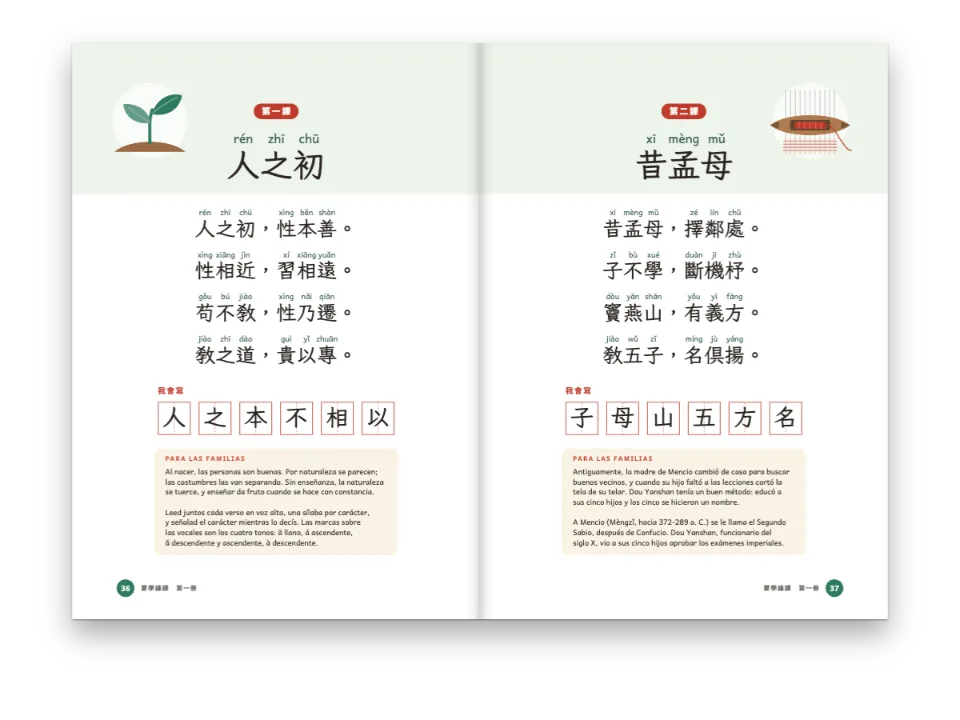
La lección 12 del libro noveno de 國語, un libro taiwanés de lectura de quinto de primaria, inventado: dos fábulas del Han Feizi, la del campesino de Song que espera otra liebre junto a un tocón y la del hombre de Zheng que se fía más de su medida que de sus pies. En Taiwán estos libros se componen en vertical, en letra Kai, con el zhuyin de cada carácter en una columna a su derecha, para que el niño lea un carácter antes de aprenderlo. La lección se abre en un pliego con el lomo a la derecha. Arriba, un piso guarda los dibujos, las notas, el autor y los caracteres nuevos; abajo va la lección en Iansui de 16 pt, 23 caracteres por línea. Su pareja en escritura latina es el libro de texto con columna al margen, cuya columna lateral de flotantes es aquí el piso de arriba, girado un cuarto de vuelta.
Esta receta responde a
- ¿Cómo pongo el zhuyin junto a cada carácter de un texto chino vertical?
- ¿Cómo compongo un libro chino en vertical, encuadernado por la derecha?
La respuesta corta
const layout = {
  writingMode: 'vertical-rl', // lines run down the page, read from the right; bound on the right
  layoutType: 'oneAndHalf', // two tiers: the text below, pictures and notes above
  sideColumnRole: 'floats', sideColumnSide: 'left', // 'left' is the top tier in vertical text
  sideColumnPercent: 34,
  gutterWidth: pt(2 * SIZE),
};
const cjk = {
  // The lower tier: 23 characters down, 13 lines across the page.
  grid: { enabled: true, charsPerLine: 23, linesPerPage: 13 },
  // Readings at half the text size; zhuyin sets its symbols at 60 % of that, 0.3 em,
  // so three symbols fit beside one character, and beside each of two in a row.
  ruby: { fontFamily: ZHUYIN, fontSize: em(0.5) },
};
// The line pitch is twice the size: a gap of one em, which the zhuyin and its tone
// marks half fill. clreq asks for 1.5 em; one em keeps 13 lines of 23 on the page.
const LINE = 2 * SIZE;
const bodyText = {
  fontFamily: KAI, fontSize: pt(SIZE), lineHeight: pt(LINE), color: col('ink'),
  boldColor: col('ink'), italicColor: col('ink'), referenceColor: col('ink'),
  textAlign: 'justify', firstLineIndent: em(2), indentAfterHeading: true,
};
Ingredientes
- Funciones
- Ruby: lecturas en pinyin y zhuyinTexto verticalLibros encuadernados por la derechaFuentes chinas, japonesas y coreanasAnchura de la puntuación chinaRetícula de caracteresColumna y mediaColumna al margen para flotantesNotas al margenNumeración chinaListas numeradasTipos de recurso propiosRecuadrosEstilos de párrafoEstilos de títuloTextos, filetes y cajas en los diseños de páginaCabeceras y foliosExportación a PDF
- También usa
- Corte de líneas en chinoAtributos de títuloFiguras justo aquíCabeceras según el tipo de páginaFuentes incrustadas en el PDFFiguras y tablas como recursosNúmeros en pie en texto vertical
- Tipografía
- Iansui, LXGW WenKai TC, Noto Serif TC, Noto Sans TC (SIL OFL 1.1)
- Recursos
- Ninguno: todas las imágenes se dibujan en código
Elaboración
#1 · Una columna de zhuyin junto a cada carácter
El código es la respuesta corta de arriba. {宋人|ㄙㄨㄥˋ|ㄖㄣˊ} da a cada carácter su lectura, una por cada |; la puntuación queda fuera de las llaves, así que 。 y , no llevan ninguna. En texto vertical, una lectura en bopomofo va a la derecha de la columna, con los signos uno debajo de otro, la marca de tono a la derecha del último y el punto del tono neutro encima del primero. A la mitad del cuerpo del texto, cjk.ruby.fontSize deja los signos en 0,3 em, así que tres signos caben junto a un carácter, y dos lecturas así seguidas, como en 就像, guardan entre sí al menos un cuarto de signo sin ensanchar ninguno de los dos caracteres; con 0,6 em, ㄇㄧㄥˊ es más alta que 明 y separa los dos 明 de 明明. El interlineado de 32 pt deja un hueco de un cuadratín entre líneas, que el zhuyin y sus tonos llenan a medias. clreq pide 1,5 em cuando el zhuyin va entre líneas verticales; eso son 40 pt de interlineado y diez líneas por página, así que esta página se queda en un cuadratín para meter 13 líneas de 23, y cada lectura queda a unos 8 pt de la línea vecina.
#2 · Dibujos y notas en el piso de arriba
const resourceTypes = [{ id: 'plate', name: '插圖', shortLabel: '圖', numberingTemplate: '{n}',
  resetOn: 'never', counterFormat: 'decimal', captionPrefix: '' }]; // no prefix, no caption
const box = (id, title, body) => ({ id, title, background: col('tint'),
  padding: { top: mm(3), right: mm(3), bottom: mm(3), left: mm(3) },
  titleStyle: { fontFamily: HEI, fontSize: pt(11), fontWeight: 700, color: col('accent') },
  body: { color: col('ink'), firstLineIndent: pt(0), textAlign: 'left', boldColor: col('ink'),
    italicColor: col('ink'), ...body } });
// Zhuyin is 0.3 em of the text it reads: at 13 pt the notes' readings are 3.9 pt.
const calloutStyles = [ // fenced :::callout{type="notes" span="side"} in the text
  box('notes', '注釋', { fontFamily: MING, fontSize: pt(13), lineHeight: pt(24) }),
  box('author', '作者', { fontFamily: MING, fontSize: pt(13), lineHeight: pt(24),
    textAlign: 'justify', firstLineIndent: em(2) }),
  box('chars', '生字', { fontFamily: KAI, fontSize: pt(22), lineHeight: pt(40),
    textAlign: 'center' }),
];
En texto vertical, las columnas de una maquetación oneAndHalf son pisos, y sideColumnSide: 'left' pone arriba el que solo admite flotantes. ::resource{id="plate-1"} en el texto manda allí el primer dibujo; el tipo plate no tiene prefijo de pie y los dibujos no llevan pie, así que debajo no se imprime nada. Un recuadro abierto con span="side" cae en el piso a partir de la línea donde se abre, y su texto corre hacia abajo dentro del piso. Las notas de las dos fábulas van en un solo recuadro, numeradas de corrido; se abre tras el primer original, que termina en la página 86, y llena el piso de la página 87, así que las notas de cada fábula quedan en el pliego de su original. El zhuyin mide 0,3 em del texto que lee y cjk.ruby es un ajuste para todo el libro, así que las notas y el recuadro del autor van en 13 pt para que sus lecturas no bajen de 3,9 pt.
#3 · Cuatro fuentes, cada una cargada con su texto
// {株|ㄓㄨ}: the characters are the text, the readings go to the zhuyin face.
const BOXES = /^:::callout\{type="(?:notes|author)"[^}]*\}\n([\s\S]*?)^:::$/gm;
const bases = (md) => md.replace(/\{([^|{}]+)((?:\|[^|{}]+)+)\}/g, '$1');
const readings = [...markdown.matchAll(/\{[^|{}]+((?:\|[^|{}]+)+)\}/g)].map((m) => m[1]).join('');
await loadFonts(FONTS, markdown);
await loadCjkFonts({ [KAI]: ['400'] }, bases(markdown.replace(BOXES, '')), { vertical: true });
const notesText = [...markdown.matchAll(BOXES)].map((m) => m[1]).join('\n');
await loadCjkFonts({ [MING]: ['400'] }, bases(notesText), { vertical: true });
await loadCjkFonts({ [ZHUYIN]: ['400'] }, readings.replaceAll('|', ''), { vertical: true });
await loadCjkFonts({ [HEI]: ['400', '700'] }, LABELS, { vertical: true });
await Promise.all(Object.entries(plates).map(([id, markup]) => loadSvg(`${id}.svg`, markup)));
// Lesson 12 of a reader: page 86 is a verso, so the lesson opens on a spread.
const continuation = { pageIndexOffset: 1, pageNumbering: { startAt: 86 } };
const doc = await buildWithFonts(
  () => buildDocument({ markdown, resources, continuation }, config()), markdown);
showBook(doc, { title: t({ en: 'A vertical reader with zhuyin',
  es: 'Un libro de lectura vertical con zhuyin' }) });
offerPdf(() => renderToPdf(doc, { fontProvider: cjkPdfProvider, resourceBytes: imageBytes }),
  `${RECIPE}.pdf`);
La lección va en Iansui, una letra Kai dibujada a partir de Klee One con las formas estándar de Taiwán, las que los niños aprenden a escribir. Las lecturas van en LXGW WenKai TC, cuyo punto de tono neutro sigue redondo a 4,8 pt; las notas, en Noto Serif TC, y las etiquetas, en Noto Sans TC. Cada fuente carga los archivos que tienen los caracteres que compone: las lecturas se separan de sus caracteres y los recuadros de notas van solo a la fuente Ming. vertical: true añade las formas verticales, para que 「」 y 、 queden bien en la columna. pageIndexOffset: 1 hace de la página 86 una página par, así que la lección se abre en un pliego.
#4 · La pestaña y los folios en el borde exterior
// The verso lies on the right of the spread, so even pages carry both at the right edge.
const tab = (parity, edge) => [
  { kind: 'box', id: `tab-${parity}`, parity, pages: 'all',
    placement: { anchor: { to: 'page', edge }, offset: { y: mm(24) },
      size: { width: mm(9), height: mm(64) } }, style: { backgroundColor: col('accent') } },
  { kind: 'text', id: `unit-${parity}`, content: '第三單元 寓言故事', parity, pages: 'all',
    writingMode: 'vertical-rl', fontFamily: HEI, fontSize: pt(9), fontWeight: 700,
    color: col('paper'), align: 'center', verticalAlign: 'middle',
    placement: { anchor: { to: `#tab-${parity}`, edge: 'align-top' },
      size: { width: mm(9), height: mm(64) } } },
];
const foot = (id, parity, edge, x, content, extra = {}) => ({
  kind: 'text', id, content, parity, pages: 'all', fontFamily: HEI, fontSize: pt(8),
  color: col('muted'), placement: { anchor: { to: 'page', edge }, offset: { x: mm(x), y: mm(-9) } },
  ...extra,
});
const folio = { fontSize: pt(9), fontWeight: 700 };
const header = { elements: [...tab('even', 'top-right'), ...tab('odd', 'top-left')] };
const footer = {
  elements: [
    foot('folio-even', 'even', 'bottom-right', -16, '{pageNumber}', folio),
    foot('book', 'even', 'bottom-right', -26, '國語 第九冊'),
    foot('folio-odd', 'odd', 'bottom-left', 16, '{pageNumber}', folio),
    foot('lesson', 'odd', 'bottom-left', 26, '{chapterTitle}'),
  ],
};
En un libro con el lomo a la derecha, la página par queda a la derecha del pliego, así que las pares llevan la pestaña de la unidad y el folio en el borde derecho y las impares en el izquierdo. La pestaña es una caja con un elemento de texto encima; writingMode: 'vertical-rl' en el elemento compone 第三單元 寓言故事 de arriba abajo, mientras los folios y las líneas del pie siguen en horizontal.
La receta completa
// ═══ Postext Cookbook · Nº 080 · A vertical reader with zhuyin to the right ═════════ // https://postext.dev/en/cookbook/zhuyin-vertical-reader // Code: MIT · Text: Han Feizi, zh.wikisource (CC BY-SA 4.0) · Pictures: drawn in code // Fonts: Iansui, LXGW WenKai TC, Noto Serif TC, Noto Sans TC (SIL OFL 1.1) · Needs postext ≥ 1.9.0 import { buildDocument, renderPageToCanvas, clearMeasurementCache, registerResourceImage, loadVerticalAlternates, } from 'https://esm.sh/postext'; import { renderToPdf, decompressWoff2 } from 'https://esm.sh/postext-pdf'; const LANG = 'es'; // @lang: the language of the sample document ('en' | 'es') const RECIPE = 'zhuyin-vertical-reader'; // ─── 1 · Design ───────────────────────────────────────────────────────────── // #region palette: semantic colours, every one linked by id const palette = { ink: '#2b2520', // text and zhuyin accent: '#b83f28', // lesson title, labels, the unit's tab (4.9:1 on the tint) tint: '#f7efdf', // the boxes of the upper tier muted: '#72675b', // lead, folios, colophon paper: '#ffffff', // the lettering on the tab }; const col = (id) => ({ hex: palette[id], model: 'hex', paletteId: id }); const colorPalette = [ ...Object.entries(palette).map(([id, hex]) => ({ id, name: id, value: { hex, model: 'hex' } })), { id: 'main-color', name: 'accent (defaults)', value: { hex: palette.accent, model: 'hex' } }, ]; // #endregion const KAI = 'Iansui'; // 楷: the lesson, drawn to Taiwan's standard forms (為, not 爲) const ZHUYIN = 'LXGW WenKai TC'; // the readings: a round dot for the neutral tone const MING = 'Noto Serif TC'; // 明: notes and the author box const HEI = 'Noto Sans TC'; // 黑: labels, folios, the tab const SIZE = 16; // the text size (三號) // #region answer: vertical text with a zhuyin column right of every character const layout = { writingMode: 'vertical-rl', // lines run down the page, read from the right; bound on the right layoutType: 'oneAndHalf', // two tiers: the text below, pictures and notes above sideColumnRole: 'floats', sideColumnSide: 'left', // 'left' is the top tier in vertical text sideColumnPercent: 34, gutterWidth: pt(2 * SIZE), }; const cjk = { // The lower tier: 23 characters down, 13 lines across the page. grid: { enabled: true, charsPerLine: 23, linesPerPage: 13 }, // Readings at half the text size; zhuyin sets its symbols at 60 % of that, 0.3 em, // so three symbols fit beside one character, and beside each of two in a row. ruby: { fontFamily: ZHUYIN, fontSize: em(0.5) }, }; // The line pitch is twice the size: a gap of one em, which the zhuyin and its tone // marks half fill. clreq asks for 1.5 em; one em keeps 13 lines of 23 on the page. const LINE = 2 * SIZE; const bodyText = { fontFamily: KAI, fontSize: pt(SIZE), lineHeight: pt(LINE), color: col('ink'), boldColor: col('ink'), italicColor: col('ink'), referenceColor: col('ink'), textAlign: 'justify', firstLineIndent: em(2), indentAfterHeading: true, }; // #endregion // #region upper-tier: pictures without a caption line, boxes of notes set down the tier const resourceTypes = [{ id: 'plate', name: '插圖', shortLabel: '圖', numberingTemplate: '{n}', resetOn: 'never', counterFormat: 'decimal', captionPrefix: '' }]; // no prefix, no caption const box = (id, title, body) => ({ id, title, background: col('tint'), padding: { top: mm(3), right: mm(3), bottom: mm(3), left: mm(3) }, titleStyle: { fontFamily: HEI, fontSize: pt(11), fontWeight: 700, color: col('accent') }, body: { color: col('ink'), firstLineIndent: pt(0), textAlign: 'left', boldColor: col('ink'), italicColor: col('ink'), ...body } }); // Zhuyin is 0.3 em of the text it reads: at 13 pt the notes' readings are 3.9 pt. const calloutStyles = [ // fenced :::callout{type="notes" span="side"} in the text box('notes', '注釋', { fontFamily: MING, fontSize: pt(13), lineHeight: pt(24) }), box('author', '作者', { fontFamily: MING, fontSize: pt(13), lineHeight: pt(24), textAlign: 'justify', firstLineIndent: em(2) }), box('chars', '生字', { fontFamily: KAI, fontSize: pt(22), lineHeight: pt(40), textAlign: 'center' }), ]; // #endregion // #region furniture: the unit's tab and the folios, on the outer edge of a right-bound book // The verso lies on the right of the spread, so even pages carry both at the right edge. const tab = (parity, edge) => [ { kind: 'box', id: `tab-${parity}`, parity, pages: 'all', placement: { anchor: { to: 'page', edge }, offset: { y: mm(24) }, size: { width: mm(9), height: mm(64) } }, style: { backgroundColor: col('accent') } }, { kind: 'text', id: `unit-${parity}`, content: '第三單元 寓言故事', parity, pages: 'all', writingMode: 'vertical-rl', fontFamily: HEI, fontSize: pt(9), fontWeight: 700, color: col('paper'), align: 'center', verticalAlign: 'middle', placement: { anchor: { to: `#tab-${parity}`, edge: 'align-top' }, size: { width: mm(9), height: mm(64) } } }, ]; const foot = (id, parity, edge, x, content, extra = {}) => ({ kind: 'text', id, content, parity, pages: 'all', fontFamily: HEI, fontSize: pt(8), color: col('muted'), placement: { anchor: { to: 'page', edge }, offset: { x: mm(x), y: mm(-9) } }, ...extra, }); const folio = { fontSize: pt(9), fontWeight: 700 }; const header = { elements: [...tab('even', 'top-right'), ...tab('odd', 'top-left')] }; const footer = { elements: [ foot('folio-even', 'even', 'bottom-right', -16, '{pageNumber}', folio), foot('book', 'even', 'bottom-right', -26, '國語 第九冊'), foot('folio-odd', 'odd', 'bottom-left', 16, '{pageNumber}', folio), foot('lesson', 'odd', 'bottom-left', 26, '{chapterTitle}'), ], }; // #endregion const config = () => ({ // a factory: the engine caches resolved configs per object locale: 'zh-Hant', // Taiwan: full-width punctuation, centred in its cell (gotcha: cjk-locale-tag) colorPalette, resourceTypes, page: { sizePreset: 'custom', width: mm(184), height: mm(260), dpi: 150, // 16開 margins: { top: mm(24), bottom: mm(18), left: mm(18), right: mm(16), mirror: true }, }, layout, cjk, bodyText, headings: { fontFamily: KAI, color: col('ink'), fontWeight: 400, // Iansui has one weight levels: [ // The lesson and fable numbers are typed in the headings: a numberingTemplate would // join the number to the title's first reading (see the recipe's workarounds). { level: 1, fontSize: pt(30), lineHeight: pt(2 * LINE), color: col('accent'), breakBefore: { enabled: true, parity: 'any' }, marginBottom: pt(0) }, { level: 2, fontSize: pt(20), lineHeight: pt(2 * LINE), marginTop: pt(LINE), marginBottom: pt(0) }, { level: 3, fontFamily: HEI, fontWeight: 700, fontSize: pt(13), lineHeight: pt(LINE), color: col('accent'), marginTop: pt(LINE / 2), marginBottom: pt(0) }, ], }, // 想一想 and 語文天地: exercise heads in the label face, one line tall. headingStyles: [{ id: 'drill', fontFamily: HEI, fontWeight: 700, fontSize: pt(13), lineHeight: pt(LINE), color: col('accent'), marginTop: pt(LINE / 2), marginBottom: pt(0) }], orderedLists: { numberFormat: 'trad-chinese-informal', separator: '、', color: col('accent'), fontFamily: HEI, fontWeight: 700, marginTop: pt(0), marginBottom: pt(0) }, paragraphStyles: [ { id: 'lead', fontFamily: KAI, fontSize: pt(14), lineHeight: pt(LINE), color: col('muted'), textAlign: 'justify', firstLineIndent: em(0) }, { id: 'plain', fontFamily: KAI, fontSize: pt(14), lineHeight: pt(LINE), color: col('ink'), textAlign: 'justify', firstLineIndent: em(2) }, { id: 'idiom', fontFamily: KAI, fontSize: pt(SIZE), lineHeight: pt(LINE), color: col('ink'), boldColor: col('accent'), boldFontWeight: 400, textAlign: 'justify', // bold in colour only firstLineIndent: em(0) }, { id: 'colophon', fontFamily: HEI, fontSize: pt(7), lineHeight: pt(11), color: col('muted'), textAlign: 'left', firstLineIndent: pt(0), marginTop: pt(LINE) }, ], calloutStyles, header, footer, }); // ─── 2 · Content ──────────────────────────────────────────────────────────── const markdown = String.raw`# 第十二課 {寓言兩則|ㄩˋ|ㄧㄢˊ|ㄌㄧㄤˇ|ㄗㄜˊ}Muestra en Markdown · 91 líneas · content.es.md
:::paragraphs{style="lead"} {寓言用一個短短的故事|ㄩˋ|ㄧㄢˊ|ㄩㄥˋ|ㄧ|˙ㄍㄜ|ㄉㄨㄢˇ|ㄉㄨㄢˇ|˙ㄉㄜ|ㄍㄨˋ|˙ㄕ},{說出一個道理|ㄕㄨㄛ|ㄔㄨ|ㄧ|˙ㄍㄜ|ㄉㄠˋ|ㄌㄧˇ}。{這一課的兩則寓言|ㄓㄜˋ|ㄧ|ㄎㄜˋ|˙ㄉㄜ|ㄌㄧㄤˇ|ㄗㄜˊ|ㄩˋ|ㄧㄢˊ},{都選自戰國時代韓非所寫的|ㄉㄡ|ㄒㄩㄢˇ|ㄗˋ|ㄓㄢˋ|ㄍㄨㄛˊ|ㄕˊ|ㄉㄞˋ|ㄏㄢˊ|ㄈㄟ|ㄙㄨㄛˇ|ㄒㄧㄝˇ|˙ㄉㄜ}《{韓非子|ㄏㄢˊ|ㄈㄟ|ㄗˇ}》。{讀的時候想一想|ㄉㄨˊ|˙ㄉㄜ|ㄕˊ|ㄏㄡˋ|ㄒㄧㄤˇ|ㄧ|ㄒㄧㄤˇ}:{故事裡的人|ㄍㄨˋ|˙ㄕ|ㄌㄧˇ|˙ㄉㄜ|ㄖㄣˊ},{錯在哪裡|ㄘㄨㄛˋ|ㄗㄞˋ|ㄋㄚˇ|ㄌㄧˇ}? ::: ::resource{id="plate-1"} ## 一 {守株待兔|ㄕㄡˇ|ㄓㄨ|ㄉㄞˋ|ㄊㄨˋ} {宋人有耕田者|ㄙㄨㄥˋ|ㄖㄣˊ|ㄧㄡˇ|ㄍㄥ|ㄊㄧㄢˊ|ㄓㄜˇ},{田中有株|ㄊㄧㄢˊ|ㄓㄨㄥ|ㄧㄡˇ|ㄓㄨ},{兔走觸株|ㄊㄨˋ|ㄗㄡˇ|ㄔㄨˋ|ㄓㄨ},{折頸而死|ㄓㄜˊ|ㄐㄧㄥˇ|ㄦˊ|ㄙˇ},{因釋其耒而守株|ㄧㄣ|ㄕˋ|ㄑㄧˊ|ㄌㄟˇ|ㄦˊ|ㄕㄡˇ|ㄓㄨ},{冀復得兔|ㄐㄧˋ|ㄈㄨˋ|ㄉㄜˊ|ㄊㄨˋ},{兔不可復得|ㄊㄨˋ|ㄅㄨˋ|ㄎㄜˇ|ㄈㄨˋ|ㄉㄜˊ},{而身為宋國笑|ㄦˊ|ㄕㄣ|ㄨㄟˊ|ㄙㄨㄥˋ|ㄍㄨㄛˊ|ㄒㄧㄠˋ}。 :::callout{type="notes" span="side"} ①{株|ㄓㄨ}:露出地面的樹根。 ②{走|ㄗㄡˇ}:跑。 ③{觸|ㄔㄨˋ}:碰,撞。 ④{釋|ㄕˋ}:放下。 ⑤{耒|ㄌㄟˇ}:古代翻土用的農具。 ⑥{冀|ㄐㄧˋ}:希望。 ⑦{為宋國笑|ㄨㄟˊ|ㄙㄨㄥˋ|ㄍㄨㄛˊ|ㄒㄧㄠˋ}:被宋國人譏笑。 ⑧{且置履|ㄑㄧㄝˇ|ㄓˋ|ㄌㄩˇ}:將要買鞋。 ⑨{度|ㄉㄨㄛˋ}:量長短。 ⑩{坐|ㄗㄨㄛˋ}:同「座」,座位。 ⑪{操|ㄘㄠ}:拿,帶著。 ⑫{度|ㄉㄨˋ}:量好的尺碼。 ⑬{反|ㄈㄢˇ}:同「返」,回去。 ⑭{罷|ㄅㄚˋ}:結束,散了。 ⑮{寧|ㄋㄧㄥˊ}:寧可。 ::: ### {語譯|ㄩˇ|ㄧˋ} :::paragraphs{style="plain"} {宋國有一個種田的人|ㄙㄨㄥˋ|ㄍㄨㄛˊ|ㄧㄡˇ|ㄧ|˙ㄍㄜ|ㄓㄨㄥˋ|ㄊㄧㄢˊ|˙ㄉㄜ|ㄖㄣˊ},{田裡有一截樹樁|ㄊㄧㄢˊ|ㄌㄧˇ|ㄧㄡˇ|ㄧ|ㄐㄧㄝˊ|ㄕㄨˋ|ㄓㄨㄤ}。{有一天|ㄧㄡˇ|ㄧ|ㄊㄧㄢ},{一隻兔子跑過來|ㄧ|ㄓ|ㄊㄨˋ|˙ㄗ|ㄆㄠˇ|ㄍㄨㄛˋ|˙ㄌㄞ},{一頭撞在樹樁上|ㄧ|ㄊㄡˊ|ㄓㄨㄤˋ|ㄗㄞˋ|ㄕㄨˋ|ㄓㄨㄤ|ㄕㄤˋ},{折斷脖子死了|ㄓㄜˊ|ㄉㄨㄢˋ|ㄅㄛˊ|˙ㄗ|ㄙˇ|˙ㄌㄜ}。{這個人就放下手裡的農具|ㄓㄜˋ|˙ㄍㄜ|ㄖㄣˊ|ㄐㄧㄡˋ|ㄈㄤˋ|ㄒㄧㄚˋ|ㄕㄡˇ|ㄌㄧˇ|˙ㄉㄜ|ㄋㄨㄥˊ|ㄐㄩˋ},{天天守在樹樁旁邊|ㄊㄧㄢ|ㄊㄧㄢ|ㄕㄡˇ|ㄗㄞˋ|ㄕㄨˋ|ㄓㄨㄤ|ㄆㄤˊ|ㄅㄧㄢ},{希望再撿到兔子|ㄒㄧ|ㄨㄤˋ|ㄗㄞˋ|ㄐㄧㄢˇ|ㄉㄠˋ|ㄊㄨˋ|˙ㄗ}。{兔子再也沒有來過|ㄊㄨˋ|˙ㄗ|ㄗㄞˋ|ㄧㄝˇ|ㄇㄟˊ|ㄧㄡˇ|ㄌㄞˊ|ㄍㄨㄛˋ},{他自己倒成了宋國人的笑話|ㄊㄚ|ㄗˋ|ㄐㄧˇ|ㄉㄠˋ|ㄔㄥˊ|˙ㄌㄜ|ㄙㄨㄥˋ|ㄍㄨㄛˊ|ㄖㄣˊ|˙ㄉㄜ|ㄒㄧㄠˋ|ㄏㄨㄚˋ}。 ::: ::resource{id="plate-2"} ## 二 {鄭人買履|ㄓㄥˋ|ㄖㄣˊ|ㄇㄞˇ|ㄌㄩˇ} {鄭人有且置履者|ㄓㄥˋ|ㄖㄣˊ|ㄧㄡˇ|ㄑㄧㄝˇ|ㄓˋ|ㄌㄩˇ|ㄓㄜˇ},{先自度其足而置之其坐|ㄒㄧㄢ|ㄗˋ|ㄉㄨㄛˋ|ㄑㄧˊ|ㄗㄨˊ|ㄦˊ|ㄓˋ|ㄓ|ㄑㄧˊ|ㄗㄨㄛˋ},{至之市而忘操之|ㄓˋ|ㄓ|ㄕˋ|ㄦˊ|ㄨㄤˋ|ㄘㄠ|ㄓ}。{已得履|ㄧˇ|ㄉㄜˊ|ㄌㄩˇ},{乃曰|ㄋㄞˇ|ㄩㄝ}:「{吾忘持度|ㄨˊ|ㄨㄤˋ|ㄔˊ|ㄉㄨˋ}。」{反歸取之|ㄈㄢˇ|ㄍㄨㄟ|ㄑㄩˇ|ㄓ}。{及反|ㄐㄧˊ|ㄈㄢˇ},{市罷|ㄕˋ|ㄅㄚˋ},{遂不得履|ㄙㄨㄟˋ|ㄅㄨˋ|ㄉㄜˊ|ㄌㄩˇ}。{人曰|ㄖㄣˊ|ㄩㄝ}:「{何不試之以足|ㄏㄜˊ|ㄅㄨˋ|ㄕˋ|ㄓ|ㄧˇ|ㄗㄨˊ}?」{曰|ㄩㄝ}:「{寧信度|ㄋㄧㄥˊ|ㄒㄧㄣˋ|ㄉㄨˋ},{無自信也|ㄨˊ|ㄗˋ|ㄒㄧㄣˋ|ㄧㄝˇ}。」 ### {語譯|ㄩˇ|ㄧˋ} :::paragraphs{style="plain"} {鄭國有個人要買鞋子|ㄓㄥˋ|ㄍㄨㄛˊ|ㄧㄡˇ|˙ㄍㄜ|ㄖㄣˊ|ㄧㄠˋ|ㄇㄞˇ|ㄒㄧㄝˊ|˙ㄗ}。{他先在家裡量好自己腳的大小|ㄊㄚ|ㄒㄧㄢ|ㄗㄞˋ|ㄐㄧㄚ|˙ㄌㄧ|ㄌㄧㄤˊ|ㄏㄠˇ|ㄗˋ|ㄐㄧˇ|ㄐㄧㄠˇ|˙ㄉㄜ|ㄉㄚˋ|ㄒㄧㄠˇ},{把量好的尺碼放在座位上|ㄅㄚˇ|ㄌㄧㄤˊ|ㄏㄠˇ|˙ㄉㄜ|ㄔˇ|ㄇㄚˇ|ㄈㄤˋ|ㄗㄞˋ|ㄗㄨㄛˋ|ㄨㄟˋ|ㄕㄤˋ}。{到了市場|ㄉㄠˋ|˙ㄌㄜ|ㄕˋ|ㄔㄤˊ},{卻忘了把尺碼帶在身上|ㄑㄩㄝˋ|ㄨㄤˋ|˙ㄌㄜ|ㄅㄚˇ|ㄔˇ|ㄇㄚˇ|ㄉㄞˋ|ㄗㄞˋ|ㄕㄣ|ㄕㄤˋ}。{他已經挑好了鞋子|ㄊㄚ|ㄧˇ|ㄐㄧㄥ|ㄊㄧㄠ|ㄏㄠˇ|˙ㄌㄜ|ㄒㄧㄝˊ|˙ㄗ},{才說|ㄘㄞˊ|ㄕㄨㄛ}:「{我忘了帶尺碼|ㄨㄛˇ|ㄨㄤˋ|˙ㄌㄜ|ㄉㄞˋ|ㄔˇ|ㄇㄚˇ}。」{就轉身回家去拿|ㄐㄧㄡˋ|ㄓㄨㄢˇ|ㄕㄣ|ㄏㄨㄟˊ|ㄐㄧㄚ|ㄑㄩˋ|ㄋㄚˊ}。{等他再回到市場|ㄉㄥˇ|ㄊㄚ|ㄗㄞˋ|ㄏㄨㄟˊ|ㄉㄠˋ|ㄕˋ|ㄔㄤˊ},{市場已經散了|ㄕˋ|ㄔㄤˊ|ㄧˇ|ㄐㄧㄥ|ㄙㄢˋ|˙ㄌㄜ},{終於沒買到鞋子|ㄓㄨㄥ|ㄩˊ|ㄇㄟˊ|ㄇㄞˇ|ㄉㄠˋ|ㄒㄧㄝˊ|˙ㄗ}。{有人問他|ㄧㄡˇ|ㄖㄣˊ|ㄨㄣˋ|ㄊㄚ}:「{為什麼不用腳試穿呢|ㄨㄟˋ|ㄕㄣˊ|˙ㄇㄜ|ㄅㄨˋ|ㄩㄥˋ|ㄐㄧㄠˇ|ㄕˋ|ㄔㄨㄢ|˙ㄋㄜ}?」{他說|ㄊㄚ|ㄕㄨㄛ}:「{我寧可相信尺碼|ㄨㄛˇ|ㄋㄧㄥˊ|ㄎㄜˇ|ㄒㄧㄤ|ㄒㄧㄣˋ|ㄔˇ|ㄇㄚˇ},{也不相信自己的腳|ㄧㄝˇ|ㄅㄨˋ|ㄒㄧㄤ|ㄒㄧㄣˋ|ㄗˋ|ㄐㄧˇ|˙ㄉㄜ|ㄐㄧㄠˇ}。」 ::: ## {想一想|ㄒㄧㄤˇ|ㄧ|ㄒㄧㄤˇ} {style="drill"} 1. {宋國的農夫為什麼成了別人的笑話|ㄙㄨㄥˋ|ㄍㄨㄛˊ|˙ㄉㄜ|ㄋㄨㄥˊ|ㄈㄨ|ㄨㄟˋ|ㄕㄣˊ|˙ㄇㄜ|ㄔㄥˊ|˙ㄌㄜ|ㄅㄧㄝˊ|ㄖㄣˊ|˙ㄉㄜ|ㄒㄧㄠˋ|ㄏㄨㄚˋ}? 2. {鄭國人明明到了市場|ㄓㄥˋ|ㄍㄨㄛˊ|ㄖㄣˊ|ㄇㄧㄥˊ|ㄇㄧㄥˊ|ㄉㄠˋ|˙ㄌㄜ|ㄕˋ|ㄔㄤˊ},{為什麼沒買到鞋子|ㄨㄟˋ|ㄕㄣˊ|˙ㄇㄜ|ㄇㄟˊ|ㄇㄞˇ|ㄉㄠˋ|ㄒㄧㄝˊ|˙ㄗ}? 3. {這兩個人做錯的地方|ㄓㄜˋ|ㄌㄧㄤˇ|˙ㄍㄜ|ㄖㄣˊ|ㄗㄨㄛˋ|ㄘㄨㄛˋ|˙ㄉㄜ|ㄉㄧˋ|ㄈㄤ},{有什麼相同|ㄧㄡˇ|ㄕㄣˊ|˙ㄇㄜ|ㄒㄧㄤ|ㄊㄨㄥˊ}? :::callout{type="author" span="side"} {韓非|ㄏㄢˊ|ㄈㄟ},戰國時代韓國的貴族,大約生於西元前二八〇年,死於西元前二三三年。他和{李斯|ㄌㄧˇ|ㄙ}都是{荀子|ㄒㄩㄣˊ|ㄗˇ}的學生,說話口吃,卻很會寫文章。後人把他的文章編成《韓非子》,書中有許多有趣的寓言故事。 ::: ## {語文天地|ㄩˇ|ㄨㄣˊ|ㄊㄧㄢ|ㄉㄧˋ} {style="drill"} 「{守株待兔|ㄕㄡˇ|ㄓㄨ|ㄉㄞˋ|ㄊㄨˋ}」{與|ㄩˇ}「{鄭人買履|ㄓㄥˋ|ㄖㄣˊ|ㄇㄞˇ|ㄌㄩˇ}」{後來都成了成語|ㄏㄡˋ|ㄌㄞˊ|ㄉㄡ|ㄔㄥˊ|˙ㄌㄜ|ㄔㄥˊ|ㄩˇ}。 :::paragraphs{style="idiom"} **{守株待兔|ㄕㄡˇ|ㄓㄨ|ㄉㄞˋ|ㄊㄨˋ}**:{比喻不肯努力|ㄅㄧˇ|ㄩˋ|ㄅㄨˋ|ㄎㄣˇ|ㄋㄨˇ|ㄌㄧˋ},{只想白白得到好處|ㄓˇ|ㄒㄧㄤˇ|ㄅㄞˊ|ㄅㄞˊ|ㄉㄜˊ|ㄉㄠˋ|ㄏㄠˇ|ㄔㄨˋ}。{例|ㄌㄧˋ}:{考試前不讀書|ㄎㄠˇ|ㄕˋ|ㄑㄧㄢˊ|ㄅㄨˋ|ㄉㄨˊ|ㄕㄨ},{只希望考的題目剛好都會|ㄓˇ|ㄒㄧ|ㄨㄤˋ|ㄎㄠˇ|˙ㄉㄜ|ㄊㄧˊ|ㄇㄨˋ|ㄍㄤ|ㄏㄠˇ|ㄉㄡ|ㄏㄨㄟˋ},{這就是守株待兔|ㄓㄜˋ|ㄐㄧㄡˋ|ㄕˋ|ㄕㄡˇ|ㄓㄨ|ㄉㄞˋ|ㄊㄨˋ}。 **{鄭人買履|ㄓㄥˋ|ㄖㄣˊ|ㄇㄞˇ|ㄌㄩˇ}**:{比喻只相信死板的規定|ㄅㄧˇ|ㄩˋ|ㄓˇ|ㄒㄧㄤ|ㄒㄧㄣˋ|ㄙˇ|ㄅㄢˇ|˙ㄉㄜ|ㄍㄨㄟ|ㄉㄧㄥˋ},{不看實際的情形|ㄅㄨˋ|ㄎㄢˋ|ㄕˊ|ㄐㄧˋ|˙ㄉㄜ|ㄑㄧㄥˊ|ㄒㄧㄥˊ}。{例|ㄌㄧˋ}:{買衣服不試穿|ㄇㄞˇ|ㄧ|˙ㄈㄨ|ㄅㄨˋ|ㄕˋ|ㄔㄨㄢ},{只看尺寸|ㄓˇ|ㄎㄢˋ|ㄔˊ|˙ㄘㄨㄣ},{就像鄭人買履|ㄐㄧㄡˋ|ㄒㄧㄤˋ|ㄓㄥˋ|ㄖㄣˊ|ㄇㄞˇ|ㄌㄩˇ}。 ::: :::callout{type="chars" span="side"} {株|ㄓㄨ} {耒|ㄌㄟˇ} {冀|ㄐㄧˋ} {履|ㄌㄩˇ} {罷|ㄅㄚˋ} {遂|ㄙㄨㄟˋ} ::: :::paragraphs{style="colophon"} Compuesto en Iansui, LXGW WenKai TC, Noto Serif TC y Noto Sans TC (SIL OFL). Texto: Han Feizi, capítulos :sideways[49] y :sideways[32], Wikisource en chino, revisiones 2642850 y 2327662 (CC BY-SA 4.0). Zhuyin cotejado con el Diccionario Revisado de Chino Mandarín (Ministerio de Educación, Taiwán); versiones modernas, notas y ejercicios escritos para esta receta (CC BY 4.0). :::`; // content.<lang>.md, inlined by the Cookbook // ─── 3 · Fonts ────────────────────────────────────────────────────────────── const FONTS = { Iansui: ['400'], 'LXGW WenKai TC': ['400'], 'Noto Serif TC': ['400'], 'Noto Sans TC': ['400', '700'], }; // What the label face sets: the tab, the foot of the page, box titles and exercise heads. const LABELS = '第三單元寓言故事國語第九冊十二課兩則注釋作者生字語譯想一文天地、0123456789'; // #region art: two pictures for the upper tier, drawn in code // The pictures' own colours: a spring field under a pale sky. const hue = { sky: '#edf1e6', far: '#d9e3cb', hill: '#bccfa6', field: '#e7d4a2', furrow: '#d3b97f', leaf: '#7e9a58', bark: '#86603f', wood: '#dcbd8e', straw: '#e2bf6e', skin: '#eecba4', robe: '#44617a', shade: '#2f4557', fur: '#f6f2ea', sun: '#f4d98a', }; const seeded = (seed) => () => { // Mulberry32: the same tufts on every run seed = (seed + 0x6d2b79f5) | 0; let x = Math.imul(seed ^ (seed >>> 15), 1 | seed); x = (x + Math.imul(x ^ (x >>> 7), 61 | x)) ^ x; return ((x ^ (x >>> 14)) >>> 0) / 4294967296; }; const svg = (w, h, body) => `<svg xmlns="http://www.w3.org/2000/svg" viewBox="0 0 ${w} ${h}" ` + `width="${w}" height="${h}">${body}</svg>`; const fill = (d, color) => `<path d="${d}" fill="${color}"/>`; const line = (d, color, width, extra = '') => `<path d="${d}" fill="none" stroke="${color}" ` + `stroke-width="${width}" stroke-linecap="round" stroke-linejoin="round"${extra}/>`; const dot = (cx, cy, r, color) => `<circle cx="${cx}" cy="${cy}" r="${r}" fill="${color}"/>`; const at = (x, y, s, body, flip = false) => `<g transform="translate(${x} ${y}) ` + `scale(${flip ? -s : s} ${s})">${body}</g>`; const tufts = (rand, n, x0, x1, y0, y1, color) => Array.from({ length: n }, () => { const x = x0 + rand() * (x1 - x0), y = y0 + rand() * (y1 - y0), h = 14 + rand() * 16; return line(`M${x - 9} ${y}Q${x - 8} ${y - h * 0.6} ${x - 15} ${y - h}M${x} ${y}V${y - h * 1.2}` + `M${x + 9} ${y}Q${x + 8} ${y - h * 0.6} ${x + 15} ${y - h}`, color, 4); }).join(''); const cloud = (x, y, s) => at(x, y, s, fill('M-90 0Q-96 -34 -60 -38Q-50 -76 -8 -70Q24 -96 56 -64' + 'Q98 -66 96 -28Q120 -18 104 0Z', palette.paper)); const tree = (x, y, s) => at(x, y, s, fill('M-10 0L-6 -120H6L10 0Z', hue.bark) + fill('M0 -250Q70 -240 76 -170Q96 -110 40 -96Q0 -80 -40 -96Q-96 -110 -76 -170' + 'Q-70 -240 0 -250Z', hue.leaf)); const landscape = (w) => fill(`M0 0H${w}V700H0Z`, hue.sky) + cloud(560, 150, 1) + cloud(980, 96, 0.7) + fill(`M0 320C200 250 380 300 560 290S900 230 1100 270S1380 300 ${w} 250V700H0Z`, hue.far) + fill(`M0 390C240 340 480 380 700 365S1100 330 ${w} 380V700H0Z`, hue.hill) + fill(`M0 430Q400 405 800 425T${w} 420V700H0Z`, hue.field); // A farmer in a straw hat, drawn about his feet, facing left: sitting with his chin on his // hand, or walking. Limbs are round-capped strokes. const hat = fill('M-66 -262Q-4 -312 62 -262Q-2 -250 -66 -262Z', hue.straw) + line('M-66 -262Q-2 -250 62 -262', hue.bark, 4); const head = dot(-4, -238, 26, hue.skin); const sitter = line('M10 -58L-58 -104L-78 -20', hue.shade, 34) // thigh up to the knee, shin down + fill('M-26 -200Q8 -212 34 -196L44 -56Q0 -40 -34 -60Z', hue.robe) + fill('M-30 -122H40V-108H-30Z', palette.accent) + line('M-6 -190L-54 -112L-30 -214', hue.robe, 26) // elbow on the knee, hand under the chin + dot(-30, -214, 12, hue.skin) + line('M-100 -12H-66', hue.shade, 16) + head + hat; const walker = line('M0 -80L-34 -6', hue.shade, 26) + line('M4 -80L40 -10', hue.shade, 26) + line('M-40 -6H-24M34 -8H52', palette.ink, 14) + line('M-10 -176L-44 -104', hue.shade, 22) + fill('M-26 -200Q8 -212 30 -198L48 -70Q0 -56 -46 -70Z', hue.robe) + fill('M-32 -134H38V-120H-32Z', palette.accent) + line('M14 -184L52 -120', hue.robe, 24) + dot(56, -112, 11, hue.skin) + head + hat; const rabbit = fill('M-46 -18Q-50 -52 -10 -54Q34 -56 42 -26Q44 -6 22 -4H-34Q-46 -6 -46 -18Z', hue.fur) + fill('M30 -48Q40 -70 62 -62Q74 -52 66 -38Q54 -30 38 -34Z', hue.fur) + fill('M50 -64Q46 -104 58 -110Q66 -100 60 -62Z', hue.fur) + fill('M58 -62Q66 -98 80 -100Q84 -88 66 -58Z', hue.fur) + dot(62, -50, 3.5, palette.ink) + dot(-46, -24, 9, hue.fur); const shoes = [100, 200, 300, 400, 500].map((x, i) => fill(`M${x} 440Q${x + 4} 412 ${x + 30} 414` + `H${x + 58}Q${x + 70} 424 ${x + 66} 440ZM${x + 34} 440Q${x + 38} 418 ${x + 60} 420H${x + 80}` + `Q${x + 90} 428 ${x + 86} 440Z`, i % 2 ? hue.robe : palette.ink)).join(''); const plates = { // 守株待兔: the farmer sits by the stump, his tool dropped; a rabbit runs off. 'plate-1': svg(1500, 700, landscape(1500) + dot(1330, 128, 58, hue.sun) + tree(150, 440, 1.1) + tree(250, 430, 0.8) + line('M60 520Q420 480 800 505T1500 500M0 590Q400 560 820 585T1500 585' + 'M0 660Q420 640 840 660T1500 660', hue.furrow, 10) + tufts(seeded(80), 46, 20, 1480, 450, 690, hue.leaf) + fill('M836 560Q846 470 840 440H960Q954 470 966 560Q980 574 1002 580H800Q822 574 836 560Z', hue.bark) + `<ellipse cx="900" cy="440" rx="60" ry="17" fill="${hue.wood}"/>` + line('M864 440Q900 424 936 440Q900 454 872 442M886 440Q900 434 914 441', hue.bark, 3) + line('M930 450L948 400L962 408', hue.bark, 7) + fill('M958 400Q990 380 996 408Q978 420 958 410Z', hue.leaf) + fill('M1020 590Q1110 560 1200 590Z', hue.furrow) + at(1110, 588, 1, sitter) + line('M1210 640L1420 560M1236 630L1214 598M1254 623L1232 591', hue.bark, 9) + at(330, 505, 0.9, rabbit, true) + line('M470 486Q430 470 400 478M476 500Q440 494 410 500', hue.furrow, 4)), // 鄭人買履: from the shoe stall back home, where the measure lies on the stool. 'plate-2': svg(1500, 700, landscape(1500) + tufts(seeded(81), 24, 640, 1480, 440, 530, hue.leaf) + fill('M0 560Q500 530 1000 550T1500 540V700H0Z', hue.furrow) + line('M620 600Q820 575 1000 585T1300 590', palette.paper, 6, ' stroke-dasharray="2 22"') + fill('M1130 300L1290 200L1450 300Z', hue.shade) + fill('M1160 300H1420V560H1160Z', palette.tint) + fill('M1240 400H1320V560H1240Z', hue.bark) + fill('M1180 340H1226V386H1180ZM1354 340H1400V386H1354Z', hue.shade) + fill('M1330 486H1440V504H1330ZM1342 504H1356V566H1342ZM1414 504H1428V566H1414Z', hue.bark) + line('M1340 480Q1360 458 1380 480T1420 480', palette.accent, 7) + dot(1360, 469, 7, palette.accent) + dot(1400, 491, 7, palette.accent) + tree(1060, 440, 0.9) + fill('M60 250H600L630 320H30Z', palette.accent) + fill('M120 250H180L186 320H110ZM240 250H300L318 320H236ZM360 250H420L446 320H364Z' + 'M480 250H540L578 320H492Z', palette.paper) + fill('M60 320H74V560H60ZM586 320H600V560H586Z', hue.bark) + fill('M40 440H620V466H40Z', hue.bark) + fill('M60 466H600V560H60Z', hue.wood) + shoes + at(860, 566, 1.05, walker, true)), }; // #endregion const altText = { 'plate-1': '守株待兔:農夫坐在樹樁旁,農具丟在田裡,一隻兔子跑遠了。', 'plate-2': '鄭人買履:鄭國人從鞋攤走回家,量好的尺碼還放在家門口的凳子上。', }; const resources = Object.keys(plates).map((id) => ({ id, typeId: 'plate', kind: 'svg', createdAt: 0, updatedAt: 0, altText: altText[id], placement: { span: 'side' }, // upper tier svg: { fileId: `${id}.svg`, width: 1500, height: 700 } })); // ─── 4 · Build & show ─────────────────────────────────────────────────────── // #region build: each voice loads with the text it sets; vertical forms for the canvas // {株|ㄓㄨ}: the characters are the text, the readings go to the zhuyin face. const BOXES = /^:::callout\{type="(?:notes|author)"[^}]*\}\n([\s\S]*?)^:::$/gm; const bases = (md) => md.replace(/\{([^|{}]+)((?:\|[^|{}]+)+)\}/g, '$1'); const readings = [...markdown.matchAll(/\{[^|{}]+((?:\|[^|{}]+)+)\}/g)].map((m) => m[1]).join(''); await loadFonts(FONTS, markdown); await loadCjkFonts({ [KAI]: ['400'] }, bases(markdown.replace(BOXES, '')), { vertical: true }); const notesText = [...markdown.matchAll(BOXES)].map((m) => m[1]).join('\n'); await loadCjkFonts({ [MING]: ['400'] }, bases(notesText), { vertical: true }); await loadCjkFonts({ [ZHUYIN]: ['400'] }, readings.replaceAll('|', ''), { vertical: true }); await loadCjkFonts({ [HEI]: ['400', '700'] }, LABELS, { vertical: true }); await Promise.all(Object.entries(plates).map(([id, markup]) => loadSvg(`${id}.svg`, markup))); // Lesson 12 of a reader: page 86 is a verso, so the lesson opens on a spread. const continuation = { pageIndexOffset: 1, pageNumbering: { startAt: 86 } }; const doc = await buildWithFonts( () => buildDocument({ markdown, resources, continuation }, config()), markdown); showBook(doc, { title: t({ en: 'A vertical reader with zhuyin', es: 'Un libro de lectura vertical con zhuyin' }) }); offerPdf(() => renderToPdf(doc, { fontProvider: cjkPdfProvider, resourceBytes: imageBytes }), `${RECIPE}.pdf`); // #endregionKit · core, fonts, viewer, pdf, images, cjk: igual en todas las recetas · 457 líneas
// ─── Kit ── helpers shared by every Cookbook recipe · postext.dev/cookbook ───── // ─── Kit · core v1 ── the same in every recipe · postext.dev/cookbook ───────── function mm(value) { return { value, unit: 'mm' }; } function pt(value) { return { value, unit: 'pt' }; } function em(value) { return { value, unit: 'em' }; } /** The sample language's string: t({ en: 'Figure', es: 'Figura' }). */ function t(strings) { return strings[LANG] ?? Object.values(strings)[0]; } /** A file in this recipe's assets folder, served from the Postext repo by jsDelivr. */ function asset(file) { return `https://cdn.jsdelivr.net/gh/drnachio/postext@main/cookbook/${RECIPE}/assets/${file}`; } // ─── Kit · fonts v1 ── the same in every recipe · postext.dev/cookbook ──────── // Postext measures text with the faces the browser has loaded, and caches the // widths, so every face must be ready before the first build. Faces come from // Fontsource: the same static files the PDF embeds, so screen and PDF agree. /** faces = { 'Family Name': ['400', '400i', '700'] }. `text` is the sample: * letters beyond Latin-1 (č, ł, ő…) also load the latin-ext files. With * `optional`, a face Fontsource does not ship is skipped instead of failing. * Resolves to the number of faces added. */ async function loadFonts(faces, text = '', { optional = false } = {}) { kitStatus('Loading fonts…'); const ranges = { latin: 'U+0000-00FF,U+0131,U+0152-0153,U+02BB-02BC,U+02C6,U+02DA,U+02DC,U+0304,U+0308,U+0329,' + 'U+2000-206F,U+20AC,U+2122,U+2191,U+2193,U+2212,U+2215,U+FEFF,U+FFFD', 'latin-ext': 'U+0100-02BA,U+02BD-02C5,U+02C7-02CC,U+02CE-02D7,U+02DD-02FF,U+0304,U+0308,U+0329,' + 'U+1D00-1DBF,U+1E00-1E9F,U+1EF2-1EFF,U+2020,U+20A0-20AB,U+20AD-20C0,U+2113,U+2C60-2C7F,U+A720-A7FF', }; const subsets = /[Ā-˿Ḁ-ỿ]/.test(text) ? ['latin', 'latin-ext'] : ['latin']; const jobs = []; let added = 0; for (const [family, specs] of Object.entries(faces)) { const id = fontsourceId(family); const meta = optional ? await fontsourceMeta(family) : null; for (const spec of new Set(specs)) { const weight = parseInt(spec, 10); const style = spec.endsWith('i') ? 'italic' : 'normal'; if (hasFace(family, weight, style)) continue; if (optional && !(meta?.weights.includes(weight) && meta.styles.includes(style))) continue; for (const subset of subsets) { const url = `https://cdn.jsdelivr.net/npm/@fontsource/${id}@5/files/${id}-${subset}-${weight}-${style}.woff2`; const face = new FontFace(family, `url(${url}) format('woff2')`, { weight: String(weight), style, unicodeRange: ranges[subset] }); jobs.push(face.load().then((ready) => { document.fonts.add(ready); added++; }, () => { if (subset === 'latin' && !optional) throw new Error(`Fontsource has no ${family} ${weight} ${style}`); })); } } } await Promise.all(jobs).catch((error) => { kitFail(error); throw error; }); return added; } /** Runs `build` (a buildDocument or buildBundle call) and checks the faces * the pages use. A regular face missing from FONTS is loaded with a warning; * bold and italic variants are loaded when the family ships them. Then the * measurement caches are cleared and the build runs again. */ async function buildWithFonts(build, text = '') { const tried = new Set(); for (let round = 0; round < 3; round++) { kitStatus('Laying out…'); await new Promise(requestAnimationFrame); // let the status paint first const result = await Promise.resolve().then(build).catch((error) => { kitFail(error); throw error; }); const wanted = { base: {}, variants: {} }; for (const { font, base } of [result].flat().flatMap(fontStringsOf)) { const { family, weight, style } = parseFont(font); const key = `${family}|${weight}|${style}`; if (tried.has(key) || hasFace(family, weight, style)) continue; tried.add(key); (wanted[base ? 'base' : 'variants'][family] ??= []).push(`${weight}${style === 'italic' ? 'i' : ''}`); } if (Object.keys(wanted.base).length) { console.warn(`[cookbook] FONTS does not list ${JSON.stringify(wanted.base)}: loading them.`); } const added = await loadFonts(wanted.base, text) + await loadFonts(wanted.variants, text, { optional: true }); if (added === 0) return result; clearMeasurementCache(); } throw new Error('The fonts did not settle after three builds.'); } /** Every font string of the layout. `base` marks a block's own face; its * bold, italic and bold-italic variants are listed whether or not used. */ function fontStringsOf(doc) { const found = new Map(); const walk = (node) => { if (!node || typeof node !== 'object') return; if (Array.isArray(node)) { node.forEach(walk); return; } for (const [key, value] of Object.entries(node)) { if (typeof value === 'string' && /fontString$/i.test(key)) { found.set(value, found.get(value) || key === 'fontString'); } else if (value && typeof value === 'object') walk(value); } }; walk(doc.pages); walk(doc.blocks); return [...found].map(([font, base]) => ({ font, base })); } /** '700 37.5px Open Sans' / 'italic 400 13px "Source Serif 4"' → { family, weight, style }. * A string with no weight ('95.8px Young Serif', from a design text) is 400. */ function parseFont(font) { const m = /^(?:(italic|oblique)\s+)?(?:small-caps\s+)?(?:(\d+|bold|normal)\s+)?[\d.]+px\s+(.+)$/.exec(font.trim()); if (!m) throw new Error(`Unexpected font string: ${font}`); const weight = m[2] === 'bold' ? 700 : !m[2] || m[2] === 'normal' ? 400 : Number(m[2]); return { family: m[3].replace(/^["']|["']$/g, ''), weight, style: m[1] ? 'italic' : 'normal' }; } /** True when a loaded FontFace covers exactly this family, weight and style * (document.fonts.check() is also true for families nobody declared). */ function hasFace(family, weight, style) { for (const face of document.fonts) { if (face.status !== 'loaded' || face.style !== style) continue; if (face.family.replace(/^["']|["']$/g, '') !== family) continue; const [low, high = low] = face.weight.split(' ').map(Number); if (weight >= low && weight <= high) return true; } return false; } /** Fontsource's id for a family: 'Source Serif 4' → 'source-serif-4'. */ function fontsourceId(family) { return family.toLowerCase().replace(/\s+/g, '-'); } /** The weights and styles a family ships ({ weights: [400, 700], styles: ['normal', 'italic'] }), or null. */ function fontsourceMeta(family) { fontsourceMeta.cache ??= new Map(); const id = fontsourceId(family); if (!fontsourceMeta.cache.has(id)) { fontsourceMeta.cache.set(id, fetch(`https://api.fontsource.org/v1/fonts/${id}`) .then((res) => (res.ok ? res.json() : null), () => null)); } return fontsourceMeta.cache.get(id); } // ─── Kit · viewer v1 ── the same in every recipe · postext.dev/cookbook ─────── /** Shows the pages as facing spreads on a dark desk: the first page is a * recto on its own, then verso | recto pairs, as in a bound book. Pages * are painted when they scroll near the screen. */ function showPages(docs, { title, width = 460 } = {}) { const root = viewer(title); const pages = [docs].flat().flatMap((doc) => doc.pages.map((page) => ({ doc, page, n: (doc.pageIndexOffset ?? 0) + page.index }))); const spreads = []; let verso = null; for (const p of pages) { if (p.n % 2 === 1) { if (verso) spreads.push([verso, null]); verso = p; } else { spreads.push([verso, p]); verso = null; } } if (verso) spreads.push([verso, null]); const density = Math.min(window.devicePixelRatio || 1, 2); showPages.painter?.disconnect(); const painter = new IntersectionObserver((entries) => { for (const { isIntersecting, target } of entries) { if (!isIntersecting) continue; painter.unobserve(target); const { doc, page } = target.postext; renderPageToCanvas(page, doc, target, { scale: (width * density) / page.width }); } }, { rootMargin: '800px' }); showPages.painter = painter; root.replaceChildren(...spreads.map((pair) => { const spread = document.createElement('div'); spread.className = 'pt-spread'; for (const p of pair) { const figure = document.createElement('figure'); if (p) { const label = p.page.pageLabel || String(p.n + 1); const canvas = document.createElement('canvas'); canvas.postext = p; canvas.style.aspectRatio = `${p.page.width} / ${p.page.height}`; canvas.setAttribute('role', 'img'); canvas.setAttribute('aria-label', `Page ${label}`); const folio = document.createElement('figcaption'); folio.textContent = label; figure.append(canvas, folio); painter.observe(canvas); } else figure.className = 'pt-blank'; spread.append(figure); } return spread; })); kitStatus(`${pages.length} ${pages.length === 1 ? 'page' : 'pages'}`); document.documentElement.dataset.postext = 'ready'; return pages.length; } /** The desk, the bar and the error reporting, created once. */ function viewer(title) { if (!document.getElementById('pt-kit')) { document.head.insertAdjacentHTML('beforeend', `<style id="pt-kit"> :root { color-scheme: dark; } body { margin: 0; background: #0e1014; color: #b9bcc4; font: 13px/1.45 system-ui, sans-serif; } #pt-bar { position: sticky; top: 0; z-index: 1; display: flex; flex-wrap: wrap; align-items: center; gap: 6px 16px; padding: 10px 16px; background: rgb(14 16 20 / .92); backdrop-filter: blur(6px); border-bottom: 1px solid #23262d; } #pt-bar strong { color: #f4f1ea; font-weight: 600; } #pt-actions { display: flex; gap: 12px; margin-left: auto; } #pt-actions a, #pt-actions button { color: #d8a21a; font: inherit; background: none; border: 0; padding: 0; cursor: pointer; } #pages { display: grid; justify-items: center; gap: 48px; padding: 32px 16px 72px; } .pt-spread { display: flex; } .pt-spread figure { margin: 0; width: min(460px, 44vw); } .pt-spread canvas { display: block; width: 100%; background: #fff; box-shadow: 0 1px 2px rgb(0 0 0 / .5), 0 22px 44px -16px rgb(0 0 0 / .8); } .pt-spread figure:first-child canvas { box-shadow: inset -14px 0 14px -14px rgb(0 0 0 / .18), 0 1px 2px rgb(0 0 0 / .5), 0 22px 44px -16px rgb(0 0 0 / .8); } .pt-spread figcaption { margin-top: 10px; text-align: center; font: 600 10px/1 system-ui, sans-serif; letter-spacing: .18em; text-transform: uppercase; color: #6c7079; } .pt-blank { visibility: hidden; } @media (max-width: 760px) { .pt-spread { flex-direction: column; gap: 32px; } .pt-spread figure { width: min(460px, 92vw); } .pt-blank { display: none; } } </style>`); document.body.insertAdjacentHTML('afterbegin', '<header id="pt-bar"><strong id="pt-title"></strong><span id="pt-status" role="status"></span><span id="pt-actions"></span></header>'); document.getElementById('pt-title').textContent = document.title || 'Postext'; addEventListener('error', (event) => kitFail(event.error ?? event.message)); addEventListener('unhandledrejection', (event) => kitFail(event.reason)); } if (title) document.getElementById('pt-title').textContent = title; return document.getElementById('pages') ?? document.body.appendChild(Object.assign(document.createElement('main'), { id: 'pages' })); } function kitStatus(text) { viewer(); document.getElementById('pt-status').textContent = text; } function kitFail(error) { document.documentElement.dataset.postext = 'error'; kitStatus(`Error: ${error?.message ?? error}`); } // ─── Kit · pdf v1 ── the same in every recipe that exports a PDF ────────────── /** postext-pdf embeds TrueType bytes. Fetch the Fontsource file the screen * used, snapping to a weight the family ships and falling back to upright * when it has no italic: the PDF asks for every face a block could use. */ async function fontsourceProvider(family, weight, style) { const id = fontsourceId(family); const meta = await fontsourceMeta(family); const weights = meta?.weights?.length ? meta.weights : [400, 700]; const w = weights.reduce((a, b) => (Math.abs(b - weight) < Math.abs(a - weight) ? b : a)); const s = style === 'italic' && meta && !meta.styles.includes('italic') ? 'normal' : style; const res = await fetch(`https://cdn.jsdelivr.net/npm/@fontsource/${id}@5/files/${id}-latin-${w}-${s}.woff2`); if (!res.ok) throw new Error(`Fontsource has no ${family} ${w} ${s} (${res.status})`); return decompressWoff2(new Uint8Array(await res.arrayBuffer())); } /** A "Build the PDF" button in the bar. Once built: "Open the PDF" (a new * tab, since CodePen's preview frame cannot show PDFs) and a download link. */ function offerPdf(makePdf, filename) { viewer(); const button = Object.assign(document.createElement('button'), { type: 'button', textContent: 'Build the PDF' }); button.dataset.postextPdf = filename; button.addEventListener('click', async () => { button.disabled = true; button.textContent = 'Building the PDF…'; try { const bytes = await makePdf(); const url = URL.createObjectURL(new Blob([bytes], { type: 'application/pdf' })); const size = `${Math.max(1, Math.round(bytes.length / 1024))} KB`; button.replaceWith( Object.assign(document.createElement('a'), { href: url, target: '_blank', rel: 'noopener', textContent: 'Open the PDF ↗' }), Object.assign(document.createElement('a'), { href: url, download: filename, textContent: `Download ${filename} · ${size}` })); } catch (error) { button.disabled = false; button.textContent = 'Build the PDF'; kitFail(error); } }); document.getElementById('pt-actions').append(button); } // ─── Kit · images v1 ── recipes with pictures · postext.dev/cookbook ────────── /** Registers a photo or PNG for the canvas and keeps its bytes for the PDF. * fetch → ImageBitmap never taints the canvas (a plain cross-origin <img> would). */ async function loadImage(fileId, url) { const res = await fetch(url); if (!res.ok) throw new Error(`Image not found (${res.status}): ${url}`); const bytes = new Uint8Array(await res.arrayBuffer()); registerResourceImage(fileId, await createImageBitmap(new Blob([bytes]))); (loadImage.bytes ??= new Map()).set(fileId, bytes); } /** Registers SVG markup (drawn in code, or fetched) as a vector image. */ async function loadSvg(fileId, svg) { const img = new Image(); img.src = `data:image/svg+xml;charset=utf-8,${encodeURIComponent(svg)}`; await img.decode(); registerResourceImage(fileId, img); (loadImage.bytes ??= new Map()).set(fileId, new TextEncoder().encode(svg)); } /** renderToPdf({ resourceBytes: imageBytes }) */ function imageBytes(fileId) { return loadImage.bytes?.get(fileId); } /** renderToHtml({ resourceImageUrl: imageUrl }) */ function imageUrl(fileId) { const bytes = imageBytes(fileId); if (!bytes) return undefined; imageUrl.urls ??= new Map(); if (!imageUrl.urls.has(fileId)) { const type = /\.svg$/i.test(fileId) ? 'image/svg+xml' : /\.png$/i.test(fileId) ? 'image/png' : 'image/jpeg'; imageUrl.urls.set(fileId, URL.createObjectURL(new Blob([bytes], { type }))); } return imageUrl.urls.get(fileId); } // ─── Kit · cjk v1 ── Chinese, Japanese and Korean books · postext.dev/cookbook ─ // Fontsource ships a CJK family as about a hundred files per weight, each // declared in its stylesheet with the unicode-range it covers. The screen // loads the files the sample touches; the PDF gets the same files for the // characters its pages set in each face, and embeds each as a subset. // A book bound on the right (vertical text) is shown with its spreads // mirrored: page 1 alone on the left of the spine, then [3 | 2]. /** The files of a Fontsource face, read from its stylesheet: { url, range, * ranges }, the last declared first (the order the browser tries them in). */ function cjkSlices(family, weight, style) { cjkSlices.cache ??= new Map(); const id = fontsourceId(family); const css = `https://cdn.jsdelivr.net/npm/@fontsource/${id}@5/${weight}${style === 'italic' ? '-italic' : ''}.css`; if (!cjkSlices.cache.has(css)) { cjkSlices.cache.set(css, fetch(css) .then((res) => { if (!res.ok) throw new Error(`Fontsource has no ${family} ${weight} ${style} (${res.status})`); return res.text(); }) .then((text) => [...text.matchAll(/@font-face\s*{([^}]*)}/g)].map(([, rule]) => { const range = /unicode-range:\s*([^;]+);/.exec(rule)?.[1].trim() ?? 'U+0-10FFFF'; const ranges = range.split(',').map((part) => { const [lo, hi = lo] = part.trim().slice(2).split('-'); return [parseInt(lo, 16), parseInt(hi, 16)]; }); return { url: new URL(/url\(([^)]+?\.woff2)\)/.exec(rule)[1], css).href, range, ranges }; }).reverse())); } return cjkSlices.cache.get(css); } /** The file of `slices` that holds code point `cp`, if any. */ function cjkSliceFor(slices, cp) { return slices.find((slice) => slice.ranges.some(([lo, hi]) => cp >= lo && cp <= hi)); } /** Whether Fontsource serves `family` as a Chinese, Japanese or Korean * family (its subsets name the script). Fails when the API does not * answer: a CJK face taken for a Latin one would paint in a system face. */ async function isCjkFamily(family) { const meta = await fontsourceMeta(family); if (!meta) throw new Error(`api.fontsource.org did not describe ${family}: reload to try again`); return !!meta.subsets?.some((subset) => /^(chinese|japanese|korean)/.test(subset)); } /** faces = { 'Noto Serif TC': ['400', '700'] }, as for loadFonts: the * whole FONTS object may be passed, its other families are left to * loadFonts. Adds one FontFace per file of each CJK face with its * unicodeRange, then loads the files `text` touches. `text` is what the * faces set: the sample for the text face; a book in several voices calls * it once per voice (loadCjkFonts({ 'LXGW WenKai TC': ['400'] }, quotes)), * so the heading and quotation faces fetch and check only their own * characters. Fails when a character of `text` is in no file of a face. * List every weight the pages use: a weight left to buildWithFonts gets * the latin file only. With { vertical: true } it also loads each * family's vertical forms (brackets, quotes, pause marks) for the canvas, * which needs loadVerticalAlternates imported from postext. Resolves to * the number of files loaded. */ async function loadCjkFonts(faces, text, { vertical = false } = {}) { kitStatus('Loading fonts…'); let loaded = 0; try { if (vertical && typeof loadVerticalAlternates !== 'function') { throw new Error('loadCjkFonts(…, { vertical: true }) needs loadVerticalAlternates imported from postext'); } for (const [family, specs] of Object.entries(faces)) { if (!(await isCjkFamily(family))) continue; const twin = []; for (const spec of new Set(specs)) { const weight = parseInt(spec, 10); const style = spec.endsWith('i') ? 'italic' : 'normal'; const slices = await cjkSlices(family, weight, style); const missing = [...new Set(text)].filter((ch) => /\S/.test(ch) && !cjkSliceFor(slices, ch.codePointAt(0))); if (missing.length) { throw new Error(`${family} ${spec} has no file for ${missing.slice(0, 12).join(' ')}: ` + `give each face the text it sets (loadCjkFonts({ '${family}': ['${spec}'] }, text))`); } for (const slice of slices) { document.fonts.add(new FontFace(family, `url(${slice.url}) format('woff2')`, { weight: String(weight), style, unicodeRange: slice.range })); twin.push({ source: slice.url, weight: String(weight), style, unicodeRange: slice.range }); } const font = `${style === 'italic' ? 'italic ' : ''}${weight} 16px "${family}"`; loaded += (await document.fonts.load(font, text)).length; if (!document.fonts.check(font, text)) throw new Error(`${family} ${spec} did not load for the sample`); } // The same files under a twin name with the `vert` feature on: the // canvas paints the punctuation of vertical lines with it. if (vertical && twin.length) await loadVerticalAlternates(family, twin); } } catch (error) { kitFail(error); throw error; } return loaded; } /** The PDF font provider for recipes with CJK faces: a family whose * Fontsource subsets are Chinese, Japanese or Korean gets the files that * hold the characters its pages set (`request.codePoints`); any other * family goes to fontsourceProvider (the "pdf" block). */ async function cjkPdfProvider(family, weight, style, request) { if (!(await isCjkFamily(family))) return fontsourceProvider(family, weight, style); const meta = await fontsourceMeta(family); const weights = meta.weights?.length ? meta.weights : [400, 700]; const w = weights.reduce((a, b) => (Math.abs(b - weight) < Math.abs(a - weight) ? b : a)); const s = style === 'italic' && !meta.styles.includes('italic') ? 'normal' : style; const slices = await cjkSlices(family, w, s); const picked = new Set(); for (const cp of request?.codePoints ?? []) { const slice = cjkSliceFor(slices, cp); if (slice) picked.add(slice); } if (!picked.size) picked.add(slices[0]); return Promise.all(slices.filter((slice) => picked.has(slice)).map(async (slice) => { const res = await fetch(slice.url); if (!res.ok) throw new Error(`Fontsource file ${slice.url} (${res.status})`); return decompressWoff2(new Uint8Array(await res.arrayBuffer())); })); } /** showPages for a book bound on either edge. A right-bound book (the * document says so: doc.binding is 'right' for page.binding 'right' and * for vertical text) lies on the desk as it opens: page 1 alone on the * left of the spine, then [3 | 2], the spine shade on each page's inner * edge. `binding` ('left' | 'right') overrides the document's. */ function showBook(docs, { binding, ...options } = {}) { const count = showPages(docs, options); const right = (binding ?? [docs].flat()[0]?.binding) === 'right'; if (!document.getElementById('pt-kit-cjk')) { // The pages keep direction ltr: a canvas draws text in the direction its // element inherits, and under rtl each run would end where the engine // starts it, its brackets mirrored. document.head.insertAdjacentHTML('beforeend', `<style id="pt-kit-cjk"> .pt-spread[dir="rtl"] canvas { direction: ltr; } .pt-spread[dir="rtl"] figure:first-child canvas { box-shadow: inset 14px 0 14px -14px rgb(0 0 0 / .18), 0 1px 2px rgb(0 0 0 / .5), 0 22px 44px -16px rgb(0 0 0 / .8); } </style>`); } // Each pair stays [verso, recto] in the page; right to left, the verso // sits on the right. Phones stack the pages in reading order either way. for (const spread of document.querySelectorAll('#pages > .pt-spread')) spread.dir = right ? 'rtl' : 'ltr'; document.getElementById('pages').dataset.binding = right ? 'right' : 'left'; return count; } // ─── /Kit ───────────────────────────────────────────────────────────────────────
El script.js compuesto funciona tal cual: pégalo como script de módulo en cualquier página o abre la receta en CodePen. Carpeta de la receta en GitHub ↗
Variantes
#Imprime el zhuyin en otro color
Algunos libros imprimen las lecturas más claras que el texto, para que los caracteres destaquen.
-  ruby: { fontFamily: ZHUYIN, fontSize: em(0.5) },
+ ruby: { fontFamily: ZHUYIN, fontSize: em(0.5), color: col('muted') },#Pon las lecturas sobre texto horizontal
La cartilla con pinyin pone una sílaba sobre cada carácter en líneas horizontales, como las primeras cartillas de China continental y Hong Kong.
Errores frecuentes
Error frecuente
Las lecturas se imprimen en el texto, no en diseños, pies ni celdas
Las lecturas ruby se dibujan en párrafos, títulos, elementos de lista, citas y recuadros. Un elemento de texto de un diseño (una apertura, una cabecera, una etiqueta), un pie, una nota al pie y una celda de tabla imprimen los caracteres base sin sus lecturas. Un título que necesita su pinyin es un título sin diseño propio: dibuja lo que lo rodea (una banda, el número de la lección) con el diseño del título anterior, cuyos elementos con reserve: false se pintan bajo el texto de una apertura span: 'page'. Ruby: lecturas en pinyin y zhuyin →
Error frecuente
En texto vertical la columna lateral es un piso, y 'left' es el de arriba
Con layout.writingMode 'vertical-rl' la página es una página horizontal girada un cuarto de vuelta, así que la columna lateral de una disposición oneAndHalf pasa a ser un piso que cruza la página: sideColumnSide 'left' la pone arriba, donde van los comentarios del margen superior (眉批), y 'right' al pie. 'outer' e 'inner' se leen como 'right' y 'left' (un piso no tiene borde exterior), así que el 'outer' de la columna de notas de un libro de texto manda las notas al pie. sideColumnPercent es una fracción de la altura de la página. Columna al margen para flotantes →
Error frecuente
Las fuentes chinas se cargan por fragmentos, con el bloque cjk
Fontsource sirve una familia china, japonesa o coreana en un centenar de archivos por peso, cada uno con un intervalo de caracteres. loadFonts solo descarga el archivo latin, así que en pantalla los caracteres chinos salen de una fuente del sistema y se miden mal, y fontsourceProvider entrega al PDF ese archivo latin, que los imprime como cajas vacías. Añade el bloque cjk del kit, llama a loadCjkFonts(FONTS, markdown) después de loadFonts (una vez por voz, con el texto que compone, si el libro usa varias fuentes chinas) y pasa a renderToPdf fontProvider: cjkPdfProvider: ambos toman los archivos que contienen los caracteres del texto. Fuentes chinas, japonesas y coreanas →
Error frecuente
Un libro encuadernado por la derecha muestra sus pliegos con showBook
En un libro encuadernado por la derecha (chino vertical, o page.binding 'right') la página 1 sigue siendo impar, pero queda a la izquierda del lomo, y los pliegos se leen [3 | 2]. showPages compone todos los libros como si se encuadernaran por la izquierda; showBook, del bloque cjk, lee doc.binding y refleja los pliegos. capture.hero sigue nombrando un pliego en orden de lectura, [par, impar]: [2, 3]. Libros encuadernados por la derecha →
Error frecuente
Etiqueta el documento zh-Hans o zh-Hant, no con LANG
Las ediciones de una receta son en y es, pero una muestra china es china en las dos: `locale: LANG` la etiquetaría como inglés o español, separaría sus palabras latinas, llamaría Figure o Figura a sus figuras y daría al PDF un idioma equivocado. Escribe tú la etiqueta: 'zh-Hans' (convenciones de la China continental: corte GB, puntuación Kaiming) o 'zh-Hant' (Taiwán: puntuación de ancho completo centrada); 'zh-HK' para Hong Kong. Un 'zh' a secas se lee como chino simplificado continental. Corte de líneas en chino →
-
Toma las lecturas del diccionario de Taiwán. Las herramientas hechas sobre diccionarios del continente, pypinyin entre ellas, dan 度 duó, 寧 nìng, 時候 shíhou y 市場 shìchǎng; el Diccionario Revisado de Chino Mandarín del Ministerio de Educación, que siguen los libros de Taiwán, lee ㄉㄨㄛˋ, ㄋㄧㄥˊ, ㄕˊ ㄏㄡˋ y ㄕˋ ㄔㄤˊ, y pone en tono neutro la segunda sílaba de 故事, 家裡 y 過來. moedict.tw lo sirve palabra por palabra. Mantiene 一 y 不 en su tono propio, y esta lección también.
-
Dibuja unos cuantos caracteres en cada fuente antes de mezclarlas. LXGW WenKai TC sigue las formas heredadas y dibuja 為 (U+70BA) como 爲, así que una lección compuesta con ella imprimía 爲宋國笑 en el texto y 為宋國笑 en la nota en Ming del mismo pliego. Iansui dibuja el 為 estándar.
-
Los números de la lección y de las fábulas se escriben en los títulos (
# 第十二課 {寓言兩則|…}). UnnumberingTemplateune el número al primer carácter del título, y cuando ese carácter lleva lectura, la lectura se centra sobre el número y el carácter juntos. -
Calcula lo que tiene que caber en el piso de arriba de cada página y abre cada recuadro donde su página tenga sitio. El recuadro del autor se abre antes de 語文天地 para que empiece el piso de la página 89, y el de los caracteres nuevos, abierto tras las frases hechas, va detrás. Un recuadro o un dibujo que no encuentra sitio antes de que acabe el texto sale en una página sin nada debajo, y el siguiente se queda fuera sin aviso, así que comprueba que todos aparecen en las páginas.
-
Iansui tiene un solo grosor. Los títulos destacan por el tamaño y los lemas de las frases hechas por el color: el estilo
idiomfijaboldFontWeight: 400con el acento comoboldColor, así que**…**cambia el color y no la letra.
Créditos
- Receta
- Ignacio Ferro
- Texto
- Han Feizi, capítulo 49, «Wu du» (Las cinco carcomas): el hombre de Song que esperaba junto al tocón · Han Fei; transcription and punctuation by Wikisource editors (爲 set as 為, the Taiwan standard form) · CC BY-SA 4.0
- Han Feizi, capítulo 32, «Wai chu shuo zuo shang»: el hombre de Zheng que fue a comprar zapatos · Han Fei; transcription and punctuation by Wikisource editors · CC BY-SA 4.0
- El zhuyin (cotejado con el Diccionario Revisado de Chino Mandarín del Ministerio de Educación de Taiwán), las versiones en chino moderno, las notas, el recuadro del autor, la entradilla y los ejercicios, escritos para esta receta · Postext Cookbook · CC BY 4.0
- Fuentes
- Iansui (SIL OFL 1.1) · LXGW WenKai TC (SIL OFL 1.1) · Noto Serif TC (SIL OFL 1.1) · Noto Sans TC (SIL OFL 1.1)
- Código
- MIT, como Postext