In breve
L’inizio di un racconto di Lu Xun composto come una pagina di tascabile cinese. Mostra come far stare esattamente 28 caratteri in ogni riga e 28 righe in ogni pagina, secondo le regole cinesi della punteggiatura.
Che cosa comporrai
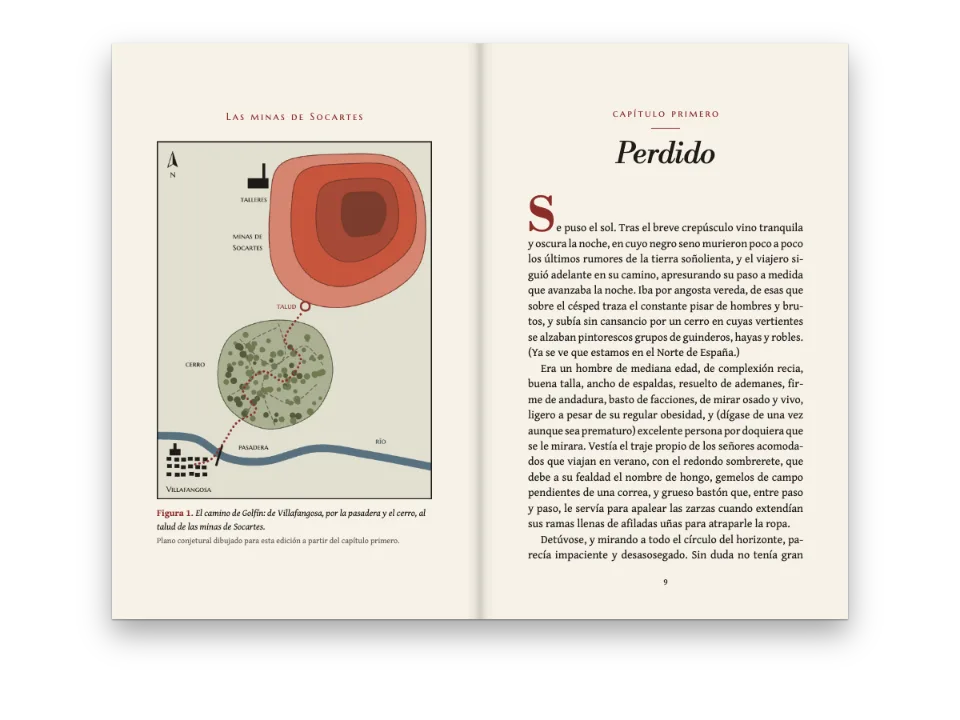
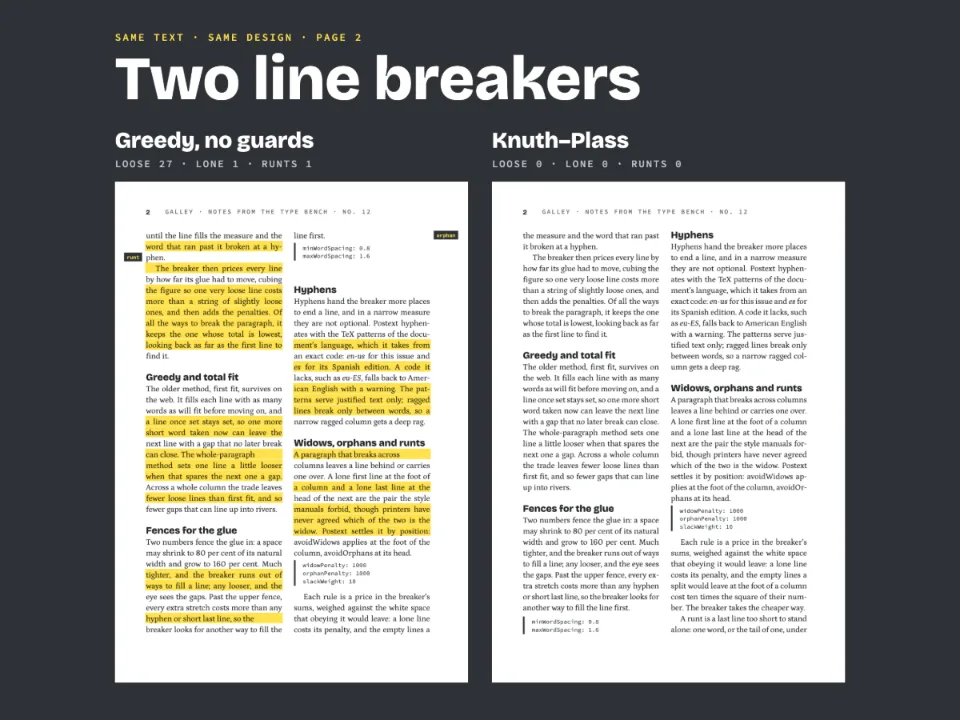
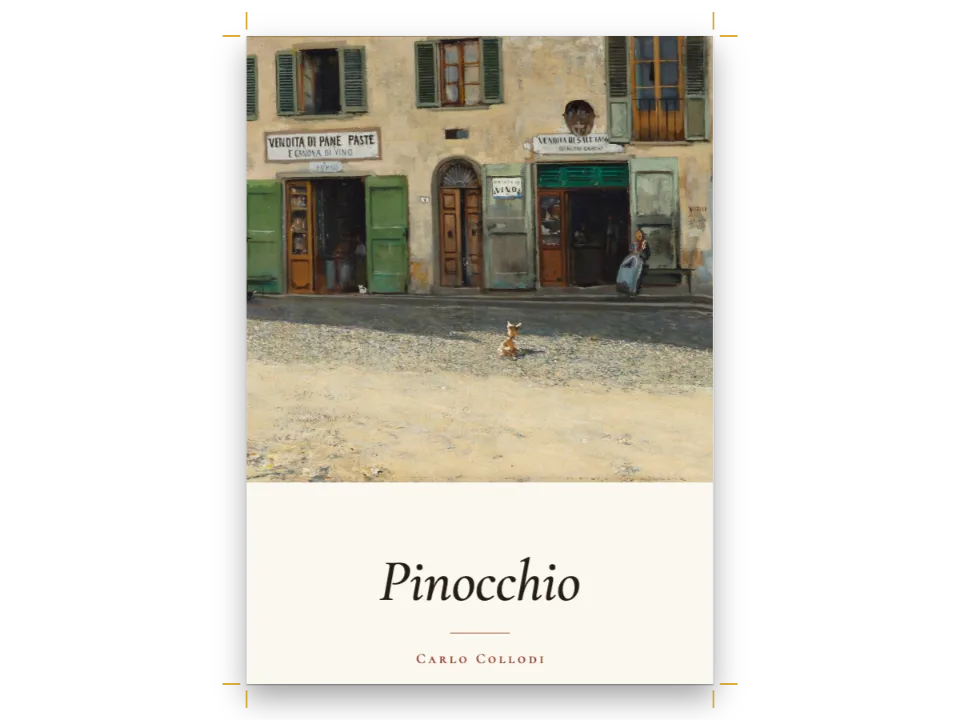
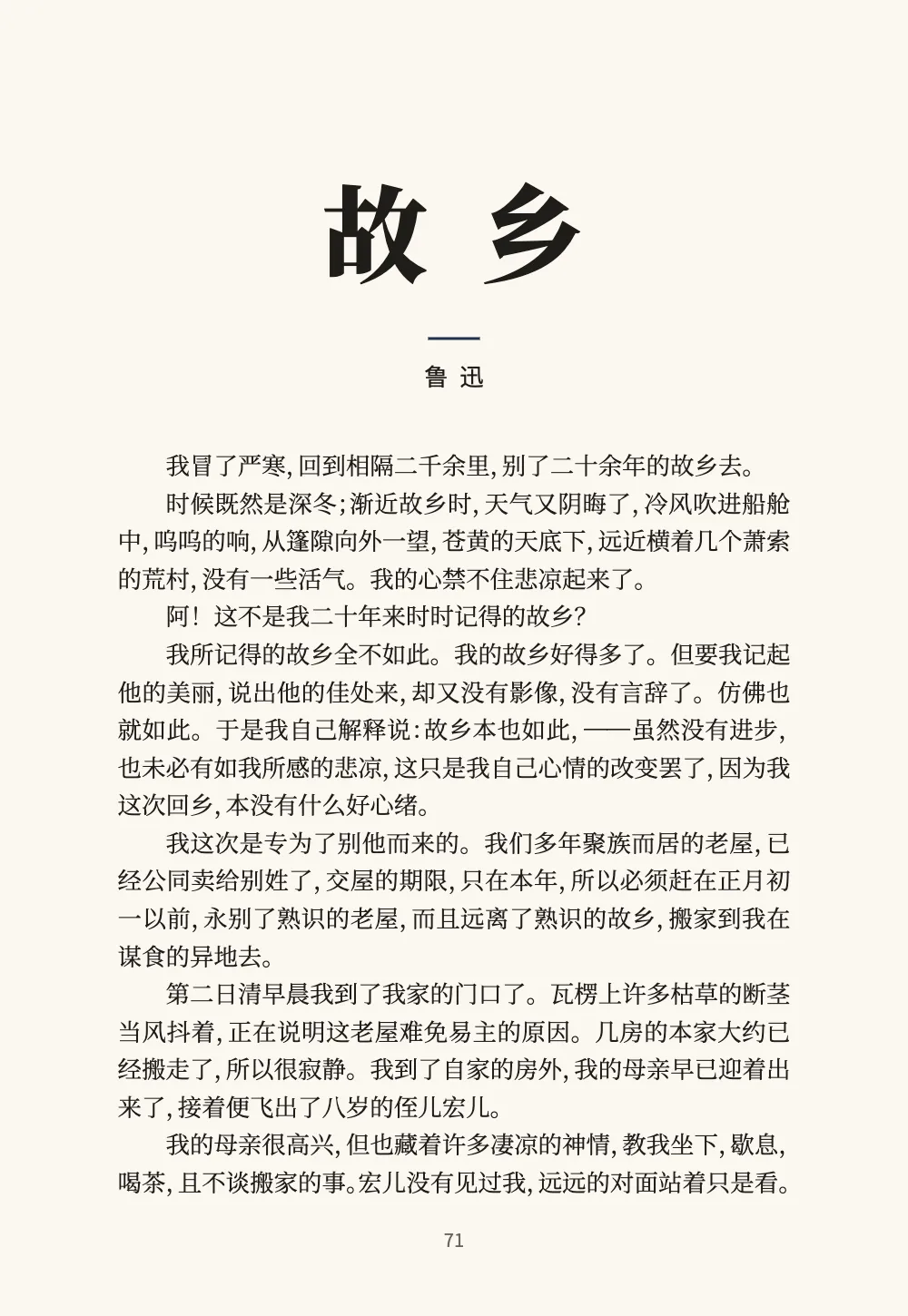
L’inizio de «Il paese natale» di Lu Xun (故乡, 1921) come lo comporrebbe un tascabile della Cina continentale della sua prima raccolta: una pagina 大32开, 140 × 203 mm, la cui gabbia si conta in caratteri, 28 per riga e 28 righe per pagina, in Noto Serif SC a 五号 (10,5 pt). Ogni paragrafo si apre rientrato di due caratteri; virgole e virgolette occupano mezzo carattere, come nella maggior parte dei libri continentali; nessuna riga comincia con 。 o , e nessuna finisce con “. Il racconto si apre su un recto sotto il titolo nel peso nero del carattere Song. Di fronte, una tavola dipinta mostra il campo di meloni al chiaro di luna che il narratore ricorda, con le parole che lo descrivono nella calligrafia a pennello di Ma Shan Zheng. Lo spagnolo giustificato in un romanzo tascabile fa lo stesso lavoro per una scrittura latina.
Questa ricetta risponde a
- Come imposto la gabbia in caratteri, con tanti caratteri per riga e tante righe per pagina?
- Come evito che 。 e , finiscano a inizio riga?
- Come compongo la punteggiatura cinese Kaiming, come i libri della Cina continentale, o a mezza larghezza?
- Come metto uno spazio tra parole cinesi e latine senza digitarlo?
La risposta breve
const cjk = {
  // The type area in characters: 28 ems wide, 28 lines of LEAD tall. page.margins become
  // minimums, and the grid centres the type area in the room they leave.
  grid: { enabled: true, charsPerLine: CHARS, linesPerPage: LINES },
  // What 'zh-Hans' gives by itself, written out so a reader can compare regions and styles.
  region: 'mainland',
  lineBreak: 'gb', // no 。,、”》 opens a line, no “《( ends one, and no / at either end
  punctuationWidth: 'kaiming', // ,、:; quotes, brackets ½ em; 。?! one em, ½ at a line end
  compressAdjacent: true, // idle under Kaiming (no pair tops 1.5 em); 'fullwidth' needs it
  latinSpacing: em(0.25), // 1921年, 用Noto Serif SC五号: a quarter em, none of it typed
};
const bodyText = {
  fontFamily: SONG, fontSize: pt(BODY), lineHeight: pt(LEAD), color: col('ink'),
  boldColor: col('ink'), italicColor: col('ink'), referenceColor: col('ink'),
  textAlign: 'justify', // spread between the characters, never between words
  firstLineIndent: em(2), indentAfterHeading: true, // two characters, every paragraph
};
Ingredienti
- Funzionalità
- Griglia dei caratteriDivisione in righe del cineseLarghezze della punteggiatura cineseGiustificazione tra i caratteriSpazio tra cinese e latinoFont cinesi, giapponesi e coreaniRientri, allineamento e spaziatura dei paragrafiCarattere del testo correnteTestatine e folioAperture progettateStili di titoloAttributi dei titoliTesto, filetti e riquadri nei progetti di paginaTestatine secondo il ruolo della paginaMargini speculariStili di paragrafoSegnalibri del PDF
- Usa anche
- Colore della cartaEsportazione in PDFFont incorporati nel PDFFigure e tabelle come risorseTestatine per sezione
- Tipo
- Noto Serif SC, Noto Sans SC, Ma Shan Zheng (SIL OFL 1.1)
- Risorse
plate-1120.jpg- The plate: the moonlit melon field of the story, a painting (Generated With Diffusion Models, originale)
Preparazione
#1 · Una pagina contata in caratteri
Il codice è nella risposta breve qui sopra. cjk.grid porta la giustezza a 28 em di bodyText.fontSize (294 pt, 103,7 mm) e la gabbia a 28 righe di lineHeight (462 pt, 163 mm), poi sposta i margini perché ci stiano, così una riga piena di Han contiene esattamente 28 caratteri e ogni pagina piena finisce sulla stessa riga (Griglia di caratteri). Le cinque impostazioni sotto la griglia sono quelle che locale: 'zh-Hans' dà da solo; sono scritte per esteso perché tu possa cambiarne una alla volta, anche se compressAdjacent non cambia nulla finché punctuationWidth non è 'fullwidth': con il Kaiming due segni che si incontrano non occupano mai più di 1,5 em. A pagina 71 il 。 di chiusura di un paragrafo non ci sta, e le regole di inizio riga (ogni livello di lineBreak tranne 'none'; 'gb' aggiunge la barra) gli vietano di aprire una riga. La riga lo accoglie componendo il 。 dopo 事 largo mezzo carattere (push-in), così 事。宏 si stringe e il paragrafo non va su un’altra riga (Larghezze della punteggiatura). Le righe che restano corte si allargano tra i caratteri, mai tra le parole, e su queste pagine di non più di 0,05 em (Cinese, giapponese e coreano).
#2 · Una pagina 大32开 con il margine di testa più ampio
const page = {
  width: mm(TRIM.width), height: mm(TRIM.height), dpi: 150, backgroundColor: col('paper'),
  // 22 + 18 mm leave 163 mm, exactly 28 lines of 16.5 pt; 18 mm a side leave the 103.7 mm
  // measure 0.3 mm to share. A grid that no longer fits is cut down (cjkGridClamped).
  margins: { top: mm(22), bottom: mm(18), left: mm(18), right: mm(18), mirror: true },
};
Con la griglia attiva i margini sono dei minimi: la griglia colloca la gabbia nello spazio che lasciano e distribuisce l’avanzo. 22 e 18 mm lasciano esattamente 163 mm, così il margine di testa resta 4 mm più ampio di quello di piede, come lo tengono i libri cinesi; i 18 mm per lato lasciano 0,3 mm da distribuire. Chiedi più caratteri o righe di quante ne stanno e la griglia si riduce a ciò che ci sta, con un avviso cjkGridClamped; il corpo e l’interlinea restano come li hai scritti.
#3 · Un titolo abbassato di un numero intero di righe
const SINK = 8; // lines of LEAD: a whole number, so the text under it keeps to the grid
const centred = (y) => ({ anchor: { to: 'container', edge: 'top' }, offset: { y: mm(y) } });
const opener = {
  enabled: true,
  minHeight: pt(SINK * LEAD),
  slot: { elements: [
    // The spacing after the last character is advance, not ink: the title stays centred.
    { kind: 'text', id: 'title', content: '{titleText}', fontFamily: SONG, fontWeight: 900,
      fontSize: pt(46), letterSpacing: pt(23), lineHeight: 1.1, color: col('ink'),
      align: 'center', placement: centred(6) },
    { kind: 'rule', id: 'rule', direction: 'horizontal', thickness: pt(1.2),
      color: col('night'), placement: { ...centred(30), size: { width: mm(8) } } },
    { kind: 'text', id: 'author', content: '{author}', fontFamily: HEI, fontSize: pt(10.5),
      letterSpacing: pt(5), color: col('ink'), align: 'center', placement: centred(34) },
  ] },
};
// parity 'any': a story opens on the next page, left or right.
const chapter = { level: 1, breakBefore: { enabled: true, parity: 'any' },
  marginTop: pt(0), marginBottom: pt(0), advancedDesign: opener };
minHeight vale otto righe di 16,5 pt, così il testo sotto il titolo comincia sulla nona riga della griglia, sulle stesse linee di base di ogni altra pagina. I 23 pt di spaziatura tra lettere mettono mezzo carattere tra 故 e 乡, la spaziatura consueta per un titolo di due caratteri; Postext lascia fuori la spaziatura dopo l’ultimo carattere quando centra la riga, così il titolo resta sull’asse della pagina (Stili dei titoli).
#4 · Il libro sul verso, il racconto sul recto
const HEAD_Y = 11; // mm from the top edge to the heads; the hairline 5 mm lower
const label = { fontFamily: HEI, fontSize: pt(8), color: col('muted'), pages: 'body' };
const at = (edge, x, y = HEAD_Y) => ({ anchor: { to: 'page', edge },
  offset: { x: mm(x), y: mm(y) } });
const header = { elements: [
  { kind: 'text', id: 'verso-folio', content: '{pageNumber}', parity: 'even', ...label,
    placement: at('top-left', SIDE) },
  { kind: 'text', id: 'verso-book', content: '{title}', parity: 'even', ...label,
    letterSpacing: pt(4), placement: at('top', 0) },
  { kind: 'text', id: 'recto-story', content: '{chapterTitle}', parity: 'odd', ...label,
    letterSpacing: pt(4), placement: at('top', 0) },
  { kind: 'text', id: 'recto-folio', content: '{pageNumber}', parity: 'odd', ...label,
    placement: at('top-right', -SIDE) },
  { kind: 'rule', id: 'hairline', direction: 'horizontal', thickness: pt(0.5), color: col('rule'),
    pages: 'body', placement: { ...at('top-left', SIDE, HEAD_Y + 5), size: { width: mm(MEASURE) } },
  },
] };
// The opener has no head: its folio drops to the foot, centred under the text.
const footer = { elements: [{ kind: 'text', id: 'drop-folio', content: '{pageNumber}',
  ...label, pages: 'opener', align: 'center', placement: at('bottom', 0, -10) }] };
I romanzi continentali portano il titolo del libro sui versi e quello del racconto sui recti, centrati, con il folio sul margine esterno e un filetto sottile sotto entrambi. pages: 'body' li tiene lontani dall’apertura e dalla tavola, e l’apertura riceve invece il suo folio al piede. Le testatine sono composte in Noto Sans SC, il carattere Hei, a 8 pt: piccole, ma con una voce diversa dal Song del testo.
#5 · Una tavola su tutto il foglio
// The plate, a painting: a JPEG in assets/ cut to the 140 × 203 mm trim, declared at its pixels.
const resources = [{
  id: 'moon', typeId: 'figure', kind: 'bitmap', createdAt: 0, updatedAt: 0,
  bitmap: { fileId: 'plate-1120.jpg', format: 'jpeg', width: 1120, height: 1624 },
  altText: t({
    en: 'A golden full moon in a deep blue sky over a strip of sea. On the sand below, among '
      + 'rows of striped watermelons, a boy with a silver collar stabs a steel fork at the '
      + 'sand ahead of him, and the small animal he aimed at runs off between his legs.',
    es: 'Una luna llena dorada en un cielo azul oscuro sobre una franja de mar. En la arena, '
      + 'entre hileras de sandías rayadas, un muchacho con un aro de plata al cuello clava una '
      + 'horquilla de acero en la arena, delante de él, y el animalillo al que apuntaba huye '
      + 'entre sus piernas.',
  }),
}];
const quote = { fontFamily: KAI, fontSize: pt(14), lineHeight: 1.5, color: col('paper') };
// # 月下的瓜地 {style="plate" line1="…" line2="…" line3="…"}: a page with no head or folio.
// 'page' spans the design over the sheet: a heading's design in the column is cut at its foot.
const plate = {
  id: 'plate', span: 'page', runningChapter: false, toc: false, // out of the PDF outline
  breakBefore: { enabled: true, parity: 'any' }, // (gotcha: style-inherits-break)
  header: { elements: [] }, footer: { elements: [] },
  advancedDesign: { enabled: true, slot: { elements: [
    { kind: 'image', id: 'picture', resourceId: 'moon', placement: { // the whole trim
      anchor: { to: 'bleed', edge: 'top-left' },
      size: { width: mm(TRIM.width), height: mm(TRIM.height) } } },
    { kind: 'text', id: 'line1', content: '{attr.line1}', ...quote, align: 'left',
      placement: { anchor: { to: 'container', edge: 'top-left' }, offset: { y: mm(2) } } },
    { kind: 'text', id: 'line2', content: '{attr.line2}', ...quote, align: 'left',
      placement: { anchor: { to: '#line1', edge: 'below' } } },
    { kind: 'text', id: 'line3', content: '{attr.line3}', ...quote, align: 'left',
      placement: { anchor: { to: '#line2', edge: 'below' } } },
  ] } },
};
L’immagine appartiene a un titolo proprio, # 月下的瓜地 {style="plate" …}, il cui stile disegna la pagina e ne toglie testatina e folio. La tavola ha bisogno di span: 'page', perché la grafica di un titolo che resta nella colonna viene tagliata al piede della colonna, 18 mm prima del rifilo. runningChapter: false con toc: false la tiene fuori dai segnalibri del PDF, che si aprono su 故乡. Le tre righe della citazione sono tre attributi e tre elementi di testo, perché il testo della grafica ha un proprio algoritmo di divisione in righe, che non applica le larghezze della punteggiatura cinese; divise a mano, le righe perdono anche le virgole, come fanno di solito le righe di titolo in cinese.
#6 · Lettere latine e cifre nel testo cinese
const paragraphStyles = [
  // 小五 (9 pt) nudged to 9.1875 pt: 32 of its characters fill the 28-em measure exactly.
  { id: 'note', fontSize: pt((CHARS * BODY) / 32), lineHeight: pt(LEAD), color: col('ink'),
    firstLineIndent: em(2), marginTop: pt(LEAD) }, // on the grid, a line below the text
  { id: 'colophon', fontFamily: HEI, fontSize: pt(7), lineHeight: pt(11), color: col('muted'),
    textAlign: 'left', firstLineIndent: pt(0), marginTop: pt(LEAD / 2) },
];
La nota e il colophon di pagina 76 sono i punti in cui cifre e nomi latini incontrano lo Han. latinSpacing mette un quarto di em ovunque si tocchino, come nel 1921年 della nota e nel 用Noto Serif SC五号 del colophon, scritti senza alcuno spazio (Spazio tra Han e latino); su una riga giustificata è quello spazio a crescere per primo, fino a mezzo em. La nota è composta a 9,1875 pt, non ai 9 pt del 小五, così 32 dei suoi caratteri riempiono la giustezza: a 9 pt ogni riga avanzava di due terzi di em, e gli spazi Han–latino li assorbivano. Nel Markdown i nomi dei font sono uniti da spazi indivisibili (U+00A0), che lo spazio Han–latino lascia stare: con spazi normali le righe in bandiera del colophon spezzavano Noto Sans / SC.
La ricetta completa
// ═══ Postext Cookbook · Nº 074 · A Chinese novel page on a 28 × 28 grid ════════════ // https://postext.dev/en/cookbook/chinese-novel-horizontal // Code: MIT · Text: Lu Xun, 故乡 (1921), public domain, zh.wikisource · Plate: diffusion models // Fonts: Noto Serif SC, Noto Sans SC, Ma Shan Zheng (SIL OFL 1.1) · Needs postext ≥ 1.25.0 import { buildDocument, withLoadedFonts, renderPageToCanvas, registerResourceImage, } from 'https://esm.sh/postext'; import { renderToPdf, decompressWoff2 } from 'https://esm.sh/postext-pdf'; const LANG = 'en'; // @lang: the language of the sample document ('en' | 'es') const RECIPE = 'chinese-novel-horizontal'; // ─── 1 · Design ───────────────────────────────────────────────────────────── // The night of the story's memory, and ink on a cream paper. const palette = { ink: '#1f1c19', // text: a warm near-black night: '#1d3150', // the accent: the deep blue of the plate's sky, the opener's rule rule: '#c9c1b2', // the hairline under the running heads muted: '#6a645b', // running heads, folios, the colophon paper: '#fbf8f1', // a cream book paper }; const col = (id) => ({ hex: palette[id], model: 'hex', paletteId: id }); const colorPalette = [ ...Object.entries(palette).map(([id, hex]) => ({ id, name: id, value: { hex, model: 'hex' } })), { id: 'main-color', name: 'night (defaults)', value: { hex: palette.night, model: 'hex' } }, ]; const SONG = 'Noto Serif SC'; // 宋: the text, and the title in its black weight const HEI = 'Noto Sans SC'; // 黑: running heads, folios, the author, the colophon const KAI = 'Ma Shan Zheng'; // 楷: a brush regular script for the plate's quotation const [BODY, LEAD] = [10.5, 16.5]; // pt: 五号 on a 6 pt line gap, the grid's pitch const [CHARS, LINES] = [28, 28]; const TRIM = { width: 140, height: 203 }; // mm: 大32开 const MEASURE = (CHARS * BODY * 25.4) / 72; // 103.7 mm: 28 ems of 五号 const SIDE = (TRIM.width - MEASURE) / 2; // 18.1 mm: the grid centres the measure // #region answer: 28 characters × 28 lines of 五号, mainland line breaks and Kaiming marks const cjk = { // The type area in characters: 28 ems wide, 28 lines of LEAD tall. page.margins become // minimums, and the grid centres the type area in the room they leave. grid: { enabled: true, charsPerLine: CHARS, linesPerPage: LINES }, // What 'zh-Hans' gives by itself, written out so a reader can compare regions and styles. region: 'mainland', lineBreak: 'gb', // no 。,、”》 opens a line, no “《( ends one, and no / at either end punctuationWidth: 'kaiming', // ,、:; quotes, brackets ½ em; 。?! one em, ½ at a line end compressAdjacent: true, // idle under Kaiming (no pair tops 1.5 em); 'fullwidth' needs it latinSpacing: em(0.25), // 1921年, 用Noto Serif SC五号: a quarter em, none of it typed }; const bodyText = { fontFamily: SONG, fontSize: pt(BODY), lineHeight: pt(LEAD), color: col('ink'), boldColor: col('ink'), italicColor: col('ink'), referenceColor: col('ink'), textAlign: 'justify', // spread between the characters, never between words firstLineIndent: em(2), indentAfterHeading: true, // two characters, every paragraph }; // #endregion // #region page: 大32开 with a head margin larger than the foot const page = { width: mm(TRIM.width), height: mm(TRIM.height), dpi: 150, backgroundColor: col('paper'), // 22 + 18 mm leave 163 mm, exactly 28 lines of 16.5 pt; 18 mm a side leave the 103.7 mm // measure 0.3 mm to share. A grid that no longer fits is cut down (cjkGridClamped). margins: { top: mm(22), bottom: mm(18), left: mm(18), right: mm(18), mirror: true }, }; // #endregion // #region opener: the title in the Song face's black weight, sunk 8 lines const SINK = 8; // lines of LEAD: a whole number, so the text under it keeps to the grid const centred = (y) => ({ anchor: { to: 'container', edge: 'top' }, offset: { y: mm(y) } }); const opener = { enabled: true, minHeight: pt(SINK * LEAD), slot: { elements: [ // The spacing after the last character is advance, not ink: the title stays centred. { kind: 'text', id: 'title', content: '{titleText}', fontFamily: SONG, fontWeight: 900, fontSize: pt(46), letterSpacing: pt(23), lineHeight: 1.1, color: col('ink'), align: 'center', placement: centred(6) }, { kind: 'rule', id: 'rule', direction: 'horizontal', thickness: pt(1.2), color: col('night'), placement: { ...centred(30), size: { width: mm(8) } } }, { kind: 'text', id: 'author', content: '{author}', fontFamily: HEI, fontSize: pt(10.5), letterSpacing: pt(5), color: col('ink'), align: 'center', placement: centred(34) }, ] }, }; // parity 'any': a story opens on the next page, left or right. const chapter = { level: 1, breakBefore: { enabled: true, parity: 'any' }, marginTop: pt(0), marginBottom: pt(0), advancedDesign: opener }; // #endregion // #region heads: the book on the verso, the story on the recto, a hairline under both const HEAD_Y = 11; // mm from the top edge to the heads; the hairline 5 mm lower const label = { fontFamily: HEI, fontSize: pt(8), color: col('muted'), pages: 'body' }; const at = (edge, x, y = HEAD_Y) => ({ anchor: { to: 'page', edge }, offset: { x: mm(x), y: mm(y) } }); const header = { elements: [ { kind: 'text', id: 'verso-folio', content: '{pageNumber}', parity: 'even', ...label, placement: at('top-left', SIDE) }, { kind: 'text', id: 'verso-book', content: '{title}', parity: 'even', ...label, letterSpacing: pt(4), placement: at('top', 0) }, { kind: 'text', id: 'recto-story', content: '{chapterTitle}', parity: 'odd', ...label, letterSpacing: pt(4), placement: at('top', 0) }, { kind: 'text', id: 'recto-folio', content: '{pageNumber}', parity: 'odd', ...label, placement: at('top-right', -SIDE) }, { kind: 'rule', id: 'hairline', direction: 'horizontal', thickness: pt(0.5), color: col('rule'), pages: 'body', placement: { ...at('top-left', SIDE, HEAD_Y + 5), size: { width: mm(MEASURE) } }, }, ] }; // The opener has no head: its folio drops to the foot, centred under the text. const footer = { elements: [{ kind: 'text', id: 'drop-folio', content: '{pageNumber}', ...label, pages: 'opener', align: 'center', placement: at('bottom', 0, -10) }] }; // #endregion // #region plate: the moonlit melon field faces the opener, the quotation set in Kai // The plate, a painting: a JPEG in assets/ cut to the 140 × 203 mm trim, declared at its pixels. const resources = [{ id: 'moon', typeId: 'figure', kind: 'bitmap', createdAt: 0, updatedAt: 0, bitmap: { fileId: 'plate-1120.jpg', format: 'jpeg', width: 1120, height: 1624 }, altText: t({ en: 'A golden full moon in a deep blue sky over a strip of sea. On the sand below, among ' + 'rows of striped watermelons, a boy with a silver collar stabs a steel fork at the ' + 'sand ahead of him, and the small animal he aimed at runs off between his legs.', es: 'Una luna llena dorada en un cielo azul oscuro sobre una franja de mar. En la arena, ' + 'entre hileras de sandías rayadas, un muchacho con un aro de plata al cuello clava una ' + 'horquilla de acero en la arena, delante de él, y el animalillo al que apuntaba huye ' + 'entre sus piernas.', }), }]; const quote = { fontFamily: KAI, fontSize: pt(14), lineHeight: 1.5, color: col('paper') }; // # 月下的瓜地 {style="plate" line1="…" line2="…" line3="…"}: a page with no head or folio. // 'page' spans the design over the sheet: a heading's design in the column is cut at its foot. const plate = { id: 'plate', span: 'page', runningChapter: false, toc: false, // out of the PDF outline breakBefore: { enabled: true, parity: 'any' }, // (gotcha: style-inherits-break) header: { elements: [] }, footer: { elements: [] }, advancedDesign: { enabled: true, slot: { elements: [ { kind: 'image', id: 'picture', resourceId: 'moon', placement: { // the whole trim anchor: { to: 'bleed', edge: 'top-left' }, size: { width: mm(TRIM.width), height: mm(TRIM.height) } } }, { kind: 'text', id: 'line1', content: '{attr.line1}', ...quote, align: 'left', placement: { anchor: { to: 'container', edge: 'top-left' }, offset: { y: mm(2) } } }, { kind: 'text', id: 'line2', content: '{attr.line2}', ...quote, align: 'left', placement: { anchor: { to: '#line1', edge: 'below' } } }, { kind: 'text', id: 'line3', content: '{attr.line3}', ...quote, align: 'left', placement: { anchor: { to: '#line2', edge: 'below' } } }, ] } }, }; // #endregion // #region styles: the editor's note in 小五 Song, the colophon in Hei const paragraphStyles = [ // 小五 (9 pt) nudged to 9.1875 pt: 32 of its characters fill the 28-em measure exactly. { id: 'note', fontSize: pt((CHARS * BODY) / 32), lineHeight: pt(LEAD), color: col('ink'), firstLineIndent: em(2), marginTop: pt(LEAD) }, // on the grid, a line below the text { id: 'colophon', fontFamily: HEI, fontSize: pt(7), lineHeight: pt(11), color: col('muted'), textAlign: 'left', firstLineIndent: pt(0), marginTop: pt(LEAD / 2) }, ]; // #endregion const config = () => ({ locale: 'zh-Hans', // written out, never LANG (gotcha: cjk-locale-tag) colorPalette, page, layout: { layoutType: 'single' }, cjk, bodyText, // The designs paint the titles; weight 400 keeps the heading blocks in the loaded face. headings: { fontFamily: SONG, fontWeight: 400, levels: [chapter] }, headingStyles: [plate], paragraphStyles, header, footer, }); // ─── 2 · Content ──────────────────────────────────────────────────────────── const markdown = String.raw`---Esempio Markdown · 141 righe · content.en.md
title: "呐喊" author: "鲁迅" --- # 月下的瓜地 {style="plate" line1="深蓝的天空中挂着一轮金黄的圆月" line2="下面是海边的沙地" line3="都种着一望无际的碧绿的西瓜"} # 故乡 我冒了严寒,回到相隔二千余里,别了二十余年的故乡去。 时候既然是深冬;渐近故乡时,天气又阴晦了,冷风吹进船舱中,呜呜的响,从篷隙向外一望,苍黄的天底下,远近横着几个萧索的荒村,没有一些活气。我的心禁不住悲凉起来了。 阿!这不是我二十年来时时记得的故乡? 我所记得的故乡全不如此。我的故乡好得多了。但要我记起他的美丽,说出他的佳处来,却又没有影像,没有言辞了。仿佛也就如此。于是我自己解释说:故乡本也如此,——虽然没有进步,也未必有如我所感的悲凉,这只是我自己心情的改变罢了,因为我这次回乡,本没有什么好心绪。 我这次是专为了别他而来的。我们多年聚族而居的老屋,已经公同卖给别姓了,交屋的期限,只在本年,所以必须赶在正月初一以前,永别了熟识的老屋,而且远离了熟识的故乡,搬家到我在谋食的异地去。 第二日清早晨我到了我家的门口了。瓦楞上许多枯草的断茎当风抖着,正在说明这老屋难免易主的原因。几房的本家大约已经搬走了,所以很寂静。我到了自家的房外,我的母亲早已迎着出来了,接着便飞出了八岁的侄儿宏儿。 我的母亲很高兴,但也藏着许多凄凉的神情,教我坐下,歇息,喝茶,且不谈搬家的事。宏儿没有见过我,远远的对面站着只是看。 但我们终于谈到搬家的事。我说外间的寓所已经租定了,又买了几件家具,此外须将家里所有的木器卖去,再去增添。母亲也说好,而且行李也略已齐集,木器不便搬运的,也小半卖去了,只是收不起钱来。 “你休息一两天,去拜望亲戚本家一回,我们便可以走了。”母亲说。 “是的。” “还有闰土,他每到我家来时,总问起你,很想见你一回面。我已经将你到家的大约日期通知他,他也许就要来了。” 这时候,我的脑里忽然闪出一幅神异的图画来:深蓝的天空中挂着一轮金黄的圆月,下面是海边的沙地,都种着一望无际的碧绿的西瓜,其间有一个十一二岁的少年,项带银圈,手捏一柄钢叉,向一匹猹尽力的刺去,那猹却将身一扭,反从他的胯下逃走了。 这少年便是闰土。我认识他时,也不过十多岁,离现在将有三十年了;那时我的父亲还在世,家景也好,我正是一个少爷。那一年,我家是一件大祭祀的值年。这祭祀,说是三十多年才能轮到一回,所以很郑重;正月里供祖像,供品很多,祭器很讲究,拜的人也很多,祭器也很要防偷去。我家只有一个忙月(我们这里给人做工的分三种:整年给一定人家做工的叫长年;按日给人做工的叫短工;自己也种地,只在过年过节以及收租时候来给一定的人家做工的称忙月),忙不过来,他便对父亲说,可以叫他的儿子闰土来管祭器的。 我的父亲允许了;我也很高兴,因为我早听到闰土这名字,而且知道他和我仿佛年纪,闰月生的,五行缺土,所以他的父亲叫他闰土。他是能装弶捉小鸟雀的。 我于是日日盼望新年,新年到,闰土也就到了。好容易到了年末,有一日,母亲告诉我,闰土来了,我便飞跑的去看。他正在厨房里,紫色的圆脸,头戴一顶小毡帽,颈上套一个明晃晃的银项圈,这可见他的父亲十分爱他,怕他死去,所以在神佛面前许下愿心,用圈子将他套住了。他见人很怕羞,只是不怕我,没有旁人的时候,便和我说话,于是不到半日,我们便熟识了。 我们那时候不知道谈些什么,只记得闰土很高兴,说是上城之后,见了许多没有见过的东西。 第二日,我便要他捕鸟。他说: “这不能。须大雪下了才好。我们沙地上,下了雪,我扫出一块空地来,用短棒支起一个大竹匾,撒下秕谷,看鸟雀来吃时,我远远地将缚在棒上的绳子只一拉,那鸟雀就罩在竹匾下了。什么都有:稻鸡、角鸡、鹁鸪、蓝背……” 我于是又很盼望下雪。 闰土又对我说: “现在太冷,你夏天到我们这里来。我们日里到海边检贝壳去,红的绿的都有,鬼见怕也有,观音手也有,晚上我和爹管西瓜去,你也去。” “管贼么?” “不是。走路的人口渴了摘一个瓜吃,我们这里是不算偷的。要管的是獾猪、刺猬、猹。月亮地下,你听,啦啦的响了,猹在咬瓜了。你便捏了胡叉,轻轻地走去……” 我那时并不知道这所谓猹的是怎么一件东西——便是现在也没有知道——只是无端的觉得状如小狗而很凶猛。 “他不咬人么?” “有胡叉呢。走到了,看见猹了,你便刺。这畜生很伶俐,倒向你奔来,反从胯下窜了。他的皮毛是油一般的滑。……” 我素不知道天下有这许多新鲜事:海边有如许五色的贝壳;西瓜有这样危险的经历,我先前单知道他在水果店里出卖罢了。 “我们沙地里,潮汛要来的时候,就有许多跳鱼儿只是跳,都有青蛙似的两个脚。……” 阿!闰土的心里有无穷无尽的希奇的事,都是我往常的朋友所不知道的。他们不知道一些事,闰土在海边时,他们都和我一样只看见院子里高墙上的四角的天空。 可惜正月过去了,闰土须回家里去,我急得大哭,他也躲到厨房里,哭着不肯出门,但终于被他父亲带走了。他后来还托他的父亲带给我一包贝壳和几枝很好看的鸟毛,我也曾送他一两次东西,但从此没有再见面。 现在我的母亲提起了他,我这儿时的记忆,忽而全都闪电似的苏生过来,似乎看到了我的美丽的故乡了。我应声说: “这好极!他,——怎样?……” “他?……他景况也很不如意……”母亲说着,便向房外看,“这些人又来了。说是买木器,顺手也就随便拿走的,我得去看看。” 母亲站起身,出去了。门外有几个女人的声音,我便招宏儿走近面前,和他闲话:问他可会写字,可愿意出门。 “我们坐火车去么?” “我们坐火车去。” “船呢?” “先坐船,……” “哈!这模样了!胡子这么长了!”一种尖利的怪声突然大叫起来。 我吃了一吓,赶忙抬起头,却见一个凸颧骨,薄嘴唇,五十岁上下的女人站在我面前,两手搭在髀间,没有系裙,张着两脚,正像一个画图仪器里细脚伶仃的圆规。 我愕然了。 “不认识了么?我还抱你咧!” 我愈加愕然了。幸而我的母亲也就进来,从旁说: “他多年出门,统忘却了。你该记得罢,”便向着我说,“这是斜对门的杨二嫂,……开豆腐店的。” 哦,我记得了。我孩子时候,在斜对门的豆腐店里确乎终日坐着一个杨二嫂,人都叫伊“豆腐西施”。但是擦着白粉,颧骨没有这么高,嘴唇也没有这么薄。而且终日坐着,我也从没有见过这圆规式的姿势。那时人说:因为伊,这豆腐店的买卖非常好。但这大约因为年龄的关系,我却并未蒙着一毫感化,所以竟完全忘却了。然而圆规很不平,显出鄙夷的神色,仿佛嗤笑法国人不知道拿破仑,美国人不知道华盛顿似的,冷笑说: “忘了?这真是贵人眼高。……” “那有这事……我……”我惶恐着,站起来说。 “那么,我对你说。迅哥儿,你阔了,搬动又笨重,你还要什么这些破烂木器,让我拿去罢。我们小户人家,用得着。” “我并没有阔哩。我须卖了这些,再去……” “阿呀呀,你放了道台了,还说不阔?你现在有三房姨太太;出门便是八抬的大轿,还说不阔?吓,什么都瞒不过我。” 我知道无话可说了,便闭了口,默默的站着。 “阿呀阿呀,真是愈有钱,便愈是一毫不肯放松,愈是一毫不肯放松,便愈有钱……”圆规一面愤愤的回转身,一面絮絮的说,慢慢向外走,顺便将我母亲的一副手套塞在裤腰里,出去了。 此后又有近处的本家和亲戚来访问我。我一面应酬,偷空便收拾些行李,这样的过了三四天。 一日是天气很冷的午后,我吃过午饭,坐着喝茶,觉得外面有人进来了,便回头去看。我看时,不由的非常出惊,慌忙站起身,迎着走去。 这来的便是闰土。虽然我一见便知道是闰土,但又不是我这记忆上的闰土了。他身材增加了一倍;先前的紫色的圆脸,已经变作灰黄,而且加上了很深的皱纹;眼睛也像他父亲一样,周围都肿得通红,这我知道,在海边种地的人,终日吹着海风,大抵是这样的。他头上是一顶破毡帽,身上只一件极薄的棉衣,浑身瑟索着;手里提着一个纸包和一枝长烟管,那手也不是我所记得的红活圆实的手,却又粗又笨而且开裂,像是松树皮了。 我这时很兴奋,但不知道怎么说才好,只是说: “阿!闰土哥,——你来了?……” 我接着便有许多话,想要连珠一般涌出:角鸡、跳鱼儿、贝壳、猹,……但又总觉得被什么挡着似的。单在脑里面回旋,吐不出口外去。 他站住了,脸上现出欢喜和凄凉的神情;动着嘴唇,却没有作声。他的态度终于恭敬起来了,分明的叫道: “老爷!……” 我似乎打了一个寒噤;我就知道,我们之间已经隔了一层可悲的厚障壁了。我也说不出话。 :::paragraphs{style="note"} (本篇作于1921年1月,同年5月1日发表于《新青年》第9卷第1号,1923年8月收入小说集《呐喊》。这里节选前半篇,至闰土来访为止。文字据1948年版《鲁迅全集》第一卷,改排为简体横排:引号『』改作“”,“馀”“偸”改作“余”“偷”。) ::: :::paragraphs{style="colophon"} 本书正文用Noto Serif SC五号字排,每行28字,每面28行;书眉、页码和版本说明用Noto Sans SC,篇首题句用Ma Shan Zheng,均为SIL OFL字体。篇首插图由程序绘制。 ::: :::paragraphs{style="colophon"} Lu Xun, 故乡 (My Old Home), 1921: the first half of the story · Text: public domain, from zh.wikisource · Plate: a painting. :::`; // content.<lang>.md, inlined by the Cookbook // ─── 3 · Fonts ────────────────────────────────────────────────────────────── const FONTS = { // every face the pages use, loaded before the build 'Noto Serif SC': ['400', '900'], // SONG: the text; the title 'Noto Sans SC': ['400'], // HEI: running heads, folios, the author, the colophon 'Ma Shan Zheng': ['400'], // KAI: the plate's quotation }; // ─── 4 · Build & show ─────────────────────────────────────────────────────── // Each voice loads the files of the characters it sets (gotcha: cjk-fonts-slices). const part = (re) => markdown.match(re)?.[0] ?? ''; const colophon = part(/:::paragraphs\{style="colophon"\}[\s\S]*$/); await loadFonts(FONTS, markdown); await loadCjkFonts({ [SONG]: ['400'] }, markdown); await loadCjkFonts({ [SONG]: ['900'] }, '故乡'); await loadCjkFonts({ [HEI]: ['400'] }, `呐喊故乡鲁迅0123456789${colophon}`); await loadCjkFonts({ [KAI]: ['400'] }, part(/^# .*style="plate".*$/m)); await loadImage(resources[0].bitmap.fileId, asset(resources[0].bitmap.fileId)); // The plate is page 70 of the book, a verso: folios and parity follow the book. const continuation = { pageIndexOffset: 69, pageNumbering: { startAt: 70 } }; const doc = await withLoadedFonts( () => buildDocument({ markdown, resources, continuation }, config()), { ...kitFonts(FONTS), text: markdown }); showPages(doc, { title: t({ en: 'A Chinese novel page on a 28 × 28 grid', es: 'Una página de novela china en una retícula de 28 × 28' }) }); offerPdf(() => renderToPdf(doc, { fontProvider: cjkPdfProvider, resourceBytes: imageBytes }), `${RECIPE}.pdf`);Kit · core, fonts, viewer, pdf, images, cjk: uguale in ogni ricetta · 504 righe
// ─── Kit ── helpers shared by every Cookbook recipe · postext.dev/cookbook ───── // ─── Kit · core v1 ── the same in every recipe · postext.dev/cookbook function mm(value) { return { value, unit: 'mm' }; } function pt(value) { return { value, unit: 'pt' }; } function em(value) { return { value, unit: 'em' }; } /** The sample language's string: t({ en: 'Figure', es: 'Figura' }). */ function t(strings) { return strings[LANG] ?? Object.values(strings)[0]; } /** A file in this recipe's assets folder, served from the Postext repo by jsDelivr. */ function asset(file) { return `https://cdn.jsdelivr.net/gh/drnachio/postext@main/cookbook/${RECIPE}/assets/${file}`; } // ─── Kit · fonts v3 ── the same in every recipe · postext.dev/cookbook // Postext loads the faces a config asks for before layout (prepareFonts, // buildDocumentWithFonts) and asks the kit for the files: Fontsource's, the // files the PDF embeds too. /** The options of buildDocumentWithFonts / prepareFonts / withLoadedFonts: * the Fontsource resolver, and the faces of FONTS loaded with the ones the * config names. FONTS = { 'Family Name': ['400', '400i', '700'] }. */ function kitFonts(FONTS = {}) { const faces = Object.entries(FONTS).flatMap(([family, specs]) => specs.map((spec) => ({ family, weight: parseInt(spec, 10), style: spec.endsWith('i') ? 'italic' : 'normal' }))); return { resolve: fontsourceResolver, faces }; } /** A face's Fontsource files, in a fixed order: latin, then latin-ext and greek * when `text` needs them and the family ships them (kitSubsetsFor), each with * its unicode-range. Null for a weight or slant Fontsource does not ship. */ async function fontsourceResolver(family, weight, style, { text = '' } = {}) { const id = fontsourceId(family); const meta = await fontsourceMeta(family); if (meta && !(meta.weights.includes(weight) && meta.styles.includes(style))) return null; kitStatus('Loading fonts…'); const at = await fontsourceAt(id); return ['latin', ...kitSubsetsFor(text, meta)].map((subset) => ({ source: `${at}files/${id}-${subset}-${weight}-${style}.woff2`, unicodeRange: kitRanges()[subset], })); } /** The unicode-range of each Fontsource file the kit loads (a function: the * kit is inlined after the pen's code, which runs before a const would be set). */ function kitRanges() { return { latin: 'U+0000-00FF,U+0131,U+0152-0153,U+02BB-02BC,U+02C6,U+02DA,U+02DC,U+0304,U+0308,U+0329,' + 'U+2000-206F,U+20AC,U+2122,U+2191,U+2193,U+2212,U+2215,U+FEFF,U+FFFD', 'latin-ext': 'U+0100-02BA,U+02BD-02C5,U+02C7-02CC,U+02CE-02D7,U+02DD-02FF,U+0304,U+0308,U+0329,' + 'U+1D00-1DBF,U+1E00-1E9F,U+1EF2-1EFF,U+2020,U+20A0-20AB,U+20AD-20C0,U+2113,U+2C60-2C7F,U+A720-A7FF', greek: 'U+0370-03FF', }; } /** For the cjk, arabic and comics blocks, which add their own files: the * faces of `faces` = { 'Family Name': ['400', '400i', '700'] }. `text` is the sample: * č ł † α χ also load latin-ext and greek files (kitSubsetsFor). With * `optional`, a face Fontsource does not ship is skipped instead of failing. * The files are added once all have loaded, in the order asked (latin, then * latin-ext, then greek), whatever order they arrive in: the last one added * wins a character two files hold. Resolves to the number of faces added. */ async function loadFonts(faces, text = '', { optional = false } = {}) { kitStatus('Loading fonts…'); const ranges = kitRanges(); const jobs = []; for (const [family, specs] of Object.entries(faces)) { const id = fontsourceId(family); const todo = [...new Set(specs)].map((spec) => [parseInt(spec, 10), spec.endsWith('i') ? 'italic' : 'normal']) .filter(([weight, style]) => !hasFace(family, weight, style)); // before any await const at = fontsourceAt(id); const meta = optional || /[^\0-ÿ]/u.test(text) ? await fontsourceMeta(family) : null; const subsets = ['latin', ...kitSubsetsFor(text, meta)]; for (const [weight, style] of todo) { if (optional && !(meta?.weights.includes(weight) && meta.styles.includes(style))) continue; for (const subset of subsets) { const url = `${await at}files/${id}-${subset}-${weight}-${style}.woff2`; const face = new FontFace(family, `url(${url}) format('woff2')`, { weight: String(weight), style, unicodeRange: ranges[subset] }); jobs.push(face.load().catch(() => { if (subset === 'latin' && !optional) throw new Error(`Fontsource has no ${family} ${weight} ${style}`); })); } } } const ready = await Promise.all(jobs).catch((error) => { kitFail(error); throw error; }); return ready.filter((face) => face && document.fonts.add(face)).length; } /** A loaded FontFace covers this family, weight and style (fonts.check() would * also say yes for families nobody declared). */ function hasFace(family, weight, style) { for (const face of document.fonts) { if (face.status !== 'loaded' || face.style !== style) continue; if (face.family.replace(/^["']|["']$/g, '') !== family) continue; const [low, high = low] = face.weight.split(' ').map(Number); if (weight >= low && weight <= high) return true; } return false; } /** The files beyond latin `text` needs that `meta`'s family ships. */ function kitSubsetsFor(text, meta) { return [[/[Ā-˿ᴀ-ᶿḀ-ỿ†ℓⱠ-Ɀ꜠-ꟿ]/u, 'latin-ext'], [/[Ͱ-Ͽ]/u, 'greek']] .filter(([re, x]) => re.test(text) && meta?.subsets?.includes(x)).map(([, x]) => x); } /** Fontsource's id for a family: 'Source Serif 4' → 'source-serif-4'. */ function fontsourceId(family) { return family.toLowerCase().replace(/\s+/g, '-'); } /** A package's folder at the one version @5 names now (#766). */ function fontsourceAt(id, u = `https://cdn.jsdelivr.net/npm/@fontsource/${id}@`) { return (fontsourceAt.c ??= {})[id] ??= fetch(u + '5/package.json').then((r) => r.json()) .then((p) => p.version || 5, () => 5).then((v) => `${u}${v}/`); } /** The family's Fontsource metadata (weights, styles, subsets), or null. */ function fontsourceMeta(family) { fontsourceMeta.cache ??= new Map(); const id = fontsourceId(family); if (!fontsourceMeta.cache.has(id)) { fontsourceMeta.cache.set(id, fetch(`https://api.fontsource.org/v1/fonts/${id}`) .then((res) => (res.ok ? res.json() : null), () => null)); } return fontsourceMeta.cache.get(id); } // ─── Kit · viewer v2 ── the same in every recipe · postext.dev/cookbook /** The pages as spreads on a dark desk, page 1 alone, then verso | recto, * each painted when it scrolls near. Other options go to renderPageToCanvas. */ function showPages(docs, { title, width = 460, ...render } = {}) { const root = viewer(title); const pages = [docs].flat().flatMap((doc) => doc.pages.map((page) => ({ doc, page, n: (doc.pageIndexOffset ?? 0) + page.index }))); const spreads = []; let verso = null; for (const p of pages) { if (p.n % 2 === 1) { if (verso) spreads.push([verso, null]); verso = p; } else { spreads.push([verso, p]); verso = null; } } if (verso) spreads.push([verso, null]); const density = Math.min(window.devicePixelRatio || 1, 2); showPages.painter?.disconnect(); const painter = new IntersectionObserver((entries) => { for (const { isIntersecting, target } of entries) { if (!isIntersecting) continue; painter.unobserve(target); const { doc, page } = target.postext; renderPageToCanvas(page, doc, target, { ...render, scale: (width * density) / page.width }); } }, { rootMargin: '800px' }); showPages.painter = painter; root.replaceChildren(...spreads.map((pair) => { const spread = document.createElement('div'); spread.className = 'pt-spread'; for (const p of pair) { const figure = document.createElement('figure'); if (p) { const label = p.page.pageLabel || String(p.n + 1); const canvas = document.createElement('canvas'); canvas.postext = p; canvas.style.aspectRatio = `${p.page.width} / ${p.page.height}`; canvas.setAttribute('role', 'img'); canvas.setAttribute('aria-label', `Page ${label}`); const folio = document.createElement('figcaption'); folio.textContent = label; figure.append(canvas, folio); painter.observe(canvas); } else figure.className = 'pt-blank'; spread.append(figure); } return spread; })); kitStatus(`${pages.length} ${pages.length === 1 ? 'page' : 'pages'}`); document.documentElement.dataset.postext = 'ready'; return pages.length; } /** The desk, the bar and the error reporting, created once. */ function viewer(title) { if (!document.getElementById('pt-kit')) { document.head.insertAdjacentHTML('beforeend', `<style id="pt-kit"> :root { color-scheme: dark; } body { margin: 0; background: #0e1014; color: #b9bcc4; font: 13px/1.45 system-ui, sans-serif; } #pt-bar { position: sticky; top: 0; z-index: 1; display: flex; flex-wrap: wrap; align-items: center; gap: 6px 16px; padding: 10px 16px; background: rgb(14 16 20 / .92); backdrop-filter: blur(6px); border-bottom: 1px solid #23262d; } #pt-bar strong { color: #f4f1ea; font-weight: 600; } #pt-actions { display: flex; gap: 12px; margin-left: auto; } #pt-actions a, #pt-actions button { color: #d8a21a; font: inherit; background: none; border: 0; padding: 0; cursor: pointer; } #pages { display: grid; justify-items: center; gap: 48px; padding: 32px 16px 72px; } .pt-spread { display: flex; } .pt-spread figure { margin: 0; width: min(460px, 44vw); } .pt-spread canvas { display: block; width: 100%; background: #fff; box-shadow: 0 1px 2px rgb(0 0 0 / .5), 0 22px 44px -16px rgb(0 0 0 / .8); } .pt-spread figure:first-child canvas { box-shadow: inset -14px 0 14px -14px rgb(0 0 0 / .18), 0 1px 2px rgb(0 0 0 / .5), 0 22px 44px -16px rgb(0 0 0 / .8); } .pt-spread figcaption { margin-top: 10px; text-align: center; font: 600 10px/1 system-ui, sans-serif; letter-spacing: .18em; text-transform: uppercase; color: #6c7079; } .pt-blank { visibility: hidden; } @media (max-width: 760px) { .pt-spread { flex-direction: column; gap: 32px; } .pt-spread figure { width: min(460px, 92vw); } .pt-blank { display: none; } } </style>`); document.body.insertAdjacentHTML('afterbegin', '<header id="pt-bar"><strong id="pt-title"></strong><span id="pt-status" role="status"></span><span id="pt-actions"></span></header>'); document.getElementById('pt-title').textContent = document.title || 'Postext'; addEventListener('error', (event) => kitFail(event.error ?? event.message)); addEventListener('unhandledrejection', (event) => kitFail(event.reason)); } if (title) document.getElementById('pt-title').textContent = title; return document.getElementById('pages') ?? document.body.appendChild(Object.assign(document.createElement('main'), { id: 'pages' })); } function kitStatus(text) { viewer(); document.getElementById('pt-status').textContent = text; } function kitFail(error) { document.documentElement.dataset.postext = 'error'; kitStatus(`Error: ${error?.message ?? error}`); } // ─── Kit · pdf v3 ── the same in every recipe that exports a PDF /** The Fontsource files the screen used, as TrueType, with their range and * place: the nearest weight the family ships, upright with no italic; * latin, then what its letters need (kitSubsetsFor). */ async function fontsourceProvider(family, weight, style, request) { const id = fontsourceId(family); const meta = await fontsourceMeta(family); const weights = meta?.weights?.length ? meta.weights : [400, 700]; const w = weights.reduce((a, b) => (Math.abs(b - weight) < Math.abs(a - weight) ? b : a)); const s = style === 'italic' && meta && !meta.styles.includes('italic') ? 'normal' : style; const text = String.fromCodePoint(...(request?.codePoints ?? [])); const files = await Promise.all(['latin', ...kitSubsetsFor(text, meta)].map(async (subset, order) => { const res = await fetch(`${await fontsourceAt(id)}files/${id}-${subset}-${w}-${s}.woff2`); if (!res.ok) throw new Error(`Fontsource has no ${family} ${w} ${s} ${subset}`); return Object.assign(await decompressWoff2(new Uint8Array(await res.arrayBuffer())), { unicodeRange: kitRanges()[subset], order }); })); return files.length === 1 ? files[0] : files; } /** A "Build the PDF" button; then "Open the PDF" (a new tab: CodePen's frame * shows no PDFs) and a download link. */ function offerPdf(makePdf, filename) { viewer(); const button = Object.assign(document.createElement('button'), { type: 'button', textContent: 'Build the PDF' }); button.dataset.postextPdf = filename; button.addEventListener('click', async () => { button.disabled = true; button.textContent = 'Building the PDF…'; try { const bytes = await makePdf(); const url = URL.createObjectURL(new Blob([bytes], { type: 'application/pdf' })); const size = `${Math.max(1, Math.round(bytes.length / 1024))} KB`; button.replaceWith( Object.assign(document.createElement('a'), { href: url, target: '_blank', rel: 'noopener', textContent: 'Open the PDF ↗' }), Object.assign(document.createElement('a'), { href: url, download: filename, textContent: `Download ${filename} · ${size}` })); } catch (error) { button.disabled = false; button.textContent = 'Build the PDF'; kitFail(error); } }); document.getElementById('pt-actions').append(button); } // ─── Kit · images v3 ── recipes with pictures · postext.dev/cookbook /** Registers a photo or PNG for the canvas and keeps its bytes for the PDF. * fetch → ImageBitmap never taints the canvas (a plain cross-origin <img> would). */ async function loadImage(fileId, url) { const res = await fetch(url); if (!res.ok) throw new Error(`Image not found (${res.status}): ${url}`); const bytes = new Uint8Array(await res.arrayBuffer()); registerResourceImage(fileId, await createImageBitmap(new Blob([bytes]))); (loadImage.bytes ??= new Map()).set(fileId, bytes); } /** Registers SVG markup as a vector image, its fonts inside (inlineSvgFonts, ≥ 1.25). * `options` go to registerResourceImage: { singleInk: true } tints it on the canvas. */ async function loadSvg(fileId, svg, options) { if (typeof inlineSvgFonts === 'function') svg = await inlineSvgFonts(svg, svgFaces); const img = new Image(); img.src = `data:image/svg+xml;charset=utf-8,${encodeURIComponent(svg)}`; await img.decode(); registerResourceImage(fileId, img, options); (loadImage.bytes ??= new Map()).set(fileId, new TextEncoder().encode(svg)); } /** A face's Fontsource files: nearest weight; latin + what the SVG sets. */ async function svgFaces(family, weight, style, { codePoints = [] } = {}) { const [id, m] = [fontsourceId(family), await fontsourceMeta(family)]; const w = m?.weights.reduce((a, b) => (Math.abs(b - weight) < Math.abs(a - weight) ? b : a)) ?? weight; const s = m?.styles.includes(style) === false ? 'normal' : style; return Promise.all(['latin', ...kitSubsetsFor(String.fromCodePoint(...codePoints), m)].map(async (x) => new Uint8Array( await (await fetch(`${await fontsourceAt(id)}files/${id}-${x}-${w}-${s}.woff2`)).arrayBuffer()))); } /** renderToPdf({ resourceBytes: imageBytes }) */ function imageBytes(fileId) { return loadImage.bytes?.get(fileId); } /** renderToHtml({ resourceImageUrl: imageUrl }) */ function imageUrl(fileId) { const bytes = imageBytes(fileId); if (!bytes) return undefined; imageUrl.urls ??= new Map(); if (!imageUrl.urls.has(fileId)) { const type = /\.svg$/i.test(fileId) ? 'image/svg+xml' : /\.png$/i.test(fileId) ? 'image/png' : 'image/jpeg'; imageUrl.urls.set(fileId, URL.createObjectURL(new Blob([bytes], { type }))); } return imageUrl.urls.get(fileId); } // ─── Kit · cjk v2 ── Chinese, Japanese and Korean books · postext.dev/cookbook // Fontsource ships a CJK family as about a hundred files per weight, each // declared in its stylesheet with the unicode-range it covers. The screen // loads the files the sample touches; the PDF gets the same files for the // characters its pages set in each face, and embeds each as a subset. // A book bound on the right (vertical text) is shown with its spreads // mirrored: page 1 alone on the left of the spine, then [3 | 2]. /** The files of a Fontsource face, read from its stylesheet: { url, range, * ranges }, the last declared first (the order the browser tries them in). */ function cjkSlices(family, weight, style) { cjkSlices.cache ??= new Map(); const id = fontsourceId(family); const css = `${id}/${weight}${style === 'italic' ? '-italic' : ''}.css`; if (!cjkSlices.cache.has(css)) { let at; cjkSlices.cache.set(css, fontsourceAt(id).then((a) => fetch(at = a + css.slice(id.length + 1))) .then((res) => { if (!res.ok) throw new Error(`Fontsource has no ${family} ${weight} ${style} (${res.status})`); return res.text(); }) .then((text) => [...text.matchAll(/@font-face\s*{([^}]*)}/g)].map(([, rule]) => { const range = /unicode-range:\s*([^;]+);/.exec(rule)?.[1].trim() ?? 'U+0-10FFFF'; const ranges = range.split(',').map((part) => { const [lo, hi = lo] = part.trim().slice(2).split('-'); return [parseInt(lo, 16), parseInt(hi, 16)]; }); return { url: new URL(/url\(([^)]+?\.woff2)\)/.exec(rule)[1], at).href, range, ranges }; }).reverse())); } return cjkSlices.cache.get(css); } /** The file of `slices` the screen sets code point `cp` in, if any: the * last one loadCjkFonts adds whose range holds it. A numbered file that * repeats a letter of latin is added after latin, and wins it. */ function cjkSliceFor(slices, cp) { const holds = (slice) => slice.ranges.some(([lo, hi]) => cp >= lo && cp <= hi); return slices.reduce((last, slice) => (holds(slice) ? slice : last), undefined); } /** Whether Fontsource serves `family` as a Chinese, Japanese or Korean * family (its subsets name the script). Fails when the API does not * answer: a CJK face taken for a Latin one would paint in a system face. */ async function isCjkFamily(family) { const meta = await fontsourceMeta(family); if (!meta) throw new Error(`api.fontsource.org did not describe ${family}: reload to try again`); return !!meta.subsets?.some((subset) => /^(chinese|japanese|korean)/.test(subset)); } /** faces = { 'Noto Serif TC': ['400', '700'] }, as for loadFonts: the * whole FONTS object may be passed, its other families are left to * loadFonts. Adds one FontFace per file of each CJK face with its * unicodeRange, then loads the files `text` touches. `text` is what the * faces set: the sample for the text face; a book in several voices calls * it once per voice (loadCjkFonts({ 'LXGW WenKai TC': ['400'] }, quotes)), * so the heading and quotation faces fetch and check only their own * characters. Fails when a character of `text` is in no file of a face. * List every weight the pages use: a weight left to the engine's later round * gets the latin file only. With { vertical: true } it also loads each * family's vertical forms (brackets, quotes, pause marks) for the canvas, * which needs loadVerticalAlternates imported from postext. Resolves to * the number of files loaded. */ async function loadCjkFonts(faces, text, { vertical = false } = {}) { kitStatus('Loading fonts…'); let loaded = 0; try { if (vertical && typeof loadVerticalAlternates !== 'function') { throw new Error('loadCjkFonts(…, { vertical: true }) needs loadVerticalAlternates imported from postext'); } for (const [family, specs] of Object.entries(faces)) { if (!(await isCjkFamily(family))) continue; const twin = []; for (const spec of new Set(specs)) { const weight = parseInt(spec, 10); const style = spec.endsWith('i') ? 'italic' : 'normal'; const slices = await cjkSlices(family, weight, style); const missing = [...new Set(text)].filter((ch) => /\S/.test(ch) && !cjkSliceFor(slices, ch.codePointAt(0))); if (missing.length) { throw new Error(`${family} ${spec} has no file for ${missing.slice(0, 12).join(' ')}: ` + `give each face the text it sets (loadCjkFonts({ '${family}': ['${spec}'] }, text))`); } for (const slice of slices) { document.fonts.add(new FontFace(family, `url(${slice.url}) format('woff2')`, { weight: String(weight), style, unicodeRange: slice.range })); twin.push({ source: slice.url, weight: String(weight), style, unicodeRange: slice.range }); } const font = `${style === 'italic' ? 'italic ' : ''}${weight} 16px "${family}"`; loaded += (await document.fonts.load(font, text)).length; if (!document.fonts.check(font, text)) throw new Error(`${family} ${spec} did not load for the sample`); } // The same files under a twin name with the `vert` feature on: the // canvas paints the punctuation of vertical lines with it. if (vertical && twin.length) await loadVerticalAlternates(family, twin); } } catch (error) { kitFail(error); throw error; } return loaded; } /** The PDF font provider for recipes with CJK faces: a family whose * Fontsource subsets are Chinese, Japanese or Korean gets the files the * screen set its pages' characters in (`request.codePoints`), each marked * with its unicode-range and its place in the order loadCjkFonts added * them: postext-pdf sets a character two files hold in the one added * last, as the browser does. Any other family gets the latin file * fontsourceProvider fetches (the "pdf" block) and, when the face sets * letters only latin-ext has, that file too. */ async function cjkPdfProvider(family, weight, style, request) { if (!(await isCjkFamily(family))) return cjkLatinPdfFiles(family, weight, style, request); const meta = await fontsourceMeta(family); const weights = meta.weights?.length ? meta.weights : [400, 700]; const w = weights.reduce((a, b) => (Math.abs(b - weight) < Math.abs(a - weight) ? b : a)); const s = style === 'italic' && !meta.styles.includes('italic') ? 'normal' : style; const slices = await cjkSlices(family, w, s); const picked = new Set(); for (const cp of request?.codePoints ?? []) { const slice = cjkSliceFor(slices, cp); if (slice) picked.add(slice); } if (!picked.size) picked.add(slices[0]); return Promise.all(slices.map(async (slice, order) => { if (!picked.has(slice)) return null; const res = await fetch(slice.url); if (!res.ok) throw new Error(`Fontsource file ${slice.url} (${res.status})`); const bytes = await decompressWoff2(new Uint8Array(await res.arrayBuffer())); return Object.assign(bytes, { unicodeRange: slice.range, order }); })).then((files) => files.filter(Boolean)); } /** A Latin family set next to the CJK faces: its latin file, then its * latin-ext file when the face sets letters only latin-ext has (ō ū in * Hepburn rōmaji, ǎ in pinyin), the file loadFonts adds on screen for * them, each marked with its unicode-range and its place in that order: * the PDF sets a character in the file the browser took it from. A face * Fontsource ships without latin-ext, or whose file does not come, gets * latin alone, and the PDF names the letters it lacks. */ async function cjkLatinPdfFiles(family, weight, style, request) { const meta = await fontsourceMeta(family); const beyond = [...(request?.codePoints ?? [])].some(cjkLatinExtOnly); if (!beyond || !meta?.subsets?.includes('latin-ext')) return fontsourceProvider(family, weight, style); const weights = meta.weights?.length ? meta.weights : [400, 700]; const w = weights.reduce((a, b) => (Math.abs(b - weight) < Math.abs(a - weight) ? b : a)); const s = style === 'italic' && !meta.styles.includes('italic') ? 'normal' : style; const id = fontsourceId(family); const url = `${await fontsourceAt(id)}files/${id}-latin-ext-${w}-${s}.woff2`; const [latin, ext] = await Promise.all([fontsourceProvider(family, weight, style), fetch(url) .then(async (res) => (res.ok ? decompressWoff2(new Uint8Array(await res.arrayBuffer())) : null), () => null)]); const ranges = kitRanges(); return ext ? [Object.assign(latin, { unicodeRange: ranges.latin, order: 0 }), Object.assign(ext, { unicodeRange: ranges['latin-ext'], order: 1 })] : latin; } /** Whether code point `cp` is in Fontsource's latin-ext file and not in * its latin file: Latin Extended-A and -B, IPA, the spacing modifiers and * Latin Extended Additional (loadFonts's test for latin-ext), less the * few latin holds too (ı Œ œ ʻ ʼ ˆ ˚ ˜). */ function cjkLatinExtOnly(cp) { if (!((cp >= 0x100 && cp <= 0x2ff) || (cp >= 0x1e00 && cp <= 0x1eff))) return false; return ![0x131, 0x152, 0x153, 0x2bb, 0x2bc, 0x2c6, 0x2da, 0x2dc].includes(cp); } /** showPages for a book bound on either edge. A right-bound book (the * document says so: doc.binding is 'right' for page.binding 'right' and * for vertical text) lies on the desk as it opens: page 1 alone on the * left of the spine, then [3 | 2], the spine shade on each page's inner * edge. `binding` ('left' | 'right') overrides the document's. */ function showBook(docs, { binding, ...options } = {}) { const count = showPages(docs, options); const right = (binding ?? [docs].flat()[0]?.binding) === 'right'; if (!document.getElementById('pt-kit-cjk')) { // The pages keep direction ltr: a canvas draws text in the direction its // element inherits, and under rtl each run would end where the engine // starts it, its brackets mirrored. document.head.insertAdjacentHTML('beforeend', `<style id="pt-kit-cjk"> .pt-spread[dir="rtl"] canvas { direction: ltr; } .pt-spread[dir="rtl"] figure:first-child canvas { box-shadow: inset 14px 0 14px -14px rgb(0 0 0 / .18), 0 1px 2px rgb(0 0 0 / .5), 0 22px 44px -16px rgb(0 0 0 / .8); } </style>`); } // Each pair stays [verso, recto] in the page; right to left, the verso // sits on the right. Phones stack the pages in reading order either way. for (const spread of document.querySelectorAll('#pages > .pt-spread')) spread.dir = right ? 'rtl' : 'ltr'; document.getElementById('pages').dataset.binding = right ? 'right' : 'left'; return count; } // ─── /Kit ───────────────────────────────────────────────────────────────────────
Lo script.js composto funziona così com’è: incollalo nello script modulo di qualsiasi pagina, oppure apri la ricetta su CodePen. Cartella della ricetta su GitHub ↗ (si apre in una nuova scheda)
Varianti
#Componi ogni segno a larghezza piena (全角式)
Virgole, segni di pausa e virgolette occupano un carattere intero, 。” ne occupa due, e ogni riga contiene meno caratteri di testo.
-  punctuationWidth: 'kaiming', // ,、:; quotes, brackets ½ em; 。?! one em, ½ at a line end
-  compressAdjacent: true, // idle under Kaiming (no pair tops 1.5 em); 'fullwidth' needs it
+  punctuationWidth: 'fullwidth',
+ compressAdjacent: false,#Mostra la griglia mentre componi la pagina
Il canvas disegna un quadratino grigio chiaro per ogni posizione di carattere di ogni riga (稿纸); il PDF lo omette a meno che renderToPdf non riceva characterGrid: true.
-  grid: { enabled: true, charsPerLine: CHARS, linesPerPage: LINES },
+ grid: { enabled: true, charsPerLine: CHARS, linesPerPage: LINES, show: true },Errori frequenti
Errore frequente
I caratteri cinesi si caricano a fette, tramite il blocco cjk
Fontsource serve una famiglia cinese, giapponese o coreana come un centinaio di file per peso, ognuno dei quali copre un intervallo di caratteri. loadFonts scarica solo il file latin, così a schermo i caratteri Han vengono da un font di sistema e sono misurati male, e fontsourceProvider passa al PDF quel file latin, che li stampa come riquadri vuoti. Elenca il blocco cjk del kit, chiama loadCjkFonts(FONTS, markdown) dopo loadFonts (una volta per voce tipografica, con il testo che compone, quando il libro usa più caratteri CJK) e passa a renderToPdf fontProvider: cjkPdfProvider: entrambi prendono i file che contengono i caratteri del testo. Font cinesi, giapponesi e coreani →
Errore frequente
Assegna al documento il tag zh-Hans o zh-Hant, non LANG
Le edizioni di una ricetta sono en ed es, ma un esempio cinese è cinese in entrambe: `locale: LANG` gli darebbe il tag inglese o spagnolo, sillaberebbe le sue parole latine, etichetterebbe le figure Figure o Figura e darebbe al PDF la lingua sbagliata. Da postext 1.30 il tag è anche la lingua usata per lo shaping del testo (misura, disegno e incorporamento), quindi con un tag inglese o spagnolo un carattere cinese compone in altre forme le cifre e la punteggiatura che condivide con il testo latino, e le righe vanno a capo altrove. Scrivi tu il tag: 'zh-Hans' (convenzioni della Cina continentale: divisione in righe GB, punteggiatura Kaiming) o 'zh-Hant' (Taiwan: punteggiatura centrata a tutta larghezza); 'zh-HK' per Hong Kong. Un 'zh' da solo vale come semplificato, Cina continentale. Un esempio giapponese prende 'ja' (errore frequente ja-locale-tag). Divisione in righe del cinese →
Errore frequente
Componi la punteggiatura di ogni regione in un carattere di quella regione
Le larghezze della punteggiatura spostano il bianco accanto a ogni segno dal lato in cui lo mette la regione del documento, non da quello in cui lo disegna il font: con zh-Hans una virgola Kaiming conserva la metà sinistra del suo quadratino, dove un carattere semplificato disegna il glifo, e cede la metà destra. Un carattere tradizionale centra ,。 nel quadratino, quindi la metà che se ne va contiene parte del glifo e la virgola si schiaccia sul carattere successivo. LXGW WenKai TC, l’unico carattere Kai da testo su Fontsource, fa questo nel testo semplificato. Componi il testo, le note e le citazioni della Cina continentale in Noto Serif SC o Noto Sans SC, tieni i caratteri TC per zh-Hant e usa un carattere a pennello semplificato (Ma Shan Zheng) solo per le righe di titolazione, dove il testo grafico non applica le larghezze della punteggiatura. Disegna anche forme ereditate che né lo standard continentale né quello di Taiwan stampano, 為 con la parte alta 爫 di 爲 e 令 (in 冷, 領) con un piede 卩: controlla i caratteri che una pagina compone con esso. Larghezze della punteggiatura cinese →
Errore frequente
Il cinese non ha corsivo
Le famiglie CJK non includono corsivi, e la tipografia cinese segna l’enfasi con punti accanto ai caratteri, non con un’inclinazione. In un documento con tag cinese, *…* mette i punti d’enfasi sui caratteri cinesi che contiene e riserva il corsivo alle parole latine (cjk.emphasis: 'dots', il valore predefinito per il cinese); :dots[…] li mette ovunque. Con cjk.emphasis: 'italic', o in un documento con tag en o es, *…* fa inclinare al canvas i glifi in tondo, un obliquo sintetico che la tipografia cinese non usa mai (il PDF ripiega sulla variante in tondo): mantieni il tag cinese, oppure componi l’enfasi in grassetto o in un carattere Kai (LXGW WenKai) tramite uno stile di paragrafo o di chip. Font cinesi, giapponesi e coreani →
Errore frequente
Uno stile di titolo eredita l’interruzione di pagina del suo livello
Una voce di headingStyles prende dal suo livello di titolo ogni campo che omette, breakBefore compreso. Un indice o un colophon con lo stile di un H1 dopo un :::pagebreak eredita parity 'odd' e finisce dietro una pagina bianca. Dai a uno stile del genere breakBefore: { enabled: false }. Stili di titolo →
Avviso di impaginazione · cjkGridClamped
Griglia dei caratteri troppo grande
Perché. `cjk.grid` chiede più caratteri per riga o più righe per pagina di quanti ne lascino entrare i margini della pagina al corpo e all’interlinea del testo, quindi la griglia si imposta con il massimo che ci sta.
Soluzione. Riduci `charsPerLine` o `linesPerPage`, restringi i margini (sono valori minimi), oppure imposta un `bodyText.fontSize` o un `lineHeight` minori. Documentazione →
- La tavola è un titolo, e un titolo riceve un segnalibro nel PDF: senza
runningChapter: falseetoc: falsenello stile della tavola, i segnalibri si aprirebbero su 月下的瓜地, un segnalibro di primo livello prima di 故乡. Basta una sola delle due impostazioni. Il PDF con tag conserva comunque il titolo della tavola come H1. - Il carattere proprio dei titoli deve essere uno che
FONTScarica, anche quando una grafica disegna ogni titolo: con il peso predefinito 700 il kit ha trovato Noto Serif SC 700 nell’impaginazione e ne ha caricato il file latino con un avviso.headings.fontWeight: 400tiene i blocchi dei titoli nel carattere del testo.
Crediti
- Ricetta
- Ignacio Ferro
- Testo
- “My Old Home” (故乡, 1921), the first half, from the 1948 Complete Works, in simplified characters · Lu Xun (鲁迅) · pubblico dominio
- The editor’s note and the colophon · Postext Cookbook · originale
- Immagini
- The plate: the moonlit melon field of the story, a painting · Generated With Diffusion Models · originale
- Font
- Noto Serif SC (SIL OFL 1.1) · Noto Sans SC (SIL OFL 1.1) · Ma Shan Zheng (SIL OFL 1.1)
- Codice
- MIT, come Postext
Modifica questo testo ↗ (si apre in una nuova scheda)Cartella della ricetta su GitHub ↗ (si apre in una nuova scheda)