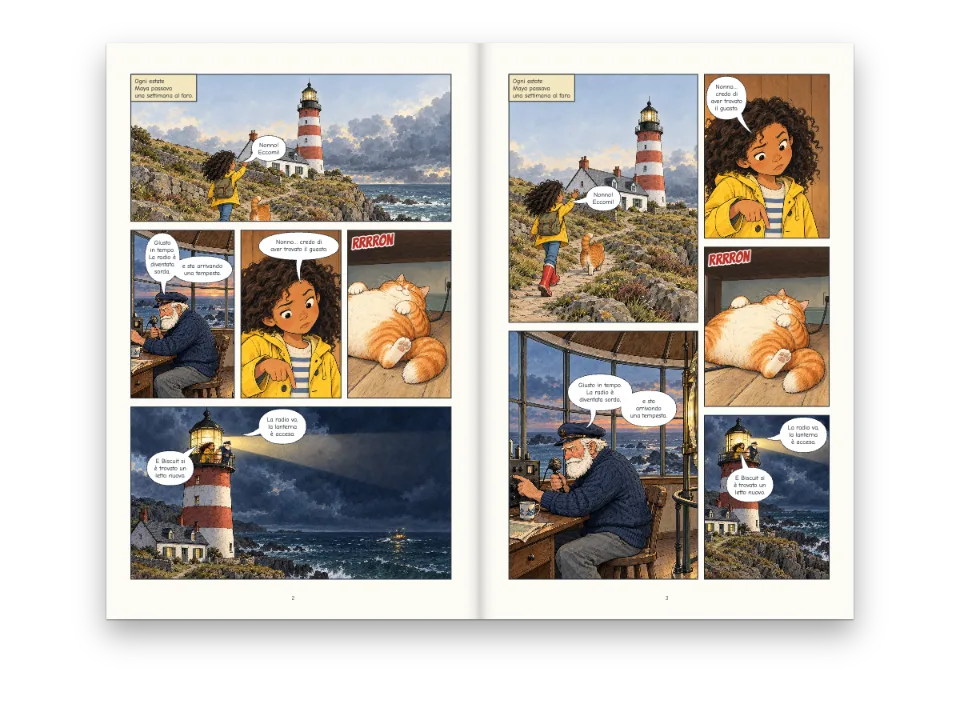
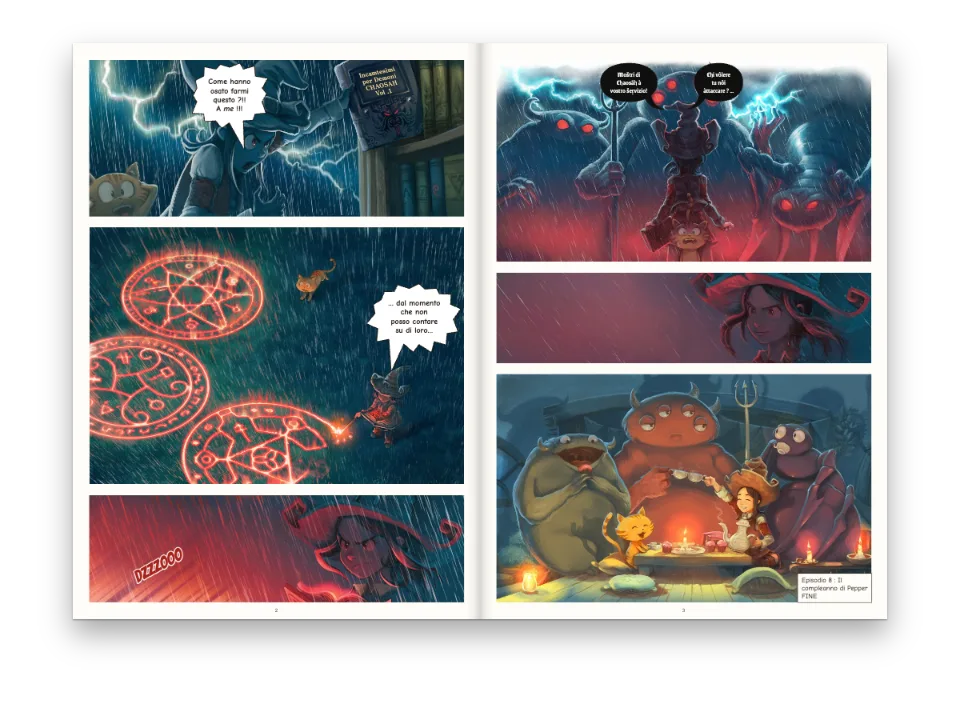
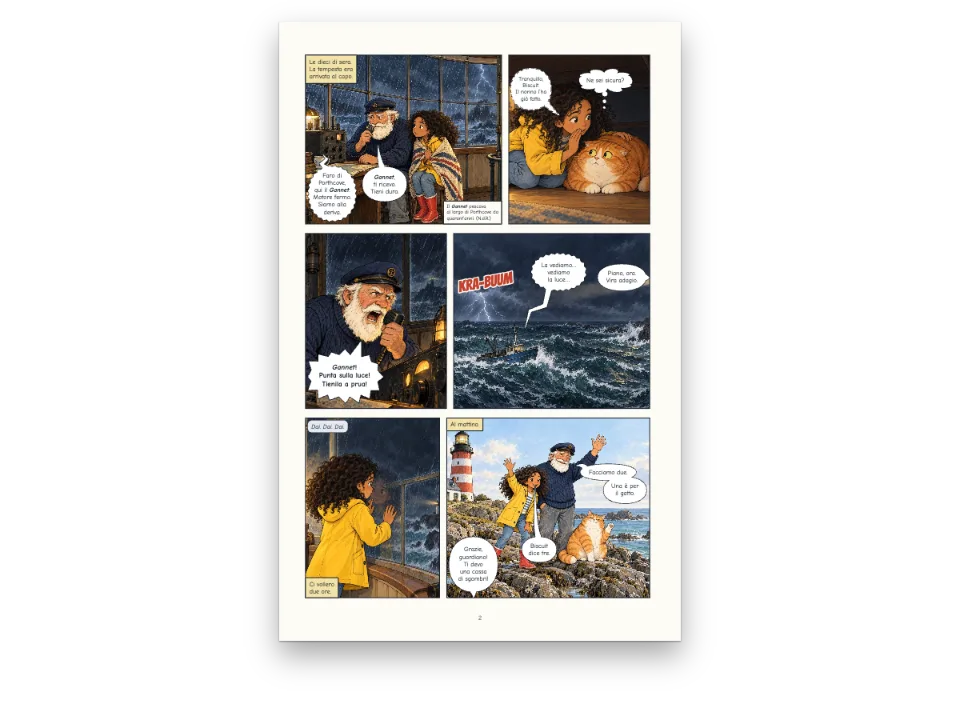
In breve
Un fumetto di due pagine salvato come PDF per la stampa e come e-book: uno che mantiene le pagine e permette di ingrandire una vignetta dopo l’altra, uno per Kindle e uno in cui i dialoghi sono testo semplice.
Che cosa comporrai
Il primo capitolo del Faro di Porthcove: un frontespizio e due pagine di fumetto, impaginati una volta ed esportati in quattro modi. Il PDF è per la stampa. L’EPUB a layout fisso mantiene le pagine stampate e porta una navigazione per regioni, così un sistema di lettura può mostrare il libro una vignetta alla volta, passando con lo zoom dalla vignetta dell’arrivo alla radio, poi a Maya. Un secondo EPUB fisso aggiunge Kindle Panel View; quello fluido compone ogni vignetta come la sua immagine ritagliata seguita dalle sue battute. La pagina elenca ogni file come lo aprirà un lettore, con un link per scaricarlo, in dieci lingue.
Questa ricetta risponde a
- Come rendo un EPUB a fumetti leggibile vignetta per vignetta?
La risposta breve
// The fixed layout keeps every printed page and writes regions.xhtml (EPUB Region-Based
// Navigation): one panel region per panel in reading order, its balloons nested in it.
// kindlePanelView adds Kindle's tap-to-magnify targets; the reflowable book sets each panel
// as its cropped picture followed by its lines as text.
const book = {
  metadata: { title: doc.metadata.title, creators: [doc.metadata.author], language: config().locale,
    modified: new Date('2026-10-07T00:00:00Z') }, // a fixed date: the same bytes on every run
  fonts: await epubFonts([LETTERING, SFX], markdown), // every face the pages set, as bytes
  resourceBytes: (fileId) => ({ bytes: imageBytes(fileId), mediaType: 'image/jpeg' }),
  onWarning: (w) => console.warn(`[epub] ${w.kind}`, w.family ?? w.fileId ?? w.detail),
};
const epubs = {
  fixed: await renderToEpub(doc, { ...book, layout: 'fixed' }),
  kindle: await renderToEpub(doc, { ...book, layout: 'fixed', kindlePanelView: true }),
  reflowable: await renderToEpub(doc, { ...book, layout: 'reflowable' }),
};
Ingredienti
- Funzionalità
- Fumetti in PDF ed EPUBEsportazione in EPUBDivisione in vignetteDisegni nelle vignette e ritagliPagine a fumettiLettering dei fumettiRifare il lettering in altre lingueParlanti e ancoraggiStili delle nuvoletteZona sicura dell’immagineTavolozza di colori semanticaPagine su un canvasEsportazione in PDF
- Usa anche
- Bordi e spazi delle vignetteColore della cartaTestatine secondo il ruolo della paginaStili di paragrafoFont incorporati nel PDFFigure e tabelle come risorseEffetti sonori
- Tipo
- Comic Neue, Bangers, Zen Antique, Dela Gothic One, ZCOOL KuaiLe, ZCOOL QingKe HuangYou, Playpen Sans Arabic, Lalezar (SIL OFL 1.1)
- Risorse
lh-arrive.jpglh-beam.jpglh-biscuit.jpglh-maya.jpglh-radio.jpg- Panel picture: Maya arrives at the lighthouse (Generated With Diffusion Models, originale)
- Panel picture: Tomás at the radio (Generated With Diffusion Models, originale)
- Panel picture: Maya finds the problem (Generated With Diffusion Models, originale)
- Panel picture: Biscuit asleep on the cable (Generated With Diffusion Models, originale)
- Panel picture: the lamp lit at night (Generated With Diffusion Models, originale)
Preparazione
#1 · Esporta lo stesso documento in EPUB
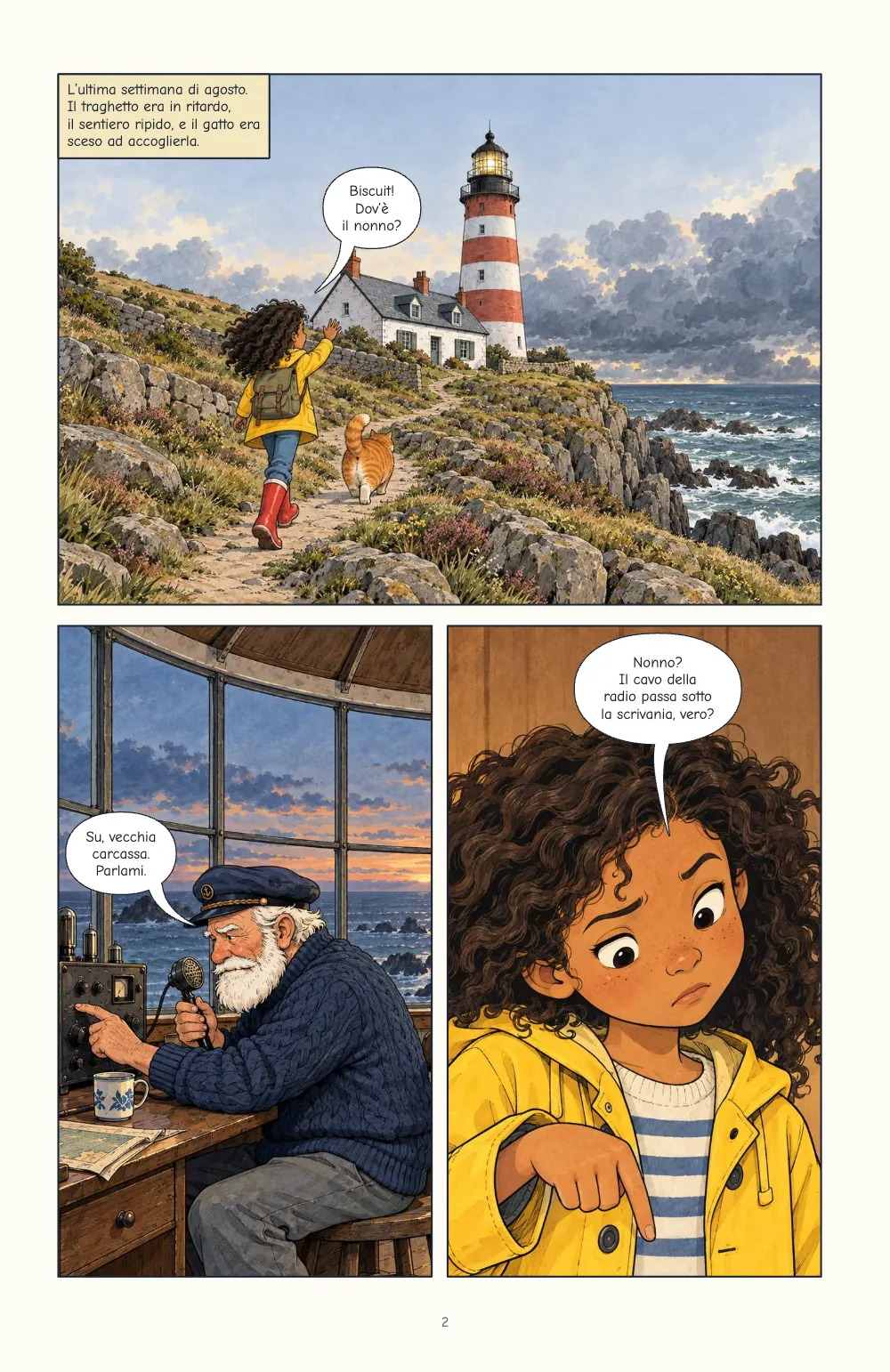
Il codice è nella risposta breve qui sopra. renderToEpub riceve i documenti che stampa renderToPdf, quindi le pagine dell’EPUB sono quelle del PDF (output dei fumetti). Con layout: 'fixed' e pagine di fumetto nel libro scrive anche regions.xhtml: una regione panel per ogni vignetta nell’ordine di lettura, ciascuna un rettangolo in percentuale della sua pagina, con le nuvolette, le didascalie e gli effetti sonori come regioni al suo interno. La progressione delle pagine segue la direzione di lettura del fumetto, quindi le edizioni giapponese e araba si sfogliano da destra a sinistra. kindlePanelView: true aggiunge un’area da toccare per ogni vignetta e una sua copia ingrandita, con i metadati che Kindle si aspetta. L’edizione fluida non ha pagine da mantenere: ogni vignetta è la sua immagine, ritagliata come sulla pagina, poi le sue battute, «Maya: Biscuit! Dov’è il nonno?», con i nomi presi da comics.cast.
#2 · Incorpora i caratteri che le pagine usano
// For each weight and style the lettering asks for, the file loadComicFonts chose (the
// nearest one Fontsource ships), only the slices whose characters the book sets. A file that
// serves several weights is embedded once, with a weight range ('400 700').
const inRange = (range, cp) => range.split(',').some((part) => {
  const [lo, hi = lo] = part.trim().slice(2).split('-');
  return cp >= parseInt(lo, 16) && cp <= parseInt(hi, 16);
});
async function epubFonts(families, text) {
  const cps = [...new Set(text)].map((ch) => ch.codePointAt(0));
  const byFile = new Map(); // url → the face it serves
  for (const family of families) {
    const meta = await fontsourceMeta(family);
    const asks = [[400, 'normal'], [700, 'normal'], [400, 'italic'], [700, 'italic']];
    for (const [weight, style] of asks) {
      const w = meta.weights.reduce((a, b) => (Math.abs(b - weight) < Math.abs(a - weight) ? b : a),
        400);
      const s = style === 'italic' && meta.styles.includes('italic') ? 'italic' : 'normal';
      for (const { url, range } of await comicFaceFiles(family, w, s, meta, text)) {
        if (range && !cps.some((cp) => inRange(range, cp))) continue;
        const face = byFile.get(url) ?? { family, style: s, weights: new Set(), range };
        face.weights.add(weight);
        byFile.set(url, face);
      }
    }
  }
  return Promise.all([...byFile].map(async ([url, { family, style, weights, range }]) => ({
    family, style, format: 'woff2', unicodeRange: range,
    weight: weights.size > 1 ? `${Math.min(...weights)} ${Math.max(...weights)}` : [...weights][0],
    bytes: new Uint8Array(await (await fetch(url)).arrayBuffer()) })));
}
Un EPUB a layout fisso disegna il testo con i caratteri che contiene, e un carattere lasciato fuori viene sostituito da quello del lettore. Il lettering chiede regolare, grassetto e corsivo; i caratteri da fumetto ne offrono meno, quindi ogni richiesta riceve il file che loadComicFonts ha scelto per lei, e un file che serve entrambi i pesi entra una volta sola con l’intervallo '400 700'. I caratteri giapponesi e cinesi prendono solo le porzioni che contengono i caratteri dell’edizione, e così il libro giapponese resta a 1,4 MB.
#3 · Rileggi ogni file
const el = (tag, css, text) => Object.assign(document.createElement(tag),
  { textContent: text ?? '' }, { style: css });
const shelf = el('section', 'display: flex; flex-wrap: wrap; gap: 16px; justify-content: center;'
  + 'padding: 24px 16px 0; color: #d9d5cc; font: 13px/1.5 system-ui, sans-serif');
for (const [name, bytes] of Object.entries(epubs)) {
  const epub = readEpub(bytes);
  const regions = new TextDecoder().decode(epub.files.get(`${epub.root}regions.xhtml`)
    ?? new Uint8Array());
  const panels = regions.split('<li epub:type="panel">').slice(1); // one per panel
  const card = el('article', 'width: min(300px, 92vw); padding: 16px; border: 1px solid #2c3038');
  const steps = el('ol', 'margin: 8px 0; padding-left: 22px');
  steps.append(...panels.map((p, i) => el('li', '', `panel ${i + 1}: ${(p.match(
    /epub:type="(balloon|caption|sound-area|text-area)"/g) ?? []).length} text regions`)));
  const link = Object.assign(el('a', 'color: #d8a21a', `Download ${RECIPE}-${name}.epub`), {
    href: URL.createObjectURL(new Blob([bytes])), download: `${RECIPE}-${name}.epub` });
  card.append(el('h2', 'margin: 0; font-size: 15px; color: #f4f1ea', `EPUB 3 · ${name}`),
    el('p', 'margin: 4px 0 0', `${epub.layout} · ${epub.pageProgression} · `
      + `${epub.spine.length} documents · ${Math.round(bytes.length / 1024)} KB`),
    panels.length ? steps : el('p', '', 'No region navigation: the panels are text.'), link);
  shelf.append(card);
}
document.getElementById('pages').before(shelf);
readEpub apre i byte come farebbe un sistema di lettura: layout, progressione delle pagine, spine. L’elenco sotto ogni scheda è la lettura guidata stessa, letta da regions.xhtml: cinque vignette e le loro regioni di testo, nell’ordine in cui un lettore le percorre. I tre file superano EPUBCheck 5.4 senza errori né avvisi in inglese, giapponese e arabo.
#4 · Un’impaginazione, dieci edizioni
const [LETTERING, SFX] = t({
  en: ['Comic Neue', 'Bangers'], es: ['Comic Neue', 'Bangers'], ca: ['Comic Neue', 'Bangers'],
  ja: ['Zen Antique', 'Dela Gothic One'], zh: ['ZCOOL KuaiLe', 'ZCOOL QingKe HuangYou'],
  ar: ['Playpen Sans Arabic', 'Lalezar'], pt: ['Comic Neue', 'Bangers'],
  fr: ['Comic Neue', 'Bangers'], de: ['Comic Neue', 'Bangers'], it: ['Comic Neue', 'Bangers'],
});
Ogni content.<lang>.md contiene le parole di un’edizione sotto gli stessi id dei personaggi. Le regioni delle vignette sono le stesse in ogni lingua; quelle delle nuvolette si spostano con le nuvolette, che vengono riletterate attorno al testo di ciascuna lingua.
La ricetta completa
// ═══ Postext Cookbook · Nº 148 · A comic EPUB read panel by panel ═══════════════════ // https://postext.dev/en/cookbook/comic-epub-guided-view // Code: MIT · Text: original (CC BY 4.0) · Pictures: generated with diffusion models // Fonts: Comic Neue, Bangers and the faces of five editions (OFL) · Needs postext ≥ 1.25.0 // // A short comic laid out once and exported four ways: a PDF for print, a fixed-layout EPUB // whose region-based navigation lets a reading system step through it panel by panel, the // same EPUB with Kindle Panel View, and a reflowable EPUB with each panel's lines as text. // Each file is read back to list what a reader will find in it. import { buildDocument, withLoadedFonts, renderPageToCanvas, registerResourceImage, loadVerticalAlternates, } from 'https://esm.sh/postext'; import { renderToPdf, decompressWoff2 } from 'https://esm.sh/postext-pdf'; import { renderToEpub, readEpub } from 'https://esm.sh/postext-epub'; const LANG = 'it'; // @lang: 'en' | 'es' | 'ca' | 'zh' | 'ar' | 'ja' | 'pt' | 'fr' | 'de' | 'it' const RECIPE = 'comic-epub-guided-view'; // ─── 1 · Design ───────────────────────────────────────────────────────────── // #region palette: the night sea, the lighthouse red and the yellow of the captions const palette = { ink: '#1b2430', // panel borders, lettering and the title page accent: '#b8322a', // the lighthouse red: title and sound effects caption: '#f4e7bf', // caption boxes muted: '#5f6873', // folios and the imprint paper: '#fdfbf6', }; const col = (id) => ({ hex: palette[id], model: 'hex', paletteId: id }); const colorPalette = [ ...Object.entries(palette).map(([id, hex]) => ({ id, name: id, value: { hex, model: 'hex' } })), { id: 'main-color', name: 'accent (defaults)', value: { hex: palette.accent, model: 'hex' } }, ]; // #endregion // #region editions: six editions, each lettered in faces for its script const [LETTERING, SFX] = t({ en: ['Comic Neue', 'Bangers'], es: ['Comic Neue', 'Bangers'], ca: ['Comic Neue', 'Bangers'], ja: ['Zen Antique', 'Dela Gothic One'], zh: ['ZCOOL KuaiLe', 'ZCOOL QingKe HuangYou'], ar: ['Playpen Sans Arabic', 'Lalezar'], pt: ['Comic Neue', 'Bangers'], fr: ['Comic Neue', 'Bangers'], de: ['Comic Neue', 'Bangers'], it: ['Comic Neue', 'Bangers'], }); // #endregion const comics = { gutter: { horizontal: mm(4), vertical: mm(3) }, panel: { borderWidth: pt(1), borderColor: col('ink'), background: col('paper') }, lettering: { fontFamily: LETTERING, fontSize: pt(8), color: col('ink'), inset: mm(1.5) }, balloonStyles: [{ id: 'speech', stroke: col('ink') }, { id: 'caption', fill: col('caption'), stroke: col('ink') }, { id: 'sfx', fontFamily: SFX, color: col('accent') }], // The names the reflowable EPUB prints before each line ("Maya: …"). cast: [{ id: 'maya', name: 'Maya' }, { id: 'tomas', name: t({ en: 'Tomás', es: 'Tomás', ca: 'Tomàs', zh: '托马斯', ar: 'توماس', ja: 'トマス', pt: 'Tomás', fr: 'Tomás', de: 'Tomás', it: 'Tomás' }) }], runningHeads: true, // the folio on every comic page }; const footer = { elements: [{ kind: 'text', id: 'folio', content: '{pageNumber}', pages: 'comic', fontFamily: LETTERING, fontSize: pt(7.5), color: col('muted'), align: 'center', placement: { anchor: { to: 'page', edge: 'bottom' }, offset: { x: mm(0), y: mm(-8) } } }] }; const config = () => ({ locale: t({ en: 'en-gb', es: 'es', ca: 'ca', ja: 'ja', zh: 'zh-Hans', ar: 'ar', pt: 'pt-BR', fr: 'fr', de: 'de', it: 'it' }), colorPalette, comics, // The trim of an American comic book, 6⅝ × 10³⁄₁₆ in. page: { sizePreset: 'custom', width: mm(168), height: mm(259), dpi: 150, backgroundColor: col('paper'), margins: { top: mm(14), bottom: mm(18), left: mm(13), right: mm(11), mirror: true } }, layout: { layoutType: 'single' }, bodyText: { fontFamily: LETTERING, fontSize: pt(10.5), lineHeight: pt(15), color: col('ink'), boldColor: col('ink'), italicColor: col('ink'), referenceColor: col('ink'), textAlign: 'left', firstLineIndent: pt(0), paragraphSpacing: true, hyphenation: { enabled: false } }, headings: { fontFamily: SFX, color: col('accent'), fontWeight: 400, levels: [ // parity 'any': the H1 opens on the next page, either side (the default waits for a recto). { level: 1, fontSize: pt(44), lineHeight: pt(48), breakBefore: { enabled: true, parity: 'any' }, marginTop: mm(60), marginBottom: pt(15) }, { level: 2, fontFamily: LETTERING, fontSize: pt(14), fontWeight: 700, color: col('ink'), marginTop: pt(0), marginBottom: pt(15) }, ] }, paragraphStyles: [{ id: 'imprint', fontSize: pt(7.5), lineHeight: pt(10), color: col('muted'), marginTop: mm(90) }], header: { elements: [] }, footer, }); // ─── 2 · Content ──────────────────────────────────────────────────────────── const markdown = String.raw`---Esempio Markdown · 31 righe · content.it.md
title: "Il faro di Porthcove" author: "Il Ricettario di Postext" --- # Il faro di Porthcove ## Capitolo primo: il cavo :::paragraphs{style="imprint"} Sceneggiatura e lettering per il Ricettario di Postext. Immagini generate con modelli di diffusione. Lettering in Comic Neue e Bangers (SIL OFL). ::: :::page{split="45 / * [50 | *]"} ::panel{art=lh-arrive} caption: L’ultima settimana di agosto. Il traghetto era in ritardo, il sentiero ripido, e il gatto era sceso ad accoglierla. maya: Biscuit! Dov’è il nonno? ::panel{art=lh-radio} tomas: Su, vecchia carcassa. Parlami. ::panel{art=lh-maya} maya: Nonno? Il cavo della radio passa sotto la scrivania, vero? ::: :::page{split="55 / *"} ::panel{art=lh-biscuit} sfx{rotate=-6}: rrrron maya{whisper}: Trovato. ::panel{art=lh-beam} caption: Alle nove la radio parlava di nuovo: burrasca da ovest, le piccole barche restano in porto. tomas: Lanterna accesa. Stanotte nessuno va in mare. maya: Tranne il gatto. Tiene il broncio sulle scale. :::`; // content.<lang>.md, inlined by the Cookbook // #region art: the five pictures of Nº 144, with the same safe areas and anchors const face = (x, y, width, height) => ({ x, y, width, height }); const ART = { 'lh-arrive': { width: 1100, height: 733, safeArea: face(0.22, 0.08, 0.4, 0.64), anchors: [{ id: 'maya', x: 0.29, y: 0.52, face: face(0.22, 0.42, 0.12, 0.16) }, { id: 'biscuit', x: 0.4, y: 0.68, face: face(0.37, 0.64, 0.07, 0.08) }], avoid: [face(0.51, 0.09, 0.1, 0.43), face(0.34, 0.33, 0.21, 0.2)] }, // lighthouse, cottage 'lh-radio': { width: 1000, height: 1000, safeArea: face(0.11, 0.36, 0.36, 0.31), anchors: [{ id: 'tomas', x: 0.345, y: 0.52, face: face(0.29, 0.4, 0.16, 0.18) }], avoid: [face(0, 0.44, 0.22, 0.26)] }, 'lh-maya': { width: 1100, height: 1100, safeArea: face(0.25, 0.27, 0.41, 0.68), anchors: [{ id: 'maya', x: 0.54, y: 0.565, face: face(0.4, 0.33, 0.24, 0.29) }], avoid: [face(0.27, 0.73, 0.25, 0.22)] }, 'lh-biscuit': { width: 1000, height: 1000, safeArea: face(0.58, 0.25, 0.42, 0.33), anchors: [{ id: 'biscuit', x: 0.72, y: 0.355, face: face(0.64, 0.27, 0.2, 0.18) }], avoid: [face(0.93, 0.28, 0.07, 0.24), face(0, 0.72, 0.4, 0.1)] }, 'lh-beam': { width: 1200, height: 800, safeArea: face(0.15, 0.01, 0.25, 0.3), anchors: [{ id: 'maya', x: 0.235, y: 0.15, face: face(0.21, 0.11, 0.05, 0.07) }, { id: 'tomas', x: 0.3, y: 0.145, face: face(0.28, 0.11, 0.04, 0.06) }], avoid: [face(0.79, 0.55, 0.08, 0.09)] }, }; const ALT = { 'lh-arrive': t({ en: 'Maya walks up the coastal path to the lighthouse, the cat ahead of her.', es: 'Maya sube por el camino de la costa hacia el faro, con el gato delante.', ca: 'La Maya puja pel camí de la costa cap al far, amb el gat al davant.', zh: '玛雅沿着海边小路走向灯塔,猫走在她前面。', ar: 'مايا تصعد الدرب الساحلي إلى المنارة والقط أمامها.', ja: 'マヤが海辺の小道を灯台へのぼっていく。前を猫が歩く。', pt: 'Maya sobe a trilha da costa até o farol, com o gato na frente.', fr: 'Maya monte le sentier côtier vers le phare, le chat devant elle.', de: 'Maya geht den Küstenpfad zum Leuchtturm hinauf, der Kater vor ihr.', it: 'Maya sale per il sentiero costiero verso il faro, con il gatto davanti.' }), 'lh-radio': t({ en: 'The old keeper taps his valve radio, microphone in hand.', es: 'El viejo farero golpea su radio de válvulas con el micrófono en la mano.', ca: 'El vell faroner pica la ràdio de vàlvules amb el micròfon a la mà.', zh: '老守塔人手握话筒,敲着他的电子管收音机。', ar: 'الحارس العجوز ينقر على مذياعه القديم والميكروفون في يده.', ja: '老灯台守がマイクを握り、真空管ラジオをたたく。', pt: 'O velho faroleiro dá umas batidinhas no rádio valvulado, com o microfone na mão.', fr: 'Le vieux gardien tapote sa radio à lampes, le micro à la main.', de: 'Der alte Wärter klopft auf sein Röhrenradio, das Mikrofon in der Hand.', it: 'Il vecchio guardiano picchietta sulla sua radio a valvole, il microfono in mano.' }), 'lh-maya': t({ en: 'Maya frowns at the floor and points down.', es: 'Maya frunce el ceño mirando al suelo y señala hacia abajo.', ca: 'La Maya arrufa les celles mirant a terra i assenyala avall.', zh: '玛雅皱着眉看着地板,手指向下。', ar: 'مايا تعقد حاجبيها ناظرةً إلى الأرض وتشير إلى أسفل.', ja: 'マヤが眉をひそめて床を見つめ、下を指さす。', pt: 'Maya franze a testa olhando para o chão e aponta para baixo.', fr: 'Maya fronce les sourcils en fixant le sol et pointe le doigt vers le bas.', de: 'Maya blickt mit gerunzelter Stirn auf den Boden und zeigt nach unten.', it: 'Maya, accigliata, guarda il pavimento e indica in basso.' }), 'lh-biscuit': t({ en: 'The fat orange cat sleeps on his back on the radio cable.', es: 'El gato naranja gordo duerme panza arriba sobre el cable de la radio.', ca: 'El gat taronja gras dorm panxa enlaire sobre el cable de la ràdio.', zh: '胖橘猫四脚朝天睡在收音机的电线上。', ar: 'القط البرتقالي السمين نائم على ظهره فوق سلك المذياع.', ja: '太ったオレンジ色の猫が、ラジオのコードの上であおむけに眠っている。', pt: 'O gato laranja gordo dorme de barriga para cima sobre o cabo do rádio.', fr: 'Le gros chat roux dort sur le dos, sur le câble de la radio.', de: 'Der dicke rote Kater schläft auf dem Rücken auf dem Kabel des Funkgeräts.', it: 'Il grosso gatto rosso dorme a pancia in su sul cavo della radio.' }), 'lh-beam': t({ en: 'Night: the beam sweeps the sea; Maya and her grandfather stand on the ' + 'gallery.', es: 'De noche, el haz barre el mar; Maya y su abuelo están en la galería.', ca: 'De nit, el feix escombra el mar; la Maya i el seu avi són a la galeria.', zh: '夜里,光束扫过海面;玛雅和外公站在回廊上。', ar: 'ليلًا يمسح الشعاع البحر، ومايا وجدّها على الشرفة.', ja: '夜。光の帯が海をなでる。マヤと祖父が回廊に立つ。', pt: 'À noite, o facho varre o mar; Maya e o avô estão na galeria.', fr: 'La nuit, le faisceau balaie la mer ; Maya et son grand-père sont sur la galerie.', de: 'Nacht: Der Lichtstrahl streicht über das Meer; Maya und ihr Großvater stehen auf der ' + 'Galerie.', it: 'Di notte il fascio di luce spazza il mare; Maya e suo nonno sono sulla balconata.' }), }; // #endregion // ─── 3 · Fonts ────────────────────────────────────────────────────────────── // Every face of the six editions; each edition loads the latin files of all of them and the // Japanese, Chinese or Arabic files of its own two. const FONTS = { 'Comic Neue': ['400', '400i', '700', '700i'], Bangers: ['400'], 'Zen Antique': ['400'], 'Dela Gothic One': ['400'], 'ZCOOL KuaiLe': ['400'], 'ZCOOL QingKe HuangYou': ['400'], 'Playpen Sans Arabic': ['400', '700'], Lalezar: ['400'], }; // #region embed: the files the pages use, as the EPUB's font files // For each weight and style the lettering asks for, the file loadComicFonts chose (the // nearest one Fontsource ships), only the slices whose characters the book sets. A file that // serves several weights is embedded once, with a weight range ('400 700'). const inRange = (range, cp) => range.split(',').some((part) => { const [lo, hi = lo] = part.trim().slice(2).split('-'); return cp >= parseInt(lo, 16) && cp <= parseInt(hi, 16); }); async function epubFonts(families, text) { const cps = [...new Set(text)].map((ch) => ch.codePointAt(0)); const byFile = new Map(); // url → the face it serves for (const family of families) { const meta = await fontsourceMeta(family); const asks = [[400, 'normal'], [700, 'normal'], [400, 'italic'], [700, 'italic']]; for (const [weight, style] of asks) { const w = meta.weights.reduce((a, b) => (Math.abs(b - weight) < Math.abs(a - weight) ? b : a), 400); const s = style === 'italic' && meta.styles.includes('italic') ? 'italic' : 'normal'; for (const { url, range } of await comicFaceFiles(family, w, s, meta, text)) { if (range && !cps.some((cp) => inRange(range, cp))) continue; const face = byFile.get(url) ?? { family, style: s, weights: new Set(), range }; face.weights.add(weight); byFile.set(url, face); } } } return Promise.all([...byFile].map(async ([url, { family, style, weights, range }]) => ({ family, style, format: 'woff2', unicodeRange: range, weight: weights.size > 1 ? `${Math.min(...weights)} ${Math.max(...weights)}` : [...weights][0], bytes: new Uint8Array(await (await fetch(url)).arrayBuffer()) }))); } // #endregion // ─── 4 · Build & show ─────────────────────────────────────────────────────── const faces = { [LETTERING]: FONTS[LETTERING], [SFX]: FONTS[SFX] }; await loadFonts(FONTS, markdown); await loadCjkFonts(faces, markdown, { vertical: LANG === 'ja' }); // ja balloons are vertical await loadArabicFonts(faces, markdown); await loadComicFonts(faces, markdown); // the bold and italic the faces do not ship const panel = (id, url) => comicPanel(id, url, { ...ART[id], alt: ALT[id] }); const resources = await Promise.all([ panel('lh-arrive', asset('lh-arrive.jpg')), panel('lh-radio', asset('lh-radio.jpg')), panel('lh-maya', asset('lh-maya.jpg')), panel('lh-biscuit', asset('lh-biscuit.jpg')), panel('lh-beam', asset('lh-beam.jpg')), ]); const doc = await withLoadedFonts(() => buildDocument({ markdown, resources }, config()), { ...kitFonts(FONTS), text: markdown }); showBook(doc, { title: t({ en: 'A comic EPUB read panel by panel', es: 'Un EPUB de cómic que se lee viñeta a viñeta', pt: 'Um EPUB de HQ lido quadro a quadro', fr: 'Un EPUB de BD qui se lit case par case', de: 'Ein Comic-EPUB, Panel für Panel gelesen', it: 'Un EPUB a fumetti vignetta per vignetta' }) }); offerPdf(() => renderToPdf(doc, { fontProvider: comicPdfProvider, resourceBytes: imageBytes }), `${RECIPE}.pdf`); // #region answer: the same document as a fixed EPUB with regions, for Kindle, and reflowable // The fixed layout keeps every printed page and writes regions.xhtml (EPUB Region-Based // Navigation): one panel region per panel in reading order, its balloons nested in it. // kindlePanelView adds Kindle's tap-to-magnify targets; the reflowable book sets each panel // as its cropped picture followed by its lines as text. const book = { metadata: { title: doc.metadata.title, creators: [doc.metadata.author], language: config().locale, modified: new Date('2026-10-07T00:00:00Z') }, // a fixed date: the same bytes on every run fonts: await epubFonts([LETTERING, SFX], markdown), // every face the pages set, as bytes resourceBytes: (fileId) => ({ bytes: imageBytes(fileId), mediaType: 'image/jpeg' }), onWarning: (w) => console.warn(`[epub] ${w.kind}`, w.family ?? w.fileId ?? w.detail), }; const epubs = { fixed: await renderToEpub(doc, { ...book, layout: 'fixed' }), kindle: await renderToEpub(doc, { ...book, layout: 'fixed', kindlePanelView: true }), reflowable: await renderToEpub(doc, { ...book, layout: 'reflowable' }), }; // #endregion // #region shelf: each file read back, with the guided view a reading system will follow const el = (tag, css, text) => Object.assign(document.createElement(tag), { textContent: text ?? '' }, { style: css }); const shelf = el('section', 'display: flex; flex-wrap: wrap; gap: 16px; justify-content: center;' + 'padding: 24px 16px 0; color: #d9d5cc; font: 13px/1.5 system-ui, sans-serif'); for (const [name, bytes] of Object.entries(epubs)) { const epub = readEpub(bytes); const regions = new TextDecoder().decode(epub.files.get(`${epub.root}regions.xhtml`) ?? new Uint8Array()); const panels = regions.split('<li epub:type="panel">').slice(1); // one per panel const card = el('article', 'width: min(300px, 92vw); padding: 16px; border: 1px solid #2c3038'); const steps = el('ol', 'margin: 8px 0; padding-left: 22px'); steps.append(...panels.map((p, i) => el('li', '', `panel ${i + 1}: ${(p.match( /epub:type="(balloon|caption|sound-area|text-area)"/g) ?? []).length} text regions`))); const link = Object.assign(el('a', 'color: #d8a21a', `Download ${RECIPE}-${name}.epub`), { href: URL.createObjectURL(new Blob([bytes])), download: `${RECIPE}-${name}.epub` }); card.append(el('h2', 'margin: 0; font-size: 15px; color: #f4f1ea', `EPUB 3 · ${name}`), el('p', 'margin: 4px 0 0', `${epub.layout} · ${epub.pageProgression} · ` + `${epub.spine.length} documents · ${Math.round(bytes.length / 1024)} KB`), panels.length ? steps : el('p', '', 'No region navigation: the panels are text.'), link); shelf.append(card); } document.getElementById('pages').before(shelf); // #endregionKit · core, fonts, viewer, pdf, images, cjk, arabic, comics: uguale in ogni ricetta · 740 righe
// ─── Kit ── helpers shared by every Cookbook recipe · postext.dev/cookbook ───── // ─── Kit · core v1 ── the same in every recipe · postext.dev/cookbook function mm(value) { return { value, unit: 'mm' }; } function pt(value) { return { value, unit: 'pt' }; } function em(value) { return { value, unit: 'em' }; } /** The sample language's string: t({ en: 'Figure', es: 'Figura' }). */ function t(strings) { return strings[LANG] ?? Object.values(strings)[0]; } /** A file in this recipe's assets folder, served from the Postext repo by jsDelivr. */ function asset(file) { return `https://cdn.jsdelivr.net/gh/drnachio/postext@main/cookbook/${RECIPE}/assets/${file}`; } // ─── Kit · fonts v3 ── the same in every recipe · postext.dev/cookbook // Postext loads the faces a config asks for before layout (prepareFonts, // buildDocumentWithFonts) and asks the kit for the files: Fontsource's, the // files the PDF embeds too. /** The options of buildDocumentWithFonts / prepareFonts / withLoadedFonts: * the Fontsource resolver, and the faces of FONTS loaded with the ones the * config names. FONTS = { 'Family Name': ['400', '400i', '700'] }. */ function kitFonts(FONTS = {}) { const faces = Object.entries(FONTS).flatMap(([family, specs]) => specs.map((spec) => ({ family, weight: parseInt(spec, 10), style: spec.endsWith('i') ? 'italic' : 'normal' }))); return { resolve: fontsourceResolver, faces }; } /** A face's Fontsource files, in a fixed order: latin, then latin-ext and greek * when `text` needs them and the family ships them (kitSubsetsFor), each with * its unicode-range. Null for a weight or slant Fontsource does not ship. */ async function fontsourceResolver(family, weight, style, { text = '' } = {}) { const id = fontsourceId(family); const meta = await fontsourceMeta(family); if (meta && !(meta.weights.includes(weight) && meta.styles.includes(style))) return null; kitStatus('Loading fonts…'); const at = await fontsourceAt(id); return ['latin', ...kitSubsetsFor(text, meta)].map((subset) => ({ source: `${at}files/${id}-${subset}-${weight}-${style}.woff2`, unicodeRange: kitRanges()[subset], })); } /** The unicode-range of each Fontsource file the kit loads (a function: the * kit is inlined after the pen's code, which runs before a const would be set). */ function kitRanges() { return { latin: 'U+0000-00FF,U+0131,U+0152-0153,U+02BB-02BC,U+02C6,U+02DA,U+02DC,U+0304,U+0308,U+0329,' + 'U+2000-206F,U+20AC,U+2122,U+2191,U+2193,U+2212,U+2215,U+FEFF,U+FFFD', 'latin-ext': 'U+0100-02BA,U+02BD-02C5,U+02C7-02CC,U+02CE-02D7,U+02DD-02FF,U+0304,U+0308,U+0329,' + 'U+1D00-1DBF,U+1E00-1E9F,U+1EF2-1EFF,U+2020,U+20A0-20AB,U+20AD-20C0,U+2113,U+2C60-2C7F,U+A720-A7FF', greek: 'U+0370-03FF', }; } /** For the cjk, arabic and comics blocks, which add their own files: the * faces of `faces` = { 'Family Name': ['400', '400i', '700'] }. `text` is the sample: * č ł † α χ also load latin-ext and greek files (kitSubsetsFor). With * `optional`, a face Fontsource does not ship is skipped instead of failing. * The files are added once all have loaded, in the order asked (latin, then * latin-ext, then greek), whatever order they arrive in: the last one added * wins a character two files hold. Resolves to the number of faces added. */ async function loadFonts(faces, text = '', { optional = false } = {}) { kitStatus('Loading fonts…'); const ranges = kitRanges(); const jobs = []; for (const [family, specs] of Object.entries(faces)) { const id = fontsourceId(family); const todo = [...new Set(specs)].map((spec) => [parseInt(spec, 10), spec.endsWith('i') ? 'italic' : 'normal']) .filter(([weight, style]) => !hasFace(family, weight, style)); // before any await const at = fontsourceAt(id); const meta = optional || /[^\0-ÿ]/u.test(text) ? await fontsourceMeta(family) : null; const subsets = ['latin', ...kitSubsetsFor(text, meta)]; for (const [weight, style] of todo) { if (optional && !(meta?.weights.includes(weight) && meta.styles.includes(style))) continue; for (const subset of subsets) { const url = `${await at}files/${id}-${subset}-${weight}-${style}.woff2`; const face = new FontFace(family, `url(${url}) format('woff2')`, { weight: String(weight), style, unicodeRange: ranges[subset] }); jobs.push(face.load().catch(() => { if (subset === 'latin' && !optional) throw new Error(`Fontsource has no ${family} ${weight} ${style}`); })); } } } const ready = await Promise.all(jobs).catch((error) => { kitFail(error); throw error; }); return ready.filter((face) => face && document.fonts.add(face)).length; } /** A loaded FontFace covers this family, weight and style (fonts.check() would * also say yes for families nobody declared). */ function hasFace(family, weight, style) { for (const face of document.fonts) { if (face.status !== 'loaded' || face.style !== style) continue; if (face.family.replace(/^["']|["']$/g, '') !== family) continue; const [low, high = low] = face.weight.split(' ').map(Number); if (weight >= low && weight <= high) return true; } return false; } /** The files beyond latin `text` needs that `meta`'s family ships. */ function kitSubsetsFor(text, meta) { return [[/[Ā-˿ᴀ-ᶿḀ-ỿ†ℓⱠ-Ɀ꜠-ꟿ]/u, 'latin-ext'], [/[Ͱ-Ͽ]/u, 'greek']] .filter(([re, x]) => re.test(text) && meta?.subsets?.includes(x)).map(([, x]) => x); } /** Fontsource's id for a family: 'Source Serif 4' → 'source-serif-4'. */ function fontsourceId(family) { return family.toLowerCase().replace(/\s+/g, '-'); } /** A package's folder at the one version @5 names now (#766). */ function fontsourceAt(id, u = `https://cdn.jsdelivr.net/npm/@fontsource/${id}@`) { return (fontsourceAt.c ??= {})[id] ??= fetch(u + '5/package.json').then((r) => r.json()) .then((p) => p.version || 5, () => 5).then((v) => `${u}${v}/`); } /** The family's Fontsource metadata (weights, styles, subsets), or null. */ function fontsourceMeta(family) { fontsourceMeta.cache ??= new Map(); const id = fontsourceId(family); if (!fontsourceMeta.cache.has(id)) { fontsourceMeta.cache.set(id, fetch(`https://api.fontsource.org/v1/fonts/${id}`) .then((res) => (res.ok ? res.json() : null), () => null)); } return fontsourceMeta.cache.get(id); } // ─── Kit · viewer v2 ── the same in every recipe · postext.dev/cookbook /** The pages as spreads on a dark desk, page 1 alone, then verso | recto, * each painted when it scrolls near. Other options go to renderPageToCanvas. */ function showPages(docs, { title, width = 460, ...render } = {}) { const root = viewer(title); const pages = [docs].flat().flatMap((doc) => doc.pages.map((page) => ({ doc, page, n: (doc.pageIndexOffset ?? 0) + page.index }))); const spreads = []; let verso = null; for (const p of pages) { if (p.n % 2 === 1) { if (verso) spreads.push([verso, null]); verso = p; } else { spreads.push([verso, p]); verso = null; } } if (verso) spreads.push([verso, null]); const density = Math.min(window.devicePixelRatio || 1, 2); showPages.painter?.disconnect(); const painter = new IntersectionObserver((entries) => { for (const { isIntersecting, target } of entries) { if (!isIntersecting) continue; painter.unobserve(target); const { doc, page } = target.postext; renderPageToCanvas(page, doc, target, { ...render, scale: (width * density) / page.width }); } }, { rootMargin: '800px' }); showPages.painter = painter; root.replaceChildren(...spreads.map((pair) => { const spread = document.createElement('div'); spread.className = 'pt-spread'; for (const p of pair) { const figure = document.createElement('figure'); if (p) { const label = p.page.pageLabel || String(p.n + 1); const canvas = document.createElement('canvas'); canvas.postext = p; canvas.style.aspectRatio = `${p.page.width} / ${p.page.height}`; canvas.setAttribute('role', 'img'); canvas.setAttribute('aria-label', `Page ${label}`); const folio = document.createElement('figcaption'); folio.textContent = label; figure.append(canvas, folio); painter.observe(canvas); } else figure.className = 'pt-blank'; spread.append(figure); } return spread; })); kitStatus(`${pages.length} ${pages.length === 1 ? 'page' : 'pages'}`); document.documentElement.dataset.postext = 'ready'; return pages.length; } /** The desk, the bar and the error reporting, created once. */ function viewer(title) { if (!document.getElementById('pt-kit')) { document.head.insertAdjacentHTML('beforeend', `<style id="pt-kit"> :root { color-scheme: dark; } body { margin: 0; background: #0e1014; color: #b9bcc4; font: 13px/1.45 system-ui, sans-serif; } #pt-bar { position: sticky; top: 0; z-index: 1; display: flex; flex-wrap: wrap; align-items: center; gap: 6px 16px; padding: 10px 16px; background: rgb(14 16 20 / .92); backdrop-filter: blur(6px); border-bottom: 1px solid #23262d; } #pt-bar strong { color: #f4f1ea; font-weight: 600; } #pt-actions { display: flex; gap: 12px; margin-left: auto; } #pt-actions a, #pt-actions button { color: #d8a21a; font: inherit; background: none; border: 0; padding: 0; cursor: pointer; } #pages { display: grid; justify-items: center; gap: 48px; padding: 32px 16px 72px; } .pt-spread { display: flex; } .pt-spread figure { margin: 0; width: min(460px, 44vw); } .pt-spread canvas { display: block; width: 100%; background: #fff; box-shadow: 0 1px 2px rgb(0 0 0 / .5), 0 22px 44px -16px rgb(0 0 0 / .8); } .pt-spread figure:first-child canvas { box-shadow: inset -14px 0 14px -14px rgb(0 0 0 / .18), 0 1px 2px rgb(0 0 0 / .5), 0 22px 44px -16px rgb(0 0 0 / .8); } .pt-spread figcaption { margin-top: 10px; text-align: center; font: 600 10px/1 system-ui, sans-serif; letter-spacing: .18em; text-transform: uppercase; color: #6c7079; } .pt-blank { visibility: hidden; } @media (max-width: 760px) { .pt-spread { flex-direction: column; gap: 32px; } .pt-spread figure { width: min(460px, 92vw); } .pt-blank { display: none; } } </style>`); document.body.insertAdjacentHTML('afterbegin', '<header id="pt-bar"><strong id="pt-title"></strong><span id="pt-status" role="status"></span><span id="pt-actions"></span></header>'); document.getElementById('pt-title').textContent = document.title || 'Postext'; addEventListener('error', (event) => kitFail(event.error ?? event.message)); addEventListener('unhandledrejection', (event) => kitFail(event.reason)); } if (title) document.getElementById('pt-title').textContent = title; return document.getElementById('pages') ?? document.body.appendChild(Object.assign(document.createElement('main'), { id: 'pages' })); } function kitStatus(text) { viewer(); document.getElementById('pt-status').textContent = text; } function kitFail(error) { document.documentElement.dataset.postext = 'error'; kitStatus(`Error: ${error?.message ?? error}`); } // ─── Kit · pdf v3 ── the same in every recipe that exports a PDF /** The Fontsource files the screen used, as TrueType, with their range and * place: the nearest weight the family ships, upright with no italic; * latin, then what its letters need (kitSubsetsFor). */ async function fontsourceProvider(family, weight, style, request) { const id = fontsourceId(family); const meta = await fontsourceMeta(family); const weights = meta?.weights?.length ? meta.weights : [400, 700]; const w = weights.reduce((a, b) => (Math.abs(b - weight) < Math.abs(a - weight) ? b : a)); const s = style === 'italic' && meta && !meta.styles.includes('italic') ? 'normal' : style; const text = String.fromCodePoint(...(request?.codePoints ?? [])); const files = await Promise.all(['latin', ...kitSubsetsFor(text, meta)].map(async (subset, order) => { const res = await fetch(`${await fontsourceAt(id)}files/${id}-${subset}-${w}-${s}.woff2`); if (!res.ok) throw new Error(`Fontsource has no ${family} ${w} ${s} ${subset}`); return Object.assign(await decompressWoff2(new Uint8Array(await res.arrayBuffer())), { unicodeRange: kitRanges()[subset], order }); })); return files.length === 1 ? files[0] : files; } /** A "Build the PDF" button; then "Open the PDF" (a new tab: CodePen's frame * shows no PDFs) and a download link. */ function offerPdf(makePdf, filename) { viewer(); const button = Object.assign(document.createElement('button'), { type: 'button', textContent: 'Build the PDF' }); button.dataset.postextPdf = filename; button.addEventListener('click', async () => { button.disabled = true; button.textContent = 'Building the PDF…'; try { const bytes = await makePdf(); const url = URL.createObjectURL(new Blob([bytes], { type: 'application/pdf' })); const size = `${Math.max(1, Math.round(bytes.length / 1024))} KB`; button.replaceWith( Object.assign(document.createElement('a'), { href: url, target: '_blank', rel: 'noopener', textContent: 'Open the PDF ↗' }), Object.assign(document.createElement('a'), { href: url, download: filename, textContent: `Download ${filename} · ${size}` })); } catch (error) { button.disabled = false; button.textContent = 'Build the PDF'; kitFail(error); } }); document.getElementById('pt-actions').append(button); } // ─── Kit · images v3 ── recipes with pictures · postext.dev/cookbook /** Registers a photo or PNG for the canvas and keeps its bytes for the PDF. * fetch → ImageBitmap never taints the canvas (a plain cross-origin <img> would). */ async function loadImage(fileId, url) { const res = await fetch(url); if (!res.ok) throw new Error(`Image not found (${res.status}): ${url}`); const bytes = new Uint8Array(await res.arrayBuffer()); registerResourceImage(fileId, await createImageBitmap(new Blob([bytes]))); (loadImage.bytes ??= new Map()).set(fileId, bytes); } /** Registers SVG markup as a vector image, its fonts inside (inlineSvgFonts, ≥ 1.25). * `options` go to registerResourceImage: { singleInk: true } tints it on the canvas. */ async function loadSvg(fileId, svg, options) { if (typeof inlineSvgFonts === 'function') svg = await inlineSvgFonts(svg, svgFaces); const img = new Image(); img.src = `data:image/svg+xml;charset=utf-8,${encodeURIComponent(svg)}`; await img.decode(); registerResourceImage(fileId, img, options); (loadImage.bytes ??= new Map()).set(fileId, new TextEncoder().encode(svg)); } /** A face's Fontsource files: nearest weight; latin + what the SVG sets. */ async function svgFaces(family, weight, style, { codePoints = [] } = {}) { const [id, m] = [fontsourceId(family), await fontsourceMeta(family)]; const w = m?.weights.reduce((a, b) => (Math.abs(b - weight) < Math.abs(a - weight) ? b : a)) ?? weight; const s = m?.styles.includes(style) === false ? 'normal' : style; return Promise.all(['latin', ...kitSubsetsFor(String.fromCodePoint(...codePoints), m)].map(async (x) => new Uint8Array( await (await fetch(`${await fontsourceAt(id)}files/${id}-${x}-${w}-${s}.woff2`)).arrayBuffer()))); } /** renderToPdf({ resourceBytes: imageBytes }) */ function imageBytes(fileId) { return loadImage.bytes?.get(fileId); } /** renderToHtml({ resourceImageUrl: imageUrl }) */ function imageUrl(fileId) { const bytes = imageBytes(fileId); if (!bytes) return undefined; imageUrl.urls ??= new Map(); if (!imageUrl.urls.has(fileId)) { const type = /\.svg$/i.test(fileId) ? 'image/svg+xml' : /\.png$/i.test(fileId) ? 'image/png' : 'image/jpeg'; imageUrl.urls.set(fileId, URL.createObjectURL(new Blob([bytes], { type }))); } return imageUrl.urls.get(fileId); } // ─── Kit · cjk v2 ── Chinese, Japanese and Korean books · postext.dev/cookbook // Fontsource ships a CJK family as about a hundred files per weight, each // declared in its stylesheet with the unicode-range it covers. The screen // loads the files the sample touches; the PDF gets the same files for the // characters its pages set in each face, and embeds each as a subset. // A book bound on the right (vertical text) is shown with its spreads // mirrored: page 1 alone on the left of the spine, then [3 | 2]. /** The files of a Fontsource face, read from its stylesheet: { url, range, * ranges }, the last declared first (the order the browser tries them in). */ function cjkSlices(family, weight, style) { cjkSlices.cache ??= new Map(); const id = fontsourceId(family); const css = `${id}/${weight}${style === 'italic' ? '-italic' : ''}.css`; if (!cjkSlices.cache.has(css)) { let at; cjkSlices.cache.set(css, fontsourceAt(id).then((a) => fetch(at = a + css.slice(id.length + 1))) .then((res) => { if (!res.ok) throw new Error(`Fontsource has no ${family} ${weight} ${style} (${res.status})`); return res.text(); }) .then((text) => [...text.matchAll(/@font-face\s*{([^}]*)}/g)].map(([, rule]) => { const range = /unicode-range:\s*([^;]+);/.exec(rule)?.[1].trim() ?? 'U+0-10FFFF'; const ranges = range.split(',').map((part) => { const [lo, hi = lo] = part.trim().slice(2).split('-'); return [parseInt(lo, 16), parseInt(hi, 16)]; }); return { url: new URL(/url\(([^)]+?\.woff2)\)/.exec(rule)[1], at).href, range, ranges }; }).reverse())); } return cjkSlices.cache.get(css); } /** The file of `slices` the screen sets code point `cp` in, if any: the * last one loadCjkFonts adds whose range holds it. A numbered file that * repeats a letter of latin is added after latin, and wins it. */ function cjkSliceFor(slices, cp) { const holds = (slice) => slice.ranges.some(([lo, hi]) => cp >= lo && cp <= hi); return slices.reduce((last, slice) => (holds(slice) ? slice : last), undefined); } /** Whether Fontsource serves `family` as a Chinese, Japanese or Korean * family (its subsets name the script). Fails when the API does not * answer: a CJK face taken for a Latin one would paint in a system face. */ async function isCjkFamily(family) { const meta = await fontsourceMeta(family); if (!meta) throw new Error(`api.fontsource.org did not describe ${family}: reload to try again`); return !!meta.subsets?.some((subset) => /^(chinese|japanese|korean)/.test(subset)); } /** faces = { 'Noto Serif TC': ['400', '700'] }, as for loadFonts: the * whole FONTS object may be passed, its other families are left to * loadFonts. Adds one FontFace per file of each CJK face with its * unicodeRange, then loads the files `text` touches. `text` is what the * faces set: the sample for the text face; a book in several voices calls * it once per voice (loadCjkFonts({ 'LXGW WenKai TC': ['400'] }, quotes)), * so the heading and quotation faces fetch and check only their own * characters. Fails when a character of `text` is in no file of a face. * List every weight the pages use: a weight left to the engine's later round * gets the latin file only. With { vertical: true } it also loads each * family's vertical forms (brackets, quotes, pause marks) for the canvas, * which needs loadVerticalAlternates imported from postext. Resolves to * the number of files loaded. */ async function loadCjkFonts(faces, text, { vertical = false } = {}) { kitStatus('Loading fonts…'); let loaded = 0; try { if (vertical && typeof loadVerticalAlternates !== 'function') { throw new Error('loadCjkFonts(…, { vertical: true }) needs loadVerticalAlternates imported from postext'); } for (const [family, specs] of Object.entries(faces)) { if (!(await isCjkFamily(family))) continue; const twin = []; for (const spec of new Set(specs)) { const weight = parseInt(spec, 10); const style = spec.endsWith('i') ? 'italic' : 'normal'; const slices = await cjkSlices(family, weight, style); const missing = [...new Set(text)].filter((ch) => /\S/.test(ch) && !cjkSliceFor(slices, ch.codePointAt(0))); if (missing.length) { throw new Error(`${family} ${spec} has no file for ${missing.slice(0, 12).join(' ')}: ` + `give each face the text it sets (loadCjkFonts({ '${family}': ['${spec}'] }, text))`); } for (const slice of slices) { document.fonts.add(new FontFace(family, `url(${slice.url}) format('woff2')`, { weight: String(weight), style, unicodeRange: slice.range })); twin.push({ source: slice.url, weight: String(weight), style, unicodeRange: slice.range }); } const font = `${style === 'italic' ? 'italic ' : ''}${weight} 16px "${family}"`; loaded += (await document.fonts.load(font, text)).length; if (!document.fonts.check(font, text)) throw new Error(`${family} ${spec} did not load for the sample`); } // The same files under a twin name with the `vert` feature on: the // canvas paints the punctuation of vertical lines with it. if (vertical && twin.length) await loadVerticalAlternates(family, twin); } } catch (error) { kitFail(error); throw error; } return loaded; } /** The PDF font provider for recipes with CJK faces: a family whose * Fontsource subsets are Chinese, Japanese or Korean gets the files the * screen set its pages' characters in (`request.codePoints`), each marked * with its unicode-range and its place in the order loadCjkFonts added * them: postext-pdf sets a character two files hold in the one added * last, as the browser does. Any other family gets the latin file * fontsourceProvider fetches (the "pdf" block) and, when the face sets * letters only latin-ext has, that file too. */ async function cjkPdfProvider(family, weight, style, request) { if (!(await isCjkFamily(family))) return cjkLatinPdfFiles(family, weight, style, request); const meta = await fontsourceMeta(family); const weights = meta.weights?.length ? meta.weights : [400, 700]; const w = weights.reduce((a, b) => (Math.abs(b - weight) < Math.abs(a - weight) ? b : a)); const s = style === 'italic' && !meta.styles.includes('italic') ? 'normal' : style; const slices = await cjkSlices(family, w, s); const picked = new Set(); for (const cp of request?.codePoints ?? []) { const slice = cjkSliceFor(slices, cp); if (slice) picked.add(slice); } if (!picked.size) picked.add(slices[0]); return Promise.all(slices.map(async (slice, order) => { if (!picked.has(slice)) return null; const res = await fetch(slice.url); if (!res.ok) throw new Error(`Fontsource file ${slice.url} (${res.status})`); const bytes = await decompressWoff2(new Uint8Array(await res.arrayBuffer())); return Object.assign(bytes, { unicodeRange: slice.range, order }); })).then((files) => files.filter(Boolean)); } /** A Latin family set next to the CJK faces: its latin file, then its * latin-ext file when the face sets letters only latin-ext has (ō ū in * Hepburn rōmaji, ǎ in pinyin), the file loadFonts adds on screen for * them, each marked with its unicode-range and its place in that order: * the PDF sets a character in the file the browser took it from. A face * Fontsource ships without latin-ext, or whose file does not come, gets * latin alone, and the PDF names the letters it lacks. */ async function cjkLatinPdfFiles(family, weight, style, request) { const meta = await fontsourceMeta(family); const beyond = [...(request?.codePoints ?? [])].some(cjkLatinExtOnly); if (!beyond || !meta?.subsets?.includes('latin-ext')) return fontsourceProvider(family, weight, style); const weights = meta.weights?.length ? meta.weights : [400, 700]; const w = weights.reduce((a, b) => (Math.abs(b - weight) < Math.abs(a - weight) ? b : a)); const s = style === 'italic' && !meta.styles.includes('italic') ? 'normal' : style; const id = fontsourceId(family); const url = `${await fontsourceAt(id)}files/${id}-latin-ext-${w}-${s}.woff2`; const [latin, ext] = await Promise.all([fontsourceProvider(family, weight, style), fetch(url) .then(async (res) => (res.ok ? decompressWoff2(new Uint8Array(await res.arrayBuffer())) : null), () => null)]); const ranges = kitRanges(); return ext ? [Object.assign(latin, { unicodeRange: ranges.latin, order: 0 }), Object.assign(ext, { unicodeRange: ranges['latin-ext'], order: 1 })] : latin; } /** Whether code point `cp` is in Fontsource's latin-ext file and not in * its latin file: Latin Extended-A and -B, IPA, the spacing modifiers and * Latin Extended Additional (loadFonts's test for latin-ext), less the * few latin holds too (ı Œ œ ʻ ʼ ˆ ˚ ˜). */ function cjkLatinExtOnly(cp) { if (!((cp >= 0x100 && cp <= 0x2ff) || (cp >= 0x1e00 && cp <= 0x1eff))) return false; return ![0x131, 0x152, 0x153, 0x2bb, 0x2bc, 0x2c6, 0x2da, 0x2dc].includes(cp); } /** showPages for a book bound on either edge. A right-bound book (the * document says so: doc.binding is 'right' for page.binding 'right' and * for vertical text) lies on the desk as it opens: page 1 alone on the * left of the spine, then [3 | 2], the spine shade on each page's inner * edge. `binding` ('left' | 'right') overrides the document's. */ function showBook(docs, { binding, ...options } = {}) { const count = showPages(docs, options); const right = (binding ?? [docs].flat()[0]?.binding) === 'right'; if (!document.getElementById('pt-kit-cjk')) { // The pages keep direction ltr: a canvas draws text in the direction its // element inherits, and under rtl each run would end where the engine // starts it, its brackets mirrored. document.head.insertAdjacentHTML('beforeend', `<style id="pt-kit-cjk"> .pt-spread[dir="rtl"] canvas { direction: ltr; } .pt-spread[dir="rtl"] figure:first-child canvas { box-shadow: inset 14px 0 14px -14px rgb(0 0 0 / .18), 0 1px 2px rgb(0 0 0 / .5), 0 22px 44px -16px rgb(0 0 0 / .8); } </style>`); } // Each pair stays [verso, recto] in the page; right to left, the verso // sits on the right. Phones stack the pages in reading order either way. for (const spread of document.querySelectorAll('#pages > .pt-spread')) spread.dir = right ? 'rtl' : 'ltr'; document.getElementById('pages').dataset.binding = right ? 'right' : 'left'; return count; } // ─── Kit · arabic v2 ── Arabic-script faces · postext.dev/cookbook // Fontsource ships an Arabic family as one file per subset and weight: the // `arabic` file holds the letters, the harakat, the Arabic-Indic digits, the // Arabic punctuation and the presentation forms; `latin` and `latin-ext` // hold the rest. loadFonts loads the latin files; this block adds the arabic // file of every Arabic family, for the canvas and for the PDF, which shapes // the letters with HarfBuzz from the same bytes. /** The code points of Fontsource's `arabic` subset, as its stylesheets * declare them (the same unicode-range the browser picks the file by). A * function, not a const: the kit is inlined after the recipe's top-level * awaits, and a const read before its line throws, where a function * declaration is hoisted. */ function arabicRange() { return 'U+0600-06FF,U+0750-077F,U+0870-088E,U+0890-0891,U+0897-08E1,U+08E3-08FF,' + 'U+200C-200E,U+2010-2011,U+204F,U+2E41,U+FB50-FDFF,U+FE70-FE74,U+FE76-FEFC,U+102E0-102FB,' + 'U+10E60-10E7E,U+10EC2-10EC4,U+10EFC-10EFF,U+1EE00-1EEFF'; } /** Whether code point `cp` is in the arabic file. */ function inArabicRange(cp) { inArabicRange.ranges ??= arabicRange().split(',').map((part) => { const [lo, hi = lo] = part.slice(2).split('-'); return [parseInt(lo, 16), parseInt(hi, 16)]; }); return inArabicRange.ranges.some(([lo, hi]) => cp >= lo && cp <= hi); } /** Whether Fontsource serves `family` with an `arabic` subset. Fails when * the API does not answer: an Arabic face taken for a Latin one would set * its letters in a system face. */ async function isArabicFamily(family) { const meta = await fontsourceMeta(family); if (!meta) throw new Error(`api.fontsource.org did not describe ${family}: reload to try again`); return !!meta.subsets?.includes('arabic'); } /** The arabic file of a face. */ async function arabicFileUrl(family, weight, style) { const id = fontsourceId(family); return `${await fontsourceAt(id)}files/${id}-arabic-${weight}-${style}.woff2`; } /** faces = { Amiri: ['400', '700'] }, as for loadFonts, after it: the whole * FONTS object may be passed, its families without an arabic subset are * left alone. Adds the arabic file of every listed weight of each Arabic * family (the latin files come from loadFonts) and loads it. `text` is * the sample: fails when it holds an Arabic-script character the arabic * file does not cover. List every weight the pages set in Arabic: a weight * left to the engine's later round gets the latin file only, and its Arabic letters * fall back to a system face. Resolves to the number of files loaded. */ async function loadArabicFonts(faces, text = '') { kitStatus('Loading fonts…'); let loaded = 0; try { const outside = [...new Set(text)].filter((ch) => /\p{Script=Arabic}/u.test(ch) && !inArabicRange(ch.codePointAt(0))); if (outside.length) throw new Error(`Fontsource's arabic files have no ${outside.slice(0, 12).join(' ')}`); for (const [family, specs] of Object.entries(faces)) { if (!(await isArabicFamily(family))) continue; for (const spec of new Set(specs)) { const weight = parseInt(spec, 10); const style = spec.endsWith('i') ? 'italic' : 'normal'; const face = new FontFace(family, `url(${await arabicFileUrl(family, weight, style)}) format('woff2')`, { weight: String(weight), style, unicodeRange: arabicRange() }); document.fonts.add(await face.load().catch(() => { throw new Error(`Fontsource has no arabic file for ${family} ${weight} ${style}`); })); loaded++; } } } catch (error) { kitFail(error); throw error; } return loaded; } /** The PDF font provider for recipes with Arabic faces: a family with an * arabic subset gets its arabic file when its pages set Arabic letters * (`request.codePoints`), then its latin file, and its latin-ext file for * the letters beyond latin (transliteration: ā ḥ ʿ), each marked with its * unicode-range and its place in the order the screen added them (latin * and latin-ext by loadFonts, then arabic): the arabic file also has a * space and brackets, which the browser takes from latin, the file whose * range holds them, and postext-pdf follows it. Any other family goes to * fontsourceProvider (the "pdf" block). */ async function arabicPdfProvider(family, weight, style, request) { if (!(await isArabicFamily(family))) return fontsourceProvider(family, weight, style, request); const meta = await fontsourceMeta(family); const weights = meta.weights?.length ? meta.weights : [400, 700]; const w = weights.reduce((a, b) => (Math.abs(b - weight) < Math.abs(a - weight) ? b : a)); const s = style === 'italic' && !meta.styles.includes('italic') ? 'normal' : style; const wanted = [...(request?.codePoints ?? [])]; const id = fontsourceId(family); const subsets = !wanted.length || wanted.some(inArabicRange) ? ['arabic', 'latin'] : ['latin']; if (meta.subsets.includes('latin-ext') && wanted.some((cp) => /[Ā-˿Ḁ-ỿ]/u.test(String.fromCodePoint(cp)))) { subsets.push('latin-ext'); } const at = await fontsourceAt(id); return Promise.all(subsets.map(async (subset) => { const url = `${at}files/${id}-${subset}-${w}-${s}.woff2`; const res = await fetch(url); if (!res.ok) throw new Error(`Fontsource file ${url} (${res.status})`); const bytes = await decompressWoff2(new Uint8Array(await res.arrayBuffer())); return Object.assign(bytes, { unicodeRange: subset === 'arabic' ? arabicRange() : kitRanges()[subset], order: ['latin', 'latin-ext', 'greek', 'arabic'].indexOf(subset) }); })); } // ─── Kit · comics v2 ── comic pages · postext.dev/cookbook // The engine letters a comic in a face per language (defaultComicFont: // Comic Neue, Zen Antique for Japanese, Noto Sans SC, LXGW WenKai TC, // Playpen Sans Arabic; defaultComicSfxFont: Bangers, Dela Gothic One, // ZCOOL KuaiLe, Lalezar) and asks for the bold of a shout or a sound effect // and the italic of an inner voice. Most of these faces ship one weight and // no italic: this block declares the file Fontsource does ship for those // variants, so the canvas measures and paints the letters the PDF embeds // (the providers snap to the shipped file) and not a bold or a slant the // browser makes up. It also turns the art manifest into panel resources. /** faces = { 'Comic Neue': ['400', '700'], Bangers: ['400'] }, as for * loadFonts, after it (and after loadCjkFonts or loadArabicFonts for the * faces of those scripts); the whole FONTS object may be passed. List in * FONTS only what Fontsource ships (Bangers: ['400']): loadFonts fails on * the rest. For each family, the regular, bold, italic and bold italic it * lacks are declared with its nearest file (the regular for the bold, the * upright for the italic) and loaded for `text`. A CJK face needs the cjk * block; an Arabic face setting Arabic, the arabic block. Resolves to the * number of variants added. */ async function loadComicFonts(faces, text = '') { kitStatus('Loading fonts…'); let added = 0; try { for (const family of Object.keys(faces)) { const meta = await fontsourceMeta(family); if (!meta) throw new Error(`api.fontsource.org did not describe ${family}: reload to try again`); const weights = meta.weights?.length ? meta.weights : [400, 700]; const styles = meta.styles?.length ? meta.styles : ['normal']; for (const [weight, style] of [[400, 'normal'], [700, 'normal'], [400, 'italic'], [700, 'italic']]) { if ((weights.includes(weight) && styles.includes(style)) || hasFace(family, weight, style)) continue; const w = weights.reduce((a, b) => (Math.abs(b - weight) < Math.abs(a - weight) ? b : a)); const s = style === 'italic' && styles.includes('italic') ? 'italic' : 'normal'; for (const { url, range } of await comicFaceFiles(family, w, s, meta, text)) { document.fonts.add(new FontFace(family, `url(${url}) format('woff2')`, { weight: String(weight), style, unicodeRange: range })); } await document.fonts.load(`${style === 'italic' ? 'italic ' : ''}${weight} 16px "${family}"`, text || 'A'); added++; } } } catch (error) { kitFail(error); throw error; } return added; } /** The files of a shipped face ({ url, range }): a CJK face's slices (the * cjk block reads them from its stylesheet), else latin, the latin-ext * and greek files `text` needs, and the arabic file when `text` holds * Arabic. */ async function comicFaceFiles(family, weight, style, meta, text) { if (meta.subsets?.some((subset) => /^(chinese|japanese|korean)/.test(subset))) { if (typeof cjkSlices !== 'function') throw new Error(`${family} is a CJK face: list the cjk kit block`); return (await cjkSlices(family, weight, style)).map(({ url, range }) => ({ url, range })); } const id = fontsourceId(family); const at = await fontsourceAt(id); const file = (subset) => `${at}files/${id}-${subset}-${weight}-${style}.woff2`; const files = ['latin', ...kitSubsetsFor(text, meta)].map((subset) => ({ url: file(subset), range: comicRange(subset) })); if (meta.subsets?.includes('arabic') && /\p{Script=Arabic}/u.test(text)) { if (typeof arabicRange !== 'function') throw new Error(`${family} sets Arabic: list the arabic kit block`); files.unshift({ url: file('arabic'), range: arabicRange() }); } return files; } /** The unicode-range loadFonts gives a Fontsource file. A function, not a * const: the kit is inlined after the recipe's top-level awaits. */ function comicRange(subset) { return { latin: 'U+0000-00FF,U+0131,U+0152-0153,U+02BB-02BC,U+02C6,U+02DA,U+02DC,U+0304,U+0308,U+0329,' + 'U+2000-206F,U+20AC,U+2122,U+2191,U+2193,U+2212,U+2215,U+FEFF,U+FFFD', 'latin-ext': 'U+0100-02BA,U+02BD-02C5,U+02C7-02CC,U+02CE-02D7,U+02DD-02FF,U+0304,U+0308,U+0329,' + 'U+1D00-1DBF,U+1E00-1E9F,U+1EF2-1EFF,U+2020,U+20A0-20AB,U+20AD-20C0,U+2113,U+2C60-2C7F,U+A720-A7FF', greek: 'U+0370-03FF', }[subset]; } /** The PDF font provider of a comic in any script: a CJK face goes to * cjkPdfProvider, an Arabic face to arabicPdfProvider, any other to * fontsourceProvider (the "pdf" block). Each embeds the shipped weight * and style nearest to the one asked for, the file loadComicFonts * declared for the canvas. */ async function comicPdfProvider(family, weight, style, request) { const subsets = (await fontsourceMeta(family))?.subsets ?? []; if (subsets.some((subset) => /^(chinese|japanese|korean)/.test(subset))) { if (typeof cjkPdfProvider !== 'function') throw new Error(`${family} is a CJK face: list the cjk kit block`); return cjkPdfProvider(family, weight, style, request); } if (subsets.includes('arabic') && typeof arabicPdfProvider === 'function') { return arabicPdfProvider(family, weight, style, request); } return fontsourceProvider(family, weight, style, request); } /** A panel picture as a resource for art= (and pop=): loads `url` * (write asset('lh-arrive.jpg') in the call, so the lint checks the file) * and declares it with `meta`, its entry in the art manifest: * { width, height, alt, safeArea, anchors, avoid, faces }. The safe area * is what every crop keeps, the anchors the speakers' mouths, heads and * faces, the avoid zones what no balloon covers unless a panel has no * other room, and `faces` the faces of the people who do not speak, which * no balloon ever covers; all in fractions of the picture, the same in * every language. Without width and height, the picture's own size. Needs * the images block. Resolves to the resource. */ async function comicPanel(id, url, meta = {}) { const fileId = decodeURIComponent(url.split('/').pop()); await loadImage(fileId, url); let { width, height } = meta; if (!width || !height) { const bitmap = await createImageBitmap(new Blob([imageBytes(fileId)])); ({ width, height } = bitmap); bitmap.close(); } return { id, typeId: meta.typeId ?? 'figure', kind: 'bitmap', createdAt: 0, updatedAt: 0, bitmap: { fileId, format: /\.png$/i.test(fileId) ? 'png' : 'jpeg', width, height }, ...(meta.alt && { altText: meta.alt }), ...(meta.safeArea && { safeArea: meta.safeArea }), ...(meta.anchors?.length && { anchors: meta.anchors }), ...(meta.avoid?.length && { avoid: meta.avoid }), ...(meta.faces?.length && { faces: meta.faces }), }; } // ─── /Kit ───────────────────────────────────────────────────────────────────────
Lo script.js composto funziona così com’è: incollalo nello script modulo di qualsiasi pagina, oppure apri la ricetta su CodePen. Cartella della ricetta su GitHub ↗ (si apre in una nuova scheda)
Varianti
#Lascia fuori l’edizione Kindle
La navigazione per regioni si scrive in ogni EPUB fisso; Kindle Panel View si limita ad aggiungersi.
- kindle: await renderToEpub(doc, { ...book, layout: 'fixed', kindlePanelView: true }),#Dai una copertina al libro fluido
-  reflowable: await renderToEpub(doc, { ...book, layout: 'reflowable' }),
+  reflowable: await renderToEpub(doc, { ...book, layout: 'reflowable',
+ cover: { bytes: imageBytes('lh-beam.jpg'), mediaType: 'image/jpeg' } }),Errori frequenti
- Un carattere incorporato una volta per ogni peso che serve verrebbe copiato quattro volte; l’edizione cinese pesava 5,3 MB prima degli intervalli di peso.
Crediti
- Ricetta
- Ignacio Ferro
- Testo
- Testo originale, CC BY 4.0
- Immagini
- Panel picture: Maya arrives at the lighthouse · Generated With Diffusion Models · originale
- Panel picture: Tomás at the radio · Generated With Diffusion Models · originale
- Panel picture: Maya finds the problem · Generated With Diffusion Models · originale
- Panel picture: Biscuit asleep on the cable · Generated With Diffusion Models · originale
- Panel picture: the lamp lit at night · Generated With Diffusion Models · originale
- Font
- Comic Neue (SIL OFL 1.1) · Bangers (SIL OFL 1.1) · Zen Antique (SIL OFL 1.1) · Dela Gothic One (SIL OFL 1.1) · ZCOOL KuaiLe (SIL OFL 1.1) · ZCOOL QingKe HuangYou (SIL OFL 1.1) · Playpen Sans Arabic (SIL OFL 1.1) · Lalezar (SIL OFL 1.1)
- Codice
- MIT, come Postext
Modifica questo testo ↗ (si apre in una nuova scheda)Cartella della ricetta su GitHub ↗ (si apre in una nuova scheda)