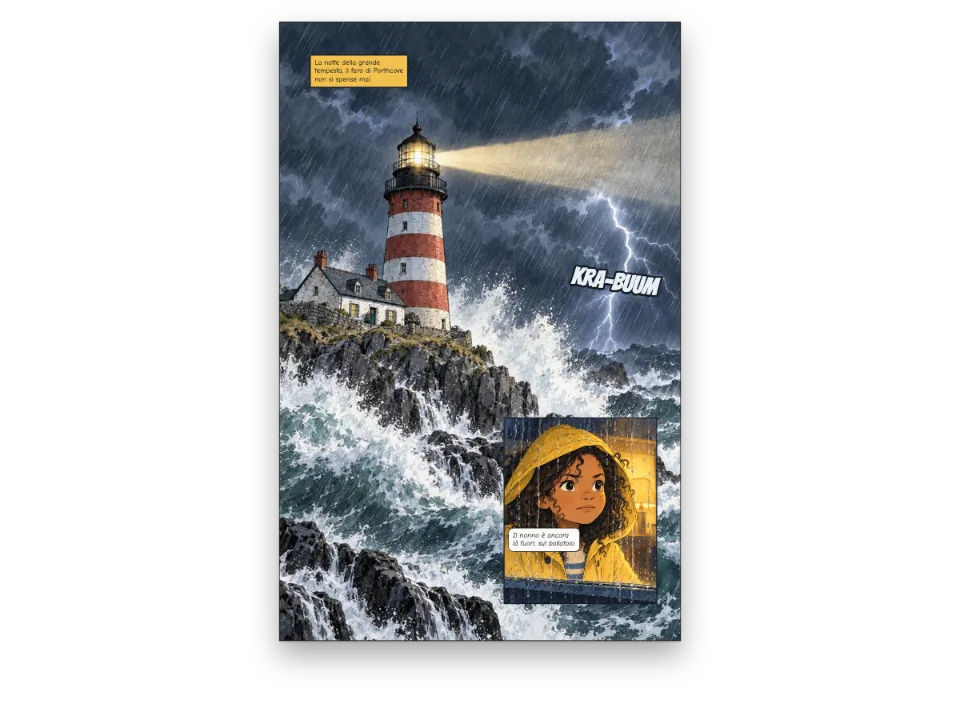
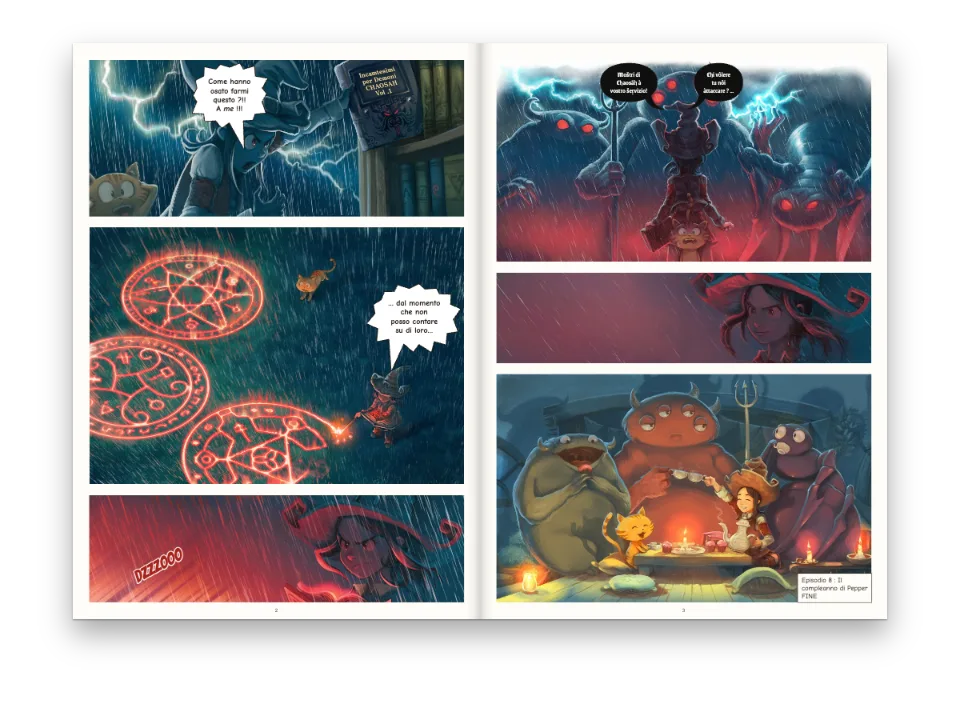
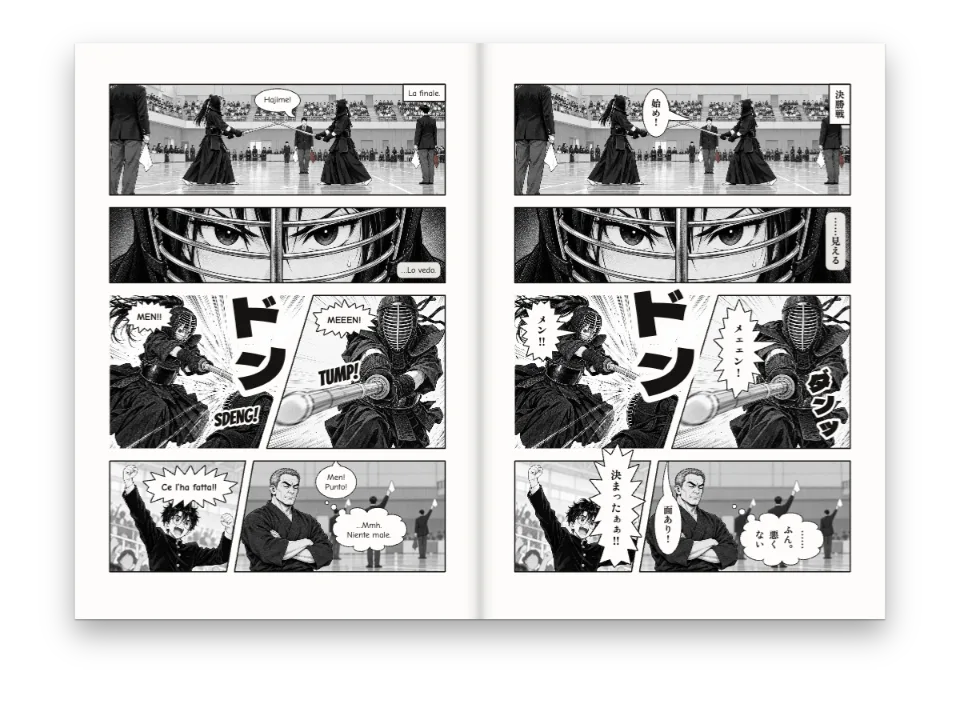
In breve
Una pagina di fumetto disegnata una volta e impaginata in tre modi. Le stesse cinque immagini e gli stessi dialoghi riempiono tre griglie di vignette diverse, e ogni immagine viene ritagliata di nuovo per la sua nuova vignetta.
Che cosa comporrai
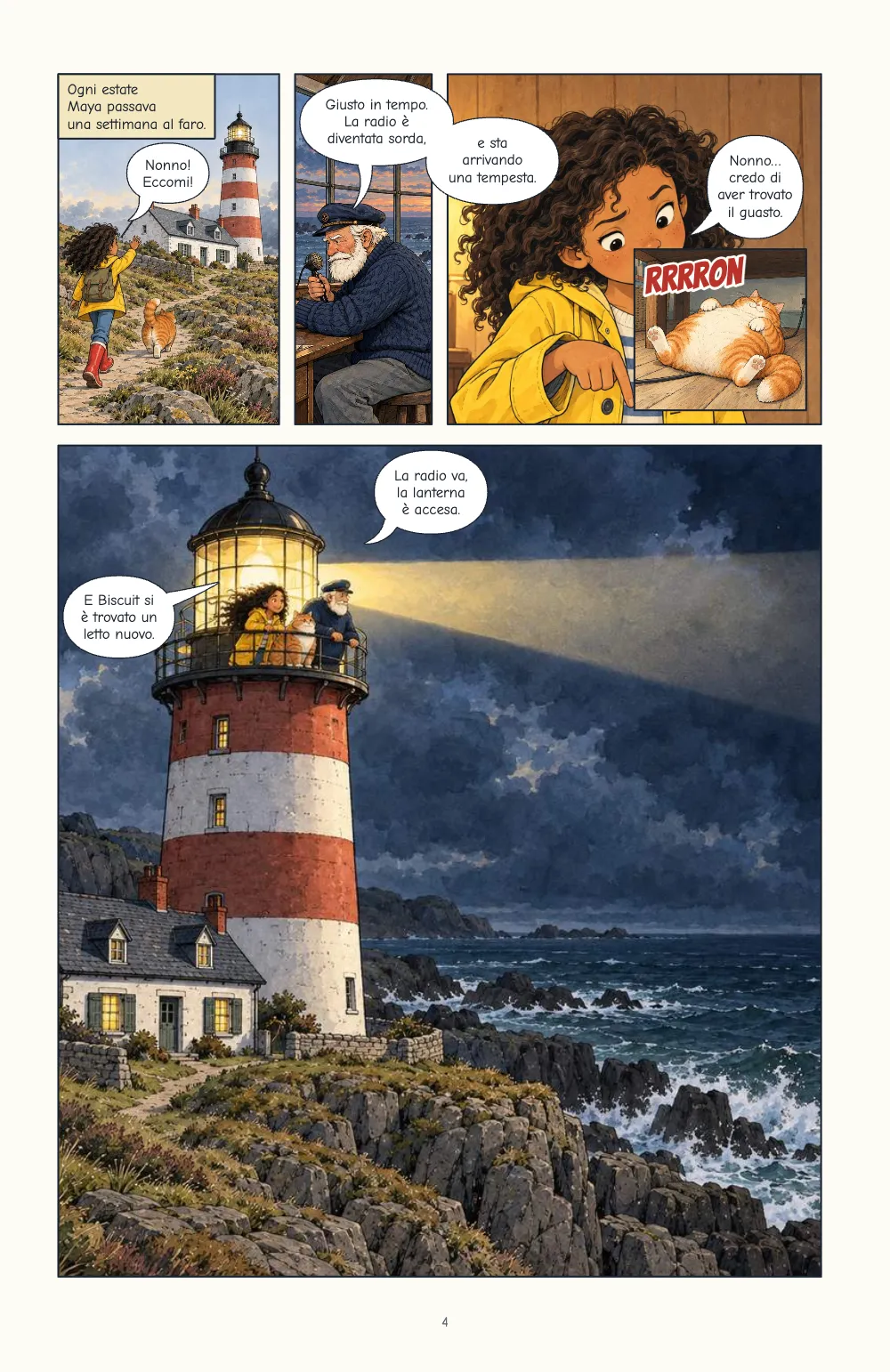
Una prova di impaginazione per una pagina di un fumetto, Il faro di Porthcove: un frontespizio e la stessa pagina in tre schemi, tra cui l’autore può scegliere. Le cinque immagini (Maya che sale al faro, suo nonno davanti a una radio muta, Maya che indica il pavimento, il gatto addormentato sul cavo, la lanterna accesa di notte) e le sei battute del lettering non cambiano mai; cambia solo lo split di ogni :::page. Ogni immagine viene ritagliata di nuovo per la sua cella e ogni balloon ricollocato attorno a chi parla. Il formato è quello di un comic book americano, 168 × 259 mm, e la prova esce in dieci edizioni, ciascuna letterata nella propria lingua.
Questa ricetta risponde a
- Come divido una pagina in vignette di fumetto?
- Come mantengo in vista un volto quando una vignetta ritaglia l’immagine?
- Come riscrivo il lettering di un fumetto in un’altra lingua?
La risposta breve
// Every :::page fills the type area; its split attribute cuts it into cells and its ::panel
// lines fill them in reading order (rows top to bottom, columns from the start side):
//   :::page{split="30 / 35 [* | * | *] / *"}    three tiers, the middle one in three
//   :::page{split="60 [* / *] | * [* / * / *]"} two columns, then each column in tiers
//   :::page{split="30 [30 | 20 | *] / *"}       a 30 % tier cut 30 | 20 | rest, then the rest
// A size is a percentage of the parent cell, * shares what is left, [ … ] cuts that cell
// on the other axis. A panel with inset="x y w h" sits over the panel before it.
const comics = {
  gutter: { horizontal: mm(4), vertical: mm(3) }, // between tiers, between panels in a tier
  panel: { borderWidth: pt(1), borderColor: col('ink'), background: col('paper') },
  lettering: { fontFamily: LETTERING, fontSize: pt(8), color: col('ink'), inset: mm(1) },
  balloonStyles: [
    { id: 'speech', stroke: col('ink') },
    { id: 'caption', fill: col('caption'), stroke: col('ink') },
    { id: 'sfx', fontFamily: SFX, color: col('accent'), haloColor: col('paper') },
  ],
  runningHeads: true, // a comic page has no running head unless asked: here, its folio
};
Ingredienti
- Funzionalità
- Divisione in vignetteDisegni nelle vignette e ritagliParlanti e ancoraggiZona sicura dell’immagineBordi e spazi delle vignettePagine a fumettiLettering dei fumettiRifare il lettering in altre lingueStili delle nuvoletteEffetti sonoriTavolozza di colori semanticaPagine su un canvasEsportazione in PDF
- Usa anche
- Paragrafi nell’altra direzioneRiquadri sovrapposti, vignette al vivo e bordi spezzatiColore della cartaStili di paragrafoFont incorporati nel PDFFigure e tabelle come risorse
- Tipo
- Comic Neue, Bangers, Zen Antique, Dela Gothic One, ZCOOL KuaiLe, ZCOOL QingKe HuangYou, Playpen Sans Arabic, Lalezar (SIL OFL 1.1)
- Risorse
lh-arrive.jpglh-beam.jpglh-biscuit.jpglh-maya.jpglh-radio.jpg- Panel picture: Maya arrives at the lighthouse (Generated With Diffusion Models, originale)
- Panel picture: Tomás at the radio (Generated With Diffusion Models, originale)
- Panel picture: Maya finds the problem (Generated With Diffusion Models, originale)
- Panel picture: Biscuit asleep on the cable (Generated With Diffusion Models, originale)
- Panel picture: the lamp lit at night (Generated With Diffusion Models, originale)
Preparazione
#1 · Taglia la pagina con un albero di suddivisione
Il codice è la risposta breve qui sopra. Un :::page riempie la gabbia del testo, qui 144 × 227 mm, e il suo attributo split la taglia. / separa le righe, | separa le colonne, ogni misura è una percentuale della cella che taglia, * divide ciò che resta, e una parentesi quadra taglia di nuovo quella cella sull’altro asse (suddividere la pagina). Lo schema C, 30 [30 | 20 | *] / *, crea una striscia profonda il 30%, la taglia in celle larghe il 30% e il 20% più il resto, e lascia sotto una cella alta. Gli spazi tra le vignette stanno a cavallo di ogni linea: 4 mm tra le strisce, 3 mm tra le vignette di una striscia. Le righe ::panel riempiono le celle in ordine di lettura, righe dall’alto e colonne dal lato di partenza.
#2 · Dai a ogni immagine una zona sicura
// From the art manifest; fractions of each picture, the same in every language. The safe
// area is what every crop keeps: Tomás alone, not his radio, so a cell a fifth of the page
// wide still shows him; the lighthouse and the gallery, not the boat, so a tall cell holds them.
const ART = {
  'lh-arrive': { width: 1100, height: 733, safeArea: { x: 0.22, y: 0.08, width: 0.4, height: 0.64 },
    anchors: [{ id: 'maya', x: 0.29, y: 0.52, head: { x: 0.27, y: 0.47 },
      face: { x: 0.22, y: 0.42, width: 0.12, height: 0.16 } },
    { id: 'biscuit', x: 0.4, y: 0.68, face: { x: 0.37, y: 0.64, width: 0.07, height: 0.08 } }],
    avoid: [{ x: 0.51, y: 0.09, width: 0.1, height: 0.43 }],
    alt: t({ en: 'A girl in a yellow raincoat walks up a coastal path towards a red-and-white '
      + 'lighthouse, a fat orange cat ahead of her.',
      es: 'Una niña con chubasquero amarillo sube por un camino de costa hacia un faro rojo y '
        + 'blanco, con un gato naranja gordo delante.',
      ca: 'Una nena amb impermeable groc puja per un camí de costa cap a un far vermell i blanc, '
        + 'amb un gat taronja gras al davant.',
      zh: '一个穿黄色雨衣的女孩沿着海边小路走向红白相间的灯塔,一只胖胖的橘猫走在前面。',
      ar: 'فتاة بمعطف مطر أصفر تصعد دربًا ساحليًا نحو منارة حمراء وبيضاء، وأمامها قط برتقالي سمين.',
      ja: '黄色いレインコートの女の子が、赤と白の灯台へ続く海辺の小道をのぼっていく。前を太ったオレンジ色の猫が歩く。',
      pt: 'Uma menina de capa de chuva amarela sobe um caminho à beira-mar rumo a um farol '
        + 'vermelho e branco, com um gato laranja gordo à frente.',
      fr: 'Une fillette en ciré jaune monte un sentier côtier vers un phare rouge et blanc, '
        + 'précédée d’un gros chat roux.',
      de: 'Ein Mädchen in gelbem Regenmantel geht einen Küstenpfad zu einem rot-weißen '
        + 'Leuchtturm hinauf, eine dicke rote Katze vor ihr.',
      it: 'Una bambina con l’impermeabile giallo sale per un sentiero costiero verso un faro '
        + 'bianco e rosso, preceduta da un grosso gatto rosso.' }) },
  'lh-radio': { width: 1000, height: 1000,
    safeArea: { x: 0.27, y: 0.38, width: 0.24, height: 0.3 },
    anchors: [{ id: 'tomas', x: 0.345, y: 0.52, head: { x: 0.38, y: 0.44 },
      face: { x: 0.29, y: 0.4, width: 0.16, height: 0.18 } }],
    avoid: [{ x: 0, y: 0.44, width: 0.22, height: 0.26 }],
    alt: t({ en: 'The old keeper, white-bearded, in a navy sweater and cap, taps a valve radio '
      + 'with the microphone in his hand.',
      es: 'El viejo farero, de barba blanca, jersey azul marino y gorra, golpea una radio de '
        + 'válvulas con el micrófono en la mano.',
      ca: 'El vell faroner, de barba blanca, jersei blau marí i gorra, pica una ràdio de vàlvules '
        + 'amb el micròfon a la mà.',
      zh: '白胡子的老守塔人穿着藏青色毛衣、戴着帽子,手握话筒,敲着一台电子管收音机。',
      ar: 'حارس المنارة العجوز بلحيته البيضاء وكنزته الكحلية وقبعته ينقر على مذياع قديم '
        + 'والميكروفون في يده.',
      ja: '白いひげの老灯台守が、紺のセーターに帽子姿でマイクを握り、真空管ラジオをたたいている。',
      pt: 'O velho faroleiro, de barba branca, suéter azul-marinho e boné, dá batidinhas num '
        + 'rádio valvulado com o microfone na mão.',
      fr: 'Le vieux gardien, barbe blanche, pull bleu marine et casquette, tapote une radio à '
        + 'lampes, le micro à la main.',
      de: 'Der alte Wärter mit weißem Bart, marineblauem Pullover und Mütze klopft auf ein '
        + 'Röhrenradio, das Mikrofon in der Hand.',
      it: 'Il vecchio guardiano, barba bianca, maglione blu e berretto, picchietta su una radio a '
        + 'valvole con il microfono in mano.' }) },
  'lh-maya': { width: 1100, height: 1100, safeArea: { x: 0.25, y: 0.27, width: 0.41, height: 0.68 },
    anchors: [{ id: 'maya', x: 0.54, y: 0.565, head: { x: 0.5, y: 0.3 },
      face: { x: 0.4, y: 0.33, width: 0.24, height: 0.29 } }],
    avoid: [{ x: 0.27, y: 0.73, width: 0.25, height: 0.22 }],
    alt: t({ en: 'Close-up of Maya frowning at the floor and pointing down.',
      es: 'Primer plano de Maya, que frunce el ceño mirando al suelo y señala hacia abajo.',
      ca: 'Primer pla de la Maya, que arrufa les celles mirant a terra i assenyala avall.',
      zh: '玛雅的特写:她皱着眉头看着地板,手指向下指。',
      ar: 'لقطة قريبة لمايا وهي تعقد حاجبيها ناظرةً إلى الأرض وتشير إلى أسفل.',
      ja: 'マヤのアップ。眉をひそめて床を見つめ、下を指さしている。',
      pt: 'Close de Maya, de testa franzida, olhando para o chão e apontando para baixo.',
      fr: 'Gros plan sur Maya, sourcils froncés, qui fixe le sol et pointe le doigt vers le '
        + 'bas.',
      de: 'Nahaufnahme von Maya, die mit gerunzelter Stirn auf den Boden blickt und nach unten '
        + 'zeigt.',
      it: 'Primo piano di Maya, accigliata, che fissa il pavimento e indica in basso.' }) },
  'lh-biscuit': { width: 1000, height: 1000,
    safeArea: { x: 0.58, y: 0.25, width: 0.42, height: 0.33 },
    anchors: [{ id: 'biscuit', x: 0.72, y: 0.355, head: { x: 0.73, y: 0.32 },
      face: { x: 0.64, y: 0.27, width: 0.2, height: 0.18 } }],
    avoid: [{ x: 0.93, y: 0.28, width: 0.07, height: 0.24 },
      { x: 0, y: 0.72, width: 0.4, height: 0.1 }],
    alt: t({ en: 'Under the desk the fat orange cat sleeps on his back, right on top of the black '
      + 'radio cable.',
      es: 'Bajo la mesa, el gato naranja gordo duerme panza arriba justo encima del cable negro '
        + 'de la radio.',
      ca: 'Sota la taula, el gat taronja gras dorm panxa enlaire just a sobre del cable negre de '
        + 'la ràdio.',
      zh: '桌子底下,胖橘猫四脚朝天地睡着,正好压在收音机的黑色电线上。',
      ar: 'تحت المكتب ينام القط البرتقالي السمين على ظهره فوق سلك المذياع الأسود تمامًا.',
      ja: '机の下で、太ったオレンジ色の猫がラジオの黒いコードの真上にあおむけで眠っている。',
      pt: 'Debaixo da mesa, o gato laranja gordo dorme de barriga para cima bem em cima do cabo '
        + 'preto do rádio.',
      fr: 'Sous le bureau, le gros chat roux dort sur le dos, juste sur le câble noir de la '
        + 'radio.',
      it: 'Sotto la scrivania, il grosso gatto rosso dorme a pancia in su, proprio sopra il cavo '
        + 'nero della radio.',
      de: 'Unter dem Schreibtisch schläft die dicke rote Katze auf dem Rücken, genau auf dem '
        + 'schwarzen Kabel des Funkgeräts.' }) },
  'lh-beam': { width: 1200, height: 800, safeArea: { x: 0.15, y: 0.01, width: 0.25, height: 0.3 },
    anchors: [{ id: 'maya', x: 0.235, y: 0.15,
      face: { x: 0.21, y: 0.11, width: 0.05, height: 0.07 } },
      { id: 'tomas', x: 0.3, y: 0.145, face: { x: 0.28, y: 0.11, width: 0.04, height: 0.06 } }],
    avoid: [{ x: 0.79, y: 0.55, width: 0.08, height: 0.09 }],
    alt: t({ en: 'Night: the beam sweeps over a dark sea; Maya and her grandfather stand on the '
      + 'lantern gallery and a fishing boat shows its lights far out.',
      es: 'De noche, el haz barre un mar oscuro; Maya y su abuelo están en la galería de la '
        + 'linterna y a lo lejos se ven las luces de un pesquero.',
      ca: 'De nit, el feix escombra un mar fosc; la Maya i el seu avi són a la galeria de la '
        + 'llanterna i lluny es veuen els llums d’un pesquer.',
      zh: '夜里,灯塔的光束扫过漆黑的海面;玛雅和外公站在灯室外的回廊上,远处一艘渔船亮着灯。',
      ar: 'ليلًا يمسح الشعاع بحرًا مظلمًا، ومايا وجدّها واقفان على شرفة الفانوس، وفي البعيد قارب '
        + 'صيد بأضوائه.',
      ja: '夜。光の帯が暗い海をなでる。マヤと祖父は灯室の回廊に立ち、沖には漁船の明かりが見える。',
      pt: 'À noite, o facho varre um mar escuro; Maya e o avô estão na galeria da lanterna e, ao '
        + 'longe, aparecem as luzes de um barco de pesca.',
      fr: 'La nuit, le faisceau balaie une mer sombre ; Maya et son grand-père se tiennent sur '
        + 'la galerie de la lanterne et, au large, un bateau de pêche montre ses feux.',
      de: 'Nacht: Der Lichtstrahl streicht über ein dunkles Meer; Maya und ihr Großvater stehen '
        + 'auf der Galerie der Laterne, und weit draußen zeigt ein Fischerboot seine Lichter.',
      it: 'Di notte il fascio di luce spazza un mare scuro; Maya e suo nonno sono sulla balconata '
        + 'della lanterna e, al largo, si vedono le luci di un peschereccio.' }) },
};
Ogni immagine viene disegnata una volta e ritagliata per riempire la cella in cui finisce. La zona sicura è la parte che ogni ritaglio conserva intera (vignette e disegni). La zona sicura dell’immagine della radio è il solo guardiano, il 24% della sua larghezza, quindi la cella di 26 mm dello schema C lo mostra dal berretto agli stivali e lascia fuori la radio; le celle larghe degli schemi A e B mostrano entrambi. Una cella la cui forma non può contenere una zona sicura mette l’immagine in letterbox e la build avvisa (comicPanelLetterbox). Le ancore segnano la bocca e il volto di ogni personaggio nelle stesse frazioni, così le code dei balloon trovano chi parla in ogni ritaglio.
#3 · Sovrapponi una vignetta a un’altra
La suddivisione dello schema C crea quattro celle per cinque vignette. Il gatto entra con inset="50 50 46 46": una vignetta larga il 46% e alta il 46%, collocata al 50%, 50% della vignetta che la precede, quella di Maya. Una vignetta inserita non occupa una cella, quindi le vignette successive restano al loro posto, e viene letta subito dopo la vignetta che copre.
#4 · Lettera dieci edizioni da una sola impaginazione
// The lettering and sound-effect faces of each edition: the engine's defaults, but for Chinese
// two ZCOOL faces drawn for cartoons instead of Noto Sans SC. content.<lang>.md holds the words
// of each edition under the same speaker ids; Japanese balloons are set vertically, and the
// Japanese and Arabic editions, read right to left, mirror the order of the panels in every row.
const [LETTERING, SFX] = t({
  en: ['Comic Neue', 'Bangers'], es: ['Comic Neue', 'Bangers'], ca: ['Comic Neue', 'Bangers'],
  ja: ['Zen Antique', 'Dela Gothic One'], zh: ['ZCOOL KuaiLe', 'ZCOOL QingKe HuangYou'],
  ar: ['Playpen Sans Arabic', 'Lalezar'], pt: ['Comic Neue', 'Bangers'],
  fr: ['Comic Neue', 'Bangers'], de: ['Comic Neue', 'Bangers'], it: ['Comic Neue', 'Bangers'],
});
La suddivisione, le immagini, i ritagli e le ancore sono gli stessi in ogni lingua; content.<lang>.md contiene solo le parole, sotto gli stessi id dei personaggi (maya, tomas). L’edizione giapponese compone i balloon in verticale, otto caratteri per colonna, e toglie il 。 finale; si legge da destra a sinistra, come quella araba, quindi le vignette di ogni riga sono specchiate mentre le immagini no. Il corpo del lettering resta di 8 pt in ogni edizione: una riga più lunga produce un balloon più grande, mai un carattere più piccolo (lettering).
La ricetta completa
// ═══ Postext Cookbook · Nº 144 · One set of panels, three page splits ═══════════════ // https://postext.dev/en/cookbook/comic-page-splitters // Code: MIT · Text: original (CC BY 4.0) · Pictures: generated with diffusion models // Fonts: Comic Neue, Bangers and the faces of five editions (OFL) · Needs postext ≥ 1.25.0 // // A layout proof for one page of a comic: the same five pictures and the same lines of // dialogue laid out under three `split` trees. Each picture carries a safe area, so its subject // stays in view whether its cell is wide, tall or square, and the lettering is placed again // around the speakers' anchors on every page and in every language. import { buildDocument, withLoadedFonts, renderPageToCanvas, registerResourceImage, loadVerticalAlternates, } from 'https://esm.sh/postext'; import { renderToPdf, decompressWoff2 } from 'https://esm.sh/postext-pdf'; const LANG = 'it'; // @lang: 'en' | 'es' | 'ca' | 'zh' | 'ar' | 'ja' | 'pt' | 'fr' | 'de' | 'it' const RECIPE = 'comic-page-splitters'; // ─── 1 · Design ───────────────────────────────────────────────────────────── // #region palette: the night sea, the lighthouse red and the yellow of the captions const palette = { ink: '#1b2430', // panel borders, lettering and text: a blue-black accent: '#b8322a', // the lighthouse red: the proof's labels caption: '#f4e7bf', // caption boxes, an old-paper yellow muted: '#5f6873', // folios and the imprint paper: '#fdfbf6', }; const col = (id) => ({ hex: palette[id], model: 'hex', paletteId: id }); const colorPalette = [ ...Object.entries(palette).map(([id, hex]) => ({ id, name: id, value: { hex, model: 'hex' } })), { id: 'main-color', name: 'accent (defaults)', value: { hex: palette.accent, model: 'hex' } }, ]; // #endregion // #region editions: one comic, six editions, each lettered in faces for its script // The lettering and sound-effect faces of each edition: the engine's defaults, but for Chinese // two ZCOOL faces drawn for cartoons instead of Noto Sans SC. content.<lang>.md holds the words // of each edition under the same speaker ids; Japanese balloons are set vertically, and the // Japanese and Arabic editions, read right to left, mirror the order of the panels in every row. const [LETTERING, SFX] = t({ en: ['Comic Neue', 'Bangers'], es: ['Comic Neue', 'Bangers'], ca: ['Comic Neue', 'Bangers'], ja: ['Zen Antique', 'Dela Gothic One'], zh: ['ZCOOL KuaiLe', 'ZCOOL QingKe HuangYou'], ar: ['Playpen Sans Arabic', 'Lalezar'], pt: ['Comic Neue', 'Bangers'], fr: ['Comic Neue', 'Bangers'], de: ['Comic Neue', 'Bangers'], it: ['Comic Neue', 'Bangers'], }); // #endregion // #region answer: the comic: a frame, gutters, a panel border, and a page per split // Every :::page fills the type area; its split attribute cuts it into cells and its ::panel // lines fill them in reading order (rows top to bottom, columns from the start side): // :::page{split="30 / 35 [* | * | *] / *"} three tiers, the middle one in three // :::page{split="60 [* / *] | * [* / * / *]"} two columns, then each column in tiers // :::page{split="30 [30 | 20 | *] / *"} a 30 % tier cut 30 | 20 | rest, then the rest // A size is a percentage of the parent cell, * shares what is left, [ … ] cuts that cell // on the other axis. A panel with inset="x y w h" sits over the panel before it. const comics = { gutter: { horizontal: mm(4), vertical: mm(3) }, // between tiers, between panels in a tier panel: { borderWidth: pt(1), borderColor: col('ink'), background: col('paper') }, lettering: { fontFamily: LETTERING, fontSize: pt(8), color: col('ink'), inset: mm(1) }, balloonStyles: [ { id: 'speech', stroke: col('ink') }, { id: 'caption', fill: col('caption'), stroke: col('ink') }, { id: 'sfx', fontFamily: SFX, color: col('accent'), haloColor: col('paper') }, ], runningHeads: true, // a comic page has no running head unless asked: here, its folio }; // #endregion const LABEL = { fontFamily: LETTERING, fontSize: pt(7.5), color: col('muted') }; const footer = { elements: [{ kind: 'text', id: 'folio', content: '{pageNumber}', ...LABEL, align: 'center', placement: { anchor: { to: 'page', edge: 'bottom' }, offset: { x: mm(0), y: mm(-8) } } }] }; const config = () => ({ locale: t({ en: 'en-us', es: 'es', ca: 'ca', ja: 'ja', zh: 'zh-Hans', ar: 'ar', pt: 'pt-BR', fr: 'fr', de: 'de', it: 'it' }), colorPalette, comics, // The trim of an American comic book, 6⅝ × 10³⁄₁₆ in; the type area is the panel frame. page: { sizePreset: 'custom', width: mm(168), height: mm(259), dpi: 150, backgroundColor: col('paper'), margins: { top: mm(14), bottom: mm(18), left: mm(13), right: mm(11), mirror: true } }, layout: { layoutType: 'single' }, // The proof's cover sheet is set in the lettering face of the edition. bodyText: { fontFamily: LETTERING, fontSize: pt(10.5), lineHeight: pt(15), color: col('ink'), boldColor: col('ink'), italicColor: col('ink'), referenceColor: col('ink'), textAlign: 'left', firstLineIndent: pt(0), paragraphSpacing: true, hyphenation: { enabled: false } }, headings: { fontFamily: SFX, color: col('accent'), fontWeight: 400, levels: [ // The cover sheet's title opens a page, on either side. { level: 1, fontSize: pt(34), lineHeight: pt(38), breakBefore: { enabled: true, parity: 'any' }, marginTop: mm(30), marginBottom: pt(15) }, { level: 2, fontFamily: LETTERING, fontSize: pt(10.5), fontWeight: 700, color: col('accent'), marginTop: pt(15), marginBottom: pt(0) }, ] }, paragraphStyles: [ { id: 'split', fontSize: pt(10.5), color: col('accent'), textAlign: 'left' }, // the attribute { id: 'imprint', fontSize: pt(7.5), lineHeight: pt(10), color: col('muted'), marginTop: pt(30) }, ], header: { elements: [] }, footer, }); // ─── 2 · Content ──────────────────────────────────────────────────────────── const markdown = String.raw`# Una pagina, tre schemiEsempio Markdown · 74 righe · content.it.md
## Il faro di Porthcove · pagina 12 · prova di impaginazione Tre schemi per la stessa pagina, tra cui l’autore sceglierà. Ognuno tiene le stesse cinque immagini e le stesse battute; cambia solo la suddivisione della pagina, e i ritagli e le nuvolette la seguono. **Schema A, pagina 2.** Tre strisce, quella centrale divisa in tre vignette. :::paragraphs{style="split" dir=ltr} split="30 / 35 [\* | \* | \*] / \*" ::: **Schema B, pagina 3.** Due colonne: quella di sinistra in due vignette, quella di destra in tre. :::paragraphs{style="split" dir=ltr} split="60 [\* / \*] | \* [\* / \* / \*]" ::: **Schema C, pagina 4.** Una striscia alta il 30% della pagina, divisa 30 | 20 | il resto, sopra un’unica vignetta alta; il gatto è un riquadro incassato nella vignetta di Maya. :::paragraphs{style="split" dir=ltr} split="30 [30 | 20 | \*] / \*" ::: :::paragraphs{style="imprint"} Sceneggiatura e lettering per il Ricettario di Postext. Immagini generate con modelli di diffusione. Lettering in Comic Neue e Bangers (SIL OFL). ::: :::page{split="30 / 35 [* | * | *] / *"} ::panel{art=lh-arrive} caption: Ogni estate Maya passava una settimana al faro. maya: Nonno! Eccomi! ::panel{art=lh-radio} tomas: Giusto in tempo. La radio è diventata sorda, tomas: e sta arrivando una tempesta. ::panel{art=lh-maya} maya: Nonno… credo di aver trovato il guasto. ::panel{art=lh-biscuit} sfx{rotate=-6}: rrrron ::panel{art=lh-beam} tomas: La radio va, la lanterna è accesa. maya: E Biscuit si è trovato un letto nuovo. ::: :::page{split="60 [* / *] | * [* / * / *]"} ::panel{art=lh-arrive} caption: Ogni estate Maya passava una settimana al faro. maya: Nonno! Eccomi! ::panel{art=lh-radio} tomas: Giusto in tempo. La radio è diventata sorda, tomas: e sta arrivando una tempesta. ::panel{art=lh-maya} maya: Nonno… credo di aver trovato il guasto. ::panel{art=lh-biscuit} sfx{rotate=-6}: rrrron ::panel{art=lh-beam} tomas: La radio va, la lanterna è accesa. maya: E Biscuit si è trovato un letto nuovo. ::: :::page{split="30 [30 | 20 | *] / *"} ::panel{art=lh-arrive} caption: Ogni estate Maya passava una settimana al faro. maya: Nonno! Eccomi! ::panel{art=lh-radio} tomas{break}: Giusto in tempo. La radio è diventata sorda, tomas: e sta arrivando una tempesta. ::panel{art=lh-maya} maya: Nonno… credo di aver trovato il guasto. ::panel{art=lh-biscuit inset="50 50 46 46"} sfx{rotate=-6}: rrrron ::panel{art=lh-beam} tomas: La radio va, la lanterna è accesa. maya: E Biscuit si è trovato un letto nuovo. :::`; // content.<lang>.md, inlined by the Cookbook // #region art: the five pictures: safe area, speakers' anchors and avoid zones // From the art manifest; fractions of each picture, the same in every language. The safe // area is what every crop keeps: Tomás alone, not his radio, so a cell a fifth of the page // wide still shows him; the lighthouse and the gallery, not the boat, so a tall cell holds them. const ART = { 'lh-arrive': { width: 1100, height: 733, safeArea: { x: 0.22, y: 0.08, width: 0.4, height: 0.64 }, anchors: [{ id: 'maya', x: 0.29, y: 0.52, head: { x: 0.27, y: 0.47 }, face: { x: 0.22, y: 0.42, width: 0.12, height: 0.16 } }, { id: 'biscuit', x: 0.4, y: 0.68, face: { x: 0.37, y: 0.64, width: 0.07, height: 0.08 } }], avoid: [{ x: 0.51, y: 0.09, width: 0.1, height: 0.43 }], alt: t({ en: 'A girl in a yellow raincoat walks up a coastal path towards a red-and-white ' + 'lighthouse, a fat orange cat ahead of her.', es: 'Una niña con chubasquero amarillo sube por un camino de costa hacia un faro rojo y ' + 'blanco, con un gato naranja gordo delante.', ca: 'Una nena amb impermeable groc puja per un camí de costa cap a un far vermell i blanc, ' + 'amb un gat taronja gras al davant.', zh: '一个穿黄色雨衣的女孩沿着海边小路走向红白相间的灯塔,一只胖胖的橘猫走在前面。', ar: 'فتاة بمعطف مطر أصفر تصعد دربًا ساحليًا نحو منارة حمراء وبيضاء، وأمامها قط برتقالي سمين.', ja: '黄色いレインコートの女の子が、赤と白の灯台へ続く海辺の小道をのぼっていく。前を太ったオレンジ色の猫が歩く。', pt: 'Uma menina de capa de chuva amarela sobe um caminho à beira-mar rumo a um farol ' + 'vermelho e branco, com um gato laranja gordo à frente.', fr: 'Une fillette en ciré jaune monte un sentier côtier vers un phare rouge et blanc, ' + 'précédée d’un gros chat roux.', de: 'Ein Mädchen in gelbem Regenmantel geht einen Küstenpfad zu einem rot-weißen ' + 'Leuchtturm hinauf, eine dicke rote Katze vor ihr.', it: 'Una bambina con l’impermeabile giallo sale per un sentiero costiero verso un faro ' + 'bianco e rosso, preceduta da un grosso gatto rosso.' }) }, 'lh-radio': { width: 1000, height: 1000, safeArea: { x: 0.27, y: 0.38, width: 0.24, height: 0.3 }, anchors: [{ id: 'tomas', x: 0.345, y: 0.52, head: { x: 0.38, y: 0.44 }, face: { x: 0.29, y: 0.4, width: 0.16, height: 0.18 } }], avoid: [{ x: 0, y: 0.44, width: 0.22, height: 0.26 }], alt: t({ en: 'The old keeper, white-bearded, in a navy sweater and cap, taps a valve radio ' + 'with the microphone in his hand.', es: 'El viejo farero, de barba blanca, jersey azul marino y gorra, golpea una radio de ' + 'válvulas con el micrófono en la mano.', ca: 'El vell faroner, de barba blanca, jersei blau marí i gorra, pica una ràdio de vàlvules ' + 'amb el micròfon a la mà.', zh: '白胡子的老守塔人穿着藏青色毛衣、戴着帽子,手握话筒,敲着一台电子管收音机。', ar: 'حارس المنارة العجوز بلحيته البيضاء وكنزته الكحلية وقبعته ينقر على مذياع قديم ' + 'والميكروفون في يده.', ja: '白いひげの老灯台守が、紺のセーターに帽子姿でマイクを握り、真空管ラジオをたたいている。', pt: 'O velho faroleiro, de barba branca, suéter azul-marinho e boné, dá batidinhas num ' + 'rádio valvulado com o microfone na mão.', fr: 'Le vieux gardien, barbe blanche, pull bleu marine et casquette, tapote une radio à ' + 'lampes, le micro à la main.', de: 'Der alte Wärter mit weißem Bart, marineblauem Pullover und Mütze klopft auf ein ' + 'Röhrenradio, das Mikrofon in der Hand.', it: 'Il vecchio guardiano, barba bianca, maglione blu e berretto, picchietta su una radio a ' + 'valvole con il microfono in mano.' }) }, 'lh-maya': { width: 1100, height: 1100, safeArea: { x: 0.25, y: 0.27, width: 0.41, height: 0.68 }, anchors: [{ id: 'maya', x: 0.54, y: 0.565, head: { x: 0.5, y: 0.3 }, face: { x: 0.4, y: 0.33, width: 0.24, height: 0.29 } }], avoid: [{ x: 0.27, y: 0.73, width: 0.25, height: 0.22 }], alt: t({ en: 'Close-up of Maya frowning at the floor and pointing down.', es: 'Primer plano de Maya, que frunce el ceño mirando al suelo y señala hacia abajo.', ca: 'Primer pla de la Maya, que arrufa les celles mirant a terra i assenyala avall.', zh: '玛雅的特写:她皱着眉头看着地板,手指向下指。', ar: 'لقطة قريبة لمايا وهي تعقد حاجبيها ناظرةً إلى الأرض وتشير إلى أسفل.', ja: 'マヤのアップ。眉をひそめて床を見つめ、下を指さしている。', pt: 'Close de Maya, de testa franzida, olhando para o chão e apontando para baixo.', fr: 'Gros plan sur Maya, sourcils froncés, qui fixe le sol et pointe le doigt vers le ' + 'bas.', de: 'Nahaufnahme von Maya, die mit gerunzelter Stirn auf den Boden blickt und nach unten ' + 'zeigt.', it: 'Primo piano di Maya, accigliata, che fissa il pavimento e indica in basso.' }) }, 'lh-biscuit': { width: 1000, height: 1000, safeArea: { x: 0.58, y: 0.25, width: 0.42, height: 0.33 }, anchors: [{ id: 'biscuit', x: 0.72, y: 0.355, head: { x: 0.73, y: 0.32 }, face: { x: 0.64, y: 0.27, width: 0.2, height: 0.18 } }], avoid: [{ x: 0.93, y: 0.28, width: 0.07, height: 0.24 }, { x: 0, y: 0.72, width: 0.4, height: 0.1 }], alt: t({ en: 'Under the desk the fat orange cat sleeps on his back, right on top of the black ' + 'radio cable.', es: 'Bajo la mesa, el gato naranja gordo duerme panza arriba justo encima del cable negro ' + 'de la radio.', ca: 'Sota la taula, el gat taronja gras dorm panxa enlaire just a sobre del cable negre de ' + 'la ràdio.', zh: '桌子底下,胖橘猫四脚朝天地睡着,正好压在收音机的黑色电线上。', ar: 'تحت المكتب ينام القط البرتقالي السمين على ظهره فوق سلك المذياع الأسود تمامًا.', ja: '机の下で、太ったオレンジ色の猫がラジオの黒いコードの真上にあおむけで眠っている。', pt: 'Debaixo da mesa, o gato laranja gordo dorme de barriga para cima bem em cima do cabo ' + 'preto do rádio.', fr: 'Sous le bureau, le gros chat roux dort sur le dos, juste sur le câble noir de la ' + 'radio.', it: 'Sotto la scrivania, il grosso gatto rosso dorme a pancia in su, proprio sopra il cavo ' + 'nero della radio.', de: 'Unter dem Schreibtisch schläft die dicke rote Katze auf dem Rücken, genau auf dem ' + 'schwarzen Kabel des Funkgeräts.' }) }, 'lh-beam': { width: 1200, height: 800, safeArea: { x: 0.15, y: 0.01, width: 0.25, height: 0.3 }, anchors: [{ id: 'maya', x: 0.235, y: 0.15, face: { x: 0.21, y: 0.11, width: 0.05, height: 0.07 } }, { id: 'tomas', x: 0.3, y: 0.145, face: { x: 0.28, y: 0.11, width: 0.04, height: 0.06 } }], avoid: [{ x: 0.79, y: 0.55, width: 0.08, height: 0.09 }], alt: t({ en: 'Night: the beam sweeps over a dark sea; Maya and her grandfather stand on the ' + 'lantern gallery and a fishing boat shows its lights far out.', es: 'De noche, el haz barre un mar oscuro; Maya y su abuelo están en la galería de la ' + 'linterna y a lo lejos se ven las luces de un pesquero.', ca: 'De nit, el feix escombra un mar fosc; la Maya i el seu avi són a la galeria de la ' + 'llanterna i lluny es veuen els llums d’un pesquer.', zh: '夜里,灯塔的光束扫过漆黑的海面;玛雅和外公站在灯室外的回廊上,远处一艘渔船亮着灯。', ar: 'ليلًا يمسح الشعاع بحرًا مظلمًا، ومايا وجدّها واقفان على شرفة الفانوس، وفي البعيد قارب ' + 'صيد بأضوائه.', ja: '夜。光の帯が暗い海をなでる。マヤと祖父は灯室の回廊に立ち、沖には漁船の明かりが見える。', pt: 'À noite, o facho varre um mar escuro; Maya e o avô estão na galeria da lanterna e, ao ' + 'longe, aparecem as luzes de um barco de pesca.', fr: 'La nuit, le faisceau balaie une mer sombre ; Maya et son grand-père se tiennent sur ' + 'la galerie de la lanterne et, au large, un bateau de pêche montre ses feux.', de: 'Nacht: Der Lichtstrahl streicht über ein dunkles Meer; Maya und ihr Großvater stehen ' + 'auf der Galerie der Laterne, und weit draußen zeigt ein Fischerboot seine Lichter.', it: 'Di notte il fascio di luce spazza un mare scuro; Maya e suo nonno sono sulla balconata ' + 'della lanterna e, al largo, si vedono le luci di un peschereccio.' }) }, }; // #endregion // ─── 3 · Fonts ────────────────────────────────────────────────────────────── // Every face of the six editions; each edition loads the latin files of all of them and the // Japanese, Chinese or Arabic files of its own two. const FONTS = { 'Comic Neue': ['400', '400i', '700', '700i'], Bangers: ['400'], 'Zen Antique': ['400'], 'Dela Gothic One': ['400'], 'ZCOOL KuaiLe': ['400'], 'ZCOOL QingKe HuangYou': ['400'], 'Playpen Sans Arabic': ['400', '700'], Lalezar: ['400'], }; // ─── 4 · Build & show ─────────────────────────────────────────────────────── const faces = { [LETTERING]: FONTS[LETTERING], [SFX]: FONTS[SFX] }; await loadFonts(FONTS, markdown); await loadCjkFonts(faces, markdown, { vertical: LANG === 'ja' }); // ja balloons are vertical await loadArabicFonts(faces, markdown); await loadComicFonts(faces, markdown); // the bold and italic the faces do not ship const resources = await Promise.all([ comicPanel('lh-arrive', asset('lh-arrive.jpg'), ART['lh-arrive']), comicPanel('lh-radio', asset('lh-radio.jpg'), ART['lh-radio']), comicPanel('lh-maya', asset('lh-maya.jpg'), ART['lh-maya']), comicPanel('lh-biscuit', asset('lh-biscuit.jpg'), ART['lh-biscuit']), comicPanel('lh-beam', asset('lh-beam.jpg'), ART['lh-beam']), ]); const doc = await withLoadedFonts(() => buildDocument({ markdown, resources }, config()), { ...kitFonts(FONTS), text: markdown }); showBook(doc, { title: t({ en: 'One set of panels, three page splits', es: 'Las mismas viñetas en tres divisiones de página', pt: 'Os mesmos quadros em três divisões de página', fr: 'Les mêmes cases en trois découpages de page', de: 'Dieselben Panels in drei Seitenaufteilungen', it: 'Le stesse vignette in tre suddivisioni della pagina' }) }); offerPdf(() => renderToPdf(doc, { fontProvider: comicPdfProvider, resourceBytes: imageBytes }), `${RECIPE}.pdf`);Kit · core, fonts, viewer, pdf, images, cjk, arabic, comics: uguale in ogni ricetta · 740 righe
// ─── Kit ── helpers shared by every Cookbook recipe · postext.dev/cookbook ───── // ─── Kit · core v1 ── the same in every recipe · postext.dev/cookbook function mm(value) { return { value, unit: 'mm' }; } function pt(value) { return { value, unit: 'pt' }; } function em(value) { return { value, unit: 'em' }; } /** The sample language's string: t({ en: 'Figure', es: 'Figura' }). */ function t(strings) { return strings[LANG] ?? Object.values(strings)[0]; } /** A file in this recipe's assets folder, served from the Postext repo by jsDelivr. */ function asset(file) { return `https://cdn.jsdelivr.net/gh/drnachio/postext@main/cookbook/${RECIPE}/assets/${file}`; } // ─── Kit · fonts v3 ── the same in every recipe · postext.dev/cookbook // Postext loads the faces a config asks for before layout (prepareFonts, // buildDocumentWithFonts) and asks the kit for the files: Fontsource's, the // files the PDF embeds too. /** The options of buildDocumentWithFonts / prepareFonts / withLoadedFonts: * the Fontsource resolver, and the faces of FONTS loaded with the ones the * config names. FONTS = { 'Family Name': ['400', '400i', '700'] }. */ function kitFonts(FONTS = {}) { const faces = Object.entries(FONTS).flatMap(([family, specs]) => specs.map((spec) => ({ family, weight: parseInt(spec, 10), style: spec.endsWith('i') ? 'italic' : 'normal' }))); return { resolve: fontsourceResolver, faces }; } /** A face's Fontsource files, in a fixed order: latin, then latin-ext and greek * when `text` needs them and the family ships them (kitSubsetsFor), each with * its unicode-range. Null for a weight or slant Fontsource does not ship. */ async function fontsourceResolver(family, weight, style, { text = '' } = {}) { const id = fontsourceId(family); const meta = await fontsourceMeta(family); if (meta && !(meta.weights.includes(weight) && meta.styles.includes(style))) return null; kitStatus('Loading fonts…'); const at = await fontsourceAt(id); return ['latin', ...kitSubsetsFor(text, meta)].map((subset) => ({ source: `${at}files/${id}-${subset}-${weight}-${style}.woff2`, unicodeRange: kitRanges()[subset], })); } /** The unicode-range of each Fontsource file the kit loads (a function: the * kit is inlined after the pen's code, which runs before a const would be set). */ function kitRanges() { return { latin: 'U+0000-00FF,U+0131,U+0152-0153,U+02BB-02BC,U+02C6,U+02DA,U+02DC,U+0304,U+0308,U+0329,' + 'U+2000-206F,U+20AC,U+2122,U+2191,U+2193,U+2212,U+2215,U+FEFF,U+FFFD', 'latin-ext': 'U+0100-02BA,U+02BD-02C5,U+02C7-02CC,U+02CE-02D7,U+02DD-02FF,U+0304,U+0308,U+0329,' + 'U+1D00-1DBF,U+1E00-1E9F,U+1EF2-1EFF,U+2020,U+20A0-20AB,U+20AD-20C0,U+2113,U+2C60-2C7F,U+A720-A7FF', greek: 'U+0370-03FF', }; } /** For the cjk, arabic and comics blocks, which add their own files: the * faces of `faces` = { 'Family Name': ['400', '400i', '700'] }. `text` is the sample: * č ł † α χ also load latin-ext and greek files (kitSubsetsFor). With * `optional`, a face Fontsource does not ship is skipped instead of failing. * The files are added once all have loaded, in the order asked (latin, then * latin-ext, then greek), whatever order they arrive in: the last one added * wins a character two files hold. Resolves to the number of faces added. */ async function loadFonts(faces, text = '', { optional = false } = {}) { kitStatus('Loading fonts…'); const ranges = kitRanges(); const jobs = []; for (const [family, specs] of Object.entries(faces)) { const id = fontsourceId(family); const todo = [...new Set(specs)].map((spec) => [parseInt(spec, 10), spec.endsWith('i') ? 'italic' : 'normal']) .filter(([weight, style]) => !hasFace(family, weight, style)); // before any await const at = fontsourceAt(id); const meta = optional || /[^\0-ÿ]/u.test(text) ? await fontsourceMeta(family) : null; const subsets = ['latin', ...kitSubsetsFor(text, meta)]; for (const [weight, style] of todo) { if (optional && !(meta?.weights.includes(weight) && meta.styles.includes(style))) continue; for (const subset of subsets) { const url = `${await at}files/${id}-${subset}-${weight}-${style}.woff2`; const face = new FontFace(family, `url(${url}) format('woff2')`, { weight: String(weight), style, unicodeRange: ranges[subset] }); jobs.push(face.load().catch(() => { if (subset === 'latin' && !optional) throw new Error(`Fontsource has no ${family} ${weight} ${style}`); })); } } } const ready = await Promise.all(jobs).catch((error) => { kitFail(error); throw error; }); return ready.filter((face) => face && document.fonts.add(face)).length; } /** A loaded FontFace covers this family, weight and style (fonts.check() would * also say yes for families nobody declared). */ function hasFace(family, weight, style) { for (const face of document.fonts) { if (face.status !== 'loaded' || face.style !== style) continue; if (face.family.replace(/^["']|["']$/g, '') !== family) continue; const [low, high = low] = face.weight.split(' ').map(Number); if (weight >= low && weight <= high) return true; } return false; } /** The files beyond latin `text` needs that `meta`'s family ships. */ function kitSubsetsFor(text, meta) { return [[/[Ā-˿ᴀ-ᶿḀ-ỿ†ℓⱠ-Ɀ꜠-ꟿ]/u, 'latin-ext'], [/[Ͱ-Ͽ]/u, 'greek']] .filter(([re, x]) => re.test(text) && meta?.subsets?.includes(x)).map(([, x]) => x); } /** Fontsource's id for a family: 'Source Serif 4' → 'source-serif-4'. */ function fontsourceId(family) { return family.toLowerCase().replace(/\s+/g, '-'); } /** A package's folder at the one version @5 names now (#766). */ function fontsourceAt(id, u = `https://cdn.jsdelivr.net/npm/@fontsource/${id}@`) { return (fontsourceAt.c ??= {})[id] ??= fetch(u + '5/package.json').then((r) => r.json()) .then((p) => p.version || 5, () => 5).then((v) => `${u}${v}/`); } /** The family's Fontsource metadata (weights, styles, subsets), or null. */ function fontsourceMeta(family) { fontsourceMeta.cache ??= new Map(); const id = fontsourceId(family); if (!fontsourceMeta.cache.has(id)) { fontsourceMeta.cache.set(id, fetch(`https://api.fontsource.org/v1/fonts/${id}`) .then((res) => (res.ok ? res.json() : null), () => null)); } return fontsourceMeta.cache.get(id); } // ─── Kit · viewer v2 ── the same in every recipe · postext.dev/cookbook /** The pages as spreads on a dark desk, page 1 alone, then verso | recto, * each painted when it scrolls near. Other options go to renderPageToCanvas. */ function showPages(docs, { title, width = 460, ...render } = {}) { const root = viewer(title); const pages = [docs].flat().flatMap((doc) => doc.pages.map((page) => ({ doc, page, n: (doc.pageIndexOffset ?? 0) + page.index }))); const spreads = []; let verso = null; for (const p of pages) { if (p.n % 2 === 1) { if (verso) spreads.push([verso, null]); verso = p; } else { spreads.push([verso, p]); verso = null; } } if (verso) spreads.push([verso, null]); const density = Math.min(window.devicePixelRatio || 1, 2); showPages.painter?.disconnect(); const painter = new IntersectionObserver((entries) => { for (const { isIntersecting, target } of entries) { if (!isIntersecting) continue; painter.unobserve(target); const { doc, page } = target.postext; renderPageToCanvas(page, doc, target, { ...render, scale: (width * density) / page.width }); } }, { rootMargin: '800px' }); showPages.painter = painter; root.replaceChildren(...spreads.map((pair) => { const spread = document.createElement('div'); spread.className = 'pt-spread'; for (const p of pair) { const figure = document.createElement('figure'); if (p) { const label = p.page.pageLabel || String(p.n + 1); const canvas = document.createElement('canvas'); canvas.postext = p; canvas.style.aspectRatio = `${p.page.width} / ${p.page.height}`; canvas.setAttribute('role', 'img'); canvas.setAttribute('aria-label', `Page ${label}`); const folio = document.createElement('figcaption'); folio.textContent = label; figure.append(canvas, folio); painter.observe(canvas); } else figure.className = 'pt-blank'; spread.append(figure); } return spread; })); kitStatus(`${pages.length} ${pages.length === 1 ? 'page' : 'pages'}`); document.documentElement.dataset.postext = 'ready'; return pages.length; } /** The desk, the bar and the error reporting, created once. */ function viewer(title) { if (!document.getElementById('pt-kit')) { document.head.insertAdjacentHTML('beforeend', `<style id="pt-kit"> :root { color-scheme: dark; } body { margin: 0; background: #0e1014; color: #b9bcc4; font: 13px/1.45 system-ui, sans-serif; } #pt-bar { position: sticky; top: 0; z-index: 1; display: flex; flex-wrap: wrap; align-items: center; gap: 6px 16px; padding: 10px 16px; background: rgb(14 16 20 / .92); backdrop-filter: blur(6px); border-bottom: 1px solid #23262d; } #pt-bar strong { color: #f4f1ea; font-weight: 600; } #pt-actions { display: flex; gap: 12px; margin-left: auto; } #pt-actions a, #pt-actions button { color: #d8a21a; font: inherit; background: none; border: 0; padding: 0; cursor: pointer; } #pages { display: grid; justify-items: center; gap: 48px; padding: 32px 16px 72px; } .pt-spread { display: flex; } .pt-spread figure { margin: 0; width: min(460px, 44vw); } .pt-spread canvas { display: block; width: 100%; background: #fff; box-shadow: 0 1px 2px rgb(0 0 0 / .5), 0 22px 44px -16px rgb(0 0 0 / .8); } .pt-spread figure:first-child canvas { box-shadow: inset -14px 0 14px -14px rgb(0 0 0 / .18), 0 1px 2px rgb(0 0 0 / .5), 0 22px 44px -16px rgb(0 0 0 / .8); } .pt-spread figcaption { margin-top: 10px; text-align: center; font: 600 10px/1 system-ui, sans-serif; letter-spacing: .18em; text-transform: uppercase; color: #6c7079; } .pt-blank { visibility: hidden; } @media (max-width: 760px) { .pt-spread { flex-direction: column; gap: 32px; } .pt-spread figure { width: min(460px, 92vw); } .pt-blank { display: none; } } </style>`); document.body.insertAdjacentHTML('afterbegin', '<header id="pt-bar"><strong id="pt-title"></strong><span id="pt-status" role="status"></span><span id="pt-actions"></span></header>'); document.getElementById('pt-title').textContent = document.title || 'Postext'; addEventListener('error', (event) => kitFail(event.error ?? event.message)); addEventListener('unhandledrejection', (event) => kitFail(event.reason)); } if (title) document.getElementById('pt-title').textContent = title; return document.getElementById('pages') ?? document.body.appendChild(Object.assign(document.createElement('main'), { id: 'pages' })); } function kitStatus(text) { viewer(); document.getElementById('pt-status').textContent = text; } function kitFail(error) { document.documentElement.dataset.postext = 'error'; kitStatus(`Error: ${error?.message ?? error}`); } // ─── Kit · pdf v3 ── the same in every recipe that exports a PDF /** The Fontsource files the screen used, as TrueType, with their range and * place: the nearest weight the family ships, upright with no italic; * latin, then what its letters need (kitSubsetsFor). */ async function fontsourceProvider(family, weight, style, request) { const id = fontsourceId(family); const meta = await fontsourceMeta(family); const weights = meta?.weights?.length ? meta.weights : [400, 700]; const w = weights.reduce((a, b) => (Math.abs(b - weight) < Math.abs(a - weight) ? b : a)); const s = style === 'italic' && meta && !meta.styles.includes('italic') ? 'normal' : style; const text = String.fromCodePoint(...(request?.codePoints ?? [])); const files = await Promise.all(['latin', ...kitSubsetsFor(text, meta)].map(async (subset, order) => { const res = await fetch(`${await fontsourceAt(id)}files/${id}-${subset}-${w}-${s}.woff2`); if (!res.ok) throw new Error(`Fontsource has no ${family} ${w} ${s} ${subset}`); return Object.assign(await decompressWoff2(new Uint8Array(await res.arrayBuffer())), { unicodeRange: kitRanges()[subset], order }); })); return files.length === 1 ? files[0] : files; } /** A "Build the PDF" button; then "Open the PDF" (a new tab: CodePen's frame * shows no PDFs) and a download link. */ function offerPdf(makePdf, filename) { viewer(); const button = Object.assign(document.createElement('button'), { type: 'button', textContent: 'Build the PDF' }); button.dataset.postextPdf = filename; button.addEventListener('click', async () => { button.disabled = true; button.textContent = 'Building the PDF…'; try { const bytes = await makePdf(); const url = URL.createObjectURL(new Blob([bytes], { type: 'application/pdf' })); const size = `${Math.max(1, Math.round(bytes.length / 1024))} KB`; button.replaceWith( Object.assign(document.createElement('a'), { href: url, target: '_blank', rel: 'noopener', textContent: 'Open the PDF ↗' }), Object.assign(document.createElement('a'), { href: url, download: filename, textContent: `Download ${filename} · ${size}` })); } catch (error) { button.disabled = false; button.textContent = 'Build the PDF'; kitFail(error); } }); document.getElementById('pt-actions').append(button); } // ─── Kit · images v3 ── recipes with pictures · postext.dev/cookbook /** Registers a photo or PNG for the canvas and keeps its bytes for the PDF. * fetch → ImageBitmap never taints the canvas (a plain cross-origin <img> would). */ async function loadImage(fileId, url) { const res = await fetch(url); if (!res.ok) throw new Error(`Image not found (${res.status}): ${url}`); const bytes = new Uint8Array(await res.arrayBuffer()); registerResourceImage(fileId, await createImageBitmap(new Blob([bytes]))); (loadImage.bytes ??= new Map()).set(fileId, bytes); } /** Registers SVG markup as a vector image, its fonts inside (inlineSvgFonts, ≥ 1.25). * `options` go to registerResourceImage: { singleInk: true } tints it on the canvas. */ async function loadSvg(fileId, svg, options) { if (typeof inlineSvgFonts === 'function') svg = await inlineSvgFonts(svg, svgFaces); const img = new Image(); img.src = `data:image/svg+xml;charset=utf-8,${encodeURIComponent(svg)}`; await img.decode(); registerResourceImage(fileId, img, options); (loadImage.bytes ??= new Map()).set(fileId, new TextEncoder().encode(svg)); } /** A face's Fontsource files: nearest weight; latin + what the SVG sets. */ async function svgFaces(family, weight, style, { codePoints = [] } = {}) { const [id, m] = [fontsourceId(family), await fontsourceMeta(family)]; const w = m?.weights.reduce((a, b) => (Math.abs(b - weight) < Math.abs(a - weight) ? b : a)) ?? weight; const s = m?.styles.includes(style) === false ? 'normal' : style; return Promise.all(['latin', ...kitSubsetsFor(String.fromCodePoint(...codePoints), m)].map(async (x) => new Uint8Array( await (await fetch(`${await fontsourceAt(id)}files/${id}-${x}-${w}-${s}.woff2`)).arrayBuffer()))); } /** renderToPdf({ resourceBytes: imageBytes }) */ function imageBytes(fileId) { return loadImage.bytes?.get(fileId); } /** renderToHtml({ resourceImageUrl: imageUrl }) */ function imageUrl(fileId) { const bytes = imageBytes(fileId); if (!bytes) return undefined; imageUrl.urls ??= new Map(); if (!imageUrl.urls.has(fileId)) { const type = /\.svg$/i.test(fileId) ? 'image/svg+xml' : /\.png$/i.test(fileId) ? 'image/png' : 'image/jpeg'; imageUrl.urls.set(fileId, URL.createObjectURL(new Blob([bytes], { type }))); } return imageUrl.urls.get(fileId); } // ─── Kit · cjk v2 ── Chinese, Japanese and Korean books · postext.dev/cookbook // Fontsource ships a CJK family as about a hundred files per weight, each // declared in its stylesheet with the unicode-range it covers. The screen // loads the files the sample touches; the PDF gets the same files for the // characters its pages set in each face, and embeds each as a subset. // A book bound on the right (vertical text) is shown with its spreads // mirrored: page 1 alone on the left of the spine, then [3 | 2]. /** The files of a Fontsource face, read from its stylesheet: { url, range, * ranges }, the last declared first (the order the browser tries them in). */ function cjkSlices(family, weight, style) { cjkSlices.cache ??= new Map(); const id = fontsourceId(family); const css = `${id}/${weight}${style === 'italic' ? '-italic' : ''}.css`; if (!cjkSlices.cache.has(css)) { let at; cjkSlices.cache.set(css, fontsourceAt(id).then((a) => fetch(at = a + css.slice(id.length + 1))) .then((res) => { if (!res.ok) throw new Error(`Fontsource has no ${family} ${weight} ${style} (${res.status})`); return res.text(); }) .then((text) => [...text.matchAll(/@font-face\s*{([^}]*)}/g)].map(([, rule]) => { const range = /unicode-range:\s*([^;]+);/.exec(rule)?.[1].trim() ?? 'U+0-10FFFF'; const ranges = range.split(',').map((part) => { const [lo, hi = lo] = part.trim().slice(2).split('-'); return [parseInt(lo, 16), parseInt(hi, 16)]; }); return { url: new URL(/url\(([^)]+?\.woff2)\)/.exec(rule)[1], at).href, range, ranges }; }).reverse())); } return cjkSlices.cache.get(css); } /** The file of `slices` the screen sets code point `cp` in, if any: the * last one loadCjkFonts adds whose range holds it. A numbered file that * repeats a letter of latin is added after latin, and wins it. */ function cjkSliceFor(slices, cp) { const holds = (slice) => slice.ranges.some(([lo, hi]) => cp >= lo && cp <= hi); return slices.reduce((last, slice) => (holds(slice) ? slice : last), undefined); } /** Whether Fontsource serves `family` as a Chinese, Japanese or Korean * family (its subsets name the script). Fails when the API does not * answer: a CJK face taken for a Latin one would paint in a system face. */ async function isCjkFamily(family) { const meta = await fontsourceMeta(family); if (!meta) throw new Error(`api.fontsource.org did not describe ${family}: reload to try again`); return !!meta.subsets?.some((subset) => /^(chinese|japanese|korean)/.test(subset)); } /** faces = { 'Noto Serif TC': ['400', '700'] }, as for loadFonts: the * whole FONTS object may be passed, its other families are left to * loadFonts. Adds one FontFace per file of each CJK face with its * unicodeRange, then loads the files `text` touches. `text` is what the * faces set: the sample for the text face; a book in several voices calls * it once per voice (loadCjkFonts({ 'LXGW WenKai TC': ['400'] }, quotes)), * so the heading and quotation faces fetch and check only their own * characters. Fails when a character of `text` is in no file of a face. * List every weight the pages use: a weight left to the engine's later round * gets the latin file only. With { vertical: true } it also loads each * family's vertical forms (brackets, quotes, pause marks) for the canvas, * which needs loadVerticalAlternates imported from postext. Resolves to * the number of files loaded. */ async function loadCjkFonts(faces, text, { vertical = false } = {}) { kitStatus('Loading fonts…'); let loaded = 0; try { if (vertical && typeof loadVerticalAlternates !== 'function') { throw new Error('loadCjkFonts(…, { vertical: true }) needs loadVerticalAlternates imported from postext'); } for (const [family, specs] of Object.entries(faces)) { if (!(await isCjkFamily(family))) continue; const twin = []; for (const spec of new Set(specs)) { const weight = parseInt(spec, 10); const style = spec.endsWith('i') ? 'italic' : 'normal'; const slices = await cjkSlices(family, weight, style); const missing = [...new Set(text)].filter((ch) => /\S/.test(ch) && !cjkSliceFor(slices, ch.codePointAt(0))); if (missing.length) { throw new Error(`${family} ${spec} has no file for ${missing.slice(0, 12).join(' ')}: ` + `give each face the text it sets (loadCjkFonts({ '${family}': ['${spec}'] }, text))`); } for (const slice of slices) { document.fonts.add(new FontFace(family, `url(${slice.url}) format('woff2')`, { weight: String(weight), style, unicodeRange: slice.range })); twin.push({ source: slice.url, weight: String(weight), style, unicodeRange: slice.range }); } const font = `${style === 'italic' ? 'italic ' : ''}${weight} 16px "${family}"`; loaded += (await document.fonts.load(font, text)).length; if (!document.fonts.check(font, text)) throw new Error(`${family} ${spec} did not load for the sample`); } // The same files under a twin name with the `vert` feature on: the // canvas paints the punctuation of vertical lines with it. if (vertical && twin.length) await loadVerticalAlternates(family, twin); } } catch (error) { kitFail(error); throw error; } return loaded; } /** The PDF font provider for recipes with CJK faces: a family whose * Fontsource subsets are Chinese, Japanese or Korean gets the files the * screen set its pages' characters in (`request.codePoints`), each marked * with its unicode-range and its place in the order loadCjkFonts added * them: postext-pdf sets a character two files hold in the one added * last, as the browser does. Any other family gets the latin file * fontsourceProvider fetches (the "pdf" block) and, when the face sets * letters only latin-ext has, that file too. */ async function cjkPdfProvider(family, weight, style, request) { if (!(await isCjkFamily(family))) return cjkLatinPdfFiles(family, weight, style, request); const meta = await fontsourceMeta(family); const weights = meta.weights?.length ? meta.weights : [400, 700]; const w = weights.reduce((a, b) => (Math.abs(b - weight) < Math.abs(a - weight) ? b : a)); const s = style === 'italic' && !meta.styles.includes('italic') ? 'normal' : style; const slices = await cjkSlices(family, w, s); const picked = new Set(); for (const cp of request?.codePoints ?? []) { const slice = cjkSliceFor(slices, cp); if (slice) picked.add(slice); } if (!picked.size) picked.add(slices[0]); return Promise.all(slices.map(async (slice, order) => { if (!picked.has(slice)) return null; const res = await fetch(slice.url); if (!res.ok) throw new Error(`Fontsource file ${slice.url} (${res.status})`); const bytes = await decompressWoff2(new Uint8Array(await res.arrayBuffer())); return Object.assign(bytes, { unicodeRange: slice.range, order }); })).then((files) => files.filter(Boolean)); } /** A Latin family set next to the CJK faces: its latin file, then its * latin-ext file when the face sets letters only latin-ext has (ō ū in * Hepburn rōmaji, ǎ in pinyin), the file loadFonts adds on screen for * them, each marked with its unicode-range and its place in that order: * the PDF sets a character in the file the browser took it from. A face * Fontsource ships without latin-ext, or whose file does not come, gets * latin alone, and the PDF names the letters it lacks. */ async function cjkLatinPdfFiles(family, weight, style, request) { const meta = await fontsourceMeta(family); const beyond = [...(request?.codePoints ?? [])].some(cjkLatinExtOnly); if (!beyond || !meta?.subsets?.includes('latin-ext')) return fontsourceProvider(family, weight, style); const weights = meta.weights?.length ? meta.weights : [400, 700]; const w = weights.reduce((a, b) => (Math.abs(b - weight) < Math.abs(a - weight) ? b : a)); const s = style === 'italic' && !meta.styles.includes('italic') ? 'normal' : style; const id = fontsourceId(family); const url = `${await fontsourceAt(id)}files/${id}-latin-ext-${w}-${s}.woff2`; const [latin, ext] = await Promise.all([fontsourceProvider(family, weight, style), fetch(url) .then(async (res) => (res.ok ? decompressWoff2(new Uint8Array(await res.arrayBuffer())) : null), () => null)]); const ranges = kitRanges(); return ext ? [Object.assign(latin, { unicodeRange: ranges.latin, order: 0 }), Object.assign(ext, { unicodeRange: ranges['latin-ext'], order: 1 })] : latin; } /** Whether code point `cp` is in Fontsource's latin-ext file and not in * its latin file: Latin Extended-A and -B, IPA, the spacing modifiers and * Latin Extended Additional (loadFonts's test for latin-ext), less the * few latin holds too (ı Œ œ ʻ ʼ ˆ ˚ ˜). */ function cjkLatinExtOnly(cp) { if (!((cp >= 0x100 && cp <= 0x2ff) || (cp >= 0x1e00 && cp <= 0x1eff))) return false; return ![0x131, 0x152, 0x153, 0x2bb, 0x2bc, 0x2c6, 0x2da, 0x2dc].includes(cp); } /** showPages for a book bound on either edge. A right-bound book (the * document says so: doc.binding is 'right' for page.binding 'right' and * for vertical text) lies on the desk as it opens: page 1 alone on the * left of the spine, then [3 | 2], the spine shade on each page's inner * edge. `binding` ('left' | 'right') overrides the document's. */ function showBook(docs, { binding, ...options } = {}) { const count = showPages(docs, options); const right = (binding ?? [docs].flat()[0]?.binding) === 'right'; if (!document.getElementById('pt-kit-cjk')) { // The pages keep direction ltr: a canvas draws text in the direction its // element inherits, and under rtl each run would end where the engine // starts it, its brackets mirrored. document.head.insertAdjacentHTML('beforeend', `<style id="pt-kit-cjk"> .pt-spread[dir="rtl"] canvas { direction: ltr; } .pt-spread[dir="rtl"] figure:first-child canvas { box-shadow: inset 14px 0 14px -14px rgb(0 0 0 / .18), 0 1px 2px rgb(0 0 0 / .5), 0 22px 44px -16px rgb(0 0 0 / .8); } </style>`); } // Each pair stays [verso, recto] in the page; right to left, the verso // sits on the right. Phones stack the pages in reading order either way. for (const spread of document.querySelectorAll('#pages > .pt-spread')) spread.dir = right ? 'rtl' : 'ltr'; document.getElementById('pages').dataset.binding = right ? 'right' : 'left'; return count; } // ─── Kit · arabic v2 ── Arabic-script faces · postext.dev/cookbook // Fontsource ships an Arabic family as one file per subset and weight: the // `arabic` file holds the letters, the harakat, the Arabic-Indic digits, the // Arabic punctuation and the presentation forms; `latin` and `latin-ext` // hold the rest. loadFonts loads the latin files; this block adds the arabic // file of every Arabic family, for the canvas and for the PDF, which shapes // the letters with HarfBuzz from the same bytes. /** The code points of Fontsource's `arabic` subset, as its stylesheets * declare them (the same unicode-range the browser picks the file by). A * function, not a const: the kit is inlined after the recipe's top-level * awaits, and a const read before its line throws, where a function * declaration is hoisted. */ function arabicRange() { return 'U+0600-06FF,U+0750-077F,U+0870-088E,U+0890-0891,U+0897-08E1,U+08E3-08FF,' + 'U+200C-200E,U+2010-2011,U+204F,U+2E41,U+FB50-FDFF,U+FE70-FE74,U+FE76-FEFC,U+102E0-102FB,' + 'U+10E60-10E7E,U+10EC2-10EC4,U+10EFC-10EFF,U+1EE00-1EEFF'; } /** Whether code point `cp` is in the arabic file. */ function inArabicRange(cp) { inArabicRange.ranges ??= arabicRange().split(',').map((part) => { const [lo, hi = lo] = part.slice(2).split('-'); return [parseInt(lo, 16), parseInt(hi, 16)]; }); return inArabicRange.ranges.some(([lo, hi]) => cp >= lo && cp <= hi); } /** Whether Fontsource serves `family` with an `arabic` subset. Fails when * the API does not answer: an Arabic face taken for a Latin one would set * its letters in a system face. */ async function isArabicFamily(family) { const meta = await fontsourceMeta(family); if (!meta) throw new Error(`api.fontsource.org did not describe ${family}: reload to try again`); return !!meta.subsets?.includes('arabic'); } /** The arabic file of a face. */ async function arabicFileUrl(family, weight, style) { const id = fontsourceId(family); return `${await fontsourceAt(id)}files/${id}-arabic-${weight}-${style}.woff2`; } /** faces = { Amiri: ['400', '700'] }, as for loadFonts, after it: the whole * FONTS object may be passed, its families without an arabic subset are * left alone. Adds the arabic file of every listed weight of each Arabic * family (the latin files come from loadFonts) and loads it. `text` is * the sample: fails when it holds an Arabic-script character the arabic * file does not cover. List every weight the pages set in Arabic: a weight * left to the engine's later round gets the latin file only, and its Arabic letters * fall back to a system face. Resolves to the number of files loaded. */ async function loadArabicFonts(faces, text = '') { kitStatus('Loading fonts…'); let loaded = 0; try { const outside = [...new Set(text)].filter((ch) => /\p{Script=Arabic}/u.test(ch) && !inArabicRange(ch.codePointAt(0))); if (outside.length) throw new Error(`Fontsource's arabic files have no ${outside.slice(0, 12).join(' ')}`); for (const [family, specs] of Object.entries(faces)) { if (!(await isArabicFamily(family))) continue; for (const spec of new Set(specs)) { const weight = parseInt(spec, 10); const style = spec.endsWith('i') ? 'italic' : 'normal'; const face = new FontFace(family, `url(${await arabicFileUrl(family, weight, style)}) format('woff2')`, { weight: String(weight), style, unicodeRange: arabicRange() }); document.fonts.add(await face.load().catch(() => { throw new Error(`Fontsource has no arabic file for ${family} ${weight} ${style}`); })); loaded++; } } } catch (error) { kitFail(error); throw error; } return loaded; } /** The PDF font provider for recipes with Arabic faces: a family with an * arabic subset gets its arabic file when its pages set Arabic letters * (`request.codePoints`), then its latin file, and its latin-ext file for * the letters beyond latin (transliteration: ā ḥ ʿ), each marked with its * unicode-range and its place in the order the screen added them (latin * and latin-ext by loadFonts, then arabic): the arabic file also has a * space and brackets, which the browser takes from latin, the file whose * range holds them, and postext-pdf follows it. Any other family goes to * fontsourceProvider (the "pdf" block). */ async function arabicPdfProvider(family, weight, style, request) { if (!(await isArabicFamily(family))) return fontsourceProvider(family, weight, style, request); const meta = await fontsourceMeta(family); const weights = meta.weights?.length ? meta.weights : [400, 700]; const w = weights.reduce((a, b) => (Math.abs(b - weight) < Math.abs(a - weight) ? b : a)); const s = style === 'italic' && !meta.styles.includes('italic') ? 'normal' : style; const wanted = [...(request?.codePoints ?? [])]; const id = fontsourceId(family); const subsets = !wanted.length || wanted.some(inArabicRange) ? ['arabic', 'latin'] : ['latin']; if (meta.subsets.includes('latin-ext') && wanted.some((cp) => /[Ā-˿Ḁ-ỿ]/u.test(String.fromCodePoint(cp)))) { subsets.push('latin-ext'); } const at = await fontsourceAt(id); return Promise.all(subsets.map(async (subset) => { const url = `${at}files/${id}-${subset}-${w}-${s}.woff2`; const res = await fetch(url); if (!res.ok) throw new Error(`Fontsource file ${url} (${res.status})`); const bytes = await decompressWoff2(new Uint8Array(await res.arrayBuffer())); return Object.assign(bytes, { unicodeRange: subset === 'arabic' ? arabicRange() : kitRanges()[subset], order: ['latin', 'latin-ext', 'greek', 'arabic'].indexOf(subset) }); })); } // ─── Kit · comics v2 ── comic pages · postext.dev/cookbook // The engine letters a comic in a face per language (defaultComicFont: // Comic Neue, Zen Antique for Japanese, Noto Sans SC, LXGW WenKai TC, // Playpen Sans Arabic; defaultComicSfxFont: Bangers, Dela Gothic One, // ZCOOL KuaiLe, Lalezar) and asks for the bold of a shout or a sound effect // and the italic of an inner voice. Most of these faces ship one weight and // no italic: this block declares the file Fontsource does ship for those // variants, so the canvas measures and paints the letters the PDF embeds // (the providers snap to the shipped file) and not a bold or a slant the // browser makes up. It also turns the art manifest into panel resources. /** faces = { 'Comic Neue': ['400', '700'], Bangers: ['400'] }, as for * loadFonts, after it (and after loadCjkFonts or loadArabicFonts for the * faces of those scripts); the whole FONTS object may be passed. List in * FONTS only what Fontsource ships (Bangers: ['400']): loadFonts fails on * the rest. For each family, the regular, bold, italic and bold italic it * lacks are declared with its nearest file (the regular for the bold, the * upright for the italic) and loaded for `text`. A CJK face needs the cjk * block; an Arabic face setting Arabic, the arabic block. Resolves to the * number of variants added. */ async function loadComicFonts(faces, text = '') { kitStatus('Loading fonts…'); let added = 0; try { for (const family of Object.keys(faces)) { const meta = await fontsourceMeta(family); if (!meta) throw new Error(`api.fontsource.org did not describe ${family}: reload to try again`); const weights = meta.weights?.length ? meta.weights : [400, 700]; const styles = meta.styles?.length ? meta.styles : ['normal']; for (const [weight, style] of [[400, 'normal'], [700, 'normal'], [400, 'italic'], [700, 'italic']]) { if ((weights.includes(weight) && styles.includes(style)) || hasFace(family, weight, style)) continue; const w = weights.reduce((a, b) => (Math.abs(b - weight) < Math.abs(a - weight) ? b : a)); const s = style === 'italic' && styles.includes('italic') ? 'italic' : 'normal'; for (const { url, range } of await comicFaceFiles(family, w, s, meta, text)) { document.fonts.add(new FontFace(family, `url(${url}) format('woff2')`, { weight: String(weight), style, unicodeRange: range })); } await document.fonts.load(`${style === 'italic' ? 'italic ' : ''}${weight} 16px "${family}"`, text || 'A'); added++; } } } catch (error) { kitFail(error); throw error; } return added; } /** The files of a shipped face ({ url, range }): a CJK face's slices (the * cjk block reads them from its stylesheet), else latin, the latin-ext * and greek files `text` needs, and the arabic file when `text` holds * Arabic. */ async function comicFaceFiles(family, weight, style, meta, text) { if (meta.subsets?.some((subset) => /^(chinese|japanese|korean)/.test(subset))) { if (typeof cjkSlices !== 'function') throw new Error(`${family} is a CJK face: list the cjk kit block`); return (await cjkSlices(family, weight, style)).map(({ url, range }) => ({ url, range })); } const id = fontsourceId(family); const at = await fontsourceAt(id); const file = (subset) => `${at}files/${id}-${subset}-${weight}-${style}.woff2`; const files = ['latin', ...kitSubsetsFor(text, meta)].map((subset) => ({ url: file(subset), range: comicRange(subset) })); if (meta.subsets?.includes('arabic') && /\p{Script=Arabic}/u.test(text)) { if (typeof arabicRange !== 'function') throw new Error(`${family} sets Arabic: list the arabic kit block`); files.unshift({ url: file('arabic'), range: arabicRange() }); } return files; } /** The unicode-range loadFonts gives a Fontsource file. A function, not a * const: the kit is inlined after the recipe's top-level awaits. */ function comicRange(subset) { return { latin: 'U+0000-00FF,U+0131,U+0152-0153,U+02BB-02BC,U+02C6,U+02DA,U+02DC,U+0304,U+0308,U+0329,' + 'U+2000-206F,U+20AC,U+2122,U+2191,U+2193,U+2212,U+2215,U+FEFF,U+FFFD', 'latin-ext': 'U+0100-02BA,U+02BD-02C5,U+02C7-02CC,U+02CE-02D7,U+02DD-02FF,U+0304,U+0308,U+0329,' + 'U+1D00-1DBF,U+1E00-1E9F,U+1EF2-1EFF,U+2020,U+20A0-20AB,U+20AD-20C0,U+2113,U+2C60-2C7F,U+A720-A7FF', greek: 'U+0370-03FF', }[subset]; } /** The PDF font provider of a comic in any script: a CJK face goes to * cjkPdfProvider, an Arabic face to arabicPdfProvider, any other to * fontsourceProvider (the "pdf" block). Each embeds the shipped weight * and style nearest to the one asked for, the file loadComicFonts * declared for the canvas. */ async function comicPdfProvider(family, weight, style, request) { const subsets = (await fontsourceMeta(family))?.subsets ?? []; if (subsets.some((subset) => /^(chinese|japanese|korean)/.test(subset))) { if (typeof cjkPdfProvider !== 'function') throw new Error(`${family} is a CJK face: list the cjk kit block`); return cjkPdfProvider(family, weight, style, request); } if (subsets.includes('arabic') && typeof arabicPdfProvider === 'function') { return arabicPdfProvider(family, weight, style, request); } return fontsourceProvider(family, weight, style, request); } /** A panel picture as a resource for art= (and pop=): loads `url` * (write asset('lh-arrive.jpg') in the call, so the lint checks the file) * and declares it with `meta`, its entry in the art manifest: * { width, height, alt, safeArea, anchors, avoid, faces }. The safe area * is what every crop keeps, the anchors the speakers' mouths, heads and * faces, the avoid zones what no balloon covers unless a panel has no * other room, and `faces` the faces of the people who do not speak, which * no balloon ever covers; all in fractions of the picture, the same in * every language. Without width and height, the picture's own size. Needs * the images block. Resolves to the resource. */ async function comicPanel(id, url, meta = {}) { const fileId = decodeURIComponent(url.split('/').pop()); await loadImage(fileId, url); let { width, height } = meta; if (!width || !height) { const bitmap = await createImageBitmap(new Blob([imageBytes(fileId)])); ({ width, height } = bitmap); bitmap.close(); } return { id, typeId: meta.typeId ?? 'figure', kind: 'bitmap', createdAt: 0, updatedAt: 0, bitmap: { fileId, format: /\.png$/i.test(fileId) ? 'png' : 'jpeg', width, height }, ...(meta.alt && { altText: meta.alt }), ...(meta.safeArea && { safeArea: meta.safeArea }), ...(meta.anchors?.length && { anchors: meta.anchors }), ...(meta.avoid?.length && { avoid: meta.avoid }), ...(meta.faces?.length && { faces: meta.faces }), }; } // ─── /Kit ───────────────────────────────────────────────────────────────────────
Lo script.js composto funziona così com’è: incollalo nello script modulo di qualsiasi pagina, oppure apri la ricetta su CodePen. Cartella della ricetta su GitHub ↗ (si apre in una nuova scheda)
Varianti
#Inclina la striscia centrale
Una misura scritta 30~40 fa correre lo spazio sul lato lontano di quella cella dal 30% a un’estremità al 40% all’altra. Le celle inclinate perdono gli angoli arrotondati.
-:::page{split="30 / 35 [* | * | *] / *"}
+:::page{split="30 / 35 [30~40 | * | *] / *"}#Specchia i disegni nelle edizioni da destra a sinistra
Per impostazione predefinita le immagini conservano il loro orientamento. Un fumetto disegnato senza scritte né orologi può seguire la direzione di lettura.
 const comics = {
+  mirrorArt: true, // pictures flip in a right-to-left edition
gutter: { horizontal: mm(4), vertical: mm(3) },Errori frequenti
- Una cella larga un quinto della pagina contiene circa quattro parole per riga a 8 pt, e nello schema C il volto del guardiano sta a metà della sua: i suoi due balloon sulla tempesta sono più alti dello spazio sopra o sotto di esso. Lì la prima delle due battute porta
break(tomas{break}:), così la coppia può attraversare lo spazio tra le vignette fino a quella di Maya; il motore tiene il secondo balloon dopo il primo e non lo lascia mai sconfinare nel margine della pagina. Senzabreakla build avvisacomicBalloonOverflow. - Una zona sicura più stretta dà a più celle un ritaglio pulito, ma ciò che sta fuori può essere tagliato: gli stivali nella prima striscia dello schema A, la radio nello schema C.
Crediti
- Ricetta
- Ignacio Ferro
- Testo
- Testo originale, CC BY 4.0
- Immagini
- Panel picture: Maya arrives at the lighthouse · Generated With Diffusion Models · originale
- Panel picture: Tomás at the radio · Generated With Diffusion Models · originale
- Panel picture: Maya finds the problem · Generated With Diffusion Models · originale
- Panel picture: Biscuit asleep on the cable · Generated With Diffusion Models · originale
- Panel picture: the lamp lit at night · Generated With Diffusion Models · originale
- Font
- Comic Neue (SIL OFL 1.1) · Bangers (SIL OFL 1.1) · Zen Antique (SIL OFL 1.1) · Dela Gothic One (SIL OFL 1.1) · ZCOOL KuaiLe (SIL OFL 1.1) · ZCOOL QingKe HuangYou (SIL OFL 1.1) · Playpen Sans Arabic (SIL OFL 1.1) · Lalezar (SIL OFL 1.1)
- Codice
- MIT, come Postext
Modifica questo testo ↗ (si apre in una nuova scheda)Cartella della ricetta su GitHub ↗ (si apre in una nuova scheda)