In breve
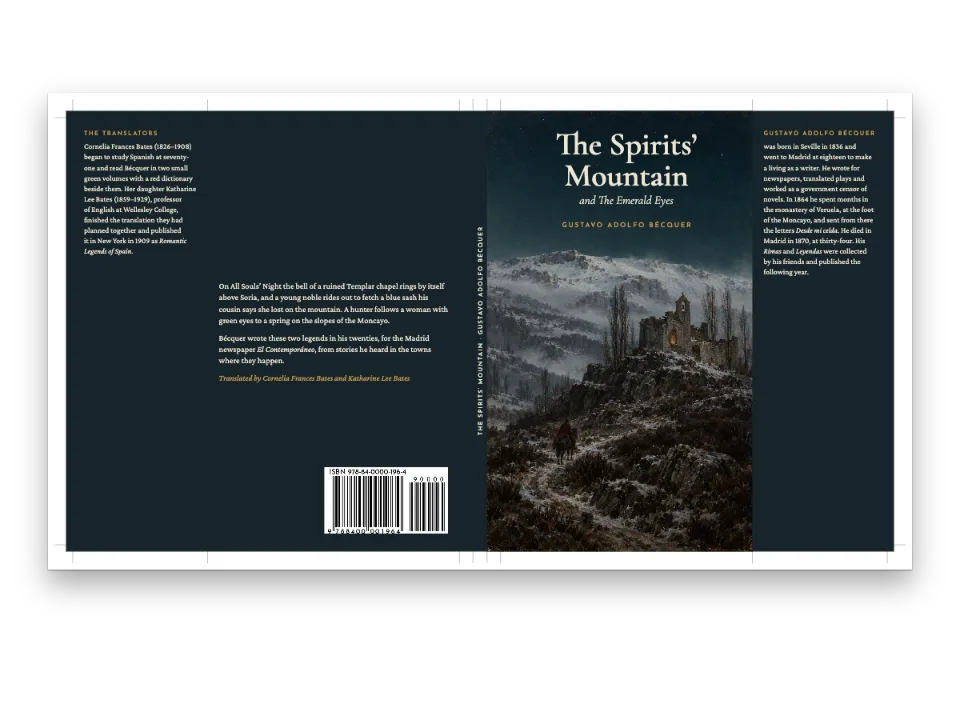
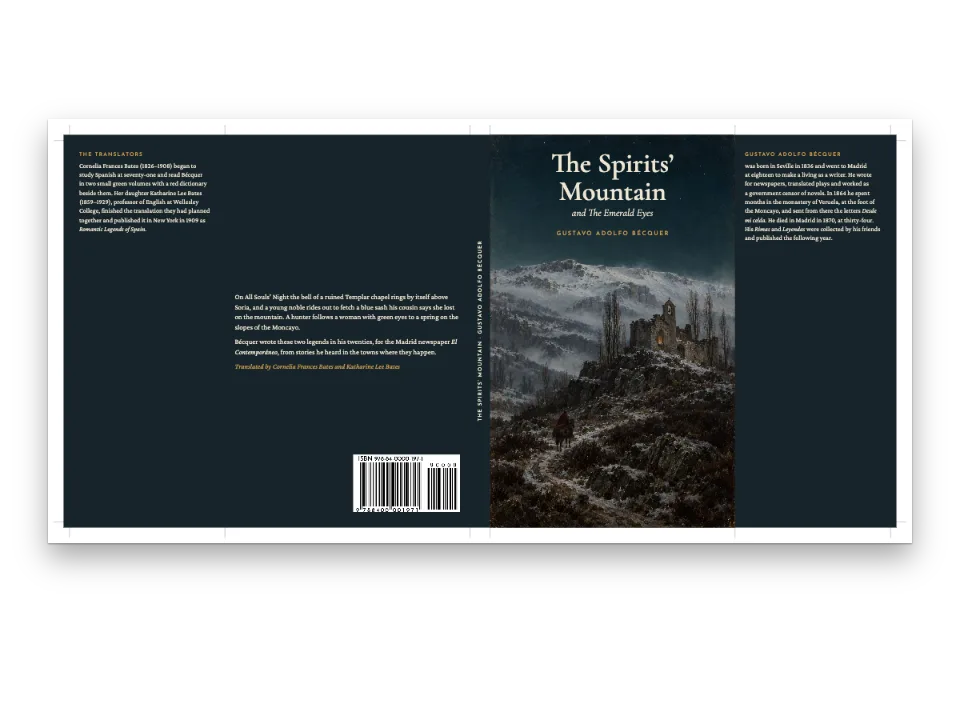
Un libretto con una poesia classica e il foglio della sua copertina. Alcune parti si lavorano dopo la stampa: uno strato lucido sul dipinto, una cornice in oro a caldo e forme in rilievo sul cartoncino.
Che cosa comporrai
Le Coplas di Jorge Manrique per la morte del padre, nella traduzione di Longfellow (l’edizione spagnola compone l’originale), in una brossura di 125 × 200 mm, e il foglio di copertina che va in legatoria per le finiture una volta stampati i quattro colori. Le finiture sono tre. Una vernice lucida selettiva copre il dipinto sopra e sotto il cartiglio. La doppia cornice del cartiglio è stampata a caldo in oro e il riquadro che racchiude è goffrato, così il titolo sta su un campo in rilievo. In quarta, un rombo in goffratura a secco: nessun inchiostro, solo il cartoncino sollevato. Sotto il libro la ricetta disegna il foglio quattro volte: come si stampa, con le lastre di vernice e oro in falsi colori, a luce radente e come la lastra di goffratura da cui l’incisore ricava il cliché. Il PDF è un PDF/X-4 con una lastra per ciascuna finitura.
Questa ricetta risponde a
- Come metto vernice selettiva, lamina e un titolo a rilievo su una copertina, per lo stampatore e il legatore?
La risposta breve
// A slim paperback: PUR perfect binding, the spine from the pages on 120 g/m² wove. The
// spine is under the 6 mm a spine is lettered from by default, so this version letters it
// from 4.5 mm.
const production = {
  bindings: [{ id: 'pur', name: 'PUR perfect binding', style: 'perfect', signature: 16,
    measures: { bleed: 3, spineAllowance: 0.5 } }],
  versions: [{ id: 'paperback', name: t({ en: 'Paperback', es: 'Rústica' }), binding: 'pur',
    isbn: '978-84-0000-199-5', spineText: { minSpine: 4.5 } }],
};
const folio = { paper: { type: 'bookWove', grammage: 120, bulk: 2.2, shade: '#f7f1e3' } };
const cover = {
  background: col('ground'),
  elements: [
    { id: 'art', kind: 'image', zone: 'front', x: 0, y: -3, width: 128, height: 206,
      resourceId: 'river', fit: 'cover' },
    // The title's panel, a shade darker than the ground, and the frame round it. The frame
    // prints nothing in four colours (it has the panel's colour): the foil plate carries it.
    { id: 'panel', kind: 'shape', zone: 'front', x: 14, y: 77, width: CW, height: CH,
      color: col('panel'), path: [{ closed: true, nodes: contour(0, 6) }] },
    { id: 'cartouche', kind: 'shape', zone: 'front', x: 14, y: 77, width: CW, height: CH,
      color: col('panel'), path: cartouche },
  ],
  finishes: [
    // A spot gloss over the painting above and below the panel, 4 mm clear of it, so the
    // varnish never lies on the foil. The back and the spine stay matt.
    ...[[-3, 76], [127, 76]].map(([y, height], i) => ({ id: `gloss-${i + 1}`, process: 'varnish',
      ink: col('varnish'), shape: { box: { zone: 'front', x: 0, y, width: 128, height } } })),
    // Gold foil on the frame, and the whole panel embossed: the title prints on a raised
    // field, the foil stamped round its edge.
    { id: 'gold', process: 'foil', ink: col('foil'), shape: { element: 'cartouche' } },
    { id: 'relief', process: 'emboss', shape: { element: 'panel' } },
    // A blind emboss: no ink and no foil, only the paper raised.
    { id: 'emblem', process: 'emboss', shape: { outline: emblem,
      box: { zone: 'back', x: 52.5, y: 30, width: 20, height: 20 } } },
  ],
  verticalAlign: { front: 'middle', back: 'middle' },
};
// The press file: PDF/X-4. The varnish and the foil are spot inks with a finish, each on
// its plate; the emboss goes on a plate named Emboss, beside the die line.
const print = { standard: 'pdfx4', outputProfile: 'fogra51', convertImages: false };
Ingredienti
- Funzionalità
- Finiture di copertina e lastre tecnicheFoglio di copertinaInchiostri specialiVersioni a stampa, ISBN e dorsoCopertine, frontespizi e colophonStili di titoloAperture progettateTesto, filetti e riquadri nei progetti di paginaMetadati del documentoStili di paragrafoVersi riga per rigaTestatine e folioFigure e tabelle come risorseTavolozza di colori semanticaEsportazione in PDFPDF in CMYK e in scala di grigiPagine su un canvas
- Usa anche
- Carta, rilegatura, scrivania e luce (Folio)Attributi dei titoliColore della cartaTestatine secondo il ruolo della paginaFont incorporati nel PDFTestatine per sezioneTinte piatte e tabella degli inchiostriCapitoli non numerati
- Tipo
- Alegreya, Alegreya SC, Alegreya Sans SC (SIL OFL 1.1)
- Risorse
river-1100.jpg- The cover painting: a river at sunset running to the sea below a ruined castle, in oils (Generated With Diffusion Models, originale)
Preparazione
#1 · Ogni finitura segue una forma del progetto
Il codice è la risposta breve qui sopra. Una finitura nomina un processo, un inchiostro se il processo ne stampa uno, e una forma: un elemento della copertina ({ element: 'cartouche' }), un riquadro in una delle sue zone o un contorno dentro un riquadro. La vernice e l’oro sono tinte piatte con un finish nella tavolozza, quindi ciascuna ha la sua lastra nel PDF e il controllo preliminare le elenca. La goffratura non stampa nulla. Va su una lastra tecnica che il file di stampa chiama Emboss, quella che usa l’incisore, e sulla pagina non viene dipinta.
La vernice è fatta di due riquadri, uno sopra il cartiglio e uno sotto, che si fermano a 4 mm da esso perché la vernice non finisca mai sull’oro. La quarta e il dorso restano opachi. Il libro conta 27 pagine su carta avoriata da 120 g/m² con mano 2,2, 32 una volta legato in segnature da 16, e ne viene un dorso di 4,7 mm. Di norma un dorso sotto i 6 mm non porta scritte, perciò la versione imposta spineText.minSpine a 4,5. L’ISBN è un numero d’esempio, non assegnato a nessun libro.
#2 · Il cartiglio è un tracciato del progetto, non un’immagine
// Fractions of its box, so the frame stretches with it. Two rings, each an outer contour and
// an inner one run the other way round: the hole between them stays empty, and the foil and
// the emboss take exactly this outline.
const [CW, CH] = [97, 46]; // the cartouche's box, mm
const K = 0.5523; // a quarter circle as a cubic
function contour(inset, notch) {
  const [tx, ty, rx, ry] = [inset / CW, inset / CH, (notch + inset) / CW, (notch + inset) / CH];
  // Each corner: the point on the edge before it and on the edge after it, a hollow arc
  // between them whose handles leave each edge square.
  const corners = [
    [[1 - rx, ty], [1 - tx, ry], 'h'], [[1 - tx, 1 - ry], [1 - rx, 1 - ty], 'v'],
    [[rx, 1 - ty], [tx, 1 - ry], 'h'], [[tx, ry], [rx, ty], 'v']];
  return corners.flatMap(([[ax, ay], [bx, by], edge]) => [
    { x: ax, y: ay, out: edge === 'h' ? { x: ax, y: ay + K * (by - ay) }
      : { x: ax + K * (bx - ax), y: ay } },
    { x: bx, y: by, in: edge === 'h' ? { x: bx - K * (bx - ax), y: by }
      : { x: bx, y: by - K * (by - ay) } }]);
}
const reversed = (nodes) => nodes.slice().reverse()
  .map(({ x, y, in: i, out: o }) => ({ x, y, ...(o && { in: o }), ...(i && { out: i }) }));
const ring = (outer, inner, notch) => [{ closed: true, nodes: contour(outer, notch) },
  { closed: true, nodes: reversed(contour(inner, notch)) }];
const cartouche = [...ring(0, 1.3, 6), ...ring(2.3, 2.75, 6)];
// The emblem on the back: a lozenge with a lozenge cut out of it, as a saved outline.
const lozenge = (d) => [[0.5, d], [1 - d, 0.5], [0.5, 1 - d], [d, 0.5]].map(([x, y]) => ({ x, y }));
const emblem = [lozenge(0), lozenge(0.24).reverse()];
L’oro e la goffratura prendono esattamente il contorno dell’elemento che nominano, quindi la cornice deve essere una forma di cui il motore conosce il tracciato. Un tracciato di copertina è un elenco di contorni chiusi con nodi espressi come frazioni del riquadro dell’elemento e maniglie d’entrata e d’uscita per le curve. Ogni angolo è un quarto di cerchio rivolto verso l’interno, disegnato come una cubica. Un anello è un contorno esterno più uno interno percorso al contrario: con la regola nonzero lo spazio tra i due resta vuoto. Due anelli formano la doppia cornice. La cornice ha il colore del riquadro e in quadricromia non stampa nulla: la porta la lastra dell’oro. L’emblema in quarta è un contorno salvato, due rombi, il minore rovesciato.
#3 · Gli stili della copertina
const style = (id, fontFamily, size, lead, color, extra) => ({ id, fontFamily, fontSize: pt(size),
  lineHeight: pt(lead), color, italicColor: color, firstLineIndent: mm(0), textAlign: 'left',
  hyphenation: false, ...extra });
const caps = (tracking) => ({ fontWeight: 700, letterSpacing: pt(tracking) });
const mid = { textAlign: 'center' };
const coverStyles = [
  style('cover-title', 'Alegreya SC', 40, 40, col('cream'), { ...mid, fontWeight: 500 }),
  style('cover-subtitle', 'Alegreya', 13, 17, col('cream'), { ...mid, italic: true }),
  style('cover-author', 'Alegreya Sans SC', 9, 12, col('ochre'), { ...mid, ...caps(1.6),
    marginTop: pt(9) }),
  style('cover-spine', 'Alegreya Sans SC', 7, 8, col('cream'), { ...mid, ...caps(1.1) }),
  style('cover-quote', 'Alegreya', 13, 17, col('ochre'), { ...mid, italic: true,
    marginBottom: pt(16) }),
  style('cover-blurb', 'Alegreya', 10.5, 14.5, col('cream'), { marginBottom: pt(7) }),
  style('cover-note', 'Alegreya Sans SC', 8, 11, col('ochre'), { ...caps(1.2),
    marginTop: pt(4) }),
];
cover-title, cover-subtitle, cover-author e cover-spine sono i nomi che buildCover dà ai metadati che colloca; cover-quote, cover-blurb e cover-note si nominano nel Markdown della copertina. La prima è centrata in altezza (verticalAlign), e così il titolo cade nel cartiglio qualunque sia il suo corpo.
#4 · Il blocco del libro
const [W, H, TOP, FOOT, INNER, OUTER, LEAD] = [125, 200, 22, 24, 19, 17, 15]; // mm, pt
const at = (to, edge, x, y, size) => ({ anchor: { to, edge }, offset: { x: mm(x), y: mm(y) },
  ...(size && { size }) });
const text = (id, content, look, place) => ({ kind: 'text', id, content, align: 'center',
  overflow: 'wrap', placement: place, ...look });
const face = (fontFamily, size, color, x) => ({ fontFamily, fontSize: pt(size), color, ...x });
const label = (size, color = col('muted')) => face('Alegreya Sans SC', size, color, caps(size / 6));
const sc = (size, extra) => face('Alegreya SC', size, col('ink'), { fontWeight: 500, ...extra });
const none = { header: { elements: [] }, footer: { elements: [] }, numbered: false, toc: false };
const design = (minHeight, elements) => ({ enabled: true, minHeight: mm(minHeight),
  slot: { elements } });
const page = (parity) => ({ breakBefore: { enabled: true, parity } });
const rule = (id, y, to = 'page') => ({ kind: 'rule', id, direction: 'horizontal',
  thickness: pt(0.6), color: col('accent'), placement: at(to, 'top', 0, y, { width: mm(12) }) });
const headingStyles = [
  { ...none, id: 'half-title', advancedDesign: design(60, [
    text('t', '{title}', sc(18), at('page', 'top', 0, 64))]) },
  { ...none, ...page('odd'), id: 'title-page', advancedDesign: design(H - TOP - FOOT, [
    text('t', '{title}', sc(34), at('page', 'top', 0, 50)),
    text('s', '{subtitle}', face('Alegreya', 13, col('ink'), { italic: true }),
      at('page', 'top', 0, 66)),
    rule('r', 76),
    text('a', '{author}', label(8.5, col('accent')), at('page', 'top', 0, 81)),
    text('c', '{attr.credit}', face('Alegreya', 9.5, col('muted'), { italic: true }),
      at('page', 'top', 0, 120, { width: mm(76) })),
    text('i', '{attr.imprint}', label(7.5), at('page', 'bottom', 0, -28)),
  ]) },
  { ...none, ...page('even'), id: 'rights',
    advancedDesign: design(92, [rule('r', 86, 'container')]) },
  // The poem opens on a recto, sunk 46 mm, its title in small capitals over a short rule.
  { ...page('odd'), id: 'poem', toc: false, header: { elements: [] }, advancedDesign: design(46, [
    text('t', '{titleText}', sc(19), at('container', 'top', 0, 18)),
    text('n', '{attr.note}', face('Alegreya', 10.5, col('muted'), { italic: true }),
      at('container', 'top', 0, 28, { width: mm(80) })),
    rule('r', 38, 'container')]) },
  { ...none, ...page('odd'), id: 'colophon', advancedDesign: design(64, [
    rule('r', 56, 'container')]) },
];
const head = (id, content, parity) => text(id, content, { ...label(6.8), parity, pages: 'body' },
  at('page', 'top', 0, 11));
Occhiello, frontespizio, pagina dei crediti, poi la poesia da una pagina dispari, 46 mm più in basso, composta in versi senza dividere una strofa tra due pagine. Le testatine portano l’autore sulla pari e il titolo sulla dispari. Il colophon chiude il libro sull’ultima dispari.
#5 · Il foglio nasce dalle pagine composte
const built = buildCover({ config, version: 'paperback', pages: book.pages, markdown: coverText,
  metadata: book.metadata, resources });
if (!('config' in built)) throw new Error(built.issues.map((i) => i.kind).join(', '));
// The barcode's digits name OCR-B, which no font server has: the label face sets them.
for (const [id, bytes] of Object.entries(built.files)) {
  await loadSvg(id, new TextDecoder().decode(bytes)
    .replace(/font-family="[^"]*"/g, 'font-family="Alegreya Sans SC"'));
}
const sheet = await buildDocumentWithFonts(built.content, built.config, kitFonts(FONTS));
buildCover riceve le pagine, i metadati e il Markdown della copertina e restituisce un documento per buildDocumentWithFonts, più il codice a barre in SVG. Le sue cifre chiedono l’OCR-B, che nessun server di font offre, quindi la ricetta le compone in Alegreya Sans SC, già caricata.
#6 · Che cosa copre ogni lastra
// 'flat' paints the inks: the foil in its colour, the varnish and the emboss not at all.
// 'map' marks the special plates in false colour over a faded sheet, 'sheen' rakes a light
// across it. The emboss plate is drawn from the page's technical plates, the outlines the
// PDF fills on its Emboss separation.
const leaf = sheet.pages[0];
const scale = 1100 / leaf.width;
const outline = (ctx, paths) => {
  ctx.beginPath();
  for (const c of paths.flat()) {
    if (c.op === 'M') ctx.moveTo(c.x, c.y);
    else if (c.op === 'L') ctx.lineTo(c.x, c.y);
    else if (c.op === 'C') ctx.bezierCurveTo(c.x1, c.y1, c.x2, c.y2, c.x, c.y);
    else if (c.op === 'Q') ctx.quadraticCurveTo(c.x1, c.y1, c.x, c.y);
    else ctx.closePath();
  }
  ctx.fill('nonzero');
};
const VIEWS = [
  ['flat', t({ en: 'As it prints', es: 'Como se imprime' })],
  ['map', t({ en: 'The varnish and foil plates', es: 'Las planchas de barniz y oro' })],
  ['sheen', t({ en: 'Under a raking light', es: 'Con luz rasante' })],
  ['emboss', t({ en: 'The Emboss plate', es: 'La plancha de gofrado' })],
];
const views = document.createElement('section');
views.id = 'finish-views';
views.style.cssText = 'display: grid; grid-template-columns: repeat(2, minmax(0, 560px)); '
  + 'gap: 18px; justify-content: center; padding: 24px max(16px, calc(50% - 520px)); color: #ddd; '
  + 'font: 14px sans-serif';
for (const [mode, name] of VIEWS) {
  const [figure, canvas, caption] = ['figure', 'canvas', 'figcaption']
    .map((tag) => document.createElement(tag));
  figure.style.margin = '0';
  canvas.style.cssText = 'display: block; width: 100%';
  canvas.setAttribute('role', 'img');
  canvas.setAttribute('aria-label', `${t({ en: 'The cover sheet', es: 'El pliego' })}: ${name}`);
  renderPageToCanvas(leaf, sheet, canvas, { scale, finishes: mode === 'emboss' ? 'flat' : mode });
  if (mode === 'emboss') {
    // The die-maker's film: the plate in black on white, the sheet faded under it.
    const ctx = canvas.getContext('2d');
    ctx.setTransform(1, 0, 0, 1, 0, 0);
    ctx.fillStyle = 'rgba(255, 255, 255, 0.86)';
    ctx.fillRect(0, 0, canvas.width, canvas.height);
    ctx.setTransform(scale, 0, 0, scale, 0, 0);
    ctx.fillStyle = '#111';
    outline(ctx, (leaf.plates ?? []).flatMap((p) => p.paths));
  }
  caption.textContent = name;
  figure.append(canvas, caption);
  views.append(figure);
}
// What the preflight reads from the sheet: its spot plates and the reliefs it checks.
const spots = preflightDocument(sheet).find((i) => i.kind === 'spotInks');
const list = document.createElement('p');
list.style.cssText = 'grid-column: 1 / -1; margin: 0; text-align: center';
list.textContent = `${t({ en: 'Plates beside CMYK', es: 'Planchas además de CMYK' })}: `
  + [...(spots?.inks ?? []), ...new Set((leaf.plates ?? [])
    .map((p) => `${p.process[0].toUpperCase()}${p.process.slice(1)}`))].join(' · ');
views.append(list);
document.getElementById('pages').before(views);
renderPageToCanvas dipinge le finiture in tre modi. flat dipinge gli inchiostri come li stende la macchina: l’oro nel suo colore, la vernice per niente. map sbiadisce il foglio e segna ogni lastra speciale in falso colore. sheen fa passare una luce radente sul foglio, e la vernice e l’oro la riflettono. La goffratura non compare in nessuna delle tre, perché non stampa; la quarta vista disegna in nero sul foglio sbiadito le lastre tecniche della pagina (page.plates), i contorni che il PDF riempie nella sua separazione Emboss. La riga sotto legge le tinte piatte da preflightDocument e i processi dalle lastre.
La ricetta completa
// ═══ Postext Cookbook · Nº 199 · A cover in foil, spot varnish and emboss ═══════════════
// https://postext.dev/en/cookbook/cover-foil-varnish-emboss
// Code: MIT · Text: Manrique, tr. H. W. Longfellow (public domain) · Art: diffusion models
// Fonts: Alegreya, Alegreya SC, Alegreya Sans SC (SIL OFL 1.1) · Needs postext ≥ 1.92.0
//
// Manrique's Coplas as a slim paperback whose cover goes to the finisher after the press: a
// spot gloss over the painting, a gold-foil cartouche stamped over an emboss of the same
// shape, and a blind emboss on the back. Each finish is a shape of the cover's design; the
// varnish and the foil get spot plates of their own, the emboss a plate that prints nothing.
import { buildDocumentWithFonts, renderPageToCanvas, registerResourceImage, inlineSvgFonts,
  preflightDocument } from 'https://esm.sh/postext';
import { buildCover } from 'https://esm.sh/postext/production';
import { renderToPdf, decompressWoff2 } from 'https://esm.sh/postext-pdf';

const LANG = 'en'; // @lang: the language of the sample document ('en' | 'es')
const RECIPE = 'cover-foil-varnish-emboss';

// ─── 1 · Design ─────────────────────────────────────────────────────────────
// The pages' four colours, then the cover's: a bottle-green ground and its darker panel.
const palette = { ink: '#262320', accent: '#8a3b2a', muted: '#6d655b', paper: '#fbf7ef',
  ground: '#1d2b27', panel: '#15201d', cream: '#efe5cf', ochre: '#c8a15a' };
// The two inks the finisher is asked for: spot colours that each make a plate of their own.
const spot = (hex, name, cmyk, kind) => ({ hex, model: 'spot',
  spot: { name, cmyk, finish: { kind, sheen: 'gloss' } } });
const inks = { foil: spot('#b8963e', 'Gold foil', { c: 0, m: 20, y: 60, k: 25 }, 'foil'),
  varnish: spot('#eef0e6', 'Gloss varnish', { c: 0, m: 0, y: 0, k: 0 }, 'varnish') };
const col = (id) => (inks[id] ? { ...inks[id], paletteId: id }
  : { hex: palette[id], model: 'hex', paletteId: id });
const colorPalette = [
  ...Object.entries(palette).map(([id, hex]) => ({ id, name: id, value: { hex, model: 'hex' } })),
  ...Object.entries(inks).map(([id, value]) => ({ id, name: value.spot.name, value })),
  { id: 'main-color', name: 'accent (defaults)', value: { hex: palette.accent, model: 'hex' } },
];

// #region art: the cartouche, a frame with hollow corners, drawn as a shape of the design
// Fractions of its box, so the frame stretches with it. Two rings, each an outer contour and
// an inner one run the other way round: the hole between them stays empty, and the foil and
// the emboss take exactly this outline.
const [CW, CH] = [97, 46]; // the cartouche's box, mm
const K = 0.5523; // a quarter circle as a cubic
function contour(inset, notch) {
  const [tx, ty, rx, ry] = [inset / CW, inset / CH, (notch + inset) / CW, (notch + inset) / CH];
  // Each corner: the point on the edge before it and on the edge after it, a hollow arc
  // between them whose handles leave each edge square.
  const corners = [
    [[1 - rx, ty], [1 - tx, ry], 'h'], [[1 - tx, 1 - ry], [1 - rx, 1 - ty], 'v'],
    [[rx, 1 - ty], [tx, 1 - ry], 'h'], [[tx, ry], [rx, ty], 'v']];
  return corners.flatMap(([[ax, ay], [bx, by], edge]) => [
Lo script.js composto funziona così com’è: incollalo nello script modulo di qualsiasi pagina, oppure apri la ricetta su CodePen. Cartella della ricetta su GitHub ↗ (si apre in una nuova scheda)
Varianti
#Goffrare l’emblema in incavo
L’incavo spinge la forma dentro il cartoncino invece di sollevarla, e va su una lastra Deboss a parte.
-    { id: 'emblem', process: 'emboss', shape: { outline: emblem,
+ { id: 'emblem', process: 'deboss', shape: { outline: emblem,#Verniciare tutto il dipinto
Una sola finitura sull’elemento del dipinto sostituisce i due riquadri. La vernice allora passa anche sul cartiglio e sul titolo.
-    ...[[-3, 76], [127, 76]].map(([y, height], i) => ({ id: `gloss-${i + 1}`, process: 'varnish',
-      ink: col('varnish'), shape: { box: { zone: 'front', x: 0, y, width: 128, height } } })),
+ { id: 'gloss', process: 'varnish', ink: col('varnish'), shape: { element: 'art' } },Errori frequenti
- Una goffratura o un incavo a meno di 3 mm dal taglio o da una piega viene segnalato dal controllo preliminare (
reliefTrim,reliefFold): lì il cartoncino si crepa. Tieni i rilievi lontani dalle pieghe del dorso. - La goffratura non si dipinge mai sullo schermo. Controllala nella separazione Emboss del PDF, oppure disegna
page.platescome fa la ricetta. - Una finitura posata su una cornice di testo ne copre le righe, nelle viste come nel file di stampa. Lascia parte del testo fuori dall’oro, come qui il titolo, nel vuoto del cartiglio.
Crediti
- Ricetta
- Ignacio Ferro
- Testo
- Coplas de Manrique, translated by Henry Wadsworth Longfellow (1833), from The Complete Poetical Works of Henry Wadsworth Longfellow (Household Edition, 1902), Project Gutenberg eBook #1365 · Jorge Manrique · pubblico dominio
- Coplas por la muerte de su padre, from the first critical edition by R. Foulché-Delbosc (1902), Project Gutenberg eBook #49333, spelling and punctuation modernised · Jorge Manrique · pubblico dominio
- Immagini
- The cover painting: a river at sunset running to the sea below a ruined castle, in oils · Generated With Diffusion Models · originale
- Font
- Alegreya (SIL OFL 1.1) · Alegreya SC (SIL OFL 1.1) · Alegreya Sans SC (SIL OFL 1.1)
- Codice
- MIT, come Postext
Modifica questo testo ↗ (si apre in una nuova scheda)Cartella della ricetta su GitHub ↗ (si apre in una nuova scheda)