In breve
Un breve articolo di ricerca di una rivista cinese. L’autore scrive un codice per ogni fonte; Postext numera le fonti nell’ordine in cui sono citate e stampa la bibliografia come la vogliono le riviste cinesi.
Che cosa comporrai
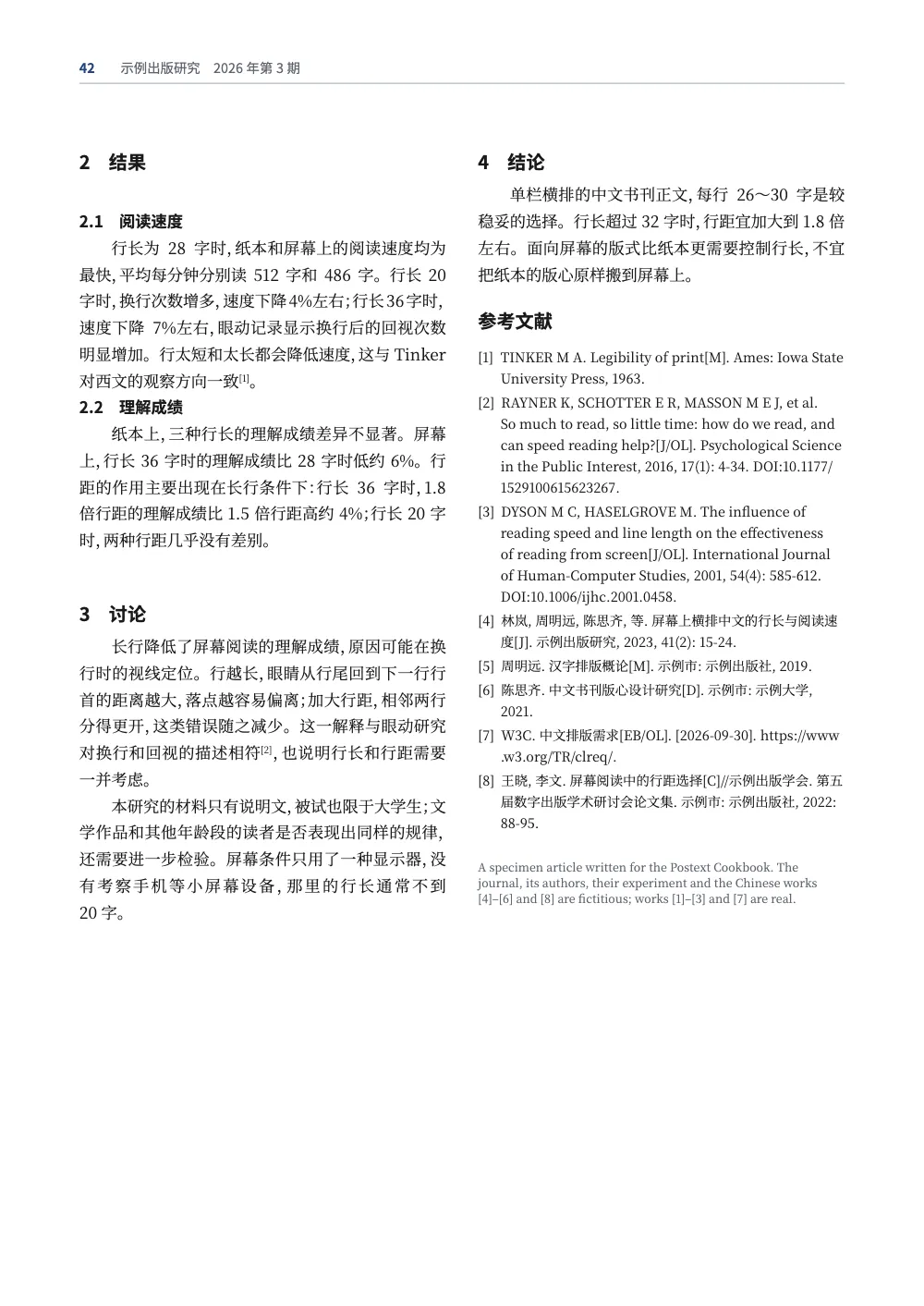
Due pagine di un articolo di ricerca in una rivista inventata di studi editoriali, 示例出版研究 («Example Publishing Research»), composte come una rivista universitaria cinese compone i suoi articoli. La pagina è un 16开, 184 × 260 mm, con due colonne di 23 caratteri in 小五 su una griglia di 15 pt. Un blocco del titolo attraversa la pagina: il nome della rivista su una fascia indaco, il titolo in Hei grassetto, gli autori, le loro affiliazioni e un abstract con le parole chiave. Le citazioni seguono GB/T 7714—2015, la norma nazionale per i riferimenti bibliografici, nel suo sistema numerico (顺序编码制): ogni opera prende un numero nell’ordine in cui è citata per la prima volta, il numero si stampa in apice tra parentesi quadre, e tre o più numeri consecutivi diventano un intervallo. La bibliografia dà a ogni voce il suo codice di tipo di documento e scrive 等 dopo tre autori di un’opera cinese ed «et al.» dopo quelli di un’opera occidentale. Un capitolo di tesi citato in APA 7 usa lo stesso markup delle citazioni in uno stile autore-data.
Questa ricetta risponde a
- Come cito secondo lo standard cinese GB/T 7714, anche nel testo verticale?
- Come cito le opere e costruisco la bibliografia in APA, IEEE o un altro stile citazionale?
La risposta breve
// Register the engine once, before the first build. The GB/T 7714 numeric style writes
// superscript [n] in the order works are first cited, joins three or more in a row into a
// range and sets the list with its type codes: [M] book, [J] article, [D] thesis, [C]
// conference paper, [EB/OL] web page. Its CSL file holds a second layout for works whose
// language is English, with "et al." for 等: a Western entry takes "et al." and a Chinese
// one keeps 等, each chosen by the entry's `language`.
registerCitationEngine(createCiteprocEngine({ styles: STYLES, locales: LOCALES }));
const citations = {
  style: 'china-national-standard-gb-t-7714-2015-numeric',
  locale: 'zh-CN', // 等, 卷, 版 and the other terms of the list
  bibliography: { fontSize: em(7.5 / BODY), lineHeight: pt(12), entrySpacing: pt(1.5),
    labelWidth: em(1.7) }, // turnovers under the text, not past it: [1] and a space
};
Ingredienti
- Funzionalità
- Citazioni in uno stile citazionaleBibliografia dai riferimentiGriglia dei caratteriFont cinesi, giapponesi e coreaniLarghezze della punteggiatura cineseUna o due colonneAperture progettateAncoraggio degli elementi del progettoTitoli numeratiStili di titoloCapitoli non numeratiRiquadriChip in lineaTestatine e folioTavolozza di colori semanticaEsportazione in PDF
- Usa anche
- Divisione in righe del cineseBilanciamento delle colonneAttributi dei titoliTestatine secondo il ruolo della paginaStili di paragrafoFont incorporati nel PDFPagine preliminari in numeri romaniA capo nei titoli
- Tipo
- Noto Serif SC, Noto Sans SC, LXGW WenKai TC (SIL OFL 1.1)
- Risorse
- Nessuna: ogni immagine è disegnata nel codice
Preparazione
#1 · Lo stile, e la sua disposizione per le opere occidentali
Il codice è nella risposta breve qui sopra. Il motore delle citazioni si registra una volta, prima della prima composizione, e postext-citeproc include i tre stili GB/T 7714: numerico, autore-data e note (Citazioni). Nel testo una citazione è una chiave tra parentesi quadre. [@tinker1963] stampa un [1] in apice, e [@rayner2016; @dyson2001; @lin2023] stampa [2–4]. Due numeri di fila restano un elenco, [5,6]. Un’opera citata di nuovo conserva il suo primo numero: [4] nel terzo paragrafo, e [1] e [2] più avanti nell’articolo.
La norma chiede «et al.» dopo i primi tre autori di un’opera occidentale e 等 dopo quelli di un’opera cinese. Il file CSL incluso contiene per questo due disposizioni, una per le opere in inglese, e ogni voce prende la sua dal proprio campo language: Rayner e quattro coautori diventano «RAYNER K, SCHOTTER E R, MASSON M E J, et al.», e 林岚 e tre coautori diventano «林岚, 周明远, 陈思齐, 等». locale: 'zh-CN' scrive in cinese le altre parole dell’elenco.
#2 · I riferimenti in un blocco CSL-YAML
Le opere sono elencate in un blocco :::references{format=csl-yaml} alla fine del Markdown, nel formato che Zotero esporta come CSL YAML (Riferimenti). Il tipo CSL decide il codice: book stampa [M], article-journal [J], thesis [D], paper-conference [C] dopo il suo // e gli atti, e webpage [EB/OL] con la data di consultazione tra parentesi quadre. Un articolo di rivista con un DOI diventa [J/OL] e conserva il DOI, come chiede la norma. I nomi cinesi vanno in literal, così lo stile non li divide in cognome e nome. :::bibliography{title=""} mette l’elenco sotto il titolo non numerato 参考文献, e labelWidth allinea le righe successive sotto il testo della voce, non oltre.
#3 · Il blocco del titolo su una fascia
const BAND = 30; // mm from the trim's top
const at = (id, edge, y) => ({ anchor: { to: id ? `#${id}` : 'container', edge },
  offset: { y: mm(y) }, size: { width: mm(AREA) } });
const line = (id, content, family, size, color, placement, extra) => ({ kind: 'text', id,
  content, fontFamily: family, fontSize: pt(size), color: col(color), align: 'center',
  overflow: 'wrap', placement, ...extra });
const onBand = (x, y) => ({ anchor: { to: 'page', edge: 'top-left' },
  offset: { x: mm(x), y: mm(y) }, size: { width: mm(AREA) } });
const masthead = { enabled: true, minHeight: pt(9 * LEAD), slot: { elements: [
  { kind: 'box', id: 'band', style: { backgroundColor: col('indigo') },
    placement: { anchor: { to: 'page', edge: 'top-left' },
      size: { width: 'fill', height: mm(BAND) } } },
  line('journal', '示例出版研究', HEI, 15, 'paper', onBand(15.8, 13),
    { fontWeight: 700, align: 'left', letterSpacing: pt(3) }),
  line('issue', '第44卷 第3期 2026年9月', HEI, 8, 'mist', onBand(15.8, 16),
    { align: 'right' }),
  line('title', '{titleText}', HEI, 17, 'ink', at('', 'top-left', 14),
    { fontWeight: 700, lineHeight: 1.45 }),
  line('authors', '{attr.authors}', KAI, 12, 'ink', at('title', 'below', 4)),
  line('affiliations', '{attr.affiliations}', SONG, 7.5, 'muted', at('authors', 'below', 2)),
] } };
Il blocco del titolo è il progetto grafico dell’H1, uno stile di titolo che occupa entrambe le colonne. La fascia è un riquadro ancorato al rifilo, e il nome della rivista ci sta sopra in bianco. Il titolo, gli autori e le affiliazioni vengono dal titolo e dai suoi attributi, ciascuno posto sotto il precedente (#title, below), così un titolo su tre righe spinge in basso il resto (Progetto grafico a tutta larghezza e avanzato).
#4 · L’abstract e le sue etichette
// In 宋, not 楷: the one Kai on Fontsource is a Taiwan face (gotcha: cjk-face-region).
const calloutStyles = [{ id: 'abstract', span: 'page', backgroundEnabled: false,
  padding: { top: pt(0), bottom: pt(0), left: em(2), right: em(2) },
  marginTop: pt(0), marginBottom: pt(LEAD),
  body: { fontFamily: SONG, fontSize: pt(BODY), lineHeight: pt(LEAD), firstLineIndent: pt(0),
    textAlign: 'justify' } }];
const chipStyles = [{ id: 'label', fontFamily: HEI, bold: true, color: col('indigo'),
  backgroundEnabled: false, borderWidth: pt(0), paddingX: em(0), gap: em(0.5) }];
L’abstract è un riquadro a tutta larghezza, rientrato di due caratteri per lato. Le sue etichette sono chip: :chip[摘 要:]{style="label"} compone la parola in Hei grassetto, nell’indaco della rivista, senza riquadro (Stili dei chip). Le riviste cinesi compongono spesso l’abstract in 楷体; questa resta in Song, per il motivo spiegato negli errori frequenti.
const palette = {
  ink: '#1a1a1a', indigo: '#24427a', mist: '#b8c6e0', rule: '#9aa3b5', muted: '#5f6470',
  paper: '#ffffff',
};
const col = (id) => ({ hex: palette[id], model: 'hex', paletteId: id });
const colorPalette = Object.entries({ ...palette, 'main-color': palette.indigo })
  .map(([id, hex]) => ({ id, name: id, value: { hex, model: 'hex' } }));
La ricetta completa
// ═══ Postext Cookbook · Nº 090 · A Chinese paper cited to GB/T 7714 ═════════════════ // https://postext.dev/en/cookbook/gbt7714-chinese-paper // Code: MIT · Text: original (CC BY 4.0) · Pictures: none // Fonts: Noto Serif SC, Noto Sans SC, LXGW WenKai TC (SIL OFL 1.1) · Needs postext ≥ 1.25.0 import { buildDocument, withLoadedFonts, renderPageToCanvas, registerCitationEngine, } from 'https://esm.sh/postext'; import { renderToPdf, decompressWoff2 } from 'https://esm.sh/postext-pdf'; import { createCiteprocEngine, STYLES, LOCALES } from 'https://esm.sh/postext-citeproc'; const LANG = 'en'; // @lang: the language of the frame; the paper is Chinese in both editions const RECIPE = 'gbt7714-chinese-paper'; // ─── 1 · Design ───────────────────────────────────────────────────────────── // #region palette: black text, one indigo for the journal's name, its rules and its labels const palette = { ink: '#1a1a1a', indigo: '#24427a', mist: '#b8c6e0', rule: '#9aa3b5', muted: '#5f6470', paper: '#ffffff', }; const col = (id) => ({ hex: palette[id], model: 'hex', paletteId: id }); const colorPalette = Object.entries({ ...palette, 'main-color': palette.indigo }) .map(([id, hex]) => ({ id, name: id, value: { hex, model: 'hex' } })); // #endregion const [SONG, HEI, KAI] = ['Noto Serif SC', 'Noto Sans SC', 'LXGW WenKai TC']; // 宋, 黑, 楷 const [BODY, LEAD] = [9, 15]; // pt: 小五 on a 15 pt line, the grid both columns share const [CHARS, LINES] = [23, 40]; // characters to a column's line, lines to a column const PT = 25.4 / 72; // mm in a point const AREA = (2 * CHARS + 2) * BODY * PT; // mm: two columns and a 2-em gutter, 152.4 // #region answer: GB/T 7714 numbered: [1] in citation order, [2–4], 等 or et al. by language // Register the engine once, before the first build. The GB/T 7714 numeric style writes // superscript [n] in the order works are first cited, joins three or more in a row into a // range and sets the list with its type codes: [M] book, [J] article, [D] thesis, [C] // conference paper, [EB/OL] web page. Its CSL file holds a second layout for works whose // language is English, with "et al." for 等: a Western entry takes "et al." and a Chinese // one keeps 等, each chosen by the entry's `language`. registerCitationEngine(createCiteprocEngine({ styles: STYLES, locales: LOCALES })); const citations = { style: 'china-national-standard-gb-t-7714-2015-numeric', locale: 'zh-CN', // 等, 卷, 版 and the other terms of the list bibliography: { fontSize: em(7.5 / BODY), lineHeight: pt(12), entrySpacing: pt(1.5), labelWidth: em(1.7) }, // turnovers under the text, not past it: [1] and a space }; // #endregion // #region masthead: the journal's name on an indigo band, then title, authors, affiliations const BAND = 30; // mm from the trim's top const at = (id, edge, y) => ({ anchor: { to: id ? `#${id}` : 'container', edge }, offset: { y: mm(y) }, size: { width: mm(AREA) } }); const line = (id, content, family, size, color, placement, extra) => ({ kind: 'text', id, content, fontFamily: family, fontSize: pt(size), color: col(color), align: 'center', overflow: 'wrap', placement, ...extra }); const onBand = (x, y) => ({ anchor: { to: 'page', edge: 'top-left' }, offset: { x: mm(x), y: mm(y) }, size: { width: mm(AREA) } }); const masthead = { enabled: true, minHeight: pt(9 * LEAD), slot: { elements: [ { kind: 'box', id: 'band', style: { backgroundColor: col('indigo') }, placement: { anchor: { to: 'page', edge: 'top-left' }, size: { width: 'fill', height: mm(BAND) } } }, line('journal', '示例出版研究', HEI, 15, 'paper', onBand(15.8, 13), { fontWeight: 700, align: 'left', letterSpacing: pt(3) }), line('issue', '第44卷 第3期 2026年9月', HEI, 8, 'mist', onBand(15.8, 16), { align: 'right' }), line('title', '{titleText}', HEI, 17, 'ink', at('', 'top-left', 14), { fontWeight: 700, lineHeight: 1.45 }), line('authors', '{attr.authors}', KAI, 12, 'ink', at('title', 'below', 4)), line('affiliations', '{attr.affiliations}', SONG, 7.5, 'muted', at('authors', 'below', 2)), ] } }; // #endregion // #region abstract: across both columns, its labels in 黑 the colour of the journal // In 宋, not 楷: the one Kai on Fontsource is a Taiwan face (gotcha: cjk-face-region). const calloutStyles = [{ id: 'abstract', span: 'page', backgroundEnabled: false, padding: { top: pt(0), bottom: pt(0), left: em(2), right: em(2) }, marginTop: pt(0), marginBottom: pt(LEAD), body: { fontFamily: SONG, fontSize: pt(BODY), lineHeight: pt(LEAD), firstLineIndent: pt(0), textAlign: 'justify' } }]; const chipStyles = [{ id: 'label', fontFamily: HEI, bold: true, color: col('indigo'), backgroundEnabled: false, borderWidth: pt(0), paddingX: em(0), gap: em(0.5) }]; // #endregion // Running heads on the body pages, the folio at the outer corner, over a hairline. const head = (id, content, parity, edge, x, extra) => ({ kind: 'text', id, content, parity, pages: 'body', fontFamily: HEI, fontSize: pt(7.5), color: col('muted'), overflow: 'clip', align: edge, placement: { anchor: { to: 'page', edge: `top-${edge}` }, offset: { x: mm(x), y: mm(12) } }, ...extra }); const folio = { fontWeight: 700, color: col('indigo') }; const header = { elements: [ head('v-folio', '{pageNumber}', 'even', 'left', 15.8, folio), head('v-head', '示例出版研究 2026年第3期', 'even', 'left', 24), head('r-head', '赵一鸣,等:横排中文正文的行长与行距', 'odd', 'right', -24), head('r-folio', '{pageNumber}', 'odd', 'right', -15.8, folio), { kind: 'rule', id: 'head-rule', pages: 'body', thickness: pt(0.5), color: col('rule'), placement: { anchor: { to: 'page', edge: 'top-left' }, offset: { x: mm(15.8), y: mm(16.5) }, size: { width: mm(AREA) } } }, ] }; const config = () => ({ locale: 'zh-Hans', // written out, never LANG (gotcha: cjk-locale-tag) colorPalette, citations, page: { width: mm(184), height: mm(260), dpi: 150, pageNumbering: { startAt: 41 }, // 16开; with the grid on the margins are minimums, grown to centre the 23 × 40 area margins: { top: mm(22), bottom: mm(20), left: mm(15), right: mm(15), mirror: true } }, layout: { layoutType: 'double', gutterWidth: pt(2 * BODY) }, cjk: { grid: { enabled: true, charsPerLine: CHARS, linesPerPage: LINES } }, bodyText: { fontFamily: SONG, fontSize: pt(BODY), lineHeight: pt(LEAD), color: col('ink'), boldColor: col('ink'), italicColor: col('ink'), referenceColor: col('ink'), textAlign: 'justify', firstLineIndent: em(2), indentAfterHeading: true, }, headings: { fontFamily: HEI, fontWeight: 700, color: col('ink'), // Off by default on a character grid. On, a short column takes whole grid lines above // its heads, and the two columns of the last page end level. balancing: { enabled: true }, levels: [ { level: 1, breakBefore: { enabled: true, parity: 'any' } }, // the next page, either side { level: 2, numberingTemplate: '{2}', numberSeparator: ' ', fontSize: pt(10.5), lineHeight: pt(2 * LEAD), marginTop: pt(0), marginBottom: pt(0) }, // 1 实验方法 { level: 3, numberingTemplate: '{2}.{3}', numberSeparator: ' ', fontSize: pt(BODY), lineHeight: pt(LEAD), marginTop: pt(0), marginBottom: pt(0) }, // 1.1 被试 ] }, headingStyles: [ { id: 'article', numbered: false, span: 'page', advancedDesign: masthead }, { id: 'intro', numbered: false }, // 引言 goes before section 1, unnumbered { id: 'references', numbered: false }, ], calloutStyles, chipStyles, paragraphStyles: [{ id: 'colophon', fontFamily: SONG, fontSize: pt(6.5), lineHeight: pt(9), color: col('muted'), firstLineIndent: pt(0), textAlign: 'left', marginTop: pt(LEAD) }], header, footer: { elements: [] }, }); // ─── 2 · Content ──────────────────────────────────────────────────────────── const markdown = String.raw`---Esempio Markdown · 140 righe · content.en.md
title: "横排中文正文的行长与行距" --- # 横排中文正文的行长与行距:\\一项纸本与屏幕的对照阅读实验 {style="article" authors="赵一鸣¹ 孙雨桐²" affiliations="1. 示例大学新闻与传播学院,示例市 100000;2. 示例出版社排版中心,示例市 100000"} :::callout{type="abstract"} :chip[摘 要:]{style="label"}行长和行距是横排中文正文最基本的两个版式参数,现行出版物大多凭经验确定。本文以48名大学生为被试,比较每行20、28、36字三种行长与1.5倍、1.8倍两种行距在纸本和屏幕上的阅读速度与理解成绩。结果表明:行长为28字时阅读速度最快;行长增至36字,纸本上的理解成绩无显著变化,屏幕上则下降约6%;1.8倍行距的优势在长行条件下比在短行条件下明显。据此建议单栏横排书刊正文以每行26~30字为宜,行长超过32字时应相应加大行距。 :chip[关键词:]{style="label"}行长;行距;中文排版;阅读速度;屏幕阅读 :chip[文献标志码:]{style="label"}A :chip[文章编号:]{style="label"}1000-0000(2026)03-0041-04 ::: ## 引言 {style="intro"} 行长与行距对阅读的影响,西文排版界讨论已久。Tinker在20世纪中叶以印刷品为材料做了大量易读性实验,认为最适宜的行长取决于字号和行距,不能脱离二者单独规定[@tinker1963]。近二十年来,眼动记录和屏幕阅读进入这一领域,研究者发现阅读速度与理解成绩并不总是同步变化,只用速度评价版式容易得出片面的结论[@rayner2016; @dyson2001; @lin2023]。 中文的情况与西文不同。汉字等宽,行长可以直接用字数计量,出版社也习惯以“每行字数×每页行数”规定版心,32开图书的正文多为每行26~28字[@zhou2019; @chen2021]。W3C的《中文排版需求》整理了中文版面的基本要素和术语[@clreq],但行长、行距取什么值,仍由各出版社自行决定。 这些数值大多来自排版经验,以汉字为材料、同时比较纸本与屏幕的实证研究还很少。林岚等[@lin2023]测量了屏幕上三种行长的阅读速度,没有考察行距;王晓和李文[@wang2022]讨论了屏幕阅读中的行距,只用了一种行长。本研究把行长和行距放在同一个实验中,在纸本和屏幕上分别测量阅读速度和理解成绩,为书刊正文的版式设计提供依据。 ## 实验方法 ### 被试 示例大学本科生48名,其中男生21名、女生27名,年龄18~23岁,母语均为汉语,视力或矫正视力正常,此前均未参加过阅读实验。 ### 材料与版式 从近年出版的科普读物中选取说明文24篇,每篇约600字,难度经预实验平衡。版式按3(行长:每行20、28、36字)×2(行距:1.5倍、1.8倍)设计,字号统一为五号(10.5 pt),字体为宋体,两端对齐。纸本材料用A4纸单面印刷;屏幕材料在27英寸显示器上呈现,调整显示比例,使字的视角大小与纸本一致。 ### 程序与测量 每名被试在纸本和屏幕上各读12篇,媒介的先后顺序在被试间平衡,版式条件在篇目间轮换。每读完一篇,回答5道理解题。阅读速度以每分钟字数计,理解成绩以答对题数的百分比计。屏幕条件下同时记录眼动,采样率为1000 Hz。 ## 结果 ### 阅读速度 行长为28字时,纸本和屏幕上的阅读速度均为最快,平均每分钟分别读512字和486字。行长20字时,换行次数增多,速度下降4%左右;行长36字时,速度下降7%左右,眼动记录显示换行后的回视次数明显增加。行太短和太长都会降低速度,这与Tinker对西文的观察方向一致[@tinker1963]。 ### 理解成绩 纸本上,三种行长的理解成绩差异不显著。屏幕上,行长36字时的理解成绩比28字时低约6%。行距的作用主要出现在长行条件下:行长36字时,1.8倍行距的理解成绩比1.5倍行距高约4%;行长20字时,两种行距几乎没有差别。 ## 讨论 长行降低了屏幕阅读的理解成绩,原因可能在换行时的视线定位。行越长,眼睛从行尾回到下一行行首的距离越大,落点越容易偏离;加大行距,相邻两行分得更开,这类错误随之减少。这一解释与眼动研究对换行和回视的描述相符[@rayner2016],也说明行长和行距需要一并考虑。 本研究的材料只有说明文,被试也限于大学生;文学作品和其他年龄段的读者是否表现出同样的规律,还需要进一步检验。屏幕条件只用了一种显示器,没有考察手机等小屏幕设备,那里的行长通常不到20字。 ## 结论 单栏横排的中文书刊正文,每行26~30字是较稳妥的选择。行长超过32字时,行距宜加大到1.8倍左右。面向屏幕的版式比纸本更需要控制行长,不宜把纸本的版心原样搬到屏幕上。 ## 参考文献 {style="references"} :::bibliography{title=""} :::paragraphs{style="colophon"} A specimen article written for the Postext Cookbook. The journal, its authors, their experiment and the Chinese works [4]–[6] and [8] are fictitious; works [1]–[3] and [7] are real. ::: :::references{format=csl-yaml} - id: tinker1963 type: book language: en author: [{family: Tinker, given: Miles A.}] title: Legibility of print publisher: Iowa State University Press publisher-place: Ames issued: 1963 - id: rayner2016 type: article-journal language: en author: [{family: Rayner, given: Keith}, {family: Schotter, given: Elizabeth R.}, {family: Masson, given: Michael E. J.}, {family: Potter, given: Mary C.}, {family: Treiman, given: Rebecca}] title: "So much to read, so little time: how do we read, and can speed reading help?" container-title: Psychological Science in the Public Interest volume: 17 issue: 1 page: 4-34 issued: 2016 DOI: 10.1177/1529100615623267 - id: dyson2001 type: article-journal language: en author: [{family: Dyson, given: Mary C.}, {family: Haselgrove, given: Mark}] title: The influence of reading speed and line length on the effectiveness of reading from screen container-title: International Journal of Human-Computer Studies volume: 54 issue: 4 page: 585-612 issued: 2001 DOI: 10.1006/ijhc.2001.0458 - id: lin2023 type: article-journal language: zh-CN author: [{literal: 林岚}, {literal: 周明远}, {literal: 陈思齐}, {literal: 王晓}] title: 屏幕上横排中文的行长与阅读速度 container-title: 示例出版研究 volume: 41 issue: 2 page: 15-24 issued: 2023 - id: zhou2019 type: book language: zh-CN author: [{literal: 周明远}] title: 汉字排版概论 publisher: 示例出版社 publisher-place: 示例市 issued: 2019 - id: chen2021 type: thesis genre: 硕士学位论文 language: zh-CN author: [{literal: 陈思齐}] title: 中文书刊版心设计研究 publisher: 示例大学 publisher-place: 示例市 issued: 2021 - id: wang2022 type: paper-conference language: zh-CN author: [{literal: 王晓}, {literal: 李文}] title: 屏幕阅读中的行距选择 container-title: 第五届数字出版学术研讨会论文集 editor: [{literal: 示例出版学会}] publisher: 示例出版社 publisher-place: 示例市 page: 88-95 issued: 2022 - id: clreq type: webpage language: zh-CN author: [{literal: W3C}] title: 中文排版需求 URL: https://www.w3.org/TR/clreq/ accessed: 2026-09-30 :::`; // content.<lang>.md: the same Chinese text in both // ─── 3 · Fonts ────────────────────────────────────────────────────────────── const FONTS = { // every face the pages use, loaded before the build 'Noto Serif SC': ['400'], // SONG: the text, the references, the affiliations 'Noto Sans SC': ['400', '700'], // HEI: running heads; the journal, title, heads, labels 'LXGW WenKai TC': ['400'], // KAI: the authors' names }; // ─── 4 · Build & show ─────────────────────────────────────────────────────── // Each voice loads the files of what it sets, and the Song the words the style adds. const all = (re) => (markdown.match(re) ?? []).join(''); const labels = all(/:chip\[[^\]]*\]/g); const heads = `${all(/^#+ .*$/gm)}示例出版研究第卷期年月赵一鸣等横排中文正文的行长与行距`; await loadFonts(FONTS, markdown); await loadCjkFonts({ [SONG]: ['400'] }, `${markdown}等版卷期页`); await loadCjkFonts({ [HEI]: ['400', '700'] }, `${heads}${labels}0123456789`); await loadCjkFonts({ [KAI]: ['400'] }, all(/authors="[^"]*"/g)); const doc = await withLoadedFonts(() => buildDocument({ markdown }, config()), { ...kitFonts(FONTS), text: markdown }); showPages(doc, { title: t({ en: 'A Chinese paper cited to GB/T 7714', es: 'Un artículo chino citado según la GB/T 7714' }) }); offerPdf(() => renderToPdf(doc, { fontProvider: cjkPdfProvider }), `${RECIPE}.pdf`);Kit · core, fonts, viewer, pdf, cjk: uguale in ogni ricetta · 458 righe
// ─── Kit ── helpers shared by every Cookbook recipe · postext.dev/cookbook ───── // ─── Kit · core v1 ── the same in every recipe · postext.dev/cookbook function mm(value) { return { value, unit: 'mm' }; } function pt(value) { return { value, unit: 'pt' }; } function em(value) { return { value, unit: 'em' }; } /** The sample language's string: t({ en: 'Figure', es: 'Figura' }). */ function t(strings) { return strings[LANG] ?? Object.values(strings)[0]; } /** A file in this recipe's assets folder, served from the Postext repo by jsDelivr. */ function asset(file) { return `https://cdn.jsdelivr.net/gh/drnachio/postext@main/cookbook/${RECIPE}/assets/${file}`; } // ─── Kit · fonts v3 ── the same in every recipe · postext.dev/cookbook // Postext loads the faces a config asks for before layout (prepareFonts, // buildDocumentWithFonts) and asks the kit for the files: Fontsource's, the // files the PDF embeds too. /** The options of buildDocumentWithFonts / prepareFonts / withLoadedFonts: * the Fontsource resolver, and the faces of FONTS loaded with the ones the * config names. FONTS = { 'Family Name': ['400', '400i', '700'] }. */ function kitFonts(FONTS = {}) { const faces = Object.entries(FONTS).flatMap(([family, specs]) => specs.map((spec) => ({ family, weight: parseInt(spec, 10), style: spec.endsWith('i') ? 'italic' : 'normal' }))); return { resolve: fontsourceResolver, faces }; } /** A face's Fontsource files, in a fixed order: latin, then latin-ext and greek * when `text` needs them and the family ships them (kitSubsetsFor), each with * its unicode-range. Null for a weight or slant Fontsource does not ship. */ async function fontsourceResolver(family, weight, style, { text = '' } = {}) { const id = fontsourceId(family); const meta = await fontsourceMeta(family); if (meta && !(meta.weights.includes(weight) && meta.styles.includes(style))) return null; kitStatus('Loading fonts…'); const at = await fontsourceAt(id); return ['latin', ...kitSubsetsFor(text, meta)].map((subset) => ({ source: `${at}files/${id}-${subset}-${weight}-${style}.woff2`, unicodeRange: kitRanges()[subset], })); } /** The unicode-range of each Fontsource file the kit loads (a function: the * kit is inlined after the pen's code, which runs before a const would be set). */ function kitRanges() { return { latin: 'U+0000-00FF,U+0131,U+0152-0153,U+02BB-02BC,U+02C6,U+02DA,U+02DC,U+0304,U+0308,U+0329,' + 'U+2000-206F,U+20AC,U+2122,U+2191,U+2193,U+2212,U+2215,U+FEFF,U+FFFD', 'latin-ext': 'U+0100-02BA,U+02BD-02C5,U+02C7-02CC,U+02CE-02D7,U+02DD-02FF,U+0304,U+0308,U+0329,' + 'U+1D00-1DBF,U+1E00-1E9F,U+1EF2-1EFF,U+2020,U+20A0-20AB,U+20AD-20C0,U+2113,U+2C60-2C7F,U+A720-A7FF', greek: 'U+0370-03FF', }; } /** For the cjk, arabic and comics blocks, which add their own files: the * faces of `faces` = { 'Family Name': ['400', '400i', '700'] }. `text` is the sample: * č ł † α χ also load latin-ext and greek files (kitSubsetsFor). With * `optional`, a face Fontsource does not ship is skipped instead of failing. * The files are added once all have loaded, in the order asked (latin, then * latin-ext, then greek), whatever order they arrive in: the last one added * wins a character two files hold. Resolves to the number of faces added. */ async function loadFonts(faces, text = '', { optional = false } = {}) { kitStatus('Loading fonts…'); const ranges = kitRanges(); const jobs = []; for (const [family, specs] of Object.entries(faces)) { const id = fontsourceId(family); const todo = [...new Set(specs)].map((spec) => [parseInt(spec, 10), spec.endsWith('i') ? 'italic' : 'normal']) .filter(([weight, style]) => !hasFace(family, weight, style)); // before any await const at = fontsourceAt(id); const meta = optional || /[^\0-ÿ]/u.test(text) ? await fontsourceMeta(family) : null; const subsets = ['latin', ...kitSubsetsFor(text, meta)]; for (const [weight, style] of todo) { if (optional && !(meta?.weights.includes(weight) && meta.styles.includes(style))) continue; for (const subset of subsets) { const url = `${await at}files/${id}-${subset}-${weight}-${style}.woff2`; const face = new FontFace(family, `url(${url}) format('woff2')`, { weight: String(weight), style, unicodeRange: ranges[subset] }); jobs.push(face.load().catch(() => { if (subset === 'latin' && !optional) throw new Error(`Fontsource has no ${family} ${weight} ${style}`); })); } } } const ready = await Promise.all(jobs).catch((error) => { kitFail(error); throw error; }); return ready.filter((face) => face && document.fonts.add(face)).length; } /** A loaded FontFace covers this family, weight and style (fonts.check() would * also say yes for families nobody declared). */ function hasFace(family, weight, style) { for (const face of document.fonts) { if (face.status !== 'loaded' || face.style !== style) continue; if (face.family.replace(/^["']|["']$/g, '') !== family) continue; const [low, high = low] = face.weight.split(' ').map(Number); if (weight >= low && weight <= high) return true; } return false; } /** The files beyond latin `text` needs that `meta`'s family ships. */ function kitSubsetsFor(text, meta) { return [[/[Ā-˿ᴀ-ᶿḀ-ỿ†ℓⱠ-Ɀ꜠-ꟿ]/u, 'latin-ext'], [/[Ͱ-Ͽ]/u, 'greek']] .filter(([re, x]) => re.test(text) && meta?.subsets?.includes(x)).map(([, x]) => x); } /** Fontsource's id for a family: 'Source Serif 4' → 'source-serif-4'. */ function fontsourceId(family) { return family.toLowerCase().replace(/\s+/g, '-'); } /** A package's folder at the one version @5 names now (#766). */ function fontsourceAt(id, u = `https://cdn.jsdelivr.net/npm/@fontsource/${id}@`) { return (fontsourceAt.c ??= {})[id] ??= fetch(u + '5/package.json').then((r) => r.json()) .then((p) => p.version || 5, () => 5).then((v) => `${u}${v}/`); } /** The family's Fontsource metadata (weights, styles, subsets), or null. */ function fontsourceMeta(family) { fontsourceMeta.cache ??= new Map(); const id = fontsourceId(family); if (!fontsourceMeta.cache.has(id)) { fontsourceMeta.cache.set(id, fetch(`https://api.fontsource.org/v1/fonts/${id}`) .then((res) => (res.ok ? res.json() : null), () => null)); } return fontsourceMeta.cache.get(id); } // ─── Kit · viewer v2 ── the same in every recipe · postext.dev/cookbook /** The pages as spreads on a dark desk, page 1 alone, then verso | recto, * each painted when it scrolls near. Other options go to renderPageToCanvas. */ function showPages(docs, { title, width = 460, ...render } = {}) { const root = viewer(title); const pages = [docs].flat().flatMap((doc) => doc.pages.map((page) => ({ doc, page, n: (doc.pageIndexOffset ?? 0) + page.index }))); const spreads = []; let verso = null; for (const p of pages) { if (p.n % 2 === 1) { if (verso) spreads.push([verso, null]); verso = p; } else { spreads.push([verso, p]); verso = null; } } if (verso) spreads.push([verso, null]); const density = Math.min(window.devicePixelRatio || 1, 2); showPages.painter?.disconnect(); const painter = new IntersectionObserver((entries) => { for (const { isIntersecting, target } of entries) { if (!isIntersecting) continue; painter.unobserve(target); const { doc, page } = target.postext; renderPageToCanvas(page, doc, target, { ...render, scale: (width * density) / page.width }); } }, { rootMargin: '800px' }); showPages.painter = painter; root.replaceChildren(...spreads.map((pair) => { const spread = document.createElement('div'); spread.className = 'pt-spread'; for (const p of pair) { const figure = document.createElement('figure'); if (p) { const label = p.page.pageLabel || String(p.n + 1); const canvas = document.createElement('canvas'); canvas.postext = p; canvas.style.aspectRatio = `${p.page.width} / ${p.page.height}`; canvas.setAttribute('role', 'img'); canvas.setAttribute('aria-label', `Page ${label}`); const folio = document.createElement('figcaption'); folio.textContent = label; figure.append(canvas, folio); painter.observe(canvas); } else figure.className = 'pt-blank'; spread.append(figure); } return spread; })); kitStatus(`${pages.length} ${pages.length === 1 ? 'page' : 'pages'}`); document.documentElement.dataset.postext = 'ready'; return pages.length; } /** The desk, the bar and the error reporting, created once. */ function viewer(title) { if (!document.getElementById('pt-kit')) { document.head.insertAdjacentHTML('beforeend', `<style id="pt-kit"> :root { color-scheme: dark; } body { margin: 0; background: #0e1014; color: #b9bcc4; font: 13px/1.45 system-ui, sans-serif; } #pt-bar { position: sticky; top: 0; z-index: 1; display: flex; flex-wrap: wrap; align-items: center; gap: 6px 16px; padding: 10px 16px; background: rgb(14 16 20 / .92); backdrop-filter: blur(6px); border-bottom: 1px solid #23262d; } #pt-bar strong { color: #f4f1ea; font-weight: 600; } #pt-actions { display: flex; gap: 12px; margin-left: auto; } #pt-actions a, #pt-actions button { color: #d8a21a; font: inherit; background: none; border: 0; padding: 0; cursor: pointer; } #pages { display: grid; justify-items: center; gap: 48px; padding: 32px 16px 72px; } .pt-spread { display: flex; } .pt-spread figure { margin: 0; width: min(460px, 44vw); } .pt-spread canvas { display: block; width: 100%; background: #fff; box-shadow: 0 1px 2px rgb(0 0 0 / .5), 0 22px 44px -16px rgb(0 0 0 / .8); } .pt-spread figure:first-child canvas { box-shadow: inset -14px 0 14px -14px rgb(0 0 0 / .18), 0 1px 2px rgb(0 0 0 / .5), 0 22px 44px -16px rgb(0 0 0 / .8); } .pt-spread figcaption { margin-top: 10px; text-align: center; font: 600 10px/1 system-ui, sans-serif; letter-spacing: .18em; text-transform: uppercase; color: #6c7079; } .pt-blank { visibility: hidden; } @media (max-width: 760px) { .pt-spread { flex-direction: column; gap: 32px; } .pt-spread figure { width: min(460px, 92vw); } .pt-blank { display: none; } } </style>`); document.body.insertAdjacentHTML('afterbegin', '<header id="pt-bar"><strong id="pt-title"></strong><span id="pt-status" role="status"></span><span id="pt-actions"></span></header>'); document.getElementById('pt-title').textContent = document.title || 'Postext'; addEventListener('error', (event) => kitFail(event.error ?? event.message)); addEventListener('unhandledrejection', (event) => kitFail(event.reason)); } if (title) document.getElementById('pt-title').textContent = title; return document.getElementById('pages') ?? document.body.appendChild(Object.assign(document.createElement('main'), { id: 'pages' })); } function kitStatus(text) { viewer(); document.getElementById('pt-status').textContent = text; } function kitFail(error) { document.documentElement.dataset.postext = 'error'; kitStatus(`Error: ${error?.message ?? error}`); } // ─── Kit · pdf v3 ── the same in every recipe that exports a PDF /** The Fontsource files the screen used, as TrueType, with their range and * place: the nearest weight the family ships, upright with no italic; * latin, then what its letters need (kitSubsetsFor). */ async function fontsourceProvider(family, weight, style, request) { const id = fontsourceId(family); const meta = await fontsourceMeta(family); const weights = meta?.weights?.length ? meta.weights : [400, 700]; const w = weights.reduce((a, b) => (Math.abs(b - weight) < Math.abs(a - weight) ? b : a)); const s = style === 'italic' && meta && !meta.styles.includes('italic') ? 'normal' : style; const text = String.fromCodePoint(...(request?.codePoints ?? [])); const files = await Promise.all(['latin', ...kitSubsetsFor(text, meta)].map(async (subset, order) => { const res = await fetch(`${await fontsourceAt(id)}files/${id}-${subset}-${w}-${s}.woff2`); if (!res.ok) throw new Error(`Fontsource has no ${family} ${w} ${s} ${subset}`); return Object.assign(await decompressWoff2(new Uint8Array(await res.arrayBuffer())), { unicodeRange: kitRanges()[subset], order }); })); return files.length === 1 ? files[0] : files; } /** A "Build the PDF" button; then "Open the PDF" (a new tab: CodePen's frame * shows no PDFs) and a download link. */ function offerPdf(makePdf, filename) { viewer(); const button = Object.assign(document.createElement('button'), { type: 'button', textContent: 'Build the PDF' }); button.dataset.postextPdf = filename; button.addEventListener('click', async () => { button.disabled = true; button.textContent = 'Building the PDF…'; try { const bytes = await makePdf(); const url = URL.createObjectURL(new Blob([bytes], { type: 'application/pdf' })); const size = `${Math.max(1, Math.round(bytes.length / 1024))} KB`; button.replaceWith( Object.assign(document.createElement('a'), { href: url, target: '_blank', rel: 'noopener', textContent: 'Open the PDF ↗' }), Object.assign(document.createElement('a'), { href: url, download: filename, textContent: `Download ${filename} · ${size}` })); } catch (error) { button.disabled = false; button.textContent = 'Build the PDF'; kitFail(error); } }); document.getElementById('pt-actions').append(button); } // ─── Kit · cjk v2 ── Chinese, Japanese and Korean books · postext.dev/cookbook // Fontsource ships a CJK family as about a hundred files per weight, each // declared in its stylesheet with the unicode-range it covers. The screen // loads the files the sample touches; the PDF gets the same files for the // characters its pages set in each face, and embeds each as a subset. // A book bound on the right (vertical text) is shown with its spreads // mirrored: page 1 alone on the left of the spine, then [3 | 2]. /** The files of a Fontsource face, read from its stylesheet: { url, range, * ranges }, the last declared first (the order the browser tries them in). */ function cjkSlices(family, weight, style) { cjkSlices.cache ??= new Map(); const id = fontsourceId(family); const css = `${id}/${weight}${style === 'italic' ? '-italic' : ''}.css`; if (!cjkSlices.cache.has(css)) { let at; cjkSlices.cache.set(css, fontsourceAt(id).then((a) => fetch(at = a + css.slice(id.length + 1))) .then((res) => { if (!res.ok) throw new Error(`Fontsource has no ${family} ${weight} ${style} (${res.status})`); return res.text(); }) .then((text) => [...text.matchAll(/@font-face\s*{([^}]*)}/g)].map(([, rule]) => { const range = /unicode-range:\s*([^;]+);/.exec(rule)?.[1].trim() ?? 'U+0-10FFFF'; const ranges = range.split(',').map((part) => { const [lo, hi = lo] = part.trim().slice(2).split('-'); return [parseInt(lo, 16), parseInt(hi, 16)]; }); return { url: new URL(/url\(([^)]+?\.woff2)\)/.exec(rule)[1], at).href, range, ranges }; }).reverse())); } return cjkSlices.cache.get(css); } /** The file of `slices` the screen sets code point `cp` in, if any: the * last one loadCjkFonts adds whose range holds it. A numbered file that * repeats a letter of latin is added after latin, and wins it. */ function cjkSliceFor(slices, cp) { const holds = (slice) => slice.ranges.some(([lo, hi]) => cp >= lo && cp <= hi); return slices.reduce((last, slice) => (holds(slice) ? slice : last), undefined); } /** Whether Fontsource serves `family` as a Chinese, Japanese or Korean * family (its subsets name the script). Fails when the API does not * answer: a CJK face taken for a Latin one would paint in a system face. */ async function isCjkFamily(family) { const meta = await fontsourceMeta(family); if (!meta) throw new Error(`api.fontsource.org did not describe ${family}: reload to try again`); return !!meta.subsets?.some((subset) => /^(chinese|japanese|korean)/.test(subset)); } /** faces = { 'Noto Serif TC': ['400', '700'] }, as for loadFonts: the * whole FONTS object may be passed, its other families are left to * loadFonts. Adds one FontFace per file of each CJK face with its * unicodeRange, then loads the files `text` touches. `text` is what the * faces set: the sample for the text face; a book in several voices calls * it once per voice (loadCjkFonts({ 'LXGW WenKai TC': ['400'] }, quotes)), * so the heading and quotation faces fetch and check only their own * characters. Fails when a character of `text` is in no file of a face. * List every weight the pages use: a weight left to the engine's later round * gets the latin file only. With { vertical: true } it also loads each * family's vertical forms (brackets, quotes, pause marks) for the canvas, * which needs loadVerticalAlternates imported from postext. Resolves to * the number of files loaded. */ async function loadCjkFonts(faces, text, { vertical = false } = {}) { kitStatus('Loading fonts…'); let loaded = 0; try { if (vertical && typeof loadVerticalAlternates !== 'function') { throw new Error('loadCjkFonts(…, { vertical: true }) needs loadVerticalAlternates imported from postext'); } for (const [family, specs] of Object.entries(faces)) { if (!(await isCjkFamily(family))) continue; const twin = []; for (const spec of new Set(specs)) { const weight = parseInt(spec, 10); const style = spec.endsWith('i') ? 'italic' : 'normal'; const slices = await cjkSlices(family, weight, style); const missing = [...new Set(text)].filter((ch) => /\S/.test(ch) && !cjkSliceFor(slices, ch.codePointAt(0))); if (missing.length) { throw new Error(`${family} ${spec} has no file for ${missing.slice(0, 12).join(' ')}: ` + `give each face the text it sets (loadCjkFonts({ '${family}': ['${spec}'] }, text))`); } for (const slice of slices) { document.fonts.add(new FontFace(family, `url(${slice.url}) format('woff2')`, { weight: String(weight), style, unicodeRange: slice.range })); twin.push({ source: slice.url, weight: String(weight), style, unicodeRange: slice.range }); } const font = `${style === 'italic' ? 'italic ' : ''}${weight} 16px "${family}"`; loaded += (await document.fonts.load(font, text)).length; if (!document.fonts.check(font, text)) throw new Error(`${family} ${spec} did not load for the sample`); } // The same files under a twin name with the `vert` feature on: the // canvas paints the punctuation of vertical lines with it. if (vertical && twin.length) await loadVerticalAlternates(family, twin); } } catch (error) { kitFail(error); throw error; } return loaded; } /** The PDF font provider for recipes with CJK faces: a family whose * Fontsource subsets are Chinese, Japanese or Korean gets the files the * screen set its pages' characters in (`request.codePoints`), each marked * with its unicode-range and its place in the order loadCjkFonts added * them: postext-pdf sets a character two files hold in the one added * last, as the browser does. Any other family gets the latin file * fontsourceProvider fetches (the "pdf" block) and, when the face sets * letters only latin-ext has, that file too. */ async function cjkPdfProvider(family, weight, style, request) { if (!(await isCjkFamily(family))) return cjkLatinPdfFiles(family, weight, style, request); const meta = await fontsourceMeta(family); const weights = meta.weights?.length ? meta.weights : [400, 700]; const w = weights.reduce((a, b) => (Math.abs(b - weight) < Math.abs(a - weight) ? b : a)); const s = style === 'italic' && !meta.styles.includes('italic') ? 'normal' : style; const slices = await cjkSlices(family, w, s); const picked = new Set(); for (const cp of request?.codePoints ?? []) { const slice = cjkSliceFor(slices, cp); if (slice) picked.add(slice); } if (!picked.size) picked.add(slices[0]); return Promise.all(slices.map(async (slice, order) => { if (!picked.has(slice)) return null; const res = await fetch(slice.url); if (!res.ok) throw new Error(`Fontsource file ${slice.url} (${res.status})`); const bytes = await decompressWoff2(new Uint8Array(await res.arrayBuffer())); return Object.assign(bytes, { unicodeRange: slice.range, order }); })).then((files) => files.filter(Boolean)); } /** A Latin family set next to the CJK faces: its latin file, then its * latin-ext file when the face sets letters only latin-ext has (ō ū in * Hepburn rōmaji, ǎ in pinyin), the file loadFonts adds on screen for * them, each marked with its unicode-range and its place in that order: * the PDF sets a character in the file the browser took it from. A face * Fontsource ships without latin-ext, or whose file does not come, gets * latin alone, and the PDF names the letters it lacks. */ async function cjkLatinPdfFiles(family, weight, style, request) { const meta = await fontsourceMeta(family); const beyond = [...(request?.codePoints ?? [])].some(cjkLatinExtOnly); if (!beyond || !meta?.subsets?.includes('latin-ext')) return fontsourceProvider(family, weight, style); const weights = meta.weights?.length ? meta.weights : [400, 700]; const w = weights.reduce((a, b) => (Math.abs(b - weight) < Math.abs(a - weight) ? b : a)); const s = style === 'italic' && !meta.styles.includes('italic') ? 'normal' : style; const id = fontsourceId(family); const url = `${await fontsourceAt(id)}files/${id}-latin-ext-${w}-${s}.woff2`; const [latin, ext] = await Promise.all([fontsourceProvider(family, weight, style), fetch(url) .then(async (res) => (res.ok ? decompressWoff2(new Uint8Array(await res.arrayBuffer())) : null), () => null)]); const ranges = kitRanges(); return ext ? [Object.assign(latin, { unicodeRange: ranges.latin, order: 0 }), Object.assign(ext, { unicodeRange: ranges['latin-ext'], order: 1 })] : latin; } /** Whether code point `cp` is in Fontsource's latin-ext file and not in * its latin file: Latin Extended-A and -B, IPA, the spacing modifiers and * Latin Extended Additional (loadFonts's test for latin-ext), less the * few latin holds too (ı Œ œ ʻ ʼ ˆ ˚ ˜). */ function cjkLatinExtOnly(cp) { if (!((cp >= 0x100 && cp <= 0x2ff) || (cp >= 0x1e00 && cp <= 0x1eff))) return false; return ![0x131, 0x152, 0x153, 0x2bb, 0x2bc, 0x2c6, 0x2da, 0x2dc].includes(cp); } /** showPages for a book bound on either edge. A right-bound book (the * document says so: doc.binding is 'right' for page.binding 'right' and * for vertical text) lies on the desk as it opens: page 1 alone on the * left of the spine, then [3 | 2], the spine shade on each page's inner * edge. `binding` ('left' | 'right') overrides the document's. */ function showBook(docs, { binding, ...options } = {}) { const count = showPages(docs, options); const right = (binding ?? [docs].flat()[0]?.binding) === 'right'; if (!document.getElementById('pt-kit-cjk')) { // The pages keep direction ltr: a canvas draws text in the direction its // element inherits, and under rtl each run would end where the engine // starts it, its brackets mirrored. document.head.insertAdjacentHTML('beforeend', `<style id="pt-kit-cjk"> .pt-spread[dir="rtl"] canvas { direction: ltr; } .pt-spread[dir="rtl"] figure:first-child canvas { box-shadow: inset 14px 0 14px -14px rgb(0 0 0 / .18), 0 1px 2px rgb(0 0 0 / .5), 0 22px 44px -16px rgb(0 0 0 / .8); } </style>`); } // Each pair stays [verso, recto] in the page; right to left, the verso // sits on the right. Phones stack the pages in reading order either way. for (const spread of document.querySelectorAll('#pages > .pt-spread')) spread.dir = right ? 'rtl' : 'ltr'; document.getElementById('pages').dataset.binding = right ? 'right' : 'left'; return count; } // ─── /Kit ───────────────────────────────────────────────────────────────────────
Lo script.js composto funziona così com’è: incollalo nello script modulo di qualsiasi pagina, oppure apri la ricetta su CodePen. Cartella della ricetta su GitHub ↗ (si apre in una nuova scheda)
Varianti
#Parentesi d’angolo invece dell’apice
Alcune riviste stampano i numeri delle citazioni sulla riga, in corpo del testo. marker cambia il modo in cui il numero è segnato e lascia stare lo stile: 'brackets' dà [1] sulla riga, 'corner' dà 〔1〕.
   locale: 'zh-CN', // 等, 卷, 版 and the other terms of the list
+ marker: 'brackets',#Prima le opere cinesi
Le bibliografie miste a volte si ordinano con le opere cinesi prima di quelle occidentali. In uno stile numerico i numeri allora non scorrono più in ordine lungo l’elenco, quindi questo si adatta meglio allo stile autore-data.
-  style: 'china-national-standard-gb-t-7714-2015-numeric',
+  style: 'china-national-standard-gb-t-7714-2015-author-date',
   locale: 'zh-CN', // 等, 卷, 版 and the other terms of the list
-  bibliography: { fontSize: em(7.5 / BODY), lineHeight: pt(12), entrySpacing: pt(1.5),
+ bibliography: { groupByLanguage: true, fontSize: em(7.5 / BODY), lineHeight: pt(12),Errori frequenti
Errore frequente
Assegna al documento il tag zh-Hans o zh-Hant, non LANG
Le edizioni di una ricetta sono en ed es, ma un esempio cinese è cinese in entrambe: `locale: LANG` gli darebbe il tag inglese o spagnolo, sillaberebbe le sue parole latine, etichetterebbe le figure Figure o Figura e darebbe al PDF la lingua sbagliata. Da postext 1.30 il tag è anche la lingua usata per lo shaping del testo (misura, disegno e incorporamento), quindi con un tag inglese o spagnolo un carattere cinese compone in altre forme le cifre e la punteggiatura che condivide con il testo latino, e le righe vanno a capo altrove. Scrivi tu il tag: 'zh-Hans' (convenzioni della Cina continentale: divisione in righe GB, punteggiatura Kaiming) o 'zh-Hant' (Taiwan: punteggiatura centrata a tutta larghezza); 'zh-HK' per Hong Kong. Un 'zh' da solo vale come semplificato, Cina continentale. Un esempio giapponese prende 'ja' (errore frequente ja-locale-tag). Divisione in righe del cinese →
Errore frequente
I caratteri cinesi si caricano a fette, tramite il blocco cjk
Fontsource serve una famiglia cinese, giapponese o coreana come un centinaio di file per peso, ognuno dei quali copre un intervallo di caratteri. loadFonts scarica solo il file latin, così a schermo i caratteri Han vengono da un font di sistema e sono misurati male, e fontsourceProvider passa al PDF quel file latin, che li stampa come riquadri vuoti. Elenca il blocco cjk del kit, chiama loadCjkFonts(FONTS, markdown) dopo loadFonts (una volta per voce tipografica, con il testo che compone, quando il libro usa più caratteri CJK) e passa a renderToPdf fontProvider: cjkPdfProvider: entrambi prendono i file che contengono i caratteri del testo. Font cinesi, giapponesi e coreani →
- Una citazione narrativa,
@zhou2019senza parentesi, nomina gli autori e aggiunge il numero, ma una chiave prosegue attraverso i caratteri cinesi, quindi@zhou2019认为si legge come una chiave che non esiste. Scrivi il nome nel testo e la citazione dopo,周明远[@zhou2019]认为, come fanno comunque gli articoli cinesi. - Lo stile numerico incluso non stampa localizzatori:
[@zhou2019, 页 45]dà [5] senza la pagina. GB/T 7714 mette la pagina dopo la parentesi nell’apice, [5]45; finché lo stile non lo fa, scrivi la pagina nella frase. - LXGW WenKai TC, l’unico Kai su Fontsource, è un carattere di Taiwan: disegna ,e 。 al centro della cella, e con
zh-Hansil motore taglia la metà destra della cella, che intacca il glifo. L’abstract è composto in Noto Serif SC, e il Kai resta per i nomi degli autori, che non hanno punteggiatura. - Su una griglia di caratteri il bilanciamento delle colonne è disattivato per impostazione predefinita: ogni riga resta sulla griglia, e una colonna che non può accogliere il titolo successivo finisce corta. Lasciato disattivato, la seconda colonna di pagina 1 finirebbe tre righe più corta (il titolo 2 结果 ha bisogno delle sue due righe e di due righe di testo sotto, quindi apre pagina 2), e l’ultima pagina riempirebbe la prima colonna lasciando vuota metà della seconda. La ricetta imposta
headings.balancing.enabled: true: una colonna corta prende righe di griglia intere sopra i suoi titoli, mai spostando i caratteri fuori dalle loro celle, e le due colonne dell’ultima pagina finiscono alla stessa altezza.
Crediti
- Ricetta
- Ignacio Ferro
- Testo
- Testo originale, CC BY 4.0
- Font
- Noto Serif SC (SIL OFL 1.1) · Noto Sans SC (SIL OFL 1.1) · LXGW WenKai TC (SIL OFL 1.1)
- Codice
- MIT, come Postext
Modifica questo testo ↗ (si apre in una nuova scheda)Cartella della ricetta su GitHub ↗ (si apre in una nuova scheda)