かんたんな説明
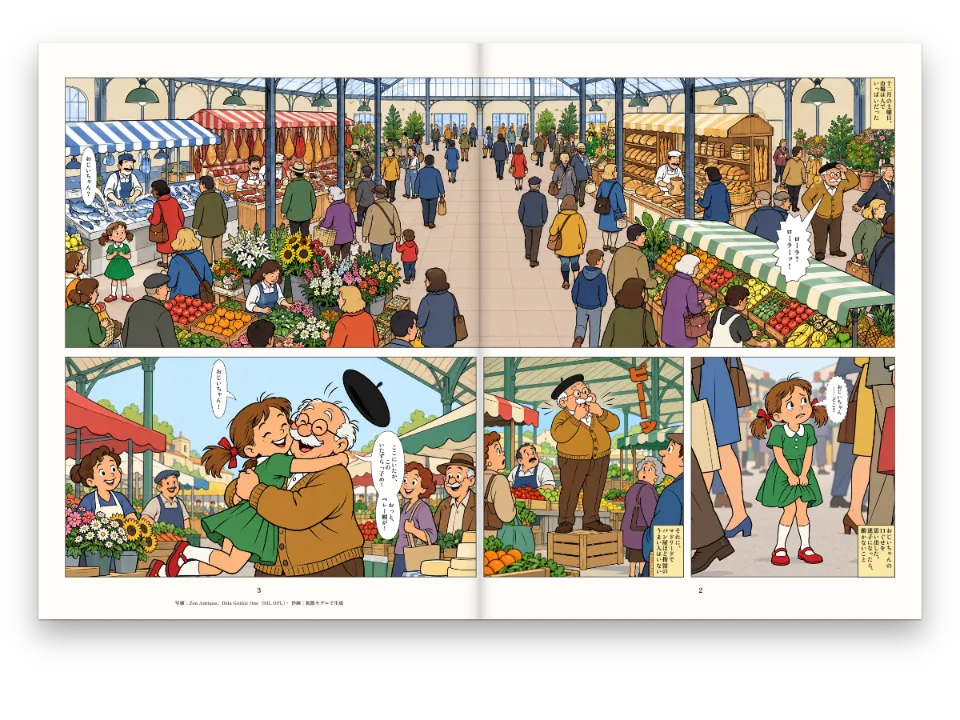
歴史の教科書の向かい合う二ページを一枚のように組みます。色の帯が本の真ん中を横切り、その下で絵の付いた六枚のカードが幅を分け合い、いちばん長い話のカードがいちばん広くなります。
できあがり
中学校の歴史の教科書の48・49ページ、「紙がたどった道」です。蔡倫の工房からケラーの砥石まで、紙すきの千年をたどります。左ページは題名と二つの段落で始まり、右ページは手すき紙の作り方を説明する囲みで始まります。真ん中を年表が横切ります。アジアは藍色の帯、ヨーロッパは赤茶の帯で、赤茶の帯は左ページから始まってのどをまたぎます。その下に、絵の付いたカードが六枚、点と線で帯からつり下がっています。カードは幅を分け合います。いちばん話の長い1844年のカードが両隣から幅を借り(スペイン語版で1mm、日本語版で7mm)、その点もいっしょに動きます。文字はすべてMarkdownにあり、スペイン語、英語、日本語の三版があります。このページは日本語版です。
このレシピが答える質問
- のどをまたぐ帯と左右のページのカードで、見開きの年表を組むには?
- 横に並んだ囲みで幅を分け合い、文章のいちばん長い囲みを広くするには?
手短な答え
const pageTemplates = [{
  id: 'timeline',
  spread: true, // two facing pages laid as one sheet; it opens on a verso
  gutter: mm(10), // the band round the spine that frames keep off
  grid: { columns: 2, rows: ROWS, columnGap: mm(2 * PAGE.inner), rowGap: mm(ROW_GAP) },
  frames: [
    { name: 'title', takes: 'h1' },
    { name: 'lead', flow: true, fit: { minScale: 0.8 } },
    { name: 'box', style: 'box', grid: { col: 2, row: 1, rows: 4 }, height: 'fill',
      padding: { right: mm(66) }, fit: { minScale: 0.85 } },
    { name: 'box-picture', layer: 2, width: mm(56), placement: at('#box', 'top-right', -5, 10) },
    { name: 'band-1', style: 'band-asia', grid: { col: 1, row: 5 }, height: mm(BAND) },
    { name: 'band-2', style: 'band-europe', crossGutter: true, width: 'fill', height: mm(BAND),
      padding: { left: mm(2 * PAGE.inner + 4) }, // the colour crosses the fold, the words do not
      placement: at('#band-1', 'right-of') },
    ...cards.map(card),
    { name: 'colophon', style: 'colophon', optional: true, width: mm(170),
      placement: at('page', 'bottom-right', -PAGE.outer, -7) },
  ],
  groups: [
    { name: 'opening', kind: 'stack', grid: { col: 1, row: 1, rows: 4 }, gap: mm(4),
      frames: ['title', 'lead'] },
    // A card whose text runs past its drawn height takes width from its neighbours first;
    // only when they have none to give does the row grow taller.
    { name: 'asia', kind: 'row', gap: mm(5), frames: ['c1', 'c2', 'c3'] },
    { name: 'europe', kind: 'row', gap: mm(5), frames: ['c4', 'c5', 'c6'] },
  ],
  decoration: { elements: [ground(), ...cards.flatMap(marks)] },
}];
材料
- 機能
- 見開きのテンプレートグループの中で伸びる枠枠に固定した飾りテンプレートページ番号付きの囲みのタブ囲みデザイン要素の基準位置柱とノンブル見開きの余白番号付きリスト中国語・日本語・韓国語のフォントセマンティックカラーパレットキャンバス上のページPDFの書き出し
- 種類
- Literata, Archivo, Noto Serif JP, Noto Sans JP (SIL OFL 1.1)
- 素材
forma-800.jpgv105-1000.jpgv1150-1000.jpgv1282-1000.jpgv1844-1000.jpgv610-1000.jpgv751-1000.jpg- A Han court official watches a craftsman lift a bamboo mould from a vat. (Generated With Diffusion Models, オリジナル)
- A monk shows two Japanese courtiers how to hold a papermaking mould. (Generated With Diffusion Models, オリジナル)
- Papermakers by a canal in Samarkand, sheets drying on a wall. (Generated With Diffusion Models, オリジナル)
- A paper workshop below the castle of Xàtiva. (Generated With Diffusion Models, オリジナル)
- A Fabriano mill with its water wheel; a sheet held up to the light. (Generated With Diffusion Models, オリジナル)
- A craftsman grinds a spruce log against a stone into wood pulp. (Generated With Diffusion Models, オリジナル)
- Two hands lift a papermaker's mould from a vat of pulp. (Generated With Diffusion Models, オリジナル)
作り方
#1 · 二ページで一枚のシート
const pageTemplates = [{
  id: 'timeline',
  spread: true, // two facing pages laid as one sheet; it opens on a verso
  gutter: mm(10), // the band round the spine that frames keep off
  grid: { columns: 2, rows: ROWS, columnGap: mm(2 * PAGE.inner), rowGap: mm(ROW_GAP) },
  frames: [
    { name: 'title', takes: 'h1' },
    { name: 'lead', flow: true, fit: { minScale: 0.8 } },
    { name: 'box', style: 'box', grid: { col: 2, row: 1, rows: 4 }, height: 'fill',
      padding: { right: mm(66) }, fit: { minScale: 0.85 } },
    { name: 'box-picture', layer: 2, width: mm(56), placement: at('#box', 'top-right', -5, 10) },
    { name: 'band-1', style: 'band-asia', grid: { col: 1, row: 5 }, height: mm(BAND) },
    { name: 'band-2', style: 'band-europe', crossGutter: true, width: 'fill', height: mm(BAND),
      padding: { left: mm(2 * PAGE.inner + 4) }, // the colour crosses the fold, the words do not
      placement: at('#band-1', 'right-of') },
    ...cards.map(card),
    { name: 'colophon', style: 'colophon', optional: true, width: mm(170),
      placement: at('page', 'bottom-right', -PAGE.outer, -7) },
  ],
  groups: [
    { name: 'opening', kind: 'stack', grid: { col: 1, row: 1, rows: 4 }, gap: mm(4),
      frames: ['title', 'lead'] },
    // A card whose text runs past its drawn height takes width from its neighbours first;
    // only when they have none to give does the row grow taller.
    { name: 'asia', kind: 'row', gap: mm(5), frames: ['c1', 'c2', 'c3'] },
    { name: 'europe', kind: 'row', gap: mm(5), frames: ['c4', 'c5', 'c6'] },
  ],
  decoration: { elements: [ground(), ...cards.flatMap(marks)] },
}];
spread: trueでテンプレートは二ページ分の幅の一枚のシートになり、ページのブロックもspreadで同じことを示します。見開きは左ページから始まるので、ビルドにcontinuation: { pageIndexOffset: 1, pageNumbering: { startAt: 48 } }を渡します。この抜粋の1ページ目は本の48ページ、左ページになり、前に白ページは入りません。グリッドは一ページに一列で、列の間はノド側の余白の二倍です。のどに近づくのは帯だけです。二本目の帯はcrossGutterと左の36mmの余白を持ちます。色は一本目の帯の端から続いてのどをまたぎ、文字は右ページから始まります。文字が読まれるのも右ページです。
#2 · 幅を分け合うカード
const cards = ['c1', 'c2', 'c3', 'c4', 'c5', 'c6'];
const card = (name, i) => ({ name, style: i < 3 ? 'card-asia' : 'card-europe',
  width: mm((HALF - 10) / 3), minWidth: mm(40), minHeight: mm(CARD),
  shrink: 1, // a card gives width to a neighbour whose text runs past the row
  ...(i % 3 === 0 && { placement: at('container', 'top-left', i ? HALF + 2 * PAGE.inner : 0,
    CARD_TOP) }) }); // where each row starts
三枚のカードの列はそれぞれrowグループで、カードには描いたときの高さのminHeightがあり、それより上はautoの高さです。カードの文章が列の高さに収まらないと、shrinkを持つ隣のカードから必要な最小のミリ数を借ります。隣のカードは、自分の文章が収まる幅を残します。借りきれないときにだけ列が下へ伸びます。1844年のカードは、スペイン語版では1282年のカードから1mm、日本語版では1150年から3mm、1282年から4mm、合わせて7mm借ります。すべての文章を30%長くしたベンチのテストでは、日本語版は両隣から合わせて18mm借り、1150年と1282年のカードの絵も85%に縮み、囲みとリードの文字は87.5%と82.5%になります。
#3 · カードに付いて動く点
function marks(name, i) {
  const ink = col(i < 3 ? 'asia' : 'europe');
  return [
    { kind: 'rule', id: `${name}-tick`, direction: 'vertical', thickness: pt(1), color: ink,
      placement: { ...at(`#${name}`, 'top', 0, -DROP), size: { height: mm(DROP) } } },
    { kind: 'box', id: `${name}-dot`,
      placement: { ...at(`#${name}`, 'top', 0, -DROP + 0.6), size: { width: mm(4.4),
        height: mm(4.4) } },
      style: { backgroundColor: col('paper'), borderColor: ink, borderWidth: pt(1.6),
        borderRadius: mm(2.2) } },
  ];
}
点と線はテンプレートの飾り(decoration)で、#c1 … #c6の上端(top)に固定し、帯までの距離だけ上にずらしています。飾りは枠を置いたあとに配置されるので、カードが動いたり広がったりしても、点はいつもカードの中央の上にあります。クリーム色の地も飾りで、裁ち落としの下端に固定した箱です。高さは#band-1の下端まで届くので(size: { height: { to: '#band-1', edge: 'bottom' } })、帯に付いて動きます。
#4 · 印刷の大きさで置く絵
const ART = {
  v105: t({ es: 'Un funcionario de la corte Han mira cómo un artesano saca de la tina un molde '
      + 'de bambú lleno de pasta, junto a corteza, trapos y redes viejas.',
    en: 'A Han court official watches a craftsman lift a bamboo mould full of pulp from a vat, '
      + 'beside bark, rags and old nets.',
    ja: '漢の役人が見守るなか、職人が竹のすき枠を漉き舟から引き上げる。そばに樹皮、ぼろ布、古い網。' }),
  v610: t({ es: 'Un monje enseña a dos cortesanos japoneses a sostener el molde sobre una tina, '
      + 'con ramas de kozo en una estera.',
    en: 'A monk shows two Japanese courtiers how to hold the mould over a tub, with kozo '
      + 'branches on a mat.',
    ja: '僧が二人の宮廷人に、桶の上ですき枠を持つ手つきを見せる。むしろの上に楮の枝。' }),
  v751: t({ es: 'Papeleros de Samarcanda junto a un canal; las hojas se secan al sol contra un '
      + 'muro de adobe.',
    en: 'Samarkand papermakers by a canal; the sheets dry in the sun against a mud-brick wall.',
    ja: '水路のそばで働くサマルカンドの紙すき職人。日干しれんがの壁に紙が張られて乾いている。' }),
  v1150: t({ es: 'Un taller de Xàtiva bajo el castillo: un operario golpea trapos en una pila '
      + 'de piedra y las hojas cuelgan de cuerdas.',
    en: 'A workshop in Xàtiva below the castle: a worker pounds rags in a stone trough and the '
      + 'sheets hang on ropes.',
    ja: '城の下のシャティバの工房。職人が石の槽でぼろ布をたたき、紙が綱につるされている。' }),
  v1282: t({ es: 'Un molino de Fabriano con su rueda hidráulica y sus mazos; un papelero mira '
      + 'una filigrana al trasluz.',
    en: 'A Fabriano mill with its water wheel and hammers; a papermaker holds a watermark up '
      + 'to the light.',
    ja: '水車と木づちのあるファブリアーノの製紙場。職人が紙を光にかざして透かしを見ている。' }),
  v1844: t({ es: 'Un artesano aprieta un tronco de abeto contra una muela que gira; debajo se '
      + 'amontonan las fibras.',
    en: 'A craftsman presses a spruce log against a turning grindstone; the fibres pile up '
      + 'below.',
    ja: '職人がトウヒの丸太を回る砥石に押し当て、その下に木の繊維が積もっていく。' }),
  forma: t({ es: 'Dos manos sacan de la tina el molde con una capa fina de fibras.',
    en: 'Two hands lift the mould from the vat with a thin layer of fibres on it.',
    ja: '両手ですき枠を引き上げる。網の上に繊維の薄い層ができている。' }),
};
const SIZE = { forma: [800, 800, 363] }; // pixels and ppi: 56 mm wide; the cards' are 46 mm
const resources = await Promise.all(Object.entries(ART).map(async ([id, altText]) => {
  const px = SIZE[id] ?? [1000, 667, 550];
  const fileId = `${id}-${px[0]}.jpg`;
  await loadImage(fileId, asset(fileId));
  return { id, typeId: 'picture', kind: 'bitmap', caption: '', altText, createdAt: 0,
    updatedAt: 0,
    bitmap: { fileId, format: 'jpeg', width: px[0], height: px[1], resolution: px[2] } };
}));
挿絵は幅1,000px、550ppiで、ページ上では46mmです。画像は拡大されないので、広がったカードは絵の大きさを保ち、増えた幅を文章に回します。53mm(絵に左右3.5mmずつの余白を足した幅)より狭いカードでは絵が縮みます。ベンチのテストの日本語版では、1150年と1282年のカードの絵が85%になります。
レシピの全体
// ═══ Postext Cookbook · Nº 158 · An illustrated timeline across a double page ═══════ // https://postext.dev/en/cookbook/illustrated-timeline-spread // Code: MIT · Text: original (CC BY 4.0) · Pictures: generated with diffusion models // Fonts: Literata, Archivo, Noto Serif JP, Noto Sans JP (SIL OFL 1.1) · Needs postext ≥ 1.38.0 import { buildDocument, withLoadedFonts, renderPageToCanvas, registerResourceImage, } from 'https://esm.sh/postext'; import { renderToPdf, decompressWoff2 } from 'https://esm.sh/postext-pdf'; const LANG = 'ja'; // @lang: the language of the sample document ('es' | 'en' | 'ja') const RECIPE = 'illustrated-timeline-spread'; // ─── 1 · Design ───────────────────────────────────────────────────────────── // #region palette: one ink, an accent for each half of the timeline, a pale ground const palette = { ink: '#22201d', // text asia: '#2f4f7a', // indigo: the Asian half of the timeline europe: '#a2412a', // terracotta: the European half ground: '#f1ebdf', // the cream under the cards rule: '#c9bfae', // hairlines and the card borders muted: '#6b6359', // running heads and the colophon paper: '#ffffff', }; const col = (id) => ({ hex: palette[id], model: 'hex', paletteId: id }); const colorPalette = [ ...Object.entries(palette).map(([id, hex]) => ({ id, name: id, value: { hex, model: 'hex' } })), { id: 'main-color', name: 'europe (defaults)', value: { hex: palette.europe, model: 'hex' } }, ]; // #endregion const JA = LANG === 'ja'; const SERIF = JA ? 'Noto Serif JP' : 'Literata'; const SANS = JA ? 'Noto Sans JP' : 'Archivo'; // A Western textbook page is 210 × 280 mm; a Japanese one is AB判, 210 × 257 mm. const PAGE = { w: 210, h: JA ? 257 : 280, top: 22, bottom: 20, inner: 16, outer: 15 }; const ROWS = 12; const ROW_GAP = 3; const ROW = (PAGE.h - PAGE.top - PAGE.bottom - (ROWS - 1) * ROW_GAP) / ROWS; // one grid row, mm const HALF = PAGE.w - PAGE.inner - PAGE.outer; // the width of one page's half of the sheet const BAND = 9; // the timeline band, in grid row 5 const DROP = ROW - BAND + ROW_GAP; // from the band's foot to the cards' heads const CARD_TOP = 5 * (ROW + ROW_GAP); // grid row 6 // The drawn height of a card; 16 mm of the area stay free for a longer text. const CARD = PAGE.h - PAGE.top - PAGE.bottom - CARD_TOP - 16; const at = (to, edge, x = 0, y = 0) => ({ anchor: { to, edge }, offset: { x: mm(x), y: mm(y) } }); // #region cards: six cards at least one height tall that trade width with their neighbours const cards = ['c1', 'c2', 'c3', 'c4', 'c5', 'c6']; const card = (name, i) => ({ name, style: i < 3 ? 'card-asia' : 'card-europe', width: mm((HALF - 10) / 3), minWidth: mm(40), minHeight: mm(CARD), shrink: 1, // a card gives width to a neighbour whose text runs past the row ...(i % 3 === 0 && { placement: at('container', 'top-left', i ? HALF + 2 * PAGE.inner : 0, CARD_TOP) }) }); // where each row starts // #endregion // #region answer: one sheet for two pages, a band across the spine, two rows of cards const pageTemplates = [{ id: 'timeline', spread: true, // two facing pages laid as one sheet; it opens on a verso gutter: mm(10), // the band round the spine that frames keep off grid: { columns: 2, rows: ROWS, columnGap: mm(2 * PAGE.inner), rowGap: mm(ROW_GAP) }, frames: [ { name: 'title', takes: 'h1' }, { name: 'lead', flow: true, fit: { minScale: 0.8 } }, { name: 'box', style: 'box', grid: { col: 2, row: 1, rows: 4 }, height: 'fill', padding: { right: mm(66) }, fit: { minScale: 0.85 } }, { name: 'box-picture', layer: 2, width: mm(56), placement: at('#box', 'top-right', -5, 10) }, { name: 'band-1', style: 'band-asia', grid: { col: 1, row: 5 }, height: mm(BAND) }, { name: 'band-2', style: 'band-europe', crossGutter: true, width: 'fill', height: mm(BAND), padding: { left: mm(2 * PAGE.inner + 4) }, // the colour crosses the fold, the words do not placement: at('#band-1', 'right-of') }, ...cards.map(card), { name: 'colophon', style: 'colophon', optional: true, width: mm(170), placement: at('page', 'bottom-right', -PAGE.outer, -7) }, ], groups: [ { name: 'opening', kind: 'stack', grid: { col: 1, row: 1, rows: 4 }, gap: mm(4), frames: ['title', 'lead'] }, // A card whose text runs past its drawn height takes width from its neighbours first; // only when they have none to give does the row grow taller. { name: 'asia', kind: 'row', gap: mm(5), frames: ['c1', 'c2', 'c3'] }, { name: 'europe', kind: 'row', gap: mm(5), frames: ['c4', 'c5', 'c6'] }, ], decoration: { elements: [ground(), ...cards.flatMap(marks)] }, }]; // #endregion // #region marks: a dot under the band and a tick down to each card, anchored to the card function marks(name, i) { const ink = col(i < 3 ? 'asia' : 'europe'); return [ { kind: 'rule', id: `${name}-tick`, direction: 'vertical', thickness: pt(1), color: ink, placement: { ...at(`#${name}`, 'top', 0, -DROP), size: { height: mm(DROP) } } }, { kind: 'box', id: `${name}-dot`, placement: { ...at(`#${name}`, 'top', 0, -DROP + 0.6), size: { width: mm(4.4), height: mm(4.4) } }, style: { backgroundColor: col('paper'), borderColor: ink, borderWidth: pt(1.6), borderRadius: mm(2.2) } }, ]; } // #endregion // The cream ground under the cards: from the foot of the band down to the bleed. function ground() { return { kind: 'box', id: 'ground', decorative: true, placement: { ...at('bleed', 'bottom-left'), size: { width: 'fill', height: { to: '#band-1', edge: 'bottom' } } }, style: { backgroundColor: col('ground') } }; } const tab = (ink) => ({ position: 'top-left', background: col(ink), color: col('paper'), fontFamily: SANS, fontSize: pt(10), fontWeight: 700, height: mm(6), paddingX: mm(2.6), offset: mm(3.5), inset: mm(0), rule: { enabled: false } }); const cardStyle = (id, ink) => ({ id, backgroundEnabled: true, background: col('paper'), border: { enabled: true, color: col('rule'), width: pt(0.5) }, borderRadius: mm(1.5), stripe: { enabled: true, side: 'top', width: pt(2.5), color: col(ink) }, padding: { top: mm(8), right: mm(3.5), bottom: mm(3.5), left: mm(3.5) }, label: tab(ink), body: { fontFamily: SERIF, fontSize: pt(JA ? 8.6 : 9.4), lineHeight: pt(JA ? 15 : 12.8), color: col('ink'), boldColor: col(ink), italicColor: col('ink'), textAlign: JA ? 'justify' : 'left', hyphenation: !JA, firstLineIndent: pt(0), boldFontWeight: 700 } }); const bandStyle = (id, ink) => ({ id, backgroundEnabled: true, background: col(ink), border: { enabled: false }, padding: { top: mm(1.6), right: mm(4), bottom: mm(1), left: mm(4) }, body: { fontFamily: SANS, fontSize: pt(9.5), lineHeight: pt(12), fontWeight: 700, color: col('paper'), firstLineIndent: pt(0) } }); const head = (id, content, parity, edge, x) => ({ kind: 'text', id, content, parity, fontFamily: SANS, fontSize: pt(8), fontWeight: 600, letterSpacing: pt(JA ? 0 : 0.8), color: col('muted'), placement: at('page', edge, x, 11) }); const folio = (id, parity, edge, x) => ({ kind: 'text', id, content: '{pageNumber}', parity, fontFamily: SANS, fontSize: pt(9), fontWeight: 700, color: col('ink'), placement: at('page', edge, x, -10) }); const config = { locale: t({ es: 'es', en: 'en-gb', ja: 'ja' }), resourceTypes: [{ id: 'picture', name: t({ es: 'Ilustración', en: 'Illustration', ja: 'イラスト' }), shortLabel: '', numberingTemplate: '', resetOn: 'never', counterFormat: 'decimal', captionPrefix: '', defaultPlacement: { position: 'here' } }], colorPalette, page: { sizePreset: 'custom', width: mm(PAGE.w), height: mm(PAGE.h), dpi: 150, margins: { top: mm(PAGE.top), bottom: mm(PAGE.bottom), left: mm(PAGE.inner), right: mm(PAGE.outer), mirror: true }, }, layout: { layoutType: 'single' }, bodyText: { fontFamily: SERIF, fontSize: pt(JA ? 10.5 : 12.4), lineHeight: pt(JA ? 18.5 : 17), paragraphSpacing: !JA, color: col('ink'), boldColor: col('ink'), italicColor: col('ink'), referenceColor: col('ink'), textAlign: JA ? 'justify' : 'left', firstLineIndent: JA ? em(1) : pt(0), // Japanese paragraphs open with a one-character indent hyphenation: { enabled: !JA }, }, headings: { fontFamily: SANS, color: col('ink'), fontWeight: 800, levels: [{ level: 1, fontSize: pt(JA ? 44 : 58), lineHeight: pt(JA ? 54 : 60), color: col('asia'), marginTop: pt(0), marginBottom: pt(0), breakBefore: { enabled: false } }], }, orderedLists: { numberFormat: 'arabic', color: col('europe'), fontWeight: 700 }, calloutStyles: [ { id: 'box', backgroundEnabled: true, background: col('paper'), border: { enabled: true, color: col('rule'), width: pt(0.5) }, borderRadius: mm(1.5), padding: { top: mm(9), right: mm(5), bottom: mm(4), left: mm(5) }, label: tab('europe'), body: { fontFamily: SERIF, fontSize: pt(JA ? 9.5 : 10.4), lineHeight: pt(JA ? 16.5 : 14.2), color: col('ink'), boldColor: col('ink'), italicColor: col('ink'), textAlign: 'left', firstLineIndent: pt(0), paragraphSpacing: true }, lists: { color: col('europe'), gap: mm(1.5), itemSpacing: mm(1.2) } }, cardStyle('card-asia', 'asia'), cardStyle('card-europe', 'europe'), bandStyle('band-asia', 'asia'), bandStyle('band-europe', 'europe'), { id: 'colophon', backgroundEnabled: false, border: { enabled: false }, padding: { top: mm(0), right: mm(0), bottom: mm(0), left: mm(0) }, body: { fontFamily: SANS, fontSize: pt(6.5), lineHeight: pt(8), color: col('muted'), firstLineIndent: pt(0) } }, ], header: { elements: [ head('subject', '{attr.subject}', 'even', 'top-left', PAGE.outer), head('unit', '{attr.unit}', 'odd', 'top-right', -PAGE.outer), ] }, footer: { elements: [ folio('verso-folio', 'even', 'bottom-left', PAGE.outer), folio('recto-folio', 'odd', 'bottom-right', -PAGE.outer), ] }, pageTemplates, }; // The spread opens on a verso: page 1 of this excerpt is book page 48. const continuation = { pageIndexOffset: 1, pageNumbering: { startAt: 48 } }; // ─── 2 · Content ──────────────────────────────────────────────────────────── const markdown = String.raw`::::page{template="timeline" spread subject="中学社会 歴史的分野" unit="第5章 交易の道"}Markdownの見本 · 65行 · content.ja.md
# 紙がたどった道 紙をすく技術は、長いあいだ中国の工房の秘密でした。そこからヨーロッパの水車小屋に届くまで、千年以上の時間がかかっています。 技術を受け取った土地の人びとは、身近な材料に合わせて作り方を変えました。中国ではクワの樹皮、日本では楮(こうぞ)、サマルカンドやアンダルスでは亜麻とぼろ布、そして19世紀には木材です。 :::frame{slot="box" label="手すき紙ができるまで"} 1. 繊維を細かくして水につけ、どろどろの紙料にする。 2. 木の枠に細かい網を張ったすき枠を漉き舟に入れ、紙料をすくい上げる。 3. すき枠をゆすると水が落ち、繊維がからみ合って均一な層になる。 4. フェルトにはさんで圧搾し、つるして乾かす。 すき枠の網の跡は紙に残ります。紙を光にかざすと見える細い線がそれです。 ::: ::resource{id="forma" slot="box-picture"} :::frame{slot="band-1"} アジア 2世紀〜8世紀 ::: :::frame{slot="band-2"} 地中海とヨーロッパ 12世紀〜19世紀 ::: :::frame{slot="c1" label="105年"} ::resource{id="v105"} **中国** 後漢の宦官、{蔡倫|さいりん}が、樹皮や麻くず、ぼろ布、古い漁網から作った紙を皇帝に献上します。絹より安く、竹簡よりずっと軽い書写材料でした。これより200年ほど古い紙も見つかっていますが、帝国じゅうに広まったのは蔡倫の紙です。 ::: :::frame{slot="c2" label="610年"} ::resource{id="v610"} **日本** 『日本書紀』によると、高句麗の僧、{曇徴|どんちょう}が紙と墨の作り方を伝えました。やがて楮の皮から、薄くて丈夫な和紙がすかれるようになります。奈良の正倉院には、702年の紙に書かれた戸籍が今も残っています。 ::: :::frame{slot="c3" label="751年"} ::resource{id="v751"} **サマルカンド** タラス河畔の戦いで捕らえられた中国人が、このシルクロードの町に紙すきを伝えたという言い伝えがあります。原料は亜麻と木綿のぼろ布でした。800年ごろにはバグダードにも工房ができ、カリフの役所では紙が羊皮紙に代わります。 ::: :::frame{slot="c4" label="1150年"} ::resource{id="v1150"} **シャティバ** 地理学者イドリースィーは、アンダルスのこの町で作られる紙は世界に並ぶものがなく、東へも西へも売られていると書いています。1244年にアラゴン王ハイメ1世が町を征服したあとも、工房は仕事を続けました。 ::: :::frame{slot="c5" label="1282年"} ::resource{id="v1282"} **ファブリアーノ** イタリアのこの町の製紙場では、川の水車が木づちを動かし、ぼろ布をつき砕きました。インクがにじまないよう紙にゼラチンを引き、光にかざすと見える透かし模様を入れます。14世紀には、イタリアの紙がヨーロッパの半分で売られていました。 ::: :::frame{slot="c6" label="1844年"} ::resource{id="v1844"} **ザクセン** 印刷術のあとに新聞が生まれ、ぼろ布だけでは紙が足りなくなります。1798年、フランスのルイ=ニコラ・ロベールが、すき枠を使わずに長い紙を連続して作る機械を組み立てていました。1844年、織工のフリードリヒ・ゴットロープ・ケラーは、トウヒの丸太を砥石に押し当ててパルプを作ります。こうして紙は安く大量に作れるようになり、新聞1部の値段はパン1個ほどになりました。 ::: :::frame{slot="colophon"} 組版:Noto Serif JP、Noto Sans JP(SIL OFL)・本文:書き下ろし(CC BY 4.0)・挿絵:拡散モデルで生成 ::: ::::`; // content.<lang>.md, inlined by the Cookbook // #region art: seven pictures at the size they print, with what each shows const ART = { v105: t({ es: 'Un funcionario de la corte Han mira cómo un artesano saca de la tina un molde ' + 'de bambú lleno de pasta, junto a corteza, trapos y redes viejas.', en: 'A Han court official watches a craftsman lift a bamboo mould full of pulp from a vat, ' + 'beside bark, rags and old nets.', ja: '漢の役人が見守るなか、職人が竹のすき枠を漉き舟から引き上げる。そばに樹皮、ぼろ布、古い網。' }), v610: t({ es: 'Un monje enseña a dos cortesanos japoneses a sostener el molde sobre una tina, ' + 'con ramas de kozo en una estera.', en: 'A monk shows two Japanese courtiers how to hold the mould over a tub, with kozo ' + 'branches on a mat.', ja: '僧が二人の宮廷人に、桶の上ですき枠を持つ手つきを見せる。むしろの上に楮の枝。' }), v751: t({ es: 'Papeleros de Samarcanda junto a un canal; las hojas se secan al sol contra un ' + 'muro de adobe.', en: 'Samarkand papermakers by a canal; the sheets dry in the sun against a mud-brick wall.', ja: '水路のそばで働くサマルカンドの紙すき職人。日干しれんがの壁に紙が張られて乾いている。' }), v1150: t({ es: 'Un taller de Xàtiva bajo el castillo: un operario golpea trapos en una pila ' + 'de piedra y las hojas cuelgan de cuerdas.', en: 'A workshop in Xàtiva below the castle: a worker pounds rags in a stone trough and the ' + 'sheets hang on ropes.', ja: '城の下のシャティバの工房。職人が石の槽でぼろ布をたたき、紙が綱につるされている。' }), v1282: t({ es: 'Un molino de Fabriano con su rueda hidráulica y sus mazos; un papelero mira ' + 'una filigrana al trasluz.', en: 'A Fabriano mill with its water wheel and hammers; a papermaker holds a watermark up ' + 'to the light.', ja: '水車と木づちのあるファブリアーノの製紙場。職人が紙を光にかざして透かしを見ている。' }), v1844: t({ es: 'Un artesano aprieta un tronco de abeto contra una muela que gira; debajo se ' + 'amontonan las fibras.', en: 'A craftsman presses a spruce log against a turning grindstone; the fibres pile up ' + 'below.', ja: '職人がトウヒの丸太を回る砥石に押し当て、その下に木の繊維が積もっていく。' }), forma: t({ es: 'Dos manos sacan de la tina el molde con una capa fina de fibras.', en: 'Two hands lift the mould from the vat with a thin layer of fibres on it.', ja: '両手ですき枠を引き上げる。網の上に繊維の薄い層ができている。' }), }; const SIZE = { forma: [800, 800, 363] }; // pixels and ppi: 56 mm wide; the cards' are 46 mm const resources = await Promise.all(Object.entries(ART).map(async ([id, altText]) => { const px = SIZE[id] ?? [1000, 667, 550]; const fileId = `${id}-${px[0]}.jpg`; await loadImage(fileId, asset(fileId)); return { id, typeId: 'picture', kind: 'bitmap', caption: '', altText, createdAt: 0, updatedAt: 0, bitmap: { fileId, format: 'jpeg', width: px[0], height: px[1], resolution: px[2] } }; })); // #endregion // ─── 3 · Fonts ────────────────────────────────────────────────────────────── const FONTS = { Literata: ['400', '400i', '700'], Archivo: ['400', '600', '700', '800'], // es, en 'Noto Serif JP': ['400', '700'], 'Noto Sans JP': ['400', '600', '700', '800'], // ja }; // ─── 4 · Build & show ─────────────────────────────────────────────────────── await loadFonts(FONTS, markdown); // the latin files of every face await loadCjkFonts({ [SERIF]: FONTS[SERIF], [SANS]: FONTS[SANS] }, markdown); // ja only const doc = await withLoadedFonts( () => buildDocument({ markdown, resources, continuation }, config), { ...kitFonts(FONTS), text: markdown }); showPages(doc, { title: t({ es: 'Una cronología ilustrada a doble página', en: 'An illustrated timeline across a double page', ja: '見開きの絵入り年表' }) }); offerPdf(() => renderToPdf(doc, { fontProvider: cjkPdfProvider, resourceBytes: imageBytes }), `${RECIPE}.pdf`);キット · core, fonts, viewer, pdf, images, cjk:全レシピ共通 · 504行
// ─── Kit ── helpers shared by every Cookbook recipe · postext.dev/cookbook ───── // ─── Kit · core v1 ── the same in every recipe · postext.dev/cookbook function mm(value) { return { value, unit: 'mm' }; } function pt(value) { return { value, unit: 'pt' }; } function em(value) { return { value, unit: 'em' }; } /** The sample language's string: t({ en: 'Figure', es: 'Figura' }). */ function t(strings) { return strings[LANG] ?? Object.values(strings)[0]; } /** A file in this recipe's assets folder, served from the Postext repo by jsDelivr. */ function asset(file) { return `https://cdn.jsdelivr.net/gh/drnachio/postext@main/cookbook/${RECIPE}/assets/${file}`; } // ─── Kit · fonts v3 ── the same in every recipe · postext.dev/cookbook // Postext loads the faces a config asks for before layout (prepareFonts, // buildDocumentWithFonts) and asks the kit for the files: Fontsource's, the // files the PDF embeds too. /** The options of buildDocumentWithFonts / prepareFonts / withLoadedFonts: * the Fontsource resolver, and the faces of FONTS loaded with the ones the * config names. FONTS = { 'Family Name': ['400', '400i', '700'] }. */ function kitFonts(FONTS = {}) { const faces = Object.entries(FONTS).flatMap(([family, specs]) => specs.map((spec) => ({ family, weight: parseInt(spec, 10), style: spec.endsWith('i') ? 'italic' : 'normal' }))); return { resolve: fontsourceResolver, faces }; } /** A face's Fontsource files, in a fixed order: latin, then latin-ext and greek * when `text` needs them and the family ships them (kitSubsetsFor), each with * its unicode-range. Null for a weight or slant Fontsource does not ship. */ async function fontsourceResolver(family, weight, style, { text = '' } = {}) { const id = fontsourceId(family); const meta = await fontsourceMeta(family); if (meta && !(meta.weights.includes(weight) && meta.styles.includes(style))) return null; kitStatus('Loading fonts…'); const at = await fontsourceAt(id); return ['latin', ...kitSubsetsFor(text, meta)].map((subset) => ({ source: `${at}files/${id}-${subset}-${weight}-${style}.woff2`, unicodeRange: kitRanges()[subset], })); } /** The unicode-range of each Fontsource file the kit loads (a function: the * kit is inlined after the pen's code, which runs before a const would be set). */ function kitRanges() { return { latin: 'U+0000-00FF,U+0131,U+0152-0153,U+02BB-02BC,U+02C6,U+02DA,U+02DC,U+0304,U+0308,U+0329,' + 'U+2000-206F,U+20AC,U+2122,U+2191,U+2193,U+2212,U+2215,U+FEFF,U+FFFD', 'latin-ext': 'U+0100-02BA,U+02BD-02C5,U+02C7-02CC,U+02CE-02D7,U+02DD-02FF,U+0304,U+0308,U+0329,' + 'U+1D00-1DBF,U+1E00-1E9F,U+1EF2-1EFF,U+2020,U+20A0-20AB,U+20AD-20C0,U+2113,U+2C60-2C7F,U+A720-A7FF', greek: 'U+0370-03FF', }; } /** For the cjk, arabic and comics blocks, which add their own files: the * faces of `faces` = { 'Family Name': ['400', '400i', '700'] }. `text` is the sample: * č ł † α χ also load latin-ext and greek files (kitSubsetsFor). With * `optional`, a face Fontsource does not ship is skipped instead of failing. * The files are added once all have loaded, in the order asked (latin, then * latin-ext, then greek), whatever order they arrive in: the last one added * wins a character two files hold. Resolves to the number of faces added. */ async function loadFonts(faces, text = '', { optional = false } = {}) { kitStatus('Loading fonts…'); const ranges = kitRanges(); const jobs = []; for (const [family, specs] of Object.entries(faces)) { const id = fontsourceId(family); const todo = [...new Set(specs)].map((spec) => [parseInt(spec, 10), spec.endsWith('i') ? 'italic' : 'normal']) .filter(([weight, style]) => !hasFace(family, weight, style)); // before any await const at = fontsourceAt(id); const meta = optional || /[^\0-ÿ]/u.test(text) ? await fontsourceMeta(family) : null; const subsets = ['latin', ...kitSubsetsFor(text, meta)]; for (const [weight, style] of todo) { if (optional && !(meta?.weights.includes(weight) && meta.styles.includes(style))) continue; for (const subset of subsets) { const url = `${await at}files/${id}-${subset}-${weight}-${style}.woff2`; const face = new FontFace(family, `url(${url}) format('woff2')`, { weight: String(weight), style, unicodeRange: ranges[subset] }); jobs.push(face.load().catch(() => { if (subset === 'latin' && !optional) throw new Error(`Fontsource has no ${family} ${weight} ${style}`); })); } } } const ready = await Promise.all(jobs).catch((error) => { kitFail(error); throw error; }); return ready.filter((face) => face && document.fonts.add(face)).length; } /** A loaded FontFace covers this family, weight and style (fonts.check() would * also say yes for families nobody declared). */ function hasFace(family, weight, style) { for (const face of document.fonts) { if (face.status !== 'loaded' || face.style !== style) continue; if (face.family.replace(/^["']|["']$/g, '') !== family) continue; const [low, high = low] = face.weight.split(' ').map(Number); if (weight >= low && weight <= high) return true; } return false; } /** The files beyond latin `text` needs that `meta`'s family ships. */ function kitSubsetsFor(text, meta) { return [[/[Ā-˿ᴀ-ᶿḀ-ỿ†ℓⱠ-Ɀ꜠-ꟿ]/u, 'latin-ext'], [/[Ͱ-Ͽ]/u, 'greek']] .filter(([re, x]) => re.test(text) && meta?.subsets?.includes(x)).map(([, x]) => x); } /** Fontsource's id for a family: 'Source Serif 4' → 'source-serif-4'. */ function fontsourceId(family) { return family.toLowerCase().replace(/\s+/g, '-'); } /** A package's folder at the one version @5 names now (#766). */ function fontsourceAt(id, u = `https://cdn.jsdelivr.net/npm/@fontsource/${id}@`) { return (fontsourceAt.c ??= {})[id] ??= fetch(u + '5/package.json').then((r) => r.json()) .then((p) => p.version || 5, () => 5).then((v) => `${u}${v}/`); } /** The family's Fontsource metadata (weights, styles, subsets), or null. */ function fontsourceMeta(family) { fontsourceMeta.cache ??= new Map(); const id = fontsourceId(family); if (!fontsourceMeta.cache.has(id)) { fontsourceMeta.cache.set(id, fetch(`https://api.fontsource.org/v1/fonts/${id}`) .then((res) => (res.ok ? res.json() : null), () => null)); } return fontsourceMeta.cache.get(id); } // ─── Kit · viewer v2 ── the same in every recipe · postext.dev/cookbook /** The pages as spreads on a dark desk, page 1 alone, then verso | recto, * each painted when it scrolls near. Other options go to renderPageToCanvas. */ function showPages(docs, { title, width = 460, ...render } = {}) { const root = viewer(title); const pages = [docs].flat().flatMap((doc) => doc.pages.map((page) => ({ doc, page, n: (doc.pageIndexOffset ?? 0) + page.index }))); const spreads = []; let verso = null; for (const p of pages) { if (p.n % 2 === 1) { if (verso) spreads.push([verso, null]); verso = p; } else { spreads.push([verso, p]); verso = null; } } if (verso) spreads.push([verso, null]); const density = Math.min(window.devicePixelRatio || 1, 2); showPages.painter?.disconnect(); const painter = new IntersectionObserver((entries) => { for (const { isIntersecting, target } of entries) { if (!isIntersecting) continue; painter.unobserve(target); const { doc, page } = target.postext; renderPageToCanvas(page, doc, target, { ...render, scale: (width * density) / page.width }); } }, { rootMargin: '800px' }); showPages.painter = painter; root.replaceChildren(...spreads.map((pair) => { const spread = document.createElement('div'); spread.className = 'pt-spread'; for (const p of pair) { const figure = document.createElement('figure'); if (p) { const label = p.page.pageLabel || String(p.n + 1); const canvas = document.createElement('canvas'); canvas.postext = p; canvas.style.aspectRatio = `${p.page.width} / ${p.page.height}`; canvas.setAttribute('role', 'img'); canvas.setAttribute('aria-label', `Page ${label}`); const folio = document.createElement('figcaption'); folio.textContent = label; figure.append(canvas, folio); painter.observe(canvas); } else figure.className = 'pt-blank'; spread.append(figure); } return spread; })); kitStatus(`${pages.length} ${pages.length === 1 ? 'page' : 'pages'}`); document.documentElement.dataset.postext = 'ready'; return pages.length; } /** The desk, the bar and the error reporting, created once. */ function viewer(title) { if (!document.getElementById('pt-kit')) { document.head.insertAdjacentHTML('beforeend', `<style id="pt-kit"> :root { color-scheme: dark; } body { margin: 0; background: #0e1014; color: #b9bcc4; font: 13px/1.45 system-ui, sans-serif; } #pt-bar { position: sticky; top: 0; z-index: 1; display: flex; flex-wrap: wrap; align-items: center; gap: 6px 16px; padding: 10px 16px; background: rgb(14 16 20 / .92); backdrop-filter: blur(6px); border-bottom: 1px solid #23262d; } #pt-bar strong { color: #f4f1ea; font-weight: 600; } #pt-actions { display: flex; gap: 12px; margin-left: auto; } #pt-actions a, #pt-actions button { color: #d8a21a; font: inherit; background: none; border: 0; padding: 0; cursor: pointer; } #pages { display: grid; justify-items: center; gap: 48px; padding: 32px 16px 72px; } .pt-spread { display: flex; } .pt-spread figure { margin: 0; width: min(460px, 44vw); } .pt-spread canvas { display: block; width: 100%; background: #fff; box-shadow: 0 1px 2px rgb(0 0 0 / .5), 0 22px 44px -16px rgb(0 0 0 / .8); } .pt-spread figure:first-child canvas { box-shadow: inset -14px 0 14px -14px rgb(0 0 0 / .18), 0 1px 2px rgb(0 0 0 / .5), 0 22px 44px -16px rgb(0 0 0 / .8); } .pt-spread figcaption { margin-top: 10px; text-align: center; font: 600 10px/1 system-ui, sans-serif; letter-spacing: .18em; text-transform: uppercase; color: #6c7079; } .pt-blank { visibility: hidden; } @media (max-width: 760px) { .pt-spread { flex-direction: column; gap: 32px; } .pt-spread figure { width: min(460px, 92vw); } .pt-blank { display: none; } } </style>`); document.body.insertAdjacentHTML('afterbegin', '<header id="pt-bar"><strong id="pt-title"></strong><span id="pt-status" role="status"></span><span id="pt-actions"></span></header>'); document.getElementById('pt-title').textContent = document.title || 'Postext'; addEventListener('error', (event) => kitFail(event.error ?? event.message)); addEventListener('unhandledrejection', (event) => kitFail(event.reason)); } if (title) document.getElementById('pt-title').textContent = title; return document.getElementById('pages') ?? document.body.appendChild(Object.assign(document.createElement('main'), { id: 'pages' })); } function kitStatus(text) { viewer(); document.getElementById('pt-status').textContent = text; } function kitFail(error) { document.documentElement.dataset.postext = 'error'; kitStatus(`Error: ${error?.message ?? error}`); } // ─── Kit · pdf v3 ── the same in every recipe that exports a PDF /** The Fontsource files the screen used, as TrueType, with their range and * place: the nearest weight the family ships, upright with no italic; * latin, then what its letters need (kitSubsetsFor). */ async function fontsourceProvider(family, weight, style, request) { const id = fontsourceId(family); const meta = await fontsourceMeta(family); const weights = meta?.weights?.length ? meta.weights : [400, 700]; const w = weights.reduce((a, b) => (Math.abs(b - weight) < Math.abs(a - weight) ? b : a)); const s = style === 'italic' && meta && !meta.styles.includes('italic') ? 'normal' : style; const text = String.fromCodePoint(...(request?.codePoints ?? [])); const files = await Promise.all(['latin', ...kitSubsetsFor(text, meta)].map(async (subset, order) => { const res = await fetch(`${await fontsourceAt(id)}files/${id}-${subset}-${w}-${s}.woff2`); if (!res.ok) throw new Error(`Fontsource has no ${family} ${w} ${s} ${subset}`); return Object.assign(await decompressWoff2(new Uint8Array(await res.arrayBuffer())), { unicodeRange: kitRanges()[subset], order }); })); return files.length === 1 ? files[0] : files; } /** A "Build the PDF" button; then "Open the PDF" (a new tab: CodePen's frame * shows no PDFs) and a download link. */ function offerPdf(makePdf, filename) { viewer(); const button = Object.assign(document.createElement('button'), { type: 'button', textContent: 'Build the PDF' }); button.dataset.postextPdf = filename; button.addEventListener('click', async () => { button.disabled = true; button.textContent = 'Building the PDF…'; try { const bytes = await makePdf(); const url = URL.createObjectURL(new Blob([bytes], { type: 'application/pdf' })); const size = `${Math.max(1, Math.round(bytes.length / 1024))} KB`; button.replaceWith( Object.assign(document.createElement('a'), { href: url, target: '_blank', rel: 'noopener', textContent: 'Open the PDF ↗' }), Object.assign(document.createElement('a'), { href: url, download: filename, textContent: `Download ${filename} · ${size}` })); } catch (error) { button.disabled = false; button.textContent = 'Build the PDF'; kitFail(error); } }); document.getElementById('pt-actions').append(button); } // ─── Kit · images v3 ── recipes with pictures · postext.dev/cookbook /** Registers a photo or PNG for the canvas and keeps its bytes for the PDF. * fetch → ImageBitmap never taints the canvas (a plain cross-origin <img> would). */ async function loadImage(fileId, url) { const res = await fetch(url); if (!res.ok) throw new Error(`Image not found (${res.status}): ${url}`); const bytes = new Uint8Array(await res.arrayBuffer()); registerResourceImage(fileId, await createImageBitmap(new Blob([bytes]))); (loadImage.bytes ??= new Map()).set(fileId, bytes); } /** Registers SVG markup as a vector image, its fonts inside (inlineSvgFonts, ≥ 1.25). * `options` go to registerResourceImage: { singleInk: true } tints it on the canvas. */ async function loadSvg(fileId, svg, options) { if (typeof inlineSvgFonts === 'function') svg = await inlineSvgFonts(svg, svgFaces); const img = new Image(); img.src = `data:image/svg+xml;charset=utf-8,${encodeURIComponent(svg)}`; await img.decode(); registerResourceImage(fileId, img, options); (loadImage.bytes ??= new Map()).set(fileId, new TextEncoder().encode(svg)); } /** A face's Fontsource files: nearest weight; latin + what the SVG sets. */ async function svgFaces(family, weight, style, { codePoints = [] } = {}) { const [id, m] = [fontsourceId(family), await fontsourceMeta(family)]; const w = m?.weights.reduce((a, b) => (Math.abs(b - weight) < Math.abs(a - weight) ? b : a)) ?? weight; const s = m?.styles.includes(style) === false ? 'normal' : style; return Promise.all(['latin', ...kitSubsetsFor(String.fromCodePoint(...codePoints), m)].map(async (x) => new Uint8Array( await (await fetch(`${await fontsourceAt(id)}files/${id}-${x}-${w}-${s}.woff2`)).arrayBuffer()))); } /** renderToPdf({ resourceBytes: imageBytes }) */ function imageBytes(fileId) { return loadImage.bytes?.get(fileId); } /** renderToHtml({ resourceImageUrl: imageUrl }) */ function imageUrl(fileId) { const bytes = imageBytes(fileId); if (!bytes) return undefined; imageUrl.urls ??= new Map(); if (!imageUrl.urls.has(fileId)) { const type = /\.svg$/i.test(fileId) ? 'image/svg+xml' : /\.png$/i.test(fileId) ? 'image/png' : 'image/jpeg'; imageUrl.urls.set(fileId, URL.createObjectURL(new Blob([bytes], { type }))); } return imageUrl.urls.get(fileId); } // ─── Kit · cjk v2 ── Chinese, Japanese and Korean books · postext.dev/cookbook // Fontsource ships a CJK family as about a hundred files per weight, each // declared in its stylesheet with the unicode-range it covers. The screen // loads the files the sample touches; the PDF gets the same files for the // characters its pages set in each face, and embeds each as a subset. // A book bound on the right (vertical text) is shown with its spreads // mirrored: page 1 alone on the left of the spine, then [3 | 2]. /** The files of a Fontsource face, read from its stylesheet: { url, range, * ranges }, the last declared first (the order the browser tries them in). */ function cjkSlices(family, weight, style) { cjkSlices.cache ??= new Map(); const id = fontsourceId(family); const css = `${id}/${weight}${style === 'italic' ? '-italic' : ''}.css`; if (!cjkSlices.cache.has(css)) { let at; cjkSlices.cache.set(css, fontsourceAt(id).then((a) => fetch(at = a + css.slice(id.length + 1))) .then((res) => { if (!res.ok) throw new Error(`Fontsource has no ${family} ${weight} ${style} (${res.status})`); return res.text(); }) .then((text) => [...text.matchAll(/@font-face\s*{([^}]*)}/g)].map(([, rule]) => { const range = /unicode-range:\s*([^;]+);/.exec(rule)?.[1].trim() ?? 'U+0-10FFFF'; const ranges = range.split(',').map((part) => { const [lo, hi = lo] = part.trim().slice(2).split('-'); return [parseInt(lo, 16), parseInt(hi, 16)]; }); return { url: new URL(/url\(([^)]+?\.woff2)\)/.exec(rule)[1], at).href, range, ranges }; }).reverse())); } return cjkSlices.cache.get(css); } /** The file of `slices` the screen sets code point `cp` in, if any: the * last one loadCjkFonts adds whose range holds it. A numbered file that * repeats a letter of latin is added after latin, and wins it. */ function cjkSliceFor(slices, cp) { const holds = (slice) => slice.ranges.some(([lo, hi]) => cp >= lo && cp <= hi); return slices.reduce((last, slice) => (holds(slice) ? slice : last), undefined); } /** Whether Fontsource serves `family` as a Chinese, Japanese or Korean * family (its subsets name the script). Fails when the API does not * answer: a CJK face taken for a Latin one would paint in a system face. */ async function isCjkFamily(family) { const meta = await fontsourceMeta(family); if (!meta) throw new Error(`api.fontsource.org did not describe ${family}: reload to try again`); return !!meta.subsets?.some((subset) => /^(chinese|japanese|korean)/.test(subset)); } /** faces = { 'Noto Serif TC': ['400', '700'] }, as for loadFonts: the * whole FONTS object may be passed, its other families are left to * loadFonts. Adds one FontFace per file of each CJK face with its * unicodeRange, then loads the files `text` touches. `text` is what the * faces set: the sample for the text face; a book in several voices calls * it once per voice (loadCjkFonts({ 'LXGW WenKai TC': ['400'] }, quotes)), * so the heading and quotation faces fetch and check only their own * characters. Fails when a character of `text` is in no file of a face. * List every weight the pages use: a weight left to the engine's later round * gets the latin file only. With { vertical: true } it also loads each * family's vertical forms (brackets, quotes, pause marks) for the canvas, * which needs loadVerticalAlternates imported from postext. Resolves to * the number of files loaded. */ async function loadCjkFonts(faces, text, { vertical = false } = {}) { kitStatus('Loading fonts…'); let loaded = 0; try { if (vertical && typeof loadVerticalAlternates !== 'function') { throw new Error('loadCjkFonts(…, { vertical: true }) needs loadVerticalAlternates imported from postext'); } for (const [family, specs] of Object.entries(faces)) { if (!(await isCjkFamily(family))) continue; const twin = []; for (const spec of new Set(specs)) { const weight = parseInt(spec, 10); const style = spec.endsWith('i') ? 'italic' : 'normal'; const slices = await cjkSlices(family, weight, style); const missing = [...new Set(text)].filter((ch) => /\S/.test(ch) && !cjkSliceFor(slices, ch.codePointAt(0))); if (missing.length) { throw new Error(`${family} ${spec} has no file for ${missing.slice(0, 12).join(' ')}: ` + `give each face the text it sets (loadCjkFonts({ '${family}': ['${spec}'] }, text))`); } for (const slice of slices) { document.fonts.add(new FontFace(family, `url(${slice.url}) format('woff2')`, { weight: String(weight), style, unicodeRange: slice.range })); twin.push({ source: slice.url, weight: String(weight), style, unicodeRange: slice.range }); } const font = `${style === 'italic' ? 'italic ' : ''}${weight} 16px "${family}"`; loaded += (await document.fonts.load(font, text)).length; if (!document.fonts.check(font, text)) throw new Error(`${family} ${spec} did not load for the sample`); } // The same files under a twin name with the `vert` feature on: the // canvas paints the punctuation of vertical lines with it. if (vertical && twin.length) await loadVerticalAlternates(family, twin); } } catch (error) { kitFail(error); throw error; } return loaded; } /** The PDF font provider for recipes with CJK faces: a family whose * Fontsource subsets are Chinese, Japanese or Korean gets the files the * screen set its pages' characters in (`request.codePoints`), each marked * with its unicode-range and its place in the order loadCjkFonts added * them: postext-pdf sets a character two files hold in the one added * last, as the browser does. Any other family gets the latin file * fontsourceProvider fetches (the "pdf" block) and, when the face sets * letters only latin-ext has, that file too. */ async function cjkPdfProvider(family, weight, style, request) { if (!(await isCjkFamily(family))) return cjkLatinPdfFiles(family, weight, style, request); const meta = await fontsourceMeta(family); const weights = meta.weights?.length ? meta.weights : [400, 700]; const w = weights.reduce((a, b) => (Math.abs(b - weight) < Math.abs(a - weight) ? b : a)); const s = style === 'italic' && !meta.styles.includes('italic') ? 'normal' : style; const slices = await cjkSlices(family, w, s); const picked = new Set(); for (const cp of request?.codePoints ?? []) { const slice = cjkSliceFor(slices, cp); if (slice) picked.add(slice); } if (!picked.size) picked.add(slices[0]); return Promise.all(slices.map(async (slice, order) => { if (!picked.has(slice)) return null; const res = await fetch(slice.url); if (!res.ok) throw new Error(`Fontsource file ${slice.url} (${res.status})`); const bytes = await decompressWoff2(new Uint8Array(await res.arrayBuffer())); return Object.assign(bytes, { unicodeRange: slice.range, order }); })).then((files) => files.filter(Boolean)); } /** A Latin family set next to the CJK faces: its latin file, then its * latin-ext file when the face sets letters only latin-ext has (ō ū in * Hepburn rōmaji, ǎ in pinyin), the file loadFonts adds on screen for * them, each marked with its unicode-range and its place in that order: * the PDF sets a character in the file the browser took it from. A face * Fontsource ships without latin-ext, or whose file does not come, gets * latin alone, and the PDF names the letters it lacks. */ async function cjkLatinPdfFiles(family, weight, style, request) { const meta = await fontsourceMeta(family); const beyond = [...(request?.codePoints ?? [])].some(cjkLatinExtOnly); if (!beyond || !meta?.subsets?.includes('latin-ext')) return fontsourceProvider(family, weight, style); const weights = meta.weights?.length ? meta.weights : [400, 700]; const w = weights.reduce((a, b) => (Math.abs(b - weight) < Math.abs(a - weight) ? b : a)); const s = style === 'italic' && !meta.styles.includes('italic') ? 'normal' : style; const id = fontsourceId(family); const url = `${await fontsourceAt(id)}files/${id}-latin-ext-${w}-${s}.woff2`; const [latin, ext] = await Promise.all([fontsourceProvider(family, weight, style), fetch(url) .then(async (res) => (res.ok ? decompressWoff2(new Uint8Array(await res.arrayBuffer())) : null), () => null)]); const ranges = kitRanges(); return ext ? [Object.assign(latin, { unicodeRange: ranges.latin, order: 0 }), Object.assign(ext, { unicodeRange: ranges['latin-ext'], order: 1 })] : latin; } /** Whether code point `cp` is in Fontsource's latin-ext file and not in * its latin file: Latin Extended-A and -B, IPA, the spacing modifiers and * Latin Extended Additional (loadFonts's test for latin-ext), less the * few latin holds too (ı Œ œ ʻ ʼ ˆ ˚ ˜). */ function cjkLatinExtOnly(cp) { if (!((cp >= 0x100 && cp <= 0x2ff) || (cp >= 0x1e00 && cp <= 0x1eff))) return false; return ![0x131, 0x152, 0x153, 0x2bb, 0x2bc, 0x2c6, 0x2da, 0x2dc].includes(cp); } /** showPages for a book bound on either edge. A right-bound book (the * document says so: doc.binding is 'right' for page.binding 'right' and * for vertical text) lies on the desk as it opens: page 1 alone on the * left of the spine, then [3 | 2], the spine shade on each page's inner * edge. `binding` ('left' | 'right') overrides the document's. */ function showBook(docs, { binding, ...options } = {}) { const count = showPages(docs, options); const right = (binding ?? [docs].flat()[0]?.binding) === 'right'; if (!document.getElementById('pt-kit-cjk')) { // The pages keep direction ltr: a canvas draws text in the direction its // element inherits, and under rtl each run would end where the engine // starts it, its brackets mirrored. document.head.insertAdjacentHTML('beforeend', `<style id="pt-kit-cjk"> .pt-spread[dir="rtl"] canvas { direction: ltr; } .pt-spread[dir="rtl"] figure:first-child canvas { box-shadow: inset 14px 0 14px -14px rgb(0 0 0 / .18), 0 1px 2px rgb(0 0 0 / .5), 0 22px 44px -16px rgb(0 0 0 / .8); } </style>`); } // Each pair stays [verso, recto] in the page; right to left, the verso // sits on the right. Phones stack the pages in reading order either way. for (const spread of document.querySelectorAll('#pages > .pt-spread')) spread.dir = right ? 'rtl' : 'ltr'; document.getElementById('pages').dataset.binding = right ? 'right' : 'left'; return count; } // ─── /Kit ───────────────────────────────────────────────────────────────────────
組み立てたscript.jsはそのまま動きます。任意のページのモジュールスクリプトに貼り付けるか、レシピをCodePenで開いてください。 GitHub上のレシピのフォルダー ↗ (新しいタブで開きます)
アレンジ
#カードの幅をそろえる
shrink: 0にすると、どのカードも幅を譲りません。代わりに列が下へ伸び、三枚が一緒に高くなって、列の下端がページの下へずれます。
-  shrink: 1, // a card gives width to a neighbour whose text runs past the row
+ shrink: 0,よくあるつまずき
- 固定の
heightを持つカードは幅の貸し借りに加わりません。列からはみ出すことがないからです。ここでのようにカードにはminHeightを与え、高さはautoのままにします。 - 別の箱の端まで届く大きさは、要素自身の固定点から数えます。クリーム色の地は裁ち落としの下端に固定し、上へ
#band-1まで伸びます。固定点の後ろにある端は、高さ0になります。
クレジット
- 本文
- The paper road, a double-page timeline written for this recipe in Spanish, English and Japanese · Postext Cookbook · CC BY 4.0
- 画像
- A Han court official watches a craftsman lift a bamboo mould from a vat. · Generated With Diffusion Models · オリジナル
- A monk shows two Japanese courtiers how to hold a papermaking mould. · Generated With Diffusion Models · オリジナル
- Papermakers by a canal in Samarkand, sheets drying on a wall. · Generated With Diffusion Models · オリジナル
- A paper workshop below the castle of Xàtiva. · Generated With Diffusion Models · オリジナル
- A Fabriano mill with its water wheel; a sheet held up to the light. · Generated With Diffusion Models · オリジナル
- A craftsman grinds a spruce log against a stone into wood pulp. · Generated With Diffusion Models · オリジナル
- Two hands lift a papermaker's mould from a vat of pulp. · Generated With Diffusion Models · オリジナル
- フォント
- Literata (SIL OFL 1.1) · Archivo (SIL OFL 1.1) · Noto Serif JP (SIL OFL 1.1) · Noto Sans JP (SIL OFL 1.1)