Em poucas palavras
Diga até onde cada pintura vai na sua página, dentro das margens, até a borda de corte ou além, e dê ao detalhe a sua largura em milímetros. As páginas se compõem sozinhas.
O que você vai compor
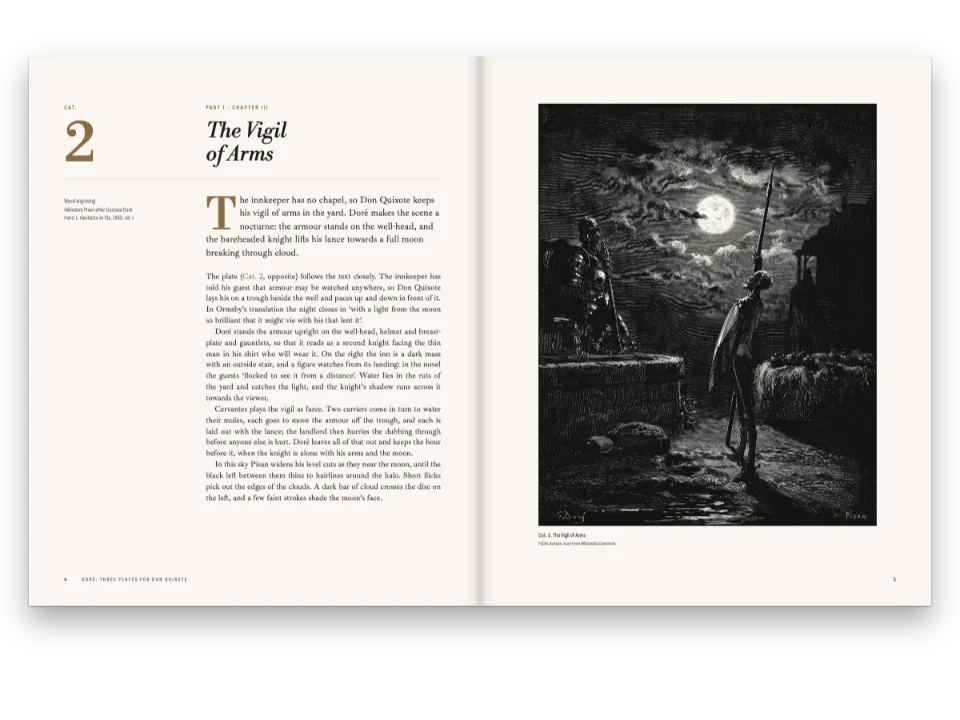
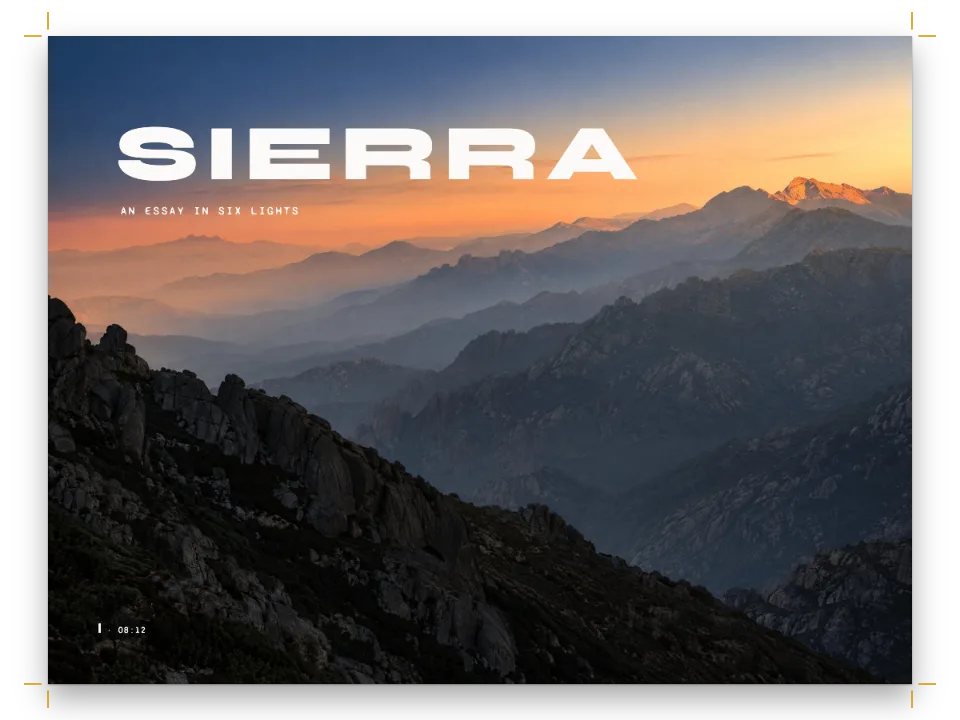
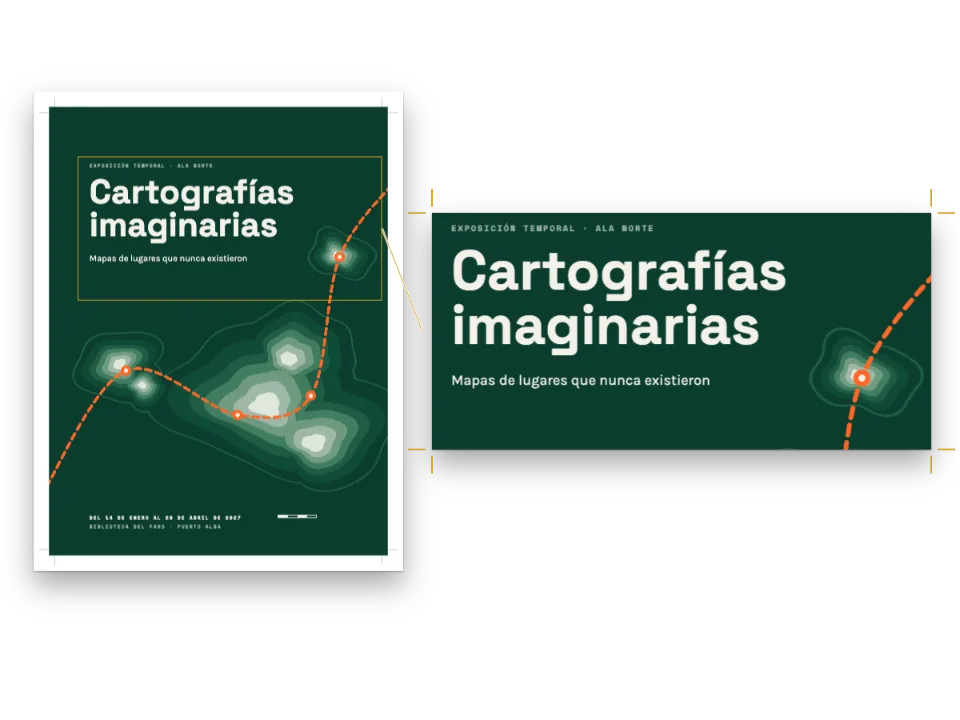
Sete páginas de um pequeno catálogo de exposição, 160 × 195 mm, sobre quatro interiores de Johannes Vermeer do Rijksmuseum, do Met e da National Gallery of Art. O ensaio abre numa página ímpar com o título rebaixado. Cada pintura que ele cita fica sozinha na próxima página inteira: A leiteira na página 2, dentro das margens e sob o seu cabeçalho; a Jovem com uma jarra de água e a Mulher lendo uma carta ficam frente a frente nas páginas 4 e 5, uma cortada rente ao refile, a outra entrando na sangria além das marcas de corte, as duas sem cabeçalho nem fólio. Um detalhe da balança sai com 60 mm de largura na página 7, com a legenda ao lado. O PDF leva as marcas, um TrimBox e um BleedBox.
Esta receita responde a
- Como imprimo uma pintura como prancha de página inteira (dentro das margens, até o refile ou sangrada) e um detalhe com largura fixa em mm?
- Como faço um catálogo de arte: a ficha na página esquerda e a prancha em frente, na direita?
- Como faço um PDF pronto para impressão, com sangria, marcas de corte, marcadores, rótulos de página e espaço de cor?
A resposta curta
// Every plate stands alone on the first whole page after its citation, as large as the area
// allows. true (or 'content') keeps it inside the margins with its running heads; 'trim'
// covers the page to the cut, 'bleed' to the bleed. Those two crop the picture about its
// centre, put the caption on a band of paper at the foot, and drop the heads and the folio.
const plateType = { id: 'plate', name: t({ en: 'Plate', es: 'Lámina' }),
  shortLabel: t({ en: 'plate', es: 'lámina' }), captionPrefix: t({ en: 'Plate', es: 'Lámina' }),
  numberingTemplate: '{n}', resetOn: 'never', counterFormat: 'decimal',
  defaultPlacement: { plate: true, captionMeasure: 'body' } }; // the caption as wide as it
const REACH = { milkmaid: 'content', pitcher: 'trim', letter: 'bleed', balance: 'content' };
// A width as a length is measured against the slot, not shared out of it: the detail prints
// 60 mm wide in any layout, 1.25 times the 48 mm of canvas it shows. Its caption stands
// beside it in what is left of the column.
const DETAIL = { width: { value: 60, unit: 'mm' }, captionSide: 'inside', align: 'left' };
Ingredientes
- Funcionalidades
- Pranchas de página inteiraLarguras de figura em milímetrosFiguras e tabelas como recursosCitações que posicionam as figurasTipos de recurso personalizadosLegendas numeradasEstilo de legendaLinhas de fonte e créditoLegendas lateraisSangria e marcas de corteCabeços por tipo de páginaCabeços e fóliosMargens espelhadasAberturas desenhadasAtributos de títuloEstilos de parágrafoPaleta de cores semânticaExportação para PDF
- Tipografia
- Spectral, Cormorant Garamond, Jost (SIL OFL 1.1)
- Materiais
balance-1700.jpgbalance-detail-1051.jpgletter-2400.jpgmilkmaid-1800.jpgpitcher-2400.jpg- Plate 1, Johannes Vermeer, The Milkmaid, c. 1660, Rijksmuseum SK-A-2344; the museum’s image reduced to 1,800 px high (Rijksmuseum, Amsterdam, CC0 1.0)
- Plate 2, Johannes Vermeer, Young Woman with a Water Pitcher, c. 1662, The Met 89.15.21; the museum’s image, its unpainted edges cut off, reduced to 2,400 px high (The Metropolitan Museum of Art, New York (Open Access), CC0 1.0)
- Plate 3, Johannes Vermeer, Woman Reading a Letter, c. 1663, Rijksmuseum SK-C-251; the museum’s image reduced to 2,400 px high (Rijksmuseum, Amsterdam, CC0 1.0)
- Plate 4, Johannes Vermeer, Woman Holding a Balance, c. 1664, National Gallery of Art 1942.9.97; the museum’s image reduced to 1,700 px high (National Gallery of Art, Washington (Open Access), CC0 1.0)
- Figure 1, a 48 × 63 mm detail of plate 4 cut from the museum’s full-resolution image and reduced to 800 px wide (National Gallery of Art, Washington (Open Access), CC0 1.0)
Preparo
#1 · Um tipo para as pranchas, um alcance por pintura
O código é a resposta curta acima. O tipo das pranchas define plate: true como posicionamento padrão, então uma pintura citada pelo ensaio vai para a primeira página que pode ocupar inteira e cresce até a mancha, com a legenda embaixo. REACH muda isso pintura a pintura: 'trim' e 'bleed' cobrem a página e recortam a imagem em torno do centro, por isso vale escolher pinturas de proporção próxima à da página (estas têm de 0,85 a 0,89 de largura para 1 de altura, a página 0,82). captionMeasure: 'body' dá à legenda de uma prancha interna a largura da imagem.
#2 · Cada arquivo do tamanho de onde é impresso
// JPEGs in assets/ at the pixels each needs for 300 ppi where it prints: 2,400 px high for
// the plates that cover the page (195 mm + 2 × 3 mm of bleed is 7.9 in), less for the rest.
const PAINTINGS = {
  milkmaid: [[1617, 1800], { en: 'Johannes Vermeer, *The Milkmaid*, c. 1660',
    es: 'Johannes Vermeer, *La lechera*, h. 1660' }, { en: 'Oil on canvas, 45.5 × 41 cm. '
    + 'Rijksmuseum, Amsterdam, SK-A-2344, purchased with the support of the Vereniging '
    + 'Rembrandt. Public domain.', es: 'Óleo sobre lienzo, 45,5 × 41 cm. Rijksmuseum, '
    + 'Ámsterdam, SK-A-2344, adquirido con el apoyo de la Vereniging Rembrandt. Dominio '
    + 'público.' }, { en: 'A kitchen maid in a yellow bodice and blue apron pours milk from '
    + 'a jug into a bowl beside a basket of bread, under a window on the left.', es: 'Una '
    + 'criada con corpiño amarillo y delantal azul vierte leche de una jarra en un cuenco, '
    + 'junto a un cesto de pan, bajo una ventana a la izquierda.' }],
  pitcher: [[2116, 2400], { en: 'Johannes Vermeer, *Young Woman with a Water Pitcher*, '
    + 'c. 1662', es: 'Johannes Vermeer, *Joven con una jarra de agua*, h. 1662' },
  { en: 'Oil on canvas, 45.7 × 40.6 cm. The Metropolitan Museum of Art, New York, 89.15.21, '
    + 'Marquand Collection, gift of Henry G. Marquand, 1889. Public domain.', es: 'Óleo sobre '
    + 'lienzo, 45,7 × 40,6 cm. The Metropolitan Museum of Art, Nueva York, 89.15.21, '
    + 'colección Marquand, donación de Henry G. Marquand, 1889. Dominio público.' },
  { en: 'A young woman in a white linen hood opens a window with one hand and holds a '
    + 'silver-gilt pitcher in a basin with the other; a map hangs behind her.', es: 'Una joven '
    + 'con toca de lino blanco abre una ventana con una mano y sujeta con la otra una jarra '
    + 'de plata dorada sobre una palangana; detrás cuelga un mapa.' }],
  letter: [[2039, 2400], { en: 'Johannes Vermeer, *Woman Reading a Letter*, c. 1663',
    es: 'Johannes Vermeer, *Mujer leyendo una carta*, h. 1663' }, { en: 'Oil on canvas, '
    + '46.5 × 39 cm. Rijksmuseum, Amsterdam, SK-C-251, on loan from the City of Amsterdam '
    + '(A. van der Hoop Bequest). Public domain.', es: 'Óleo sobre lienzo, 46,5 × 39 cm. '
    + 'Rijksmuseum, Ámsterdam, SK-C-251, en préstamo de la ciudad de Ámsterdam (legado '
    + 'A. van der Hoop). Dominio público.' }, { en: 'A woman in a blue jacket stands reading '
    + 'a letter in front of a map of Holland, between two chairs, lit from the left.',
  es: 'Una mujer con chaqueta azul lee una carta de pie ante un mapa de Holanda, entre dos '
    + 'sillas, con la luz a la izquierda.' }],
  balance: [[1502, 1700], { en: 'Johannes Vermeer, *Woman Holding a Balance*, c. 1664',
    es: 'Johannes Vermeer, *Mujer con una balanza*, h. 1664' }, { en: 'Oil on canvas, '
    + '39.7 × 35.5 cm. National Gallery of Art, Washington, 1942.9.97, Widener Collection. '
    + 'Public domain.', es: 'Óleo sobre lienzo, 39,7 × 35,5 cm. National Gallery of Art, '
    + 'Washington, 1942.9.97, colección Widener. Dominio público.' }, { en: 'A woman stands '
    + 'at a table spread with pearls and coins, holding up a small balance; a painting of the '
    + 'Last Judgment hangs behind her.', es: 'Una mujer, de pie ante una mesa con perlas y '
    + 'monedas, sostiene en alto una pequeña balanza; detrás cuelga un Juicio Final.' }],
  'balance-detail': [[800, 1051], { en: 'Detail of :ref{id="balance"}: the beam and its two '
    + 'empty pans. The 48 mm of canvas it shows print 60 mm wide, 1.25 times their size.',
  es: 'Detalle de la :ref{id="balance"}: el astil y sus dos platillos vacíos. Los 48 mm de '
    + 'lienzo que muestra se imprimen a 60 mm, 1,25 veces su tamaño.' }, { en: 'National '
    + 'Gallery of Art, Washington. Public domain.', es: 'National Gallery of Art, Washington. '
    + 'Dominio público.' }, { en: 'A hand holds a small balance by its loop between thumb '
    + 'and forefinger; both pans hang empty.', es: 'Una mano sostiene una pequeña balanza por '
    + 'el aro entre el pulgar y el índice; los dos platillos cuelgan vacíos.' }],
};
const resources = Object.entries(PAINTINGS).map(([id, [[w, h], caption, note, alt]]) => ({
  id, typeId: REACH[id] ? 'plate' : 'detail', kind: 'bitmap', createdAt: 0, updatedAt: 0,
  bitmap: { fileId: `${id}-${h > w ? h : w}.jpg`, format: 'jpeg', width: w, height: h },
  caption: t(caption), note: t(note), altText: t(alt),
  ...(REACH[id] && { placement: { plate: REACH[id] } }) }));
A verificação de pré-impressão conta o recorte: uma prancha sangrada tem aqui 201 mm de altura com a sangria, então o seu arquivo precisa de 2.400 px para chegar a 300 ppi, e as duas pranchas dentro das margens precisam de menos. Elas saem entre 303 e 348 ppi. page.cutLines dá à folha os seus 3 mm de sangria; sem ele, 'bleed' para no refile como 'trim'.
#3 · Cabeçalhos que deixam as pranchas cheias em paz
// pages: 'body' keeps them off the opener; a plate set to the trim or the bleed takes the
// 'plate' role, which no element here names, so its page prints bare.
const head = (id, content, parity, edge, x, extra = {}) => ({ kind: 'text', id, content,
  parity, pages: 'body', fontFamily: LABEL, fontSize: pt(7.5), color: col('muted'),
  placement: at('page', edge, x, 11), ...caps(7.5), ...extra });
const folio = { color: col('ink'), letterSpacing: pt(0.6) };
const header = { elements: [
  head('verso-folio', '{pageNumber}', 'even', 'top-left', OUTER, folio),
  head('verso-title', '{title}', 'even', 'top-left', OUTER + 8),
  head('recto-title', '{chapterTitle}', 'odd', 'top-right', -(OUTER + 8)),
  head('recto-folio', '{pageNumber}', 'odd', 'top-right', -OUTER, folio),
] };
const footer = { elements: [head('drop-folio', '{pageNumber}', 'all', 'top', 0,
  { ...folio, pages: 'opener', placement: at('container', 'top', 0, 8) })] };
Uma prancha no refile ou sangrada dá à sua página o papel 'plate'. Estes cabeçalhos pedem pages: 'body', então saem sobre as pranchas internas e somem nas páginas 4 e 5. Um elemento que deva aparecer ali mesmo assim, um pequeno crédito no canto, por exemplo, nomeia 'plate' no seu pages.
#4 · Um detalhe de tamanho conhecido
O tipo do detalhe define width: { value: 60, unit: 'mm' } com captionSide: 'inside'. Um comprimento é medido contra o espaço em vez de tomar uma fração dele: os 48 mm de tela que o recorte mostra saem com 60 mm, 1,25 vez o seu tamanho, em qualquer coluna e edição, e a legenda pode dizer isso.
A receita completa
// ═══ Postext Cookbook · Nº 183 · Art plates to the margins, the trim and the bleed ═════
// https://postext.dev/en/cookbook/art-plates-to-the-bleed
// Code: MIT · Text: original (CC BY 4.0) · Paintings: Rijksmuseum, The Met, NGA (CC0)
// Fonts: Spectral, Cormorant Garamond, Jost (SIL OFL 1.1) · Needs postext ≥ 1.73.0
// An exhibition essay on four interiors by Vermeer. Each painting is a full-page plate: two
// inside the margins, one to the trimmed edge, one out to the bleed. A detail prints 60 mm wide.
import {
  buildDocumentWithFonts, renderPageToCanvas, registerResourceImage,
} from 'https://esm.sh/postext';
import { renderToPdf, decompressWoff2 } from 'https://esm.sh/postext-pdf';

const LANG = 'en'; // @lang: the language of the sample document ('en' | 'es')
const RECIPE = 'art-plates-to-the-bleed';

// ─── 1 · Design ─────────────────────────────────────────────────────────────
// #region palette: a warm paper and ink, and the ultramarine of the Delft jackets
const palette = {
  ink: '#22201c', // text: a warm near-black
  accent: '#2c4a7c', // kicker, caption labels: the blue of the reading woman's jacket
  rule: '#c9bfae', // the opener's hairline
  muted: '#6b6359', // running heads, folios, credit lines
  paper: '#fbf9f4', // the page, and the band under a caption set over a plate
};
const col = (id) => ({ hex: palette[id], model: 'hex', paletteId: id });
const colorPalette = [
  ...Object.entries(palette).map(([id, hex]) => ({ id, name: id, value: { hex, model: 'hex' } })),
  // The engine's defaults link to 'main-color': pointed at the accent, no default blue shows.
  { id: 'main-color', name: 'accent (defaults)', value: { hex: palette.accent, model: 'hex' } },
];
// #endregion
const [TEXT, DISPLAY, LABEL] = ['Spectral', 'Cormorant Garamond', 'Jost'];
const [PAGE_W, PAGE_H, TOP, BOTTOM, INNER, OUTER] = [160, 195, 20, 22, 18, 24]; // mm
const BLEED = 3; // mm of picture past the trim on the bleed plate, and the crop marks' offset
const LEAD = 13.5; // body leading in pt
const at = (to, edge, x, y, size) => ({ anchor: { to, edge }, offset: { x: mm(x), y: mm(y) },
  ...(size && { size }) });
const caps = (size) => ({ fontWeight: 500, textTransform: 'uppercase',
  letterSpacing: pt(size * 0.2) });

// #region answer: a plate type, and how far each picture reaches
// Every plate stands alone on the first whole page after its citation, as large as the area
// allows. true (or 'content') keeps it inside the margins with its running heads; 'trim'
// covers the page to the cut, 'bleed' to the bleed. Those two crop the picture about its
// centre, put the caption on a band of paper at the foot, and drop the heads and the folio.
const plateType = { id: 'plate', name: t({ en: 'Plate', es: 'Lámina' }),
  shortLabel: t({ en: 'plate', es: 'lámina' }), captionPrefix: t({ en: 'Plate', es: 'Lámina' }),
  numberingTemplate: '{n}', resetOn: 'never', counterFormat: 'decimal',
  defaultPlacement: { plate: true, captionMeasure: 'body' } }; // the caption as wide as it
O script.js montado funciona como está: cole-o como script de módulo em qualquer página ou abra a receita no CodePen. Pasta da receita no GitHub ↗ (abre em uma nova aba)
Variações
#Todas as pranchas sangradas
Dê o mesmo alcance a todas as pinturas: cada prancha cobre então a sua página, sem cabeçalho nem fólio, e só o recorte muda.
-const REACH = { milkmaid: 'content', pitcher: 'trim', letter: 'bleed', balance: 'content' };
+const REACH = { milkmaid: 'bleed', pitcher: 'bleed', letter: 'bleed', balance: 'bleed' };#O detalhe em tamanho real
Recorte 60 mm de tela do arquivo do museu e mantenha a largura: a legenda dirá então 1:1. O original desta pintura tem 1.666 ppi, então mesmo um detalhe de poucos milímetros passa de 300 ppi.
Erros comuns
- Uma prancha citada no mesmo parágrafo que outra espera a página seguinte, porque uma página que já tem um flutuante é pulada, três no máximo.
- Larguras em
ptemmfuncionam;pxeemnão são lidas como comprimento, e a figura ocupa todo o seu espaço. - Uma pintura muito mais larga que a página perde as laterais numa prancha no refile ou sangrada. Mantenha as horizontais dentro das margens, onde a imagem aparece inteira.
Créditos
- Receita
- Ignacio Ferro
- Texto
- The essay, the captions and the note on the plates · Postext Cookbook · CC BY 4.0
- Imagens
- Plate 1, Johannes Vermeer, The Milkmaid, c. 1660, Rijksmuseum SK-A-2344; the museum’s image reduced to 1,800 px high · Rijksmuseum, Amsterdam · CC0 1.0
- Plate 2, Johannes Vermeer, Young Woman with a Water Pitcher, c. 1662, The Met 89.15.21; the museum’s image, its unpainted edges cut off, reduced to 2,400 px high · The Metropolitan Museum of Art, New York (Open Access) · CC0 1.0
- Plate 3, Johannes Vermeer, Woman Reading a Letter, c. 1663, Rijksmuseum SK-C-251; the museum’s image reduced to 2,400 px high · Rijksmuseum, Amsterdam · CC0 1.0
- Plate 4, Johannes Vermeer, Woman Holding a Balance, c. 1664, National Gallery of Art 1942.9.97; the museum’s image reduced to 1,700 px high · National Gallery of Art, Washington (Open Access) · CC0 1.0
- Figure 1, a 48 × 63 mm detail of plate 4 cut from the museum’s full-resolution image and reduced to 800 px wide · National Gallery of Art, Washington (Open Access) · CC0 1.0
- Fontes
- Spectral (SIL OFL 1.1) · Cormorant Garamond (SIL OFL 1.1) · Jost (SIL OFL 1.1)
- Código
- MIT, como o Postext
Editar este texto ↗ (abre em uma nova aba)Pasta da receita no GitHub ↗ (abre em uma nova aba)