Em poucas palavras
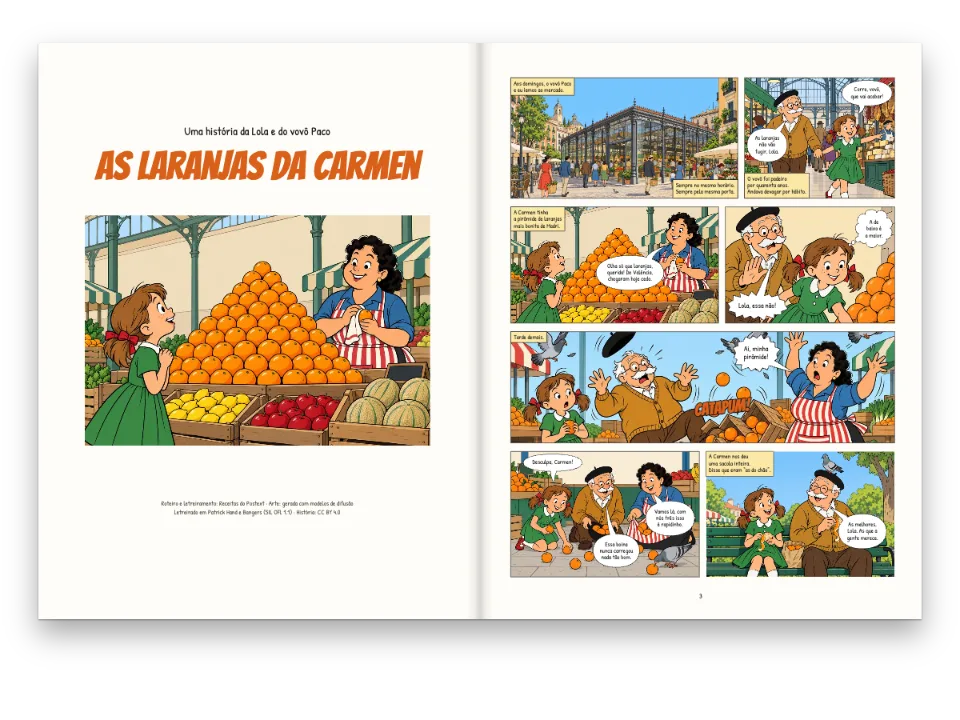
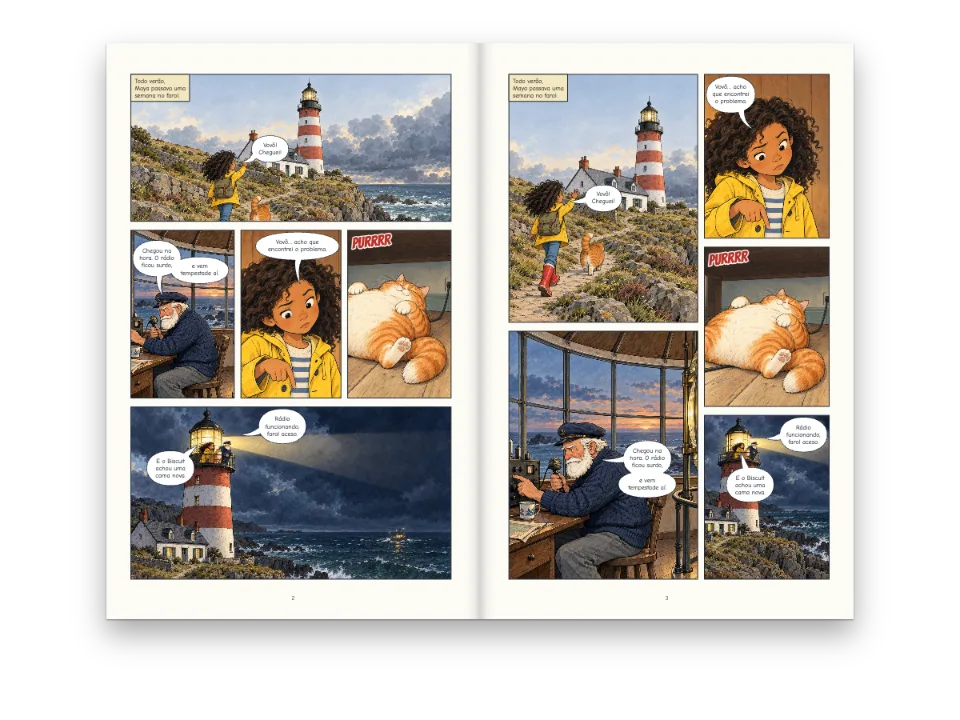
Uma história em quadrinhos montada sobre duas páginas em frente como se fossem uma só: um desenho largo de uma feira lotada atravessa o meio do livro, e três quadros ficam embaixo.
O que você vai compor
A segunda história do álbum da Nº 152, ¡Abuelo!, contada em duas páginas em frente. Num sábado de dezembro a feira está lotada, e Lola perde o avô no meio da multidão. A metade de cima da página dupla é um único panorama de 432 mm de largura: Lola, minúscula, na ponta esquerda, Paco procurando por ela na ponta direita, e entre os dois o corredor da feira, que vai dar na dobra. Embaixo, três quadros: Lola sozinha entre as pernas das pessoas, Paco assobiando em cima de um caixote de frutas, o reencontro com a boina dele voando. A divisão é escrita uma vez só para as duas páginas, então o panorama cruza a lombada e a sarjeta da faixa de baixo cai na dobra. O original é em espanhol; as edições em inglês, catalão, chinês, árabe, japonês e português letreiram a mesma página dupla.
Esta receita responde a
- Como faço para estender uma página de quadrinhos por uma página dupla?
A resposta curta
// The content writes :::page{spread split="55 / * [25 | 25 | *]"}: one frame from the verso's
// outer margin to the recto's (the inner margins drop out), split as one page. The panorama
// crosses the spine; the line at 50 % of the lower tier is the spine itself, so its gutter
// straddles the fold and no panel is cut by it.
const comics = {
  gutter: { horizontal: mm(5), vertical: mm(4) }, // 2 mm of white on each side of the fold
  panel: { borderWidth: pt(0.75), borderColor: col('ink'), background: col('paper') },
  lettering: { fontFamily: LETTER, fontSize: pt(LATIN ? 9.5 : 8.5), lineHeight: 1.1,
    color: col('ink') },
  runningHeads: true, // folios on both halves
};
// A spread opens on a verso, an even page. Page 1 of a document is a recto, so the engine
// would leave it blank and start on page 2; this episode continues an album at page 2.
const continuation = { pageIndexOffset: 1, pageNumbering: { startAt: 2 } };
Ingredientes
- Funcionalidades
- Páginas duplas de quadrinhosDivisão em quadrosArte e enquadramento do quadroPersonagens e âncorasPáginas de quadrinhosLetreiramento de quadrinhosLetreiramento em outros idiomasEstilos de balãoBordas e sarjetas dos quadrosMargens espelhadasPaleta de cores semânticaPáginas em um canvasExportação para PDF
- Também usa
- Cor do papelCabeços por tipo de páginaFontes incorporadas ao PDFFiguras e tabelas como recursosOnomatopeias
- Tipografia
- Patrick Hand, Bangers, Noto Sans SC, ZCOOL KuaiLe, Zen Antique, Dela Gothic One, Playpen Sans Arabic, Lalezar (SIL OFL 1.1)
- Materiais
ds1-1900.jpgds2.jpgds3.jpgds4.jpg- Panorama of the crowded market hall: tiny Lola stands lost on the far left; far right, her grandfather searches the crowd. (Generated With Diffusion Models, original)
- Lola, tearful, stands among grown-ups' legs and shopping bags. (Generated With Diffusion Models, original)
- Paco stands on a fruit crate and whistles through his fingers; shoppers turn to look. (Generated With Diffusion Models, original)
- Lola leaps into her grandfather's arms; his beret flies off and the stallholders smile. (Generated With Diffusion Models, original)
Preparo
#1 · Uma divisão para as duas páginas
O código é a resposta curta lá em cima. A história inteira é uma diretiva com a marca spread:
:::page{spread split="55 / * [25 | 25 | *]"}
::panel{art=ds1}
caption: Un sábado de diciembre, el mercado estaba hasta los topes.
lola: ¿Abuelo?
paco{shout}: ¿Lola? ¡Lolaaa!
O quadro geral vai da margem externa do verso até a do recto; as margens internas desaparecem. A primeira faixa, com 55 % da altura, é um único quadro que cruza a lombada. Na segunda, 25 | 25 | * põe a sua primeira linha em 25 % e a segunda em 50 %, a própria lombada: dois quadros quadrados no verso, o reencontro no recto. Uma página dupla começa numa página par, e a página 1 de um documento é um recto, então a composição passa continuation: { pageIndexOffset: 1 }: este episódio continua o álbum na página 2, e nenhuma página em branco vem antes.
#2 · Um panorama grande o bastante para duas páginas
// The panorama is 1,900 px wide: across the 432 mm of the spread it prints at about 112 dpi.
const box = ([x, y, width, height]) => ({ x, y, width, height });
const who = (id, x, y, head, face) => ({ id, x, y,
  ...(head && { head: { x: head[0], y: head[1] } }), ...(face && { face: box(face) }) });
const ART = {
  ds1: { width: 1900, height: 633, safeArea: box([.03, .27, .93, .53]),
    alt: t({ en: 'Panorama of the crowded market hall: tiny Lola stands lost on the far left; '
        + 'far right, her grandfather searches the crowd.',
      es: 'Panorámica del mercado lleno de gente: a la izquierda del todo, Lola, '
        + 'diminuta, está perdida; a la derecha del todo, su abuelo la busca entre la multitud.',
      ca: 'Panoràmica del mercat ple de gent: a l’extrem esquerre, la Lola, petitíssima, '
        + 'està perduda; a l’extrem dret, el seu avi la busca entre la gentada.',
      zh: '拥挤的市场全景:最左边,小小的萝拉迷了路;最右边,她的爷爷在人群中寻找她。',
      ar: 'منظر واسع للسوق المزدحم: لولا الصغيرة تائهة في أقصى اليسار، وفي أقصى اليمين '
        + 'جدّها يبحث عنها بين الناس.',
      ja: '人でいっぱいの市場のパノラマ。左端に小さなローラが迷子になって立ち、右端では祖父が人ごみの中を探している。',
      pt: 'Panorama do mercado lotado: na ponta esquerda, a pequena Lola está perdida; na ponta '
        + 'direita, o avô a procura no meio da multidão.' }),
    anchors: [
      who('lola', .065, .58, [.063, .55], [.045, .51, .04, .11]),
      who('paco', .925, .38, [.925, .34], [.9, .3, .05, .12]),
    ],
  },
  ds2: { width: 1152, height: 1152, safeArea: box([.31, .08, .35, .62]),
    alt: t({ en: "Lola, tearful, stands among grown-ups' legs and shopping bags.",
      es: 'Lola, con lágrimas en los ojos, está de pie entre piernas de mayores y bolsas '
        + 'de la compra.',
      ca: 'La Lola, amb llàgrimes als ulls, és dreta entre cames de grans i bosses de la compra.',
      zh: '萝拉含着眼泪,站在大人们的腿和购物袋之间。',
      ar: 'لولا والدموع في عينيها واقفة بين سيقان الكبار وأكياس التسوّق.',
      ja: '涙ぐんだローラが、大人の足と買い物袋のあいだに立っている。',
      pt: 'Lola, com lágrimas nos olhos, está de pé entre pernas de adultos e sacolas '
        + 'de compras.' }),
    anchors: [
      who('lola', .505, .24, [.48, .17], [.4, .1, .18, .19]),
    ],
  },
  ds3: { width: 1000, height: 1000, safeArea: box([.34, .07, .47, .23]),
    alt: t({ en: 'Paco stands on a fruit crate and whistles through his fingers; shoppers '
        + 'turn to look.',
      es: 'Paco, subido a una caja de fruta, silba con los dedos; la gente se vuelve a mirar.',
      ca: 'En Paco, enfilat a una caixa de fruita, xiula amb els dits; la gent es gira a mirar.',
      zh: '帕科站在水果箱上,用手指吹口哨;买东西的人都回过头来看。',
      ar: 'باكو واقف على صندوق فاكهة ويصفّر بأصابعه، والمتسوّقون يلتفتون لينظروا.',
      ja: 'パコが果物の木箱に乗って指笛を吹き、買い物客がふり返る。',
      pt: 'Paco, em cima de um caixote de frutas, assobia com os dedos; as pessoas se viram '
        + 'para olhar.' }),
    anchors: [
      who('paco', .5, .2, [.47, .14], [.38, .08, .17, .16]),
      who('sfx', .62, .17),
    ],
  },
  ds4: { width: 1200, height: 800, safeArea: box([.33, .05, .48, .57]),
    alt: t({ en: "Lola leaps into her grandfather's arms; his beret flies off and the "
        + "stallholders smile.",
      es: 'Lola salta a los brazos de su abuelo; la boina sale volando y los tenderos sonríen.',
      ca: 'La Lola salta als braços del seu avi; la boina surt volant i els paradistes somriuen.',
      zh: '萝拉扑进爷爷怀里;他的贝雷帽飞了出去,摊主们都笑了。',
      ar: 'لولا تقفز إلى ذراعي جدّها، وقبعته تطير، والباعة يبتسمون.',
      ja: 'ローラが祖父の腕に飛びこむ。ベレー帽が飛び、店の人たちがほほえむ。',
      pt: 'Lola pula nos braços do avô; a boina sai voando e os feirantes sorriem.' }),
    anchors: [
      who('lola', .51, .27, [.47, .2], [.42, .14, .13, .19]),
      who('paco', .595, .31, [.62, .22], [.55, .14, .15, .22]),
    ],
    avoid: [box([.67, .06, .13, .22])],
  },

};
O panorama é o único desenho impresso por cima da dobra, com 432 × 144 mm, por isso vai com 1.900 px (380 KB); os outros três têm de 1.000 a 1.200 px. A sua área segura é uma faixa que ocupa quase toda a largura, e os seus dois personagens que falam ficam nas pontas, a 6 % e a 92 % da largura, longe da lombada, onde a encadernação engoliria um balão. O desenho foi feito com o meio livre de rostos: o corredor da feira vai dar na dobra.
#3 · Os balões do álbum
comics.balloonStyles = [
  { id: 'speech', fill: col('balloon'), stroke: col('ink'), strokeWidth: pt(0.6) },
  { id: 'caption', fill: col('cartouche'), stroke: col('ink'), strokeWidth: pt(0.6),
    padding: em(0.45), aspect: 3.4 },
  { id: 'shout', fill: col('balloon'), stroke: col('ink'), burstPoints: 16, fontScale: 1.2 },
  { id: 'whisper', fill: col('balloon'), stroke: col('ink') },
  { id: 'sfx', fontFamily: DISPLAY, color: col('orange'), halo: pt(1.6), haloColor: col('ink'),
    fontScale: 3.2 },
];
comics.cast = [
  { id: 'lola', name: 'Lola' },
  { id: 'paco', name: t({ es: 'el abuelo Paco', en: 'Grandpa Paco', ca: "l'avi Paco",
    zh: '帕科爷爷', ar: 'الجد باكو', ja: 'パコおじいちゃん', pt: 'o vovô Paco' }) },
];
Os estilos de balão são os da Nº 152: balões de fala brancos, recordatórios amarelo-claros, uma explosão para o grito de Paco, um contorno tracejado para o sussurro de Lola e o assobio na fonte das onomatopeias do álbum, a Bangers nas edições em escrita latina. cast dá ao PDF e ao EPUB os nomes que eles leem antes de cada fala.
A receita completa
// ═══ Postext Cookbook · Nº 154 · One comic page across a double spread ═══════════════ // https://postext.dev/en/cookbook/comic-double-spread // Code: MIT · Story: written for the recipe (CC BY 4.0) · Pictures: generated with diffusion models // Fonts: Patrick Hand, Bangers, the comic faces of each script (OFL) · Needs postext ≥ 1.21.0 // One split tree laid across two facing pages: a panorama runs over the spine, and the // tier under it splits at the spine's gutter. Same album, same lettering as Nº 152. import { buildDocument, renderPageToCanvas, clearMeasurementCache, registerResourceImage, defaultComicFont, defaultComicSfxFont, } from 'https://esm.sh/postext'; import { renderToPdf, decompressWoff2 } from 'https://esm.sh/postext-pdf'; const LANG = 'pt'; // @lang: the album's language: 'es' | 'en' | 'ca' | 'zh' | 'ar' | 'ja' | 'pt' const RECIPE = 'comic-double-spread'; // ─── 1 · Design ───────────────────────────────────────────────────────────── // #region palette: the album's flat colours const palette = { ink: '#1d1b19', // outlines, lettering, folios orange: '#d9601a', // the sound effect cartouche: '#fbe8a6', // narration boxes balloon: '#ffffff', muted: '#5f5a54', // the colophon paper: '#fffdf8', }; const col = (id) => ({ hex: palette[id], model: 'hex', paletteId: id }); const colorPalette = [ ...Object.entries(palette).map(([id, hex]) => ({ id, name: id, value: { hex, model: 'hex' } })), { id: 'main-color', name: 'orange (defaults)', value: { hex: palette.orange, model: 'hex' } }, ]; // #endregion const LOCALE = t({ es: 'es', en: 'en-gb', ca: 'ca', zh: 'zh-Hans', ar: 'ar', ja: 'ja', pt: 'pt-BR' }); const LATIN = ['es', 'en', 'ca', 'pt'].includes(LANG); const LETTER = LATIN ? 'Patrick Hand' : defaultComicFont(LOCALE); // mixed-case hand lettering const DISPLAY = defaultComicSfxFont(LOCALE); // Bangers, Dela Gothic One, ZCOOL KuaiLe, Lalezar // #region answer: one split across two facing pages, opened on a verso // The content writes :::page{spread split="55 / * [25 | 25 | *]"}: one frame from the verso's // outer margin to the recto's (the inner margins drop out), split as one page. The panorama // crosses the spine; the line at 50 % of the lower tier is the spine itself, so its gutter // straddles the fold and no panel is cut by it. const comics = { gutter: { horizontal: mm(5), vertical: mm(4) }, // 2 mm of white on each side of the fold panel: { borderWidth: pt(0.75), borderColor: col('ink'), background: col('paper') }, lettering: { fontFamily: LETTER, fontSize: pt(LATIN ? 9.5 : 8.5), lineHeight: 1.1, color: col('ink') }, runningHeads: true, // folios on both halves }; // A spread opens on a verso, an even page. Page 1 of a document is a recto, so the engine // would leave it blank and start on page 2; this episode continues an album at page 2. const continuation = { pageIndexOffset: 1, pageNumbering: { startAt: 2 } }; // #endregion // #region balloons: the album's balloons and cartouches (Nº 152) comics.balloonStyles = [ { id: 'speech', fill: col('balloon'), stroke: col('ink'), strokeWidth: pt(0.6) }, { id: 'caption', fill: col('cartouche'), stroke: col('ink'), strokeWidth: pt(0.6), padding: em(0.45), aspect: 3.4 }, { id: 'shout', fill: col('balloon'), stroke: col('ink'), burstPoints: 16, fontScale: 1.2 }, { id: 'whisper', fill: col('balloon'), stroke: col('ink') }, { id: 'sfx', fontFamily: DISPLAY, color: col('orange'), halo: pt(1.6), haloColor: col('ink'), fontScale: 3.2 }, ]; comics.cast = [ { id: 'lola', name: 'Lola' }, { id: 'paco', name: t({ es: 'el abuelo Paco', en: 'Grandpa Paco', ca: "l'avi Paco", zh: '帕科爷爷', ar: 'الجد باكو', ja: 'パコおじいちゃん', pt: 'o vovô Paco' }) }, ]; // #endregion const COLOPHON = t({ es: 'Rotulado en Patrick Hand y Bangers (SIL OFL) · Dibujo: generado con modelos de difusión', en: 'Lettered in Patrick Hand and Bangers (SIL OFL) · Art: generated with diffusion models', ca: 'Retolat en Patrick Hand i Bangers (SIL OFL) · Dibuix: generat amb models de difusió', zh: '嵌字:Noto Sans SC、ZCOOL KuaiLe(SIL OFL)· 画面:由扩散模型生成', ar: 'الخطوط: Playpen Sans Arabic وLalezar (SIL OFL) · الرسوم: مولّدة بنماذج الانتشار', ja: '写植:Zen Antique、Dela Gothic One(SIL OFL)・ 作画:拡散モデルで生成', pt: 'Letreirado em Patrick Hand e Bangers (SIL OFL) · Arte: gerada com modelos de difusão', }); const foot = (id, content, y, extra) => ({ kind: 'text', id, content, fontFamily: LETTER, align: 'center', pages: 'comic', placement: { anchor: { to: 'page', edge: 'bottom' }, offset: { y: mm(y) } }, ...extra }); const config = () => ({ // a factory: the engine caches resolved configs per object locale: LOCALE, colorPalette, page: { sizePreset: 'custom', width: mm(230), height: mm(300), dpi: 150, // the album of Nº 152 backgroundColor: col('paper'), margins: { top: mm(18), bottom: mm(22), left: mm(16), right: mm(14), mirror: true }, }, layout: { layoutType: 'single' }, bodyText: { fontFamily: LETTER, fontSize: pt(11), lineHeight: pt(15), color: col('ink'), boldColor: col('ink'), italicColor: col('ink'), referenceColor: col('ink') }, headings: { fontFamily: DISPLAY, color: col('orange'), levels: [{ level: 1, breakBefore: { enabled: true, parity: 'any' } }] }, // the H1 break comics, header: { elements: [] }, footer: { elements: [ foot('folio', '{pageNumber}', -13, { fontSize: pt(10), color: col('ink') }), foot('colophon', COLOPHON, -7, { fontSize: pt(7), color: col('muted'), parity: 'odd' }), ] }, }); // ─── 2 · Content ──────────────────────────────────────────────────────────── const markdown = String.raw`:::page{spread split="55 / * [25 | 25 | *]"}Amostra em Markdown · 15 linhas · content.pt.md
::panel{art=ds1} caption: Num sábado de dezembro, o mercado estava abarrotado. lola: Vovô? paco{shout}: Lola? Lolaaa! ::panel{art=ds2} lola{whisper}: Vovô… cadê você? caption{at=bottom-start}: Lembrei do que ele sempre dizia: se você se perder, fique parada. ::panel{art=ds3} sfx{at="78% 20%" rotate=-8}: FIIIIIU! caption{at=bottom-start}: E que ninguém em Madri assobia como um padeiro. ::panel{art=ds4} lola: Vovô! paco: Aí está você, sua danadinha! paco: E lá se vai a minha boina! :::`; // content.<lang>.md: one :::page{spread} // ─── 3 · Fonts ────────────────────────────────────────────────────────────── const FONTS = { 'Patrick Hand': ['400'], Bangers: ['400'], // Latin editions 'Noto Sans SC': ['400', '700'], 'ZCOOL KuaiLe': ['400'], // Chinese 'Zen Antique': ['400'], 'Dela Gothic One': ['400'], // Japanese 'Playpen Sans Arabic': ['400', '700'], Lalezar: ['400'], // Arabic }; // #region art: the panel manifest: safe areas, speakers' mouths, heads and faces, in fractions // The panorama is 1,900 px wide: across the 432 mm of the spread it prints at about 112 dpi. const box = ([x, y, width, height]) => ({ x, y, width, height }); const who = (id, x, y, head, face) => ({ id, x, y, ...(head && { head: { x: head[0], y: head[1] } }), ...(face && { face: box(face) }) }); const ART = { ds1: { width: 1900, height: 633, safeArea: box([.03, .27, .93, .53]), alt: t({ en: 'Panorama of the crowded market hall: tiny Lola stands lost on the far left; ' + 'far right, her grandfather searches the crowd.', es: 'Panorámica del mercado lleno de gente: a la izquierda del todo, Lola, ' + 'diminuta, está perdida; a la derecha del todo, su abuelo la busca entre la multitud.', ca: 'Panoràmica del mercat ple de gent: a l’extrem esquerre, la Lola, petitíssima, ' + 'està perduda; a l’extrem dret, el seu avi la busca entre la gentada.', zh: '拥挤的市场全景:最左边,小小的萝拉迷了路;最右边,她的爷爷在人群中寻找她。', ar: 'منظر واسع للسوق المزدحم: لولا الصغيرة تائهة في أقصى اليسار، وفي أقصى اليمين ' + 'جدّها يبحث عنها بين الناس.', ja: '人でいっぱいの市場のパノラマ。左端に小さなローラが迷子になって立ち、右端では祖父が人ごみの中を探している。', pt: 'Panorama do mercado lotado: na ponta esquerda, a pequena Lola está perdida; na ponta ' + 'direita, o avô a procura no meio da multidão.' }), anchors: [ who('lola', .065, .58, [.063, .55], [.045, .51, .04, .11]), who('paco', .925, .38, [.925, .34], [.9, .3, .05, .12]), ], }, ds2: { width: 1152, height: 1152, safeArea: box([.31, .08, .35, .62]), alt: t({ en: "Lola, tearful, stands among grown-ups' legs and shopping bags.", es: 'Lola, con lágrimas en los ojos, está de pie entre piernas de mayores y bolsas ' + 'de la compra.', ca: 'La Lola, amb llàgrimes als ulls, és dreta entre cames de grans i bosses de la compra.', zh: '萝拉含着眼泪,站在大人们的腿和购物袋之间。', ar: 'لولا والدموع في عينيها واقفة بين سيقان الكبار وأكياس التسوّق.', ja: '涙ぐんだローラが、大人の足と買い物袋のあいだに立っている。', pt: 'Lola, com lágrimas nos olhos, está de pé entre pernas de adultos e sacolas ' + 'de compras.' }), anchors: [ who('lola', .505, .24, [.48, .17], [.4, .1, .18, .19]), ], }, ds3: { width: 1000, height: 1000, safeArea: box([.34, .07, .47, .23]), alt: t({ en: 'Paco stands on a fruit crate and whistles through his fingers; shoppers ' + 'turn to look.', es: 'Paco, subido a una caja de fruta, silba con los dedos; la gente se vuelve a mirar.', ca: 'En Paco, enfilat a una caixa de fruita, xiula amb els dits; la gent es gira a mirar.', zh: '帕科站在水果箱上,用手指吹口哨;买东西的人都回过头来看。', ar: 'باكو واقف على صندوق فاكهة ويصفّر بأصابعه، والمتسوّقون يلتفتون لينظروا.', ja: 'パコが果物の木箱に乗って指笛を吹き、買い物客がふり返る。', pt: 'Paco, em cima de um caixote de frutas, assobia com os dedos; as pessoas se viram ' + 'para olhar.' }), anchors: [ who('paco', .5, .2, [.47, .14], [.38, .08, .17, .16]), who('sfx', .62, .17), ], }, ds4: { width: 1200, height: 800, safeArea: box([.33, .05, .48, .57]), alt: t({ en: "Lola leaps into her grandfather's arms; his beret flies off and the " + "stallholders smile.", es: 'Lola salta a los brazos de su abuelo; la boina sale volando y los tenderos sonríen.', ca: 'La Lola salta als braços del seu avi; la boina surt volant i els paradistes somriuen.', zh: '萝拉扑进爷爷怀里;他的贝雷帽飞了出去,摊主们都笑了。', ar: 'لولا تقفز إلى ذراعي جدّها، وقبعته تطير، والباعة يبتسمون.', ja: 'ローラが祖父の腕に飛びこむ。ベレー帽が飛び、店の人たちがほほえむ。', pt: 'Lola pula nos braços do avô; a boina sai voando e os feirantes sorriem.' }), anchors: [ who('lola', .51, .27, [.47, .2], [.42, .14, .13, .19]), who('paco', .595, .31, [.62, .22], [.55, .14, .15, .22]), ], avoid: [box([.67, .06, .13, .22])], }, }; // #endregion // ─── 4 · Build & show ─────────────────────────────────────────────────────── const faces = { [LETTER]: FONTS[LETTER], [DISPLAY]: FONTS[DISPLAY] }; // this edition's faces await loadFonts(FONTS, markdown + COLOPHON); // the Latin files of every face await loadCjkFonts(faces, markdown + COLOPHON); await loadArabicFonts(faces, markdown + COLOPHON); await loadComicFonts(faces, markdown + COLOPHON); const resources = await Promise.all([ comicPanel('ds1', asset('ds1-1900.jpg'), ART.ds1), comicPanel('ds2', asset('ds2.jpg'), ART.ds2), comicPanel('ds3', asset('ds3.jpg'), ART.ds3), comicPanel('ds4', asset('ds4.jpg'), ART.ds4), ]); const doc = await buildWithFonts( () => buildDocument({ markdown, resources, continuation }, config()), markdown + COLOPHON); showBook(doc, { title: t({ es: 'Una página de cómic a doble página', en: 'One comic page across a double spread', ca: 'Una pàgina de còmic a doble pàgina', zh: '横跨两页的漫画', ar: 'صفحة قصص مصوّرة على صفحتين متقابلتين', ja: '見開きの漫画', pt: 'Uma página de quadrinhos em página dupla' }) }); offerPdf(() => renderToPdf(doc, { fontProvider: comicPdfProvider, resourceBytes: imageBytes }), `${RECIPE}.pdf`);Kit · core, fonts, viewer, pdf, images, cjk, arabic, comics: igual em todas as receitas · 722 linhas
// ─── Kit ── helpers shared by every Cookbook recipe · postext.dev/cookbook ───── // ─── Kit · core v1 ── the same in every recipe · postext.dev/cookbook function mm(value) { return { value, unit: 'mm' }; } function pt(value) { return { value, unit: 'pt' }; } function em(value) { return { value, unit: 'em' }; } /** The sample language's string: t({ en: 'Figure', es: 'Figura' }). */ function t(strings) { return strings[LANG] ?? Object.values(strings)[0]; } /** A file in this recipe's assets folder, served from the Postext repo by jsDelivr. */ function asset(file) { return `https://cdn.jsdelivr.net/gh/drnachio/postext@main/cookbook/${RECIPE}/assets/${file}`; } // ─── Kit · fonts v2 ── the same in every recipe · postext.dev/cookbook // Postext measures with the loaded faces and caches the widths: load every face // before the first build, from Fontsource, the files the PDF embeds too. /** faces = { 'Family Name': ['400', '400i', '700'] }. `text` is the sample: * č ł † α χ also load latin-ext and greek files (kitSubsetsFor). With * `optional`, a face Fontsource does not ship is skipped instead of failing. * Resolves to the number of faces added. */ async function loadFonts(faces, text = '', { optional = false } = {}) { kitStatus('Loading fonts…'); const ranges = { latin: 'U+0000-00FF,U+0131,U+0152-0153,U+02BB-02BC,U+02C6,U+02DA,U+02DC,U+0304,U+0308,U+0329,' + 'U+2000-206F,U+20AC,U+2122,U+2191,U+2193,U+2212,U+2215,U+FEFF,U+FFFD', 'latin-ext': 'U+0100-02BA,U+02BD-02C5,U+02C7-02CC,U+02CE-02D7,U+02DD-02FF,U+0304,U+0308,U+0329,' + 'U+1D00-1DBF,U+1E00-1E9F,U+1EF2-1EFF,U+2020,U+20A0-20AB,U+20AD-20C0,U+2113,U+2C60-2C7F,U+A720-A7FF', greek: 'U+0370-03FF', }; const jobs = []; let added = 0; for (const [family, specs] of Object.entries(faces)) { const id = fontsourceId(family); const todo = [...new Set(specs)].map((spec) => [parseInt(spec, 10), spec.endsWith('i') ? 'italic' : 'normal']) .filter(([weight, style]) => !hasFace(family, weight, style)); // before any await const meta = optional || /[^\0-ÿ]/u.test(text) ? await fontsourceMeta(family) : null; const subsets = ['latin', ...kitSubsetsFor(text, meta)]; for (const [weight, style] of todo) { if (optional && !(meta?.weights.includes(weight) && meta.styles.includes(style))) continue; for (const subset of subsets) { const url = `https://cdn.jsdelivr.net/npm/@fontsource/${id}@5/files/${id}-${subset}-${weight}-${style}.woff2`; const face = new FontFace(family, `url(${url}) format('woff2')`, { weight: String(weight), style, unicodeRange: ranges[subset] }); jobs.push(face.load().then((ready) => { document.fonts.add(ready); added++; }, () => { if (subset === 'latin' && !optional) throw new Error(`Fontsource has no ${family} ${weight} ${style}`); })); } } } await Promise.all(jobs).catch((error) => { kitFail(error); throw error; }); return added; } /** Runs `build` and loads any face the pages use that FONTS missed (a regular * one with a warning), then clears the measurement cache and builds again. */ async function buildWithFonts(build, text = '') { const tried = new Set(); for (let round = 0; round < 3; round++) { kitStatus('Laying out…'); await new Promise(requestAnimationFrame); // let the status paint first const result = await Promise.resolve().then(build).catch((error) => { kitFail(error); throw error; }); const wanted = { base: {}, variants: {} }; for (const { font, base } of [result].flat().flatMap(fontStringsOf)) { const { family, weight, style } = parseFont(font); const key = `${family}|${weight}|${style}`; if (tried.has(key) || hasFace(family, weight, style)) continue; tried.add(key); (wanted[base ? 'base' : 'variants'][family] ??= []).push(`${weight}${style === 'italic' ? 'i' : ''}`); } if (Object.keys(wanted.base).length) { console.warn(`[cookbook] FONTS does not list ${JSON.stringify(wanted.base)}: loading them.`); } const added = await loadFonts(wanted.base, text) + await loadFonts(wanted.variants, text, { optional: true }); if (added === 0) return result; clearMeasurementCache(); } throw new Error('The fonts did not settle after three builds.'); } /** Every font string of the layout; `base` marks a block's own face. */ function fontStringsOf(doc) { const found = new Map(); const walk = (node) => { if (!node || typeof node !== 'object') return; if (Array.isArray(node)) { node.forEach(walk); return; } for (const [key, value] of Object.entries(node)) { if (typeof value === 'string' && /fontString$/i.test(key)) { found.set(value, found.get(value) || key === 'fontString'); } else if (value && typeof value === 'object') walk(value); } }; walk(doc.pages); walk(doc.blocks); return [...found].map(([font, base]) => ({ font, base })); } /** '700 37.5px Open Sans' / 'italic 400 13px "Source Serif 4"' → { family, weight, style }. * A string with no weight ('95.8px Young Serif', from a design text) is 400. */ function parseFont(font) { const m = /^(?:(italic|oblique)\s+)?(?:small-caps\s+)?(?:(\d+|bold|normal)\s+)?[\d.]+px\s+(.+)$/.exec(font.trim()); if (!m) throw new Error(`Unexpected font string: ${font}`); const weight = m[2] === 'bold' ? 700 : !m[2] || m[2] === 'normal' ? 400 : Number(m[2]); return { family: m[3].replace(/^["']|["']$/g, ''), weight, style: m[1] ? 'italic' : 'normal' }; } /** A loaded FontFace covers this family, weight and style (fonts.check() would * also say yes for families nobody declared). */ function hasFace(family, weight, style) { for (const face of document.fonts) { if (face.status !== 'loaded' || face.style !== style) continue; if (face.family.replace(/^["']|["']$/g, '') !== family) continue; const [low, high = low] = face.weight.split(' ').map(Number); if (weight >= low && weight <= high) return true; } return false; } /** The files beyond latin `text` needs that `meta`'s family ships. */ function kitSubsetsFor(text, meta) { return [[/[Ā-˿ᴀ-ᶿḀ-ỿ†ℓⱠ-Ɀ꜠-ꟿ]/u, 'latin-ext'], [/[Ͱ-Ͽ]/u, 'greek']] .filter(([re, x]) => re.test(text) && meta?.subsets?.includes(x)).map(([, x]) => x); } /** Fontsource's id for a family: 'Source Serif 4' → 'source-serif-4'. */ function fontsourceId(family) { return family.toLowerCase().replace(/\s+/g, '-'); } /** The family's Fontsource metadata (weights, styles, subsets), or null. */ function fontsourceMeta(family) { fontsourceMeta.cache ??= new Map(); const id = fontsourceId(family); if (!fontsourceMeta.cache.has(id)) { fontsourceMeta.cache.set(id, fetch(`https://api.fontsource.org/v1/fonts/${id}`) .then((res) => (res.ok ? res.json() : null), () => null)); } return fontsourceMeta.cache.get(id); } // ─── Kit · viewer v1 ── the same in every recipe · postext.dev/cookbook /** The pages as spreads on a dark desk, page 1 alone, then verso | recto, * each painted when it scrolls near. */ function showPages(docs, { title, width = 460 } = {}) { const root = viewer(title); const pages = [docs].flat().flatMap((doc) => doc.pages.map((page) => ({ doc, page, n: (doc.pageIndexOffset ?? 0) + page.index }))); const spreads = []; let verso = null; for (const p of pages) { if (p.n % 2 === 1) { if (verso) spreads.push([verso, null]); verso = p; } else { spreads.push([verso, p]); verso = null; } } if (verso) spreads.push([verso, null]); const density = Math.min(window.devicePixelRatio || 1, 2); showPages.painter?.disconnect(); const painter = new IntersectionObserver((entries) => { for (const { isIntersecting, target } of entries) { if (!isIntersecting) continue; painter.unobserve(target); const { doc, page } = target.postext; renderPageToCanvas(page, doc, target, { scale: (width * density) / page.width }); } }, { rootMargin: '800px' }); showPages.painter = painter; root.replaceChildren(...spreads.map((pair) => { const spread = document.createElement('div'); spread.className = 'pt-spread'; for (const p of pair) { const figure = document.createElement('figure'); if (p) { const label = p.page.pageLabel || String(p.n + 1); const canvas = document.createElement('canvas'); canvas.postext = p; canvas.style.aspectRatio = `${p.page.width} / ${p.page.height}`; canvas.setAttribute('role', 'img'); canvas.setAttribute('aria-label', `Page ${label}`); const folio = document.createElement('figcaption'); folio.textContent = label; figure.append(canvas, folio); painter.observe(canvas); } else figure.className = 'pt-blank'; spread.append(figure); } return spread; })); kitStatus(`${pages.length} ${pages.length === 1 ? 'page' : 'pages'}`); document.documentElement.dataset.postext = 'ready'; return pages.length; } /** The desk, the bar and the error reporting, created once. */ function viewer(title) { if (!document.getElementById('pt-kit')) { document.head.insertAdjacentHTML('beforeend', `<style id="pt-kit"> :root { color-scheme: dark; } body { margin: 0; background: #0e1014; color: #b9bcc4; font: 13px/1.45 system-ui, sans-serif; } #pt-bar { position: sticky; top: 0; z-index: 1; display: flex; flex-wrap: wrap; align-items: center; gap: 6px 16px; padding: 10px 16px; background: rgb(14 16 20 / .92); backdrop-filter: blur(6px); border-bottom: 1px solid #23262d; } #pt-bar strong { color: #f4f1ea; font-weight: 600; } #pt-actions { display: flex; gap: 12px; margin-left: auto; } #pt-actions a, #pt-actions button { color: #d8a21a; font: inherit; background: none; border: 0; padding: 0; cursor: pointer; } #pages { display: grid; justify-items: center; gap: 48px; padding: 32px 16px 72px; } .pt-spread { display: flex; } .pt-spread figure { margin: 0; width: min(460px, 44vw); } .pt-spread canvas { display: block; width: 100%; background: #fff; box-shadow: 0 1px 2px rgb(0 0 0 / .5), 0 22px 44px -16px rgb(0 0 0 / .8); } .pt-spread figure:first-child canvas { box-shadow: inset -14px 0 14px -14px rgb(0 0 0 / .18), 0 1px 2px rgb(0 0 0 / .5), 0 22px 44px -16px rgb(0 0 0 / .8); } .pt-spread figcaption { margin-top: 10px; text-align: center; font: 600 10px/1 system-ui, sans-serif; letter-spacing: .18em; text-transform: uppercase; color: #6c7079; } .pt-blank { visibility: hidden; } @media (max-width: 760px) { .pt-spread { flex-direction: column; gap: 32px; } .pt-spread figure { width: min(460px, 92vw); } .pt-blank { display: none; } } </style>`); document.body.insertAdjacentHTML('afterbegin', '<header id="pt-bar"><strong id="pt-title"></strong><span id="pt-status" role="status"></span><span id="pt-actions"></span></header>'); document.getElementById('pt-title').textContent = document.title || 'Postext'; addEventListener('error', (event) => kitFail(event.error ?? event.message)); addEventListener('unhandledrejection', (event) => kitFail(event.reason)); } if (title) document.getElementById('pt-title').textContent = title; return document.getElementById('pages') ?? document.body.appendChild(Object.assign(document.createElement('main'), { id: 'pages' })); } function kitStatus(text) { viewer(); document.getElementById('pt-status').textContent = text; } function kitFail(error) { document.documentElement.dataset.postext = 'error'; kitStatus(`Error: ${error?.message ?? error}`); } // ─── Kit · pdf v2 ── the same in every recipe that exports a PDF /** The Fontsource files the screen used, as TrueType: the nearest weight the * family ships, upright if it has no italic; latin, then what the face's * letters need (kitSubsetsFor). */ async function fontsourceProvider(family, weight, style, request) { const id = fontsourceId(family); const meta = await fontsourceMeta(family); const weights = meta?.weights?.length ? meta.weights : [400, 700]; const w = weights.reduce((a, b) => (Math.abs(b - weight) < Math.abs(a - weight) ? b : a)); const s = style === 'italic' && meta && !meta.styles.includes('italic') ? 'normal' : style; const text = String.fromCodePoint(...(request?.codePoints ?? [])); const more = kitSubsetsFor(text, meta); const files = await Promise.all(['latin', ...more].map(async (subset) => { const res = await fetch(`https://cdn.jsdelivr.net/npm/@fontsource/${id}@5/files/${id}-${subset}-${w}-${s}.woff2`); if (!res.ok) throw new Error(`Fontsource has no ${family} ${w} ${s} ${subset}`); return decompressWoff2(new Uint8Array(await res.arrayBuffer())); })); return files.length === 1 ? files[0] : files; } /** A "Build the PDF" button; then "Open the PDF" (a new tab: CodePen's frame * shows no PDFs) and a download link. */ function offerPdf(makePdf, filename) { viewer(); const button = Object.assign(document.createElement('button'), { type: 'button', textContent: 'Build the PDF' }); button.dataset.postextPdf = filename; button.addEventListener('click', async () => { button.disabled = true; button.textContent = 'Building the PDF…'; try { const bytes = await makePdf(); const url = URL.createObjectURL(new Blob([bytes], { type: 'application/pdf' })); const size = `${Math.max(1, Math.round(bytes.length / 1024))} KB`; button.replaceWith( Object.assign(document.createElement('a'), { href: url, target: '_blank', rel: 'noopener', textContent: 'Open the PDF ↗' }), Object.assign(document.createElement('a'), { href: url, download: filename, textContent: `Download ${filename} · ${size}` })); } catch (error) { button.disabled = false; button.textContent = 'Build the PDF'; kitFail(error); } }); document.getElementById('pt-actions').append(button); } // ─── Kit · images v1 ── recipes with pictures · postext.dev/cookbook /** Registers a photo or PNG for the canvas and keeps its bytes for the PDF. * fetch → ImageBitmap never taints the canvas (a plain cross-origin <img> would). */ async function loadImage(fileId, url) { const res = await fetch(url); if (!res.ok) throw new Error(`Image not found (${res.status}): ${url}`); const bytes = new Uint8Array(await res.arrayBuffer()); registerResourceImage(fileId, await createImageBitmap(new Blob([bytes]))); (loadImage.bytes ??= new Map()).set(fileId, bytes); } /** Registers SVG markup (drawn in code, or fetched) as a vector image. */ async function loadSvg(fileId, svg) { const img = new Image(); img.src = `data:image/svg+xml;charset=utf-8,${encodeURIComponent(svg)}`; await img.decode(); registerResourceImage(fileId, img); (loadImage.bytes ??= new Map()).set(fileId, new TextEncoder().encode(svg)); } /** renderToPdf({ resourceBytes: imageBytes }) */ function imageBytes(fileId) { return loadImage.bytes?.get(fileId); } /** renderToHtml({ resourceImageUrl: imageUrl }) */ function imageUrl(fileId) { const bytes = imageBytes(fileId); if (!bytes) return undefined; imageUrl.urls ??= new Map(); if (!imageUrl.urls.has(fileId)) { const type = /\.svg$/i.test(fileId) ? 'image/svg+xml' : /\.png$/i.test(fileId) ? 'image/png' : 'image/jpeg'; imageUrl.urls.set(fileId, URL.createObjectURL(new Blob([bytes], { type }))); } return imageUrl.urls.get(fileId); } // ─── Kit · cjk v1 ── Chinese, Japanese and Korean books · postext.dev/cookbook // Fontsource ships a CJK family as about a hundred files per weight, each // declared in its stylesheet with the unicode-range it covers. The screen // loads the files the sample touches; the PDF gets the same files for the // characters its pages set in each face, and embeds each as a subset. // A book bound on the right (vertical text) is shown with its spreads // mirrored: page 1 alone on the left of the spine, then [3 | 2]. /** The files of a Fontsource face, read from its stylesheet: { url, range, * ranges }, the last declared first (the order the browser tries them in). */ function cjkSlices(family, weight, style) { cjkSlices.cache ??= new Map(); const id = fontsourceId(family); const css = `https://cdn.jsdelivr.net/npm/@fontsource/${id}@5/${weight}${style === 'italic' ? '-italic' : ''}.css`; if (!cjkSlices.cache.has(css)) { cjkSlices.cache.set(css, fetch(css) .then((res) => { if (!res.ok) throw new Error(`Fontsource has no ${family} ${weight} ${style} (${res.status})`); return res.text(); }) .then((text) => [...text.matchAll(/@font-face\s*{([^}]*)}/g)].map(([, rule]) => { const range = /unicode-range:\s*([^;]+);/.exec(rule)?.[1].trim() ?? 'U+0-10FFFF'; const ranges = range.split(',').map((part) => { const [lo, hi = lo] = part.trim().slice(2).split('-'); return [parseInt(lo, 16), parseInt(hi, 16)]; }); return { url: new URL(/url\(([^)]+?\.woff2)\)/.exec(rule)[1], css).href, range, ranges }; }).reverse())); } return cjkSlices.cache.get(css); } /** The file of `slices` that holds code point `cp`, if any. */ function cjkSliceFor(slices, cp) { return slices.find((slice) => slice.ranges.some(([lo, hi]) => cp >= lo && cp <= hi)); } /** Whether Fontsource serves `family` as a Chinese, Japanese or Korean * family (its subsets name the script). Fails when the API does not * answer: a CJK face taken for a Latin one would paint in a system face. */ async function isCjkFamily(family) { const meta = await fontsourceMeta(family); if (!meta) throw new Error(`api.fontsource.org did not describe ${family}: reload to try again`); return !!meta.subsets?.some((subset) => /^(chinese|japanese|korean)/.test(subset)); } /** faces = { 'Noto Serif TC': ['400', '700'] }, as for loadFonts: the * whole FONTS object may be passed, its other families are left to * loadFonts. Adds one FontFace per file of each CJK face with its * unicodeRange, then loads the files `text` touches. `text` is what the * faces set: the sample for the text face; a book in several voices calls * it once per voice (loadCjkFonts({ 'LXGW WenKai TC': ['400'] }, quotes)), * so the heading and quotation faces fetch and check only their own * characters. Fails when a character of `text` is in no file of a face. * List every weight the pages use: a weight left to buildWithFonts gets * the latin file only. With { vertical: true } it also loads each * family's vertical forms (brackets, quotes, pause marks) for the canvas, * which needs loadVerticalAlternates imported from postext. Resolves to * the number of files loaded. */ async function loadCjkFonts(faces, text, { vertical = false } = {}) { kitStatus('Loading fonts…'); let loaded = 0; try { if (vertical && typeof loadVerticalAlternates !== 'function') { throw new Error('loadCjkFonts(…, { vertical: true }) needs loadVerticalAlternates imported from postext'); } for (const [family, specs] of Object.entries(faces)) { if (!(await isCjkFamily(family))) continue; const twin = []; for (const spec of new Set(specs)) { const weight = parseInt(spec, 10); const style = spec.endsWith('i') ? 'italic' : 'normal'; const slices = await cjkSlices(family, weight, style); const missing = [...new Set(text)].filter((ch) => /\S/.test(ch) && !cjkSliceFor(slices, ch.codePointAt(0))); if (missing.length) { throw new Error(`${family} ${spec} has no file for ${missing.slice(0, 12).join(' ')}: ` + `give each face the text it sets (loadCjkFonts({ '${family}': ['${spec}'] }, text))`); } for (const slice of slices) { document.fonts.add(new FontFace(family, `url(${slice.url}) format('woff2')`, { weight: String(weight), style, unicodeRange: slice.range })); twin.push({ source: slice.url, weight: String(weight), style, unicodeRange: slice.range }); } const font = `${style === 'italic' ? 'italic ' : ''}${weight} 16px "${family}"`; loaded += (await document.fonts.load(font, text)).length; if (!document.fonts.check(font, text)) throw new Error(`${family} ${spec} did not load for the sample`); } // The same files under a twin name with the `vert` feature on: the // canvas paints the punctuation of vertical lines with it. if (vertical && twin.length) await loadVerticalAlternates(family, twin); } } catch (error) { kitFail(error); throw error; } return loaded; } /** The PDF font provider for recipes with CJK faces: a family whose * Fontsource subsets are Chinese, Japanese or Korean gets the files that * hold the characters its pages set (`request.codePoints`); any other * family gets the latin file fontsourceProvider fetches (the "pdf" block) * and, when the face sets letters only latin-ext has, that file too. */ async function cjkPdfProvider(family, weight, style, request) { if (!(await isCjkFamily(family))) return cjkLatinPdfFiles(family, weight, style, request); const meta = await fontsourceMeta(family); const weights = meta.weights?.length ? meta.weights : [400, 700]; const w = weights.reduce((a, b) => (Math.abs(b - weight) < Math.abs(a - weight) ? b : a)); const s = style === 'italic' && !meta.styles.includes('italic') ? 'normal' : style; const slices = await cjkSlices(family, w, s); const picked = new Set(); for (const cp of request?.codePoints ?? []) { const slice = cjkSliceFor(slices, cp); if (slice) picked.add(slice); } if (!picked.size) picked.add(slices[0]); return Promise.all(slices.filter((slice) => picked.has(slice)).map(async (slice) => { const res = await fetch(slice.url); if (!res.ok) throw new Error(`Fontsource file ${slice.url} (${res.status})`); return decompressWoff2(new Uint8Array(await res.arrayBuffer())); })); } /** A Latin family set next to the CJK faces: its latin file, then its * latin-ext file when the face sets letters only latin-ext has (ō ū in * Hepburn rōmaji, ǎ in pinyin), the file loadFonts adds on screen for * them. Latin comes first: postext-pdf draws a character from the first * file that has it, as the browser takes a character both files hold from * latin. A face Fontsource ships without latin-ext, or whose file does * not come, gets latin alone, and the PDF names the letters it lacks. */ async function cjkLatinPdfFiles(family, weight, style, request) { const meta = await fontsourceMeta(family); const beyond = [...(request?.codePoints ?? [])].some(cjkLatinExtOnly); if (!beyond || !meta?.subsets?.includes('latin-ext')) return fontsourceProvider(family, weight, style); const weights = meta.weights?.length ? meta.weights : [400, 700]; const w = weights.reduce((a, b) => (Math.abs(b - weight) < Math.abs(a - weight) ? b : a)); const s = style === 'italic' && !meta.styles.includes('italic') ? 'normal' : style; const id = fontsourceId(family); const url = `https://cdn.jsdelivr.net/npm/@fontsource/${id}@5/files/${id}-latin-ext-${w}-${s}.woff2`; const [latin, ext] = await Promise.all([fontsourceProvider(family, weight, style), fetch(url) .then(async (res) => (res.ok ? decompressWoff2(new Uint8Array(await res.arrayBuffer())) : null), () => null)]); return ext ? [latin, ext] : latin; } /** Whether code point `cp` is in Fontsource's latin-ext file and not in * its latin file: Latin Extended-A and -B, IPA, the spacing modifiers and * Latin Extended Additional (loadFonts's test for latin-ext), less the * few latin holds too (ı Œ œ ʻ ʼ ˆ ˚ ˜). */ function cjkLatinExtOnly(cp) { if (!((cp >= 0x100 && cp <= 0x2ff) || (cp >= 0x1e00 && cp <= 0x1eff))) return false; return ![0x131, 0x152, 0x153, 0x2bb, 0x2bc, 0x2c6, 0x2da, 0x2dc].includes(cp); } /** showPages for a book bound on either edge. A right-bound book (the * document says so: doc.binding is 'right' for page.binding 'right' and * for vertical text) lies on the desk as it opens: page 1 alone on the * left of the spine, then [3 | 2], the spine shade on each page's inner * edge. `binding` ('left' | 'right') overrides the document's. */ function showBook(docs, { binding, ...options } = {}) { const count = showPages(docs, options); const right = (binding ?? [docs].flat()[0]?.binding) === 'right'; if (!document.getElementById('pt-kit-cjk')) { // The pages keep direction ltr: a canvas draws text in the direction its // element inherits, and under rtl each run would end where the engine // starts it, its brackets mirrored. document.head.insertAdjacentHTML('beforeend', `<style id="pt-kit-cjk"> .pt-spread[dir="rtl"] canvas { direction: ltr; } .pt-spread[dir="rtl"] figure:first-child canvas { box-shadow: inset 14px 0 14px -14px rgb(0 0 0 / .18), 0 1px 2px rgb(0 0 0 / .5), 0 22px 44px -16px rgb(0 0 0 / .8); } </style>`); } // Each pair stays [verso, recto] in the page; right to left, the verso // sits on the right. Phones stack the pages in reading order either way. for (const spread of document.querySelectorAll('#pages > .pt-spread')) spread.dir = right ? 'rtl' : 'ltr'; document.getElementById('pages').dataset.binding = right ? 'right' : 'left'; return count; } // ─── Kit · arabic v1 ── Arabic-script faces · postext.dev/cookbook // Fontsource ships an Arabic family as one file per subset and weight: the // `arabic` file holds the letters, the harakat, the Arabic-Indic digits, the // Arabic punctuation and the presentation forms; `latin` and `latin-ext` // hold the rest. loadFonts loads the latin files; this block adds the arabic // file of every Arabic family, for the canvas and for the PDF, which shapes // the letters with HarfBuzz from the same bytes. /** The code points of Fontsource's `arabic` subset, as its stylesheets * declare them (the same unicode-range the browser picks the file by). A * function, not a const: the kit is inlined after the recipe's top-level * awaits, and a const read before its line throws, where a function * declaration is hoisted. */ function arabicRange() { return 'U+0600-06FF,U+0750-077F,U+0870-088E,U+0890-0891,U+0897-08E1,U+08E3-08FF,' + 'U+200C-200E,U+2010-2011,U+204F,U+2E41,U+FB50-FDFF,U+FE70-FE74,U+FE76-FEFC,U+102E0-102FB,' + 'U+10E60-10E7E,U+10EC2-10EC4,U+10EFC-10EFF,U+1EE00-1EEFF'; } /** Whether code point `cp` is in the arabic file. */ function inArabicRange(cp) { inArabicRange.ranges ??= arabicRange().split(',').map((part) => { const [lo, hi = lo] = part.slice(2).split('-'); return [parseInt(lo, 16), parseInt(hi, 16)]; }); return inArabicRange.ranges.some(([lo, hi]) => cp >= lo && cp <= hi); } /** Whether Fontsource serves `family` with an `arabic` subset. Fails when * the API does not answer: an Arabic face taken for a Latin one would set * its letters in a system face. */ async function isArabicFamily(family) { const meta = await fontsourceMeta(family); if (!meta) throw new Error(`api.fontsource.org did not describe ${family}: reload to try again`); return !!meta.subsets?.includes('arabic'); } /** The arabic file of a face. */ function arabicFileUrl(family, weight, style) { const id = fontsourceId(family); return `https://cdn.jsdelivr.net/npm/@fontsource/${id}@5/files/${id}-arabic-${weight}-${style}.woff2`; } /** faces = { Amiri: ['400', '700'] }, as for loadFonts, after it: the whole * FONTS object may be passed, its families without an arabic subset are * left alone. Adds the arabic file of every listed weight of each Arabic * family (the latin files come from loadFonts) and loads it. `text` is * the sample: fails when it holds an Arabic-script character the arabic * file does not cover. List every weight the pages set in Arabic: a weight * left to buildWithFonts gets the latin file only, and its Arabic letters * fall back to a system face. Resolves to the number of files loaded. */ async function loadArabicFonts(faces, text = '') { kitStatus('Loading fonts…'); let loaded = 0; try { const outside = [...new Set(text)].filter((ch) => /\p{Script=Arabic}/u.test(ch) && !inArabicRange(ch.codePointAt(0))); if (outside.length) throw new Error(`Fontsource's arabic files have no ${outside.slice(0, 12).join(' ')}`); for (const [family, specs] of Object.entries(faces)) { if (!(await isArabicFamily(family))) continue; for (const spec of new Set(specs)) { const weight = parseInt(spec, 10); const style = spec.endsWith('i') ? 'italic' : 'normal'; const face = new FontFace(family, `url(${arabicFileUrl(family, weight, style)}) format('woff2')`, { weight: String(weight), style, unicodeRange: arabicRange() }); document.fonts.add(await face.load().catch(() => { throw new Error(`Fontsource has no arabic file for ${family} ${weight} ${style}`); })); loaded++; } } } catch (error) { kitFail(error); throw error; } return loaded; } /** The PDF font provider for recipes with Arabic faces: a family with an * arabic subset gets its arabic file when its pages set Arabic letters * (`request.codePoints`), then its latin file, and its latin-ext file for * the letters beyond latin (transliteration: ā ḥ ʿ). The arabic file comes * first: it also holds the space and the brackets, so a line of Arabic is * shaped as one run and not cut at every space. Any other family goes to * fontsourceProvider (the "pdf" block). */ async function arabicPdfProvider(family, weight, style, request) { if (!(await isArabicFamily(family))) return fontsourceProvider(family, weight, style, request); const meta = await fontsourceMeta(family); const weights = meta.weights?.length ? meta.weights : [400, 700]; const w = weights.reduce((a, b) => (Math.abs(b - weight) < Math.abs(a - weight) ? b : a)); const s = style === 'italic' && !meta.styles.includes('italic') ? 'normal' : style; const wanted = [...(request?.codePoints ?? [])]; const id = fontsourceId(family); const urls = []; if (!wanted.length || wanted.some(inArabicRange)) urls.push(arabicFileUrl(family, w, s)); urls.push(`https://cdn.jsdelivr.net/npm/@fontsource/${id}@5/files/${id}-latin-${w}-${s}.woff2`); if (meta.subsets.includes('latin-ext') && wanted.some((cp) => /[Ā-˿Ḁ-ỿ]/u.test(String.fromCodePoint(cp)))) { urls.push(`https://cdn.jsdelivr.net/npm/@fontsource/${id}@5/files/${id}-latin-ext-${w}-${s}.woff2`); } return Promise.all(urls.map(async (url) => { const res = await fetch(url); if (!res.ok) throw new Error(`Fontsource file ${url} (${res.status})`); return decompressWoff2(new Uint8Array(await res.arrayBuffer())); })); } // ─── Kit · comics v1 ── comic pages · postext.dev/cookbook // The engine letters a comic in a face per language (defaultComicFont: // Comic Neue, Zen Antique for Japanese, Noto Sans SC, LXGW WenKai TC, // Playpen Sans Arabic; defaultComicSfxFont: Bangers, Dela Gothic One, // ZCOOL KuaiLe, Lalezar) and asks for the bold of a shout or a sound effect // and the italic of an inner voice. Most of these faces ship one weight and // no italic: this block declares the file Fontsource does ship for those // variants, so the canvas measures and paints the letters the PDF embeds // (the providers snap to the shipped file) and not a bold or a slant the // browser makes up. It also turns the art manifest into panel resources. /** faces = { 'Comic Neue': ['400', '700'], Bangers: ['400'] }, as for * loadFonts, after it (and after loadCjkFonts or loadArabicFonts for the * faces of those scripts); the whole FONTS object may be passed. List in * FONTS only what Fontsource ships (Bangers: ['400']): loadFonts fails on * the rest. For each family, the regular, bold, italic and bold italic it * lacks are declared with its nearest file (the regular for the bold, the * upright for the italic) and loaded for `text`. A CJK face needs the cjk * block; an Arabic face setting Arabic, the arabic block. Resolves to the * number of variants added. */ async function loadComicFonts(faces, text = '') { kitStatus('Loading fonts…'); let added = 0; try { for (const family of Object.keys(faces)) { const meta = await fontsourceMeta(family); if (!meta) throw new Error(`api.fontsource.org did not describe ${family}: reload to try again`); const weights = meta.weights?.length ? meta.weights : [400, 700]; const styles = meta.styles?.length ? meta.styles : ['normal']; for (const [weight, style] of [[400, 'normal'], [700, 'normal'], [400, 'italic'], [700, 'italic']]) { if ((weights.includes(weight) && styles.includes(style)) || hasFace(family, weight, style)) continue; const w = weights.reduce((a, b) => (Math.abs(b - weight) < Math.abs(a - weight) ? b : a)); const s = style === 'italic' && styles.includes('italic') ? 'italic' : 'normal'; for (const { url, range } of await comicFaceFiles(family, w, s, meta, text)) { document.fonts.add(new FontFace(family, `url(${url}) format('woff2')`, { weight: String(weight), style, unicodeRange: range })); } await document.fonts.load(`${style === 'italic' ? 'italic ' : ''}${weight} 16px "${family}"`, text || 'A'); added++; } } } catch (error) { kitFail(error); throw error; } return added; } /** The files of a shipped face ({ url, range }): a CJK face's slices (the * cjk block reads them from its stylesheet), else latin, the latin-ext * and greek files `text` needs, and the arabic file when `text` holds * Arabic. */ async function comicFaceFiles(family, weight, style, meta, text) { if (meta.subsets?.some((subset) => /^(chinese|japanese|korean)/.test(subset))) { if (typeof cjkSlices !== 'function') throw new Error(`${family} is a CJK face: list the cjk kit block`); return (await cjkSlices(family, weight, style)).map(({ url, range }) => ({ url, range })); } const id = fontsourceId(family); const file = (subset) => `https://cdn.jsdelivr.net/npm/@fontsource/${id}@5/files/${id}-${subset}-${weight}-${style}.woff2`; const files = ['latin', ...kitSubsetsFor(text, meta)].map((subset) => ({ url: file(subset), range: comicRange(subset) })); if (meta.subsets?.includes('arabic') && /\p{Script=Arabic}/u.test(text)) { if (typeof arabicRange !== 'function') throw new Error(`${family} sets Arabic: list the arabic kit block`); files.unshift({ url: file('arabic'), range: arabicRange() }); } return files; } /** The unicode-range loadFonts gives a Fontsource file. A function, not a * const: the kit is inlined after the recipe's top-level awaits. */ function comicRange(subset) { return { latin: 'U+0000-00FF,U+0131,U+0152-0153,U+02BB-02BC,U+02C6,U+02DA,U+02DC,U+0304,U+0308,U+0329,' + 'U+2000-206F,U+20AC,U+2122,U+2191,U+2193,U+2212,U+2215,U+FEFF,U+FFFD', 'latin-ext': 'U+0100-02BA,U+02BD-02C5,U+02C7-02CC,U+02CE-02D7,U+02DD-02FF,U+0304,U+0308,U+0329,' + 'U+1D00-1DBF,U+1E00-1E9F,U+1EF2-1EFF,U+2020,U+20A0-20AB,U+20AD-20C0,U+2113,U+2C60-2C7F,U+A720-A7FF', greek: 'U+0370-03FF', }[subset]; } /** The PDF font provider of a comic in any script: a CJK face goes to * cjkPdfProvider, an Arabic face to arabicPdfProvider, any other to * fontsourceProvider (the "pdf" block). Each embeds the shipped weight * and style nearest to the one asked for, the file loadComicFonts * declared for the canvas. */ async function comicPdfProvider(family, weight, style, request) { const subsets = (await fontsourceMeta(family))?.subsets ?? []; if (subsets.some((subset) => /^(chinese|japanese|korean)/.test(subset))) { if (typeof cjkPdfProvider !== 'function') throw new Error(`${family} is a CJK face: list the cjk kit block`); return cjkPdfProvider(family, weight, style, request); } if (subsets.includes('arabic') && typeof arabicPdfProvider === 'function') { return arabicPdfProvider(family, weight, style, request); } return fontsourceProvider(family, weight, style, request); } /** A panel picture as a resource for art= (and pop=): loads `url` * (write asset('lh-arrive.jpg') in the call, so the lint checks the file) * and declares it with `meta`, its entry in the art manifest: * { width, height, alt, safeArea, anchors, avoid }. The safe area is what * every crop keeps, the anchors the speakers' mouths, heads and faces, * the avoid zones what no balloon covers; all in fractions of the picture, * the same in every language. Without width and height, the picture's own * size. Needs the images block. Resolves to the resource. */ async function comicPanel(id, url, meta = {}) { const fileId = decodeURIComponent(url.split('/').pop()); await loadImage(fileId, url); let { width, height } = meta; if (!width || !height) { const bitmap = await createImageBitmap(new Blob([imageBytes(fileId)])); ({ width, height } = bitmap); bitmap.close(); } return { id, typeId: meta.typeId ?? 'figure', kind: 'bitmap', createdAt: 0, updatedAt: 0, bitmap: { fileId, format: /\.png$/i.test(fileId) ? 'png' : 'jpeg', width, height }, ...(meta.alt && { altText: meta.alt }), ...(meta.safeArea && { safeArea: meta.safeArea }), ...(meta.anchors?.length && { anchors: meta.anchors }), ...(meta.avoid?.length && { avoid: meta.avoid }), }; } // ─── /Kit ───────────────────────────────────────────────────────────────────────
O script.js montado funciona como está: cole-o como script de módulo em qualquer página ou abra a receita no CodePen. Pasta da receita no GitHub ↗ (abre em uma nova aba)
Variações
#Começar o livro com a página dupla
Tire a continuação e o motor deixa a página 1 em branco (papel blank), de modo que a página dupla continua caindo nas páginas 2 e 3.
-const continuation = { pageIndexOffset: 1, pageNumbering: { startAt: 2 } };
+const continuation = {};Erros comuns
Erro comum
Carregue todas as fontes antes do layout
O motor de layout mede o texto com as fontes que o navegador carregou e guarda as larguras em cache, então uma fonte que chega depois da primeira composição deixa quebras de linha erradas e um PDF que não corresponde mais à tela. Carregue antes todos os pesos e estilos e chame clearMeasurementCache() antes de recompor quando alguma chegar atrasada. Fontes antes da diagramação →
Erro comum
A configuração fica em cache pela identidade: crie um objeto novo
O motor guarda em cache as configurações resolvidas pela identidade do objeto, então alterar uma configuração no próprio objeto e compor de novo reaproveita o resultado antigo. Crie um objeto novo a cada composição; por isso a configuração de uma receita é uma função, config(). Páginas em um canvas →
- Os balões ficam fora de uma faixa de 8 mm em volta da lombada, inclusive os fixados numa posição: um personagem em pé sobre a dobra tem o balão empurrado para um lado. Mantenha os personagens de um quadro que cruza a lombada longe do meio dele.
- Um balão não cobre dois personagens cujos rostos se tocam, num abraço ou numa briga, mesmo que um deles seja quem fala. Nas edições japonesa e árabe a página dupla se lê a partir da direita, o quadro do reencontro passa para a página da esquerda e a boina voando ocupa o seu canto superior direito; os dois balões de Paco vão por cima da feira, ao lado da cabeça dele, e não sobre o abraço. Marque os dois rostos no desenho (
face) para que o motor veja que eles se tocam.
Créditos
- Receita
- Ignacio Ferro
- Texto
- ¡Abuelo! (Grandpa!), a two-page comic written for this recipe, in six languages · Postext Cookbook · CC BY 4.0
- Imagens
- Panorama of the crowded market hall: tiny Lola stands lost on the far left; far right, her grandfather searches the crowd. · Generated With Diffusion Models · original
- Lola, tearful, stands among grown-ups' legs and shopping bags. · Generated With Diffusion Models · original
- Paco stands on a fruit crate and whistles through his fingers; shoppers turn to look. · Generated With Diffusion Models · original
- Lola leaps into her grandfather's arms; his beret flies off and the stallholders smile. · Generated With Diffusion Models · original
- Fontes
- Patrick Hand (SIL OFL 1.1) · Bangers (SIL OFL 1.1) · Noto Sans SC (SIL OFL 1.1) · ZCOOL KuaiLe (SIL OFL 1.1) · Zen Antique (SIL OFL 1.1) · Dela Gothic One (SIL OFL 1.1) · Playpen Sans Arabic (SIL OFL 1.1) · Lalezar (SIL OFL 1.1)
- Código
- MIT, como o Postext
Editar este texto ↗ (abre em uma nova aba)Pasta da receita no GitHub ↗ (abre em uma nova aba)