Em poucas palavras
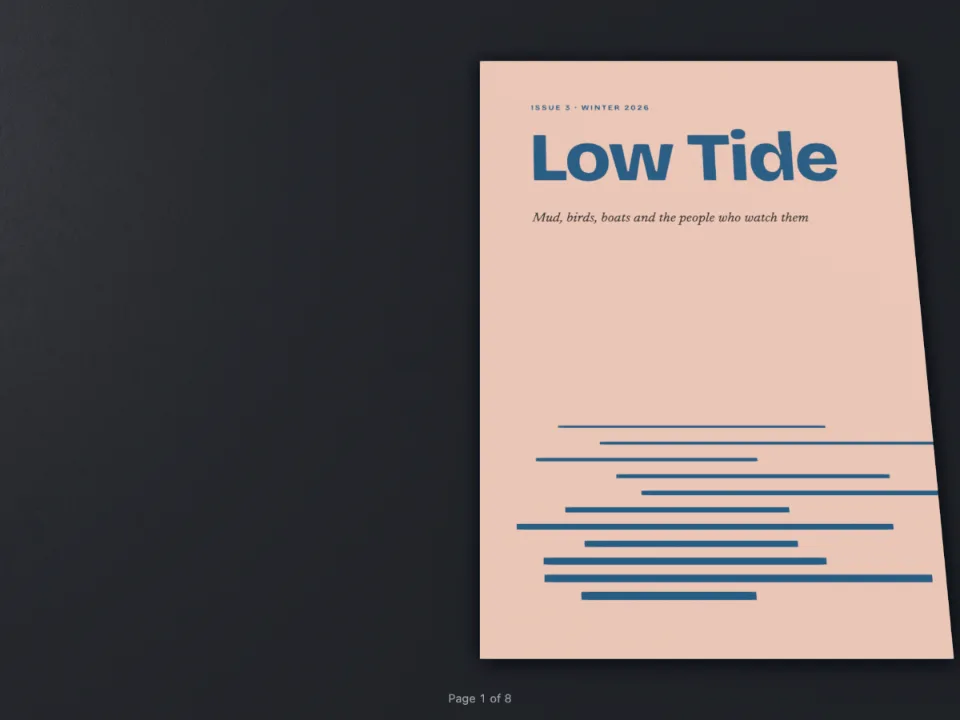
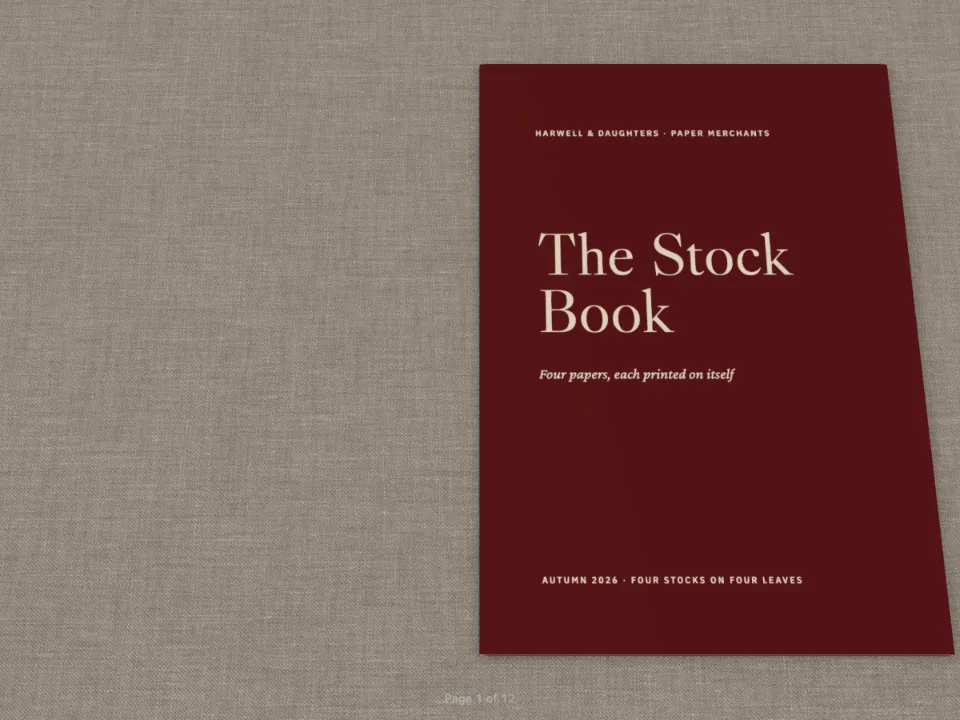
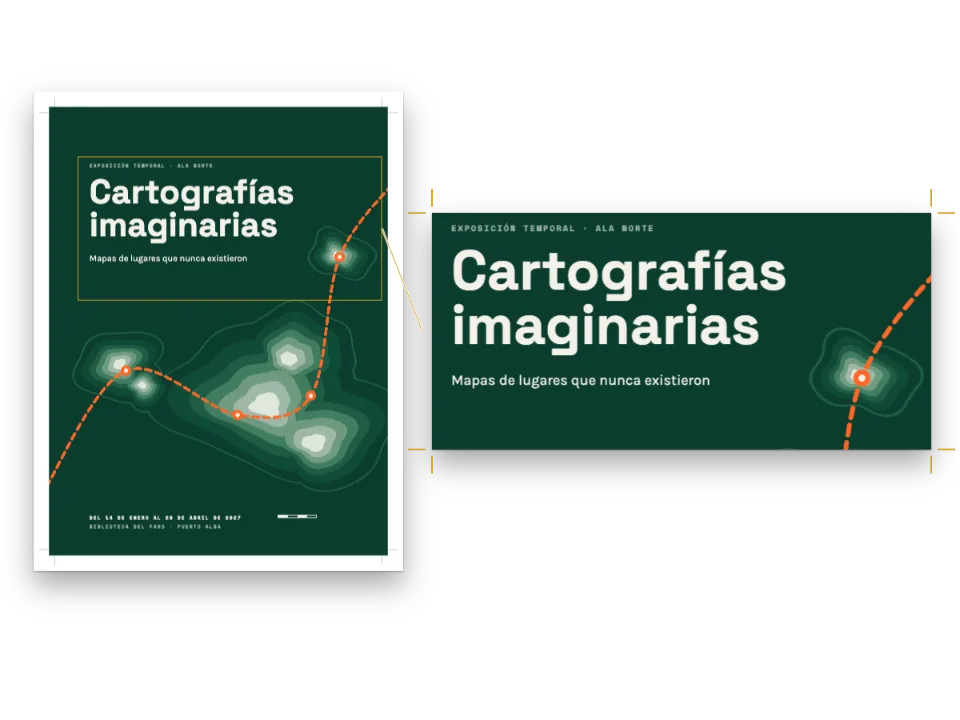
Um livrinho de poemas com capa azul-escura e letras douradas gravadas a quente. Por dentro, todos os fios e molduras também são dourados. A vista 3D mostra o brilho do dourado, e o arquivo de impressão o separa para a gráfica.
O que você vai compor
Um livreto com cinco poemas de Gerard Manley Hopkins, de 140 × 216 mm, em brochura. A capa e a folha que vem depois dela são cartão azul-escuro com hot stamping dourado e mais nada: uma moldura dupla, o título em maiúsculas Cinzel, o nome do poeta e o sumário. Por dentro, num papel vergê creme, os poemas são impressos em quatro cores, um noturno pintado fica de frente para o segundo poema, e todo fio da página é dourado: o fio duplo sob o cabeço, o fio curto sob cada título, o fio sob o fólio. O título vem do primeiro poema, em que o mundo brilha “like shining from shook foil”. O Folio vira o livro fechado para a luz, e o dourado aparece como metal.
Esta receita responde a
- Como faço hot stamping dourado numa capa e nos fios de um livro, e mando o dourado para a gráfica numa chapa à parte?
- Como visualizo a encadernação, a capa, o papel e a iluminação de um livro antes de mandá-lo para a gráfica?
A resposta curta
// Gold foil: a spot ink whose finish says what it is. The canvas paints its hex, Folio lights
// it as metal, and a CMYK or PDF/X file puts it on a Separation of its own named 'Gold foil',
// the artwork the foil block is etched from.
const foil = { hex: '#c9a24a', model: 'spot', spot: { name: 'Gold foil',
  cmyk: { c: 15, m: 30, y: 75, k: 10 }, finish: { kind: 'foil', sheen: 'gloss' } } };
// The two stocks are the paper's own colours, not inks: authored in CMYK at 0 % they paint
// on screen and put nothing on any plate. The blue card is a palette value of its own, so a
// section can turn the page blue (palette: { paper: … } in its heading style).
const stock = (hex) => ({ hex, model: 'cmyk', cmyk: { c: 0, m: 0, y: 0, k: 0 } });
const palette = {
  ink: { hex: '#232530', model: 'hex' }, // the poems: a warm near-black in process
  muted: { hex: '#6c6558', model: 'hex' }, // the attributions and the colophon
  foil,
  paper: stock('#f6f0e3'), // cream wove, inside
  card: stock('#1d2a4d'), // deep-blue card, the cover and the opener leaf
};
const col = (id) => ({ ...palette[id], paletteId: id });
const colorPalette = [
  ...Object.entries(palette).map(([id, value]) => ({ id, name: id, value })),
  { id: 'main-color', name: 'foil (defaults)', value: foil },
];
// Every blue page takes this: the paper turns to the card, and the head and foot go.
const onCard = { numbered: false, toc: false, palette: { paper: palette.card.hex },
  header: { elements: [] }, footer: { elements: [] } };
// The press file: PDF/X-4, the foil on its plate, the cream and the blue on none.
const PRINT = { standard: 'pdfx4', outputProfile: 'fogra51' };
Ingredientes
- Funcionalidades
- Tintas especiaisPDF em CMYK e em escala de cinzaVisualizador de livro em 3D (Folio)Papel, encadernação, mesa e luz (Folio)Outro papel para uma sequência de páginasPaleta de cores semânticaVerso linha a linhaSumárioEstilos de títuloCapas, folhas de rosto e colofõesAberturas desenhadasTextos, fios e caixas nos designs de páginaImagens nos designs de páginaCabeços e fóliosExportação para PDFPáginas em um canvas
- Também usa
- Atributos de títuloCor do papelEstilos de parágrafoCores por parteFontes incorporadas ao PDFFiguras e tabelas como recursosGeometria por seçãoCabeços por seçãoCores especiais e tabela de tintasCapítulos sem número
- Tipografia
- Cormorant Garamond, Cinzel, Cormorant SC (SIL OFL 1.1)
- Materiais
nocturne-600.jpg- The nocturne facing the second poem, a gouache (Generated With Diffusion Models, original)
Preparo
#1 · O dourado é uma cor especial com acabamento
O código é a resposta curta lá em cima. finish: { kind: 'foil' } transforma a cor especial numa tinta especial (acabamentos). A diagramação vê uma cor e nada se mexe; o canvas pinta o hex, o Folio a ilumina como metal e o arquivo PDF/X-4 põe cada elemento dourado numa única Separation chamada Gold foil, a partir da qual o gravador faz o clichê de latão. O dourado vaza o que está embaixo dele, como acontece na máquina de hot stamping.
#2 · Os papéis são cores que não levam tinta
// :::paper{type=cardStock grammage=300}     pages 1–4: the cover leaf and the opener leaf
// # Shook Foil {style="cover"}  # Shook Foil {style="opener"}  # Contents {style="contents"}
// :::
// # God's Grandeur  …  # Spring             pages 5–10: cream wove, the poems
// :::paper{type=cardStock grammage=300}     pages 11–12: the back cover leaf
// # Colophon {style="colophon"}  # Shook Foil {style="back"}
// :::
const markdown = String.raw`---
title: "Shook Foil"
author: "Gerard Manley Hopkins"
---

:::paper{type=cardStock grammage=300}
# Shook Foil {style="cover" kicker="Five poems" years="1877 · 1879"}

# Shook Foil {style="opener" note="Five poems written in Wales and at Oxford, first printed in 1918, after the poet’s death"}

# Contents {style="contents"}

:::toc
:::

# God’s Grandeur {sub="St Beuno’s, 1877"}

:::verse{style="verse"}
The world is charged with the grandeur of God.
  It will flame out, like shining from shook foil;
  It gathers to a greatness, like the ooze of oil
Crushed. Why do men then now not reck his rod?
Generations have trod, have trod, have trod;
  And all is seared with trade; bleared, smeared with toil;
  And wears man’s smudge and shares man’s smell: the soil
Is bare now, nor can foot feel, being shod.

And for all this, nature is never spent;
  There lives the dearest freshness deep down things;
And though the last lights off the black West went
  Oh, morning, at the brown brink eastward, springs —
Because the Holy Ghost over the bent
  World broods with warm breast and with ah! bright wings.
:::

# Nocturne {style="plate"}

# The Starlight Night {sub="St Beuno’s, 1877"}

:::verse{style="verse"}
Look at the stars! look, look up at the skies!
  O look at all the fire-folk sitting in the air!
  The bright boroughs, the circle-citadels there!
Down in dim woods the diamond delves! the elves’-eyes!
The grey lawns cold where gold, where quickgold lies!
  Wind-beat whitebeam! airy abeles set on a flare!
  Flake-doves sent floating forth at a farmyard scare! —
Ah well! it is all a purchase, all is a prize.

Buy then! bid then! — What? — Prayer, patience, alms, vows.
Look, look: a May-mess, like on orchard boughs!
  Look! March-bloom, like on mealed-with-yellow sallows!
These are indeed the barn; withindoors house
  The shocks. This piece-bright paling shuts the spouse
    Christ home, Christ and his mother and all his hallows.
:::

# Pied Beauty {sub="1877"}

:::verse{style="verse"}
Glory be to God for dappled things —
  For skies of couple-colour as a brinded cow;
    For rose-moles all in stipple upon trout that swim;
Fresh-firecoal chestnut-falls; finches’ wings;
  Landscape plotted and pieced — fold, fallow, and plough;
    And áll trádes, their gear and tackle and trim.

All things counter, original, spare, strange;
  Whatever is fickle, freckled (who knows how?)
    With swift, slow; sweet, sour; adazzle, dim;
He fathers-forth whose beauty is past change:
                    Praise him.
:::

# The Windhover {sub="To Christ our Lord"}

:::verse{style="verse"}
I caught this morning morning’s minion, king-
  dom of daylight’s dauphin, dapple-dawn-drawn Falcon, in his riding
  Of the rolling level underneath him steady air, and striding
High there, how he rung upon the rein of a wimpling wing
In his ecstasy! then off, off forth on swing,
  As a skate’s heel sweeps smooth on a bow-bend: the hurl and gliding
  Rebuffed the big wind. My heart in hiding
Stirred for a bird, — the achieve of, the mastery of the thing!

Brute beauty and valour and act, oh, air, pride, plume, here
  Buckle! AND the fire that breaks from thee then, a billion
Times told lovelier, more dangerous, O my chevalier!

  No wonder of it: shéer plód makes plough down sillion
Shine, and blue-bleak embers, ah my dear,
  Fall, gall themselves, and gash gold-vermilion.
:::

# Spring {sub="May 1877"}

:::verse{style="verse"}
Nothing is so beautiful as Spring —
  When weeds, in wheels, shoot long and lovely and lush;
  Thrush’s eggs look little low heavens, and thrush
Through the echoing timber does so rinse and wring
The ear, it strikes like lightnings to hear him sing;
  The glassy peartree leaves and blooms, they brush
  The descending blue; that blue is all in a rush
With richness; the racing lambs too have fair their fling.

What is all this juice and all this joy?
  A strain of the earth’s sweet being in the beginning
In Eden garden. — Have, get, before it cloy,
  Before it cloud, Christ, lord, and sour with sinning,
Innocent mind and Mayday in girl and boy,
  Most, O maiden’s child, thy choice and worthy the winning.
:::

:::paper{type=cardStock grammage=300}
# Colophon {style="colophon"}

:::paragraphs{style="colophon"}
The poems follow *Poems of Gerard Manley Hopkins*, edited by Robert Bridges (London, 1918), Project Gutenberg eBook #22403; they are in the public domain.

Set in Cormorant Garamond, Cinzel and Cormorant SC (SIL Open Font License). The nocturne was generated with diffusion models. Cover, opener and rules stamped in gold foil.
:::

# Shook Foil {style="back"}
:::
`; // content.<lang>.md, inlined by the Cookbook
O cartão azul e o vergê creme são cores da paleta definidas em CMYK a 0 % em todos os canais: a tela e o Folio pintam o suporte, e nenhuma chapa recebe um ponto dele. Por isso o PDF da capa tem a chapa do dourado e quatro chapas de quadricromia vazias. Cada página azul pega o cartão do seu estilo de título (palette: { paper: … } em onCard), e os dois blocos :::paper dão ao Folio a gramatura e a rigidez do cartão na folha da capa e na seguinte.
#3 · A capa é uma moldura e quatro linhas
// Two frames, a hairline inside a heavier rule: foil holds a 0.3 pt line on smooth card.
const frame = (id, inset, thickness) => ({ kind: 'box', id, style: { borderColor: col('foil'),
  borderWidth: pt(thickness) }, placement: at('page', 'top-left', inset, inset,
  { width: mm(TRIM_W - 2 * inset), height: mm(TRIM_H - 2 * inset) }) });
const flush = { span: 'page', margins: { top: mm(0), bottom: mm(0), left: mm(0), right: mm(0) } };
const cover = { ...onCard, ...flush, id: 'cover', advancedDesign: { enabled: true,
  minHeight: mm(TRIM_H), slot: { elements: [
    frame('outer', 9, 1.6), frame('inner', 11.5, 0.4),
    text('kicker', '{attr.kicker}', caps(8.5), at('page', 'top', 0, 46)),
    text('title', '{titleText}', { ...caps(40, col('foil'), 0.06), lineHeight: 1.05 },
      at('page', 'top', 0, 62, { width: mm(100) })),
    rule('rule', 112, 22, 0.8),
    text('poet', '{author}', { fontFamily: 'Cormorant SC', fontSize: pt(15), fontWeight: 500,
      letterSpacing: pt(1.5), color: col('foil') }, at('page', 'top', 0, 120)),
    text('years', '{attr.years}', caps(8), at('page', 'top', 0, 186)),
  ] } } };
O hot stamping segura uma linha fina, por isso a moldura é um fio de 1,6 pt com outro de 0,4 pt 2,5 mm para dentro, cada um a borda de uma caixa na cor do dourado. Tudo o que está na capa é dourado: nenhuma outra tinta toca o cartão, e é assim que se encomenda uma capa estampada a quente a uma encadernadora.
#4 · Por dentro, os fios são dourados e os poemas, tinta
const poem = { enabled: true, minHeight: mm(23), slot: { elements: [
  text('title', '{titleText}', { ...caps(13, col('ink'), 0.1), lineHeight: 1.2 },
    at('container', 'top', 0, 6, { width: mm(90) })),
  { ...rule('rule', 3.5, 12, 0.8, '#title', 'below') },
  text('sub', '{attr.sub}', { fontFamily: 'Cormorant Garamond', italic: true, fontSize: pt(11),
    color: col('muted') }, at('#rule', 'below', 0, 3)),
] } };
const HEAD_Y = 12; // mm from the top edge to the running heads
const headText = (id, content, parity, edge, x) => text(id, content, { ...caps(7.5,
  col('muted'), 0.18), align: edge.endsWith('left') ? 'left' : 'right', parity },
at('page', edge, x, HEAD_Y));
const header = { elements: [
  // The double rule across the text block, a thick and a thin line 1 mm apart.
  { ...rule('head-a', HEAD_Y + 5.5, TRIM_W - INNER - OUTER, 0.9, 'container', 'top'),
    placement: at('page', 'top', 0, HEAD_Y + 5, { width: mm(TRIM_W - INNER - OUTER) }) },
  { ...rule('head-b', 0, 0, 0.3), placement: at('page', 'top', 0, HEAD_Y + 6.2,
    { width: mm(TRIM_W - INNER - OUTER) }) },
  headText('verso', '{title}', 'even', 'top-left', OUTER),
  headText('recto', '{chapterTitle}', 'odd', 'top-right', -OUTER),
] };
const footer = { elements: [
  text('folio', '{pageNumber}', caps(9, col('ink'), 0.05), at('page', 'bottom', 0, -13)),
  rule('folio-l', -12, 6, 0.6, 'page', 'bottom'), // a short foil rule under the folio
] };
O cabeço fica sobre um fio duplo, um de 0,9 pt e outro de 0,3 pt 1,2 mm abaixo, da largura da mancha de texto. O design do título do poema acrescenta um fio de 12 mm sob o título, e o rodapé um de 6 mm sob o fólio. O texto fica no preto quente: letra pequena em dourado empasta na máquina.
#5 · O Folio vira a capa para a luz
const folio = {
  tilt: 24, yaw: -16,
  paper: { type: 'bookWove', grammage: 100, shade: '#ffffff' }, // the colour is the page's
  binding: { type: 'paperback', cover: 'pages' },
  surface: { type: 'walnut' },
  lighting: { environment: 'studio', intensity: 1.1 },
};
O dourado só parece dourado quando reflete alguma coisa. O ambiente studio tem softboxes claros e difusos, e uma inclinação de 24° com o livro girado 16° leva o reflexo deles até o título. Com a luz de luminária, mais fraca, o mesmo dourado fica um ocre fosco.
A receita completa
// ═══ Postext Cookbook · Nº 188 · Gold foil on a deep-blue cover ═══════════════════════
// https://postext.dev/en/cookbook/gold-foil-poetry-cover
// Code: MIT · Text: Hopkins, Bécquer (public domain) · Nocturne: diffusion models
// Fonts: Cormorant Garamond, Cinzel, Cormorant SC (SIL OFL 1.1) · Needs postext ≥ 1.85.1
//
// A poetry chapbook with a hot-foil cover. The cover, the opener and the contents are set
// in gold foil alone on deep-blue card; inside, on cream paper, the poems print in four
// colours and every rule of the page is foil. Folio lights the foil; the PDF gives it a
// plate of its own for the block-maker.
import {
  buildDocumentWithFonts, renderPageToCanvas, registerResourceImage,
} from 'https://esm.sh/postext';
import { renderToPdf, decompressWoff2 } from 'https://esm.sh/postext-pdf';
import { createFolioFromDocument } from 'https://esm.sh/postext-folio';

const LANG = 'en'; // @lang: the language of the sample document ('en' | 'es')
const RECIPE = 'gold-foil-poetry-cover';

// ─── 1 · Design ─────────────────────────────────────────────────────────────
// #region answer: the foil is a spot colour with a finish; the stocks print no ink at all
// Gold foil: a spot ink whose finish says what it is. The canvas paints its hex, Folio lights
// it as metal, and a CMYK or PDF/X file puts it on a Separation of its own named 'Gold foil',
// the artwork the foil block is etched from.
const foil = { hex: '#c9a24a', model: 'spot', spot: { name: 'Gold foil',
  cmyk: { c: 15, m: 30, y: 75, k: 10 }, finish: { kind: 'foil', sheen: 'gloss' } } };
// The two stocks are the paper's own colours, not inks: authored in CMYK at 0 % they paint
// on screen and put nothing on any plate. The blue card is a palette value of its own, so a
// section can turn the page blue (palette: { paper: … } in its heading style).
const stock = (hex) => ({ hex, model: 'cmyk', cmyk: { c: 0, m: 0, y: 0, k: 0 } });
const palette = {
  ink: { hex: '#232530', model: 'hex' }, // the poems: a warm near-black in process
  muted: { hex: '#6c6558', model: 'hex' }, // the attributions and the colophon
  foil,
  paper: stock('#f6f0e3'), // cream wove, inside
  card: stock('#1d2a4d'), // deep-blue card, the cover and the opener leaf
};
const col = (id) => ({ ...palette[id], paletteId: id });
const colorPalette = [
  ...Object.entries(palette).map(([id, value]) => ({ id, name: id, value })),
  { id: 'main-color', name: 'foil (defaults)', value: foil },
];
// Every blue page takes this: the paper turns to the card, and the head and foot go.
const onCard = { numbered: false, toc: false, palette: { paper: palette.card.hex },
  header: { elements: [] }, footer: { elements: [] } };
// The press file: PDF/X-4, the foil on its plate, the cream and the blue on none.
const PRINT = { standard: 'pdfx4', outputProfile: 'fogra51' };
// #endregion
O script.js montado funciona como está: cole-o como script de módulo em qualquer página ou abra a receita no CodePen. Pasta da receita no GitHub ↗ (abre em uma nova aba)
Variações
#Estampe em prata
Mude o hex e o CMYK equivalente; o acabamento e a chapa continuam.
-const foil = { hex: '#c9a24a', model: 'spot', spot: { name: 'Gold foil',
-  cmyk: { c: 15, m: 30, y: 75, k: 10 }, finish: { kind: 'foil', sheen: 'gloss' } } };
+const foil = { hex: '#b8bcc2', model: 'spot', spot: { name: 'Silver foil',
+ cmyk: { c: 20, m: 12, y: 10, k: 25 }, finish: { kind: 'foil', sheen: 'gloss' } } };#Imprima o dourado como tinta metálica
Uma tinta metálica sai mais barata que um clichê e é impressa junto com as outras tintas; o Folio a mostra acetinada.
-  cmyk: { c: 15, m: 30, y: 75, k: 10 }, finish: { kind: 'foil', sheen: 'gloss' } } };
+ cmyk: { c: 15, m: 30, y: 75, k: 10 }, finish: { kind: 'metallic' } } };Erros comuns
- Um papel colorido definido em
page.backgroundColorcom um hex comum é impresso como um chapado de quadricromia na página inteira. Defina o suporte em CMYK a 0 %, como aqui, quando a cor é a do papel. - Fios com menos de 0,25 pt e letras com menos de 8 pt empastam no hot stamping. Deixe o dourado para fios e títulos.
Créditos
- Receita
- Ignacio Ferro
- Texto
- Six poems by Gerard Manley Hopkins, from Poems (1918), Project Gutenberg eBook #22403 · Gerard Manley Hopkins · domínio público
- Seven rimas by Gustavo Adolfo Bécquer, from his Obras (1871) · Gustavo Adolfo Bécquer · domínio público
- Imagens
- The nocturne facing the second poem, a gouache · Generated With Diffusion Models · original
- Fontes
- Cormorant Garamond (SIL OFL 1.1) · Cinzel (SIL OFL 1.1) · Cormorant SC (SIL OFL 1.1)
- Código
- MIT, como o Postext
Editar este texto ↗ (abre em uma nova aba)Pasta da receita no GitHub ↗ (abre em uma nova aba)