Em poucas palavras
Páginas de amostra de um clássico da história chinesa. Mostra como marcar nomes com uma linha reta vermelha e títulos de livros com uma linha ondulada, em texto vertical e horizontal.
O que você vai compor
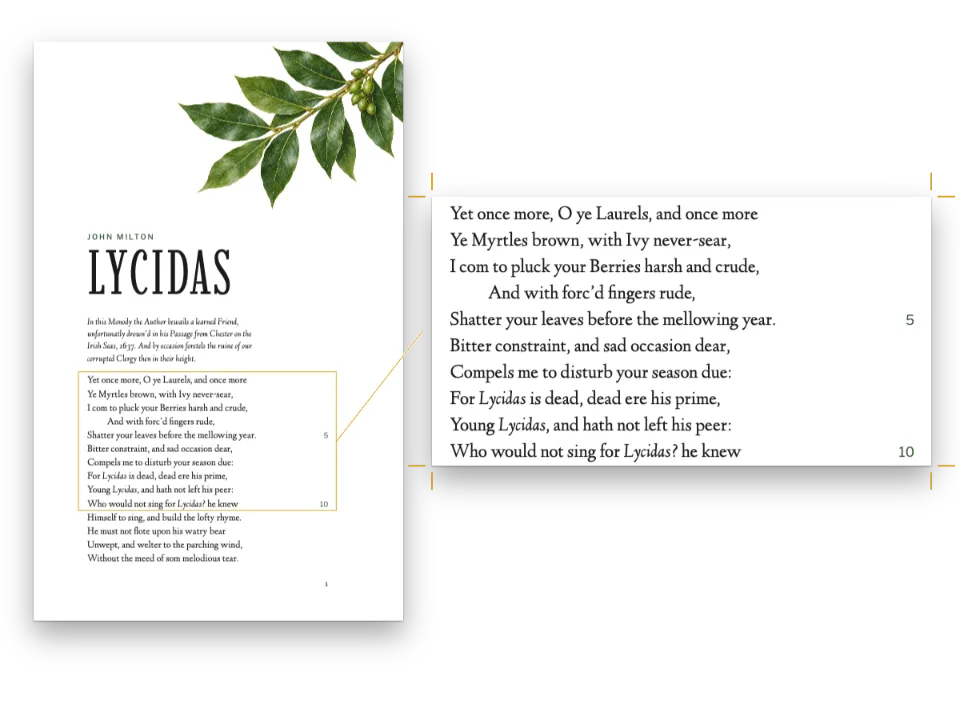
Três páginas de amostra para uma antologia dos Registros do Grande Historiador, no formato de 140 × 203 mm de um livro chinês 大32開. O trecho é o começo dos Anais básicos de Xiang Yu com a pontuação completa de uma edição de clássicos: uma linha reta ao lado de cada pessoa, lugar, Estado e dinastia, e uma linha ondulada ao lado de cada título de livro ou de capítulo, as duas em vermelhão. A página 1 traz a apresentação e as convenções do editor em letra Kai. As páginas 2 e 3 compõem duas vezes o mesmo Markdown, na vertical e na horizontal, e a página dupla mostra onde vai cada marca: à esquerda do nome nas linhas verticais, embaixo dele nas horizontais. O livro é encadernado pela direita, e uma faixa anil leva cada título. A receita Nº 044, Lycidas no texto de 1645, destaca os nomes à maneira europeia, em itálico.
Esta receita responde a
- Como marco nomes próprios e títulos de livros em texto chinês com uma linha reta e uma ondulada?
- Por que a ênfase do meu texto chinês sai inclinada, e o que devo usar no lugar?
- Como componho um livro chinês na vertical, encadernado à direita?
A resposta curta
// :name[項梁] draws the proper-name line, :book[史記] the book-title mark, :dots[…] dots.
const cjk = {
  bookTitleMark: 'wavy', // zh-Hant's default; mainland editions of the classics use it too
  annotationColor: col('mark'), // unset, the marks print in the colour of the text
  grid: { enabled: true, charsPerLine: CHARS, linesPerPage: LINES },
};
// The book runs down the page, bound on the right: the lines stand left of the names.
const layout = { layoutType: 'single', writingMode: 'vertical-rl' };
// # 項羽本紀 {style="across"} sets the same Markdown across the page, 28 characters to
// the line: the lines run under the names. Its margins set its grid; the book's grid
// counts down the page.
const MEASURE = 28 * SIZE * PT; // mm
const across = {
  id: 'across',
  layout: { layoutType: 'single', writingMode: 'horizontal-tb' },
  margins: { top: mm(SIDE), bottom: mm(H - SIDE - 25 * LEAD * PT), // 25 lines
    left: mm((W - MEASURE) / 2), right: mm((W - MEASURE) / 2) },
};
Ingredientes
- Funcionalidades
- Pontos de ênfase e linhas de nome e de títuloTexto verticalLivros encadernados pela direitaLargura da pontuação chinesaQuebra de linha em chinêsGrade de caracteresFontes chinesas, japonesas e coreanasFontes incorporadas ao PDFExportação para PDFNumeração chinesaEstilos de títuloGeometria por seçãoAberturas desenhadasFaixa de capítulo em largura totalAtributos de títuloListas numeradasRecuos, alinhamento e espaço entre parágrafosEstilos de parágrafoPaleta de cores semântica
- Tipografia
- Noto Serif TC, Noto Sans TC, LXGW WenKai TC (SIL OFL 1.1)
- Materiais
- Nenhum: todas as imagens são desenhadas em código
Preparo
#1 · A marcação põe as marcas; a direção da escrita escolhe o lado
O código é a resposta curta logo acima. :name[項梁] e :book[史記] mantêm seus caracteres no texto, então a busca, o texto copiado e o PDF leem 項梁 e 史記, e acrescentam as marcas ao lado (Marcas chinesas, rubi e warichu). Só a direção da escrita decide o lado: layout.writingMode: 'vertical-rl' põe as linhas à esquerda dos caracteres, e o estilo de título across, cuja disposição é 'horizontal-tb', as põe embaixo. bookTitleMark: 'wavy' é o que um documento zh-Hant recebe por padrão; fica escrito porque, numa troca para zh-Hans, os títulos sairiam entre 《》. Quando duas marcas do mesmo tipo se encostam, como em 東漢班固 ou 史記項羽本紀, cada uma cede um oitavo de eme na ponta em que se encontram, e as linhas se leem como dois nomes.
#2 · Uma entrelinha com espaço para as marcas
const [SONG, HEI, KAI] = ['Noto Serif TC', 'Noto Sans TC', 'LXGW WenKai TC']; // 宋, 黑, 楷
const PT = 25.4 / 72; // mm in a point
const [W, H] = [140, 203]; // mm: 大32開
const SIZE = 10.5; // pt: 五號
// A gap of 7.5 pt (0.71 em) between lines: a line of marks needs half an em of it, dots on
// one side and lines on the other five eighths. At 15 pt the build reports every marked
// paragraph (cjkMarksExceedLeading: gap 0.43 em).
const LEAD = 18; // pt
const [CHARS, LINES] = [42, 17]; // the vertical grid: characters down a line, lines across
const SIDE = (W - LINES * LEAD * PT) / 2; // mm: the side margins of a vertical page
As marcas ficam no vão entre as linhas e nunca mudam o passo da linha (Marcas, rubi e warichu). Com 10,5 pt sobre 18 pt, o vão é de 0,71 eme, e nele cabem as linhas de nome de uma coluna e os pontos da seguinte, como na quinta convenção da página 1. A grade conta a página em caracteres, 42 ao longo de cada linha e 17 linhas no sentido transversal, e desloca as margens para que a mancha meça exatamente isso: 25,7 mm de margem no alto e 21,7 mm no pé (Grade de caracteres).
#3 · Uma abertura que gira com a página
// The grid centres the text between the minimum margins; the band stops at its foot.
const FOOT = 20 + (H - 24 - 20 - CHARS * SIZE * PT) / 2; // mm, with minimums of 24 and 20
const BAND = SIDE + 3.5 * LEAD * PT; // mm from the trim, which is the right edge down the page
const onBand = { align: 'left', overflow: 'wrap' }; // design text centres and cuts by default
const next = (id, y) => ({ anchor: { to: `#${id}`, edge: 'below' }, offset: { y: mm(y) } });
const opener = {
  enabled: true,
  minHeight: pt(4 * LEAD), // the text starts on the fifth line, half a line clear of the band
  slot: { elements: [
    // Across the page the band's length runs past the trim; down it, it ends at the text's
    // foot, clear of the folio.
    { kind: 'box', id: 'band', style: { backgroundColor: col('band') },
      placement: { anchor: { to: 'bleed', edge: 'top-left' },
        size: { width: mm(H - FOOT), height: mm(BAND) } } },
    { kind: 'text', id: 'kicker', content: '{attr.kicker}', ...onBand, fontFamily: HEI,
      fontWeight: 700, fontSize: pt(8), letterSpacing: pt(1.6), color: col('tint'),
      placement: { anchor: { to: 'container', edge: 'top-left' }, offset: { y: mm(6 - SIDE) } } },
    { kind: 'text', id: 'title', content: '{titleText}', ...onBand, fontFamily: SONG,
      fontWeight: 700, fontSize: pt(46), lineHeight: 1, letterSpacing: pt(3),
      color: col('paper'), placement: next('kicker', 2) },
    { kind: 'text', id: 'byline', content: '{attr.byline}', ...onBand, fontFamily: KAI,
      fontSize: pt(10), color: col('tint'), placement: next('title', 2) },
  ] },
};
O design de um título é diagramado no fluxo da sua página, então um mesmo conjunto de elementos serve às duas direções (Escrita vertical). Ancorada ao canto superior esquerdo da sangria, a faixa atravessa o alto da página horizontal e desce pela borda direita das verticais, onde a leitura começa. O antetítulo, o título e o autor também se empilham no fluxo: um embaixo do outro na horizontal, um à esquerda do outro na vertical. O comprimento da faixa é medido ao longo do fluxo: 181,3 mm a fazem parar no pé do texto vertical, longe do fólio, e na página horizontal passam do refile.
#4 · Fólios para um livro encadernado pela direita
const foot = (id, content, parity, edge, x, extra) => ({ kind: 'text', id, content, parity,
  fontFamily: HEI, fontSize: pt(7), color: col('muted'), ...extra,
  placement: { anchor: { to: 'page', edge }, offset: { x: mm(x), y: mm(-11) } } });
const folio = { fontFamily: SONG, fontSize: pt(9) };
// Bound on the right, a recto (odd) lies left of the spine: its outer edge is its left one.
const footer = { elements: [
  foot('folio-odd', '{pageNumber}', 'odd', 'bottom-left', SIDE, folio),
  foot('folio-even', '{pageNumber}', 'even', 'bottom-right', -SIDE, folio),
  foot('slug', '{attr.slug}', 'all', 'bottom', 0, { letterSpacing: pt(0.4) }),
] };
O texto vertical encaderna o livro pela direita (Encadernação): a página 1 fica à esquerda da lombada, e a borda externa de uma página ímpar é a esquerda. O fólio ímpar vai embaixo à esquerda e o par embaixo à direita, ao contrário de um livro ocidental, e pageNumbering.format: 'trad-chinese-informal' os imprime como 一, 二, 三. A linha de identificação entre os dois vem de um atributo de cada título, slug="…"; junto com o colofão, é tudo o que muda entre a edição inglesa e a espanhola.
#5 · Uma segunda tinta
const palette = {
  ink: '#221e1b', // the text
  band: '#23394b', // the opener band and the small heads
  mark: '#b5412c', // the name, title and emphasis marks: the second ink
  tint: '#c7d2da', // kickers and bylines on the band
  muted: '#6f6a64', // folios, slug lines, the colophon
  paper: '#ffffff',
};
const col = (id) => ({ hex: palette[id], model: 'hex', paletteId: id });
const colorPalette = [
  ...Object.entries(palette).map(([id, hex]) => ({ id, name: id, value: { hex, model: 'hex' } })),
  { id: 'main-color', name: 'band (defaults)', value: { hex: palette.band, model: 'hex' } },
];
Uma edição de clássicos imprime as marcas na tinta do texto. Uma antologia escolar pode imprimi-las numa segunda cor, para que se destaquem dos traços dos caracteres: annotationColor as liga à entrada mark da paleta, o vermelhão dos comentários em tinta vermelha, e uma única mudança nessa entrada muda o tom de todas as linhas e de todos os pontos do livro.
A receita completa
// ═══ Postext Cookbook · Nº 077 · Proper-name and book-title marks, across and down ═════ // https://postext.dev/en/cookbook/proper-name-marks // Code: MIT · Text: Sima Qian, Shiji 7 (PD) · Punctuation, headnote, conventions: CC BY 4.0 // Fonts: Noto Serif TC, Noto Sans TC, LXGW WenKai TC (SIL OFL 1.1) · Needs postext ≥ 1.9.0 // Specimen pages for a classical reader: the opening of the Basic Annals of Xiang Yu with // its proper-name lines and wavy title lines, set down the page and then across it. import { buildDocument, renderPageToCanvas, clearMeasurementCache, loadVerticalAlternates, } from 'https://esm.sh/postext'; import { renderToPdf, decompressWoff2 } from 'https://esm.sh/postext-pdf'; const LANG = 'en'; // @lang: the language of the slug lines and the colophon ('en' | 'es') const RECIPE = 'proper-name-marks'; // ─── 1 · Design ───────────────────────────────────────────────────────────── // #region palette: the indigo of a thread-bound cover, vermilion for the marks const palette = { ink: '#221e1b', // the text band: '#23394b', // the opener band and the small heads mark: '#b5412c', // the name, title and emphasis marks: the second ink tint: '#c7d2da', // kickers and bylines on the band muted: '#6f6a64', // folios, slug lines, the colophon paper: '#ffffff', }; const col = (id) => ({ hex: palette[id], model: 'hex', paletteId: id }); const colorPalette = [ ...Object.entries(palette).map(([id, hex]) => ({ id, name: id, value: { hex, model: 'hex' } })), { id: 'main-color', name: 'band (defaults)', value: { hex: palette.band, model: 'hex' } }, ]; // #endregion // #region type: 五號 on 18 pt, 42 characters by 17 lines down the page const [SONG, HEI, KAI] = ['Noto Serif TC', 'Noto Sans TC', 'LXGW WenKai TC']; // 宋, 黑, 楷 const PT = 25.4 / 72; // mm in a point const [W, H] = [140, 203]; // mm: 大32開 const SIZE = 10.5; // pt: 五號 // A gap of 7.5 pt (0.71 em) between lines: a line of marks needs half an em of it, dots on // one side and lines on the other five eighths. At 15 pt the build reports every marked // paragraph (cjkMarksExceedLeading: gap 0.43 em). const LEAD = 18; // pt const [CHARS, LINES] = [42, 17]; // the vertical grid: characters down a line, lines across const SIDE = (W - LINES * LEAD * PT) / 2; // mm: the side margins of a vertical page // #endregion // #region answer: marks by the markup, their side by the writing mode // :name[項梁] draws the proper-name line, :book[史記] the book-title mark, :dots[…] dots. const cjk = { bookTitleMark: 'wavy', // zh-Hant's default; mainland editions of the classics use it too annotationColor: col('mark'), // unset, the marks print in the colour of the text grid: { enabled: true, charsPerLine: CHARS, linesPerPage: LINES }, }; // The book runs down the page, bound on the right: the lines stand left of the names. const layout = { layoutType: 'single', writingMode: 'vertical-rl' }; // # 項羽本紀 {style="across"} sets the same Markdown across the page, 28 characters to // the line: the lines run under the names. Its margins set its grid; the book's grid // counts down the page. const MEASURE = 28 * SIZE * PT; // mm const across = { id: 'across', layout: { layoutType: 'single', writingMode: 'horizontal-tb' }, margins: { top: mm(SIDE), bottom: mm(H - SIDE - 25 * LEAD * PT), // 25 lines left: mm((W - MEASURE) / 2), right: mm((W - MEASURE) / 2) }, }; // #endregion // #region opener: one design both ways: a band over the text across, right of it down // The grid centres the text between the minimum margins; the band stops at its foot. const FOOT = 20 + (H - 24 - 20 - CHARS * SIZE * PT) / 2; // mm, with minimums of 24 and 20 const BAND = SIDE + 3.5 * LEAD * PT; // mm from the trim, which is the right edge down the page const onBand = { align: 'left', overflow: 'wrap' }; // design text centres and cuts by default const next = (id, y) => ({ anchor: { to: `#${id}`, edge: 'below' }, offset: { y: mm(y) } }); const opener = { enabled: true, minHeight: pt(4 * LEAD), // the text starts on the fifth line, half a line clear of the band slot: { elements: [ // Across the page the band's length runs past the trim; down it, it ends at the text's // foot, clear of the folio. { kind: 'box', id: 'band', style: { backgroundColor: col('band') }, placement: { anchor: { to: 'bleed', edge: 'top-left' }, size: { width: mm(H - FOOT), height: mm(BAND) } } }, { kind: 'text', id: 'kicker', content: '{attr.kicker}', ...onBand, fontFamily: HEI, fontWeight: 700, fontSize: pt(8), letterSpacing: pt(1.6), color: col('tint'), placement: { anchor: { to: 'container', edge: 'top-left' }, offset: { y: mm(6 - SIDE) } } }, { kind: 'text', id: 'title', content: '{titleText}', ...onBand, fontFamily: SONG, fontWeight: 700, fontSize: pt(46), lineHeight: 1, letterSpacing: pt(3), color: col('paper'), placement: next('kicker', 2) }, { kind: 'text', id: 'byline', content: '{attr.byline}', ...onBand, fontFamily: KAI, fontSize: pt(10), color: col('tint'), placement: next('title', 2) }, ] }, }; // #endregion // #region folios: Chinese numerals at the outer foot, the slug line in the middle const foot = (id, content, parity, edge, x, extra) => ({ kind: 'text', id, content, parity, fontFamily: HEI, fontSize: pt(7), color: col('muted'), ...extra, placement: { anchor: { to: 'page', edge }, offset: { x: mm(x), y: mm(-11) } } }); const folio = { fontFamily: SONG, fontSize: pt(9) }; // Bound on the right, a recto (odd) lies left of the spine: its outer edge is its left one. const footer = { elements: [ foot('folio-odd', '{pageNumber}', 'odd', 'bottom-left', SIDE, folio), foot('folio-even', '{pageNumber}', 'even', 'bottom-right', -SIDE, folio), foot('slug', '{attr.slug}', 'all', 'bottom', 0, { letterSpacing: pt(0.4) }), ] }; // #endregion // The front page sets the headnote and the conventions in the Kai face. A section's // bodyStyle sets its list numbers bold unless its orderedLists say otherwise. const front = { id: 'front', bodyStyle: { fontFamily: KAI, orderedLists: { fontWeight: 400 } } }; const config = () => ({ // a factory: the engine caches resolved configs per object locale: 'zh-Hant', // Taiwan: full-width centred punctuation (gotcha: cjk-locale-tag) colorPalette, page: { sizePreset: 'custom', width: mm(W), height: mm(H), dpi: 150, // Minimums: the grid centres its 42 × 17 characters, 天頭 25.7 mm over 地腳 21.7 mm. margins: { top: mm(24), bottom: mm(20), left: mm(SIDE), right: mm(SIDE), mirror: true }, pageNumbering: { format: 'trad-chinese-informal' }, // 一, 二, 三 }, layout, cjk, bodyText: { fontFamily: SONG, fontSize: pt(SIZE), lineHeight: pt(LEAD), color: col('ink'), boldColor: col('ink'), italicColor: col('ink'), referenceColor: col('ink'), textAlign: 'justify', firstLineIndent: em(2), indentAfterHeading: true, }, headings: { fontFamily: HEI, fontWeight: 700, color: col('band'), levels: [ // Restated: any headings object drops the H1 break (gotcha: headings-drop-h1-break). { level: 1, span: 'page', breakBefore: { enabled: true, parity: 'any' }, advancedDesign: opener, marginBottom: pt(0) }, // No space above: 題解 sits on the fifth line, where the other pages' text starts; // a :::space line sets 凡例 apart from the headnote. { level: 2, fontSize: pt(SIZE), lineHeight: pt(LEAD), letterSpacing: pt(2), marginTop: pt(0), marginBottom: pt(0) }, ], }, headingStyles: [front, across], // No gap after 一、: the text starts two ems in, on the grid, like a paragraph's. orderedLists: { numberFormat: 'trad-chinese-informal', separator: '、', fontFamily: KAI, fontWeight: 400, color: col('ink'), gap: em(0), marginTop: pt(0), marginBottom: pt(0) }, paragraphStyles: [ { id: 'colophon', fontFamily: HEI, fontSize: pt(7), lineHeight: pt(10), color: col('muted'), textAlign: 'left', firstLineIndent: pt(0), marginTop: pt(LEAD) }, ], header: { elements: [] }, // every page opens a section: the band is its head footer, }); // ─── 2 · Content ──────────────────────────────────────────────────────────── // The Chinese is the same in both editions; the slug lines and the colophon change. const markdown = String.raw`---Amostra em Markdown · 43 linhas · content.en.md
title: "史記選讀" author: "司馬遷" --- # 史記選讀 {style="front" kicker="版式樣張" byline="題解 凡例" slug="Specimen sheet: the headnote and the conventions"} ## 題解 :book[項羽本紀]是:book[史記]第七卷,記述:name[秦]末:name[項羽]起兵、分封諸侯,以至兵敗:name[垓下]、自刎:name[烏江]的始末。:name[司馬遷]將這位未曾稱帝的人物列入「本紀」,與帝王並列。本樣張節錄篇首,寫:name[項羽]的出身與少年志氣。:name[東漢]:name[班固]:book[漢書]:book[陳勝項籍傳]敘述同一段事,文字大多沿用:book[史記]。 :::space ## 凡例 1. 正文依維基文庫所收:book[史記]卷七錄文;標點、分段與題解為本樣張所加。 2. 人名、地名、國名、朝代名旁加專名號,直排標於字左,橫排標於字下。 3. 書名、篇名旁加浪線書名號,位置與專名號相同,如:book[史記]:book[項羽本紀]。 4. 兩個專名緊相連接時各自畫線,相接處各縮八分之一字,如:name[楚]:name[漢]、:name[東漢]:name[班固]。 5. 需要強調的字旁加著重號,直排在字右,橫排在字下,如:dots[萬人敵]。 # 項羽本紀 {kicker="樣張一 直排" byline="〔漢〕司馬遷" slug="Specimen 1, down the page: the lines stand left of the names"} :name[項籍]者,:name[下相]人也,字:name[羽]。初起時,年二十四。其季父:name[項梁]。:name[梁]父即:name[楚]將:name[項燕],為:name[秦]將:name[王翦]所戮者也。:name[項氏]世世為:name[楚]將,封於:name[項],故姓:name[項氏]。 :name[項籍]少時,學書不成,去學劍,又不成。:name[項梁]怒之。:name[籍]曰:「書,足以記名姓而已;劍,一人敵,不足學。學萬人敵。」於是:name[項梁]乃教:name[籍]兵法。:name[籍]大喜,略知其意,又不肯竟學。 :name[項梁]嘗有:name[櫟陽]逮,乃請:name[蘄]獄掾:name[曹咎]書抵:name[櫟陽]獄掾:name[司馬欣],以故事得已。:name[項梁]殺人,與:name[籍]避仇於:name[吳中],:name[吳中]賢士大夫皆出:name[項梁]下。每:name[吳中]有大繇役及喪,:name[項梁]常為主辦,陰以兵法部勒賓客及子弟,以是知其能。 :name[秦始皇帝]游:name[會稽],渡:name[浙江],:name[梁]與:name[籍]俱觀。:name[籍]曰:「彼可取而代也!」:name[梁]掩其口曰:「毋妄言,族矣。」:name[梁]以此奇:name[籍]。:name[籍]長八尺餘,力能扛鼎,才氣過人,雖:name[吳中]子弟,皆已憚:name[籍]矣。 # 項羽本紀 {style="across" kicker="樣張二 橫排" byline="〔漢〕司馬遷" slug="Specimen 2, across the page: the lines run under the names"} :name[項籍]者,:name[下相]人也,字:name[羽]。初起時,年二十四。其季父:name[項梁]。:name[梁]父即:name[楚]將:name[項燕],為:name[秦]將:name[王翦]所戮者也。:name[項氏]世世為:name[楚]將,封於:name[項],故姓:name[項氏]。 :name[項籍]少時,學書不成,去學劍,又不成。:name[項梁]怒之。:name[籍]曰:「書,足以記名姓而已;劍,一人敵,不足學。學萬人敵。」於是:name[項梁]乃教:name[籍]兵法。:name[籍]大喜,略知其意,又不肯竟學。 :name[項梁]嘗有:name[櫟陽]逮,乃請:name[蘄]獄掾:name[曹咎]書抵:name[櫟陽]獄掾:name[司馬欣],以故事得已。:name[項梁]殺人,與:name[籍]避仇於:name[吳中],:name[吳中]賢士大夫皆出:name[項梁]下。每:name[吳中]有大繇役及喪,:name[項梁]常為主辦,陰以兵法部勒賓客及子弟,以是知其能。 :name[秦始皇帝]游:name[會稽],渡:name[浙江],:name[梁]與:name[籍]俱觀。:name[籍]曰:「彼可取而代也!」:name[梁]掩其口曰:「毋妄言,族矣。」:name[梁]以此奇:name[籍]。:name[籍]長八尺餘,力能扛鼎,才氣過人,雖:name[吳中]子弟,皆已憚:name[籍]矣。 :::paragraphs{style="colophon"} Set in Noto Serif TC, Noto Sans TC and LXGW WenKai TC (SIL Open Font License). Text: Sima Qian, Shiji, chapter 7, from zh.wikisource (public domain). Punctuation, paragraphs, headnote and conventions written for this specimen (CC BY 4.0). :::`; // content.<lang>.md, inlined by the Cookbook // ─── 3 · Fonts ────────────────────────────────────────────────────────────── // A Chinese face comes in slices: each voice loads the files of the text it sets // (gotcha: cjk-fonts-slices). Kai sets the front page and the bylines, Hei the small heads. const FONTS = { 'Noto Serif TC': ['400', '700'], 'Noto Sans TC': ['400', '700'], 'LXGW WenKai TC': ['400'], }; const heads = markdown.match(/^#.*$/gm).join('\n'); // titles, kickers, bylines, slug lines const preface = markdown.slice(0, markdown.indexOf('\n# ', markdown.indexOf('# ') + 2)); const colophon = markdown.slice(markdown.lastIndexOf(':::paragraphs')); const NUMERALS = '一二三四五六七八九十、'; // folios and list numbers, which the text may lack // ─── 4 · Build & show ─────────────────────────────────────────────────────── await loadFonts(FONTS, markdown); await loadCjkFonts({ [SONG]: ['400'] }, markdown + NUMERALS, { vertical: true }); // The bold sets the two titles, which have no punctuation, so it loads no vertical forms. // A browser that ignores the forms' feature settings would otherwise take a twin of the // bold files for vertical forms and set the text's brackets upright in the regular. await loadCjkFonts({ [SONG]: ['700'] }, heads); await loadCjkFonts({ [HEI]: ['400', '700'] }, heads + colophon, { vertical: true }); await loadCjkFonts({ [KAI]: ['400'] }, preface + heads + NUMERALS, { vertical: true }); const doc = await buildWithFonts(() => buildDocument({ markdown }, config()), markdown); showBook(doc, { title: t({ en: 'Name and title marks, down and across', es: 'Marcas de nombre y de título, en vertical y en horizontal' }) }); offerPdf(() => renderToPdf(doc, { fontProvider: cjkPdfProvider }), `${RECIPE}.pdf`);Kit · core, fonts, viewer, pdf, cjk: igual em todas as receitas · 459 linhas
// ─── Kit ── helpers shared by every Cookbook recipe · postext.dev/cookbook ───── // ─── Kit · core v1 ── the same in every recipe · postext.dev/cookbook function mm(value) { return { value, unit: 'mm' }; } function pt(value) { return { value, unit: 'pt' }; } function em(value) { return { value, unit: 'em' }; } /** The sample language's string: t({ en: 'Figure', es: 'Figura' }). */ function t(strings) { return strings[LANG] ?? Object.values(strings)[0]; } /** A file in this recipe's assets folder, served from the Postext repo by jsDelivr. */ function asset(file) { return `https://cdn.jsdelivr.net/gh/drnachio/postext@main/cookbook/${RECIPE}/assets/${file}`; } // ─── Kit · fonts v2 ── the same in every recipe · postext.dev/cookbook // Postext measures with the loaded faces and caches the widths: load every face // before the first build, from Fontsource, the files the PDF embeds too. /** faces = { 'Family Name': ['400', '400i', '700'] }. `text` is the sample: * č ł † α χ also load latin-ext and greek files (kitSubsetsFor). With * `optional`, a face Fontsource does not ship is skipped instead of failing. * Resolves to the number of faces added. */ async function loadFonts(faces, text = '', { optional = false } = {}) { kitStatus('Loading fonts…'); const ranges = { latin: 'U+0000-00FF,U+0131,U+0152-0153,U+02BB-02BC,U+02C6,U+02DA,U+02DC,U+0304,U+0308,U+0329,' + 'U+2000-206F,U+20AC,U+2122,U+2191,U+2193,U+2212,U+2215,U+FEFF,U+FFFD', 'latin-ext': 'U+0100-02BA,U+02BD-02C5,U+02C7-02CC,U+02CE-02D7,U+02DD-02FF,U+0304,U+0308,U+0329,' + 'U+1D00-1DBF,U+1E00-1E9F,U+1EF2-1EFF,U+2020,U+20A0-20AB,U+20AD-20C0,U+2113,U+2C60-2C7F,U+A720-A7FF', greek: 'U+0370-03FF', }; const jobs = []; let added = 0; for (const [family, specs] of Object.entries(faces)) { const id = fontsourceId(family); const todo = [...new Set(specs)].map((spec) => [parseInt(spec, 10), spec.endsWith('i') ? 'italic' : 'normal']) .filter(([weight, style]) => !hasFace(family, weight, style)); // before any await const meta = optional || /[^\0-ÿ]/u.test(text) ? await fontsourceMeta(family) : null; const subsets = ['latin', ...kitSubsetsFor(text, meta)]; for (const [weight, style] of todo) { if (optional && !(meta?.weights.includes(weight) && meta.styles.includes(style))) continue; for (const subset of subsets) { const url = `https://cdn.jsdelivr.net/npm/@fontsource/${id}@5/files/${id}-${subset}-${weight}-${style}.woff2`; const face = new FontFace(family, `url(${url}) format('woff2')`, { weight: String(weight), style, unicodeRange: ranges[subset] }); jobs.push(face.load().then((ready) => { document.fonts.add(ready); added++; }, () => { if (subset === 'latin' && !optional) throw new Error(`Fontsource has no ${family} ${weight} ${style}`); })); } } } await Promise.all(jobs).catch((error) => { kitFail(error); throw error; }); return added; } /** Runs `build` and loads any face the pages use that FONTS missed (a regular * one with a warning), then clears the measurement cache and builds again. */ async function buildWithFonts(build, text = '') { const tried = new Set(); for (let round = 0; round < 3; round++) { kitStatus('Laying out…'); await new Promise(requestAnimationFrame); // let the status paint first const result = await Promise.resolve().then(build).catch((error) => { kitFail(error); throw error; }); const wanted = { base: {}, variants: {} }; for (const { font, base } of [result].flat().flatMap(fontStringsOf)) { const { family, weight, style } = parseFont(font); const key = `${family}|${weight}|${style}`; if (tried.has(key) || hasFace(family, weight, style)) continue; tried.add(key); (wanted[base ? 'base' : 'variants'][family] ??= []).push(`${weight}${style === 'italic' ? 'i' : ''}`); } if (Object.keys(wanted.base).length) { console.warn(`[cookbook] FONTS does not list ${JSON.stringify(wanted.base)}: loading them.`); } const added = await loadFonts(wanted.base, text) + await loadFonts(wanted.variants, text, { optional: true }); if (added === 0) return result; clearMeasurementCache(); } throw new Error('The fonts did not settle after three builds.'); } /** Every font string of the layout; `base` marks a block's own face. */ function fontStringsOf(doc) { const found = new Map(); const walk = (node) => { if (!node || typeof node !== 'object') return; if (Array.isArray(node)) { node.forEach(walk); return; } for (const [key, value] of Object.entries(node)) { if (typeof value === 'string' && /fontString$/i.test(key)) { found.set(value, found.get(value) || key === 'fontString'); } else if (value && typeof value === 'object') walk(value); } }; walk(doc.pages); walk(doc.blocks); return [...found].map(([font, base]) => ({ font, base })); } /** '700 37.5px Open Sans' / 'italic 400 13px "Source Serif 4"' → { family, weight, style }. * A string with no weight ('95.8px Young Serif', from a design text) is 400. */ function parseFont(font) { const m = /^(?:(italic|oblique)\s+)?(?:small-caps\s+)?(?:(\d+|bold|normal)\s+)?[\d.]+px\s+(.+)$/.exec(font.trim()); if (!m) throw new Error(`Unexpected font string: ${font}`); const weight = m[2] === 'bold' ? 700 : !m[2] || m[2] === 'normal' ? 400 : Number(m[2]); return { family: m[3].replace(/^["']|["']$/g, ''), weight, style: m[1] ? 'italic' : 'normal' }; } /** A loaded FontFace covers this family, weight and style (fonts.check() would * also say yes for families nobody declared). */ function hasFace(family, weight, style) { for (const face of document.fonts) { if (face.status !== 'loaded' || face.style !== style) continue; if (face.family.replace(/^["']|["']$/g, '') !== family) continue; const [low, high = low] = face.weight.split(' ').map(Number); if (weight >= low && weight <= high) return true; } return false; } /** The files beyond latin `text` needs that `meta`'s family ships. */ function kitSubsetsFor(text, meta) { return [[/[Ā-˿ᴀ-ᶿḀ-ỿ†ℓⱠ-Ɀ꜠-ꟿ]/u, 'latin-ext'], [/[Ͱ-Ͽ]/u, 'greek']] .filter(([re, x]) => re.test(text) && meta?.subsets?.includes(x)).map(([, x]) => x); } /** Fontsource's id for a family: 'Source Serif 4' → 'source-serif-4'. */ function fontsourceId(family) { return family.toLowerCase().replace(/\s+/g, '-'); } /** The family's Fontsource metadata (weights, styles, subsets), or null. */ function fontsourceMeta(family) { fontsourceMeta.cache ??= new Map(); const id = fontsourceId(family); if (!fontsourceMeta.cache.has(id)) { fontsourceMeta.cache.set(id, fetch(`https://api.fontsource.org/v1/fonts/${id}`) .then((res) => (res.ok ? res.json() : null), () => null)); } return fontsourceMeta.cache.get(id); } // ─── Kit · viewer v1 ── the same in every recipe · postext.dev/cookbook /** The pages as spreads on a dark desk, page 1 alone, then verso | recto, * each painted when it scrolls near. */ function showPages(docs, { title, width = 460 } = {}) { const root = viewer(title); const pages = [docs].flat().flatMap((doc) => doc.pages.map((page) => ({ doc, page, n: (doc.pageIndexOffset ?? 0) + page.index }))); const spreads = []; let verso = null; for (const p of pages) { if (p.n % 2 === 1) { if (verso) spreads.push([verso, null]); verso = p; } else { spreads.push([verso, p]); verso = null; } } if (verso) spreads.push([verso, null]); const density = Math.min(window.devicePixelRatio || 1, 2); showPages.painter?.disconnect(); const painter = new IntersectionObserver((entries) => { for (const { isIntersecting, target } of entries) { if (!isIntersecting) continue; painter.unobserve(target); const { doc, page } = target.postext; renderPageToCanvas(page, doc, target, { scale: (width * density) / page.width }); } }, { rootMargin: '800px' }); showPages.painter = painter; root.replaceChildren(...spreads.map((pair) => { const spread = document.createElement('div'); spread.className = 'pt-spread'; for (const p of pair) { const figure = document.createElement('figure'); if (p) { const label = p.page.pageLabel || String(p.n + 1); const canvas = document.createElement('canvas'); canvas.postext = p; canvas.style.aspectRatio = `${p.page.width} / ${p.page.height}`; canvas.setAttribute('role', 'img'); canvas.setAttribute('aria-label', `Page ${label}`); const folio = document.createElement('figcaption'); folio.textContent = label; figure.append(canvas, folio); painter.observe(canvas); } else figure.className = 'pt-blank'; spread.append(figure); } return spread; })); kitStatus(`${pages.length} ${pages.length === 1 ? 'page' : 'pages'}`); document.documentElement.dataset.postext = 'ready'; return pages.length; } /** The desk, the bar and the error reporting, created once. */ function viewer(title) { if (!document.getElementById('pt-kit')) { document.head.insertAdjacentHTML('beforeend', `<style id="pt-kit"> :root { color-scheme: dark; } body { margin: 0; background: #0e1014; color: #b9bcc4; font: 13px/1.45 system-ui, sans-serif; } #pt-bar { position: sticky; top: 0; z-index: 1; display: flex; flex-wrap: wrap; align-items: center; gap: 6px 16px; padding: 10px 16px; background: rgb(14 16 20 / .92); backdrop-filter: blur(6px); border-bottom: 1px solid #23262d; } #pt-bar strong { color: #f4f1ea; font-weight: 600; } #pt-actions { display: flex; gap: 12px; margin-left: auto; } #pt-actions a, #pt-actions button { color: #d8a21a; font: inherit; background: none; border: 0; padding: 0; cursor: pointer; } #pages { display: grid; justify-items: center; gap: 48px; padding: 32px 16px 72px; } .pt-spread { display: flex; } .pt-spread figure { margin: 0; width: min(460px, 44vw); } .pt-spread canvas { display: block; width: 100%; background: #fff; box-shadow: 0 1px 2px rgb(0 0 0 / .5), 0 22px 44px -16px rgb(0 0 0 / .8); } .pt-spread figure:first-child canvas { box-shadow: inset -14px 0 14px -14px rgb(0 0 0 / .18), 0 1px 2px rgb(0 0 0 / .5), 0 22px 44px -16px rgb(0 0 0 / .8); } .pt-spread figcaption { margin-top: 10px; text-align: center; font: 600 10px/1 system-ui, sans-serif; letter-spacing: .18em; text-transform: uppercase; color: #6c7079; } .pt-blank { visibility: hidden; } @media (max-width: 760px) { .pt-spread { flex-direction: column; gap: 32px; } .pt-spread figure { width: min(460px, 92vw); } .pt-blank { display: none; } } </style>`); document.body.insertAdjacentHTML('afterbegin', '<header id="pt-bar"><strong id="pt-title"></strong><span id="pt-status" role="status"></span><span id="pt-actions"></span></header>'); document.getElementById('pt-title').textContent = document.title || 'Postext'; addEventListener('error', (event) => kitFail(event.error ?? event.message)); addEventListener('unhandledrejection', (event) => kitFail(event.reason)); } if (title) document.getElementById('pt-title').textContent = title; return document.getElementById('pages') ?? document.body.appendChild(Object.assign(document.createElement('main'), { id: 'pages' })); } function kitStatus(text) { viewer(); document.getElementById('pt-status').textContent = text; } function kitFail(error) { document.documentElement.dataset.postext = 'error'; kitStatus(`Error: ${error?.message ?? error}`); } // ─── Kit · pdf v2 ── the same in every recipe that exports a PDF /** The Fontsource files the screen used, as TrueType: the nearest weight the * family ships, upright if it has no italic; latin, then what the face's * letters need (kitSubsetsFor). */ async function fontsourceProvider(family, weight, style, request) { const id = fontsourceId(family); const meta = await fontsourceMeta(family); const weights = meta?.weights?.length ? meta.weights : [400, 700]; const w = weights.reduce((a, b) => (Math.abs(b - weight) < Math.abs(a - weight) ? b : a)); const s = style === 'italic' && meta && !meta.styles.includes('italic') ? 'normal' : style; const text = String.fromCodePoint(...(request?.codePoints ?? [])); const more = kitSubsetsFor(text, meta); const files = await Promise.all(['latin', ...more].map(async (subset) => { const res = await fetch(`https://cdn.jsdelivr.net/npm/@fontsource/${id}@5/files/${id}-${subset}-${w}-${s}.woff2`); if (!res.ok) throw new Error(`Fontsource has no ${family} ${w} ${s} ${subset}`); return decompressWoff2(new Uint8Array(await res.arrayBuffer())); })); return files.length === 1 ? files[0] : files; } /** A "Build the PDF" button; then "Open the PDF" (a new tab: CodePen's frame * shows no PDFs) and a download link. */ function offerPdf(makePdf, filename) { viewer(); const button = Object.assign(document.createElement('button'), { type: 'button', textContent: 'Build the PDF' }); button.dataset.postextPdf = filename; button.addEventListener('click', async () => { button.disabled = true; button.textContent = 'Building the PDF…'; try { const bytes = await makePdf(); const url = URL.createObjectURL(new Blob([bytes], { type: 'application/pdf' })); const size = `${Math.max(1, Math.round(bytes.length / 1024))} KB`; button.replaceWith( Object.assign(document.createElement('a'), { href: url, target: '_blank', rel: 'noopener', textContent: 'Open the PDF ↗' }), Object.assign(document.createElement('a'), { href: url, download: filename, textContent: `Download ${filename} · ${size}` })); } catch (error) { button.disabled = false; button.textContent = 'Build the PDF'; kitFail(error); } }); document.getElementById('pt-actions').append(button); } // ─── Kit · cjk v1 ── Chinese, Japanese and Korean books · postext.dev/cookbook // Fontsource ships a CJK family as about a hundred files per weight, each // declared in its stylesheet with the unicode-range it covers. The screen // loads the files the sample touches; the PDF gets the same files for the // characters its pages set in each face, and embeds each as a subset. // A book bound on the right (vertical text) is shown with its spreads // mirrored: page 1 alone on the left of the spine, then [3 | 2]. /** The files of a Fontsource face, read from its stylesheet: { url, range, * ranges }, the last declared first (the order the browser tries them in). */ function cjkSlices(family, weight, style) { cjkSlices.cache ??= new Map(); const id = fontsourceId(family); const css = `https://cdn.jsdelivr.net/npm/@fontsource/${id}@5/${weight}${style === 'italic' ? '-italic' : ''}.css`; if (!cjkSlices.cache.has(css)) { cjkSlices.cache.set(css, fetch(css) .then((res) => { if (!res.ok) throw new Error(`Fontsource has no ${family} ${weight} ${style} (${res.status})`); return res.text(); }) .then((text) => [...text.matchAll(/@font-face\s*{([^}]*)}/g)].map(([, rule]) => { const range = /unicode-range:\s*([^;]+);/.exec(rule)?.[1].trim() ?? 'U+0-10FFFF'; const ranges = range.split(',').map((part) => { const [lo, hi = lo] = part.trim().slice(2).split('-'); return [parseInt(lo, 16), parseInt(hi, 16)]; }); return { url: new URL(/url\(([^)]+?\.woff2)\)/.exec(rule)[1], css).href, range, ranges }; }).reverse())); } return cjkSlices.cache.get(css); } /** The file of `slices` that holds code point `cp`, if any. */ function cjkSliceFor(slices, cp) { return slices.find((slice) => slice.ranges.some(([lo, hi]) => cp >= lo && cp <= hi)); } /** Whether Fontsource serves `family` as a Chinese, Japanese or Korean * family (its subsets name the script). Fails when the API does not * answer: a CJK face taken for a Latin one would paint in a system face. */ async function isCjkFamily(family) { const meta = await fontsourceMeta(family); if (!meta) throw new Error(`api.fontsource.org did not describe ${family}: reload to try again`); return !!meta.subsets?.some((subset) => /^(chinese|japanese|korean)/.test(subset)); } /** faces = { 'Noto Serif TC': ['400', '700'] }, as for loadFonts: the * whole FONTS object may be passed, its other families are left to * loadFonts. Adds one FontFace per file of each CJK face with its * unicodeRange, then loads the files `text` touches. `text` is what the * faces set: the sample for the text face; a book in several voices calls * it once per voice (loadCjkFonts({ 'LXGW WenKai TC': ['400'] }, quotes)), * so the heading and quotation faces fetch and check only their own * characters. Fails when a character of `text` is in no file of a face. * List every weight the pages use: a weight left to buildWithFonts gets * the latin file only. With { vertical: true } it also loads each * family's vertical forms (brackets, quotes, pause marks) for the canvas, * which needs loadVerticalAlternates imported from postext. Resolves to * the number of files loaded. */ async function loadCjkFonts(faces, text, { vertical = false } = {}) { kitStatus('Loading fonts…'); let loaded = 0; try { if (vertical && typeof loadVerticalAlternates !== 'function') { throw new Error('loadCjkFonts(…, { vertical: true }) needs loadVerticalAlternates imported from postext'); } for (const [family, specs] of Object.entries(faces)) { if (!(await isCjkFamily(family))) continue; const twin = []; for (const spec of new Set(specs)) { const weight = parseInt(spec, 10); const style = spec.endsWith('i') ? 'italic' : 'normal'; const slices = await cjkSlices(family, weight, style); const missing = [...new Set(text)].filter((ch) => /\S/.test(ch) && !cjkSliceFor(slices, ch.codePointAt(0))); if (missing.length) { throw new Error(`${family} ${spec} has no file for ${missing.slice(0, 12).join(' ')}: ` + `give each face the text it sets (loadCjkFonts({ '${family}': ['${spec}'] }, text))`); } for (const slice of slices) { document.fonts.add(new FontFace(family, `url(${slice.url}) format('woff2')`, { weight: String(weight), style, unicodeRange: slice.range })); twin.push({ source: slice.url, weight: String(weight), style, unicodeRange: slice.range }); } const font = `${style === 'italic' ? 'italic ' : ''}${weight} 16px "${family}"`; loaded += (await document.fonts.load(font, text)).length; if (!document.fonts.check(font, text)) throw new Error(`${family} ${spec} did not load for the sample`); } // The same files under a twin name with the `vert` feature on: the // canvas paints the punctuation of vertical lines with it. if (vertical && twin.length) await loadVerticalAlternates(family, twin); } } catch (error) { kitFail(error); throw error; } return loaded; } /** The PDF font provider for recipes with CJK faces: a family whose * Fontsource subsets are Chinese, Japanese or Korean gets the files that * hold the characters its pages set (`request.codePoints`); any other * family gets the latin file fontsourceProvider fetches (the "pdf" block) * and, when the face sets letters only latin-ext has, that file too. */ async function cjkPdfProvider(family, weight, style, request) { if (!(await isCjkFamily(family))) return cjkLatinPdfFiles(family, weight, style, request); const meta = await fontsourceMeta(family); const weights = meta.weights?.length ? meta.weights : [400, 700]; const w = weights.reduce((a, b) => (Math.abs(b - weight) < Math.abs(a - weight) ? b : a)); const s = style === 'italic' && !meta.styles.includes('italic') ? 'normal' : style; const slices = await cjkSlices(family, w, s); const picked = new Set(); for (const cp of request?.codePoints ?? []) { const slice = cjkSliceFor(slices, cp); if (slice) picked.add(slice); } if (!picked.size) picked.add(slices[0]); return Promise.all(slices.filter((slice) => picked.has(slice)).map(async (slice) => { const res = await fetch(slice.url); if (!res.ok) throw new Error(`Fontsource file ${slice.url} (${res.status})`); return decompressWoff2(new Uint8Array(await res.arrayBuffer())); })); } /** A Latin family set next to the CJK faces: its latin file, then its * latin-ext file when the face sets letters only latin-ext has (ō ū in * Hepburn rōmaji, ǎ in pinyin), the file loadFonts adds on screen for * them. Latin comes first: postext-pdf draws a character from the first * file that has it, as the browser takes a character both files hold from * latin. A face Fontsource ships without latin-ext, or whose file does * not come, gets latin alone, and the PDF names the letters it lacks. */ async function cjkLatinPdfFiles(family, weight, style, request) { const meta = await fontsourceMeta(family); const beyond = [...(request?.codePoints ?? [])].some(cjkLatinExtOnly); if (!beyond || !meta?.subsets?.includes('latin-ext')) return fontsourceProvider(family, weight, style); const weights = meta.weights?.length ? meta.weights : [400, 700]; const w = weights.reduce((a, b) => (Math.abs(b - weight) < Math.abs(a - weight) ? b : a)); const s = style === 'italic' && !meta.styles.includes('italic') ? 'normal' : style; const id = fontsourceId(family); const url = `https://cdn.jsdelivr.net/npm/@fontsource/${id}@5/files/${id}-latin-ext-${w}-${s}.woff2`; const [latin, ext] = await Promise.all([fontsourceProvider(family, weight, style), fetch(url) .then(async (res) => (res.ok ? decompressWoff2(new Uint8Array(await res.arrayBuffer())) : null), () => null)]); return ext ? [latin, ext] : latin; } /** Whether code point `cp` is in Fontsource's latin-ext file and not in * its latin file: Latin Extended-A and -B, IPA, the spacing modifiers and * Latin Extended Additional (loadFonts's test for latin-ext), less the * few latin holds too (ı Œ œ ʻ ʼ ˆ ˚ ˜). */ function cjkLatinExtOnly(cp) { if (!((cp >= 0x100 && cp <= 0x2ff) || (cp >= 0x1e00 && cp <= 0x1eff))) return false; return ![0x131, 0x152, 0x153, 0x2bb, 0x2bc, 0x2c6, 0x2da, 0x2dc].includes(cp); } /** showPages for a book bound on either edge. A right-bound book (the * document says so: doc.binding is 'right' for page.binding 'right' and * for vertical text) lies on the desk as it opens: page 1 alone on the * left of the spine, then [3 | 2], the spine shade on each page's inner * edge. `binding` ('left' | 'right') overrides the document's. */ function showBook(docs, { binding, ...options } = {}) { const count = showPages(docs, options); const right = (binding ?? [docs].flat()[0]?.binding) === 'right'; if (!document.getElementById('pt-kit-cjk')) { // The pages keep direction ltr: a canvas draws text in the direction its // element inherits, and under rtl each run would end where the engine // starts it, its brackets mirrored. document.head.insertAdjacentHTML('beforeend', `<style id="pt-kit-cjk"> .pt-spread[dir="rtl"] canvas { direction: ltr; } .pt-spread[dir="rtl"] figure:first-child canvas { box-shadow: inset 14px 0 14px -14px rgb(0 0 0 / .18), 0 1px 2px rgb(0 0 0 / .5), 0 22px 44px -16px rgb(0 0 0 / .8); } </style>`); } // Each pair stays [verso, recto] in the page; right to left, the verso // sits on the right. Phones stack the pages in reading order either way. for (const spread of document.querySelectorAll('#pages > .pt-spread')) spread.dir = right ? 'rtl' : 'ltr'; document.getElementById('pages').dataset.binding = right ? 'right' : 'left'; return count; } // ─── /Kit ───────────────────────────────────────────────────────────────────────
O script.js montado funciona como está: cole-o como script de módulo em qualquer página ou abra a receita no CodePen. Pasta da receita no GitHub ↗ (abre em uma nova aba)
Variações
#Imprima os títulos entre 《》
Os livros da China continental que não são clássicos põem os títulos entre colchetes angulares: o Markdown fica como está, e os colchetes saem como pontuação do texto.
-  bookTitleMark: 'wavy', // zh-Hant's default; mainland editions of the classics use it too
+ bookTitleMark: 'brackets', // 《史記》《項羽本紀》#Imprima as marcas na tinta do texto
Sem annotationColor, cada marca assume a cor do bloco que marca.
- annotationColor: col('mark'), // unset, the marks print in the colour of the textErros comuns
Erro comum
Marque o documento como zh-Hans ou zh-Hant, não com LANG
As edições de uma receita são en e es, mas uma amostra chinesa é chinesa nas duas: `locale: LANG` a marcaria como inglês ou espanhol, hifenizaria as suas palavras latinas, chamaria as suas figuras de Figure ou Figura e daria ao PDF o idioma errado. Escreva você mesmo a marcação: 'zh-Hans' (convenções da China continental: quebra de linha GB, pontuação Kaiming) ou 'zh-Hant' (Taiwan: pontuação de largura inteira centralizada); 'zh-HK' para Hong Kong. Um 'zh' sozinho é lido como chinês simplificado continental. Uma amostra japonesa leva 'ja' (armadilha ja-locale-tag). Quebra de linha em chinês →
Erro comum
Fontes chinesas são carregadas em fatias, pelo bloco cjk
O Fontsource serve uma família chinesa, japonesa ou coreana em cerca de cem arquivos por peso, cada um com um intervalo de caracteres. loadFonts baixa só o arquivo latin, então na tela os caracteres chineses vêm de uma fonte do sistema e são medidos errado, e o fontsourceProvider entrega ao PDF esse arquivo latin, que os imprime como caixas vazias. Inclua o bloco cjk do kit, chame loadCjkFonts(FONTS, markdown) depois de loadFonts (uma vez por voz, com o texto que ela compõe, quando o livro usa várias fontes CJK) e passe a renderToPdf fontProvider: cjkPdfProvider: os dois pegam os arquivos que contêm os caracteres do texto. Fontes chinesas, japonesas e coreanas →
Erro comum
Um livro encadernado pela direita mostra as páginas duplas com showBook
Em um livro encadernado pela direita (texto árabe, hebraico ou persa, chinês vertical, ou page.binding 'right') a página 1 continua sendo a ímpar, mas fica à esquerda da lombada, e os pares se leem [3 | 2]. showPages dispõe todos os livros como se fossem encadernados pela esquerda; showBook, do bloco book (o bloco cjk traz a mesma função), lê doc.binding e espelha os pares. capture.hero continua nomeando uma página dupla em ordem de leitura, [par, ímpar]: [2, 3]. Livros encadernados pela direita →
Erro comum
O chinês não tem itálico
As famílias CJK não trazem itálico, e a tipografia chinesa marca a ênfase com pontos ao lado dos caracteres, não com inclinação. Em um documento marcado como chinês, *…* coloca pontos de ênfase nos caracteres chineses que abrange e deixa o itálico para as palavras latinas (cjk.emphasis: 'dots', o padrão para o chinês); :dots[…] os coloca em qualquer lugar. Com cjk.emphasis: 'italic', ou em um documento marcado como en ou es, *…* faz o canvas inclinar os glifos redondos, um oblíquo sintético que a tipografia chinesa nunca usa (o PDF recorre à fonte redonda): mantenha a marcação chinesa ou faça a ênfase em negrito ou em uma fonte Kai (LXGW WenKai) com um estilo de parágrafo ou de chip. Fontes chinesas, japonesas e coreanas →
Erro comum
Qualquer objeto headings desativa a quebra de página do H1
Por padrão, um H1 salta para uma página ímpar (always-odd), mas passar qualquer objeto headings redefine esse padrão, então os capítulos ficam emendados e span: 'page' não faz nada. Declare de novo headings.levels[0].breakBefore: { enabled: true, parity } em toda configuração. Capítulos que abrem em página ímpar →
Aviso de diagramação · cjkMarksExceedLeading
Marcas encostam na linha vizinha
Por quê. Um parágrafo com pontos de ênfase ou com fios de nome próprio e de título de obra tem um vão entre linhas menor que meio eme (cinco oitavos com marcas dos dois lados): as marcas ficam na entrelinha, cuja altura não aumenta por causa delas, então encostam na linha vizinha.
Correção. Dê ao parágrafo um estilo de parágrafo com mais entrelinha ou aumente `bodyText.lineHeight`. Docs →
- Um título desenhado por um design imprime o seu texto através do design, e o texto de design perde as marcas:
# :book[項羽本紀]não mostraria nenhuma linha ondulada na faixa. Cabeços, legendas e células de tabela também imprimem o texto sem marcas. - O Postext não para por causa de
cjkMarksExceedLeading: a composição o registra emdoc.contentWarningse o painel Verificações do Sandbox o mostra, mas as páginas são impressas assim mesmo, com as marcas espremidas contra a linha vizinha. Quando mudar a entrelinha, leia essa lista; com 15 pt ela reúne todos os parágrafos marcados destas páginas.
Créditos
- Receita
- Ignacio Ferro
- Texto
- The opening of the Basic Annals of Xiang Yu (項羽本紀), Records of the Grand Historian (史記), chapter 7; characters from the zh.wikisource transcription · Sima Qian (司馬遷) · domínio público
- The punctuation, the paragraphs and the marks of the passage, the headnote (題解), the conventions (凡例), the slug lines and the colophon · Ignacio Ferro · CC BY 4.0
- Fontes
- Noto Serif TC (SIL OFL 1.1) · Noto Sans TC (SIL OFL 1.1) · LXGW WenKai TC (SIL OFL 1.1)
- Código
- MIT, como o Postext
Editar este texto ↗ (abre em uma nova aba)Pasta da receita no GitHub ↗ (abre em uma nova aba)