Em poucas palavras
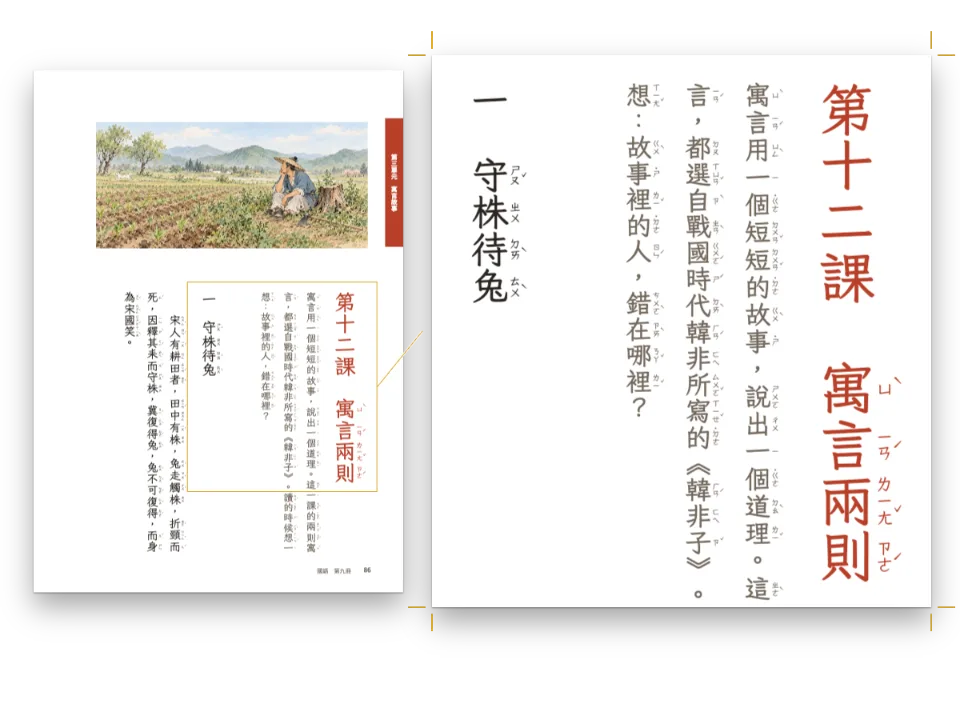
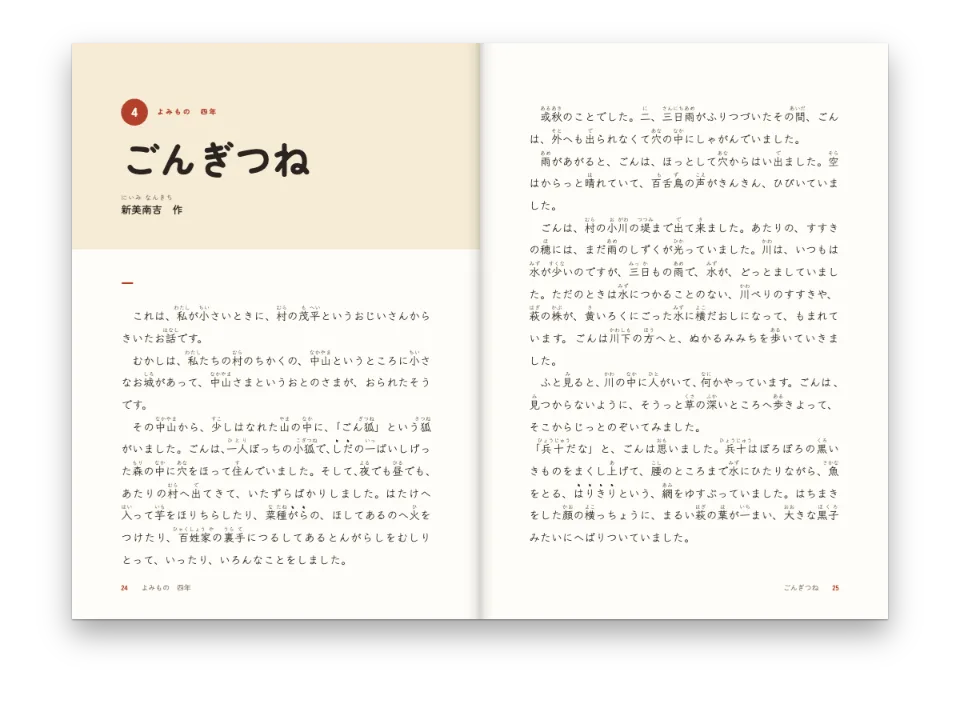
Páginas de uma cartilha infantil de Hong Kong. Mostra como imprimir a pronúncia em letras latinas acima de cada caractere chinês, com quadriculados para treinar a escrita.
O que você vai compor
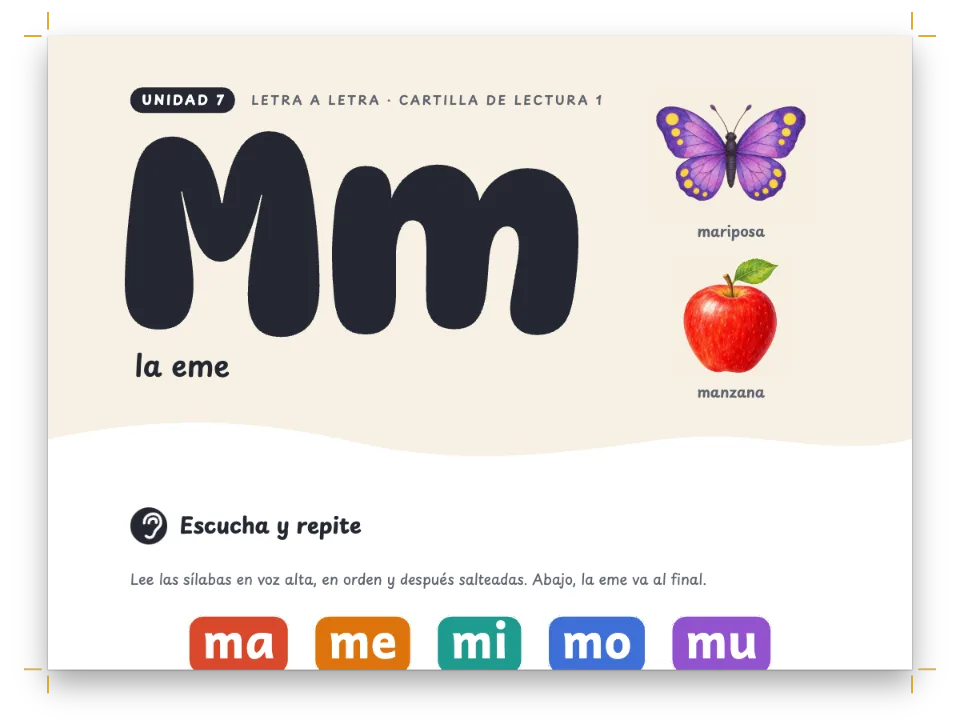
Duas páginas duplas de 《蒙學誦讀》, uma cartilha inventada de Hong Kong, onde as crianças leem em voz alta o Clássico dos Três Caracteres em mandarim (putonghua). Cada página é uma lição de quatro dísticos em Kai de 一号 (26 pt), cada caractere sob a sua sílaba de pinyin. As sílabas estão em Andika porque ela desenha o a e o g de um só bojo que os livros escolares chineses imprimem. Uma faixa clara traz o selo vermelho da lição, uma pequena aquarela e o título em 初号 (42 pt) com a sua própria leitura. Abaixo do texto, seis quadriculados de escrita (田字格) trazem os caracteres para copiar, e uma nota explica à família o que os versos querem dizer. A equivalente em espanhol é a cartilha de sílabas em chips, em que cada sílaba é um chip colorido em vez de uma leitura sobre um caractere.
Uma cartilha foge de propósito das regras do livro chinês. Uma criança lê poucos caracteres grandes por vez, então a linha leva doze de 26 pt, quando um livro põe de 25 a 40 de 10,5 pt, e a entrelinha passa um pouco do dobro do corpo para caberem as leituras. Cada dístico fica centralizado numa linha própria, sem justificação nem recuo. O texto está em Kai, a letra que segue o pincel, porque ela mostra os traços que a criança aprende a escrever; um livro o comporia em Song.
Esta receita responde a
- Como coloco pinyin sobre os caracteres chineses?
A resposta curta
// {人之初|rén zhī chū} gives each character its own syllable (mono ruby): three readings for
// three characters, split on the spaces. The reading sits in the line gap, centred on its
// character; a syllable wider than the character widens that character's box by what the
// reading needs, less the quarter of the reading's size it may lend a neighbour.
const cjk = {
  // The type area in characters: 12 per line, 11 lines of 54 pt. The margins grow to centre it.
  grid: { enabled: true, charsPerLine: CHARS, linesPerPage: 11 },
  ruby: {
    fontFamily: PINYIN, // one-storey a and g, as a Chinese primer prints them
    // 9.9 pt over the text, 16 pt over the title: the widest syllables (xiāng, zhuān) still fit
    // over one character, so every couplet is 8 em long and keeps to the grid.
    fontSize: em(0.38),
    color: col('pinyin'),
  },
};
// The line pitch never changes for a reading: the gap between lines (54 − 26 = 28 pt) must
// hold it, or the build warns rubyExceedsLeading.
const text = {
  fontFamily: KAI, fontSize: pt(TEXT), lineHeight: pt(LINE),
  textAlign: 'center', firstLineIndent: pt(0), // one couplet to a line, centred
};
Ingredientes
- Funcionalidades
- Rubi: leituras em pinyin e zhuyinFontes chinesas, japonesas e coreanasGrade de caracteresLargura da pontuação chinesaTipografia do textoAberturas desenhadasAtributos de títuloImagens nos designs de páginaTextos, fios e caixas nos designs de páginaBoxesPaleta de cores semânticaCabeços e fólios
- Também usa
- Quebra de linha em chinêsSair da grade de propósitoFaixa de capítulo em largura totalEstilos de parágrafoFiguras e tabelas como recursos
- Tipografia
- LXGW WenKai TC, Noto Sans TC, Andika (SIL OFL 1.1)
- Materiais
brush-800.jpgjade-800.jpgshuttle-800.jpgsprout-800.jpg- The writing squares, drawn in code in the page’s palette (Postext Cookbook, CC BY 4.0)
- Lesson 1’s vignette: a seedling, a watercolour (Generated With Diffusion Models, original)
- Lesson 2’s vignette: the shuttle of a loom, a watercolour (Generated With Diffusion Models, original)
- Lesson 3’s vignette: a brush and its first stroke, a watercolour (Generated With Diffusion Models, original)
- Lesson 4’s vignette: a jade disc on a red cord, a watercolour (Generated With Diffusion Models, original)
Preparo
#1 · Uma sílaba sobre cada caractere
O código é a resposta curta logo acima. {人之初|rén zhī chū} dá três leituras a três caracteres, separadas pelos espaços: cada sílaba fica centralizada sobre o seu caractere, e a linha pode quebrar entre eles. A leitura não ocupa espaço próprio. Ela fica no vão entre as linhas, aqui 54 − 26 = 28 pt, e um vão mais estreito que a leitura gera o aviso rubyExceedsLeading. Já uma sílaba mais larga que o seu caractere ocupa espaço: ela alarga a caixa desse caractere, e numa linha centralizada os caracteres seguintes saem da grade. As leituras usam o corpo em que as sílabas mais largas da amostra, xiāng e zhuān, ainda cabem sobre um caractere, 0,38 em (9,9 pt): cada dístico tem oito caracteres e cada caractere mantém o seu quadrado. Com 0,45 em, 性相近,習相遠 se esticaria até oito caracteres e meio e abriria vãos em volta de 相.
#2 · O título mantém a sua leitura
const BAND = 68; // mm from the top edge
// Heading designs ignore parity: a place for the drawing on each side, 14 mm from the outer
// edge, named {left="…"} on a verso and {right="…"} on a recto. A missing attribute draws nothing.
const picture = (side, x) => ({ kind: 'image', id: `picture-${side}`,
  resourceId: `{attr.${side}}`, decorative: true, reserve: false,
  placement: { anchor: { to: 'page', edge: `top-${side}` }, offset: { x: mm(x), y: mm(14) },
    size: { width: mm(42), height: mm(42) } } });
const opener = { enabled: true, slot: { elements: [
  { kind: 'box', id: 'band', reserve: false, style: { backgroundColor: col('tint') },
    placement: { anchor: { to: 'page', edge: 'top-left' },
      size: { width: mm(184), height: mm(BAND) } } },
  picture('left', 14), picture('right', -14),
  { kind: 'text', id: 'lesson', content: '{titleText}', fontFamily: HEI, fontSize: pt(11),
    fontWeight: 700, letterSpacing: pt(2), color: col('paper'), align: 'center', overflow: 'wrap',
    placement: { anchor: { to: 'container', edge: 'top' } },
    box: { backgroundColor: col('red'), borderRadius: mm(3.5),
      padding: { top: mm(1.2), right: mm(3.6), bottom: mm(1.2), left: mm(3.6) } } },
] } };
O texto de um design não imprime leituras, então o título não pode vir do design da abertura. O título de nível 1, 第一課, desenha a faixa, a ilustração e o selo vermelho; o título da lição é o título de nível 2 logo abaixo, um título simples em 初号 que o compositor de texto compõe com o seu pinyin. reserve: false deixa a faixa e a ilustração fora da altura do título, e span: 'page' as pinta por baixo do texto.
O design de um título ignora parity, então a ilustração tem um elemento de cada lado da página: {attr.left} a 14 mm da borda esquerda e {attr.right} a 14 mm da direita. As lições em páginas pares escrevem # 第一課 {left="sprout"} e as das ímpares {right="shuttle"}, de modo que cada ilustração fica do lado externo da página dupla; o elemento cujo atributo falta não desenha nada.
#3 · Seis quadriculados a partir de um atributo
// Design text prints no readings, so the squares hold the characters alone. A Han character
// is one em wide, so tracking of (pitch − em) sets one in the middle of each square.
const [SQ, GAP, WRITE] = [15, 3.4, 30]; // mm, mm, pt
const ROW = 6 * SQ + 5 * GAP; // mm
const X0 = (MEASURE - ROW) / 2; // the row is centred on the measure
const EM = WRITE * 25.4 / 72; // mm: one character at 30 pt, 10.6 mm wide
const squares = { enabled: true, slot: { elements: [
  { kind: 'text', id: 'label', content: '{titleText}', fontFamily: HEI, fontSize: pt(10),
    fontWeight: 700, letterSpacing: pt(1.5), color: col('red'), align: 'left', overflow: 'wrap',
    placement: { anchor: { to: 'container', edge: 'top-left' }, offset: { x: mm(X0) } } },
  ...Array.from({ length: 6 }, (_, k) => ({ kind: 'image', id: `square${k}`, resourceId: 'tian',
    decorative: true, placement: { anchor: { to: 'container', edge: 'top-left' },
      offset: { x: mm(X0 + k * (SQ + GAP)), y: mm(7) },
      size: { width: mm(SQ), height: mm(SQ) } } })),
  { kind: 'text', id: 'chars', content: '{attr.write}', fontFamily: KAI, fontSize: pt(WRITE),
    lineHeight: 1, letterSpacing: mm(SQ + GAP - EM), color: col('ink'), align: 'left',
    verticalAlign: 'middle', overflow: 'clip',
    placement: { anchor: { to: 'container', edge: 'top-left' },
      offset: { x: mm(X0 + (SQ - EM) / 2), y: mm(7) },
      size: { width: mm(ROW + GAP), height: mm(SQ) } } },
] } };
### 我會寫 {write="人之本不相以"} passa ao design os seis caracteres num único atributo. Na LXGW WenKai TC, todo caractere chinês tem um eme de largura, então um tracking igual ao passo dos quadriculados menos um eme (18,4 − 10,6 mm) leva cada caractere ao seu quadriculado, e um único elemento de texto preenche a fileira. O quadriculado é um SVG desenhado em código: uma moldura vermelha e uma cruz tracejada.
#4 · Cada fonte carrega os seus próprios caracteres
// Fontsource cuts a Chinese face into about a hundred files by character range
// (gotcha: cjk-fonts-slices). The Kai sets the whole sample; the Hei only the headings'
// labels and the footer's series line, so it fetches a few files.
const labels = (markdown.match(/^#{1,3} [^{\n]*/gm) ?? []).join('') + '蒙學誦讀 第一冊';
await loadFonts(FONTS, markdown); // the latin files, and Andika's latin-ext for ǎ ǐ ǒ ǔ
await Promise.all([loadCjkFonts({ [KAI]: FONTS[KAI] }, markdown),
  loadCjkFonts({ [HEI]: FONTS[HEI] }, labels),
  loadSvg('tian.svg', tian), ...VIGNETTES.map((fileId) => loadImage(fileId, asset(fileId)))]);
O Fontsource corta cada fonte chinesa em cerca de cem arquivos por intervalo de caracteres. A fonte Kai compõe a amostra inteira e carrega os arquivos que contêm os seus caracteres. A fonte Hei compõe só os selos, os rótulos e o rodapé, então recebe esse texto e baixa poucos arquivos. A Andika vem de loadFonts, que acrescenta o arquivo latin-ext quando o texto tem letras além do Latin-1, como ǎ e ǐ.
#5 · A pontuação de Hong Kong vem do locale
  // Punctuation at full width, where LXGW WenKai TC centres it as Hong Kong and Taiwan print
  // it, and the basic line-breaking rules. Written out, never LANG (gotcha: cjk-locale-tag).
  locale: 'zh-HK',
zh-HK define as regras de Hong Kong: pontuação de largura inteira e as regras básicas de quebra de linha, que nenhum dístico daqui precisa. A LXGW WenKai TC desenha a vírgula e o ponto no meio do quadrado, como Hong Kong e Taiwan os imprimem, e é por isso que esta cartilha é de Hong Kong. Uma cartilha da China continental também é composta em Kai, em caracteres simplificados, com a vírgula e o ponto no canto inferior esquerdo do quadrado. Mas o Fontsource não tem uma Kai de texto para o chinês simplificado, e a tradicional colaria esses sinais no caractere seguinte, então uma página continental nestas Receitas usa a Noto Serif SC, a fonte Song da página de romance continental.
A receita completa
// ═══ Postext Cookbook · Nº 076 · A pinyin primer: readings over every character ═══ // https://postext.dev/en/cookbook/pinyin-primer // Code: MIT · Text: 三字經 (PD); pinyin, notes: CC BY 4.0 · Vignettes: diffusion models // Fonts: LXGW WenKai TC, Noto Sans TC, Andika (SIL OFL 1.1) · Needs postext ≥ 1.9.0 import { buildDocument, renderPageToCanvas, clearMeasurementCache, registerResourceImage, } from 'https://esm.sh/postext'; const LANG = 'en'; // @lang: the language of the sample document ('en' | 'es') const RECIPE = 'pinyin-primer'; // ─── 1 · Design ───────────────────────────────────────────────────────────── // #region palette: a primer's colours, every one linked by id const palette = { ink: '#29241f', // the characters: a warm near-black pinyin: '#355a4d', // the readings, a shade off the ink so the two layers part red: '#bf3a2b', // lesson badges and the writing squares jade: '#2f7a5e', // the folio discs tint: '#edf4ea', // the band behind each lesson's title cream: '#faf3e4', // the note for families muted: '#6d665e', // series line, colophon paper: '#ffffff', }; const col = (id) => ({ hex: palette[id], model: 'hex', paletteId: id }); // The engine's defaults link to 'main-color': point it at the red. const colorPalette = Object.entries({ ...palette, 'main-color': palette.red }) .map(([id, hex]) => ({ id, name: id, value: { hex, model: 'hex' } })); // #endregion const [KAI, HEI, PINYIN] = ['LXGW WenKai TC', 'Noto Sans TC', 'Andika']; const TEXT = 26; // pt: 一号, the size of a first reader's text const LINE = 54; // pt: 2.1 × the size, so a reading fits between two lines const CHARS = 12; // characters per line: the measure is 12 × 26 pt = 110 mm const MEASURE = CHARS * TEXT * 25.4 / 72; // mm // #region answer: one reading per character, in Andika, in a line gap wide enough to hold it // {人之初|rén zhī chū} gives each character its own syllable (mono ruby): three readings for // three characters, split on the spaces. The reading sits in the line gap, centred on its // character; a syllable wider than the character widens that character's box by what the // reading needs, less the quarter of the reading's size it may lend a neighbour. const cjk = { // The type area in characters: 12 per line, 11 lines of 54 pt. The margins grow to centre it. grid: { enabled: true, charsPerLine: CHARS, linesPerPage: 11 }, ruby: { fontFamily: PINYIN, // one-storey a and g, as a Chinese primer prints them // 9.9 pt over the text, 16 pt over the title: the widest syllables (xiāng, zhuān) still fit // over one character, so every couplet is 8 em long and keeps to the grid. fontSize: em(0.38), color: col('pinyin'), }, }; // The line pitch never changes for a reading: the gap between lines (54 − 26 = 28 pt) must // hold it, or the build warns rubyExceedsLeading. const text = { fontFamily: KAI, fontSize: pt(TEXT), lineHeight: pt(LINE), textAlign: 'center', firstLineIndent: pt(0), // one couplet to a line, centred }; // #endregion // #region opener: a tinted band with the lesson's badge and its drawing const BAND = 68; // mm from the top edge // Heading designs ignore parity: a place for the drawing on each side, 14 mm from the outer // edge, named {left="…"} on a verso and {right="…"} on a recto. A missing attribute draws nothing. const picture = (side, x) => ({ kind: 'image', id: `picture-${side}`, resourceId: `{attr.${side}}`, decorative: true, reserve: false, placement: { anchor: { to: 'page', edge: `top-${side}` }, offset: { x: mm(x), y: mm(14) }, size: { width: mm(42), height: mm(42) } } }); const opener = { enabled: true, slot: { elements: [ { kind: 'box', id: 'band', reserve: false, style: { backgroundColor: col('tint') }, placement: { anchor: { to: 'page', edge: 'top-left' }, size: { width: mm(184), height: mm(BAND) } } }, picture('left', 14), picture('right', -14), { kind: 'text', id: 'lesson', content: '{titleText}', fontFamily: HEI, fontSize: pt(11), fontWeight: 700, letterSpacing: pt(2), color: col('paper'), align: 'center', overflow: 'wrap', placement: { anchor: { to: 'container', edge: 'top' } }, box: { backgroundColor: col('red'), borderRadius: mm(3.5), padding: { top: mm(1.2), right: mm(3.6), bottom: mm(1.2), left: mm(3.6) } } }, ] } }; // #endregion // #region squares: six writing squares (田字格) with the lesson's characters to copy // Design text prints no readings, so the squares hold the characters alone. A Han character // is one em wide, so tracking of (pitch − em) sets one in the middle of each square. const [SQ, GAP, WRITE] = [15, 3.4, 30]; // mm, mm, pt const ROW = 6 * SQ + 5 * GAP; // mm const X0 = (MEASURE - ROW) / 2; // the row is centred on the measure const EM = WRITE * 25.4 / 72; // mm: one character at 30 pt, 10.6 mm wide const squares = { enabled: true, slot: { elements: [ { kind: 'text', id: 'label', content: '{titleText}', fontFamily: HEI, fontSize: pt(10), fontWeight: 700, letterSpacing: pt(1.5), color: col('red'), align: 'left', overflow: 'wrap', placement: { anchor: { to: 'container', edge: 'top-left' }, offset: { x: mm(X0) } } }, ...Array.from({ length: 6 }, (_, k) => ({ kind: 'image', id: `square${k}`, resourceId: 'tian', decorative: true, placement: { anchor: { to: 'container', edge: 'top-left' }, offset: { x: mm(X0 + k * (SQ + GAP)), y: mm(7) }, size: { width: mm(SQ), height: mm(SQ) } } })), { kind: 'text', id: 'chars', content: '{attr.write}', fontFamily: KAI, fontSize: pt(WRITE), lineHeight: 1, letterSpacing: mm(SQ + GAP - EM), color: col('ink'), align: 'left', verticalAlign: 'middle', overflow: 'clip', placement: { anchor: { to: 'container', edge: 'top-left' }, offset: { x: mm(X0 + (SQ - EM) / 2), y: mm(7) }, size: { width: mm(ROW + GAP), height: mm(SQ) } } }, ] } }; // #endregion // The page number in a jade disc at the outer foot, the series beside it. const DISC = 8; // mm const at = (edge, x) => ({ anchor: { to: 'page', edge }, offset: { x: mm(x), y: mm(-10) } }); const folio = (parity, edge, x, sign) => [ { kind: 'text', id: `n-${parity}`, parity, content: '{pageNumber}', fontFamily: PINYIN, fontSize: pt(10), fontWeight: 700, color: col('paper'), align: 'center', verticalAlign: 'middle', overflow: 'clip', placement: { ...at(edge, x), size: { width: mm(DISC), height: mm(DISC) } }, box: { backgroundColor: col('jade'), borderRadius: mm(DISC / 2) } }, { kind: 'text', id: `s-${parity}`, parity, content: '{title} 第一冊', fontFamily: HEI, fontSize: pt(8), fontWeight: 700, letterSpacing: pt(1), color: col('muted'), align: sign > 0 ? 'left' : 'right', verticalAlign: 'middle', overflow: 'clip', placement: { ...at(edge, x + sign * (DISC + 3)), size: { width: mm(60), height: mm(DISC) } } }, ]; const config = () => ({ // a factory: the engine caches resolved configs per object // #region locale: Hong Kong's rules, the ones the Kai face is drawn for // Punctuation at full width, where LXGW WenKai TC centres it as Hong Kong and Taiwan print // it, and the basic line-breaking rules. Written out, never LANG (gotcha: cjk-locale-tag). locale: 'zh-HK', // #endregion colorPalette, page: { sizePreset: 'custom', width: mm(184), height: mm(260), dpi: 150, // 16开 // Minimums, the head deeper than the foot (天头 over 地脚): cjk.grid adds what the // 12 × 11 type area (110 × 210 mm) leaves, 3.2 mm to each, so 27.2 over 23.2 mm. margins: { top: mm(24), bottom: mm(20), left: mm(18), right: mm(18), mirror: true } }, layout: { layoutType: 'single' }, cjk, bodyText: { ...text, color: col('ink'), boldColor: col('ink'), italicColor: col('ink'), referenceColor: col('ink') }, // the palette does not reach referenceColor headings: { fontFamily: KAI, color: col('ink'), fontWeight: 400, textAlign: 'center', snapToGrid: false, levels: [ // Restated: any headings object drops the H1 break (gotcha: headings-drop-h1-break). // Every lesson opens a page; span 'page' paints the band under the text. { level: 1, span: 'page', breakBefore: { enabled: true, parity: 'any' }, marginBottom: mm(4), advancedDesign: opener }, // The lesson's title: a plain heading, so its readings print (初号, 42 pt). { level: 2, fontSize: pt(42), lineHeight: pt(76), marginTop: pt(0), marginBottom: mm(6) }, { level: 3, marginTop: mm(7), marginBottom: mm(6), advancedDesign: squares }, ] }, paragraphStyles: [ { id: 'colophon', fontFamily: PINYIN, fontSize: pt(7), lineHeight: pt(9), color: col('muted'), textAlign: 'center', marginTop: mm(3) }, ], calloutStyles: [ { id: 'family', background: col('cream'), borderRadius: mm(3), snapToGrid: false, marginTop: mm(0), marginBottom: mm(0), padding: { top: mm(3), right: mm(5), bottom: mm(3.5), left: mm(5) }, titleStyle: { fontFamily: PINYIN, fontSize: pt(8), fontWeight: 700, letterSpacing: pt(1.2), textTransform: 'uppercase', color: col('red') }, body: { fontFamily: PINYIN, fontSize: pt(9.5), lineHeight: pt(13), color: col('ink'), boldColor: col('ink'), italicColor: col('ink'), textAlign: 'left', firstLineIndent: pt(0), paragraphSpacing: true } }, ], header: { elements: [] }, footer: { elements: [...folio('even', 'bottom-left', 20, 1), ...folio('odd', 'bottom-right', -20, -1)] }, }); // ─── 2 · Content ──────────────────────────────────────────────────────────── const markdown = String.raw`---Amostra em Markdown · 86 linhas · content.en.md
title: "蒙學誦讀" --- # 第一課 {left="sprout"} ## {人之初|rén zhī chū} {人之初|rén zhī chū},{性本善|xìng běn shàn}。 {性相近|xìng xiāng jìn},{習相遠|xí xiāng yuǎn}。 {苟不教|gǒu bú jiào},{性乃遷|xìng nǎi qiān}。 {教之道|jiào zhī dào},{貴以專|guì yǐ zhuān}。 ### 我會寫 {write="人之本不相以"} :::callout{type="family" title="For families"} People are good when they are born. Their natures are much the same; their habits carry them apart. Left untaught, a nature drifts, and teaching works when it keeps at one thing. Read each line aloud together, one syllable to each character, pointing to the character as you say it. The marks over the vowels are the four tones: ā level, á rising, ǎ dipping, à falling. ::: # 第二課 {right="shuttle"} ## {昔孟母|xī mèng mǔ} {昔孟母|xī mèng mǔ},{擇鄰處|zé lín chǔ}。 {子不學|zǐ bù xué},{斷機杼|duàn jī zhù}。 {竇燕山|dòu yān shān},{有義方|yǒu yì fāng}。 {教五子|jiào wǔ zǐ},{名俱揚|míng jù yáng}。 ### 我會寫 {write="子母山五方名"} :::callout{type="family" title="For families"} Long ago, Mencius’s mother moved house to find good neighbours, and when her son skipped his lessons she cut the cloth on her loom. Dou Yanshan had the right method: he taught his five sons, and all five made their names. Mencius (Mèngzǐ, about 372–289 BC) is honoured as the Second Sage, after Confucius. Dou Yanshan, a tenth-century official, saw his five sons pass the imperial examinations. ::: # 第三課 {left="brush"} ## {養不教|yǎng bú jiào} {養不教|yǎng bú jiào},{父之過|fù zhī guò}。 {教不嚴|jiào bù yán},{師之惰|shī zhī duò}。 {子不學|zǐ bù xué},{非所宜|fēi suǒ yí}。 {幼不學|yòu bù xué},{老何為|lǎo hé wéi}? ### 我會寫 {write="父師學幼老何"} :::callout{type="family" title="For families"} To raise a child without teaching is the father’s fault; to teach without strictness is the teacher’s neglect. A child who does not study is not doing right: who does not learn when young, what will he do when old? The word bù, “not”, is said bú before a fourth tone, so the first line reads yǎng bú jiào. The book prints the tone you say. ::: # 第四課 {right="jade"} ## {玉不琢|yù bù zhuó} {玉不琢|yù bù zhuó},{不成器|bù chéng qì}。 {人不學|rén bù xué},{不知義|bù zhī yì}。 {為人子|wéi rén zǐ},{方少時|fāng shào shí}。 {親師友|qīn shī yǒu},{習禮儀|xí lǐ yí}。 ### 我會寫 {write="玉成知方友禮"} :::callout{type="family" title="For families"} Jade that is not carved does not become a vessel; a person who does not learn does not know what is right. While still young, a child keeps close to teachers and friends and learns good manners. Practise the six characters in the squares: first in the air with a finger, then with a pencil, stroke by stroke. ::: :::paragraphs{style="colophon"} Set in LXGW WenKai TC, Noto Sans TC and Andika (SIL OFL) · Text: the Three Character Classic (13th century), zh.wikisource · Pinyin and notes: Postext Cookbook, CC BY 4.0 :::`; // content.<lang>.md, inlined by the Cookbook // #region art: the writing square in code, the lessons' vignettes as watercolours // The square: a red frame and a dashed cross, the guide for placing strokes. const P = palette; const mix = (a, b, t) => `#${[1, 3, 5].map((i) => Math.round(parseInt(a.slice(i, i + 2), 16) * (1 - t) + parseInt(b.slice(i, i + 2), 16) * t).toString(16).padStart(2, '0')).join('')}`; const tian = '<svg xmlns="http://www.w3.org/2000/svg" width="150" height="150" ' + 'viewBox="0 0 15 15"><path d="M7.5 .4V14.6M.4 7.5H14.6" fill="none" stroke-width=".18" ' + `stroke="${mix(P.red, P.paper, 0.55)}" stroke-dasharray=".7 .55"/><rect x=".2" y=".2" ` + `width="14.6" height="14.6" fill="none" stroke="${P.red}" stroke-width=".35"/></svg>`; // The vignettes: 人之初 a seedling, 昔孟母 the loom's shuttle, 養不教 a brush's first stroke, // 玉不琢 a jade disc. Painted on white and multiplied by the band's tint, so they sit on it. const VIGNETTES = ['sprout-800.jpg', 'shuttle-800.jpg', 'brush-800.jpg', 'jade-800.jpg']; const artwork = [{ id: 'tian', typeId: 'figure', kind: 'svg', createdAt: 0, updatedAt: 0, svg: { fileId: 'tian.svg', width: 150, height: 150 } }, ...VIGNETTES.map((fileId) => ({ id: fileId.split('-')[0], typeId: 'figure', kind: 'bitmap', createdAt: 0, updatedAt: 0, bitmap: { fileId, format: 'jpeg', width: 800, height: 800 } }))]; // at their pixels // #endregion // ─── 3 · Fonts ────────────────────────────────────────────────────────────── // Every face the design uses. Layout measures with the browser's fonts, so the // kit loads them from Fontsource before the first build (gotcha: fonts-first). const FONTS = { 'LXGW WenKai TC': ['400'], // 楷: the text and the titles 'Noto Sans TC': ['700'], // 黑: badges, labels, the series line Andika: ['400', '700'], // the pinyin, the notes, the folios }; // ─── 4 · Build & show ─────────────────────────────────────────────────────── // #region voices: each Chinese face loads the files of the characters it sets // Fontsource cuts a Chinese face into about a hundred files by character range // (gotcha: cjk-fonts-slices). The Kai sets the whole sample; the Hei only the headings' // labels and the footer's series line, so it fetches a few files. const labels = (markdown.match(/^#{1,3} [^{\n]*/gm) ?? []).join('') + '蒙學誦讀 第一冊'; await loadFonts(FONTS, markdown); // the latin files, and Andika's latin-ext for ǎ ǐ ǒ ǔ await Promise.all([loadCjkFonts({ [KAI]: FONTS[KAI] }, markdown), loadCjkFonts({ [HEI]: FONTS[HEI] }, labels), loadSvg('tian.svg', tian), ...VIGNETTES.map((fileId) => loadImage(fileId, asset(fileId)))]); // #endregion // Page 1 is page 36 of the primer: a verso, so the four lessons lie as two spreads. const continuation = { pageIndexOffset: 35, pageNumbering: { startAt: 36 } }; const doc = await buildWithFonts(() => buildDocument({ markdown, resources: artwork, continuation }, config()), markdown); showBook(doc, { title: t({ en: 'A pinyin primer', es: 'Una cartilla con pinyin' }) });Kit · core, fonts, viewer, images, cjk: igual em todas as receitas · 449 linhas
// ─── Kit ── helpers shared by every Cookbook recipe · postext.dev/cookbook ───── // ─── Kit · core v1 ── the same in every recipe · postext.dev/cookbook function mm(value) { return { value, unit: 'mm' }; } function pt(value) { return { value, unit: 'pt' }; } function em(value) { return { value, unit: 'em' }; } /** The sample language's string: t({ en: 'Figure', es: 'Figura' }). */ function t(strings) { return strings[LANG] ?? Object.values(strings)[0]; } /** A file in this recipe's assets folder, served from the Postext repo by jsDelivr. */ function asset(file) { return `https://cdn.jsdelivr.net/gh/drnachio/postext@main/cookbook/${RECIPE}/assets/${file}`; } // ─── Kit · fonts v2 ── the same in every recipe · postext.dev/cookbook // Postext measures with the loaded faces and caches the widths: load every face // before the first build, from Fontsource, the files the PDF embeds too. /** faces = { 'Family Name': ['400', '400i', '700'] }. `text` is the sample: * č ł † α χ also load latin-ext and greek files (kitSubsetsFor). With * `optional`, a face Fontsource does not ship is skipped instead of failing. * Resolves to the number of faces added. */ async function loadFonts(faces, text = '', { optional = false } = {}) { kitStatus('Loading fonts…'); const ranges = { latin: 'U+0000-00FF,U+0131,U+0152-0153,U+02BB-02BC,U+02C6,U+02DA,U+02DC,U+0304,U+0308,U+0329,' + 'U+2000-206F,U+20AC,U+2122,U+2191,U+2193,U+2212,U+2215,U+FEFF,U+FFFD', 'latin-ext': 'U+0100-02BA,U+02BD-02C5,U+02C7-02CC,U+02CE-02D7,U+02DD-02FF,U+0304,U+0308,U+0329,' + 'U+1D00-1DBF,U+1E00-1E9F,U+1EF2-1EFF,U+2020,U+20A0-20AB,U+20AD-20C0,U+2113,U+2C60-2C7F,U+A720-A7FF', greek: 'U+0370-03FF', }; const jobs = []; let added = 0; for (const [family, specs] of Object.entries(faces)) { const id = fontsourceId(family); const todo = [...new Set(specs)].map((spec) => [parseInt(spec, 10), spec.endsWith('i') ? 'italic' : 'normal']) .filter(([weight, style]) => !hasFace(family, weight, style)); // before any await const meta = optional || /[^\0-ÿ]/u.test(text) ? await fontsourceMeta(family) : null; const subsets = ['latin', ...kitSubsetsFor(text, meta)]; for (const [weight, style] of todo) { if (optional && !(meta?.weights.includes(weight) && meta.styles.includes(style))) continue; for (const subset of subsets) { const url = `https://cdn.jsdelivr.net/npm/@fontsource/${id}@5/files/${id}-${subset}-${weight}-${style}.woff2`; const face = new FontFace(family, `url(${url}) format('woff2')`, { weight: String(weight), style, unicodeRange: ranges[subset] }); jobs.push(face.load().then((ready) => { document.fonts.add(ready); added++; }, () => { if (subset === 'latin' && !optional) throw new Error(`Fontsource has no ${family} ${weight} ${style}`); })); } } } await Promise.all(jobs).catch((error) => { kitFail(error); throw error; }); return added; } /** Runs `build` and loads any face the pages use that FONTS missed (a regular * one with a warning), then clears the measurement cache and builds again. */ async function buildWithFonts(build, text = '') { const tried = new Set(); for (let round = 0; round < 3; round++) { kitStatus('Laying out…'); await new Promise(requestAnimationFrame); // let the status paint first const result = await Promise.resolve().then(build).catch((error) => { kitFail(error); throw error; }); const wanted = { base: {}, variants: {} }; for (const { font, base } of [result].flat().flatMap(fontStringsOf)) { const { family, weight, style } = parseFont(font); const key = `${family}|${weight}|${style}`; if (tried.has(key) || hasFace(family, weight, style)) continue; tried.add(key); (wanted[base ? 'base' : 'variants'][family] ??= []).push(`${weight}${style === 'italic' ? 'i' : ''}`); } if (Object.keys(wanted.base).length) { console.warn(`[cookbook] FONTS does not list ${JSON.stringify(wanted.base)}: loading them.`); } const added = await loadFonts(wanted.base, text) + await loadFonts(wanted.variants, text, { optional: true }); if (added === 0) return result; clearMeasurementCache(); } throw new Error('The fonts did not settle after three builds.'); } /** Every font string of the layout; `base` marks a block's own face. */ function fontStringsOf(doc) { const found = new Map(); const walk = (node) => { if (!node || typeof node !== 'object') return; if (Array.isArray(node)) { node.forEach(walk); return; } for (const [key, value] of Object.entries(node)) { if (typeof value === 'string' && /fontString$/i.test(key)) { found.set(value, found.get(value) || key === 'fontString'); } else if (value && typeof value === 'object') walk(value); } }; walk(doc.pages); walk(doc.blocks); return [...found].map(([font, base]) => ({ font, base })); } /** '700 37.5px Open Sans' / 'italic 400 13px "Source Serif 4"' → { family, weight, style }. * A string with no weight ('95.8px Young Serif', from a design text) is 400. */ function parseFont(font) { const m = /^(?:(italic|oblique)\s+)?(?:small-caps\s+)?(?:(\d+|bold|normal)\s+)?[\d.]+px\s+(.+)$/.exec(font.trim()); if (!m) throw new Error(`Unexpected font string: ${font}`); const weight = m[2] === 'bold' ? 700 : !m[2] || m[2] === 'normal' ? 400 : Number(m[2]); return { family: m[3].replace(/^["']|["']$/g, ''), weight, style: m[1] ? 'italic' : 'normal' }; } /** A loaded FontFace covers this family, weight and style (fonts.check() would * also say yes for families nobody declared). */ function hasFace(family, weight, style) { for (const face of document.fonts) { if (face.status !== 'loaded' || face.style !== style) continue; if (face.family.replace(/^["']|["']$/g, '') !== family) continue; const [low, high = low] = face.weight.split(' ').map(Number); if (weight >= low && weight <= high) return true; } return false; } /** The files beyond latin `text` needs that `meta`'s family ships. */ function kitSubsetsFor(text, meta) { return [[/[Ā-˿ᴀ-ᶿḀ-ỿ†ℓⱠ-Ɀ꜠-ꟿ]/u, 'latin-ext'], [/[Ͱ-Ͽ]/u, 'greek']] .filter(([re, x]) => re.test(text) && meta?.subsets?.includes(x)).map(([, x]) => x); } /** Fontsource's id for a family: 'Source Serif 4' → 'source-serif-4'. */ function fontsourceId(family) { return family.toLowerCase().replace(/\s+/g, '-'); } /** The family's Fontsource metadata (weights, styles, subsets), or null. */ function fontsourceMeta(family) { fontsourceMeta.cache ??= new Map(); const id = fontsourceId(family); if (!fontsourceMeta.cache.has(id)) { fontsourceMeta.cache.set(id, fetch(`https://api.fontsource.org/v1/fonts/${id}`) .then((res) => (res.ok ? res.json() : null), () => null)); } return fontsourceMeta.cache.get(id); } // ─── Kit · viewer v1 ── the same in every recipe · postext.dev/cookbook /** The pages as spreads on a dark desk, page 1 alone, then verso | recto, * each painted when it scrolls near. */ function showPages(docs, { title, width = 460 } = {}) { const root = viewer(title); const pages = [docs].flat().flatMap((doc) => doc.pages.map((page) => ({ doc, page, n: (doc.pageIndexOffset ?? 0) + page.index }))); const spreads = []; let verso = null; for (const p of pages) { if (p.n % 2 === 1) { if (verso) spreads.push([verso, null]); verso = p; } else { spreads.push([verso, p]); verso = null; } } if (verso) spreads.push([verso, null]); const density = Math.min(window.devicePixelRatio || 1, 2); showPages.painter?.disconnect(); const painter = new IntersectionObserver((entries) => { for (const { isIntersecting, target } of entries) { if (!isIntersecting) continue; painter.unobserve(target); const { doc, page } = target.postext; renderPageToCanvas(page, doc, target, { scale: (width * density) / page.width }); } }, { rootMargin: '800px' }); showPages.painter = painter; root.replaceChildren(...spreads.map((pair) => { const spread = document.createElement('div'); spread.className = 'pt-spread'; for (const p of pair) { const figure = document.createElement('figure'); if (p) { const label = p.page.pageLabel || String(p.n + 1); const canvas = document.createElement('canvas'); canvas.postext = p; canvas.style.aspectRatio = `${p.page.width} / ${p.page.height}`; canvas.setAttribute('role', 'img'); canvas.setAttribute('aria-label', `Page ${label}`); const folio = document.createElement('figcaption'); folio.textContent = label; figure.append(canvas, folio); painter.observe(canvas); } else figure.className = 'pt-blank'; spread.append(figure); } return spread; })); kitStatus(`${pages.length} ${pages.length === 1 ? 'page' : 'pages'}`); document.documentElement.dataset.postext = 'ready'; return pages.length; } /** The desk, the bar and the error reporting, created once. */ function viewer(title) { if (!document.getElementById('pt-kit')) { document.head.insertAdjacentHTML('beforeend', `<style id="pt-kit"> :root { color-scheme: dark; } body { margin: 0; background: #0e1014; color: #b9bcc4; font: 13px/1.45 system-ui, sans-serif; } #pt-bar { position: sticky; top: 0; z-index: 1; display: flex; flex-wrap: wrap; align-items: center; gap: 6px 16px; padding: 10px 16px; background: rgb(14 16 20 / .92); backdrop-filter: blur(6px); border-bottom: 1px solid #23262d; } #pt-bar strong { color: #f4f1ea; font-weight: 600; } #pt-actions { display: flex; gap: 12px; margin-left: auto; } #pt-actions a, #pt-actions button { color: #d8a21a; font: inherit; background: none; border: 0; padding: 0; cursor: pointer; } #pages { display: grid; justify-items: center; gap: 48px; padding: 32px 16px 72px; } .pt-spread { display: flex; } .pt-spread figure { margin: 0; width: min(460px, 44vw); } .pt-spread canvas { display: block; width: 100%; background: #fff; box-shadow: 0 1px 2px rgb(0 0 0 / .5), 0 22px 44px -16px rgb(0 0 0 / .8); } .pt-spread figure:first-child canvas { box-shadow: inset -14px 0 14px -14px rgb(0 0 0 / .18), 0 1px 2px rgb(0 0 0 / .5), 0 22px 44px -16px rgb(0 0 0 / .8); } .pt-spread figcaption { margin-top: 10px; text-align: center; font: 600 10px/1 system-ui, sans-serif; letter-spacing: .18em; text-transform: uppercase; color: #6c7079; } .pt-blank { visibility: hidden; } @media (max-width: 760px) { .pt-spread { flex-direction: column; gap: 32px; } .pt-spread figure { width: min(460px, 92vw); } .pt-blank { display: none; } } </style>`); document.body.insertAdjacentHTML('afterbegin', '<header id="pt-bar"><strong id="pt-title"></strong><span id="pt-status" role="status"></span><span id="pt-actions"></span></header>'); document.getElementById('pt-title').textContent = document.title || 'Postext'; addEventListener('error', (event) => kitFail(event.error ?? event.message)); addEventListener('unhandledrejection', (event) => kitFail(event.reason)); } if (title) document.getElementById('pt-title').textContent = title; return document.getElementById('pages') ?? document.body.appendChild(Object.assign(document.createElement('main'), { id: 'pages' })); } function kitStatus(text) { viewer(); document.getElementById('pt-status').textContent = text; } function kitFail(error) { document.documentElement.dataset.postext = 'error'; kitStatus(`Error: ${error?.message ?? error}`); } // ─── Kit · images v1 ── recipes with pictures · postext.dev/cookbook /** Registers a photo or PNG for the canvas and keeps its bytes for the PDF. * fetch → ImageBitmap never taints the canvas (a plain cross-origin <img> would). */ async function loadImage(fileId, url) { const res = await fetch(url); if (!res.ok) throw new Error(`Image not found (${res.status}): ${url}`); const bytes = new Uint8Array(await res.arrayBuffer()); registerResourceImage(fileId, await createImageBitmap(new Blob([bytes]))); (loadImage.bytes ??= new Map()).set(fileId, bytes); } /** Registers SVG markup (drawn in code, or fetched) as a vector image. */ async function loadSvg(fileId, svg) { const img = new Image(); img.src = `data:image/svg+xml;charset=utf-8,${encodeURIComponent(svg)}`; await img.decode(); registerResourceImage(fileId, img); (loadImage.bytes ??= new Map()).set(fileId, new TextEncoder().encode(svg)); } /** renderToPdf({ resourceBytes: imageBytes }) */ function imageBytes(fileId) { return loadImage.bytes?.get(fileId); } /** renderToHtml({ resourceImageUrl: imageUrl }) */ function imageUrl(fileId) { const bytes = imageBytes(fileId); if (!bytes) return undefined; imageUrl.urls ??= new Map(); if (!imageUrl.urls.has(fileId)) { const type = /\.svg$/i.test(fileId) ? 'image/svg+xml' : /\.png$/i.test(fileId) ? 'image/png' : 'image/jpeg'; imageUrl.urls.set(fileId, URL.createObjectURL(new Blob([bytes], { type }))); } return imageUrl.urls.get(fileId); } // ─── Kit · cjk v1 ── Chinese, Japanese and Korean books · postext.dev/cookbook // Fontsource ships a CJK family as about a hundred files per weight, each // declared in its stylesheet with the unicode-range it covers. The screen // loads the files the sample touches; the PDF gets the same files for the // characters its pages set in each face, and embeds each as a subset. // A book bound on the right (vertical text) is shown with its spreads // mirrored: page 1 alone on the left of the spine, then [3 | 2]. /** The files of a Fontsource face, read from its stylesheet: { url, range, * ranges }, the last declared first (the order the browser tries them in). */ function cjkSlices(family, weight, style) { cjkSlices.cache ??= new Map(); const id = fontsourceId(family); const css = `https://cdn.jsdelivr.net/npm/@fontsource/${id}@5/${weight}${style === 'italic' ? '-italic' : ''}.css`; if (!cjkSlices.cache.has(css)) { cjkSlices.cache.set(css, fetch(css) .then((res) => { if (!res.ok) throw new Error(`Fontsource has no ${family} ${weight} ${style} (${res.status})`); return res.text(); }) .then((text) => [...text.matchAll(/@font-face\s*{([^}]*)}/g)].map(([, rule]) => { const range = /unicode-range:\s*([^;]+);/.exec(rule)?.[1].trim() ?? 'U+0-10FFFF'; const ranges = range.split(',').map((part) => { const [lo, hi = lo] = part.trim().slice(2).split('-'); return [parseInt(lo, 16), parseInt(hi, 16)]; }); return { url: new URL(/url\(([^)]+?\.woff2)\)/.exec(rule)[1], css).href, range, ranges }; }).reverse())); } return cjkSlices.cache.get(css); } /** The file of `slices` that holds code point `cp`, if any. */ function cjkSliceFor(slices, cp) { return slices.find((slice) => slice.ranges.some(([lo, hi]) => cp >= lo && cp <= hi)); } /** Whether Fontsource serves `family` as a Chinese, Japanese or Korean * family (its subsets name the script). Fails when the API does not * answer: a CJK face taken for a Latin one would paint in a system face. */ async function isCjkFamily(family) { const meta = await fontsourceMeta(family); if (!meta) throw new Error(`api.fontsource.org did not describe ${family}: reload to try again`); return !!meta.subsets?.some((subset) => /^(chinese|japanese|korean)/.test(subset)); } /** faces = { 'Noto Serif TC': ['400', '700'] }, as for loadFonts: the * whole FONTS object may be passed, its other families are left to * loadFonts. Adds one FontFace per file of each CJK face with its * unicodeRange, then loads the files `text` touches. `text` is what the * faces set: the sample for the text face; a book in several voices calls * it once per voice (loadCjkFonts({ 'LXGW WenKai TC': ['400'] }, quotes)), * so the heading and quotation faces fetch and check only their own * characters. Fails when a character of `text` is in no file of a face. * List every weight the pages use: a weight left to buildWithFonts gets * the latin file only. With { vertical: true } it also loads each * family's vertical forms (brackets, quotes, pause marks) for the canvas, * which needs loadVerticalAlternates imported from postext. Resolves to * the number of files loaded. */ async function loadCjkFonts(faces, text, { vertical = false } = {}) { kitStatus('Loading fonts…'); let loaded = 0; try { if (vertical && typeof loadVerticalAlternates !== 'function') { throw new Error('loadCjkFonts(…, { vertical: true }) needs loadVerticalAlternates imported from postext'); } for (const [family, specs] of Object.entries(faces)) { if (!(await isCjkFamily(family))) continue; const twin = []; for (const spec of new Set(specs)) { const weight = parseInt(spec, 10); const style = spec.endsWith('i') ? 'italic' : 'normal'; const slices = await cjkSlices(family, weight, style); const missing = [...new Set(text)].filter((ch) => /\S/.test(ch) && !cjkSliceFor(slices, ch.codePointAt(0))); if (missing.length) { throw new Error(`${family} ${spec} has no file for ${missing.slice(0, 12).join(' ')}: ` + `give each face the text it sets (loadCjkFonts({ '${family}': ['${spec}'] }, text))`); } for (const slice of slices) { document.fonts.add(new FontFace(family, `url(${slice.url}) format('woff2')`, { weight: String(weight), style, unicodeRange: slice.range })); twin.push({ source: slice.url, weight: String(weight), style, unicodeRange: slice.range }); } const font = `${style === 'italic' ? 'italic ' : ''}${weight} 16px "${family}"`; loaded += (await document.fonts.load(font, text)).length; if (!document.fonts.check(font, text)) throw new Error(`${family} ${spec} did not load for the sample`); } // The same files under a twin name with the `vert` feature on: the // canvas paints the punctuation of vertical lines with it. if (vertical && twin.length) await loadVerticalAlternates(family, twin); } } catch (error) { kitFail(error); throw error; } return loaded; } /** The PDF font provider for recipes with CJK faces: a family whose * Fontsource subsets are Chinese, Japanese or Korean gets the files that * hold the characters its pages set (`request.codePoints`); any other * family gets the latin file fontsourceProvider fetches (the "pdf" block) * and, when the face sets letters only latin-ext has, that file too. */ async function cjkPdfProvider(family, weight, style, request) { if (!(await isCjkFamily(family))) return cjkLatinPdfFiles(family, weight, style, request); const meta = await fontsourceMeta(family); const weights = meta.weights?.length ? meta.weights : [400, 700]; const w = weights.reduce((a, b) => (Math.abs(b - weight) < Math.abs(a - weight) ? b : a)); const s = style === 'italic' && !meta.styles.includes('italic') ? 'normal' : style; const slices = await cjkSlices(family, w, s); const picked = new Set(); for (const cp of request?.codePoints ?? []) { const slice = cjkSliceFor(slices, cp); if (slice) picked.add(slice); } if (!picked.size) picked.add(slices[0]); return Promise.all(slices.filter((slice) => picked.has(slice)).map(async (slice) => { const res = await fetch(slice.url); if (!res.ok) throw new Error(`Fontsource file ${slice.url} (${res.status})`); return decompressWoff2(new Uint8Array(await res.arrayBuffer())); })); } /** A Latin family set next to the CJK faces: its latin file, then its * latin-ext file when the face sets letters only latin-ext has (ō ū in * Hepburn rōmaji, ǎ in pinyin), the file loadFonts adds on screen for * them. Latin comes first: postext-pdf draws a character from the first * file that has it, as the browser takes a character both files hold from * latin. A face Fontsource ships without latin-ext, or whose file does * not come, gets latin alone, and the PDF names the letters it lacks. */ async function cjkLatinPdfFiles(family, weight, style, request) { const meta = await fontsourceMeta(family); const beyond = [...(request?.codePoints ?? [])].some(cjkLatinExtOnly); if (!beyond || !meta?.subsets?.includes('latin-ext')) return fontsourceProvider(family, weight, style); const weights = meta.weights?.length ? meta.weights : [400, 700]; const w = weights.reduce((a, b) => (Math.abs(b - weight) < Math.abs(a - weight) ? b : a)); const s = style === 'italic' && !meta.styles.includes('italic') ? 'normal' : style; const id = fontsourceId(family); const url = `https://cdn.jsdelivr.net/npm/@fontsource/${id}@5/files/${id}-latin-ext-${w}-${s}.woff2`; const [latin, ext] = await Promise.all([fontsourceProvider(family, weight, style), fetch(url) .then(async (res) => (res.ok ? decompressWoff2(new Uint8Array(await res.arrayBuffer())) : null), () => null)]); return ext ? [latin, ext] : latin; } /** Whether code point `cp` is in Fontsource's latin-ext file and not in * its latin file: Latin Extended-A and -B, IPA, the spacing modifiers and * Latin Extended Additional (loadFonts's test for latin-ext), less the * few latin holds too (ı Œ œ ʻ ʼ ˆ ˚ ˜). */ function cjkLatinExtOnly(cp) { if (!((cp >= 0x100 && cp <= 0x2ff) || (cp >= 0x1e00 && cp <= 0x1eff))) return false; return ![0x131, 0x152, 0x153, 0x2bb, 0x2bc, 0x2c6, 0x2da, 0x2dc].includes(cp); } /** showPages for a book bound on either edge. A right-bound book (the * document says so: doc.binding is 'right' for page.binding 'right' and * for vertical text) lies on the desk as it opens: page 1 alone on the * left of the spine, then [3 | 2], the spine shade on each page's inner * edge. `binding` ('left' | 'right') overrides the document's. */ function showBook(docs, { binding, ...options } = {}) { const count = showPages(docs, options); const right = (binding ?? [docs].flat()[0]?.binding) === 'right'; if (!document.getElementById('pt-kit-cjk')) { // The pages keep direction ltr: a canvas draws text in the direction its // element inherits, and under rtl each run would end where the engine // starts it, its brackets mirrored. document.head.insertAdjacentHTML('beforeend', `<style id="pt-kit-cjk"> .pt-spread[dir="rtl"] canvas { direction: ltr; } .pt-spread[dir="rtl"] figure:first-child canvas { box-shadow: inset 14px 0 14px -14px rgb(0 0 0 / .18), 0 1px 2px rgb(0 0 0 / .5), 0 22px 44px -16px rgb(0 0 0 / .8); } </style>`); } // Each pair stays [verso, recto] in the page; right to left, the verso // sits on the right. Phones stack the pages in reading order either way. for (const spread of document.querySelectorAll('#pages > .pt-spread')) spread.dir = right ? 'rtl' : 'ltr'; document.getElementById('pages').dataset.binding = right ? 'right' : 'left'; return count; } // ─── /Kit ───────────────────────────────────────────────────────────────────────
O script.js montado funciona como está: cole-o como script de módulo em qualquer página ou abra a receita no CodePen. Pasta da receita no GitHub ↗ (abre em uma nova aba)
Variações
#Mostre a grade enquanto compõe a página
show: true desenha no canvas os doze quadrados de cada linha; o PDF os deixa de fora, a menos que renderToPdf receba characterGrid: true.
-  grid: { enabled: true, charsPerLine: CHARS, linesPerPage: 11 },
+ grid: { enabled: true, charsPerLine: CHARS, linesPerPage: 11, show: true },#Ponha o zhuyin ao lado dos caracteres
As leituras em bopomofo ficam numa coluna à direita de cada caractere; a cartilha com zhuyin as compõe numa página vertical.
Erros comuns
Erro comum
As leituras são impressas no texto, não em designs, legendas nem células
As leituras rubi são desenhadas em parágrafos, títulos, itens de lista, citações e boxes. Um elemento de texto de design (uma abertura, um cabeço, um selo), uma legenda, uma nota de rodapé e uma célula de tabela imprimem os caracteres-base sem as leituras. Um título que precisa do seu pinyin é um título sem design próprio: desenhe o que está em volta dele (uma faixa, o número da lição) com o design do título anterior, cujos elementos com reserve: false são pintados sob o texto de uma abertura span: 'page'. Rubi: leituras em pinyin e zhuyin →
Erro comum
Componha a pontuação de cada região com uma fonte dessa região
As larguras da pontuação levam o branco de cada sinal para o lado em que a região do documento o coloca, não para o lado em que a fonte o desenha: com zh-Hans, uma vírgula Kaiming mantém a metade esquerda da sua caixa, onde uma fonte simplificada desenha o glifo, e cede a metade direita. Uma fonte tradicional centraliza ,。 na caixa, então a metade que sai leva parte do glifo e a vírgula fica colada no caractere seguinte. LXGW WenKai TC, a única Kai de texto do Fontsource, faz isso em texto simplificado. Componha o texto, as notas e as citações continentais em Noto Serif SC ou Noto Sans SC, deixe as fontes TC para zh-Hant e use uma fonte de pincel simplificada (Ma Shan Zheng) só em linhas de destaque, onde o texto de design não aplica larguras de pontuação. Ela também desenha formas herdadas que nem o padrão continental nem o de Taiwan imprimem, 為 com o topo 爫 de 爲 e 令 (em 冷, 領) com o pé de 卩: confira os caracteres que uma página compõe com ela. Largura da pontuação chinesa →
Erro comum
Fontes chinesas são carregadas em fatias, pelo bloco cjk
O Fontsource serve uma família chinesa, japonesa ou coreana em cerca de cem arquivos por peso, cada um com um intervalo de caracteres. loadFonts baixa só o arquivo latin, então na tela os caracteres chineses vêm de uma fonte do sistema e são medidos errado, e o fontsourceProvider entrega ao PDF esse arquivo latin, que os imprime como caixas vazias. Inclua o bloco cjk do kit, chame loadCjkFonts(FONTS, markdown) depois de loadFonts (uma vez por voz, com o texto que ela compõe, quando o livro usa várias fontes CJK) e passe a renderToPdf fontProvider: cjkPdfProvider: os dois pegam os arquivos que contêm os caracteres do texto. Fontes chinesas, japonesas e coreanas →
Erro comum
Marque o documento como zh-Hans ou zh-Hant, não com LANG
As edições de uma receita são en e es, mas uma amostra chinesa é chinesa nas duas: `locale: LANG` a marcaria como inglês ou espanhol, hifenizaria as suas palavras latinas, chamaria as suas figuras de Figure ou Figura e daria ao PDF o idioma errado. Escreva você mesmo a marcação: 'zh-Hans' (convenções da China continental: quebra de linha GB, pontuação Kaiming) ou 'zh-Hant' (Taiwan: pontuação de largura inteira centralizada); 'zh-HK' para Hong Kong. Um 'zh' sozinho é lido como chinês simplificado continental. Uma amostra japonesa leva 'ja' (armadilha ja-locale-tag). Quebra de linha em chinês →
Erro comum
Qualquer objeto headings desativa a quebra de página do H1
Por padrão, um H1 salta para uma página ímpar (always-odd), mas passar qualquer objeto headings redefine esse padrão, então os capítulos ficam emendados e span: 'page' não faz nada. Declare de novo headings.levels[0].breakBefore: { enabled: true, parity } em toda configuração. Capítulos que abrem em página ímpar →
Erro comum
O texto dentro de um SVG <img> não pode usar fontes web
Um SVG é desenhado como imagem, e uma imagem não tem acesso às fontes web da página, então os rótulos dele caem em uma fonte do sistema. Converta o texto em contornos, incorpore um subconjunto @font-face no SVG ou passe os rótulos para a legenda. Figuras e tabelas como recursos →
Erro comum
Carregue todas as fontes antes do layout
O motor de layout mede o texto com as fontes que o navegador carregou e guarda as larguras em cache, então uma fonte que chega depois da primeira composição deixa quebras de linha erradas e um PDF que não corresponde mais à tela. Carregue antes todos os pesos e estilos e chame clearMeasurementCache() antes de recompor quando alguma chegar atrasada. Fontes antes da diagramação →
Aviso de diagramação · rubyExceedsLeading
Leituras encostam na linha vizinha
Por quê. Um parágrafo com leituras rubi acima ou abaixo do texto tem um vão entre linhas mais estreito que as leituras: elas ocupam a entrelinha e encostam na linha vizinha.
Correção. Componha o parágrafo com mais entrelinha (pelo menos o corpo do texto mais `cjk.ruby.fontSize`) ou reduza as leituras. Docs →
-
Esta receita não oferece PDF. O
fontsourceProviderdo kit incorpora só o arquivo latin de uma fonte, e as letras com tom ā ǎ ǐ ǒ ǔ estão no latin-ext, então o PDF as perderia e o postext-pdf avisaria cada uma comomissingGlyph. Se precisar de um, componha as leituras numa fonte chinesa, cujos arquivos ocjkPdfProviderescolhe caractere a caractere. -
Confira cada caractere dos quadriculados com as formas padrão da região. A LXGW WenKai TC desenha 為 com a parte de cima 爫 de 爲, uma forma mais antiga que passa no texto corrido, como em 老何為 e 為人子 aqui, mas não num quadriculado que uma criança de Hong Kong copia. Por isso a lição três treina 幼.
Créditos
- Receita
- Ignacio Ferro
- Texto
- The Three Character Classic (三字經), lines 1–32: the text of the Harvard-Yenching Library’s 新刊三字經 as transcribed on zh.wikisource (revision 10344699), with today’s punctuation and 隣 written 鄰 · Traditionally attributed to Wang Yinglin (13th century); transcription by Wikisource editors · domínio público
- The pinyin, the notes for families and the translations · Postext Cookbook · CC BY 4.0
- Imagens
- The writing squares, drawn in code in the page’s palette · Postext Cookbook · CC BY 4.0
- Lesson 1’s vignette: a seedling, a watercolour · Generated With Diffusion Models · original
- Lesson 2’s vignette: the shuttle of a loom, a watercolour · Generated With Diffusion Models · original
- Lesson 3’s vignette: a brush and its first stroke, a watercolour · Generated With Diffusion Models · original
- Lesson 4’s vignette: a jade disc on a red cord, a watercolour · Generated With Diffusion Models · original
- Fontes
- LXGW WenKai TC (SIL OFL 1.1) · Noto Sans TC (SIL OFL 1.1) · Andika (SIL OFL 1.1)
- Código
- MIT, como o Postext
Editar este texto ↗ (abre em uma nova aba)Pasta da receita no GitHub ↗ (abre em uma nova aba)