Em poucas palavras
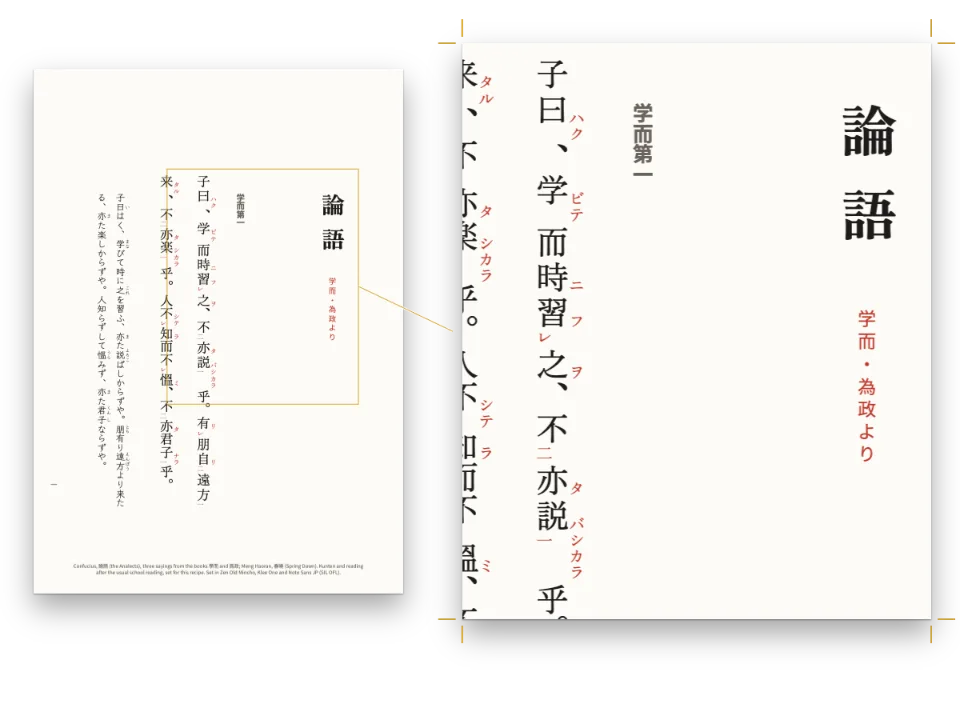
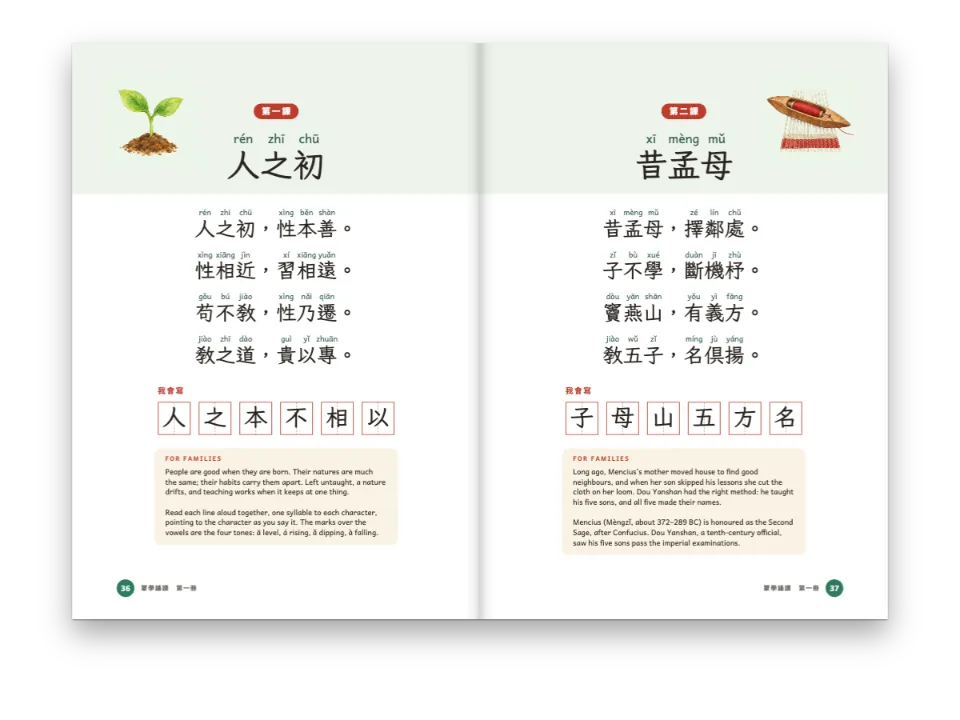
Um livro de leitura escolar de Taiwan, impresso em colunas de cima para baixo. Cada caractere chinês tem ao lado um pequeno guia de pronúncia, para as crianças lerem palavras que ainda não aprenderam.
O que você vai compor
A lição 12 do livro 9 de 國語, um livro de leitura inventado de quinto ano de Taiwan: duas fábulas do Han Feizi, a do lavrador de Song que espera junto a um toco por outra lebre e a do homem de Zheng que confia mais na sua medida do que nos próprios pés. Os livros de leitura de Taiwan são compostos na vertical, em letra Kai, com o zhuyin de cada caractere numa coluna à direita dele, para que a criança consiga ler um caractere antes de aprendê-lo. A lição abre numa página dupla encadernada pela direita. Em cima, um andar guarda as figuras, as notas, o autor e os caracteres novos; embaixo, a lição corre em Iansui de 16 pt, 23 caracteres por linha. A versão em escrita latina é o livro didático com coluna na margem, cuja coluna lateral só de flutuantes é aqui o andar de cima, girado um quarto de volta.
Esta receita responde a
- Como coloco zhuyin ao lado de cada caractere de um texto chinês vertical?
- Como componho um livro chinês na vertical, encadernado à direita?
A resposta curta
const layout = {
  writingMode: 'vertical-rl', // lines run down the page, read from the right; bound on the right
  layoutType: 'oneAndHalf', // two tiers: the text below, pictures and notes above
  sideColumnRole: 'floats', sideColumnSide: 'left', // 'left' is the top tier in vertical text
  sideColumnPercent: 34,
  gutterWidth: pt(2 * SIZE),
};
const cjk = {
  // The lower tier: 23 characters down, 13 lines across the page.
  grid: { enabled: true, charsPerLine: 23, linesPerPage: 13 },
  // Readings at half the text size; zhuyin sets its symbols at 60 % of that, 0.3 em,
  // so three symbols fit beside one character, and beside each of two in a row.
  ruby: { fontFamily: ZHUYIN, fontSize: em(0.5) },
};
// The line pitch is twice the size: a gap of one em, which the zhuyin and its tone
// marks half fill. clreq asks for 1.5 em; one em keeps 13 lines of 23 on the page.
const LINE = 2 * SIZE;
const bodyText = {
  fontFamily: KAI, fontSize: pt(SIZE), lineHeight: pt(LINE), color: col('ink'),
  boldColor: col('ink'), italicColor: col('ink'), referenceColor: col('ink'),
  textAlign: 'justify', firstLineIndent: em(2), indentAfterHeading: true,
};
Ingredientes
- Funcionalidades
- Rubi: leituras em pinyin e zhuyinTexto verticalLivros encadernados pela direitaFontes chinesas, japonesas e coreanasLargura da pontuação chinesaGrade de caracteresColuna e meiaColuna de margem para flutuantesNotas na margemNumeração chinesaListas numeradasTipos de recurso personalizadosBoxesEstilos de parágrafoEstilos de títuloTextos, fios e caixas nos designs de páginaCabeços e fóliosExportação para PDF
- Também usa
- Quebra de linha em chinêsAtributos de títuloFiguras exatamente aquiCabeços por tipo de páginaFontes incorporadas ao PDFFiguras e tabelas como recursosNúmeros em pé no texto vertical
- Tipografia
- Iansui, LXGW WenKai TC, Noto Serif TC, Noto Sans TC (SIL OFL 1.1)
- Materiais
plate-1-1500.jpgplate-2-1500.jpg- The farmer waiting by the stump, a brush painting (Generated With Diffusion Models, original)
- The man of Zheng hurrying home from the shoe stall, a brush painting (Generated With Diffusion Models, original)
Preparo
#1 · Uma coluna de zhuyin ao lado de cada caractere
O código é a resposta curta acima. {宋人|ㄙㄨㄥˋ|ㄖㄣˊ} dá a cada caractere a sua leitura, uma por |; a pontuação fica fora das chaves, então 。e , não recebem nenhuma. No texto vertical, uma leitura em bopomofo vai à direita da coluna, com os símbolos empilhados, a marca de tom à direita do último e o ponto do tom neutro acima do primeiro. Com metade do corpo do texto, cjk.ruby.fontSize deixa os símbolos com 0,3 em, então três símbolos cabem ao lado de um caractere, e duas leituras assim seguidas, como em 就像, ficam a pelo menos um quarto de símbolo uma da outra sem alargar nenhum dos dois caracteres; com 0,6 em, ㄇㄧㄥˊ fica mais alta que 明 e afasta os dois 明 de 明明. O passo de 32 pt entre linhas deixa um vão de um quadratim, que o zhuyin e as marcas de tom preenchem pela metade. O clreq pede 1,5 em quando o zhuyin fica entre linhas verticais; isso dá um passo de 40 pt e dez linhas por página, então esta página fica com um quadratim para ter 13 linhas de 23, e cada leitura fica a cerca de 8 pt da linha vizinha.
#2 · Figuras e notas no andar de cima
const resourceTypes = [{ id: 'plate', name: '插圖', shortLabel: '圖', numberingTemplate: '{n}',
  resetOn: 'never', counterFormat: 'decimal', captionPrefix: '' }]; // no prefix, no caption
const box = (id, title, body) => ({ id, title, background: col('tint'),
  padding: { top: mm(3), right: mm(3), bottom: mm(3), left: mm(3) },
  titleStyle: { fontFamily: HEI, fontSize: pt(11), fontWeight: 700, color: col('accent') },
  body: { color: col('ink'), firstLineIndent: pt(0), textAlign: 'left', boldColor: col('ink'),
    italicColor: col('ink'), ...body } });
// Zhuyin is 0.3 em of the text it reads: at 13 pt the notes' readings are 3.9 pt.
const calloutStyles = [ // fenced :::callout{type="notes" span="side"} in the text
  box('notes', '注釋', { fontFamily: MING, fontSize: pt(13), lineHeight: pt(24) }),
  box('author', '作者', { fontFamily: MING, fontSize: pt(13), lineHeight: pt(24),
    textAlign: 'justify', firstLineIndent: em(2) }),
  box('chars', '生字', { fontFamily: KAI, fontSize: pt(22), lineHeight: pt(40),
    textAlign: 'center' }),
];
No texto vertical, as colunas de um layout oneAndHalf são andares, e sideColumnSide: 'left' põe em cima o que só aceita flutuantes. ::resource{id="plate-1"} no texto manda a primeira figura para lá; o tipo plate não tem prefixo de legenda, e as figuras não têm legenda, então nada sai embaixo delas. Um boxe aberto com span="side" cai no andar a partir da linha em que foi aberto, e o texto dele desce pelo andar. As notas das duas fábulas são um único boxe, numerado ao longo da lição e aberto depois do primeiro original, que termina na página 86: ele preenche o andar da página 87, e assim as notas das duas fábulas ficam na página dupla que contém os originais. O zhuyin mede 0,3 em do texto que lê, e cjk.ruby é uma configuração única para o livro, então as notas e o boxe do autor são compostos em 13 pt para manter as leituras deles em 3,9 pt.
#3 · Quatro fontes, cada uma carregada com o seu texto
// {株|ㄓㄨ}: the characters are the text, the readings go to the zhuyin face.
const BOXES = /^:::callout\{type="(?:notes|author)"[^}]*\}\n([\s\S]*?)^:::$/gm;
const bases = (md) => md.replace(/\{([^|{}]+)((?:\|[^|{}]+)+)\}/g, '$1');
const readings = [...markdown.matchAll(/\{[^|{}]+((?:\|[^|{}]+)+)\}/g)].map((m) => m[1]).join('');
await loadFonts(FONTS, markdown);
await loadCjkFonts({ [KAI]: ['400'] }, bases(markdown.replace(BOXES, '')), { vertical: true });
const notesText = [...markdown.matchAll(BOXES)].map((m) => m[1]).join('\n');
await loadCjkFonts({ [MING]: ['400'] }, bases(notesText), { vertical: true });
await loadCjkFonts({ [ZHUYIN]: ['400'] }, readings.replaceAll('|', ''), { vertical: true });
await loadCjkFonts({ [HEI]: ['400', '700'] }, LABELS, { vertical: true });
await Promise.all(Object.values(plates).map((fileId) => loadImage(fileId, asset(fileId))));
// Lesson 12 of a reader: page 86 is a verso, so the lesson opens on a spread.
const continuation = { pageIndexOffset: 1, pageNumbering: { startAt: 86 } };
const doc = await buildWithFonts(
  () => buildDocument({ markdown, resources, continuation }, config()), markdown);
showBook(doc, { title: t({ en: 'A vertical reader with zhuyin',
  es: 'Un libro de lectura vertical con zhuyin' }) });
offerPdf(() => renderToPdf(doc, { fontProvider: cjkPdfProvider, resourceBytes: imageBytes }),
  `${RECIPE}.pdf`);
A lição é composta em Iansui, uma letra Kai desenhada a partir da Klee One nas formas padrão de caracteres de Taiwan, as que as crianças aprendem a escrever. As leituras ficam em LXGW WenKai TC, cujo ponto de tom neutro continua redondo em 4,8 pt, as notas em Noto Serif TC e os rótulos em Noto Sans TC. Cada fonte carrega os arquivos que contêm os caracteres que ela compõe: as leituras são separadas dos seus caracteres, e os boxes de notas vão só para a fonte Ming. vertical: true acrescenta as formas verticais, para que 「」 e 、 fiquem em pé como devem ao longo da coluna. pageIndexOffset: 1 faz da página 86 uma página par, e assim a lição abre numa página dupla.
#4 · A aba e os fólios na borda externa
// The verso lies on the right of the spread, so even pages carry both at the right edge.
const tab = (parity, edge) => [
  { kind: 'box', id: `tab-${parity}`, parity, pages: 'all',
    placement: { anchor: { to: 'page', edge }, offset: { y: mm(24) },
      size: { width: mm(9), height: mm(64) } }, style: { backgroundColor: col('accent') } },
  { kind: 'text', id: `unit-${parity}`, content: '第三單元 寓言故事', parity, pages: 'all',
    writingMode: 'vertical-rl', fontFamily: HEI, fontSize: pt(9), fontWeight: 700,
    color: col('paper'), align: 'center', verticalAlign: 'middle',
    placement: { anchor: { to: `#tab-${parity}`, edge: 'align-top' },
      size: { width: mm(9), height: mm(64) } } },
];
const foot = (id, parity, edge, x, content, extra = {}) => ({
  kind: 'text', id, content, parity, pages: 'all', fontFamily: HEI, fontSize: pt(8),
  color: col('muted'), placement: { anchor: { to: 'page', edge }, offset: { x: mm(x), y: mm(-9) } },
  ...extra,
});
const folio = { fontSize: pt(9), fontWeight: 700 };
const header = { elements: [...tab('even', 'top-right'), ...tab('odd', 'top-left')] };
const footer = {
  elements: [
    foot('folio-even', 'even', 'bottom-right', -16, '{pageNumber}', folio),
    foot('book', 'even', 'bottom-right', -26, '國語 第九冊'),
    foot('folio-odd', 'odd', 'bottom-left', 16, '{pageNumber}', folio),
    foot('lesson', 'odd', 'bottom-left', 26, '{chapterTitle}'),
  ],
};
Num livro encadernado pela direita, a página par fica à direita da página dupla, então as páginas pares levam a aba da unidade e o fólio na borda direita, e as ímpares na esquerda. A aba é uma caixa com um elemento de texto por cima; writingMode: 'vertical-rl' no elemento compõe 第三單元 寓言故事 descendo pela aba, enquanto os fólios e as linhas do pé continuam horizontais.
A receita completa
// ═══ Postext Cookbook · Nº 080 · A vertical reader with zhuyin to the right ═════════ // https://postext.dev/en/cookbook/zhuyin-vertical-reader // Code: MIT · Text: Han Feizi, zh.wikisource (CC BY-SA 4.0) · Pictures: diffusion models // Fonts: Iansui, LXGW WenKai TC, Noto Serif TC, Noto Sans TC (SIL OFL 1.1) · Needs postext ≥ 1.9.0 import { buildDocument, renderPageToCanvas, clearMeasurementCache, registerResourceImage, loadVerticalAlternates, } from 'https://esm.sh/postext'; import { renderToPdf, decompressWoff2 } from 'https://esm.sh/postext-pdf'; const LANG = 'en'; // @lang: the language of the sample document ('en' | 'es') const RECIPE = 'zhuyin-vertical-reader'; // ─── 1 · Design ───────────────────────────────────────────────────────────── // #region palette: semantic colours, every one linked by id const palette = { ink: '#2b2520', // text and zhuyin accent: '#b83f28', // lesson title, labels, the unit's tab (4.9:1 on the tint) tint: '#f7efdf', // the boxes of the upper tier muted: '#72675b', // lead, folios, colophon paper: '#ffffff', // the lettering on the tab }; const col = (id) => ({ hex: palette[id], model: 'hex', paletteId: id }); const colorPalette = [ ...Object.entries(palette).map(([id, hex]) => ({ id, name: id, value: { hex, model: 'hex' } })), { id: 'main-color', name: 'accent (defaults)', value: { hex: palette.accent, model: 'hex' } }, ]; // #endregion const KAI = 'Iansui'; // 楷: the lesson, drawn to Taiwan's standard forms (為, not 爲) const ZHUYIN = 'LXGW WenKai TC'; // the readings: a round dot for the neutral tone const MING = 'Noto Serif TC'; // 明: notes and the author box const HEI = 'Noto Sans TC'; // 黑: labels, folios, the tab const SIZE = 16; // the text size (三號) // #region answer: vertical text with a zhuyin column right of every character const layout = { writingMode: 'vertical-rl', // lines run down the page, read from the right; bound on the right layoutType: 'oneAndHalf', // two tiers: the text below, pictures and notes above sideColumnRole: 'floats', sideColumnSide: 'left', // 'left' is the top tier in vertical text sideColumnPercent: 34, gutterWidth: pt(2 * SIZE), }; const cjk = { // The lower tier: 23 characters down, 13 lines across the page. grid: { enabled: true, charsPerLine: 23, linesPerPage: 13 }, // Readings at half the text size; zhuyin sets its symbols at 60 % of that, 0.3 em, // so three symbols fit beside one character, and beside each of two in a row. ruby: { fontFamily: ZHUYIN, fontSize: em(0.5) }, }; // The line pitch is twice the size: a gap of one em, which the zhuyin and its tone // marks half fill. clreq asks for 1.5 em; one em keeps 13 lines of 23 on the page. const LINE = 2 * SIZE; const bodyText = { fontFamily: KAI, fontSize: pt(SIZE), lineHeight: pt(LINE), color: col('ink'), boldColor: col('ink'), italicColor: col('ink'), referenceColor: col('ink'), textAlign: 'justify', firstLineIndent: em(2), indentAfterHeading: true, }; // #endregion // #region upper-tier: pictures without a caption line, boxes of notes set down the tier const resourceTypes = [{ id: 'plate', name: '插圖', shortLabel: '圖', numberingTemplate: '{n}', resetOn: 'never', counterFormat: 'decimal', captionPrefix: '' }]; // no prefix, no caption const box = (id, title, body) => ({ id, title, background: col('tint'), padding: { top: mm(3), right: mm(3), bottom: mm(3), left: mm(3) }, titleStyle: { fontFamily: HEI, fontSize: pt(11), fontWeight: 700, color: col('accent') }, body: { color: col('ink'), firstLineIndent: pt(0), textAlign: 'left', boldColor: col('ink'), italicColor: col('ink'), ...body } }); // Zhuyin is 0.3 em of the text it reads: at 13 pt the notes' readings are 3.9 pt. const calloutStyles = [ // fenced :::callout{type="notes" span="side"} in the text box('notes', '注釋', { fontFamily: MING, fontSize: pt(13), lineHeight: pt(24) }), box('author', '作者', { fontFamily: MING, fontSize: pt(13), lineHeight: pt(24), textAlign: 'justify', firstLineIndent: em(2) }), box('chars', '生字', { fontFamily: KAI, fontSize: pt(22), lineHeight: pt(40), textAlign: 'center' }), ]; // #endregion // #region furniture: the unit's tab and the folios, on the outer edge of a right-bound book // The verso lies on the right of the spread, so even pages carry both at the right edge. const tab = (parity, edge) => [ { kind: 'box', id: `tab-${parity}`, parity, pages: 'all', placement: { anchor: { to: 'page', edge }, offset: { y: mm(24) }, size: { width: mm(9), height: mm(64) } }, style: { backgroundColor: col('accent') } }, { kind: 'text', id: `unit-${parity}`, content: '第三單元 寓言故事', parity, pages: 'all', writingMode: 'vertical-rl', fontFamily: HEI, fontSize: pt(9), fontWeight: 700, color: col('paper'), align: 'center', verticalAlign: 'middle', placement: { anchor: { to: `#tab-${parity}`, edge: 'align-top' }, size: { width: mm(9), height: mm(64) } } }, ]; const foot = (id, parity, edge, x, content, extra = {}) => ({ kind: 'text', id, content, parity, pages: 'all', fontFamily: HEI, fontSize: pt(8), color: col('muted'), placement: { anchor: { to: 'page', edge }, offset: { x: mm(x), y: mm(-9) } }, ...extra, }); const folio = { fontSize: pt(9), fontWeight: 700 }; const header = { elements: [...tab('even', 'top-right'), ...tab('odd', 'top-left')] }; const footer = { elements: [ foot('folio-even', 'even', 'bottom-right', -16, '{pageNumber}', folio), foot('book', 'even', 'bottom-right', -26, '國語 第九冊'), foot('folio-odd', 'odd', 'bottom-left', 16, '{pageNumber}', folio), foot('lesson', 'odd', 'bottom-left', 26, '{chapterTitle}'), ], }; // #endregion const config = () => ({ // a factory: the engine caches resolved configs per object locale: 'zh-Hant', // Taiwan: full-width punctuation, centred in its cell (gotcha: cjk-locale-tag) colorPalette, resourceTypes, page: { sizePreset: 'custom', width: mm(184), height: mm(260), dpi: 150, // 16開 margins: { top: mm(24), bottom: mm(18), left: mm(18), right: mm(16), mirror: true }, }, layout, cjk, bodyText, headings: { fontFamily: KAI, color: col('ink'), fontWeight: 400, // Iansui has one weight levels: [ // The lesson and fable numbers are typed in the headings: a numberingTemplate would // join the number to the title's first reading (see the recipe's workarounds). { level: 1, fontSize: pt(30), lineHeight: pt(2 * LINE), color: col('accent'), breakBefore: { enabled: true, parity: 'any' }, marginBottom: pt(0) }, { level: 2, fontSize: pt(20), lineHeight: pt(2 * LINE), marginTop: pt(LINE), marginBottom: pt(0) }, { level: 3, fontFamily: HEI, fontWeight: 700, fontSize: pt(13), lineHeight: pt(LINE), color: col('accent'), marginTop: pt(LINE / 2), marginBottom: pt(0) }, ], }, // 想一想 and 語文天地: exercise heads in the label face, one line tall. headingStyles: [{ id: 'drill', fontFamily: HEI, fontWeight: 700, fontSize: pt(13), lineHeight: pt(LINE), color: col('accent'), marginTop: pt(LINE / 2), marginBottom: pt(0) }], orderedLists: { numberFormat: 'trad-chinese-informal', separator: '、', color: col('accent'), fontFamily: HEI, fontWeight: 700, marginTop: pt(0), marginBottom: pt(0) }, paragraphStyles: [ { id: 'lead', fontFamily: KAI, fontSize: pt(14), lineHeight: pt(LINE), color: col('muted'), textAlign: 'justify', firstLineIndent: em(0) }, { id: 'plain', fontFamily: KAI, fontSize: pt(14), lineHeight: pt(LINE), color: col('ink'), textAlign: 'justify', firstLineIndent: em(2) }, { id: 'idiom', fontFamily: KAI, fontSize: pt(SIZE), lineHeight: pt(LINE), color: col('ink'), boldColor: col('accent'), boldFontWeight: 400, textAlign: 'justify', // bold in colour only firstLineIndent: em(0) }, { id: 'colophon', fontFamily: HEI, fontSize: pt(7), lineHeight: pt(11), color: col('muted'), textAlign: 'left', firstLineIndent: pt(0), marginTop: pt(LINE) }, ], calloutStyles, header, footer, }); // ─── 2 · Content ──────────────────────────────────────────────────────────── const markdown = String.raw`# 第十二課 {寓言兩則|ㄩˋ|ㄧㄢˊ|ㄌㄧㄤˇ|ㄗㄜˊ}Amostra em Markdown · 91 linhas · content.en.md
:::paragraphs{style="lead"} {寓言用一個短短的故事|ㄩˋ|ㄧㄢˊ|ㄩㄥˋ|ㄧ|˙ㄍㄜ|ㄉㄨㄢˇ|ㄉㄨㄢˇ|˙ㄉㄜ|ㄍㄨˋ|˙ㄕ},{說出一個道理|ㄕㄨㄛ|ㄔㄨ|ㄧ|˙ㄍㄜ|ㄉㄠˋ|ㄌㄧˇ}。{這一課的兩則寓言|ㄓㄜˋ|ㄧ|ㄎㄜˋ|˙ㄉㄜ|ㄌㄧㄤˇ|ㄗㄜˊ|ㄩˋ|ㄧㄢˊ},{都選自戰國時代韓非所寫的|ㄉㄡ|ㄒㄩㄢˇ|ㄗˋ|ㄓㄢˋ|ㄍㄨㄛˊ|ㄕˊ|ㄉㄞˋ|ㄏㄢˊ|ㄈㄟ|ㄙㄨㄛˇ|ㄒㄧㄝˇ|˙ㄉㄜ}《{韓非子|ㄏㄢˊ|ㄈㄟ|ㄗˇ}》。{讀的時候想一想|ㄉㄨˊ|˙ㄉㄜ|ㄕˊ|ㄏㄡˋ|ㄒㄧㄤˇ|ㄧ|ㄒㄧㄤˇ}:{故事裡的人|ㄍㄨˋ|˙ㄕ|ㄌㄧˇ|˙ㄉㄜ|ㄖㄣˊ},{錯在哪裡|ㄘㄨㄛˋ|ㄗㄞˋ|ㄋㄚˇ|ㄌㄧˇ}? ::: ::resource{id="plate-1"} ## 一 {守株待兔|ㄕㄡˇ|ㄓㄨ|ㄉㄞˋ|ㄊㄨˋ} {宋人有耕田者|ㄙㄨㄥˋ|ㄖㄣˊ|ㄧㄡˇ|ㄍㄥ|ㄊㄧㄢˊ|ㄓㄜˇ},{田中有株|ㄊㄧㄢˊ|ㄓㄨㄥ|ㄧㄡˇ|ㄓㄨ},{兔走觸株|ㄊㄨˋ|ㄗㄡˇ|ㄔㄨˋ|ㄓㄨ},{折頸而死|ㄓㄜˊ|ㄐㄧㄥˇ|ㄦˊ|ㄙˇ},{因釋其耒而守株|ㄧㄣ|ㄕˋ|ㄑㄧˊ|ㄌㄟˇ|ㄦˊ|ㄕㄡˇ|ㄓㄨ},{冀復得兔|ㄐㄧˋ|ㄈㄨˋ|ㄉㄜˊ|ㄊㄨˋ},{兔不可復得|ㄊㄨˋ|ㄅㄨˋ|ㄎㄜˇ|ㄈㄨˋ|ㄉㄜˊ},{而身為宋國笑|ㄦˊ|ㄕㄣ|ㄨㄟˊ|ㄙㄨㄥˋ|ㄍㄨㄛˊ|ㄒㄧㄠˋ}。 :::callout{type="notes" span="side"} ①{株|ㄓㄨ}:露出地面的樹根。 ②{走|ㄗㄡˇ}:跑。 ③{觸|ㄔㄨˋ}:碰,撞。 ④{釋|ㄕˋ}:放下。 ⑤{耒|ㄌㄟˇ}:古代翻土用的農具。 ⑥{冀|ㄐㄧˋ}:希望。 ⑦{為宋國笑|ㄨㄟˊ|ㄙㄨㄥˋ|ㄍㄨㄛˊ|ㄒㄧㄠˋ}:被宋國人譏笑。 ⑧{且置履|ㄑㄧㄝˇ|ㄓˋ|ㄌㄩˇ}:將要買鞋。 ⑨{度|ㄉㄨㄛˋ}:量長短。 ⑩{坐|ㄗㄨㄛˋ}:同「座」,座位。 ⑪{操|ㄘㄠ}:拿,帶著。 ⑫{度|ㄉㄨˋ}:量好的尺碼。 ⑬{反|ㄈㄢˇ}:同「返」,回去。 ⑭{罷|ㄅㄚˋ}:結束,散了。 ⑮{寧|ㄋㄧㄥˊ}:寧可。 ::: ### {語譯|ㄩˇ|ㄧˋ} :::paragraphs{style="plain"} {宋國有一個種田的人|ㄙㄨㄥˋ|ㄍㄨㄛˊ|ㄧㄡˇ|ㄧ|˙ㄍㄜ|ㄓㄨㄥˋ|ㄊㄧㄢˊ|˙ㄉㄜ|ㄖㄣˊ},{田裡有一截樹樁|ㄊㄧㄢˊ|ㄌㄧˇ|ㄧㄡˇ|ㄧ|ㄐㄧㄝˊ|ㄕㄨˋ|ㄓㄨㄤ}。{有一天|ㄧㄡˇ|ㄧ|ㄊㄧㄢ},{一隻兔子跑過來|ㄧ|ㄓ|ㄊㄨˋ|˙ㄗ|ㄆㄠˇ|ㄍㄨㄛˋ|˙ㄌㄞ},{一頭撞在樹樁上|ㄧ|ㄊㄡˊ|ㄓㄨㄤˋ|ㄗㄞˋ|ㄕㄨˋ|ㄓㄨㄤ|ㄕㄤˋ},{折斷脖子死了|ㄓㄜˊ|ㄉㄨㄢˋ|ㄅㄛˊ|˙ㄗ|ㄙˇ|˙ㄌㄜ}。{這個人就放下手裡的農具|ㄓㄜˋ|˙ㄍㄜ|ㄖㄣˊ|ㄐㄧㄡˋ|ㄈㄤˋ|ㄒㄧㄚˋ|ㄕㄡˇ|ㄌㄧˇ|˙ㄉㄜ|ㄋㄨㄥˊ|ㄐㄩˋ},{天天守在樹樁旁邊|ㄊㄧㄢ|ㄊㄧㄢ|ㄕㄡˇ|ㄗㄞˋ|ㄕㄨˋ|ㄓㄨㄤ|ㄆㄤˊ|ㄅㄧㄢ},{希望再撿到兔子|ㄒㄧ|ㄨㄤˋ|ㄗㄞˋ|ㄐㄧㄢˇ|ㄉㄠˋ|ㄊㄨˋ|˙ㄗ}。{兔子再也沒有來過|ㄊㄨˋ|˙ㄗ|ㄗㄞˋ|ㄧㄝˇ|ㄇㄟˊ|ㄧㄡˇ|ㄌㄞˊ|ㄍㄨㄛˋ},{他自己倒成了宋國人的笑話|ㄊㄚ|ㄗˋ|ㄐㄧˇ|ㄉㄠˋ|ㄔㄥˊ|˙ㄌㄜ|ㄙㄨㄥˋ|ㄍㄨㄛˊ|ㄖㄣˊ|˙ㄉㄜ|ㄒㄧㄠˋ|ㄏㄨㄚˋ}。 ::: ::resource{id="plate-2"} ## 二 {鄭人買履|ㄓㄥˋ|ㄖㄣˊ|ㄇㄞˇ|ㄌㄩˇ} {鄭人有且置履者|ㄓㄥˋ|ㄖㄣˊ|ㄧㄡˇ|ㄑㄧㄝˇ|ㄓˋ|ㄌㄩˇ|ㄓㄜˇ},{先自度其足而置之其坐|ㄒㄧㄢ|ㄗˋ|ㄉㄨㄛˋ|ㄑㄧˊ|ㄗㄨˊ|ㄦˊ|ㄓˋ|ㄓ|ㄑㄧˊ|ㄗㄨㄛˋ},{至之市而忘操之|ㄓˋ|ㄓ|ㄕˋ|ㄦˊ|ㄨㄤˋ|ㄘㄠ|ㄓ}。{已得履|ㄧˇ|ㄉㄜˊ|ㄌㄩˇ},{乃曰|ㄋㄞˇ|ㄩㄝ}:「{吾忘持度|ㄨˊ|ㄨㄤˋ|ㄔˊ|ㄉㄨˋ}。」{反歸取之|ㄈㄢˇ|ㄍㄨㄟ|ㄑㄩˇ|ㄓ}。{及反|ㄐㄧˊ|ㄈㄢˇ},{市罷|ㄕˋ|ㄅㄚˋ},{遂不得履|ㄙㄨㄟˋ|ㄅㄨˋ|ㄉㄜˊ|ㄌㄩˇ}。{人曰|ㄖㄣˊ|ㄩㄝ}:「{何不試之以足|ㄏㄜˊ|ㄅㄨˋ|ㄕˋ|ㄓ|ㄧˇ|ㄗㄨˊ}?」{曰|ㄩㄝ}:「{寧信度|ㄋㄧㄥˊ|ㄒㄧㄣˋ|ㄉㄨˋ},{無自信也|ㄨˊ|ㄗˋ|ㄒㄧㄣˋ|ㄧㄝˇ}。」 ### {語譯|ㄩˇ|ㄧˋ} :::paragraphs{style="plain"} {鄭國有個人要買鞋子|ㄓㄥˋ|ㄍㄨㄛˊ|ㄧㄡˇ|˙ㄍㄜ|ㄖㄣˊ|ㄧㄠˋ|ㄇㄞˇ|ㄒㄧㄝˊ|˙ㄗ}。{他先在家裡量好自己腳的大小|ㄊㄚ|ㄒㄧㄢ|ㄗㄞˋ|ㄐㄧㄚ|˙ㄌㄧ|ㄌㄧㄤˊ|ㄏㄠˇ|ㄗˋ|ㄐㄧˇ|ㄐㄧㄠˇ|˙ㄉㄜ|ㄉㄚˋ|ㄒㄧㄠˇ},{把量好的尺碼放在座位上|ㄅㄚˇ|ㄌㄧㄤˊ|ㄏㄠˇ|˙ㄉㄜ|ㄔˇ|ㄇㄚˇ|ㄈㄤˋ|ㄗㄞˋ|ㄗㄨㄛˋ|ㄨㄟˋ|ㄕㄤˋ}。{到了市場|ㄉㄠˋ|˙ㄌㄜ|ㄕˋ|ㄔㄤˊ},{卻忘了把尺碼帶在身上|ㄑㄩㄝˋ|ㄨㄤˋ|˙ㄌㄜ|ㄅㄚˇ|ㄔˇ|ㄇㄚˇ|ㄉㄞˋ|ㄗㄞˋ|ㄕㄣ|ㄕㄤˋ}。{他已經挑好了鞋子|ㄊㄚ|ㄧˇ|ㄐㄧㄥ|ㄊㄧㄠ|ㄏㄠˇ|˙ㄌㄜ|ㄒㄧㄝˊ|˙ㄗ},{才說|ㄘㄞˊ|ㄕㄨㄛ}:「{我忘了帶尺碼|ㄨㄛˇ|ㄨㄤˋ|˙ㄌㄜ|ㄉㄞˋ|ㄔˇ|ㄇㄚˇ}。」{就轉身回家去拿|ㄐㄧㄡˋ|ㄓㄨㄢˇ|ㄕㄣ|ㄏㄨㄟˊ|ㄐㄧㄚ|ㄑㄩˋ|ㄋㄚˊ}。{等他再回到市場|ㄉㄥˇ|ㄊㄚ|ㄗㄞˋ|ㄏㄨㄟˊ|ㄉㄠˋ|ㄕˋ|ㄔㄤˊ},{市場已經散了|ㄕˋ|ㄔㄤˊ|ㄧˇ|ㄐㄧㄥ|ㄙㄢˋ|˙ㄌㄜ},{終於沒買到鞋子|ㄓㄨㄥ|ㄩˊ|ㄇㄟˊ|ㄇㄞˇ|ㄉㄠˋ|ㄒㄧㄝˊ|˙ㄗ}。{有人問他|ㄧㄡˇ|ㄖㄣˊ|ㄨㄣˋ|ㄊㄚ}:「{為什麼不用腳試穿呢|ㄨㄟˋ|ㄕㄣˊ|˙ㄇㄜ|ㄅㄨˋ|ㄩㄥˋ|ㄐㄧㄠˇ|ㄕˋ|ㄔㄨㄢ|˙ㄋㄜ}?」{他說|ㄊㄚ|ㄕㄨㄛ}:「{我寧可相信尺碼|ㄨㄛˇ|ㄋㄧㄥˊ|ㄎㄜˇ|ㄒㄧㄤ|ㄒㄧㄣˋ|ㄔˇ|ㄇㄚˇ},{也不相信自己的腳|ㄧㄝˇ|ㄅㄨˋ|ㄒㄧㄤ|ㄒㄧㄣˋ|ㄗˋ|ㄐㄧˇ|˙ㄉㄜ|ㄐㄧㄠˇ}。」 ::: ## {想一想|ㄒㄧㄤˇ|ㄧ|ㄒㄧㄤˇ} {style="drill"} 1. {宋國的農夫為什麼成了別人的笑話|ㄙㄨㄥˋ|ㄍㄨㄛˊ|˙ㄉㄜ|ㄋㄨㄥˊ|ㄈㄨ|ㄨㄟˋ|ㄕㄣˊ|˙ㄇㄜ|ㄔㄥˊ|˙ㄌㄜ|ㄅㄧㄝˊ|ㄖㄣˊ|˙ㄉㄜ|ㄒㄧㄠˋ|ㄏㄨㄚˋ}? 2. {鄭國人明明到了市場|ㄓㄥˋ|ㄍㄨㄛˊ|ㄖㄣˊ|ㄇㄧㄥˊ|ㄇㄧㄥˊ|ㄉㄠˋ|˙ㄌㄜ|ㄕˋ|ㄔㄤˊ},{為什麼沒買到鞋子|ㄨㄟˋ|ㄕㄣˊ|˙ㄇㄜ|ㄇㄟˊ|ㄇㄞˇ|ㄉㄠˋ|ㄒㄧㄝˊ|˙ㄗ}? 3. {這兩個人做錯的地方|ㄓㄜˋ|ㄌㄧㄤˇ|˙ㄍㄜ|ㄖㄣˊ|ㄗㄨㄛˋ|ㄘㄨㄛˋ|˙ㄉㄜ|ㄉㄧˋ|ㄈㄤ},{有什麼相同|ㄧㄡˇ|ㄕㄣˊ|˙ㄇㄜ|ㄒㄧㄤ|ㄊㄨㄥˊ}? :::callout{type="author" span="side"} {韓非|ㄏㄢˊ|ㄈㄟ},戰國時代韓國的貴族,大約生於西元前二八〇年,死於西元前二三三年。他和{李斯|ㄌㄧˇ|ㄙ}都是{荀子|ㄒㄩㄣˊ|ㄗˇ}的學生,說話口吃,卻很會寫文章。後人把他的文章編成《韓非子》,書中有許多有趣的寓言故事。 ::: ## {語文天地|ㄩˇ|ㄨㄣˊ|ㄊㄧㄢ|ㄉㄧˋ} {style="drill"} 「{守株待兔|ㄕㄡˇ|ㄓㄨ|ㄉㄞˋ|ㄊㄨˋ}」{與|ㄩˇ}「{鄭人買履|ㄓㄥˋ|ㄖㄣˊ|ㄇㄞˇ|ㄌㄩˇ}」{後來都成了成語|ㄏㄡˋ|ㄌㄞˊ|ㄉㄡ|ㄔㄥˊ|˙ㄌㄜ|ㄔㄥˊ|ㄩˇ}。 :::paragraphs{style="idiom"} **{守株待兔|ㄕㄡˇ|ㄓㄨ|ㄉㄞˋ|ㄊㄨˋ}**:{比喻不肯努力|ㄅㄧˇ|ㄩˋ|ㄅㄨˋ|ㄎㄣˇ|ㄋㄨˇ|ㄌㄧˋ},{只想白白得到好處|ㄓˇ|ㄒㄧㄤˇ|ㄅㄞˊ|ㄅㄞˊ|ㄉㄜˊ|ㄉㄠˋ|ㄏㄠˇ|ㄔㄨˋ}。{例|ㄌㄧˋ}:{考試前不讀書|ㄎㄠˇ|ㄕˋ|ㄑㄧㄢˊ|ㄅㄨˋ|ㄉㄨˊ|ㄕㄨ},{只希望考的題目剛好都會|ㄓˇ|ㄒㄧ|ㄨㄤˋ|ㄎㄠˇ|˙ㄉㄜ|ㄊㄧˊ|ㄇㄨˋ|ㄍㄤ|ㄏㄠˇ|ㄉㄡ|ㄏㄨㄟˋ},{這就是守株待兔|ㄓㄜˋ|ㄐㄧㄡˋ|ㄕˋ|ㄕㄡˇ|ㄓㄨ|ㄉㄞˋ|ㄊㄨˋ}。 **{鄭人買履|ㄓㄥˋ|ㄖㄣˊ|ㄇㄞˇ|ㄌㄩˇ}**:{比喻只相信死板的規定|ㄅㄧˇ|ㄩˋ|ㄓˇ|ㄒㄧㄤ|ㄒㄧㄣˋ|ㄙˇ|ㄅㄢˇ|˙ㄉㄜ|ㄍㄨㄟ|ㄉㄧㄥˋ},{不看實際的情形|ㄅㄨˋ|ㄎㄢˋ|ㄕˊ|ㄐㄧˋ|˙ㄉㄜ|ㄑㄧㄥˊ|ㄒㄧㄥˊ}。{例|ㄌㄧˋ}:{買衣服不試穿|ㄇㄞˇ|ㄧ|˙ㄈㄨ|ㄅㄨˋ|ㄕˋ|ㄔㄨㄢ},{只看尺寸|ㄓˇ|ㄎㄢˋ|ㄔˊ|˙ㄘㄨㄣ},{就像鄭人買履|ㄐㄧㄡˋ|ㄒㄧㄤˋ|ㄓㄥˋ|ㄖㄣˊ|ㄇㄞˇ|ㄌㄩˇ}。 ::: :::callout{type="chars" span="side"} {株|ㄓㄨ} {耒|ㄌㄟˇ} {冀|ㄐㄧˋ} {履|ㄌㄩˇ} {罷|ㄅㄚˋ} {遂|ㄙㄨㄟˋ} ::: :::paragraphs{style="colophon"} Set in Iansui, LXGW WenKai TC, Noto Serif TC and Noto Sans TC (SIL OFL). Text: Han Feizi, chapters :sideways[49] and :sideways[32], Chinese Wikisource, revisions 2642850 and 2327662 (CC BY-SA 4.0). Zhuyin checked against the Revised Mandarin Chinese Dictionary (Ministry of Education, Taiwan); modern versions, notes and exercises written for this recipe (CC BY 4.0). :::`; // content.<lang>.md, inlined by the Cookbook // ─── 3 · Fonts ────────────────────────────────────────────────────────────── const FONTS = { Iansui: ['400'], 'LXGW WenKai TC': ['400'], 'Noto Serif TC': ['400'], 'Noto Sans TC': ['400', '700'], }; // What the label face sets: the tab, the foot of the page, box titles and exercise heads. const LABELS = '第三單元寓言故事國語第九冊十二課兩則注釋作者生字語譯想一文天地、0123456789'; // #region art: two brush paintings for the upper tier, JPEGs in assets/ cut to 15 : 7 const plates = { 'plate-1': 'plate-1-1500.jpg', 'plate-2': 'plate-2-1500.jpg' }; // #endregion const altText = { 'plate-1': '守株待兔:農夫坐在樹樁旁,農具丟在田裡,一隻兔子跑遠了。', 'plate-2': '鄭人買履:鄭國人從鞋攤走回家,量好的尺碼還放在家門口的凳子上。', }; const resources = Object.entries(plates).map(([id, fileId]) => ({ id, typeId: 'plate', kind: 'bitmap', createdAt: 0, updatedAt: 0, altText: altText[id], placement: { span: 'side' }, bitmap: { fileId, format: 'jpeg', width: 1500, height: 700 } })); // declared at their pixels // ─── 4 · Build & show ─────────────────────────────────────────────────────── // #region build: each voice loads with the text it sets; vertical forms for the canvas // {株|ㄓㄨ}: the characters are the text, the readings go to the zhuyin face. const BOXES = /^:::callout\{type="(?:notes|author)"[^}]*\}\n([\s\S]*?)^:::$/gm; const bases = (md) => md.replace(/\{([^|{}]+)((?:\|[^|{}]+)+)\}/g, '$1'); const readings = [...markdown.matchAll(/\{[^|{}]+((?:\|[^|{}]+)+)\}/g)].map((m) => m[1]).join(''); await loadFonts(FONTS, markdown); await loadCjkFonts({ [KAI]: ['400'] }, bases(markdown.replace(BOXES, '')), { vertical: true }); const notesText = [...markdown.matchAll(BOXES)].map((m) => m[1]).join('\n'); await loadCjkFonts({ [MING]: ['400'] }, bases(notesText), { vertical: true }); await loadCjkFonts({ [ZHUYIN]: ['400'] }, readings.replaceAll('|', ''), { vertical: true }); await loadCjkFonts({ [HEI]: ['400', '700'] }, LABELS, { vertical: true }); await Promise.all(Object.values(plates).map((fileId) => loadImage(fileId, asset(fileId)))); // Lesson 12 of a reader: page 86 is a verso, so the lesson opens on a spread. const continuation = { pageIndexOffset: 1, pageNumbering: { startAt: 86 } }; const doc = await buildWithFonts( () => buildDocument({ markdown, resources, continuation }, config()), markdown); showBook(doc, { title: t({ en: 'A vertical reader with zhuyin', es: 'Un libro de lectura vertical con zhuyin' }) }); offerPdf(() => renderToPdf(doc, { fontProvider: cjkPdfProvider, resourceBytes: imageBytes }), `${RECIPE}.pdf`); // #endregionKit · core, fonts, viewer, pdf, images, cjk: igual em todas as receitas · 494 linhas
// ─── Kit ── helpers shared by every Cookbook recipe · postext.dev/cookbook ───── // ─── Kit · core v1 ── the same in every recipe · postext.dev/cookbook function mm(value) { return { value, unit: 'mm' }; } function pt(value) { return { value, unit: 'pt' }; } function em(value) { return { value, unit: 'em' }; } /** The sample language's string: t({ en: 'Figure', es: 'Figura' }). */ function t(strings) { return strings[LANG] ?? Object.values(strings)[0]; } /** A file in this recipe's assets folder, served from the Postext repo by jsDelivr. */ function asset(file) { return `https://cdn.jsdelivr.net/gh/drnachio/postext@main/cookbook/${RECIPE}/assets/${file}`; } // ─── Kit · fonts v2 ── the same in every recipe · postext.dev/cookbook // Postext measures with the loaded faces and caches the widths: load every face // before the first build, from Fontsource, the files the PDF embeds too. /** faces = { 'Family Name': ['400', '400i', '700'] }. `text` is the sample: * č ł † α χ also load latin-ext and greek files (kitSubsetsFor). With * `optional`, a face Fontsource does not ship is skipped instead of failing. * Resolves to the number of faces added. */ async function loadFonts(faces, text = '', { optional = false } = {}) { kitStatus('Loading fonts…'); const ranges = { latin: 'U+0000-00FF,U+0131,U+0152-0153,U+02BB-02BC,U+02C6,U+02DA,U+02DC,U+0304,U+0308,U+0329,' + 'U+2000-206F,U+20AC,U+2122,U+2191,U+2193,U+2212,U+2215,U+FEFF,U+FFFD', 'latin-ext': 'U+0100-02BA,U+02BD-02C5,U+02C7-02CC,U+02CE-02D7,U+02DD-02FF,U+0304,U+0308,U+0329,' + 'U+1D00-1DBF,U+1E00-1E9F,U+1EF2-1EFF,U+2020,U+20A0-20AB,U+20AD-20C0,U+2113,U+2C60-2C7F,U+A720-A7FF', greek: 'U+0370-03FF', }; const jobs = []; let added = 0; for (const [family, specs] of Object.entries(faces)) { const id = fontsourceId(family); const todo = [...new Set(specs)].map((spec) => [parseInt(spec, 10), spec.endsWith('i') ? 'italic' : 'normal']) .filter(([weight, style]) => !hasFace(family, weight, style)); // before any await const meta = optional || /[^\0-ÿ]/u.test(text) ? await fontsourceMeta(family) : null; const subsets = ['latin', ...kitSubsetsFor(text, meta)]; for (const [weight, style] of todo) { if (optional && !(meta?.weights.includes(weight) && meta.styles.includes(style))) continue; for (const subset of subsets) { const url = `https://cdn.jsdelivr.net/npm/@fontsource/${id}@5/files/${id}-${subset}-${weight}-${style}.woff2`; const face = new FontFace(family, `url(${url}) format('woff2')`, { weight: String(weight), style, unicodeRange: ranges[subset] }); jobs.push(face.load().then((ready) => { document.fonts.add(ready); added++; }, () => { if (subset === 'latin' && !optional) throw new Error(`Fontsource has no ${family} ${weight} ${style}`); })); } } } await Promise.all(jobs).catch((error) => { kitFail(error); throw error; }); return added; } /** Runs `build` and loads any face the pages use that FONTS missed (a regular * one with a warning), then clears the measurement cache and builds again. */ async function buildWithFonts(build, text = '') { const tried = new Set(); for (let round = 0; round < 3; round++) { kitStatus('Laying out…'); await new Promise(requestAnimationFrame); // let the status paint first const result = await Promise.resolve().then(build).catch((error) => { kitFail(error); throw error; }); const wanted = { base: {}, variants: {} }; for (const { font, base } of [result].flat().flatMap(fontStringsOf)) { const { family, weight, style } = parseFont(font); const key = `${family}|${weight}|${style}`; if (tried.has(key) || hasFace(family, weight, style)) continue; tried.add(key); (wanted[base ? 'base' : 'variants'][family] ??= []).push(`${weight}${style === 'italic' ? 'i' : ''}`); } if (Object.keys(wanted.base).length) { console.warn(`[cookbook] FONTS does not list ${JSON.stringify(wanted.base)}: loading them.`); } const added = await loadFonts(wanted.base, text) + await loadFonts(wanted.variants, text, { optional: true }); if (added === 0) return result; clearMeasurementCache(); } throw new Error('The fonts did not settle after three builds.'); } /** Every font string of the layout; `base` marks a block's own face. */ function fontStringsOf(doc) { const found = new Map(); const walk = (node) => { if (!node || typeof node !== 'object') return; if (Array.isArray(node)) { node.forEach(walk); return; } for (const [key, value] of Object.entries(node)) { if (typeof value === 'string' && /fontString$/i.test(key)) { found.set(value, found.get(value) || key === 'fontString'); } else if (value && typeof value === 'object') walk(value); } }; walk(doc.pages); walk(doc.blocks); return [...found].map(([font, base]) => ({ font, base })); } /** '700 37.5px Open Sans' / 'italic 400 13px "Source Serif 4"' → { family, weight, style }. * A string with no weight ('95.8px Young Serif', from a design text) is 400. */ function parseFont(font) { const m = /^(?:(italic|oblique)\s+)?(?:small-caps\s+)?(?:(\d+|bold|normal)\s+)?[\d.]+px\s+(.+)$/.exec(font.trim()); if (!m) throw new Error(`Unexpected font string: ${font}`); const weight = m[2] === 'bold' ? 700 : !m[2] || m[2] === 'normal' ? 400 : Number(m[2]); return { family: m[3].replace(/^["']|["']$/g, ''), weight, style: m[1] ? 'italic' : 'normal' }; } /** A loaded FontFace covers this family, weight and style (fonts.check() would * also say yes for families nobody declared). */ function hasFace(family, weight, style) { for (const face of document.fonts) { if (face.status !== 'loaded' || face.style !== style) continue; if (face.family.replace(/^["']|["']$/g, '') !== family) continue; const [low, high = low] = face.weight.split(' ').map(Number); if (weight >= low && weight <= high) return true; } return false; } /** The files beyond latin `text` needs that `meta`'s family ships. */ function kitSubsetsFor(text, meta) { return [[/[Ā-˿ᴀ-ᶿḀ-ỿ†ℓⱠ-Ɀ꜠-ꟿ]/u, 'latin-ext'], [/[Ͱ-Ͽ]/u, 'greek']] .filter(([re, x]) => re.test(text) && meta?.subsets?.includes(x)).map(([, x]) => x); } /** Fontsource's id for a family: 'Source Serif 4' → 'source-serif-4'. */ function fontsourceId(family) { return family.toLowerCase().replace(/\s+/g, '-'); } /** The family's Fontsource metadata (weights, styles, subsets), or null. */ function fontsourceMeta(family) { fontsourceMeta.cache ??= new Map(); const id = fontsourceId(family); if (!fontsourceMeta.cache.has(id)) { fontsourceMeta.cache.set(id, fetch(`https://api.fontsource.org/v1/fonts/${id}`) .then((res) => (res.ok ? res.json() : null), () => null)); } return fontsourceMeta.cache.get(id); } // ─── Kit · viewer v1 ── the same in every recipe · postext.dev/cookbook /** The pages as spreads on a dark desk, page 1 alone, then verso | recto, * each painted when it scrolls near. */ function showPages(docs, { title, width = 460 } = {}) { const root = viewer(title); const pages = [docs].flat().flatMap((doc) => doc.pages.map((page) => ({ doc, page, n: (doc.pageIndexOffset ?? 0) + page.index }))); const spreads = []; let verso = null; for (const p of pages) { if (p.n % 2 === 1) { if (verso) spreads.push([verso, null]); verso = p; } else { spreads.push([verso, p]); verso = null; } } if (verso) spreads.push([verso, null]); const density = Math.min(window.devicePixelRatio || 1, 2); showPages.painter?.disconnect(); const painter = new IntersectionObserver((entries) => { for (const { isIntersecting, target } of entries) { if (!isIntersecting) continue; painter.unobserve(target); const { doc, page } = target.postext; renderPageToCanvas(page, doc, target, { scale: (width * density) / page.width }); } }, { rootMargin: '800px' }); showPages.painter = painter; root.replaceChildren(...spreads.map((pair) => { const spread = document.createElement('div'); spread.className = 'pt-spread'; for (const p of pair) { const figure = document.createElement('figure'); if (p) { const label = p.page.pageLabel || String(p.n + 1); const canvas = document.createElement('canvas'); canvas.postext = p; canvas.style.aspectRatio = `${p.page.width} / ${p.page.height}`; canvas.setAttribute('role', 'img'); canvas.setAttribute('aria-label', `Page ${label}`); const folio = document.createElement('figcaption'); folio.textContent = label; figure.append(canvas, folio); painter.observe(canvas); } else figure.className = 'pt-blank'; spread.append(figure); } return spread; })); kitStatus(`${pages.length} ${pages.length === 1 ? 'page' : 'pages'}`); document.documentElement.dataset.postext = 'ready'; return pages.length; } /** The desk, the bar and the error reporting, created once. */ function viewer(title) { if (!document.getElementById('pt-kit')) { document.head.insertAdjacentHTML('beforeend', `<style id="pt-kit"> :root { color-scheme: dark; } body { margin: 0; background: #0e1014; color: #b9bcc4; font: 13px/1.45 system-ui, sans-serif; } #pt-bar { position: sticky; top: 0; z-index: 1; display: flex; flex-wrap: wrap; align-items: center; gap: 6px 16px; padding: 10px 16px; background: rgb(14 16 20 / .92); backdrop-filter: blur(6px); border-bottom: 1px solid #23262d; } #pt-bar strong { color: #f4f1ea; font-weight: 600; } #pt-actions { display: flex; gap: 12px; margin-left: auto; } #pt-actions a, #pt-actions button { color: #d8a21a; font: inherit; background: none; border: 0; padding: 0; cursor: pointer; } #pages { display: grid; justify-items: center; gap: 48px; padding: 32px 16px 72px; } .pt-spread { display: flex; } .pt-spread figure { margin: 0; width: min(460px, 44vw); } .pt-spread canvas { display: block; width: 100%; background: #fff; box-shadow: 0 1px 2px rgb(0 0 0 / .5), 0 22px 44px -16px rgb(0 0 0 / .8); } .pt-spread figure:first-child canvas { box-shadow: inset -14px 0 14px -14px rgb(0 0 0 / .18), 0 1px 2px rgb(0 0 0 / .5), 0 22px 44px -16px rgb(0 0 0 / .8); } .pt-spread figcaption { margin-top: 10px; text-align: center; font: 600 10px/1 system-ui, sans-serif; letter-spacing: .18em; text-transform: uppercase; color: #6c7079; } .pt-blank { visibility: hidden; } @media (max-width: 760px) { .pt-spread { flex-direction: column; gap: 32px; } .pt-spread figure { width: min(460px, 92vw); } .pt-blank { display: none; } } </style>`); document.body.insertAdjacentHTML('afterbegin', '<header id="pt-bar"><strong id="pt-title"></strong><span id="pt-status" role="status"></span><span id="pt-actions"></span></header>'); document.getElementById('pt-title').textContent = document.title || 'Postext'; addEventListener('error', (event) => kitFail(event.error ?? event.message)); addEventListener('unhandledrejection', (event) => kitFail(event.reason)); } if (title) document.getElementById('pt-title').textContent = title; return document.getElementById('pages') ?? document.body.appendChild(Object.assign(document.createElement('main'), { id: 'pages' })); } function kitStatus(text) { viewer(); document.getElementById('pt-status').textContent = text; } function kitFail(error) { document.documentElement.dataset.postext = 'error'; kitStatus(`Error: ${error?.message ?? error}`); } // ─── Kit · pdf v2 ── the same in every recipe that exports a PDF /** The Fontsource files the screen used, as TrueType: the nearest weight the * family ships, upright if it has no italic; latin, then what the face's * letters need (kitSubsetsFor). */ async function fontsourceProvider(family, weight, style, request) { const id = fontsourceId(family); const meta = await fontsourceMeta(family); const weights = meta?.weights?.length ? meta.weights : [400, 700]; const w = weights.reduce((a, b) => (Math.abs(b - weight) < Math.abs(a - weight) ? b : a)); const s = style === 'italic' && meta && !meta.styles.includes('italic') ? 'normal' : style; const text = String.fromCodePoint(...(request?.codePoints ?? [])); const more = kitSubsetsFor(text, meta); const files = await Promise.all(['latin', ...more].map(async (subset) => { const res = await fetch(`https://cdn.jsdelivr.net/npm/@fontsource/${id}@5/files/${id}-${subset}-${w}-${s}.woff2`); if (!res.ok) throw new Error(`Fontsource has no ${family} ${w} ${s} ${subset}`); return decompressWoff2(new Uint8Array(await res.arrayBuffer())); })); return files.length === 1 ? files[0] : files; } /** A "Build the PDF" button; then "Open the PDF" (a new tab: CodePen's frame * shows no PDFs) and a download link. */ function offerPdf(makePdf, filename) { viewer(); const button = Object.assign(document.createElement('button'), { type: 'button', textContent: 'Build the PDF' }); button.dataset.postextPdf = filename; button.addEventListener('click', async () => { button.disabled = true; button.textContent = 'Building the PDF…'; try { const bytes = await makePdf(); const url = URL.createObjectURL(new Blob([bytes], { type: 'application/pdf' })); const size = `${Math.max(1, Math.round(bytes.length / 1024))} KB`; button.replaceWith( Object.assign(document.createElement('a'), { href: url, target: '_blank', rel: 'noopener', textContent: 'Open the PDF ↗' }), Object.assign(document.createElement('a'), { href: url, download: filename, textContent: `Download ${filename} · ${size}` })); } catch (error) { button.disabled = false; button.textContent = 'Build the PDF'; kitFail(error); } }); document.getElementById('pt-actions').append(button); } // ─── Kit · images v1 ── recipes with pictures · postext.dev/cookbook /** Registers a photo or PNG for the canvas and keeps its bytes for the PDF. * fetch → ImageBitmap never taints the canvas (a plain cross-origin <img> would). */ async function loadImage(fileId, url) { const res = await fetch(url); if (!res.ok) throw new Error(`Image not found (${res.status}): ${url}`); const bytes = new Uint8Array(await res.arrayBuffer()); registerResourceImage(fileId, await createImageBitmap(new Blob([bytes]))); (loadImage.bytes ??= new Map()).set(fileId, bytes); } /** Registers SVG markup (drawn in code, or fetched) as a vector image. */ async function loadSvg(fileId, svg) { const img = new Image(); img.src = `data:image/svg+xml;charset=utf-8,${encodeURIComponent(svg)}`; await img.decode(); registerResourceImage(fileId, img); (loadImage.bytes ??= new Map()).set(fileId, new TextEncoder().encode(svg)); } /** renderToPdf({ resourceBytes: imageBytes }) */ function imageBytes(fileId) { return loadImage.bytes?.get(fileId); } /** renderToHtml({ resourceImageUrl: imageUrl }) */ function imageUrl(fileId) { const bytes = imageBytes(fileId); if (!bytes) return undefined; imageUrl.urls ??= new Map(); if (!imageUrl.urls.has(fileId)) { const type = /\.svg$/i.test(fileId) ? 'image/svg+xml' : /\.png$/i.test(fileId) ? 'image/png' : 'image/jpeg'; imageUrl.urls.set(fileId, URL.createObjectURL(new Blob([bytes], { type }))); } return imageUrl.urls.get(fileId); } // ─── Kit · cjk v1 ── Chinese, Japanese and Korean books · postext.dev/cookbook // Fontsource ships a CJK family as about a hundred files per weight, each // declared in its stylesheet with the unicode-range it covers. The screen // loads the files the sample touches; the PDF gets the same files for the // characters its pages set in each face, and embeds each as a subset. // A book bound on the right (vertical text) is shown with its spreads // mirrored: page 1 alone on the left of the spine, then [3 | 2]. /** The files of a Fontsource face, read from its stylesheet: { url, range, * ranges }, the last declared first (the order the browser tries them in). */ function cjkSlices(family, weight, style) { cjkSlices.cache ??= new Map(); const id = fontsourceId(family); const css = `https://cdn.jsdelivr.net/npm/@fontsource/${id}@5/${weight}${style === 'italic' ? '-italic' : ''}.css`; if (!cjkSlices.cache.has(css)) { cjkSlices.cache.set(css, fetch(css) .then((res) => { if (!res.ok) throw new Error(`Fontsource has no ${family} ${weight} ${style} (${res.status})`); return res.text(); }) .then((text) => [...text.matchAll(/@font-face\s*{([^}]*)}/g)].map(([, rule]) => { const range = /unicode-range:\s*([^;]+);/.exec(rule)?.[1].trim() ?? 'U+0-10FFFF'; const ranges = range.split(',').map((part) => { const [lo, hi = lo] = part.trim().slice(2).split('-'); return [parseInt(lo, 16), parseInt(hi, 16)]; }); return { url: new URL(/url\(([^)]+?\.woff2)\)/.exec(rule)[1], css).href, range, ranges }; }).reverse())); } return cjkSlices.cache.get(css); } /** The file of `slices` that holds code point `cp`, if any. */ function cjkSliceFor(slices, cp) { return slices.find((slice) => slice.ranges.some(([lo, hi]) => cp >= lo && cp <= hi)); } /** Whether Fontsource serves `family` as a Chinese, Japanese or Korean * family (its subsets name the script). Fails when the API does not * answer: a CJK face taken for a Latin one would paint in a system face. */ async function isCjkFamily(family) { const meta = await fontsourceMeta(family); if (!meta) throw new Error(`api.fontsource.org did not describe ${family}: reload to try again`); return !!meta.subsets?.some((subset) => /^(chinese|japanese|korean)/.test(subset)); } /** faces = { 'Noto Serif TC': ['400', '700'] }, as for loadFonts: the * whole FONTS object may be passed, its other families are left to * loadFonts. Adds one FontFace per file of each CJK face with its * unicodeRange, then loads the files `text` touches. `text` is what the * faces set: the sample for the text face; a book in several voices calls * it once per voice (loadCjkFonts({ 'LXGW WenKai TC': ['400'] }, quotes)), * so the heading and quotation faces fetch and check only their own * characters. Fails when a character of `text` is in no file of a face. * List every weight the pages use: a weight left to buildWithFonts gets * the latin file only. With { vertical: true } it also loads each * family's vertical forms (brackets, quotes, pause marks) for the canvas, * which needs loadVerticalAlternates imported from postext. Resolves to * the number of files loaded. */ async function loadCjkFonts(faces, text, { vertical = false } = {}) { kitStatus('Loading fonts…'); let loaded = 0; try { if (vertical && typeof loadVerticalAlternates !== 'function') { throw new Error('loadCjkFonts(…, { vertical: true }) needs loadVerticalAlternates imported from postext'); } for (const [family, specs] of Object.entries(faces)) { if (!(await isCjkFamily(family))) continue; const twin = []; for (const spec of new Set(specs)) { const weight = parseInt(spec, 10); const style = spec.endsWith('i') ? 'italic' : 'normal'; const slices = await cjkSlices(family, weight, style); const missing = [...new Set(text)].filter((ch) => /\S/.test(ch) && !cjkSliceFor(slices, ch.codePointAt(0))); if (missing.length) { throw new Error(`${family} ${spec} has no file for ${missing.slice(0, 12).join(' ')}: ` + `give each face the text it sets (loadCjkFonts({ '${family}': ['${spec}'] }, text))`); } for (const slice of slices) { document.fonts.add(new FontFace(family, `url(${slice.url}) format('woff2')`, { weight: String(weight), style, unicodeRange: slice.range })); twin.push({ source: slice.url, weight: String(weight), style, unicodeRange: slice.range }); } const font = `${style === 'italic' ? 'italic ' : ''}${weight} 16px "${family}"`; loaded += (await document.fonts.load(font, text)).length; if (!document.fonts.check(font, text)) throw new Error(`${family} ${spec} did not load for the sample`); } // The same files under a twin name with the `vert` feature on: the // canvas paints the punctuation of vertical lines with it. if (vertical && twin.length) await loadVerticalAlternates(family, twin); } } catch (error) { kitFail(error); throw error; } return loaded; } /** The PDF font provider for recipes with CJK faces: a family whose * Fontsource subsets are Chinese, Japanese or Korean gets the files that * hold the characters its pages set (`request.codePoints`); any other * family gets the latin file fontsourceProvider fetches (the "pdf" block) * and, when the face sets letters only latin-ext has, that file too. */ async function cjkPdfProvider(family, weight, style, request) { if (!(await isCjkFamily(family))) return cjkLatinPdfFiles(family, weight, style, request); const meta = await fontsourceMeta(family); const weights = meta.weights?.length ? meta.weights : [400, 700]; const w = weights.reduce((a, b) => (Math.abs(b - weight) < Math.abs(a - weight) ? b : a)); const s = style === 'italic' && !meta.styles.includes('italic') ? 'normal' : style; const slices = await cjkSlices(family, w, s); const picked = new Set(); for (const cp of request?.codePoints ?? []) { const slice = cjkSliceFor(slices, cp); if (slice) picked.add(slice); } if (!picked.size) picked.add(slices[0]); return Promise.all(slices.filter((slice) => picked.has(slice)).map(async (slice) => { const res = await fetch(slice.url); if (!res.ok) throw new Error(`Fontsource file ${slice.url} (${res.status})`); return decompressWoff2(new Uint8Array(await res.arrayBuffer())); })); } /** A Latin family set next to the CJK faces: its latin file, then its * latin-ext file when the face sets letters only latin-ext has (ō ū in * Hepburn rōmaji, ǎ in pinyin), the file loadFonts adds on screen for * them. Latin comes first: postext-pdf draws a character from the first * file that has it, as the browser takes a character both files hold from * latin. A face Fontsource ships without latin-ext, or whose file does * not come, gets latin alone, and the PDF names the letters it lacks. */ async function cjkLatinPdfFiles(family, weight, style, request) { const meta = await fontsourceMeta(family); const beyond = [...(request?.codePoints ?? [])].some(cjkLatinExtOnly); if (!beyond || !meta?.subsets?.includes('latin-ext')) return fontsourceProvider(family, weight, style); const weights = meta.weights?.length ? meta.weights : [400, 700]; const w = weights.reduce((a, b) => (Math.abs(b - weight) < Math.abs(a - weight) ? b : a)); const s = style === 'italic' && !meta.styles.includes('italic') ? 'normal' : style; const id = fontsourceId(family); const url = `https://cdn.jsdelivr.net/npm/@fontsource/${id}@5/files/${id}-latin-ext-${w}-${s}.woff2`; const [latin, ext] = await Promise.all([fontsourceProvider(family, weight, style), fetch(url) .then(async (res) => (res.ok ? decompressWoff2(new Uint8Array(await res.arrayBuffer())) : null), () => null)]); return ext ? [latin, ext] : latin; } /** Whether code point `cp` is in Fontsource's latin-ext file and not in * its latin file: Latin Extended-A and -B, IPA, the spacing modifiers and * Latin Extended Additional (loadFonts's test for latin-ext), less the * few latin holds too (ı Œ œ ʻ ʼ ˆ ˚ ˜). */ function cjkLatinExtOnly(cp) { if (!((cp >= 0x100 && cp <= 0x2ff) || (cp >= 0x1e00 && cp <= 0x1eff))) return false; return ![0x131, 0x152, 0x153, 0x2bb, 0x2bc, 0x2c6, 0x2da, 0x2dc].includes(cp); } /** showPages for a book bound on either edge. A right-bound book (the * document says so: doc.binding is 'right' for page.binding 'right' and * for vertical text) lies on the desk as it opens: page 1 alone on the * left of the spine, then [3 | 2], the spine shade on each page's inner * edge. `binding` ('left' | 'right') overrides the document's. */ function showBook(docs, { binding, ...options } = {}) { const count = showPages(docs, options); const right = (binding ?? [docs].flat()[0]?.binding) === 'right'; if (!document.getElementById('pt-kit-cjk')) { // The pages keep direction ltr: a canvas draws text in the direction its // element inherits, and under rtl each run would end where the engine // starts it, its brackets mirrored. document.head.insertAdjacentHTML('beforeend', `<style id="pt-kit-cjk"> .pt-spread[dir="rtl"] canvas { direction: ltr; } .pt-spread[dir="rtl"] figure:first-child canvas { box-shadow: inset 14px 0 14px -14px rgb(0 0 0 / .18), 0 1px 2px rgb(0 0 0 / .5), 0 22px 44px -16px rgb(0 0 0 / .8); } </style>`); } // Each pair stays [verso, recto] in the page; right to left, the verso // sits on the right. Phones stack the pages in reading order either way. for (const spread of document.querySelectorAll('#pages > .pt-spread')) spread.dir = right ? 'rtl' : 'ltr'; document.getElementById('pages').dataset.binding = right ? 'right' : 'left'; return count; } // ─── /Kit ───────────────────────────────────────────────────────────────────────
O script.js montado funciona como está: cole-o como script de módulo em qualquer página ou abra a receita no CodePen. Pasta da receita no GitHub ↗ (abre em uma nova aba)
Variações
#Imprimir o zhuyin numa segunda cor
Alguns livros de leitura imprimem as leituras mais claras que o texto, para que os caracteres fiquem em primeiro plano.
-  ruby: { fontFamily: ZHUYIN, fontSize: em(0.5) },
+ ruby: { fontFamily: ZHUYIN, fontSize: em(0.5), color: col('muted') },#Pôr as leituras sobre texto horizontal
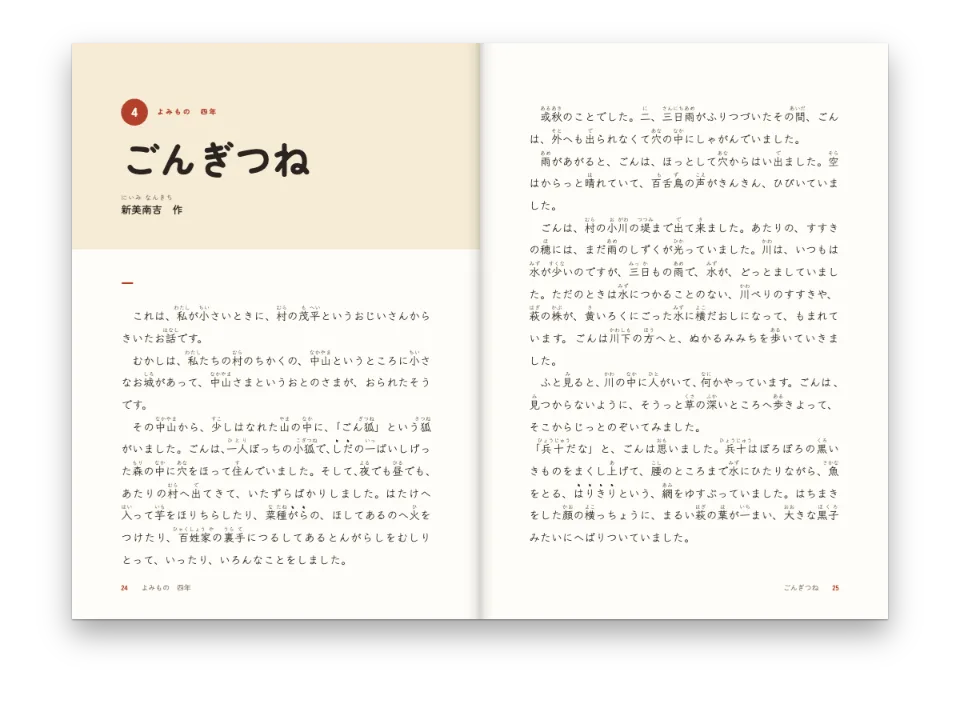
A cartilha com pinyin põe uma sílaba sobre cada caractere em linhas horizontais, como fazem as primeiras cartilhas da China continental e de Hong Kong.
Erros comuns
Erro comum
As leituras são impressas no texto, não em designs, legendas nem células
As leituras rubi são desenhadas em parágrafos, títulos, itens de lista, citações e boxes. Um elemento de texto de design (uma abertura, um cabeço, um selo), uma legenda, uma nota de rodapé e uma célula de tabela imprimem os caracteres-base sem as leituras. Um título que precisa do seu pinyin é um título sem design próprio: desenhe o que está em volta dele (uma faixa, o número da lição) com o design do título anterior, cujos elementos com reserve: false são pintados sob o texto de uma abertura span: 'page'. Rubi: leituras em pinyin e zhuyin →
Erro comum
Em texto vertical, a coluna lateral é um andar, e 'left' é o de cima
Com layout.writingMode 'vertical-rl', a página é uma página horizontal girada um quarto de volta, então a coluna lateral de um layout oneAndHalf vira um andar que atravessa a página: sideColumnSide 'left' a coloca no alto, onde ficam os comentários da margem superior (眉批), e 'right' no pé. 'outer' e 'inner' são lidos como 'right' e 'left' (um andar não tem borda externa), então o 'outer' da coluna de notas de um livro didático manda as notas para o pé. sideColumnPercent é uma fração da altura da página. Coluna de margem para flutuantes →
Erro comum
Fontes chinesas são carregadas em fatias, pelo bloco cjk
O Fontsource serve uma família chinesa, japonesa ou coreana em cerca de cem arquivos por peso, cada um com um intervalo de caracteres. loadFonts baixa só o arquivo latin, então na tela os caracteres chineses vêm de uma fonte do sistema e são medidos errado, e o fontsourceProvider entrega ao PDF esse arquivo latin, que os imprime como caixas vazias. Inclua o bloco cjk do kit, chame loadCjkFonts(FONTS, markdown) depois de loadFonts (uma vez por voz, com o texto que ela compõe, quando o livro usa várias fontes CJK) e passe a renderToPdf fontProvider: cjkPdfProvider: os dois pegam os arquivos que contêm os caracteres do texto. Fontes chinesas, japonesas e coreanas →
Erro comum
Um livro encadernado pela direita mostra as páginas duplas com showBook
Em um livro encadernado pela direita (texto árabe, hebraico ou persa, chinês vertical, ou page.binding 'right') a página 1 continua sendo a ímpar, mas fica à esquerda da lombada, e os pares se leem [3 | 2]. showPages dispõe todos os livros como se fossem encadernados pela esquerda; showBook, do bloco book (o bloco cjk traz a mesma função), lê doc.binding e espelha os pares. capture.hero continua nomeando uma página dupla em ordem de leitura, [par, ímpar]: [2, 3]. Livros encadernados pela direita →
Erro comum
Marque o documento como zh-Hans ou zh-Hant, não com LANG
As edições de uma receita são en e es, mas uma amostra chinesa é chinesa nas duas: `locale: LANG` a marcaria como inglês ou espanhol, hifenizaria as suas palavras latinas, chamaria as suas figuras de Figure ou Figura e daria ao PDF o idioma errado. Escreva você mesmo a marcação: 'zh-Hans' (convenções da China continental: quebra de linha GB, pontuação Kaiming) ou 'zh-Hant' (Taiwan: pontuação de largura inteira centralizada); 'zh-HK' para Hong Kong. Um 'zh' sozinho é lido como chinês simplificado continental. Uma amostra japonesa leva 'ja' (armadilha ja-locale-tag). Quebra de linha em chinês →
-
Tire as leituras do dicionário de Taiwan. Ferramentas feitas sobre dicionários do continente, entre elas o pypinyin, dão 度 duó, 寧 nìng, 時候 shíhou e 市場 shìchǎng; o Dicionário Revisado de Chinês Mandarim do Ministério da Educação, que os livros de leitura de Taiwan seguem, lê ㄉㄨㄛˋ, ㄋㄧㄥˊ, ㄕˊ ㄏㄡˋ e ㄕˋ ㄔㄤˊ, e põe em tom neutro a segunda sílaba de 故事, 家裡 e 過來. O moedict.tw o oferece palavra por palavra. Ele mantém 一 e 不 no tom próprio, e esta lição também.
-
Desenhe alguns caracteres em cada fonte antes de misturá-las. A LXGW WenKai TC segue as formas herdadas e desenha 為 (U+70BA) como 爲, então uma lição composta nela imprimia 爲宋國笑 no texto e 為宋國笑 na nota em Ming da mesma página dupla. A Iansui desenha o 為 padrão.
-
Os números da lição e das fábulas são digitados nos títulos (
# 第十二課 {寓言兩則|…}). UmnumberingTemplatejunta o número ao primeiro caractere do título, e quando esse caractere tem leitura, a leitura fica centralizada sobre o número e o caractere juntos. -
Calcule o que o andar de cima de cada página precisa comportar e abra cada boxe onde a página dele tem espaço. O boxe do autor é aberto antes de 語文天地 para começar o andar da página 89, e o dos caracteres novos, aberto depois das expressões idiomáticas, vem em seguida. Um boxe ou uma figura que não encontra espaço antes do fim do texto sai numa página sem nada embaixo, e o seguinte fica de fora sem aviso, então confira se todos estão nas páginas.
-
A Iansui tem um só peso. Os títulos se destacam pelo tamanho, e as entradas das expressões idiomáticas pela cor: o estilo
idiomdefineboldFontWeight: 400com a cor de destaque comoboldColor, então**…**muda a cor e não a letra.
Créditos
- Receita
- Ignacio Ferro
- Texto
- Han Feizi, chapter 49, “Wu du” (The five vermin): the man of Song who waited by the stump · Han Fei; transcription and punctuation by Wikisource editors (爲 set as 為, the Taiwan standard form) · CC BY-SA 4.0
- Han Feizi, chapter 32, “Wai chu shuo zuo shang”: the man of Zheng who went to buy shoes · Han Fei; transcription and punctuation by Wikisource editors · CC BY-SA 4.0
- The zhuyin (checked against the Ministry of Education's Revised Mandarin Chinese Dictionary), the modern Chinese versions, the notes, the author box, the lead and the exercises, written for this recipe · Postext Cookbook · CC BY 4.0
- Imagens
- The farmer waiting by the stump, a brush painting · Generated With Diffusion Models · original
- The man of Zheng hurrying home from the shoe stall, a brush painting · Generated With Diffusion Models · original
- Fontes
- Iansui (SIL OFL 1.1) · LXGW WenKai TC (SIL OFL 1.1) · Noto Serif TC (SIL OFL 1.1) · Noto Sans TC (SIL OFL 1.1)
- Código
- MIT, como o Postext
Editar este texto ↗ (abre em uma nova aba)Pasta da receita no GitHub ↗ (abre em uma nova aba)