Em poucas palavras
Um capítulo de um livro de física com uma coluna larga de texto e outra estreita junto à borda externa. A coluna estreita traz diagramas e notas curtas ao lado do texto a que se referem.
O que você vai compor
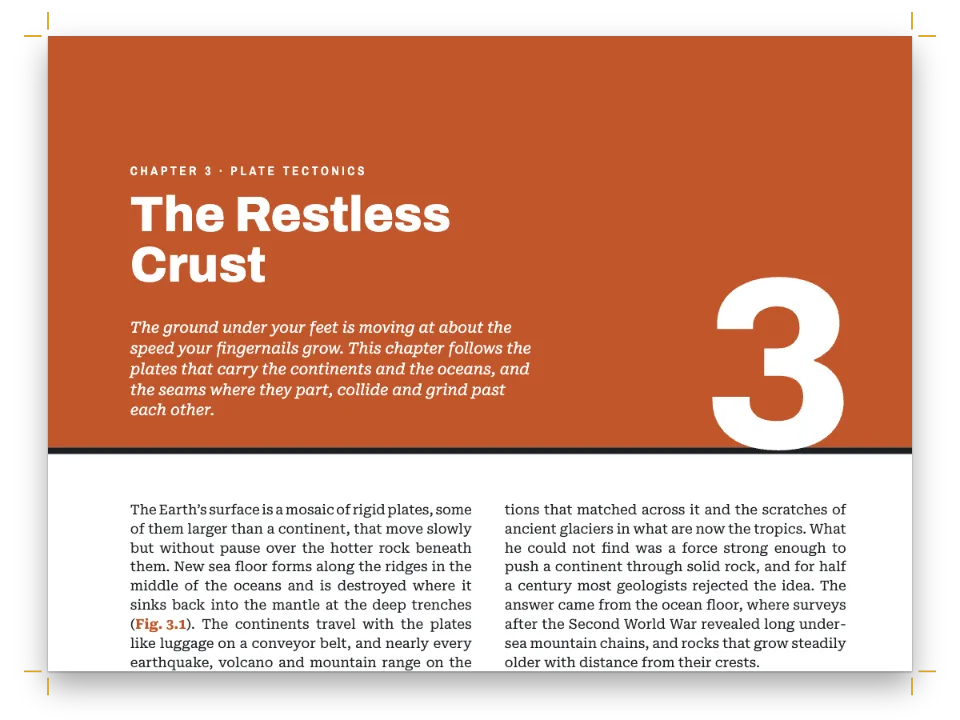
O capítulo 4 de Lever and Lens, um livro didático de física introdutória numa página de 210 × 275 mm. O texto corrido ocupa uma coluna larga e nunca entra na margem externa, um canal de 53 mm. O número do capítulo, um 4 verde, fica nesse canal na altura do título, e os objetivos de aprendizagem vêm embaixo. Os diagramas de raios se empilham a partir da cabeça do canal, e os termos-chave vão em glosas verde-menta ao lado dos trechos que os definem. As figuras que ficam na coluna de texto, sobre chapas escuras ou claras, têm as legendas na margem, na altura do pé da figura. Só o painel do prisma atravessa as duas colunas. As margens são espelhadas, então o canal fica no lado do corte de todas as páginas, à direita numa ímpar e à esquerda numa par.
Esta receita responde a
- Como monto uma diagramação em coluna e meia, com uma coluna de texto larga e uma coluna lateral estreita?
- Como coloco notas de margem ou glosas ao lado do parágrafo que elas explicam?
- Como acrescento uma figura com legenda numerada e a cito no texto (“ver fig. 3.2”)?
- Como decido onde vai uma figura: no alto da página, sobre as duas colunas, exatamente aqui ou na margem?
- Como coloco a legenda ao lado de uma figura, ou acima de uma tabela em uma barra de legenda?
- Como numero os títulos (1, 1.1, 1.1.1) e dou a cada nível um estilo diferente?
A resposta curta
const layout = {
  layoutType: 'oneAndHalf', // a wide main column and a narrow side column
  sideColumnPercent: 30, // of the 176 mm content width: a 52.8 mm channel
  sideColumnRole: 'floats', // no body text: side figures, side captions and side boxes only
  sideColumnSide: 'outer', // right on a recto, left on a verso (the margins are mirrored)
  gutterWidth: mm(7), // the text column keeps the rest: 176 − 52.8 − 7 = 116 mm
};
// A figure placed with span 'side' stacks in the channel from the head of the page that cites it.
// The stack ignores the opener's numeral: on a first page, cite side figures after the objectives.
const side = { span: 'side' };
// A figure left in the text column (the default span) sets its caption in the channel beside
// it; page-wide floats ignore captionSide and keep theirs underneath.
const resourceTypes = defaultResourceTypes(LANG).map((type) => (type.id !== 'figure' ? type
  : { ...type, defaultPlacement: { captionSide: true } })); // gotcha: resource-types-locale
// A box fenced :::callout{type="term" span="side"} leaves the flow and lands in the channel at the
// height the text has reached. Fence each gloss after a paragraph, never straight after a heading
// (gotcha: side-box-after-heading).
Ingredientes
- Funcionalidades
- Coluna de margem para flutuantesLegendas lateraisNotas na margemColuna e meiaMargens espelhadasCitações que posicionam as figurasPosicionamento de figurasLegendas numeradasFiguras e tabelas como recursosFigura e Tabela no seu idiomaAberturas desenhadasAncoragem de elementos de designAtributos de títuloTítulos numeradosEstilos de títuloCapítulos que abrem em página ímparBoxesCabeços e fóliosCabeços por tipo de páginaPaleta de cores semântica
- Também usa
- Estilos de parágrafoTipos de recurso personalizadosSobrescritos e subscritosCapítulos sem número
- Tipografia
- Merriweather, Merriweather Sans (SIL OFL 1.1)
- Materiais
- Nenhum: todas as imagens são desenhadas em código
Preparo
#1 · Entregar a margem aos flutuantes
O código deste passo é a resposta curta acima. Numa diagramação em coluna e meia, sideColumnPercent: 30 dá à coluna lateral 30% dos 176 mm de largura da mancha (52,8 mm), e a coluna de texto fica com o que sobra depois da medianiz de 7 mm (116 mm, uns 75 caracteres de Merriweather de 9,3 pt). sideColumnRole: 'floats' mantém o texto corrido fora da coluna lateral, e sideColumnSide: 'outer' a põe no lado externo, que as margens espelhadas alternam de uma página para outra. As figuras vão para lá com span: 'side'. Um boxe com span="side" no bloco sai do fluxo e entra no canal na altura a que o texto chegou, então cada glosa começa na altura do bloco que vem depois dela.
#2 · Deixar a citação posicionar cada figura
const drawings = new Map(); // fileId → SVG markup, registered before the build
const figure = (id, { width, height, markup }, placement) => {
  drawings.set(`${id}.svg`, markup);
  return { id, typeId: 'figure', kind: 'svg', createdAt: 0, updatedAt: 0, caption: t(captions[id]),
    altText: t(captions[id]), // read aloud in HTML and tagged PDF; the canvas does not use it
    svg: { fileId: `${id}.svg`, width, height }, ...(placement && { placement }) };
};
const resources = [ // no placement: a main-column float, its caption in the channel
  figure('burning-glass', burningGlass()),
  figure('refraction', refraction(), side),
  figure('critical-angle', criticalAngle(), side),
  figure('fibre', fibre()),
  figure('prism', prism(), { span: 'page', position: 'top' }), // across text column and channel
  figure('principal-rays', principalRays()),
  figure('diverging', diverging(), side),
];
O primeiro :ref a uma figura a numera e a coloca onde o seu posicionamento manda. Uma figura span: 'side' se empilha a partir da cabeça do canal na página que a cita, por mais abaixo que esteja a citação, e passa para a página seguinte quando o resto do canal é curto demais. As figuras 4.2 e 4.3, ambas citadas na página 88, descem pelo canal dessa página com a glosa do ângulo crítico entre elas. O prisma é um flutuante top na largura da página citado na página 88, e um flutuante nunca fica acima da sua citação, então ele abre a página 89 sobre as duas colunas. As figuras 4.1, 4.4 e 4.6 ficam na coluna de texto e recebem captionSide do defaultPlacement do tipo figura. Elas ocupam o espaço de baixo da coluna, então cada legenda fica na altura do pé da sua figura; num espaço de cima, ela se alinharia com o topo da figura.
#3 · Abrir o capítulo na margem
// Every element counts toward the opener's depth, the page-anchored numeral too (gotcha:
// opener-reserves-anchored). minHeight fixes that depth at nine lines of the grid, room for a
// one-line title, the rule and a four-line standfirst (41.2 mm), so the text starts on the same
// line in every such chapter, however short its standfirst and even with a smaller numeral. Kicker
// and numeral (40.6 mm) reach the ninth line too; a deeper opener grows past it, line by line.
const [KICKER, NUMERAL] = [8, 104]; // pt
const opener = {
  enabled: true,
  minHeight: pt(LEAD * 9), // 42.9 mm: the text starts on the eleventh line, after marginBottom
  slot: {
    elements: [
      { kind: 'text', id: 'title', content: '{titleText}', fontFamily: SANS, fontWeight: 800,
        fontSize: pt(32), lineHeight: 1.05, color: col('ink'), align: 'left', overflow: 'wrap',
        placement: { anchor: { to: 'container', edge: 'top-left' }, size: { width: 'fill' } } },
      { kind: 'rule', id: 'rule', direction: 'horizontal', thickness: pt(1), color: col('accent'),
        placement: { anchor: { to: '#title', edge: 'below' }, offset: { y: mm(4) },
          size: { width: 'fill' } } },
      { kind: 'text', id: 'lead', content: '{attr.lead}', fontFamily: SERIF, italic: true,
        fontSize: pt(10.5), lineHeight: 1.45, color: col('ink'), align: 'left', overflow: 'wrap',
        placement: { anchor: { to: '#rule', edge: 'below' }, offset: { y: mm(3.5) },
          size: { width: 'fill' } } },
      // The kicker hangs from the page's top-right corner, not from the heading: the channel lies
      // outside the heading's column, and on the right only on a recto (so chapters open on one).
      // The numeral hangs from the kicker.
      { kind: 'text', id: 'kicker', content: t({ en: 'Chapter', es: 'Capítulo' }), ...label,
        fontSize: pt(KICKER), align: 'left', placement: { anchor: { to: 'page', edge: 'top-right' },
          offset: { x: mm(-OUTER), y: mm(TOP) }, size: { width: mm(CHANNEL) } } },
      { kind: 'text', id: 'numeral', content: '{chapterNumber}', fontFamily: SANS, fontWeight: 800,
        fontSize: pt(NUMERAL), lineHeight: 1, color: col('accent'), align: 'left',
        placement: { anchor: { to: '#kicker', edge: 'below' }, offset: { y: mm(0.5) },
          size: { width: mm(CHANNEL) } } },
    ],
  },
};
O título de nível 1 fica na coluna de texto, onde um slot de design empilha o texto, o fio e a linha fina; o antetítulo pende do canto superior direito da página, e o numeral pende do antetítulo, os dois com a largura do canal. minHeight fixa a abertura em nove linhas da grade (42,9 mm), o bastante para um título de uma linha, o fio e uma linha fina de quatro linhas, então uma linha fina mais curta não puxa o texto para cima. O antetítulo e o numeral de 104 pt terminam 40,6 mm abaixo da margem superior, dentro dessas nove linhas, então também não empurram o texto para baixo. O canal só fica à direita numa página ímpar, por isso o H1 quebra para uma página ímpar. O boxe de objetivos vem depois do primeiro parágrafo, e não logo depois do título, e nenhuma figura de margem é citada antes dele (veja Erros comuns).
#4 · Manter os fólios na borda do canal
const [HEAD_Y, FOOT_Y, HEAD_GAP] = [12.5, -12, 9]; // mm from the top and bottom trim; folio to head
// A text on the physical page: edge picks the corner, x and y are its offsets in mm.
const head = ({ edge, x, y = HEAD_Y, ...text }) => ({
  kind: 'text', pages: 'body', ...label, color: col('muted'), ...text,
  placement: { anchor: { to: 'page', edge }, offset: { x: mm(x), y: mm(y) } },
});
const folio = { content: '{pageNumber}', fontSize: pt(8.5), letterSpacing: pt(0),
  color: col('accent') };
const verso = { parity: 'even', edge: 'top-left' }; // x counts in from the left edge
const recto = { parity: 'odd', edge: 'top-right' }; // x counts back from the right edge
const header = { elements: [
  head({ id: 'verso-folio', ...verso, ...folio, x: OUTER }),
  head({ id: 'verso-title', ...verso, content: '{title}', x: OUTER + HEAD_GAP }),
  head({ id: 'recto-title', ...recto, x: -(OUTER + HEAD_GAP),
    content: t({ en: 'Chapter {chapterNumber} · {chapterTitle}',
      es: 'Capítulo {chapterNumber} · {chapterTitle}' }) }),
  head({ id: 'recto-folio', ...recto, ...folio, x: -OUTER }),
] };
// A chapter's first page, always a recto, carries a drop folio at the foot of the channel instead.
const footer = { elements: [
  head({ id: 'drop-folio', ...recto, ...folio, pages: 'opener', edge: 'bottom-right', x: -OUTER,
    y: FOOT_Y }),
] };
Cada elemento é ancorado na página física e filtrado por parity, então fólio e cabeço ficam na mesma borda que o canal nos dois lados da página dupla. pages: 'body' os deixa fora da abertura, que recebe no lugar um fólio no pé do canal.
#5 · Começar o livro no capítulo 4
const continuation = { pageNumbering: { startAt: 87 }, // odd, like page 1: a recto
  headings: { h1: 3, h2: 0, h3: 0, h4: 0, h5: 0, h6: 0 } }; // the next # is chapter 4
const doc = await buildWithFonts(
  () => buildDocument({ markdown, resources, continuation }, config()), markdown);
showPages(doc, { title: t({ en: 'Textbook with a margin column',
  es: 'Libro de texto con columna al margen' }) });
Estas páginas são o capítulo 4 de um livro mais longo. A continuação põe o contador de capítulos em 3, então {chapterNumber} imprime 4 e o numberingTemplate: '{1}.{2}' do nível 2 numera as seções de 4.1 a 4.3; as figuras vão de 4.1 a 4.7. ## Questions {style="plain"} usa uma entrada de headingStyles com numbered: false, então esse título não tem número. Os fólios começam em 87 porque a primeira página é ímpar, e uma página ímpar leva fólio ímpar.
#6 · Dar nome às cores uma vez só
const palette = {
  ink: '#1a222d', // text, and the dark panels of figures 4.1, 4.4 and 4.5
  accent: '#17774f', // the only accent colour: numerals, folios, section headings, labels
  ray: '#f2a516', // light rays in every diagram
  glass: '#cfe6dd', // glass in the diagrams
  tint: '#edf5f1', // the key-term glosses and the light plate of a construction diagram
  muted: '#5b6863', // running heads, the normals in the diagrams, the colophon
  paper: '#ffffff',
};
// A colour carries its id and its hex: 1.4.1 paints design elements and referenceColor from the
// hex alone (gotcha: palette-skips-designs), so retint by editing `palette`, not colorPalette.
const col = (id) => ({ hex: palette[id], model: 'hex', paletteId: id });
const colorPalette = [
  ...Object.entries(palette).map(([id, hex]) => ({ id, name: id, value: { hex, model: 'hex' } })),
  // The engine's defaults link to 'main-color': point it at the accent, so nothing prints blue.
  { id: 'main-color', name: 'accent (defaults)', value: { hex: palette.accent, model: 'hex' } },
];
Cada cor da configuração está ligada a uma entrada da paleta e também carrega o seu hex, que col() copia do mesmo objeto. O Postext 1.4.1 pinta os elementos de design e a cor das referências com esse hex, não com a entrada da paleta (veja Erros comuns). Para mudar as cores do capítulo, edite palette: os diagramas leem o mesmo objeto, então o vidro, os raios, os painéis escuros e a chapa clara mudam junto com os numerais, os rótulos e as glosas. main-color aponta para a cor de destaque, então qualquer cor padrão dos estilos de texto que a configuração deixa sem definir sai em verde, não no azul do motor.
A receita completa
// ═══ Postext Cookbook · Nº 001 · Textbook with a margin column ═══════════════════ // https://postext.dev/en/cookbook/textbook-margin-column // Code: MIT · Text: original (CC BY 4.0) · Diagrams: generated in code (CC BY 4.0) // Fonts: Merriweather, Merriweather Sans (SIL OFL 1.1) · Needs postext ≥ 1.4.1 // A chapter of a physics textbook in the column-and-a-half layout: the body text keeps to // the main column, and the outer margin is a channel for diagrams, captions and glosses. import { buildDocument, renderPageToCanvas, clearMeasurementCache, registerResourceImage, defaultResourceTypes, } from 'https://esm.sh/postext'; const LANG = 'en'; // @lang: the language of the sample document ('en' | 'es') const RECIPE = 'textbook-margin-column'; // ─── 1 · Design ───────────────────────────────────────────────────────────── // #region palette: semantic colours, each linked by id and written out in hex const palette = { ink: '#1a222d', // text, and the dark panels of figures 4.1, 4.4 and 4.5 accent: '#17774f', // the only accent colour: numerals, folios, section headings, labels ray: '#f2a516', // light rays in every diagram glass: '#cfe6dd', // glass in the diagrams tint: '#edf5f1', // the key-term glosses and the light plate of a construction diagram muted: '#5b6863', // running heads, the normals in the diagrams, the colophon paper: '#ffffff', }; // A colour carries its id and its hex: 1.4.1 paints design elements and referenceColor from the // hex alone (gotcha: palette-skips-designs), so retint by editing `palette`, not colorPalette. const col = (id) => ({ hex: palette[id], model: 'hex', paletteId: id }); const colorPalette = [ ...Object.entries(palette).map(([id, hex]) => ({ id, name: id, value: { hex, model: 'hex' } })), // The engine's defaults link to 'main-color': point it at the accent, so nothing prints blue. { id: 'main-color', name: 'accent (defaults)', value: { hex: palette.accent, model: 'hex' } }, ]; // #endregion // The page in mm, named once: the channel, the opener and the running heads derive from it. const [TRIM_W, TRIM_H] = [210, 275]; const [TOP, BOTTOM, INNER, OUTER] = [24, 22, 20, 14]; // inner and outer swap on a verso const LEAD = 13.5; // body leading in pt const [SERIF, SANS] = ['Merriweather', 'Merriweather Sans']; // #region answer: a float-only channel on the outer edge, and what goes into it const layout = { layoutType: 'oneAndHalf', // a wide main column and a narrow side column sideColumnPercent: 30, // of the 176 mm content width: a 52.8 mm channel sideColumnRole: 'floats', // no body text: side figures, side captions and side boxes only sideColumnSide: 'outer', // right on a recto, left on a verso (the margins are mirrored) gutterWidth: mm(7), // the text column keeps the rest: 176 − 52.8 − 7 = 116 mm }; // A figure placed with span 'side' stacks in the channel from the head of the page that cites it. // The stack ignores the opener's numeral: on a first page, cite side figures after the objectives. const side = { span: 'side' }; // A figure left in the text column (the default span) sets its caption in the channel beside // it; page-wide floats ignore captionSide and keep theirs underneath. const resourceTypes = defaultResourceTypes(LANG).map((type) => (type.id !== 'figure' ? type : { ...type, defaultPlacement: { captionSide: true } })); // gotcha: resource-types-locale // A box fenced :::callout{type="term" span="side"} leaves the flow and lands in the channel at the // height the text has reached. Fence each gloss after a paragraph, never straight after a heading // (gotcha: side-box-after-heading). // #endregion // The channel's width, the measure of everything the opener and the heads set in it: 52.8 mm. const CHANNEL = ((TRIM_W - INNER - OUTER) * layout.sideColumnPercent) / 100; // The channel's own type, and the two boxes that stand in it. const label = { fontFamily: SANS, fontSize: pt(7.5), fontWeight: 700, letterSpacing: pt(1.2), textTransform: 'uppercase', color: col('accent') }; // A box's text takes the body's ink for text, bold and italic; only face, size and setting change. const note = { fontFamily: SANS, fontSize: pt(8), lineHeight: pt(11.25), textAlign: 'left', firstLineIndent: pt(0) }; const calloutStyles = [ { id: 'panel', backgroundEnabled: false, // objectives and key ideas; each fence names its title padding: { top: mm(2.6), right: pt(0), bottom: pt(0), left: pt(0) }, stripe: { enabled: true, side: 'top', width: pt(2.5), color: col('accent') }, titleStyle: { ...label, gap: mm(2) }, body: note, marginTop: pt(0), marginBottom: pt(LEAD), lists: { color: col('accent'), indent: mm(3), itemSpacing: pt(3) } }, { id: 'term', title: t({ en: 'Key term', es: 'Término clave' }), background: col('tint'), padding: { top: mm(2.6), right: mm(3), bottom: mm(3), left: mm(3) }, titleStyle: { ...label, gap: mm(1.2) }, body: note, marginTop: pt(0), marginBottom: pt(LEAD) }, ]; // #region opener: the title in the main column, the chapter number standing in the channel // Every element counts toward the opener's depth, the page-anchored numeral too (gotcha: // opener-reserves-anchored). minHeight fixes that depth at nine lines of the grid, room for a // one-line title, the rule and a four-line standfirst (41.2 mm), so the text starts on the same // line in every such chapter, however short its standfirst and even with a smaller numeral. Kicker // and numeral (40.6 mm) reach the ninth line too; a deeper opener grows past it, line by line. const [KICKER, NUMERAL] = [8, 104]; // pt const opener = { enabled: true, minHeight: pt(LEAD * 9), // 42.9 mm: the text starts on the eleventh line, after marginBottom slot: { elements: [ { kind: 'text', id: 'title', content: '{titleText}', fontFamily: SANS, fontWeight: 800, fontSize: pt(32), lineHeight: 1.05, color: col('ink'), align: 'left', overflow: 'wrap', placement: { anchor: { to: 'container', edge: 'top-left' }, size: { width: 'fill' } } }, { kind: 'rule', id: 'rule', direction: 'horizontal', thickness: pt(1), color: col('accent'), placement: { anchor: { to: '#title', edge: 'below' }, offset: { y: mm(4) }, size: { width: 'fill' } } }, { kind: 'text', id: 'lead', content: '{attr.lead}', fontFamily: SERIF, italic: true, fontSize: pt(10.5), lineHeight: 1.45, color: col('ink'), align: 'left', overflow: 'wrap', placement: { anchor: { to: '#rule', edge: 'below' }, offset: { y: mm(3.5) }, size: { width: 'fill' } } }, // The kicker hangs from the page's top-right corner, not from the heading: the channel lies // outside the heading's column, and on the right only on a recto (so chapters open on one). // The numeral hangs from the kicker. { kind: 'text', id: 'kicker', content: t({ en: 'Chapter', es: 'Capítulo' }), ...label, fontSize: pt(KICKER), align: 'left', placement: { anchor: { to: 'page', edge: 'top-right' }, offset: { x: mm(-OUTER), y: mm(TOP) }, size: { width: mm(CHANNEL) } } }, { kind: 'text', id: 'numeral', content: '{chapterNumber}', fontFamily: SANS, fontWeight: 800, fontSize: pt(NUMERAL), lineHeight: 1, color: col('accent'), align: 'left', placement: { anchor: { to: '#kicker', edge: 'below' }, offset: { y: mm(0.5) }, size: { width: mm(CHANNEL) } } }, ], }, }; // #endregion // #region heads: book title on the verso, chapter on the recto, folios on the outer edge const [HEAD_Y, FOOT_Y, HEAD_GAP] = [12.5, -12, 9]; // mm from the top and bottom trim; folio to head // A text on the physical page: edge picks the corner, x and y are its offsets in mm. const head = ({ edge, x, y = HEAD_Y, ...text }) => ({ kind: 'text', pages: 'body', ...label, color: col('muted'), ...text, placement: { anchor: { to: 'page', edge }, offset: { x: mm(x), y: mm(y) } }, }); const folio = { content: '{pageNumber}', fontSize: pt(8.5), letterSpacing: pt(0), color: col('accent') }; const verso = { parity: 'even', edge: 'top-left' }; // x counts in from the left edge const recto = { parity: 'odd', edge: 'top-right' }; // x counts back from the right edge const header = { elements: [ head({ id: 'verso-folio', ...verso, ...folio, x: OUTER }), head({ id: 'verso-title', ...verso, content: '{title}', x: OUTER + HEAD_GAP }), head({ id: 'recto-title', ...recto, x: -(OUTER + HEAD_GAP), content: t({ en: 'Chapter {chapterNumber} · {chapterTitle}', es: 'Capítulo {chapterNumber} · {chapterTitle}' }) }), head({ id: 'recto-folio', ...recto, ...folio, x: -OUTER }), ] }; // A chapter's first page, always a recto, carries a drop folio at the foot of the channel instead. const footer = { elements: [ head({ id: 'drop-folio', ...recto, ...folio, pages: 'opener', edge: 'bottom-right', x: -OUTER, y: FOOT_Y }), ] }; // #endregion const config = () => ({ // a factory: a fresh object per build (gotcha: config-cache-identity) locale: t({ en: 'en-us', es: 'es' }), // exact codes only (gotcha: hyphenation-locales) resourceTypes, colorPalette, page: { width: mm(TRIM_W), height: mm(TRIM_H), dpi: 150, margins: { top: mm(TOP), bottom: mm(BOTTOM), left: mm(INNER), right: mm(OUTER), mirror: true } }, // left: recto's inner layout, bodyText: { // hyphenation, optimal line breaking and widow control are on by default fontFamily: SERIF, fontWeight: 300, fontSize: pt(9.3), lineHeight: pt(LEAD), color: col('ink'), boldColor: col('ink'), italicColor: col('ink'), referenceColor: col('accent'), referenceBold: false, textAlign: 'justify', firstLineIndent: mm(4), indentAfterHeading: false }, headings: { fontFamily: SANS, color: col('ink'), fontWeight: 800, levels: [ // Restated: any headings object drops the H1 break (gotcha: headings-drop-h1-break). // 'odd': kicker, numeral and drop folio sit at the right edge, the outer one only on a recto. // The heading stays in the main column; its design draws it. { level: 1, breakBefore: { enabled: true, parity: 'odd' }, marginBottom: pt(LEAD), advancedDesign: opener }, { level: 2, fontSize: pt(13), lineHeight: pt(LEAD), numberingTemplate: '{1}.{2}', color: col('accent'), marginTop: pt(LEAD * 1.5), marginBottom: pt(0) }, ], }, headingStyles: [{ id: 'plain', numbered: false }], // ## Questions {style="plain"} orderedLists: { numberFormat: 'arabic', // the default, written out: 'decimal' prints 'undefined' fontFamily: SANS, fontWeight: 800, color: col('accent'), marginTop: pt(0), marginBottom: pt(0) }, calloutStyles, captionStyle: { fontFamily: SANS, fontSize: pt(7.6), labelColor: col('accent'), gap: mm(2) }, paragraphStyles: [{ id: 'aside', firstLineIndent: pt(0), marginTop: pt(LEAD * 0.5) }, { id: 'colophon', fontFamily: SANS, fontSize: pt(6.8), lineHeight: pt(9), color: col('muted'), textAlign: 'left', firstLineIndent: pt(0), marginTop: pt(LEAD) }], header, footer, }); // ─── 2 · Content ──────────────────────────────────────────────────────────── const markdown = String.raw`---Amostra em Markdown · 87 linhas · content.en.md
title: "Lever and Lens" subtitle: "An Introductory Course" --- # Light and Lenses {lead="Light changes direction where it passes from air into glass or water, by an amount set by the two materials and the angle at which it arrives. Lenses use that change to form images, and a prism shows that it differs slightly from colour to colour."} Hold a magnifying glass in sunshine and you can gather the light of the Sun into a spot bright enough to scorch paper (:ref{id="burning-glass" case="lower"}). :::callout{type="panel" span="side" title="In this chapter"} - Explain refraction in terms of a change in the speed of light. - Use the refractive index and Snell’s law to predict how far a ray bends. - Trace the principal rays through converging and diverging lenses. - Describe dispersion and explain how a prism makes a spectrum. ::: The lens gathers all the light that falls on it into a few square millimetres. Each ray changes direction at the two curved surfaces, and the curves are ground so that all the rays arrive at the same point. That change of direction is called *refraction*, and every lens depends on it: the camera in your phone, a pair of reading glasses, the microscope in your school laboratory and the eye itself, where the cornea and the lens focus an image on the retina. To understand any of them you need two ideas. The first is that light travels more slowly in glass or water than in air. The second is that a beam that meets a surface at an angle crosses it one edge at a time. :::callout{type="term" span="side"} **Refractive index** *n*: the speed of light in a vacuum divided by its speed in the material. It has no units. Water 1.33, crown glass 1.52, diamond 2.42. ::: ## Refraction In a vacuum light travels at almost exactly 300,000 kilometres per second. In air it is only a fraction slower, but in water it covers about 225,000 km each second, and in ordinary glass about 200,000 km. The ratio of the speed in a vacuum to the speed in a material is that material’s *refractive index*, written *n*: the more slowly light travels in a material, the higher its index. A line of marchers shows why a change of speed makes light change direction. Suppose the line crosses at an angle from a paved square onto a muddy field. Those at one end of it reach the mud first and slow down, while those at the other end are still walking at full speed, so the whole line swings round and heads off in a new direction. A beam of light does the same as it enters glass and bends *towards the normal*, the line drawn at right angles to the surface (:ref{id="refraction" case="lower"}). Leaving a parallel-sided block, it speeds up again and bends back by the same amount. How far the ray bends depends on the two refractive indices and on the angle at which it arrives. The rule was found by the Dutch mathematician Willebrord Snell in 1621 and is known as *Snell’s law*: *n*~1~ sin *i* = *n*~2~ sin *r*, where *i* is the angle of incidence and *r* the angle of refraction, both measured from the normal. A ray that strikes glass at 40° from the normal is refracted so that sin *r* = sin 40° ÷ 1.52 = 0.42, an angle of 25°, so the ray has turned 15° towards the normal. A ray that arrives along the normal, at an angle of 0°, does not bend at all. :::callout{type="term" span="side"} **Critical angle** *c*: the angle of incidence inside the denser material above which no light gets out: sin *c* = 1 ÷ *n*. About 41° for crown glass, 49° for water. ::: Reverse the ray, so that it passes from glass into air, and it bends away from the normal. As the angle inside the glass grows, the ray leaving the surface swings closer and closer to the surface itself, until at the *critical angle* it skims along it. Beyond that angle no light escapes: all of it is reflected back into the glass (:ref{id="critical-angle" case="lower"}). This *total internal reflection* returns more light than the best mirror. Total internal reflection carries telephone calls and internet traffic across the oceans. An optical fibre is a thread of very pure glass, thinner than a hair, inside a sleeve of glass with a slightly lower refractive index. Light sent into one end strikes the boundary at more than the critical angle each time, so it zigzags along the fibre for tens of kilometres with almost no loss (:ref{id="fibre" case="lower"}). The same effect makes a cut diamond sparkle: its critical angle is only 24°, so light that enters the stone is reflected round inside it several times before it finds a way out. ## Dispersion So far we have treated the refractive index as a single number, but it depends on colour. In glass, violet light travels a little more slowly than red light, so it is refracted a little more: the index of crown glass is 1.51 for red light and 1.53 for violet. The difference is small, but a prism makes it visible (:ref{id="prism" case="lower"}). Its two faces are tilted towards each other, so the bending at the second face adds to the bending at the first instead of undoing it, and each colour leaves at its own angle. In 1666 Isaac Newton let a beam of sunlight into a darkened room through a hole in a shutter and passed it through a prism. He saw a band of colour on the far wall, from red to violet, and he showed that a second prism, turned the other way, gathered the colours back into white. He concluded that white light is a mixture of every colour and that the prism only sorts them. This spreading of light into its colours is called *dispersion*, and the band of colour it produces is a *spectrum*. :::callout{type="term" span="side"} **Dispersion**: the spreading of white light into its colours, because the refractive index of a material is slightly different for each colour. ::: A rainbow is sunlight dispersed by raindrops. Each falling drop refracts the light as it enters, reflects it once from the back of the drop and refracts it again on the way out. Red light leaves at about 42° from the direction of the sunlight and violet at about 40°, so every drop sends one colour to your eye and the drops together draw an arc. :::callout{type="term" span="side"} **Focal length** *f*: the distance from the centre of a lens to its principal focus. The power of the lens in dioptres is 1 ÷ *f*, with *f* in metres. ::: ## Lenses A lens is a piece of glass or plastic whose curved faces bend light towards its axis or away from it. A *converging* lens is thicker in the middle than at the edges. Rays that arrive parallel to its axis are bent towards the axis and meet at a point behind the lens, the *principal focus* F (:ref{id="principal-rays" case="lower"}). The distance from the centre of the lens to F is the *focal length* *f*. A fatter, more strongly curved lens bends light more and has a shorter focal length. To find where a lens forms an image, draw three rays from the tip of the object, chosen because their paths are known in advance. A ray parallel to the axis leaves through the focus. A ray through the centre of the lens goes straight on. A ray through the focus in front of the lens leaves parallel to the axis. The image of the tip forms where they cross, and any two of them are enough to find it. When the object is more than two focal lengths from a converging lens, as in a camera, the image is *real*, *inverted* and smaller than the object. Real means that light from the object reaches the image itself, so it can be caught on a screen or a sensor. Move the object closer and the image grows and moves away from the lens. Bring it inside the focal length and the rays leaving the lens no longer meet at all. They spread out, and your eye traces them back to a larger, upright, *virtual* image on the same side as the object. That is how a magnifying glass works. A *diverging* lens is thinner in the middle than at the edges, and it spreads parallel rays apart as if they came from a focus in front of the lens (:ref{id="diverging" case="lower"}), so the image it forms is always virtual, upright and smaller than the object. Short-sighted eyes focus light in front of the retina, and a diverging lens in a pair of glasses moves the image back onto the retina. Long-sighted eyes need the opposite, a converging lens. Chapter 5 follows light into the eye, where the cornea does most of the focusing and the lens adjusts it for near or distant objects. It then turns to the microscope and the telescope, which extend what the eye can see. :::callout{type="panel" span="side" title="Key ideas"} - Light travels more slowly in glass and water than in air; the refractive index *n* measures how much. - A ray entering a denser material bends towards the normal, as Snell’s law describes. - Past the critical angle, light inside glass or water is totally reflected. - A converging lens forms real or virtual images; a diverging lens forms only virtual ones. ::: ## Questions {style="plain"} 1. A ray of light passes from air into water (*n* = 1.33) at 50° from the normal. Find the angle of refraction. 2. A straw standing in a glass of water seems to bend at the water’s surface. Use a ray diagram to explain why. 3. Why does a cut diamond sparkle? Find its critical angle (*n* = 2.42). 4. A reading lens has a power of +2.5 dioptres. What is its focal length? 5. An object sits just inside the focal length of a converging lens. Draw the principal rays and describe the image. :::paragraphs{style="aside"} *Answers to the numerical questions are at the back of the book.* ::: :::paragraphs{style="colophon"} Set in Merriweather and Merriweather Sans (SIL OFL 1.1) · Text and diagrams: original, CC BY 4.0 :::`; // content.<lang>.md, inlined by the Cookbook // Captions carry the labels the diagrams leave out (gotcha: svg-no-webfonts). const captions = { 'burning-glass': { en: 'A burning glass. A converging lens bends parallel rays of sunlight so that they all ' + 'meet at one point, the focus, where a card begins to scorch.', es: 'Una lupa al sol. Una lente convergente desvía los rayos paralelos de luz para que ' + 'coincidan en un punto, el foco, donde una cartulina empieza a quemarse.' }, 'refraction': { en: 'Entering glass, a ray bends towards the normal (dashed): the angle of refraction (green) ' + 'is less than the angle of incidence (amber).', es: 'Al entrar en el vidrio, el rayo se acerca a la normal (a trazos): el ángulo de refracción ' + '(verde) es menor que el de incidencia (ámbar).' }, 'critical-angle': { en: 'Rays aimed at the centre of a semicircular block. At 25° the ray escapes, bent away ' + 'from the normal; at 58°, past the critical angle, all of it is reflected.', es: 'Rayos dirigidos al centro de un bloque semicircular. A 25° el rayo sale, alejándose de ' + 'la normal; a 58°, pasado el ángulo límite, se refleja por completo.' }, 'fibre': { en: 'An optical fibre. Light meets the wall of the core at more than the critical angle, ' + 'so it is totally reflected each time and cannot leak out.', es: 'Una fibra óptica. La luz incide en la pared del núcleo con un ángulo mayor que el límite, ' + 'así que se refleja por completo cada vez y no puede escaparse por el camino.' }, 'prism': { en: 'Dispersion. The prism bends every colour towards its base, red least and violet most ' + '(the spread is exaggerated).', es: 'Dispersión. El prisma desvía todos los colores hacia su base: el rojo, menos, y el ' + 'violeta, más (la separación está exagerada).' }, 'principal-rays': { en: 'The three principal rays from the tip of an object beyond 2F meet at the tip of a real, ' + 'inverted, smaller image (green). Dots mark the foci F; open circles, the points 2F.', es: 'Los tres rayos principales que parten de la punta de un objeto situado más allá de 2F se ' + 'cortan en la punta de una imagen real, invertida y menor (verde). Los puntos marcan los ' + 'focos F, y los círculos, los puntos 2F.' }, 'diverging': { en: 'A diverging lens. Parallel rays leave as if they came from the focus in front of the ' + 'lens (dashed lines), so the image is virtual.', es: 'Una lente divergente. Los rayos paralelos salen como si vinieran del foco situado delante ' + 'de la lente (líneas a trazos), así que la imagen es virtual.' }, }; // #region art: seven diagrams drawn in code: amber rays, green glass, no text const f1 = (n) => Math.round(n * 10) / 10; const pts = (list) => list.map(([x, y]) => `${f1(x)} ${f1(y)}`).join('L'); const svg = (width, height, body) => ({ width, height, markup: '<svg ' + `xmlns="http://www.w3.org/2000/svg" width="${width}" height="${height}" ` + `viewBox="0 0 ${width} ${height}">${body}</svg>` }); const stroke = (list, color, width, extra = '') => `<path d="M${pts(list)}" fill="none" ` + `stroke="${color}" stroke-width="${width}" stroke-linecap="round" stroke-linejoin="round"` + `${extra}/>`; const shape = (d, fill, extra = '') => `<path d="${d}" fill="${fill}"${extra}/>`; const deg = (a) => (a * Math.PI) / 180; // degrees to radians // An arrowhead is a path, never a <marker> (gotcha: svg-no-marker-filters). const tip = ([x, y], [dx, dy], color, s = 12) => { const l = Math.hypot(dx, dy); const [u, v] = [dx / l, dy / l]; return shape(`M${pts([[x + u * s, y + v * s], [x - v * s * 0.5, y + u * s * 0.5], [x + v * s * 0.5, y - u * s * 0.5]])}Z`, color); }; // A ray through its points, with an arrowhead halfway along the first segment. const ray = (list, color = palette.ray, width = 3, at = 0.5) => { const [[x0, y0], [x1, y1]] = list; return stroke(list, color, width) + tip([x0 + (x1 - x0) * at, y0 + (y1 - y0) * at], [x1 - x0, y1 - y0], color, width * 4); }; const dot = (x, y, r, fill, extra = '') => `<circle cx="${f1(x)}" cy="${f1(y)}" r="${r}" ` + `fill="${fill}"${extra}/>`; const lens = (x, top, bottom, bulge, fill, line, width = 2.5, extra = '') => { const mid = (top + bottom) / 2; return shape(`M${x} ${top}Q${x + bulge} ${mid} ${x} ${bottom}Q${x - bulge} ${mid} ${x} ${top}Z`, fill, ` stroke="${line}" stroke-width="${width}"${extra}`); }; // 4.1 · A burning glass on a dark panel: the Sun, seven parallel rays, the focus on a card. function burningGlass() { const [W, H, LX, FX, AX] = [1162, 540, 470, 900, 270]; const ys = [120, 170, 220, 270, 320, 370, 420]; const cone = `M${LX} ${ys[0]}L${FX} ${AX}L${LX} ${ys[6]}Z`; return svg(W, H, `<rect width="${W}" height="${H}" fill="${palette.ink}"/>` + shape(cone, palette.ray, ' fill-opacity=".1"') + dot(-60, AX, 200, palette.ray) + dot(-60, AX, 150, palette.paper, ' fill-opacity=".2"') + ys.map((y) => ray([[200, y], [LX, y], [FX, AX]], palette.ray, 3, 0.55)).join('') + lens(LX, 60, 480, 80, palette.glass, palette.paper, 3, ' fill-opacity=".3"') + [34, 22, 13].map((r, i) => dot(FX, AX, r, palette.ray, ` fill-opacity="${0.12 + i * 0.14}"`)) .join('') + dot(FX, AX, 6, palette.paper) + shape(`M${FX + 2} 150H${FX + 12}V390H${FX + 2}Z`, palette.paper, ' fill-opacity=".85"')); } // 4.2 · Refraction at an air-glass boundary: the ray bends towards the normal. function refraction() { const [W, H, X, Y, L] = [528, 360, 250, 172, 250]; const [si, ci] = [Math.sin(deg(50)), Math.cos(deg(50))]; const sr = si / 1.52; const cr = Math.sqrt(1 - sr * sr); const wedge = (dy, ux, uy, color) => shape(`M${X} ${Y}L${X} ${Y + dy}A80 80 0 0 0 ` + `${f1(X + ux * 80)} ${f1(Y + uy * 80)}Z`, color, ' fill-opacity=".45"'); return svg(W, H, shape(`M0 ${Y}H${W}V${H}H0Z`, palette.glass) + stroke([[0, Y], [W, Y]], palette.ink, 2.5) + stroke([[X, 14], [X, H - 14]], palette.muted, 2, ' stroke-dasharray="10 8"') + wedge(-80, -si, -ci, palette.ray) + wedge(80, sr, cr, palette.accent) + ray([[X - si * L, Y - ci * L], [X, Y], [X + sr * 205, Y + cr * 205]])); } // 4.3 · A semicircular block: a shallow ray escapes, a steep one is totally reflected. function criticalAngle() { const [W, H, X, Y, R] = [528, 372, 264, 110, 250]; const inside = (a, len) => [X - Math.sin(deg(a)) * len, Y + Math.cos(deg(a)) * len]; const out = Math.asin(1.52 * Math.sin(deg(25))); return svg(W, H, shape(`M${X - R} ${Y}A${R} ${R} 0 0 0 ${X + R} ${Y}Z`, palette.glass, ` stroke="${palette.ink}" stroke-width="2.5"`) + stroke([[X, 10], [X, Y + R - 10]], palette.muted, 2, ' stroke-dasharray="10 8"') + ray([inside(25, R - 8), [X, Y], [X + Math.sin(out) * 150, Y - Math.cos(out) * 150]]) + ray([inside(58, R - 8), [X, Y], [X + Math.sin(deg(58)) * (R - 8), Y + Math.cos(deg(58)) * (R - 8)]], palette.accent, 3, 0.45)); } // 4.4 · An optical fibre on a dark panel: light zigzags along the core, reflected at each wall. function fibre() { const [W, H, CORE_TOP, CORE_BOT, END] = [1162, 360, 140, 220, 1080]; const zig = [[20, 96], [70, 180]]; // from the source into the core, then wall to wall for (let x = 145, i = 0; x < END; x += 150, i++) zig.push([x, i % 2 ? CORE_TOP : CORE_BOT]); const [lx, ly] = zig.at(-1); const exit = [END, ly + ((ly === CORE_BOT ? CORE_TOP : CORE_BOT) - ly) * ((END - lx) / 150)]; const glow = ([x, y], radii) => radii.map((r, i) => dot(x, y, r, palette.ray, ` fill-opacity="${0.2 + (i * 0.6) / radii.length}"`)).join(''); return svg(W, H, `<rect width="${W}" height="${H}" fill="${palette.ink}"/>` + shape(`M70 100H${END}V260H70Z`, palette.glass, ' fill-opacity=".14"') // the cladding + shape(`M70 ${CORE_TOP}H${END}V${CORE_BOT}H70Z`, palette.glass, ' fill-opacity=".3"') + [100, 260].map((y) => stroke([[70, y], [END, y]], palette.paper, 2, ' stroke-opacity=".35"')) .join('') + [-70, 0, 70].map((dy) => stroke([exit, [W, exit[1] + dy]], palette.ray, 3, ' stroke-opacity=".8"')).join('') + glow(exit, [26, 15]) + glow(zig[0], [30, 18, 9]) + ray([...zig, exit], palette.ray, 3.5, 0.5) + zig.slice(2, 6).map((p, i) => tip([(p[0] + zig[i + 3][0]) / 2, (p[1] + zig[i + 3][1]) / 2], [zig[i + 3][0] - p[0], zig[i + 3][1] - p[1]], palette.ray, 14)).join('')); } // 4.5 · Dispersion on a dark panel: a white beam crosses a prism at minimum deviation, and each // colour leaves bent towards the base, red least and violet most (the spread is exaggerated). function prism() { const [W, H, SX, BEAM] = [1760, 720, 1690, 8]; // the panel, the screen's x, half the beam const hues = ['#e5484d', '#f0892a', '#f5cf3a', '#58b86b', '#3b8fd0', '#4f5ab8', '#7c4fb8']; const [A, B, C] = [[800, 75], [580, 485], [1020, 485]]; // apex, base left, base right const along = (p, d, t) => [p[0] + d[0] * t, p[1] + d[1] * t]; const into = (q, r) => { // the unit normal of the face q→r that points into the glass const l = Math.hypot(r[0] - q[0], r[1] - q[1]); return [(q[1] - r[1]) / l, (r[0] - q[0]) / l]; }; // Snell's law with vectors: m is the face normal against the ray, eta = n before ÷ n after. const refract = (d, m, eta) => { const c = -(d[0] * m[0] + d[1] * m[1]); return along([eta * d[0], eta * d[1]], m, eta * c - Math.sqrt(1 - eta * eta * (1 - c * c))); }; const meet = (p, d, [q, r]) => { // where the ray from p along d crosses the line q–r const [ex, ey] = [r[0] - q[0], r[1] - q[1]]; return along(p, d, ((q[0] - p[0]) * ey - (q[1] - p[1]) * ex) / (d[0] * ey - d[1] * ex)); }; // At minimum deviation the beam crosses the glass parallel to the base: it rises to the first // face at half the deviation of the middle colour (n = 1.52), and every colour falls after. const half = Math.atan2(C[0] - A[0], C[1] - A[1]); // half the apex angle const lift = Math.asin(1.52 * Math.sin(half)) - half; const d0 = [Math.cos(lift), -Math.sin(lift)]; const across = [Math.sin(lift), Math.cos(lift)]; // square to the beam, downwards const mid = along(A, [B[0] - A[0], B[1] - A[1]], 0.5); // the beam meets the first face halfway const slit = along(mid, d0, (70 - mid[0]) / d0[0]); const edge = (s) => along(slit, across, s * BEAM); // s = -1: the beam's upper edge; 1: lower const [top, bottom] = [meet(edge(-1), d0, [B, A]), meet(edge(1), d0, [B, A])]; // The seven bands' eight edges, red (0) to violet (7), each refracted with its own index. const edges = Array.from({ length: 8 }, (_, k) => { const n = 1.46 + k * 0.02; const p = along(top, [bottom[0] - top[0], bottom[1] - top[1]], k / 7); const inside = refract(d0, into(A, B), 1 / n); const out = meet(p, inside, [A, C]); return [p, out, meet(out, refract(inside, into(A, C), n), [[SX, 0], [SX, H]])]; }); const ys = edges.map(([, , hit]) => hit[1]); const jaw = (from, to) => shape(`M${pts([edge(from), edge(to), along(edge(to), d0, -30), along(edge(from), d0, -30)])}Z`, palette.muted); return svg(W, H, `<rect width="${W}" height="${H}" fill="${palette.ink}"/>` + jaw(-1.3, -7.5) + jaw(1.3, 7.5) // the slit + shape(`M${pts([edge(-1), top, bottom, edge(1)])}Z`, palette.paper, ' fill-opacity=".95"') + shape(`M${pts([top, edges[0][1], edges[7][1], bottom])}Z`, palette.paper, ' fill-opacity=".45"') + hues.map((hue, i) => shape(`M${pts([edges[i][1], edges[i][2], edges[i + 1][2], edges[i + 1][1]])}Z`, hue, ' fill-opacity=".85"')).join('') + shape(`M${pts([A, B, C])}Z`, palette.glass, ` fill-opacity=".16" stroke="${palette.paper}" ` + 'stroke-opacity=".75" stroke-width="3" stroke-linejoin="round"') + shape(`M${pts([A, [A[0] + 40, B[1]], C])}Z`, palette.paper, ' fill-opacity=".07"') // a facet + shape(`M${SX} ${f1(Math.min(...ys) - 10)}H${SX + 16}V${f1(Math.max(...ys) + 10)}H${SX}Z`, palette.paper, ' fill-opacity=".25"') // the screen + tip(along(slit, d0, 260), d0, palette.ink, 16)); } // 4.6 · The three principal rays of a converging lens meet at the tip of a real image. function principalRays() { const [W, H, AX, LX, F] = [1162, 470, 235, 581, 200]; const [ox, oy] = [121, 95]; // the object's tip, beyond 2F const v = 1 / (1 / F - 1 / (LX - ox)); // the lens formula gives the image distance const [ix, iy] = [LX + v, AX + (AX - oy) * (v / (LX - ox))]; const along = (p, q, x) => [x, p[1] + ((q[1] - p[1]) * (x - p[0])) / (q[0] - p[0])]; const hit = along([ox, oy], [LX - F, AX], LX); // where the ray through F meets the lens const arrow = (x, y, color) => stroke([[x, AX], [x, y + Math.sign(AX - y) * 18]], color, 5) + tip([x, y + Math.sign(AX - y) * 20], [0, y - AX], color, 20); return svg(W, H, `<rect width="${W}" height="${H}" fill="${palette.tint}"/>` // a light plate + stroke([[0, AX], [W, AX]], palette.muted, 1.5) + lens(LX, 30, 440, 70, palette.glass, palette.ink) + [LX - 2 * F, LX + 2 * F].map((x) => dot(x, AX, 6, palette.paper, ` stroke="${palette.ink}" stroke-width="2.5"`)).join('') + [LX - F, LX + F].map((x) => dot(x, AX, 7, palette.ink)).join('') + ray([[ox, oy], [LX, oy], along([LX, oy], [LX + F, AX], 1110)], palette.ray, 3, 0.45) + ray([[ox, oy], along([ox, oy], [LX, AX], 1110)], palette.ray, 3, 0.28) + ray([[ox, oy], hit, [1110, hit[1]]], palette.ray, 3, 0.6) // through F, then parallel + arrow(ox, oy, palette.ink) + arrow(ix, iy, palette.accent) + dot(ix, iy, 7, palette.ray)); } // 4.7 · A diverging lens spreads parallel rays as if they came from the focus in front of it. function diverging() { const [W, H, AX, LX, F, OUT] = [528, 380, 190, 300, 150, 185]; // A ray leaves the lens along the line from the virtual focus, and every one runs OUT px. const away = (y) => { const l = Math.hypot(F, y - AX); return [LX + (F * OUT) / l, y + ((y - AX) * OUT) / l]; }; return svg(W, H, stroke([[0, AX], [W, AX]], palette.muted, 1.5) + shape(`M${LX - 26} 40H${LX + 26}Q${LX + 4} ${AX} ${LX + 26} 340H${LX - 26}Q${LX - 4} ${AX} ` + `${LX - 26} 40Z`, palette.glass, ` stroke="${palette.ink}" stroke-width="2.5"`) + dot(LX - F, AX, 7, palette.ink) + [105, 150, 230, 275].map((y) => stroke([[LX - F, AX], [LX, y]], palette.muted, 1.5, ' stroke-dasharray="8 7"') + ray([[20, y], [LX, y], away(y)], palette.ray, 3, 0.55)).join('') + ray([[20, AX], [LX + OUT, AX]], palette.ray, 3, 0.3)); } // #endregion // #region figures: where each diagram goes, set by its placement and its first citation const drawings = new Map(); // fileId → SVG markup, registered before the build const figure = (id, { width, height, markup }, placement) => { drawings.set(`${id}.svg`, markup); return { id, typeId: 'figure', kind: 'svg', createdAt: 0, updatedAt: 0, caption: t(captions[id]), altText: t(captions[id]), // read aloud in HTML and tagged PDF; the canvas does not use it svg: { fileId: `${id}.svg`, width, height }, ...(placement && { placement }) }; }; const resources = [ // no placement: a main-column float, its caption in the channel figure('burning-glass', burningGlass()), figure('refraction', refraction(), side), figure('critical-angle', criticalAngle(), side), figure('fibre', fibre()), figure('prism', prism(), { span: 'page', position: 'top' }), // across text column and channel figure('principal-rays', principalRays()), figure('diverging', diverging(), side), ]; // #endregion // ─── 3 · Fonts ────────────────────────────────────────────────────────────── const FONTS = { // text, display and label faces, loaded before the build (gotcha: fonts-first) Merriweather: ['300', '300i', '400i', '700'], 'Merriweather Sans': ['300', '300i', '700', '800'], }; // ─── 4 · Build & show ─────────────────────────────────────────────────────── await loadFonts(FONTS, markdown); await Promise.all([...drawings].map(([fileId, markup]) => loadSvg(fileId, markup))); // #region build: chapter 4 of a longer book, so the counters start where chapter 3 ended const continuation = { pageNumbering: { startAt: 87 }, // odd, like page 1: a recto headings: { h1: 3, h2: 0, h3: 0, h4: 0, h5: 0, h6: 0 } }; // the next # is chapter 4 const doc = await buildWithFonts( () => buildDocument({ markdown, resources, continuation }, config()), markdown); showPages(doc, { title: t({ en: 'Textbook with a margin column', es: 'Libro de texto con columna al margen' }) }); // #endregionKit · core, fonts, viewer, images: igual em todas as receitas · 271 linhas
// ─── Kit ── helpers shared by every Cookbook recipe · postext.dev/cookbook ───── // ─── Kit · core v1 ── the same in every recipe · postext.dev/cookbook function mm(value) { return { value, unit: 'mm' }; } function pt(value) { return { value, unit: 'pt' }; } function em(value) { return { value, unit: 'em' }; } /** The sample language's string: t({ en: 'Figure', es: 'Figura' }). */ function t(strings) { return strings[LANG] ?? Object.values(strings)[0]; } /** A file in this recipe's assets folder, served from the Postext repo by jsDelivr. */ function asset(file) { return `https://cdn.jsdelivr.net/gh/drnachio/postext@main/cookbook/${RECIPE}/assets/${file}`; } // ─── Kit · fonts v2 ── the same in every recipe · postext.dev/cookbook // Postext measures with the loaded faces and caches the widths: load every face // before the first build, from Fontsource, the files the PDF embeds too. /** faces = { 'Family Name': ['400', '400i', '700'] }. `text` is the sample: * č ł † α χ also load latin-ext and greek files (kitSubsetsFor). With * `optional`, a face Fontsource does not ship is skipped instead of failing. * Resolves to the number of faces added. */ async function loadFonts(faces, text = '', { optional = false } = {}) { kitStatus('Loading fonts…'); const ranges = { latin: 'U+0000-00FF,U+0131,U+0152-0153,U+02BB-02BC,U+02C6,U+02DA,U+02DC,U+0304,U+0308,U+0329,' + 'U+2000-206F,U+20AC,U+2122,U+2191,U+2193,U+2212,U+2215,U+FEFF,U+FFFD', 'latin-ext': 'U+0100-02BA,U+02BD-02C5,U+02C7-02CC,U+02CE-02D7,U+02DD-02FF,U+0304,U+0308,U+0329,' + 'U+1D00-1DBF,U+1E00-1E9F,U+1EF2-1EFF,U+2020,U+20A0-20AB,U+20AD-20C0,U+2113,U+2C60-2C7F,U+A720-A7FF', greek: 'U+0370-03FF', }; const jobs = []; let added = 0; for (const [family, specs] of Object.entries(faces)) { const id = fontsourceId(family); const todo = [...new Set(specs)].map((spec) => [parseInt(spec, 10), spec.endsWith('i') ? 'italic' : 'normal']) .filter(([weight, style]) => !hasFace(family, weight, style)); // before any await const meta = optional || /[^\0-ÿ]/u.test(text) ? await fontsourceMeta(family) : null; const subsets = ['latin', ...kitSubsetsFor(text, meta)]; for (const [weight, style] of todo) { if (optional && !(meta?.weights.includes(weight) && meta.styles.includes(style))) continue; for (const subset of subsets) { const url = `https://cdn.jsdelivr.net/npm/@fontsource/${id}@5/files/${id}-${subset}-${weight}-${style}.woff2`; const face = new FontFace(family, `url(${url}) format('woff2')`, { weight: String(weight), style, unicodeRange: ranges[subset] }); jobs.push(face.load().then((ready) => { document.fonts.add(ready); added++; }, () => { if (subset === 'latin' && !optional) throw new Error(`Fontsource has no ${family} ${weight} ${style}`); })); } } } await Promise.all(jobs).catch((error) => { kitFail(error); throw error; }); return added; } /** Runs `build` and loads any face the pages use that FONTS missed (a regular * one with a warning), then clears the measurement cache and builds again. */ async function buildWithFonts(build, text = '') { const tried = new Set(); for (let round = 0; round < 3; round++) { kitStatus('Laying out…'); await new Promise(requestAnimationFrame); // let the status paint first const result = await Promise.resolve().then(build).catch((error) => { kitFail(error); throw error; }); const wanted = { base: {}, variants: {} }; for (const { font, base } of [result].flat().flatMap(fontStringsOf)) { const { family, weight, style } = parseFont(font); const key = `${family}|${weight}|${style}`; if (tried.has(key) || hasFace(family, weight, style)) continue; tried.add(key); (wanted[base ? 'base' : 'variants'][family] ??= []).push(`${weight}${style === 'italic' ? 'i' : ''}`); } if (Object.keys(wanted.base).length) { console.warn(`[cookbook] FONTS does not list ${JSON.stringify(wanted.base)}: loading them.`); } const added = await loadFonts(wanted.base, text) + await loadFonts(wanted.variants, text, { optional: true }); if (added === 0) return result; clearMeasurementCache(); } throw new Error('The fonts did not settle after three builds.'); } /** Every font string of the layout; `base` marks a block's own face. */ function fontStringsOf(doc) { const found = new Map(); const walk = (node) => { if (!node || typeof node !== 'object') return; if (Array.isArray(node)) { node.forEach(walk); return; } for (const [key, value] of Object.entries(node)) { if (typeof value === 'string' && /fontString$/i.test(key)) { found.set(value, found.get(value) || key === 'fontString'); } else if (value && typeof value === 'object') walk(value); } }; walk(doc.pages); walk(doc.blocks); return [...found].map(([font, base]) => ({ font, base })); } /** '700 37.5px Open Sans' / 'italic 400 13px "Source Serif 4"' → { family, weight, style }. * A string with no weight ('95.8px Young Serif', from a design text) is 400. */ function parseFont(font) { const m = /^(?:(italic|oblique)\s+)?(?:small-caps\s+)?(?:(\d+|bold|normal)\s+)?[\d.]+px\s+(.+)$/.exec(font.trim()); if (!m) throw new Error(`Unexpected font string: ${font}`); const weight = m[2] === 'bold' ? 700 : !m[2] || m[2] === 'normal' ? 400 : Number(m[2]); return { family: m[3].replace(/^["']|["']$/g, ''), weight, style: m[1] ? 'italic' : 'normal' }; } /** A loaded FontFace covers this family, weight and style (fonts.check() would * also say yes for families nobody declared). */ function hasFace(family, weight, style) { for (const face of document.fonts) { if (face.status !== 'loaded' || face.style !== style) continue; if (face.family.replace(/^["']|["']$/g, '') !== family) continue; const [low, high = low] = face.weight.split(' ').map(Number); if (weight >= low && weight <= high) return true; } return false; } /** The files beyond latin `text` needs that `meta`'s family ships. */ function kitSubsetsFor(text, meta) { return [[/[Ā-˿ᴀ-ᶿḀ-ỿ†ℓⱠ-Ɀ꜠-ꟿ]/u, 'latin-ext'], [/[Ͱ-Ͽ]/u, 'greek']] .filter(([re, x]) => re.test(text) && meta?.subsets?.includes(x)).map(([, x]) => x); } /** Fontsource's id for a family: 'Source Serif 4' → 'source-serif-4'. */ function fontsourceId(family) { return family.toLowerCase().replace(/\s+/g, '-'); } /** The family's Fontsource metadata (weights, styles, subsets), or null. */ function fontsourceMeta(family) { fontsourceMeta.cache ??= new Map(); const id = fontsourceId(family); if (!fontsourceMeta.cache.has(id)) { fontsourceMeta.cache.set(id, fetch(`https://api.fontsource.org/v1/fonts/${id}`) .then((res) => (res.ok ? res.json() : null), () => null)); } return fontsourceMeta.cache.get(id); } // ─── Kit · viewer v1 ── the same in every recipe · postext.dev/cookbook /** The pages as spreads on a dark desk, page 1 alone, then verso | recto, * each painted when it scrolls near. */ function showPages(docs, { title, width = 460 } = {}) { const root = viewer(title); const pages = [docs].flat().flatMap((doc) => doc.pages.map((page) => ({ doc, page, n: (doc.pageIndexOffset ?? 0) + page.index }))); const spreads = []; let verso = null; for (const p of pages) { if (p.n % 2 === 1) { if (verso) spreads.push([verso, null]); verso = p; } else { spreads.push([verso, p]); verso = null; } } if (verso) spreads.push([verso, null]); const density = Math.min(window.devicePixelRatio || 1, 2); showPages.painter?.disconnect(); const painter = new IntersectionObserver((entries) => { for (const { isIntersecting, target } of entries) { if (!isIntersecting) continue; painter.unobserve(target); const { doc, page } = target.postext; renderPageToCanvas(page, doc, target, { scale: (width * density) / page.width }); } }, { rootMargin: '800px' }); showPages.painter = painter; root.replaceChildren(...spreads.map((pair) => { const spread = document.createElement('div'); spread.className = 'pt-spread'; for (const p of pair) { const figure = document.createElement('figure'); if (p) { const label = p.page.pageLabel || String(p.n + 1); const canvas = document.createElement('canvas'); canvas.postext = p; canvas.style.aspectRatio = `${p.page.width} / ${p.page.height}`; canvas.setAttribute('role', 'img'); canvas.setAttribute('aria-label', `Page ${label}`); const folio = document.createElement('figcaption'); folio.textContent = label; figure.append(canvas, folio); painter.observe(canvas); } else figure.className = 'pt-blank'; spread.append(figure); } return spread; })); kitStatus(`${pages.length} ${pages.length === 1 ? 'page' : 'pages'}`); document.documentElement.dataset.postext = 'ready'; return pages.length; } /** The desk, the bar and the error reporting, created once. */ function viewer(title) { if (!document.getElementById('pt-kit')) { document.head.insertAdjacentHTML('beforeend', `<style id="pt-kit"> :root { color-scheme: dark; } body { margin: 0; background: #0e1014; color: #b9bcc4; font: 13px/1.45 system-ui, sans-serif; } #pt-bar { position: sticky; top: 0; z-index: 1; display: flex; flex-wrap: wrap; align-items: center; gap: 6px 16px; padding: 10px 16px; background: rgb(14 16 20 / .92); backdrop-filter: blur(6px); border-bottom: 1px solid #23262d; } #pt-bar strong { color: #f4f1ea; font-weight: 600; } #pt-actions { display: flex; gap: 12px; margin-left: auto; } #pt-actions a, #pt-actions button { color: #d8a21a; font: inherit; background: none; border: 0; padding: 0; cursor: pointer; } #pages { display: grid; justify-items: center; gap: 48px; padding: 32px 16px 72px; } .pt-spread { display: flex; } .pt-spread figure { margin: 0; width: min(460px, 44vw); } .pt-spread canvas { display: block; width: 100%; background: #fff; box-shadow: 0 1px 2px rgb(0 0 0 / .5), 0 22px 44px -16px rgb(0 0 0 / .8); } .pt-spread figure:first-child canvas { box-shadow: inset -14px 0 14px -14px rgb(0 0 0 / .18), 0 1px 2px rgb(0 0 0 / .5), 0 22px 44px -16px rgb(0 0 0 / .8); } .pt-spread figcaption { margin-top: 10px; text-align: center; font: 600 10px/1 system-ui, sans-serif; letter-spacing: .18em; text-transform: uppercase; color: #6c7079; } .pt-blank { visibility: hidden; } @media (max-width: 760px) { .pt-spread { flex-direction: column; gap: 32px; } .pt-spread figure { width: min(460px, 92vw); } .pt-blank { display: none; } } </style>`); document.body.insertAdjacentHTML('afterbegin', '<header id="pt-bar"><strong id="pt-title"></strong><span id="pt-status" role="status"></span><span id="pt-actions"></span></header>'); document.getElementById('pt-title').textContent = document.title || 'Postext'; addEventListener('error', (event) => kitFail(event.error ?? event.message)); addEventListener('unhandledrejection', (event) => kitFail(event.reason)); } if (title) document.getElementById('pt-title').textContent = title; return document.getElementById('pages') ?? document.body.appendChild(Object.assign(document.createElement('main'), { id: 'pages' })); } function kitStatus(text) { viewer(); document.getElementById('pt-status').textContent = text; } function kitFail(error) { document.documentElement.dataset.postext = 'error'; kitStatus(`Error: ${error?.message ?? error}`); } // ─── Kit · images v1 ── recipes with pictures · postext.dev/cookbook /** Registers a photo or PNG for the canvas and keeps its bytes for the PDF. * fetch → ImageBitmap never taints the canvas (a plain cross-origin <img> would). */ async function loadImage(fileId, url) { const res = await fetch(url); if (!res.ok) throw new Error(`Image not found (${res.status}): ${url}`); const bytes = new Uint8Array(await res.arrayBuffer()); registerResourceImage(fileId, await createImageBitmap(new Blob([bytes]))); (loadImage.bytes ??= new Map()).set(fileId, bytes); } /** Registers SVG markup (drawn in code, or fetched) as a vector image. */ async function loadSvg(fileId, svg) { const img = new Image(); img.src = `data:image/svg+xml;charset=utf-8,${encodeURIComponent(svg)}`; await img.decode(); registerResourceImage(fileId, img); (loadImage.bytes ??= new Map()).set(fileId, new TextEncoder().encode(svg)); } /** renderToPdf({ resourceBytes: imageBytes }) */ function imageBytes(fileId) { return loadImage.bytes?.get(fileId); } /** renderToHtml({ resourceImageUrl: imageUrl }) */ function imageUrl(fileId) { const bytes = imageBytes(fileId); if (!bytes) return undefined; imageUrl.urls ??= new Map(); if (!imageUrl.urls.has(fileId)) { const type = /\.svg$/i.test(fileId) ? 'image/svg+xml' : /\.png$/i.test(fileId) ? 'image/png' : 'image/jpeg'; imageUrl.urls.set(fileId, URL.createObjectURL(new Blob([bytes], { type }))); } return imageUrl.urls.get(fileId); } // ─── /Kit ───────────────────────────────────────────────────────────────────────
O script.js montado funciona como está: cole-o como script de módulo em qualquer página ou abra a receita no CodePen. Pasta da receita no GitHub ↗ (abre em uma nova aba)
Variações
#Manter as legendas sob as figuras
Com os padrões simples do tipo figura, as legendas das figuras 4.1, 4.4 e 4.6 tomam linhas da coluna de texto, e o canal só recebe diagramas e glosas.
-const resourceTypes = defaultResourceTypes(LANG).map((type) => (type.id !== 'figure' ? type
-  : { ...type, defaultPlacement: { captionSide: true } })); // gotcha: resource-types-locale
+const resourceTypes = defaultResourceTypes(LANG); // gotcha: resource-types-locale#Pôr o canal à direita em todas as páginas
Para um documento lido uma página por vez na tela, pare de espelhar as margens e passe o fólio e o cabeço da página par para a borda direita; assim os capítulos podem abrir em qualquer página.
-  sideColumnSide: 'outer', // right on a recto, left on a verso (the margins are mirrored)
+  sideColumnSide: 'right', // what 'outer' means anyway once the margins stop mirroring
-    bottom: mm(BOTTOM), left: mm(INNER), right: mm(OUTER), mirror: true } }, // left: recto's inner
+    bottom: mm(BOTTOM), left: mm(INNER), right: mm(OUTER), mirror: false } },
-      { level: 1, breakBefore: { enabled: true, parity: 'odd' }, marginBottom: pt(LEAD),
+      { level: 1, breakBefore: { enabled: true, parity: 'any' }, marginBottom: pt(LEAD),
-const verso = { parity: 'even', edge: 'top-left' }; // x counts in from the left edge
+const verso = { parity: 'even', edge: 'top-right' };
-  head({ id: 'verso-folio', ...verso, ...folio, x: OUTER }),
-  head({ id: 'verso-title', ...verso, content: '{title}', x: OUTER + HEAD_GAP }),
+  head({ id: 'verso-folio', ...verso, ...folio, x: -OUTER }),
+  head({ id: 'verso-title', ...verso, content: '{title}', x: -(OUTER + HEAD_GAP) }),
-  head({ id: 'drop-folio', ...recto, ...folio, pages: 'opener', edge: 'bottom-right', x: -OUTER,
+ head({ id: 'drop-folio', ...folio, pages: 'opener', edge: 'bottom-right', x: -OUTER,#Abrir o capítulo sob uma faixa de cor
Abertura de capítulo sobre uma faixa sangrada sangra uma faixa de cor no alto da página e compõe sobre ela o título e um número de capítulo de 168 pt.
Erros comuns
Erro comum
Boxes laterais nunca flutuam: esperam espaço
Um boxe com span: 'side' não flutua: fica ao lado do bloco que ele segue e, quando o canal da margem está cheio, espera a página seguinte. Coloque cada glosa logo depois do parágrafo que ela explica. Notas na margem →
Erro comum
Um boxe lateral depois de um título recua o parágrafo seguinte
No postext 1.4.1, um boxe com span: 'side' delimitado entre um título e o primeiro parágrafo dá a esse parágrafo recuo de primeira linha, mesmo com indentAfterHeading: false: o boxe sai do fluxo, mas seus blocos continuam contando como o bloco que vem depois do título. Coloque o boxe depois do primeiro parágrafo. Notas na margem →
Erro comum
Um flutuante 'top' nunca cai na página que o cita
Um flutuante nunca fica acima da própria referência, então um flutuante 'top' na largura da página citado na página N abre a página N+1. Cite-o antes, ou use a posição 'auto' ou 'bottom', que podem ocupar o pé da página que o cita. Posicionamento de figuras →
Erro comum
Uma abertura reserva altura até o seu elemento ancorado mais baixo
Uma abertura com design avançado reserva a altura do seu elemento mais baixo, e os elementos ancorados à página ou à sangria abaixo do título também contam, então um ornamento no pé da página empurra o texto para a página seguinte. Mantenha esses ornamentos acima do título, passe-os para uma posição do cabeçalho ou do rodapé, ou defina a reserva com minHeight. Aberturas desenhadas →
Erro comum
Qualquer objeto headings desativa a quebra de página do H1
Por padrão, um H1 salta para uma página ímpar (always-odd), mas passar qualquer objeto headings redefine esse padrão, então os capítulos ficam emendados e span: 'page' não faz nada. Declare de novo headings.levels[0].breakBefore: { enabled: true, parity } em toda configuração. Capítulos que abrem em página ímpar →
Erro comum
Traduza Figura e Tabela com defaultResourceTypes(locale)
O locale da configuração define a hifenização, não as legendas: sem resourceTypes, os tipos embutidos dizem Figure e Table, em inglês. Passe resourceTypes: defaultResourceTypes('es') para o espanhol; para qualquer outro idioma, escreva você mesmo os nomes em resourceTypes. Figura e Tabela no seu idioma →
Erro comum
Só 8 idiomas têm hifenização, com o código exato
A hifenização existe para en-us, es, fr, de, it, pt, ca e nl, com o código exato: 'es-ES' ou qualquer outro idioma passa sem aviso para o inglês americano. Hifenização e idioma do documento →
Erro comum
Um espaço não separável ainda quebra a linha
No postext 1.4.1, o algoritmo de quebra de linha trata U+00A0 como um espaço comum, então 0,08 %, 2,006 s ou seção 2 podem ficar em duas linhas. Junte os dois elementos (0,08%) ou reescreva a frase. Escapes e caracteres literais →
Erro comum
O texto dentro de um SVG <img> não pode usar fontes web
Um SVG é desenhado como imagem, e uma imagem não tem acesso às fontes web da página, então os rótulos dele caem em uma fonte do sistema. Converta o texto em contornos, incorpore um subconjunto @font-face no SVG ou passe os rótulos para a legenda. Figuras e tabelas como recursos →
Erro comum
Sem <marker> nem filtros na arte SVG (vira bitmap)
Uma figura SVG só continua vetorial no PDF sem <marker>, filtros e máscaras; caso contrário, é rasterizada, e filtros muito aninhados podem deixá-la em branco no Chrome. Desenhe as pontas de seta como caminhos (paths). Figuras e tabelas como recursos →
Erro comum
Uma paleta trocada não chega aos elementos de design nem à cor das referências
postext 1.4.1 aplica colorPalette aos estilos de texto (corpo, títulos, listas, legendas, tabelas, boxes), mas não aos elementos de cabeçalhos, rodapés, aberturas e páginas de parte, nem a bodyText.referenceColor: eles mantêm o hex escrito ao lado do seu paletteId. Se você trocar a paleta, para uma edição de tela escura ou para mudar as cores, reescreva cada cor vinculada a partir de colorPalette antes de compor. Paleta de cores semântica →
- Figuras e glosas se empilham no canal na ordem em que o texto chega a elas, nunca lado a lado. O bloco da glosa do ângulo crítico vem depois do parágrafo da lei de Snell e antes do parágrafo que cita a figura 4.3, então na página 88 ela fica entre as figuras 4.2 e 4.3, ao lado do parágrafo que apresenta o termo. Com o bloco depois dessa citação, ela cairia sob a figura 4.3.
- Na primeira página de um capítulo, cite figuras de margem só depois do boxe de objetivos. As figuras laterais se empilham a partir da cabeça do canal sem abrir espaço para o antetítulo e o numeral ancorados ali, então uma figura citada no primeiro parágrafo é pintada por cima deles.
Créditos
- Receita
- Ignacio Ferro
- Texto
- Texto original, CC BY 4.0
- Fontes
- Merriweather (SIL OFL 1.1) · Merriweather Sans (SIL OFL 1.1)
- Código
- MIT, como o Postext
Editar este texto ↗ (abre em uma nova aba)Pasta da receita no GitHub ↗ (abre em uma nova aba)