Em poucas palavras
Cinco páginas de um romance clássico brasileiro num livrinho de bolso. Cada capítulo curto começa logo depois do anterior, e nenhuma página começa ou termina com uma linha solta.
O que você vai compor
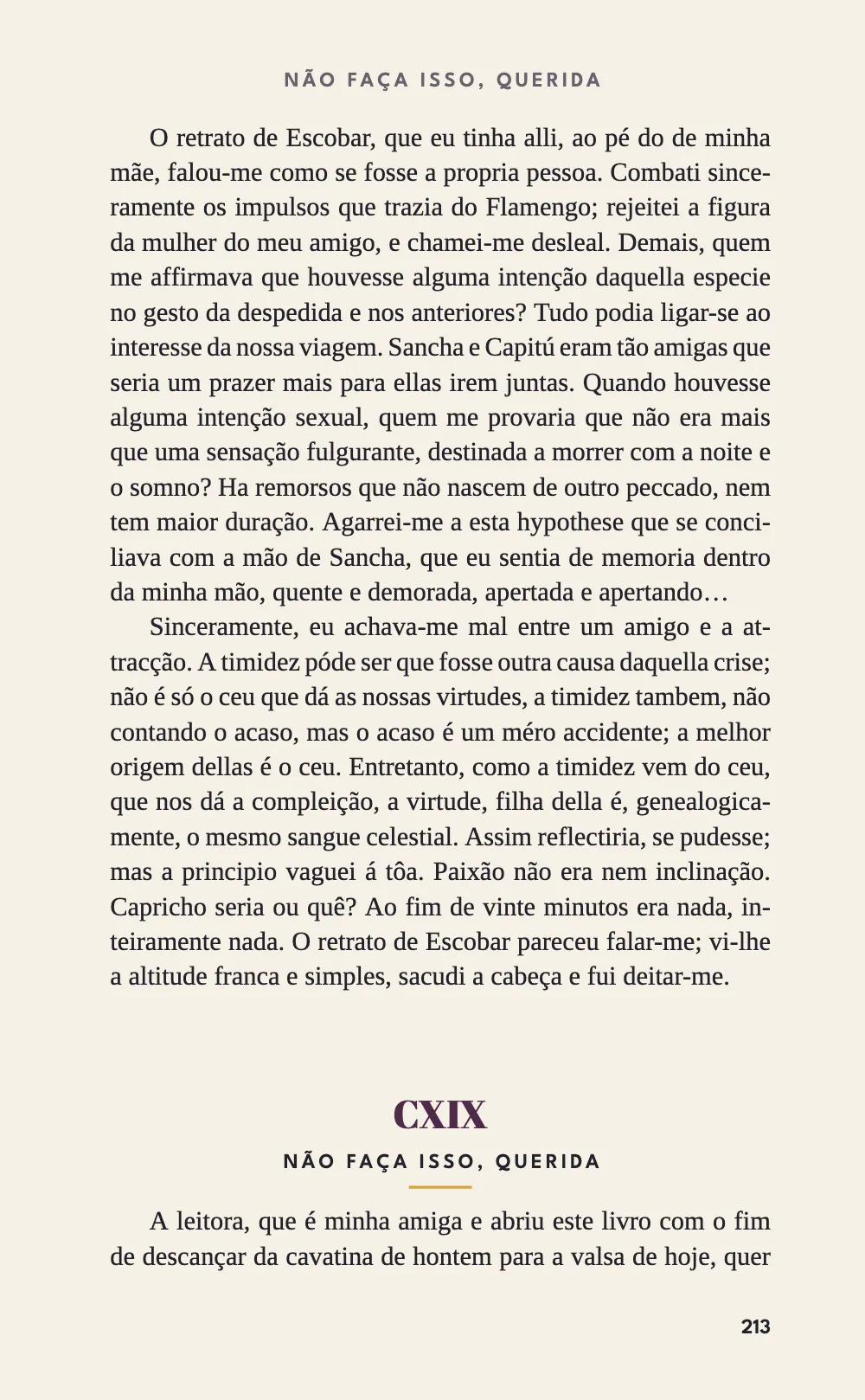
Cinco páginas de texto do final de Dom Casmurro, o romance de Machado de Assis de 1899, compostas no português original como um livro de bolso de 110 × 178 mm numa coleção inventada, a Coleção Casuarina. Uma capa em faixas ameixa, creme e ameixa traz o título em Abril Fatface e o selo açafrão da coleção, e uma prancha pintada do mar revolto do Flamengo, gerada com modelos de difusão, fica de frente para a página 213. O texto vai do fim do capítulo CXVIII ao fim do CXXIII, e nenhum capítulo abre página. Cada um começa duas linhas abaixo do fim do anterior (três no CXIX, para encher a página 213), sob um numeral romano ameixa, com o título em maiúsculas espaçadas e um fio curto açafrão. A página 214 tem dois títulos de capítulo; a 215 e a 216, um cada. Toda página de texto, menos a última, termina na sua 33ª linha, e nenhuma começa com uma linha solta.
Esta receita responde a
- Como evito viúvas, órfãs e últimas linhas de uma só palavra, e mantenho cada título junto do seu texto?
- Como deixo as colunas alinhadas no pé e a última página equilibrada (justificação vertical)?
- Como numero os títulos (1, 1.1, 1.1.1) e dou a cada nível um estilo diferente?
- Como configuro os cabeços: título do livro na página esquerda, título do capítulo na direita e fólio do lado de fora?
A resposta curta
// Machado's chapters run a page or two, so none opens a page. The level's break is off
// (1.4.1 drops it anyway, gotcha: headings-drop-h1-break, but a release that keeps the H1
// default would open each chapter on a recto) and a chapter starts two lines under the last.
const [NUMERAL, TITLE, TRACK, GAP] = [14, 7.5, 1.3, 1.6]; // pt, pt, pt, mm
const RULE_Y = NUMERAL * PT + GAP + TITLE * 1.2 * PT + GAP; // mm: under the title's line
const chapterHead = { enabled: true, slot: { elements: [ // no span: the head stays in the text
  { kind: 'text', id: 'numeral', content: '{number}', fontFamily: DISPLAY, fontSize: pt(NUMERAL),
    lineHeight: 1, color: col('plum'), align: 'center',
    placement: { ...at('container', 'top'), size: { width: 'fill' } } },
  { kind: 'text', id: 'title', content: '{titleText}', ...caps(TITLE, TRACK), color: col('ink'),
    align: 'center', overflow: 'wrap', // a long title wraps instead of ending in '…'
    placement: { anchor: { to: '#numeral', edge: 'below' }, // centred tracked text sits
      offset: { x: pt(TRACK / 2), y: mm(GAP) }, size: { width: 'fill' } } }, // left by TRACK / 2
  { kind: 'rule', id: 'rule', direction: 'horizontal', thickness: pt(1), color: col('saffron'),
    placement: { ...at('container', 'top', 0, RULE_Y), size: { width: mm(8) } } },
] } }; // 11.7 mm deep: the head takes three lines, and the text under it stays on the grid
const chapters = { level: 1, numberingTemplate: '{1:I}', // {number} prints CXIX, CXX…
  fontSize: pt(TITLE), // the hidden heading line, measured in the headings' face
  breakBefore: { enabled: false }, marginTop: pt(2 * LEAD), advancedDesign: chapterHead };
// The keep rules are on by default. avoidWidows keeps widowMinLines (2) lines of a paragraph
// at the foot of a page, and headings.keepWithNext takes the head along when the paragraph
// moves on; avoidOrphans keeps two lines at the head of the next page; avoidRunts weighs a
// last line shorter than about 20 characters as a fault. Column balancing adds lines above
// a head so that the page ends on line 33.
Ingredientes
- Funcionalidades
- Viúvas, órfãs e linhas curtasAberturas desenhadasCapítulos que abrem em página ímparTítulos numeradosEquilíbrio de colunasHifenização e idioma do documentoRecuos, alinhamento e espaço entre parágrafosCabeços e fóliosCabeços por tipo de páginaEstilos de títuloCapítulos sem númeroCapas, folhas de rosto e colofõesQuebras de página e de colunaImagens nos designs de páginaTextos, fios e caixas nos designs de páginaAtributos de títuloMargens espelhadasBoxes flutuantesMetadados do documento
- Também usa
- Ícones e selos de canto nos boxesBoxesCor do papelFiguras e tabelas como recursosElementos pré-textuais em romanosQuebras de linha nos títulos
- Tipografia
- Tinos (Apache 2.0) · Abril Fatface, League Spartan (SIL OFL 1.1)
- Materiais
plate-1100.jpg- The plate of the sea off Flamengo under the Sugarloaf, a painting (Generated With Diffusion Models, original)
- The casuarina roundel, drawn in code in the book’s palette (Ignacio Ferro, MIT)
Preparo
#1 · Encadeie os capítulos, cada título junto do seu texto
// Machado's chapters run a page or two, so none opens a page. The level's break is off
// (1.4.1 drops it anyway, gotcha: headings-drop-h1-break, but a release that keeps the H1
// default would open each chapter on a recto) and a chapter starts two lines under the last.
const [NUMERAL, TITLE, TRACK, GAP] = [14, 7.5, 1.3, 1.6]; // pt, pt, pt, mm
const RULE_Y = NUMERAL * PT + GAP + TITLE * 1.2 * PT + GAP; // mm: under the title's line
const chapterHead = { enabled: true, slot: { elements: [ // no span: the head stays in the text
  { kind: 'text', id: 'numeral', content: '{number}', fontFamily: DISPLAY, fontSize: pt(NUMERAL),
    lineHeight: 1, color: col('plum'), align: 'center',
    placement: { ...at('container', 'top'), size: { width: 'fill' } } },
  { kind: 'text', id: 'title', content: '{titleText}', ...caps(TITLE, TRACK), color: col('ink'),
    align: 'center', overflow: 'wrap', // a long title wraps instead of ending in '…'
    placement: { anchor: { to: '#numeral', edge: 'below' }, // centred tracked text sits
      offset: { x: pt(TRACK / 2), y: mm(GAP) }, size: { width: 'fill' } } }, // left by TRACK / 2
  { kind: 'rule', id: 'rule', direction: 'horizontal', thickness: pt(1), color: col('saffron'),
    placement: { ...at('container', 'top', 0, RULE_Y), size: { width: mm(8) } } },
] } }; // 11.7 mm deep: the head takes three lines, and the text under it stays on the grid
const chapters = { level: 1, numberingTemplate: '{1:I}', // {number} prints CXIX, CXX…
  fontSize: pt(TITLE), // the hidden heading line, measured in the headings' face
  breakBefore: { enabled: false }, marginTop: pt(2 * LEAD), advancedDesign: chapterHead };
// The keep rules are on by default. avoidWidows keeps widowMinLines (2) lines of a paragraph
// at the foot of a page, and headings.keepWithNext takes the head along when the paragraph
// moves on; avoidOrphans keeps two lines at the head of the next page; avoidRunts weighs a
// last line shorter than about 20 characters as a fault. Column balancing adds lines above
// a head so that the page ends on line 33.
O nível de capítulo tem a quebra desligada, e marginTop põe cada título duas linhas abaixo da última linha do capítulo anterior. O design dele não tem span, então o título é desenhado dentro da coluna, num bloco de três linhas de altura, e o texto embaixo dele fica na grade (quebra antes, span e design avançado). As regras de coesão ficam nos valores padrão. Os parágrafos de quatro linhas sob o CXIX e o CXXI deixam cada um duas linhas ao pé da sua página e levam duas para a seguinte; com avoidOrphans: false, eles se dividiriam em três e uma, e as páginas 214 e 215 começariam com uma linha solta (órfãs, viúvas e linhas curtas). O equilíbrio de colunas acrescenta uma terceira linha de espaço acima do CXIX, para que a página 213 termine na linha 33 (equilíbrio de colunas).
#2 · Monte uma página de 33 linhas, com hifenização portuguesa
const bodyText = { fontFamily: TEXT, fontSize: pt(BODY), lineHeight: pt(LEAD),
  color: col('ink'), referenceColor: col('ink'), // for a :ref added later: main-color does
  // not reach it in 1.4.1, and it would print blue
  firstLineIndent: mm(5), // every paragraph indented, the first after a head too
  maxRuntTracking: 0 }; // 1.4.1 measures a runt fix's tracking but never paints it
// (gotcha: runt-tracking-unpainted); the fix keeps its word spacing
const page = { sizePreset: 'custom', width: mm(TRIM.width), height: mm(TRIM.height), dpi: 150,
  backgroundColor: col('paper'),
  margins: { top: mm(TOP), bottom: mm(TRIM.height - TOP - LINES * LEAD * PT), // 16.3 mm
    left: mm(INNER), right: mm(OUTER), mirror: true } };
const LOCALE = 'pt'; // the Portuguese patterns, by their exact code (gotcha: hyphenation-locales)
A margem inferior tem 16,3 mm, o que sobra dos 178 mm de altura depois da margem superior de 15 mm e de 33 linhas de 12,6 pt, então toda página cheia termina na mesma linha. A Tinos, que tem as larguras da Times New Roman, compõe cerca de 59 caracteres por linha na medida de 84 mm em corpo 9,5. locale: 'pt' hifeniza com os padrões do português: at-tracção, af-fluencia, genealogica-mente (idiomas suportados). Todo parágrafo leva recuo, inclusive o primeiro depois de um título, como costumam fazer as edições portuguesas e brasileiras, então indentAfterHeading fica no valor padrão.
#3 · O nome do livro na página par e o capítulo na ímpar
const SHIFT = (INNER - OUTER) / 2; // mm: the text block sits off the page's centre
const [HEAD_Y, FOLIO_Y] = [8.5, 167]; // mm below the top edge
const head = (id, content, parity, x) => ({ kind: 'text', id, content, parity,
  pages: 'body', // never on the cover or the plate, which are opener pages
  ...caps(7.5, TRACK), color: col('muted'), align: 'center',
  placement: at('page', 'top', x + (TRACK / 2) * PT, HEAD_Y) }); // tracking, as in the answer
const folio = (id, parity, edge, x) => ({ kind: 'text', id, content: '{pageNumber}', parity,
  pages: 'body', ...caps(7.5, 0), color: col('ink'), placement: at('page', edge, x, FOLIO_Y) });
const header = { elements: [
  head('verso-title', '{title}', 'even', -SHIFT), // the title in the frontmatter
  head('recto-chapter', '{chapterTitle}', 'odd', SHIFT), // last chapter begun on or before it
] };
const footer = { elements: [folio('verso-folio', 'even', 'top-left', OUTER),
  { ...folio('recto-folio', 'odd', 'top-right', -OUTER), align: 'right' }] };
{title} imprime o título do frontmatter, e {chapterTitle}, o último capítulo que começa na página ou antes dela, de modo que a página 217 nomeia o CXXIII, que começou na 216 (elementos de texto). A página 213 nomeia o CXIX, que começa ao pé dela, embora as suas primeiras 25 linhas fechem o CXVIII: a versão 1.4.1 não tem marcador para o capítulo em que uma página abre. SHIFT leva os cabeços para o centro da mancha, 1 mm fora do centro da página, porque a margem interna é 2 mm mais larga que a externa.
#4 · Desenhe a capa e a prancha como títulos
// span: 'page', in one column too, paints their art whole and keeps the \\ in the title
// (gotcha: opener-clipped-at-top). A :::pagebreak follows each in the text (gotcha:
// cover-pagebreak): 1.4.1 drops the cover's reserved room, since its foot band runs past the
// column (gotcha: opener-taller-than-column), and the plate reserves room down to its caption
// only, since pictures do not count (gotcha: opener-image-no-reserve).
const onPage = (y, size) => ({ ...at('page', 'top', 0, y), ...(size && { size }) });
const cover = { id: 'cover', numbered: false, span: 'page',
  advancedDesign: { enabled: true, slot: { elements: [
    { kind: 'box', id: 'top-band', style: { backgroundColor: col('plum') },
      placement: { ...at('page', 'top-left'), size: { width: 'fill', height: mm(62) } } },
    { kind: 'text', id: 'author', content: '{author}', ...caps(10, 2.4), color: col('paper'),
      align: 'center', placement: at('page', 'top', 1.2 * PT, 44) },
    { kind: 'text', id: 'title', content: '{titleText}', fontFamily: DISPLAY, fontSize: pt(44),
      lineHeight: 1, color: col('plum'), align: 'center', overflow: 'wrap',
      placement: onPage(72, { width: 'fill' }) },
    { kind: 'rule', id: 'rule', direction: 'horizontal', thickness: pt(1.5),
      color: col('saffron'), placement: onPage(111, { width: mm(12) }) },
    { kind: 'box', id: 'foot-band', style: { backgroundColor: col('plum') },
      placement: { ...at('page', 'top-left', 0, 124), size: { width: 'fill', height: mm(54) } } },
    { kind: 'image', id: 'roundel', resourceId: 'roundel',
      placement: onPage(133, { width: mm(20) }) },
    { kind: 'text', id: 'series', content: 'Coleção Casuarina', ...caps(7.5, 1.8),
      color: col('saffron'), align: 'center', placement: at('page', 'top', 0.9 * PT, 159) },
  ] } } };
// The plate faces the first page of text: the morning sea off Flamengo, captioned with the
// line of chapter CXXIII it illustrates, which the heading carries in its quote attribute.
const plate = { id: 'plate', numbered: false, span: 'page',
  advancedDesign: { enabled: true, slot: { elements: [
    { kind: 'image', id: 'sea', resourceId: 'sea',
      placement: { ...at('page', 'top-left'), size: { width: 'fill', height: 'fill' } } },
    { kind: 'text', id: 'label', content: '{titleText}', ...caps(7.5, 1.6), color: col('saffron'),
      align: 'center', placement: at('page', 'top', 0.8 * PT, 146) },
    { kind: 'text', id: 'quote', content: '{attr.quote}', fontFamily: TEXT, italic: true,
      fontSize: pt(8.6), lineHeight: 1.35, color: col('paper'), align: 'center', overflow: 'wrap',
      placement: onPage(152, { width: mm(78) }) },
  ] } } };
const resources = [
  { id: 'roundel', typeId: 'figure', kind: 'svg', createdAt: 0, updatedAt: 0,
    svg: { fileId: 'roundel.svg', width: 60, height: 60 },
    altText: 'The series mark: a casuarina tree in a ring.' },
  // The plate is a painting, a JPEG in assets/ cut to the trim, declared at its pixels.
  { id: 'sea', typeId: 'figure', kind: 'bitmap', createdAt: 0, updatedAt: 0,
    bitmap: { fileId: 'plate-1100.jpg', format: 'jpeg', width: 1100, height: 1780 },
    altText: 'A heavy morning sea under the Sugarloaf, a low sun, and a lone swimmer among '
      + 'the breakers.' },
];
As duas são estilos de título com numbered: false, então o primeiro capítulo numerado continua sendo o CXIX. span: 'page' faz de cada uma uma página de abertura. Sem ele, as faixas da capa param no alto e no pé da mancha, o cabeço e o fólio 1 são impressos na capa, e o título sai numa linha só. A legenda da prancha vem do seu título: CAPÍTULO CXXIII é o texto do título, e a citação em itálico é o atributo quote (atributos de título). O :::pagebreak depois de cada uma mantém o texto longe da arte, já que a versão 1.4.1 não reserva espaço para a faixa do pé da capa nem para a imagem da prancha.
#5 · Diga ao trecho onde ele fica no livro
const continuation = { headings: { h1: 118, h2: 0, h3: 0, h4: 0, h5: 0, h6: 0 } };
continuation.headings dá os contadores de títulos a partir dos quais o trecho começa. Com h1: 118, o primeiro título numerado é o capítulo CXIX; sem ele, os cinco capítulos são numerados de I a V. numberingTemplate: '{1:I}' no nível de capítulo compõe esses números em algarismos romanos, e o design os imprime com {number}. :::numbering{startAt=212}, depois da quebra de página da capa, numera a prancha como 212 e as páginas de texto de 213 a 217 (numeração).
A receita completa
// ═══ Postext Cookbook · Nº 065 · Pocket classic: short chapters that run on ═══════════ // https://postext.dev/en/cookbook/short-chapters-run-on // Code: MIT · Text: Machado de Assis, Dom Casmurro, 1899 (PD, Gutenberg #55752) · Plate: painted // Fonts: Tinos (Apache 2.0), Abril Fatface, League Spartan (SIL OFL 1.1) · Needs postext ≥ 1.4.1 import { buildDocument, renderPageToCanvas, clearMeasurementCache, registerResourceImage } from 'https://esm.sh/postext'; const LANG = 'en'; // @lang: the language of the viewer's title; the sample is Portuguese const RECIPE = 'short-chapters-run-on'; // ─── 1 · Design ───────────────────────────────────────────────────────────── const palette = { ink: '#24202a', // the text: a violet near-black paper: '#f6f1e6', // the pocket book's paper plum: '#4f2a49', // the series colour: cover bands, the chapter numerals saffron: '#d9a03c', // the second ink: rules and drawings, never text on paper (2.1:1) muted: '#6b616e', // the running heads and the colophon (5.2:1 on paper) }; // Design slots read the hex, not the id, in 1.4.1 (gotcha: palette-skips-designs). const col = (id) => ({ hex: palette[id], model: 'hex', paletteId: id }); const colorPalette = [ ...Object.entries(palette).map(([id, hex]) => ({ id, name: id, value: { hex, model: 'hex' } })), // The default bold and italic colours link to main-color, set here to the ink, not blue. { id: 'main-color', name: 'ink (defaults)', value: { hex: palette.ink, model: 'hex' } }, ]; const [TEXT, DISPLAY, LABEL] = ['Tinos', 'Abril Fatface', 'League Spartan']; const TRIM = { width: 110, height: 178 }; // mm: a pocket book const [TOP, INNER, OUTER] = [15, 14, 12]; // mm; mirrored, so the inner margin is at the spine const [BODY, LEAD, LINES] = [9.5, 12.6, 33]; // pt, pt, and the lines of a full page const PT = 25.4 / 72; // mm per point const at = (to, edge, x = 0, y = 0) => ({ anchor: { to, edge }, offset: { x: mm(x), y: mm(y) } }); const caps = (size, track) => ({ fontFamily: LABEL, fontWeight: 600, fontSize: pt(size), letterSpacing: pt(track), textTransform: 'uppercase' }); // #region answer: chapters that run on, each under a centred head drawn in the column // Machado's chapters run a page or two, so none opens a page. The level's break is off // (1.4.1 drops it anyway, gotcha: headings-drop-h1-break, but a release that keeps the H1 // default would open each chapter on a recto) and a chapter starts two lines under the last. const [NUMERAL, TITLE, TRACK, GAP] = [14, 7.5, 1.3, 1.6]; // pt, pt, pt, mm const RULE_Y = NUMERAL * PT + GAP + TITLE * 1.2 * PT + GAP; // mm: under the title's line const chapterHead = { enabled: true, slot: { elements: [ // no span: the head stays in the text { kind: 'text', id: 'numeral', content: '{number}', fontFamily: DISPLAY, fontSize: pt(NUMERAL), lineHeight: 1, color: col('plum'), align: 'center', placement: { ...at('container', 'top'), size: { width: 'fill' } } }, { kind: 'text', id: 'title', content: '{titleText}', ...caps(TITLE, TRACK), color: col('ink'), align: 'center', overflow: 'wrap', // a long title wraps instead of ending in '…' placement: { anchor: { to: '#numeral', edge: 'below' }, // centred tracked text sits offset: { x: pt(TRACK / 2), y: mm(GAP) }, size: { width: 'fill' } } }, // left by TRACK / 2 { kind: 'rule', id: 'rule', direction: 'horizontal', thickness: pt(1), color: col('saffron'), placement: { ...at('container', 'top', 0, RULE_Y), size: { width: mm(8) } } }, ] } }; // 11.7 mm deep: the head takes three lines, and the text under it stays on the grid const chapters = { level: 1, numberingTemplate: '{1:I}', // {number} prints CXIX, CXX… fontSize: pt(TITLE), // the hidden heading line, measured in the headings' face breakBefore: { enabled: false }, marginTop: pt(2 * LEAD), advancedDesign: chapterHead }; // The keep rules are on by default. avoidWidows keeps widowMinLines (2) lines of a paragraph // at the foot of a page, and headings.keepWithNext takes the head along when the paragraph // moves on; avoidOrphans keeps two lines at the head of the next page; avoidRunts weighs a // last line shorter than about 20 characters as a fault. Column balancing adds lines above // a head so that the page ends on line 33. // #endregion // #region text: a pocket page of 33 lines, in Portuguese const bodyText = { fontFamily: TEXT, fontSize: pt(BODY), lineHeight: pt(LEAD), color: col('ink'), referenceColor: col('ink'), // for a :ref added later: main-color does // not reach it in 1.4.1, and it would print blue firstLineIndent: mm(5), // every paragraph indented, the first after a head too maxRuntTracking: 0 }; // 1.4.1 measures a runt fix's tracking but never paints it // (gotcha: runt-tracking-unpainted); the fix keeps its word spacing const page = { sizePreset: 'custom', width: mm(TRIM.width), height: mm(TRIM.height), dpi: 150, backgroundColor: col('paper'), margins: { top: mm(TOP), bottom: mm(TRIM.height - TOP - LINES * LEAD * PT), // 16.3 mm left: mm(INNER), right: mm(OUTER), mirror: true } }; const LOCALE = 'pt'; // the Portuguese patterns, by their exact code (gotcha: hyphenation-locales) // #endregion // #region heads: the book's title over the verso, the chapter over the recto, folios at the foot const SHIFT = (INNER - OUTER) / 2; // mm: the text block sits off the page's centre const [HEAD_Y, FOLIO_Y] = [8.5, 167]; // mm below the top edge const head = (id, content, parity, x) => ({ kind: 'text', id, content, parity, pages: 'body', // never on the cover or the plate, which are opener pages ...caps(7.5, TRACK), color: col('muted'), align: 'center', placement: at('page', 'top', x + (TRACK / 2) * PT, HEAD_Y) }); // tracking, as in the answer const folio = (id, parity, edge, x) => ({ kind: 'text', id, content: '{pageNumber}', parity, pages: 'body', ...caps(7.5, 0), color: col('ink'), placement: at('page', edge, x, FOLIO_Y) }); const header = { elements: [ head('verso-title', '{title}', 'even', -SHIFT), // the title in the frontmatter head('recto-chapter', '{chapterTitle}', 'odd', SHIFT), // last chapter begun on or before it ] }; const footer = { elements: [folio('verso-folio', 'even', 'top-left', OUTER), { ...folio('recto-folio', 'odd', 'top-right', -OUTER), align: 'right' }] }; // #endregion // #region cover: the cover and the plate, heading styles that fill a page each // span: 'page', in one column too, paints their art whole and keeps the \\ in the title // (gotcha: opener-clipped-at-top). A :::pagebreak follows each in the text (gotcha: // cover-pagebreak): 1.4.1 drops the cover's reserved room, since its foot band runs past the // column (gotcha: opener-taller-than-column), and the plate reserves room down to its caption // only, since pictures do not count (gotcha: opener-image-no-reserve). const onPage = (y, size) => ({ ...at('page', 'top', 0, y), ...(size && { size }) }); const cover = { id: 'cover', numbered: false, span: 'page', advancedDesign: { enabled: true, slot: { elements: [ { kind: 'box', id: 'top-band', style: { backgroundColor: col('plum') }, placement: { ...at('page', 'top-left'), size: { width: 'fill', height: mm(62) } } }, { kind: 'text', id: 'author', content: '{author}', ...caps(10, 2.4), color: col('paper'), align: 'center', placement: at('page', 'top', 1.2 * PT, 44) }, { kind: 'text', id: 'title', content: '{titleText}', fontFamily: DISPLAY, fontSize: pt(44), lineHeight: 1, color: col('plum'), align: 'center', overflow: 'wrap', placement: onPage(72, { width: 'fill' }) }, { kind: 'rule', id: 'rule', direction: 'horizontal', thickness: pt(1.5), color: col('saffron'), placement: onPage(111, { width: mm(12) }) }, { kind: 'box', id: 'foot-band', style: { backgroundColor: col('plum') }, placement: { ...at('page', 'top-left', 0, 124), size: { width: 'fill', height: mm(54) } } }, { kind: 'image', id: 'roundel', resourceId: 'roundel', placement: onPage(133, { width: mm(20) }) }, { kind: 'text', id: 'series', content: 'Coleção Casuarina', ...caps(7.5, 1.8), color: col('saffron'), align: 'center', placement: at('page', 'top', 0.9 * PT, 159) }, ] } } }; // The plate faces the first page of text: the morning sea off Flamengo, captioned with the // line of chapter CXXIII it illustrates, which the heading carries in its quote attribute. const plate = { id: 'plate', numbered: false, span: 'page', advancedDesign: { enabled: true, slot: { elements: [ { kind: 'image', id: 'sea', resourceId: 'sea', placement: { ...at('page', 'top-left'), size: { width: 'fill', height: 'fill' } } }, { kind: 'text', id: 'label', content: '{titleText}', ...caps(7.5, 1.6), color: col('saffron'), align: 'center', placement: at('page', 'top', 0.8 * PT, 146) }, { kind: 'text', id: 'quote', content: '{attr.quote}', fontFamily: TEXT, italic: true, fontSize: pt(8.6), lineHeight: 1.35, color: col('paper'), align: 'center', overflow: 'wrap', placement: onPage(152, { width: mm(78) }) }, ] } } }; const resources = [ { id: 'roundel', typeId: 'figure', kind: 'svg', createdAt: 0, updatedAt: 0, svg: { fileId: 'roundel.svg', width: 60, height: 60 }, altText: 'The series mark: a casuarina tree in a ring.' }, // The plate is a painting, a JPEG in assets/ cut to the trim, declared at its pixels. { id: 'sea', typeId: 'figure', kind: 'bitmap', createdAt: 0, updatedAt: 0, bitmap: { fileId: 'plate-1100.jpg', format: 'jpeg', width: 1100, height: 1780 }, altText: 'A heavy morning sea under the Sugarloaf, a low sun, and a lone swimmer among ' + 'the breakers.' }, ]; // #endregion // The colophon floats to the foot of the last page, beside the series roundel. const colophon = { id: 'colophon', placement: 'bottom', backgroundEnabled: false, padding: { top: pt(0), right: pt(0), bottom: pt(0), left: pt(0) }, marginBottom: pt(0), icon: { kind: 'resource', resourceId: 'roundel', size: mm(10) }, titleStyle: { gap: mm(3) }, body: { fontFamily: TEXT, fontSize: pt(7.6), lineHeight: pt(LEAD * 0.8), color: col('muted'), italicColor: col('muted'), textAlign: 'left', firstLineIndent: pt(0) } }; const config = () => ({ // a factory: the engine caches resolved configs per object locale: LOCALE, colorPalette, page, layout: { layoutType: 'single' }, bodyText, // The heading's own line is hidden under its design but still measured, in this face. headings: { fontFamily: LABEL, fontWeight: 600, levels: [chapters] }, headingStyles: [cover, plate], calloutStyles: [colophon], header, footer, }); // #region art: the series roundel, drawn in code in the book's two inks let seed = 1871; // Mulberry32, seeded: never Math.random() in a recipe const rand = () => { let r = Math.imul((seed = (seed + 0x6d2b79f5) | 0) ^ (seed >>> 15), 1 | seed); r = (r + Math.imul(r ^ (r >>> 7), 61 | r)) ^ r; return ((r ^ (r >>> 14)) >>> 0) / 4294967296; }; const n = (v) => v.toFixed(2); const svg = (w, h, body) => `<svg xmlns="http://www.w3.org/2000/svg" width="${w}mm" ` + `height="${h}mm" viewBox="0 0 ${w} ${h}">${body}</svg>`; const line = (d, stroke, width, extra = '') => `<path d="${d}" fill="none" stroke="${stroke}" ` + `stroke-width="${n(width)}" stroke-linecap="round" stroke-linejoin="round"${extra}/>`; // The casuarina of Bento's garden (chapter II): a leaning trunk, and branches that arch out // on alternate sides and let their needles hang. function roundelSvg() { const { plum, saffron } = palette; const out = [`<circle cx="30" cy="30" r="29" fill="${saffron}"/>`, line('M30 30m-25.5 0a25.5 25.5 0 1 0 51 0a25.5 25.5 0 1 0 -51 0', plum, 0.9), line('M28.6 50Q30.6 33 30.2 10.5', plum, 1.6), line('M18.5 50.2H41.5', plum, 1.3)]; for (let k = 0; k < 9; k++) { const side = k % 2 ? 1 : -1; const y0 = 12.5 + k * 3.7; const reach = (3 + k * 1.55) * (0.8 + rand() * 0.35); const x1 = 30.2 + side * reach; const y1 = y0 + 1.2 + rand() * 1.4; out.push(line(`M30.2 ${n(y0)}Q${n(30.2 + side * reach * 0.5)} ${n(y0 - 2.2)} ${n(x1)} ${n(y1)}`, plum, 0.95)); const strands = 3 + Math.round(reach / 1.6); for (let j = 1; j <= strands; j++) { // needles hang from the arch const u = j / (strands + 0.5); const x = 30.2 + side * reach * u; const y = y0 + (y1 - y0) * u ** 2 - 2.2 * 2 * u * (1 - u) + 0.3; out.push(line(`M${n(x)} ${n(y)}q${n(side * 0.4)} ${n(2)} ${n(side * 0.1)} ` + `${n(3 + rand() * 2.4)}`, plum, 0.7)); } } return svg(60, 60, out.join('')); } // #endregion // ─── 2 · Content ──────────────────────────────────────────────────────────── // Dom Casmurro in Portuguese, in the first edition's spelling: the cover, the plate, then // pages 213 to 217 (:::numbering in the text), from the end of chapter CXVIII. const markdown = String.raw`---Amostra em Markdown · 63 linhas · content.en.md
title: "Dom Casmurro" author: "Machado de Assis" --- # Dom \\ Casmurro {style="cover"} :::pagebreak :::numbering{startAt=212} # Capítulo CXXIII {style="plate" quote="«…grandes e abertos, como a vaga do mar lá fóra, como se quizesse tragar tambem o nadador da manhã.»"} :::pagebreak O retrato de Escobar, que eu tinha alli, ao pé do de minha mãe, falou-me como se fosse a propria pessoa. Combati sinceramente os impulsos que trazia do Flamengo; rejeitei a figura da mulher do meu amigo, e chamei-me desleal. Demais, quem me affirmava que houvesse alguma intenção daquella especie no gesto da despedida e nos anteriores? Tudo podia ligar-se ao interesse da nossa viagem. Sancha e Capitú eram tão amigas que seria um prazer mais para ellas irem juntas. Quando houvesse alguma intenção sexual, quem me provaria que não era mais que uma sensação fulgurante, destinada a morrer com a noite e o somno? Ha remorsos que não nascem de outro peccado, nem tem maior duração. Agarrei-me a esta hypothese que se conciliava com a mão de Sancha, que eu sentia de memoria dentro da minha mão, quente e demorada, apertada e apertando… Sinceramente, eu achava-me mal entre um amigo e a attracção. A timidez póde ser que fosse outra causa daquella crise; não é só o ceu que dá as nossas virtudes, a timidez tambem, não contando o acaso, mas o acaso é um méro accidente; a melhor origem dellas é o ceu. Entretanto, como a timidez vem do ceu, que nos dá a compleição, a virtude, filha della é, genealogicamente, o mesmo sangue celestial. Assim reflectiria, se pudesse; mas a principio vaguei á tôa. Paixão não era nem inclinação. Capricho seria ou quê? Ao fim de vinte minutos era nada, inteiramente nada. O retrato de Escobar pareceu falar-me; vi-lhe a altitude franca e simples, sacudi a cabeça e fui deitar-me. # Não faça isso, querida A leitora, que é minha amiga e abriu este livro com o fim de descançar da cavatina de hontem para a valsa de hoje, quer fechal-o ás pressas, ao ver que beiramos um abysmo. Não faça isso, querida; eu mudo de rumo. # Os autos Na manhã seguinte accordei livre das abominações da vespera; chamei-lhes allucinações, tomei café, percorri os jornaes e fui estudar uns autos. Capitú e prima Justina sairam para a missa das nove, na Lapa. A figura de Sancha desappareceu inteiramente no meio das allegações da parte adversa, que eu ia lendo nos autos, allegações falsas, inadmissiveis, sem apoio na lei nem nas praxes. Vi que era facil ganhar a demanda; consultei Dalloz, Pereira e Souza… Uma só vez olhei para o retrato de Escobar. Era uma bella photographia tirada um anno antes. Estava de pé, sobrecasaca abotoada, a mão esquerda no dorso de uma cadeira, a direita mettida ao peito, o olhar ao longe para a esquerda do espectador. Tinha garbo e naturalidade. A moldura que lhe mandei pôr não encobria a dedicatoria, escripta embaixo, não nas costas do cartão: «Ao meu querido Bentinho o seu querido Escobar 20-4-70.» Estas palavras fortaleceram-me os pensamentos daquella manhã, e espancaram de todo as recordações da vespera. Naquelle tempo a minha vista era boa; eu podia lel-as do logar em que estava. Tornei aos autos. # A catastrophe No melhor delles, ouvi passos precipitados na escada, a campainha soou, soaram palmas, golpes na cancella, vozes, acudiram todos, acudi eu mesmo. Era um escravo da casa de Sancha que me chamava: —Para ir lá… sinhô nadando, sinhô morrendo. Não disse mais nada, ou eu não lhe ouvi o resto. Vesti-me, deixei recado a Capitú e corri ao Flamengo. Em caminho, fui adivinhando a verdade. Escobar metteu-se a nadar, como usava fazer, arriscou-se um pouco mais fóra que de costume, apesar do mar bravio, foi enrolado e morreu. As canoas que acudiram mal puderam trazer-lhe o cadaver. # O enterro A viuva… Poupo-vos as lagrimas da viuva, as minhas, as da outra gente. Sai de lá cerca de onze horas; Capitú e prima Justina esperavam-me, uma com o parecer abatido e estupido, outra enfastiada apenas. —Vão fazer companhia a pobre Sanchinha; eu vou cuidar do enterro. Assim fizemos. Quiz que o enterro fosse pomposo, e a affluencia dos amigos foi numerosa. Praia, ruas, praça da Gloria, tudo eram carros, muitos delles particulares. A casa, não sendo grande, não podiam lá caber todos; muitos estavam na praia, falando do desastre, apontando o logar em que Escobar fallecèra, ouvindo referir a chegada do morto. José Dias ouviu tambem falar dos negocios do finado, divergindo alguns na avaliação dos bens, mas havendo accordo em que o passivo devia ser pequeno. Elogiavam as qualidades de Escobar. Um ou outro discutia o recente gabinete Rio Branco; estavamos em Março de 1871. Nunca me esqueceu o mez nem o anno. Como eu houvesse resolvido falar no cemiterio, escrevi algumas linhas e mostrei-as em casa a José Dias, que as achou realmente dignas do morto e de mim. Pediu-me o papel, recitou lentamente o discurso, pesando as palavras, e confirmou a primeira opinião; no Flamengo espalhou a noticia. Alguns conhecidos vieram interrogar-me: —Então, vamos ouvil-o? —Quatro palavras. Poucas mais seriam. Tinha-as escripto com receio de que a emoção me impedisse de improvisar. No tilbury em que andei uma ou duas horas, não fizera mais que recordar o tempo do seminario, as relações de Escobar, as nossas sympathias, a nossa amizade, começada, continuada e nunca interrompida, até que um lance da fortuna fez separar para sempre duas creaturas que promettiam ficar por muito tempo unidas. De quando em quando enxugava os olhos. O cocheiro aventurou duas ou tres perguntas sobre a minha situação moral; não me arrancando nada, continuou o seu officio. Chegando a casa, deitei aquellas emoções ao papel; tal seria o discurso. # Olhos de ressaca Emfim, chegou a hora da encommendação e da partida. Sancha quiz despedir-se do marido, e o desespero daquelle lance consternou a todos. Muitos homens choravam tambem, as mulheres todas. Só Capitú, amparando a viuva, parecia vencer-se a si mesma. Consolava a outra, queria arrancal-a dalli. A confusão era geral. No meio della, Capitú olhou alguns instantes para o cadaver tão fixa, tão apaixonadamente fixa, que não admira lhe saltassem algumas lagrimas poucas e caladas… As minhas cessaram logo. Fiquei a ver as della; Capitú enxugou-as depressa, olhando a furto para a gente que estava na sala. Redobrou de caricias para a amiga, e quiz leval-a; mas o cadaver parece que a retinha tambem. Momento houve em que os olhos de Capitú fitaram o defuncto, quaes os da viuva, sem o pranto nem palavras desta, mas grandes e abertos, como a vaga do mar lá fóra, como se quizesse tragar tambem o nadador da manhã. :::callout{type="colophon"} Do fim do capítulo CXVIII ao fim do CXXIII de *Dom Casmurro* (1899), com a ortografia da edição Garnier transcrita pelo Project Gutenberg (n.º 55752); corrigiu-se um erro de transcrição no capítulo CXXIII. Ilustração pintada e marca da coleção feitas para esta edição. Composto em Tinos (Apache 2.0), Abril Fatface e League Spartan (SIL OFL). :::`; // ─── 3 · Fonts ────────────────────────────────────────────────────────────── const FONTS = { // every face the pages use, loaded before the build (gotcha: fonts-first) Tinos: ['400', '400i'], // text, colophon; italic: the plate's quote, the colophon's title 'Abril Fatface': ['400'], // chapter numerals and the cover title 'League Spartan': ['600'], // chapter titles, running heads, folios, the cover's capitals }; // ─── 4 · Build & show ─────────────────────────────────────────────────────── await loadFonts(FONTS, markdown); await loadSvg('roundel.svg', roundelSvg()); await loadImage('plate-1100.jpg', asset('plate-1100.jpg')); // #region excerpt: these pages continue a book: chapter CXVIII is under way, the next is CXIX const continuation = { headings: { h1: 118, h2: 0, h3: 0, h4: 0, h5: 0, h6: 0 } }; // #endregion const doc = await buildWithFonts( () => buildDocument({ markdown, resources, continuation }, config()), markdown); showPages(doc, { title: t({ en: 'Dom Casmurro, a pocket edition', es: 'Dom Casmurro, edición de bolsillo' }) });Kit · core, fonts, viewer, images: igual em todas as receitas · 271 linhas
// ─── Kit ── helpers shared by every Cookbook recipe · postext.dev/cookbook ───── // ─── Kit · core v1 ── the same in every recipe · postext.dev/cookbook function mm(value) { return { value, unit: 'mm' }; } function pt(value) { return { value, unit: 'pt' }; } function em(value) { return { value, unit: 'em' }; } /** The sample language's string: t({ en: 'Figure', es: 'Figura' }). */ function t(strings) { return strings[LANG] ?? Object.values(strings)[0]; } /** A file in this recipe's assets folder, served from the Postext repo by jsDelivr. */ function asset(file) { return `https://cdn.jsdelivr.net/gh/drnachio/postext@main/cookbook/${RECIPE}/assets/${file}`; } // ─── Kit · fonts v2 ── the same in every recipe · postext.dev/cookbook // Postext measures with the loaded faces and caches the widths: load every face // before the first build, from Fontsource, the files the PDF embeds too. /** faces = { 'Family Name': ['400', '400i', '700'] }. `text` is the sample: * č ł † α χ also load latin-ext and greek files (kitSubsetsFor). With * `optional`, a face Fontsource does not ship is skipped instead of failing. * Resolves to the number of faces added. */ async function loadFonts(faces, text = '', { optional = false } = {}) { kitStatus('Loading fonts…'); const ranges = { latin: 'U+0000-00FF,U+0131,U+0152-0153,U+02BB-02BC,U+02C6,U+02DA,U+02DC,U+0304,U+0308,U+0329,' + 'U+2000-206F,U+20AC,U+2122,U+2191,U+2193,U+2212,U+2215,U+FEFF,U+FFFD', 'latin-ext': 'U+0100-02BA,U+02BD-02C5,U+02C7-02CC,U+02CE-02D7,U+02DD-02FF,U+0304,U+0308,U+0329,' + 'U+1D00-1DBF,U+1E00-1E9F,U+1EF2-1EFF,U+2020,U+20A0-20AB,U+20AD-20C0,U+2113,U+2C60-2C7F,U+A720-A7FF', greek: 'U+0370-03FF', }; const jobs = []; let added = 0; for (const [family, specs] of Object.entries(faces)) { const id = fontsourceId(family); const todo = [...new Set(specs)].map((spec) => [parseInt(spec, 10), spec.endsWith('i') ? 'italic' : 'normal']) .filter(([weight, style]) => !hasFace(family, weight, style)); // before any await const meta = optional || /[^\0-ÿ]/u.test(text) ? await fontsourceMeta(family) : null; const subsets = ['latin', ...kitSubsetsFor(text, meta)]; for (const [weight, style] of todo) { if (optional && !(meta?.weights.includes(weight) && meta.styles.includes(style))) continue; for (const subset of subsets) { const url = `https://cdn.jsdelivr.net/npm/@fontsource/${id}@5/files/${id}-${subset}-${weight}-${style}.woff2`; const face = new FontFace(family, `url(${url}) format('woff2')`, { weight: String(weight), style, unicodeRange: ranges[subset] }); jobs.push(face.load().then((ready) => { document.fonts.add(ready); added++; }, () => { if (subset === 'latin' && !optional) throw new Error(`Fontsource has no ${family} ${weight} ${style}`); })); } } } await Promise.all(jobs).catch((error) => { kitFail(error); throw error; }); return added; } /** Runs `build` and loads any face the pages use that FONTS missed (a regular * one with a warning), then clears the measurement cache and builds again. */ async function buildWithFonts(build, text = '') { const tried = new Set(); for (let round = 0; round < 3; round++) { kitStatus('Laying out…'); await new Promise(requestAnimationFrame); // let the status paint first const result = await Promise.resolve().then(build).catch((error) => { kitFail(error); throw error; }); const wanted = { base: {}, variants: {} }; for (const { font, base } of [result].flat().flatMap(fontStringsOf)) { const { family, weight, style } = parseFont(font); const key = `${family}|${weight}|${style}`; if (tried.has(key) || hasFace(family, weight, style)) continue; tried.add(key); (wanted[base ? 'base' : 'variants'][family] ??= []).push(`${weight}${style === 'italic' ? 'i' : ''}`); } if (Object.keys(wanted.base).length) { console.warn(`[cookbook] FONTS does not list ${JSON.stringify(wanted.base)}: loading them.`); } const added = await loadFonts(wanted.base, text) + await loadFonts(wanted.variants, text, { optional: true }); if (added === 0) return result; clearMeasurementCache(); } throw new Error('The fonts did not settle after three builds.'); } /** Every font string of the layout; `base` marks a block's own face. */ function fontStringsOf(doc) { const found = new Map(); const walk = (node) => { if (!node || typeof node !== 'object') return; if (Array.isArray(node)) { node.forEach(walk); return; } for (const [key, value] of Object.entries(node)) { if (typeof value === 'string' && /fontString$/i.test(key)) { found.set(value, found.get(value) || key === 'fontString'); } else if (value && typeof value === 'object') walk(value); } }; walk(doc.pages); walk(doc.blocks); return [...found].map(([font, base]) => ({ font, base })); } /** '700 37.5px Open Sans' / 'italic 400 13px "Source Serif 4"' → { family, weight, style }. * A string with no weight ('95.8px Young Serif', from a design text) is 400. */ function parseFont(font) { const m = /^(?:(italic|oblique)\s+)?(?:small-caps\s+)?(?:(\d+|bold|normal)\s+)?[\d.]+px\s+(.+)$/.exec(font.trim()); if (!m) throw new Error(`Unexpected font string: ${font}`); const weight = m[2] === 'bold' ? 700 : !m[2] || m[2] === 'normal' ? 400 : Number(m[2]); return { family: m[3].replace(/^["']|["']$/g, ''), weight, style: m[1] ? 'italic' : 'normal' }; } /** A loaded FontFace covers this family, weight and style (fonts.check() would * also say yes for families nobody declared). */ function hasFace(family, weight, style) { for (const face of document.fonts) { if (face.status !== 'loaded' || face.style !== style) continue; if (face.family.replace(/^["']|["']$/g, '') !== family) continue; const [low, high = low] = face.weight.split(' ').map(Number); if (weight >= low && weight <= high) return true; } return false; } /** The files beyond latin `text` needs that `meta`'s family ships. */ function kitSubsetsFor(text, meta) { return [[/[Ā-˿ᴀ-ᶿḀ-ỿ†ℓⱠ-Ɀ꜠-ꟿ]/u, 'latin-ext'], [/[Ͱ-Ͽ]/u, 'greek']] .filter(([re, x]) => re.test(text) && meta?.subsets?.includes(x)).map(([, x]) => x); } /** Fontsource's id for a family: 'Source Serif 4' → 'source-serif-4'. */ function fontsourceId(family) { return family.toLowerCase().replace(/\s+/g, '-'); } /** The family's Fontsource metadata (weights, styles, subsets), or null. */ function fontsourceMeta(family) { fontsourceMeta.cache ??= new Map(); const id = fontsourceId(family); if (!fontsourceMeta.cache.has(id)) { fontsourceMeta.cache.set(id, fetch(`https://api.fontsource.org/v1/fonts/${id}`) .then((res) => (res.ok ? res.json() : null), () => null)); } return fontsourceMeta.cache.get(id); } // ─── Kit · viewer v1 ── the same in every recipe · postext.dev/cookbook /** The pages as spreads on a dark desk, page 1 alone, then verso | recto, * each painted when it scrolls near. */ function showPages(docs, { title, width = 460 } = {}) { const root = viewer(title); const pages = [docs].flat().flatMap((doc) => doc.pages.map((page) => ({ doc, page, n: (doc.pageIndexOffset ?? 0) + page.index }))); const spreads = []; let verso = null; for (const p of pages) { if (p.n % 2 === 1) { if (verso) spreads.push([verso, null]); verso = p; } else { spreads.push([verso, p]); verso = null; } } if (verso) spreads.push([verso, null]); const density = Math.min(window.devicePixelRatio || 1, 2); showPages.painter?.disconnect(); const painter = new IntersectionObserver((entries) => { for (const { isIntersecting, target } of entries) { if (!isIntersecting) continue; painter.unobserve(target); const { doc, page } = target.postext; renderPageToCanvas(page, doc, target, { scale: (width * density) / page.width }); } }, { rootMargin: '800px' }); showPages.painter = painter; root.replaceChildren(...spreads.map((pair) => { const spread = document.createElement('div'); spread.className = 'pt-spread'; for (const p of pair) { const figure = document.createElement('figure'); if (p) { const label = p.page.pageLabel || String(p.n + 1); const canvas = document.createElement('canvas'); canvas.postext = p; canvas.style.aspectRatio = `${p.page.width} / ${p.page.height}`; canvas.setAttribute('role', 'img'); canvas.setAttribute('aria-label', `Page ${label}`); const folio = document.createElement('figcaption'); folio.textContent = label; figure.append(canvas, folio); painter.observe(canvas); } else figure.className = 'pt-blank'; spread.append(figure); } return spread; })); kitStatus(`${pages.length} ${pages.length === 1 ? 'page' : 'pages'}`); document.documentElement.dataset.postext = 'ready'; return pages.length; } /** The desk, the bar and the error reporting, created once. */ function viewer(title) { if (!document.getElementById('pt-kit')) { document.head.insertAdjacentHTML('beforeend', `<style id="pt-kit"> :root { color-scheme: dark; } body { margin: 0; background: #0e1014; color: #b9bcc4; font: 13px/1.45 system-ui, sans-serif; } #pt-bar { position: sticky; top: 0; z-index: 1; display: flex; flex-wrap: wrap; align-items: center; gap: 6px 16px; padding: 10px 16px; background: rgb(14 16 20 / .92); backdrop-filter: blur(6px); border-bottom: 1px solid #23262d; } #pt-bar strong { color: #f4f1ea; font-weight: 600; } #pt-actions { display: flex; gap: 12px; margin-left: auto; } #pt-actions a, #pt-actions button { color: #d8a21a; font: inherit; background: none; border: 0; padding: 0; cursor: pointer; } #pages { display: grid; justify-items: center; gap: 48px; padding: 32px 16px 72px; } .pt-spread { display: flex; } .pt-spread figure { margin: 0; width: min(460px, 44vw); } .pt-spread canvas { display: block; width: 100%; background: #fff; box-shadow: 0 1px 2px rgb(0 0 0 / .5), 0 22px 44px -16px rgb(0 0 0 / .8); } .pt-spread figure:first-child canvas { box-shadow: inset -14px 0 14px -14px rgb(0 0 0 / .18), 0 1px 2px rgb(0 0 0 / .5), 0 22px 44px -16px rgb(0 0 0 / .8); } .pt-spread figcaption { margin-top: 10px; text-align: center; font: 600 10px/1 system-ui, sans-serif; letter-spacing: .18em; text-transform: uppercase; color: #6c7079; } .pt-blank { visibility: hidden; } @media (max-width: 760px) { .pt-spread { flex-direction: column; gap: 32px; } .pt-spread figure { width: min(460px, 92vw); } .pt-blank { display: none; } } </style>`); document.body.insertAdjacentHTML('afterbegin', '<header id="pt-bar"><strong id="pt-title"></strong><span id="pt-status" role="status"></span><span id="pt-actions"></span></header>'); document.getElementById('pt-title').textContent = document.title || 'Postext'; addEventListener('error', (event) => kitFail(event.error ?? event.message)); addEventListener('unhandledrejection', (event) => kitFail(event.reason)); } if (title) document.getElementById('pt-title').textContent = title; return document.getElementById('pages') ?? document.body.appendChild(Object.assign(document.createElement('main'), { id: 'pages' })); } function kitStatus(text) { viewer(); document.getElementById('pt-status').textContent = text; } function kitFail(error) { document.documentElement.dataset.postext = 'error'; kitStatus(`Error: ${error?.message ?? error}`); } // ─── Kit · images v1 ── recipes with pictures · postext.dev/cookbook /** Registers a photo or PNG for the canvas and keeps its bytes for the PDF. * fetch → ImageBitmap never taints the canvas (a plain cross-origin <img> would). */ async function loadImage(fileId, url) { const res = await fetch(url); if (!res.ok) throw new Error(`Image not found (${res.status}): ${url}`); const bytes = new Uint8Array(await res.arrayBuffer()); registerResourceImage(fileId, await createImageBitmap(new Blob([bytes]))); (loadImage.bytes ??= new Map()).set(fileId, bytes); } /** Registers SVG markup (drawn in code, or fetched) as a vector image. */ async function loadSvg(fileId, svg) { const img = new Image(); img.src = `data:image/svg+xml;charset=utf-8,${encodeURIComponent(svg)}`; await img.decode(); registerResourceImage(fileId, img); (loadImage.bytes ??= new Map()).set(fileId, new TextEncoder().encode(svg)); } /** renderToPdf({ resourceBytes: imageBytes }) */ function imageBytes(fileId) { return loadImage.bytes?.get(fileId); } /** renderToHtml({ resourceImageUrl: imageUrl }) */ function imageUrl(fileId) { const bytes = imageBytes(fileId); if (!bytes) return undefined; imageUrl.urls ??= new Map(); if (!imageUrl.urls.has(fileId)) { const type = /\.svg$/i.test(fileId) ? 'image/svg+xml' : /\.png$/i.test(fileId) ? 'image/png' : 'image/jpeg'; imageUrl.urls.set(fileId, URL.createObjectURL(new Blob([bytes], { type }))); } return imageUrl.urls.get(fileId); } // ─── /Kit ───────────────────────────────────────────────────────────────────────
O script.js montado funciona como está: cole-o como script de módulo em qualquer página ou abra a receita no CodePen. Pasta da receita no GitHub ↗ (abre em uma nova aba)
Variações
#Abra cada capítulo numa página nova
Com uma quebra antes de cada capítulo, as cinco páginas de texto viram sete: a página 214 traz só o CXIX, com o título e quatro linhas, e a página 213, onde nenhum capítulo começa, recebe o título da prancha, CAPÍTULO CXXIII, como cabeço.
-  breakBefore: { enabled: false }, marginTop: pt(2 * LEAD), advancedDesign: chapterHead };
+  breakBefore: { enabled: true, parity: 'any' }, marginTop: pt(2 * LEAD),
+ advancedDesign: chapterHead };#Ponha o número do capítulo na página ímpar
{chapterNumber} imprime o numeral do mesmo capítulo de onde vem o título: CXIX · NÃO FAÇA ISSO, QUERIDA.
-  head('recto-chapter', '{chapterTitle}', 'odd', SHIFT),
+ head('recto-chapter', '{chapterNumber} · {chapterTitle}', 'odd', SHIFT),Erros comuns
Erro comum
avoidWidows cuida do pé da coluna, avoidOrphans do alto
O Postext dá nomes próprios às duas linhas isoladas: avoidWidows (widowMinLines, widowPenalty) impede que a primeira linha de um parágrafo fique sozinha no pé de uma coluna, e avoidOrphans (orphanMinLines, orphanPenalty) impede que a última fique sozinha no alto da seguinte. Muitos manuais de estilo usam os dois nomes ao contrário, então escolha a configuração pelo lugar onde ela age. As duas vêm ativadas e funcionam como penalidades: a diagramação compara cada uma com as linhas vazias que obedecê-la deixaria. Viúvas, órfãs e linhas curtas →
Erro comum
Qualquer objeto headings desativa a quebra de página do H1
Por padrão, um H1 salta para uma página ímpar (always-odd), mas passar qualquer objeto headings redefine esse padrão, então os capítulos ficam emendados e span: 'page' não faz nada. Declare de novo headings.levels[0].breakBefore: { enabled: true, parity } em toda configuração. Capítulos que abrem em página ímpar →
Erro comum
{number}/{chapterNumber} imprimem o número do H1; {numberRoman} só nas partes
{number} e {chapterNumber} imprimem o número já formatado do título, mas {numberRoman}, {numberDecimal} e as outras variantes numéricas só são preenchidas nas páginas de parte. Formate o número do capítulo no seu numberingTemplate ({1:I}) ou passe-o como atributo. Títulos numerados →
Erro comum
Só 8 idiomas têm hifenização, com o código exato
A hifenização existe para en-us, es, fr, de, it, pt, ca e nl, com o código exato: 'es-ES' ou qualquer outro idioma passa sem aviso para o inglês americano. Hifenização e idioma do documento →
Erro comum
O ajuste de linhas curtas pode apertar um tracking que nunca é pintado
No postext 1.4.1, quando um parágrafo termina numa linha curta, a diagramação o compõe com uma linha a menos: primeiro aperta o espaçamento entre palavras, depois aplica até maxRuntTracking milésimos de em de tracking negativo. Os renderizadores de canvas e PDF só pintam tracking acima de zero, então o parágrafo sai impresso sem ele: as linhas justificadas perdem essa diferença nos espaços entre palavras, que ficam esmagados, e a última linha pode passar da medida e ser cortada na borda da coluna. Defina bodyText.maxRuntTracking: 0, que mantém o ajuste pelo espaçamento entre palavras, e reescreva os parágrafos que voltarem a terminar numa linha curta. Viúvas, órfãs e linhas curtas →
Erro comum
Coloque :::pagebreak depois de uma capa de página inteira
Em um layout de várias colunas, uma abertura de página inteira, como uma capa, deixa o bloco seguinte começar na coluna 2 da mesma página, por cima da arte. Um :::pagebreak logo depois do título da capa encerra a página sem deixar uma em branco. Capas, folhas de rosto e colofões →
Erro comum
Uma abertura mais alta que a sua coluna perde toda a reserva
No postext 1.4.1, quando a altura que um título com design avançado reserva (o seu minHeight, ou o seu elemento de design mais baixo) é maior que a da coluna que ele abre, o título fica só com a altura da própria linha, sem nenhum aviso, e o texto é composto por cima do design. Uma prancha de página inteira precisa de uma coluna tão alta quanto a página: zere as margens do estilo do título e defina minHeight com a altura da página. Aberturas desenhadas →
Erro comum
As imagens de uma abertura nunca contam para a altura que ela reserva
No postext 1.4.1, um título com design avançado mede a altura que reserva sem as imagens: textos, fios e caixas contam, mesmo quando ancorados na página, mas uma imagem, como uma ilustração sangrada no alto da página, não reserva nada, então o texto pode começar por cima dela. Defina com minHeight onde o texto deve começar. Aberturas desenhadas →
Erro comum
Uma abertura que fica na sua coluna é cortada no alto da mancha
No postext 1.4.1, um título com design avançado que fica na sua coluna é recortado na borda superior da coluna: uma caixa ou uma imagem ancorada à página ou à sangria é pintada nas margens laterais, mas não na margem superior, e nenhum aviso informa isso. Dê span: 'page' a esse título, mesmo que o livro tenha uma só coluna: o design dele passa a ser pintado inteiro, como faixa de abertura da página. Aberturas desenhadas →
Erro comum
:::numbering vale a partir da página seguinte
:::numbering muda a contagem a partir da próxima página que começa, não da atual. Coloque-o logo depois de um :::pagebreak (com paridade odd antes do primeiro capítulo) para que a nova numeração comece onde você quer. Elementos pré-textuais em romanos →
Erro comum
Uma paleta trocada não chega aos elementos de design nem à cor das referências
postext 1.4.1 aplica colorPalette aos estilos de texto (corpo, títulos, listas, legendas, tabelas, boxes), mas não aos elementos de cabeçalhos, rodapés, aberturas e páginas de parte, nem a bodyText.referenceColor: eles mantêm o hex escrito ao lado do seu paletteId. Se você trocar a paleta, para uma edição de tela escura ou para mudar as cores, reescreva cada cor vinculada a partir de colorPalette antes de compor. Paleta de cores semântica →
Erro comum
O excesso de texto de design é 'ellipsis-end' por padrão
Um elemento de texto de design que não cabe na sua largura termina em reticências por padrão. Use overflow: 'wrap' nos títulos que devem passar para mais linhas. Textos, fios e caixas nos designs de página →
Erro comum
Coloque entre aspas cada valor do frontmatter
O YAML lê title: 1984 como número e uma data como objeto Date, e valores que não são strings saem vazios nos placeholders e deixam o PDF sem título. Coloque cada valor entre aspas: title: "1984". Metadados do documento →
Erro comum
Carregue todas as fontes antes do layout
O motor de layout mede o texto com as fontes que o navegador carregou e guarda as larguras em cache, então uma fonte que chega depois da primeira composição deixa quebras de linha erradas e um PDF que não corresponde mais à tela. Carregue antes todos os pesos e estilos e chame clearMeasurementCache() antes de recompor quando alguma chegar atrasada. Fontes antes da diagramação →
- Subir
widowMinLinespara 3 na versão 1.4.1 deixa o CXIX e o CXXI manterem três linhas embaixo deles ao pé, e os seus parágrafos de quatro linhas passam a se dividir em três e uma: uma linha solta abre as páginas 214 e 215, qualquer que seja oorphanPenalty. - Se o CXVIII crescer algumas linhas, o CXIX só terá espaço para uma linha sob o título.
keepWithNextentão leva o título para a página 214, e a página 213 termina quatro ou cinco linhas mais curta; comkeepWithNext: false, o título fecha a página 213 sem texto embaixo. - A prancha é um H1, então
{chapterTitle}recorre a ela: uma página de texto em que nenhum capítulo começou desde a prancha, como a 213 depois que o CXIX muda de página, imprime CAPÍTULO CXXIII como cabeço. - Desligue
avoidRuntse a última linha do livro fica só com manhã. em vez de nadador da manhã. - Sem o
:::pagebreakdepois da capa, e sem prancha, o capítulo CXVIII começa a 19,5 mm do alto da capa, sob a linha de 3 mm do título dela. Sem o que vem depois da prancha, onze linhas de texto são impressas sobre o mar quando a legenda sobe para 94 mm. - Nenhuma linha destas páginas quebra no hífen de uma ênclise (Vesti-me, metteu-se). Ponha Emfim, a primeira palavra do CXXIII, em itálico e a versão 1.4.1 manda esse parágrafo para o quebrador de linhas do texto com marcas inline, que termina uma linha em vencer- e começa a seguinte com se a si mesma, sem o hífen que a ortografia portuguesa repete no início da linha.
- Essas quebras de página só valem para este texto, em 9,5 sobre 12,6 pt numa medida de 84 mm. Depois de mudar o texto, o corpo ou a medida, confira de novo o pé de cada página e o espaço acima de cada título.
Créditos
- Receita
- Ignacio Ferro
- Texto
- Dom Casmurro (1899), from the end of chapter CXVIII to the end of chapter CXXIII, in the spelling of the Garnier edition, with one transcription slip corrected (homens, chapter CXXIII) · Machado de Assis · domínio público
- The colophon, and the series name Coleção Casuarina (invented for this recipe) · Postext Cookbook · original
- Imagens
- The plate of the sea off Flamengo under the Sugarloaf, a painting · Generated With Diffusion Models · original
- The casuarina roundel, drawn in code in the book’s palette · Ignacio Ferro · MIT
- Fontes
- Tinos (Apache 2.0) · Abril Fatface (SIL OFL 1.1) · League Spartan (SIL OFL 1.1)
- Código
- MIT, como o Postext
Editar este texto ↗ (abre em uma nova aba)Pasta da receita no GitHub ↗ (abre em uma nova aba)