Em poucas palavras
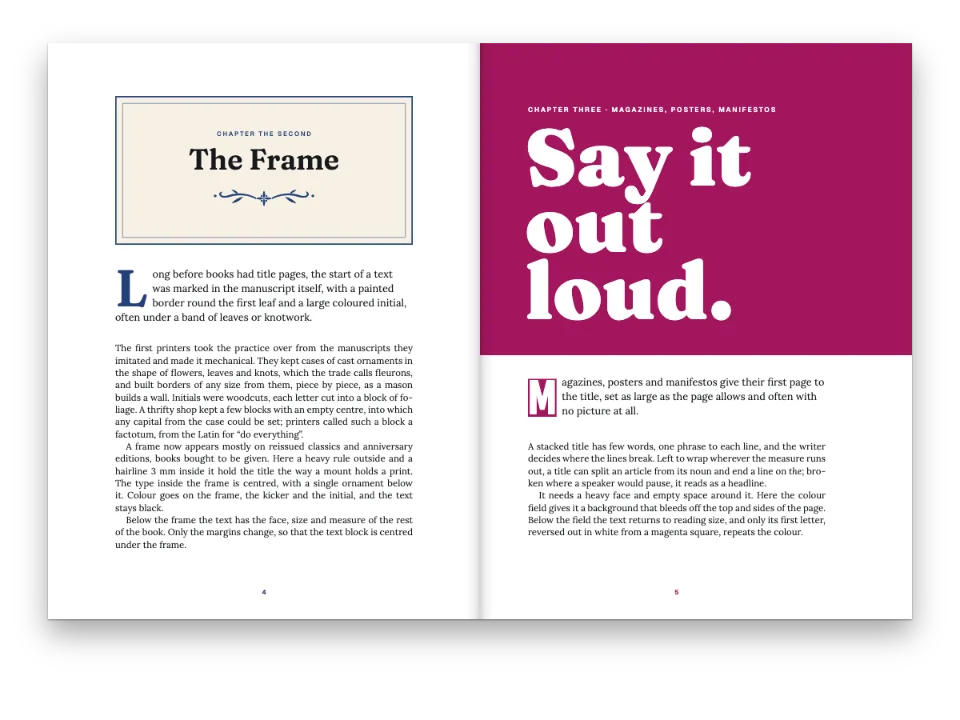
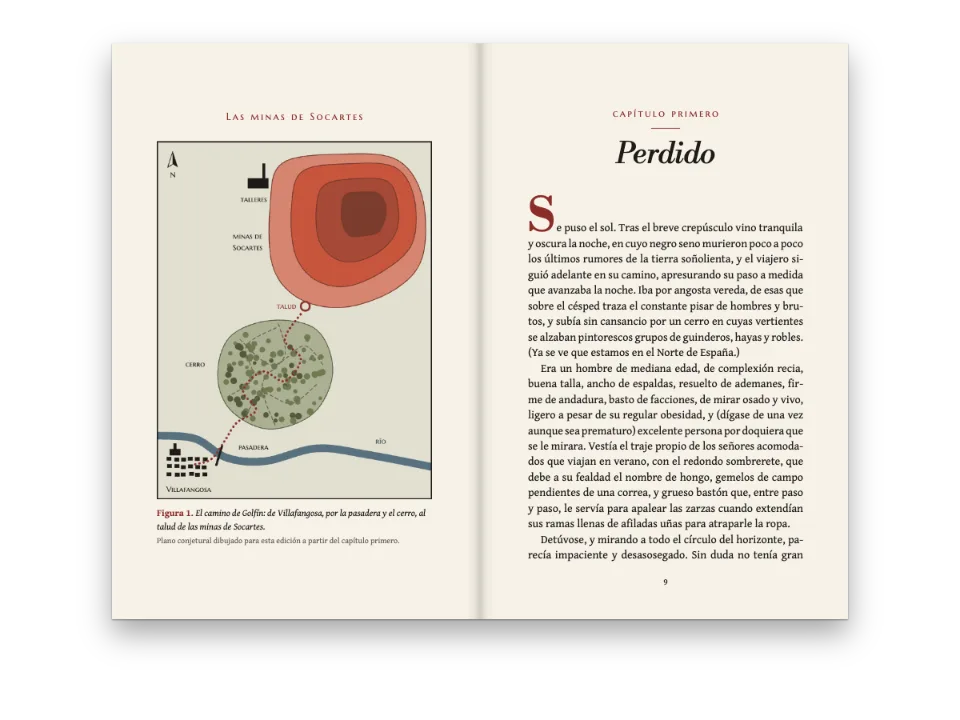
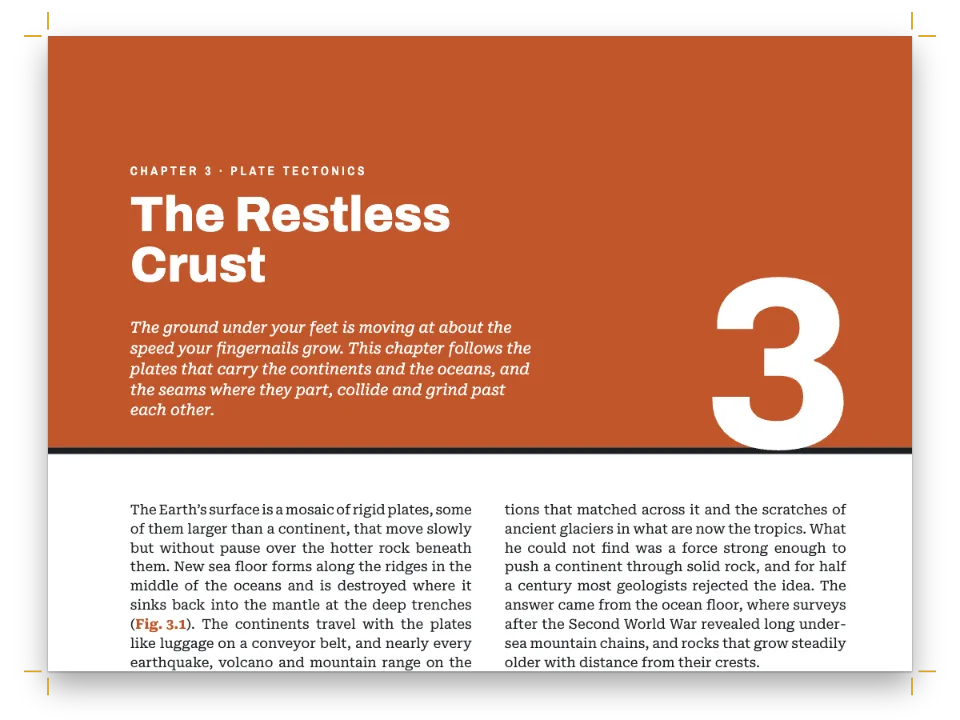
As primeiras páginas de uma edição infantil italiana de Pinóquio. Cada capítulo começa com uma ilustração própria em aquarela e um resumo curto do que acontece nele.
O que você vai compor
As primeiras páginas de uma edição infantil italiana de Le avventure di Pinocchio, de Collodi, compostas em Averia Serif Libre de 13/19 pt numa página de 190 × 240 mm. Uma folha de rosto ilustrada, na página par, fica diante do capítulo I: uma aquarela das colinas da Toscana, onde uma carroça puxada por um burro leva lenha até a oficina de um carpinteiro, acima do título em Fredericka the Great. Cada capítulo abre sob uma vinheta em aquarela que se funde com o papel (Mestre Cereja com o machado erguido sobre o tronco falante no capítulo I, Gepeto com a peruca amarela recebendo o tronco no capítulo II) e segue com a linha do capítulo e o sumário de Collodi em itálico centralizado. As quatro imagens foram geradas com modelos de difusão a partir de um mesmo prompt de estilo e da paleta da página. Os cabeços só saem nas páginas 8 e 9, as duas sem abertura. Os fólios ficam em discos cor de madeira, e duas cerejas fecham o capítulo I sem legenda nem número.
Esta receita responde a
- Como dou a cada capítulo sua própria foto, cor ou variante de abertura?
- Como componho ilustrações sem numeração: ornamentos, vinhetas, logotipos?
- Como acrescento a uma abertura uma linha de autor, uma linha fina ou um primeiro parágrafo com capitular?
- Como oculto os cabeços nas aberturas e nas páginas em branco, ou pinto uma página par em branco com a cor da parte?
A resposta curta
// # Capitolo I {style="capitolo" vignetta="ceppo" summary="Come andò che Maestro Ciliegia…"}
// resourceId takes placeholders like a design text: '{attr.vignetta}' draws the resource the
// heading names, so every chapter shares one style.
const VIGNETTE = { width: 84, height: 56 }; // mm, centred at the head of the text block
const SUMMARY = 124; // mm: the summary's measure, narrower than the text's
const opener = { enabled: true,
  // A floor for the height the opener reserves, in whole lines, so the text under chapter I's
  // two-line summary starts on the same grid line as the text under chapter II's three lines.
  minHeight: pt(14 * LEAD),
  slot: { elements: [
    { kind: 'image', id: 'vignette', resourceId: '{attr.vignetta}',
      placement: at('container', 'top', 0, 0,
        { width: mm(VIGNETTE.width), height: mm(VIGNETTE.height) }) },
    // Placed from the container, not from #vignette: images do not count in the height an
    // opener reserves (gotcha: opener-image-no-reserve), the texts under them do.
    text('chapter', '{titleText}', DISPLAY, 24, at('container', 'top-left', trail(2.4),
      VIGNETTE.height + 6, { width: mm(MEASURE) }), { ...caps(2.4), lineHeight: 1 }),
    text('summary', '{attr.summary}', TEXT, 12.5, at('#chapter', 'below',
      (MEASURE - SUMMARY) / 2 - trail(2.4), 5, { width: mm(SUMMARY) }),
    { italic: true, lineHeight: 1.38 }), // a multiple (gotcha: design-lineheight-multiple)
  ] },
};
const chapter = { id: 'capitolo', advancedDesign: opener };
Ingredientes
- Funcionalidades
- Aberturas desenhadasImagens nos designs de páginaCabeços e fóliosEstilos de títuloAtributos de títuloCapítulos que abrem em página ímparTextos, fios e caixas nos designs de páginaCabeços por tipo de páginaTipos de recurso personalizadosFiguras exatamente aquiFiguras e tabelas como recursosHifenização e idioma do documentoMargens espelhadasPaleta de cores semânticaPáginas em um canvas
- Tipografia
- Averia Serif Libre, Fredericka the Great, Quicksand (SIL OFL 1.1)
- Materiais
ceppo-1200.jpgciliegie-600.jpgfrontespizio-1400.jpgpolenta-1200.jpg- The frontispiece: Tuscan hills, a hill village and a donkey cart of firewood on its way to the carpenter’s workshop (Generated With Diffusion Models, original)
- Chapter I’s vignette: Maestro Ciliegia, axe raised over the talking log (Generated With Diffusion Models, original)
- Chapter II’s vignette: Geppetto in his yellow wig receives the log, beside a pot of polenta (Generated With Diffusion Models, original)
- The cherry tailpiece (Generated With Diffusion Models, original)
Preparo
#1 · Um só estilo de título, a vinheta indicada em cada título
O código deste passo está na resposta curta. O resourceId de um elemento de imagem aceita os mesmos marcadores de um texto de design, então '{attr.vignetta}' desenha o recurso que o título indica, do mesmo jeito que {attr.summary} imprime o sumário. Os dois capítulos compartilham o estilo capitolo e indicam a imagem na linha do título: # Capitolo II {style="capitolo" vignetta="polenta" summary="…"}. Um terceiro capítulo precisa de mais um recurso e mais um título, não de outro estilo (elementos de imagem). A linha do capítulo é posicionada a partir do topo do contêiner, 6 mm abaixo da caixa da vinheta, em vez de ancorada em #vignette. Uma imagem não reserva altura, então os textos ancorados abaixo dela são medidos como se o desenho não estivesse ali; sem minHeight, o texto do capítulo I começaria a 62 mm do topo da página, dentro do desenho. Com minHeight como piso de 14 linhas, o texto do capítulo I começa na mesma linha que o do capítulo II, cujo sumário tem uma linha a mais; sem ele, o texto do capítulo I começa 6,7 mm mais acima (span e design avançado).
#2 · Carregar as pinturas como recursos bitmap
const PICTURES = { // id: [file, width, height, alt text in the book's language]
  frontespizio: ['frontespizio-1400.jpg', 1400, 1105, 'Colline toscane con cipressi e un borgo; '
    + 'un contadino guida un asinello con un carretto di legna verso la bottega di un falegname.'],
  ceppo: ['ceppo-1200.jpg', 1200, 800, 'Maestro Ciliegia, con la scure alzata sopra un pezzo di '
    + 'legno sul banco, si guarda intorno spaventato.'],
  polenta: ['polenta-1200.jpg', 1200, 800, 'Geppetto, con la parrucca gialla, riceve il pezzo di '
    + 'legno da Maestro Ciliegia; accanto, un paiolo di polenta fumante.'],
  ciliegie: ['ciliegie-600.jpg', 600, 626, 'Due ciliegie rosse su un picciolo, con una foglia.'],
};
const resources = Object.entries(PICTURES).map(([id, [fileId, w, h, altText]]) => ({
  id, typeId: 'fregio', kind: 'bitmap', createdAt: 0, updatedAt: 0, altText,
  bitmap: { fileId, format: 'jpeg', width: w, height: h } }));
Cada imagem é um JPEG da pasta assets/ da receita, declarado com o tamanho em pixels: a diagramação só lê esses tamanhos, e o canvas pinta o que loadImage() tiver registrado sob cada id de arquivo no momento em que desenha a página. As vinhetas e as cerejas foram geradas sobre branco e depois multiplicadas pela cor do papel, #fffaf0, de modo que as margens delas saem na cor da página e as imagens não têm borda visível. A ilustração da folha de rosto está recortada em 190:150, a proporção do seu campo, para que a imagem ajustada preencha o campo sem uma faixa de papel. A paisagem e as vinhetas são pintadas por elementos de imagem dos designs; as cerejas, por ::resource{id="ciliegie"} no Markdown.
#3 · Fazer da folha de rosto um estilo de título
const SKY = 150; // mm from the top edge: the foot of the painted field
// # Pinocchio {style="frontespizio" kicker="Le avventure di"}; subtitle and author come from
// the frontmatter. Every element hangs from the page, so the field runs off three edges.
const frontispiece = {
  id: 'frontespizio',
  span: 'page', // or the field is cut at the top of the text block (gotcha: opener-clipped-at-top)
  footer: { elements: [] }, // no folio; the running heads already skip openers
  advancedDesign: { enabled: true, slot: { elements: [ // array order is paint order
    { kind: 'image', id: 'landscape', resourceId: 'frontespizio', // cut to the field's 190:150
      placement: at('page', 'top-left', 0, 0, { width: 'fill', height: mm(SKY) }) },
    text('kicker', '{attr.kicker}', LABEL, 11, at('page', 'top', trail(2.6), SKY + 11),
      { ...caps(2.6), fontWeight: 700 }),
    text('title', '{titleText}', DISPLAY, 70, at('page', 'top', 0, SKY + 17),
      { lineHeight: 1, color: col('bark') }),
    text('subtitle', '{subtitle}', TEXT, 15, at('page', 'top', 0, SKY + 44), { italic: true }),
    text('author', '{author}', LABEL, 9, at('page', 'top', trail(2), SKY + 58),
      { ...caps(2), fontWeight: 600 }),
  ] } },
};
A folha de rosto é o primeiro título do Markdown, # Pinocchio {style="frontespizio" kicker="Le avventure di"}, e o estilo dela pinta tudo na página: a paisagem, com 150 mm de altura a partir da borda superior, e depois o antetítulo vindo do atributo, o título e, do frontmatter, o subtítulo e o autor. O estilo usa span: 'page' embora o livro tenha uma só coluna, porque um design preso à coluna é cortado no topo da mancha, e os 22 mm de cima da pintura sairiam como papel em branco. O footer vazio tira o disco do fólio que as aberturas de capítulo imprimem, e pages: 'body' já deixa os cabeços fora da página (estilos de título).
#4 · Cabeços nas páginas de texto, fólios em discos
// The excerpt opens on book page 6, a verso, so the title page faces chapter I.
const continuation = { pageIndexOffset: 5, pageNumbering: { startAt: 6 } };
const SHIFT = (INNER - OUTER) / 2; // mm: the text block's centre sits off the page's centre
const head = (id, content, parity, x) => text(id, content, LABEL, 8,
  at('page', 'top', x + trail(1.8), 12), { ...caps(1.8), fontWeight: 600, parity, pages: 'body' });
const DISC = 7.4; // mm: the folio's disc
// A fixed square with a radius of half its side is a circle; the figures sit in its middle.
// lineHeight 1.17: the baseline falls at 0.8 of the line, 0.94 em down, so Quicksand's
// figures (0.70 em tall) leave 0.23 em above and below them, and 'middle' centres that line.
const disc = (id, parity, pages, edge, x) => text(id, '{pageNumber}', LABEL, 8.5,
  at('page', edge, x, -(BOTTOM - DISC) / 2, { width: mm(DISC), height: mm(DISC) }),
  { fontWeight: 700, color: col('paper'), lineHeight: 1.17, verticalAlign: 'middle', parity,
    pages, box: { backgroundColor: col('wood'), borderRadius: mm(DISC / 2) } });
const header = { elements: [
  head('verso-title', '{title}', 'even', -SHIFT), // the book on the left-hand page
  head('recto-chapter', '{chapterTitle}', 'odd', SHIFT), // the chapter on the right
] };
const footer = { elements: [
  disc('verso-folio', 'even', 'body', 'bottom-left', OUTER),
  disc('recto-folio', 'odd', 'body', 'bottom-right', -OUTER),
  disc('opener-folio', 'all', 'opener', 'bottom', 0), // a chapter opens on either side
] };
continuation numera o trecho a partir da página 6 do livro, uma página par, de modo que a folha de rosto fica diante do capítulo I e o primeiro fólio impresso é o 7. pages: 'body' deixa os cabeços fora da folha de rosto e das duas aberturas, então eles só saem nas páginas 8 e 9, o título do livro na par e o do capítulo na ímpar (elementos de texto). O fólio é um texto de design num quadrado fixo de 7,4 mm cujo raio de canto é metade do lado, o que dá um círculo; verticalAlign: 'middle' e a entrelinha calculada no comentário centralizam os algarismos nele. Os algarismos cor de papel têm contraste de 4,98:1 sobre a madeira. trail() move cada rótulo espaçado para a direita metade do seu tracking, porque a 1.4.1 centraliza uma linha espaçada como se o espaço depois da última letra fizesse parte dela.
#5 · Fechar o capítulo com uma vinheta de fecho sem número
// No caption prefix and no caption, so the cherries that close chapter I print with no
// label or number. The pictures the design slots paint are of this type too.
const resourceTypes = [{ id: 'fregio', name: 'Fregio', namePlural: 'Fregi', shortLabel: 'Fregio',
  captionPrefix: '', numberingTemplate: '{n}', resetOn: 'never', counterFormat: 'decimal',
  defaultPlacement: { position: 'here', width: 0.16, align: 'center' } }];
Um tipo de recurso imprime o seu captionPrefix e o número antes da legenda. Com o prefixo vazio e sem legenda, nada sai sob as cerejas; com captionPrefix: 'Fregio', o mesmo recurso imprime Fregio 1. sob o desenho e fica 10 mm mais alto (tipos de recurso). O defaultPlacement do tipo põe cada recurso onde está a sua linha ::resource, com um sexto da medida de largura e centralizado, então o Markdown só precisa de ::resource{id="ciliegie"} depois do último parágrafo do capítulo. As outras imagens compartilham o tipo, mas nenhum :ref ou ::resource as menciona, por isso nunca são posicionadas nem contadas.
A receita completa
// ═══ Postext Cookbook · Nº 066 · Storybook chapters with vignettes and summaries ═══ // https://postext.dev/en/cookbook/storybook-chapter-vignettes // Code: MIT · Text: C. Collodi, 1883 (PD, Gutenberg #52484) · Pictures: diffusion models // Fonts: Averia Serif Libre, Fredericka the Great, Quicksand (SIL OFL 1.1) · Needs postext ≥ 1.8.0 import { buildDocument, renderPageToCanvas, clearMeasurementCache, registerResourceImage } from 'https://esm.sh/postext'; const LANG = 'en'; // @lang: the language of the sample document (the sample is Italian in both) const RECIPE = 'storybook-chapter-vignettes'; // ─── 1 · Design ───────────────────────────────────────────────────────────── const palette = { // every colour in the config comes from here; the pictures were painted to it ink: '#2b2118', // text: a brown near-black paper: '#fffaf0', // a warm book paper, which the vignettes' margins were tinted to bark: '#6b4224', // chapter lines, running heads, the title wood: '#9a5f30', // the folio discs }; // Each colour names its palette entry and carries its hex (gotcha: palette-skips-designs). const col = (id) => ({ hex: palette[id], model: 'hex', paletteId: id }); const colorPalette = [ ...Object.entries(palette).map(([id, hex]) => ({ id, name: id, value: { hex, model: 'hex' } })), // The defaults linked to main-color, bold among them, print in bark instead of blue. { id: 'main-color', name: 'bark (defaults)', value: { hex: palette.bark, model: 'hex' } }, ]; // Text and summaries; the book's title and the chapter lines; running heads and folios. const [TEXT, DISPLAY, LABEL] = ['Averia Serif Libre', 'Fredericka the Great', 'Quicksand']; const TRIM = { width: 190, height: 240 }; // mm const [TOP, INNER, OUTER] = [22, 22, 20]; // mm; mirrored, so the spine margin swaps sides const MEASURE = TRIM.width - INNER - OUTER; // 148 mm const [BODY, LEAD, LINES] = [13, 19, 29]; // pt, pt, and whole lines in the text block const BOTTOM = TRIM.height - TOP - (LINES * LEAD * 25.4) / 72; // mm: 23.6 // Design-slot shorthands: a placement from an anchor's edge (mm), and a design text. const at = (to, edge, x = 0, y = 0, size) => ({ anchor: { to, edge }, offset: { x: mm(x), y: mm(y) }, ...(size && { size }) }); const text = (id, content, fontFamily, size, placement, extra = {}) => ({ kind: 'text', id, content, fontFamily, fontSize: pt(size), color: col('ink'), align: 'center', overflow: 'wrap', // wrap, never '…' (gotcha: overflow-ellipsis-default) placement, ...extra }); const caps = (tracking) => ({ textTransform: 'uppercase', letterSpacing: pt(tracking), color: col('bark') }); // Half a tracking (mm): 1.4.1 tracks after a centred line's last letter, shifting it left. const trail = (tracking) => (tracking * 25.4) / 72 / 2; // #region answer: one opener for every chapter: the vignette the heading names, then its summary // # Capitolo I {style="capitolo" vignetta="ceppo" summary="Come andò che Maestro Ciliegia…"} // resourceId takes placeholders like a design text: '{attr.vignetta}' draws the resource the // heading names, so every chapter shares one style. const VIGNETTE = { width: 84, height: 56 }; // mm, centred at the head of the text block const SUMMARY = 124; // mm: the summary's measure, narrower than the text's const opener = { enabled: true, // A floor for the height the opener reserves, in whole lines, so the text under chapter I's // two-line summary starts on the same grid line as the text under chapter II's three lines. minHeight: pt(14 * LEAD), slot: { elements: [ { kind: 'image', id: 'vignette', resourceId: '{attr.vignetta}', placement: at('container', 'top', 0, 0, { width: mm(VIGNETTE.width), height: mm(VIGNETTE.height) }) }, // Placed from the container, not from #vignette: images do not count in the height an // opener reserves (gotcha: opener-image-no-reserve), the texts under them do. text('chapter', '{titleText}', DISPLAY, 24, at('container', 'top-left', trail(2.4), VIGNETTE.height + 6, { width: mm(MEASURE) }), { ...caps(2.4), lineHeight: 1 }), text('summary', '{attr.summary}', TEXT, 12.5, at('#chapter', 'below', (MEASURE - SUMMARY) / 2 - trail(2.4), 5, { width: mm(SUMMARY) }), { italic: true, lineHeight: 1.38 }), // a multiple (gotcha: design-lineheight-multiple) ] }, }; const chapter = { id: 'capitolo', advancedDesign: opener }; // #endregion // #region frontispiece: the title page as a heading style: a painted field, then the title const SKY = 150; // mm from the top edge: the foot of the painted field // # Pinocchio {style="frontespizio" kicker="Le avventure di"}; subtitle and author come from // the frontmatter. Every element hangs from the page, so the field runs off three edges. const frontispiece = { id: 'frontespizio', span: 'page', // or the field is cut at the top of the text block (gotcha: opener-clipped-at-top) footer: { elements: [] }, // no folio; the running heads already skip openers advancedDesign: { enabled: true, slot: { elements: [ // array order is paint order { kind: 'image', id: 'landscape', resourceId: 'frontespizio', // cut to the field's 190:150 placement: at('page', 'top-left', 0, 0, { width: 'fill', height: mm(SKY) }) }, text('kicker', '{attr.kicker}', LABEL, 11, at('page', 'top', trail(2.6), SKY + 11), { ...caps(2.6), fontWeight: 700 }), text('title', '{titleText}', DISPLAY, 70, at('page', 'top', 0, SKY + 17), { lineHeight: 1, color: col('bark') }), text('subtitle', '{subtitle}', TEXT, 15, at('page', 'top', 0, SKY + 44), { italic: true }), text('author', '{author}', LABEL, 9, at('page', 'top', trail(2), SKY + 58), { ...caps(2), fontWeight: 600 }), ] } }, }; // #endregion // #region folios: running heads on body pages only, folios in wood-coloured discs // The excerpt opens on book page 6, a verso, so the title page faces chapter I. const continuation = { pageIndexOffset: 5, pageNumbering: { startAt: 6 } }; const SHIFT = (INNER - OUTER) / 2; // mm: the text block's centre sits off the page's centre const head = (id, content, parity, x) => text(id, content, LABEL, 8, at('page', 'top', x + trail(1.8), 12), { ...caps(1.8), fontWeight: 600, parity, pages: 'body' }); const DISC = 7.4; // mm: the folio's disc // A fixed square with a radius of half its side is a circle; the figures sit in its middle. // lineHeight 1.17: the baseline falls at 0.8 of the line, 0.94 em down, so Quicksand's // figures (0.70 em tall) leave 0.23 em above and below them, and 'middle' centres that line. const disc = (id, parity, pages, edge, x) => text(id, '{pageNumber}', LABEL, 8.5, at('page', edge, x, -(BOTTOM - DISC) / 2, { width: mm(DISC), height: mm(DISC) }), { fontWeight: 700, color: col('paper'), lineHeight: 1.17, verticalAlign: 'middle', parity, pages, box: { backgroundColor: col('wood'), borderRadius: mm(DISC / 2) } }); const header = { elements: [ head('verso-title', '{title}', 'even', -SHIFT), // the book on the left-hand page head('recto-chapter', '{chapterTitle}', 'odd', SHIFT), // the chapter on the right ] }; const footer = { elements: [ disc('verso-folio', 'even', 'body', 'bottom-left', OUTER), disc('recto-folio', 'odd', 'body', 'bottom-right', -OUTER), disc('opener-folio', 'all', 'opener', 'bottom', 0), // a chapter opens on either side ] }; // #endregion // #region tailpiece: an unnumbered resource type, set where ::resource stands // No caption prefix and no caption, so the cherries that close chapter I print with no // label or number. The pictures the design slots paint are of this type too. const resourceTypes = [{ id: 'fregio', name: 'Fregio', namePlural: 'Fregi', shortLabel: 'Fregio', captionPrefix: '', numberingTemplate: '{n}', resetOn: 'never', counterFormat: 'decimal', defaultPlacement: { position: 'here', width: 0.16, align: 'center' } }]; // #endregion // #region pictures: four paintings, declared at their pixel size under the file ids they load as const PICTURES = { // id: [file, width, height, alt text in the book's language] frontespizio: ['frontespizio-1400.jpg', 1400, 1105, 'Colline toscane con cipressi e un borgo; ' + 'un contadino guida un asinello con un carretto di legna verso la bottega di un falegname.'], ceppo: ['ceppo-1200.jpg', 1200, 800, 'Maestro Ciliegia, con la scure alzata sopra un pezzo di ' + 'legno sul banco, si guarda intorno spaventato.'], polenta: ['polenta-1200.jpg', 1200, 800, 'Geppetto, con la parrucca gialla, riceve il pezzo di ' + 'legno da Maestro Ciliegia; accanto, un paiolo di polenta fumante.'], ciliegie: ['ciliegie-600.jpg', 600, 626, 'Due ciliegie rosse su un picciolo, con una foglia.'], }; const resources = Object.entries(PICTURES).map(([id, [fileId, w, h, altText]]) => ({ id, typeId: 'fregio', kind: 'bitmap', createdAt: 0, updatedAt: 0, altText, bitmap: { fileId, format: 'jpeg', width: w, height: h } })); // #endregion const config = () => ({ // a factory: the engine caches resolved configs per object locale: 'it', // Italian hyphenation, by its exact code (gotcha: hyphenation-locales) resourceTypes, colorPalette, header, footer, layout: { layoutType: 'single' }, page: { width: mm(TRIM.width), height: mm(TRIM.height), dpi: 150, backgroundColor: col('paper'), margins: { top: mm(TOP), bottom: mm(BOTTOM), left: mm(INNER), right: mm(OUTER), mirror: true } }, bodyText: { fontFamily: TEXT, fontSize: pt(BODY), lineHeight: pt(LEAD), color: col('ink'), italicColor: col('ink'), // *ohi* in ink, not in the defaults' bark // The book cites nothing, but a :ref added later prints in ink: main-color does not reach // this colour, which stays #295AA3 (gotcha: palette-skips-designs). referenceColor: col('ink'), firstLineIndent: mm(5), indentAfterHeading: false, maxWordSpacing: 1.45, // the default 2 lets 14 lines stretch past 1.45×; 3 still do, to 1.58× }, headings: { fontFamily: DISPLAY, fontWeight: 400, // the designs paint the titles: no Open Sans to load // Any headings object drops the H1 break (gotcha: headings-drop-h1-break): every // chapter on a new page, on either side, so chapter II opens on a verso. levels: [{ level: 1, breakBefore: { enabled: true, parity: 'any' } }], }, headingStyles: [frontispiece, chapter], paragraphStyles: [{ id: 'colofon', fontFamily: LABEL, fontSize: pt(7.5), lineHeight: pt(11), color: col('bark'), textAlign: 'center', firstLineIndent: pt(0), marginTop: pt(LEAD) }], }); // ─── 2 · Content ──────────────────────────────────────────────────────────── const markdown = String.raw`---Amostra em Markdown · 74 linhas · content.en.md
title: "Le avventure di Pinocchio" subtitle: "Storia di un burattino" author: "Carlo Collodi" --- # Pinocchio {style="frontespizio" kicker="Le avventure di"} # Capitolo I {style="capitolo" vignetta="ceppo" summary="Come andò che Maestro Ciliegia, falegname, trovò un pezzo di legno che piangeva e rideva come un bambino."} — C’era una volta… — Un re! — diranno subito i miei piccoli lettori. — No, ragazzi, avete sbagliato. C’era una volta un pezzo di legno. Non era un legno di lusso, ma un semplice pezzo da catasta, di quelli che d’inverno si mettono nelle stufe e nei caminetti per accendere il fuoco e per riscaldare le stanze. Non so come andasse, ma il fatto gli è che un bel giorno questo pezzo di legno capitò nella bottega di un vecchio falegname, il quale aveva nome mastr’Antonio, se non che tutti lo chiamavano maestro Ciliegia, per via della punta del suo naso, che era sempre lustra e paonazza, come una ciliegia matura. Appena maestro Ciliegia ebbe visto quel pezzo di legno, si rallegrò tutto; e dandosi una fregatina di mani per la contentezza, borbottò a mezza voce: — Questo legno è capitato a tempo; voglio servirmene per fare una gamba di tavolino. — Detto fatto, prese subito l’ascia arrotata per cominciare a levargli la scorza e a digrossarlo; ma quando fu lì per lasciare andare la prima asciata, rimase col braccio sospeso in aria, perchè sentì una vocina sottile sottile, che disse raccomandandosi: — Non mi picchiar tanto forte! — Figuratevi come rimase quel buon vecchio di maestro Ciliegia! Girò gli occhi smarriti intorno alla stanza per vedere di dove mai poteva essere uscita quella vocina, e non vide nessuno! Guardò sotto il banco, e nessuno: guardò dentro un armadio che stava sempre chiuso, e nessuno; guardò nel corbello dei trucioli e della segatura, e nessuno; aprì l’uscio di bottega per dare un’occhiata anche sulla strada, e nessuno. O dunque?… — Ho capito; — disse allora ridendo e grattandosi la parrucca — si vede che quella vocina me la son figurata io. Rimettiamoci a lavorare. — E ripresa l’ascia in mano, tirò giù un solennissimo colpo sul pezzo di legno. — Ohi! tu m’hai fatto male! — gridò rammaricandosi la solita vocina. Questa volta maestro Ciliegia restò di stucco, cogli occhi fuori del capo per la paura, colla bocca spalancata e colla lingua giù ciondoloni fino al mento, come un mascherone da fontana. Appena riebbe l’uso della parola, cominciò a dire tremando e balbettando dallo spavento: — Ma di dove sarà uscita questa vocina che ha detto ohi?… Eppure qui non c’è anima viva. Che sia per caso questo pezzo di legno che abbia imparato a piangere e a lamentarsi come un bambino? Io non lo posso credere. Questo legno eccolo qui; è un pezzo di legno da caminetto, come tutti gli altri, e a buttarlo sul fuoco, c’è da far bollire una pentola di fagioli… O dunque? Che ci sia nascosto dentro qualcuno? Se c’è nascosto qualcuno, tanto peggio per lui. Ora l’accomodo io! — E così dicendo, agguantò con tutt’e due le mani quel povero pezzo di legno, e si pose a sbatacchiarlo senza carità contro le pareti della stanza. Poi si messe in ascolto, per sentire se c’era qualche vocina che si lamentasse. Aspettò due minuti, e nulla; cinque minuti, e nulla; dieci minuti, e nulla! — Ho capito — disse allora sforzandosi di ridere e arruffandosi la parrucca — si vede che quella vocina che ha detto *ohi*, me la son figurata io! Rimettiamoci a lavorare. — E perchè gli era entrato addosso una gran paura, si provò a canterellare per farsi un po’ di coraggio. Intanto, posata da una parte l’ascia, prese in mano la pialla, per piallare e tirare a pulimento il pezzo di legno; ma nel mentre che lo piallava in su e in giù, sentì la solita vocina che gli disse ridendo: — Smetti! tu mi fai il pizzicorino sul corpo! — Questa volta il povero maestro Ciliegia cadde giù come fulminato. Quando riaprì gli occhi, si trovò seduto per terra. Il suo viso pareva trasfigurito, e perfino la punta del naso, di paonazza come era quasi sempre, gli era diventata turchina dalla gran paura. ::resource{id="ciliegie"} # Capitolo II {style="capitolo" vignetta="polenta" summary="Maestro Ciliegia regala il pezzo di legno al suo amico Geppetto, il quale lo prende per fabbricarsi un burattino maraviglioso, che sappia ballare, tirar di scherma e fare i salti mortali."} In quel punto fu bussato alla porta. — Passate pure, — disse il falegname, senza aver la forza di rizzarsi in piedi. Allora entrò in bottega un vecchietto tutto arzillo, il quale aveva nome Geppetto; ma i ragazzi del vicinato, quando lo volevano far montare su tutte le furie, lo chiamavano col soprannome di Polendina, a motivo della sua parrucca gialla, che somigliava moltissimo alla polendina di granturco. Geppetto era bizzosissimo. Guai a chiamarlo Polendina! Diventava subito una bestia, e non c’era più verso di tenerlo. :::paragraphs{style="colofon"} Composto in Averia Serif Libre, Fredericka the Great e Quicksand (SIL Open Font License). Testo di Carlo Collodi (1883) secondo l’edizione Bemporad del 1902, Project Gutenberg n. 52484. Illustrazioni generate con modelli di diffusione. :::`; // content.<lang>.md: Collodi's Italian in both editions // ─── 3 · Fonts ────────────────────────────────────────────────────────────── const FONTS = { 'Averia Serif Libre': ['400', '400i'], 'Fredericka the Great': ['400'], Quicksand: ['400', '600', '700'] }; // every face, loaded before layout (gotcha: fonts-first) // ─── 4 · Build & show ─────────────────────────────────────────────────────── await loadFonts(FONTS, markdown); // A design slot or ::resource names a resource, the resource a file id: load each file. await Promise.all(Object.values(PICTURES).map(([file]) => loadImage(file, asset(file)))); const doc = await buildWithFonts( () => buildDocument({ markdown, resources, continuation }, config()), markdown); showPages(doc, { title: 'Le avventure di Pinocchio' });Kit · core, fonts, viewer, images: igual em todas as receitas · 271 linhas
// ─── Kit ── helpers shared by every Cookbook recipe · postext.dev/cookbook ───── // ─── Kit · core v1 ── the same in every recipe · postext.dev/cookbook function mm(value) { return { value, unit: 'mm' }; } function pt(value) { return { value, unit: 'pt' }; } function em(value) { return { value, unit: 'em' }; } /** The sample language's string: t({ en: 'Figure', es: 'Figura' }). */ function t(strings) { return strings[LANG] ?? Object.values(strings)[0]; } /** A file in this recipe's assets folder, served from the Postext repo by jsDelivr. */ function asset(file) { return `https://cdn.jsdelivr.net/gh/drnachio/postext@main/cookbook/${RECIPE}/assets/${file}`; } // ─── Kit · fonts v2 ── the same in every recipe · postext.dev/cookbook // Postext measures with the loaded faces and caches the widths: load every face // before the first build, from Fontsource, the files the PDF embeds too. /** faces = { 'Family Name': ['400', '400i', '700'] }. `text` is the sample: * č ł † α χ also load latin-ext and greek files (kitSubsetsFor). With * `optional`, a face Fontsource does not ship is skipped instead of failing. * Resolves to the number of faces added. */ async function loadFonts(faces, text = '', { optional = false } = {}) { kitStatus('Loading fonts…'); const ranges = { latin: 'U+0000-00FF,U+0131,U+0152-0153,U+02BB-02BC,U+02C6,U+02DA,U+02DC,U+0304,U+0308,U+0329,' + 'U+2000-206F,U+20AC,U+2122,U+2191,U+2193,U+2212,U+2215,U+FEFF,U+FFFD', 'latin-ext': 'U+0100-02BA,U+02BD-02C5,U+02C7-02CC,U+02CE-02D7,U+02DD-02FF,U+0304,U+0308,U+0329,' + 'U+1D00-1DBF,U+1E00-1E9F,U+1EF2-1EFF,U+2020,U+20A0-20AB,U+20AD-20C0,U+2113,U+2C60-2C7F,U+A720-A7FF', greek: 'U+0370-03FF', }; const jobs = []; let added = 0; for (const [family, specs] of Object.entries(faces)) { const id = fontsourceId(family); const todo = [...new Set(specs)].map((spec) => [parseInt(spec, 10), spec.endsWith('i') ? 'italic' : 'normal']) .filter(([weight, style]) => !hasFace(family, weight, style)); // before any await const meta = optional || /[^\0-ÿ]/u.test(text) ? await fontsourceMeta(family) : null; const subsets = ['latin', ...kitSubsetsFor(text, meta)]; for (const [weight, style] of todo) { if (optional && !(meta?.weights.includes(weight) && meta.styles.includes(style))) continue; for (const subset of subsets) { const url = `https://cdn.jsdelivr.net/npm/@fontsource/${id}@5/files/${id}-${subset}-${weight}-${style}.woff2`; const face = new FontFace(family, `url(${url}) format('woff2')`, { weight: String(weight), style, unicodeRange: ranges[subset] }); jobs.push(face.load().then((ready) => { document.fonts.add(ready); added++; }, () => { if (subset === 'latin' && !optional) throw new Error(`Fontsource has no ${family} ${weight} ${style}`); })); } } } await Promise.all(jobs).catch((error) => { kitFail(error); throw error; }); return added; } /** Runs `build` and loads any face the pages use that FONTS missed (a regular * one with a warning), then clears the measurement cache and builds again. */ async function buildWithFonts(build, text = '') { const tried = new Set(); for (let round = 0; round < 3; round++) { kitStatus('Laying out…'); await new Promise(requestAnimationFrame); // let the status paint first const result = await Promise.resolve().then(build).catch((error) => { kitFail(error); throw error; }); const wanted = { base: {}, variants: {} }; for (const { font, base } of [result].flat().flatMap(fontStringsOf)) { const { family, weight, style } = parseFont(font); const key = `${family}|${weight}|${style}`; if (tried.has(key) || hasFace(family, weight, style)) continue; tried.add(key); (wanted[base ? 'base' : 'variants'][family] ??= []).push(`${weight}${style === 'italic' ? 'i' : ''}`); } if (Object.keys(wanted.base).length) { console.warn(`[cookbook] FONTS does not list ${JSON.stringify(wanted.base)}: loading them.`); } const added = await loadFonts(wanted.base, text) + await loadFonts(wanted.variants, text, { optional: true }); if (added === 0) return result; clearMeasurementCache(); } throw new Error('The fonts did not settle after three builds.'); } /** Every font string of the layout; `base` marks a block's own face. */ function fontStringsOf(doc) { const found = new Map(); const walk = (node) => { if (!node || typeof node !== 'object') return; if (Array.isArray(node)) { node.forEach(walk); return; } for (const [key, value] of Object.entries(node)) { if (typeof value === 'string' && /fontString$/i.test(key)) { found.set(value, found.get(value) || key === 'fontString'); } else if (value && typeof value === 'object') walk(value); } }; walk(doc.pages); walk(doc.blocks); return [...found].map(([font, base]) => ({ font, base })); } /** '700 37.5px Open Sans' / 'italic 400 13px "Source Serif 4"' → { family, weight, style }. * A string with no weight ('95.8px Young Serif', from a design text) is 400. */ function parseFont(font) { const m = /^(?:(italic|oblique)\s+)?(?:small-caps\s+)?(?:(\d+|bold|normal)\s+)?[\d.]+px\s+(.+)$/.exec(font.trim()); if (!m) throw new Error(`Unexpected font string: ${font}`); const weight = m[2] === 'bold' ? 700 : !m[2] || m[2] === 'normal' ? 400 : Number(m[2]); return { family: m[3].replace(/^["']|["']$/g, ''), weight, style: m[1] ? 'italic' : 'normal' }; } /** A loaded FontFace covers this family, weight and style (fonts.check() would * also say yes for families nobody declared). */ function hasFace(family, weight, style) { for (const face of document.fonts) { if (face.status !== 'loaded' || face.style !== style) continue; if (face.family.replace(/^["']|["']$/g, '') !== family) continue; const [low, high = low] = face.weight.split(' ').map(Number); if (weight >= low && weight <= high) return true; } return false; } /** The files beyond latin `text` needs that `meta`'s family ships. */ function kitSubsetsFor(text, meta) { return [[/[Ā-˿ᴀ-ᶿḀ-ỿ†ℓⱠ-Ɀ꜠-ꟿ]/u, 'latin-ext'], [/[Ͱ-Ͽ]/u, 'greek']] .filter(([re, x]) => re.test(text) && meta?.subsets?.includes(x)).map(([, x]) => x); } /** Fontsource's id for a family: 'Source Serif 4' → 'source-serif-4'. */ function fontsourceId(family) { return family.toLowerCase().replace(/\s+/g, '-'); } /** The family's Fontsource metadata (weights, styles, subsets), or null. */ function fontsourceMeta(family) { fontsourceMeta.cache ??= new Map(); const id = fontsourceId(family); if (!fontsourceMeta.cache.has(id)) { fontsourceMeta.cache.set(id, fetch(`https://api.fontsource.org/v1/fonts/${id}`) .then((res) => (res.ok ? res.json() : null), () => null)); } return fontsourceMeta.cache.get(id); } // ─── Kit · viewer v1 ── the same in every recipe · postext.dev/cookbook /** The pages as spreads on a dark desk, page 1 alone, then verso | recto, * each painted when it scrolls near. */ function showPages(docs, { title, width = 460 } = {}) { const root = viewer(title); const pages = [docs].flat().flatMap((doc) => doc.pages.map((page) => ({ doc, page, n: (doc.pageIndexOffset ?? 0) + page.index }))); const spreads = []; let verso = null; for (const p of pages) { if (p.n % 2 === 1) { if (verso) spreads.push([verso, null]); verso = p; } else { spreads.push([verso, p]); verso = null; } } if (verso) spreads.push([verso, null]); const density = Math.min(window.devicePixelRatio || 1, 2); showPages.painter?.disconnect(); const painter = new IntersectionObserver((entries) => { for (const { isIntersecting, target } of entries) { if (!isIntersecting) continue; painter.unobserve(target); const { doc, page } = target.postext; renderPageToCanvas(page, doc, target, { scale: (width * density) / page.width }); } }, { rootMargin: '800px' }); showPages.painter = painter; root.replaceChildren(...spreads.map((pair) => { const spread = document.createElement('div'); spread.className = 'pt-spread'; for (const p of pair) { const figure = document.createElement('figure'); if (p) { const label = p.page.pageLabel || String(p.n + 1); const canvas = document.createElement('canvas'); canvas.postext = p; canvas.style.aspectRatio = `${p.page.width} / ${p.page.height}`; canvas.setAttribute('role', 'img'); canvas.setAttribute('aria-label', `Page ${label}`); const folio = document.createElement('figcaption'); folio.textContent = label; figure.append(canvas, folio); painter.observe(canvas); } else figure.className = 'pt-blank'; spread.append(figure); } return spread; })); kitStatus(`${pages.length} ${pages.length === 1 ? 'page' : 'pages'}`); document.documentElement.dataset.postext = 'ready'; return pages.length; } /** The desk, the bar and the error reporting, created once. */ function viewer(title) { if (!document.getElementById('pt-kit')) { document.head.insertAdjacentHTML('beforeend', `<style id="pt-kit"> :root { color-scheme: dark; } body { margin: 0; background: #0e1014; color: #b9bcc4; font: 13px/1.45 system-ui, sans-serif; } #pt-bar { position: sticky; top: 0; z-index: 1; display: flex; flex-wrap: wrap; align-items: center; gap: 6px 16px; padding: 10px 16px; background: rgb(14 16 20 / .92); backdrop-filter: blur(6px); border-bottom: 1px solid #23262d; } #pt-bar strong { color: #f4f1ea; font-weight: 600; } #pt-actions { display: flex; gap: 12px; margin-left: auto; } #pt-actions a, #pt-actions button { color: #d8a21a; font: inherit; background: none; border: 0; padding: 0; cursor: pointer; } #pages { display: grid; justify-items: center; gap: 48px; padding: 32px 16px 72px; } .pt-spread { display: flex; } .pt-spread figure { margin: 0; width: min(460px, 44vw); } .pt-spread canvas { display: block; width: 100%; background: #fff; box-shadow: 0 1px 2px rgb(0 0 0 / .5), 0 22px 44px -16px rgb(0 0 0 / .8); } .pt-spread figure:first-child canvas { box-shadow: inset -14px 0 14px -14px rgb(0 0 0 / .18), 0 1px 2px rgb(0 0 0 / .5), 0 22px 44px -16px rgb(0 0 0 / .8); } .pt-spread figcaption { margin-top: 10px; text-align: center; font: 600 10px/1 system-ui, sans-serif; letter-spacing: .18em; text-transform: uppercase; color: #6c7079; } .pt-blank { visibility: hidden; } @media (max-width: 760px) { .pt-spread { flex-direction: column; gap: 32px; } .pt-spread figure { width: min(460px, 92vw); } .pt-blank { display: none; } } </style>`); document.body.insertAdjacentHTML('afterbegin', '<header id="pt-bar"><strong id="pt-title"></strong><span id="pt-status" role="status"></span><span id="pt-actions"></span></header>'); document.getElementById('pt-title').textContent = document.title || 'Postext'; addEventListener('error', (event) => kitFail(event.error ?? event.message)); addEventListener('unhandledrejection', (event) => kitFail(event.reason)); } if (title) document.getElementById('pt-title').textContent = title; return document.getElementById('pages') ?? document.body.appendChild(Object.assign(document.createElement('main'), { id: 'pages' })); } function kitStatus(text) { viewer(); document.getElementById('pt-status').textContent = text; } function kitFail(error) { document.documentElement.dataset.postext = 'error'; kitStatus(`Error: ${error?.message ?? error}`); } // ─── Kit · images v1 ── recipes with pictures · postext.dev/cookbook /** Registers a photo or PNG for the canvas and keeps its bytes for the PDF. * fetch → ImageBitmap never taints the canvas (a plain cross-origin <img> would). */ async function loadImage(fileId, url) { const res = await fetch(url); if (!res.ok) throw new Error(`Image not found (${res.status}): ${url}`); const bytes = new Uint8Array(await res.arrayBuffer()); registerResourceImage(fileId, await createImageBitmap(new Blob([bytes]))); (loadImage.bytes ??= new Map()).set(fileId, bytes); } /** Registers SVG markup (drawn in code, or fetched) as a vector image. */ async function loadSvg(fileId, svg) { const img = new Image(); img.src = `data:image/svg+xml;charset=utf-8,${encodeURIComponent(svg)}`; await img.decode(); registerResourceImage(fileId, img); (loadImage.bytes ??= new Map()).set(fileId, new TextEncoder().encode(svg)); } /** renderToPdf({ resourceBytes: imageBytes }) */ function imageBytes(fileId) { return loadImage.bytes?.get(fileId); } /** renderToHtml({ resourceImageUrl: imageUrl }) */ function imageUrl(fileId) { const bytes = imageBytes(fileId); if (!bytes) return undefined; imageUrl.urls ??= new Map(); if (!imageUrl.urls.has(fileId)) { const type = /\.svg$/i.test(fileId) ? 'image/svg+xml' : /\.png$/i.test(fileId) ? 'image/png' : 'image/jpeg'; imageUrl.urls.set(fileId, URL.createObjectURL(new Blob([bytes], { type }))); } return imageUrl.urls.get(fileId); } // ─── /Kit ───────────────────────────────────────────────────────────────────────
O script.js montado funciona como está: cole-o como script de módulo em qualquer página ou abra a receita no CodePen. Pasta da receita no GitHub ↗ (abre em uma nova aba)
Variações
#Abrir todo capítulo numa página ímpar
Com 'odd', o capítulo II passa para a página 11 e a página 10 fica em branco; a folha de rosto desativa a sua própria quebra, porque herda a do nível e, sem isso, iria para a página 7 depois de uma página 6 em branco.
@@ the frontispiece style @@
   id: 'frontespizio',
+  breakBefore: { enabled: false },
@@ headings, in config() @@
-    levels: [{ level: 1, breakBefore: { enabled: true, parity: 'any' } }],
+ levels: [{ level: 1, breakBefore: { enabled: true, parity: 'odd' } }],Erros comuns
Erro comum
As imagens de uma abertura nunca contam para a altura que ela reserva
No postext 1.4.1, um título com design avançado mede a altura que reserva sem as imagens: textos, fios e caixas contam, mesmo quando ancorados na página, mas uma imagem, como uma ilustração sangrada no alto da página, não reserva nada, então o texto pode começar por cima dela. Defina com minHeight onde o texto deve começar. Aberturas desenhadas →
Erro comum
Uma abertura que fica na sua coluna é cortada no alto da mancha
No postext 1.4.1, um título com design avançado que fica na sua coluna é recortado na borda superior da coluna: uma caixa ou uma imagem ancorada à página ou à sangria é pintada nas margens laterais, mas não na margem superior, e nenhum aviso informa isso. Dê span: 'page' a esse título, mesmo que o livro tenha uma só coluna: o design dele passa a ser pintado inteiro, como faixa de abertura da página. Aberturas desenhadas →
Erro comum
Valores de atributo: sem { ou }; aspas simples se tiver "
Um valor de atributo termina na chave de fechamento, por isso não pode conter { nem }. Um valor que contém aspas duplas vai entre aspas simples; o cifrão não causa problema. Atributos de título →
Erro comum
Coloque entre aspas cada valor do frontmatter
O YAML lê title: 1984 como número e uma data como objeto Date, e valores que não são strings saem vazios nos placeholders e deixam o PDF sem título. Coloque cada valor entre aspas: title: "1984". Metadados do documento →
Erro comum
Qualquer objeto headings desativa a quebra de página do H1
Por padrão, um H1 salta para uma página ímpar (always-odd), mas passar qualquer objeto headings redefine esse padrão, então os capítulos ficam emendados e span: 'page' não faz nada. Declare de novo headings.levels[0].breakBefore: { enabled: true, parity } em toda configuração. Capítulos que abrem em página ímpar →
Erro comum
Uma paleta trocada não chega aos elementos de design nem à cor das referências
postext 1.4.1 aplica colorPalette aos estilos de texto (corpo, títulos, listas, legendas, tabelas, boxes), mas não aos elementos de cabeçalhos, rodapés, aberturas e páginas de parte, nem a bodyText.referenceColor: eles mantêm o hex escrito ao lado do seu paletteId. Se você trocar a paleta, para uma edição de tela escura ou para mudar as cores, reescreva cada cor vinculada a partir de colorPalette antes de compor. Paleta de cores semântica →
Erro comum
O lineHeight de um texto de design é um múltiplo, nunca uma medida
Num slot de design, o lineHeight de um elemento de texto multiplica o tamanho da fonte (lineHeight: 1.05). No postext 1.4.1, uma medida como pt(15) não é rejeitada: a altura da abertura dá NaN, o espaço que ela reserva, minHeight incluído, se perde sem aviso e o texto passa por baixo do título. Textos, fios e caixas nos designs de página →
Erro comum
O excesso de texto de design é 'ellipsis-end' por padrão
Um elemento de texto de design que não cabe na sua largura termina em reticências por padrão. Use overflow: 'wrap' nos títulos que devem passar para mais linhas. Textos, fios e caixas nos designs de página →
Erro comum
Só 8 idiomas têm hifenização, com o código exato
A hifenização existe para en-us, es, fr, de, it, pt, ca e nl, com o código exato: 'es-ES' ou qualquer outro idioma passa sem aviso para o inglês americano. Hifenização e idioma do documento →
Erro comum
Carregue todas as fontes antes do layout
O motor de layout mede o texto com as fontes que o navegador carregou e guarda as larguras em cache, então uma fonte que chega depois da primeira composição deixa quebras de linha erradas e um PDF que não corresponde mais à tela. Carregue antes todos os pesos e estilos e chame clearMeasurementCache() antes de recompor quando alguma chegar atrasada. Fontes antes da diagramação →
- No Markdown, um espaço não separável (U+00A0) prende cada travessão de diálogo de Collodi à sua palavra, para que um travessão de fechamento nunca abra uma linha; outros dois mantêm juntos di legno e in piedi no fim dos seus parágrafos. Na 1.4.1, uma linha ainda pode quebrar num espaço não separável quando o parágrafo tem negrito ou itálico. O único parágrafo com esses espaços e uma palavra em itálico, o do ohi na página 9, tem quatro deles, e na captura todos caem no meio da linha ou no fim do parágrafo.
Créditos
- Receita
- Ignacio Ferro
- Texto
- Le avventure di Pinocchio (1883): chapter I and the opening of chapter II with Collodi’s chapter summaries, from the 1902 Bemporad edition, with typographic apostrophes, dashes and ellipses; chapter I’s summary has the comma after “falegname” that the edition’s table of contents prints and its chapter head leaves out · Carlo Collodi · domínio público
- Imagens
- The frontispiece: Tuscan hills, a hill village and a donkey cart of firewood on its way to the carpenter’s workshop · Generated With Diffusion Models · original
- Chapter I’s vignette: Maestro Ciliegia, axe raised over the talking log · Generated With Diffusion Models · original
- Chapter II’s vignette: Geppetto in his yellow wig receives the log, beside a pot of polenta · Generated With Diffusion Models · original
- The cherry tailpiece · Generated With Diffusion Models · original
- Fontes
- Averia Serif Libre (SIL OFL 1.1) · Fredericka the Great (SIL OFL 1.1) · Quicksand (SIL OFL 1.1)
- Código
- MIT, como o Postext
Editar este texto ↗ (abre em uma nova aba)Pasta da receita no GitHub ↗ (abre em uma nova aba)