Em poucas palavras
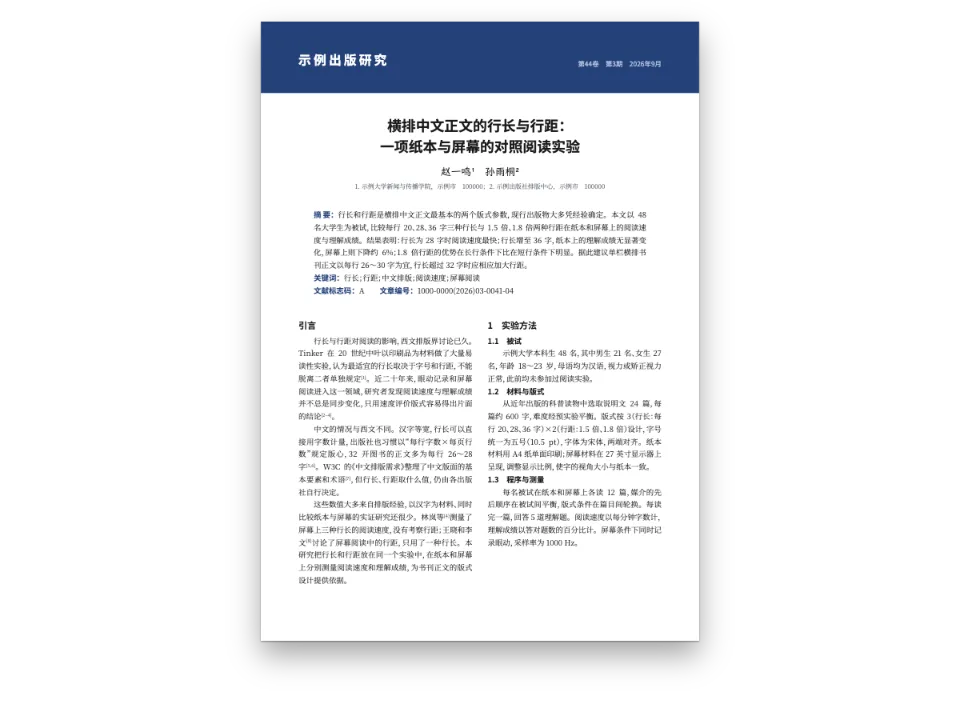
Um artigo curto de uma revista científica japonesa. O autor escreve um código para cada fonte; o Postext as numera na ordem em que são citadas e imprime a lista de referências como as revistas científicas japonesas pedem.
O que você vai compor
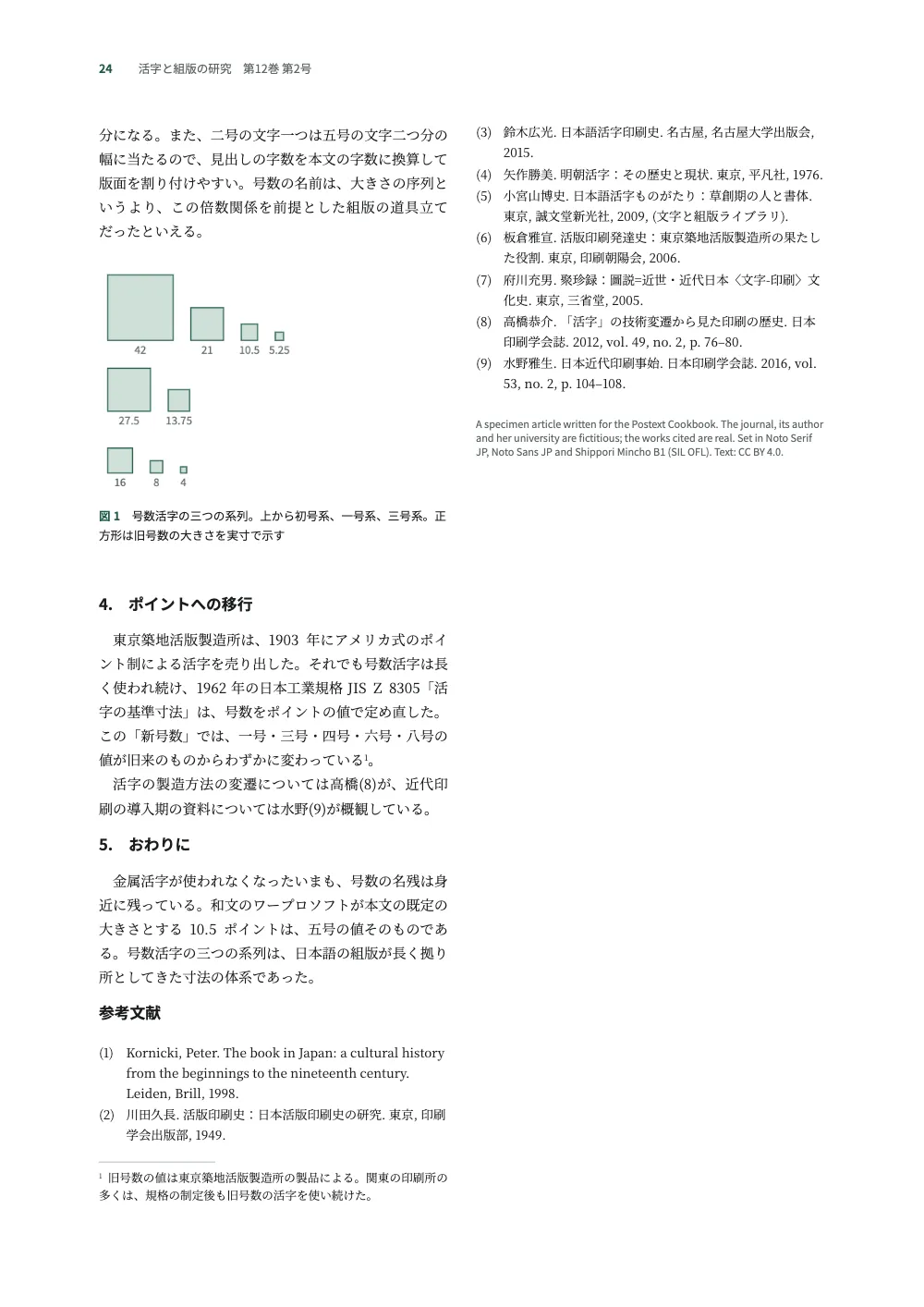
Duas páginas de uma nota de pesquisa, 号数活字の三つの系列 (“As três séries de corpos gōsū”), de uma revista inventada sobre tipos e composição, composta como as sociedades acadêmicas japonesas compõem as suas revistas: A4, duas colunas de 25 caracteres por 45 linhas de Noto Serif JP em 9 pt, e o título em Shippori Mincho B1 sobre a faixa verde da revista. As citações seguem a SIST 02, o guia de referências que as revistas japonesas de ciência e tecnologia usam: cada obra é numerada na ordem em que é citada pela primeira vez, (1), (2, 3), e a lista sob 参考文献 dá os nomes japoneses com o sobrenome primeiro, o local antes da editora e o ano no fim. Uma tabela dos nove corpos, uma figura que os desenha em escala e duas notas de rodapé vêm com rótulos japoneses. O artigo chinês citado pela GB/T 7714 é o equivalente chinês.
Esta receita responde a
- Como cito obras e monto a bibliografia em APA, IEEE ou outro estilo de citação?
- Como componho as notas de um livro japonês: (1) no fim do capítulo, no pé da página ou ao lado do texto ao longo da página dupla?
A resposta curta
// Register the engine once, before the first build. SIST 02, the standard Japanese science
// and technology journals cite to, numbers works in the order they are first cited; the
// ja-JP locale writes the list's words and joins authors with と and ほか. The document's
// own locale 'ja' gives the notes their Japanese defaults: at the foot of the column,
// numbered per page, a superscript marker and a rule a third of the column.
registerCitationEngine(createCiteprocEngine({ styles: STYLES, locales: LOCALES }));
const citations = {
  style: 'sist02',
  locale: 'ja-JP',
  bibliography: { fontSize: em(8 / BODY), lineHeight: pt(13), entrySpacing: pt(1),
    labelWidth: em(2.2) }, // turnovers under the text of the entry, past the (n)
};
const footnotes = { fontSize: pt(7.5), lineHeight: pt(11.5), color: col('ink'),
  separator: { color: col('rule') } }; // placement, numbering and marker: the 'ja' defaults
Ingredientes
- Funcionalidades
- Citações em um estilo de citaçãoBibliografia a partir das referênciasNotas nos livros japonesesNotas de rodapéLegendas numeradasFigura e Tabela no seu idiomaEstilo de tabelaEstilo de legendaFiguras e tabelas como recursosFiguras exatamente aquiTítulos numeradosTítulos sobre linhas do texto (gyōdori)Uma ou duas colunasGrade de caracteresAberturas desenhadasEstilos de títuloFontes chinesas, japonesas e coreanasChips no textoCabeços e fóliosExportação para PDF
- Também usa
- BoxesQuebra de linha em chinêsEquilíbrio de colunasReferências cruzadasAtributos de títuloCabeços por tipo de páginaEstilos de parágrafoFontes incorporadas ao PDFTipos de recurso personalizadosElementos pré-textuais em romanosTabelas a partir de dadosQuebras de linha nos títulosCapítulos sem número
- Tipografia
- Noto Serif JP, Noto Sans JP, Shippori Mincho B1 (SIL OFL 1.1)
- Materiais
- Figure 1, the three series of type sizes, drawn in code to scale (Postext Cookbook, CC BY 4.0)
Preparo
#1 · O estilo, o locale e as notas
O código é a resposta curta lá em cima. O postext-citeproc traz a SIST 02 como 'sist02' e o locale CSL ja-JP, que escreve os termos da lista em japonês e liga dois autores japoneses com と e mais de dois com ほか numa citação narrativa (citações). No texto, [@kawada1949; @suzuki2015] imprime (2, 3), e 高橋[@takahashi2012]が põe o número depois do nome, 高橋(8)が. O estilo difere da norma chinesa GB/T 7714 no marcador: a SIST 02 põe o número entre parênteses na linha, e a GB/T 7714, entre colchetes e elevado. As notas não precisam de nada: locale: 'ja' dá a um documento horizontal notas ao pé da coluna, numeradas a partir de 1 em cada página, com marcador sobrescrito e um fio de um terço da largura da coluna.
#2 · As referências num bloco CSL-YAML
As obras são listadas no fim do Markdown em :::references{format=csl-yaml}, o formato que o Zotero exporta como CSL YAML (citar). Os nomes japoneses entram como family e given, {family: 鈴木, given: 広光}, e a SIST 02 os imprime juntos, 鈴木広光, enquanto Kornicki mantém a vírgula: Kornicki, Peter. Uma coleção de livros vai em collection-title e sai entre parênteses depois do ano; os dois artigos do 日本印刷学会誌 dão volume, número e páginas como vol. 49, no. 2, p. 76–80. Todas as obras existem; as entradas podem ser conferidas no CiNii.
#3 · O título na faixa da revista
const BAND = 78; // mm from the trim's top: the title sits on the journal's green
const at = (id, y) => ({ anchor: { to: `#${id}`, edge: 'below' }, offset: { y: mm(y) },
  size: { width: mm(AREA) } });
const line = (id, content, family, size, color, placement, extra) => ({ kind: 'text', id,
  content, fontFamily: family, fontSize: pt(size), color: col(color), align: 'center',
  overflow: 'wrap', placement, ...extra });
const top = (y) => ({ anchor: { to: 'container', edge: 'top-left' }, offset: { y: mm(y) },
  size: { width: mm(AREA) } });
const masthead = { enabled: true, minHeight: pt(10 * PITCH), slot: { elements: [
  { kind: 'box', id: 'band', style: { backgroundColor: col('green') },
    placement: { anchor: { to: 'page', edge: 'top-left' },
      size: { width: 'fill', height: mm(BAND) } } },
  line('journal', '活字と組版の研究', GOTHIC, 13, 'paper', top(-13), { fontWeight: 700,
    align: 'left', letterSpacing: pt(2) }),
  line('issue', '第12巻 第2号(2026)', GOTHIC, 8, 'mist', top(-12), { align: 'right' }),
  line('kind', '{attr.kind}', GOTHIC, 8, 'mist', top(2), { fontWeight: 700,
    letterSpacing: pt(2) }),
  line('title', '{titleText}', TITLE, 20, 'paper', at('kind', 3), { fontWeight: 700,
    lineHeight: 1.45 }),
  line('english', '{attr.english}', MINCHO, 8.5, 'mist', at('title', 3)),
  line('author', '{attr.authors}', MINCHO, 11, 'ink', top(BAND - 16)),
  line('affiliation', '{attr.affiliation}', MINCHO, 8, 'muted', at('author', 1.5)),
] } };
O bloco do título é o design do H1, um estilo de título que atravessa as duas colunas. A faixa é uma caixa ancorada no refile; o rótulo, o título e a sua tradução para o inglês ficam sobre ela, cada um posicionado embaixo do anterior, de modo que um título de três linhas empurra a linha em inglês para baixo. A autora e a sua filiação vêm de atributos do título e ficam sob a faixa.
#4 · O resumo e os seus rótulos
const calloutStyles = [{ id: 'abstract', span: 'page', backgroundEnabled: false,
  stripe: { enabled: true, side: 'top', width: pt(1.5), color: col('green') },
  padding: { top: mm(2.5), bottom: mm(2.5), left: em(2), right: em(2) },
  marginTop: pt(0), marginBottom: pt(PITCH),
  body: { fontFamily: MINCHO, fontSize: pt(8.5), lineHeight: pt(14), firstLineIndent: pt(0),
    textAlign: 'justify' } }];
const chipStyles = [{ id: 'label', fontFamily: GOTHIC, bold: true, color: col('green'),
  backgroundEnabled: false, borderWidth: pt(0), paddingX: em(0), gap: em(1) }];
O resumo é um boxe na largura da página sob uma tarja verde no alto, e os seus rótulos são chips em gótica negrito na cor da revista. Um espaço ideográfico depois de cada rótulo, digitado no Markdown, separa 要 旨 do texto.
#5 · 表1 e 図1 onde são citados
const SIZES = `号数\t旧号数(pt)\t新号数(pt)\t系列
初号\t42\t42\t初号系
一号\t27.5\t26.25\t一号系
二号\t21\t21\t初号系
三号\t16\t15.75\t三号系
四号\t13.75\t13.125\t一号系
五号\t10.5\t10.5\t初号系
六号\t8\t7.875\t三号系
七号\t5.25\t5.25\t初号系
八号\t4\t3.9375\t三号系`;
const SERIES = [[42, 21, 10.5, 5.25], [27.5, 13.75], [16, 8, 4]]; // old values, pt
const resources = [
  { id: 'tbl:sizes', typeId: 'table', kind: 'table', createdAt: 0, updatedAt: 0,
    placement: { position: 'here' },
    caption: '号数活字の大きさ。新号数はJIS Z 8305(1962)による',
    table: { model: { ...parseTSV(SIZES), headerRowCount: 1, columnWidths: [16, 28, 28, 28] } } },
  { id: 'fig:series', typeId: 'figure', kind: 'svg', createdAt: 0, updatedAt: 0,
    placement: { position: 'here' },
    caption: '号数活字の三つの系列。上から初号系、一号系、三号系。正方形は旧号数の大きさを実寸で示す',
    altText: 'Three rows of squares drawn to scale: 42, 21, 10.5 and 5.25 pt; 27.5 and 13.75 pt; '
      + '16, 8 and 4 pt. Each square is half the one before it.',
    svg: { fileId: 'series.svg', width: 790, height: 520 } },
];
defaultResourceTypes('ja') dá 図 e 表; o artigo os numera em sequência, 表1 e 図1, e não por capítulo, então o modelo é '{n}'. Os dois são posicionados 'here', sob o parágrafo que os cita, dentro da coluna. Os quadrados da figura são desenhados no tamanho do tipo que representam, de 42 pt no 初号 a 4 pt no 八号, para que a redução pela metade se veja na página.
A receita completa
// ═══ Postext Cookbook · Nº 125 · A Japanese research paper cited to SIST 02 ═══════════ // https://postext.dev/en/cookbook/sist02-research-paper // Code: MIT · Text: original (CC BY 4.0) · Pictures: drawn in code // Fonts: Noto Serif JP, Noto Sans JP, Shippori Mincho B1 (SIL OFL 1.1) · Needs postext ≥ 1.16.1 import { buildDocument, renderPageToCanvas, clearMeasurementCache, registerCitationEngine, defaultResourceTypes, parseTSV, registerResourceImage, } from 'https://esm.sh/postext'; import { renderToPdf, decompressWoff2 } from 'https://esm.sh/postext-pdf'; import { createCiteprocEngine, STYLES, LOCALES } from 'https://esm.sh/postext-citeproc'; const LANG = 'en'; // @lang: the language of the frame; the paper is Japanese in both const RECIPE = 'sist02-research-paper'; // ─── 1 · Design ───────────────────────────────────────────────────────────── // #region palette: black text, one deep green for the journal, its rules and its labels const palette = { ink: '#1b1d1c', green: '#1f5a46', mist: '#cfe0d8', rule: '#a7b3ad', muted: '#5d6662', paper: '#ffffff', }; const col = (id) => ({ hex: palette[id], model: 'hex', paletteId: id }); const colorPalette = Object.entries({ ...palette, 'main-color': palette.green }) .map(([id, hex]) => ({ id, name: id, value: { hex, model: 'hex' } })); // #endregion const [MINCHO, GOTHIC, TITLE] = ['Noto Serif JP', 'Noto Sans JP', 'Shippori Mincho B1']; const [BODY, PITCH] = [9, 15.5]; // pt: 9 pt text on a 15.5 pt line const [CHARS, LINES] = [25, 45]; // characters to a column's line, lines to a column const PT = 25.4 / 72; // mm in a point const AREA = (2 * CHARS + 2) * BODY * PT; // mm: two columns and a 2-em gutter, 165 // #region answer: SIST 02 in Japanese: numbered citations, the list under 参考文献 // Register the engine once, before the first build. SIST 02, the standard Japanese science // and technology journals cite to, numbers works in the order they are first cited; the // ja-JP locale writes the list's words and joins authors with と and ほか. The document's // own locale 'ja' gives the notes their Japanese defaults: at the foot of the column, // numbered per page, a superscript marker and a rule a third of the column. registerCitationEngine(createCiteprocEngine({ styles: STYLES, locales: LOCALES })); const citations = { style: 'sist02', locale: 'ja-JP', bibliography: { fontSize: em(8 / BODY), lineHeight: pt(13), entrySpacing: pt(1), labelWidth: em(2.2) }, // turnovers under the text of the entry, past the (n) }; const footnotes = { fontSize: pt(7.5), lineHeight: pt(11.5), color: col('ink'), separator: { color: col('rule') } }; // placement, numbering and marker: the 'ja' defaults // #endregion // #region masthead: the journal, the paper's kind, its title and English title on a band const BAND = 78; // mm from the trim's top: the title sits on the journal's green const at = (id, y) => ({ anchor: { to: `#${id}`, edge: 'below' }, offset: { y: mm(y) }, size: { width: mm(AREA) } }); const line = (id, content, family, size, color, placement, extra) => ({ kind: 'text', id, content, fontFamily: family, fontSize: pt(size), color: col(color), align: 'center', overflow: 'wrap', placement, ...extra }); const top = (y) => ({ anchor: { to: 'container', edge: 'top-left' }, offset: { y: mm(y) }, size: { width: mm(AREA) } }); const masthead = { enabled: true, minHeight: pt(10 * PITCH), slot: { elements: [ { kind: 'box', id: 'band', style: { backgroundColor: col('green') }, placement: { anchor: { to: 'page', edge: 'top-left' }, size: { width: 'fill', height: mm(BAND) } } }, line('journal', '活字と組版の研究', GOTHIC, 13, 'paper', top(-13), { fontWeight: 700, align: 'left', letterSpacing: pt(2) }), line('issue', '第12巻 第2号(2026)', GOTHIC, 8, 'mist', top(-12), { align: 'right' }), line('kind', '{attr.kind}', GOTHIC, 8, 'mist', top(2), { fontWeight: 700, letterSpacing: pt(2) }), line('title', '{titleText}', TITLE, 20, 'paper', at('kind', 3), { fontWeight: 700, lineHeight: 1.45 }), line('english', '{attr.english}', MINCHO, 8.5, 'mist', at('title', 3)), line('author', '{attr.authors}', MINCHO, 11, 'ink', top(BAND - 16)), line('affiliation', '{attr.affiliation}', MINCHO, 8, 'muted', at('author', 1.5)), ] } }; // #endregion // #region abstract: across both columns, its labels in gothic the colour of the journal const calloutStyles = [{ id: 'abstract', span: 'page', backgroundEnabled: false, stripe: { enabled: true, side: 'top', width: pt(1.5), color: col('green') }, padding: { top: mm(2.5), bottom: mm(2.5), left: em(2), right: em(2) }, marginTop: pt(0), marginBottom: pt(PITCH), body: { fontFamily: MINCHO, fontSize: pt(8.5), lineHeight: pt(14), firstLineIndent: pt(0), textAlign: 'justify' } }]; const chipStyles = [{ id: 'label', fontFamily: GOTHIC, bold: true, color: col('green'), backgroundEnabled: false, borderWidth: pt(0), paddingX: em(0), gap: em(1) }]; // #endregion // Running heads on the body pages: the journal on the verso, the author on the recto. const head = (id, content, parity, edge, x, extra) => ({ kind: 'text', id, content, parity, pages: 'body', fontFamily: GOTHIC, fontSize: pt(7.5), color: col('muted'), align: edge.endsWith('left') ? 'left' : 'right', placement: { anchor: { to: 'container', edge }, offset: { x: mm(x), y: mm(14) } }, ...extra }); const folio = { fontWeight: 700, color: col('green') }; const header = { elements: [ head('v-folio', '{pageNumber}', 'even', 'top-left', 0, folio), head('v-head', '活字と組版の研究 第12巻 第2号', 'even', 'top-left', 9), head('r-head', '森川:号数活字の三つの系列', 'odd', 'top-right', -9), head('r-folio', '{pageNumber}', 'odd', 'top-right', 0, folio), ] }; const config = () => ({ // a factory: the engine caches resolved configs per object locale: 'ja', // written out, never LANG (gotcha: ja-locale-tag) resourceTypes: defaultResourceTypes('ja').map((type) => ({ ...type, numberingTemplate: '{n}' })), // 図1, 表1: a paper numbers through, not by chapter colorPalette, citations, footnotes, page: { sizePreset: 'custom', width: mm(210), height: mm(297), dpi: 150, // A4 pageNumbering: { startAt: 23 }, margins: { top: mm(24), bottom: mm(20), left: mm(18), right: mm(18), mirror: true } }, layout: { layoutType: 'double', gutterWidth: pt(2 * BODY) }, cjk: { grid: { enabled: true, charsPerLine: CHARS, linesPerPage: LINES } }, bodyText: { fontFamily: MINCHO, fontSize: pt(BODY), lineHeight: pt(PITCH), color: col('ink'), boldColor: col('ink'), italicColor: col('ink'), referenceColor: col('ink'), referenceBold: false, textAlign: 'justify', firstLineIndent: em(1), indentAfterHeading: true }, headings: { fontFamily: GOTHIC, fontWeight: 700, color: col('ink'), balancing: { enabled: false }, // heads stay on the grid levels: [ { level: 1, breakBefore: { enabled: true, parity: 'any' } }, // headings-drop-h1-break { level: 2, numberingTemplate: '{2}.', numberSeparator: ' ', fontSize: pt(10), lineSpan: 2 }, // 2行取り: 1. はじめに on two lines of the grid ] }, headingStyles: [ { id: 'article', numbered: false, span: 'page', advancedDesign: masthead }, { id: 'references', numbered: false }, ], calloutStyles, chipStyles, tableStyle: { rules: 'horizontal', borderColor: col('rule'), borderWidth: pt(0.5), headerBackground: col('green'), headerColor: col('paper'), headerFontFamily: GOTHIC, bodyFontFamily: MINCHO, bodyFontSize: pt(8), bodyColor: col('ink'), cellPadding: mm(1) }, captionStyle: { fontFamily: GOTHIC, fontSize: pt(7.5), color: col('ink'), labelBold: true, labelColor: col('green') }, // 表1 …, the ja default paragraphStyles: [{ id: 'colophon', fontFamily: GOTHIC, fontSize: pt(6.5), lineHeight: pt(9), color: col('muted'), firstLineIndent: pt(0), textAlign: 'left', marginTop: pt(PITCH) }], header, footer: { elements: [] }, }); // ─── 2 · Content ──────────────────────────────────────────────────────────── const markdown = String.raw`---Amostra em Markdown · 134 linhas · content.en.md
title: "号数活字の三つの系列" --- # 号数活字の三つの系列:\\近代日本の活字の大きさはどう決められたか {style="article" kind="研究ノート" authors="森川 啓" affiliation="架空大学 文学部" english="Three Series of Gōsū Type Sizes: How the Sizes of Modern Japanese Type Were Set"} :::callout{type="abstract"} :chip[要 旨]{style="label"} 明治初期に日本で鋳造が始まった金属活字は、初号から八号までの九つの大きさを「号数」で呼び分けた。本稿では、号数活字の大きさが倍と半分の関係で結ばれた三つの系列からなることを示し、その構造が組版の実務に何をもたらしたかを整理する。また、1962年に日本工業規格が号数をポイントの値で定め直した経緯と、いまも五号に当たる10.5ポイントが和文の標準の大きさとして残っている理由を考察する。 :chip[キーワード]{style="label"} 号数活字、ポイント、明朝体、東京築地活版製造所、JIS Z 8305 ::: ## はじめに 日本語の活字印刷は、近世初期の古活字版のように早くから試みられてきたが[@kornicki1998]、出版の主流となったのは明治に入って金属活字が鋳造されてからである[@kawada1949; @suzuki2015]。その活字の大きさは、いまのようなポイントではなく、「号数」という独自の単位で呼ばれていた。 号数活字の名前は、組版や印刷の歴史を扱う文献にたびたび現れる[@yahagi1976; @komiyama2009]。しかし、九つの大きさがどのような関係で並んでいるのかは、個々の数値ほどには知られていない。本稿では、号数の大きさを系列ごとに整理し、その構造が組版に与えた影響を考える[^term]。 ## 号数活字の成立 号数の体系は、1869年に長崎で本木昌造らが上海の美華書館の技術者から活字鋳造を学んだことに始まるとされる。その後、平野富二が東京築地活版製造所を設け、号数活字は同所の製品として全国に広まった[@itakura2006]。同所の活字見本は、近代日本の書体と字形を知るための基本資料となっている[@fukawa2005]。 ## 三つの系列 号数活字の大きさを[@tbl:sizes]に示す。九つの大きさは、互いに倍と半分の関係で結ばれた三つの系列に分けられる。初号・二号・五号・七号の系列、一号・四号の系列、三号・六号・八号の系列である([@fig:series])。 ::resource{id="tbl:sizes"} この構造には実務上の利点があった。五号の本文に七号のルビを付けると、ルビの大きさはちょうど本文の半分になる。また、二号の文字一つは五号の文字二つ分の幅に当たるので、見出しの字数を本文の字数に換算して版面を割り付けやすい。号数の名前は、大きさの序列というより、この倍数関係を前提とした組版の道具立てだったといえる。 ::resource{id="fig:series"} ## ポイントへの移行 東京築地活版製造所は、1903年にアメリカ式のポイント制による活字を売り出した。それでも号数活字は長く使われ続け、1962年の日本工業規格JIS Z 8305「活字の基準寸法」は、号数をポイントの値で定め直した。この「新号数」では、一号・三号・四号・六号・八号の値が旧来のものからわずかに変わっている[^jis]。 活字の製造方法の変遷については高橋[@takahashi2012]が、近代印刷の導入期の資料については水野[@mizuno2016]が概観している。 ## おわりに 金属活字が使われなくなったいまも、号数の名残は身近に残っている。和文のワープロソフトが本文の既定の大きさとする10.5ポイントは、五号の値そのものである。号数活字の三つの系列は、日本語の組版が長く拠り所としてきた寸法の体系であった。 ## 参考文献 {style="references"} :::bibliography{title=""} [^term]: 本稿でいう「活字」は、鉛合金で鋳造した金属活字を指す。 [^jis]: 旧号数の値は東京築地活版製造所の製品による。関東の印刷所の多くは、規格の制定後も旧号数の活字を使い続けた。 :::paragraphs{style="colophon"} A specimen article written for the Postext Cookbook. The journal, its author and her university are fictitious; the works cited are real. Set in Noto Serif JP, Noto Sans JP and Shippori Mincho B1 (SIL OFL). Text: CC BY 4.0. ::: :::references{format=csl-yaml} - id: suzuki2015 type: book language: ja author: [{family: 鈴木, given: 広光}] title: 日本語活字印刷史 publisher: 名古屋大学出版会 publisher-place: 名古屋 issued: 2015 - id: yahagi1976 type: book language: ja author: [{family: 矢作, given: 勝美}] title: 明朝活字:その歴史と現状 publisher: 平凡社 publisher-place: 東京 issued: 1976 - id: komiyama2009 type: book language: ja author: [{family: 小宮山, given: 博史}] title: 日本語活字ものがたり:草創期の人と書体 publisher: 誠文堂新光社 publisher-place: 東京 collection-title: 文字と組版ライブラリ issued: 2009 - id: itakura2006 type: book language: ja author: [{family: 板倉, given: 雅宣}] title: 活版印刷発達史:東京築地活版製造所の果たした役割 publisher: 印刷朝陽会 publisher-place: 東京 issued: 2006 - id: fukawa2005 type: book language: ja author: [{family: 府川, given: 充男}] title: 聚珍録:圖説=近世・近代日本〈文字-印刷〉文化史 publisher: 三省堂 publisher-place: 東京 issued: 2005 - id: kawada1949 type: book language: ja author: [{family: 川田, given: 久長}] title: 活版印刷史:日本活版印刷史の研究 publisher: 印刷学会出版部 publisher-place: 東京 issued: 1949 - id: kornicki1998 type: book language: en author: [{family: Kornicki, given: Peter}] title: "The book in Japan: a cultural history from the beginnings to the nineteenth century" publisher: Brill publisher-place: Leiden issued: 1998 - id: takahashi2012 type: article-journal language: ja author: [{family: 高橋, given: 恭介}] title: 「活字」の技術変遷から見た印刷の歴史 container-title: 日本印刷学会誌 volume: 49 issue: 2 page: 76-80 issued: 2012 DOI: 10.11413/nig.49.076 - id: mizuno2016 type: article-journal language: ja author: [{family: 水野, given: 雅生}] title: 日本近代印刷事始 container-title: 日本印刷学会誌 volume: 53 issue: 2 page: 104-108 issued: 2016 DOI: 10.11413/nig.53.104 :::`; // content.<lang>.md: the same Japanese paper in both // #region resources: the table of sizes, and the three series drawn to scale const SIZES = `号数\t旧号数(pt)\t新号数(pt)\t系列 初号\t42\t42\t初号系 一号\t27.5\t26.25\t一号系 二号\t21\t21\t初号系 三号\t16\t15.75\t三号系 四号\t13.75\t13.125\t一号系 五号\t10.5\t10.5\t初号系 六号\t8\t7.875\t三号系 七号\t5.25\t5.25\t初号系 八号\t4\t3.9375\t三号系`; const SERIES = [[42, 21, 10.5, 5.25], [27.5, 13.75], [16, 8, 4]]; // old values, pt const resources = [ { id: 'tbl:sizes', typeId: 'table', kind: 'table', createdAt: 0, updatedAt: 0, placement: { position: 'here' }, caption: '号数活字の大きさ。新号数はJIS Z 8305(1962)による', table: { model: { ...parseTSV(SIZES), headerRowCount: 1, columnWidths: [16, 28, 28, 28] } } }, { id: 'fig:series', typeId: 'figure', kind: 'svg', createdAt: 0, updatedAt: 0, placement: { position: 'here' }, caption: '号数活字の三つの系列。上から初号系、一号系、三号系。正方形は旧号数の大きさを実寸で示す', altText: 'Three rows of squares drawn to scale: 42, 21, 10.5 and 5.25 pt; 27.5 and 13.75 pt; ' + '16, 8 and 4 pt. Each square is half the one before it.', svg: { fileId: 'series.svg', width: 790, height: 520 } }, ]; // #endregion // #region art: squares at their size in points, labelled in the gothic's latin file async function labelFace() { const url = 'https://cdn.jsdelivr.net/npm/@fontsource/noto-sans-jp@5/files/' + 'noto-sans-jp-latin-400-normal.woff2'; const bytes = new Uint8Array(await (await fetch(url)).arrayBuffer()); let bin = ''; for (let i = 0; i < bytes.length; i += 8192) { bin += String.fromCharCode(...bytes.subarray(i, i + 8192)); } return `@font-face{font-family:L;src:url(data:font/woff2;base64,${btoa(bin)}) format('woff2')}` + `text{font-family:L;font-size:2.4px;text-anchor:middle;fill:${palette.muted}}`; } function seriesArt(style) { let out = ''; SERIES.forEach((row, r) => { let x = 2; const base = [17, 33, 47][r]; // mm: the squares of a row stand on one line for (const size of row) { const s = size * PT; // a square as wide as the type body out += `<rect x="${x}" y="${base - s}" width="${s}" height="${s}" fill="${palette.mist}" ` + `stroke="${palette.green}" stroke-width=".25"/><text x="${x + s / 2}" y="${base + 3}">` + `${size}</text>`; x += s + 4; } }); return `<svg xmlns="http://www.w3.org/2000/svg" width="790" height="520" viewBox="0 0 79 52">` + `<style>${style}</style>${out}</svg>`; } // #endregion // ─── 3 · Fonts ────────────────────────────────────────────────────────────── const FONTS = { // every face the pages use, loaded before the build (gotcha: fonts-first) 'Noto Serif JP': ['400'], // 明朝: text, abstract, notes, references, author 'Noto Sans JP': ['400', '700'], // ゴシック: journal, heads, labels, captions, table head 'Shippori Mincho B1': ['700'], // the title, a display mincho }; // ─── 4 · Build & show ─────────────────────────────────────────────────────── // Each voice loads the files of what it sets (gotcha: cjk-fonts-slices); the text face also // gets the words SIST 02 adds to the list. const all = (re) => (markdown.match(re) ?? []).join(''); const gothic = `${all(/^#+ .*$/gm)}${all(/:chip\[[^\]]*\]/g)}${SIZES}` + `${resources.map((r) => r.caption).join('')}活字と組版の研究第巻号森川:三つの系列0123456789`; await loadFonts(FONTS, markdown); await loadCjkFonts({ [MINCHO]: FONTS[MINCHO] }, `${markdown}${SIZES}ほかと編巻号頁`); await loadCjkFonts({ [GOTHIC]: FONTS[GOTHIC] }, gothic); await loadCjkFonts({ [TITLE]: FONTS[TITLE] }, all(/^# .*$/gm)); await loadSvg('series.svg', seriesArt(await labelFace())); const doc = await buildWithFonts(() => buildDocument({ markdown, resources }, config()), markdown); showPages(doc, { title: t({ en: 'A Japanese paper cited to SIST 02', es: 'Un artículo japonés citado según SIST 02' }) }); offerPdf(() => renderToPdf(doc, { fontProvider: cjkPdfProvider, resourceBytes: imageBytes }), `${RECIPE}.pdf`);Kit · core, fonts, viewer, pdf, images, cjk: igual em todas as receitas · 494 linhas
// ─── Kit ── helpers shared by every Cookbook recipe · postext.dev/cookbook ───── // ─── Kit · core v1 ── the same in every recipe · postext.dev/cookbook function mm(value) { return { value, unit: 'mm' }; } function pt(value) { return { value, unit: 'pt' }; } function em(value) { return { value, unit: 'em' }; } /** The sample language's string: t({ en: 'Figure', es: 'Figura' }). */ function t(strings) { return strings[LANG] ?? Object.values(strings)[0]; } /** A file in this recipe's assets folder, served from the Postext repo by jsDelivr. */ function asset(file) { return `https://cdn.jsdelivr.net/gh/drnachio/postext@main/cookbook/${RECIPE}/assets/${file}`; } // ─── Kit · fonts v2 ── the same in every recipe · postext.dev/cookbook // Postext measures with the loaded faces and caches the widths: load every face // before the first build, from Fontsource, the files the PDF embeds too. /** faces = { 'Family Name': ['400', '400i', '700'] }. `text` is the sample: * č ł † α χ also load latin-ext and greek files (kitSubsetsFor). With * `optional`, a face Fontsource does not ship is skipped instead of failing. * Resolves to the number of faces added. */ async function loadFonts(faces, text = '', { optional = false } = {}) { kitStatus('Loading fonts…'); const ranges = { latin: 'U+0000-00FF,U+0131,U+0152-0153,U+02BB-02BC,U+02C6,U+02DA,U+02DC,U+0304,U+0308,U+0329,' + 'U+2000-206F,U+20AC,U+2122,U+2191,U+2193,U+2212,U+2215,U+FEFF,U+FFFD', 'latin-ext': 'U+0100-02BA,U+02BD-02C5,U+02C7-02CC,U+02CE-02D7,U+02DD-02FF,U+0304,U+0308,U+0329,' + 'U+1D00-1DBF,U+1E00-1E9F,U+1EF2-1EFF,U+2020,U+20A0-20AB,U+20AD-20C0,U+2113,U+2C60-2C7F,U+A720-A7FF', greek: 'U+0370-03FF', }; const jobs = []; let added = 0; for (const [family, specs] of Object.entries(faces)) { const id = fontsourceId(family); const todo = [...new Set(specs)].map((spec) => [parseInt(spec, 10), spec.endsWith('i') ? 'italic' : 'normal']) .filter(([weight, style]) => !hasFace(family, weight, style)); // before any await const meta = optional || /[^\0-ÿ]/u.test(text) ? await fontsourceMeta(family) : null; const subsets = ['latin', ...kitSubsetsFor(text, meta)]; for (const [weight, style] of todo) { if (optional && !(meta?.weights.includes(weight) && meta.styles.includes(style))) continue; for (const subset of subsets) { const url = `https://cdn.jsdelivr.net/npm/@fontsource/${id}@5/files/${id}-${subset}-${weight}-${style}.woff2`; const face = new FontFace(family, `url(${url}) format('woff2')`, { weight: String(weight), style, unicodeRange: ranges[subset] }); jobs.push(face.load().then((ready) => { document.fonts.add(ready); added++; }, () => { if (subset === 'latin' && !optional) throw new Error(`Fontsource has no ${family} ${weight} ${style}`); })); } } } await Promise.all(jobs).catch((error) => { kitFail(error); throw error; }); return added; } /** Runs `build` and loads any face the pages use that FONTS missed (a regular * one with a warning), then clears the measurement cache and builds again. */ async function buildWithFonts(build, text = '') { const tried = new Set(); for (let round = 0; round < 3; round++) { kitStatus('Laying out…'); await new Promise(requestAnimationFrame); // let the status paint first const result = await Promise.resolve().then(build).catch((error) => { kitFail(error); throw error; }); const wanted = { base: {}, variants: {} }; for (const { font, base } of [result].flat().flatMap(fontStringsOf)) { const { family, weight, style } = parseFont(font); const key = `${family}|${weight}|${style}`; if (tried.has(key) || hasFace(family, weight, style)) continue; tried.add(key); (wanted[base ? 'base' : 'variants'][family] ??= []).push(`${weight}${style === 'italic' ? 'i' : ''}`); } if (Object.keys(wanted.base).length) { console.warn(`[cookbook] FONTS does not list ${JSON.stringify(wanted.base)}: loading them.`); } const added = await loadFonts(wanted.base, text) + await loadFonts(wanted.variants, text, { optional: true }); if (added === 0) return result; clearMeasurementCache(); } throw new Error('The fonts did not settle after three builds.'); } /** Every font string of the layout; `base` marks a block's own face. */ function fontStringsOf(doc) { const found = new Map(); const walk = (node) => { if (!node || typeof node !== 'object') return; if (Array.isArray(node)) { node.forEach(walk); return; } for (const [key, value] of Object.entries(node)) { if (typeof value === 'string' && /fontString$/i.test(key)) { found.set(value, found.get(value) || key === 'fontString'); } else if (value && typeof value === 'object') walk(value); } }; walk(doc.pages); walk(doc.blocks); return [...found].map(([font, base]) => ({ font, base })); } /** '700 37.5px Open Sans' / 'italic 400 13px "Source Serif 4"' → { family, weight, style }. * A string with no weight ('95.8px Young Serif', from a design text) is 400. */ function parseFont(font) { const m = /^(?:(italic|oblique)\s+)?(?:small-caps\s+)?(?:(\d+|bold|normal)\s+)?[\d.]+px\s+(.+)$/.exec(font.trim()); if (!m) throw new Error(`Unexpected font string: ${font}`); const weight = m[2] === 'bold' ? 700 : !m[2] || m[2] === 'normal' ? 400 : Number(m[2]); return { family: m[3].replace(/^["']|["']$/g, ''), weight, style: m[1] ? 'italic' : 'normal' }; } /** A loaded FontFace covers this family, weight and style (fonts.check() would * also say yes for families nobody declared). */ function hasFace(family, weight, style) { for (const face of document.fonts) { if (face.status !== 'loaded' || face.style !== style) continue; if (face.family.replace(/^["']|["']$/g, '') !== family) continue; const [low, high = low] = face.weight.split(' ').map(Number); if (weight >= low && weight <= high) return true; } return false; } /** The files beyond latin `text` needs that `meta`'s family ships. */ function kitSubsetsFor(text, meta) { return [[/[Ā-˿ᴀ-ᶿḀ-ỿ†ℓⱠ-Ɀ꜠-ꟿ]/u, 'latin-ext'], [/[Ͱ-Ͽ]/u, 'greek']] .filter(([re, x]) => re.test(text) && meta?.subsets?.includes(x)).map(([, x]) => x); } /** Fontsource's id for a family: 'Source Serif 4' → 'source-serif-4'. */ function fontsourceId(family) { return family.toLowerCase().replace(/\s+/g, '-'); } /** The family's Fontsource metadata (weights, styles, subsets), or null. */ function fontsourceMeta(family) { fontsourceMeta.cache ??= new Map(); const id = fontsourceId(family); if (!fontsourceMeta.cache.has(id)) { fontsourceMeta.cache.set(id, fetch(`https://api.fontsource.org/v1/fonts/${id}`) .then((res) => (res.ok ? res.json() : null), () => null)); } return fontsourceMeta.cache.get(id); } // ─── Kit · viewer v1 ── the same in every recipe · postext.dev/cookbook /** The pages as spreads on a dark desk, page 1 alone, then verso | recto, * each painted when it scrolls near. */ function showPages(docs, { title, width = 460 } = {}) { const root = viewer(title); const pages = [docs].flat().flatMap((doc) => doc.pages.map((page) => ({ doc, page, n: (doc.pageIndexOffset ?? 0) + page.index }))); const spreads = []; let verso = null; for (const p of pages) { if (p.n % 2 === 1) { if (verso) spreads.push([verso, null]); verso = p; } else { spreads.push([verso, p]); verso = null; } } if (verso) spreads.push([verso, null]); const density = Math.min(window.devicePixelRatio || 1, 2); showPages.painter?.disconnect(); const painter = new IntersectionObserver((entries) => { for (const { isIntersecting, target } of entries) { if (!isIntersecting) continue; painter.unobserve(target); const { doc, page } = target.postext; renderPageToCanvas(page, doc, target, { scale: (width * density) / page.width }); } }, { rootMargin: '800px' }); showPages.painter = painter; root.replaceChildren(...spreads.map((pair) => { const spread = document.createElement('div'); spread.className = 'pt-spread'; for (const p of pair) { const figure = document.createElement('figure'); if (p) { const label = p.page.pageLabel || String(p.n + 1); const canvas = document.createElement('canvas'); canvas.postext = p; canvas.style.aspectRatio = `${p.page.width} / ${p.page.height}`; canvas.setAttribute('role', 'img'); canvas.setAttribute('aria-label', `Page ${label}`); const folio = document.createElement('figcaption'); folio.textContent = label; figure.append(canvas, folio); painter.observe(canvas); } else figure.className = 'pt-blank'; spread.append(figure); } return spread; })); kitStatus(`${pages.length} ${pages.length === 1 ? 'page' : 'pages'}`); document.documentElement.dataset.postext = 'ready'; return pages.length; } /** The desk, the bar and the error reporting, created once. */ function viewer(title) { if (!document.getElementById('pt-kit')) { document.head.insertAdjacentHTML('beforeend', `<style id="pt-kit"> :root { color-scheme: dark; } body { margin: 0; background: #0e1014; color: #b9bcc4; font: 13px/1.45 system-ui, sans-serif; } #pt-bar { position: sticky; top: 0; z-index: 1; display: flex; flex-wrap: wrap; align-items: center; gap: 6px 16px; padding: 10px 16px; background: rgb(14 16 20 / .92); backdrop-filter: blur(6px); border-bottom: 1px solid #23262d; } #pt-bar strong { color: #f4f1ea; font-weight: 600; } #pt-actions { display: flex; gap: 12px; margin-left: auto; } #pt-actions a, #pt-actions button { color: #d8a21a; font: inherit; background: none; border: 0; padding: 0; cursor: pointer; } #pages { display: grid; justify-items: center; gap: 48px; padding: 32px 16px 72px; } .pt-spread { display: flex; } .pt-spread figure { margin: 0; width: min(460px, 44vw); } .pt-spread canvas { display: block; width: 100%; background: #fff; box-shadow: 0 1px 2px rgb(0 0 0 / .5), 0 22px 44px -16px rgb(0 0 0 / .8); } .pt-spread figure:first-child canvas { box-shadow: inset -14px 0 14px -14px rgb(0 0 0 / .18), 0 1px 2px rgb(0 0 0 / .5), 0 22px 44px -16px rgb(0 0 0 / .8); } .pt-spread figcaption { margin-top: 10px; text-align: center; font: 600 10px/1 system-ui, sans-serif; letter-spacing: .18em; text-transform: uppercase; color: #6c7079; } .pt-blank { visibility: hidden; } @media (max-width: 760px) { .pt-spread { flex-direction: column; gap: 32px; } .pt-spread figure { width: min(460px, 92vw); } .pt-blank { display: none; } } </style>`); document.body.insertAdjacentHTML('afterbegin', '<header id="pt-bar"><strong id="pt-title"></strong><span id="pt-status" role="status"></span><span id="pt-actions"></span></header>'); document.getElementById('pt-title').textContent = document.title || 'Postext'; addEventListener('error', (event) => kitFail(event.error ?? event.message)); addEventListener('unhandledrejection', (event) => kitFail(event.reason)); } if (title) document.getElementById('pt-title').textContent = title; return document.getElementById('pages') ?? document.body.appendChild(Object.assign(document.createElement('main'), { id: 'pages' })); } function kitStatus(text) { viewer(); document.getElementById('pt-status').textContent = text; } function kitFail(error) { document.documentElement.dataset.postext = 'error'; kitStatus(`Error: ${error?.message ?? error}`); } // ─── Kit · pdf v2 ── the same in every recipe that exports a PDF /** The Fontsource files the screen used, as TrueType: the nearest weight the * family ships, upright if it has no italic; latin, then what the face's * letters need (kitSubsetsFor). */ async function fontsourceProvider(family, weight, style, request) { const id = fontsourceId(family); const meta = await fontsourceMeta(family); const weights = meta?.weights?.length ? meta.weights : [400, 700]; const w = weights.reduce((a, b) => (Math.abs(b - weight) < Math.abs(a - weight) ? b : a)); const s = style === 'italic' && meta && !meta.styles.includes('italic') ? 'normal' : style; const text = String.fromCodePoint(...(request?.codePoints ?? [])); const more = kitSubsetsFor(text, meta); const files = await Promise.all(['latin', ...more].map(async (subset) => { const res = await fetch(`https://cdn.jsdelivr.net/npm/@fontsource/${id}@5/files/${id}-${subset}-${w}-${s}.woff2`); if (!res.ok) throw new Error(`Fontsource has no ${family} ${w} ${s} ${subset}`); return decompressWoff2(new Uint8Array(await res.arrayBuffer())); })); return files.length === 1 ? files[0] : files; } /** A "Build the PDF" button; then "Open the PDF" (a new tab: CodePen's frame * shows no PDFs) and a download link. */ function offerPdf(makePdf, filename) { viewer(); const button = Object.assign(document.createElement('button'), { type: 'button', textContent: 'Build the PDF' }); button.dataset.postextPdf = filename; button.addEventListener('click', async () => { button.disabled = true; button.textContent = 'Building the PDF…'; try { const bytes = await makePdf(); const url = URL.createObjectURL(new Blob([bytes], { type: 'application/pdf' })); const size = `${Math.max(1, Math.round(bytes.length / 1024))} KB`; button.replaceWith( Object.assign(document.createElement('a'), { href: url, target: '_blank', rel: 'noopener', textContent: 'Open the PDF ↗' }), Object.assign(document.createElement('a'), { href: url, download: filename, textContent: `Download ${filename} · ${size}` })); } catch (error) { button.disabled = false; button.textContent = 'Build the PDF'; kitFail(error); } }); document.getElementById('pt-actions').append(button); } // ─── Kit · images v1 ── recipes with pictures · postext.dev/cookbook /** Registers a photo or PNG for the canvas and keeps its bytes for the PDF. * fetch → ImageBitmap never taints the canvas (a plain cross-origin <img> would). */ async function loadImage(fileId, url) { const res = await fetch(url); if (!res.ok) throw new Error(`Image not found (${res.status}): ${url}`); const bytes = new Uint8Array(await res.arrayBuffer()); registerResourceImage(fileId, await createImageBitmap(new Blob([bytes]))); (loadImage.bytes ??= new Map()).set(fileId, bytes); } /** Registers SVG markup (drawn in code, or fetched) as a vector image. */ async function loadSvg(fileId, svg) { const img = new Image(); img.src = `data:image/svg+xml;charset=utf-8,${encodeURIComponent(svg)}`; await img.decode(); registerResourceImage(fileId, img); (loadImage.bytes ??= new Map()).set(fileId, new TextEncoder().encode(svg)); } /** renderToPdf({ resourceBytes: imageBytes }) */ function imageBytes(fileId) { return loadImage.bytes?.get(fileId); } /** renderToHtml({ resourceImageUrl: imageUrl }) */ function imageUrl(fileId) { const bytes = imageBytes(fileId); if (!bytes) return undefined; imageUrl.urls ??= new Map(); if (!imageUrl.urls.has(fileId)) { const type = /\.svg$/i.test(fileId) ? 'image/svg+xml' : /\.png$/i.test(fileId) ? 'image/png' : 'image/jpeg'; imageUrl.urls.set(fileId, URL.createObjectURL(new Blob([bytes], { type }))); } return imageUrl.urls.get(fileId); } // ─── Kit · cjk v1 ── Chinese, Japanese and Korean books · postext.dev/cookbook // Fontsource ships a CJK family as about a hundred files per weight, each // declared in its stylesheet with the unicode-range it covers. The screen // loads the files the sample touches; the PDF gets the same files for the // characters its pages set in each face, and embeds each as a subset. // A book bound on the right (vertical text) is shown with its spreads // mirrored: page 1 alone on the left of the spine, then [3 | 2]. /** The files of a Fontsource face, read from its stylesheet: { url, range, * ranges }, the last declared first (the order the browser tries them in). */ function cjkSlices(family, weight, style) { cjkSlices.cache ??= new Map(); const id = fontsourceId(family); const css = `https://cdn.jsdelivr.net/npm/@fontsource/${id}@5/${weight}${style === 'italic' ? '-italic' : ''}.css`; if (!cjkSlices.cache.has(css)) { cjkSlices.cache.set(css, fetch(css) .then((res) => { if (!res.ok) throw new Error(`Fontsource has no ${family} ${weight} ${style} (${res.status})`); return res.text(); }) .then((text) => [...text.matchAll(/@font-face\s*{([^}]*)}/g)].map(([, rule]) => { const range = /unicode-range:\s*([^;]+);/.exec(rule)?.[1].trim() ?? 'U+0-10FFFF'; const ranges = range.split(',').map((part) => { const [lo, hi = lo] = part.trim().slice(2).split('-'); return [parseInt(lo, 16), parseInt(hi, 16)]; }); return { url: new URL(/url\(([^)]+?\.woff2)\)/.exec(rule)[1], css).href, range, ranges }; }).reverse())); } return cjkSlices.cache.get(css); } /** The file of `slices` that holds code point `cp`, if any. */ function cjkSliceFor(slices, cp) { return slices.find((slice) => slice.ranges.some(([lo, hi]) => cp >= lo && cp <= hi)); } /** Whether Fontsource serves `family` as a Chinese, Japanese or Korean * family (its subsets name the script). Fails when the API does not * answer: a CJK face taken for a Latin one would paint in a system face. */ async function isCjkFamily(family) { const meta = await fontsourceMeta(family); if (!meta) throw new Error(`api.fontsource.org did not describe ${family}: reload to try again`); return !!meta.subsets?.some((subset) => /^(chinese|japanese|korean)/.test(subset)); } /** faces = { 'Noto Serif TC': ['400', '700'] }, as for loadFonts: the * whole FONTS object may be passed, its other families are left to * loadFonts. Adds one FontFace per file of each CJK face with its * unicodeRange, then loads the files `text` touches. `text` is what the * faces set: the sample for the text face; a book in several voices calls * it once per voice (loadCjkFonts({ 'LXGW WenKai TC': ['400'] }, quotes)), * so the heading and quotation faces fetch and check only their own * characters. Fails when a character of `text` is in no file of a face. * List every weight the pages use: a weight left to buildWithFonts gets * the latin file only. With { vertical: true } it also loads each * family's vertical forms (brackets, quotes, pause marks) for the canvas, * which needs loadVerticalAlternates imported from postext. Resolves to * the number of files loaded. */ async function loadCjkFonts(faces, text, { vertical = false } = {}) { kitStatus('Loading fonts…'); let loaded = 0; try { if (vertical && typeof loadVerticalAlternates !== 'function') { throw new Error('loadCjkFonts(…, { vertical: true }) needs loadVerticalAlternates imported from postext'); } for (const [family, specs] of Object.entries(faces)) { if (!(await isCjkFamily(family))) continue; const twin = []; for (const spec of new Set(specs)) { const weight = parseInt(spec, 10); const style = spec.endsWith('i') ? 'italic' : 'normal'; const slices = await cjkSlices(family, weight, style); const missing = [...new Set(text)].filter((ch) => /\S/.test(ch) && !cjkSliceFor(slices, ch.codePointAt(0))); if (missing.length) { throw new Error(`${family} ${spec} has no file for ${missing.slice(0, 12).join(' ')}: ` + `give each face the text it sets (loadCjkFonts({ '${family}': ['${spec}'] }, text))`); } for (const slice of slices) { document.fonts.add(new FontFace(family, `url(${slice.url}) format('woff2')`, { weight: String(weight), style, unicodeRange: slice.range })); twin.push({ source: slice.url, weight: String(weight), style, unicodeRange: slice.range }); } const font = `${style === 'italic' ? 'italic ' : ''}${weight} 16px "${family}"`; loaded += (await document.fonts.load(font, text)).length; if (!document.fonts.check(font, text)) throw new Error(`${family} ${spec} did not load for the sample`); } // The same files under a twin name with the `vert` feature on: the // canvas paints the punctuation of vertical lines with it. if (vertical && twin.length) await loadVerticalAlternates(family, twin); } } catch (error) { kitFail(error); throw error; } return loaded; } /** The PDF font provider for recipes with CJK faces: a family whose * Fontsource subsets are Chinese, Japanese or Korean gets the files that * hold the characters its pages set (`request.codePoints`); any other * family gets the latin file fontsourceProvider fetches (the "pdf" block) * and, when the face sets letters only latin-ext has, that file too. */ async function cjkPdfProvider(family, weight, style, request) { if (!(await isCjkFamily(family))) return cjkLatinPdfFiles(family, weight, style, request); const meta = await fontsourceMeta(family); const weights = meta.weights?.length ? meta.weights : [400, 700]; const w = weights.reduce((a, b) => (Math.abs(b - weight) < Math.abs(a - weight) ? b : a)); const s = style === 'italic' && !meta.styles.includes('italic') ? 'normal' : style; const slices = await cjkSlices(family, w, s); const picked = new Set(); for (const cp of request?.codePoints ?? []) { const slice = cjkSliceFor(slices, cp); if (slice) picked.add(slice); } if (!picked.size) picked.add(slices[0]); return Promise.all(slices.filter((slice) => picked.has(slice)).map(async (slice) => { const res = await fetch(slice.url); if (!res.ok) throw new Error(`Fontsource file ${slice.url} (${res.status})`); return decompressWoff2(new Uint8Array(await res.arrayBuffer())); })); } /** A Latin family set next to the CJK faces: its latin file, then its * latin-ext file when the face sets letters only latin-ext has (ō ū in * Hepburn rōmaji, ǎ in pinyin), the file loadFonts adds on screen for * them. Latin comes first: postext-pdf draws a character from the first * file that has it, as the browser takes a character both files hold from * latin. A face Fontsource ships without latin-ext, or whose file does * not come, gets latin alone, and the PDF names the letters it lacks. */ async function cjkLatinPdfFiles(family, weight, style, request) { const meta = await fontsourceMeta(family); const beyond = [...(request?.codePoints ?? [])].some(cjkLatinExtOnly); if (!beyond || !meta?.subsets?.includes('latin-ext')) return fontsourceProvider(family, weight, style); const weights = meta.weights?.length ? meta.weights : [400, 700]; const w = weights.reduce((a, b) => (Math.abs(b - weight) < Math.abs(a - weight) ? b : a)); const s = style === 'italic' && !meta.styles.includes('italic') ? 'normal' : style; const id = fontsourceId(family); const url = `https://cdn.jsdelivr.net/npm/@fontsource/${id}@5/files/${id}-latin-ext-${w}-${s}.woff2`; const [latin, ext] = await Promise.all([fontsourceProvider(family, weight, style), fetch(url) .then(async (res) => (res.ok ? decompressWoff2(new Uint8Array(await res.arrayBuffer())) : null), () => null)]); return ext ? [latin, ext] : latin; } /** Whether code point `cp` is in Fontsource's latin-ext file and not in * its latin file: Latin Extended-A and -B, IPA, the spacing modifiers and * Latin Extended Additional (loadFonts's test for latin-ext), less the * few latin holds too (ı Œ œ ʻ ʼ ˆ ˚ ˜). */ function cjkLatinExtOnly(cp) { if (!((cp >= 0x100 && cp <= 0x2ff) || (cp >= 0x1e00 && cp <= 0x1eff))) return false; return ![0x131, 0x152, 0x153, 0x2bb, 0x2bc, 0x2c6, 0x2da, 0x2dc].includes(cp); } /** showPages for a book bound on either edge. A right-bound book (the * document says so: doc.binding is 'right' for page.binding 'right' and * for vertical text) lies on the desk as it opens: page 1 alone on the * left of the spine, then [3 | 2], the spine shade on each page's inner * edge. `binding` ('left' | 'right') overrides the document's. */ function showBook(docs, { binding, ...options } = {}) { const count = showPages(docs, options); const right = (binding ?? [docs].flat()[0]?.binding) === 'right'; if (!document.getElementById('pt-kit-cjk')) { // The pages keep direction ltr: a canvas draws text in the direction its // element inherits, and under rtl each run would end where the engine // starts it, its brackets mirrored. document.head.insertAdjacentHTML('beforeend', `<style id="pt-kit-cjk"> .pt-spread[dir="rtl"] canvas { direction: ltr; } .pt-spread[dir="rtl"] figure:first-child canvas { box-shadow: inset 14px 0 14px -14px rgb(0 0 0 / .18), 0 1px 2px rgb(0 0 0 / .5), 0 22px 44px -16px rgb(0 0 0 / .8); } </style>`); } // Each pair stays [verso, recto] in the page; right to left, the verso // sits on the right. Phones stack the pages in reading order either way. for (const spread of document.querySelectorAll('#pages > .pt-spread')) spread.dir = right ? 'rtl' : 'ltr'; document.getElementById('pages').dataset.binding = right ? 'right' : 'left'; return count; } // ─── /Kit ───────────────────────────────────────────────────────────────────────
O script.js montado funciona como está: cole-o como script de módulo em qualquer página ou abra a receita no CodePen. Pasta da receita no GitHub ↗ (abre em uma nova aba)
Variações
#Números de citação sobrescritos
Muitas revistas japonesas elevam o número acima da linha. marker: 'superscript' o imprime elevado, sem parênteses, e não mexe na lista.
   locale: 'ja-JP',
+ marker: 'superscript',#Notas numeradas ao longo do artigo
Um artigo de poucas páginas pode contar as notas de 1 até o fim em vez de por página.
-const footnotes = { fontSize: pt(7.5), lineHeight: pt(11.5), color: col('ink'),
+const footnotes = { numbering: 'document', fontSize: pt(7.5), lineHeight: pt(11.5),
+ color: col('ink'),Erros comuns
Erro comum
Marque um texto japonês como 'ja', nunca com zh-Hans nem LANG
As edições de uma receita são en e es, mas uma amostra japonesa é japonesa nas duas: `locale: LANG` a marcaria como inglês ou espanhol, e uma marcação chinesa a comporia pelas regras chinesas (pontuação Kaiming, kana pequeno livre para começar linha, 图 no lugar de 図, formas chinesas dos glifos no PDF). Escreva 'ja': isso escolhe a região do Japão (quebra de linha e pontuação da JLReq, pontos de ênfase em gergelim, espaçamento dos furigana, rótulos 図 e 表) e desativa a hifenização. O lint reprova um texto com kana sob uma marcação zh ou ko. Quebra de linha em japonês (kinsoku) →
Erro comum
Componha o japonês com uma fonte japonesa
A Noto Serif SC e a TC têm kana, mas desenham os kanji com formas chinesas (直, 骨 e 角 mudam) e o kana com desenho chinês. Componha o texto em Noto Serif JP ou Shippori Mincho B1 e os títulos em Noto Sans JP, carregadas com loadCjkFonts. Os arquivos japoneses do Fontsource não têm hentaigana nem outros kana históricos (U+1B000–1B16F): loadCjkFonts falha com eles e o PDF imprime caixas, então escreva o kana moderno ou inclua nos recursos da receita uma fonte que os tenha. A Shippori Mincho também não tem as vogais com mácron ō e ū: componha o rōmaji com uma fonte latina. Kana, kanji e rōmaji →
Erro comum
Fontes chinesas são carregadas em fatias, pelo bloco cjk
O Fontsource serve uma família chinesa, japonesa ou coreana em cerca de cem arquivos por peso, cada um com um intervalo de caracteres. loadFonts baixa só o arquivo latin, então na tela os caracteres chineses vêm de uma fonte do sistema e são medidos errado, e o fontsourceProvider entrega ao PDF esse arquivo latin, que os imprime como caixas vazias. Inclua o bloco cjk do kit, chame loadCjkFonts(FONTS, markdown) depois de loadFonts (uma vez por voz, com o texto que ela compõe, quando o livro usa várias fontes CJK) e passe a renderToPdf fontProvider: cjkPdfProvider: os dois pegam os arquivos que contêm os caracteres do texto. Fontes chinesas, japonesas e coreanas →
Erro comum
Em uma grade de caracteres, desative o balanceamento de colunas
O balanceamento de colunas preenche uma página que termina curta (como quando um título mantido junto ao seu texto deixa linhas em branco no pé) acrescentando linhas da grade acima dos títulos e compondo um parágrafo com uma linha mais frouxa. Uma linha chinesa mais frouxa espaça os seus caracteres (0,13 eme em uma página GB/T 9704, muito acima de balancing.maxTracking), então os caracteres saem das colunas da grade e os títulos saem das suas linhas. Uma página contada em células deve terminar curta: defina headings.balancing: { enabled: false }. Grade de caracteres →
Erro comum
O texto dentro de um SVG <img> não pode usar fontes web
Um SVG é desenhado como imagem, e uma imagem não tem acesso às fontes web da página, então os rótulos dele caem em uma fonte do sistema. Converta o texto em contornos, incorpore um subconjunto @font-face no SVG ou passe os rótulos para a legenda. Figuras e tabelas como recursos →
Erro comum
Qualquer objeto headings desativa a quebra de página do H1
Por padrão, um H1 salta para uma página ímpar (always-odd), mas passar qualquer objeto headings redefine esse padrão, então os capítulos ficam emendados e span: 'page' não faz nada. Declare de novo headings.levels[0].breakBefore: { enabled: true, parity } em toda configuração. Capítulos que abrem em página ímpar →
Erro comum
Coloque entre aspas cada valor do frontmatter
O YAML lê title: 1984 como número e uma data como objeto Date, e valores que não são strings saem vazios nos placeholders e deixam o PDF sem título. Coloque cada valor entre aspas: title: "1984". Metadados do documento →
Erro comum
Carregue todas as fontes antes do layout
O motor de layout mede o texto com as fontes que o navegador carregou e guarda as larguras em cache, então uma fonte que chega depois da primeira composição deixa quebras de linha erradas e um PDF que não corresponde mais à tela. Carregue antes todos os pesos e estilos e chame clearMeasurementCache() antes de recompor quando alguma chegar atrasada. Fontes antes da diagramação →
- Escreva um nome japonês como
familyegiven, ou como um únicoliteralsem espaço. Um nome digitado como uma só string com um espaço entre sobrenome e nome, como o BibTeX costuma trazer (author = {夏目 漱石}), é lido com o sobrenome primeiro, mas um nome romanizado,Natsume Soseki, é lido como nome e depois sobrenome, como os nomes ingleses. - A SIST 02 incluída não imprime DOI; um artigo cujo DOI importa precisa dele no texto ou numa nota.
Créditos
- Receita
- Ignacio Ferro
- Texto
- Texto original, CC BY 4.0
- Imagens
- Figure 1, the three series of type sizes, drawn in code to scale · Postext Cookbook · CC BY 4.0
- Fontes
- Noto Serif JP (SIL OFL 1.1) · Noto Sans JP (SIL OFL 1.1) · Shippori Mincho B1 (SIL OFL 1.1)
- Código
- MIT, como o Postext
Editar este texto ↗ (abre em uma nova aba)Pasta da receita no GitHub ↗ (abre em uma nova aba)