Em poucas palavras
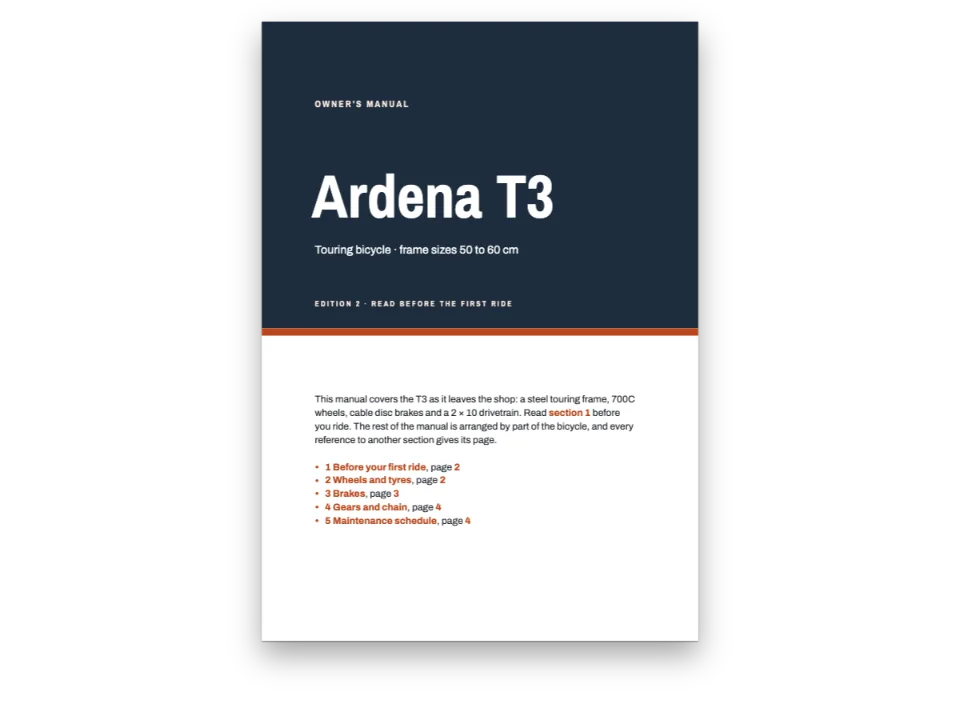
Um manual curto para dimensionar os painéis solares e as baterias de uma cabana. Quando o capítulo 3 remete a uma tabela do capítulo 1, ou o capítulo 1 a uma seção do 2, saem impressos o número e a página certos, e eles são links.
O que você vai compor
Um manual técnico curto, Power for a Cabin, composto em IBM Plex numa página de 178 × 233 mm: uma capa com as trajetórias do sol desenhadas em código, um sumário e três capítulos sob uma faixa azul-noite. O livro dimensiona um pequeno sistema solar, então cada capítulo se apoia nos outros. O capítulo 3 cita a tabela de consumo do capítulo 1 e o gráfico de horas de sol do capítulo 2; o capítulo 1 manda o leitor adiante, para a seção 2.3, e informa a página. Quem escreve põe @tbl:loads e @sec:array-size, do jeito que o pandoc-crossref lê, em quatro arquivos Markdown separados. buildBundle os diagrama como um só livro, de modo que cada referência imprime o número que o destino recebeu no seu próprio capítulo, a página em que ele caiu e um link para ele.
Esta receita responde a
- Como remeto a uma figura, uma tabela ou uma seção de outro capítulo, no estilo do pandoc-crossref, com os números sempre corretos?
- Como remeto a uma seção e à página em que ela está, e mantenho as duas corretas quando o livro muda?
A resposta curta
// buildBundle lays the chapters out in order. Each chapter whose text names a target it
// does not hold (`@sec:array-size` in chapter 1, `@tbl:loads` in chapter 3) is laid out
// with the outline of the whole book, so the reference prints "section 2.3" and its page,
// and links to it. Headings carry their ids in the Markdown, `## Sizing the array
// {#sec:array-size}`; figures and tables are resources whose ids are what follows the @.
const book = () => buildBundle({ chapters, config: config(), resources });
const crossRefs = {
  chapter: t({ en: 'chapter {n}', es: 'capítulo {n}' }), // @sec:array → "chapter 2"
  section: t({ en: 'section {n}', es: 'apartado {n}' }), // @sec:losses → "section 2.2"
  page: t({ en: 'p. {n}', es: 'pág. {n}' }), // :ref{id="sec:losses" style=page} → "p. 7"
};
// Figures and tables count per chapter ({h1}.{n}) and carry on from one document to the
// next. A reference prints the type's shortLabel: @fig:sun → "Fig. 2.1", @Tbl:loads (capital
// T, at the start of a sentence) → "Table 1.1", [-@tbl:loads] → the bare "1.1".
const resourceTypes = defaultResourceTypes(LANG).map((type) => ({ ...type,
  shortLabel: type.id === 'table' ? t({ en: 'table', es: 'tabla' })
    : t({ en: 'fig.', es: 'figura' }),
  ...(type.id === 'table' && { captionStyle: { position: 'above' } }) }));
Ingredientes
- Funcionalidades
- Referências cruzadasLegendas numeradasLivros compostos capítulo a capítuloTítulos numeradosSumárioAberturas desenhadasAtributos de títuloEstilos de títuloCapítulos sem númeroCabeços e fóliosCapas, folhas de rosto e colofõesImagens nos designs de páginaMargens espelhadasPaleta de cores semânticaEstilos de parágrafoExportação para PDF
- Também usa
- Citações em um estilo de citaçãoCitações que posicionam as figurasFigura e Tabela no seu idiomaCabeços por tipo de páginaFontes incorporadas ao PDFTipos de recurso personalizadosFiguras e tabelas como recursosCabeços por seçãoTabelas a partir de dados
- Tipografia
- IBM Plex Serif, IBM Plex Sans Condensed, IBM Plex Mono (SIL OFL 1.1)
- Materiais
- Nenhum: todas as imagens são desenhadas em código
Preparo
#1 · Dar nome a cada destino uma vez, para o livro inteiro
O código é a resposta curta acima. Os títulos levam um identificador do Pandoc com o seu prefixo, ## Sizing the array {#sec:array-size}. Figuras e tabelas são recursos declarados no script, e os ids delas se escrevem do mesmo jeito, fig:sun e tbl:loads, de modo que o texto diz @fig:sun esteja a figura dois parágrafos antes ou dois capítulos antes. Um id precisa ser único no livro todo, não só no seu capítulo.
#2 · Diagramar os capítulos como um só livro
// buildBundle lays the chapters out in order. Each chapter whose text names a target it
// does not hold (`@sec:array-size` in chapter 1, `@tbl:loads` in chapter 3) is laid out
// with the outline of the whole book, so the reference prints "section 2.3" and its page,
// and links to it. Headings carry their ids in the Markdown, `## Sizing the array
// {#sec:array-size}`; figures and tables are resources whose ids are what follows the @.
const book = () => buildBundle({ chapters, config: config(), resources });
const crossRefs = {
  chapter: t({ en: 'chapter {n}', es: 'capítulo {n}' }), // @sec:array → "chapter 2"
  section: t({ en: 'section {n}', es: 'apartado {n}' }), // @sec:losses → "section 2.2"
  page: t({ en: 'p. {n}', es: 'pág. {n}' }), // :ref{id="sec:losses" style=page} → "p. 7"
};
// Figures and tables count per chapter ({h1}.{n}) and carry on from one document to the
// next. A reference prints the type's shortLabel: @fig:sun → "Fig. 2.1", @Tbl:loads (capital
// T, at the start of a sentence) → "Table 1.1", [-@tbl:loads] → the bare "1.1".
const resourceTypes = defaultResourceTypes(LANG).map((type) => ({ ...type,
  shortLabel: type.id === 'table' ? t({ en: 'table', es: 'tabla' })
    : t({ en: 'fig.', es: 'figura' }),
  ...(type.id === 'table' && { captionStyle: { position: 'above' } }) }));
buildBundle leva os contadores de figuras e tabelas de um capítulo para o seguinte, então a primeira tabela do capítulo 3 é a 3.1 e @tbl:loads no capítulo 3 continua imprimindo table 1.1. Um capítulo cujo texto menciona um título que ele não contém é diagramado com a estrutura do livro inteiro, e diagramado de novo (três rodadas no máximo) até as páginas dessa estrutura pararem de mudar. É assim que o capítulo 1 consegue imprimir section 2.1 … p. 6 antes de o capítulo 2 existir no papel.
#3 · Escolher as palavras que uma referência imprime
crossRefs define chapter, section e p. (em espanhol, capítulo, apartado e pág.). Uma referência a figura ou tabela imprime o shortLabel do tipo, aqui em minúscula como o pandoc-crossref as compõe, fig. 2.1 e table 1.1. Uma maiúscula no prefixo, @Tbl:loads ou @Sec:array, põe o rótulo em maiúscula no início da frase, e [-@tbl:losses] imprime só o número, para tables 2.1 and 3.1.
#4 · Remeter adiante a seções, para trás a figuras
Uma figura ou tabela é numerada, e posicionada como flutuante, onde é citada pela primeira vez. @fig:soc no capítulo 1 a transformaria na figura 1.2 e a colocaria no capítulo 1. Por isso o capítulo 1 remete adiante a @sec:autonomy, e as figuras e tabelas são citadas primeiro no seu próprio capítulo; os capítulos seguintes remetem a elas à vontade. A página vai junto com a seção, :ref{id="sec:sun-hours" style=page}: uma referência a um recurso imprime o rótulo e o número, nunca a página.
#5 · As aberturas e a capa saem da mesma faixa
const BAND = 52; // mm from the trim's top
const opener = { enabled: true, minHeight: mm(54), slot: { elements: [
  { kind: 'box', id: 'band', style: { backgroundColor: col('night') },
    placement: { ...at('bleed', 'top-left'), size: { width: 'fill', height: mm(BAND + 3) } } },
  { kind: 'text', id: 'kicker', content: t({ en: 'Chapter', es: 'Capítulo' }), ...caps(8.5),
    color: col('sun'), placement: at('container', 'top-left', 0, 2) },
  { kind: 'text', id: 'title', content: '{titleText}', fontFamily: COND, fontWeight: 600,
    fontSize: pt(30), lineHeight: 1.05, color: col('paper'), align: 'left', overflow: 'wrap',
    placement: { ...at('#kicker', 'below', 0, 3), size: { width: mm(MEASURE - 26) } } },
  { kind: 'text', id: 'number', content: '{chapterNumber}', fontFamily: COND, fontWeight: 600,
    fontSize: pt(84), lineHeight: 1, color: col('sun'), align: 'right',
    placement: { ...at('container', 'top-right', 0, -6), size: { width: mm(40) } } },
  { kind: 'text', id: 'lead', content: '{attr.lead}', fontFamily: SERIF, italic: true,
    fontSize: pt(11), lineHeight: 1.38, color: col('ink'), align: 'left', overflow: 'wrap',
    placement: { ...at('container', 'top-left', 0, BAND - MARGIN.top + 8),
      size: { width: mm(MEASURE - 10) } } },
] } };
// The contents page wears the same band, with the book's subtitle as its kicker.
const contentsOpener = { ...opener, minHeight: mm(BAND - MARGIN.top + 4), slot: { elements:
  opener.slot.elements.filter((e) => ['band', 'kicker', 'title'].includes(e.id))
    .map((e) => (e.id === 'kicker' ? { ...e, content: '{subtitle}' } : e)) } };
A faixa desce 55 mm a partir do topo do refile em todos os capítulos e no sumário, que reaproveitam os mesmos elementos; o número do capítulo é {chapterNumber}, e o texto de entrada, um atributo do título.
const COVER_BAND = 168; // mm
const cover = { enabled: true, slot: { elements: [
  { kind: 'box', id: 'band', style: { backgroundColor: col('night') },
    placement: { ...at('bleed', 'top-left'), size: { width: 'fill', height: mm(COVER_BAND) } } },
  { kind: 'image', id: 'art', resourceId: 'cover',
    placement: { ...at('bleed', 'top-left'), size: { width: 'fill' } } },
  // Stacked upwards from the subtitle, so a title of one line or two keeps its distance.
  { kind: 'text', id: 'subtitle', content: '{subtitle}', fontFamily: SERIF, italic: true,
    fontSize: pt(14), color: col('tint'), align: 'left',
    placement: at('page', 'top-left', MARGIN.inner, COVER_BAND - 22) },
  { kind: 'text', id: 'title', content: '{titleText}', fontFamily: COND, fontWeight: 600,
    fontSize: pt(52), lineHeight: 1, color: col('paper'), align: 'left', overflow: 'wrap',
    placement: { ...at('#subtitle', 'above', 0, -4), size: { width: mm(140) } } },
  { kind: 'text', id: 'kicker', content: '{attr.kicker}', ...caps(8.5), color: col('sun'),
    placement: at('#title', 'above', 0, -4) },
  { kind: 'text', id: 'author', content: '{author}', fontFamily: COND, fontWeight: 600,
    fontSize: pt(13), color: col('ink'), align: 'left',
    placement: at('page', 'top-left', MARGIN.inner, COVER_BAND + 14) },
  { kind: 'text', id: 'edition', content: '{attr.edition}', ...caps(7.5), color: col('muted'),
    placement: at('#author', 'below', 0, 2.5) },
] } };
A receita completa
// ═══ Postext Cookbook · Nº 094 · A technical book whose references cross chapters ═══ // https://postext.dev/en/cookbook/technical-book-crossref-chapters // Code: MIT · Text: original (CC BY 4.0) · Charts: generated in code (CC BY 4.0) // Fonts: IBM Plex Serif, Sans Condensed and Mono (SIL OFL 1.1) · Needs postext ≥ 1.12.1 // A small handbook in four Markdown documents. The text writes @fig:sun, @tbl:loads and // @sec:array-size the way pandoc-crossref reads them, and buildBundle resolves each one to // the right number, title or page wherever in the book its target lies. import { buildBundle, renderPageToCanvas, clearMeasurementCache, registerResourceImage, defaultResourceTypes, parseTSV, setAlignment, } from 'https://esm.sh/postext'; import { renderToPdf, decompressWoff2 } from 'https://esm.sh/postext-pdf'; const LANG = 'en'; // @lang: the language of the sample document ('en' | 'es') const RECIPE = 'technical-book-crossref-chapters'; // ─── 1 · Design ───────────────────────────────────────────────────────────── // #region palette: a night-blue band, one burnt-orange accent, an amber for the charts const palette = { ink: '#1c1f24', // text: a cool near-black night: '#1f3247', // openers, the cover, table heads accent: '#a8471a', // numbers, kickers, references (5.6:1 on paper) sun: '#e9a33a', // the charts and the cover only, never text on paper tint: '#f5ede3', // daylight in the charts rule: '#cfc7bc', // hairlines muted: '#5e636a', // running heads, colophon, chart labels paper: '#ffffff', }; // A design element paints the hex beside its paletteId (gotcha: palette-skips-designs). const col = (id) => ({ hex: palette[id], model: 'hex', paletteId: id }); const colorPalette = Object.entries({ ...palette, 'main-color': palette.accent }) .map(([id, hex]) => ({ id, name: id, value: { hex, model: 'hex' } })); // #endregion const SERIF = 'IBM Plex Serif', COND = 'IBM Plex Sans Condensed', MONO = 'IBM Plex Mono'; const TRIM = { w: 178, h: 233 }; // mm: a technical-book trim const MARGIN = { top: 22, bottom: 22, inner: 20, outer: 32 }; // a 126 mm measure const LEAD = 13.8; // pt: the body leading const MEASURE = TRIM.w - MARGIN.inner - MARGIN.outer; const at = (to, edge, x = 0, y = 0) => ({ anchor: { to, edge }, offset: { x: mm(x), y: mm(y) } }); const caps = (size, extra = {}) => ({ fontFamily: MONO, fontSize: pt(size), fontWeight: 600, letterSpacing: pt(size * 0.14), textTransform: 'uppercase', align: 'left', ...extra }); // #region answer: one set of identifiers for the whole book, resolved across chapters // buildBundle lays the chapters out in order. Each chapter whose text names a target it // does not hold (`@sec:array-size` in chapter 1, `@tbl:loads` in chapter 3) is laid out // with the outline of the whole book, so the reference prints "section 2.3" and its page, // and links to it. Headings carry their ids in the Markdown, `## Sizing the array // {#sec:array-size}`; figures and tables are resources whose ids are what follows the @. const book = () => buildBundle({ chapters, config: config(), resources }); const crossRefs = { chapter: t({ en: 'chapter {n}', es: 'capítulo {n}' }), // @sec:array → "chapter 2" section: t({ en: 'section {n}', es: 'apartado {n}' }), // @sec:losses → "section 2.2" page: t({ en: 'p. {n}', es: 'pág. {n}' }), // :ref{id="sec:losses" style=page} → "p. 7" }; // Figures and tables count per chapter ({h1}.{n}) and carry on from one document to the // next. A reference prints the type's shortLabel: @fig:sun → "Fig. 2.1", @Tbl:loads (capital // T, at the start of a sentence) → "Table 1.1", [-@tbl:loads] → the bare "1.1". const resourceTypes = defaultResourceTypes(LANG).map((type) => ({ ...type, shortLabel: type.id === 'table' ? t({ en: 'table', es: 'tabla' }) : t({ en: 'fig.', es: 'figura' }), ...(type.id === 'table' && { captionStyle: { position: 'above' } }) })); // #endregion // #region opener: each chapter under a night-blue band, its number large on the outer side const BAND = 52; // mm from the trim's top const opener = { enabled: true, minHeight: mm(54), slot: { elements: [ { kind: 'box', id: 'band', style: { backgroundColor: col('night') }, placement: { ...at('bleed', 'top-left'), size: { width: 'fill', height: mm(BAND + 3) } } }, { kind: 'text', id: 'kicker', content: t({ en: 'Chapter', es: 'Capítulo' }), ...caps(8.5), color: col('sun'), placement: at('container', 'top-left', 0, 2) }, { kind: 'text', id: 'title', content: '{titleText}', fontFamily: COND, fontWeight: 600, fontSize: pt(30), lineHeight: 1.05, color: col('paper'), align: 'left', overflow: 'wrap', placement: { ...at('#kicker', 'below', 0, 3), size: { width: mm(MEASURE - 26) } } }, { kind: 'text', id: 'number', content: '{chapterNumber}', fontFamily: COND, fontWeight: 600, fontSize: pt(84), lineHeight: 1, color: col('sun'), align: 'right', placement: { ...at('container', 'top-right', 0, -6), size: { width: mm(40) } } }, { kind: 'text', id: 'lead', content: '{attr.lead}', fontFamily: SERIF, italic: true, fontSize: pt(11), lineHeight: 1.38, color: col('ink'), align: 'left', overflow: 'wrap', placement: { ...at('container', 'top-left', 0, BAND - MARGIN.top + 8), size: { width: mm(MEASURE - 10) } } }, ] } }; // The contents page wears the same band, with the book's subtitle as its kicker. const contentsOpener = { ...opener, minHeight: mm(BAND - MARGIN.top + 4), slot: { elements: opener.slot.elements.filter((e) => ['band', 'kicker', 'title'].includes(e.id)) .map((e) => (e.id === 'kicker' ? { ...e, content: '{subtitle}' } : e)) } }; // #endregion // #region cover: the sun's December and June paths over the panels, the title in the band const COVER_BAND = 168; // mm const cover = { enabled: true, slot: { elements: [ { kind: 'box', id: 'band', style: { backgroundColor: col('night') }, placement: { ...at('bleed', 'top-left'), size: { width: 'fill', height: mm(COVER_BAND) } } }, { kind: 'image', id: 'art', resourceId: 'cover', placement: { ...at('bleed', 'top-left'), size: { width: 'fill' } } }, // Stacked upwards from the subtitle, so a title of one line or two keeps its distance. { kind: 'text', id: 'subtitle', content: '{subtitle}', fontFamily: SERIF, italic: true, fontSize: pt(14), color: col('tint'), align: 'left', placement: at('page', 'top-left', MARGIN.inner, COVER_BAND - 22) }, { kind: 'text', id: 'title', content: '{titleText}', fontFamily: COND, fontWeight: 600, fontSize: pt(52), lineHeight: 1, color: col('paper'), align: 'left', overflow: 'wrap', placement: { ...at('#subtitle', 'above', 0, -4), size: { width: mm(140) } } }, { kind: 'text', id: 'kicker', content: '{attr.kicker}', ...caps(8.5), color: col('sun'), placement: at('#title', 'above', 0, -4) }, { kind: 'text', id: 'author', content: '{author}', fontFamily: COND, fontWeight: 600, fontSize: pt(13), color: col('ink'), align: 'left', placement: at('page', 'top-left', MARGIN.inner, COVER_BAND + 14) }, { kind: 'text', id: 'edition', content: '{attr.edition}', ...caps(7.5), color: col('muted'), placement: at('#author', 'below', 0, 2.5) }, ] } }; // #endregion // #region running-heads: the book on the verso, the chapter on the recto, folios in orange const head = (id, content, parity, edge, x, extra = {}) => ({ kind: 'text', id, content, parity, pages: 'body', ...caps(7), color: col('muted'), placement: at('page', edge, x, 12), ...extra }); const folio = { color: col('accent'), fontSize: pt(8) }; const header = { elements: [ head('verso-folio', '{pageNumber}', 'even', 'top-left', MARGIN.outer, folio), head('verso-title', '{title}', 'even', 'top-left', MARGIN.outer + 9), head('recto-title', '{chapterTitle}', 'odd', 'top-right', -(MARGIN.outer + 9), { align: 'right' }), head('recto-folio', '{pageNumber}', 'odd', 'top-right', -MARGIN.outer, { ...folio, align: 'right' }), ] }; const footer = { elements: [head('drop-folio', '{pageNumber}', 'all', 'top', 0, { ...folio, pages: 'opener', align: 'center', placement: at('container', 'bottom', 0, 8) })] }; const bare = { header: { elements: [] }, footer: { elements: [] } }; // #endregion const contents = { // what :::toc prints: chapters in the condensed face, sections under them levels: [ { level: 1, fontFamily: COND, fontSize: pt(13), fontWeight: 600, lineHeight: pt(18), numberFontFamily: MONO, numberFontSize: pt(10), numberFontWeight: 600, numberColor: col('accent'), numberWidth: mm(9), numberGap: mm(2), marginTop: pt(10) }, { level: 2, fontFamily: SERIF, fontSize: pt(9.5), lineHeight: pt(13.5), indent: mm(11), numberFontFamily: MONO, numberFontSize: pt(8), numberColor: col('muted'), numberWidth: mm(9), numberGap: mm(2) }, ], pageNumber: { fontFamily: MONO, fontSize: pt(8.5), fontWeight: 600, width: mm(8) }, leader: { char: '. ', gap: mm(2) }, }; const config = () => ({ // a factory: the engine caches resolved configs per object locale: t({ en: 'en-gb', es: 'es' }), // exact codes (gotcha: hyphenation-locales) crossRefs, resourceTypes, colorPalette, toc: contents, header, footer, page: { sizePreset: 'custom', width: mm(TRIM.w), height: mm(TRIM.h), dpi: 150, margins: { top: mm(MARGIN.top), bottom: mm(MARGIN.bottom), left: mm(MARGIN.inner), right: mm(MARGIN.outer), mirror: true } }, layout: { layoutType: 'single' }, bodyText: { fontFamily: SERIF, fontSize: pt(9.6), lineHeight: pt(LEAD), color: col('ink'), boldColor: col('ink'), italicColor: col('ink'), referenceColor: col('accent'), // every reference is a link: orange says so textAlign: 'justify', firstLineIndent: mm(4.5), indentAfterHeading: false, hyphenation: { enabled: true }, optimalLineBreaking: true, avoidWidows: true, avoidOrphans: true, avoidRunts: true }, headings: { fontFamily: COND, color: col('ink'), fontWeight: 600, levels: [ // Restated: any headings object drops the H1 break (gotcha: headings-drop-h1-break). // 'any': short chapters start on the next page, recto or verso. { level: 1, fontSize: pt(30), numberingTemplate: '{1}', breakBefore: { enabled: true, parity: 'any' }, advancedDesign: opener, marginBottom: pt(0) }, { level: 2, fontSize: pt(13), lineHeight: pt(LEAD * 1.5), numberingTemplate: '{1}.{2}', numberSeparator: ' ', marginTop: pt(LEAD / 2), marginBottom: pt(0) }, ] }, // The cover and the contents take no number and no contents line, so the first // chapter is still chapter 1. headingStyles: [ { id: 'cover', numbered: false, toc: false, advancedDesign: cover, ...bare }, { id: 'contents', numbered: false, toc: false, advancedDesign: contentsOpener, ...bare }, ], paragraphStyles: [ { id: 'formula', fontFamily: MONO, fontSize: pt(9), textAlign: 'center', firstLineIndent: pt(0), marginTop: pt(LEAD / 2), marginBottom: pt(LEAD / 2) }, { id: 'colophon', fontFamily: COND, fontSize: pt(7.5), lineHeight: pt(10.5), color: col('muted'), textAlign: 'left', firstLineIndent: pt(0), spaceBetween: pt(4), marginTop: pt(LEAD * 3) }, ], tableStyle: { rules: 'horizontal', borderColor: col('rule'), borderWidth: pt(0.5), headerBackground: col('night'), headerColor: col('paper'), headerFontFamily: COND, headerFontSize: pt(8.2), bodyFontFamily: COND, bodyFontSize: pt(8.6), bodyColor: col('ink'), cellPadding: mm(1.4) }, captionStyle: { fontFamily: COND, fontSize: pt(8.4), color: col('ink'), labelBold: true, labelColor: col('accent'), gap: mm(2.5) }, }); // ─── 2 · Content ──────────────────────────────────────────────────────────── const front = String.raw`---Amostra em Markdown · 16 linhas · content.en.md
title: "Power for a Cabin" subtitle: "Sizing a small off-grid solar system" author: "Lucía Arregui" --- # Power for a Cabin {style="cover" kicker="Larch Hill Technical Notes · No. 4" edition="Second edition"} # Contents {style="contents"} :::toc :::paragraphs{style="colophon"} Larch Hill Technical Notes are short handbooks for people who build and maintain their own equipment. The cabin, the valley and the figures in this one are an example worked by hand: check every number against your own loads, site and suppliers before you buy anything. Set in IBM Plex Serif, IBM Plex Sans Condensed and IBM Plex Mono (SIL OFL). Text written for the Postext Cookbook, CC BY 4.0. :::`; // frontmatter, cover and contents (content.<lang>.md) const load = String.raw`# The daily load {#sec:load lead="Every component of an off-grid system is sized from one number: the energy the cabin uses on a winter day. Get it wrong and nothing downstream can put it right."}Amostra em Markdown · 26 linhas · content.load.en.md
A solar system for a cabin is sized backwards. You start at the sockets, add up what the cabin draws in a day, and only then work out how many panels and batteries it takes to supply that much in the worst month of the year. This chapter arrives at that number: 1,159 watt-hours a day, which the rest of the book rounds to 1,160. @Sec:array turns it into panels, and @sec:battery into batteries. The example is a stone cabin of 48 m² at 1,100 m in a valley that faces south-east, used every weekend and for three weeks in winter. Heating and cooking are wood and bottled gas; electricity runs the lights, a fridge, a water pump, a laptop and a router. ## Listing the loads {#sec:load-list} Walk round the cabin with a notebook and write down everything that plugs in or is wired in, with its power in watts and the hours it runs on a winter day. The power is on the rating plate or in the manual; for anything with a motor or a compressor, a plug-in meter left for a day gives a truer figure than the plate. @Tbl:loads is the list for the example cabin. Two lines in the table are easy to forget. The inverter, which turns the battery's 24 volts into 230 volts for the sockets, draws 8 W from the moment it is switched on, whether anything is plugged in or not: over a day that is more than the lights. The router runs all night as well. Both are worth a timer or a switch by the door, and the saving is worked out in @sec:winter-margin. The fridge figure needs care. A chest fridge of 100 litres draws 55 W while its compressor runs, and in a cool cabin the compressor runs about five hours in twenty-four. In August it may run nine, but August is not the month that sizes the system, as @sec:sun-hours shows on :ref{id="sec:sun-hours" style=page}. ## When the energy is used {#sec:load-profile} The total says how much energy the cabin needs; it does not say when. @Fig:profile spreads the same 1,160 Wh over the hours of a winter day. The fridge, the router and the inverter make a floor of about 27 W that never goes away. The laptop adds a block in the morning, and the evening brings the largest draw of the day, when lights, the stove fan and the pump run together after sunset. That evening peak matters more than its size suggests. Almost all of it falls after the sun has gone, so none of it can come straight from the panels: it is drawn from the battery and paid back the next day. The battery bank in @sec:autonomy is sized for exactly this, and for the days when the sun does not pay it back at all. ## The winter margin {#sec:winter-margin} A list made in October is a guess about January. Lights run longer in midwinter, guests come at New Year, and someone always brings a hair dryer. Rather than pad every line of @tbl:loads, keep the list honest and add the margin once, at the end, where it can be seen. For a weekend cabin a margin of 15% is enough, and the example takes it from the loads themselves rather than adding it on top: switching the inverter and the router off at night saves 8 W and 8 W for ten hours, 160 Wh a day, close to 14% of the total. The system is sized for the full 1,160 Wh, and the habit of the switch by the door is the margin. With the load fixed, the next question is how much of it the sun can supply in the darkest month. That is the work of @sec:array, which starts from the sun hours of the site on :ref{id="sec:sun-hours" style=page}.`; // chapter 1: content.load.<lang>.md const array = String.raw`# The array {#sec:array lead="Panels are sized for December, when the days are short and the sun is low. In summer the same array makes twice what the cabin needs, and that is the price of a winter that works."}Amostra em Markdown · 26 linhas · content.array.en.md
@Sec:load ended with a daily load of 1,160 Wh, the total of @tbl:loads. This chapter finds the array that delivers that much on an average December day, after every loss between the panel and the socket. ## Sun hours by month {#sec:sun-hours} The sunlight a site receives is given in peak sun hours: the number of hours at a standard intensity of 1,000 W/m² that would deliver the same energy as the whole day does. A panel rated at 300 W makes roughly 300 Wh for each peak sun hour, before losses. The figures come from a solar database for the site's coordinates and the panels' tilt; @fig:sun gives them for the example cabin, at 42° N with the panels tilted at 60°. A steep tilt trades some summer yield for the low winter sun. Even so, December gets half the yield of July: 2.8 peak sun hours against 5.6. December is therefore the design month, and every calculation in this chapter uses its figure. ## Losses between panel and socket {#sec:losses} Not all of the energy a panel makes reaches the sockets. Each stage between them takes a share, and the shares multiply. @Tbl:losses lists them for the example system. The largest single loss is the inverter's, and it applies only to the loads that run on 230 V. In a cabin where the fridge, the pump and the lights all run on 24 V, the overall factor rises from 0.79 to about 0.85. The example keeps the inverter in the chain, because the laptop and the router need it and the calculation is safer that way. The battery's share is its round-trip loss, the energy that goes in and does not come out; it is small for lithium cells and larger for lead-acid, as @sec:chemistry explains on :ref{id="sec:chemistry" style=page}. ## Sizing the array {#sec:array-size} The array must make the daily load, divided by the overall loss factor, in the peak sun hours of December: :::paragraphs{style="formula"} 1,160 Wh ÷ (2.8 h × 0.79) = 524 W ::: The example uses two panels of 310 W in series, 620 W in all, which leaves a margin of 18% for an old panel, a cloudy fortnight or a load that has grown. The panels work between ten and four; the cabin, as @fig:profile shows, spends most of its energy after dark. How large the battery between them must be is the subject of @sec:battery.`; // chapter 2 const battery = String.raw`# The battery bank {#sec:battery lead="The battery carries the cabin through every night and through the grey days when the panels make almost nothing. Its size is a choice about how many such days in a row you will accept."}Amostra em Markdown · 26 linhas · content.battery.en.md
The array of @sec:array-size works between ten and four, the cabin mostly after dark, and on an overcast December day the 2.8 peak sun hours of @fig:sun fall to half an hour or less. The battery bank bridges both gaps. ## Days of autonomy {#sec:autonomy} Autonomy is the number of days the bank can run the cabin with no sun at all. Three days is usual for a cabin in a valley with fog, and it is what the example uses: :::paragraphs{style="formula"} 3 days × 1,160 Wh = 3,480 Wh usable ::: The daily load is the total of @tbl:loads, without the margin of @sec:winter-margin (:ref{id="sec:winter-margin" style=page}), which stays in reserve. How far a bank may be drawn down depends on its chemistry. ## Choosing a chemistry {#sec:chemistry} @Tbl:chemistry compares the three chemistries sold for small off-grid systems. Lithium iron phosphate (LiFePO4) cells can be drawn down to 20% every night for thousands of cycles. Lead-acid batteries last longest when they are never taken below half their charge, so the same usable energy needs a bank about 60% larger, and five times the weight to carry up the track. The round trip matters too. The overall factor of 0.79 in @tbl:losses assumes the lithium bank's 0.95. With an AGM bank at 0.85 the factor falls to 0.71, and the formula of @sec:array-size asks for 586 W instead of 524 W. The two 310 W panels still cover it, with a margin of 6% instead of 18%. Change the battery, and tables [-@tbl:losses] and [-@tbl:chemistry] must be read again together. The example cabin uses a LiFePO4 bank of 200 Ah at 25.6 V: 5.1 kWh nominal, 4.1 kWh usable, a little more than three days. ## A week of cloud {#sec:cloud-week} @Fig:soc follows the bank's state of charge through five December days: one clear, three overcast at about half a peak sun hour, and a clear day to finish. The bank starts at 80%, rises to 94% on the first afternoon and then loses about 17% a day, with a dip each evening from the peak of @fig:profile. At its lowest, on the last night of cloud, it holds 27%, above the 20% floor. The figure also shows the weakness of sizing for the average December day. On a clear day the array makes about 1,370 Wh after losses, only 210 Wh more than the cabin uses, so a bank drawn down by three grey days takes some twelve clear days to fill again. A third panel, on a controller of its own, raises the surplus of a clear day from 210 Wh to about 900 Wh; a small petrol generator with a charger refills the bank in an afternoon.`; // chapter 3 const tables = String.raw`Load Power (W) Hours a day Wh a dayAmostra em Markdown · 22 linhas · content.tables.en.md
LED lighting, 6 points 30 5 150 Chest fridge, 100 L 55 5 275 Water pump, 24 V 120 0.5 60 Laptop 45 4 180 Router 8 24 192 Inverter, idle draw 8 24 192 Two phones 10 2 20 Wood-stove fan 15 6 90 **Total** **1,159** Between panel and socket Factor Dust, snow and shading 0.95 Cable resistance 0.97 MPPT charge controller 0.97 Battery round trip (LiFePO4) 0.95 Inverter, 230 V loads 0.93 **Overall (product)** **0.79** Chemistry Usable depth Round trip Cycles Bank for 3 days Mass LiFePO4 80% 0.95 4,000 200 Ah, 5.1 kWh 45 kg AGM lead-acid 50% 0.85 600 300 Ah, 7.2 kWh 220 kg Tubular lead-acid 50% 0.80 1,500 300 Ah, 7.2 kWh 260 kg`; // the three tables as TSV, blank-line separated // Four Markdown documents in reading order, one book. const chapters = [front, load, array, battery].map((markdown) => ({ markdown })); // #region tables: three tables pasted from a spreadsheet as TSV, parsed into table models function tableModel(tsv, columnWidths) { let m = Object.assign(parseTSV(tsv), { headerRowCount: 1, columnWidths }); for (let r = 0; r < m.rows.length; r++) { // figures flush right, words flush left for (let c = 1; c < m.rows[r].length; c++) m = setAlignment(m, { row: r, col: c }, 'right'); } return m; } const [loads, losses, chemistry] = tables.trim().split(/\n\s*\n/); const TABLES = { loads, losses, chemistry }; // #endregion const CAPTIONS = t({ en: { loads: 'Daily loads of the example cabin on a winter day', losses: 'Losses between the panels and the sockets, multiplied', chemistry: 'Three battery chemistries for 3,480 Wh of usable energy', profile: 'Average draw, hour by hour, on a winter day. Grey: the constant floor of fridge, ' + 'router and inverter; orange: everything else; pale band: daylight.', sun: 'Peak sun hours a day by month at 42°\u00a0N, panels tilted at 60°. December is the ' + 'design month.', soc: 'State of charge of the 5.1 kWh bank over five December days: clear, three overcast, ' + 'clear. Shaded: night. Dashed: the 20% floor.', }, es: { loads: 'Consumos diarios de la cabaña de ejemplo en un día de invierno', losses: 'Pérdidas entre los paneles y los enchufes, multiplicadas', chemistry: 'Tres químicas de batería para 3480\u00a0Wh de energía útil', profile: 'Consumo medio, hora a hora, en un día de invierno. Gris: el suelo constante de ' + 'frigorífico, rúter e inversor; naranja: todo lo demás; banda clara: horas de luz.', sun: 'Horas de sol pico al día por mes a 42°\u00a0N, con los paneles inclinados 60°. Diciembre ' + 'es el mes de diseño.', soc: 'Estado de carga del banco de 5,1 kWh durante cinco días de diciembre: despejado, tres ' + 'nublados, despejado. Sombreado: noche. Discontinua: el suelo del 20\u00a0%.', } }); const table = (id, widths) => ({ id: `tbl:${id}`, typeId: 'table', kind: 'table', caption: CAPTIONS[id], createdAt: 0, updatedAt: 0, table: { model: tableModel(TABLES[id], widths) } }); const figure = (id, [w, h]) => ({ id: `fig:${id}`, typeId: 'figure', kind: 'svg', caption: CAPTIONS[id], altText: CAPTIONS[id], createdAt: 0, updatedAt: 0, svg: { fileId: `${id}.svg`, width: w * 10, height: h * 10 } }); const resources = [ { id: 'cover', typeId: 'figure', kind: 'svg', createdAt: 0, updatedAt: 0, svg: { fileId: 'cover.svg', width: TRIM.w * 10, height: 110 * 10 } }, figure('profile', [MEASURE, 50]), figure('sun', [MEASURE, 46]), figure('soc', [MEASURE, 50]), table('loads', [44, 18, 18, 18]), table('losses', [70, 20]), table('chemistry', [26, 16, 15, 12, 26, 12]), ]; // #region art: the cover and three charts, drawn in code in the book's palette // An SVG loaded as an image has no access to the page's web fonts (gotcha: // svg-no-webfonts), so the charts embed the one IBM Plex Mono face their labels use. async function labelFace() { const url = 'https://cdn.jsdelivr.net/npm/@fontsource/ibm-plex-mono@5/files/' + 'ibm-plex-mono-latin-400-normal.woff2'; const bytes = new Uint8Array(await (await fetch(url)).arrayBuffer()); let bin = ''; for (let i = 0; i < bytes.length; i += 8192) { bin += String.fromCharCode(...bytes.subarray(i, i + 8192)); } return `@font-face{font-family:L;src:url(data:font/woff2;base64,${btoa(bin)}) format('woff2')}` + `text{font-family:L;font-size:2.5px;fill:${palette.muted}}`; } const n2 = (v) => +v.toFixed(2); const sheet = (w, h, body, style = '') => `<svg xmlns="http://www.w3.org/2000/svg" ` + `width="${w * 10}" height="${h * 10}" viewBox="0 0 ${w} ${h}"><style>${style}</style>` + `${body}</svg>`; const rect = (x, y, w, h, fill, extra = '') => `<rect x="${n2(x)}" y="${n2(y)}" width="${n2(w)}" ` + `height="${n2(h)}" fill="${palette[fill]}" ${extra}/>`; const pathOf = (pts) => pts.map(([x, y]) => `${n2(x)} ${n2(y)}`).join('L'); const line = (pts, stroke, width, extra = '') => `<path d="M${pathOf(pts)}" fill="none" ` + `stroke="${palette[stroke]}" stroke-width="${width}" ${extra}/>`; const label = (x, y, text, anchor = 'middle') => `<text x="${n2(x)}" y="${n2(y)}" ` + `text-anchor="${anchor}">${text}</text>`; // A chart frame: plot area from x0 to w − 2, y from top 3 to the axis at h − 7. function axes(w, h, x0, max, step, unit) { const y = (v) => h - 7 - (v / max) * (h - 10); let out = ''; for (let v = 0; v <= max; v += step) { out += line([[x0, y(v)], [w - 2, y(v)]], 'rule', v ? 0.15 : 0.35) + label(x0 - 1.5, y(v) + 0.9, `${v}${v === max ? unit : ''}`, 'end'); } return { out, y }; } // The hourly profile of chapter 1, built from the same loads as its table. const FLOOR = 27.46; // W: fridge 275 Wh + router + inverter 192 Wh each, over 24 hours const EXTRA = Array.from({ length: 24 }, (_, h) => (h >= 18 && h <= 22 ? 30 : 0) // lights + (h === 7 || h === 19 ? 30 : 0) + (h >= 9 && h <= 12 ? 45 : 0) // pump, laptop + (h === 21 || h === 22 ? 10 : 0) + (h >= 17 && h <= 22 ? 15 : 0)); // phones, stove fan function profileArt(w, h) { const x0 = 12, bw = (w - 2 - x0) / 24; const { out, y } = axes(w, h, x0, 120, 30, ' W'); let bars = rect(x0 + 8.5 * bw, 3, 9.25 * bw, h - 10, 'tint') + out; // daylight, 8:30 to 17:45 EXTRA.forEach((extra, i) => { const x = x0 + i * bw + 0.35; bars += rect(x, y(FLOOR), bw - 0.7, y(0) - y(FLOOR), 'rule') + (extra ? rect(x, y(FLOOR + extra), bw - 0.7, y(FLOOR) - y(FLOOR + extra), 'accent') : ''); }); const hours = [0, 6, 12, 18, 24].map((hr) => label(x0 + hr * bw, h - 2.5, `${hr}h`)).join(''); return bars + hours; } const PSH = [3.1, 3.9, 4.6, 5.0, 5.2, 5.3, 5.6, 5.6, 5.2, 4.3, 3.3, 2.8]; // peak sun hours const MONTHS = t({ en: 'JFMAMJJASOND', es: 'EFMAMJJASOND' }); function sunArt(w, h) { const x0 = 12, bw = (w - 2 - x0) / 12; const { out, y } = axes(w, h, x0, 6, 1, ' h'); const value = (v) => (LANG === 'es' ? v.toFixed(1).replace('.', ',') : v.toFixed(1)); return out + PSH.map((v, i) => rect(x0 + i * bw + 1.6, y(v), bw - 3.2, y(0) - y(v), i === 11 ? 'accent' : 'night') + label(x0 + (i + 0.5) * bw, y(v) - 1.2, value(v)) + label(x0 + (i + 0.5) * bw, h - 2.5, MONTHS[i])).join(''); } // Five December days, hour by hour: the array (620 W × 0.79) against the load profile. function socSeries() { const bank = 5120, days = [2.8, 0.5, 0.4, 0.7, 2.8]; const sun = Array.from({ length: 24 }, (_, h) => (h >= 8 && h < 17 ? Math.sin(Math.PI * (h - 7.5) / 9) : 0)); const sum = sun.reduce((a, b) => a + b); let soc = 0.8 * bank; const out = [0.8]; days.forEach((d) => sun.forEach((s, h) => { soc = Math.min(bank, soc + d * 620 * 0.79 * s / sum - FLOOR - EXTRA[h]); out.push(soc / bank); })); return out; } function socArt(w, h) { const x0 = 12, step = (w - 2 - x0) / 120; const { out, y } = axes(w, h, x0, 100, 20, t({ en: '%', es: ' %' })); let night = ''; for (let d = 0; d < 5; d++) { night += rect(x0 + d * 24 * step, 3, 8.5 * step, h - 10, 'tint') + rect(x0 + (d * 24 + 17.75) * step, 3, 6.25 * step, h - 10, 'tint') + label(x0 + (d * 24 + 12) * step, h - 2.5, t({ en: `day ${d + 1}`, es: `día ${d + 1}` })); } const curve = line(socSeries().map((v, i) => [x0 + i * step, y(v * 100)]), 'accent', 0.6, 'stroke-linejoin="round"'); return night + out + line([[x0, y(20)], [w - 2, y(20)]], 'night', 0.35, 'stroke-dasharray="1.2 0.8"') + curve; } // The cover: the sun's paths in June and December over a tilted panel, on the night band. function coverArt(w, h) { const horizon = 86, cx = w * 0.56; const path = (r, k) => line(Array.from({ length: 41 }, (_, i) => { const a = Math.PI * (i / 40); return [cx - r * Math.cos(a), horizon - k * r * Math.sin(a)]; }), 'sun', 0.5); const sunAt = (r, k, color, size) => `<circle cx="${n2(cx)}" cy="${n2(horizon - k * r)}" ` + `r="${size}" fill="${palette[color]}"/>`; let cells = ''; // a panel tilted towards the low sun, 6 × 4 cells const px = 14, py = 84, pw = 46, ph = 30, skew = 14; for (let r = 0; r < 4; r++) { for (let c = 0; c < 6; c++) { const [x, y] = [px + c * pw / 6 + (r + 0.5) * skew / 4, py - (r + 1) * ph / 4]; const pts = [[x, y], [x + pw / 6 - 0.8, y], [x + pw / 6 - 0.8 + skew / 4 * 0.8, y - ph / 4 + 0.8], [x + skew / 4 * 0.8, y - ph / 4 + 0.8]].map(([a, b]) => [a, b + ph / 4]); cells += `<path d="M${pts.map(([a, b]) => `${n2(a)} ${n2(b)}`).join('L')}Z" ` + `fill="${palette.paper}" fill-opacity="${0.16 + ((r + c) % 3) * 0.05}"/>`; } } return path(70, 0.9) + path(54, 0.45) + sunAt(70, 0.9, 'sun', 2.2) + sunAt(54, 0.45, 'sun', 4) + line([[8, horizon], [w - 8, horizon]], 'sun', 0.35) + cells; } // #endregion // ─── 3 · Fonts ────────────────────────────────────────────────────────────── // Every face the design uses (gotcha: fonts-first). const FONTS = { 'IBM Plex Serif': ['400', '400i', '600'], 'IBM Plex Sans Condensed': ['400', '600', '700'], 'IBM Plex Mono': ['400', '600'], }; // ─── 4 · Build & show ─────────────────────────────────────────────────────── const text = chapters.map((chapter) => chapter.markdown).join('\n'); await loadFonts(FONTS, text); const face = await labelFace(); await loadSvg('cover.svg', sheet(TRIM.w, 110, coverArt(TRIM.w, 110))); await loadSvg('profile.svg', sheet(MEASURE, 50, profileArt(MEASURE, 50), face)); await loadSvg('sun.svg', sheet(MEASURE, 46, sunArt(MEASURE, 46), face)); await loadSvg('soc.svg', sheet(MEASURE, 50, socArt(MEASURE, 50), face)); const docs = await buildWithFonts(book, text); // one VDTDocument per Markdown document showPages(docs, { title: t({ en: 'Power for a Cabin', es: 'Energía para una cabaña' }) }); // One PDF for the book: a reference in chapter 3 links to its table in chapter 1. offerPdf(() => renderToPdf(docs, { fontProvider: fontsourceProvider, resourceBytes: imageBytes }), `${RECIPE}.pdf`);Kit · core, fonts, viewer, pdf, images: igual em todas as receitas · 316 linhas
// ─── Kit ── helpers shared by every Cookbook recipe · postext.dev/cookbook ───── // ─── Kit · core v1 ── the same in every recipe · postext.dev/cookbook function mm(value) { return { value, unit: 'mm' }; } function pt(value) { return { value, unit: 'pt' }; } function em(value) { return { value, unit: 'em' }; } /** The sample language's string: t({ en: 'Figure', es: 'Figura' }). */ function t(strings) { return strings[LANG] ?? Object.values(strings)[0]; } /** A file in this recipe's assets folder, served from the Postext repo by jsDelivr. */ function asset(file) { return `https://cdn.jsdelivr.net/gh/drnachio/postext@main/cookbook/${RECIPE}/assets/${file}`; } // ─── Kit · fonts v2 ── the same in every recipe · postext.dev/cookbook // Postext measures with the loaded faces and caches the widths: load every face // before the first build, from Fontsource, the files the PDF embeds too. /** faces = { 'Family Name': ['400', '400i', '700'] }. `text` is the sample: * č ł † α χ also load latin-ext and greek files (kitSubsetsFor). With * `optional`, a face Fontsource does not ship is skipped instead of failing. * Resolves to the number of faces added. */ async function loadFonts(faces, text = '', { optional = false } = {}) { kitStatus('Loading fonts…'); const ranges = { latin: 'U+0000-00FF,U+0131,U+0152-0153,U+02BB-02BC,U+02C6,U+02DA,U+02DC,U+0304,U+0308,U+0329,' + 'U+2000-206F,U+20AC,U+2122,U+2191,U+2193,U+2212,U+2215,U+FEFF,U+FFFD', 'latin-ext': 'U+0100-02BA,U+02BD-02C5,U+02C7-02CC,U+02CE-02D7,U+02DD-02FF,U+0304,U+0308,U+0329,' + 'U+1D00-1DBF,U+1E00-1E9F,U+1EF2-1EFF,U+2020,U+20A0-20AB,U+20AD-20C0,U+2113,U+2C60-2C7F,U+A720-A7FF', greek: 'U+0370-03FF', }; const jobs = []; let added = 0; for (const [family, specs] of Object.entries(faces)) { const id = fontsourceId(family); const todo = [...new Set(specs)].map((spec) => [parseInt(spec, 10), spec.endsWith('i') ? 'italic' : 'normal']) .filter(([weight, style]) => !hasFace(family, weight, style)); // before any await const meta = optional || /[^\0-ÿ]/u.test(text) ? await fontsourceMeta(family) : null; const subsets = ['latin', ...kitSubsetsFor(text, meta)]; for (const [weight, style] of todo) { if (optional && !(meta?.weights.includes(weight) && meta.styles.includes(style))) continue; for (const subset of subsets) { const url = `https://cdn.jsdelivr.net/npm/@fontsource/${id}@5/files/${id}-${subset}-${weight}-${style}.woff2`; const face = new FontFace(family, `url(${url}) format('woff2')`, { weight: String(weight), style, unicodeRange: ranges[subset] }); jobs.push(face.load().then((ready) => { document.fonts.add(ready); added++; }, () => { if (subset === 'latin' && !optional) throw new Error(`Fontsource has no ${family} ${weight} ${style}`); })); } } } await Promise.all(jobs).catch((error) => { kitFail(error); throw error; }); return added; } /** Runs `build` and loads any face the pages use that FONTS missed (a regular * one with a warning), then clears the measurement cache and builds again. */ async function buildWithFonts(build, text = '') { const tried = new Set(); for (let round = 0; round < 3; round++) { kitStatus('Laying out…'); await new Promise(requestAnimationFrame); // let the status paint first const result = await Promise.resolve().then(build).catch((error) => { kitFail(error); throw error; }); const wanted = { base: {}, variants: {} }; for (const { font, base } of [result].flat().flatMap(fontStringsOf)) { const { family, weight, style } = parseFont(font); const key = `${family}|${weight}|${style}`; if (tried.has(key) || hasFace(family, weight, style)) continue; tried.add(key); (wanted[base ? 'base' : 'variants'][family] ??= []).push(`${weight}${style === 'italic' ? 'i' : ''}`); } if (Object.keys(wanted.base).length) { console.warn(`[cookbook] FONTS does not list ${JSON.stringify(wanted.base)}: loading them.`); } const added = await loadFonts(wanted.base, text) + await loadFonts(wanted.variants, text, { optional: true }); if (added === 0) return result; clearMeasurementCache(); } throw new Error('The fonts did not settle after three builds.'); } /** Every font string of the layout; `base` marks a block's own face. */ function fontStringsOf(doc) { const found = new Map(); const walk = (node) => { if (!node || typeof node !== 'object') return; if (Array.isArray(node)) { node.forEach(walk); return; } for (const [key, value] of Object.entries(node)) { if (typeof value === 'string' && /fontString$/i.test(key)) { found.set(value, found.get(value) || key === 'fontString'); } else if (value && typeof value === 'object') walk(value); } }; walk(doc.pages); walk(doc.blocks); return [...found].map(([font, base]) => ({ font, base })); } /** '700 37.5px Open Sans' / 'italic 400 13px "Source Serif 4"' → { family, weight, style }. * A string with no weight ('95.8px Young Serif', from a design text) is 400. */ function parseFont(font) { const m = /^(?:(italic|oblique)\s+)?(?:small-caps\s+)?(?:(\d+|bold|normal)\s+)?[\d.]+px\s+(.+)$/.exec(font.trim()); if (!m) throw new Error(`Unexpected font string: ${font}`); const weight = m[2] === 'bold' ? 700 : !m[2] || m[2] === 'normal' ? 400 : Number(m[2]); return { family: m[3].replace(/^["']|["']$/g, ''), weight, style: m[1] ? 'italic' : 'normal' }; } /** A loaded FontFace covers this family, weight and style (fonts.check() would * also say yes for families nobody declared). */ function hasFace(family, weight, style) { for (const face of document.fonts) { if (face.status !== 'loaded' || face.style !== style) continue; if (face.family.replace(/^["']|["']$/g, '') !== family) continue; const [low, high = low] = face.weight.split(' ').map(Number); if (weight >= low && weight <= high) return true; } return false; } /** The files beyond latin `text` needs that `meta`'s family ships. */ function kitSubsetsFor(text, meta) { return [[/[Ā-˿ᴀ-ᶿḀ-ỿ†ℓⱠ-Ɀ꜠-ꟿ]/u, 'latin-ext'], [/[Ͱ-Ͽ]/u, 'greek']] .filter(([re, x]) => re.test(text) && meta?.subsets?.includes(x)).map(([, x]) => x); } /** Fontsource's id for a family: 'Source Serif 4' → 'source-serif-4'. */ function fontsourceId(family) { return family.toLowerCase().replace(/\s+/g, '-'); } /** The family's Fontsource metadata (weights, styles, subsets), or null. */ function fontsourceMeta(family) { fontsourceMeta.cache ??= new Map(); const id = fontsourceId(family); if (!fontsourceMeta.cache.has(id)) { fontsourceMeta.cache.set(id, fetch(`https://api.fontsource.org/v1/fonts/${id}`) .then((res) => (res.ok ? res.json() : null), () => null)); } return fontsourceMeta.cache.get(id); } // ─── Kit · viewer v1 ── the same in every recipe · postext.dev/cookbook /** The pages as spreads on a dark desk, page 1 alone, then verso | recto, * each painted when it scrolls near. */ function showPages(docs, { title, width = 460 } = {}) { const root = viewer(title); const pages = [docs].flat().flatMap((doc) => doc.pages.map((page) => ({ doc, page, n: (doc.pageIndexOffset ?? 0) + page.index }))); const spreads = []; let verso = null; for (const p of pages) { if (p.n % 2 === 1) { if (verso) spreads.push([verso, null]); verso = p; } else { spreads.push([verso, p]); verso = null; } } if (verso) spreads.push([verso, null]); const density = Math.min(window.devicePixelRatio || 1, 2); showPages.painter?.disconnect(); const painter = new IntersectionObserver((entries) => { for (const { isIntersecting, target } of entries) { if (!isIntersecting) continue; painter.unobserve(target); const { doc, page } = target.postext; renderPageToCanvas(page, doc, target, { scale: (width * density) / page.width }); } }, { rootMargin: '800px' }); showPages.painter = painter; root.replaceChildren(...spreads.map((pair) => { const spread = document.createElement('div'); spread.className = 'pt-spread'; for (const p of pair) { const figure = document.createElement('figure'); if (p) { const label = p.page.pageLabel || String(p.n + 1); const canvas = document.createElement('canvas'); canvas.postext = p; canvas.style.aspectRatio = `${p.page.width} / ${p.page.height}`; canvas.setAttribute('role', 'img'); canvas.setAttribute('aria-label', `Page ${label}`); const folio = document.createElement('figcaption'); folio.textContent = label; figure.append(canvas, folio); painter.observe(canvas); } else figure.className = 'pt-blank'; spread.append(figure); } return spread; })); kitStatus(`${pages.length} ${pages.length === 1 ? 'page' : 'pages'}`); document.documentElement.dataset.postext = 'ready'; return pages.length; } /** The desk, the bar and the error reporting, created once. */ function viewer(title) { if (!document.getElementById('pt-kit')) { document.head.insertAdjacentHTML('beforeend', `<style id="pt-kit"> :root { color-scheme: dark; } body { margin: 0; background: #0e1014; color: #b9bcc4; font: 13px/1.45 system-ui, sans-serif; } #pt-bar { position: sticky; top: 0; z-index: 1; display: flex; flex-wrap: wrap; align-items: center; gap: 6px 16px; padding: 10px 16px; background: rgb(14 16 20 / .92); backdrop-filter: blur(6px); border-bottom: 1px solid #23262d; } #pt-bar strong { color: #f4f1ea; font-weight: 600; } #pt-actions { display: flex; gap: 12px; margin-left: auto; } #pt-actions a, #pt-actions button { color: #d8a21a; font: inherit; background: none; border: 0; padding: 0; cursor: pointer; } #pages { display: grid; justify-items: center; gap: 48px; padding: 32px 16px 72px; } .pt-spread { display: flex; } .pt-spread figure { margin: 0; width: min(460px, 44vw); } .pt-spread canvas { display: block; width: 100%; background: #fff; box-shadow: 0 1px 2px rgb(0 0 0 / .5), 0 22px 44px -16px rgb(0 0 0 / .8); } .pt-spread figure:first-child canvas { box-shadow: inset -14px 0 14px -14px rgb(0 0 0 / .18), 0 1px 2px rgb(0 0 0 / .5), 0 22px 44px -16px rgb(0 0 0 / .8); } .pt-spread figcaption { margin-top: 10px; text-align: center; font: 600 10px/1 system-ui, sans-serif; letter-spacing: .18em; text-transform: uppercase; color: #6c7079; } .pt-blank { visibility: hidden; } @media (max-width: 760px) { .pt-spread { flex-direction: column; gap: 32px; } .pt-spread figure { width: min(460px, 92vw); } .pt-blank { display: none; } } </style>`); document.body.insertAdjacentHTML('afterbegin', '<header id="pt-bar"><strong id="pt-title"></strong><span id="pt-status" role="status"></span><span id="pt-actions"></span></header>'); document.getElementById('pt-title').textContent = document.title || 'Postext'; addEventListener('error', (event) => kitFail(event.error ?? event.message)); addEventListener('unhandledrejection', (event) => kitFail(event.reason)); } if (title) document.getElementById('pt-title').textContent = title; return document.getElementById('pages') ?? document.body.appendChild(Object.assign(document.createElement('main'), { id: 'pages' })); } function kitStatus(text) { viewer(); document.getElementById('pt-status').textContent = text; } function kitFail(error) { document.documentElement.dataset.postext = 'error'; kitStatus(`Error: ${error?.message ?? error}`); } // ─── Kit · pdf v2 ── the same in every recipe that exports a PDF /** The Fontsource files the screen used, as TrueType: the nearest weight the * family ships, upright if it has no italic; latin, then what the face's * letters need (kitSubsetsFor). */ async function fontsourceProvider(family, weight, style, request) { const id = fontsourceId(family); const meta = await fontsourceMeta(family); const weights = meta?.weights?.length ? meta.weights : [400, 700]; const w = weights.reduce((a, b) => (Math.abs(b - weight) < Math.abs(a - weight) ? b : a)); const s = style === 'italic' && meta && !meta.styles.includes('italic') ? 'normal' : style; const text = String.fromCodePoint(...(request?.codePoints ?? [])); const more = kitSubsetsFor(text, meta); const files = await Promise.all(['latin', ...more].map(async (subset) => { const res = await fetch(`https://cdn.jsdelivr.net/npm/@fontsource/${id}@5/files/${id}-${subset}-${w}-${s}.woff2`); if (!res.ok) throw new Error(`Fontsource has no ${family} ${w} ${s} ${subset}`); return decompressWoff2(new Uint8Array(await res.arrayBuffer())); })); return files.length === 1 ? files[0] : files; } /** A "Build the PDF" button; then "Open the PDF" (a new tab: CodePen's frame * shows no PDFs) and a download link. */ function offerPdf(makePdf, filename) { viewer(); const button = Object.assign(document.createElement('button'), { type: 'button', textContent: 'Build the PDF' }); button.dataset.postextPdf = filename; button.addEventListener('click', async () => { button.disabled = true; button.textContent = 'Building the PDF…'; try { const bytes = await makePdf(); const url = URL.createObjectURL(new Blob([bytes], { type: 'application/pdf' })); const size = `${Math.max(1, Math.round(bytes.length / 1024))} KB`; button.replaceWith( Object.assign(document.createElement('a'), { href: url, target: '_blank', rel: 'noopener', textContent: 'Open the PDF ↗' }), Object.assign(document.createElement('a'), { href: url, download: filename, textContent: `Download ${filename} · ${size}` })); } catch (error) { button.disabled = false; button.textContent = 'Build the PDF'; kitFail(error); } }); document.getElementById('pt-actions').append(button); } // ─── Kit · images v1 ── recipes with pictures · postext.dev/cookbook /** Registers a photo or PNG for the canvas and keeps its bytes for the PDF. * fetch → ImageBitmap never taints the canvas (a plain cross-origin <img> would). */ async function loadImage(fileId, url) { const res = await fetch(url); if (!res.ok) throw new Error(`Image not found (${res.status}): ${url}`); const bytes = new Uint8Array(await res.arrayBuffer()); registerResourceImage(fileId, await createImageBitmap(new Blob([bytes]))); (loadImage.bytes ??= new Map()).set(fileId, bytes); } /** Registers SVG markup (drawn in code, or fetched) as a vector image. */ async function loadSvg(fileId, svg) { const img = new Image(); img.src = `data:image/svg+xml;charset=utf-8,${encodeURIComponent(svg)}`; await img.decode(); registerResourceImage(fileId, img); (loadImage.bytes ??= new Map()).set(fileId, new TextEncoder().encode(svg)); } /** renderToPdf({ resourceBytes: imageBytes }) */ function imageBytes(fileId) { return loadImage.bytes?.get(fileId); } /** renderToHtml({ resourceImageUrl: imageUrl }) */ function imageUrl(fileId) { const bytes = imageBytes(fileId); if (!bytes) return undefined; imageUrl.urls ??= new Map(); if (!imageUrl.urls.has(fileId)) { const type = /\.svg$/i.test(fileId) ? 'image/svg+xml' : /\.png$/i.test(fileId) ? 'image/png' : 'image/jpeg'; imageUrl.urls.set(fileId, URL.createObjectURL(new Blob([bytes], { type }))); } return imageUrl.urls.get(fileId); } // ─── /Kit ───────────────────────────────────────────────────────────────────────
O script.js montado funciona como está: cole-o como script de módulo em qualquer página ou abra a receita no CodePen. Pasta da receita no GitHub ↗ (abre em uma nova aba)
Variações
#Imprimir “Figure 2.1” no texto
Um livro que escreve as referências por extenso usa o nome completo do tipo em vez do rótulo curto.
-  shortLabel: type.id === 'table' ? t({ en: 'table', es: 'tabla' })
-    : t({ en: 'fig.', es: 'figura' }),
+  shortLabel: type.id === 'table' ? t({ en: 'Table', es: 'Tabla' })
+ : t({ en: 'Figure', es: 'Figura' }),#Numerar as seções com o sinal de parágrafo
-  section: t({ en: 'section {n}', es: 'apartado {n}' }), // @sec:losses → "section 2.2"
+ section: '§ {n}',Erros comuns
Erro comum
Uma figura é numerada e posicionada onde é citada pela primeira vez
A primeira referência :ref ou @fig: a uma figura ou tabela dá a ela o seu número e o seu lugar, então uma referência em um capítulo anterior a leva para lá. Remeta adiante à seção que a contém, e à própria figura só depois que ela estiver posicionada. Referências cruzadas →
Erro comum
Qualquer objeto headings desativa a quebra de página do H1
Por padrão, um H1 salta para uma página ímpar (always-odd), mas passar qualquer objeto headings redefine esse padrão, então os capítulos ficam emendados e span: 'page' não faz nada. Declare de novo headings.levels[0].breakBefore: { enabled: true, parity } em toda configuração. Capítulos que abrem em página ímpar →
Erro comum
Carregue todas as fontes antes do layout
O motor de layout mede o texto com as fontes que o navegador carregou e guarda as larguras em cache, então uma fonte que chega depois da primeira composição deixa quebras de linha erradas e um PDF que não corresponde mais à tela. Carregue antes todos os pesos e estilos e chame clearMeasurementCache() antes de recompor quando alguma chegar atrasada. Fontes antes da diagramação →
Erro comum
Uma paleta trocada não chega aos elementos de design nem à cor das referências
postext 1.4.1 aplica colorPalette aos estilos de texto (corpo, títulos, listas, legendas, tabelas, boxes), mas não aos elementos de cabeçalhos, rodapés, aberturas e páginas de parte, nem a bodyText.referenceColor: eles mantêm o hex escrito ao lado do seu paletteId. Se você trocar a paleta, para uma edição de tela escura ou para mudar as cores, reescreva cada cor vinculada a partir de colorPalette antes de compor. Paleta de cores semântica →
Erro comum
Só 8 idiomas têm hifenização, com o código exato
A hifenização existe para en-us, es, fr, de, it, pt, ca e nl, com o código exato: 'es-ES' ou qualquer outro idioma passa sem aviso para o inglês americano. Hifenização e idioma do documento →
Erro comum
O texto dentro de um SVG <img> não pode usar fontes web
Um SVG é desenhado como imagem, e uma imagem não tem acesso às fontes web da página, então os rótulos dele caem em uma fonte do sistema. Converta o texto em contornos, incorpore um subconjunto @font-face no SVG ou passe os rótulos para a legenda. Figuras e tabelas como recursos →
Erro comum
A configuração fica em cache pela identidade: crie um objeto novo
O motor guarda em cache as configurações resolvidas pela identidade do objeto, então alterar uma configuração no próprio objeto e compor de novo reaproveita o resultado antigo. Crie um objeto novo a cada composição; por isso a configuração de uma receita é uma função, config(). Páginas em um canvas →
- Uma referência a um id que nenhum capítulo define imprime ?. Confira os ids depois de renomear um título num capítulo: as referências a ele estão nos outros.
- Diagramar os capítulos um por um com
buildDocumentperde os contadores e a estrutura do livro: cada capítulo numera as figuras a partir de 1 de novo, e uma referência a outro capítulo imprime ?. UsebuildBundle, ou encadeiecontinuatione passe ooutlinevocê mesmo. - As equações não têm numeração própria no Postext, então
@eq:só encontra uma âncora que você tenha definido e imprime o texto dela; este livro escreve as suas duas fórmulas sem número.
Créditos
- Receita
- Ignacio Ferro
- Texto
- Texto original, CC BY 4.0
- Fontes
- IBM Plex Serif (SIL OFL 1.1) · IBM Plex Sans Condensed (SIL OFL 1.1) · IBM Plex Mono (SIL OFL 1.1)
- Código
- MIT, como o Postext
Editar este texto ↗ (abre em uma nova aba)Pasta da receita no GitHub ↗ (abre em uma nova aba)